Updated January 2026
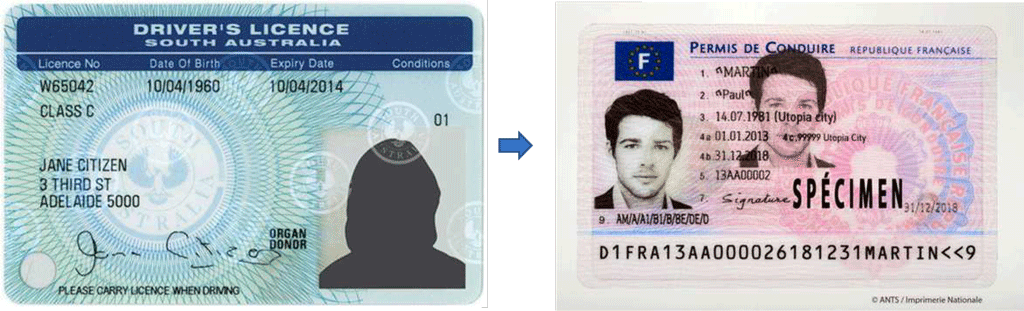
A driver’s licence issued by a country outside France is only recognised for one year once the person has acquired “normal residence” in France, normal residence being defined as the place in which you live for at least six months (185 days) a year due to professional or personal attachments.
If you are not an EU citizen you need to make your application less than one year after the date on which your resident permit was validated.
If you are a foreign student in France, however, you can drive with your non-European licence during your studies.
If you are a dual national, see below.
If, because of your nationality, you have no way of proving the start of your residency in France, please see below.
Can I use my Australian licence for a short stay?
Yes, if you stay for less than 6 months, provided that:
1/ your licence is valid throughout your stay
2/ you have an international licence or an official translation. If it is translated in France, a certified translator (traducteur assermenté) must be used. If it is translated in another country, it must have an apostille.
Cost of exchanging a licence
The exchange of a foreign driving licence for a French licence is free of charge.
For licences from countries other than Australia
Not all countries have a reciprocal agreement with France. In the case of the US, for example, only 18 states have an agreement. You can check on the following simulator (scroll down until you reach your country): https://www.service-public.gouv.fr/simulateur/calcul/PermisEtrangerPermisFrancais
Where to apply?
All applications are on-line at https://www.service-public.gouv.fr/particuliers/vosdroits/F1460
See instructions below
Who qualifies?
To qualify, your licence must be valid and issued by the country in which you had normal residence at the time.
You cannot apply to have your licence exchanged if it is currently suspended, withdrawn or cancelled in the country of issue or in France.
If you have an existing driver’s licence that is less than three years old, then your newly issued French licence will also be provisional until a three-year period has elapsed.
Anyone with a driving licence issued by a State outside the European Union and the European Economic Area, must apply to exchange their licence for a French licence within a period of one year following the acquisition of normal residency in France.
Dual nationals
For anyone with the nationality of a member country of the European Union or another country which belongs to the European Economic Area, Switzerland or Monaco, including those who also have the nationality of the State that issued the licence, the date of acquisition of normal residency is defined as being the 186th day following the date of their arrival in France.
This means that if you are European with a driver’s licence issued by a State outside the EU and EEA, you must apply to exchange your licence for a French licence between the end of the 6th month of your stay in France and before the end of the 18th month.
Australian licence issued to non-Australians
If you do not have the nationality of the country in which your licence was issued, you must also prove that you were a normal resident in that country at the time of issue. For example, you only have a Greek passport but you got your licence in Australia. You must prove that you were an Australian resident when the licence was issued. The easiest proof is the declaration of arrival and departure at the consulate, but a tax declaration, pay slip, work certificate, rental agreement, high school diploma or other document proving residence can be used too.
Anyone who has both French and Australian nationality should apply to exchange their licence as soon as possible after their arrival as the process is considered to be complex.
What about a motorcycle licence?
It is not possible to obtain an open motorbike licence (permis moto A) through an exchange. A restricted motorbike licence (permis moto A2) only will be issued (a power output of less than 35 kW). To have it upgraded to an open licence, you are required to have 2 years of practice and about 7 hours of additional training with a driving school.
Unfortunately, there is no way of getting around this as it applies to all French motorbike licences.
When to apply?
The deadlines are as follows:
1st carte de séjour : Less than one year after your card was issued.
Visa de long séjour valant titre de séjour: Less than one year after the date of validation by OFII.
No residency visa required (EU national, for example) : between the end of the 6th month of your stay in France and before the end of the 18th month.
It’s best to start the process a couple of months ahead of time as some documents may require a little time to acquire.
What do I need?
- An Australian driver’s licence
- An Australian driving record or traffic history
1) An Australian driver’s licence and
2) a driving record or traffic history (droits à conduire)
In addition to your national driver’s licence (an international licence is not sufficient) you will need an Australian driving record or traffic history (licence details) less than 6 months old, which is normally only available to the driver themselves. It can be ordered on-line but in some States, it must be sent to an Australian address, usually the last one on record. If you haven’t already done so, you’ll need to officially change your address to an address in Australia where the record can be sent. The system is different for each state. If you have a choice between an on-line version and a printed version, you can choose the on-line version. All the relevant links are given at the end of this post. The traffic history (licence details) is called “Droits à conduire” in French and must prove that your licence is currently valid. It must also give the date on which your licence was first issued. A record of traffic infringements is not enough. If you have held more than one Australian licence, it’s the last one that is needed unless the current record does not indicate the date of first issue. Then you will need a record from the corresponding State.
3) A passport photo (see below)
4) Proof of address (see below)
5) Proof of residency (see below)
Translation into French
You will then need to have your national licence and driving record/history translated by a court-certified translator. The official list can be found on the Court de Cassation website https://www.courdecassation.fr/experts. Click on Télécharger la liste nationale des experts en pdf, then go to TRADUCTION.
This is the official list of certified translators in France. All other lists are usually agencies in disguise. Translation agencies cannot be certified themselves, only the individual translators who carry out the work which is usually outsourced.
You can have the translation carried out by a translator living anywhere in France. There are no fixed prices for certified translations in France so they can vary considerably. Depending on the translator, you will need to take your licence and history to the translator in person or send them a good quality scan by email or a colour photocopy by post. A good quality scan means that it must be done with a scanner/photocopier and not a phone unless you have a special app.
Translators usually ask to be paid in advance by bank transfer, PayPal, etc. The stamped translation is sent back by pdf. A hard copy is not required (information provided by the ANTS website hotline).
On-line application process
All applications are on-line at https://www.service-public.gouv.fr/particuliers/vosdroits/F1460
1/ Register on the website
2/ Follow the steps (you can use Google Translate to help you). Make sure that you are uploading your documents into the correct section.
3/ Photo:
You will need an approved passport photo with a digital code and signature so you do not have to send the actual photo. This can be obtained in most photo booths (see complete list on https://permisdeconduire.ants.gouv.fr/services/geolocaliser-les-photographes-habilites.) Look for a photobooth that says “Agrée ANTS SERVICES EN LIGNE”.
4/ Proof of address:
The most common documents are your phone bill and electricity bill. The EDF app (and website) provide a “justificatif de domicile” in pdf form.
You can also ask your landlord to write a letter saying that you are being hosted by them (lettre d’hébergement). Don’t forget to include the date you arrived. The person should say you have been continuously living with them since a specific date. You will need a copy of their ID as well.
5/ Proof of residency:
You can use your “titre de séjour“, stamps in your passport, a letter from your landlord, lease receipts, a letter from the town hall in small towns, or anything else that will prove you have been living in France for the specified amount of time, including declaration at the Australian Embassy on arrival.
If you have no way of proving the beginning of your residency in France (perhaps you were living elsewhere in Europe before coming the France and don’t need a “titre de séjour” because you have a second passport), then you should register your arrival at the local town hall or the Australian embassy or declare that your home is your main residence with the local tax office. Then wait six months to make your application to exchange your licence.
6/ Driver’s licence
Two separate files: front and back. I suggest you name them smith_joe_permis_recto [front] and smith_joe_permis_verso [back]
7/ Translation of driver’slicence
One file with the licence and translation both stamped. Just the translation is not sufficient.
I suggest you name the file smith_joe_permis_traduction_certifiee
8/ Droits à conduire (driving history/record, etc. depending on State)
This document must prove that your licence is currently valid and state the date of first issue. It varies from State to State. NSW: driving history (you can order the on-line version) QLD: traffic history, VIC: driver history, SA: driving history, WA: Driver’s Licence Details and Traffic Infringements (2 documents), ACT: driver licence information, NT: driver licence history
I suggest you name it smith_joe_droits_conduire
9/ Translation of droits à conduire
One file with history/record and translation, both stamped. Just the translation is not sufficient. It needs to show that your licence is currently valid, the date of first issue and date of expiry. The ANTS website only allows three pages to be uploaded. In the case of the 3-page Victorian documents which means a 6-page document including the translation, it will be cut off after the translation. You can upload the full 6 pages in the Other Document section.
I suggest you name the file smith_joe_droits_conduire_traduction_certifiee
10/ Special cases – contact ANTS by telephone
You can phone ANTS (in French) on 3400 (not taxed) from within France or 09 70 83 07 07 from outside France from 7.45 am to 7 pm on weekdays and from 8 am to 5 pm on Saturdays.
What happens next?
If any documents are missing, it will be indicated on the ANTS website and you will be requested to upload additional ones. Check the website regularly. VERY IMPORTANT: if you receive a request for additional documents, you must upload a document to ALL the areas with a question mark, especially “Autres types de documents”. It’s a defect in the system. Just upload again (in both modules) one of the documents you have already uploaded. Otherwise, you will not be able to go to the next page.
You will be contacted by the authority concerned and issued a certificate of secure deposit (ADS) for your Australian driver licence, valid for 4 months.
You can use the ADS to drive while waiting for your French licence to issued, within the limit of the date of expiration of your Australian licence. If your licence is about to expire, apply for a new one first!
Once your application has been processed, you will be systematically asked to send in your original licence by registered mail together with your ADS. Your French licence will then be sent to your home address.
How long will it take?
The processing time will vary according to the complexity of your application and mainly depends on how long it takes to check your right to drive (driving history).
How can you track your application?
You can track your application on the ANTS website.
If you are asked to submit further documents and you can’t move on from “Enregistrer” after uploading your document, then upload a document into each section that has a question mark. It doesn’t matter what the document is – just upload documents you have already submitted. This is a technical hitch on the website.
If you move during the process
When requested to send in your Australian licence by registered mail, you can indicate your new address with a new proof of domicile and the ADS (i.e. interim licence) or, if you haven’t received the ADS, your birth name, given names, date of birth and nationality of the licence.
The French licence is then posted to your home address.
What sort of licence will I get?
The licence is not probationary unless the original licence is less than 3 years old.
The issue date indicated on the licence is the issue date of the French licence. The licence is valid for 15 years from the issue date (except when a medical check-up is needed, for drivers of HGVs for example).
What happens if I am refused?
If you are refused, and you cannot understand why, you can appeal to have the decision reviewed. I have noted that many people do not upload their documents under the correct headings which can lead to refusal.
If there is nothing to be done and you wish to obtain a French licence, you can go to the Bureau des Etrangers at your Préfecture and ask for an Attestation dispensing you from the obligatory driving lessons i.e. you will need to sit for the Code (theoretical examination) and a driving test only.
It is possible to sit for the Code with the help of an interpreter who must be a sworn translator or interpretor. However, having provided this service, I strongly recommend that you sit for the test in French by practising until you know all the vocabulary. During the test, the interpretor must stand with their back to the screen. The proctor reads the question and the interpretor translates it. They are allowed to repeat once. Road rules vocabulary varies enormously among English speakers so if you do choose to have an interpretor, make sure you spend at least an hour with them before the test so you can make sure you know all the vocabulary.
Will I get my Australian licence back?
No, you won’t. The French authorities will keep your licence and only give it back in return for the French one. (Arrêté du 12 janvier 2012, Article 13 modifié par l’arrêté du 19 décembre 2017, Article 9). It would seem that the NSW authorities will issue a duplicate of your licence if you declare it lost but that information is not official and not substantiated. An exchange means you surrender the original licence.
Good luck!
All information taken from the official government site https://www.service-public.fr/particuliers/vosdroits/F1460, verified in October 2025.
LINKS TO OBTAIN AN AUSTRALIAN DRIVING HISTORY/TRAFFIC RECORD
NSW https://www.service.nsw.gov.au/transaction/request-driving-record
QLD https://www.service.transport.qld.gov.au/applyformytraffichistory/public/Welcome.xhtml?dswid=-9714
VIC https://billing.vicroads.vic.gov.au/driverhistory(there are three pages; theoretically, only the first is required – Driver licence details – but sometimes the Complete demerit point extract is requested.)
SA https://www.sa.gov.au/topics/driving-and-transport/licences/drivers-licence/check-your-driving-history
WA (two different documents required) https://online.transport.wa.gov.au/ (Driver’s Licence Details) contact.centre@transport.wa.gov.au or www.transport.wa.gov.au/licensing.
Phone +61 8 9320 4656 if you are outside Australia.
https://www.wa.gov.au/service/transport/road-transport/apply-traffic-infringement-notice-record(Traffic Infringements)
TAS
https://www.transport.tas.gov.au/licensing/requesting_information
ACT
https://www.accesscanberra.act.gov.au/driving-transport-and-parking/licences/licence-records