Tag Archives: Friday’s French

Friday’s French – Reflexive verbs

I don’t usually write about grammar. I learnt French at high school in Australia where we did a lot of grammar in both English and French and, believe it or not, it was something that appealed to me, a bit like maths somehow. However I have some friends who are having difficulty with the reflexive so I thought I might try to help.

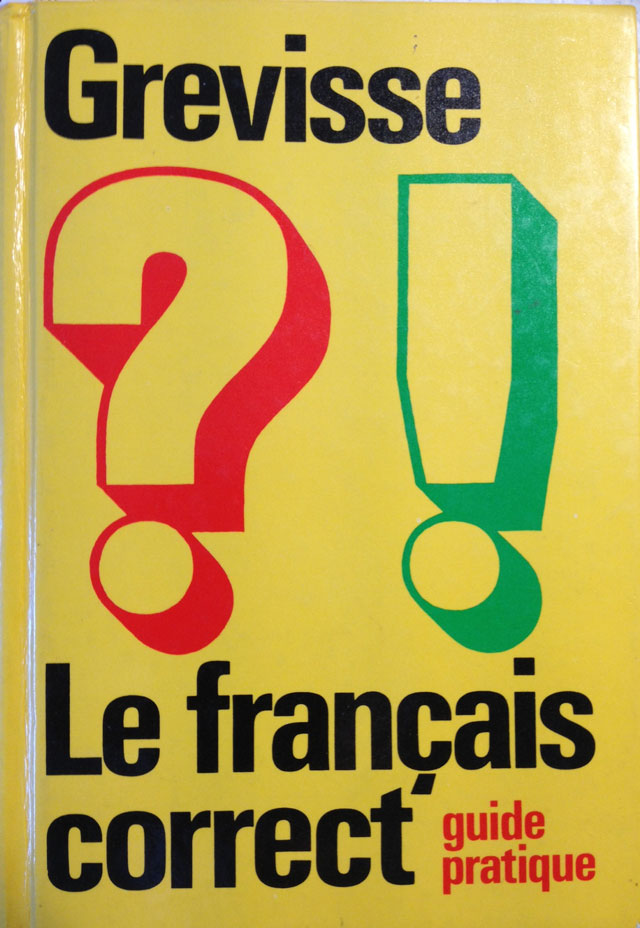
grevisse

We don’t have reflexive verbs in English, of course, which is probably why they pose problems to people learning French.

We wake up in the morning, get up, get dressed, comb or brush our hair and brush our teeth, without any help from anyone else and we wouldn’t dream of saying “I woke myself up, I got myself up, I got myself dressed, I combed my hair myself and I brushed my teeth myself”.

Yet that is what you have to say in French, je me suis réveillée, je me suis levée, je me suis habillée, je me suis peignée et je me suis brossé les dents.

I think most people get the concept, but have trouble organising where to put all those pronouns, especially when there is a second verb involved. I’ve been thinking about it and maybe the best rule of thumb is that the me, te or se and the nous, vous and se all have to be right next to the first person pronoun: je me, tu te, il/elle se, nous nous, vous vous, ils/elles se.

So if we go back to our verb from last week, s’embrouiller, we can’t say J’étais m’embrouillé because the me has to be next to the je. The sentence becomes Je m’étais embrouillé, although we’re much more likely to say Je me suis embrouillé (unless the second part of the sentence requires the imperfect, but that’s something else again).

Now, just to make things a bit more complicated, you need to make those past participles agree. Even the French often get this wrong, I’d like to point out. I always have my little Grevisse Le français correct so I can check if necessary.

So, the basic rule is that, with the auxiliary être, the past participle has to agree with the direct object if it’s before the verb. Well, this is the case here because me, te, se and so on are direct objects (or COD as the French say – complément d’objet direct). Je me suis coupée, ils se sont blessés, nous nous sommes habillées (if we’re all female) and nous nous sommes habillés (if there is at least one male).

On the other hand, in the case of je me suis brossé les dents, since it’s not me that I’m brushing, but my teeth, there is no agreement. . It’s because the direct object is after the verb. Other examples are elle s’est coupé le bras, nous nous sommes lavé les mains.

There are a few exceptions to this rule, but, frankly, unless you’re writing to be published, I wouldn’t worry too much : se nuire, se parler (parler à soi), se plaire (plaire à soi), se ressembler, se rire, se sourire, and a few more you’ve probably never heard of and will never need to use, i.e. ils se sont plu l’un à l’autre.

I hope you’re not too confused!

Friday’s French – s’embrouiller

Well, when I left some homework at the end of last week’s post about “confusing”, I didn’t realise it was so difficult. My apologies.

The last hollyhocks of the season
The last hollyhocks of the season which have nothing to do with s’embrouiller ou confusion!

Two brave souls did, however, take up the challenge. Both found a good solution for the third sentence i.e.

3) Imminent and eminent are easily confused words.

Il est très facile de confondre les mots imminent et éminent.

On confond facilement le mot imminent avec éminent.

But the other two sentences caused a lot of confusion to say the least.

1) Are you still confused about how to use confuse in French?

2) I was confused when nothing happened.

Now, I asked a couple of Frenchies for help and the best we seem to have come up with are the following:

1) Avez-vous toujours du mal à savoir utiliser le verbe “to confuse” en français?

2) J’étais étonné qu’il ne se soit rien passé.

If nothing, it proves that “confusing” can rarely be translated literally.

Both my contributors attempted to use the verb s’embrouiller and I realised that my explications musn’t have been very clear.

The past participle “embrouillé” cannot apply to a person. You can have “une histoire embrouillée”, “des idées embrouillées”, “les paroles embrouillées”, but neither you nor anyone else can be “embrouillé”.

If you want to say you got confused about something or muddled up, you have to use the reflexive verb: je me suis embrouillée en voulant suivre ses explications – I got confused trying to follow his explanations. Il s’est embrouillé dans ses réponses. He got his answers muddled up. It’s all confused in my mind.

François Hollande s’est embrouillé sur la baisse de la TVA pendant de son discours: François Hollande got confused about the drop in VAT/GST during his speech.

Another slightly different meaning can be seen in the following sentence: Autour de vous, tout s’embrouille, les images deviennent floues ou semblent irréelles. All around you, there is confusion, the images became fuzzy or seemed unreal. Tout s’embrouille dans ma mémoire. It’s all mixed up in my memory.

Sometimes people confuse s’embrouiller et se brouiller which can mean to have an argument: je me suis brouillé hier avec ma copine: my girlfriend and I had a fight yesterday.

It can, however, be used to mean “confuse”: tout se brouilla dans sa tête:  everything became confused or muddled in his mind. And guess how you say “scrambled eggs” in French? Oeufs brouillés!

All very confusing, isn’t it?