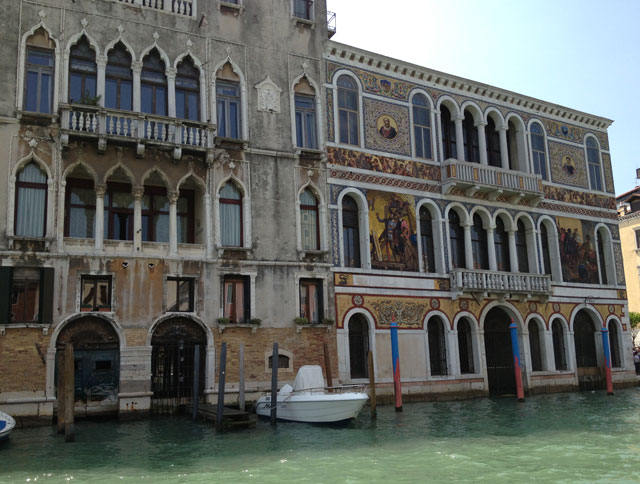
We did a lot of walking in Venice and saw a lot of doors with often intricate decorations. These are just a few!
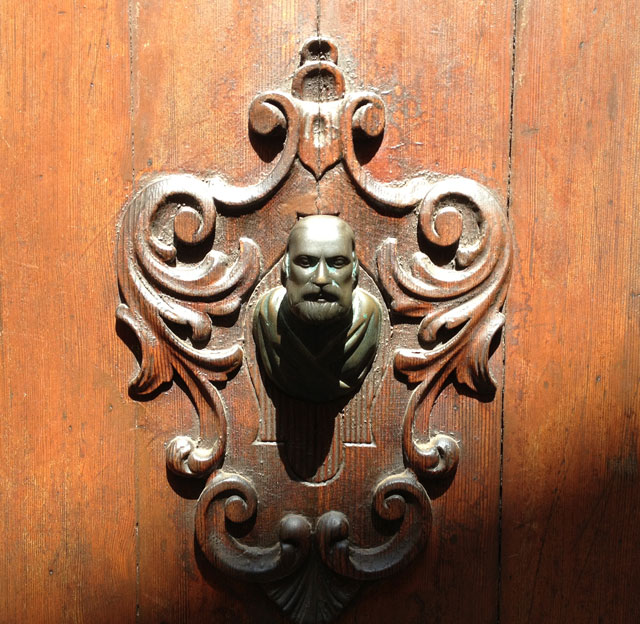
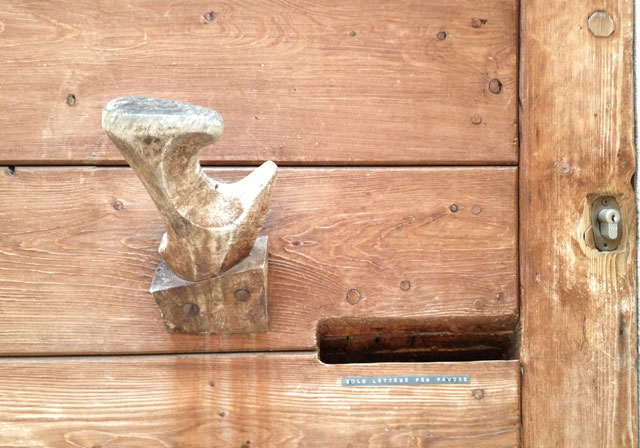
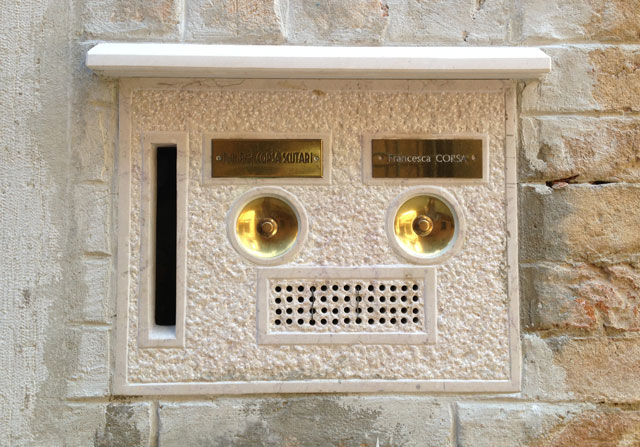
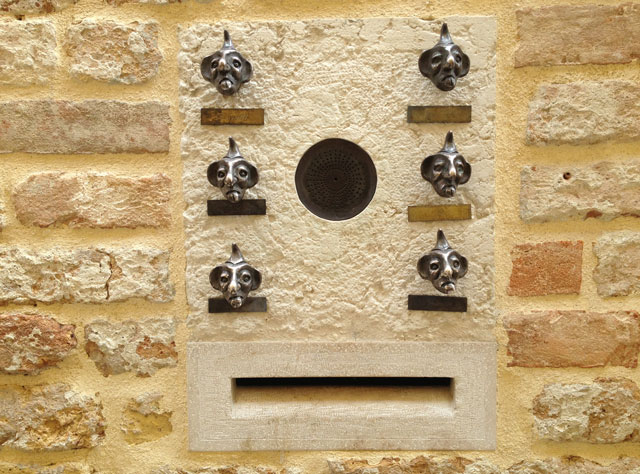
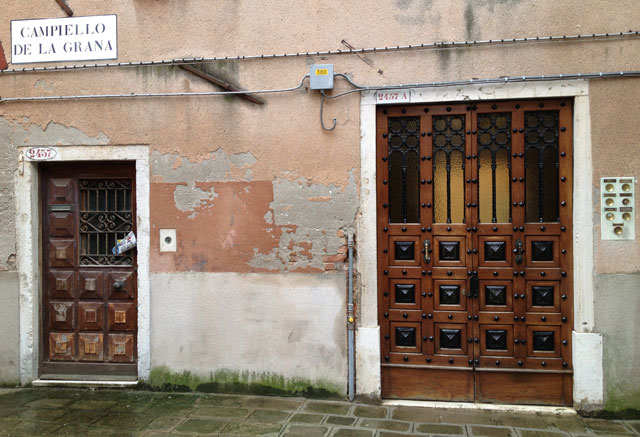
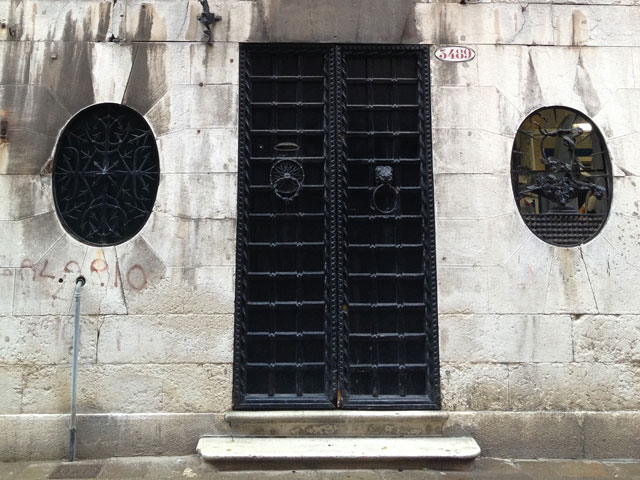
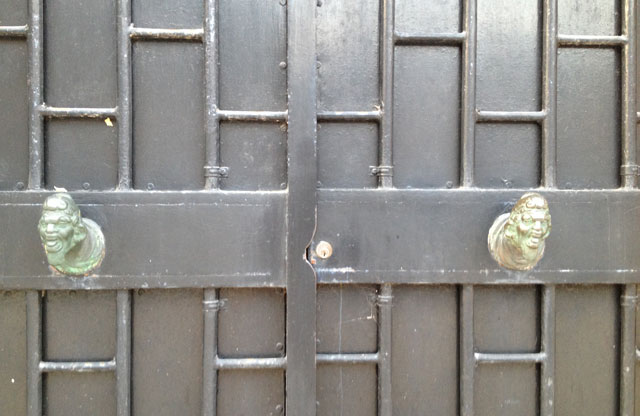
We did a lot of walking in Venice and saw a lot of doors with often intricate decorations. These are just a few!
When you grow up in Australia, you know all about Venetian blinds. They are not nearly as popular in France and most people don’t know how to use them. We had them at the French university where I taught and I began each year with a lesson on how to open and close them! However, I had never really thought about the name until we got to Venice where our home exchange/rental flat had two sets that didn’t close properly.
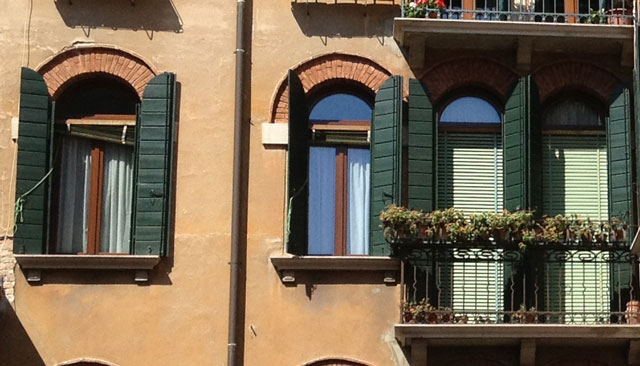
Our French guide book, Le Routard, mentioned them, giving persiennes as a translation which is rather strange because persiennes are something quite different. They are what I call louvres, which is a funny word when you come to think about it as it comes from the French word open.
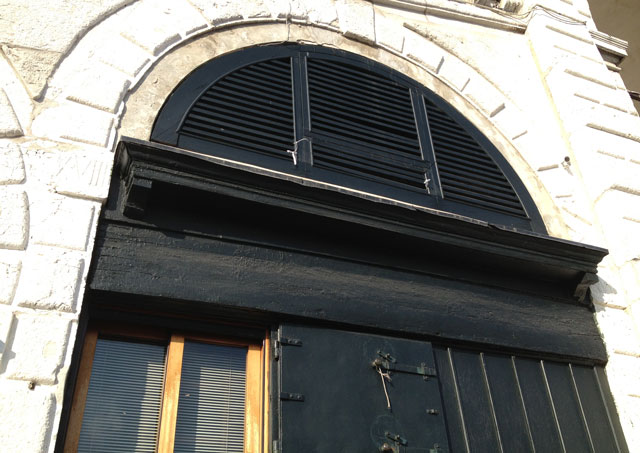
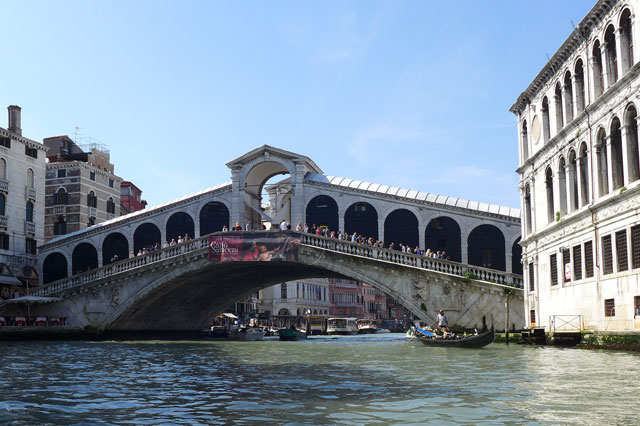
Obviously modern Venetian blinds are adaptations of the original ones. I checked out the windows in Venice but they mostly seemed to have wooden shutters or curtains with only a few Venetians on some older buildings. I found some slatted shutters or louvres on the Rialto bridge but they are hardly what I’d call a Venetian blind.
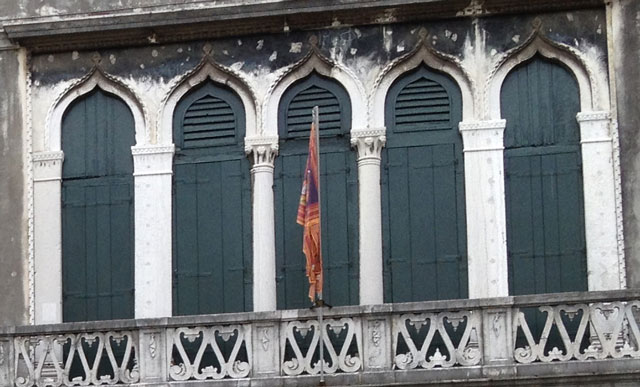
In fact, Venetian blind turns out to be very nebulous terminology and seems to cover various types of blinds, made of different materials (wood, metal, plastic) and consisting of horizontal overlapping slats held together with a cord so they can be rotated open or closed.
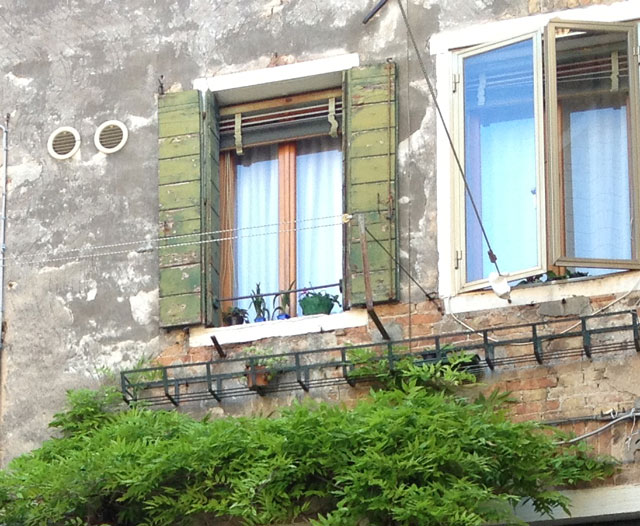
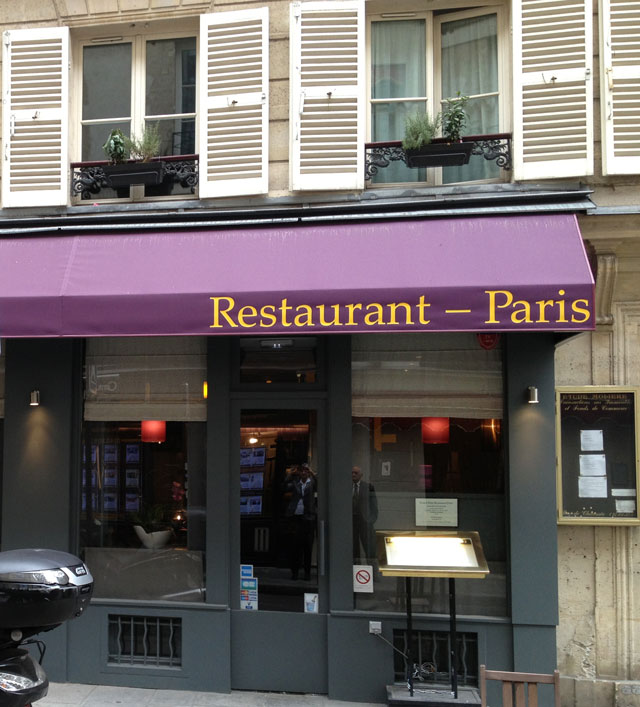
The generic term for blind in French is store which comes from the Italian stora, meaning mat. It also includes the sort of awnings you have in front of a shop or café in France. Like a blind, a store can be solid or have slats.
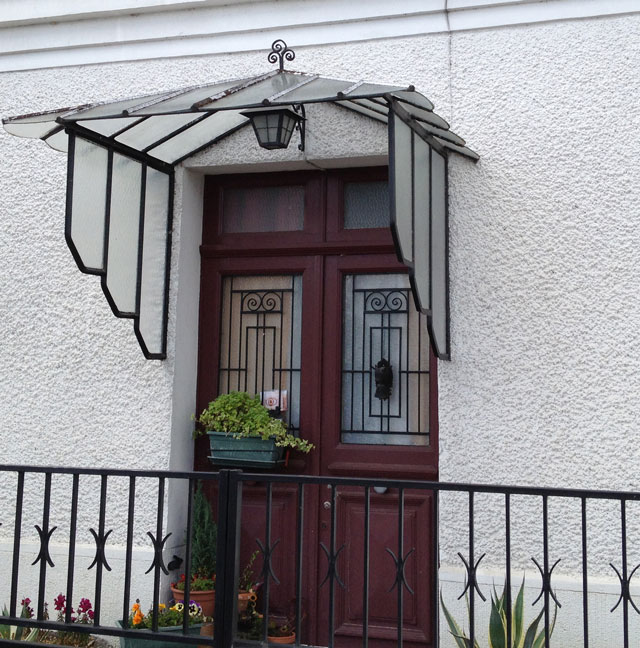
Those metal and glass awnings over front doors are called marquises by the way, which I think is a lovely term but I have no idea where it comes from.
Back to our blinds. Persiennes are mostly wooden but can also be metal with horiziontal and occasionally vertical overlapping slats that are fixed. They can be opened in several ways – outwards or upwards like a window, by sliding across, etc.
Some persiennes are a type of shutter or volet. A volet can also be solid and is defined as a covering over a window to block out the light from either the inside or outside. Most French houses have them and most French people prefer to sleep in almost total darkness.
This was very strange to me when I first moved to France as we only had Venetian blinds in our house and they weren’t necessarily closed. They certainly didn’t block out all the light. Once I got used to sleeping with shutters, I found it very difficult not to have them. Our flat in Paris only has roller blinds so I had curtains made with special light-blocking lining.
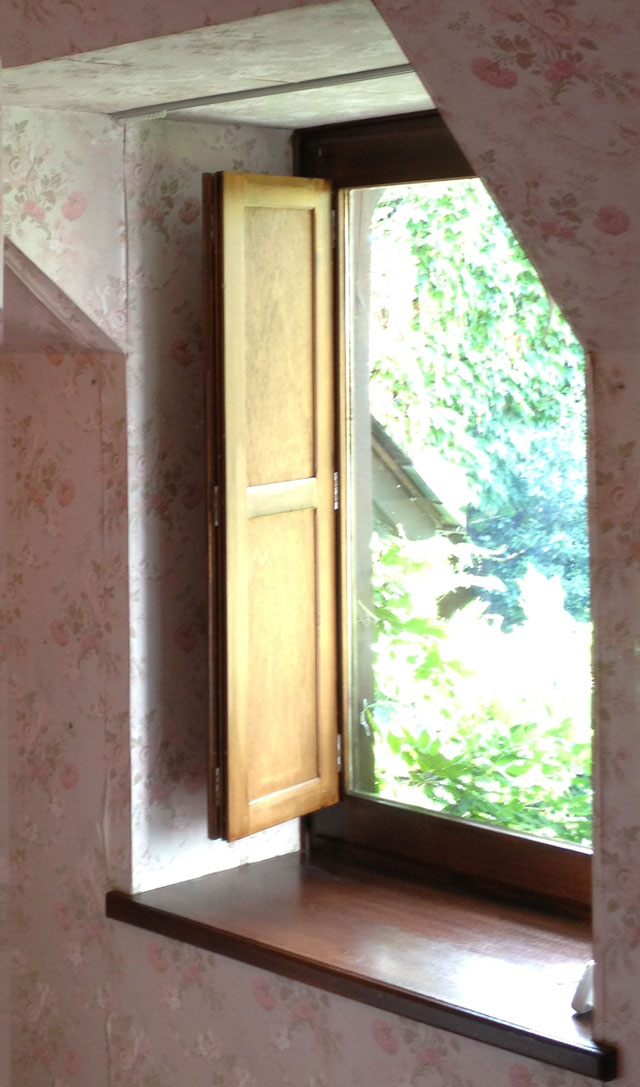
Our house in Blois has shutters that open and close inside and guarantee total darkness. A recent Australian visitor loved them – she said it was like sleeping in a cave!
A thought has just struck me – what is the Italian meaning of Venetian blinds is not our Venitian blinds at all, but the French persiennes? I hope someone will be able to answer me!
Paula McInerney from Contented Traveller, whom I’ve already featured in my weekly blogger round-up, is publishing a series of posts entitled “Outside my front door”. I was delighted when she asked me to contribute and I’ve been enjoying hearing from other bloggers as well.
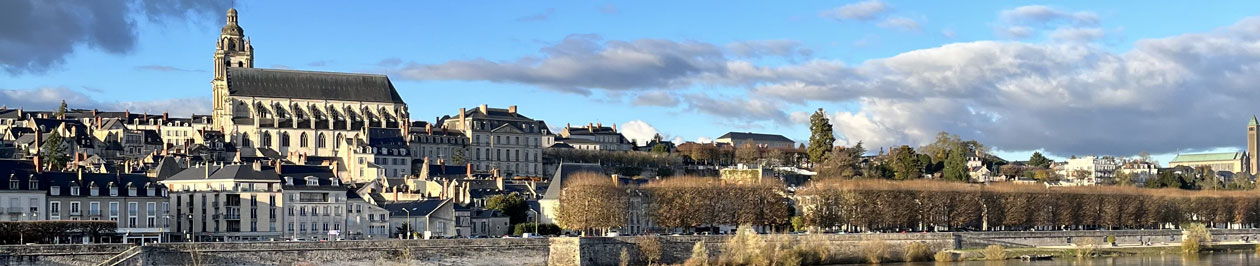
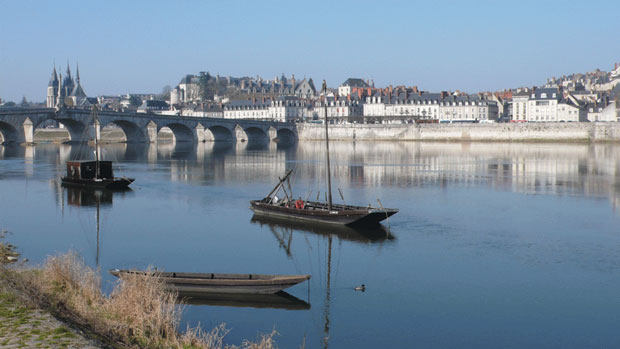 Outside my front door is a large expanse of trees and grass and on the other side is the Loire River, flanked by two levees, first mentioned in 1584, which is the exact same year in which my Renaissance house was built.
If I go left five kilometers along the river, I will come to the city of Blois, with its royal castle, built on a promontory overlooking the Loire, and former home of Louis XII, François I, the star of the French Renaissance, and his son Henri II. Read more
On our last trip to Venice seven years ago, we chose not to go on a gondola ride – it seemed too much of a cliché. Instead we took the little traghetto ferry across the Grand Canal.
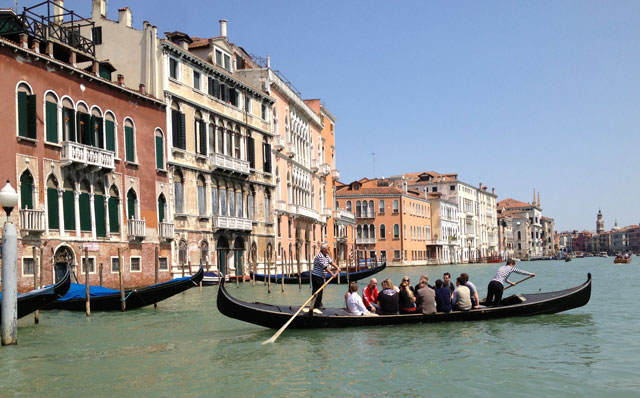
This time, however, I am fascinated with water traffic in general and our home exchange host tells us that the building we are staying in was once a workshop for making gondola oars and oarlocks (forcula) so I start taking a greater interest in Venice’s iconic boat.
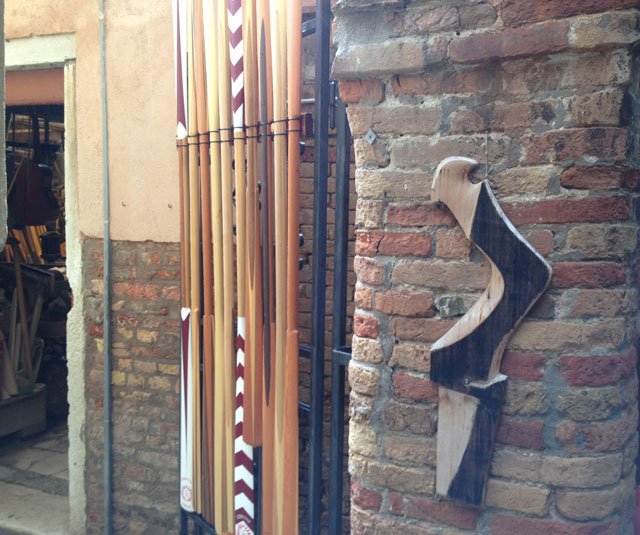
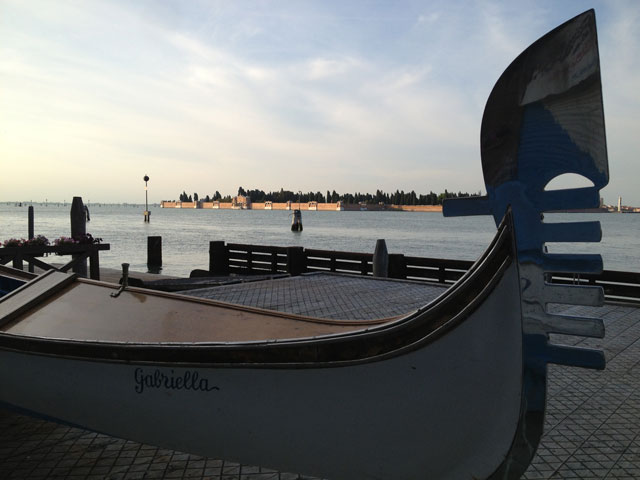
First, we learn there is a difference between the 11-metre long gondola with its typical figurehead and slightly asymetrical shape designed to row on one side only and turn in a very small space, and the sandolo, which is shorter, symmetrical and originally from Burano.
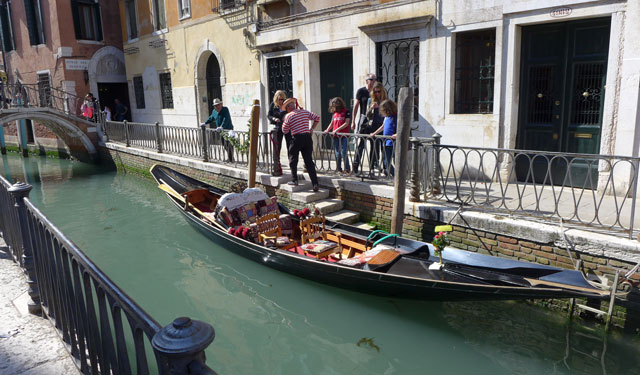
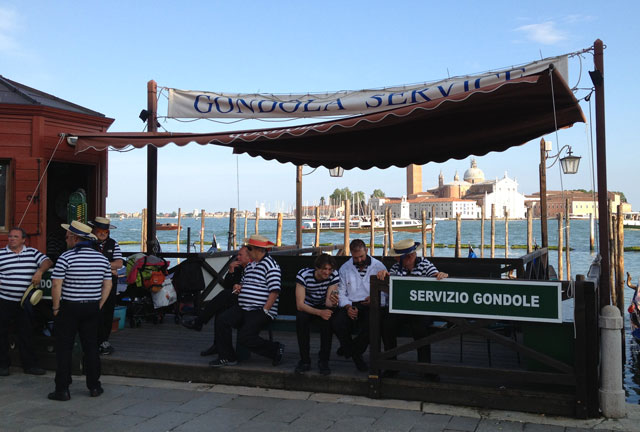
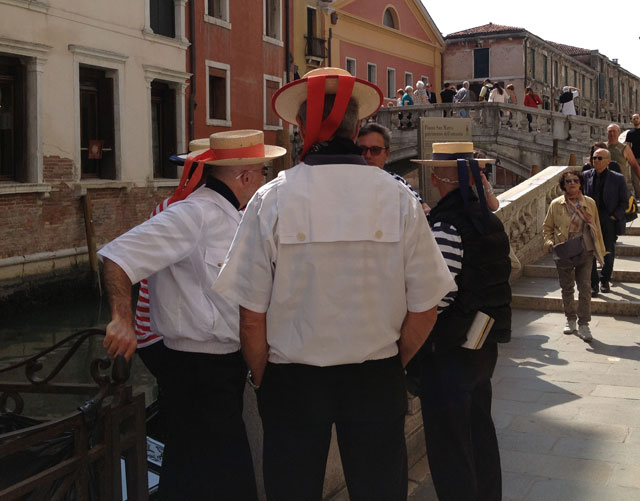
The gondoliers have to wear black trousers, black shoes and a striped top. They also have a straw hat but don’t have to wear it while rowing. Considering the height of some of the bridges, it’s not surprising though some manage. We observe various collars and tops but the older gondoliers wear a white pea jacket with a sailor collar and elasticised waist over their stripes.
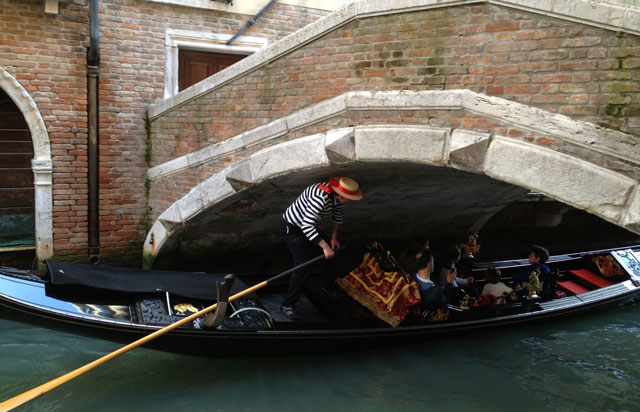
The basic price for a gondola ride is fixed by the gondoliers’ federation at 80 euro for 35 minutes. If you want to change the itinerary, extend the time or be serenaded, it’s more expensive. Our French guidebook, Le Routard, recommends a gondolier who speaks French and takes you through the back canals rather than the Grand Canal so we go looking for him, but to no avail.
I check out a few websites but the price instantly climbs to 100 euro or more for an on-line booking, and since you have to book ahead, you need to be sure of the weather. A gondola ride in the rain does not look much fun!
It’s a bright sunny morning so we decide to try one of the piazzas rather than the Grand Canal and head for Campo dei Santi Giovanni e Paolo where the Ospedale is.
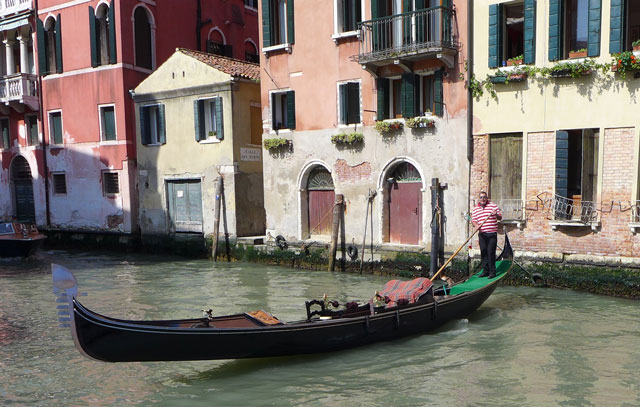
On the way, as we cross a bridge, I see an empty gondola with a whistling gondolier. We do not want a half-hearted young man talking on his cell phone all the time. “E libero?” I ask. “Si, yes, oui, English, Français?” “Français,” I reply, as Jean Michel would like to be able to communicate as well. “I’ll meet you at Santi Giovanni e Paolo,” he says.
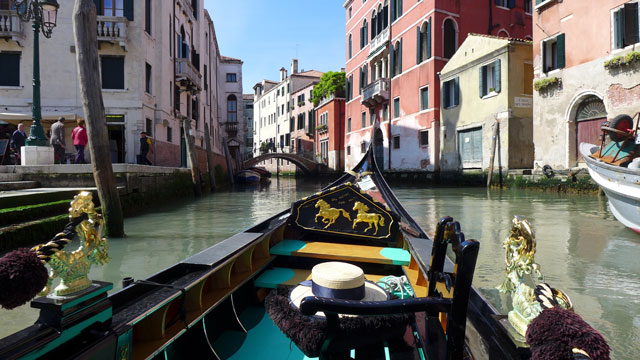
He pulls up and before we get in, he takes the protection off the seat, makes sure everything is spick and span and asks if we know the price: 80 euro for 35 minutes with part of the ride through the smaller canals and the other part on the Grand Canal. Otherwise, we can have a longer ride with trimmings for 120 euro an hour. We settle for the regular 35 minutes.
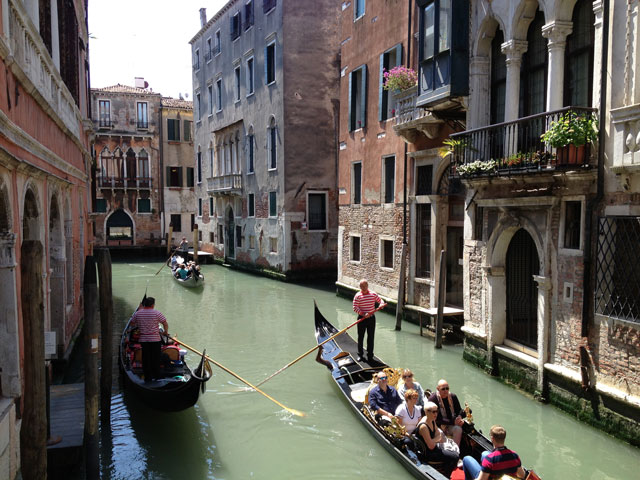
“Je m’appelle Alessio“, he says, and hands me down. Jean Michel follows. Ensconced in our seats and very pleased with ourselves at having found a genial French-speaking gondolier, we set off. “Walking around Venice is wonderful,” says Alessio, “but seeing it in a gondola is magnificent.” We have to agree.
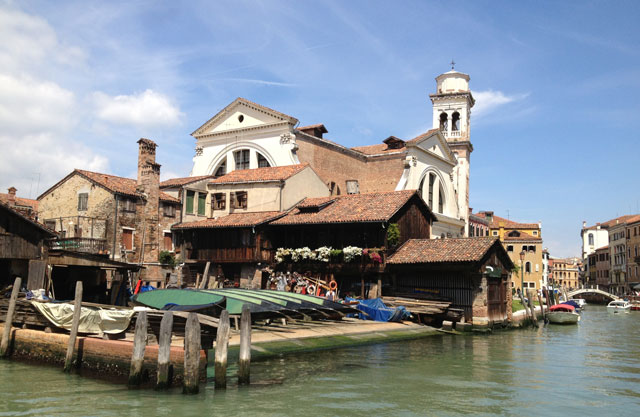
He fills us in on life as a gondolier. Both his father and grandfather were gondoliers (we know that our home exchange host’s son unsuccessfully tried to break into the profession). A gondola costs 30 000 euro and lasts about 20 years, after which time it starts to lose its curve. We’ve already been to the gondola repair yard in Dorsoduro.
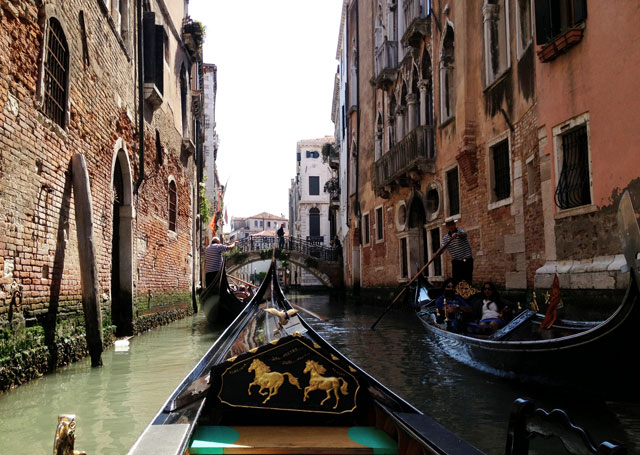
He comments on life in Venice and the various buildings we pass. Then, to our delight, he starts singing. Whenever we pass another gondola, he launches into a conversation in Venetian. He’s obviously well known and a lot of bantering seems to be going on.
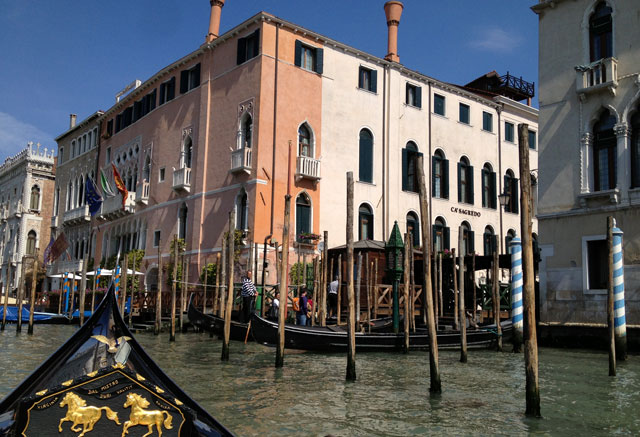
We turn into the Grand Canal and after a fairly short time, we pull over next to the traghetto stop near the fish market. Jean Michel and I look at each other – time’s up already? But Alessio alights and greets a young man who places a punnet of strawberries in his hand. He offers us some. I apologise as I don’t eat strawberries but Jean Michel takes one and says they’re delicious.
At one stage, we point to the sandolo and ask if it’s a real gondola. Alessio laughs and says that most tourists don’t know the difference but it’s like comparing a Fiat 500 and a saloon car.
We continue on our way, down towards the Rialto Bridge, then back into the smaller canals, with Alessio cheerfully alternating comments, singing and whistling. When we arrive back at Ospedale, he takes our photo, telling us to say spaghetti, which is very successful with Jean Michel, who’s not usually very photogenic.
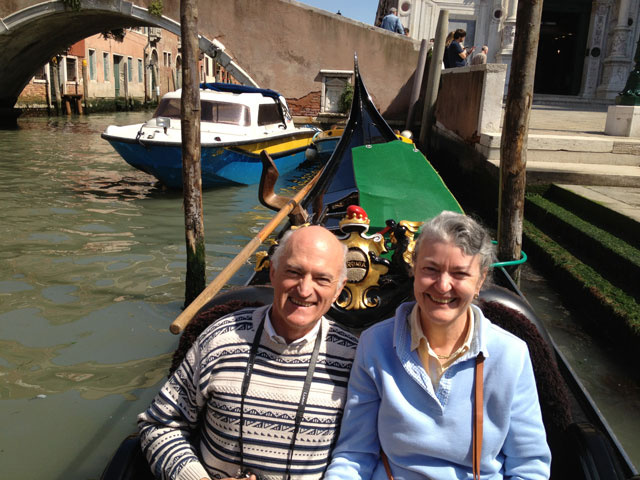
We give a tip and he is very surprised – Jean Michel gets the rest of the strawberries! Definitely worth the cliché … And a little piece of advice – forget about taking photos or videos while you’re in the gondola. You can get exactly the same ones on the vaporetto or walking along the canals. Just sit back and enjoy a one-off experience.
We have already visited Burano, Murano and Tortello, the best known islands in the Venetian lagoon. We want to return to Burano and Murano but also go to Erasmo via the Lido and Treporti. The sun is shining when we depart from Fondamenta Nuove at 11.15 on line 14 and after an enjoyable one-hour ride seated at the back of the vaporetto, we arrive at Treporti.
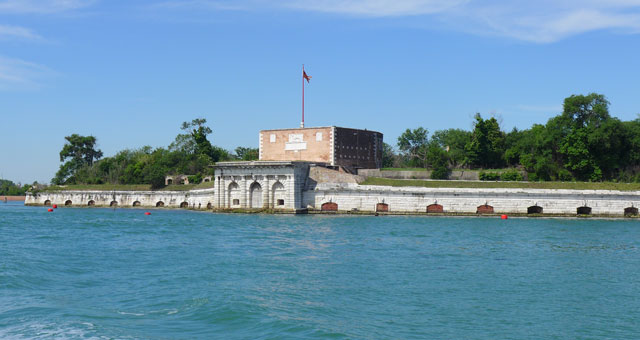
During the fifteen minutes we’re there, we admire the terrace of the only restaurant in sight and hope we’ll find something similar in Erasmo, which is Venice’s orchard and vegetable garden, according to Le Routard. As we haven’t been getting many vegetables apart from our 5:2 fast days, we’re hoping to make up for it.
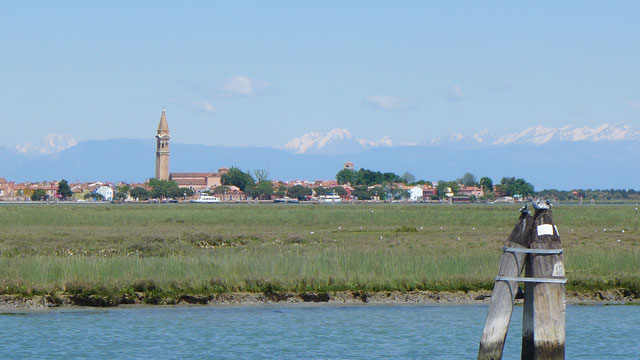
Our little vaporetto takes us past marshy land with decoy ducks on the posts instead of the usual seagulls, and Burano and the snow-capped peaks of the Dolomites in the distance.
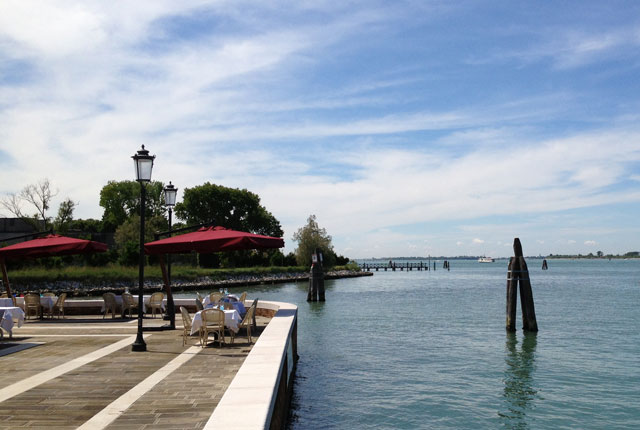
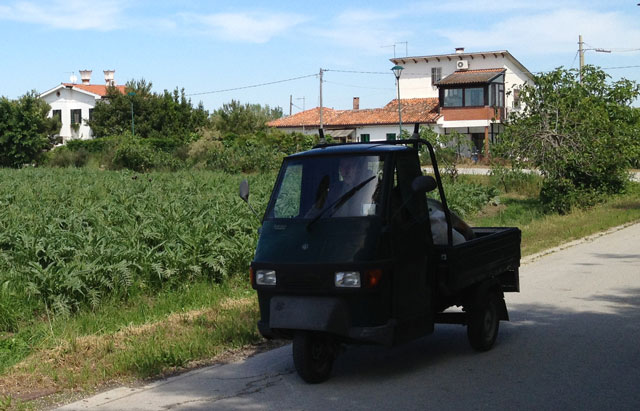
It takes us twenty minutes to get to Erasmo Chiesa and we are almost the only ones to alight. Apart from a couple of those little three-wheeled pick-ups they have in Italy and a few bikes, there’s no one in sight. We walk about 5 minutes along the water to the right and decide it doesn’t look like restaurant material so we start walking in the other direction.
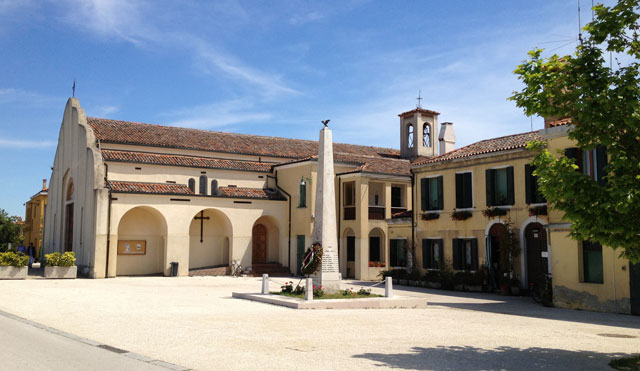
After the constant throng in Venice, we’re amazed at the tranquillity. We pass fields of artichokes, zucchini and rosemary and can smell a barbecue somewhere but no sign of a ristorante or a trattoria or even a bar. After a half an hour we reach the Punta Vela vaporetto stop just as the boat arrives and waive to the driver so he’ll wait for us.
By now it’s 1.15 and we’re wondering how long the Antica Dogana in Treporti will keep serving. A few sunny tables are occupied on the terrace but it’s windy and a little chilly. We find a spot at a small round bare table close to the wall and ask if we can eat there. The waiter looks askance and goes off to find his boss. Other people arrive at the same time and suddenly the two waiters are moving laid tables in every direction. Our round one is whisked away and replaced with a square one.
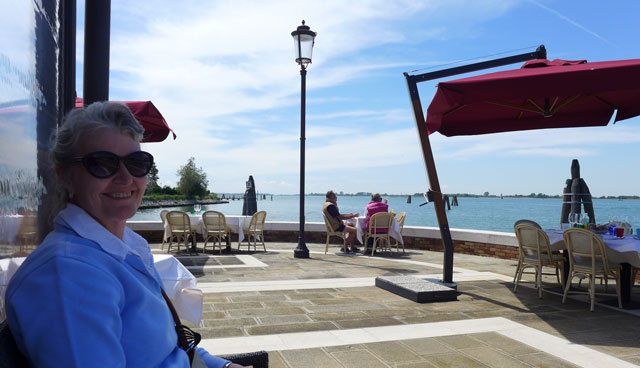
After a short time, the first waiter arrives with a cold bottle of water, one menu (they’re short today because there are a lot of people inside) and a basket of grissini (bread sticks) and bread. Fortunately, we have a great view with a lot of boating activity because we don’t get to order for another 30 minutes!
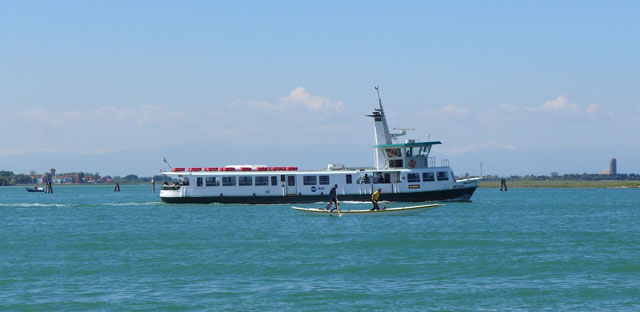
We choose an excellent soave wine and a house welcome turns up consisting of fried baby prawns and polenta.
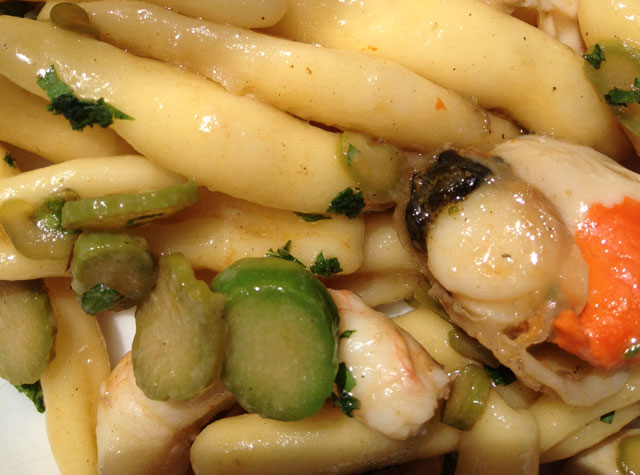
We then share strozzapreti with Dublin Bay prawns, queen scallops and asparagus and fresh egg pasta with cuttlefish. I check my iPhone app to see what strozzapreti means and think I must have misunderstood but at home I learn that it does indeed mean priest stranglers, one explanation being that that gluttonous priests found the hand-rolled pasta so delicious that they ate too quickly and choked themselves, sometimes to death.
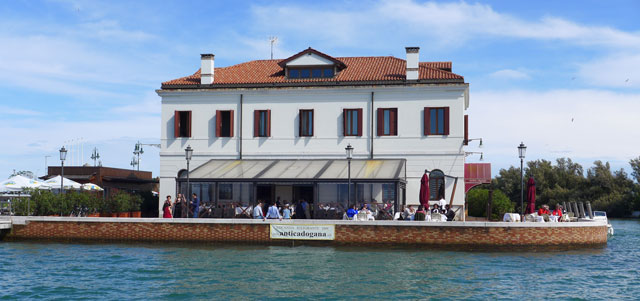
By the time we are served it’s nearly 3 pm so we finally take the 3.44 boat to Burano after an excellent meal and very friendly (if not speedy) service – and no choking – promising ourselves desert in the form of a gelato on Burano, which turns out to be another interesting story!
We didn’t go to the Accademia in Venice last time and I’m not really sure what is awaiting us but the weather isn’t brilliant so a gallery seems like a good idea. Housed in the former Scuola della Carità, the Convento dei Canonici Lateranensi and the church of Santa Maria della Carita, all disbanded by Napoleon, the Accademia exhibits pre-19th century paintings. Surprisingly, there is no queue.
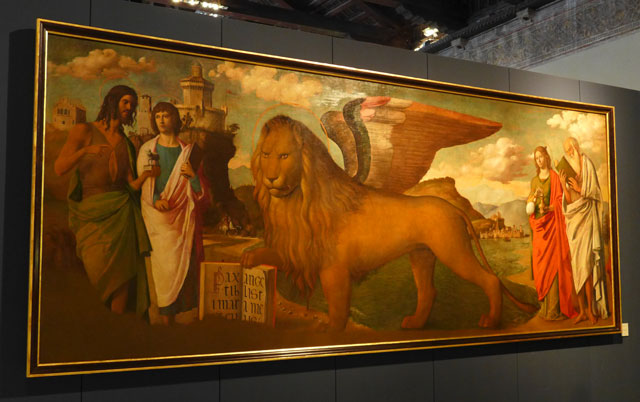
One of the first paintings that strikes me is a winged lion by Cima da Conegliano. We’ve been seeing these all over the city of Venice. The original is bronze sculpture which arrived in the Piazza di San Marco in the 12th century and came to symbolise Venice, as well as of its patron saints, St Mark. Whenever the Venetians conquered another city, they left a winged lion behind.
Opposite is a painting by Paris Bordone in 1534, showing the legend behind the tempest that struck Venice on 15th February 1340, in which a gondolier returns Saint Mark’s ring to the Doge, Bartolomeo Gradenigo.
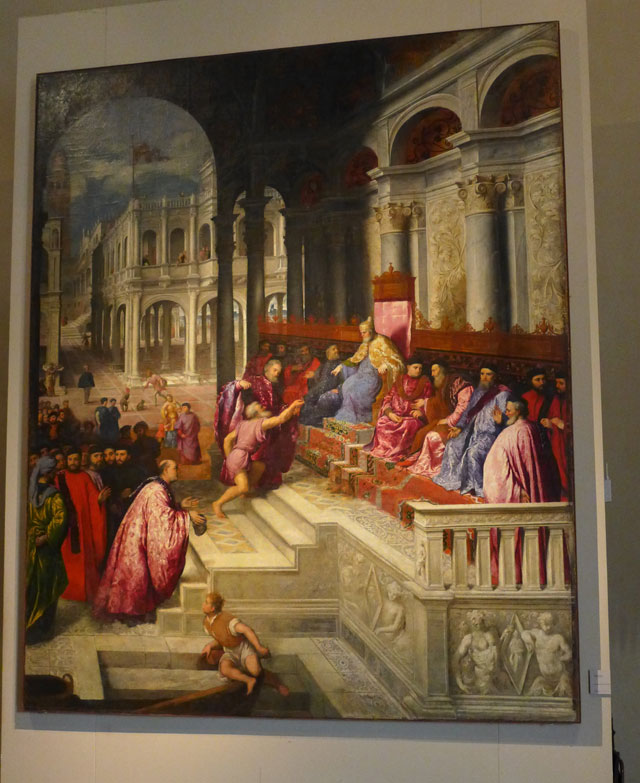
The Doge, who ruled the city, was partly chosen by lot and partly elected in several rounds or ballots (from the Italian pallote = small balls used as counters in secret voting) according to a complex elective machinery to minimize the influence of individual families that operated from 1268 until 1797.
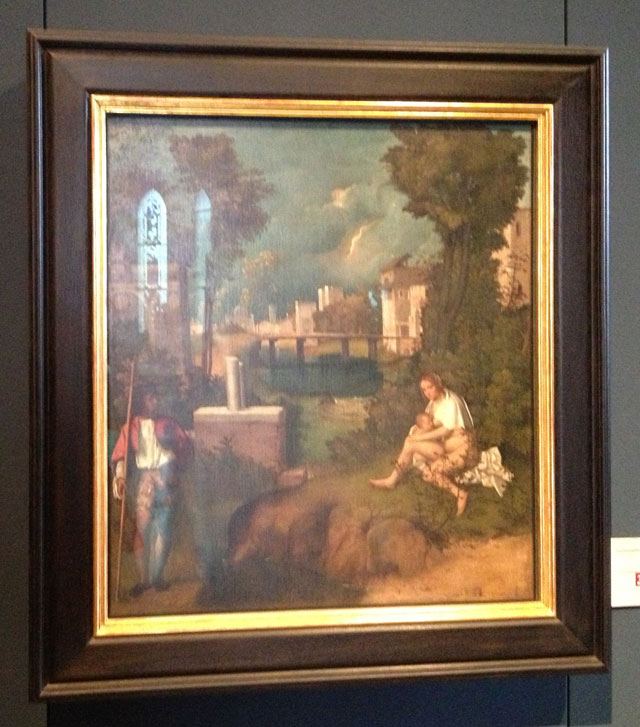
A much smaller painting called The Tempest, depicting a woman suckling a baby and exposing her pubic area, and a man, possibly a soldier, was painted in about 1506 by Giorgione, who died of the plague at the age of 32. The historians are not really sure what it’s about, but it is one of the first paintings in which the landscape is not merely a backdrop, but a feature.
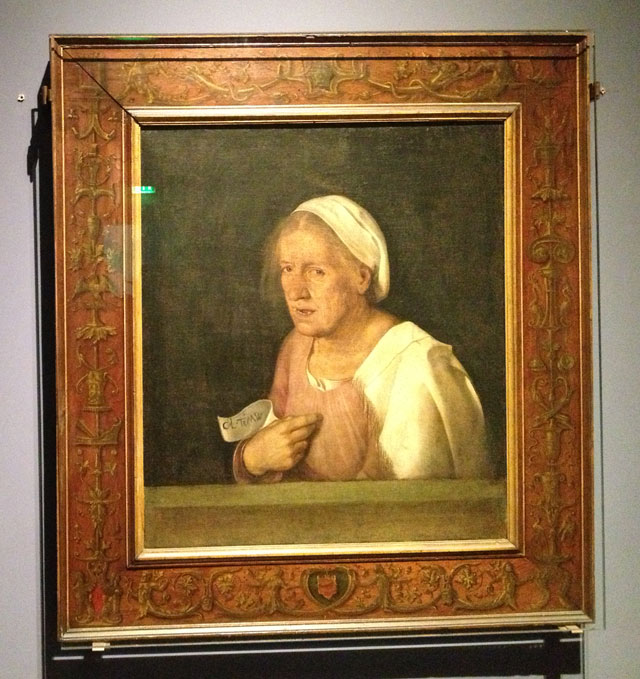
According to Philippe Solers in his Dictionnaire amoureux de Venise, a second painting, which we eventually track down in another room, called La Vecchia (the Old Woman) shows the same woman, fifty or sixty years later. Instead of a baby, she’s holding a paper that says COL TEMPO – with time. An allegory of Venice?
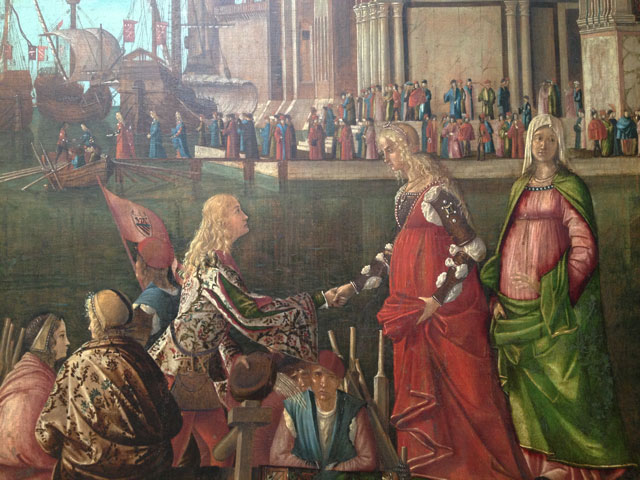
But the paintings that really fascinate me are by Carpaccio, who had disappointed me at the Louis Vitton store earlier in the week. Venice is brought to life in incredible detail in his cycle of nine paintings entitled The Legend of Saint Ursula. There are the Venitian blonds, who used to bleach their hair on the top of the palazzi, on wooden terraces called altane, one of which you can see in The Tempest above, on the left of the tree.
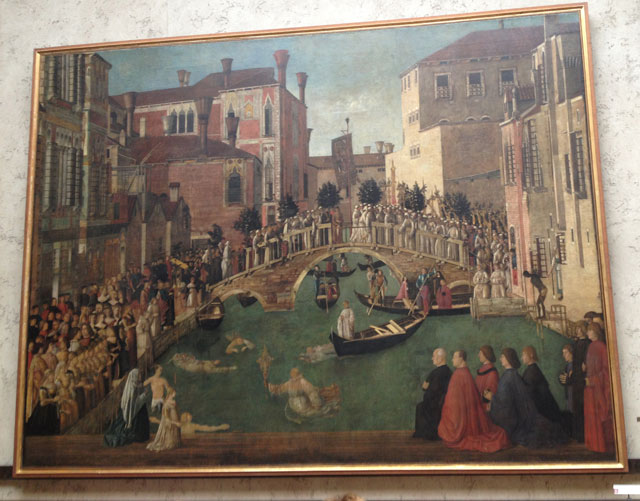
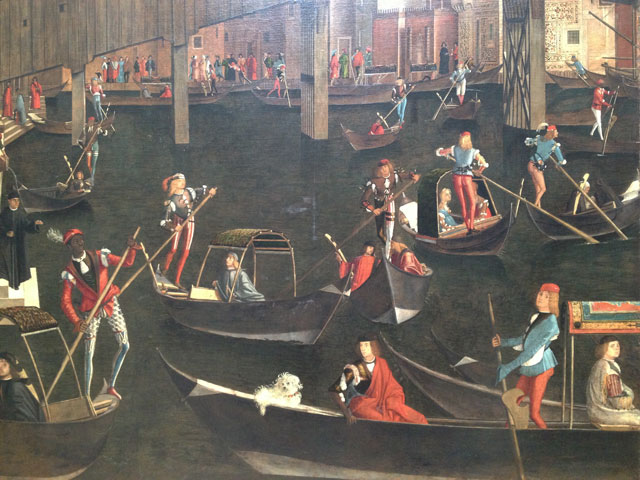
There is the old wooden Rialto bridge in The Miracle of the Relic of the True Cross with the gondoliers in much the same attitude as today except that they are wearing jerkins and hose and the tourists look a lot more elegant.
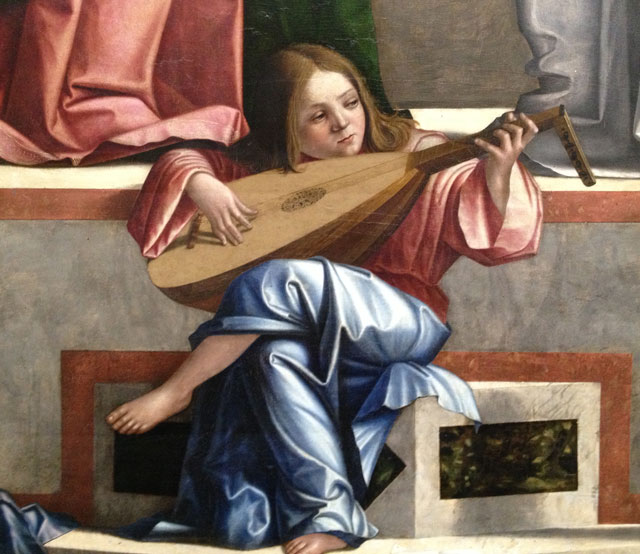
At the bottom of the Presentation of Jesus at the Temple, there is a little mandoline player who so reminds me of a childhood friend that I stop in my tracks. What concentration and independance!
But the most impressive painting of all and one of the largest canvasses of the 16th century, is by Veronese. It is ostensibly a last supper but created such scandal that its name was changed to The Feast in the House of Levi.
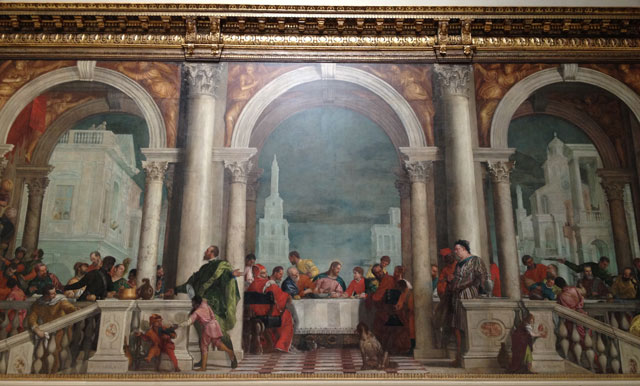
Painted to hang in the refectory of the Basilica di Santi Giovanni e Paolo, a Dominican friary, it was taxed with irreverence and indecorum by the church. Veronese was asked to explain why it contained “buffoons, drunken Germans, drawfs and other such scurrilities”, as well as extravagant costumes and settings, depicting a Venetian patrician feast.
Rather than change the painting as ordered, he changed the title and that was the end of the story! I haven’t enjoyed an art gallery this much in a long time!
It’s the first of May, Labour Day, and the sun is shining brightly unlike the day we arrived. There’s a gondola race in Venice but it’s not in the centre and we’re afraid of the crowds. Instead, we head for the island of San Georgio to visit the church there. We push our way through the crowds near Piazza San Marco to San Zaccharia to take the vaporetto across the lagoon and I’m glad we decided against the gondola race!
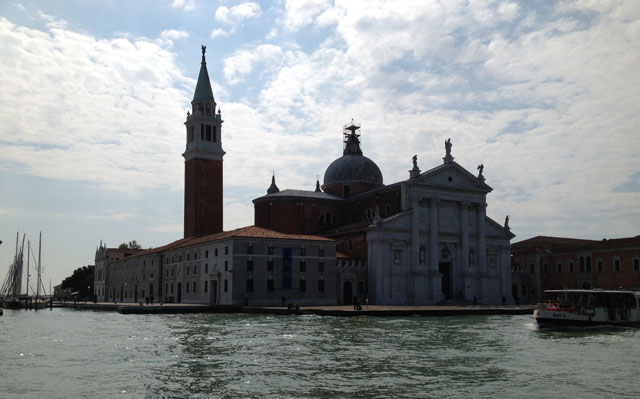
We take photos of the opposite shore, with the Doge’s Palace and the famous column in the middle of the Piazza, then enter the church. Strange. It’s free. I see a sign “Lift to the top of the belfry” and suggest we take it. We pay our six euro each (that’s why the church is free!) and stand in line for the 6-person lift.
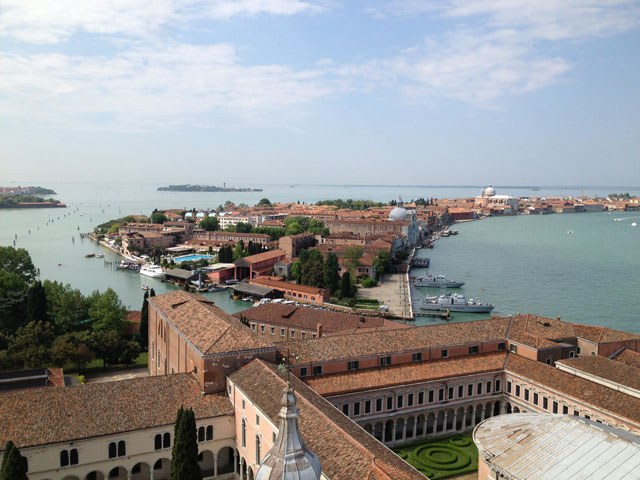
At the top, there is a spectacular 360° view but only a very small space so we take turns to get a bird’s eye view of Venice through our cameras and binoculars. We can see right across the island of Venice to the other side. Nothing could beat this view.
We have to forego a visit to the Renaissance cloisters because they are closed. The vaporetto arrives and we manage to get two seats outside at the back so we stay there for the next hour, going halfway around the island and up through the Grand Canal discovering new palazzi until we arrive back at San Marco by which time the crowds have doubled, if that’s possible.
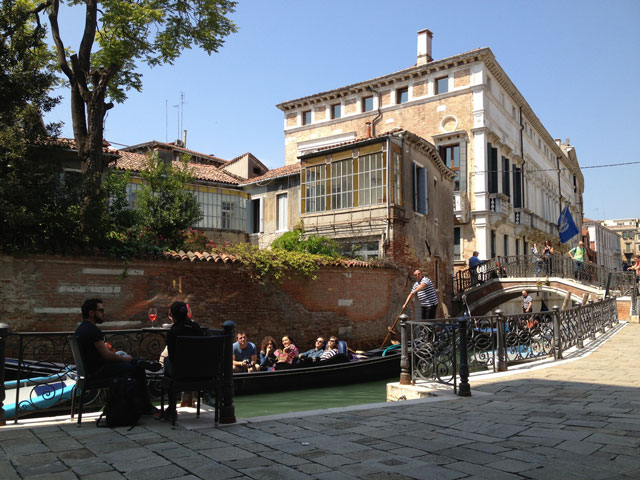
As soon as we can, we leave the main area and head homewards. On the way, we find a little restaurant called Luna Santada on Rio di San Severo canal which we’ve already noticed. A table awaits us and we have another perfect view – it’s obviously on the gondola route!
After a poetic evocation of Marco Polo’s return to Venice after his voyage across the globe, the placemat tells us that Luna Santada is a culinary voyage that takes you from Venezia to many different gastronomic worlds, on his trip, on my trip, be my guest and travel with me. Could we have chosen better?
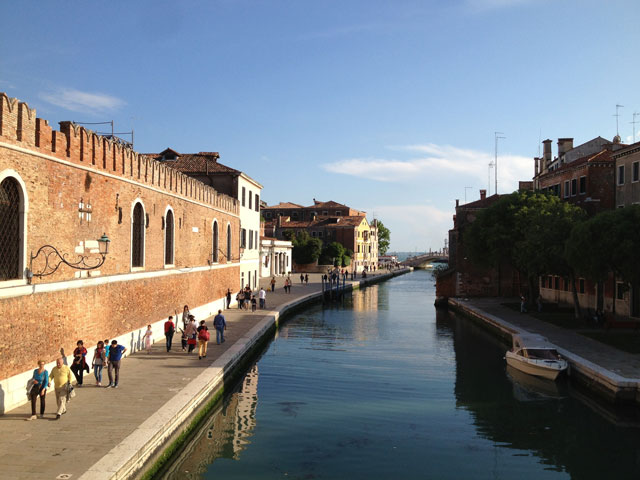
The obligatory siesta and we’re off again, past the Maritime Museum, along the lagoon and over the bridge to Santa Elena island to see the sunset. There are no bars along the way and sundown is still a couple of hours away so we decide to take the vaporetto to the Lido, Venice’s iconic island that I have been reading about in novels ever since I can remember. For some reason, we didn’t go there on our last trip.
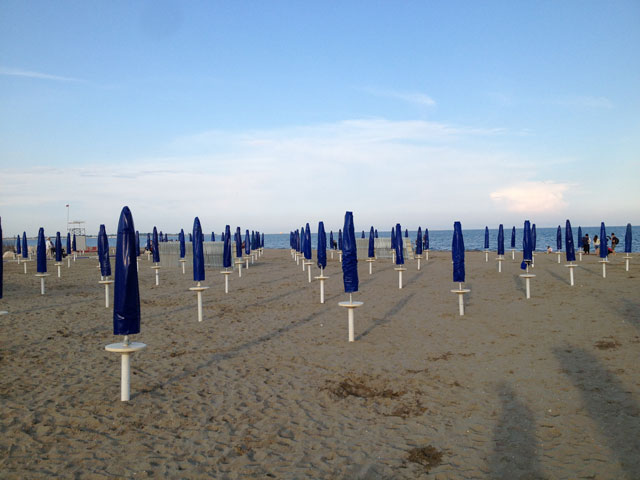
The first thing that strikes us is the presence of cars and buses. The Adriatic and the famous Lido beaches are on the other side of the island which is 500 metres wide and 12 kilometers long. If you’ve never seen an Italian beach, it’s difficult to imagine. They are lined with paraols and deck chairs in neat rows and the sand is usually grey.
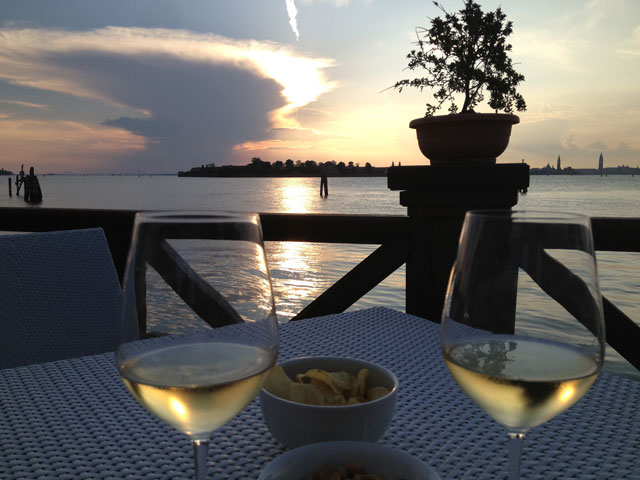
The Lido is no exception. We can’t see anything to redeem it and even the Grand Hôtel des Bains, where Death in Venice was shot, is closed. So much for our aperitivo. All is not lost, though, because we end up at a table on the lagoon at Villa Laguna, sipping pinot grigio and admiring the view for a surprising 5 euro each. This is the life.
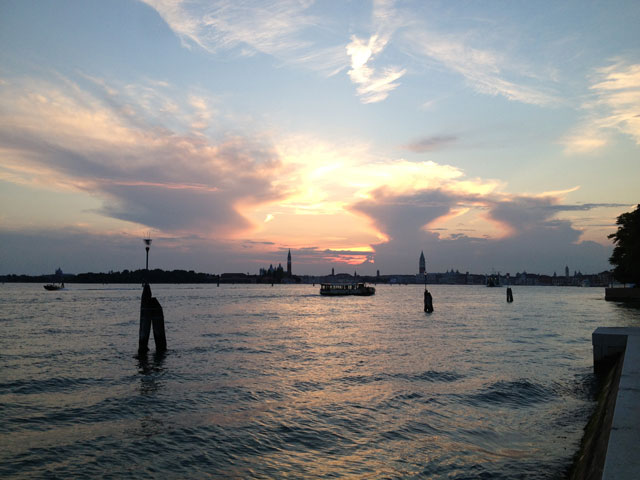
We head back to Santa Elena in time to watch the sun set over Venice from a convenient bench. Unfortunately, the restaurant we found on the island seven years ago (Osteria Santa Elena da Pampo) is closed so a helpful local tells us to eat at Mario’s which I won’t recommend. The food is average and the service abysmal. But we are sitting outside and the weather is still balmy.
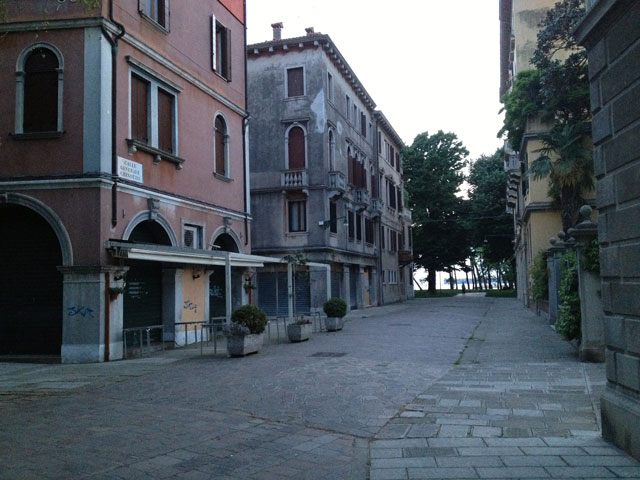
The end of another wonderful day in Venice.
Seven years ago, we had an aperitivo on the terrace of the mythical Caffè Florian on Piazza San Marco, Venice’s oldest café, which dates back to 1720. This time, we’re having a late breakfast, but inside, surrounded by romantic art deco work. Yesterday’s beautiful sunshine has been replaced by thunder and rain.
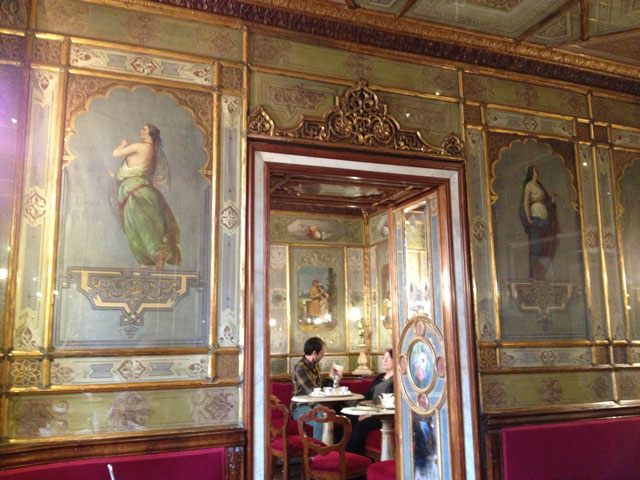
Through the open window, we can hear the café’s live musicians, a wonderful way to start the day.
We order the Colazione Casanova, which consists of fresh blood orange juice, thick hot chocolate, croissants, toasted white bread with butter, honey and jam, yoghurt, fresh fruit salad and chocolate cake (38 euro).
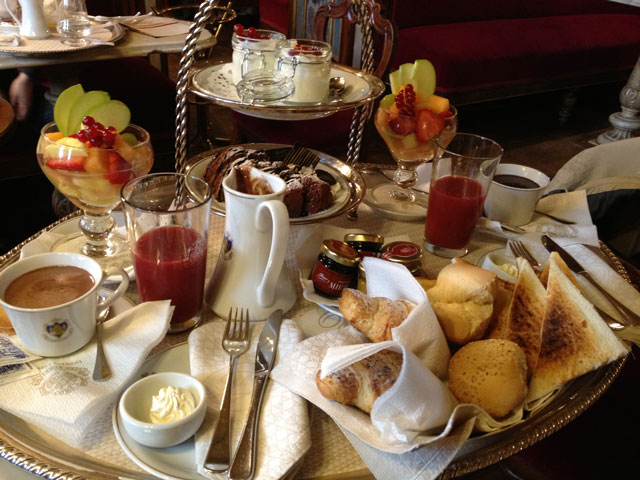
The waiter asks if we want to share but Jean Michel looks alarmed so we take one each. No need for lunch! It isn’t as good as Angelina’s but we still enjoy it and the presentation is certainly worth it in any case. Most of the other people who come in order coffee and sometimes cake. One couple shares a Casanova.
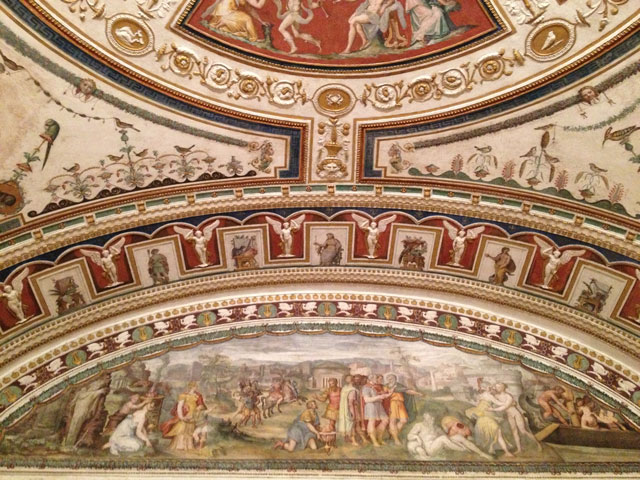
The rain doesn’t let up all day so we mostly stay indoors. After our siesta, we go to visit Palazzo Grimani, built in the sixteen century and famous for its ancient Roman decor. The frescoes are impressive but the general effect is somewhat disconcerting with its somewhat eclectic ancient Roman marble doors and fireplaces.
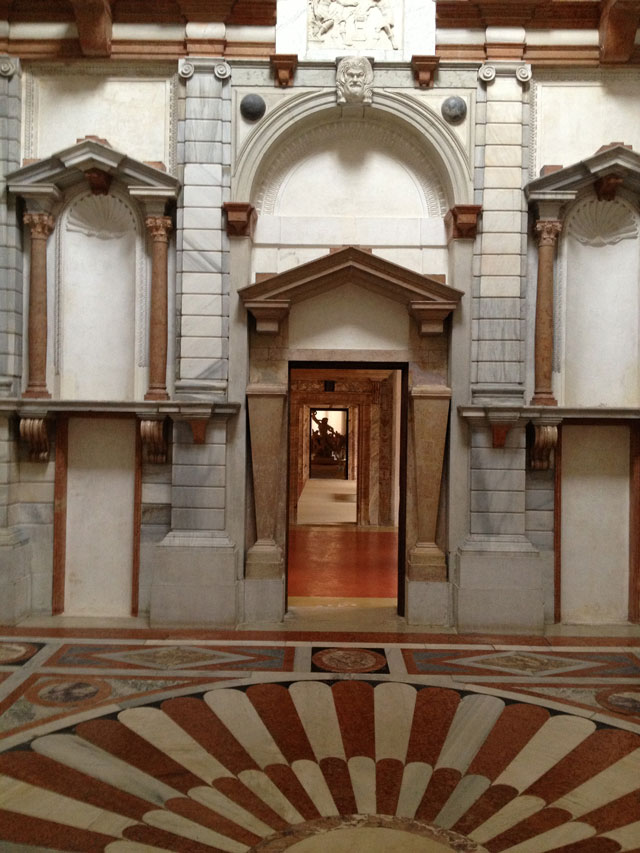
The main advantage is that we buy a double ticket to include the Academia which means we won’t have to queue when we go there later this week.
The rain lets up and we are able to wander around a bit. We eventually come across a restaurant we remember well from our last visit, Hosteria Al Vecio Bragosso, recommended by the young man at our hotel and run by members of his family who told us that the fish served was very fresh because his cousins were fishermen.
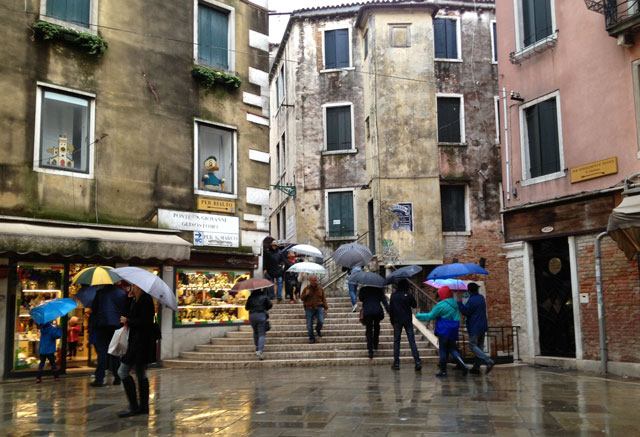
After reserving a table, we have our aperitivo on the terrace of a small bar with an awning to keep off the rain which has started again in earnest. We try a soave this time instead of our usual pinot grigio and decide we like it better.
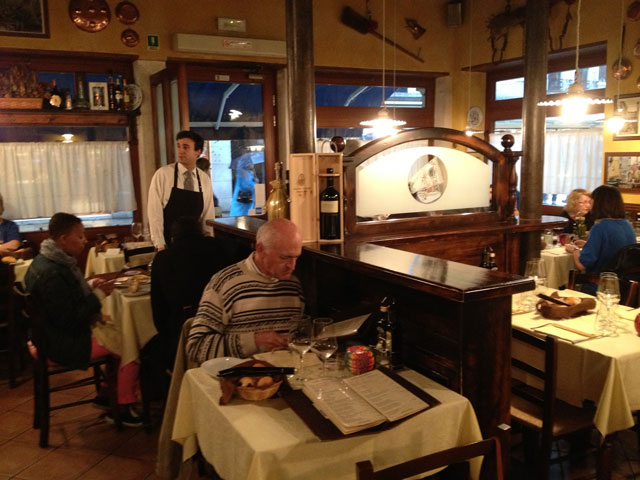
At Al Vecio Bragosso, the staff are very friendly and speak both French and English but still let me order in Italian which is part of the fun for me. We share a delicious raw fish dish of scampi, tuna, sea bream and prawns as a starter, then Jean Michel takes the mixed grill of fish while I have the fried fried fish, with grilled vegetables on the side, all of which are excellent.
It pales a little in comparison with as our first experience when we came with a recommendation and had several raw fish dishes off the menu, but we can still definitely recommend it. It’s best to book as it seems to be popular with the locals and in several guidebooks.
Tomorrow we should have better weather – we hope so, in any case!
Hosteria Al Vecio Bragosso, Strada Nuova 4386 S.S. Apostoli, 30131 Venezia www.alveciobragosso.com . 041.5237277. info@alveciobragosso.com. Closed Mondays. http://www.alveciobragosso.com/restaurant-in-venice/restaurant-venice.htm
I am fascinated by the activity on the canals and lagoons in Venice. I can sit and watch them for hours. There are no vehicles of course and everything has to be transported by water.
[Sorry about the sound – I don’t know how to remove it yet!]
The gondolas, vaporettos and water taxis are the most obvious, but they are actually only a small part of the traffic.
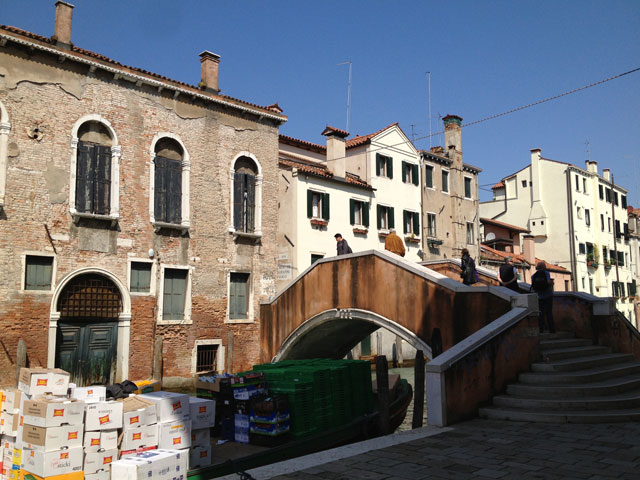
In the morning in particular, there are all sorts of boats on the smaller canals, with people loading and unloading everything imaginable.
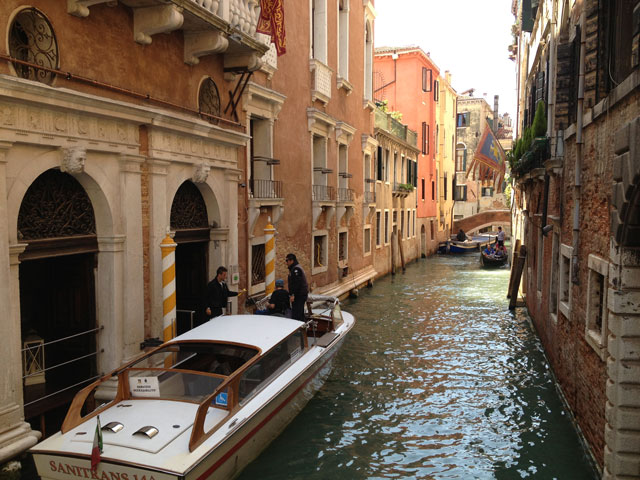
Yesterday, we saw a speed boat called Sanitrans which pulled up at a landing to collect a man in a wheel chair.
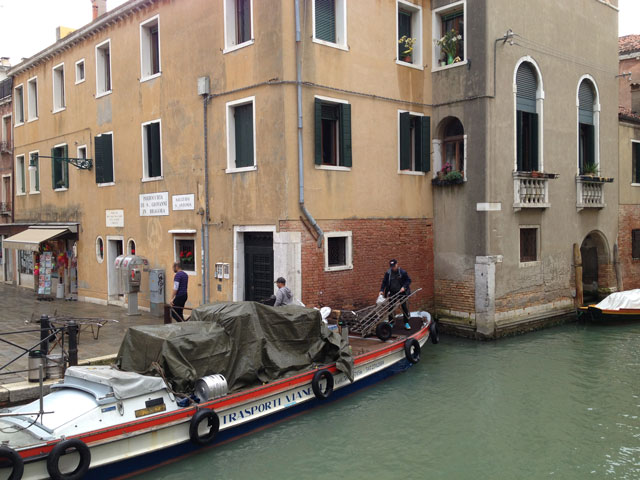
Imagine having a mattress delivered or large pieces of furniture. No wonder everything in our home exchange flat comes from Ikea. The delivery charges must be horrendous.
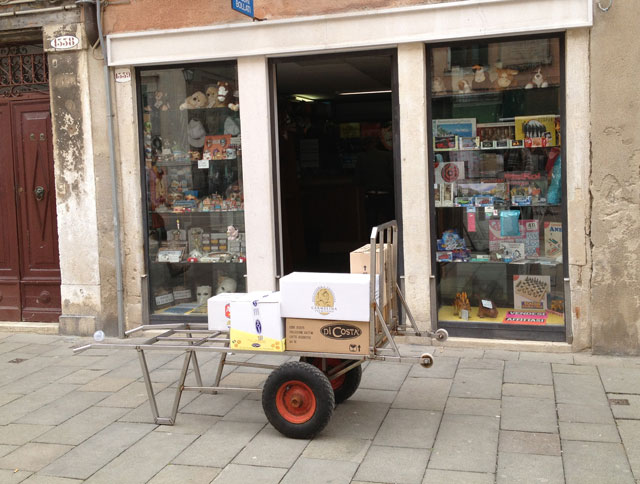
Of course, once the goods are taken out of the boats, they have to be transported by hand so the delivery men (I have not seen any women!) all have these nifty little carts with extra wheels to help them go up and down the hump-backed bridges. And a lot of arm and leg muscles.
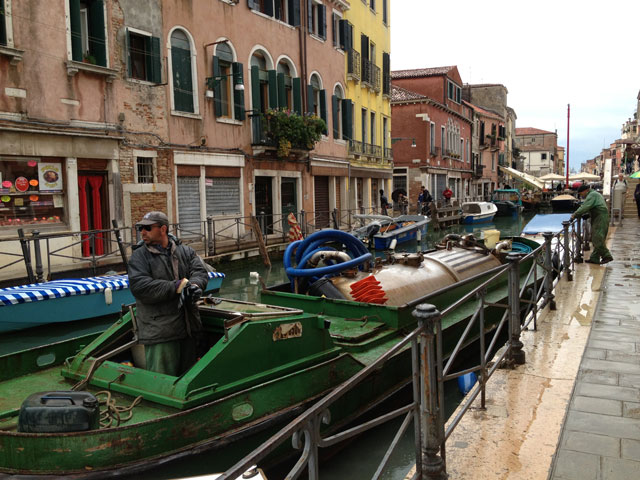
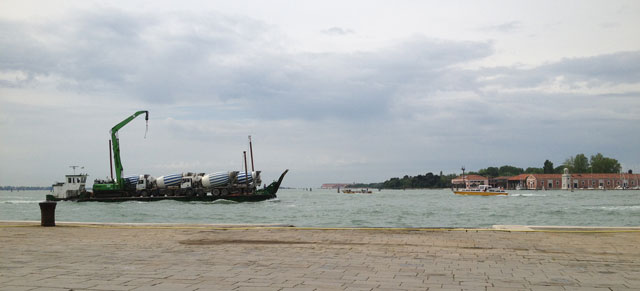
We can only guess what all the hoses are for on the boat above.
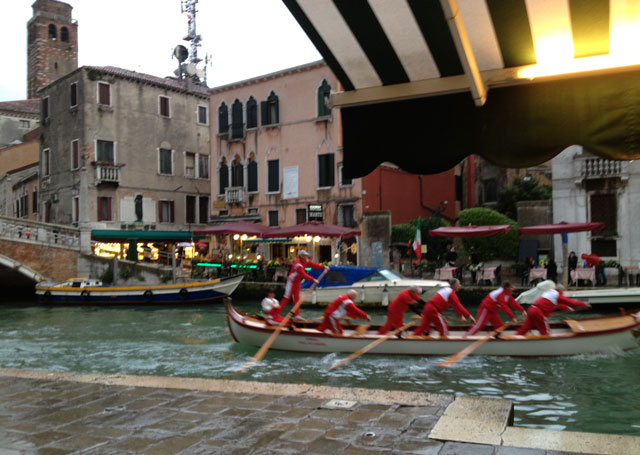
Several times we saw people training for regattas but they are so fast that it’s difficult to catch them in time.
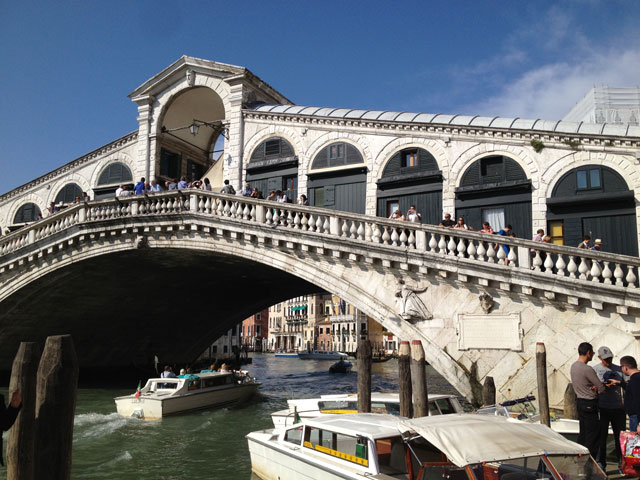
Today we went to the maritime museum near the Arsenal, a bargain at less than 2 euro per person and half-empty. They have a very large collection of scale models of every shape and size, spread out over five stories, including a room dedicated to the stunningly decorated Bucintoro, which was the ceremonial barge of the Doges of Venice.
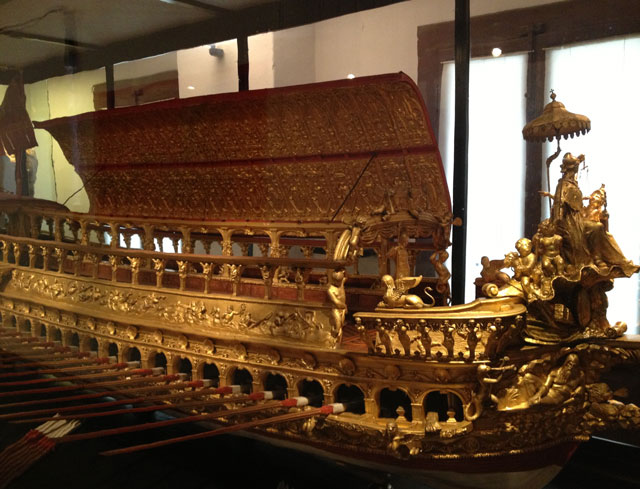
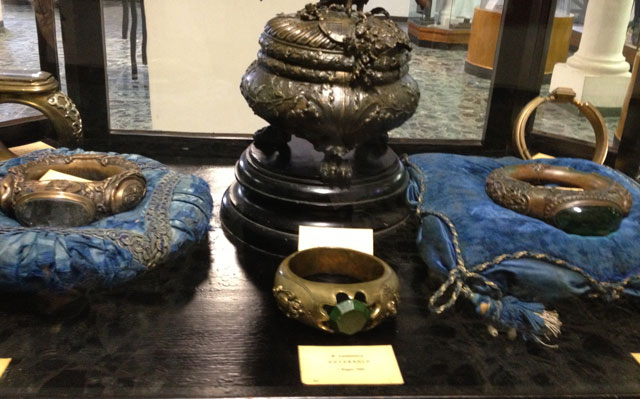
Every year, on Ascension Thursday, the Doge would throw a ring into the lagoon, symbolizing the marriage of Venice to the sea. The museum has a collection of these rings. We were mystified when we first saw them!
While we were having a cappuccino opposite the lagoon, a barge went past loaded with cranes and cement mixers!
 The gondola experience still awaits us so keep tuned!
As this is our second time in Venice and we’re (almost) living like locals, the main attractions are not on our list. Our home exchange is in Castello, which is a working class area of Venice. Our host, Pierleone, is waiting at the vaporetto station, Ospedale, when we arrive from the airport. He takes us in light rain through a maze of streets that I will never remember. I hope Jean Michel will.
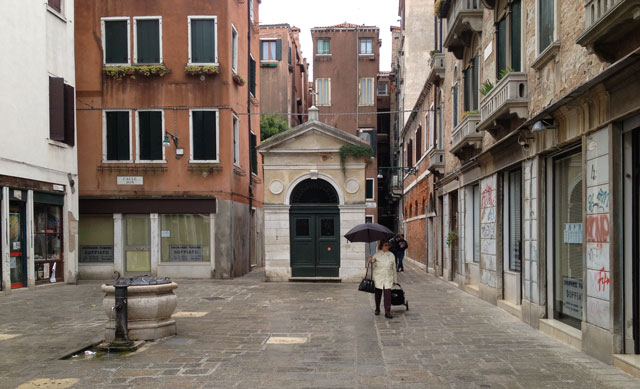
Our first floor flat is on the a corner of two narrow streets. It is small but clean and appears to have everything we need. The windows give directly onto the street and we can see people walking past. Pierleone, who speaks French, has set out a handful of brochures on the table and tells us about several places to visit that are off the beaten track.
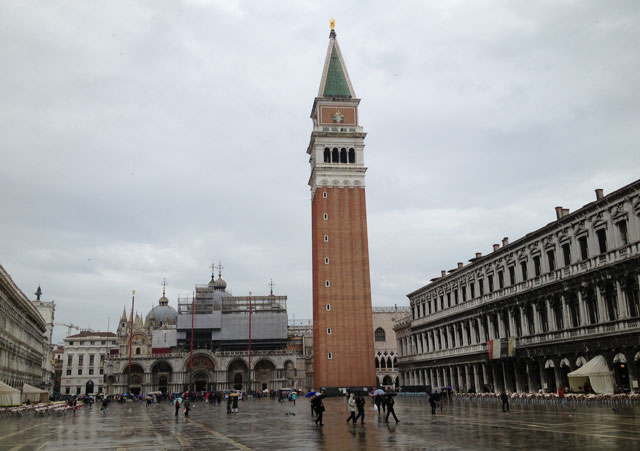
We leave our luggage but don’t unpack, eager to be outside. We set out for nearby Piazza San Marco, taking photos of each little bridge and palazzo on the way, despite the rain. Even if there is no sun, it’s still Venezia la serenissima and our accumulated fatigue seems to melt away.
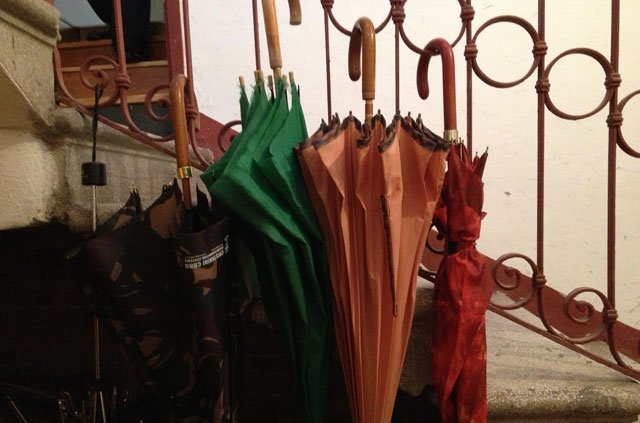
Strange as it may seem for people who know me well, we’re looking for Louis Vuitton near the Corer Museum on the corner of Piazza San Marco at Pierleone’s suggestion but don’t have the name of the street which turns out to be Salizzada San Moise. As we walk in, we’re given a long transparent plastic bag for our dripping umbrella. We head for the staircase, nodding at the shop assistants who all greet us with a friendly buon giorno. At the top floor, we browse through the books on display then enter a darkened room on the right.
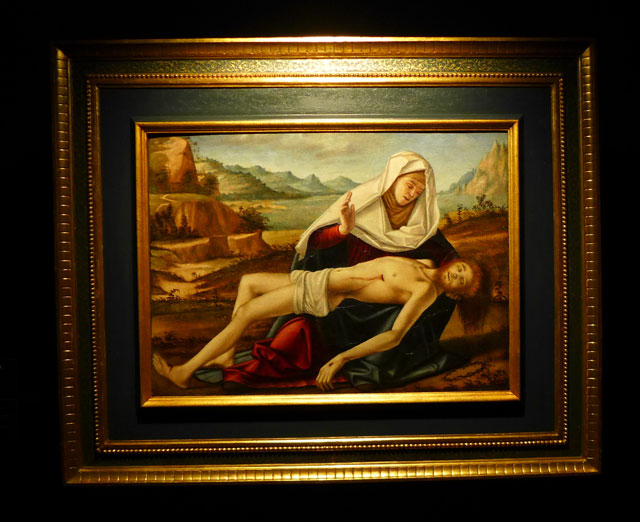
There are two rather stiff-looking paintings by Vittore Carpaccio, a painter of the Venetian school (1465 to 1525), most of whose work remains in Venice, and two projections, one showing two women sitting on the ground on either side of a stone monument suffering some kind of angst, and the other depicting a diver splashing through the water with a sun in the background. We don’t find the artwork particularly interesting but we like the idea of a private exhibition!
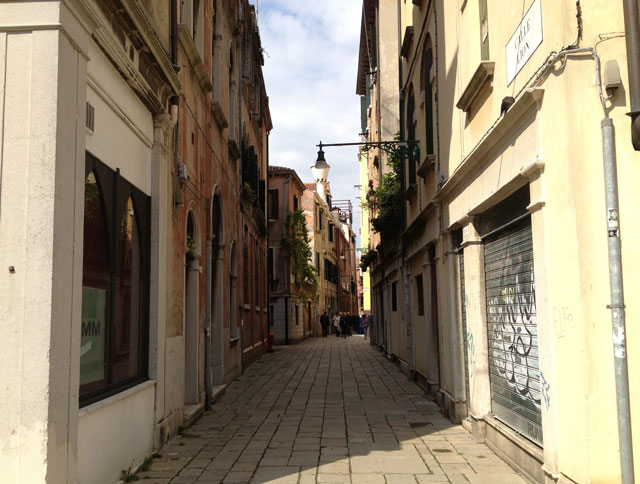
It’s next morning and we don’t feel very refreshed. It turns out there is a very bright street light just outside our bedroom window which only has Venetian blinds (of course!) and we’re used to almost total darkness from wooden shutters in Blois and opaque curtains in Paris.
We send an SMS to Pierleone because we don’t seem to have a single sharp knife and one of our lights isn’t working. He obligingly comes by immediately, fixes the light and asks what sort of knife we want. We explain we want to cut up fruit and vegetables (it’s a fast day) so he brings us back two serrated knives. When we express surprise, he explains that it’s almost impossible to get a smooth-edged knife in Venice. Could this be true?
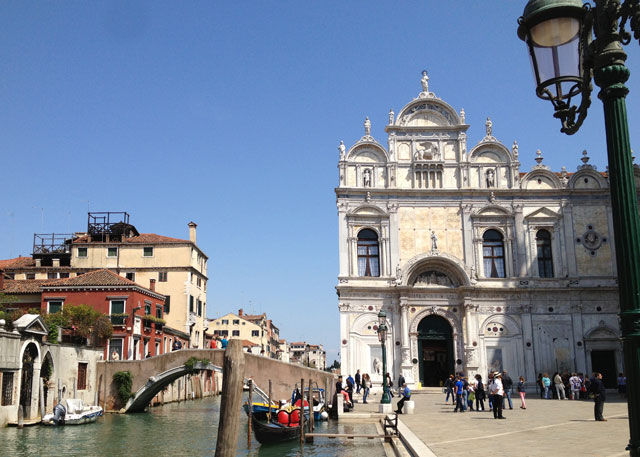
Following another of Pierleone’s suggestions, we go to nearby Campo dei Santi Giovanni e Paolo to visit the Scuola Grande di San Marco, originally a religious charity founded in 1261 and rebuilt in 1487. It is now a public hospital (Ospedale). The ground floor houses a majestic Renaissance hall but Jean Michel is sure there is something else to visit.
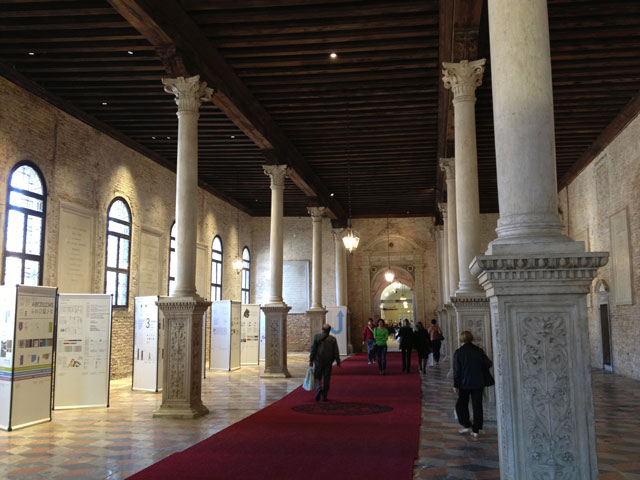
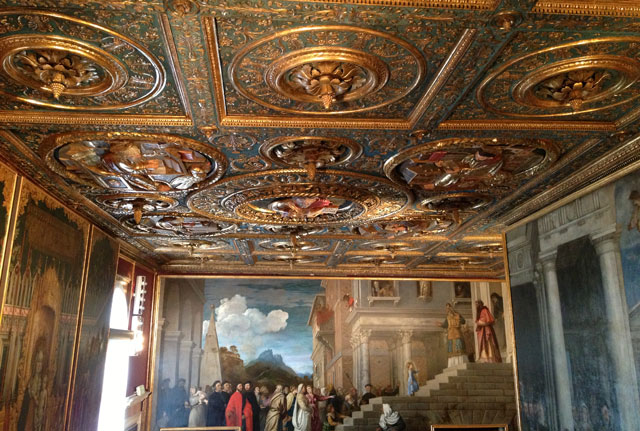
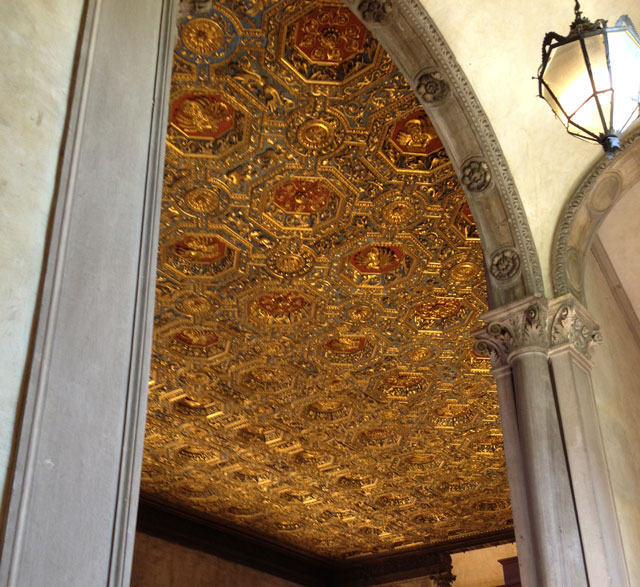
There are no signs to direct us and we are about to leave the building when a man in uniform indicates that we should take a flight of steps to the right. Halfway up we stop in amazement. Before our eyes is a magnificent gilt Renaissance caisson ceiling completed in 1519.
Glass cases around the wall contain primitive-looking antique surgical equipment all beautifully presented as part of the Museum of the History of Medicine.
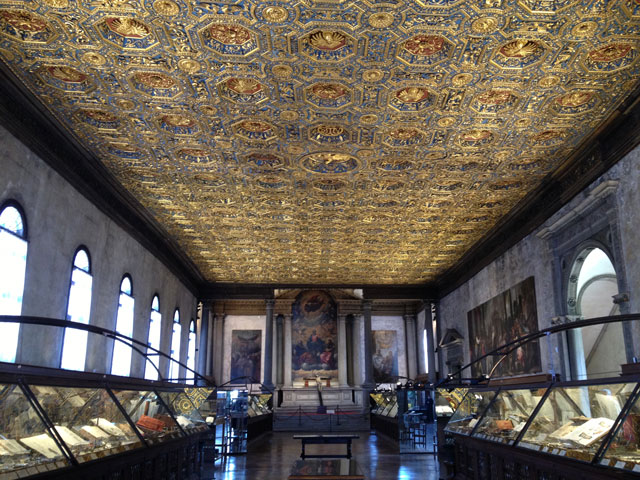
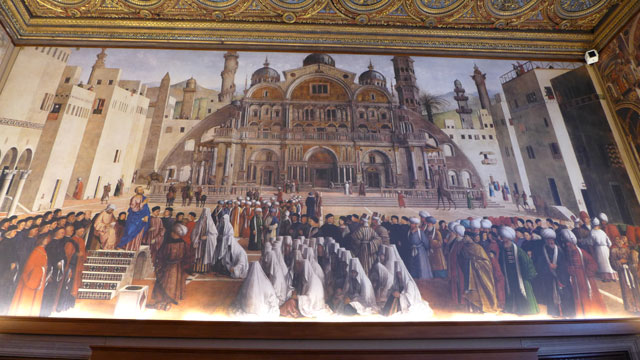
A smaller room contains books and paintings, mostly copies (some the originals are in the Accademia). The one that appeals to me most is by Gentile and Giovanni Bellini depicting Saint Mark preaching in Alexandria, Egypt, the original of which is in Galleria Brera in Milan. I later find further information on Venezia Blog where you can see a lot more (and better) photos.
We then have our first espresso for the day in the Campo to rest our weary feet and watch the gondolas and working boats plying the river. We sigh in contentment.
Opening Hours for Grande Scuola di San Marco From Tuesday to Saturday, 9.30 am to 1.00 pm, 2.00 pm to 5.00 pm
