Tag Archives: Friday’s French

Friday’s French – incinération

OK, this maybe isn’t the brightest subject in the world but it’s a very interesting false cognate. The first time I heard the word incinération used in French in relation to death I thought it was a joke. I couldn’t believe that incinération could really be the French word for cremation. But it is. And the verb is incinérer. It sounds so down to earth. They do say crématorium though and not incinérateur (except when talking about the cremator or high-temperature furnace). It seems, however, that with today’s environmental focus on waste incineration, crémation is becoming the more usual term.

Crematorium at Père Lachaise Cemetary

Not that I’ve been to a lot of crematoriums – or burials (inhumations) for that matter, I’m pleased to say, despite my age. In France – and this is borne out by IPSOS, the national survey institute – the trend is definitely towards cremation.

Columbarium at the back of the Crematorium at Père Lachaise Cemetary

The nicest crematorium I’ve been to is Père Lachaise. An English friend’s mother was cremated there last summer. Given its celebrity, I would have imagined that it would be restricted to people living in the area, but apparently not.

Peaceful gravestones at Père Lachaise near the Crematorium

Before the ceremony, we wandered around the surrounding graves and it felt very calm and peaceful.

But I’m getting sidetracked. Another word used in relation to crématorium is columbarium from the word colombe which means dove. The columbarium is a wall with lots of little niches in which urns can be stored. The first time I heard the word was in the Cinque Terre where cremation is preferred to burial due to lack of space.

Columbarium in the Cinque Terrae overlooking the sea
Columbarium in the Cinque Terre on the Mediterranean Coast of Italy overlooking the sea

I don’t know about other countries but in France, you can’t just do anything with a person’s ashes (cendres). If you wish, you can disperse them in a site cinéraire in the crematorium, sometimes called a jardin de souvenir. If you’d like the ashes to be dispersed at the foot of a tree or shrub, it’s called mémorialisation.

Close-up of the columbarium in the Cinque Terrae

Outside the crematorium, ashes can’t be dispersed near a place of residence, so that rules out private gardens. Larger areas such as forests and meadows are possible, provided you have the owner’s authorisation. Dispersing them at sea is fine if you respect maritime law. You have to declare that the ashes have been dispersed at the town hall of the person’s birthplace.

You can bury the urn containing the ashes on private property if you obtain autorisation from the préfet first.

I found all that information in a little brochure at a crematorium in Greater Paris.

Friday’s French – bonne année

I couldn’t resist the temptation to take a look at new year’s greetings in France particularly since I overheard my father-in-law explaining the tradition of mistletoe in France to Jean Michel and it didn’t seem very clear to me so I checked it out.

Mistletoe hanging from our 400-year old beam!

There are several different explanations but it seems that the Druids used to say o ghel an heu, meaning “may the wheat germinate”, when they cut the sacred mistletoe at the winter solstice. This seems to have gradually muted into kissing under the mistletoe at new year and saying au gui l’an neuf which is a corruption of the original Celtic expression and doesn’t have any obvious meaning on its own. I’ve never actually heard anyone say it.

Later, the expression became Bon an mal an, Dieu soit céans, i.e. good year, bad year, may God be with you. By itself bon an mal an means on average as in our expression taking one year with the other. Bon an mal an, l’immigration se maintient au Québec = Immigration in Quebec is about the same each year.

Nowadays the most common new year expression is bonne année ou bonne et heureuse année often followed by et la santé surtout as you get older and health becomes more of an issue. You wish people bonne année the first time you see them throughout the month of January. You can also say meilleurs vœux (best wishes), je vous souhaite une excellente année 2014 (I wish you an excellent 2014), que vos vœux les plus chers se réalisent (may your dearest wishes come true). Santé, joie and bonheur (health, joy and happiness) are usually in there somewhere as well. Jean Michel’s favourite is Bonne année et bonne santé physique et morale. He says that way he’s covered everything.

Note that you don’t say nouvel an except when you’re referring to new year’s eve or new year’s day e.g. je vous verrai au nouvel an : I’ll see you at New Year or nous avons fêté la nouvelle année en famille : we celebrated new year at home. A new year card is une carte de nouvel an or une carte du nouvel an but it’s probably more correct to say une carte de vœux de/du nouvel an. You don’t see them much any more but when I moved to France in 1975, people used to send tiny cards about half the size of a normal envelope.

Something I find interesting is that Jean Michel never bothers to contact his family at Christmas but makes sure that he talks to everyone on New Year’s day. For me and my Australian family, it’s quite the opposite. Christmas is more important.

And there is an unwritten rule that the younger members call the older members first. As Jean Michel’s the oldest, he only has to call his father.When I sent messages to both my children at midnight on New Year’s Eve this year, he was quite surprised that I didn’t wait until they contacted me.

Today the galette des rois or kings’ cake is probably the greatest symbol of the new year in France. A galette was originally a buckwheat pancake from the country of the Gauls (Gallois) and by extension any thick, flat cake or biscuit. I’ve described the tradition of the galette des rois in another post. Today I’m only looking at the linguistic aspect.

The youngest person sharing the galette goes under the table and indicates which piece is for whom to the person cutting and serving it.

A popular expression connected with the galette des rois is tirer les rois. Tirer means to draw stakes, so tirer les rois means that people are going to share a galette and see who gets the token or fève inside.

But each region of France is different so you may know of other new year traditions.


All_About_France_blog_linky_xmas
This post is a contribution to Lou Messugo’s All About France link-up. Feel free to pop over and have a look at the other posts this month by clicking here

Friday’s French – chevreuil, biche & deer

I’m telling someone about our little wood and explain that the biches ate all our medlars. “We don’t have any biches“, says Jean Michel. “We only have chevreuils“. “Isn’t it the same thing”, I ask. “No, it’s not. The only thing in common is that they’re all cervidés“, he replies. “Well, they are all deer to me”, I answer.

And there you go. It’s one of those words where the generic is used in English with something tagged on to describe the individual species. Remember nuts? I then asked what the difference was between a biche and a chevreuil. “The biche is much bigger”, I’m told. So we turned on the iPad and this is what we found.

First, the word biche is sometimes used incorrectly. It should only be used to designate the female of a cerf. But I thought a cerf was a stag which is a male deer so there is obviously something wrong. You can hardly talk about a female stag, can you? I then find a wonderful document on www.gmb.asso.fr by the Groupe Mammalogique Bréton.

Source: www.gmb.asso.fr/PDF/Atlas/Cerf-Chevreuil.pdf

Chevreuil is capreolus capreolus and when I look for that in English I find European roe deer, also known as western roe deer, chevreuil or just roe deer. We now have the size: 65 to 75 cm high, and learn they have a white patch on their rear (bean shaped for males and heart-shaped for females). The tail is 2 to 3 cm long and the males have antlers of up to 26 cm, called bois which literally means “wood”, but we’ll come back to that later. The female is called a chevrette.

From www.gmb.asso.fr/Atlas/Cerf-Chevreuil.pdf

Here we have our cerf élaphe or cervus elaphus, red deer in English, one of the largest deer species. It is much taller, 1 m 20 to 1 m 50, has a 12 to 15 cm tail, yellow rear, massive neck and 70 cm antlers with up to 12 points. It specifically says, “The red deer is the size of a cow”. No, I have to agree, we don’t have any biches in our wood!

Since the stag and doe question is bothering me, I do some more research. In English, I find various sorts of deer such as fallow deer, reindeer and elk. I learn that the word “deer” was originally broader in meaning and meant a wild animal of any kind as opposed to cattle.

Usually, the male is a “buck” and the female a “doe” but there are regional variations. “Stag” is used for many larger deer and sometimes even “bull” and “cow” are used. The male red deer is a “hart” and the female a “hind”. Young deer can be called fawn for the smaller species and calf the the bigger ones. A castrated male deer is a havier, which I have never heard of before.

Now let’s have a look in French. A fallow deer is a daim and the female is daine. The female of renne (reindeer) is renne femelle which isn’t very exciting, is it? Elk is élan and follows the same rule. The names for the young are much more complicated: faon is used for the cerf, chevreuil, daim and renne; hère for a young cerf aged 6 months to one year with no antlers; daguet applies to a young cerf with his first set of antlers and brocard is a male chevreuil more than one year old. I’m sure I’ll remember all that!

To sum up, they are all called deer in English and all called cervidés in French but you need to make the distinction in French between the different species. The term “cervids” exists in English but is a scientific term and most lay people probably wouldn’t know what it was.

And to quote Susan from Days on the Claise in her comment: “Really big deer (American elk, moose) are bull and cow; big deer (red) are stag (cerf) and hind (biche); small deer (fallow, roe) are buck and doe. The only red and fallow deer you will see here are captive (farms or deer parks) although they would once have roamed freely as wild animals. Roe deer are common in the wild (too common, in fact, and need culling). Hart is an old fashioned word for stag that you won’t really find used these days.”

Since antlers are called bois, I checked what they are made of. They are an extension of the animal’s skull and are actually bones. Velvet covers a growing antler and provides it with blood, supplying oxygen and nutrients. Fascinating. Surprisingly, antler comes from Old French antoillier (from ant-, meaning before, oeil, meaning eye and -ier, a suffix indicating an action or state of being, so kind of loosely “behind the eye”. But in fact there is another word relating to antlers in French – andouillers are the branches of the antlers, called tine in English which, as we all know (knew?) are also the prongs of a fork or comb.

Next time I mention the medlars I shall definitely talk about chevreuils.

Friday’s French – parapharmacie, paramédical & paramedics

I was doing a translation today and had to find a solution for the word parapharmacie. A parapharmacie is a shop that sells everything you would find in a French pharmacy except medication, and you usually pay a lot less.

parapharmie_leclerc

From my FaceBook research today, it seems that there is nothing similar in the UK. I don’t know about the US. Parapharmacies also sell certain brands of dermocosmetics that are not sold in department stores or large supermarkets.

I go there to buy shampoo, skincare products, bandaids and make-up.

In France, there are no pharmacy chains such as Boots the Chemist although some pharmacies may use a central buying office. Most pharmacies are independently owned. The parapharmacies, however, are usually chains. The Leclerc hypermarket and supermarket chain has its own parapharmacie.

The suffix para comes from Ancient Greek παρά  meaning beside; next to, near, from; against, contrary to” which means that there are a lot of very different words starting with para.

Take the word paramédical in French. It applies to healthcare professionals with the except of physicians i.e. ambulance drivers, nurses, nurse’s aides, dental assistants, chiropodists, dental technicians, physiotherapists, opticians, occupational therapists, osteopaths, dieticians, nutritionists, medical secretaries, medical reps, medical laboratory technicians and so on.

A paramedic in English however is a healthcare professional who works in emergency medical situations which means that most paramedics are based in the field in ambulances, emergency response vehicles and specialist mobile units. In the hospital, they may treat injuries. So not the same thing at all. Paramedics are all paramédical but not the opposite is not true.

Parachute, which comes from para and chute (fall) is actually a French word.

A parapluie keeps off the rain. When he was little, my son called it a rainbrella in English which we thought was very cute of course.

So, what did I do about parapharmacie in my translation? Since it was a didactic text aimed at instructors, I was able to explain the term then use parapharmacie in Italics, but it’s not always that simple!

Friday’s French – gîte

Even French people confuse gîte and chambre d’hôte. I know this for certain because when I tell people I have a gîte they often start talking about le petit déjeuner which, of course, is only served in a B&B.
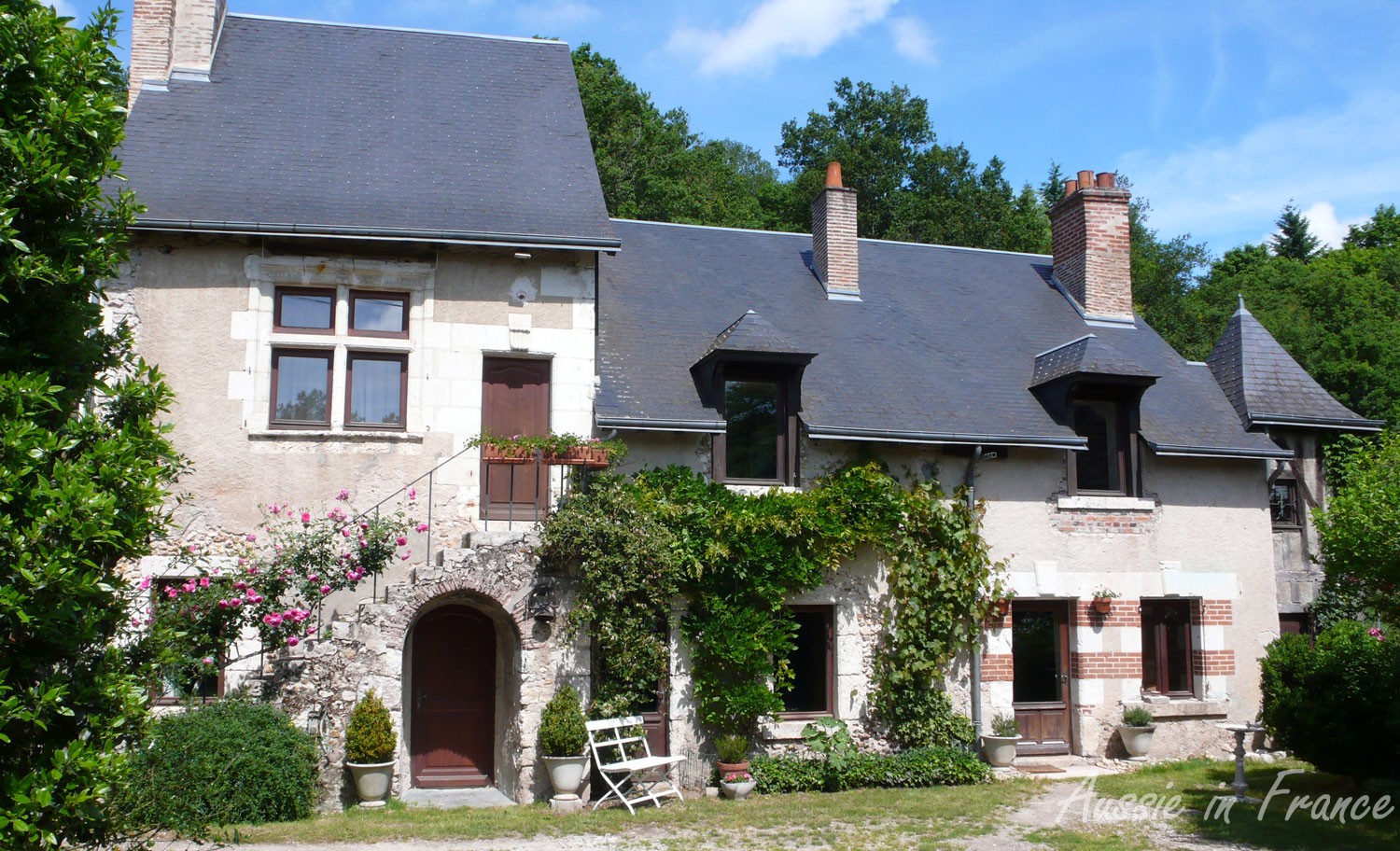
Our gîte and future permanent home

Before it came to mean a self-catering cottage in the country, gîte, which comes from the verb gésir, derived from the Latin jacere (to lie down), meant any place to sleep either permanently or temporarily.

Offrir le gîte et le couvert, for example, means to offer board and lodging.

A gîte, I have just learnt, is also a resting place for hares. Ten points to anyone who knows the equivalent in English! I certainly didn’t. “Hares do not bear their young below ground in a burrow as do other leporids, but rather in a shallow depression or flattened nest of grass called a form. All rabbits (except the cottontail rabbits) live underground in burrows or warrens, while hares (and cottontail rabbits) live in simple nests above the ground, and usually do not live in groups.” Thank you Wikipedia. And thank you Susan from Days in the Claise who has posted a photo of a form.

A mineral deposit is also called a gîte, as in gîte de zinc but an oil deposit is a gisement de pétrole. And pétrole is not petrol as we say in Australia for gasoline – you fill your car with essence in France. Pétrole means oil or petroleum. Diesel engines take gas-oil or gazole (pronounced gaz-well, don’t ask me why!)
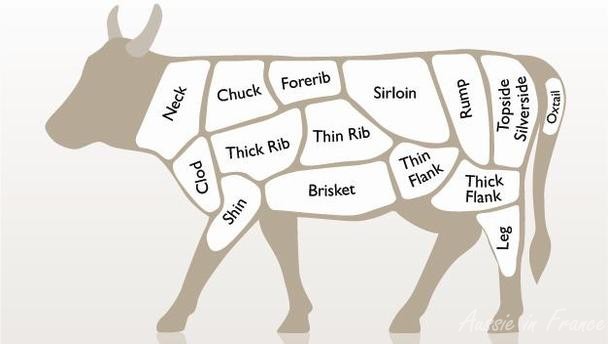
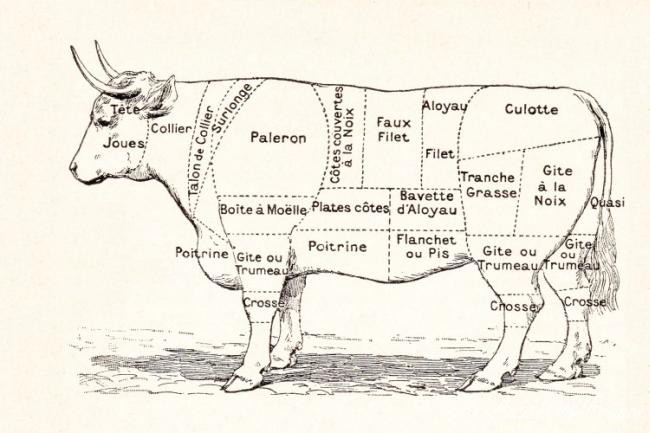
beef_16x9 Boeuf

Gîte (short for gîte à la noix) is also a cut of beef corresponding more or less to what we call topside (UK) or bottom round (US). French and English butchers don’t cut up beef in the same way so quite often there is no real equivalent (entrecôte, côte de boeuf, T-bone, etc.), as you can see from the drawings. You can read more on the subject in Posted in Paris.

Another expression with the verb gésir is Ici gît le roi d’Espagne (here lies the King of Spain). Other examples are: un trésor qui gît au fond des mers = A treasure lying on the bottom of the sea and ses vêtements gisaient sur le sol, a somewhat literary way of saying that his clothes were strewn all over the floor.

So now you know the difference between a gîte and a chambre d’hôte – and a lot more useful things besides!
Friday’s French – raisins

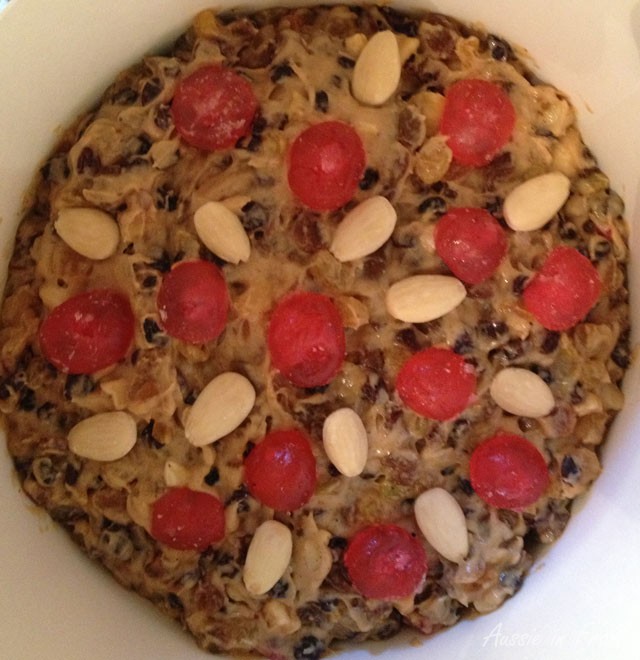
I made my Christmas cake this week using the recipe handed down to my mother by her mother. For the last 8 years, I’ve been able to buy all the dried and candied fruit (peel) at my local market but the stall has closed so I’ve been chasing around Paris for such simple ingredients as currants and raisins.  Not so simple in France however.

xmas_cake

The word raisin is an interesting one. In French, it means grape and what we call raisins are raisins secs (dried grapes). However, in Australia (and apparently the other Commonwealth countries), raisin describes a particular sort of large dried grape.

The most common raisins secs in France are what we call sultanas in Australia, except that they are darker. However, you can buy sultanines here which are usually a golden colour and sometimes called raisins blonds.

Our currants, which are very small black raisins secs are raisins de Corinthe – currant is a degradation of the word Corinth.

As far as I know, there is no generic term in Australian English for dried grapes though raisin would seem to cover the lot in American English.

When hunting for my currants, sultanas and raisins, I came across other varieties of raisins secs: raisins de Malaga (in Spain), raisins de Muscat (like our muscatelles), raisin de smyrne, .

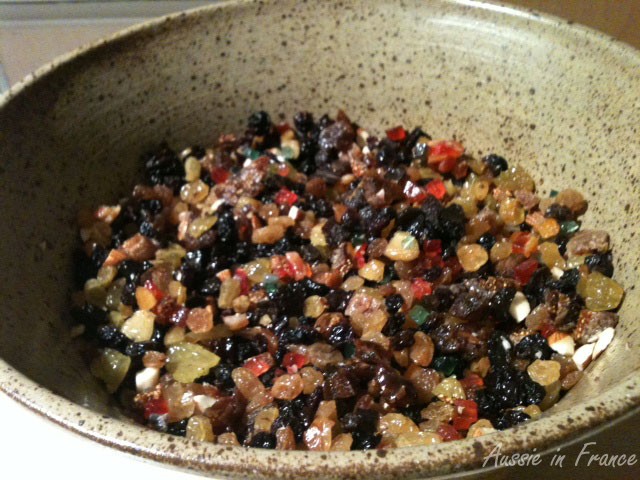
christmas_cake_dried_fruitIf you buy mélange de fruits secs, you’ll find yourself with a mixture of raisins secs and nuts, whereas dried fruit in English only includes dried grapes, figs, abricots, etc.

Now, that’s  a word that doesn’t exist in French – nuts. You have to specify the type: walnut  = noix, hazelnut = noisette , cashew nut = noix de cajou, peanut = cacahuète, almond = amande. They all come under fruit sec, but that’s not very satisfactory, is it?

Friday’s French – père de famille

Now I bet most of you don’t know what this post is about. Père de famille, you say, “father of the family”? Don’t all fathers have families? And why not mère de famille? Aren’t père and mère enough?

Well, there is an added meaning. Of course. Un père de famille ne doit pas prendre de risques means that a man who has a wife and family to think about shouldn’t be taking any risks. We could say a family man as well in English. Une mère de famille pense toujours à ses enfants. Funny, but we don’t say a “family woman”.  I can think of a “woman with a family” or maybe “a wife and mother” and even “housewife” in some contexts. You may have other suggestions.

But that’s not really what I want to talk about. Believe it or not, père de famille and more specifically, bon père de famille, is also a financial term, which always amuses me.

Yesterday, I came across it when I was translating a takeover bid: gestion de la Société en bon père de famille. “Management of the company like a good family man” would be a literal translation but you certainly wouldn’t find it in a contract! I decided on “good, safe management of the Company”.

The expression often goes hand-in-hand with investment: placement de père de famille is what we call a gilt-edged or safe investment. Valeurs de père de famille are gilt-edged or blue-chip securities.

The masculinity of the expression is not surprising – French women were kept out of money matters for a very, very long time. It was not until 1965 that women no longer needed their husband’s consent to choose their own profession or open a bank account. Astonishing, isn’t it?

And it was much later – only I can’t find the date – that women were finally entitled to see and sign the family’s tax declaration. Up until then, the husband en bon père de famille, n’est-ce pas declared both his and his wife’s revenue and could refuse to even show her the declaration!

Women were given voting rights in New Zealand in 1893, in Australia in 1902, in the UK in 1918 (but you had to be 30, equal suffrage only came in 1928) and in the US in 1919 (though women could vote in Wyoming as early as 1868) while French women finally voted in 1944. Enough said.

Friday’s French – chance, fortune and luck

What luck! What bad luck! What good luck!

Quelle chance ! Quelle mauvaise chance ! Quelle chance !

That’s right, it’s not a mistake – quelle chance twice – because you don’t say quelle bonne chance in French. You can say bonne chance all by itself though to wish someone good luck. Otherwise, chance is always good.

J'ai de la chance d'avoir cette vue - I'm lucky (or fortunate) to have this view
J’ai de la chance d’avoir cette vue – I’m lucky (or fortunate) to have this view

In English we have three words to mean more or less the same thing – chance, fortune and luck.

Fortune in French usually has a financial meaning as in il a fait fortune, which means he made his fortune.

In literary contexts, fortune can be used in our sense of luck or fortune but I’ve never heard anyone use it.

My Larousse gives the expression La fortune sourit aux audacieux which means “Fortune favours the bold or strong or brave”. They are all translations of the Latin proverb Audentes fortuna iuuat, Fortes fortuna adiuuat, Fortuna audaces iuua or Fortes fortuna iuuat.

In most contexts, chance  is used in French to convey the English luck or lucky or fortunate. There is an adjective, chanceux and its antonym malchanceux or malencontreux but they’re rarely used in comparison with lucky. Jean Michel couldn’t find any examples of chanceux in normal speech.

Quelle chance tu as d’habiter le Palais Royal = You’re so lucky to live in the Palais Royal.

Tu as de la chance d’habiter le Palais Royal = You’re lucky or fortunate to live in the Palais Royal.

Il n’a jamais de chance = He’s always unlucky.

J’avais de la chance de trouver ce que je cherchais = I was lucky to find what I was looking for.

Elle avait de la chance d’être là au bon moment = She was fortunate in being there at the right time.

Just for the record, il est fortuné has nothing to do with being lucky – it means he’s wealthy.

So what about “chance” in English? For example, how do you say “I didn’t get a chance to talk to him”? Well, here “chance” means “opportunity” or “possibility” so we would say je n’ai pas eu l’occasion (ou la possibilité) de lui parler.

But if it means “luck” e.g. he hasn’t much chance of winning, you’d use chance but in the plural: il n’a pas beaucoup de chances de gagner.

“Chance” in English is used in a lot of different contexts that I won’t bore you with. Just a couple that might be useful though.

I went there on the chance of seeing him = j’y suis allé dans l’espoir de le voir. Here, “chance” means “hope”.

No chance! not a chance = jamais ! jamais de la vie !

Alors bonne chance in your future use of chance! And if you have any questions, don’t hesitate!

Friday’s French – avoir le droit & entitlement

In a comment on last Friday’s French, Conrad from Canada asked me how I would translate the word “entitlement”. His example was “The community lost their vistas because of a new housing project; they were convinced that they were entitled to these vistas, so it created great stress for years to come.”

The sort of vista where you wouldn't like a hospital to appear.
The sort of vista where you wouldn’t like a hospital to appear.

I would have spontaneously found a solution using droit but Conrad feels that it doesn’t incorporate the idea of an historic right that entitlement does.

So I asked my translators’ community TLSFRM for some ideas. There were several suggestions such as il leur revenait de (plein) droit de conserver leurs vues; ils pensaient qu’il était légitime de conserver leur vues; ils pensaient qu’ils étaient fondés à conserver leurs vues and ils pensaient qu’ils étaient en droit de conserver leurs vues.

Another possibility is ils estimaient qu’ils n’auraient jamais dû être privés de leur vue which means turning the sentence around completely – another prime example that words in one language rarely overlap in another and that it’s often the context that provides the full meaning.

There are other everyday contexts in which avoir droit à or donne droit à is used in the meaning of entitlement:

Elle a droit à une bourse: she’s entitled to a scholarship.

Cette carte vous donne droit à des places gratuites: this card entitles you to free seats.

The meaning, of course, is that of having the right to something, except that we use a different word in English. The same applies to the following examples:

“J’ai droit à deux morceaux ?”, a child would ask if he wants two squares of chocolate. An English-speaker would say “Can I have two pieces?” or “Am I allowed to have two pieces”.

Tu n’as pas le droit de le taper: you’re not allowed to hit him or you musn’t hit him.

So, can we always use droit when we want to say “allow”. Of course not, that would be far too easy !

She allowed me to borrow her shoes – elle m’a permis d’emprunter ses chaussures.

Smoking is not allowed : il est interdit or défendu de fumer.

The teacher allowed me to go early : le professeur m’a autorisé de partir de bonne heure.

You need to allow 28 days for delivery : Il faut prévoir un délai de livraison de 28 jours.

We are not allowed much freedom : on nous accorde peu de liberté.

I could go on and on and find a different French verb each time! I’m sure you have lots of other examples.

Friday’s French – capital soleil

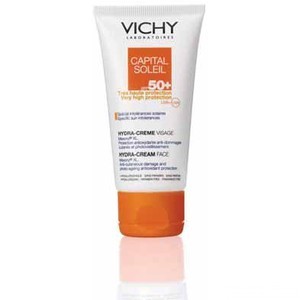
vichyIt’s interesting that such a wonderful expression should exist in French and not in English, or at least in Australian English where it would be very useful, given all the sun there compared to what we get in France (it’s a very rainy day today).

Your capital soleil is the amount of sun that your body can be exposed to during your lifetime without causing something disastrous like skin cancer. It’s used very widely in advertising for sunscreens in France. Vichy even has a brand called Capital Soleil.

When I’m translating for cosmetic brands, I usually have to rewrite the sentence completely:

Chaque individu dispose d’un capital soleil déterminé à la naissance becomesEach person can only absorb so much ultraviolet radiation during their lifetime without developing cancer”, for example.

Close in meaning is capital santé which is sort of health and fitness combined. Surprisingly, there is no word for “fitness” in French so salle de fitness and centre de fitness are used.

Yet the French go on fitness kicks as much as anyone else. Maybe the idea could be expressed using forme. J’ai retrouvé la forme means that I got back in shape or got fit again and il a la forme means he’s very fit (well, in the physical sense anyway – it can also mean “he’s in great form”).

So back to capital. Here are some other examples of capital in French where we wouldn’t use “capital” in English (examples from the Robert-Collins dictionary which, if you’re going to use a bilingual dictionary, is probably the best because Harraps has become outdated and the others are pitiful):

le capital de connaissances acquises à l’école = the stock or fund of knowledge acquired at school

la connaissance d’une langue constitue un capital appréciable = knowing a language is a major asset

le capital artistique d’une région = the artistic wealth or resources of a region

elle a su bâtir un capital confiance = she managed to win everybody’s trust

Capital is used in the financial sense of course and we have all sorts of lovely expressions there as well, sometimes using “capital” and sometimes not:

capital circulant = working capital, circulating capital

capital décès = death benefit

capital d’exploitation = working capital

capitaux fébriles = hot money (I love that one!)

capital initial = start-up money

capitaux propres = equity capital (where propre = own and not clean! “Dirty money” is argent noir or sale)

capital social = share capital

Any more suggestions?