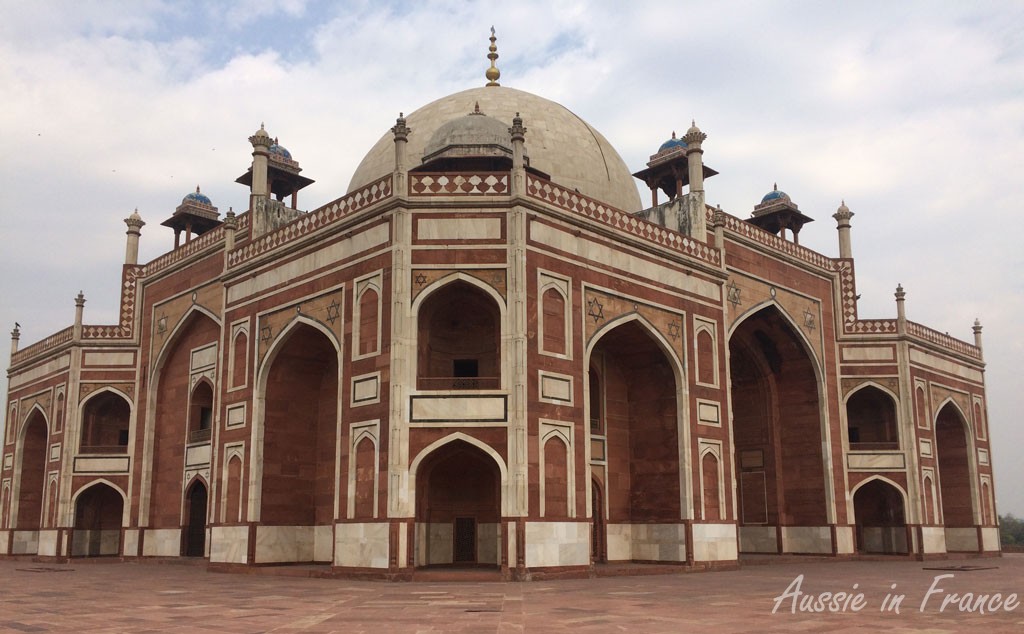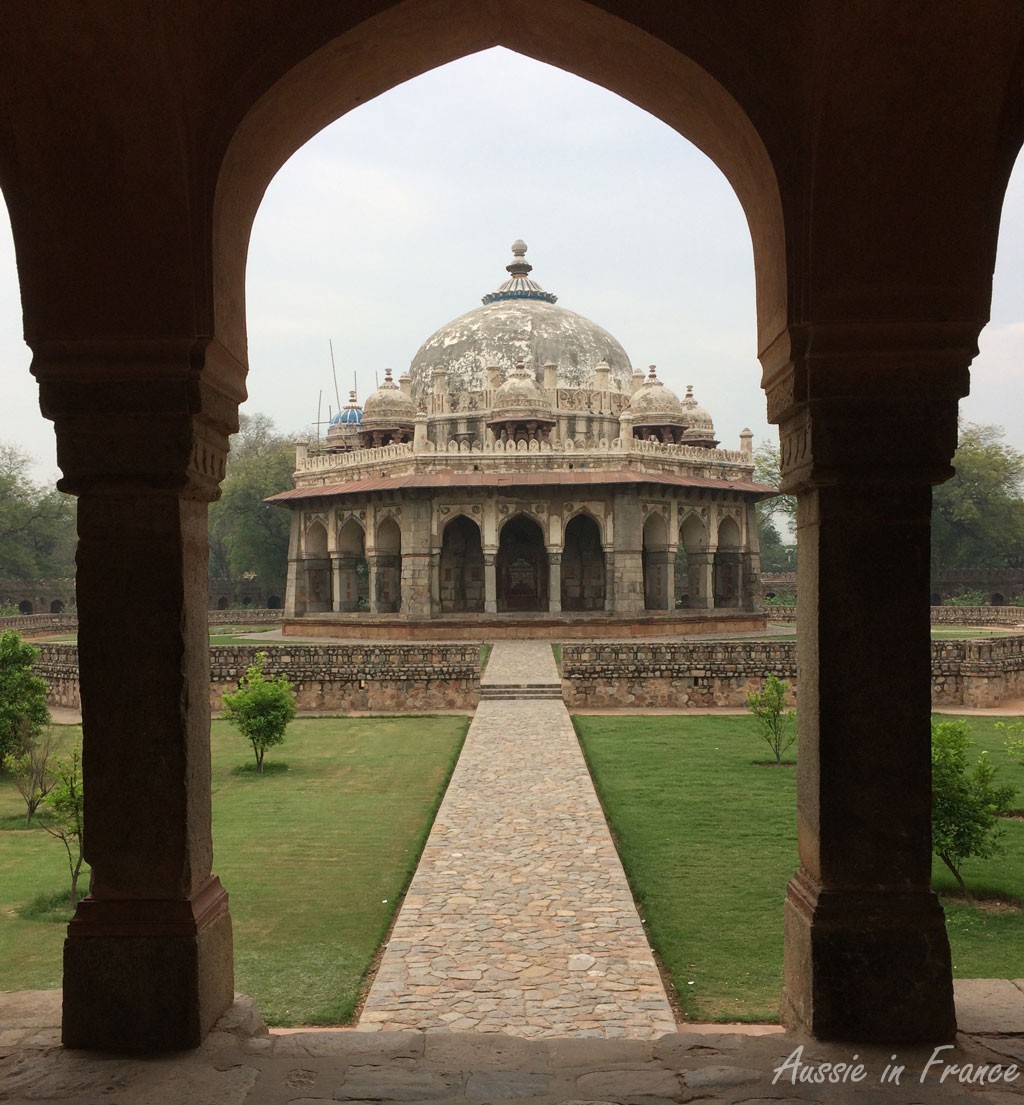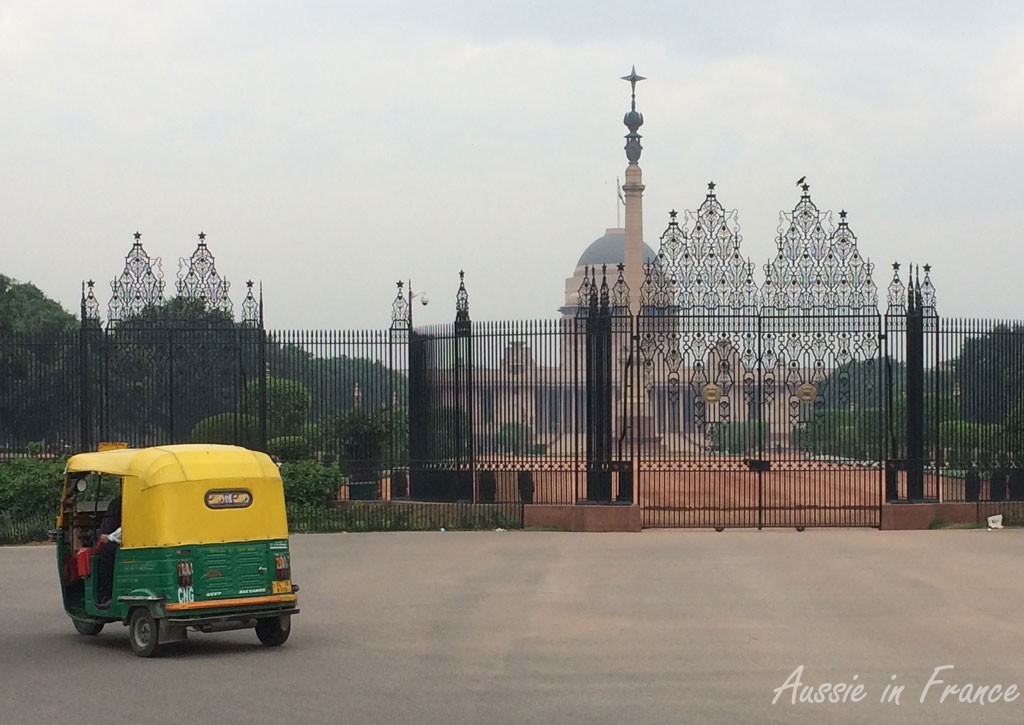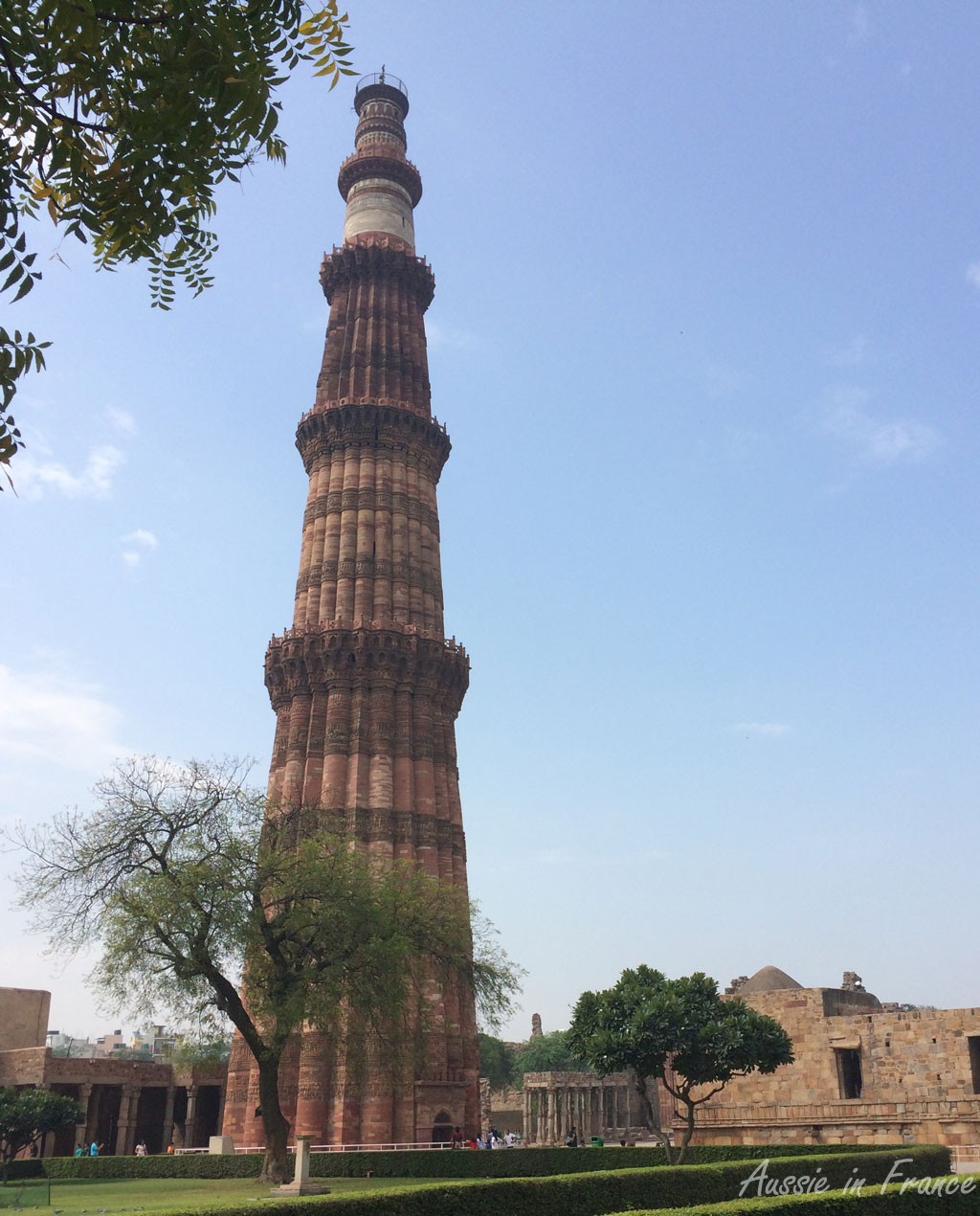
Delhi Delights

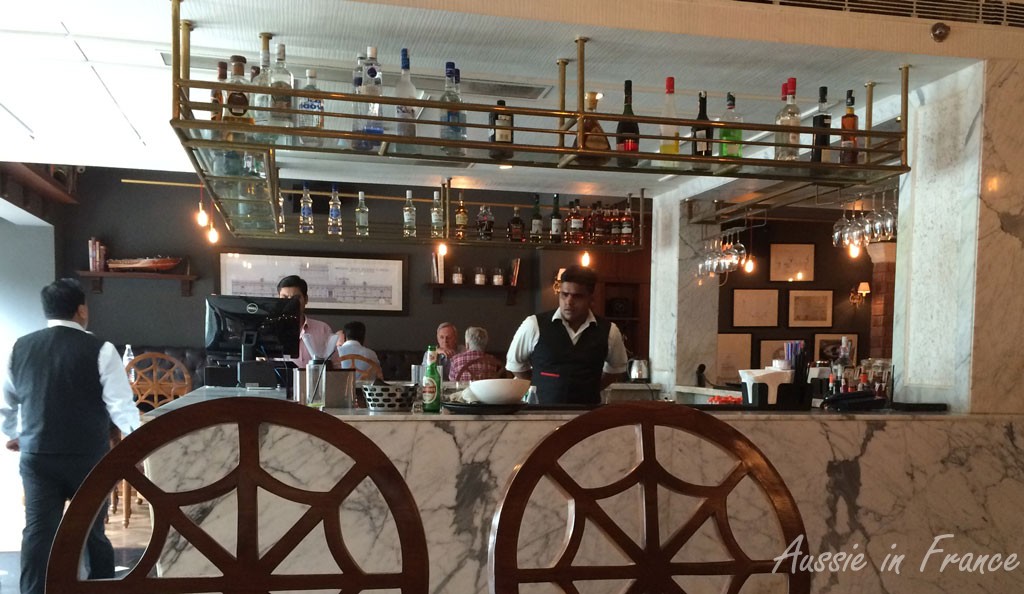
We’ve arrived in Delhi, met up with the coordinator, driver and French-speaking guide from Trinetra Tours, checked into our hotel and are about to have lunch. I’m surprised to see that the restaurant is called Lutyens Cocktail Bar, opposite the Meridien Hotel. When we enter the half-filled room, the only people I can see certainly not Indian. There are only tourists here, I say to Summer, our guide for the afternoon. “No, no”, he says, “there are Indians as well”.
Inside Luytens Cocktail House
Inside Lutyens Cocktail House

When we visit another country, we like to eat like locals and this does not correspond to what we are looking for but we don’t have much choice. We have decided to become temporary vegetarians in India for two reasons: first there is less chance of having food poisoning and second we are certain of getting vegetables that way. We choose a mixed vegetable dish and naan and hope for the best.


Although a little spicy, the food is good, but not very copious. When the bill comes, we discover that we were only given one serving of each and not two. The total is 1120 rupees (16 euro) – hardly good value for money in Delhi and we could have been anywhere in the world. We later learn that the guide chooses where we eat so it’s best to explain early in the day that we would like a localn, authentic experience.

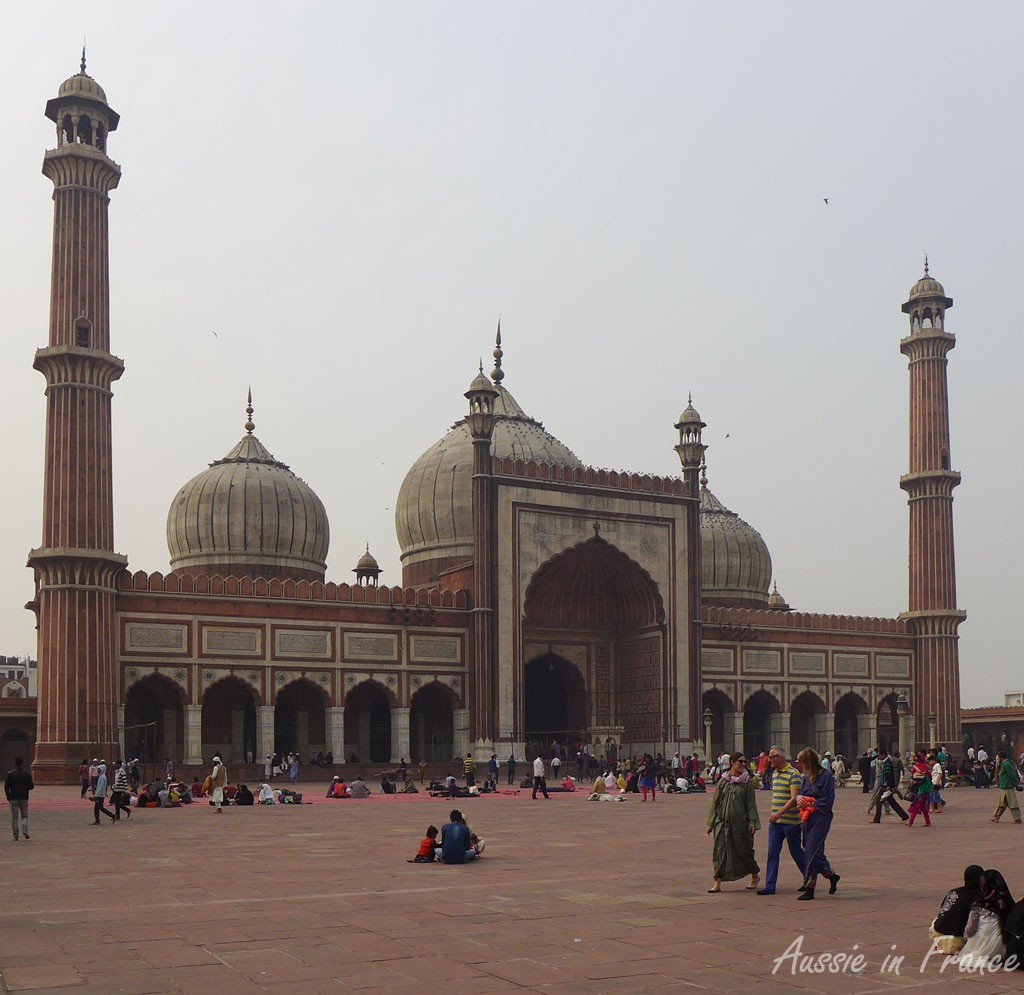
The Great Mosque façade
The face of Jama Masjid, the Great Mosque 

Our first visit is to the Jama Masjid (The Great Mosque), the largest in India. Summer explains that the entrance to the mosque is free but that we have to pay 400 rupees to use our camera, have our shoes looked after and don suitable attire, which means a wrap-around skirt for Jean Michel (he’s wearing ¾ pants) and a sort of throwover for me (I’m wearing 7/8 pants and a long-sleeved shirt). All the non-Muslim women are given the same garb.

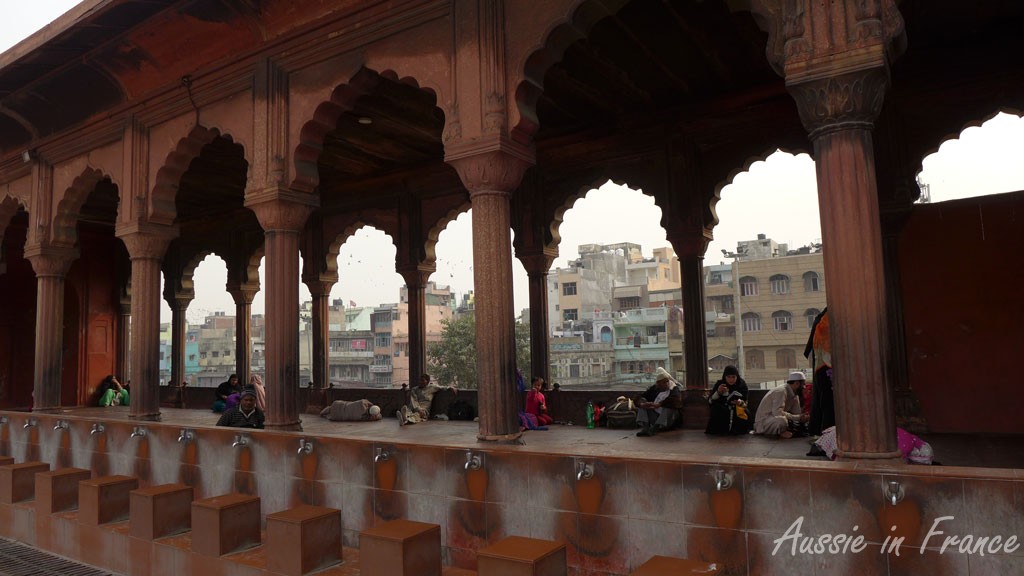
The gallery that runs around the mosque

I realise of course that I should have brought socks or cloth scuffs with me – I’ll remember next time. The ground is not particularly clean and is strewn with litter from sweets and biscuits.  A lot of families come and picnic in the main square and under the galleries enclosing the mosque. It gets busier as time goes on.

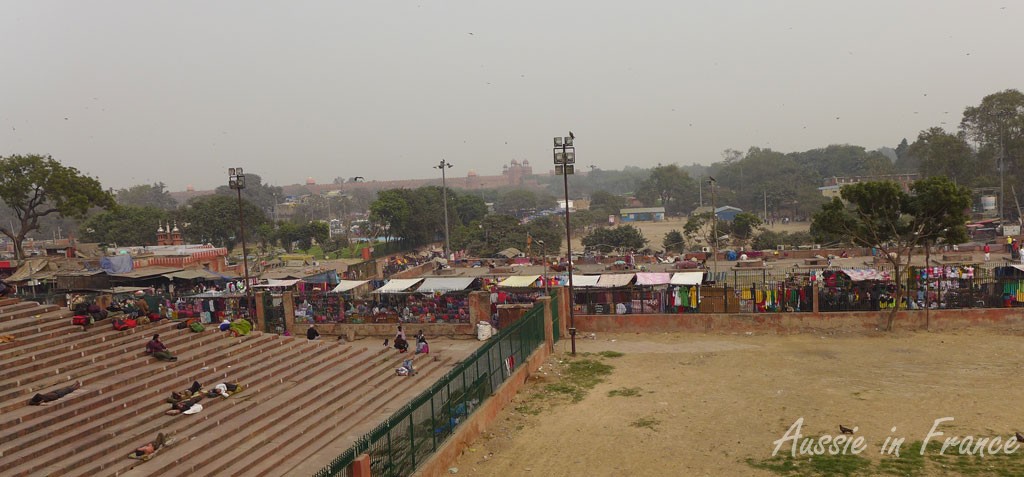
View from one side of the mosque

Built in 1650 in the middle of Old Delhi, it can welcome 25,000 people in the enclosed area although the building itself is not very big. The three domes made of white marble striated with black offer a striking contrast with the pink sandstone of the rest of the mosque.

From the galleries there is a sweeping view of Delhi with all its contrasts.

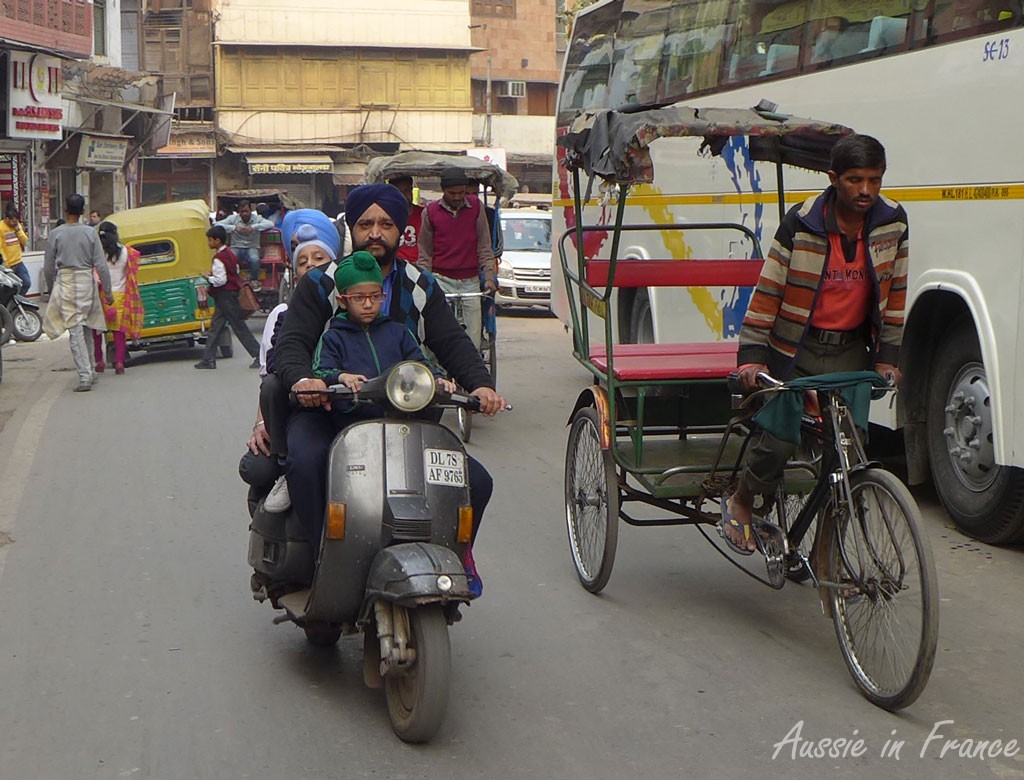
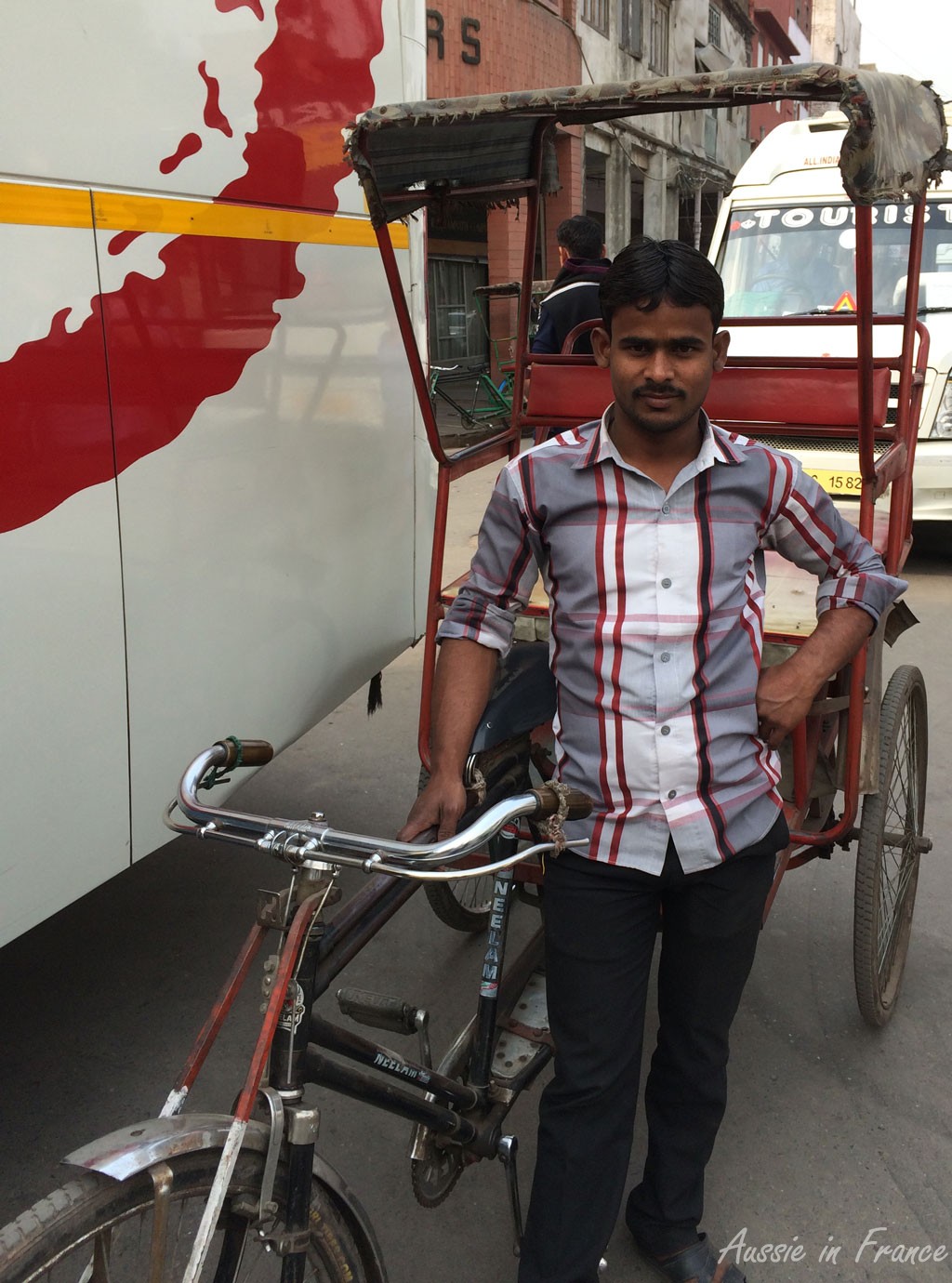
Next on the programme is a rickshaw ride through the main bazaar. We go through a maze of very narrow alleyways and I am continually surprised that the rickshaw doesn’t overturn but our wallah is obviously a champion. The amount of muscle power required to keep us going in some parts is impressive. Also, since we have said we’re not interested in shopping, he doesn’t even get a break.

Our rickshaw wallah
Our rickshaw wallah

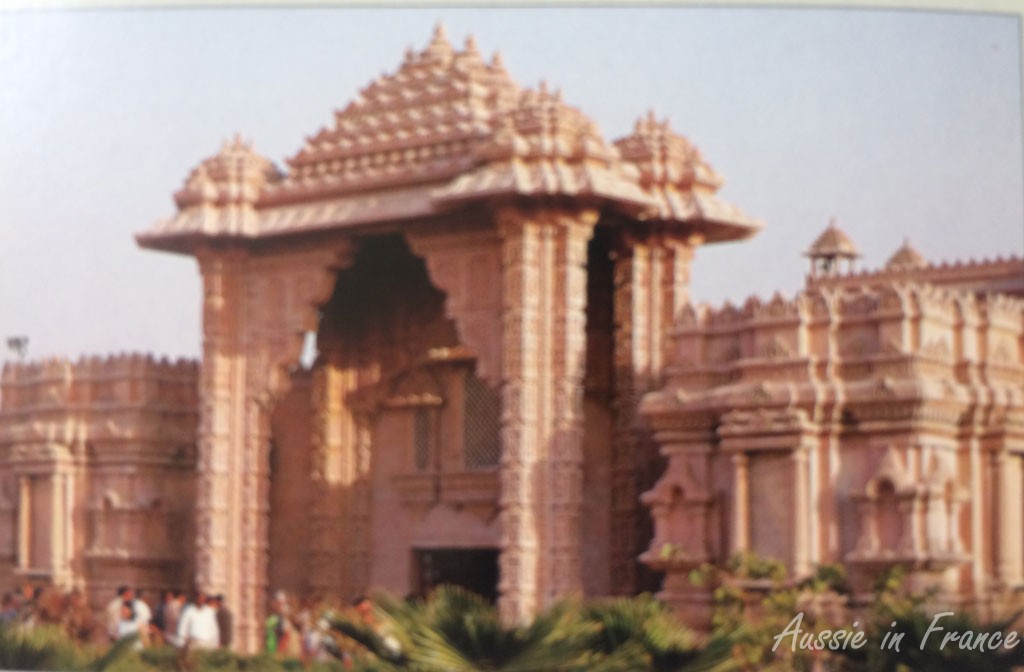
We return to our starting point where Summer is waiting for us. Anand soon arrives and we set off for the last part of our visit – Akshardham Swaminarayan Temple, which we have added to the original itinerary. This amazing Hindu temple displays millennia of tradition Hindu and Indian culture. We can’t take cameras, phones or electronic equipment of any kind so all I can do is to describe my impressions and take a couple of photos of the brochure we received. But I invite you to explore the site more on the official website.

The Temple (photo from a brochure)
Akshardham Swaminarayan Temple (photo from a brochure)

This extraordinary complex covering 40 hectares was opened in 2006. It was inspired and developed by Pramukh Swami Maharaj, the spiritual head of the Bochasanwasi Shri Akshar Purushottam Swaminarayan Sanstha, whose 3,000 volunteers helped 7,000 artisans construct the temple. The first impression is one of serenity.

Summer does not come in as guides are not allowed. He suggests we meet him at the entrance in 45 minutes but we don’t come out for 1 ½ hours!

The elephant frieze (photo from a brochure)

We wander around, visiting the inside of the temple with its intricate carvings and many statues. I am a little surprised that despite its recent construction, it’s very traditional but the workmanship is exceptional.

What I like best, however, is the elephant show, Gajendra Peeth, on which the temple is based. It is 326 metres long and comprises 148 elephants carved out of stone telling various stories with the help of numerous other sculptures of men, animals and birds, paying hommage to the role of elephants and nature in Indian culture. It is most definitely the highlight of our tour. We’ll be visiting the more modern part of Delhi on our way back from Australia in a month’s time.

Getting to Delhi and First Impressions

The big day has arrived at last for our 6-week holiday in Australia via India. As you know, we now have our hard-won visas. We leave Blois at 1.30 pm by car. Our flight is at 9.30 pm. We’ve checked out the trains and discovered that, since we arrive back at 6 pm at Charles de Gaulle airport we’ll be too late to take the last train back to Blois which means an overnight stay in Paris. We check out the long-term parking around the airport and secure, underground parking at the Mariott Hotel turns out to be the cheapest. At 164 euro for 41 days, it’s cheaper than taking the train to Blois then to the airport and paying for a hotel and it’s certainly much easier !

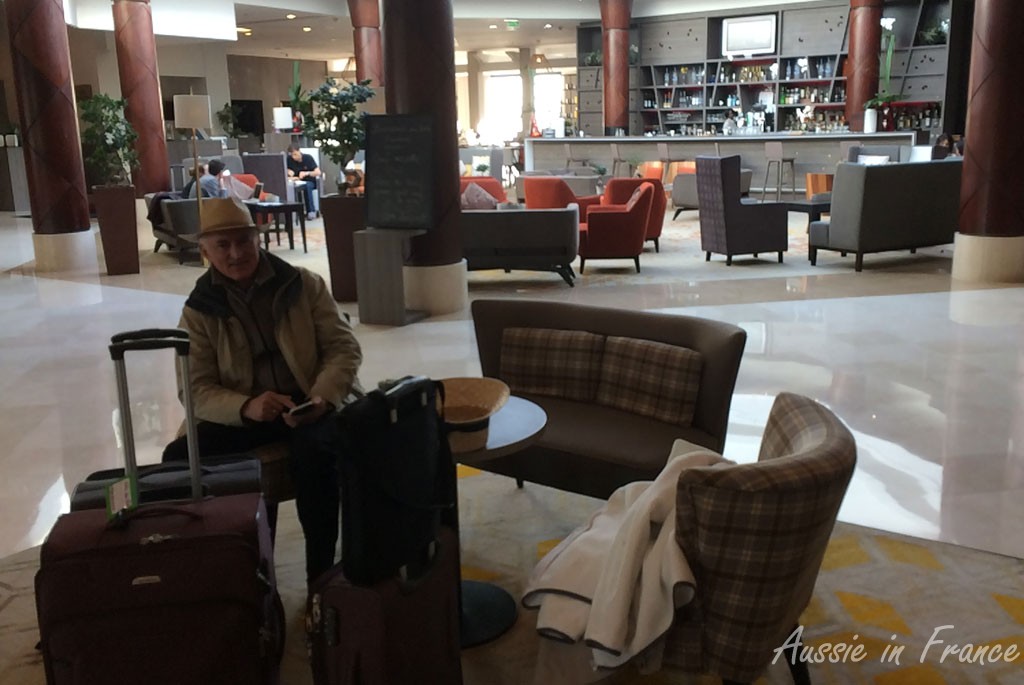
Waiting in the Mariott Hotel lobby

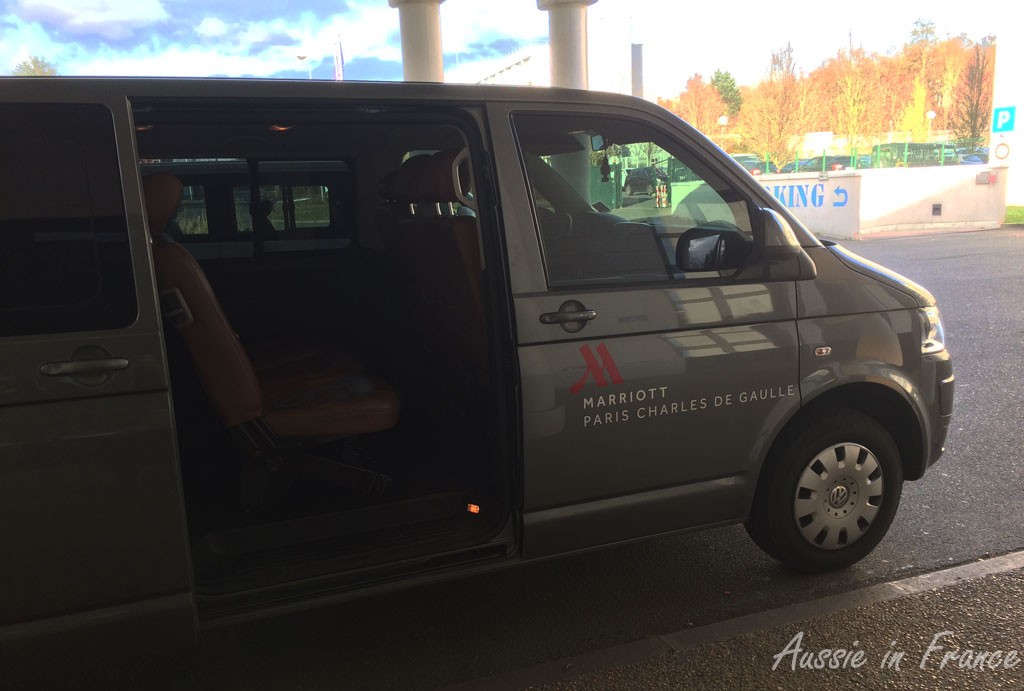
We arrive at the Mariott at 4.30 pm and enter the parking lot with our code (we’ve reserved and paid on-line). We take the lift up to the lobby of the hotel where we wait for about 15 minutes until the free shuttle arrives. It leaves us at the hotel shuttle drop-off point near the train station at the airport. That’s where we’ll pick it up on the way back. Very smooth.

The shuttle bus at the Mariott Hotel

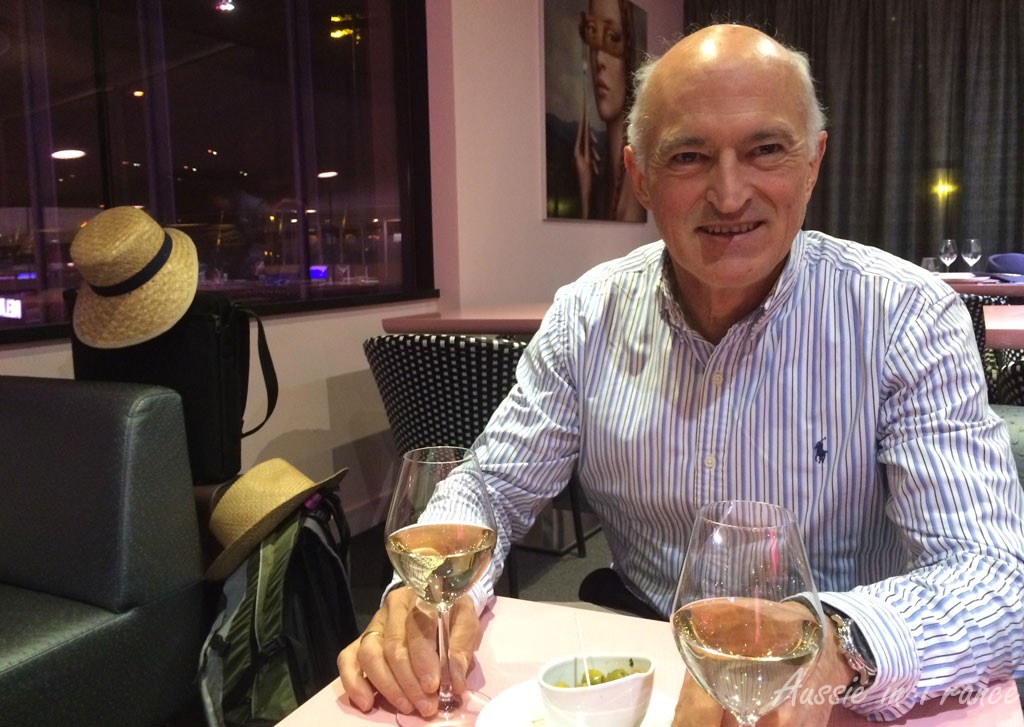
After checking in our luggage at the Air India counter, we go through passport control and security and look for somewhere to have a drink as we have another two hours to kill before boarding. There is now free wifi throughout the airport BTW. We reject MacDonalds despite its luxurious looking sofas but can’t seem to find an alternative. Just when we’ve despaired of finding anything better, we see that Fauchon has a bar. We are practically the only people there. You wonder how they can even survive although admittedly February is not peak season.

Having a drink at Fauchon's bar at Charles de Gaulle
Having a drink at Fauchon’s bar at Charles de Gaulle

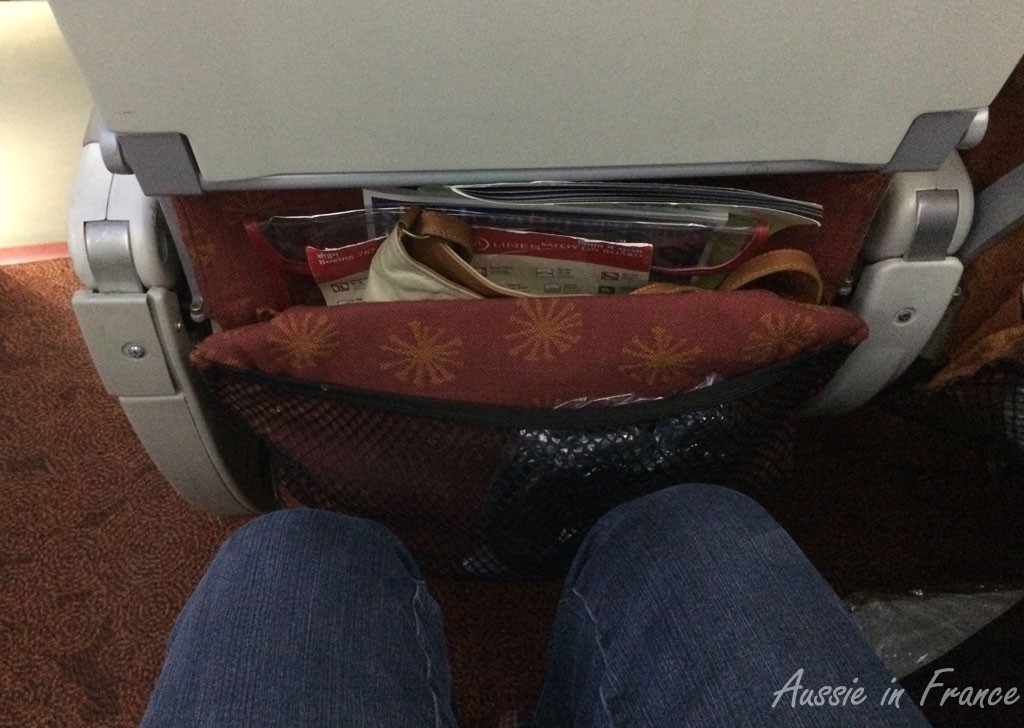
We are pleasantly surprised by the leg-room in Air India’s hi-tech Boeing 787-8 Dreamliner. The last time we went on a long-haul flight, we could hardly move our legs. The service is not very good nor very friendly, but we’ve chosen Air India this time because the prices are very competitive. My head phones are broken and not very comfortable. I’m given new ones and we watch the King’s Speech which I’ve already seen and enjoy again. We stop from time to time so that I can explain to Jean Michel the parts he hasn’t understood. I don’t get a wink’s sleep during the 7 ½ hour flight but at least I get some rest.

Good leg room in the new Boeing Dreamliner

Passport control on arrival at 9.30 am in Delhi is quick and easy and we have soon picked up our luggage (both suitcases are there to our relief – on our return trip from Australia 3 ½ years ago, Cathay Pacific permanently lost one of our cases). We change some euro into rupees (71 rupees for one euro which means we have to start thinking in thousands) and are met as we come out of customs by Shiva, from Trinetra Tours which we have chosen because it has one of the best ratings on Trip Advisor and the services seem to correspond to what we are looking for.

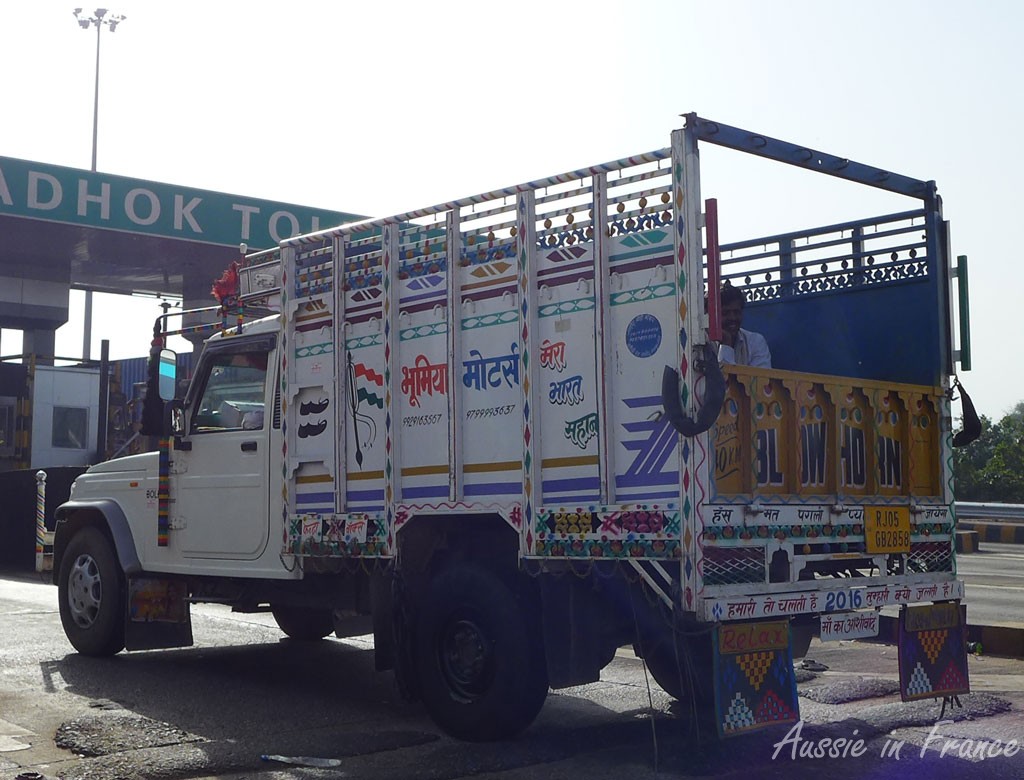
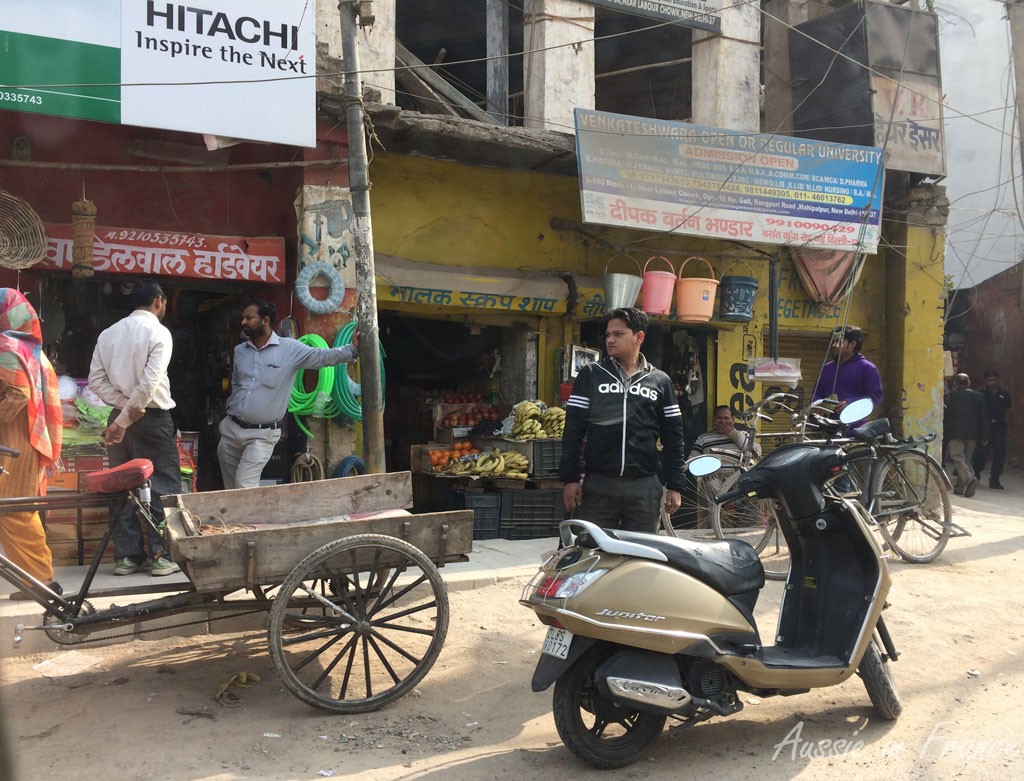
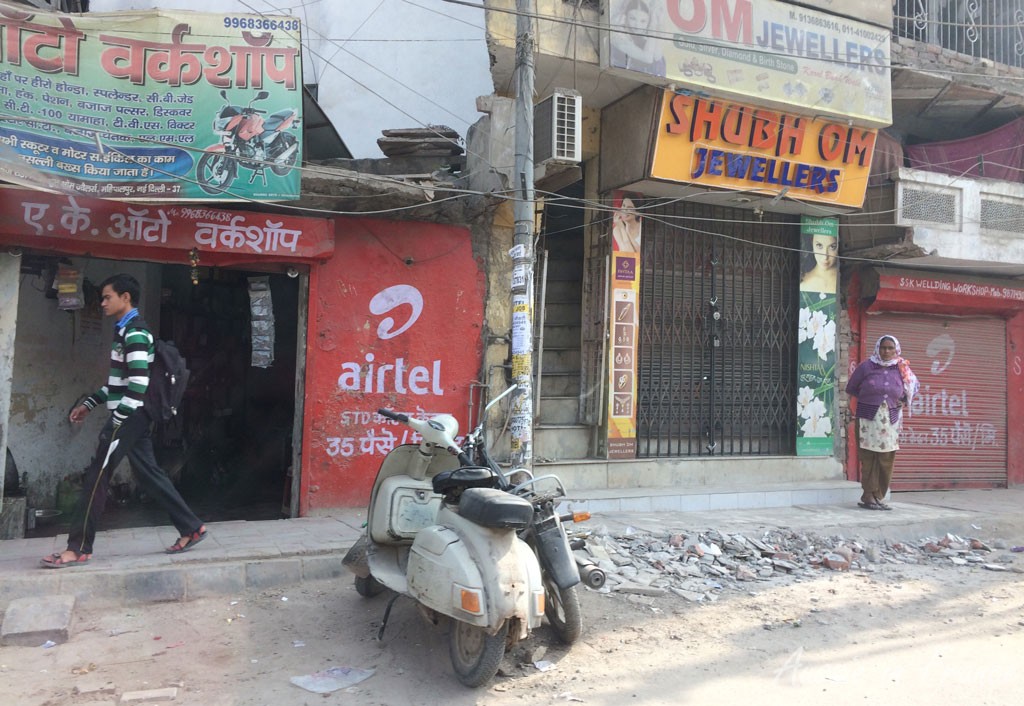
Old and new in Delhi

He greets us and takes us out to our airconditioned chauffered car driven by Anand. This beats having to fend for yourself in a country like India!  Shiva outlines our Delhi Delights tour (we are leaving for Sydney the next day at 1.15 pm so it’s essentially an afternoon tour) and gives us our vouchers, information about tour etiquette including tips, and the itinerary for our 5-night Golden Triangle tour on our way back from Australia in mid-March. We will tip Shiva 500 rupees, Anand 300 rupees a day and our French-speaking tour guide who is joining us at our hotel at 12.30 pm, 500 rupees per day.

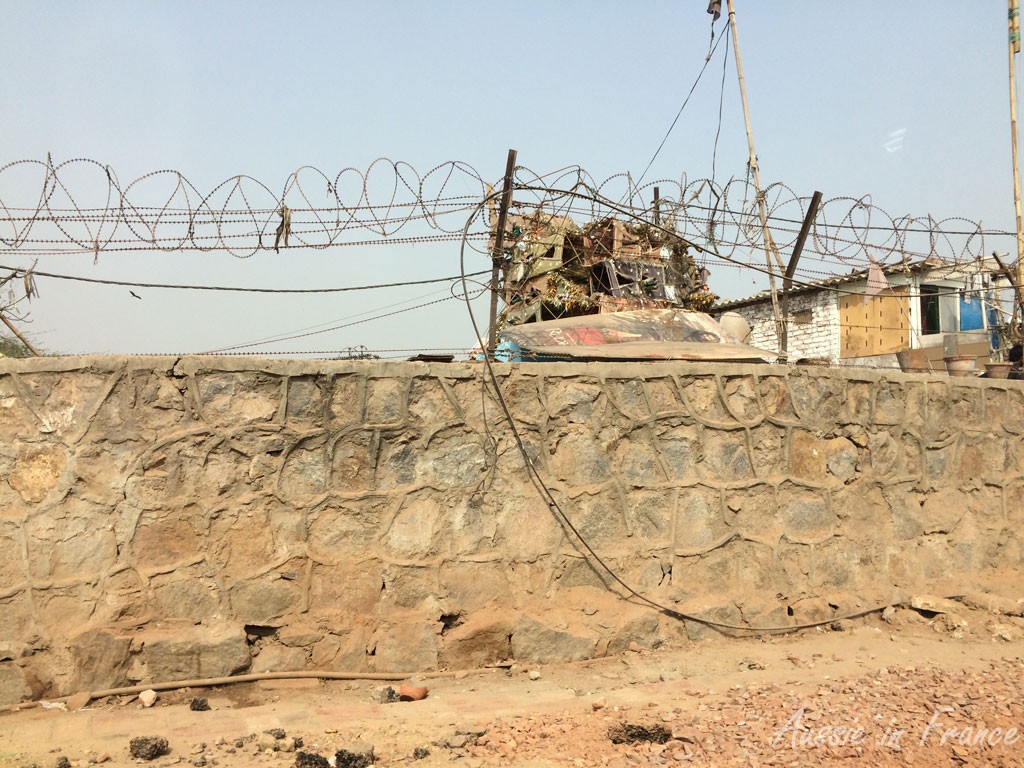
There is a lot of barbed wire in Delhi

The drive from the airport to our hotel, Jüsta Residence Greater Kailash, is an eye opener for Jean Michel. He’s surprised there are no skyscrapers, considering that New Delhi has a population of 16 million people. Perhaps they are some further out but throughout the day we see only very moderate high-rise buildings.

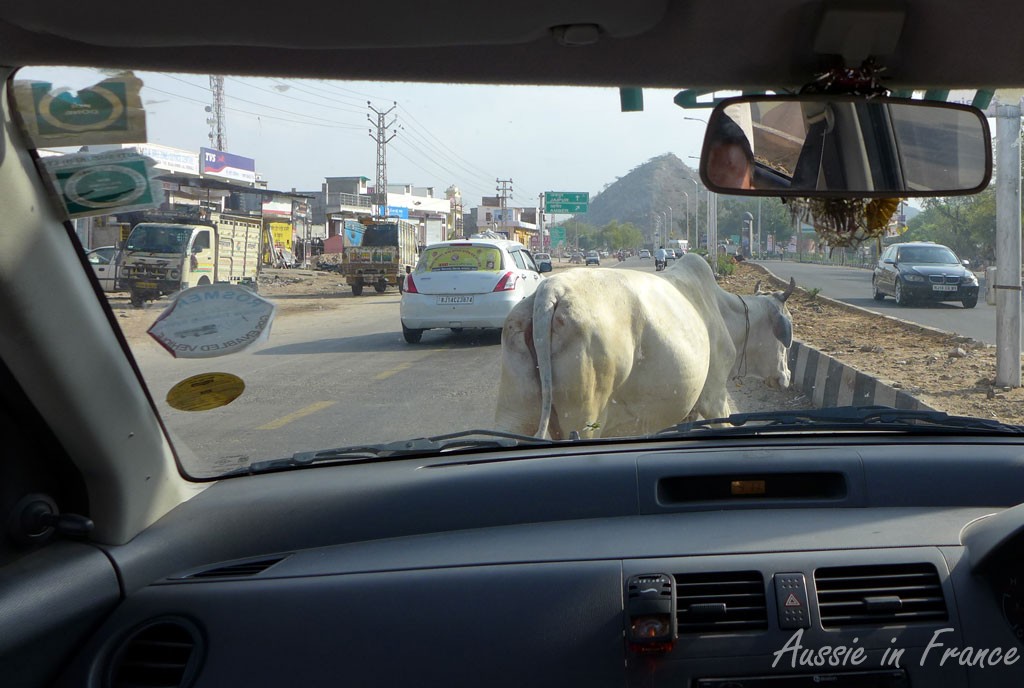
On the road from the airport

We drop Shiva off halfway along and Anand, whose English is much more basic but still sufficient, takes over, telling us about the transport system – a metro, 4 types of buses and 4 types of taxis and rickshaws, if I remember correctly – and asks us information about ourselves. Where do we come from, how many children do we have, how old are they, etc. We inquire about his own family.

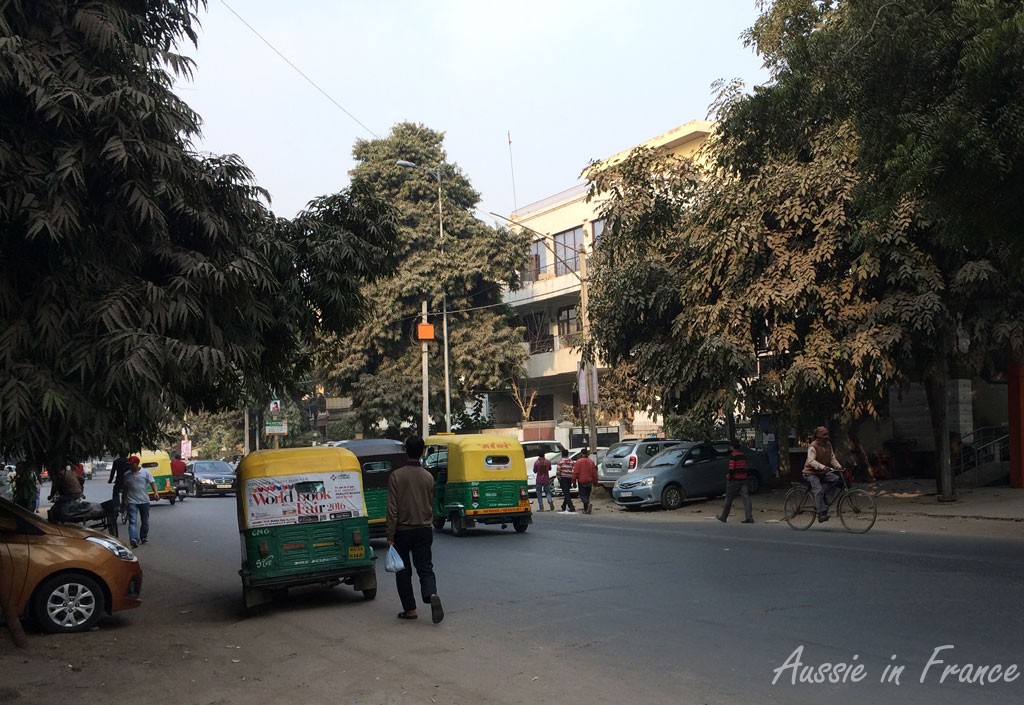
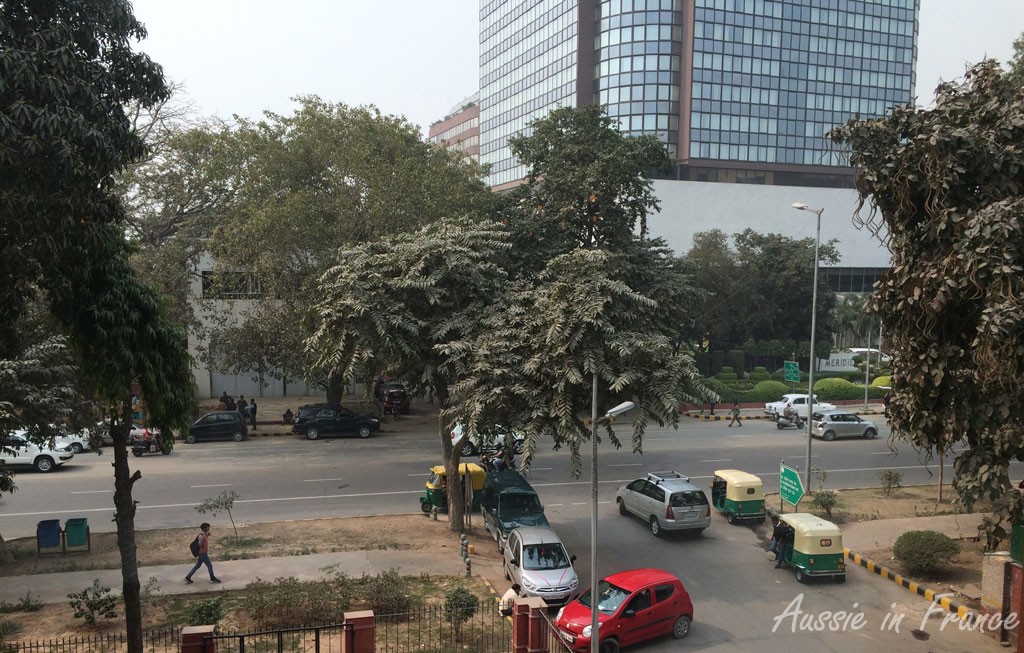
The street in front of our hotel

He and his wife are from the Himalayas and had an arranged marriage 22 years ago and are very happy. They have three children, 13, 15 and 17, and his 91-year old mother also lives with them. He tells us that 70% of marriages in India are arranged and 90% in the Himalayas. There are more love marriages in the big cities

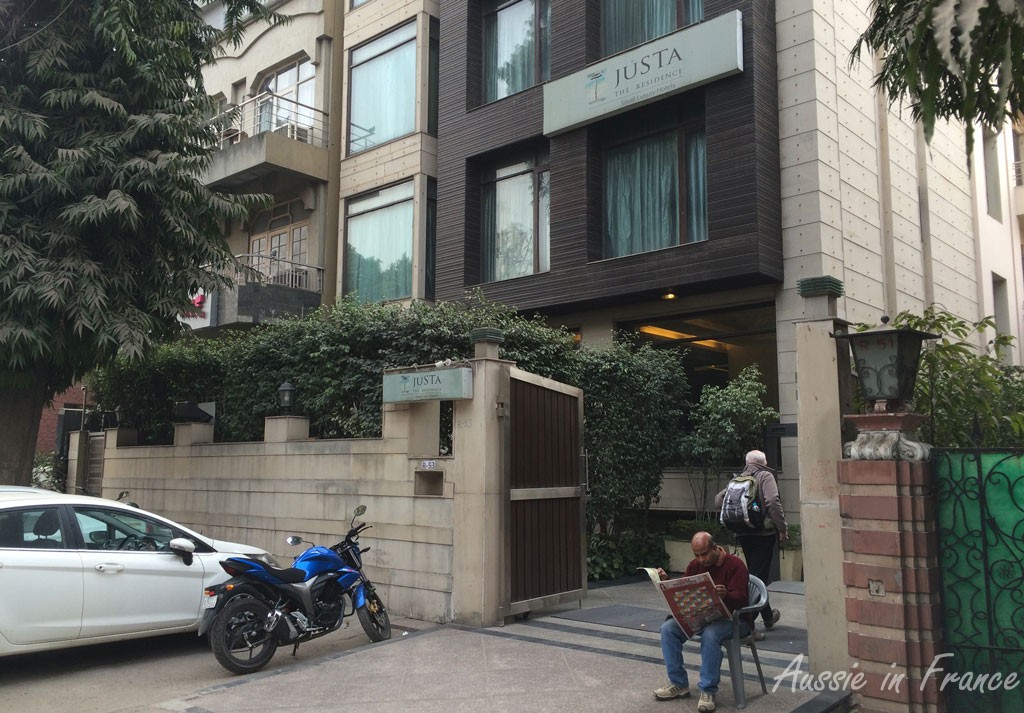
The Justa Greater Kalesh Hotel
The Justa Residence Greater Kailash Hotel

He points out various buildings as well, showing us in particular where the civil servants and middle class live, many in enclosed residential areas. He tells us our hotel is in a chic area. It’s hard to really tell, but there aren’t any slums.

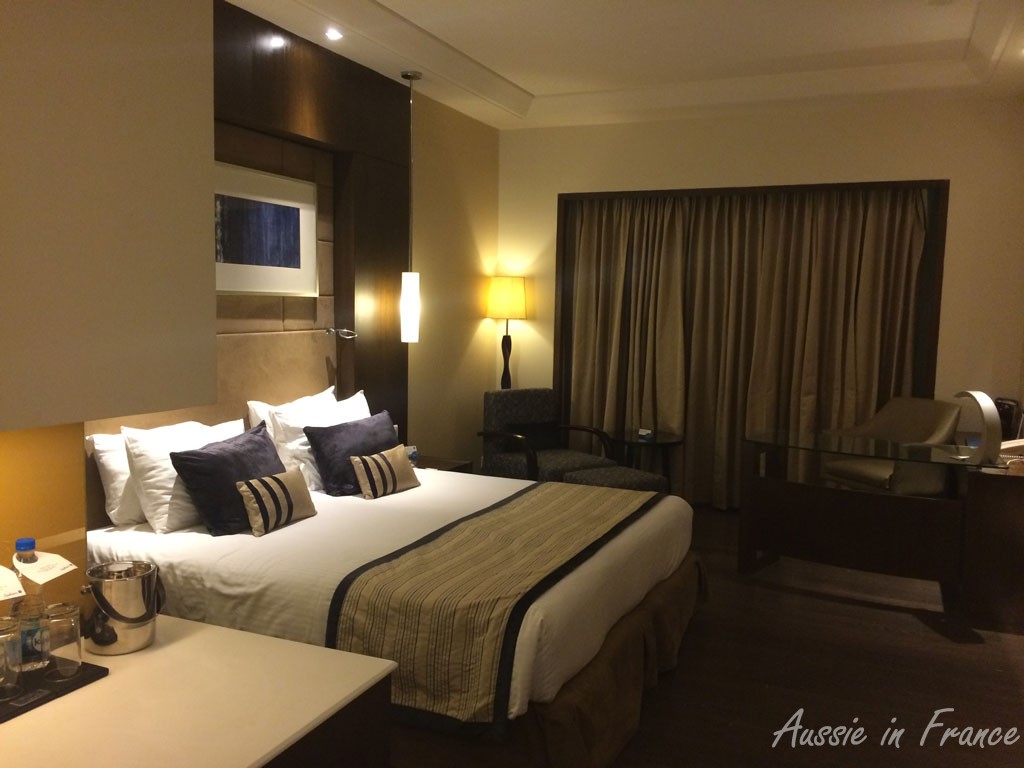
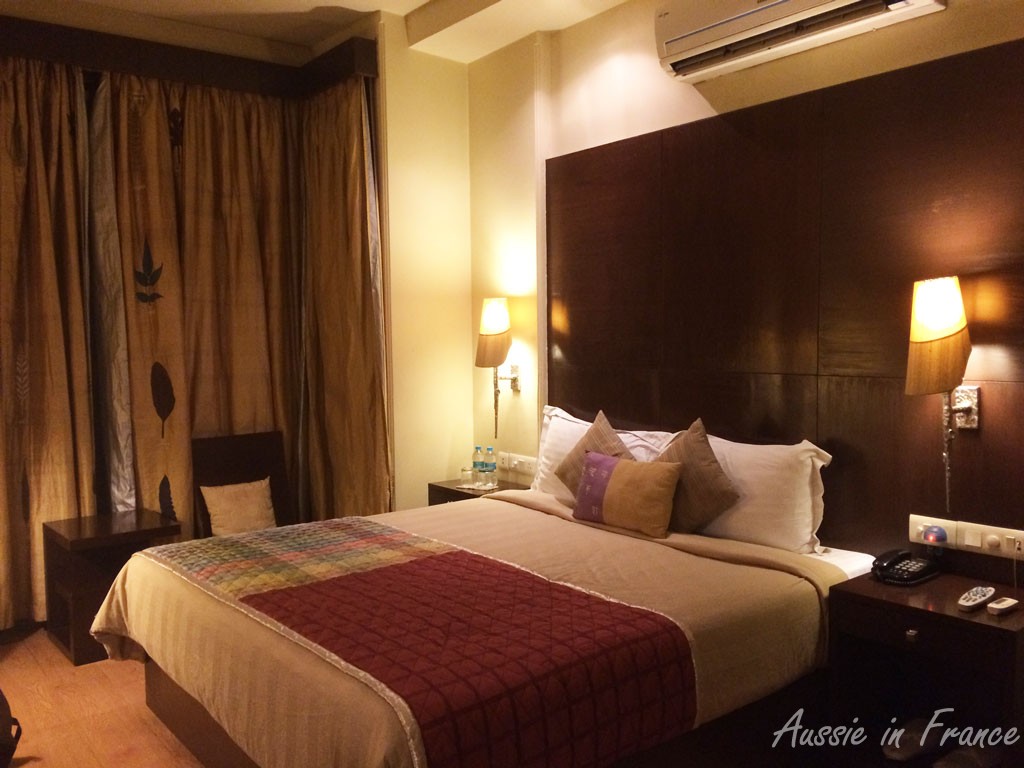
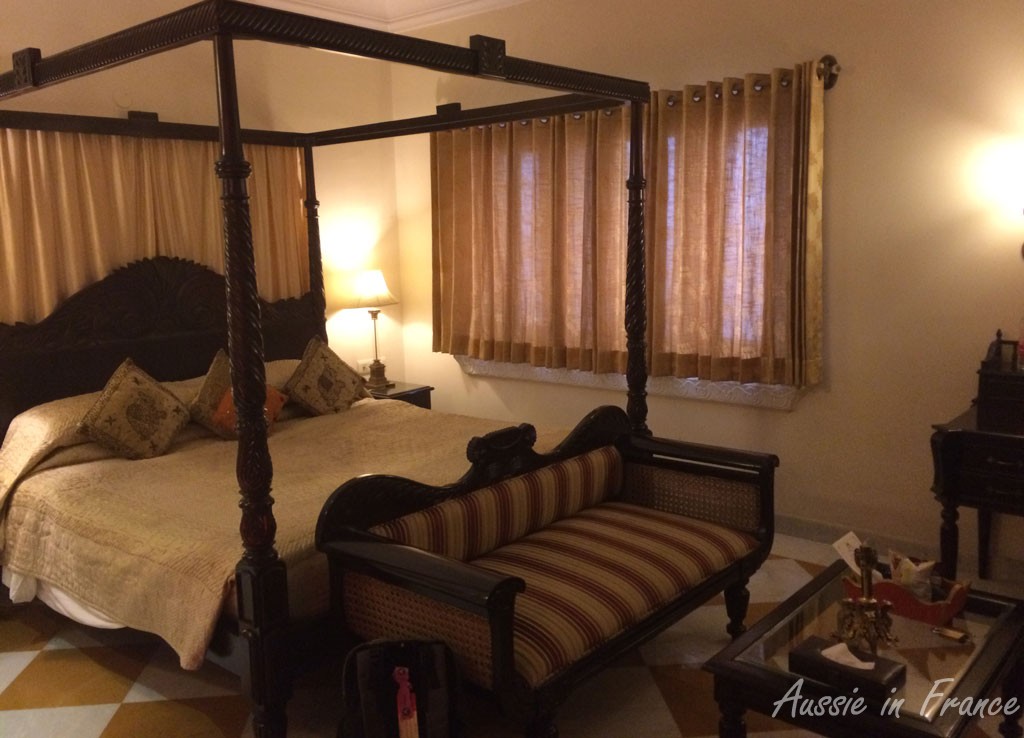
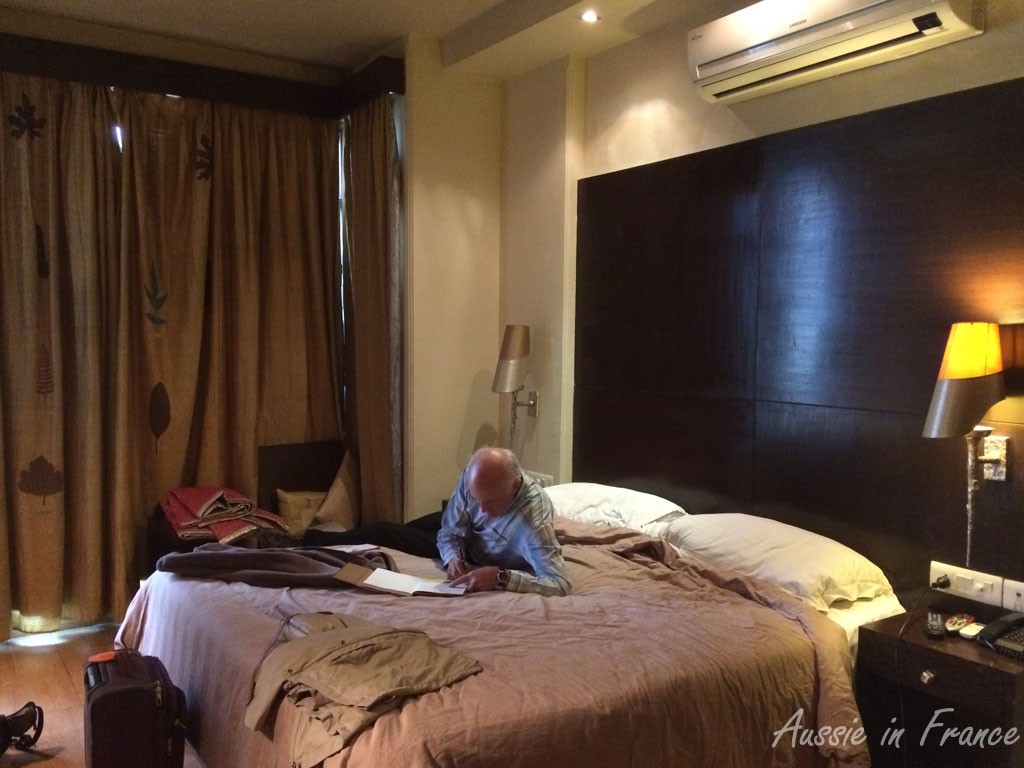
Our bedroom at the Justa GK Hotel
Our bedroom at the Justa Residence GK Hotel

We pull up outside the hotel which is not very pretentious from the outside and are swooped on by several young men who take our luggage. We arrange to meet with our French-speaking guide and Anand at 12.30 pm and go up to take a shower and get changed. It was 13°C when we arrived but it’s a cloudless sky and the temperatures will reach 26°C during the day.

The Meridien Hotel, one of the few high-rise buildings in the centre

I check the tipping instructions and we give 50 rupees to the bellboy who brings our cases in one at a time. The room is clean, pleasant and reasonably spacious. However, there is no bath mat, only two large towels (no small ones) and the shower takes a long time to drain. There is an electric jug but no tea and only one cup. Thank goodness I brought a couple of tea bags. The attractive silk curtains have a problem in the middle. It seems very noisy but at night it turns out to be fine.

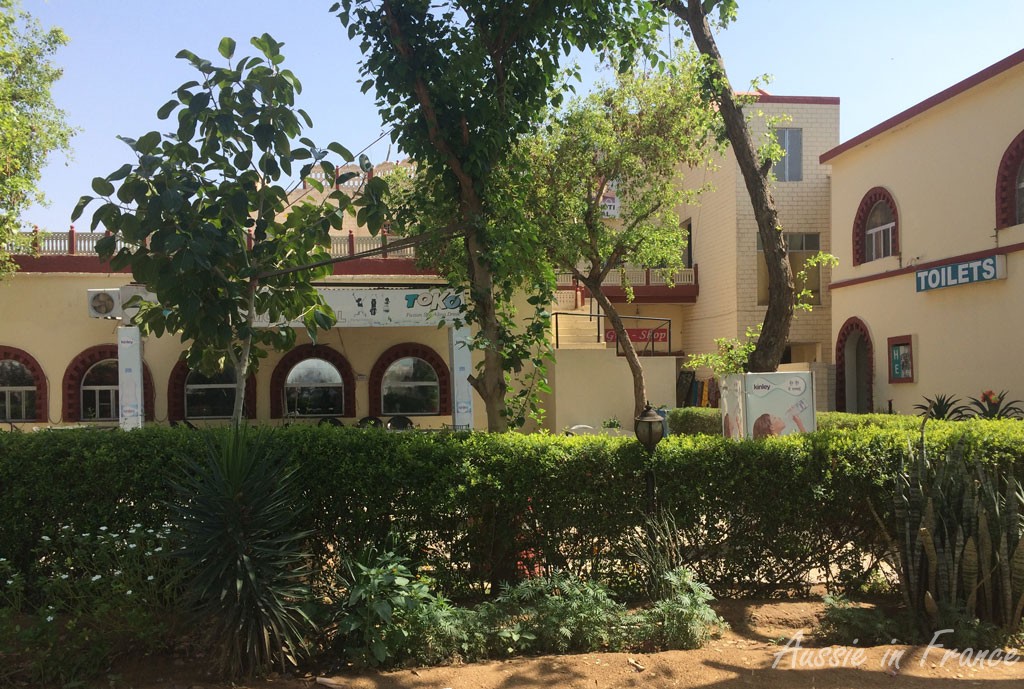
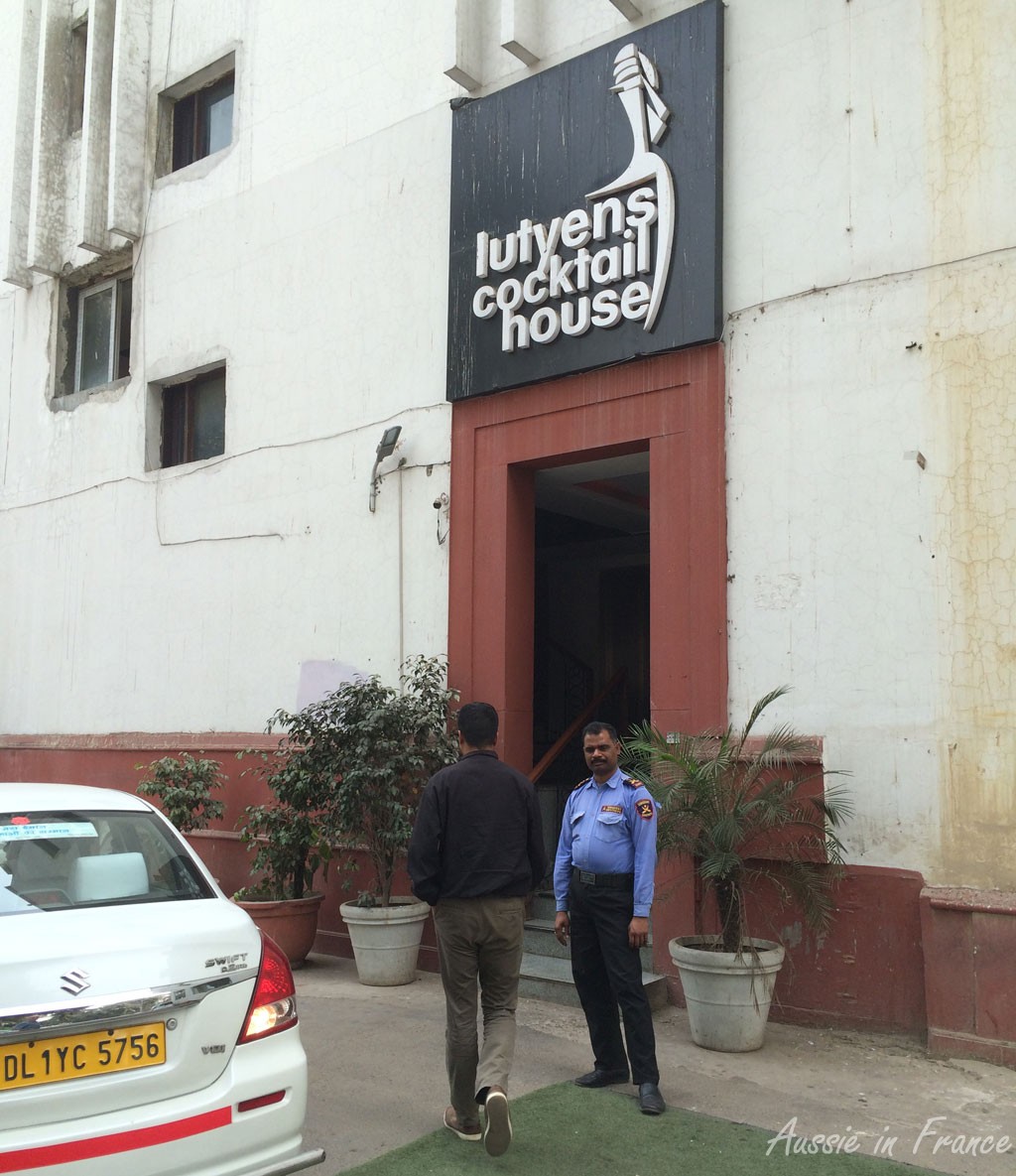
The Lutyens Cocktail House, not exactly what we were expecting

I think it’s one of those hotels that was probably very nice when it first opened but suffers from a lack of maintenance as so often happens. We sort out what we need for the day and join our guide, Summer, and Anand to go to lunch at the Luytens Cocktail Hotel, not exactly what we are expecting …

The Indian Visa

We’re fairly seasoned travellers and have made a lot of stop overs between France and Australia in our time so aren’t too worried about getting our Indian visas for our forthcoming visit to Delhi on the way to and from Australia. We know that we have to apply within 30 days of our departure date. We leave on 11th February.

Jean Michel says he’ll look after it and soon discovers that as we live in France, we have to go through an agent call VFS.

With a lot of difficulty, he manages to log onto the correct site and start filling in an on-line form in English. He has a French pdf put out by VFS which explains what to do. He has a lot of questions so I decide to have a look at the form myself. The whole thing is so frustrating that we decide to go and have lunch.

When we come back, we discover the form has disappeared and Jean Michel forgot to copy down the temporary reference number immediately so has to start again. I manage to lose my form too before recording the reference number. After that, it’s the first thing we do!

We argue about whether he should put AVRIL Jean as his father’s name or Jean AVRIL. The French pdf says AVRIL Jean but I’m worried it might complicate matters if the names are reversed. Then we discover too major problems that are going to prevent us from applying on-line : I have two passports and the Indian government wants to see them both, and we are enter India twice at an interval of less than the stipulated two months.

There is a pay-for help line so we try phoning. I don’t understand what’s being said in English and the woman obviously doesn’t know what I’m asking so I hang up and Jean Michel tries to get a French help line. It’s much better.

The order of the names doesn’t matter, we are told. Yes, I have to submit both passports. The two-month interval may or may not be a problem. We’ll have to go to Paris to submit our applications.

Before we go, we pay a little visit to a local photography shop to have our special SQUARE photos taken. They don’t do them, of course, and send us off to another shop out on the other side of town. We pay 13 euro each to have 4 photos taken although we only need 2.

I suddenly realise that I will need to apply to have my visa in my Australian passport because I am not allowed to enter Australia on my French passport. I phone the help line again and they explain how to do it, though it takes a while for me to really understand what I’m supposed to do.

On an old VSF website it says I have to fill out a special form if I have two passports but the only form I can find is for people applying in France who aren’t French. I print it out anyway.

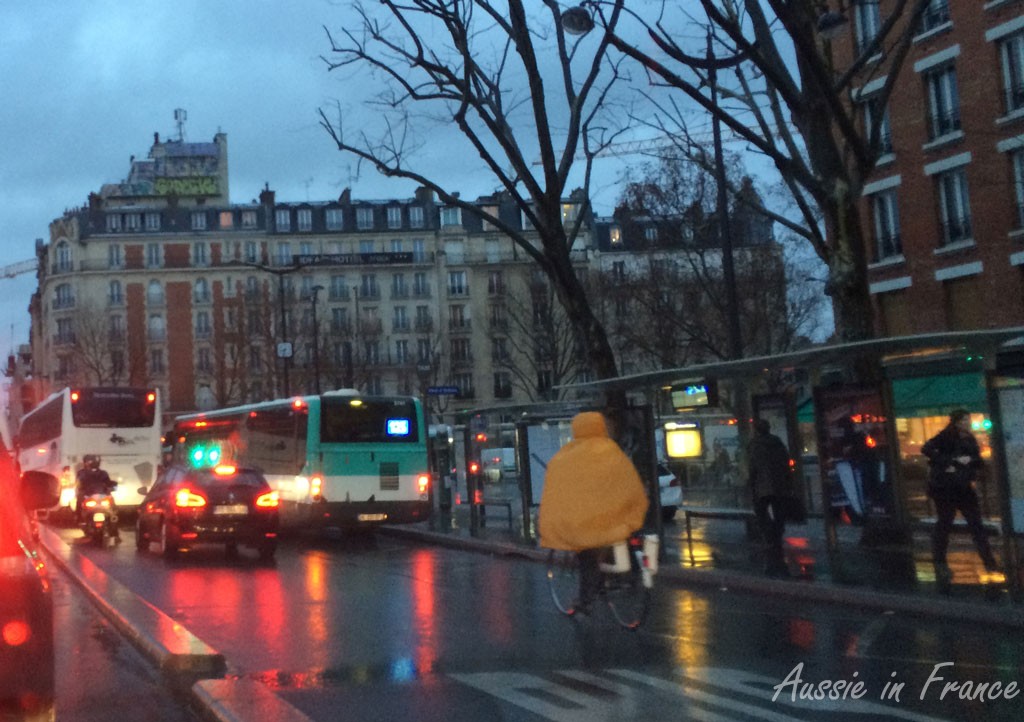
Rainy streets of Paris at sunrise

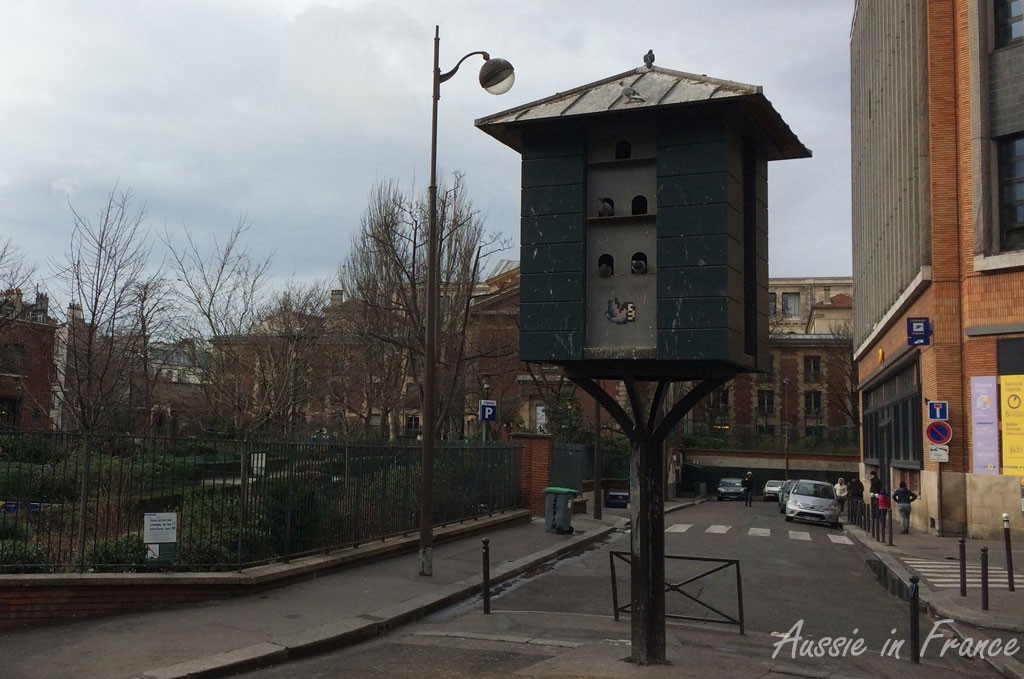
The Indian Consulate in the 10th arrondissement in Paris is only open in the morning so we get up at 6 am on Wednesday 27th February (it’s still nighttime here are that hour)  and arrive at the Consulate just after nine in the rain. First we go to the nearby post office which is just next to a very suave pigeon house to buy the two Chronopost envelopes (26 euro a time) that we are told we will need.

The pigeon house
The pigeon house

By 10.30 am, our mission is accomplished. It turns out that I do indeed have to fill out the “non-French” form. Who am I to argue ? The 2-month interval between visits is no longer relevant. They’re changed the rules. We have to ask for a multiple-entry, 3 month-visa. Fortunately we are paying our 164 euro (gulp) by Visa Card because it shortens the queue considerably. There are, in fact, an amazing number of people in the room, but I guess India is very populated.

The man at the desk does not want our Chronopost envelopes (that goodness Jean Michel only filled out one of them) because they use their own. We are asked to put our name and address on an ordinary envelope instead. We are told that Jean Michel’s visa will take about 4 days and mine will take 6.

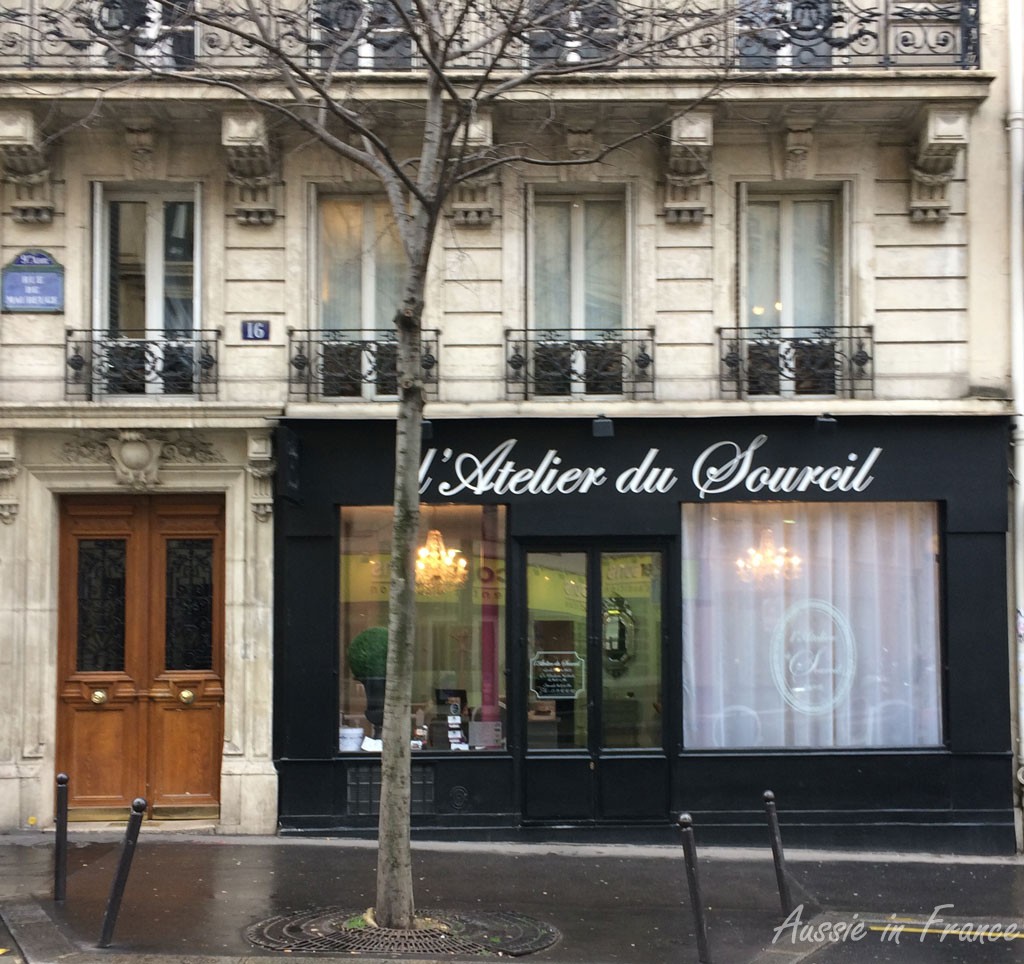
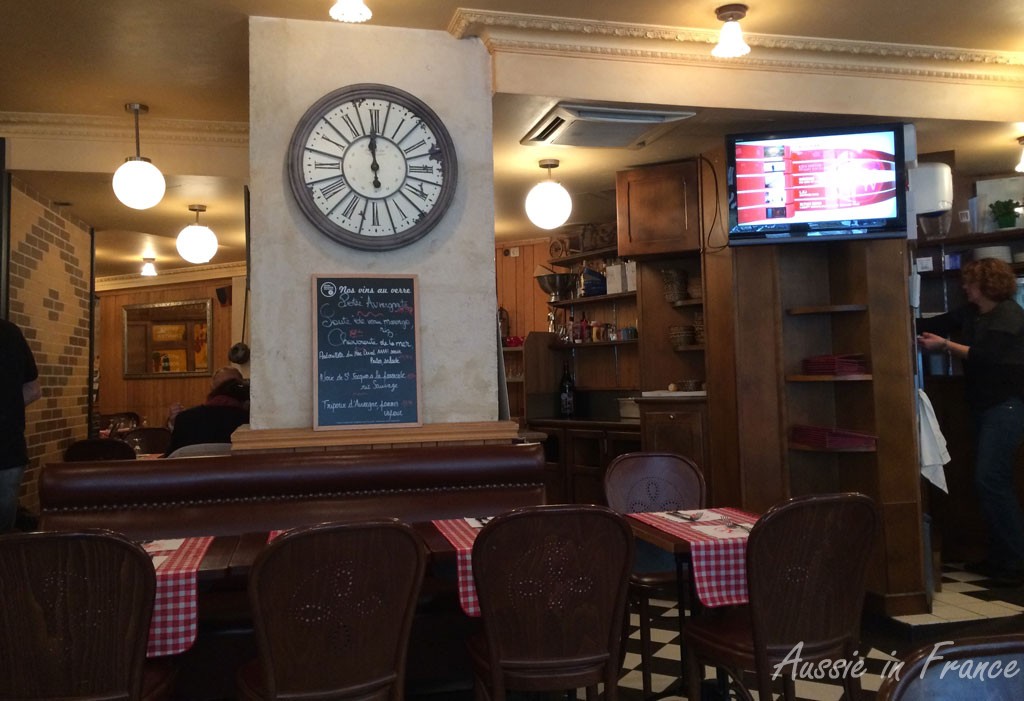
L'Atelier du Sourcil - The Eyebrow Workshop
L’Atelier du Sourcil – The Eyebrow Workshop

By the time we leave the consultate, we are feeling somewhat frazzled. We decide to walk around for awhile until lunchtime. I’m chasing after green hand towels green is not the fashionable colour at the moment (except lime green) so I don’t find any. We do see an Eyebrow Workshop though.

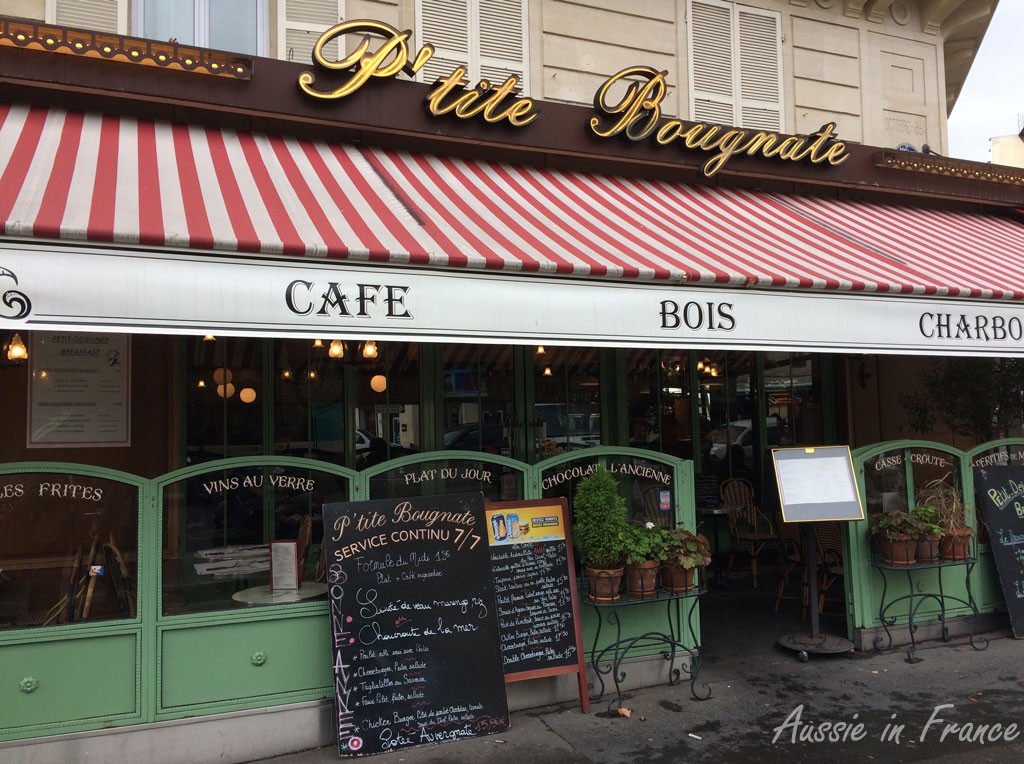
P'tite Bougnate
P’tite Bougnate

We then eat in a bougnat before driving back to Blois. I have never heard of a bougnat but Jean Michel explains it means coal merchant. It was traditional in Paris for coal and firewood merchants to run cafés as a sideline. They usually came from the Massif Central in the centre of France.

Inside teh bougnat
Inside teh bougnat

We both receive an SMS next day saying our visas are being processed. Well, that’s a relief. I receive an SMS and an email on the following Wednesday (whole week later) saying that VSF has received my visa and their postal service is looking after it. It should arrive in 2 to 3 days.

Jean Michel receives nothing. The next day, the Chronopost man delivers my two passports and visa. Jean Michel is getting increasingly worried about his so  phones the VSF oay-for hotline again but is told that they can do nothing. It’s in the hands of the Indian consulate. Great!

The next day, Jean Michel finally gets an email to say that VFS has now received his visa too and it’s being processed by their postal department. The next day is Saturday of course so there is no sign of the Chronopost man.

On Monday, at 9.30 am, Jean Michel sees a van outside the gate and dashes out. The letter’s in the box, he’s told. And there it is. Exactly 12 days after we submitted the visa application we have both our visas with a whole 3 days to spare. Yay! Delhi and the Taj Mahal, here we come!

A Monumental Afternoon

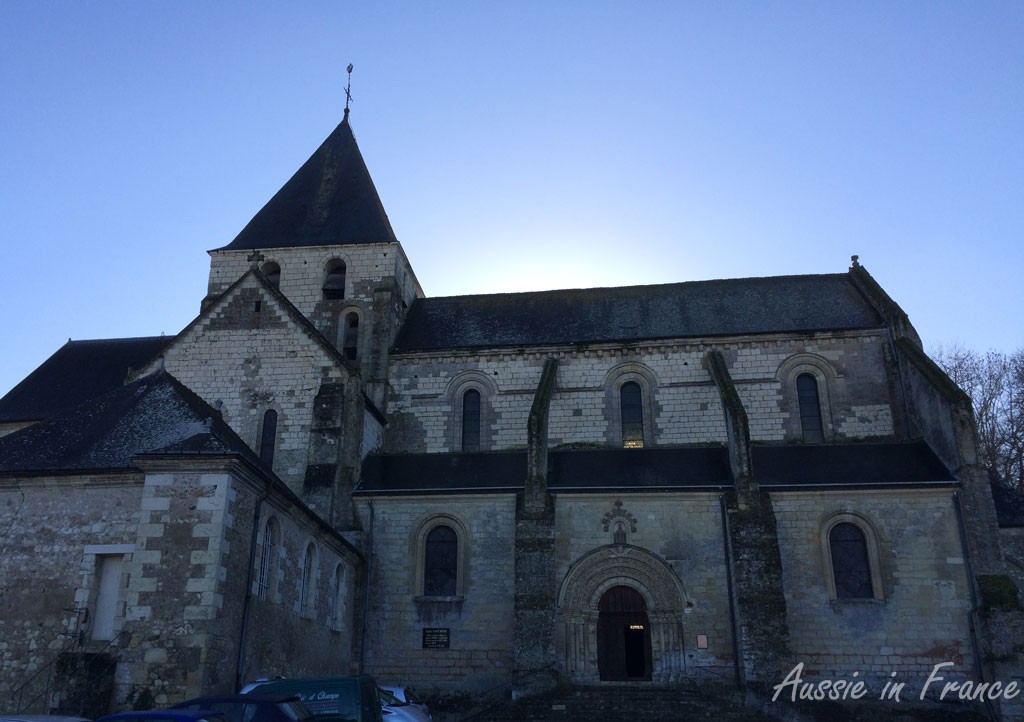
We’re in Amboise in front of the Church of Saint Denis, waiting for our friends Susan and Simon from Days on the Claise. We’re here for a purpose. Susan wants to see some artworks in the church that she has heard about. It’s extremely cold so we go inside and wander around. It’s quite dark and gloomy and I don’t notice anything very interesting.

Collegiate Church of Saint Denis, Amboise, 12th century

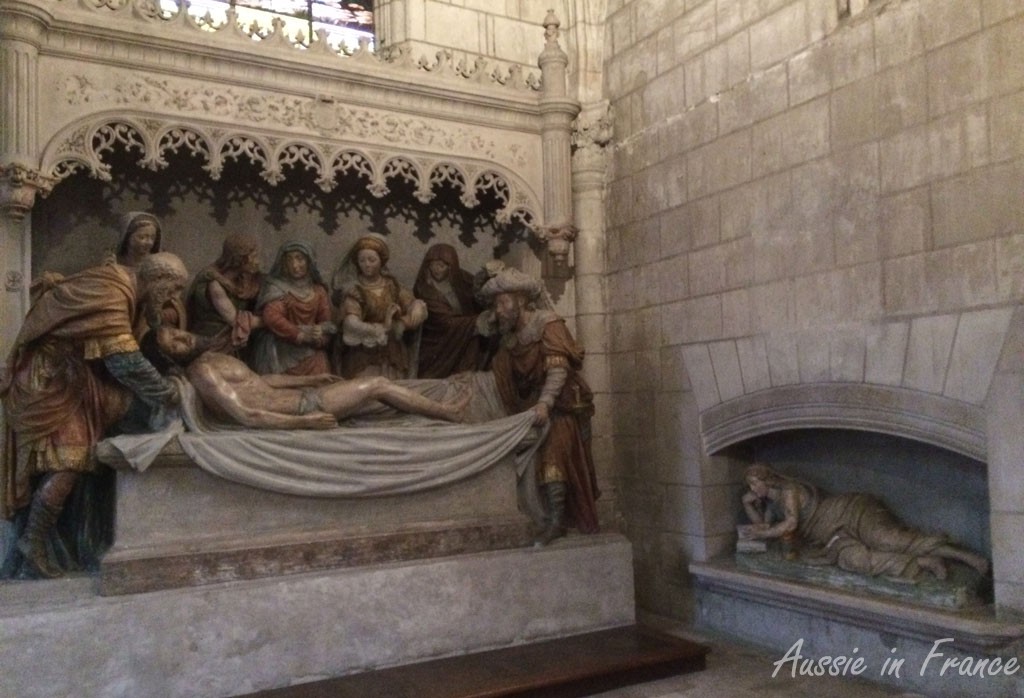
Susan and Simon arrive with Antoinette from Chez Charnizay who is also interested in art. Our mutual friends Janet and Antoine who live in Amboise also join up with us. Susan takes us over the other side of the church in front of a group of statues called a Mise au tombeau which means emtombment and refers to the emtombment of Christ. I wonder why I didn’t notice it the first time.

Mise au tombeau
16th century Mise au tombeau

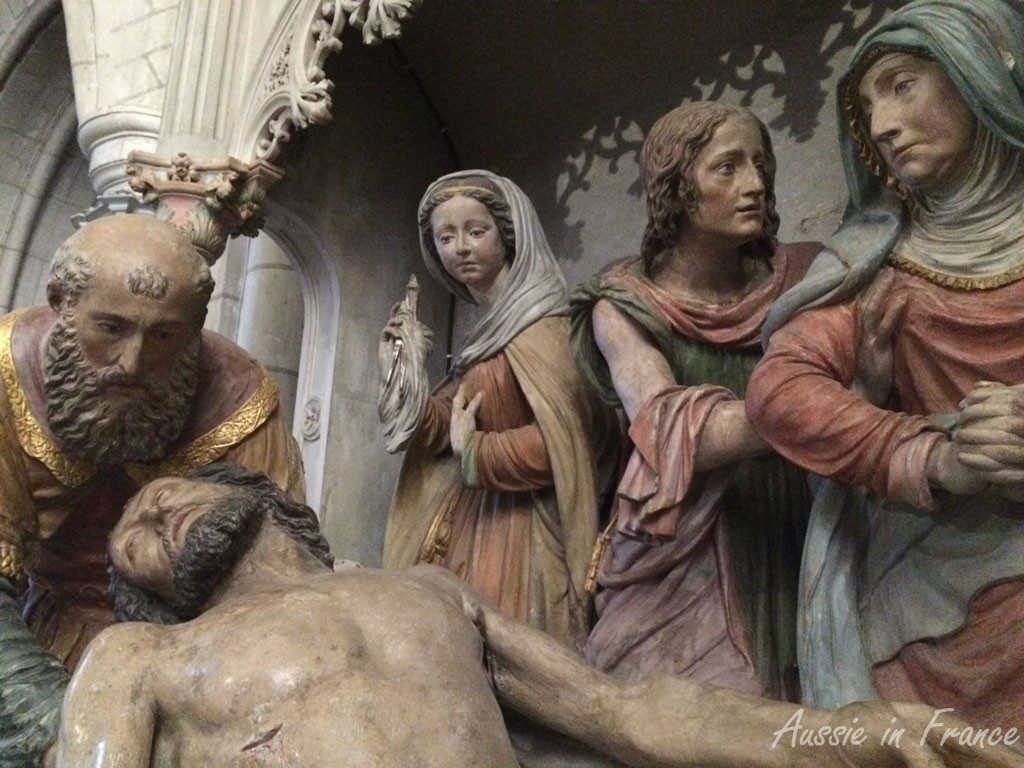
Susan and Antoinette start discussing the different people in the group. It was common practice for patrons of the art at the time – we’re talking about the 16th century here – to be depicted as historical and religious figures.   A man called Philibert Babou, Treasurer to François I, commissioned the group of eight life-sized figures in painted limestone. It is believed that the figures are members of the Babou family.

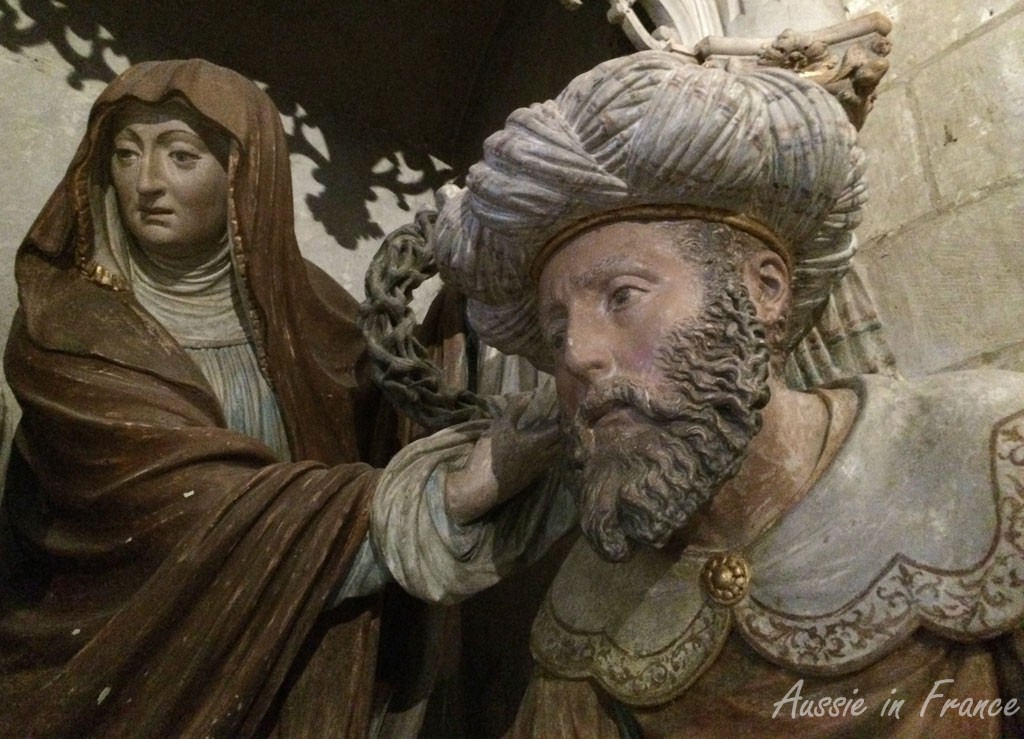
Mary of Clopas and Nicodemus

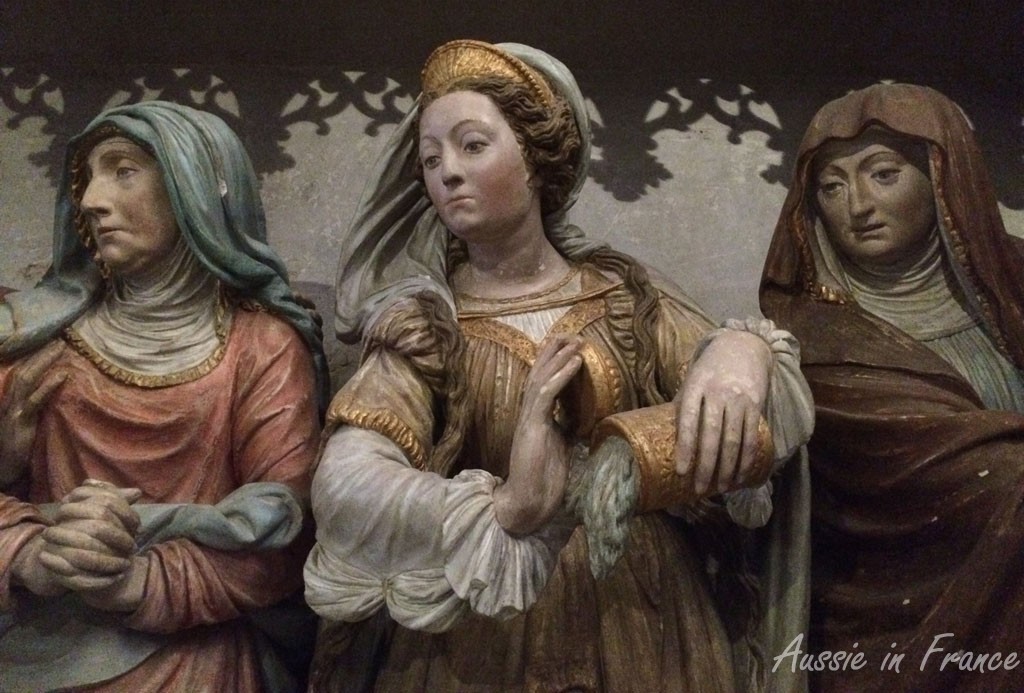
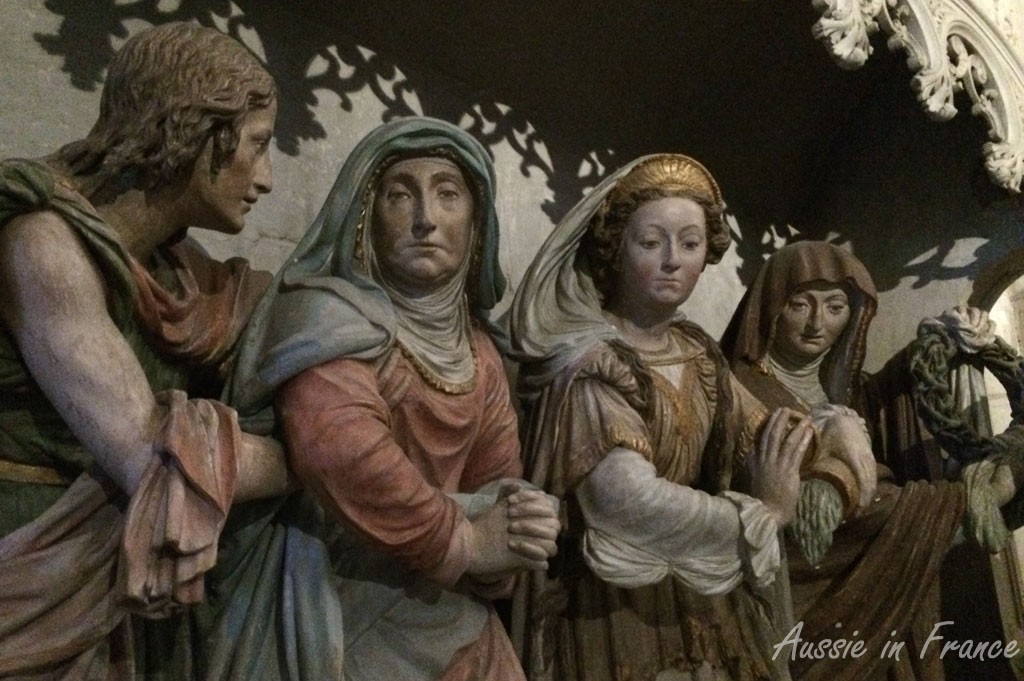
For people who know their religious history, the identity of the original characters should not pose a problem : Joseph of Arimathea, St Veronica, St John the Evangelist, the Virgin Mary, St Mary Magdelene, Mary of Clopas and Nicodemus. However, Susan is very curious about the fact that Mary Magdelene seems to be wearing a crown. Surely the Virgin Mary should be wearing it? Mary is thought to be Marie Gaudin, Philibert’s wife, who would have been about 50 at the time and was considered in her youth to be one of the most beautiful women  of her time. She even had an affair with François I some 30 years earlier.

The Virgin Mary and Mary Magdelene

Antoinette also points out the clothes they are wearing, such as the ornate turban and flowing garments with their liberal gold trimming. Large amounts of fabric indicate greater wealth. The oriental look is typical of the sixteenth century.  The headgear in general is very indicative of status. Mary Magdelene, who has the finest features and most intricate garments of the people depicted, is in fact wearing a gilded headdress and not a crown. Susan finally comes to the conclusion that “the message might be that anyone can come to God and it need not interfere with you looking gorgeous or showing off your assets”.

Joseph of Arimathea, St Veronica, St John the Evangelist and the Virgin Mary

I’m really enjoying myself. Having specialists to point out all these different aspects is far better than a guide book which I soon get bored with ! The two written guides we find in church are not very useful and don’t answer any of our questions. I’m also amazed that they were able to move it to Saint Denis intact from Montlouis further along the river.

Saint John, the Virgin Mary, Mary Magdelene and Mary of Clopas

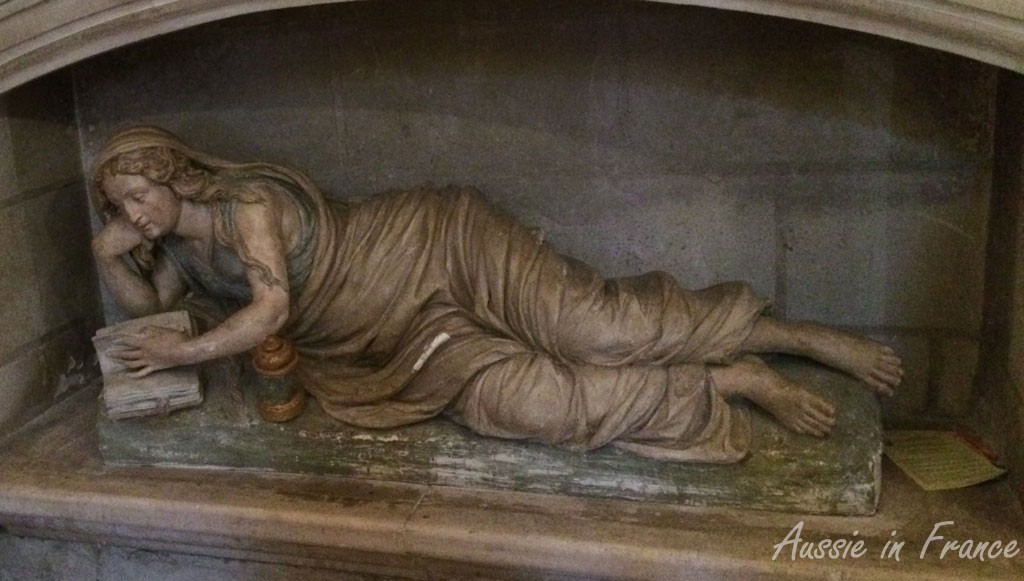
We take a closer look at the reclining figure on the right. It’s Mary Magdalen with a book in her hand and a box of perfume. The sculpture was originally in a chapel in Amboise that has now disappeared. I’m surprised to see MM with a book but Susan tells me this is a typical way of depicting women in the 16th century.

Mary Magdelene reclining

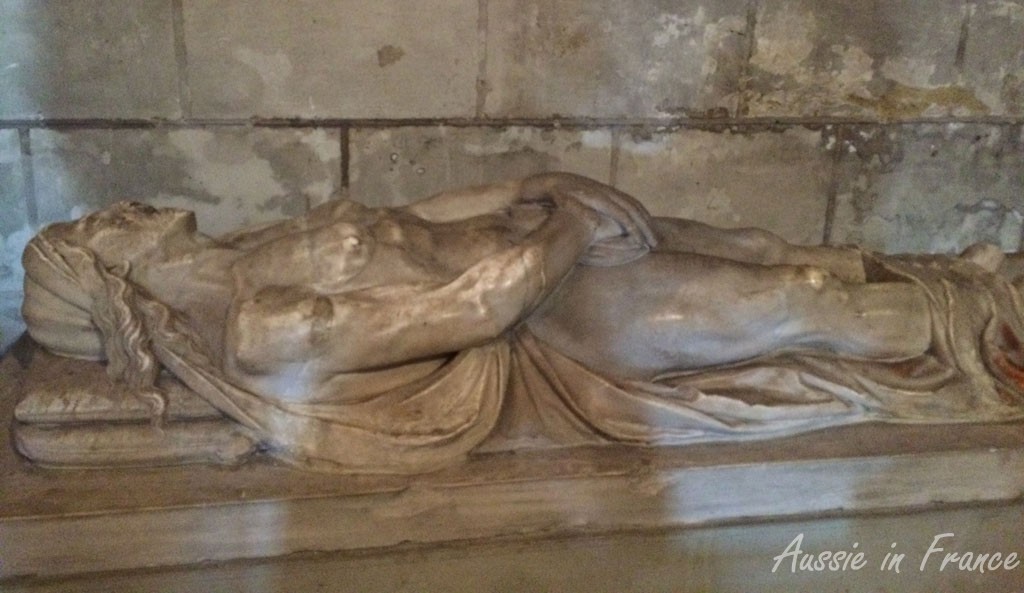
We then move onto the sculpture, known as la femme noyée or drowned woman. We all stand around while Susan explains that it is comes from Bon-Désir Chapel in Montlouis and thought to represent a member of the Babou family, perhaps Marie Gaudin who drowned in the Loire. She then says, “but I don’t agree with that”. It’s true that after we take a look at the smooth muscular thighs it’s seems unlikely that the effigy is that of a drowned woman. Susan adds that she thinks it is exactly contemporary with a similar effigy of Catherine de Medici in the Royal Mausoleum in the Basilica of Saint Denis, Paris. “Catherine rejected the first version of hers because it was too emaciated and gruesome, and I suspect a similar sentiment with this one in Amboise.”

Mary Magdelene reclining

What really surprises me is there should still be so much mystery surrounding two artistic works of such calibre. Susan tells me it’s actually quite common and that, if nothing is known about a work of art, it is just ignored in the local guide books! I go back to the Mise au Tombeau and look at more of the details which are quite amazing. Just the draperies could hold my interest for hours.

The drowned woman
The drowned woman

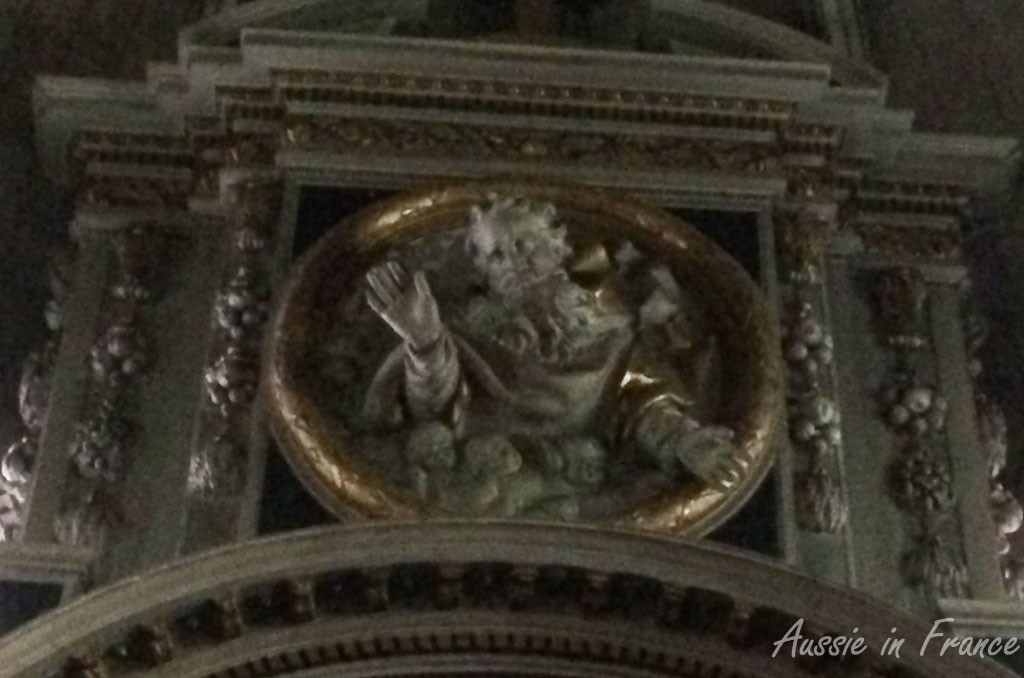
Susan then calls smy attention to another work of art which is part of the altar piece – what can only be a representation of god which, as Susan points out, is most unusual. Only Christ and the Holy Spirit are usually depicted. She later discovers that it is, in fact, the Eternal Father, which corresponds to the first person of the Holy Trinity.

The eternal father on the altarpiece
The eternal father on the altar piece

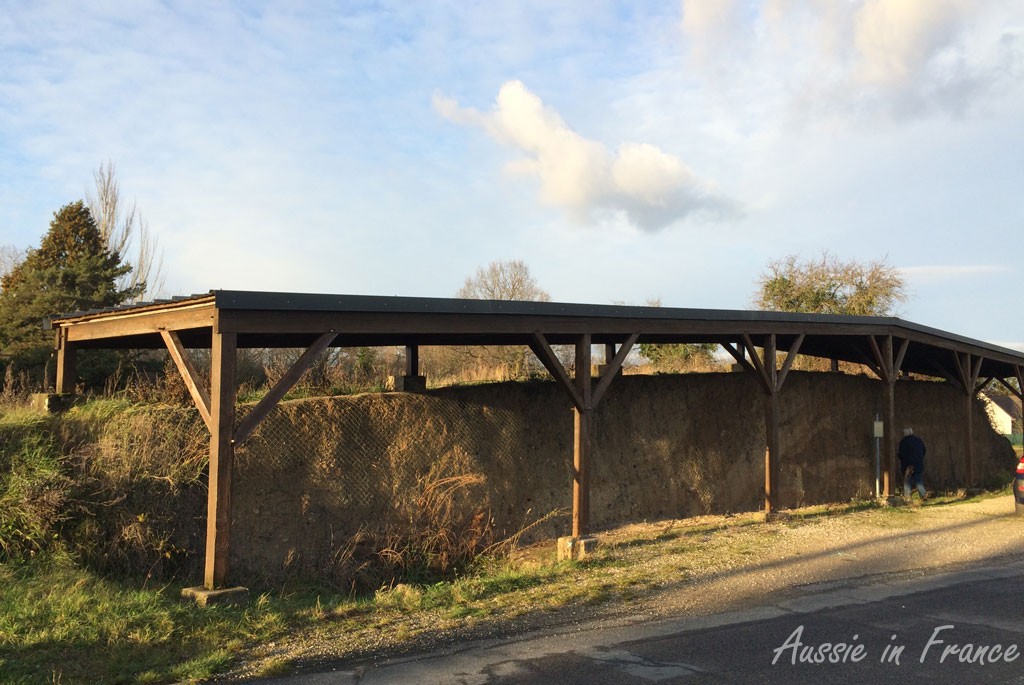
We end our wonderful afternoon a few kilometers outside Amboise at the Gaulish Oppidum where there is a mud rampart that dates from 400 to 50 BC and a mound called Caesar’s Hill overlooking the surrounding countryside. My only regret is that Susan and Simon live in the south of the Loire, an 90-minute drive from us!

The rampart from Gaulish times built from 400 to 50 BC

For more details about the Mise au Tombeau, I strongly recommend that you pop over to Susan’s blog Days on the Claise. She has written a very lively, yet very scholarly account in her usual inimitable fashion.

A Day in Paris with Lunch at Le Lobby

It’s nearly 9 am and we’re about to go to Paris for the day which we don’t do very often. To our immense surprise, the ground is covered in snow!  I run around taking photos and videos while Jean Michel makes sure all the bird feeders are well stocked. This is our first snowfall for the season and totally unexpected.

The roads aren’t too bad although they haven’t yet been sanded and we have to keep in the middle lane until Orléans. As we approach Paris, the sky is a brilliant blue but it’s only a few degrees so quite cold.

Driving past Notre Dame on our way to Au Vieux Campeur

Our first stop is  Paris’ best-known sports store – Au Vieux Campeur near Saint Germain des Prés – because we need to replace our falling apart Meindl Capri walking sandals to go to Australia next month. We tried to buy the same ones on the Internet, to no avail. Buying sandals in winter is not a great idea.

Pick the new sandals!

Despite the churlish, know-it-all salesman – even Jean Michel thinks he is terrible – we manage to find a suitable pair of sandals before we each go our separate ways. I have to admit the new Teva ones are much more stylish. Jean Michel is having lunch with a former colleague and I am meeting up with my lovely friend Mary Kay from Out and About in Paris who is soon to go and live in Prague. I am not the only person who will miss her.

The conciergerie from Notre Dame bridge

As I walk across the Seine to Notre Dame then past the Conciergerie and over the river again to the right bank and my metro at Hôtel de Ville, I can’t stop taking photos, the sky is so clear and sharp.

The Arc of Triumph
The Arc of Triumph

I emerge at the Arc of Triumph  which is also looking good with so much blue sky around it and head for the 5-star Peninsula Hotel on Avenue Kléber where Mary Kay and I are having lunch in Le Lobby recommended by Janine Marsh in a recent post in her blog, The Good Life magazine, relayed by Susie Kelly on No Damn Blog.

The Peninsula Hotel
The Peninsula Hotel

After 5 years of renovation, the lobby of the Peninsula is, indeed, a splendiferous setting. The welcome and service, of course, are impeccable. I can even forget my iPhone on the table while I wash my hands and find it still waiting for me.

Our sword fish to rhyme with sworn

We choose the 60 euro set meal that includes a glass of wine and bottled water. A very tasty Jerusalem artichoke and foie gras soup is followed by beautifully cooked sword fish (which the waiter pronounces to rhyme with sworn) on a bed of vegetables. We finish with cheesecake on a strawberry crust which is somewhat disappointing especially as I’m not a big fan of France’s favourite fruit.

The Oiseau Bleu biplane on top of the Peninsula

Mary Kay, who has been to the L’Oiseau Bleu restaurant and bar several times then takes me up to the roof of the building. The view of the rooftops of Paris with Sacré Cœur in the distance is stunning. I make a vow to come back here for a drink in the summer.

The Oiseau Bleu summer terrace with Sacré Coeur in the background

L’Oiseau Bleu is named after the biplane that disappeared on 8th May 1927 with its two French pilots, Charles Nungesser and François Coli, during the first attempt to fly non-stop across the Atlantic from Paris to New York. Less than two weeks after their disappearance, Charles Lindbergh was the first to make the crossing, but in the other direction, on board the Spirit of St Louis. No trace of the Blue Bird has ever been found. There is a replica of the plane on the roof.

The main square in Paris alive with music
The main square in Prague alive with music

I am sad to leave to leave Mary Kay but hope to see her again before too long, perhaps in Boston or New York now that Leonardo and Black Cat are both living there. Much as I enjoyed the week I spent in Prague several years ago, it isn’t on the agenda again for the moment, but who knows?

Friday’s French – Content, contented, satisfait, satisfied, heureux, happy

Content is another one of those words that does not necessarily have the same meaning in French and in English.

Je suis contente de te voir = I am happy to see you. You can also say Je suis heureuse de te voir but I’d say it’s more emphatic. Heureux (heureuse) is usually reserved for expressing happiness: Je suis heureux d’être là = I’m happy to be here. Note that in this context, means “here “and not “there”. I’ve written another post about here and there.

Trois amies bien contentes !

Content in French can also have the meaning of the English contented. Je suis contente de rester là = I am content to stay here or I am happy to stay here. Contentment can also be expressed by using satisfait. Je suis satisfait de mon choix – I am contented with my choice.

I just run not race, I am contented to just jog. – Je cours, je ne fais pas la course. Faire un jogging, ça me suffit.

The above sentence is a good illustration of how different French and English constructions can be be. Also, the English jog has been borrowed as jogging and not jog (like the old footing which doesn’t even exist in English!). J’ai mis un jogging actually means I put a track suit on!

Il a l’air content = He looks happy/pleased, but not “He looks content” which would be “Il a l’air satisfait” which can also mean “he looks satisfied”. 🙂 Are you confused? The trick is deciding when the meaning is the same. There is no real difference between “he looks happy/pleased”, is there? But “content” and “satisfied” in English have the added meaning of being quietly happy, of having achieved peace of mind which is not included in the French verb.

There is, however, an entirely different use of satisfied in English which needs a different verb in French i.e. to be free from doubt.

I’m satisfied that her death was accidental means that I’m convinced about it. You would not use satisfait in French but convaincu (from convaincre = to persuade) : je suis convaincu que sa mort a été accidentelle.

I’m satisfied that I’m right = je suis convaincue d’avoir raison. This is another example of a different construction. In English, we use the conjunction “that”. It’s possible to say Je suis convaincue que j’ai raison” but it wouldn’t really “sound” French. What do my French readers think?

Heureux and happy are fairly synonymous (isn’t that lucky?) except justement (in fact) when heureux means fortunate or lucky. Someone who is heureux au jeu or en amour is lucky at cards or in love. Heureusement qu’il est là = Lucky thing he’s here. A very popular expression in French is “Encore heureux” which means “Good thing” or “Luckily” and has nothing to do with being happy. An example would be “Encore heureux qu’il soit arrivé de bonne heure ou il aurait perdu sa place” which means “Luckily he arrived early or he would have lost his place”. Note the use of the subjunctive “soit” which is correct but you wouldn’t near many people using it.

Friday’s French: poireaux & oignons – leeks & onions

I was so excited at the market last Saturday when I saw this wonderful shopping trolley. In response to my post on navets (turnips), a reader suggested several expressions including arrête de poireauter from poireau meaning leek. And here is a wonderful example: j’aime pas trop poireauter, which means I don’t like waiting around, very appropriate for the type of trolley that most people take to the market where you often have to wait in a queue.

poireauter

So what is the connection with leeks which, incidentally, is the national emblem of Wales ?

It was in 1866 that planter son poireau meaning “to plant one’s leek” was first recorded. Although poireau means the male member (I’m using a euphemism to avoid attracting unwanted spam), the expression has no erotic connotations. It simply meant “waiting for a long time”, based on the image of the leek sticking up straight from the ground, and the influence of the expression rester planter (stay planted) meaning immobile or unable to move, like our English expression, “he planted himself next to her”.

About ten years later, the expression faire le poireau appeared as an extension to the one above and with exactly the same meaning. The verbal form – poireauter – was soon formed.

leeks

Now I don’t want to dispute this explanation given by expressio.fr, but I’d like to offer my own personal interpretation. We planted leeks this year for the first time. I grew them from seedlings and we then replanted them. They do not stand up straight as you can see from the photo. In fact they are very floppy. They do, however, seem to be taking absolutely ages to grow so maybe that is the origin of poireauter. We certainly seem to be hanging around waiting for them!

An expression mentioned by another reader is qu’il s’occupe de ses oignons meaning that he should mind his own business. I dropped in again at expression.fr which gives two explanations. I prefer the second one because it’s a little more elegant.

In the centre of France, one of the signs of a woman’s independence was her right to cultivate a corner of the garden where she grew onions to sell on the market and make some money of her own. Men were often heard to say to women who wanted to stick their noses in their husbands’ business occupe-toi de tes oignons (go look after your onions) or ce n’est pas tes oignons (they’re not your onions). Considering that you only get one onion for each little bulb you plant, I don’t think they could have made much money …

Happy New Year 2016 – Bonne année à tous !

It’s New Year’s Eve and there are just the two of us, in front of our fireplace. We’re not having anything complicated to celebrate the New Year. I once spent all day making a special dish that took forever and I didn’t think it was worth the trouble so we’re mainly having Christmas leftovers (unfortunately, we’ve finished our homemade foie gras). We’re having champagne though.

Christmas leftovers in front of the fire

I ask Jean Michel if he remembers his resolutions for 2015 and he just looks at me. “I have the bits of paper I wrote them on”, I say. So we have a look. Out of Jean Michel’s six resolutions, only one has come to fruition, but it’s the most important: “finding a better balance after retirement”. The last is also taking shape at the moment, namely improving his English. As we’re off to Australia for a month in mid-February, it’s more than important – it’s essential.

I then take a look at my five and burst out laughing. My score is even worse.

The first was to average 10,000 steps a day. I check it out on my iPhone app – 5,500. I try and console myself that for someone who spends a lot of the day in front of a computer, it isn’t too bad.

The second was to make a video for each Friday’s French post. Well, that’s a laugh! I don’t even write a Friday’s French post every week. I’m lucky if I write one a month though I wrote two recently in the same week J.

Number 3 was to sign up for Italian lessons. Yes, well, that didn’t get very far! January didn’t seem the ideal time to start because the class was already well underway and in September we went away for a month’s holiday. I might wait until I retire!

My fourth resolution was to help Jean Michel improve his English but he was far too busy all summer to be learning another language. However, now that he’s started listening to Michel Thomas again, I’m being very supportive.

Number 5 was to stop complaining and look on the positive side of life. I’m not sure about this one so I ask Jean Michel and Black Cat. They seem to think that I am positive on the whole and don’t complain most of the time so I guess that I can see it’s been mostly achieved.

Spring in our little wood - one of the bright sides of life
Spring in our little wood – one of the bright sides of life

So now I’m wondering what resolutions I can put on the agenda this year and, do you know, I can’t think of any so I thought I might make a quick review of the year instead.

The most important thing is Jean Michel’s adjustment to retirement. I’d love to join him but I still have another 3 years and 4 months to go unless I suddenly strike it rich which doesn’t seem likely.

Bird watching from our wonderful window

After all Jean Michel’s hard work, we now have a wonderful kitchen window that looks out onto our little wood and gives us endless pleasure, especially bird watching now that we have outwitted the neighbour’s cat.

I don’t miss my life in Paris even remotely though I do miss my friends. I have been there only four times since we moved at the end of October 2014.

View from the window of thecrêperie during our most recent visit to Chambord on boxing day

We try to make the most of living (almost) in the country and among some of the most beautiful châteaux in the world. Chambord remains our favourite because you can go there any time for a walk, a bike ride, an ice-cream or a crêpe. We have taken full advantage of all the cycling possibilities offered to us.

I don’t blog a lot any more as you may realise. My readership went from 12,000 views a month in December 2014 up to 18,000 in May 2016 then down to 10,000 in December 2015. I lost a few subscribers in December but I quite understand that my reflections on bird feeding and walking in Blois are not nearly as exciting to most people as living in the Palais Royal! My “star” post is still “The Best Area to Stay in Paris”.

loire_daily_photo

My other blog, Loire Daily Photo, dropped from 1200 in December 2014 to 1,100  in December 2015 after climbing to 1,600 in May. I wonder what was going on in May last year? However, despite the small audience, having a daily photo blog makes me much more aware of my surroundings and more interested in local history.

I don’t feel I have quite found my rhythm yet, but I can feel it coming.

Our New Year mistletoe

In any case, I’d like to wish all my readers a wonderful 2016 and thank you for stopping by.

Best Nine Instagram Photos for 2015

aussiefrance_full

These are my nine most “liked” photos on Instagram for the year. Four are châteaux of the Loire and two are the flowers in my garden!

Top: Chenonceau, Sully, my wisteria

Middle: Grenada, foie gras and vouvray in front of our fireplace, Chambord

Bottom: Chenonceau (from the other side), spring blossoms in Chouzy, our Pierre Ronsard roses

Which is your favourite?

Friday’s French – Trêve des confiseurs

I heard a new expression on France Info this week – “l’entre deux fêtes” – which literally means “between two celebrations”, the first being Christmas and the second New Year. It’s the same construction as ‘l’entre-deux-guerres”, which is what the French call the interwar years.

We're spending the "trève des confiseurs" walking off the confectioners' ware at Chambord
We’re spending the “trêve des confiseurs” walking off the confectioners’ ware at Chambord

When I mentioned it to Jean Michel, he said it wasn’t new but I checked it out on google and “l’entre deux fêtes” only has 4,000 hits whereas “l’entre-deux-guerres” has 576,000 so it can’t be that popular. Then he told me something much more interesting. The period between Christmas and New Year is also called “la trêve des confiseurs“. “the confectioner’s truce”. Now that’s intriguing!

The expression first appeared in France around 1875 during a period of lively discussion in the National Assembly (lower house of parliament) between the monarchists, Bonapartists and republicans about the future of the constitution of the Third Republic. In December 1874, all the groups in the National Assemblee agreed that the New Year was not a good time for this sort of debate. To promote peace and harmony, they decided to go their separate ways and take a holiday until the New Year.

The confectioners were delighted and business boomed! As a result, the satiric press coined the expression “trêve des confiseurs”.

Today, the expression is also used to describe the traditional period of slack on the stock exchange and on the football field at the end of the year.

There is another meaning as well – the period in teaching hospitals when medical students devote their time entirely to caring for the sick and are dispensed from university classes.

I don’t know any similar expressions in English to describe the period between Christmas and New Year. Do you?

And just in case you didn’t know, there is no Boxing Day in France!

AllAboutFranceBadge_bisI’m contributing this post to Lou Messugo’s All About France Link-Up. Click here to find out more about Christmas in France! 

from the Tropics to the City of Light