After the terrible terrorist attack yesterday on the offices of the satirical weekly, Charlie Hebdo, and the deaths of 12 people, I tried to write a post, as I felt I could not simply ignore what happened, but I kept scrapping everything I wrote.
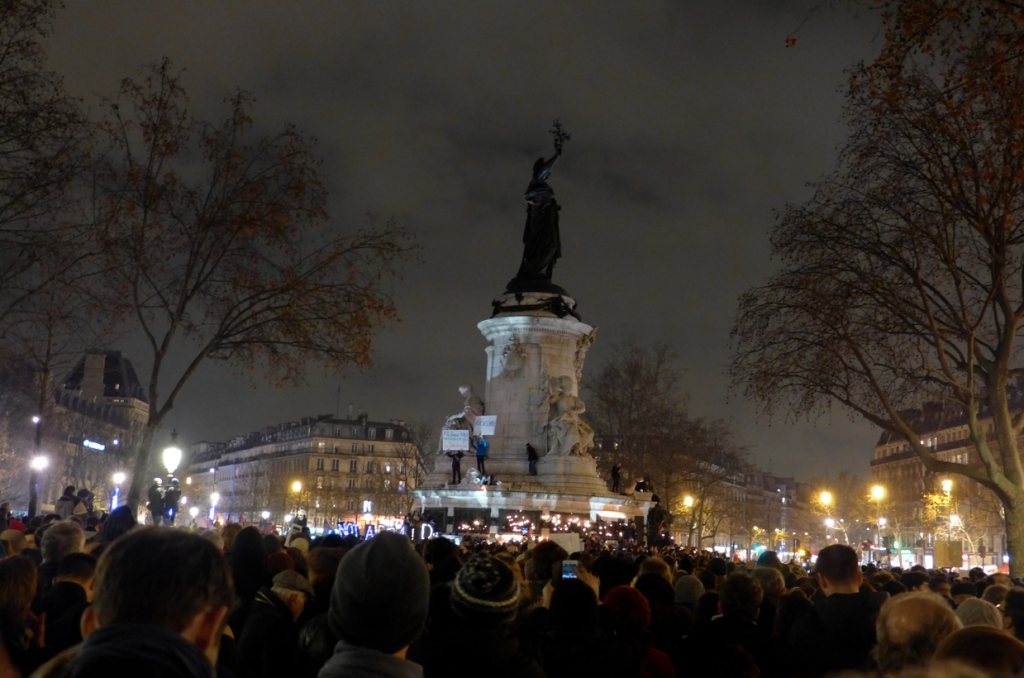
Today, Sylvia from Finding Noon published a post I would like to share instead. “Je suis Charlie” is a call for freedom of the press.
Je suis Charlie
by Sylvia from Finding Noon, an American living in Paris who appreciates fine art, good music, succulent food, and breath taking scenery
There are no words. That is the cliché. But, there have to be words. That is what yesterday’s attack was about. Silencing our words. Now is the time to cry out. Those who believe in the freedom of expression must shout that we will not be silenced. Mosques across France are calling out for prayers of peace. Read more
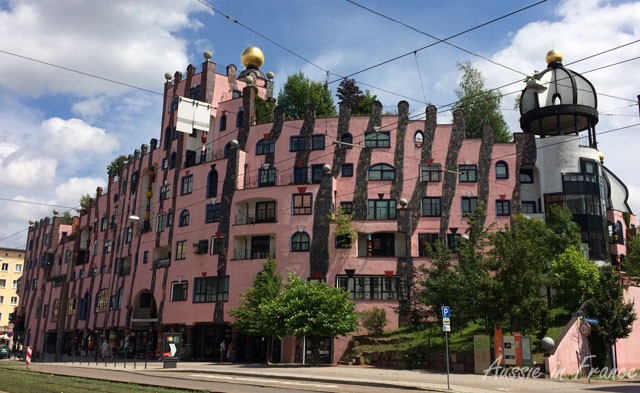
Venice, Germany and Lisbon, in that order, outside France, and Turquant near Chinon, closer to home.
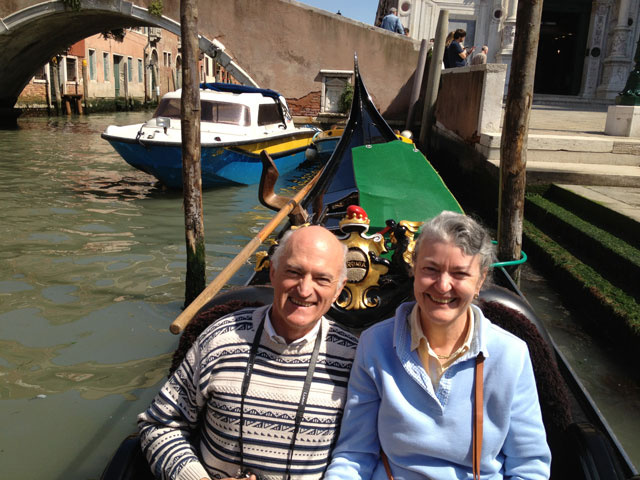
Saying “spaghetti” at the end of our wonderful gondola ride
Venice comes first because of our wonderful gondola experience (which sounds very touristy I know) and all our other less touristy visits as it was our second time in the Floating City. Strange as it may seem, it was not until I had read my way through Donna Leon’s 23 Commissioner Brunetti crime novels a few months later that it became really apparent to me that there are no cars in Venice.
I see Venice as being full of canals and bridges and boats and alleyways rather than being without cars. I was fascinated by all the different types of boats and activities on the canal. Last time we were there, I had a foot problem and we spent a lot of time on the vaporettos. This time, we did a lot more walking.
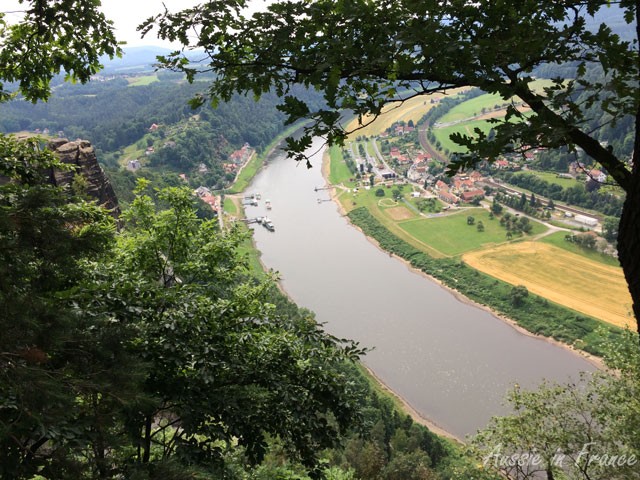
The Elbe from Bastei Rocks
Next, Germany, where we cycled for a month, first along the Moselle River, then the Rhine, followed by the Elbe, which took as into the former East Germany then up to the North Sea and Friesland, chasing the sun and windmills.
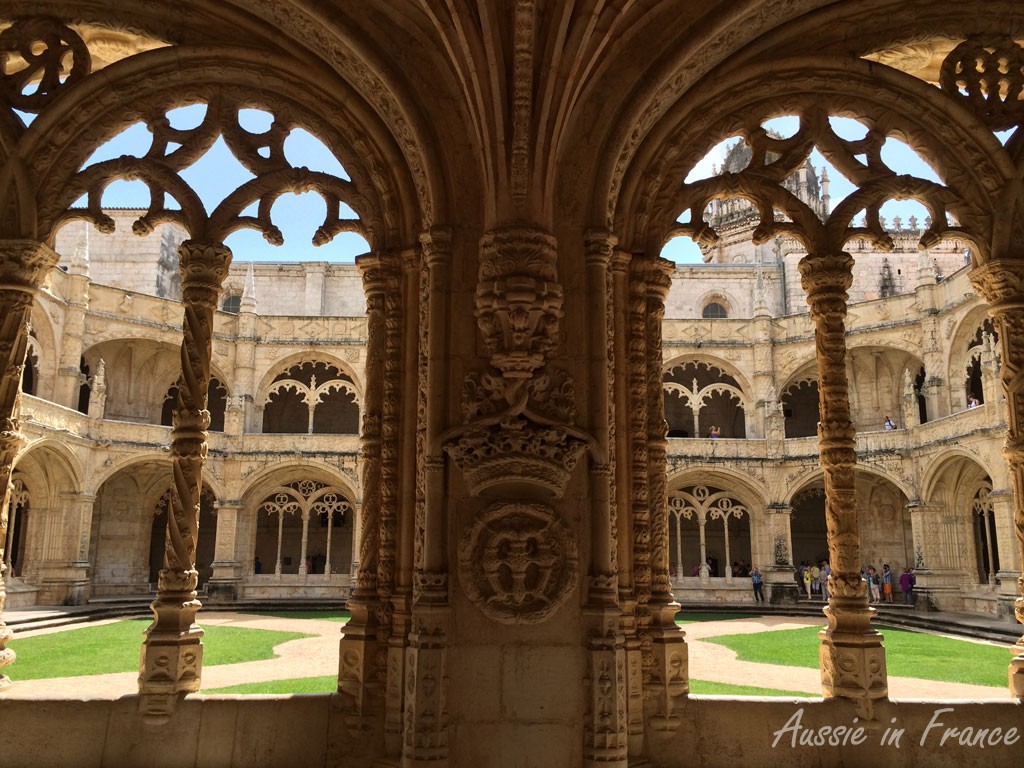
September found us in Lisbon which we loved when the sun come out but found somewhat seedy when it rained, which was more often than not. The best surprise was the marvellous monastery of Jeronimos in Belem, which is among the five places in the world that have left an indelible mark on me. The others are Gaudi’s Sagrada Familia in Barcelona, Plitvice Lakes in Croatia, Tasman National Park in Australia and Rila Monastery in Bulgaria.
Beautiful lacework on the arcades at Jeronimos Monastery
Lisbon is a city of vistas and tiles and we even bought some 18th century azulejos to incorporate into our future kitchen. The other place we really enjoyed was Sintra with its beautiful palace and hilltop castles.
We didn’t go very far afield in France this year, because we spent a lot of time cycling along the many paths around Blois and the neighbouring châteaux of Chambord, Chaumont and Cheverny, but we did go to Turquant on the Loire not far from Saumur for a surprisingly early cycling weekend in March.
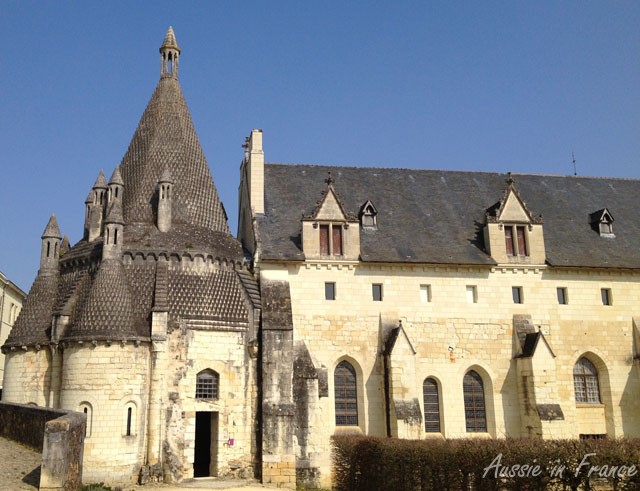
The famous kitchen at Fontevraud l’Abbaye
We went back to visit the austere and beautiful 12th century abbey of Fontevraud with its extraordinary kitchens.
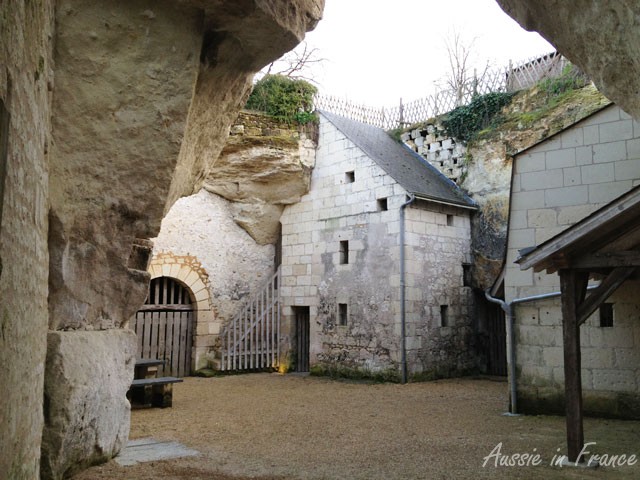
However the real find was the restored troglodyte village of Souzay Champigny which we literally stumbled upon on the bike path between Saumur and Turquant.
An 18th century pigeon house in the troglodyte village of Souzay Champigny
Our first trip in 2015 will be to Granada for a week at the end of January to soak up the Spanish atmosphere of Andalucia, which we discovered (and loved) in Seville a few years ago and get some much-needed sun.
We have a home-exchange in Istanbul to redeem, but haven’t fixed the dates yet.
With Black Cat now living in New York I would like to visit the city through her eyes and take in Boston as well.
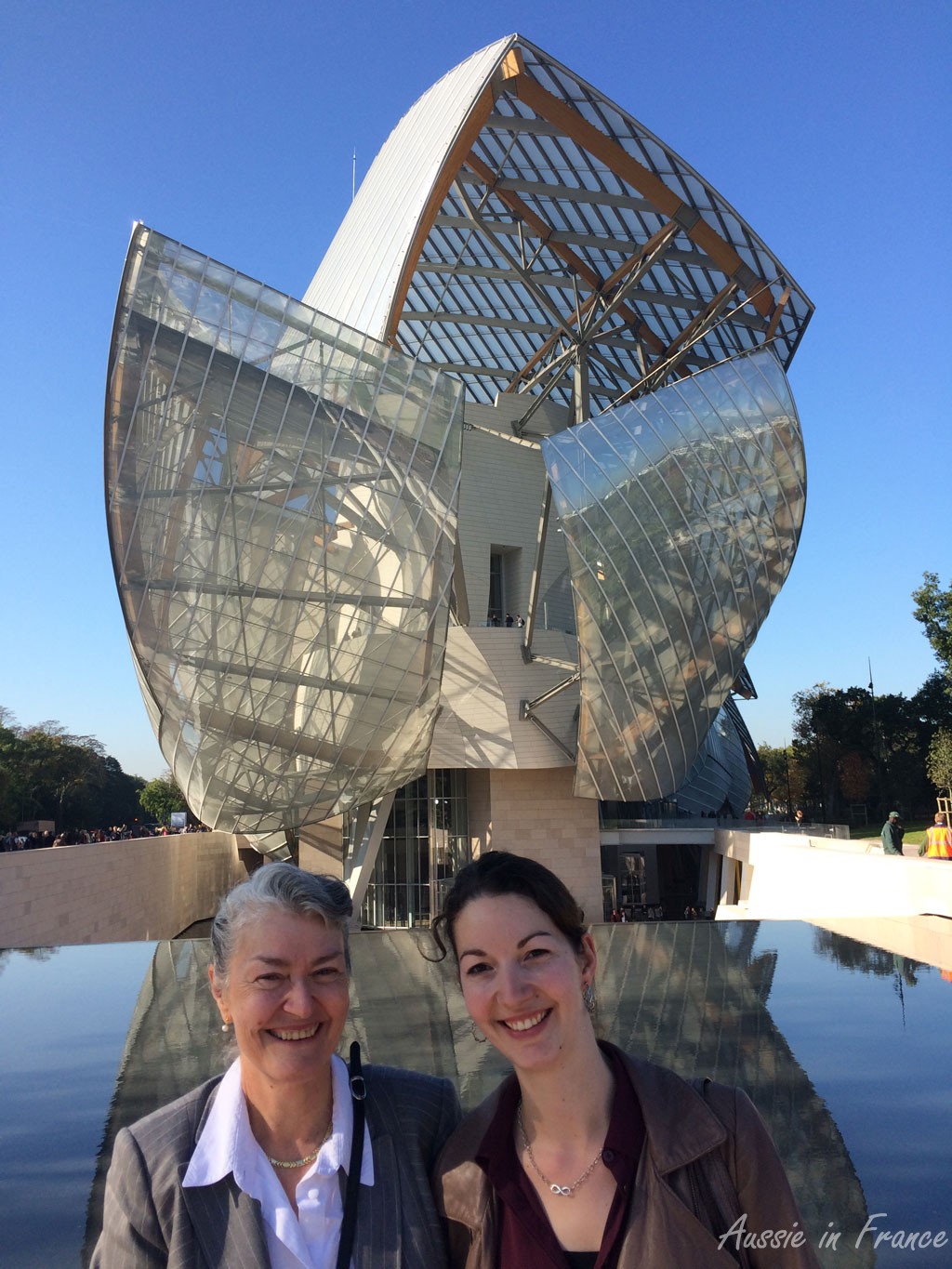
With Black Cat on the opening day of the Louis Vuitton Foundation in Paris
I’m still hoping to go to Australia before the end of the year but don’t know yet whether that will eventuate.
This summer may be a series of short cycling trips, along the lines of Turquant, as we plan to renovate the kitchen and add at least one large and several small windows to bring in more light. And, as everyone knows, renovation always takes far longer than expected!
Who remembers their new year resolutions ? I certainly don’t so rereading last year’s blog post was very helpful.
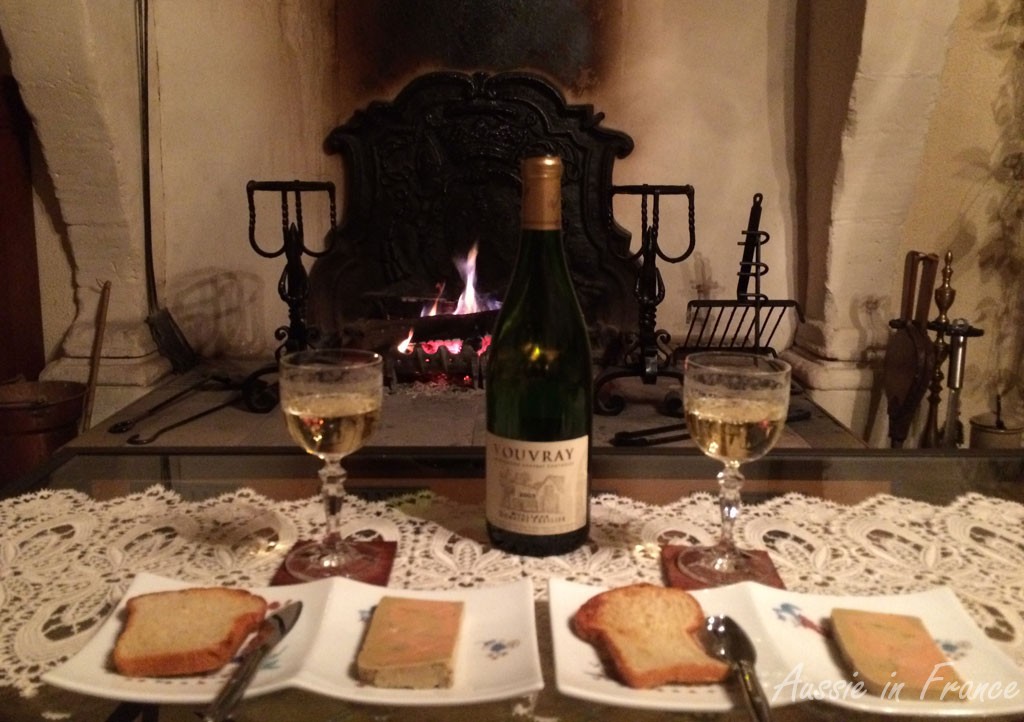
Homemade foie gras and vouvray to see the New Year in before the fire
The first resolution was to have a maximum number of holiday bookings for Closerie Falaiseau during the season. At one stage, it looked as though August would be completely empty but in the end, it filled up, giving us a total of 15 weeks which was very satisfactory. Now that we are living here permanently, we’re not sure about how we’ll manage rental, but we’re pretty certain we’ll be renting out the entire house for the month of September.
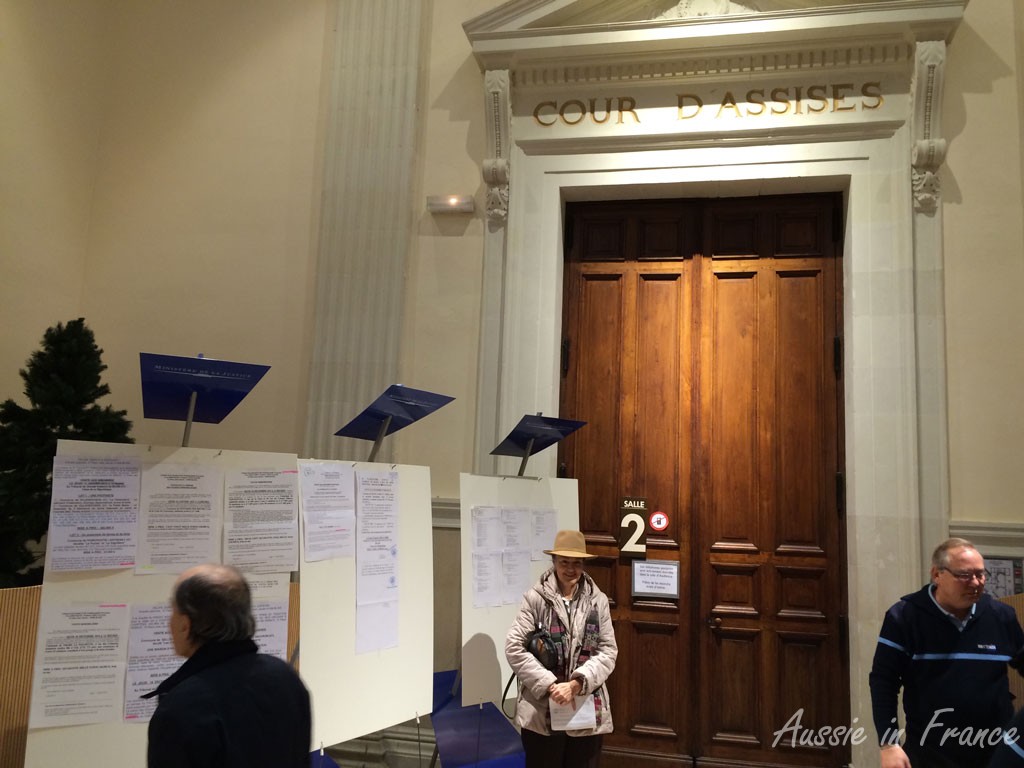
In front of the court room in Blois after taking oath
Second on the list was to diversify into some sort of tourist-related activity in Blois which did not even remotely happen due to lack of time and energy. My translation business unexpectedly picked up and I was appointed court translator in December which may also keep me busier than I expected.
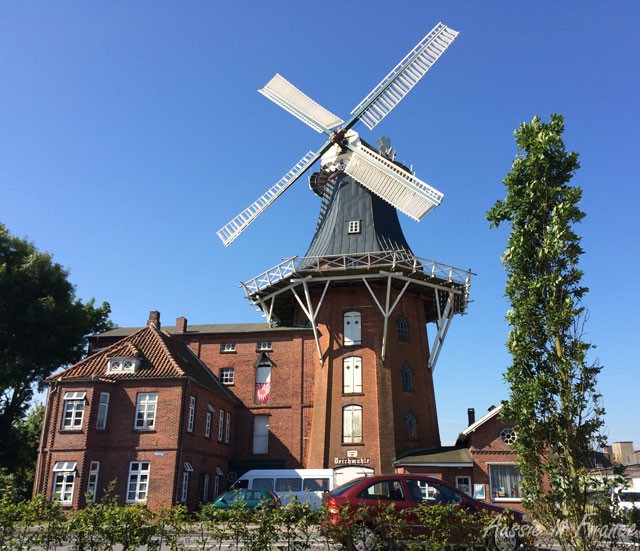
Deichmühle in Friesland
A repeat of our Danube cycling holiday was my third resolution. We spent a month cycling in Germany along the Moselle and the Elbe in particular and found ourselves up in Friesland in the very north of the country chasing the sun and admiring the windmills.
My fourth resolution which was to discover the secret of getting enough sleep simply didn’t happen. I think the situation even got worse. I don’t think there is an answer without medication which I am still resisting.
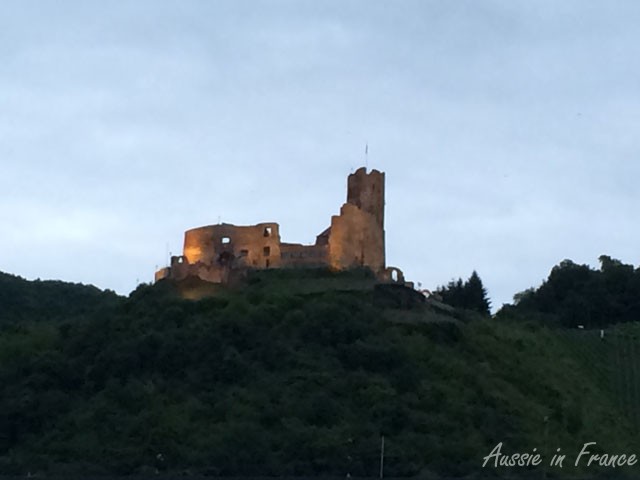
The Landhaus at night in Bernkastel in Germany
Improving my night photography skills was already a carry-over resolution from the year before and no progress was made, especially as my night vision has gone down as a result of my otherwise successful cataract operation.
So what are my resolutions for 2015?
The last two months with Jean Michel in retirement mode have taken so much out of me that I am scaling down my resolutions this year.
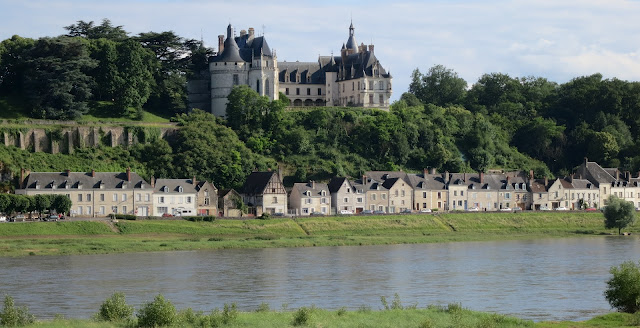
Château de Chaumont
When walking up the hill to Château de Chaumont after Christmas with Black Cat and the Flying Dutchman, I discovered that my iPhone counts my steps. How it does so, I do not know but it seems that we should be banking on an average of 10,000 steps a day. Just to give you an idea, it’s 3.30 pm and so far, by just staying in the house, I have clocked up 1000 steps. Yesterday, with two not very long walks, I made it to 10,000. So that is my first resolution – to average 10,000 steps a day over a week.
The second is to make a video for each Friday’s French post. Considering that I am only averaging one post a week at the moment and have missed several Fridays along the way, this might be a bit ambitious, but I’m hoping that our holiday in Grenada at the end of January is going to give us both a new lease of life.
First view of the Cinque Terre in Italy
I learnt recently that there are excellent Italian lessons in Blois so I am going to sign up in February (no point in doing so before going to Spain or I’m going to be speaking Spanitalian) as my third resolution. I’ve been wanting to improve my basic Italian for a long time so this is something I’m really happy about. My ultimate aim when I eventually retire is to live in Italy for a few months.
My fourth resolution is to find a way to help Jean Michel improve his English. A friend has told me about a group she goes to in the south of France where you partner up with the opposite in your language combination and speak each language for ¾ hour. He likes the idea and I have already found one English speaker who’s interested.
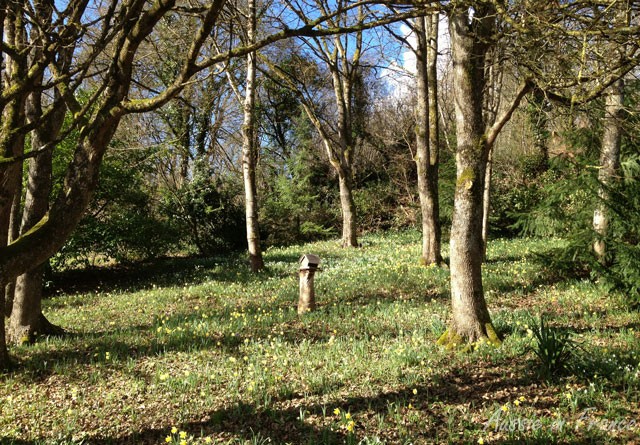
Daffodils in spring
For my fifth resolution, I debated about putting night photography back on the agenda but now that we’re living in Blois, I have even less motivation than before. So I’ve decided on something quite different. I am going to stop complaining about things and look on the positive side of life. At the moment I’m looking forward to the daffodils in spring!
So, with that, I would like to wish you an excellent 2015 andI’d love to know some of your resolutions!
I’m off to visit Château de Chaumont with Black Cat and the Flying Dutchman. I suggest we park along the Loire and take the front entrance to the castle. Not a good idea. It’s closed so we have to walk a kilometer up the hill at a nearly freezing 2°C. Stoic, the Flying Dutchman does not complain about leaving his earmuffs behind.
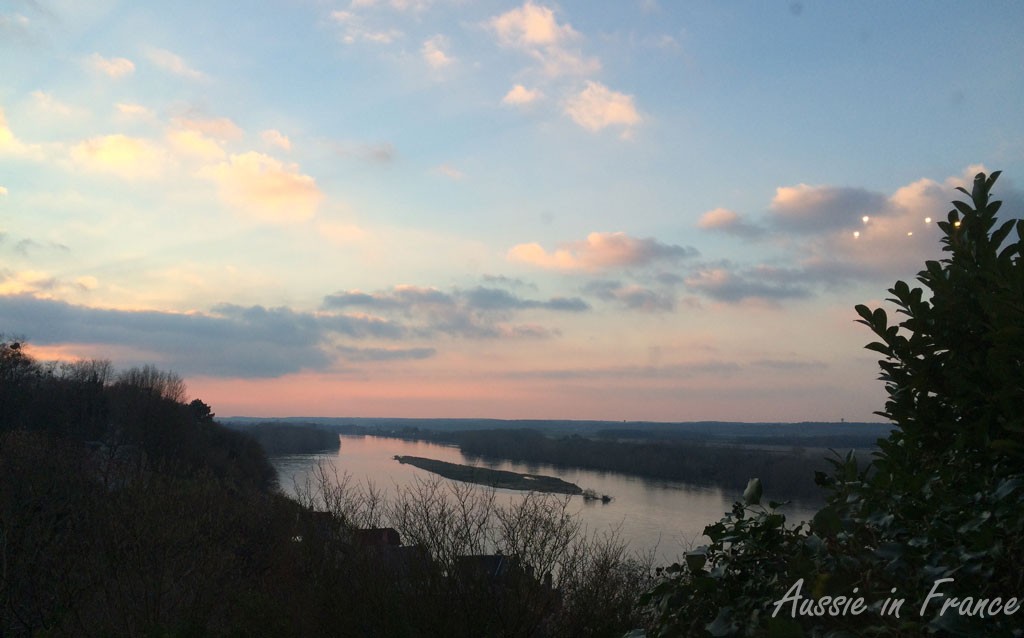
View of an island in the Loire from inside the castle
We take the back entrance, next to the parking lot where we usually leave the car, and walk through the gardens towards the château which is just as beautiful as it usually is, despite the cold, because at least the sky is a wan blue.
Chaumont has a spectacular view of the Loire River below. It initially belonged to Catherine de Medicis but after the death of her husband Henri II in 1560, she swapped it with Henri’s mistress, Diane de Poitiers, for Chenonceau. Diane was understandably very disappointed in the exchange and preferred living in the Château d’Anet to the west of Paris.
There are not many people which is always pleasant when visiting and I am surprised to discover that there are lots of things I missed the last time.
The Ruggieri Room
In the Ruggieri Room assigned to Catherine de Medicis’s personal astrologer, I suddenly realise the connection with the Astrological Tower near the old Commodities Market (Bourse du Commerce) in Paris where we used to live.
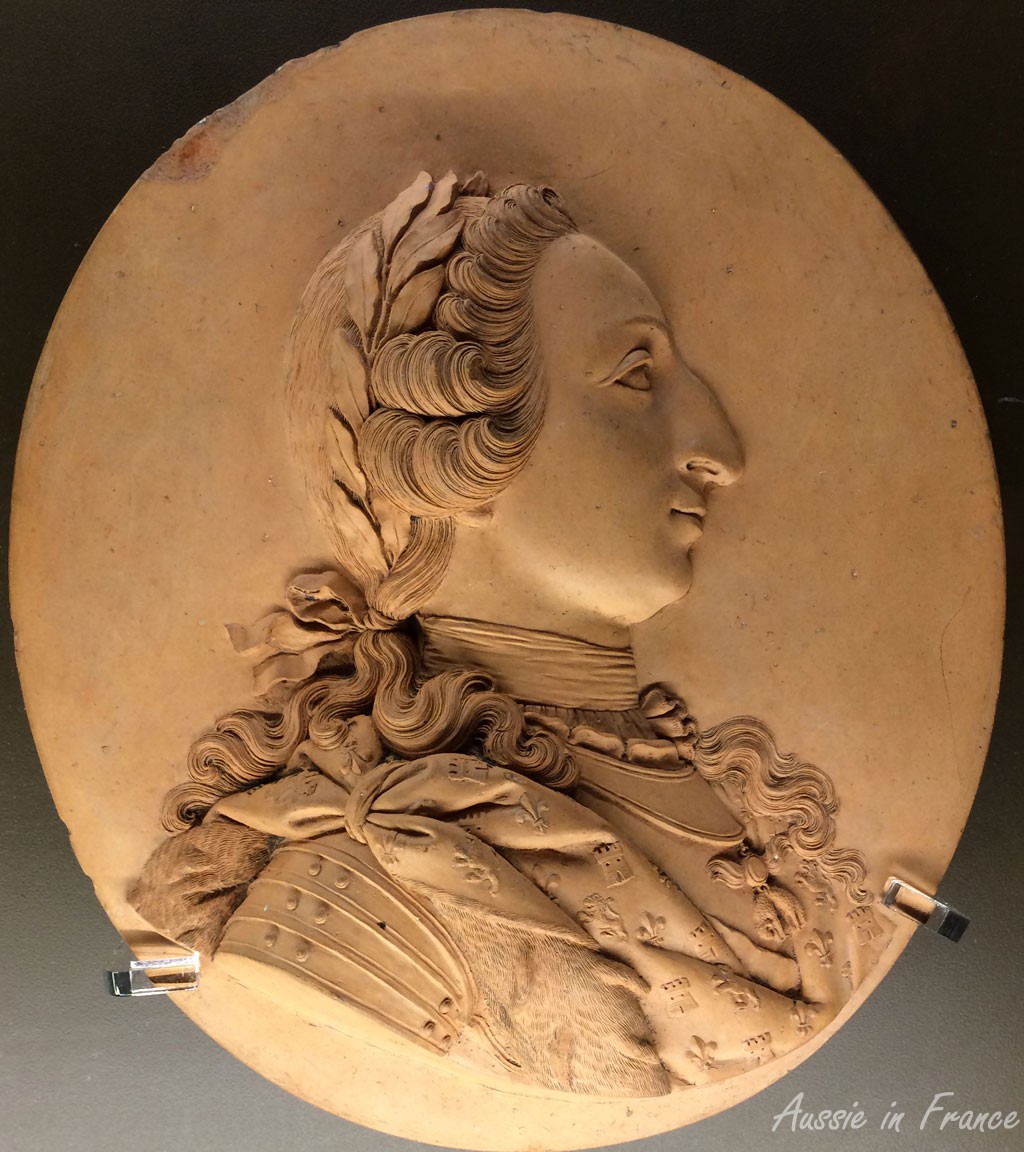
We then closely examine a series of seventy medaillons and eight moulds produced in the 18th century by the Italian artist Jean-Baptiste Nini. The delicately sculpted medaillons depict celebrities of the time such as Louis XV, Louis XVI, Marie-Antoinette and Benjamin Franklin as well as members of the Leray famille, who owned the château at the time, and the local bourgoisie – doctors, lawyers, etc.
The aristocratic nose of Charles III of Spain
The beautiful 17th century majolica floor in the Council Room which originated in Collutio Palace in Palerma in Sicily and acquired by the last owners, the Boglie family, provokes an interesting discussion about transporting art and archeological works from other countries.
At another point we spend time looking at old photographs of the Broglie family showing the fashions and moustaches of the time. When Princess Henri-Amédée de Broglie, the granddaughter of sugar magnate, Louis Say, first saw Château de Chaumont as a child, she immediately declared “Je veux ça, je veux ça” (I want that). In 1875, at the age of 17, she became the owner of the castle and the one thousand and so hectares around it. Hard to imagine.
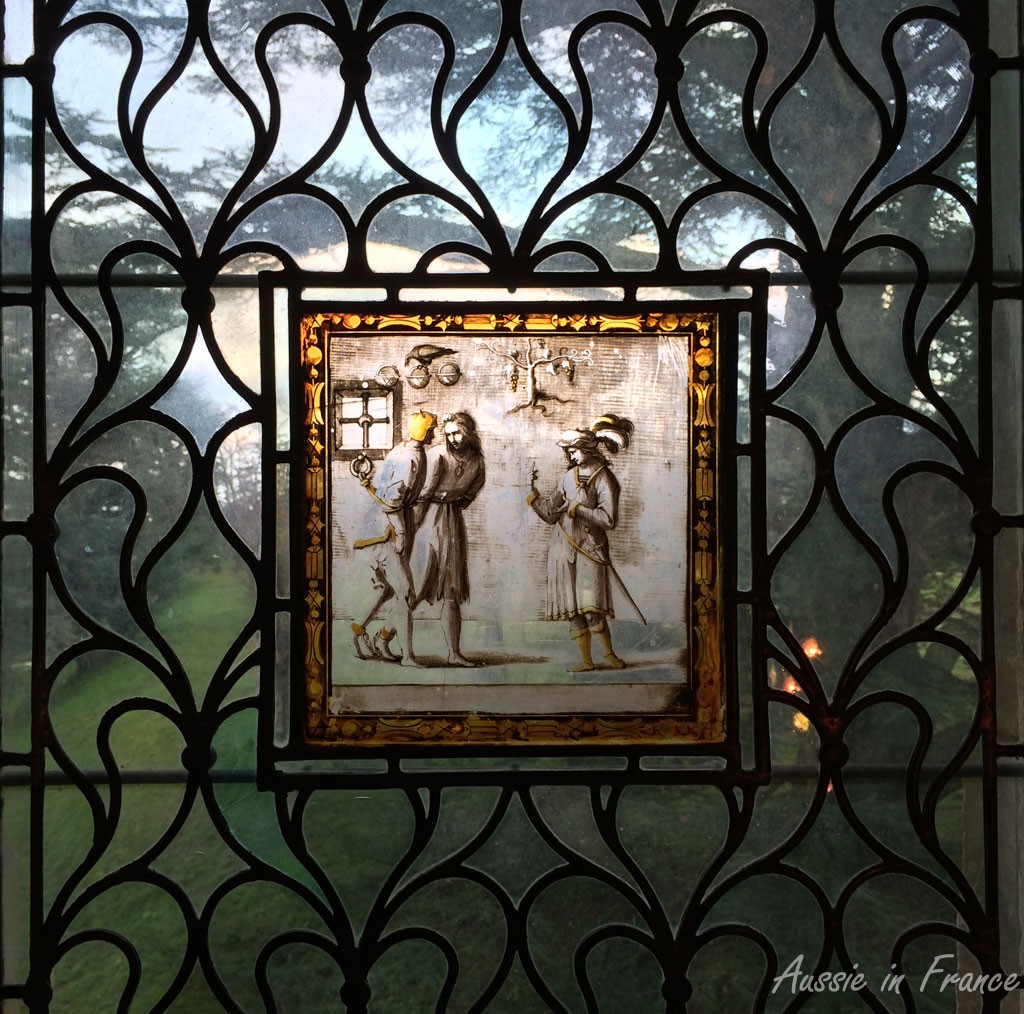
One of the giant cedars in the park surrounding the Château, seen through a grisaille window
It’s closing time before we know it so we walk very quickly down the hill in the cold spurring each other on with thoughts of tea and Christmas cake in front of the fire!
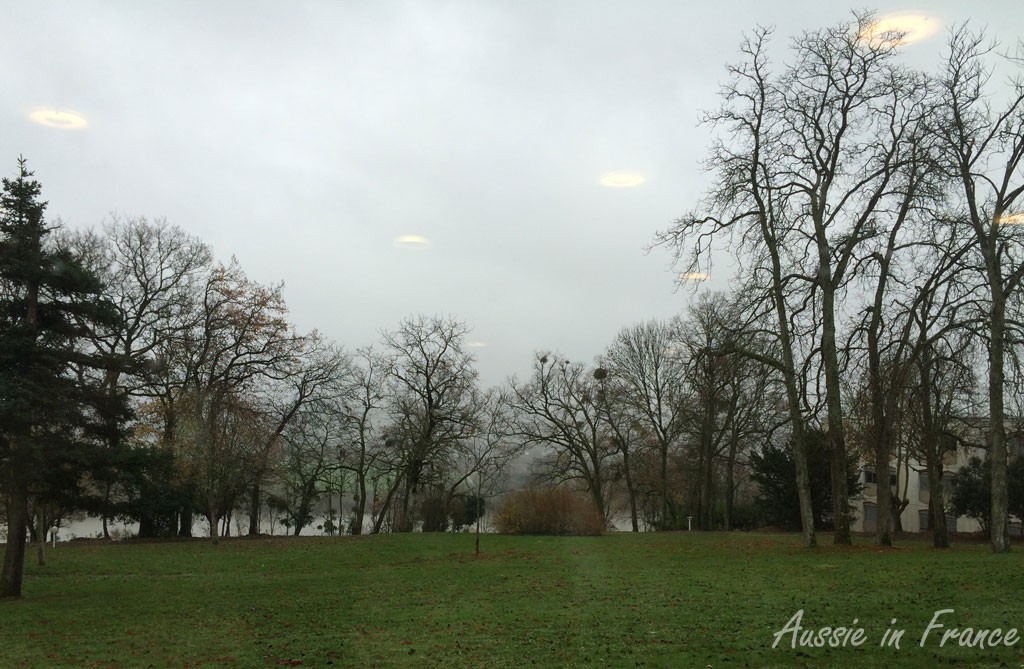
The weather is revolting. When it’s not raining, it’s grey and overcast and I can’t remember the last time we saw any sun. The adjustment to retirement is proving far more difficult than anyone imagined so I am truly grateful for any distraction that will take us out the house and into the company of others.
Dull grey weather typical at the moment
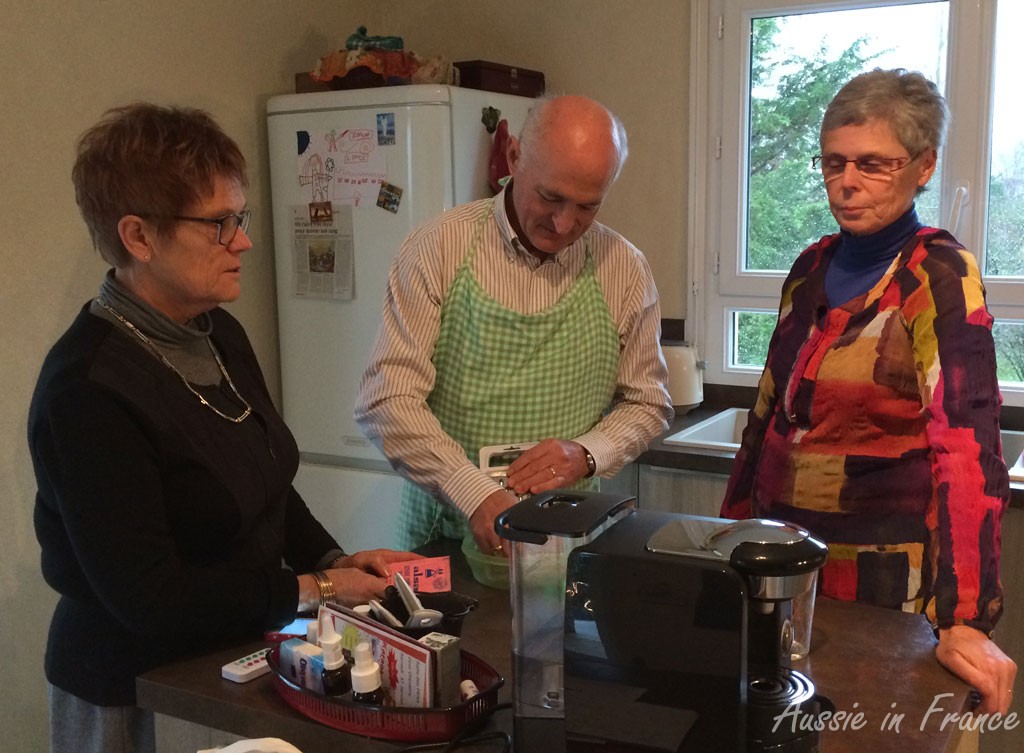
The first distraction on the programme is a gougères and mini-croissants workshop at Martine’s in preparation for Christmas. We tasted both these goodies at her place recently when she held a book signing.
Martine, Jean Michel and Françoise
The gougères are a speciality from Burgundy, where Martine hails from. They are little puffy cheese things, light as a feather, delicious and surprisingly easy to make. You can also freeze them for later use (as in Christmas).
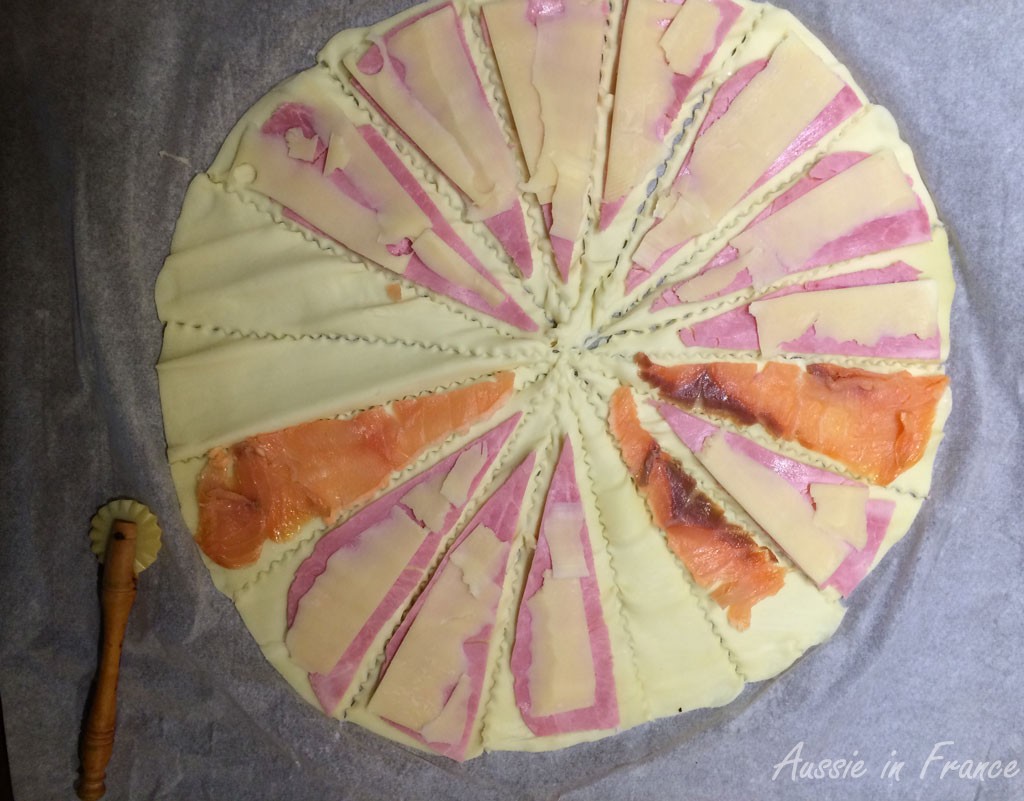
Mini-croissants, ready to be rolled up
Next come the mini-croissants filled with ham and cheese, salmon, goat cheese or whatever else you think will taste good. You start with store-bought flaky pastry and use a little cutting wheel to make sixteen wedges. You cut the filling to size, roll up the wedges and pop them in the oven. Hey presto! Perfect as an apéritif with vouvray sparkling wine.
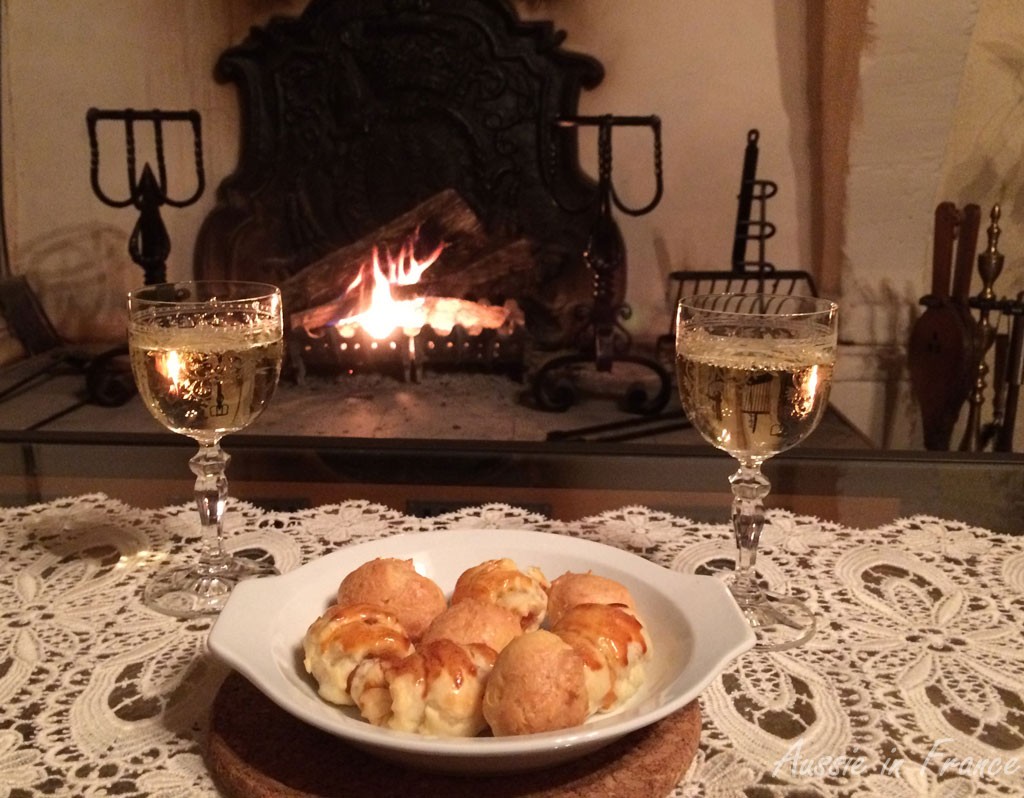
Gougères and mini-croissants beside the fire
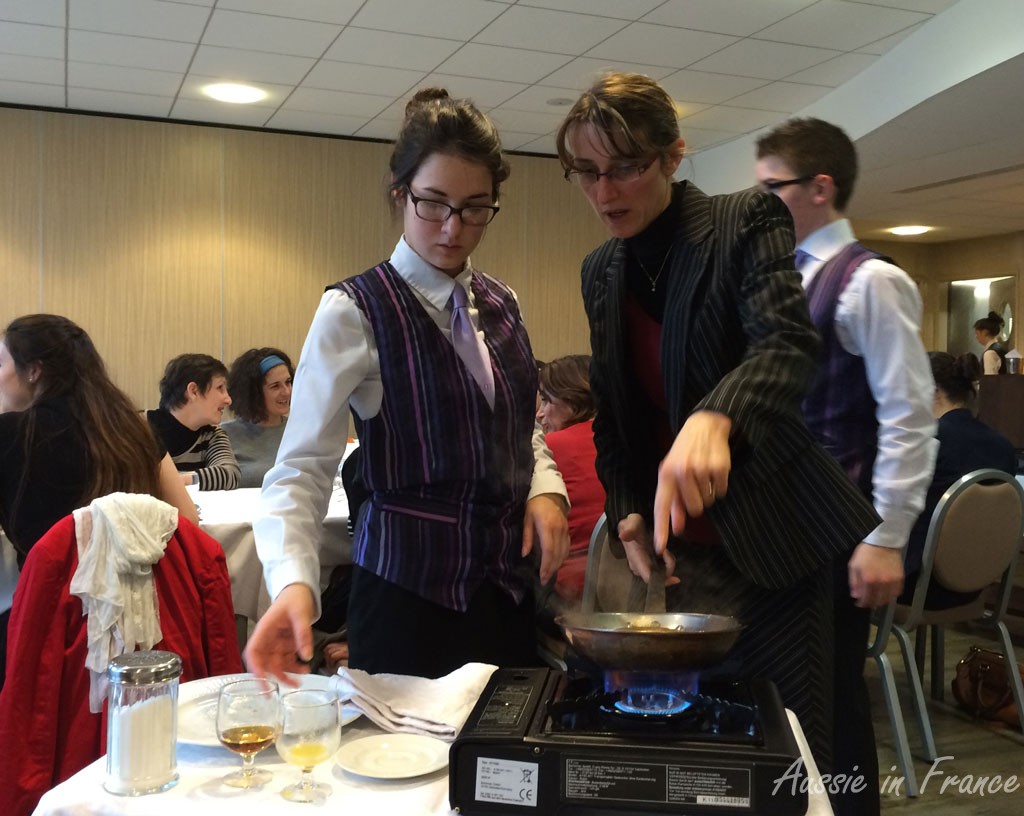
The second distraction is lunch with the girls from Françoise’s gym. I’m not really into gym but I like meeting all the participants. Sixteen of us, including one game husband and the gym teacher, have a most enjoyable lunch in the Initiation dining room of the local catering school, where we’ve already eaten a couple of times in the Brasserie.
A little help from the supervisor in getting the flambeed bananas right
For 14.50 euro, we have an apéritif, eggs Benedictine, poulet chasseur and flambéed bananas which are prepared at the end of the table, together with a local red and coffee. As usual, good value for money. The young apprentices are very serious and do a good job under the attentive eye of their supervisor.
The view from the dining room – grey as usual
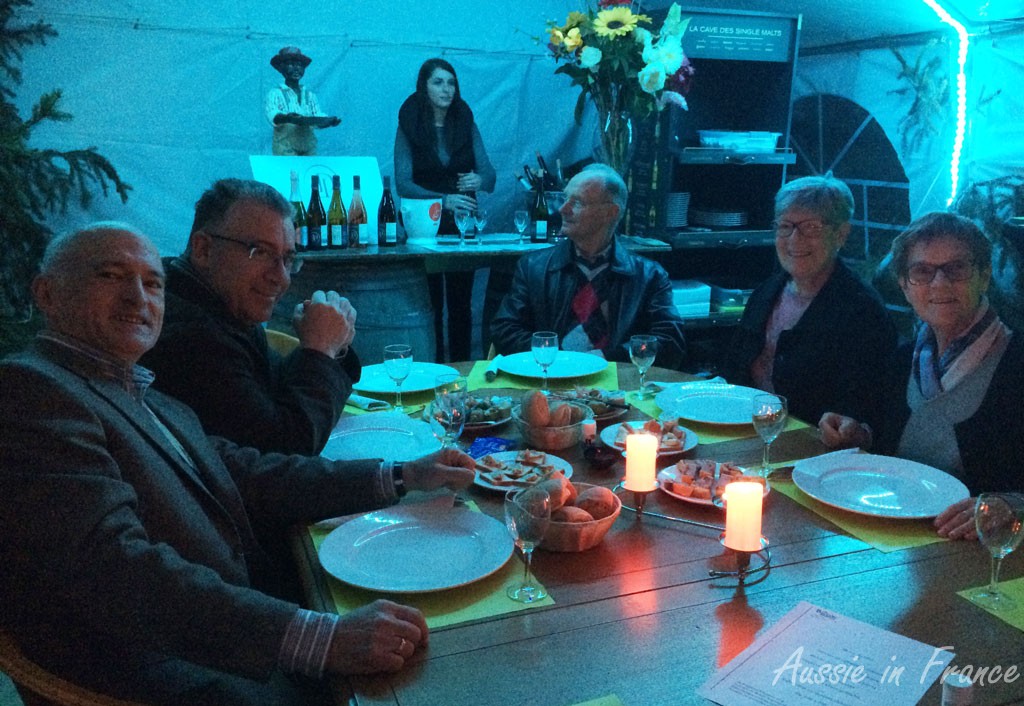
On Saturday, a local caterer, Eric Bacon, is holding an open day where you can taste and buy various Christmas foods, such as foie gras, salmon, snails and a selection of tarts. Around six, we walk up the hill with our four neighbours from Les Grouets to Eric’s place where a large tent is keeping everyone nice and warm to the sound of the accordéon. Our local biscuit maker, Damien, is also there as well as a representative of Daridan vineyard near Cheverny.
Sharing an appetizer platter inside Eric Bacon’s tent
We taste their cheverny, cour cheverny, sauvignon and « fines bulles » (natural sparkling wine with fine bubbles) and choose the sauvignon to go with the appetizer platter we’ve decided to share : shrimp, whelks with herb mayonnaise, foie gras and wild boar pâté.
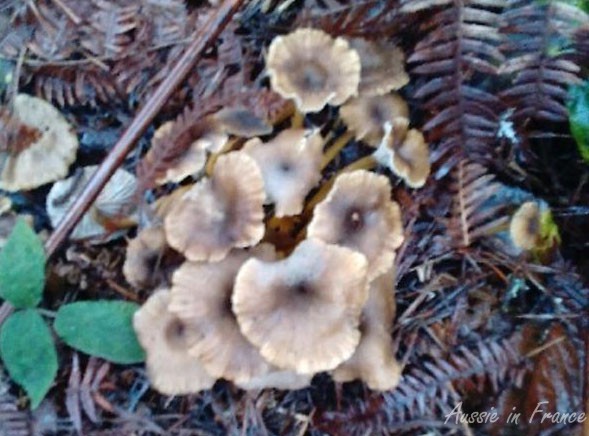
Chanterelles mushrooms in their natural habitat
Going down the hill is much easier particularly as Liliane has invited us all to share a duckling that has been simmering on the side of the wood burner all day accompanied by chanterelle mushrooms that Jean Michel and Alain went picking the day before while Françoise and I were enjoying our lunch!
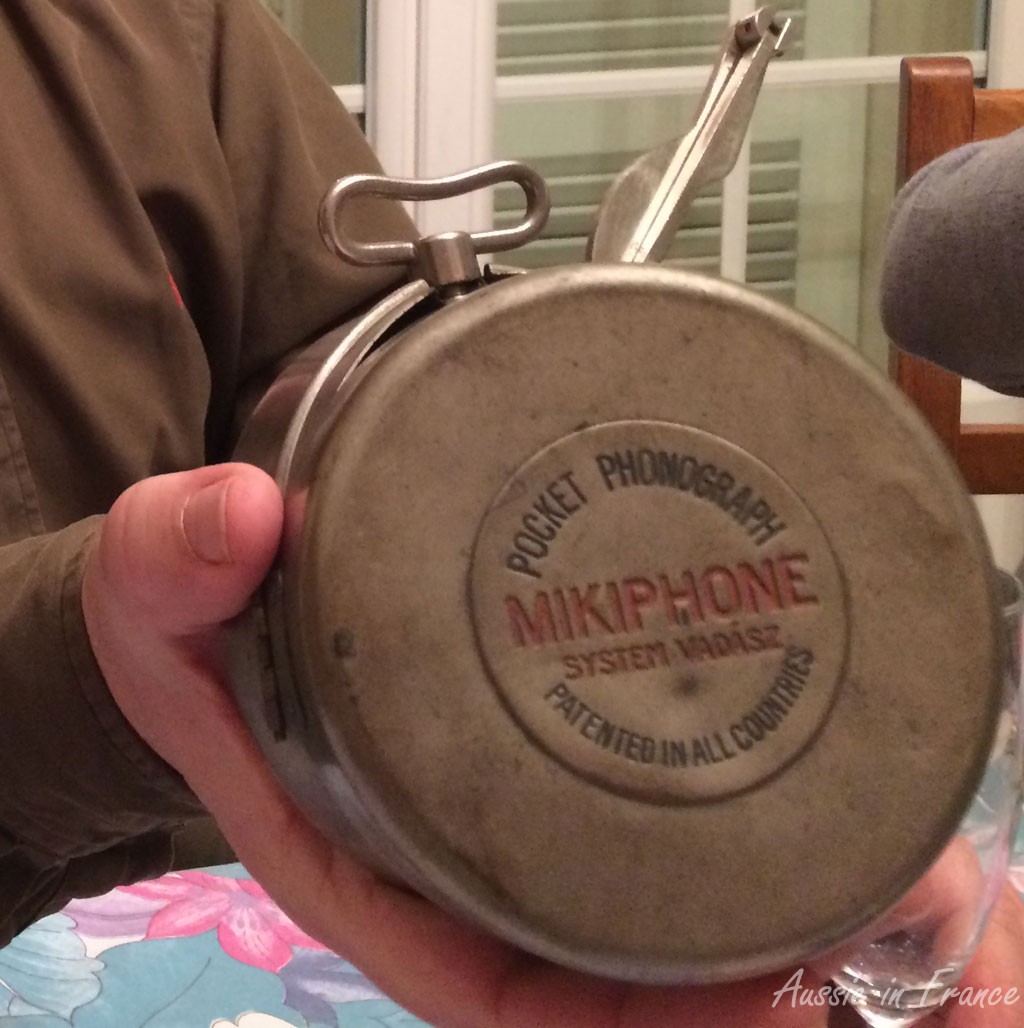
The Mikiphone, the smallest talking machine ever made
Halfway through dinner, Alain brings out a surprise. It looks like a large tobacco tin and turns out to a Mikiphone pocket phonograph patented by a Swiss firm in the Jura mountains in 1924, the smallest talking machine on the market. We watch as Alain puts it together, then gets out an old vinyl record. The sound isn’t brilliant because the stabiliser is missing but the songs are still recognisable!
We walk home feeling warm and fuzzy at the thought of having such wonderful friends and neighbours to help us through this period of adjustment to togetherness as one of our Australian friends so aptly described it.
It’s one of those dull and dreary rainy days in December with little motivation to venture much further than the fireside but our local association, Les Amis des Grouets, is having its annual mulled wine and chestnut evening just down the road at 6 pm and we missed it last year.
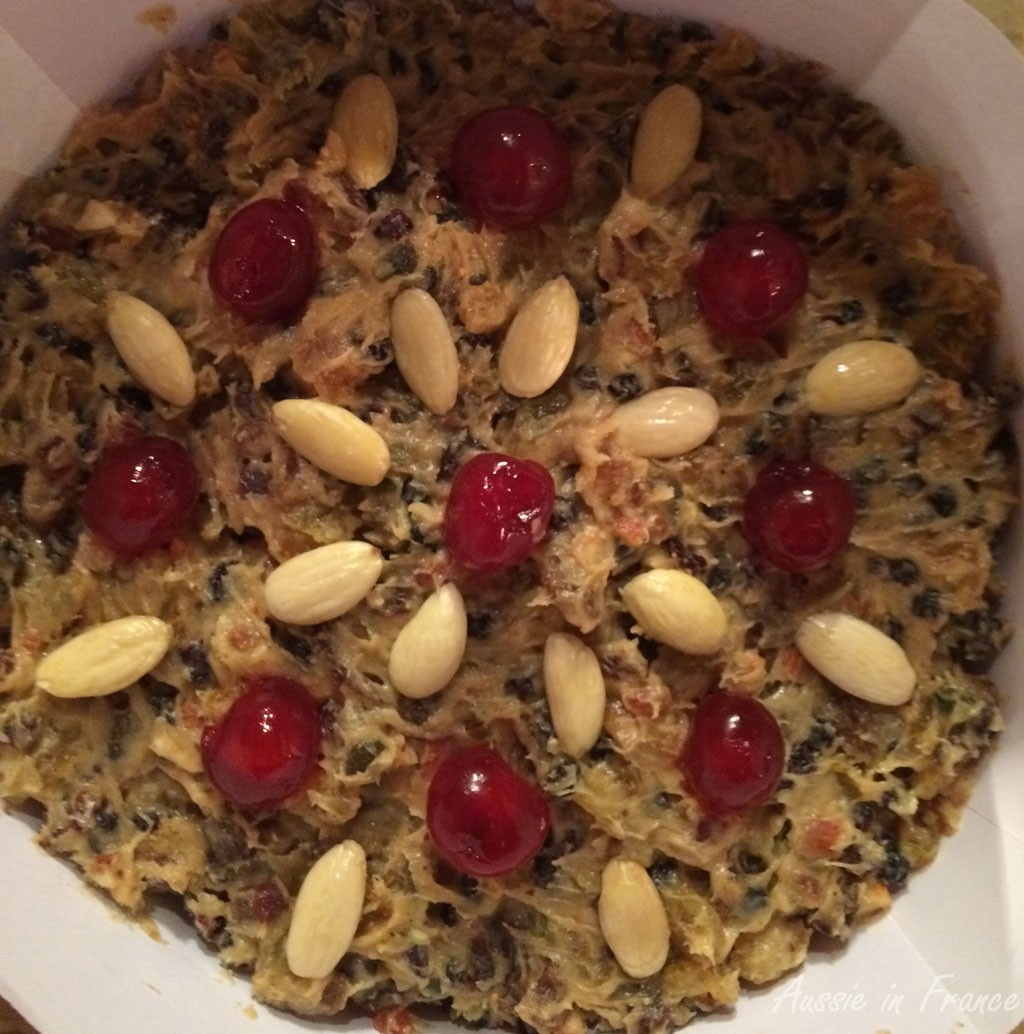
This year’s Christmas cake
The Christmas cake is in the oven but this year only Jean Michel was able to stir and make a wish in person. Black Cat and I chatted on skype while I was making the cake (she was ironing in New York!) and she made a virtual wish.
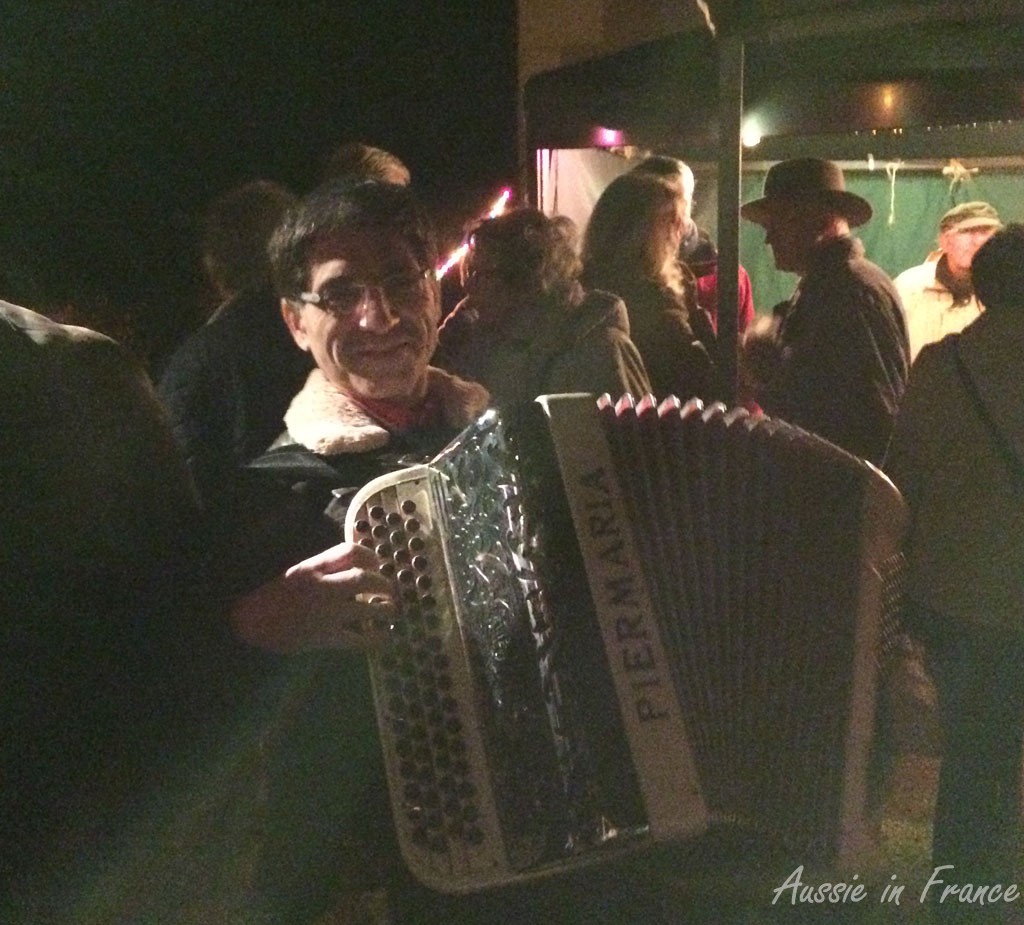
So, umbrellas open, we call in to collect Françoise and Paul on the way. As we get close to the church, we can hear accordion music and see fairy lights.
We pay our annual dues and buy a ticket each. Fortunately, there are a couple of tents (no doubt the same ones that were used for the bread baking day in May when it was also raining …) but surprisingly, the rain lets up completely.
Accordian player
We are given a white paper bag to collect our chestnuts and raffle tickets to get a plastic cup of mulled wine. We’re allowed refills, we’re told.
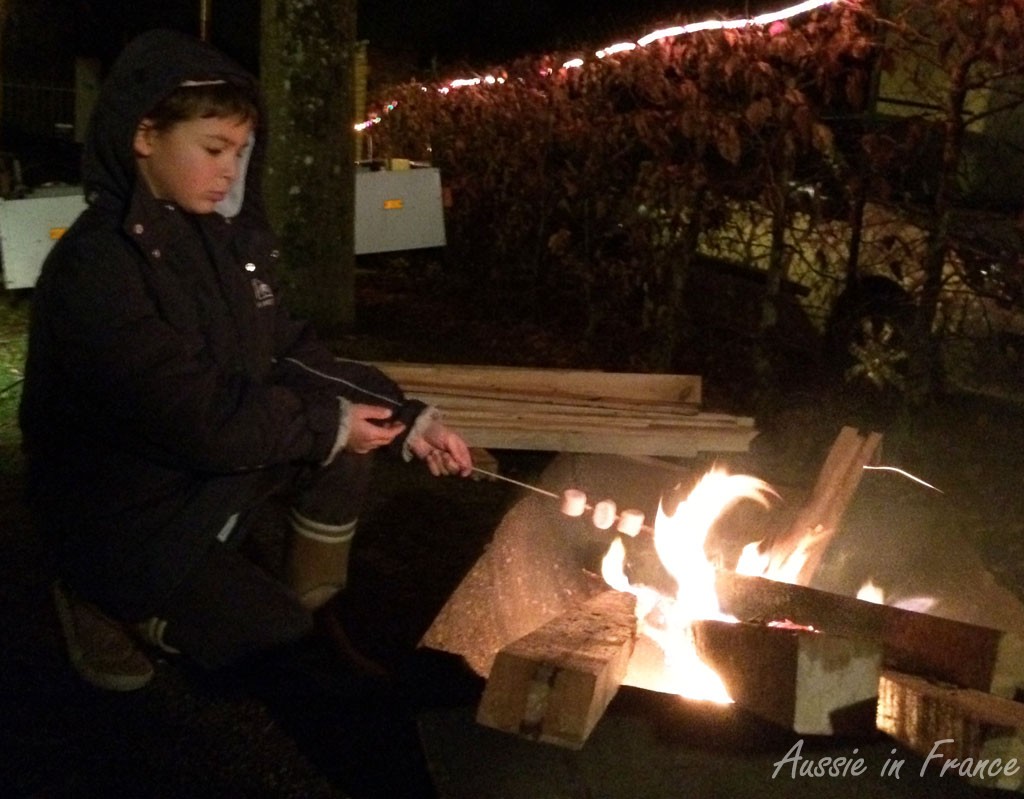
Quite a few people eventually arrive but very few children which is a pity. However, the ones that are there have a lovely time roasting marshmallows over an open fire.
The chestnut burner is manned by Norbert, who was the baker on bread baking day, and the postman who doesn’t actually live in Les Grouets but likes the neighbourhood so much that he comes back after work.
Roasting marshmallows over the open fire
We are starting to recognise a few people. Françoise introduces a neighbour who is a retired mason and once did some work on our house, but he can’t remember the details.
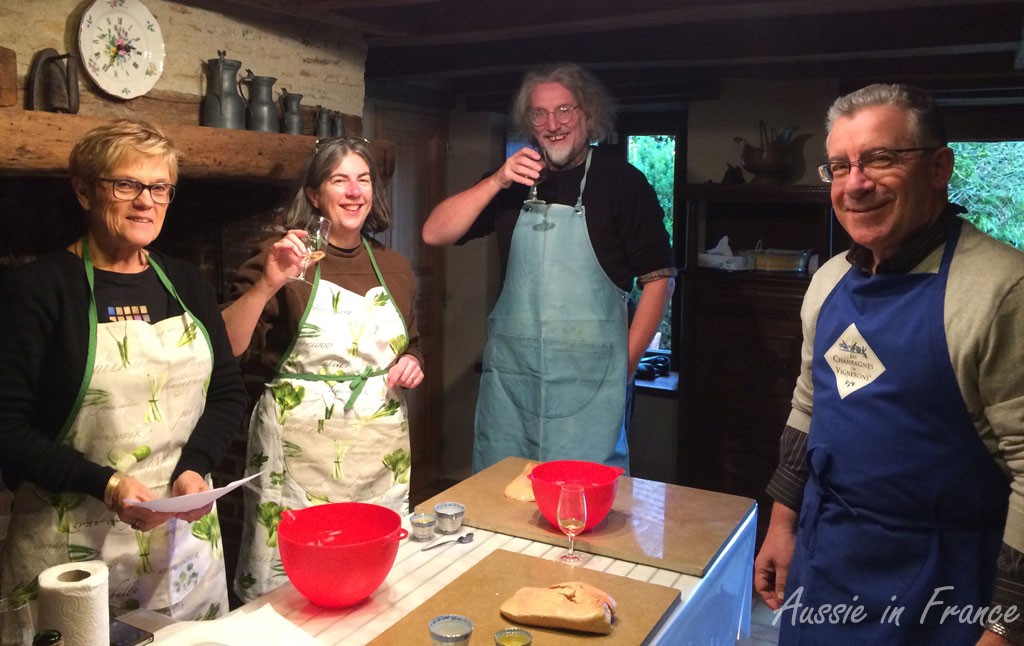
I explain to his wife how to make foie gras au sel as we spent a fun day last week with Françoise and Paul and Susan and Simon from Days on the Claise teaching them how to devein foie gras ready for Christmas. For a detailed description of our workshop, I suggest you go over to Susan’s blog.
Françoise, Susan, Simon and Paul tasting the vouvray used for the foie gras
In return, the mason’s wife promises to send me her kugelhof recipe. I’m not a great kugelhof fan but it seems this is a variant so I shall try it out for Christmas. Which reminds me that I should also make Liliane’s gingerbread cake as well.
I’m linking this post to Lou Messugo’s Christmas edition of the All About France monthly link-up. For other entries, click here.
You may remember a discussion about poêle a couple of weeks ago. Now there is another word that is pronounced exactly the same way (unless you come from the south of France and pronounce the “e” at the end of poêle) and seems to have resulted in a few embarrassing situations for some of our readers!
Poil, from the Latin pilus, means body hair and applies to both animals and humans. In the case of animals, of course, it’s what we call fur. Un chien à poil ras = A dog with short fur. It is also used for a man’s beard, what we sometimes refer to as bristles in English.
It is NOT used for the hair on your head which is cheveu in the singular and cheveux in the plural. J’ai trouvé un cheveu gris sur ma tête – I found a grey hair on my head ; il a des cheveux bouclés = he has curly hair.
But back to poil which is far more interesting because of all the many expressions that exist.
Etre à poil means to be stark naked, as in, you can see all the person’s hair.
Avoir un poil dans la main (literally, to have a hair in one’s hand) = to be lazy. Now why is a complete mystery.
Reprendre du poil de la bête = to pick up again, to regain strength. For example, j’ai eu la grippe pendant une semaine, mais j’ai repris du poil de la bête : I was down with the flu for a week, but now I’m on top of things again.
The expression literally means to take fur from an animal because people believed that the fur of an animal that had just bitten you could be used to heal the wound. It seems there is an English expression “the hair of the dog” that means an alcholic beverage consumed to cure a hangover, but I have personally never heard of it !
Another expression is s’il avait un poil de bon sens : if he had an ounce of good sense.
C’est pile poil ce que je voulais: it’s exactly what I wanted. This comes from tomber pile (au) poil from the expression pile ou face which means heads or tails (or more exactly tails or heads) and au poil which means exactly, that is, to within a hair’s breadth.
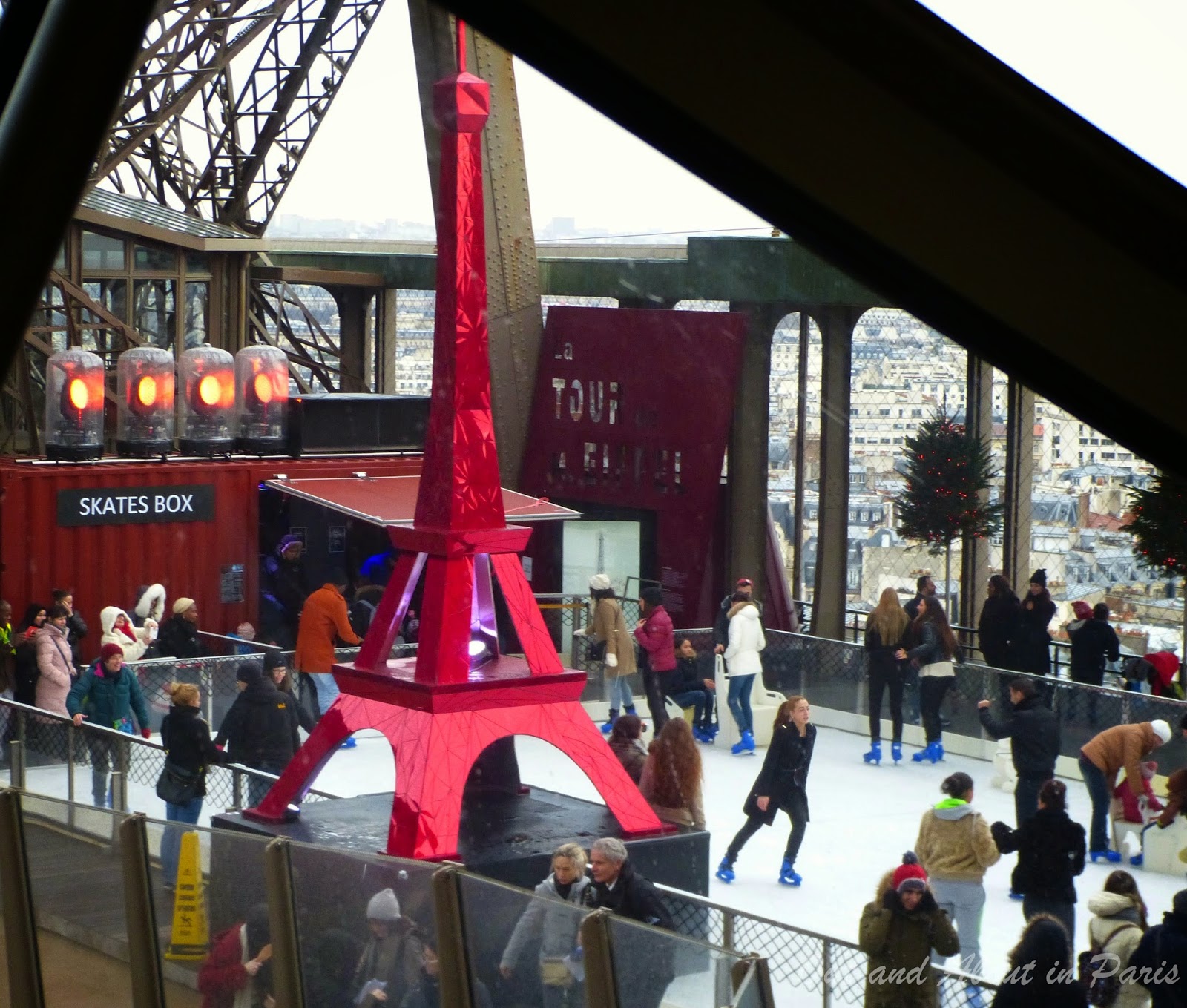
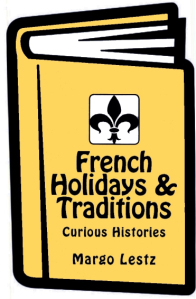
I missed last week’s blogger round-up from lack of organisation and general post-move sluggishness but this week I have three great posts to share with you. First, Mary Kay from Out and About in Paris takes us ice skating on the Eiffel Tower and I’m very jealous not to be there myself! Next Anda from Travel Notes and Beyond has published her blogger highlights for 2014 (including my tips and tricks for cycling in Germany) so you’ll have lots of new blogs to discover, from stunning photos of Yellowstone National Park to surreal places you never knew existed. And to finish off, our gifted storyteller Margo Lestz from The Curious Rambler has just published a book on French holidays and traditions, month by month. Enjoy!
Ice skating on the Eiffel Tower! One of the coolest experiences in Paris
by Mary Kay from Out and About in Paris, an American by birth, Swiss by marriage, resident of Paris with a Navigo Pass for the metro that she feels compelled to use
One of the coolest winter activities has returned to Paris — ice skating on the first floor of the Eiffel Tower! In between your camel spins and double Axels, warm up with a cup of hot chocolate or sip a glass of champagne while admiring the view of the Champ de Mars and the golden dome of Les Invalides. For an extra special evening, time your visit to coincide with the twinkling of the Eiffel Tower’s lights. This magical sight happens every hour on the hour, for five minutes.
If you’re in shape, take the stairs to the first floor 57 meters (187 feet) above the city of Paris. Admission to the rink and the use of skates is included in the 5 euro ticket price. Otherwise, you can take the elevator to the second floor and walk back down to the first floor. Read more
Travel Blogger Round-Up: Highlights for 2014
by Anda from Travel Notes & Beyond, the Opinionated Travelogue of a Photo Maniac, is a Romanian-born citizen of Southern California who has never missed the opportunity to travel.
Hello everyone and welcome to my 2014 Travel Blogger Round-Up. Another year has passed in tumultuous and competitive world of travel blogging. While there are thousands of wonderful posts out there that stimulate your curiosity and spur your desire to travel, I’ll introduce you to some that have caught my eye in 2014. Read more
French Holidays & Traditions
by Margo Lestz from The Curious Rambler, who lives in Nice, France where she likes to bask in the sunshine, study the French language and blog
If you are intrigued by French culture and curious about the history behind French traditions, this book is for you. In it, you’ll find a selection of short stories, written in a lively style, which often reveal little-known, but always fascinating facts about French customs. If you have ever wondered how French Easter eggs are delivered, or why the French walk around with paper fish taped to their backs on the 1st of April, you can find the answers to these questions plus much more in this book. Read more
We wake up quite late and realise we’re going to have to hurry up a bit if we’re to go to the market and still arrive at 12.30 in Vendôme for our anniversary (of-the-day-we-met) lunch at Pertica, an up-and-coming success that Jean Michel has read about in the local newspaper La Nouvelle République – the one we starred in recently!
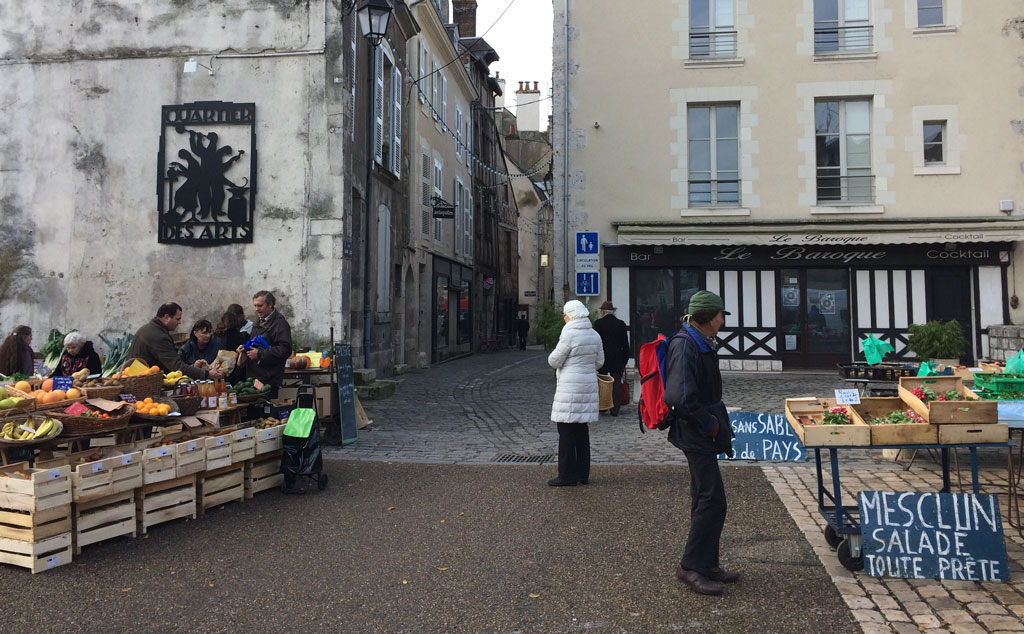
Saturday market in Blois
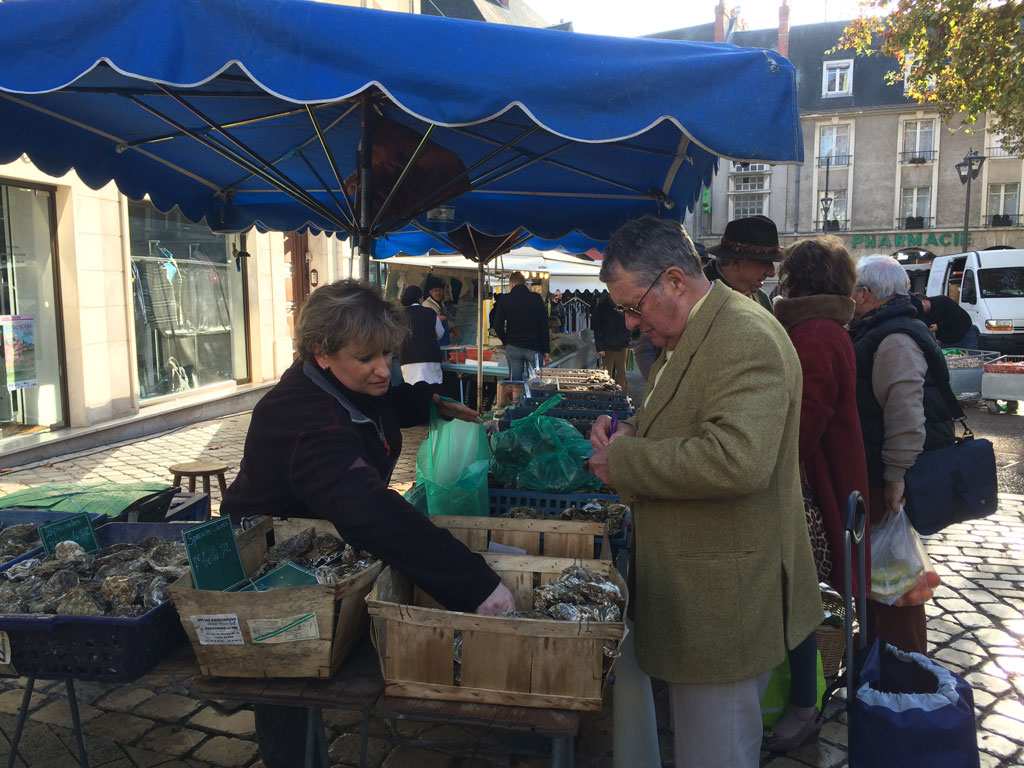
At the market, we spilt up to get some money out of the D.A.B., buy the oysters for Sunday, then the rabbit and chicken, followed by eggs, fruit and vegetables, coffee, more vegetables, local Les Grouets biscuits and cheese. The market is packed so it takes a good hour. At least we don’t have fresh pasta, fish and scallops to buy as that would have meant another 3 stalls.
The all-important oyster vendor
We go home and quickly sort everything out. I change my muddy shoes so I won’t look too countrified while Jean Michel phones the restaurant and says we won’t be there until closer to one, but they are fine about that.
When we arrive in Vendôme, we park right in front of the restaurant which is in the main shopping street, since everything else is closed for lunch.
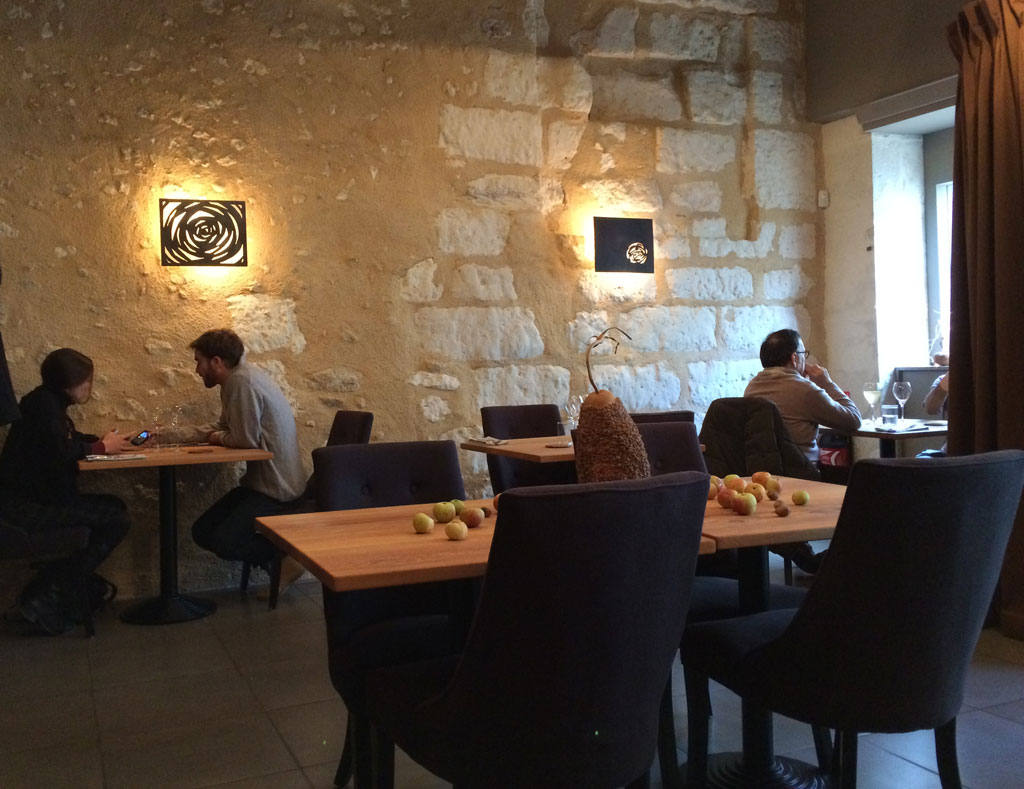
Natural and modern interior
We enter and wait for about 5 minutes before anyone greets us. There only seem to be two people serving and they are both giving their undivided attention to the patrons already seated. That could be positive or negative. The décor is a stark mix of modern and natural.
Eventually we are seated and the menu is explained to us. There are three possibilities : entrée, main and dessert for 32 euro, entrée, two mains and a dessert for 45 euro and a six-course meal for 70 euro, but no indication of what we are going to eat. We choose the 4-course meal and are asked if there is anything we don’t like (I say turnips and offal). It’s now up to the chef to decide what he is going to give us.
Jean Michel orders two glasses of champagne and we get ready to celebrate.
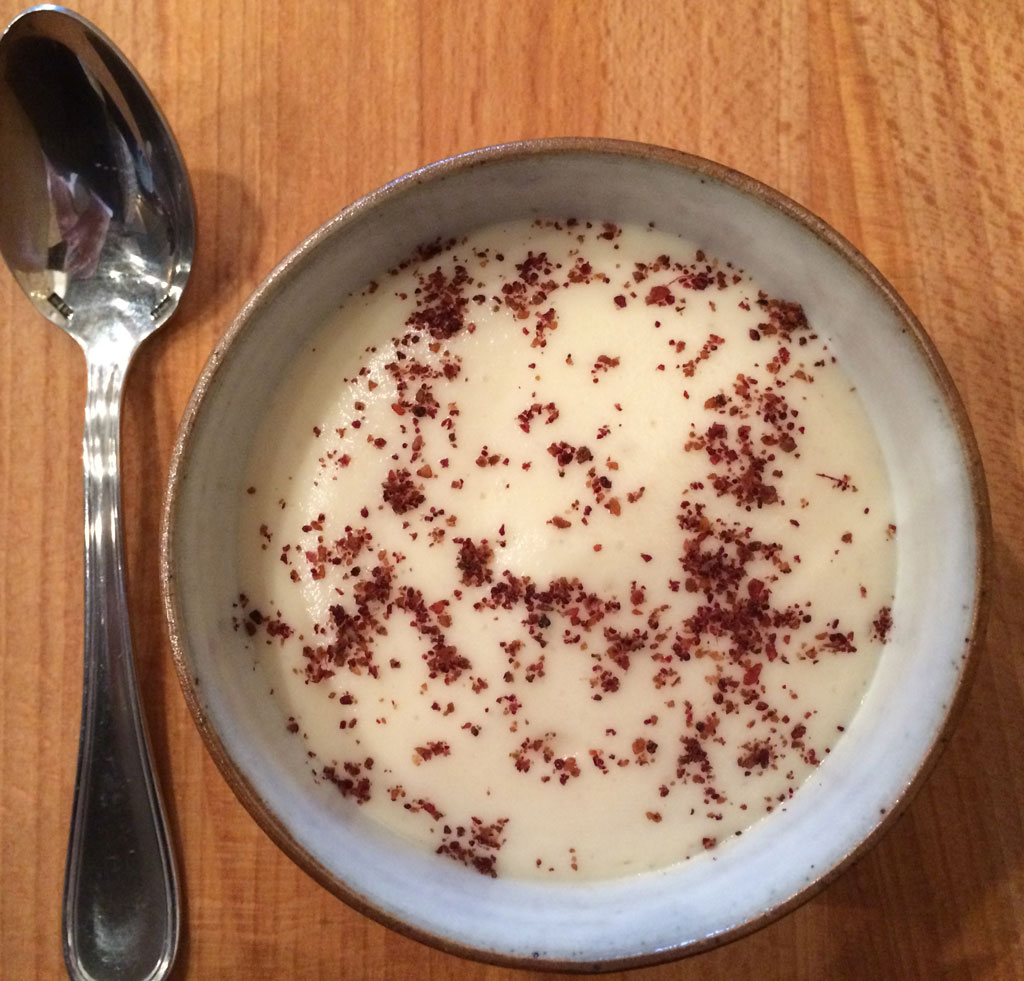
Parsnip bechamel mousse
The amuse-bouche arrives and turns out to be parsnip mousse with an aniseed-type spice. Hmm, I’m starting to wonder about the rest of the meal. Serving parsnips as an appetizer suggests that the rest might all be based on those “forgotten vegetables” that no one (understandably in my opinion) eats any more.
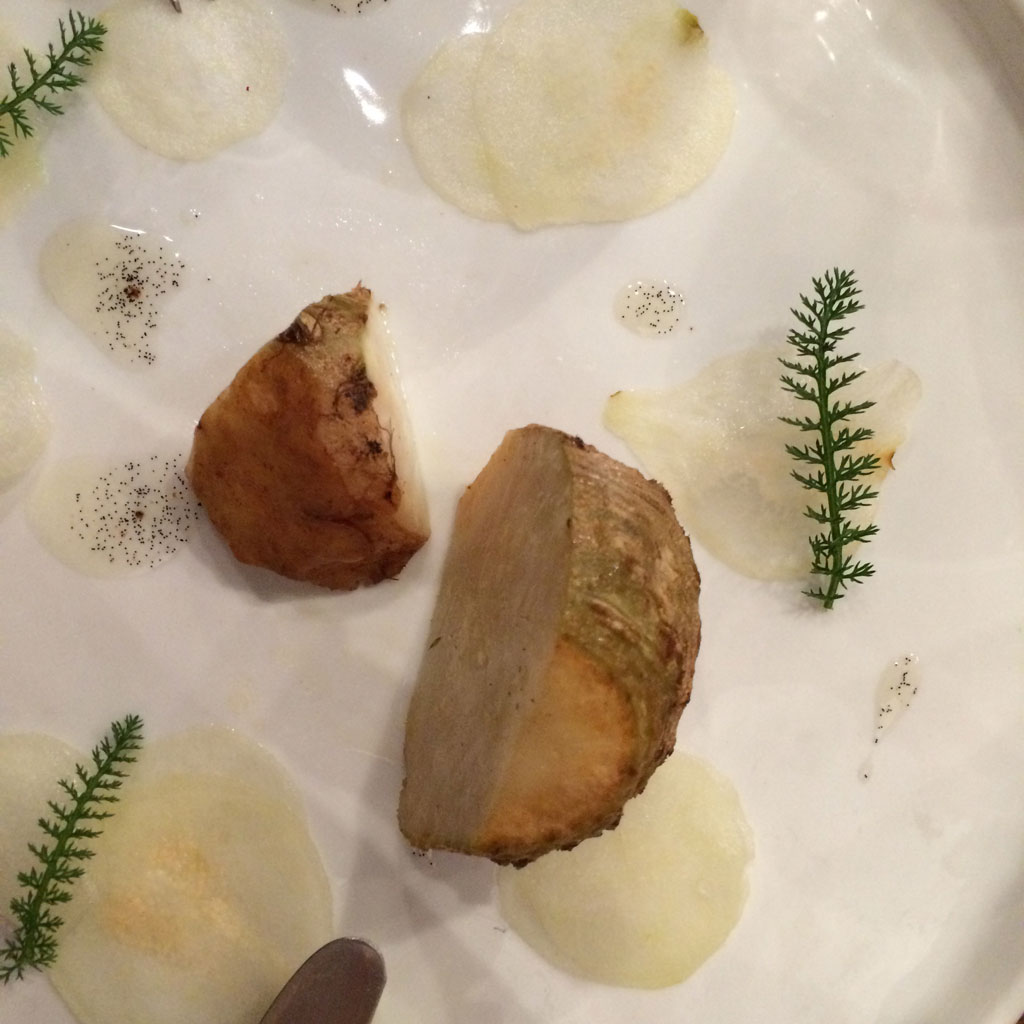
Baked celeriac starter
The starter arrives and my suspicions prove to be grounded. Baked celeriac (a bland root vegetable) and thin slices of pear with some sort of edible grass. Groan. It didn’t occur to me to mention celeriac. I don’t mind if it’s drowned in remoulade sauce but baked, on its own, is not brilliant. Jean Michel, who eats everything, agrees.
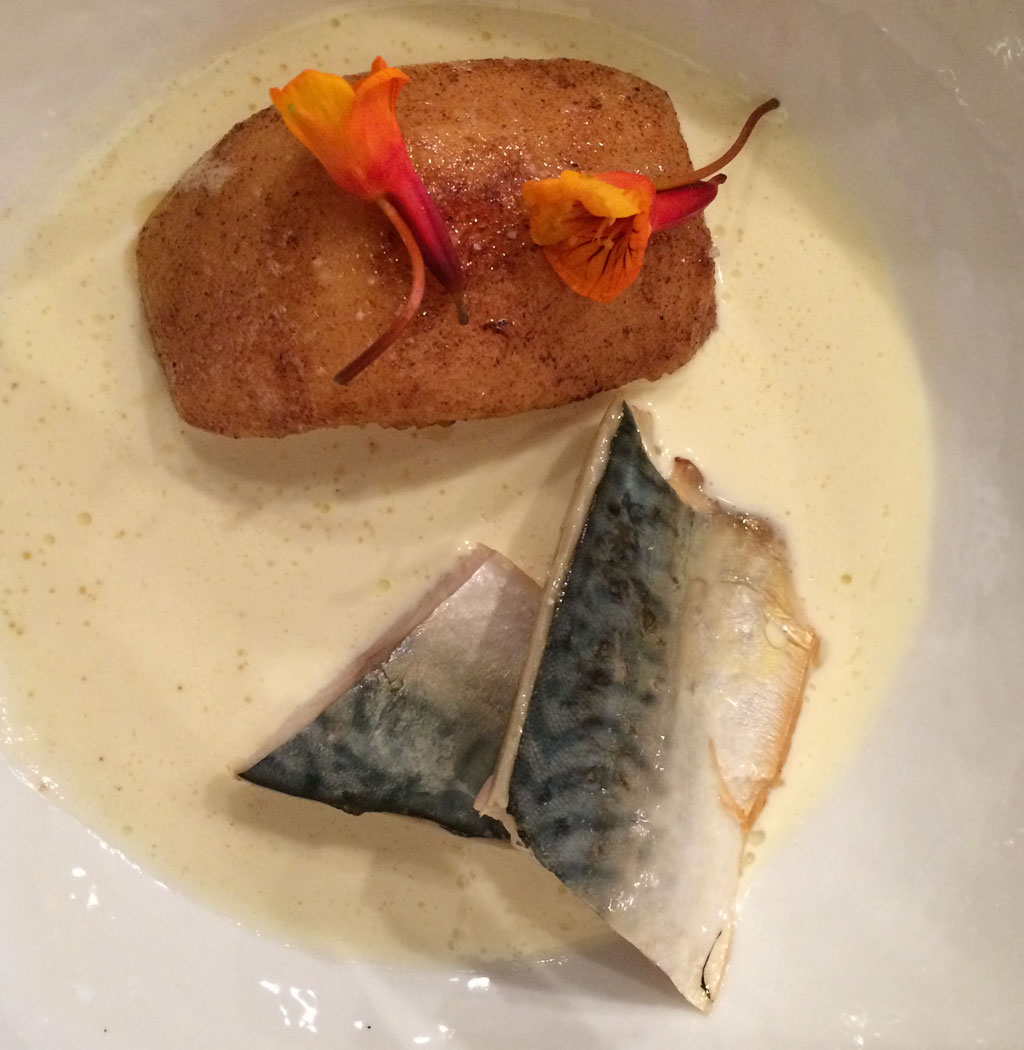
Mackerel and old-style pears
The fish course comes next, with two tiny pieces of mackerel and old-style pears i.e. the sort that aren’t sweet. Yes, well. Also, pears are not among my favourite fruits.
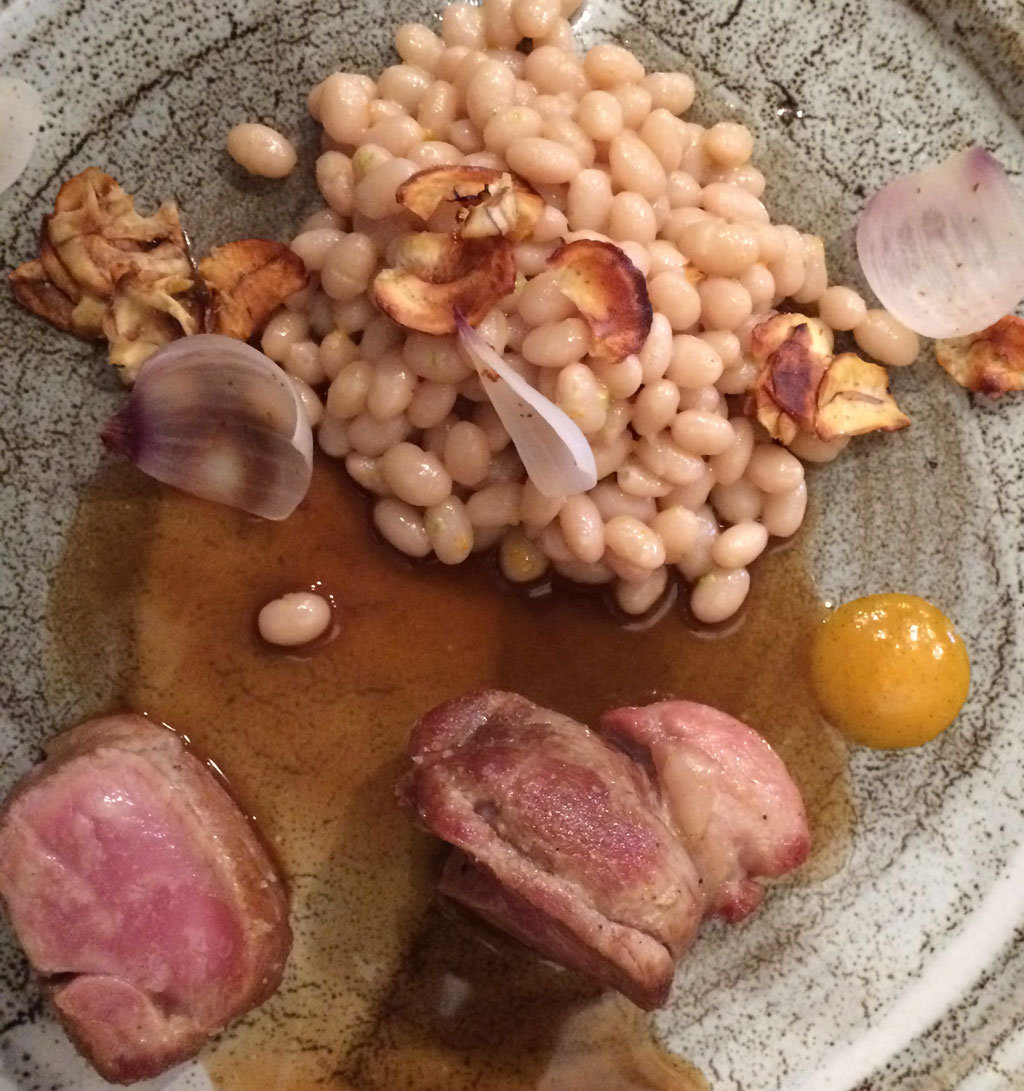
White beans with pork
Next comes the meat course. OK, I forgot to mention that I’m not that keen on white beans either, especially if they are not cooked properly. The two small pieces of pork are tasty enough, as are the slivers of chestnut. I’m not convinced that the little puddle of passionfruit purée ressembling an egg-yolk enhances anything though. It’s marginally better than the other two courses.
By now, Jean Michel is apologizing for such a bad choice. It’s hardly his fault – the article in La Nouvelle république gave a rave review, and talked about a new take on traditional cuisine … I’m wondering what the dessert is going to be.
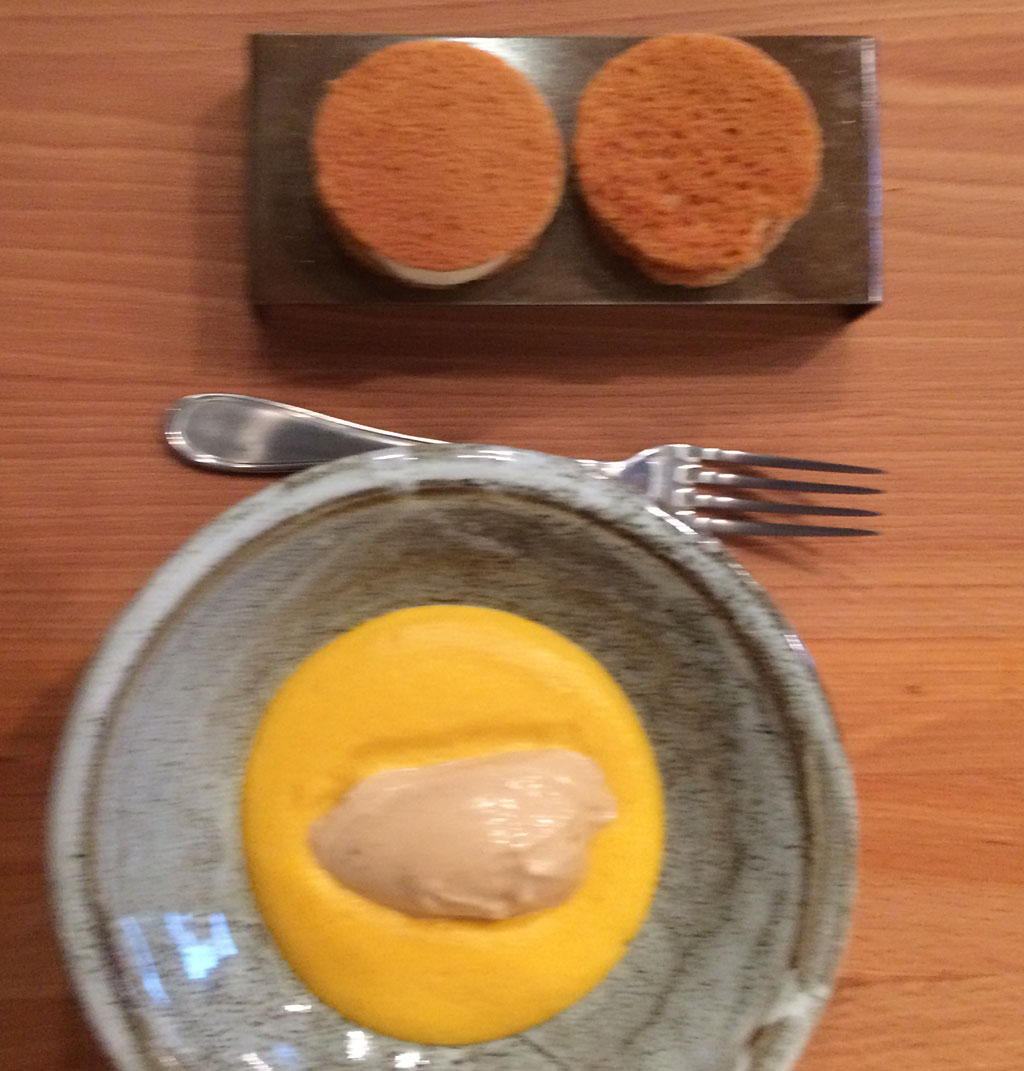
Pumpkin purée and vanilla ice-cream
Pumpkin purée and a little biscuit-like cake each. Tasty enough but the lemon cream squashes out the side of the cake which requires very careful eating.
I have to say that this type of food is not my scene. It definitely doesn’t not flatter the taste buds. Les Hauts de Loire can run rings around them all.
You might also be thinking that there are a lot of things I don’t like. Well, it’s not true – it just happened that every single one of them (with the exception of frogs’ legs) was on the menu!
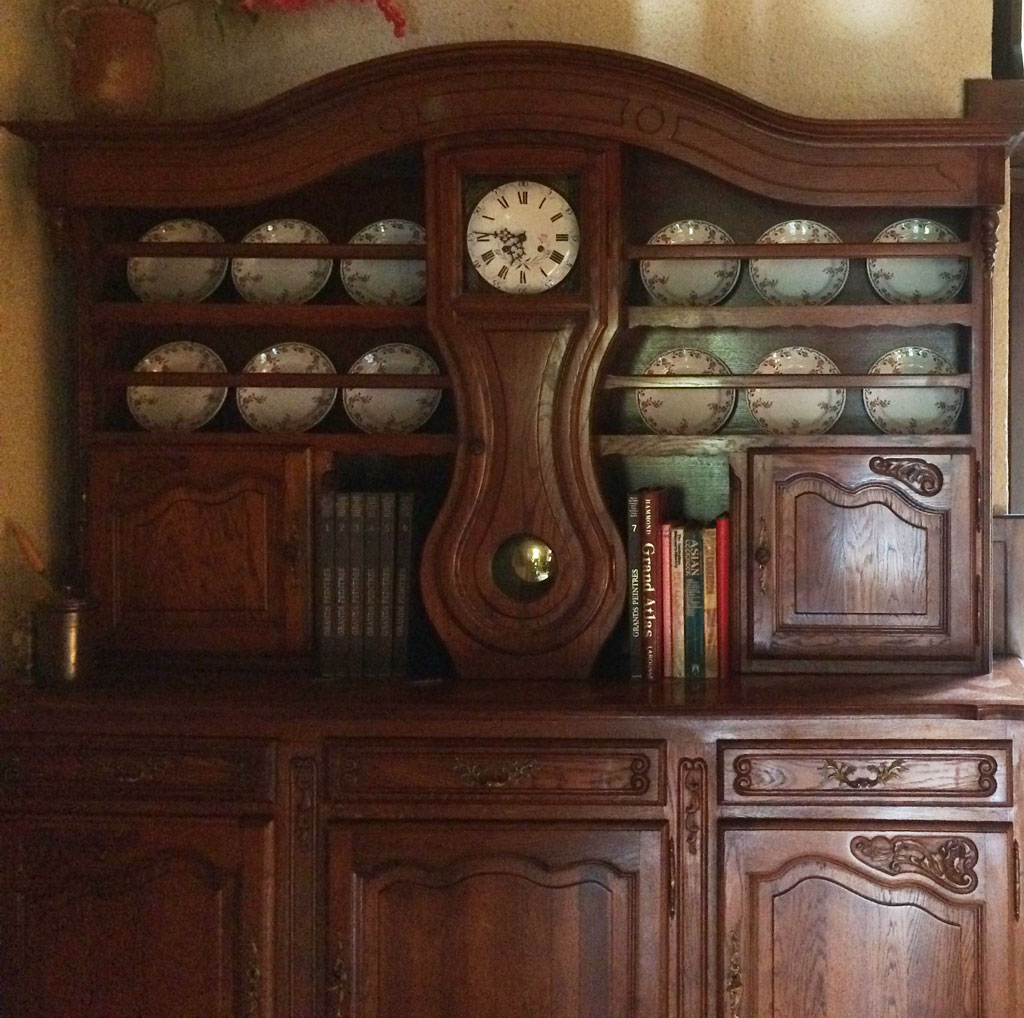
Our clock dresser with its new plates
After walking around in the cold for a while, we wander into the covered market where there is a second-hand fair and pick up 12 plates for our clock dresser. “Why twelve?” asks Jean Michel. “Because I counted them. That’s how many our dresser takes”. He can’t get over the fact that I knew how many we needed! At 10 euros, they’re a real bargain.
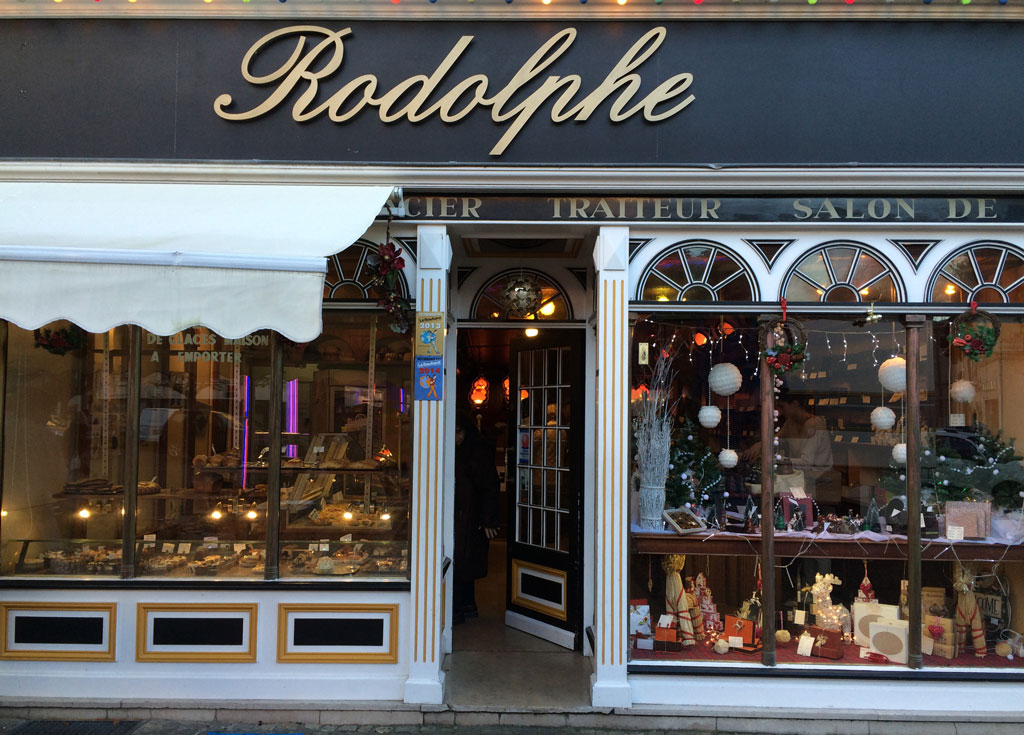
Rodolphe’s which looks as though it might be the best pâtisserie in town
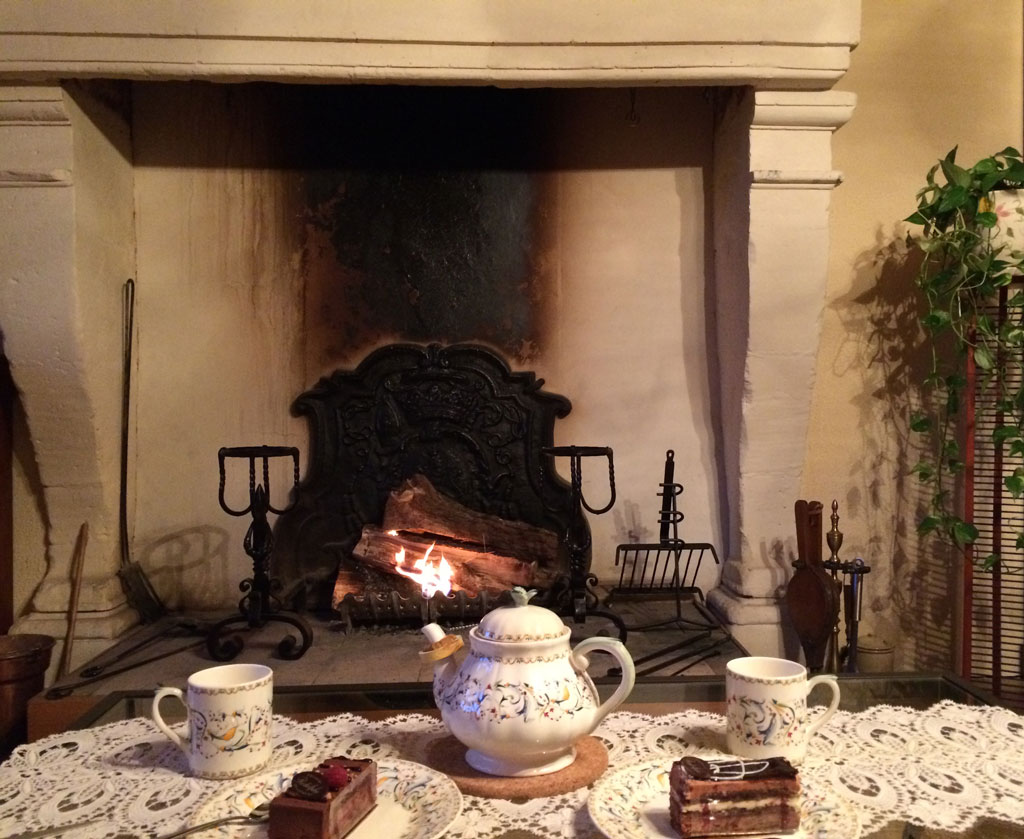
Then we go to Rodolphe’s to pick up some nice traditional French pâtisseries made of chocolate to eat in front of the fire when we get home ! None of this new wave cuisine for us.
It’s not really an office. That’s the word Jean Michel uses in French; it means a place next to the kitchen or dining room in which the table service is prepared. Well, it’s sort of that. I would call it an upstairs kitchen but Jean Michel has names for all the rooms so I’m happy to call it an office. The bureau is downstairs.
Closerie Falaiseau, our late 16th century house, has a funny layout. Despite its 200 square metres, it only has two bedrooms. The upstairs living room is where our Renaissance fireplace is and it is probably the most pleasant room in the house. It has large proportions, lots of light (and it will have even more when the solid door becomes a glass door), a view out the mullion windows and, of course, the fireplace.
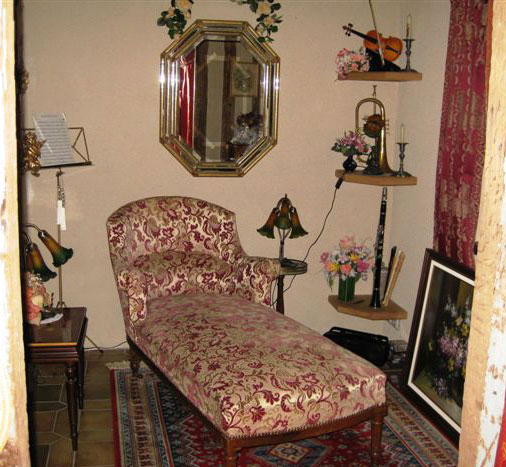
When we first saw the office, it was a sort of museum for musical instruments. There was also a daybed. Jean Michel thought of turning it into a small kitchen early on, when we turned the bottom floor of the house into a gîte, but I couldn’t see the point.
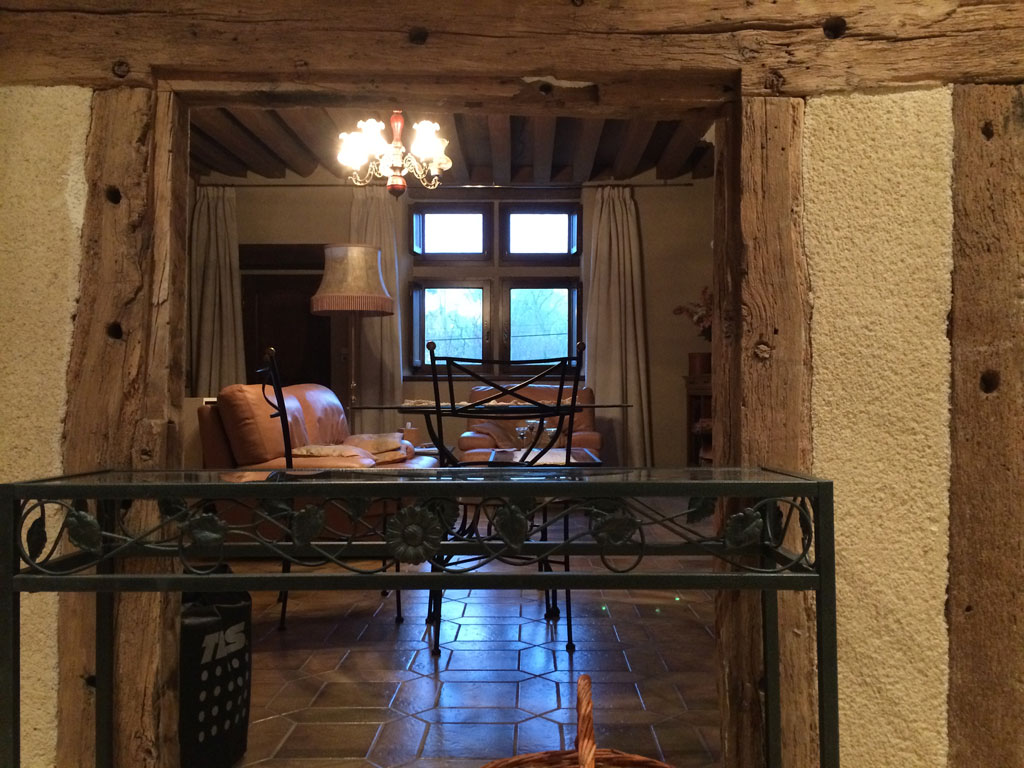
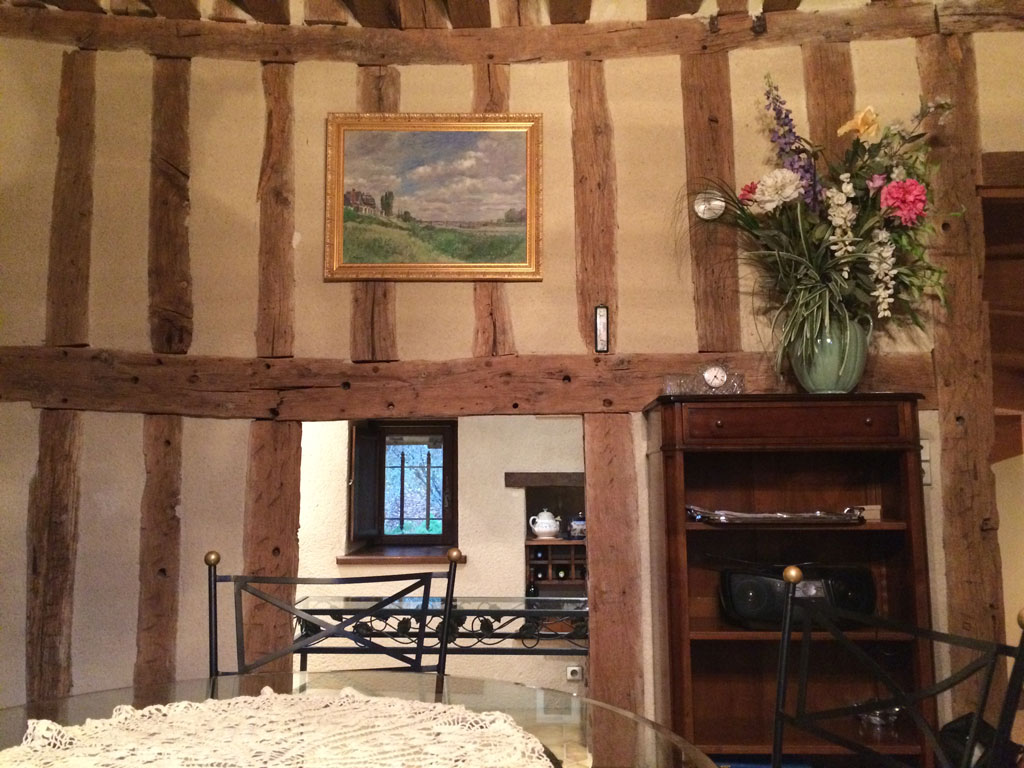
However, after we renovated the fireplace and started using it to cook côte de bœuf, it seemed it might be a good idea. One thing I was certain about though was that we’d block off the really low opening between the living room and the kitchen where I nearly killed myself the first year. We used a wrought-iron and glass console which doubles as a serving hatch.
Looking from the office into the living room with the console protecting our heads
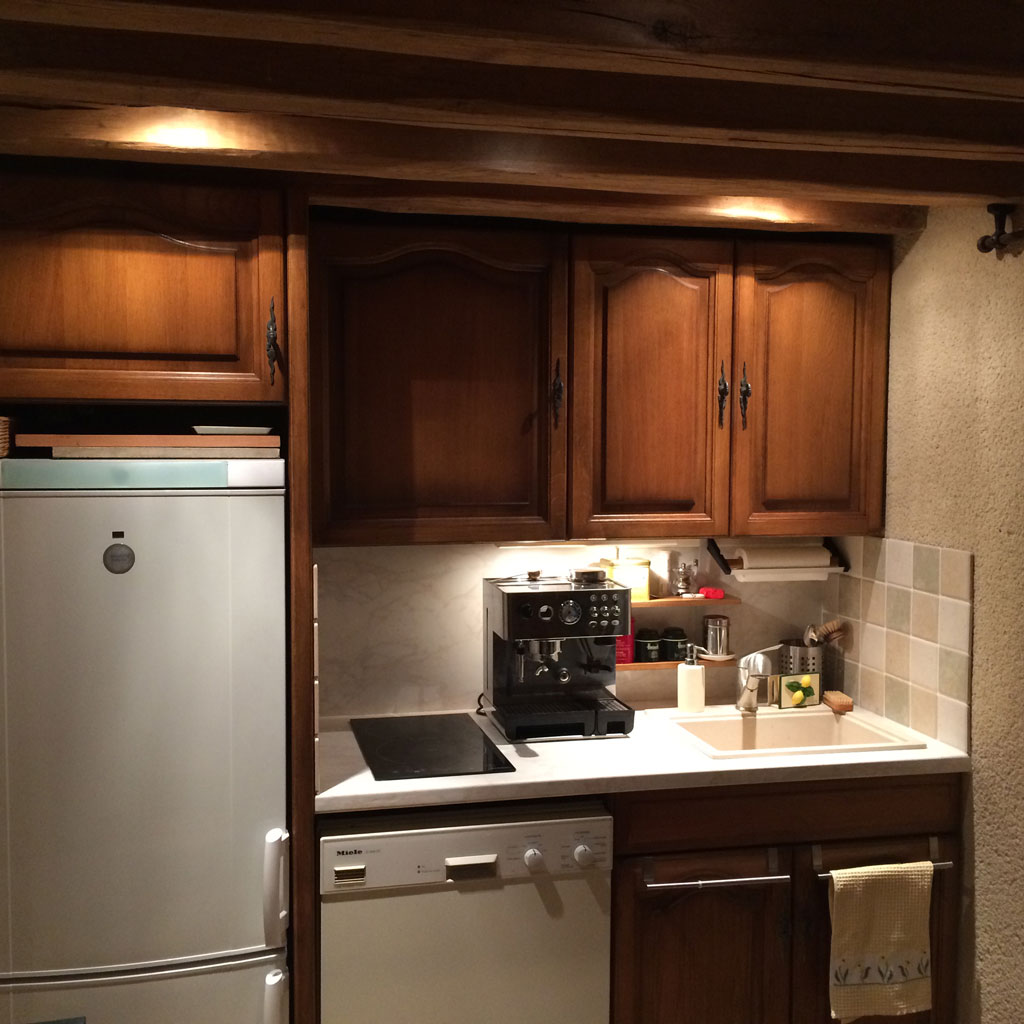
Then we used that neat Ikea on-line software to work out where to put all the kitchen appliances and cupboards. We finally fitted in a normal-sized fridge with a freezer, a dishwasher, a sink, a two-ring induction plate and a microwave with enough room on the table top for our espresso machine.
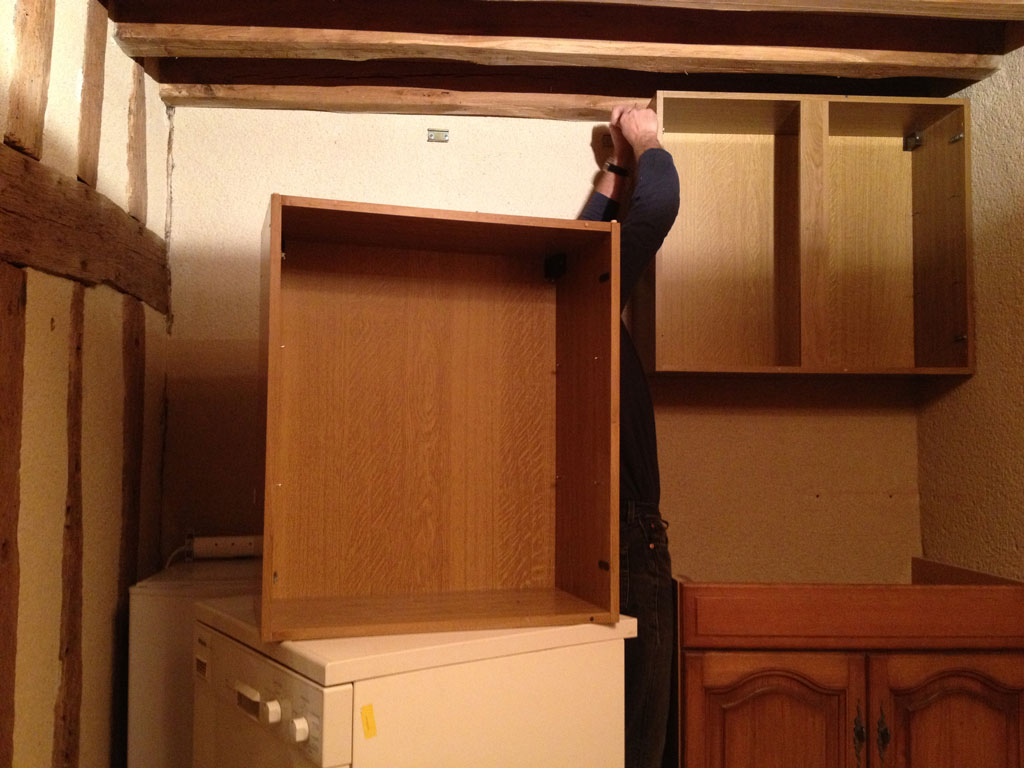
Jean Michel putting the cupboards up
We found some second-hand oak kitchen cupboards on Le Bon Coin to suit the style of our living room furniture because you can see them through the hatch. We picked them up miles away but it was difficult to find exactly what we wanted. I also spend quite a while removing decades of accumulated grease.
The induction plate also came from Le Bon Coin (never used) and we bought the sink from Leroy Merlin because the size meant it wasn’t standard and we didn’t want it to be chipped or anything.
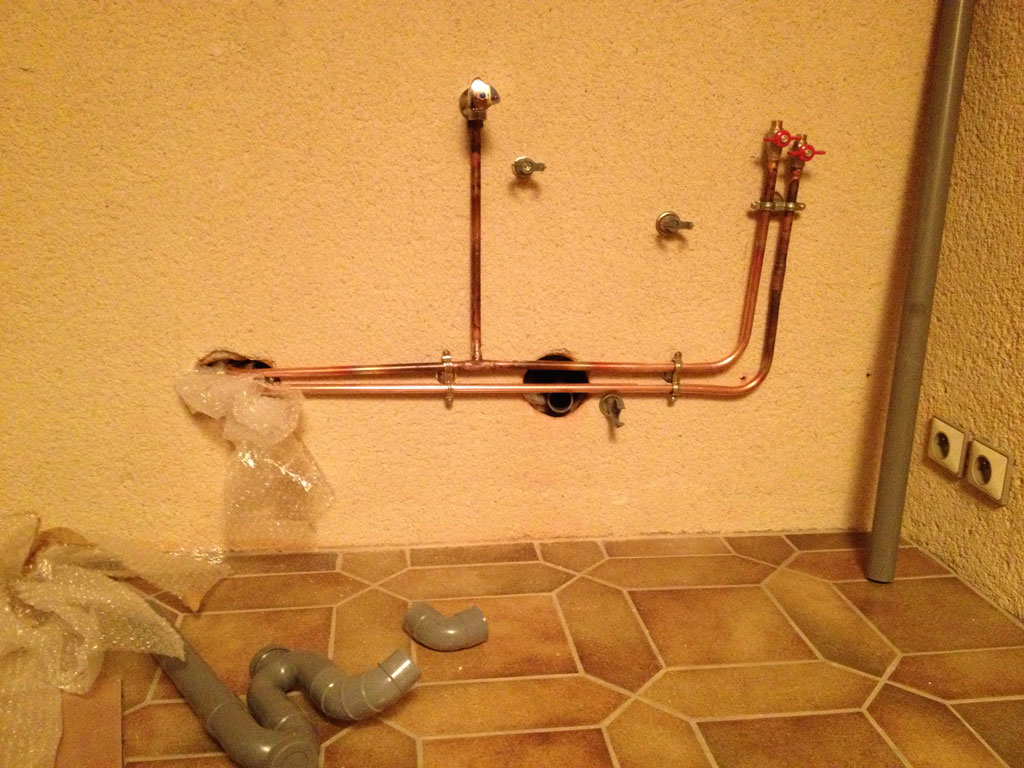
To bring water into the office required drilling through 70 cm walls
Jean Michel then started working on the plumbing, wiring and lighting. The plumbing was complicated, as usual, by the fact that the walls are 70 cm thick and the lighting by the visible beams.
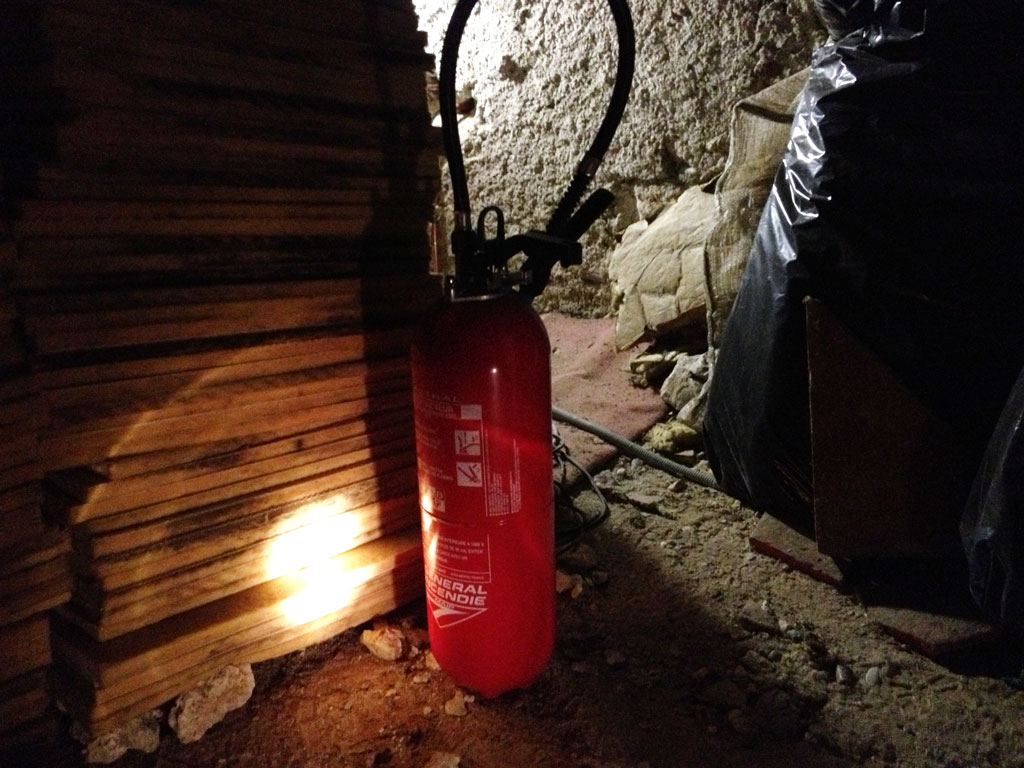
Extinguisher at the read just in case the insulation caught fire during soldering
He spent quite a bit of time in the roof space doing the wiring for the little spotlights we finally decided upon. At one stage, I had to hold a torch and be ready with a fire extinguisher while he soldered the pipes in the attic on the other side of the kitchen.
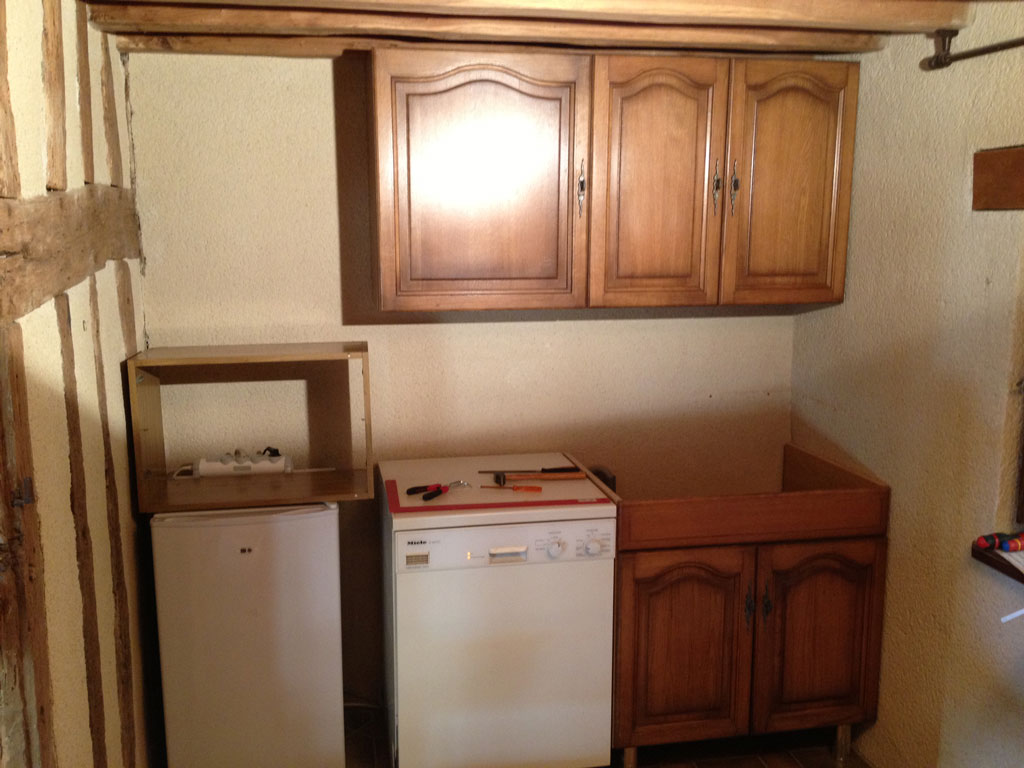
Little fridge and dishwasher in place
All this was done last winter while we still had the gîte and had the major advantage of providing us with a dishwasher. We used a small fridge we picked up at Troc de l’île while waiting for a larger one after we moved. But the final touches were still missing.
Normal fridge in place with sink induction plate and of course the espresso machine
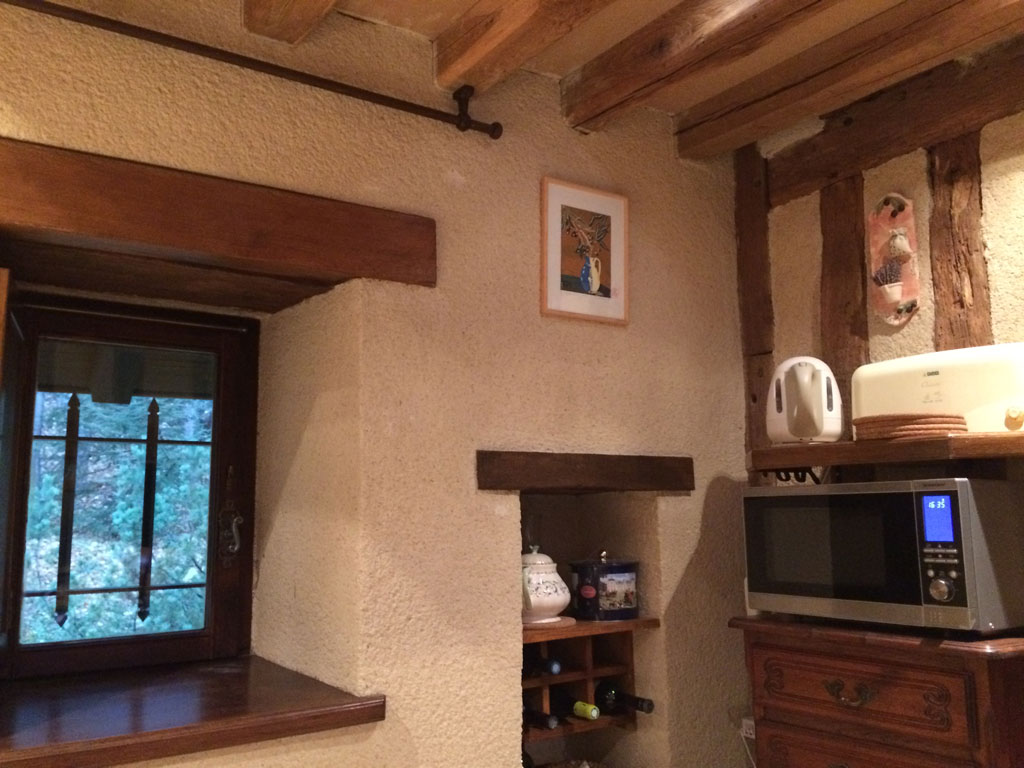
Yesterday, Jean Michel finished it completely. He combined two corner shelves to provide somewhere to put the jug and toaster and made a wine bottle stand to put in the recess which now also houses the bread board & bread, the water jug and teapot.
Niche with wine racks made by Jean Michel with our Australian lithograph above
We have a chest of drawers for cutlery, utensils, tablecloths and teatowels and use the cupboard above the induction plate and sink for important things such as nibbles, tea and breakfast food. The glass-fronted bookcase in the living room takes the plates, cups and glasses.
Looking from the living room into the office
So now we have the perfect place to prepare breakfast, apéritifs and coffee. We also have everything we need to have a barbecue in the fireplace.
Oh, and I nearly forgot. I framed and hung up the lithography that our very first home exchange guests from Australia brought us as a gift.