Friday’s French – Reflexive verbs

I don’t usually write about grammar. I learnt French at high school in Australia where we did a lot of grammar in both English and French and, believe it or not, it was something that appealed to me, a bit like maths somehow. However I have some friends who are having difficulty with the reflexive so I thought I might try to help.

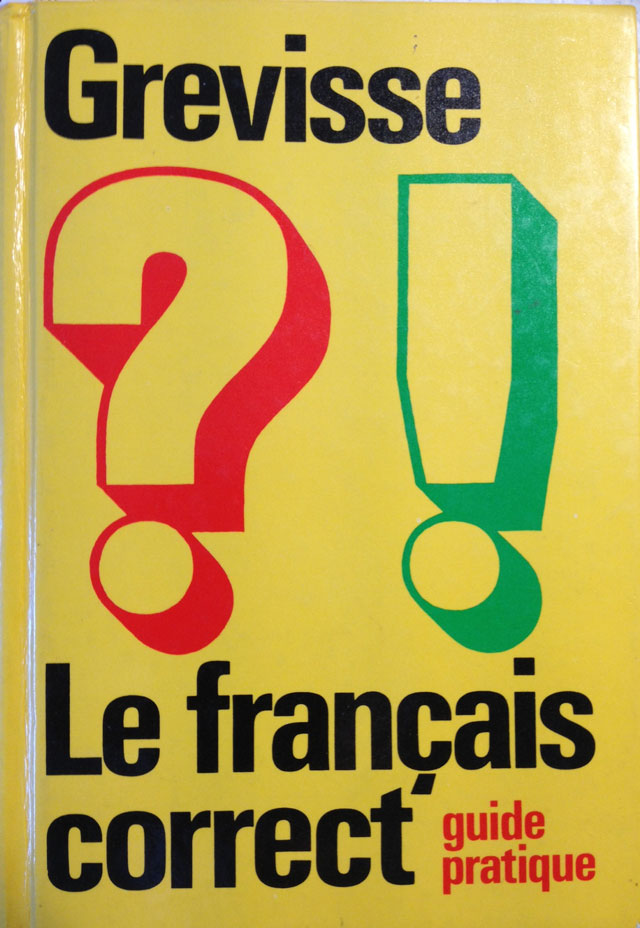
grevisse

We don’t have reflexive verbs in English, of course, which is probably why they pose problems to people learning French.

We wake up in the morning, get up, get dressed, comb or brush our hair and brush our teeth, without any help from anyone else and we wouldn’t dream of saying “I woke myself up, I got myself up, I got myself dressed, I combed my hair myself and I brushed my teeth myself”.

Yet that is what you have to say in French, je me suis réveillée, je me suis levée, je me suis habillée, je me suis peignée et je me suis brossé les dents.

I think most people get the concept, but have trouble organising where to put all those pronouns, especially when there is a second verb involved. I’ve been thinking about it and maybe the best rule of thumb is that the me, te or se and the nous, vous and se all have to be right next to the first person pronoun: je me, tu te, il/elle se, nous nous, vous vous, ils/elles se.

So if we go back to our verb from last week, s’embrouiller, we can’t say J’étais m’embrouillé because the me has to be next to the je. The sentence becomes Je m’étais embrouillé, although we’re much more likely to say Je me suis embrouillé (unless the second part of the sentence requires the imperfect, but that’s something else again).

Now, just to make things a bit more complicated, you need to make those past participles agree. Even the French often get this wrong, I’d like to point out. I always have my little Grevisse Le français correct so I can check if necessary.

So, the basic rule is that, with the auxiliary être, the past participle has to agree with the direct object if it’s before the verb. Well, this is the case here because me, te, se and so on are direct objects (or COD as the French say – complément d’objet direct). Je me suis coupée, ils se sont blessés, nous nous sommes habillées (if we’re all female) and nous nous sommes habillés (if there is at least one male).

On the other hand, in the case of je me suis brossé les dents, since it’s not me that I’m brushing, but my teeth, there is no agreement. . It’s because the direct object is after the verb. Other examples are elle s’est coupé le bras, nous nous sommes lavé les mains.

There are a few exceptions to this rule, but, frankly, unless you’re writing to be published, I wouldn’t worry too much : se nuire, se parler (parler à soi), se plaire (plaire à soi), se ressembler, se rire, se sourire, and a few more you’ve probably never heard of and will never need to use, i.e. ils se sont plu l’un à l’autre.

I hope you’re not too confused!

Off to Plovdiv in Bulgaria

We leave our home exchange apartment in Sofia around 10 am. It’s a short walk to the central bus station. We go past a group of bystanders and see three men lying on their sides on the ground, hands handcuffed behind them and surrounded by police officers in front of a police station. I’m not brave enough to take a photo unfortunately. It’s the first sign of crime we’ve seen since we arrived.

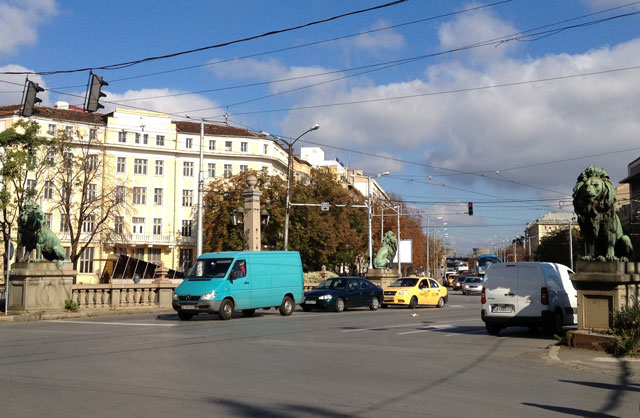
The Lion Bridge
The Lion Bridge

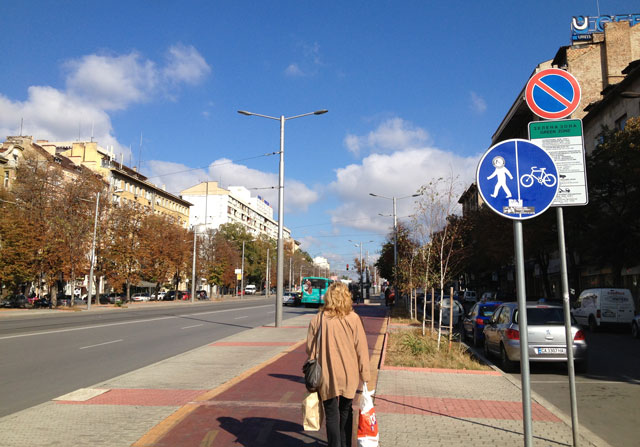
Our walk takes us past the Lion Bridge and along the first bike path we’ve seen too. It’s a very good bike path, much frequented by pedestrians and perfect for our roll-on bag. We only see one bike. We arrive at the very modern bus station. I buy the tickets (14 lev each) from a window on the right as you walk in and am served by the rudest person you could imagine. That, too, is a first in Bulgaria.

The pedestrian/bike path

I go to the Ladies (0.5 lev) and we make our way to platform 6 to take the 11 am bus. The buses leave every hour on the hour. We climb in and I am surprised to see there is no one down the back. We take the first two available seats together. The bus fills up and a very big, loud woman arrives and is obviously saying I’m in her seat. She shows us her ticket and we discover, to our surprise, that ours are numbered too!  The lady behind us says to stay put and says something to the other lady who goes off to find another seat. We’re relieved because our seat numbers are not together!

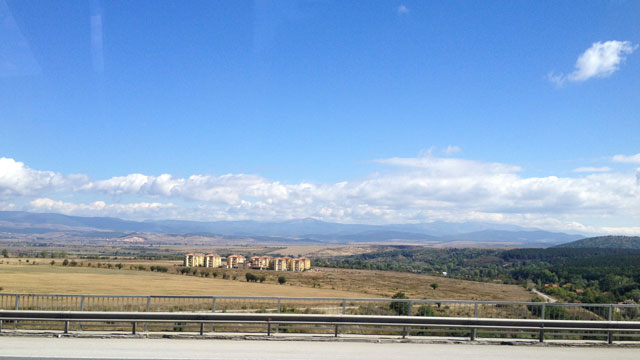
A surprising housing estate in the middle of nowhere

The trip itself, mainly along the motorway, is fairly monotonous and takes a little over 2 hours. When we get out, it already feels different from Sofia. The sun is shining and it’s a bit warmer. We find Yvan Vazov street and start walking the 15 minutes to our hotel. I immediately  feel good in Plovdiv. The street is lovely and shady and there is a definite vibrancy in the air. It is less run-down than Sofia.

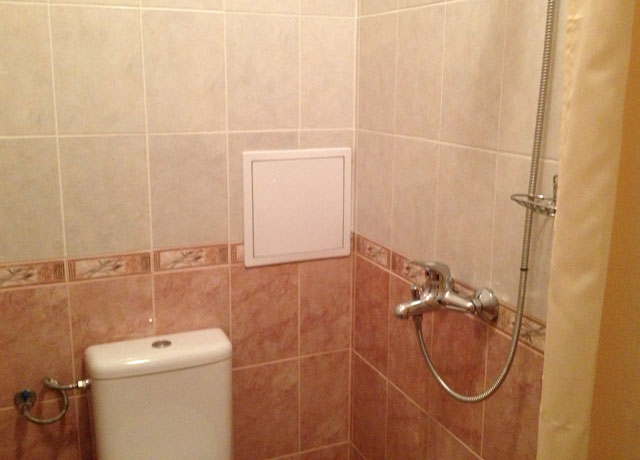
Our surprising bathroom

We arrive at the Romantica Hotel and the friendly receptionist takes us to our room. It was the last one available when I booked several days earlier and although there are twin beds, I was told they could be pushed together. Considering the size of the room, right next to reception, I might add, there isn’t much hope of that. But the real surprise is the bathroom. The toilet is IN the shower area with a curtain in front of the toilet. I’ve never seen that one before! Definitely not as romantic as its name.

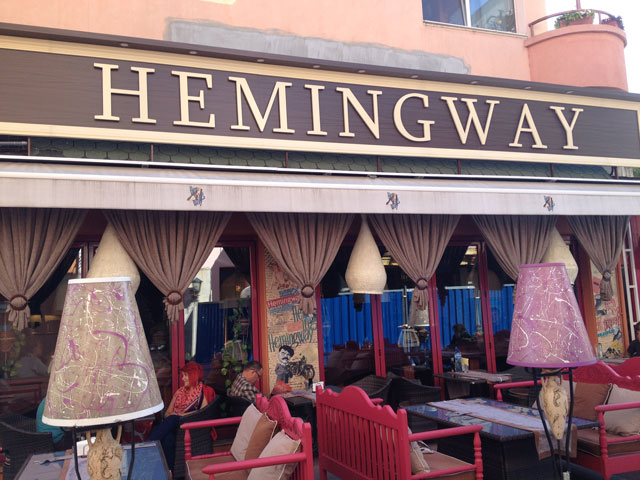
The Hemingway
The Hemingway

I like the look of the restaurant opposite, which is called Hemingway, so we decide to eat there. Our initial plan to sit on the very attractive terrace is thwarted by construction work just next to our hotel. Oh dear, I hope it doesn’t start too early in the morning.

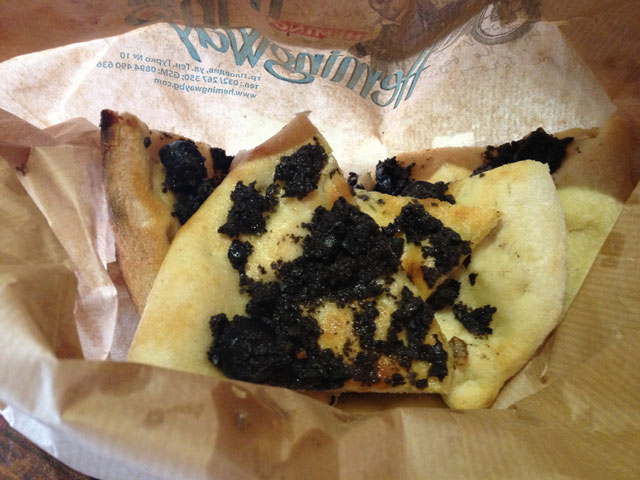
Focaccia and spinach

When the waiter hears us speak French, he goes off to get another waiter who speaks excellent English (learnt from the movies) and a smattering of French. We order a couple of delicious vegetarian dishes and a glass of excellent wine. I choose some divine foccacia-like bread served in a paper bag. It’s the best meal we’ve had in Bulgaria so far, all for a mere 30 lev (15 euro) for the two of us.  I’m liking Plovdiv more and more.

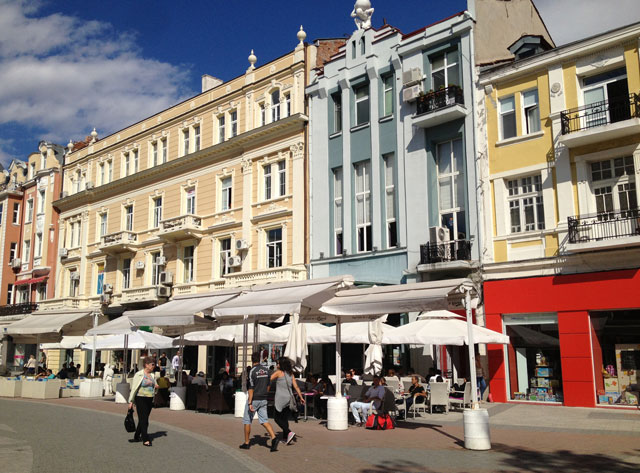
Main street leading to the old town

After lunch, we set off for the old town. But that will be another post!

Hemingway, 10 Gurko Street, Plovdiv. 9 am to 1 am. Tel 032 267350. Mobile 0894490636. http://hemingway.bg/en. office@hemingwaybg.net


Wednesday’s Blogger Round-up: La Maison du Chou – Autumn in France – Driving in Europe

So what’s on the agenda this Wednesday? Mary Kay from Out and About in Paris takes us to the Maison du Chou where she has discovered the lightest choux à la crème, while French Moments delights us with ten stunning photos of autumn in France. Meanwhile Carolyn from Holidays to Europe brings us some very useful tips for driving in Europe. Enjoy!

Something Sweet for Monday – La Maison du Chou

by Mary Kay from Out and About in Paris, an American by birth, Swiss by marriage, resident of Paris with a Navigo Pass for the metro that she feels compelled to use
chouWhether it’s an unexpected glimpse of the Eiffel Tower as you round a corner or a chance encounter with a beloved friend in a bistro on the Île Saint-Louis, the best things in life are often unplanned and completely spontaneous. In Paris, I know exactly where to go for the most delicate macarons and the richest hot chocolate. What I didn’t know, at least not until yesterday afternoon, was where to find the lightest choux à la crème.

If you would like to serendipitously discover these delightful cream puffs freshly filled with a mousse-like mixture of sugar and fromage blanc, stroll down Rue Bonaparte past the famous Deux Magots Café in the Saint-Germain-des-Prés neighborhood of Paris. In your best flâneur style, casually turn right on Rue de l’Abbaye and left when you see the quaint Place de Fürstenberg. Read more

Top 10 Most Beautiful Photos of Autumn

by French Moments, a Sydney-based organisation with an international focus which promotes the French language and culture to English-speakers worldwide. Their French team is all about the language, culture and experience.

In this post we have compiled a selection of French Moments’ photos of autumn all taken in France’s North-East and Lyon.

autumn

Summer has now been replaced by autumn and the trees have put on a fabulous colour display with yellows fading to reds. Under the beautiful blue sky of an Indian summer or on a misty morning, the colours of autumn sometimes do not look as good in a photograph as they really do to the eye. Read more

Tips for Driving in Europe

by Carolyn from Holidays to Europe, an Australian based business passionate about sharing their European travel expertise and helping travellers to experience the holiday in Europe they have always dreamed of

When planning their travels in Europe, many Aussies are keen to hire a car for at least some of their trip but are, understandably, apprehensive about driving in large cities. Driving on the ‘wrong’ side of the road can be hard enough, but navigating your way through busy streets that are often very narrow and one-way, can quickly raise the blood pressure. So, what do I recommend?

The rail network in most countries in Western Europe is excellent and it’s often the first choice of transport for travellers but for those wanting to visit more rural locations or countries where the rail system is a little less sophisticated (or barely exists, such as Croatia), driving is the next best thing. Read more


The Hornets’ Nest


We’re very worried. Our guests have been telling us about large bees in the kitchen at Closerie Falaiseau that appear to be coming from the inside. When we arrive, the first thing I do is look for the bees. There are several dead insects in the  birdbath but I can see instantly that they are not bees or wasps but hornets! Thank goodness no one got stung.

The dead hornets in the bird bath

When Jean Michel cleaned the bedroom fireplace when we first bought the Closerie, he discovered an enormous, fortunately empty, hornets’ nest, so he immediately assumes that the hornets must be in the kitchen chimney. Sure enough, we can see a lot of activity around the top of the chimney stack.

The hornets nest that fell out of the chimney stack in the bedroom fireplace

But the fireplace in question is completely closed off with a board at mantle level. We check it thoroughly and can’t see any way the hornets could possibly be getting from the chimney stack into the kitchen. They must be coming through an open door or windows.

The kitchen fireplace

We call the fire brigade who explain that early autumn, especially when it’s mild, is a favourite time for hornets. They tell us we should call a company specialising in désinsectisation. We check out the yellow pages and start searching for someone who can come next day at the latest as we have new guests arriving on Saturday.

The first ladder in place

After calling several numbers, we get a positive response from Mr B. who turns out to have been born and bred in our neighbourhood in Blois, Les Grouets. He says he can come late afternoon the next day. We’re relieved.

Mr B. taking up the second ladder

He turns up with his van and ladders and starts setting them up. He has a regular alumium telescopic ladder and two wooden ladders to climb across the roof without damaging the slate. He sets up the aluminium ladder then climbs up with one of the wooden ladders in his hand. He places it flat on the roof then puts the second wooden ladder next to it.

Mr B. checking out the fireplace

After that, he climbs up the first wooden ladder then pulls the second one up so that it is an extension of the first. Now he can get to the chimney. No harness of any sort we notice. He has a look at the chimney and says it has a concrete plug that is somewhat deteriorated and is letting the hornets get in.

Mr B.'s protective overalls
Mr B.’s protective overalls

He climbs down. “Yes, a belt would be good”, he says, and gets one from the front seat of his van. I’m wondering what the belt’s for. Maybe to tie the two ladders together ? He then proceeds to thread it through the loops of his jeans ! “That’s better”, he says.  “I have some overalls”, he explains to no one in particular, “with a mask and everything, but once you put them on, you can’t see anything. No much point.”

Mr B. taking his spray cans up the ladder

Armed with four large spray cans (two instant insecticides and two softer environment-friendly ones), he climbs back up the ladder and over to the chimney. He starts spraying the hornets that are clustered around the top. I have to confess it seems very amateurish to me.

Mr B. spraying inside the chimney

Let me know if you see any coming from behind, he says. So, there we are, standing on the ground, watching out for any hornets that might attack him, and when one comes along, he sprays it. It’s a family business, he explains, handed down from father to son, so I suppose he knows what he’s doing. “I like it up here”, he says.

Mr B. climbing up the roof with his spray cans
Mr B. climbing up the roof with his second lot of spray cans

He comes down for more ammunition. Jean Michel sees a hornet rapping on the kitchen window. Since everything is clean for our next guests, I volunteer to go and let it out since I can take  my rubber clogs off easily. I walk in and can hear a very loud buzzing noise.  It seems to be coming from above me.

Writhing hornets on the kitchen floor

“Watch out”, says Jean Michel, sounding very alarmed. “Don’t panic”, says Mr B.  And I look down. The floor is covered in writhing hornets. I get a terrible fright and leap out of the way. How on earth did they get in ?

The hole in the corner of the fireplace through which the hornets were passing

It turns out there is a small space between the wall of the fireplace and the board closing off the chimney. That’s where the hornets are getting out ! Mr B uses his environment-friendly spray to finish off the ones on the floor and his potent spray near the hole they are getting through.

A writhing hornet up close

I get the broom and sweep them all up. Mr B. climbs up his ladder again to get rid of the last few stragglers. We check there are no more in the kitchen and he packs up his gear, promising to come back again next day if there is any more activity. But his sprays have done the trick and the hornets are gone.

Friday’s French – s’embrouiller

Well, when I left some homework at the end of last week’s post about “confusing”, I didn’t realise it was so difficult. My apologies.

The last hollyhocks of the season
The last hollyhocks of the season which have nothing to do with s’embrouiller ou confusion!

Two brave souls did, however, take up the challenge. Both found a good solution for the third sentence i.e.

3) Imminent and eminent are easily confused words.

Il est très facile de confondre les mots imminent et éminent.

On confond facilement le mot imminent avec éminent.

But the other two sentences caused a lot of confusion to say the least.

1) Are you still confused about how to use confuse in French?

2) I was confused when nothing happened.

Now, I asked a couple of Frenchies for help and the best we seem to have come up with are the following:

1) Avez-vous toujours du mal à savoir utiliser le verbe “to confuse” en français?

2) J’étais étonné qu’il ne se soit rien passé.

If nothing, it proves that “confusing” can rarely be translated literally.

Both my contributors attempted to use the verb s’embrouiller and I realised that my explications musn’t have been very clear.

The past participle “embrouillé” cannot apply to a person. You can have “une histoire embrouillée”, “des idées embrouillées”, “les paroles embrouillées”, but neither you nor anyone else can be “embrouillé”.

If you want to say you got confused about something or muddled up, you have to use the reflexive verb: je me suis embrouillée en voulant suivre ses explications – I got confused trying to follow his explanations. Il s’est embrouillé dans ses réponses. He got his answers muddled up. It’s all confused in my mind.

François Hollande s’est embrouillé sur la baisse de la TVA pendant de son discours: François Hollande got confused about the drop in VAT/GST during his speech.

Another slightly different meaning can be seen in the following sentence: Autour de vous, tout s’embrouille, les images deviennent floues ou semblent irréelles. All around you, there is confusion, the images became fuzzy or seemed unreal. Tout s’embrouille dans ma mémoire. It’s all mixed up in my memory.
Sometimes people confuse s’embrouiller et se brouiller which can mean to have an argument: je me suis brouillé hier avec ma copine: my girlfriend and I had a fight yesterday.

It can, however, be used to mean “confuse”: tout se brouilla dans sa tête:  everything became confused or muddled in his mind. And guess how you say “scrambled eggs” in French? Oeufs brouillés!

All very confusing, isn’t it?

A Vide-grenier from the inside

It’s not the first time Black Cat and I have participated in a vide-grenier. Living in an appartment with no cellar meant we needed to regularly get rid of toys and clothes and the local town hall had a free garage sale for kids once a year. After that, we shared stalls with friends until Black Cat was old enough to branch out on her own.

Our stand
Our stand

With our move to Blois scheduled for 30 September 2014 and Black Cat actively looking for work in New York, we have taken a stall at the yearly vide-grenier in nearby Rue Colonel Driant. We’re up early and at 8.15 am we’re handing in our documents (ID and electricity bill to prove we are locals) and paying 15 euro in exchange for 2 metres of pavement space. I go and get the car which Jean Michel has filled up the day before and park it temporarily in front of stand n°65 while we unload.

Place Karcher
Place Karcher

We set up a trestle table and Black Cat starts putting the clothes rack together. As we unpack, the early scavengers arrive, mainly looking for jewellery. By the time we have everything out of the cartons, it’s 9 am and we’ve already made a couple of sales. We also make the acquaintance of our neighbours.

Checking out the neighbours' stall
Checking out the neighbours’ stall

On the left is a Ukranian girl and her French friend. It’s their first vide-grenier but, apart from the fact that their two clothes racks topple over at regular intervals, they seem to have their act together. They have a mirror which we don’t have but they lend it to us whenever we need one. They seem to be having a whale of a time. Everytime I look over they seem to be dressed differently!

Tidying up the stall

The lady on the left is a regular. She has a small stock of women’s clothes that she has brought in a suitcase, including a rack that regularly falls over with the wind as well. She also has two plastic sheets that she spreads on the ground to display anoraks and jackets. She explains later in the day that she buys summer dresses cheaply on cheaper markets and sells them on the more expensive ones.
Clever use of grating to hang up clothes and shoes

I’ve brought along two folding chairs because I know I can’t stand up all day. We can’t possibly display everything we have on the clothes rack and table so we work out a new arrangement. We put the table on one side and the rack on the other so that people can enter the stand and also look through our cartons which we’ve divided into tops, skirts, dresses and pants.

The vide-grenier went right down Colonel Driant

Business is steady. Black Cat’s fairly large collection of DVDs, a handful of CDs and my books are the most popular initially. At 2 euro for a DVD and 1 euro for a book, you’d think it was a bargain but there are still people who want to bring the price down. We’re selling the clothes at 2 euro for a top or skirt, 3 euro for a dress and 5 to 10 euro for jackets and coats.

A little visit from the mounted police

Late morning, I go back home and make a large thermos of tea which I bring back and share with our neighbours who are delighted. “Oh, but I don’t have anything to offer you”, says the Ukrainian. “That’s OK. We’re using your mirror.” But when I bring the second thermos around 4 pm, she has acquired some biscuits to share.

Our young neighbours

During the day, at least three English speakers, hearing me chatting with Black Cat, come up and ask for directions!

Most of the people are friendly which is not true of all street markets. I tell someone that Black Cat has made some of the clothes herself. Those items are snapped up as unique pieces. One young woman makes us laugh as she wiggles into a skirt then removes her own from underneath so she can check if it fits properly.

The fight
The fight

There’s a big fight at the stall opposite at one stage when a woman claims that she hasn’t had her money’s worth. It looks as though they might come to blows but she finally walks away.

Some interesting shoes at n° 65

At about 6 pm, business picks up and we bring the prices down even further. I tell my neighbours they can take what they want because they are all doing another vide-grenier next day. Then it starts to spit and we all have to start packing up before everything gets wet.

The leftover shoe next morning

Jean Michel turns up with the car and we bundle it all in. I take everything to La Ressourcerie at 62 rue Oberkampf because there’s no way we can store any of it. Black Cat is very pleased with her takings and I have had a most enjoyable day with my daughter!

Wednesday’s Blogger Round-up: Butte aux Cailles – Texting in French – Céléri Rémoulade

This week, Filly di Somma, writing for Guide2Paris, takes us off the beaten track to the Butte aux Cailles in Paris, while Katerina Forrester, in a post for My French Life gives us tips on text messaging in French. Meanwhile, Susan from Days on the Claise tells us about a little-known vegetable – celeriac – and how to prepare it. Enjoy!

Butte aux Cailles – A True Paris Ambiance

by Filly di Somma, a fanatical Paris fan, in one of her regular posts for Guide2Paris, which aims to be the complete source of information in English about the Ile-de-France region of France which includes the city of Paris.  Designed specifically for English speakers visiting Paris or the region of Ile-de-France, contemplating buying property in Paris or those already living in Paris.

020913171859--Butte aux Cailles - PTO - David LefrancDuring my last trip to Paris I had the opportunity to visit a lovely ‘quartier’ which I hadn’t previously discovered on my trips to the city. “The Butte aux Cailles” district is almost like a separate village in the centre of Paris in the 13th arrondissement. Whilst being driven there by a lovely Parisian, I discovered and adored the narrow cobblestone streets featuring original restaurants, cafes and boutiques full of people eating and drinking outside. I loved its art deco architecture and its traditional Paris atmosphere.
Read more

Unlocking French language: text a’grieve’iations

by Katerina Forrester, born in Australia but always longing to be French at heart, currently living the Arts student life in Melbourne, where she is studying to become a Linguist. writing for My French Life, a global community of French and francophiles connecting like-minded people in English & French

Texting_in_trafficLOL is the furthest I will go when writing with text abbreviations. Nothing more, nothing less. When writing texts in English, I write in full, and I write with proper syntactic features. I don’t want to be seen as an over-texting teenager! I want my friends to receive properly articulated sentences with substance. Nevertheless, this is not the case when I text to friends in French. Read more

Céleri Rémoulade

by Susan from Days on the Claise, an Australian living in the south of the Loire Valley, writing about restoring an old house and the area and its history and running Loire Valley Time Travel.

celeri_remouladeThe general appearance of celeriac doesn’t inspire much confidence in it being tasty, and even less so if you consider eating it raw. Nevertheless, the most popular dish using celeriac (céleri-rave in French) does indeed use raw, grated celeriac.

Don’t be fooled into thinking that this is diet food though. This is a dish to which cream is added in order to make it lighter (!!) and easier to digest (!!!) It is tremendously popular in France, but I don’t think many people bother to make it themselves. Most people buy it from their trusted local charcutière traiteur (delicatessen). If you do make it at home, it’s not just a matter of grating some celeriac and coating it with mayonnaise. There’s a trick to getting the deli style céleri rémoulade. Read more

Saint Eustache and the Fish of Remorse


You’ve probably never even heard of Saint Eustache, although you may have seen it if you’ve been to the famous market street of Montorgueil behind the old central markets or halles which are under renovation at the moment and not exactly a tourist attraction.

Saint-Eustache
Saint-Eustache

The church is very ornate, in the gothic style of Notre Dame. Like many cathedrals, it took over a hundred years to build – from 1532 to 1640 – and is located on the site of a chapel dedicated to Saint Agnès. The plan is gothic but the decoration is renaissance. Over 33 metres high, 100 metres long and 43 metres wide, it is very imposing despite its missing tower.

So how do we tell the difference between gothic and renaissance? Gothic architecture originated in France in the 12th century and its most famous example is Notre Dame. Its characteristic features are the flying buttress, the ribbed vault and the pointed arch.

Side of Saint Eustache in Rue du Jour

It was the flying buttress that enabled architects to build increasingly higher churches because the buttress takes the extra weight off the load-bearing walls. Churches in the previous period – Romanesque or roman in French were much smaller and had no buttresses. They are more prevalent in the south of France.

The Romanesque church of Saint-Austrégésile at  Mouchan in the south-west of France
The Romanesque church of Saint-Austrégésile at Mouchan in the south-west of France

Along with the ribbed vault, the flying buttress meant that more windows could be added high up in the building. When ribbed vaulting is used, the arching and intersecting stone ribs support a vaulted ceiling surface made of thin stone panels, which greatly reduces the weight of the ceiling vault.

The pointed or ogival arch may be of Islamic origin or have evolved naturally in Western Europe as a structural solution to a purely technical problem but whatever the case, it ‘s a distinguishing feature of Gothic architecture.

The Louvre
The Louvre

Renaissance is the next period after that, between the early 15th and early 17th centuries. It originated in Italy but soon spread across Europe. It puts emphasis on symmetry, proportion and geometry and features orderly arrangements of columns, pilaster and lintels, with semicircular arches, hemispherical domes, niches and edicules. The Louvre is a prime example of Renaissance architecture.

The buttresses on Saint Eustache are not as obvious as those of Notre Dame, for example, and the western façade, with its classical lines, is perfectly symmetrical except for the missing tower.

Notre Dame
Notre Dame

If you go around the back of Saint Eustache, you’ll see a small plaque dated 1213 with a fish trying to bite its tail, a reminder that a man once made his fortune from the local fish markets. On Sundays, our fishmonger’s stall is coincidentally just in front of it!

Jean Allais, a Parisian bourgeois, helped to finance Philippe Auguste’s crusades and in return, he asked to be allowed to levy a tax of one denier for each basket of fish sold in the covered market (or Halle whence the current name of the area).

The fish plaque
The fish plaque

He made a fortune and felt such remorse ( !!!) that he built a chapel for the fishmongers dedicated to Saint Agnès. It was added to over the centuries, partly demolished, and rechristened Saint Eustache. It was finally razed to the ground in the 16th century and the present church built and never completed.

A crypt in the basement of the church still bears the name of Saint Agnès. Remains of the original chapel can still be seen. Access is via a small door, but only during temporary exhibitions and concerts.

Which is your favourite Gothic church?

Monday’s Travel Photos – Sofia off the beaten track

When visiting a new city, I’m always on the lookout for things I haven’t seen anywhere else or that catch my attention because they are unexpected. Sofia provided lots of opportunities!

Three seniors on a bench
Just a small plaque to indicate that the ruins were of a Turkish barracks
Just a small plaque to indicate that the remnants of some 16th century Turkish barracks
I loved the fact that they were advertising toilet paper in the window
The sleeping woman in front of the National Art Gallery
The poetry wall
One of 28 poems on 28 buildings in Sofia as part of the European Wall-to-Wall poetry project to illustrate European unity
I was very amused by the contrast between this little girl and her mother
Putting up parasols in the park as it starts to spit
This is the best outdoor gym equipment I've ever seen in a public park
This is the best outdoor gym equipment I’ve ever seen in a public park
This vacant allotment is opposite Sofia's largest department store
This vacant allotment is opposite Sofia’s largest department store
Contast between old and new
Bikes inside the Ministry of the Environment
The stall was offering some sort of workshop for children
The stall was offering some sort of workshop for children after school
A hotel entrance
A hotel entrance
One of many fruit and nut stalls
We saw many women walking along with similar bouquets in their hands
A makeshift shop in a doorway

If you have enjoyed reading this, don’t forget to subscribe to new posts using the subscription form on the top right – that way you’ll get them directly on your smart phone or in your mail box! And I love to hear your comments!

from the Tropics to the City of Light