I have often quoted paragraphs from Kathy Stanford’s blog Femmes Francophiles in my Wednesday’s Bloggers Round-up. Kathy’s permanent home is in Adelaide, but she comes to France as often as she can. In my contribution this month to My French Life, the global community & magazine for francophiles & French, I tell the fascinating story of how she manages to reconcile her love for France and her life in Australia. Enjoy!
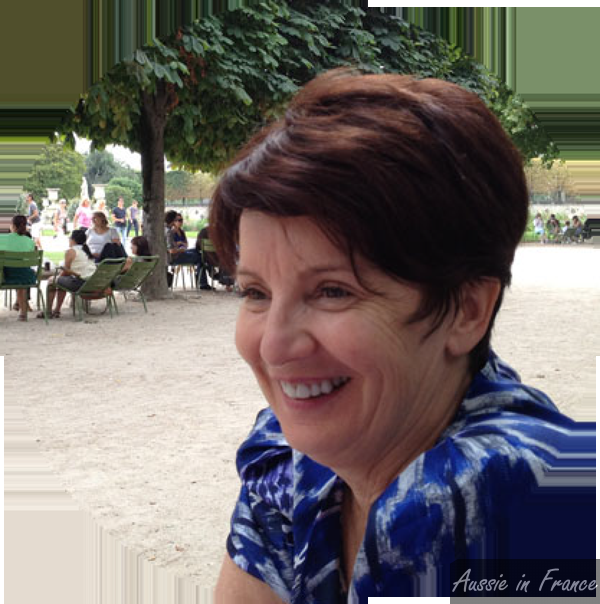
Meet Kathy, a francophile with big dreams
Thirteen years ago, when she was preparing for a trip to France, Kathy became enthralled with the French language and culture.
This was the start of her French dilemma, because her home and husband are in Adelaide and her French connection has grown stronger with the passing years.
She began learning French at the Alliance Française in Adelaide to ressurect her dim memories of school French. She has done several courses in France; in Rouen, Toulouse and Vendôme – as well as Noumea. She has worked as a volunteer for the Alliance Française in Rouen. Read more
Another all-Australian bloggers round-up this Wednesday, with advice from the ever-practical Jo Karnaghan from Frugal First Class Travel on safe travel for solo women travellers; a report from Carolyn from Holidays to Europe on her recent cycling tour in a different part of Austria from us; and tips on transferring from Orly airport to various train stations in Paris from A House in France, written by an Aussie couple living in the south of France. Enjoy!
Travelling safely – A guide for solo woman travellers
by Jo Karnaghan from Frugal First Class Travel, an Australian who loves to travel – especially in Europe – and who has gradually learned how to have a First Class trip on an economy budget, without missing out on anything!
One of my lovely readers, Linda, recently contacted me about hotels in Paris that would be safe for her as a solo traveller. Now, most of the time I travel in Europe I also travel alone. It therefore got me thinking about the things I do to make sure I keep myself safe when I’m travelling solo. Travelling safely is an important travel skill to master, so here are my top tips for safe and confident solo travel:
1. Pack light
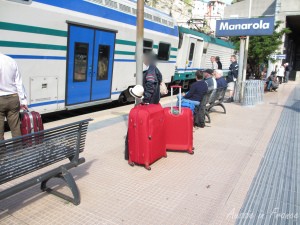
I know, I say this all the time, but packing light is travelling safe. If you pack lightly you have less stuff to worry about. On the train, it is easier to keep track of your luggage. Read more
Scenery, sunshine and saddle bags: My Austrian Lakes cycling tour
by Carolyn from Holidays to Europe, an Australian based business passionate about sharing their European travel expertise and helping travellers to experience the holiday in Europe they have always dreamed of
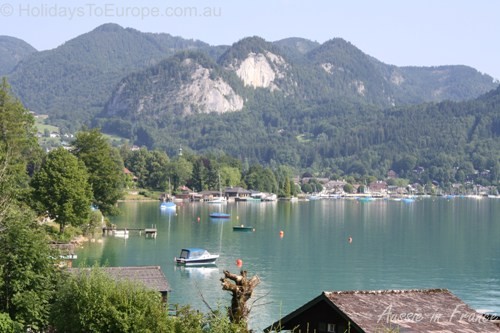
There are some countries that hold a special place in a traveller’s heart and to me, Austria is one of those places. So what better way to get a closer look at a part of Austria I hadn’t visited before than on a cycling tour? I spent nine fantastic days in July doing just that, discovering some wonderful scenery and an appreciation for ‘slow travel’ along the way.
After comparing a few different itineraries offered by various companies I selected the 9 day Austrian Lakes Hike and Bike tour sold through UTracks in Australia. One of the big sellers for me was the fact that this tour spends two nights at Hallstatt, a town I had long wanted to visit. As the itinerary featured both walking days and cycling days, it also gave me the opportunity to have a ‘rest’ day on the walking days should I decide to. Read more
Paris-Orly train transfer tips
by A House in France – 2 Aussies living part-time in France who share their experiences
We had always flown in and out of Paris from Charles de Gaulle (CDG) airport until recently.
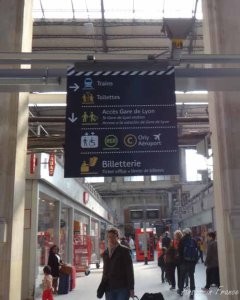
Our regional train down to our house in central France departs from Gare d’Austerlitz, and on one of our many jaunts through that train station we noticed that there were signs indicating the way to catch a train to Orly airport.
So when we found some cheap flights departing from Orly we thought it would be a good chance to check it out and compare it with the ease of getting to and from CDG. Read more
It’s Black Cat’s last day in Paris before she goes to New York to look for a job. I’m delighted for her, of course, because she’s following her dream, just as I did 38 years ago, but I am very sad to see her go. We’ve decided not to say goodbye at the airport so we part ways in the street. I go back upstairs and try to work. When Jean Michel phones at five to say he’s finished for the day, I suggest we go cycling along the Marne.
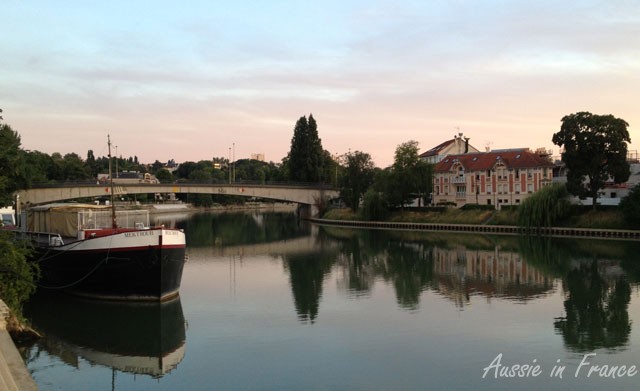
Looking towards Pont de Bry
The cycle path from Pont de Bry to the old chocolate factory in Champs sur Marne remains our favourite ride and is filled with happy memories of when we lived in Fontenay sous Bois and could easily go there at the end of the day.
And we love stopping off on the way back for a barbecued côte de boeuf at La Pergola.
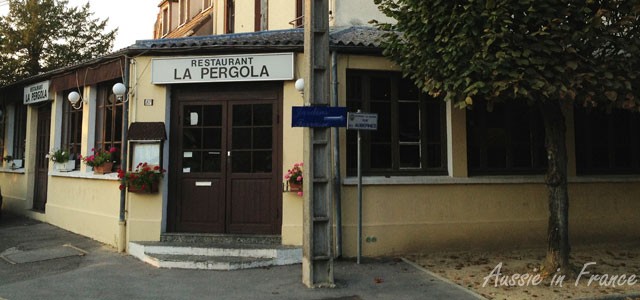
The inauspicious façade of the Pergola
As it’s the last Friday in August, there is very little traffic so we only take about three-quarters of an hour to get there. We’ve already phoned La Pergola to check they’re open and make sure our côte de boeuf will be ready when we arrive after cycling for an hour along the Marne. The owner recognises knows us as le couple en vélo even if we haven’t been there since last summer.
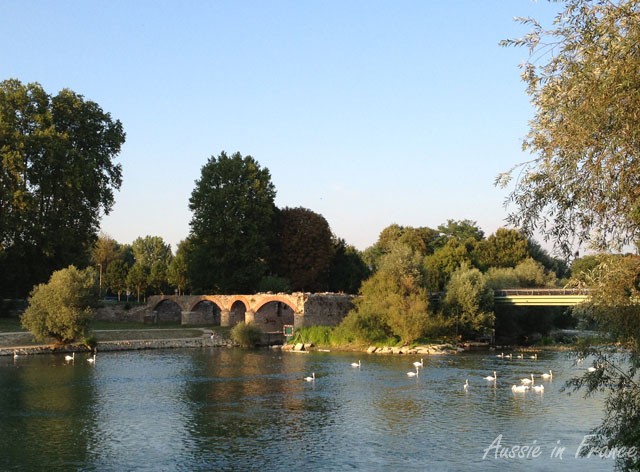
Swans on the Marne
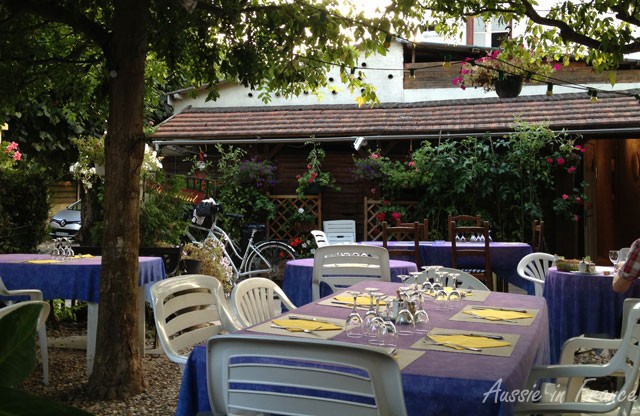
As soon as we get on our bikes, I start feeling better. It’s a lovely day and the Marne is full of swans. We ride down to the chocolate factory and back to La Pergola. Our favourite table in the garden is waiting for us.
The Pergola garden
The côte de bœuf arrives and it’s enormous. Since we began intermittent fasting in June , our appetite has diminished somewhat. We manage to finish it anyway particularly as the meat is delicious. Jean Michel even orders tarte tatin for dessert! Fortunately it doesn’t have any cream with it.
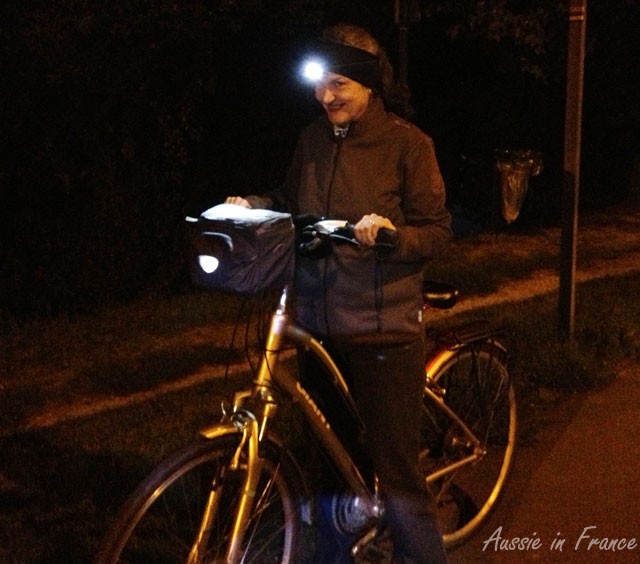
Wearing my headlight
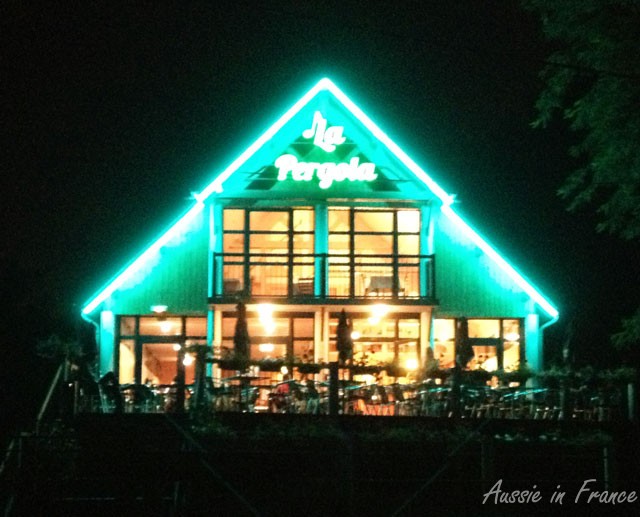
It’s completely dark by the time we finish and we still have a 20-minute ride back to the car so we don our headlights and windcheaters and off we go. On the way, we pass the other, more recently opened La Pergola with its bright neon lights. I think it’s an eyesore.
The other neon-lit Pergola
Next morning we’re not even remotely hungry so decide to have a fast day. Today is the first day of Black Cat’s new life! Good luck!
La Pergola, 87, promenade Hermann Régnier, 93460 Gournay Sur Marne, 01 43 05 36 56
These are photos of things I saw in Germany that were unexpected. They may not be typical of the country at all but I didn’t see them anywhere else!
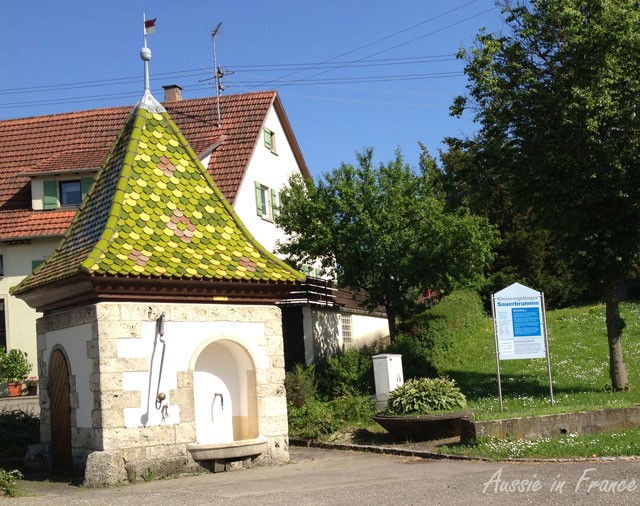
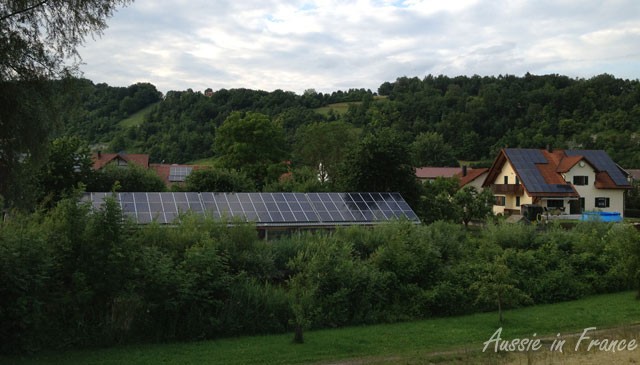
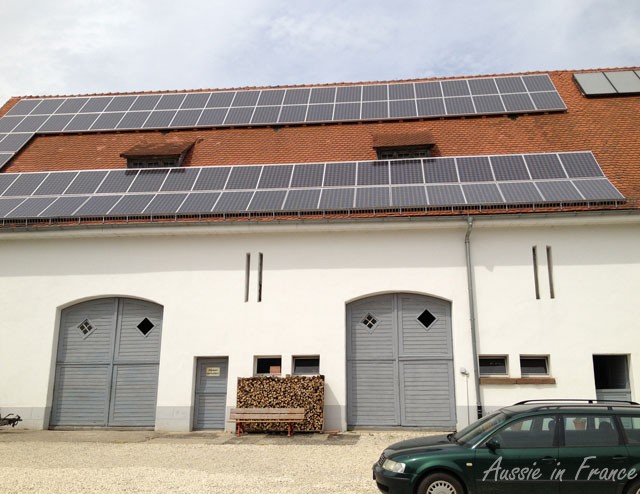
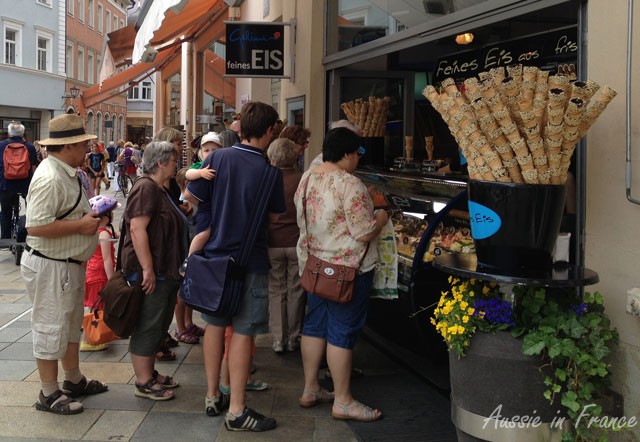
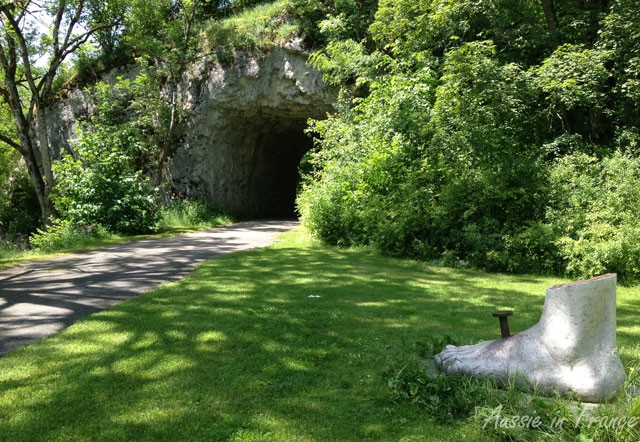
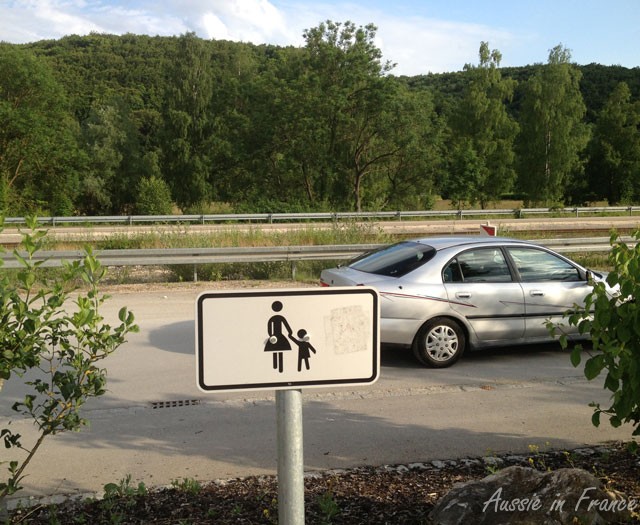
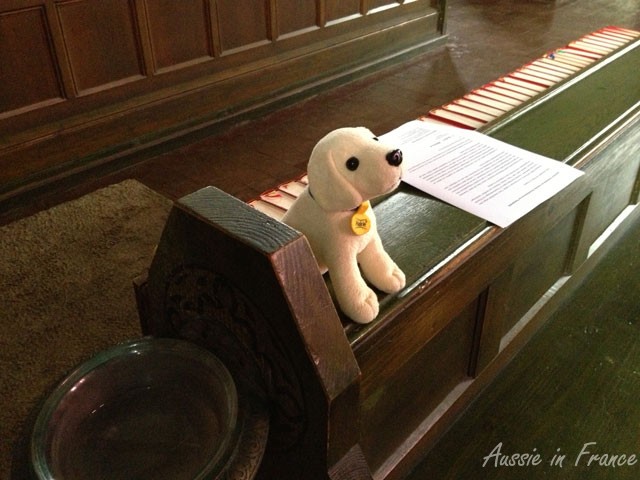
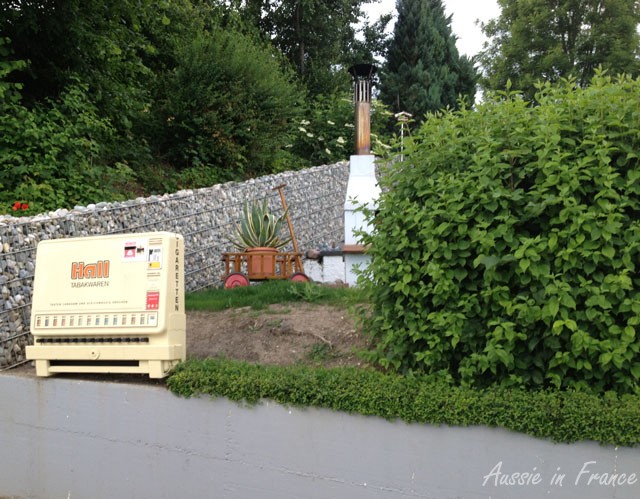
Varnished tiles on a little building housing a fountainWe were struck by how many houses and agricultural buildings had solar panelsSolar panels on a traditional barn in a villageI had never seen ice-cream cones like these beforeWe came across this foot as we were cycling along the DanubeThis sign means that the car park is reserved for mothers with childrenThis dog was sitting on the end of a church pewI was surprised to see this cigarette vendor on a private fence
Special is a very special word and very rarely translated by spécial in French and vice versa. Special est un mot très particulier qu’on traduit rarement par spécial en français et vice versa. Now that’s an easy meaning to translate. What is more difficult in finding an equivalent term when we want to talk about a special day or a special friend.
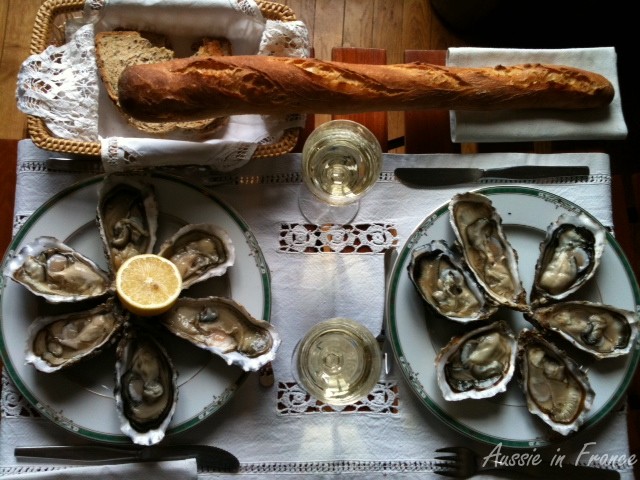
Huîtres spéciales which we eat every Sunday in season
The Chambers Dictionary gives as synonyms: particular, peculiar, distinctive, exceptional, additional to ordinary, detailed, intimate, designed for a special purpose and confined or mainly applied to a particular subject. So first you’ll have to decide why your day or friend is special. You’d probably talk about une journée exceptionnelle and une amie intime.
A special offer, on the other hand, is quite simply une promotion.
So what does spécial mean? Does it ever have the same meaning in French and English? Yes, in certain cases, it does.
Il a reçu une formation spéciale = He was given special training.
Elle a bénéficié d’une faveur spéciale = She was given a special favour.
Comme il n’y pas de conduite assistée, conduire une voiture ancienne c’est spécial = With no power steering, driving an old car can be challenging.
But spécial can have an entirely different meaning when applied to people. If we were to say elle est vraiment spéciale, I would mean that her mentality or behaviour is not within the norm. She has a strange/bizarre way of acting/looking at things. It is definitely not a compliment!
Spécial can also mean deviant. Il a des moeurs spéciales means that he has certain tendencies not elaborated upon and is a euphemism.
And, of course, huîtres spéciales are those lovely juicy oysters fattened in small numbers in deep oyster parks which have a sort of sweet salty lingering taste called noisette (hazelnut) in French.
Do you have other examples of special and spécial?
When Kathy from Femmes Francophiles suggests we have lunch together today, I ask if she can find something close by so I don’t take too much time off work. The downside of being my own boss is that the work doesn’t get done when I’m not there.
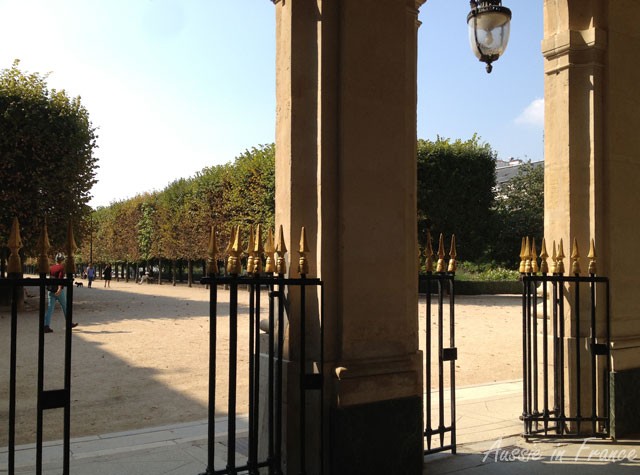
Fine and sunny in the Palais Royal gardens
She suggests Le Comptoir des Petits Champs, just down the road from me. All I have to do is walk through the Palais Royal gardens, up rue Vivienne and left into Rue des Petits Champs. I’ve never heard of it, despite the fact that I must have walked past it hundreds of times over the past 7 years! I arrive a little ahead of Kathy around 12.30 and am pleased to see that only a couple of tables are taken. That’s because it’s still August and half of Paris is still off at the beach somewhere.
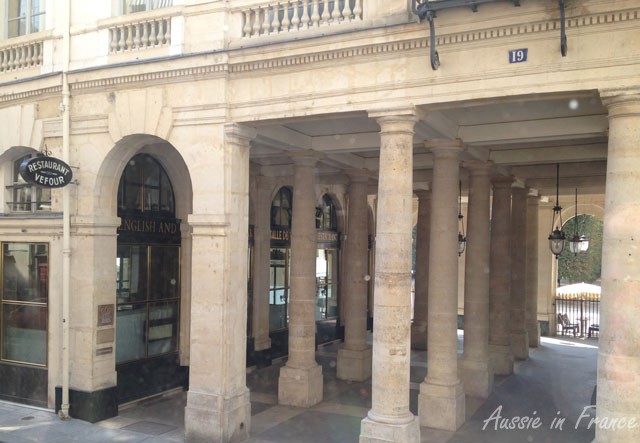
Le Grand Véfour seen through the window
The friendly waiter takes me to the last of three window tables. I’m amazed to see I can see right through to the Palais Royal. How come I’ve never noticed this restaurant? I later learn that it is voluntarily discreet, to encourage a neighbourhood clientele. I probably shouldn’t even be writing this post …
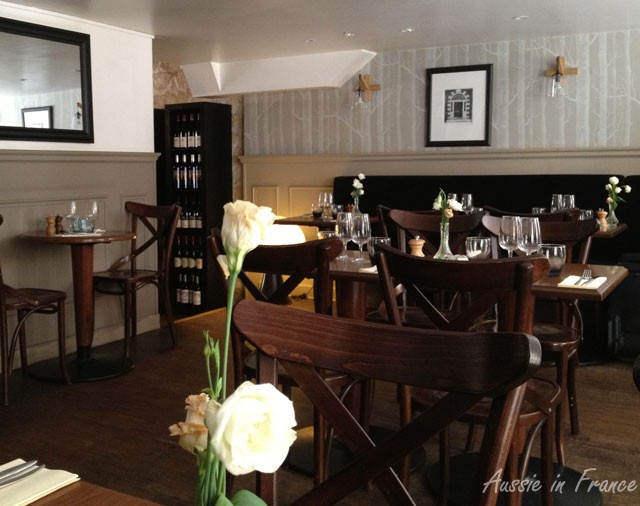
The interior of Le Comptoir des Petits Champs
I’m given some “reading material” but instead of studying the menu, I look out the window and discover that I have a balcony view of the Gardens and the Grand Véfour, one of the oldest and most prestigious restaurants in the area.
Kathy soon arrives so we look at the menu. At lunchtime, it’s 14 euro for a main course only, 20 for entrée + main or main + dessert and 26 for all three. An entrée or main is 10 euro. At night, it’s 19 euro for a main, 27 for entrée + main or main + dessert and 35 for all three.
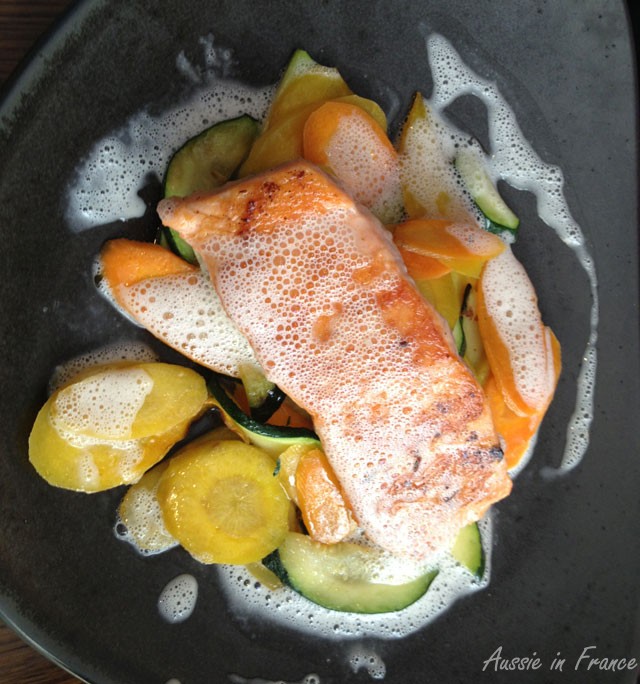
Kathy’s salmon
I choose sword fish tartare served with sucrine lettuce, croutons and capsicum while Kathy has fresh salmon on a bed of cooked vegetables. We choose a glass of white from the south of France to go with it. It’s not a wine I know so the waitress immediately offers to let me taste first.
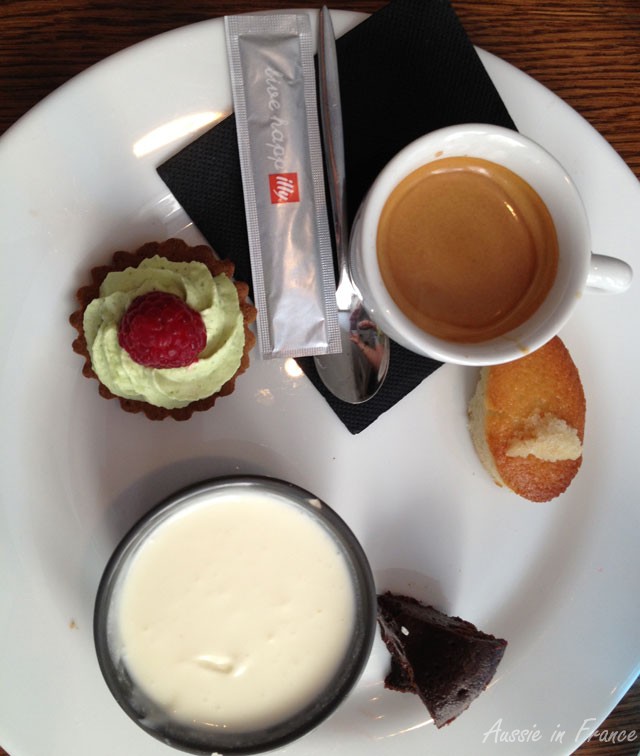
Café gourmand
We follow with a café gourmand consisting of a mini-financier, a slice of one of the best moelleux au chocolat I’ve had for a long time, a small cream tart and a lemon mousse for me and strawberry mousse for Kathy, because I’m not a strawberry fan. The service throughout is discreet and friendly.
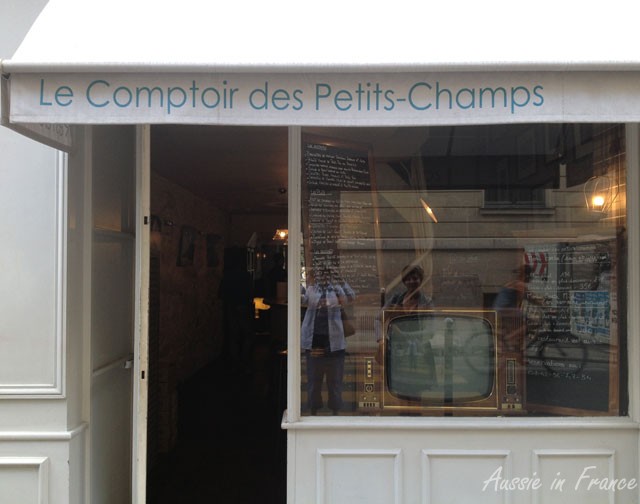
The discreet exterior of Le Comptoir des Petits Champs, with its old TV (and our reflections!)
When we leave, I take a photo of the outside and marvel that I have never noticed it. Kathy did because she was intrigued by the old television set in the window!
Despite the fact that Paris is full of restaurants and there are a lot in our area (1st and 2nd arrondissements), we don’t often find a new one that we consider it’s worth going back to. Either it’s too expensive or the food isn’t wonderful or the service is not up to scratch. As a result, we have a little handful we return to regularly depending on what we want that particular day.
Le Comptoir des Petits Champs will be joining the list.
Le Comptoir des Petits Champs, 17 Rue des Petits Champs, 75001 Paris, 01 42 96 47 54. Open 7 days a week.
I often take photos that simply don’t fit into a post but that I want to share so I thought I might alternate Wednesday’s Bloggers Round-up with Photo of the Week. Those who follow me on Facebook or Instagram may have already seen them.
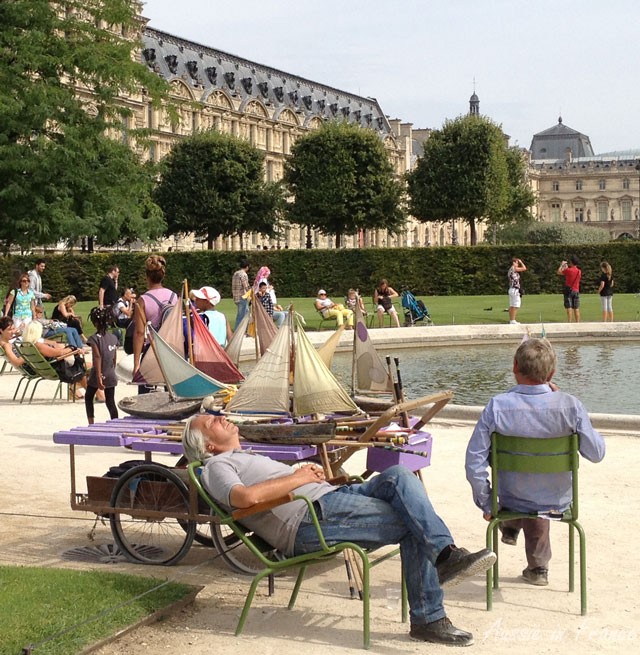
The photo was taken in the Tuileries Gardens. The same man has been renting boats to children here for many years.
After our recent and most enjoyable wander along the Berges de la Seine between the Orsay Museum and Pont Alexandre III, we decide to go in search of the much-vaunted floating gardens on the other side of the bridge at Port du Gros Caillou. It’s a cloudy night and I realise too late that I should have taken the Lumix and not my iPhone which explains the poor quality of the photos.
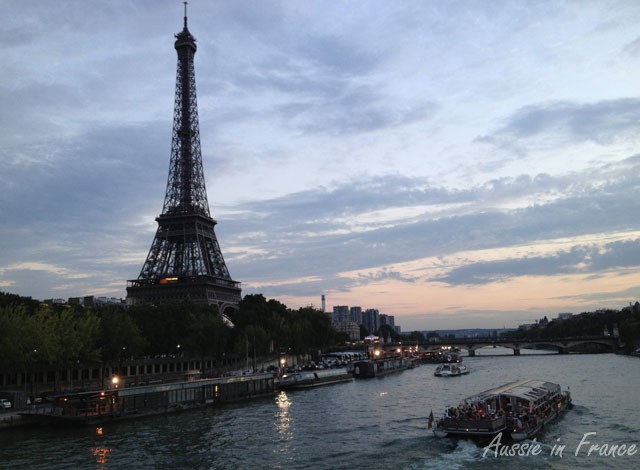
The Eiffel Tower at sunset seen from Debilly footbridge
We take our favourite n° 72 bus on rue de Rivoli opposite the Louvre and get out at Passerelle Debilly footbridge with its wonderful view of the Eiffel Tower. We walk across towards Quai Branly Museum but there are no signs of any gardens and we can’t even get down to the edge of the river from where we are.
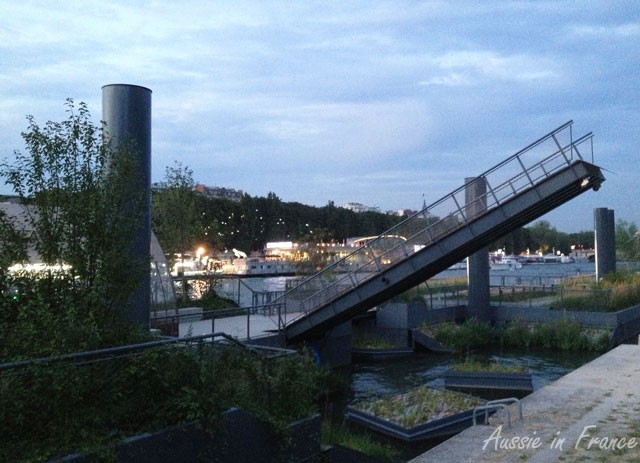
Raised footbridge across to the floating gardens
I try to find some indication of where to go and finally consult Mary Kay’s post on Out and About in Paris, written when the islands were still in the project stage. We’ve come too far. We need to go back to Pont de l’Alma bridge. I was beginning to think we’d come on a wild-goose chase.
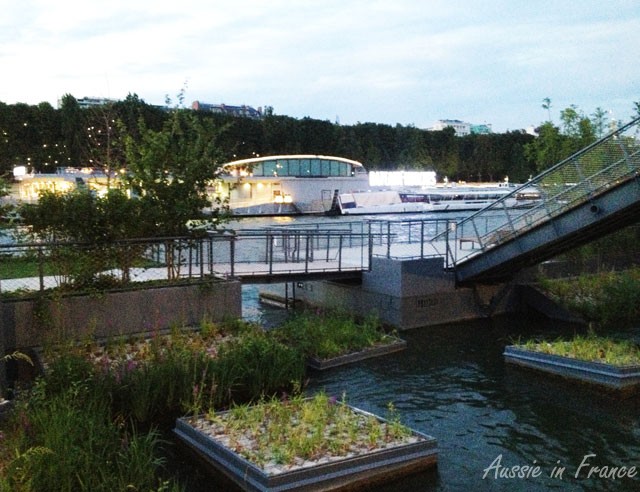
Rather sad looking floating gardens
The handful of barges containing the gardens look very sad and sorry. As it’s after 6 pm, we can’t access them and the footbridge is raised. Obviously the wonderful weather this summer which has made the other parts of the Berges popular has not helped the gardens. Adequate watering, it seems, has not been scheduled.
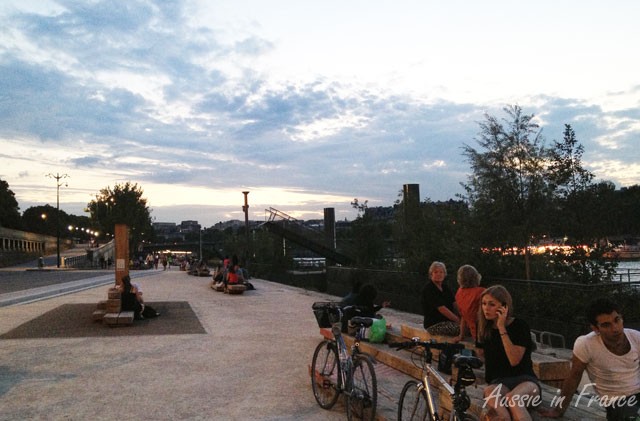
Practically deserted area on Berges de la Seine
You can’t eat, drink or take animals onto the gardens. Also there seems to be no shade in the daytime. I wonder exactly what they are for and if anyone uses them between the opening hours of 10 and 6. I’m also not convinced that the view of the Bateaux Mouches opposite is particularly attractive.
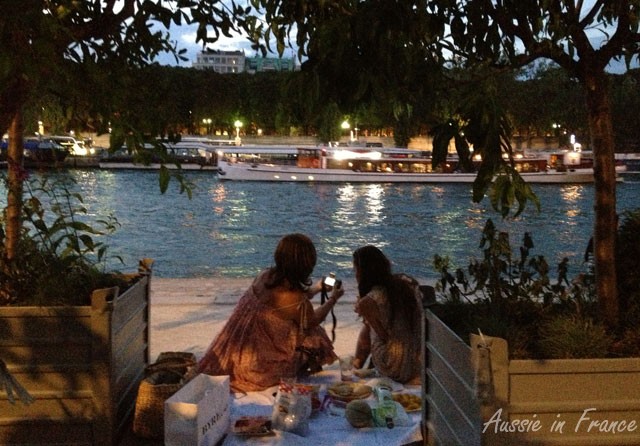
An intimate alcove
We keep walking towards Alexandre III bridge. Initially there isn’t much activity but after a while, we come to a more popular picnic area with vegetation forming a partial screen and little alcoves for the people sitting along the river.
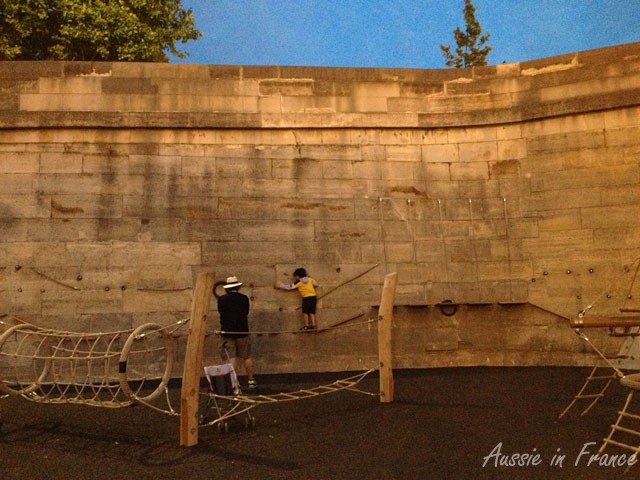
The climbing wall along Berges de la Seine
A climbing wall with a few stray children comes into sight as we get closer to the bridge.
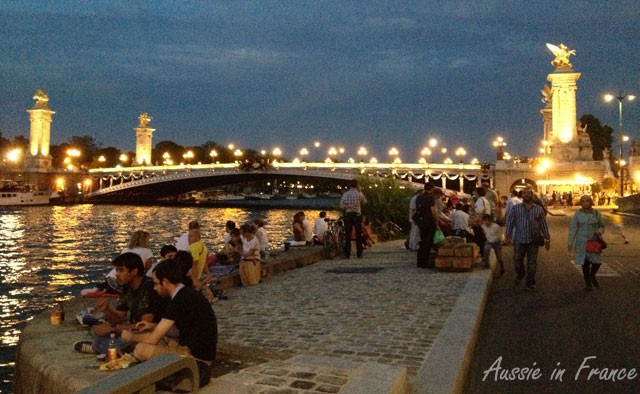
Opposite Faust’s near Alexandre III bridge
I’m surprised that at 9.15 pm on a Friday night, there isn’t more activity. There are no tables left at Faust’s but fewer people sitting in front. We debate about why. I wonder whether it was the after-work crowd that we saw mid-week. Jean Michel thinks they’ve all gone to the country.
View of Berges de la Seine from the right bank
We walk across the bridge and can see crowds on the opposite bank where the restaurants are. We decide to walk home along the right bank but it’s very dark and not very interesting. We see a few people sitting in the shadows on their barges but that’s about all. Next time we’ll stay on the left bank!
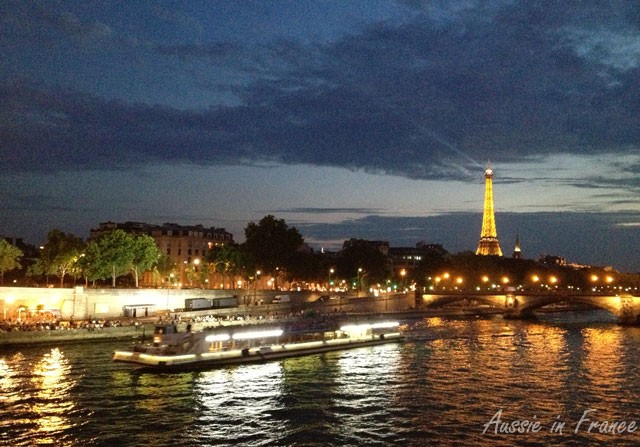
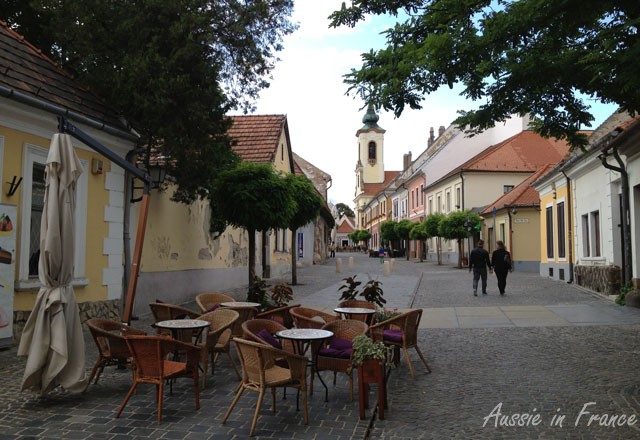
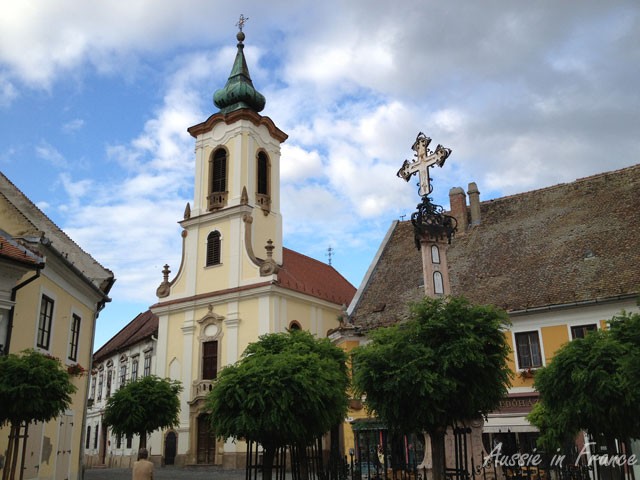
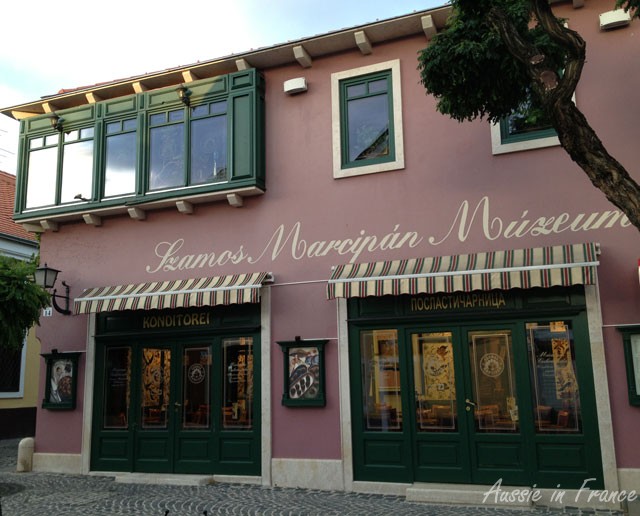
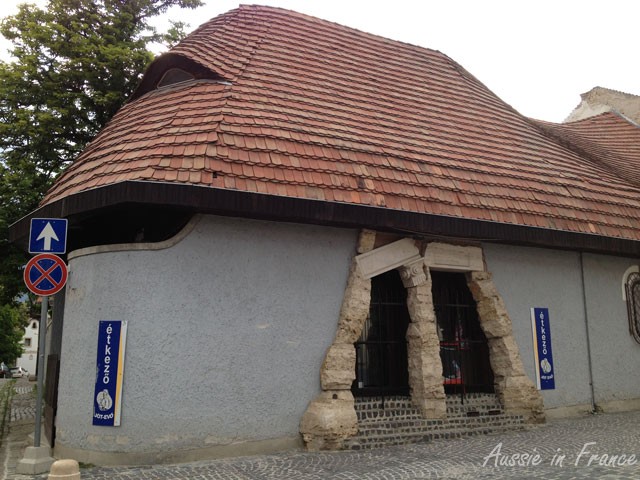
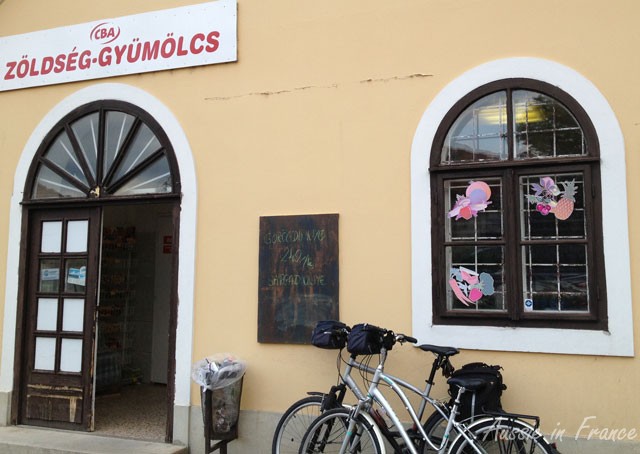
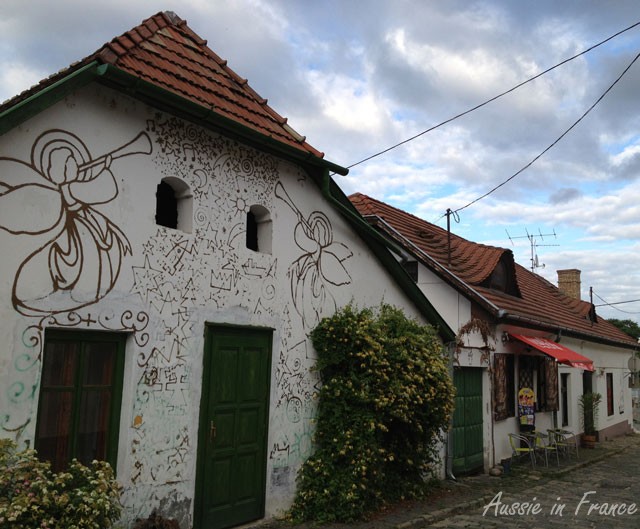
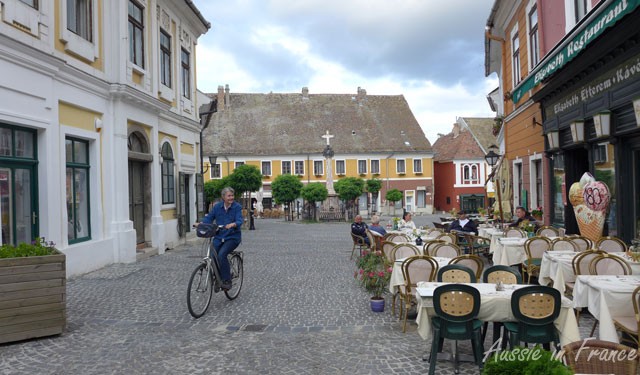
Szentendre, pronounced San-ten-dray, is a charming little town on the Danube about twenty kilometers north of Budapest, very popular in summer it seems as it is easy to get there by boat, bus, train or bike, but only crowded between about 10 am and 6 pm. After that, you can wander down the main street and only meet the locals. And we had one of our best dining experiences this summer at Muvesz in the Main Square. The architecture is mainly 18th century baroque and there are no fewer than nine churches!
The Main Square with its cobblestonesBlagovestenska Greek Orthodox Church and the Baroque cross erected in 1763 to celebrate the fact that the plague bypassed the townThe Marzipan MuseumWe often saw these tiled roofs with their unusual dormer windowA local shop where the Hungarian owner was very helpful and friendly despite our lack of a common languagePainted angelsBlagovestenska Greek Orthodox Church
Cycling past the colourful merchant houses after 6 pm
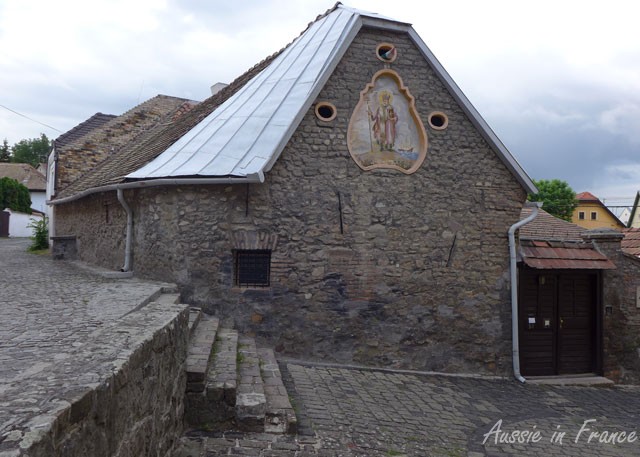
The waterfront at Szentendre after the 2013 floodsStone church with painted medallion
It’s the next day after a wedding. Everyone’s having a late breakfast, including the groom who’s just joined us. The bride is still upstairs in their bedroom. This, of course, wouldn’t have happened in the olden days. They would have already been off on their honeymoon.
“As-tu consommé?” asks one of the guests. “Yes”, he replies, and everyone laughs. I am shocked! Fancy using the term consommer (to consume) in that context. How vulgar can you get. Then I realise that it must mean “consumate” as well.
I might add that it also means to perpetrate a crime …
It’s one of those French verbs that needs a different translation nearly every time in English. You could conceivably say “consume” in English when talking about food or petrol consumption, for example, but it certainly wouldn’t be natural.
On consomme beaucoup de fruits chez nous – we eat a lot of fruit in our family.
Cette machine consomme beaucoup d’eau – this machine uses up a lot of water
Le lot a été consommé par cette opération – the batch was entirely consumed by this operation
In fact, in English, we usually use the word consumption rather than consume, a typical case of a verb being replaced by a noun.
La voiture consomme 8 litres au 100 km – the gas/petrol consumption is 8 litres per 100 k.
La France est le pays où l’on consomme le plus de vin – France is the country with the highest wine consumption.
Another typical example is à consommer de préférence avant le 10/09/2013 – best before 10/09/2013.
On the opposite end of consummating a marriage, you can say la rupture est consommée, meaning the break-up is complete.
 Thirteen years ago, when she was preparing for a trip to France, Kathy became enthralled with the French language and culture.