My Two Favourites B&Bs in France

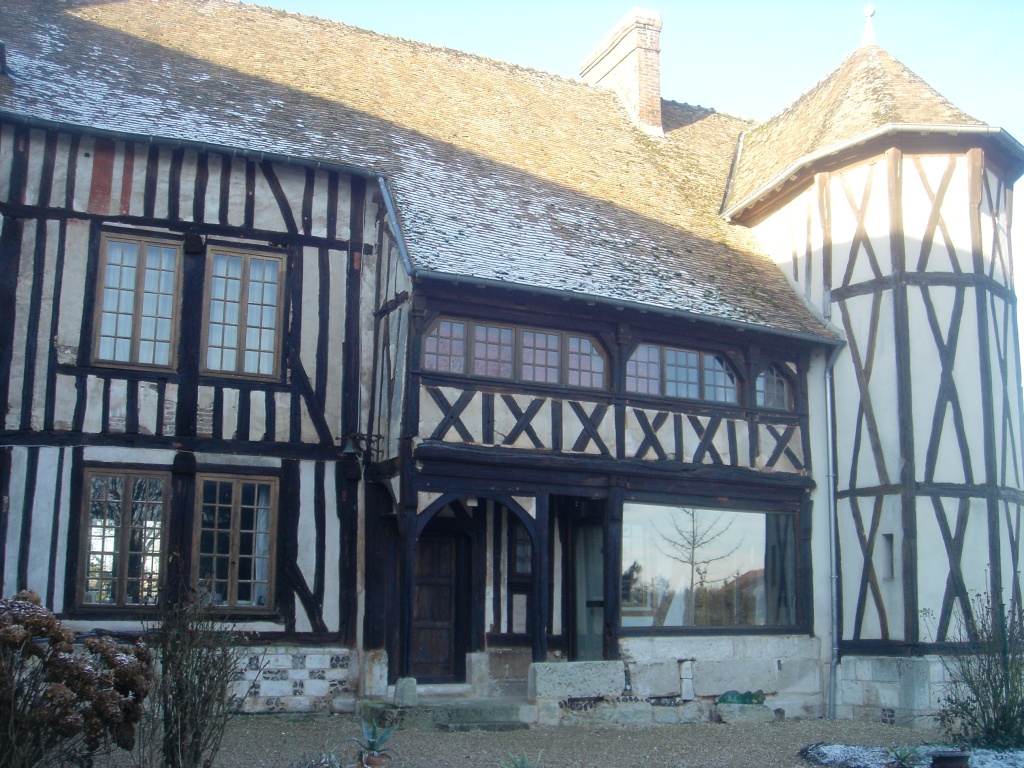
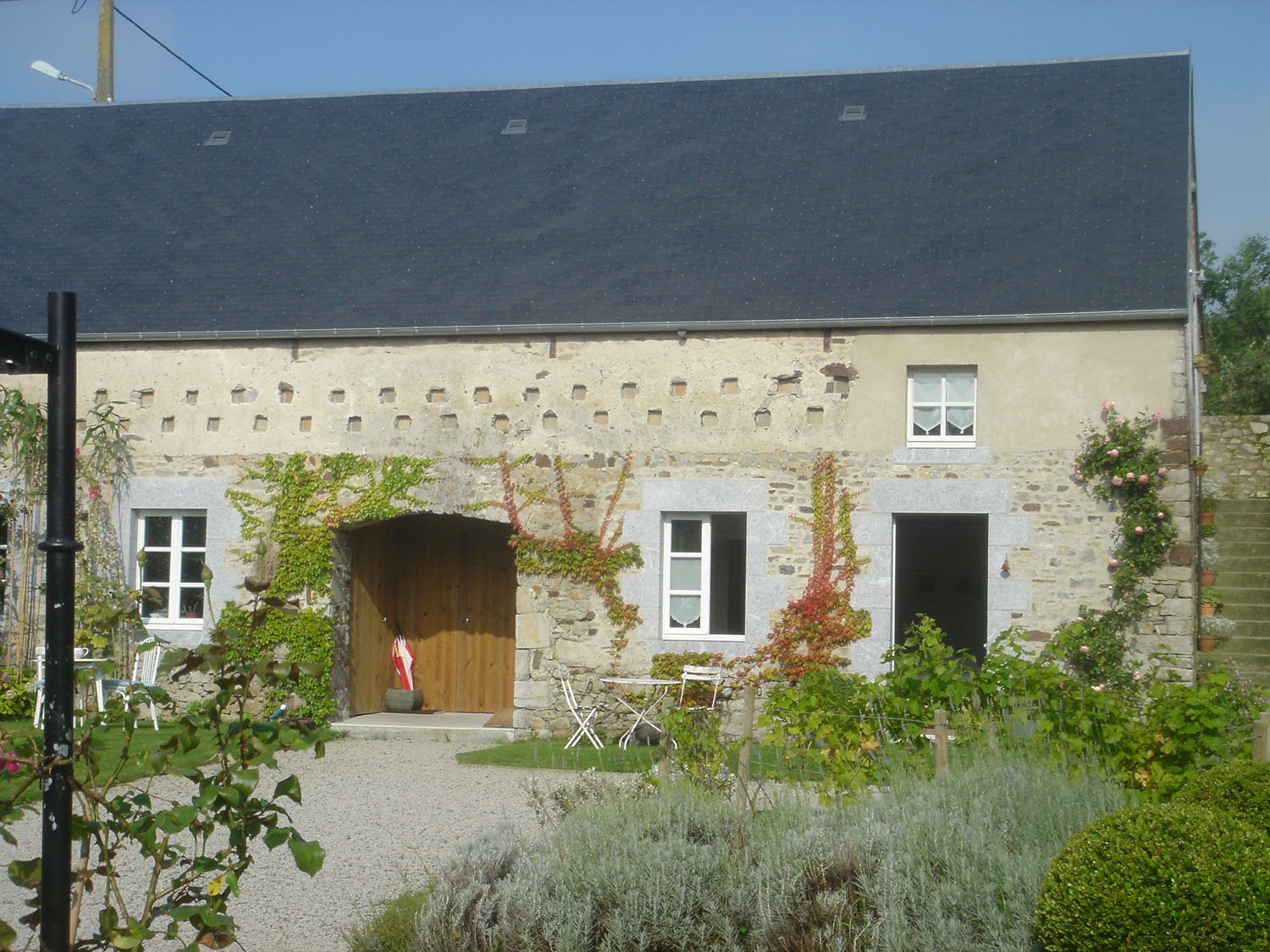
Dove cote at Le Clos Postel

It took me a long time to start using B&Bs in France. I had horrible memories of my arrival in Dublin when I first left Australia many long years ago. I went there with friends who were staying with friends and I had thought, in my innocence, that I would be staying with them too. Not so. It was back in the days without mobiles of course and I must have knocked on twenty doors between the airport and the city (I don’t really think I’m exaggerating) before I finally found a room. I must say I felt very much like Joseph and Mary. No room in the inn. I had a bedroom to myself but I shared the bathroom and toilet with the rest of the family and the other guests. It was very eerie staying in a house with people I didn’t know.

I tried out some more B&Bs in Ireland a couple of years later, but I always felt the guests were displacing the family. We would be having breakfast around the table while the kids would be talking in hushed voices in the kitchen, obviously on their best behaviour. Then a few years ago, a friend told me about a wonderful B&B she stayed in on her way to Italy each year that had a private bathroom for each of the guests which sounded much more to my liking. But I was still reticent because I didn’t want to have to interact with other people I didn’t know first thing in the morning.

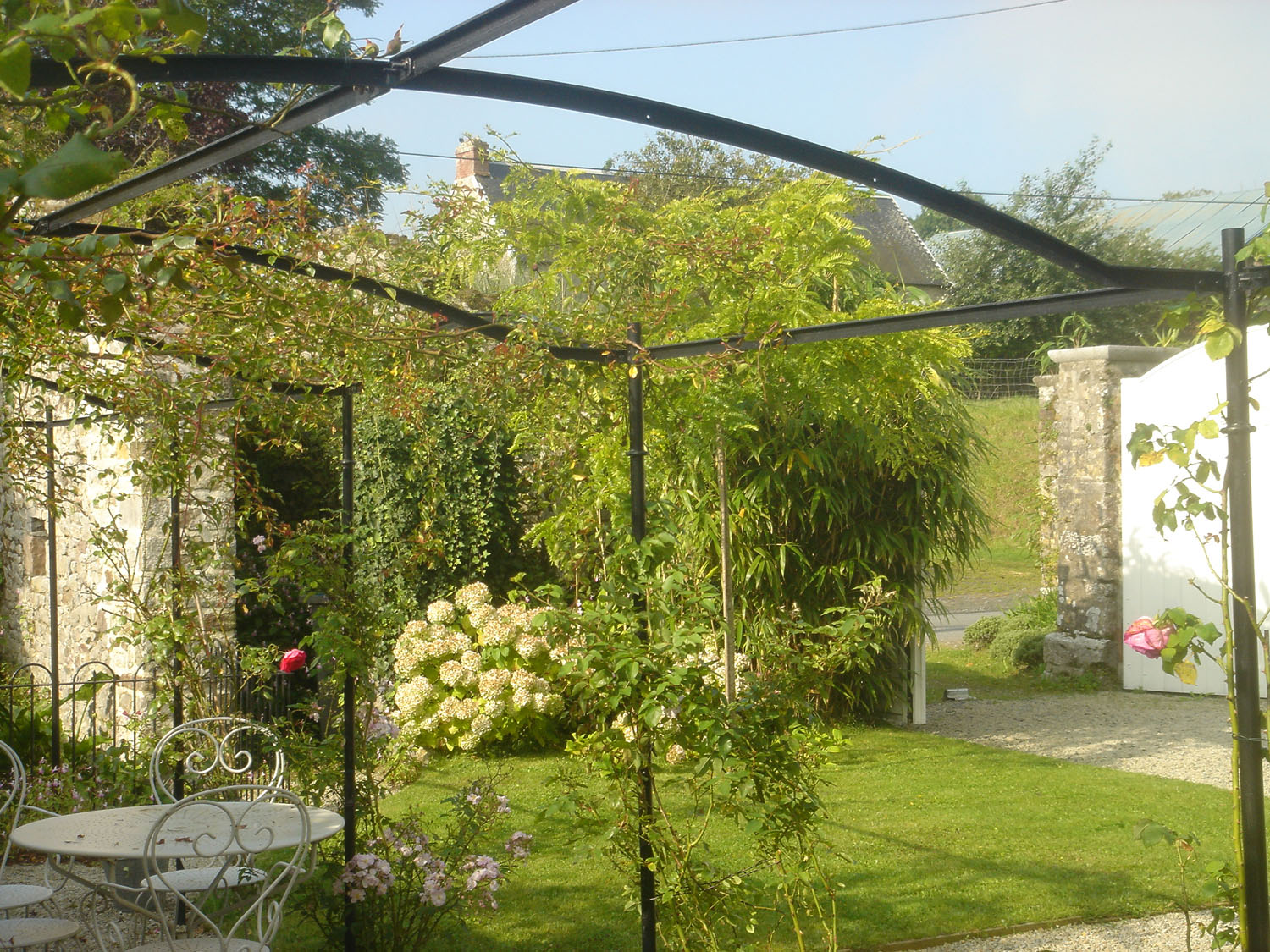
Rose bower at Le Clos Postel

But in the end, we decided to give it a try five years ago on a spur-of-the-moment cycling trip to the Cotentin which is that little peninsula that sticks out into the English Channel where the D-Day boats landed. We headed for the western side which is much prettier, not far from Granville. The B&B, Le Clos Postel, was just perfect. We were in a separate building (the dove cote) from our hosts who have renovated a lovely old stone presbytery. Tastefully furnished with our own bathroom and separate toilet and a lovely view of the surrounding countryside. Our hosts, Lydie and Robert Friaux were charming, the breakfast table full of lovely surprises such as a different type of cake each day and unusual home-made jams, and the other guests were interesting and not invasive. There was even a log fire to take the chill of the morning. Guests can also use the lovely grounds with their trellised roses and herb garden. We have been back several times and tried many other B&Bs since, but Le Clos Postel remains our favourite, especially now that the bed has added comfort. We usually sleep in Angelus, but next time we’re going to try the little split-level appartment called Prélude which has a small kitchen as well.

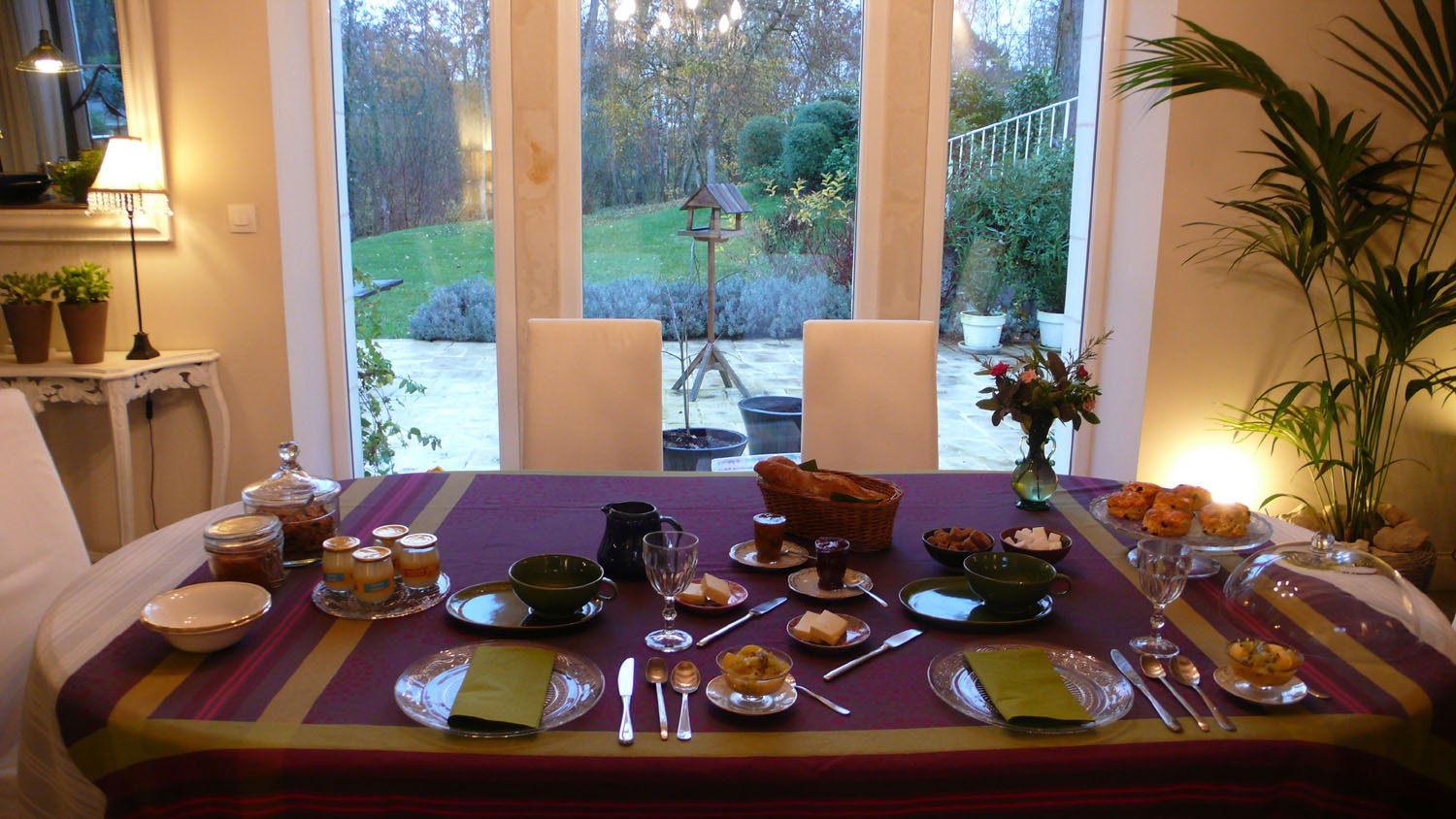
Breakfast table at Le Moulin du Mesnil

However, we may have discovered a rival! We went down to the Loire Valley last week and stayed at Le Moulin du Mesnil, a renovated mill-house near Montrichard, recommended by an American friend living in the area. Yvonne, the English hostess, came out to greet us in the cold and took us to our lovely warm room with its separate entrance from the rest of the house. Perfect, once again, with a little entrance containing a cupboard, a table with a jug to make coffee and tea and hooks to hang up our coats (often a missing feature). Then came the bedroom, with its visible timbers and white walls and furniture. Like Le Clos Postel, the bed is very comfortable and the shower is attached to the wall! At breakfast next morning in Yvonne and Jean François’ beautiful open-plan kitchen/dining room/living room, we had a wonderful view of the extensive grounds. Fresh scones and pancakes. Need I say more? They have a log fire too. Next time we’re taking the suite across the way which has a little patio.

Now I have two favourite B&Bs!!!

Lydie and Robert Friaux
Le Clos Postel
5, 7 route d’Urville
Village d’Urville
50590 Regnéville sur Mer
02 33 07 12 38
clospostel@hotmail.com
http://www.clospostel.com
 
Yvonne and Jean-François David
Le Moulin du Mesnil
31 Chemin du Moulin du Mesnil
41400 St Georges sur Cher
France
T +33 2 54 32 22 51
M +33 6 62 57 91 75
http://www.moulindumesnil.com/en/

Frogs in the Wine Vat

The one and only Magnetic Island

I don’t like frogs. In fact, I’m petrified of them. Strange that I should chosen to live in a country like France. But apart from the actual people, they don’t have frogs here. Not noticeable ones anyway. Not those great big slimy green ones they have under the toilet seats in Townsville. It took me years to stop lifting the lid to check for bad surprises after I left Australia. A few years ago, I was up in the North with Black Cat staying on my very favourite coral island when I discovered a frog in the toilet in the middle of the night. Well, that was the end of that night’s sleep. I had to steal out in the garden to answer the call of nature and then had to lock myself in the bedroom until morning soI could get a neighbour to come and get rid of it. Black Cat was of no help of course. She goes into hysterics if she sees a spider. When I came home late at night as a teenager, I’d have to wake up my father to come and shoo the frogs and cane toads off the steps so I could get in. He tried teaching me to stamp my feet to frighten them but it didn’t always work. And those cane toads are even worse.

Hunter Valley Vineyards

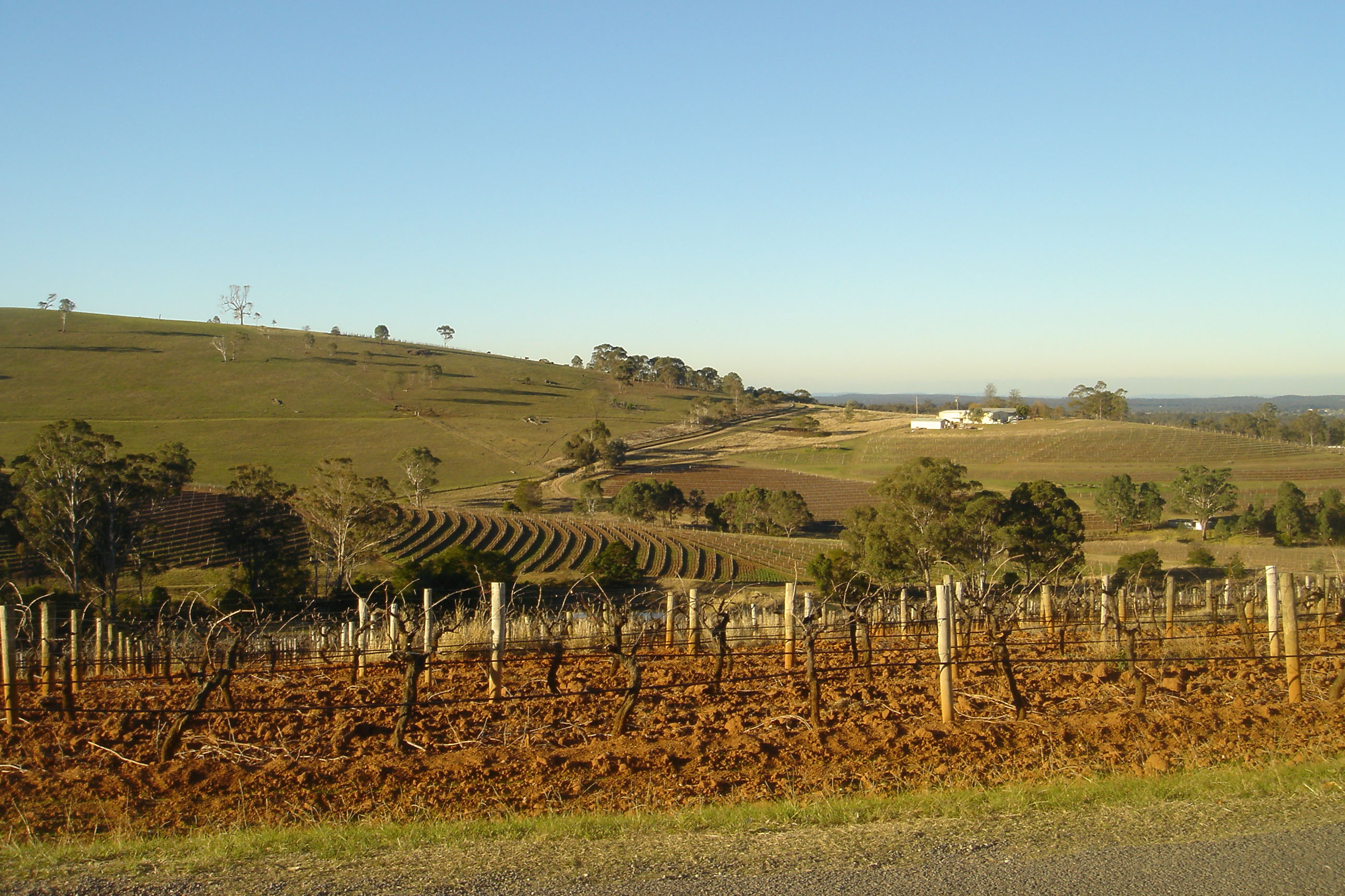
Now what has this got to do with wine vats, you may ask. Well, on the same trip, after Relationnel had joined me (I treated myself to a whole six weeks in Australia during Black Cat’s exchange year), we visited the Hunter Valley. Friends living there, who also have their own vines, took us along to the Capercaillie Vineyards where they had tracked down a French-speaking winemaker from the New Hebrides. Relationnel, whose English is not exactly fluent, was delighted and so was I as it gave me a rest from have to interpret all the time. Our young winemaker obviously loved to have an audience and regaled us with a wealth of harveting tales. According to him, he opened the vat one day to find a pair of eyes glinting back at him. A frog had been thrown in with the grapes.

Every time I drank that wine, I tried not to think of the frogs.

Capercaillie Vineyards, Hunter Valley

http://www.capercailliewine.com.au/

My Foie Gras

The idea of making my own foie gras came to me when I went to a party and the hostess had made her own. It was just the way I like it – mouth-melting. So when Relationnel came home from work one day and said that the Comité d’entreprise* had a special offer for a foie gras cooking class with l’Atelier des Chefs we jumped at the chance! I got off the plane from a exhausting week teaching technical translation in Chennai in India, dropped my luggage and headed over to the Atelier, a little groggy with jet lag.
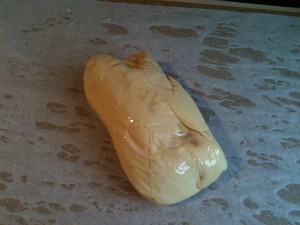
They told us not to take notes, that we’d be given full instructions to go home with us. That was a mistake – it’s taken us about 5 years to fill in the gaps and get it right so this post is definitely a scoop! It was all very fun and interesting though and we got to taste the chef’s foie gras at the end and take home our own creations which lived up to expectations. I’m going to try and describe the process, but I’m not convinced you can really do it without having some sort of demonstration. So I suggest you watch this video by L’Atelier des Chefs even though it’s in French. The second part shows how to cover the foie gras with chocolate, but that’s not in my recipe!
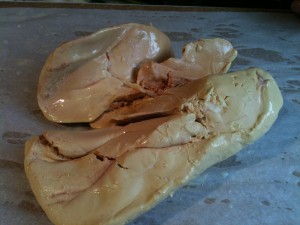
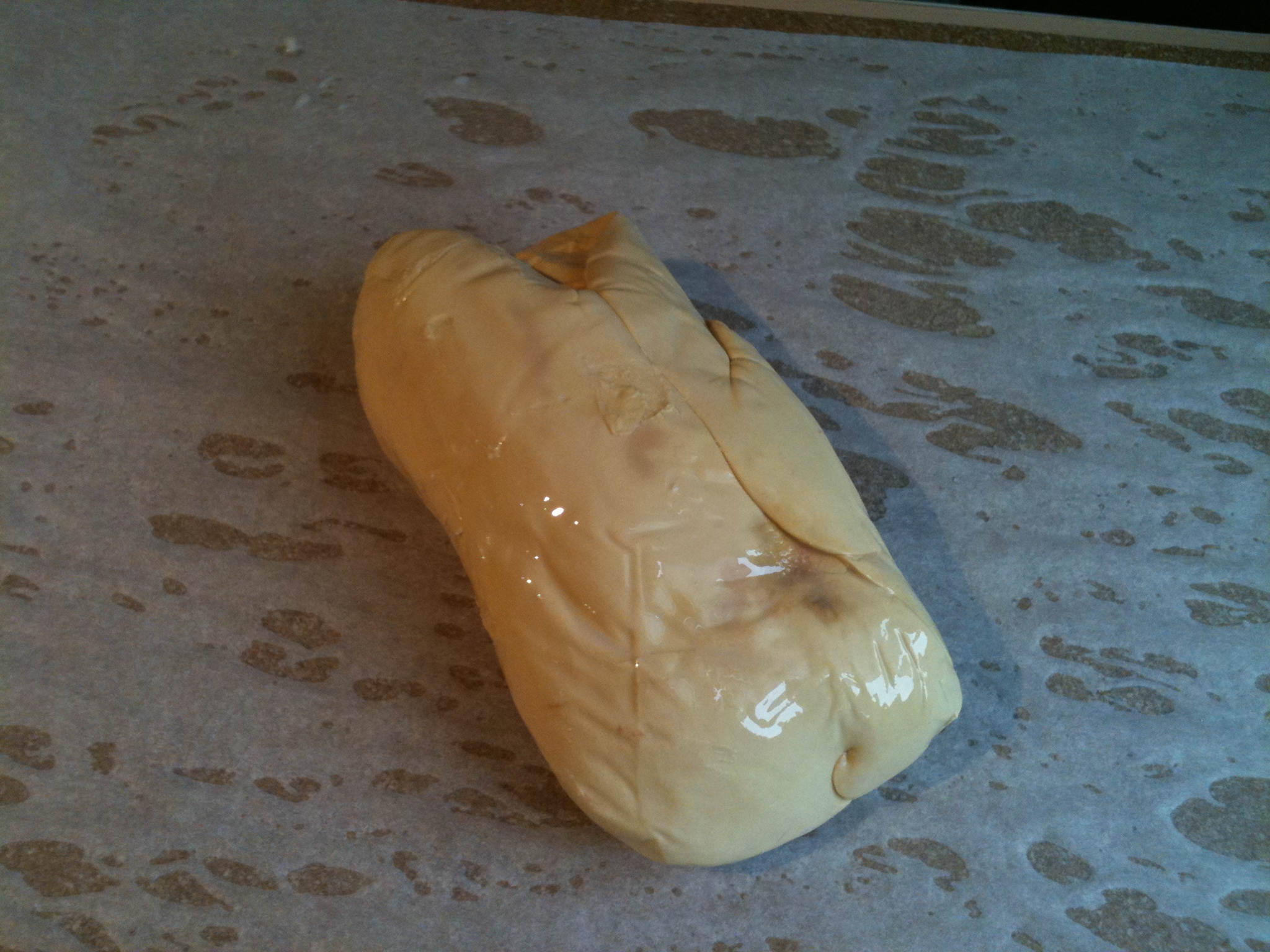
The result mainly depends on the quality of the foie gras itself. A couple of years ago, we bought some Eastern European foie gras on the market – much cheaper – but were very disappointed with the results. Now we ask for “high quality foie gras” from the south west of France at the butcher’s on Rue Montorgueil. It usually weighs 500 to 700 grams. The one I bought this time was 500 grams and cost 30 euros. The same foie gras (mi-cuit) bought from the traiteur costs 110 to 120 euros a kilo, so making your own is definitely more economical.

It needs to be cooked at least 5 days before you eat it and you need one or two days to make it. The first thing you do is to soak the whole foie gras in a mixture of ½ litre of milk and 10 grams of coarse salt with enough water to cover. You leave it in the fridge overnight or at ambient temperature for 1 ½ hours if you’re pushed for time. Cover the top of the foie gras with greaseproof paper to stop it drying out and take it out about an hour before you use it.
Next day, you get everything ready beforehand because once you’ve got your hands in the foie gras, it’s like having them in butter, only worse. The seasoning is important and very precise : 8 grams per 500 grams of foie gras, consisting of 7 grams of fine salt, ½ gram of freshly-ground pepper and ½ gram of 5-spice mixture (cinnamom, cloves, star anis, fennel and brown peppercorns). Since few people have scales with that type of precision, it’s a good idea to make up a bigger batch and keep it in a screw-top jar. Measure out the 8 grams and put it into a small cup with a coffee spoon.

Another thing is keeping your hands and the foie gras cold enough. Relationnel (who likes very sophisticated cooking equipment) has a very handy marble plaque that is perfect. You just put it in the fridge for a couple of hours beforehand (this means taking everything off one shelf of course …) or on the balcony if it’s cold enough. You then moisten it slightly and cover with a sheet of greaseproof paper or cling-film (if you feel brave enough) as it makes the foie gras easier to handle and faciltates cleaning up afterwards.  Of course, any other flat surface works as well!

You then measure out the white port wine (3 deciliters) into a small cup and add a coffee spoon. Put some iced water into a bowl to dip your fingers in when the foie gras gets too slippery. You can also turn off the heating in the kitchen which I invariably forget to do. Put the terrine (or a small aluminium tray) on the table next to you together with a few pieces of paper towel (to clean your iPhone when you drop it on top of the foie gras you’re trying to photograph) and a sharp pointed knife. Now you’re ready to go!
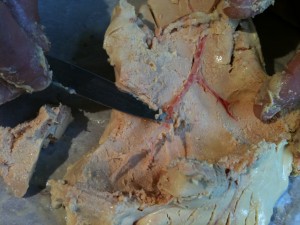
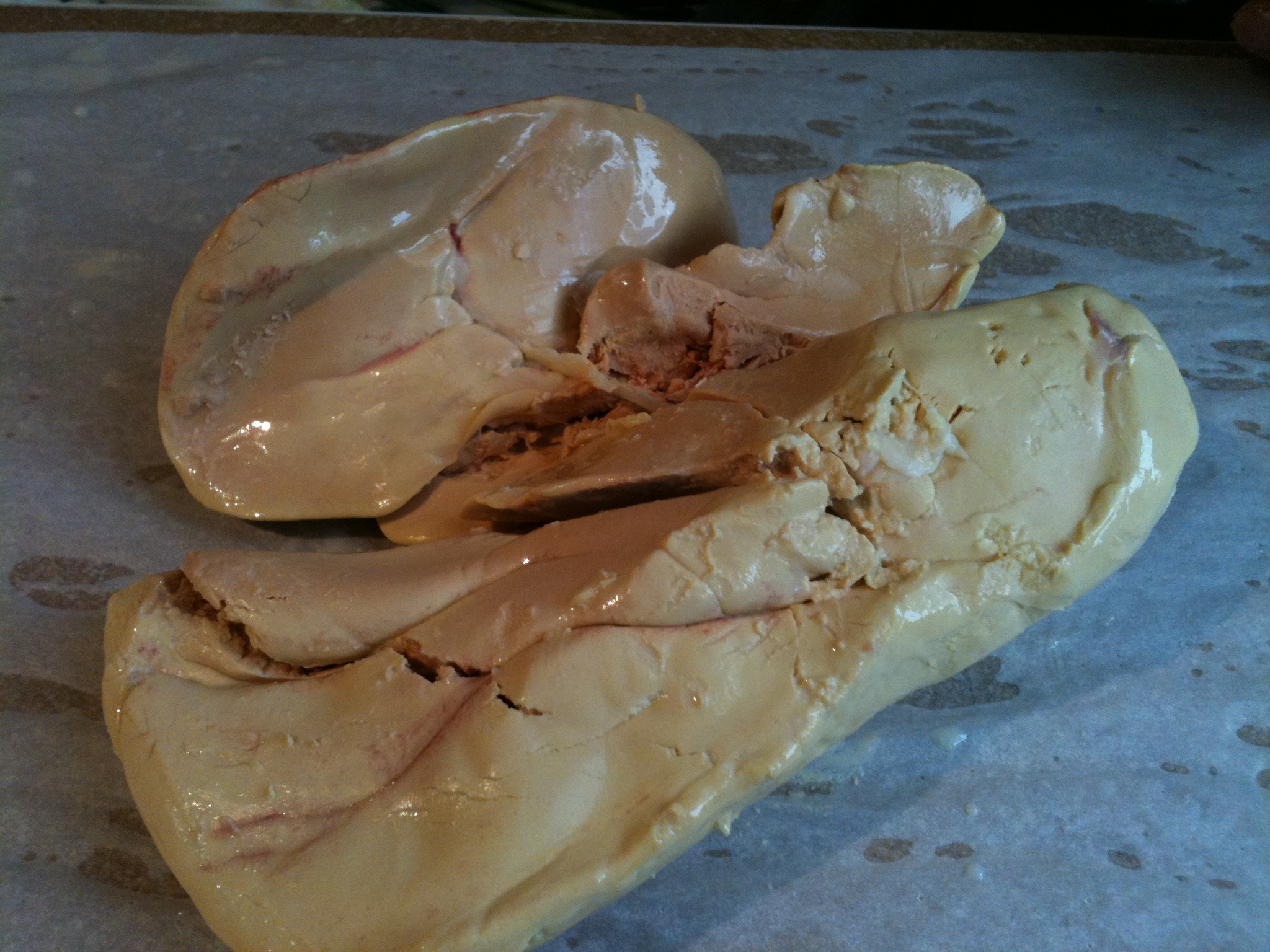
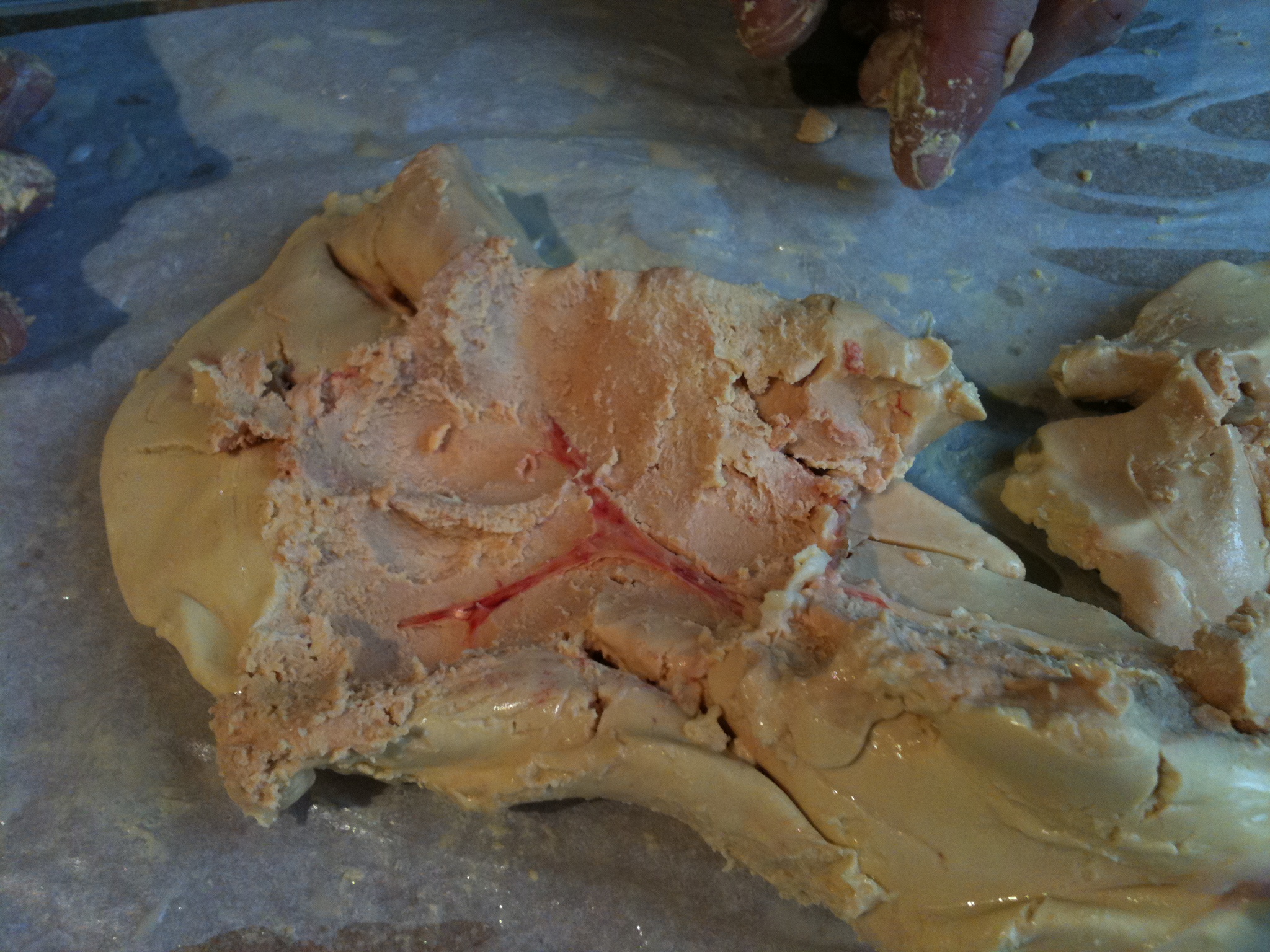
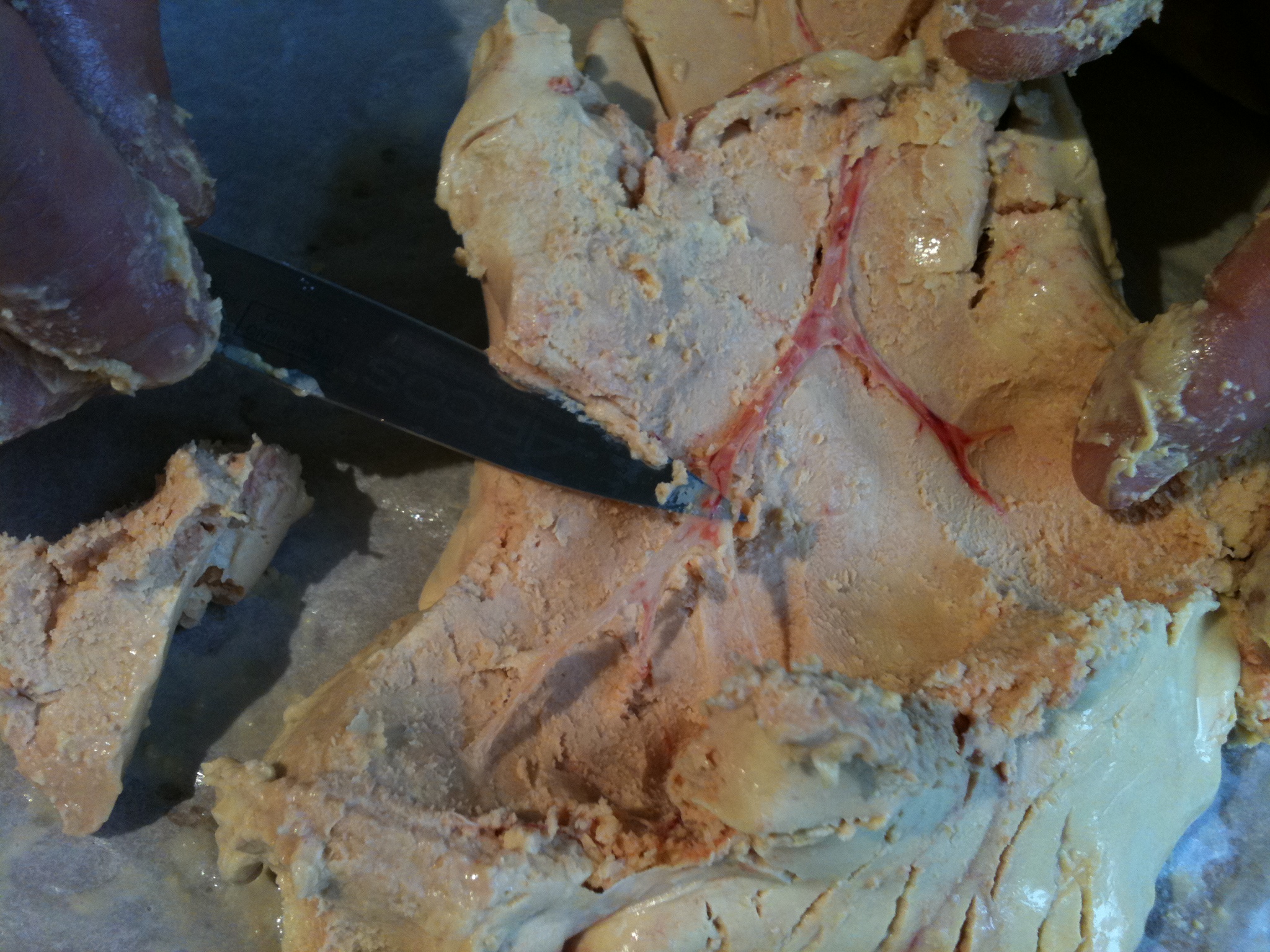
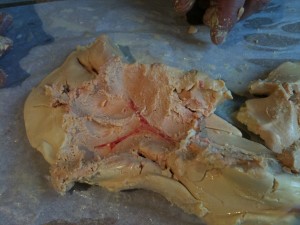
Place the foie gras on the greaseproof paper. Gently separate the two lobes. One is much bigger than the other. Gently open up the big lobe lengthways, sort of running your finger along it. You’ll see a large Y-shaped vein which you have to remove without breaking it. Now the idea is to knead the foie gras underneath to release the vein, lifting the vein very gently with a knife but not cutting it. The foie gras gets completely mashed in the process but that’s normal. After you remove the first vein, you’ll find a second, larger one, underneath. Repeat the process. The second lobe also has two veins, but they are star-shaped this time.
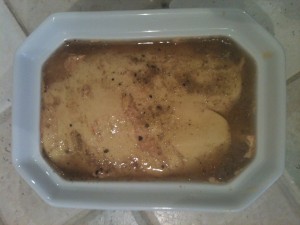
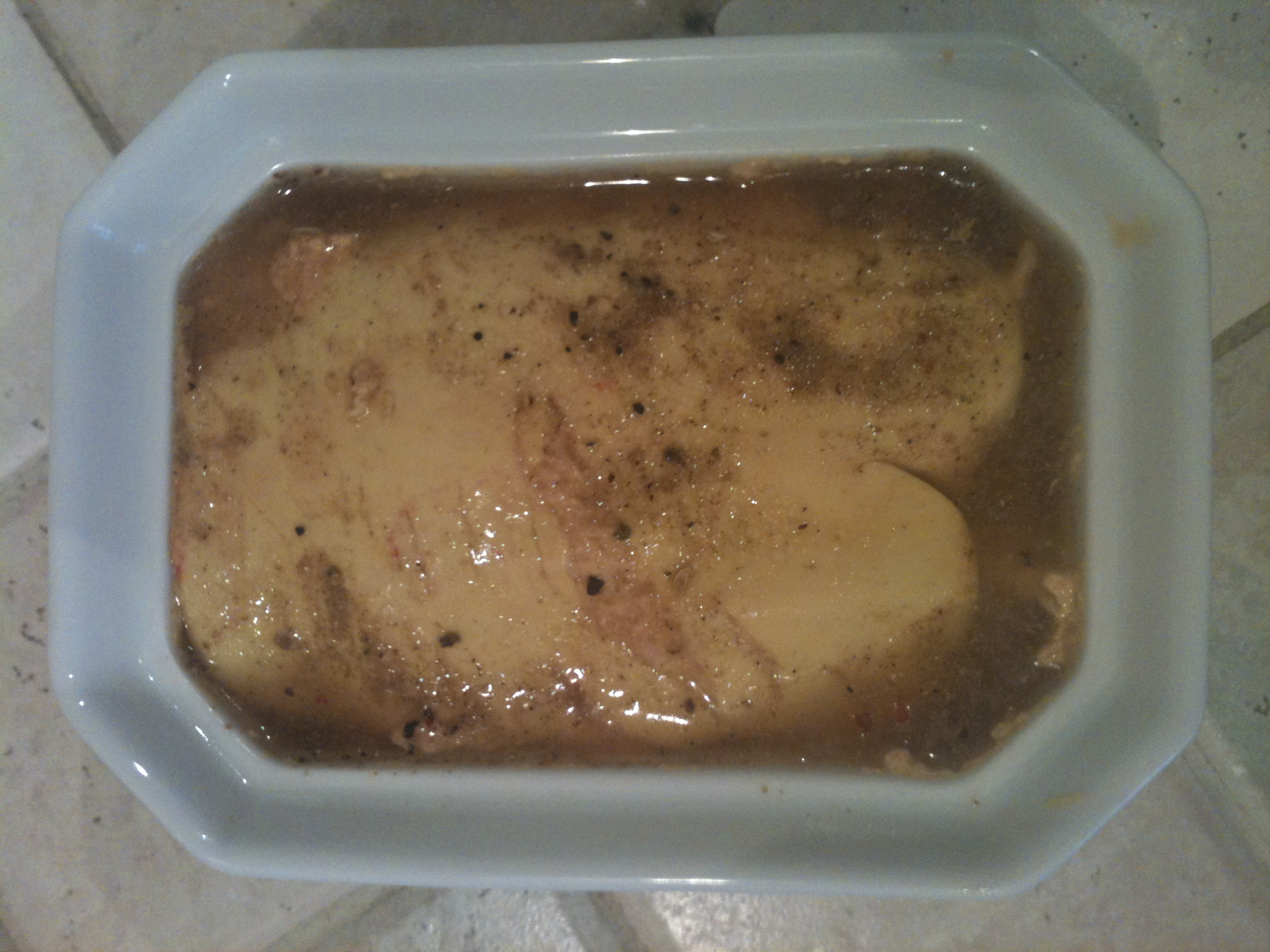
Once the veins have been removed, gather up all the bits and pieces of foie gras and put them back on the lobes. Sprinkle about half the seasoning evenly over the two lobes, then dissolve with about half the port wine. Put the two lobes together like a sandwich then put into the terrine or aluminium tray after sprinkling some more of the seasoning on the bottom. The terrine should be just big enough to take the foie gras. Push down on the top to remove any air, then sprinkle with the rest of the seasoning and port wine. It always seems like a lot to me but it really is just the right amount.
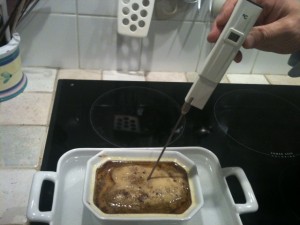
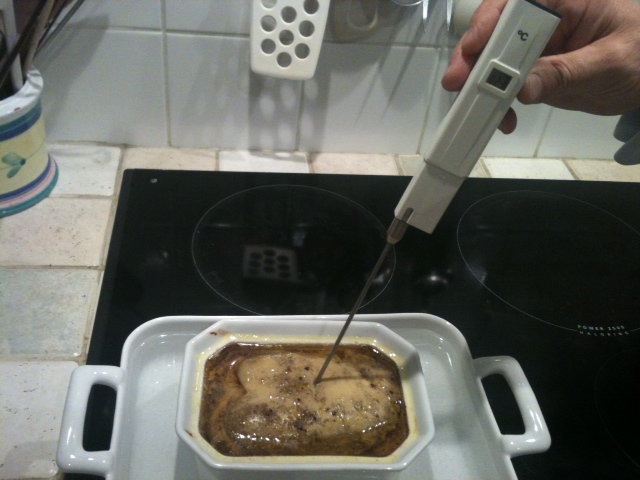
Now is what I consider to be the most delicate part – the cooking. The important thing is getting the core at just the right temperature (the sides are always hotter). You place the terrine or aluminium tray in a larger tray and fill with water and cook for 20 to 25 minutes at 150°C. You can use a thermometer to check when it gets to 37°C (body temperature) but also a skewer, which is less precise of course because you have to judge the temperature yourself. After taking it out the oven you place a press on top (you can make this with a thick piece of cardboard covered in alfoil) and leave at ambient temperature for about 30 minutes. The fat will congeal on top and preserve the foie gras. We then wrap it all in cling wrap to keep it airtight.

Enjoy!

Recipe: 
One 500 g lobe of foie gras 
7 g salt
1/2 g of freshly ground pepper
1/2 g of five spices
3 centiliters of white port wine
Cooking time: 150°C for 20 to 25 minutes.
 

*Companies with over 50 employees in France have to set up a « works committee » with staff representatives and pay a subsidy at least equal to 0.2% of the wages bill. Depending on the size of the company, employees can then benefit from various lurks and perks such as reductions on holiday accommodation, wine-tasting courses and cooking classes!

L’Atelier des Chefs: http://www.atelierdeschefs.fr/
Le Nez du Vin

One of my greatest frustrations during our 4-part introduction to wine-tasting many years ago was my inability to identify all the “noses” that the other participants seemed to have constantly … on the tip of their tongues. “Blackberry, most definitely”, they’d say, or “bilberry – reminds me of my grandmother’s tarts”, “morello cherry – just like home-made cherry brandy”, “wild violets – you can smell the undergrowth”, “hawthorn – shades of country lanes”. “Mmmm …”, I’d say, trying desperately to memorise the elusive scent.

Although I’ve now been living in France for over 30 years, my childhood in the Australian tropics did not prepare me in any way for the subtleties of berries and flowers from temperate climes. The next spring, during our long country walks, Relationnel would invite me to smell the blossoms along the way: hawthorn, wild cherry and apple blossoms. I gradually began to enrich my olfactory memory and was delighted when I, too, could identify what the French usually lump together as “fleurs blanches” or “white flowers”. When the summer came, I seized every opportunity to smell all the different berries available on the market. But having to wait until the season came around again made the learning process a little slow.

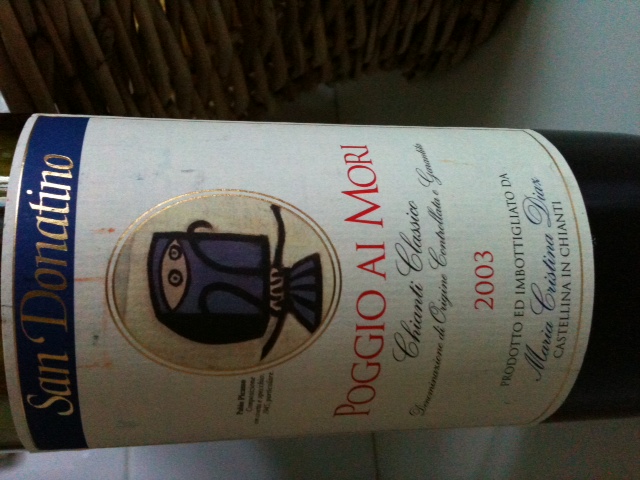
During the wine-tasting classes, our instructors used to pass around tiny numbered phials of “noses”, part of a collection of 54 different concentrated aromas called “Le Nez du Vin” with an explanatory card for each “nose”. Since the full collection was rather expensive, we started with a smaller set of the 12 most common aromas found in bordeaux wines: strawberry, raspberry, black currant, blackberry, cherry, violet, green pepper, truffle, liquorice, vanilla, pepper and smoke (!).

It didn’t take long for us to learn them off by heart and it became our best party trick. One day, we tried them out on my daughter’s friend who was born and bred in the country and I was most reassured to see that she had even more trouble than me putting a name to what she could smell.

Of course, when we started tasting white wines, I came into my own: citrus fruits, pineapple, banana and lychee were far more familiar to me than wild berries of course. I’ve become quite an expert at picking up the “banana” aroma intentionally cultivated in “beaujolais nouveau”. Contrary to popular belief, most French people probably know less about wine today than Australians do. When beaujolais nouveau hits the cafés and restaurants on the third Thursday of November the question is always “does it smell of banana or strawberry this year?” Since people expect one or the other and love being able to get it right, the winemakers often adapt the wine-making process to produce isomyle acetate which is the molecule that gives a banana its characteristic smell.

Then one November, at the wine producers’ fair at Porte de Versailles in Paris, we didn’t like any of the wine we tasted so decided to splurge and buy the whole set of “noses”. The box is divided into citrus fruit, exotic fruit, seeded fruit, red berries, black berries, pitted fruit, nuts, floral aromas, vegetables, mushrooms, wood, herbs, spices, animal aromas and roasted aromas. Of course, the concentrated phials are only a reminder of the real thing, and what you can smell in the wine is something else again. Fifty-four aromas, however, are taking much longer to get our noses around!

But I can now identify most of the berries and flowers with a reasonable success rate, often confirmed by the experts at our regular wine tastings. And I can tell you, having the whole set is a much better party trick!

Le Nez du Vin: http://www.lenez.com/en/index.htm

Beds I Have Known

I’ve already told you about my obsession with showers. I’m probably just as obsessed, if not more obsessed, with beds. Not as easy to do something about though. I don’t think I’ve always been this fussy. It’s probably developed with age.

The worst are the ones that sag in the middle, particularly when there are two of you. Now this shouldn’t be a problem – it’s not when you’re young anyway. That’s why I think age has something to do with it. Inner spring mattresses are often the culprit here. They can also cause hard lumps, particularly if they happen to be the beds you jumped on as a child.

Bed in a hotel in Innsbruck

I have horrible memories of terrible beds in French hotels and rental homes in the past. They’ve improved considerably over the years, partly because we can afford to stay in more expensive accommodation, I assume, but also because hotel owners and Gîtes de France have now realised that foreigners (like me!) don’t like awful beds. We’ve never had the problem in the Netherlands, Germany, Austria , Luxembourg or Switzerland  because double beds always consist of two single beds joined together. They even have separate covers most of the time, usually dooners. Now, I think that is very strange. There is something I don’t understand. I still haven’t worked out the logistics. How do you sleep at night (and otherwise use the bed) with two separate mattresses and two separate covers? In Italy, you usually have a double bed which is rightly called a « letto matrimonial » and is generally comfortable. The country hasn’t gained its reputation as the land of the Latin lover for nothing.

Speaking of dooners, that is something I have a problem with as well. When I first moved to France, I loved them. I bought a very expensive one made of goose and duck down and used it for years. Then I guess I got used to the cooler weather so that now, even when the heating is not very high, I absolutely roast with a dooner and have gone back to using a woollen blanket. However, dooners have become standard equipment in rental homes so we usually take our own!

In the last place we lived, we had a small bedroom so we had a small bed (140 cm). When we moved into Paris though, we decided to get a BIG bed, meaning a queen size. However, I didn’t realise it would have two separate bases joined together, nor that that would pose a problem. However, instead of sagging in the middle, it gradually developed a hump in the centre which forced us to sleep on the outer edges. Now the reason for the two bases is that it is otherwise impossible to get a queen size bed up to the fourth floor without a lift. This, it seems, is a recurring problem in Paris.

We eventually decided to get a new bed and went to a local store. The salesperson said we could claim on our warranty and get the other one replaced. I hadn’t thought of that! So we went to back to the original shop and organised to have the mattress replaced. I was relieved because despite my obsession with good beds, I find it nearly impossible to lie down on a bed in a shop and decide if it’s the right mattress or not. Some are very treacherous. You think they’re fine and they turn out to be too hard or too soft. And it’s a bit difficult to take them back. What’s that saying? If you make your own bed, you must lie in it?

Angelus at Le Clos Postel

Since we’ve been going to B&Bs, which have really upgraded in the last ten years in more ways than one, we haven’t had any more bed problems. Our first and all-time-favourite B&B in the Cotentin in Normandy, Le Clos Postel, has the most wonderful bed imaginable. First, the bed itself is not too hard and not too soft. Then it has this luxurious down cover between the mattress and the sheet that doesn’t generates just the right amount of warmth and is oh so soft.  I couldn’t wait to have one myself so we got all the details from our hostess Lydie. Now we have one of our own and that, together with our electric blanket in winter, makes our bed the best place in the world to be!

B&B Le Clos Postel : http://www.clospostel.com/, though it is probably a big mistake sharing the link because if you all take my adivce, there will never be any room for us!

Cycling in Croatia

When I first talked to Relationnel about cycling in Croatia, he was most dubious. It’s full of mountains. But in the end, he agreed and we started organising the trip. I love cycling when I travel because I think you go at just the right pace. You aren’t stuck with the other tourists in the town centre and you’re able to experience places you wouldn’t get to in a car. You ride through the suburbs and out into the countryside. You see into people’s back yards and can observe them in their everyday lives. One of the things I noticed most in Croatia, for example, was that you always saw older people with babies and small children in their arms. You rarely see that in France. Babies are usually in prams.

Our first cycling experience in Croatia was perfect. We had found a very handy appartment on the western side of Split, with a cycle path along the road leading directly to Marjan Hill which is on a peninsula and closed to cars. The first, very easy circuit around the hill took us past breathtaking views of the coast. We had stupidly not taken our swimsuits so couldn’t cool off in the many little inlets like the Croatians for whom it was obviously a popular family outing. When we completed the circle we saw a second path leading further up the hill. We looked at each other and decided the view would be worth the effort. It was a long hard steady climb but I actually made it without having to get off my bike. There was a marvellous lookout up the top which literally gave us a 360° view.  We made the most of it with our trusty binoculars. The ride was only 20 K but took longer than we expected. We arrived back in Split as the sun was setting.

No possibility of cycling in Dubrovnik, although it was one of our favourite venues, but Zadar would have been perfect if I hadn’t picked up the famous turista from eating suspect prawns in Dubrovnik. The paths around the spectacular lakes and waterfalls at Plitvicka were not accessible to bikes so we walked. I definitely recommend going in the morning. While I was still recovering from my turista, Relationnel did the lower lakes, by far the most beautiful, in 2 hours in single file in the late afternoon. When I decided to make up for lost time two days later, we started at 10 am and  it only took a little over an hour! The site is quite magical and the colours unbelievable.

The next stop was the peninsula of Istria. There was a cycling route around our hotel but it didn’t look very interesting so we found another circuit outside Pula with its magnificent amphitheatre. We started out at the Marina and tried to follow the signs but it was not always easy. There were often steep hills and lots of stones. But the views were certainly worth it. There are very few beaches in Croatia but they have lots of little “landings” everywhere so that you can get in and out the water. During the ride, I had spied what looked like a beach but was really like an amphitheatre with the steps going down into the water so we came back by car after our siesta to have a late afternoon swim, wearing the special shoes we’d bought the day before to stop your feet getting cut on the rocks. Afterwards we sat and watched everyone pack up and leave. The whole “beach” was covered with deck chairs that all had to be put away and chained together. There were even two changing tents that were folded up and stored in the bar across the road.

Then we went on to Slovenia, but that’s another story that I’ve already told.

Apartman Riva
Branimirova Obala 6
SPLIT
+385 (0)98 937 0942
apartman.riva@gmail.com
Antonela Cmrlec
 
Matko Jelic
Zvijezdiceva
DUBROVNIK
www.apartmentsdubrovnik.com
matko@apartmentsdubrovnik.com
 
Apartmani Lipa
Plitvice Selo 62
PLITVICKA JEZERA
Stanislav Mihinjac
385(0)53 891 0386
385(0)98 389 492 (mobile)
 

Showers I Have Known

I’m very fussy about my shower. First,  I want to be able to attach it to the wall. Now if you think that’s a strange thing to say, it’s because you haven’t been to France.  Or you’ve only stayed at my place or in four-star hotels. The first time I ever came across a hand-held shower, I was mystified. Particularly since it was attached to a bath without a curtain or a partition. I can remember taking the kids on beach holidays and having to demonstrate how to have a shower bath without flooding the bathroom at the same time. Not that they ever really managed. I thought that Relationnel, being French, would have the technique. Not so. If we stay in a hotel or a gîte without a curtain, I make sure I have my shower first.

While we’re on the subject of curtains and partitions, that is something else I am fussy about.  I can remember being in Greece many long years ago where my accommodation was fairly basic. There was usually a very large shower room but no shower cubicle or curtain, just a shower (attached to the ceiling though). As there was nothing else in the room (except my towel and dry clothes), it didn’t matter all that much. I found a large plastic bag to put everything in and hang on the hook (when there was one) or put on the floor in the opposite corner (when there wasn’t).

In the first house I bought in France, there was a bathroom with a sunken shower tray, a shower attached to the wall, a wash basin, a bidet and a toilet. But no curtain or partition.  I finally asked the daughter of the house why the shower was completely open. She said that it was her mother’s way of getting them all to clean the bathroom. Hmm. I immediately bought a curtain rail and a curtain. I’m not keen on those glass cubicles. They may be fine in a hot country but when you’re having your shower in a cooler country, particularly during heating season, they’re perfect while you’re in there. But when you turn off the shower and step out, wow!  The cold air massively hits you.  Curtains do not have that drawback. They’re also easier to clean. Just buy the nylon ones and put them in the washing machine every couple of weeks.

Next, the water temperature has to be right, which means that anywhere else except North Queensland in summer, I want it to be hot.  Not lukewarm or, even worse, what the French call a Scottish shower (douche écossaise) – scalding one minute and freezing the next. Why Scottish, you wouldn’t know and even my French expression reference site doesn’t know the origin. Seems it might refer to some sort of hydrotherapy they used to use there. Not my scene.

After that I want pressure. This is something you can’t always do anything about. It depends on the water tower. I don’t remember seeing water towers in Australia but they’re all over the place here, sometimes very plain, sometimes just ugly, sometimes decorated with fresques and sometimes used for advertising. There’s one in Le Crotoy in Normandy, for example, that has a beach and hot air balloon painted on it. They pump the water up to the top and then let it go and the pressure acquired on the way down is what provides the pressure at the tap. I think that’s ingenious. It’s called a “château d’eau”, what’s more. If you google “chateau d’eau” images, you’ll find the most amazing collection.

Now it’s no good having hot water and good pressure if the shower head is clogged up. This happens when the water is hard, meaning it has a lot of lime in it. I remember my sister used to unclog the holes with a pin when we used to go the Island on holidays as children. My obsession with showers obviously goes back a long way. But there is a much more effective way. You soak it in ordinary vinegar. We always take a bottle away with us (when we’re travelling by car of course). As soon as we get there, Relationnel cuts off the top of the plastic bottle and sticks the shower head in it for a few hours. You have to be able to unhook the shower of course. It’s miraculous. A perfect, even shower.

I was very interested to see the showers in Croatia in the flats we rented this summer. They were all the same. A stand-alone cubicle with sliding curved glass doors (it was hot enough not to be blasted with cold air when you got out). The only problem with the bathrooms there is that none of them have towel racks. Or hooks for that matter. It was in Dubrovnik that we finally discovered what we were supposed to do with our wet towels (I still don’t know where you put them while you’re having your shower). One day, we were out and the owner dropped by to take a folding bed out of the flat. When we got back, our towels were nowhere to be seen. Then we found them. He had hung them out the window on the lines overhanging the mediaeval street below. Different countries, different customs.

What is your experience of showers ?


My Christmas Cake

Yesterday, I was just cutting up the dried fruit for my Christmas cake, which always takes me back home to Townsville of course. I’m using my mother’s recipe, that she got from her mother, written in Mum’s lovely copperplate writing (she used to handwrite wills in a solicitor’s office when she was young) and still on the onion paper she used to send me airmail letters when I first came to France, so I’m feeling very traditional.

Our Christmas cake was a whole ritual. Mum very rarely made cakes so it always seemed very special. First, she would get out the big scales with their special weights to make sure all the ingredients were the exact weight. Then we’d cut up everything up into small pieces; the rum was added and it was left overnight. Next day, we would get to sift the flour and mixed spice together with the special sifter, and get it all over everything. For years after I began making the cake in France, I used to mix the spices myself, guessing what proportions I should use, but when Black Cat came home from UQ, she brought me two boxes. Mum would do the creaming of the butter and sugar. After that, I’d vie with my sister to see who would crack the eggs. Since there were five eggs and she was the oldest, I’d only get to break two. I usually got to put the dollop of marmelade in though. Then the flour was added alternately with the mixed fruit until it got harder and harder to stir.

Then would come the big moment when everyone had to come and stir the cake and have a wish. We did that today. We’re two children short this year – Leonardo’s in Australia and Forge Ahead’s in Madagascar – but we have Brainy Pianist to give us a helping hand. I don’t know if this is a custom in other Australian families, but I suspect it was really devised by some clever ancestor to give the poor cook some relief from stirring the thick mixture by herself!

After that, you have to cut the paper for the cake tin: two layers of brown paper and one layer of butcher’s paper. Since I don’t have either, I just use extra large sheets of thick white paper. You have to cut circles for the bottom and top and long strips for the sides. You butter the sides of the tin then line them with the paper. After you’ve spooned the mixture in, you add a decoration of blanched almonds and candied cherries. Then it’s time to lick the bowl! Do I dare admit that I still like doing that today?

You then cook it for 3 hours and try not to go to bed and forget the cake’s still in the oven. When it’s ready, you wrap the cake and the tin in a thick tea towel and leave it until Christmas. It will then keep for several months if it doesn’t get finished off immediately.


250 g of butter                                              250 g of raisins
125 g brown sugar                                      250 g of currants
5 eggs                                                             250 g of sultanas
1 tablespoon of marmelade jam              125 g of mixed peel
250 g of plain flour                                       60 g of dried figs
60 g of rice flour (or arrowroot)                 60 g of dried apricots
2 teaspoons of mixed spice                        60 g of dates
1 teaspoon of cinnamon                             60 g of chopped almonds
½ teaspoon of nutmeg                               3 tablespoons of rum or brandy
enough blanched almonds and candied cherries to decorate
 
  1. Chop fruit. Place in basin. Add spirits and stand at least overnight.
  2. Line cake tin (8 inch diameter) with 2 layers of brown paper and one of white. Also sides of tin (have paper come up to 3 inches (7 cm) above tin). Also 2 brown and one white paper circles for top of cake.
  3.  Cream shortening & sugar. Add whole eggs one at a time, beating well. Add marmelade, then siften dry ingredients alternately with prepared fruit. Stir evenly.
  4. Bake in an electric oven at 900°F (150°C) for about 3 hours. Bake slowly. Remove.
  5. Wrap tin (with cake in it) in old cloth. Let cool in tin.

Captain Cook and the French Revolution

I’ve been reading Hough’s biography of Captain Cook and thinking about what Townsvillean said when I told him we’d bought a house in Blois built in 1584: “Your house is about twice as old as my nation!”.


One of the amazing things to me about Cook is that he didn’t know he had discovered Australia. I find it very hard to understand how someone with such intimate knowledge of map making could have sailed up 4,000 kilometers of unknown coastline and still not realised he had discovered Terra Australis. He even sailed past Magnetic Island, my very favourite coral island, calling it that because his compass went haywire. But he made two other voyages in an endeavour (unintended pun) to find the Great Southern Land, but to no avail. Instead, he got killed in a skirmish in Hawaii in 1779 at the age of 50. He’d been at sea for nearly three years.

He first sighted Australia in 1770 as we all know. The first convicts arrived in 1788 and a mottley crowd they were.  It was survival of the fittest. The First Fleet consisted of 11 ships  carrying about 1400 people and it took 8 months to get there.  They lost about 70 on the way.   A little over half of the first settlers were convicts.

Now what was happening in France at the time?

1770. Mild winter. Cool spring. Heat-shrivelled wheat in May and June. Catastrophic harvest. A hailstorm of exceptional violence that devasted all the cereal crops from the Loire to the Rhine on 13th July. Drought in the south. An early wine harvest. Some authors believed that the disastrous weather spurred on the French Revolution which took place the next year.

We all know the story of Marie-Antoinette who, when she heard there was no more bread for the poor, replied « Then give them cake! » It was actually brioche which is just as naive and very indictive of the great gulf that separated the people who had just set foot on Australian soil from the ruling classes. In France, a bloody revolution and a guillotine were needed to break the bonds of servitude, which meant brains and education. In Australia, a more native cunning was needed to survive combined with perseverance and endurance.

The effects of the French Revolution didn’t last long. Just ten years later, Napoleon was First Consul and in 1804, he became Emperor. There was no longer royal blood in power but you could hardly call it democratic.  In 1804 in Australia, Irish convicts launched the Castle Hill Rebellion. 51 were punished and 9 hanged. In the same year, the settlement that was later to become Hobart was founded at Sullivan’s Cove.

1815 saw the defeat of Napoleon at Waterloo and the start of a constitutional monarchy  but it was not exactly plain sailing. In Australia, the road over the Blue Mountains, first crossed in 1813 by Lawson, Blaxland and Wentworth, was completed to the Macquarie River.  1848 saw the proclamation of the second republic in France and the beginning of the Second Empire with Napoleon III.  Meanwhile, back in Australia, that was the year Ludwig Leichhardt the explorer disappeared on the Darling Downs.

The French empire  finally came to an end in 1870. In the same year, Western Australia, Victoria, Queensland, New South Wales and South Australia each adopted its own flag. On 1st January 1901, Australia became a nation. Queen Victoria, also the Queen of Australia died on 22nd January after 64 years on the throne. By 1908 women had the vote in every State. Would you believe that French women didn’t enjoy that basic right until 1944!

France then suffered horrendous losses, both in lives and heritage during two world wars. Australia also lost many lives particularly in proportion to its population. It gets me terribly upset to see the aftermath of war in France, where whole villages and towns were completely wiped out and were rebuilt as quickly as possible to house the remaining population. This is particularly obvious in some parts of Normandy and Brittany.

Since then, both countries have forged ahead with far more similar paths. I wonder what present-day characteristics of the French and the Australians can be attributed to these different events in history.

Captain James Cook: A Biography by Richard Alexander Hough (W.W. Norton & Company, 1997)

Another Country, Another Language: from Taipei to Ljubljana

We were in Taipei on a 24-hour stopover on our way to Australia and Black Cat must have been about twelve.  The language barrier was not easy as very few people spoke English once you set foot outside the hotel. Black Cat was quite scandalised at my lack of preparation. She was used to being able to communicate with people in two languages. “Mum, we don’t even know how to say hello, goodbye, please and thankyou!”. It was a lesson to me. I’ve made sure ever since that I can say those four words in the language of whatever country I visit.  And I’ve added “excuse me” and “do you speak English” for good measure. They certainly open many doors.

Being able to download dictionaries and automatic translation apps on your iPhone and computer definitely makes things easier. There are a lot of apps to teach you basic words and phrases along with pronunciation. Definitely a bonus when we went to Croatia last summer.  I practised away beforehand saying “dober dan” and “dobro jutro”, “hvala” and “molim” until I felt comfortable with them. I was delighted to learn that I could use them in Slovenia too.

The French have a terrible reputation with languages. I had a funny experience twice last summer in Ljubljana in Slovenia. We were in the tourist office waiting for a cycling map and I was speaking to Relationnel in French. When it was my turn, I spoke to the young man behind the desk in English. After a few exchanges he asked me where I was from. “France”. “Are you a teacher then ?” “Why ?” “Your English is too good to be French”. I had to laugh! So I explained I was really Australian. He looked reassured.

Dragon Bridge with Ljubljana's mascot

On another occasion, we were pushing our bikes up a steep hill that definitely shouldn’t have been part of the bike route, particularly at the end of the day, when a young woman asked if she could help me. I thanked her but thought I should really push the bike myself. However, she kept me company and chatted as we went along. She asked if I was Canadian. She had heard me speaking French with Relationnel but after hearing my English couldn’t believe I was French. What a reputation …

A word about the Slovenia biking experience while we’re on the subject. Ljubljana is really set up for bikes. They have rent-a-bikes in the street like they do in Paris and there are lots of bike paths in the city. But, for some reason, they don’t have a proper bike map. However, the young man in the tourist office found me a map that had a little dotted line around the city that was supposed to be a bike route. It was a bit worrying to see that it went off the map at times but we decided to give it a try. It was supposed to be 34 K so we left at 3.30 pm, following signs marked POT (and sometimes 88). Very occasionally, the letters PS were indicated on the ground showing a change of direction. We liked those.

Well, we started out on flat ground, riding past weeping willows and beautiful gardens and really enjoying ourselves. Twice we had to take shelter from showers of rain but otherwise the weather was fine and warm.  We wound our way through residential areas, industrial estates and low income housing all surrounded with lots of trees and shrubs. Sometimes we had to backtrack because we’d loose the POT and 88 and PS signs.  As a result, it took much longer than it was supposed to.

The real challenge came when we suddenly found ourselves out in the countryside, riding past fields of wheat and saw to our dismay that the road led into a forest and up a steep hill. The path had horizontal logs about every meter practically all the way along to stop the ground sliding when it rains I imagine. I don’t know how you are supposed to ride a bike up there. Even coming down on the other side was a bit dicey. I had to keep getting off so that I wouldn’t go head first over the logs. Of course, when we got out of the forest, we discovered we could have taken a road around and not up the hill. It ended up being 42 K and we didn’t get home until 9 pm by which time I was exhausted!  We found a lovely place for dinner though. And I forgot to mention – Ljubljana is one of my favourite places.

from the Tropics to the City of Light