A Monumental Afternoon

We’re in Amboise in front of the Church of Saint Denis, waiting for our friends Susan and Simon from Days on the Claise. We’re here for a purpose. Susan wants to see some artworks in the church that she has heard about. It’s extremely cold so we go inside and wander around. It’s quite dark and gloomy and I don’t notice anything very interesting.
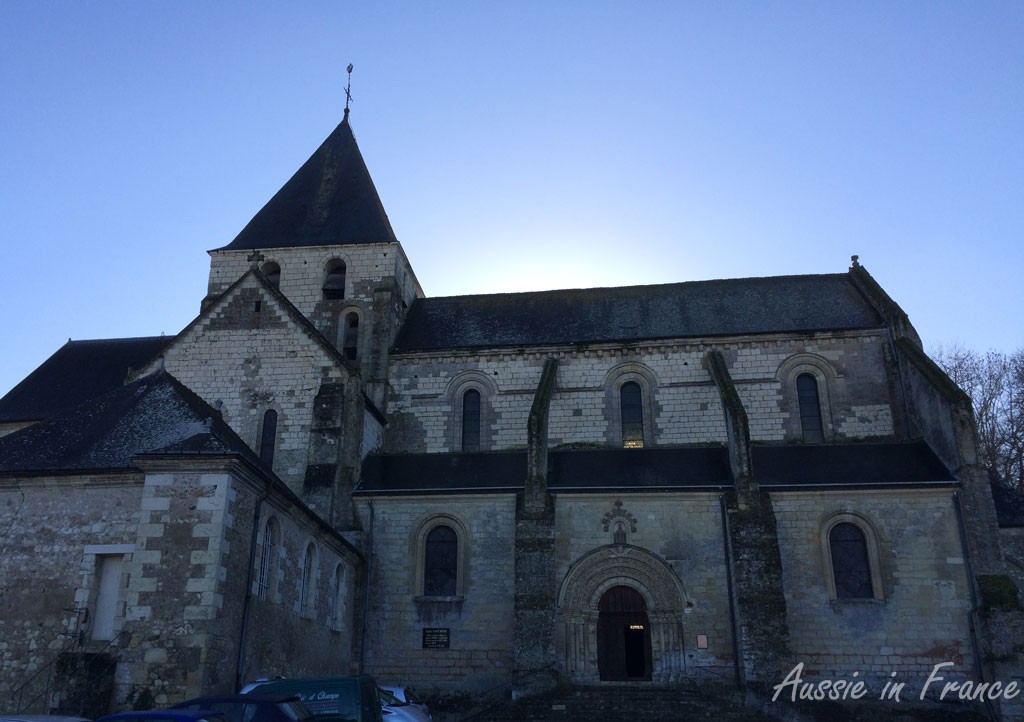
Collegiate Church of Saint Denis, Amboise, 12th century

Susan and Simon arrive with Antoinette from Chez Charnizay who is also interested in art. Our mutual friends Janet and Antoine who live in Amboise also join up with us. Susan takes us over the other side of the church in front of a group of statues called a Mise au tombeau which means emtombment and refers to the emtombment of Christ. I wonder why I didn’t notice it the first time.
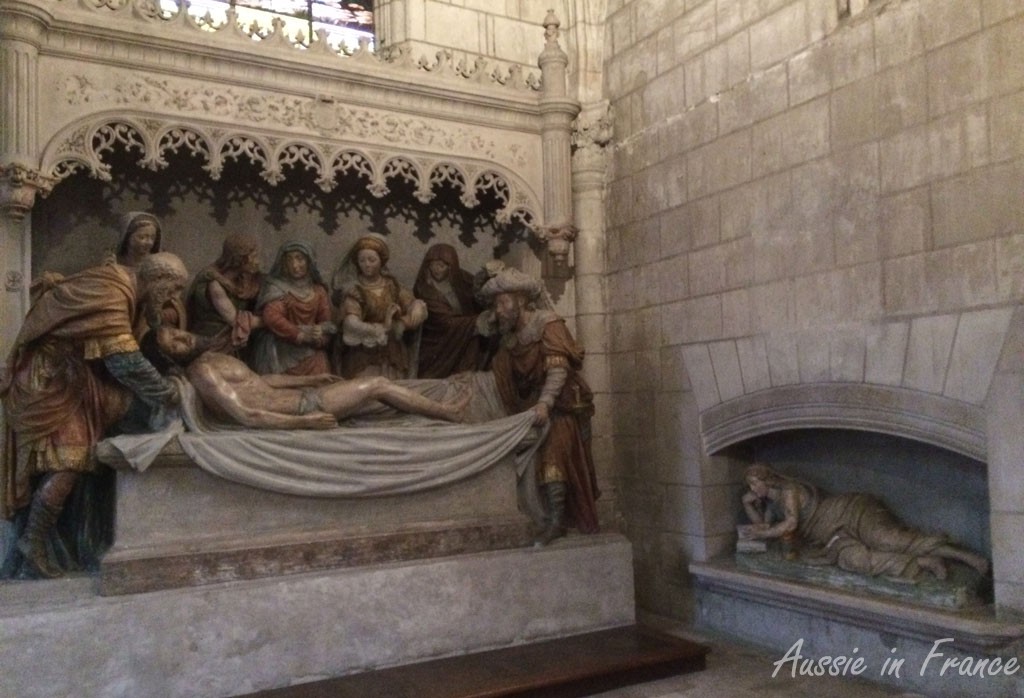
Mise au tombeau
16th century Mise au tombeau

Susan and Antoinette start discussing the different people in the group. It was common practice for patrons of the art at the time – we’re talking about the 16th century here – to be depicted as historical and religious figures.   A man called Philibert Babou, Treasurer to François I, commissioned the group of eight life-sized figures in painted limestone. It is believed that the figures are members of the Babou family.

Mary of Clopas and Nicodemus

For people who know their religious history, the identity of the original characters should not pose a problem : Joseph of Arimathea, St Veronica, St John the Evangelist, the Virgin Mary, St Mary Magdelene, Mary of Clopas and Nicodemus. However, Susan is very curious about the fact that Mary Magdelene seems to be wearing a crown. Surely the Virgin Mary should be wearing it? Mary is thought to be Marie Gaudin, Philibert’s wife, who would have been about 50 at the time and was considered in her youth to be one of the most beautiful women  of her time. She even had an affair with François I some 30 years earlier.
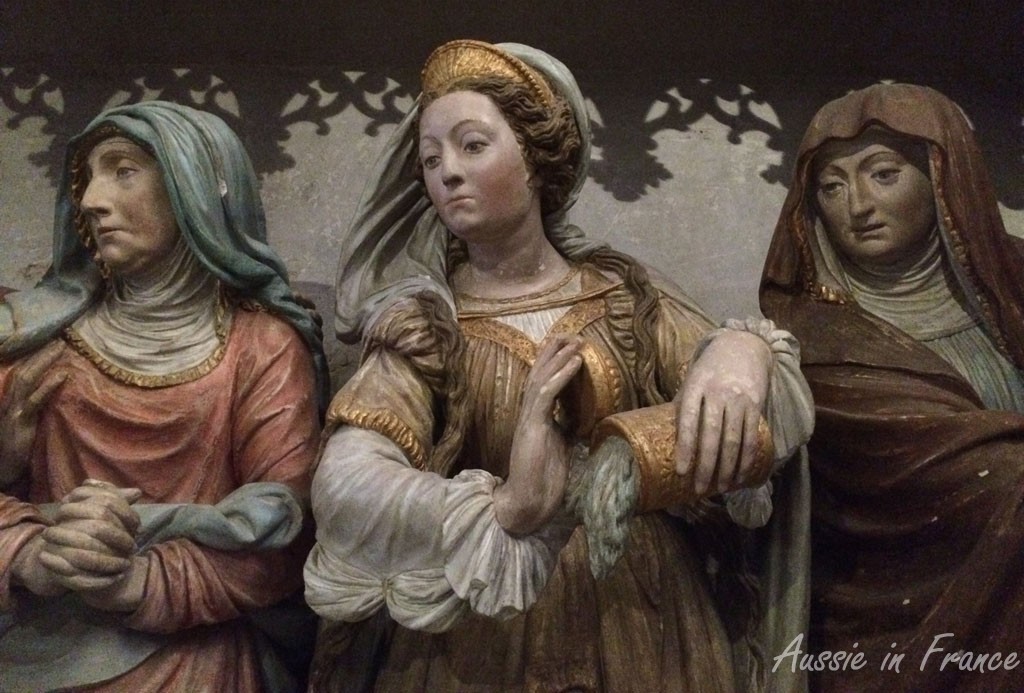
The Virgin Mary and Mary Magdelene

Antoinette also points out the clothes they are wearing, such as the ornate turban and flowing garments with their liberal gold trimming. Large amounts of fabric indicate greater wealth. The oriental look is typical of the sixteenth century.  The headgear in general is very indicative of status. Mary Magdelene, who has the finest features and most intricate garments of the people depicted, is in fact wearing a gilded headdress and not a crown. Susan finally comes to the conclusion that “the message might be that anyone can come to God and it need not interfere with you looking gorgeous or showing off your assets”.
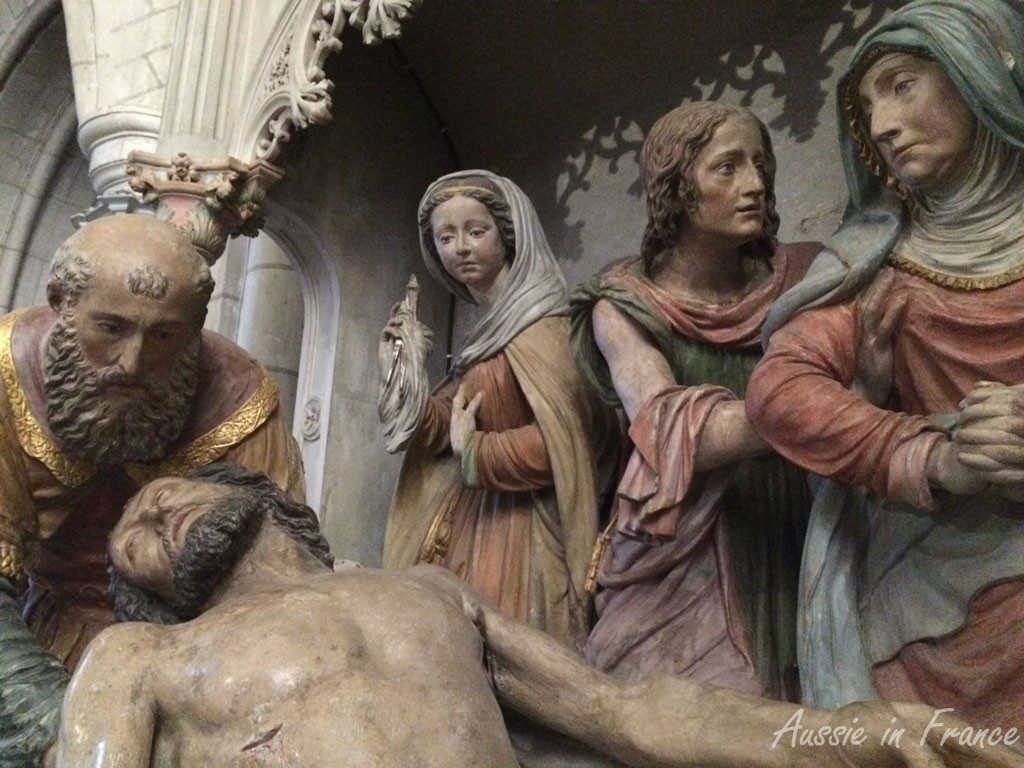
Joseph of Arimathea, St Veronica, St John the Evangelist and the Virgin Mary

I’m really enjoying myself. Having specialists to point out all these different aspects is far better than a guide book which I soon get bored with ! The two written guides we find in church are not very useful and don’t answer any of our questions. I’m also amazed that they were able to move it to Saint Denis intact from Montlouis further along the river.
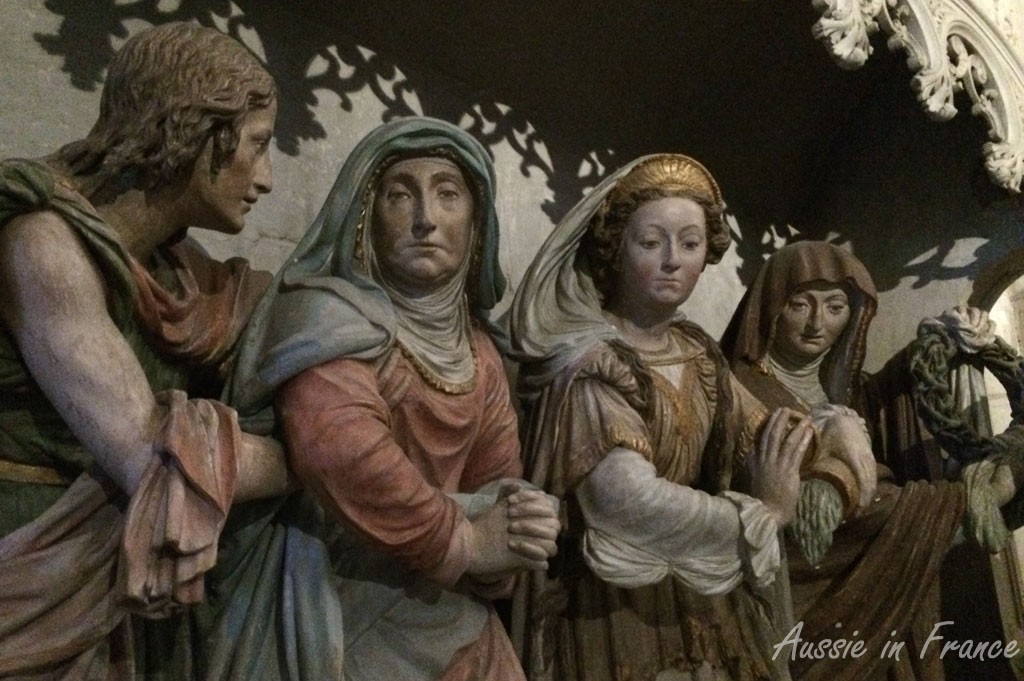
Saint John, the Virgin Mary, Mary Magdelene and Mary of Clopas

We take a closer look at the reclining figure on the right. It’s Mary Magdalen with a book in her hand and a box of perfume. The sculpture was originally in a chapel in Amboise that has now disappeared. I’m surprised to see MM with a book but Susan tells me this is a typical way of depicting women in the 16th century.
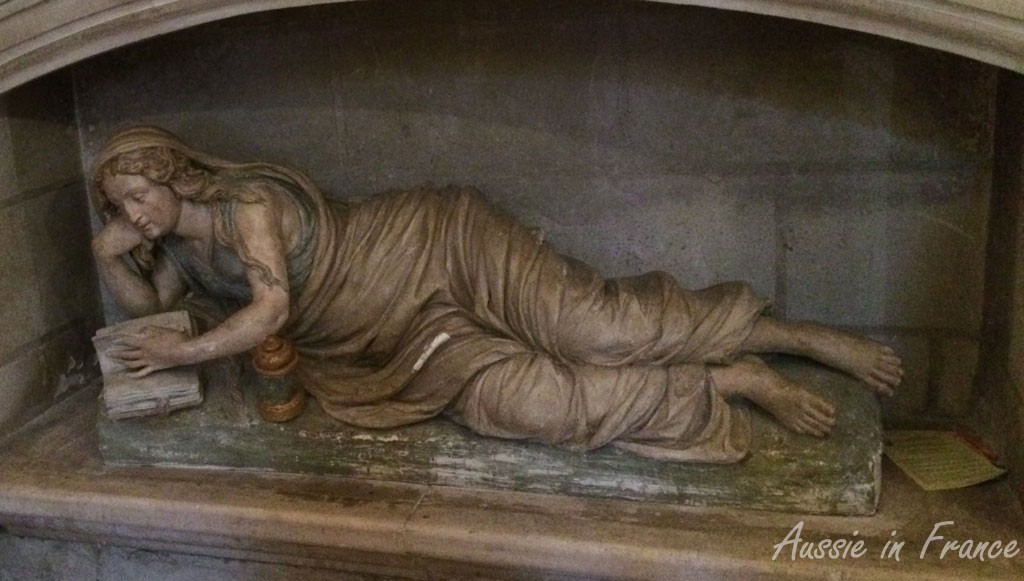
Mary Magdelene reclining

We then move onto the sculpture, known as la femme noyée or drowned woman. We all stand around while Susan explains that it is comes from Bon-Désir Chapel in Montlouis and thought to represent a member of the Babou family, perhaps Marie Gaudin who drowned in the Loire. She then says, “but I don’t agree with that”. It’s true that after we take a look at the smooth muscular thighs it’s seems unlikely that the effigy is that of a drowned woman. Susan adds that she thinks it is exactly contemporary with a similar effigy of Catherine de Medici in the Royal Mausoleum in the Basilica of Saint Denis, Paris. “Catherine rejected the first version of hers because it was too emaciated and gruesome, and I suspect a similar sentiment with this one in Amboise.”

Mary Magdelene reclining

What really surprises me is there should still be so much mystery surrounding two artistic works of such calibre. Susan tells me it’s actually quite common and that, if nothing is known about a work of art, it is just ignored in the local guide books! I go back to the Mise au Tombeau and look at more of the details which are quite amazing. Just the draperies could hold my interest for hours.
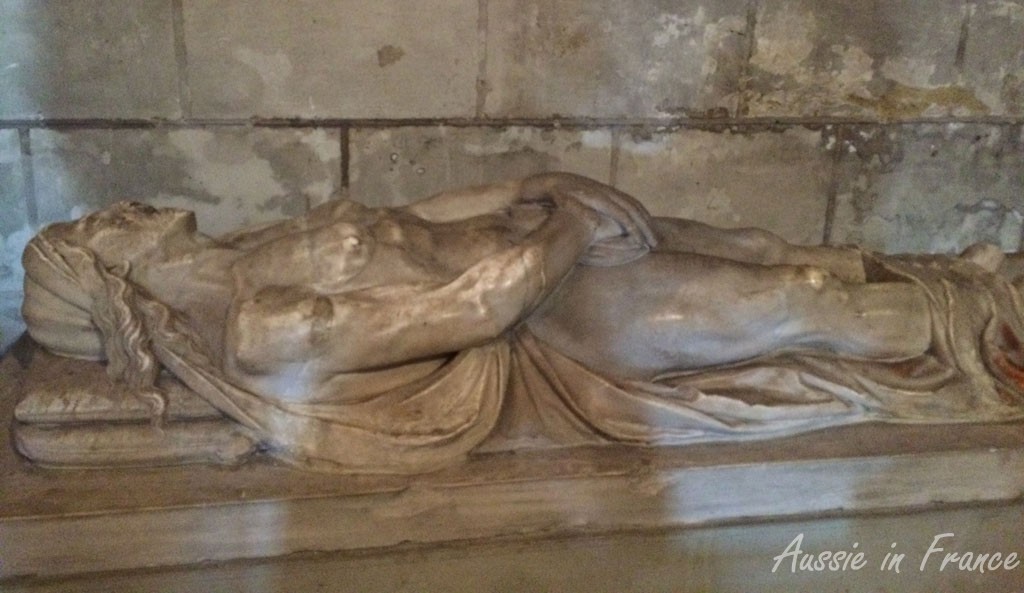
The drowned woman
The drowned woman

Susan then calls smy attention to another work of art which is part of the altar piece – what can only be a representation of god which, as Susan points out, is most unusual. Only Christ and the Holy Spirit are usually depicted. She later discovers that it is, in fact, the Eternal Father, which corresponds to the first person of the Holy Trinity.
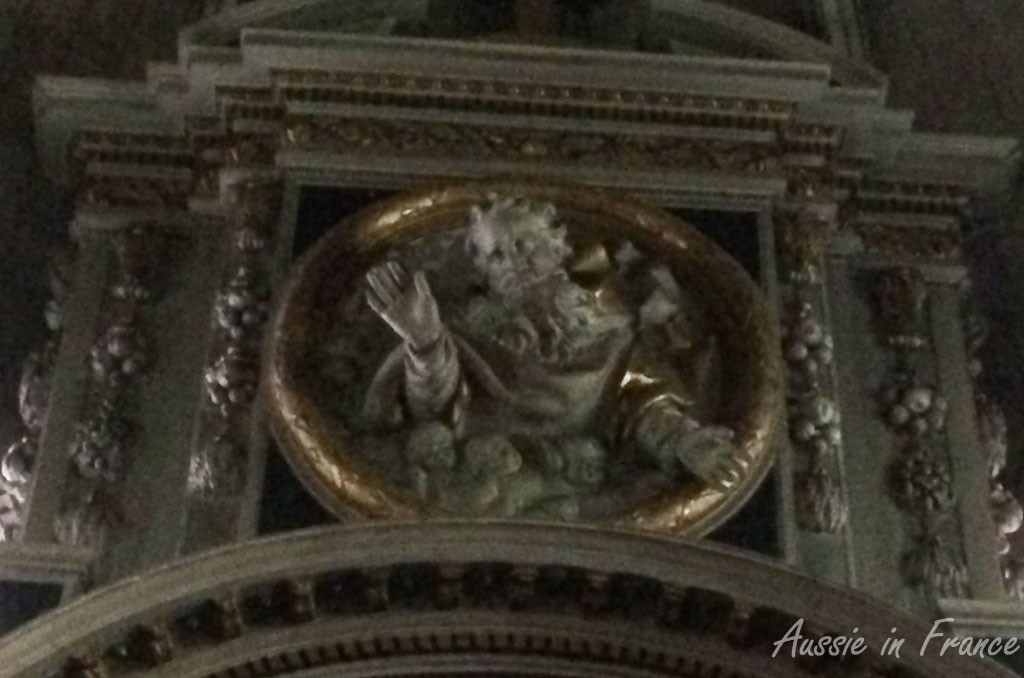
The eternal father on the altarpiece
The eternal father on the altar piece

We end our wonderful afternoon a few kilometers outside Amboise at the Gaulish Oppidum where there is a mud rampart that dates from 400 to 50 BC and a mound called Caesar’s Hill overlooking the surrounding countryside. My only regret is that Susan and Simon live in the south of the Loire, an 90-minute drive from us!
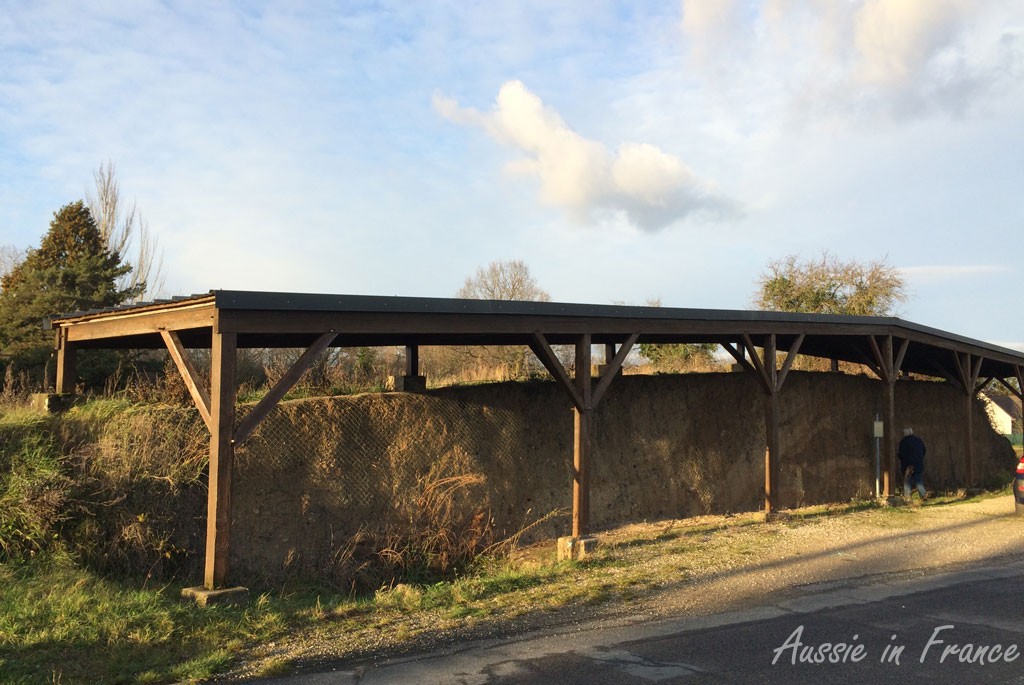
The rampart from Gaulish times built from 400 to 50 BC

For more details about the Mise au Tombeau, I strongly recommend that you pop over to Susan’s blog Days on the Claise. She has written a very lively, yet very scholarly account in her usual inimitable fashion.
A Day in Paris with Lunch at Le Lobby

It’s nearly 9 am and we’re about to go to Paris for the day which we don’t do very often. To our immense surprise, the ground is covered in snow!  I run around taking photos and videos while Jean Michel makes sure all the bird feeders are well stocked. This is our first snowfall for the season and totally unexpected.

The roads aren’t too bad although they haven’t yet been sanded and we have to keep in the middle lane until Orléans. As we approach Paris, the sky is a brilliant blue but it’s only a few degrees so quite cold.

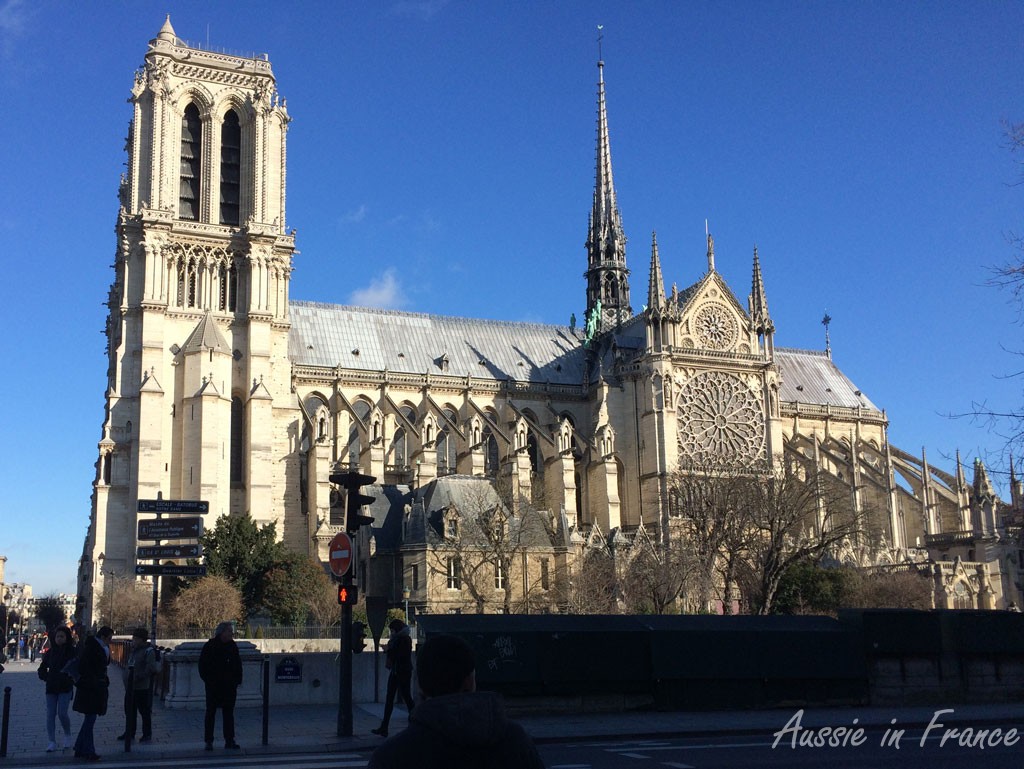
Driving past Notre Dame on our way to Au Vieux Campeur

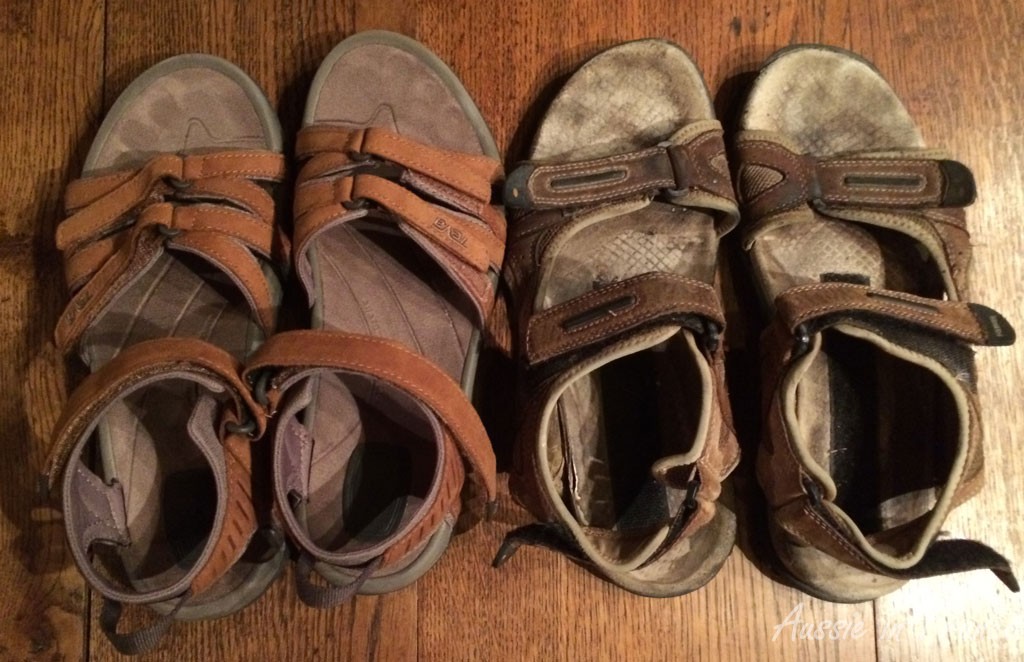
Our first stop is  Paris’ best-known sports store – Au Vieux Campeur near Saint Germain des Prés – because we need to replace our falling apart Meindl Capri walking sandals to go to Australia next month. We tried to buy the same ones on the Internet, to no avail. Buying sandals in winter is not a great idea.

Pick the new sandals!

Despite the churlish, know-it-all salesman – even Jean Michel thinks he is terrible – we manage to find a suitable pair of sandals before we each go our separate ways. I have to admit the new Teva ones are much more stylish. Jean Michel is having lunch with a former colleague and I am meeting up with my lovely friend Mary Kay from Out and About in Paris who is soon to go and live in Prague. I am not the only person who will miss her.

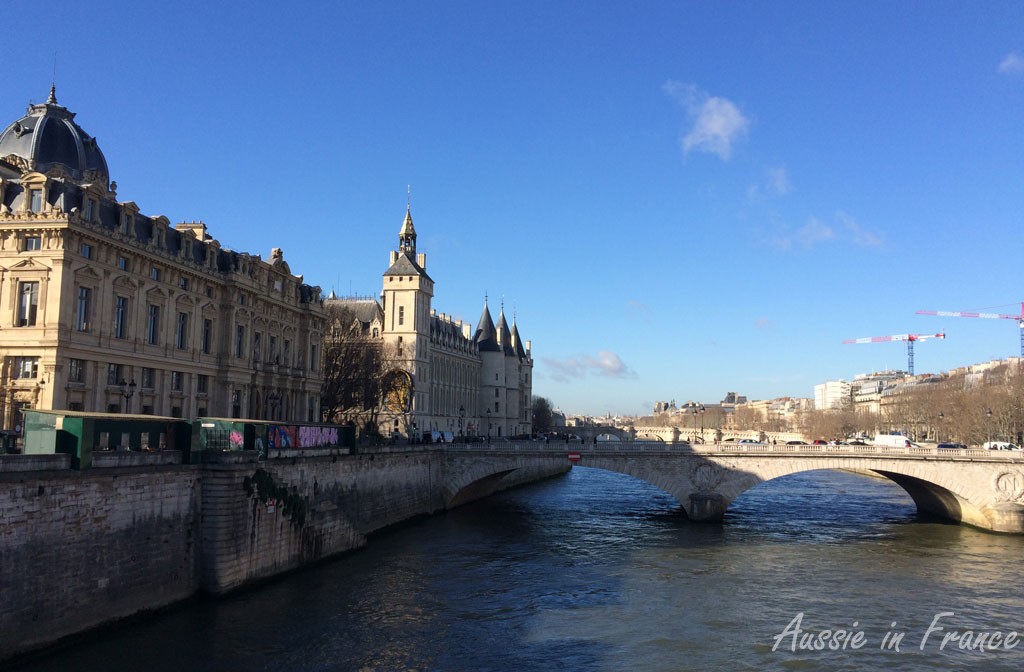
The conciergerie from Notre Dame bridge

As I walk across the Seine to Notre Dame then past the Conciergerie and over the river again to the right bank and my metro at Hôtel de Ville, I can’t stop taking photos, the sky is so clear and sharp.

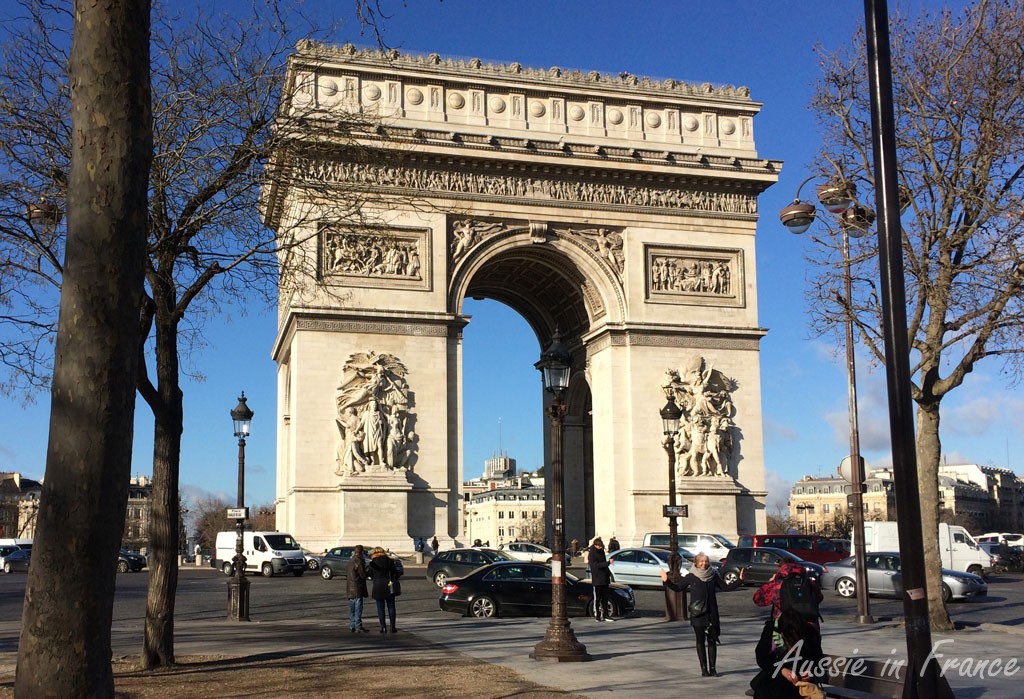
The Arc of Triumph
The Arc of Triumph

I emerge at the Arc of Triumph  which is also looking good with so much blue sky around it and head for the 5-star Peninsula Hotel on Avenue Kléber where Mary Kay and I are having lunch in Le Lobby recommended by Janine Marsh in a recent post in her blog, The Good Life magazine, relayed by Susie Kelly on No Damn Blog.

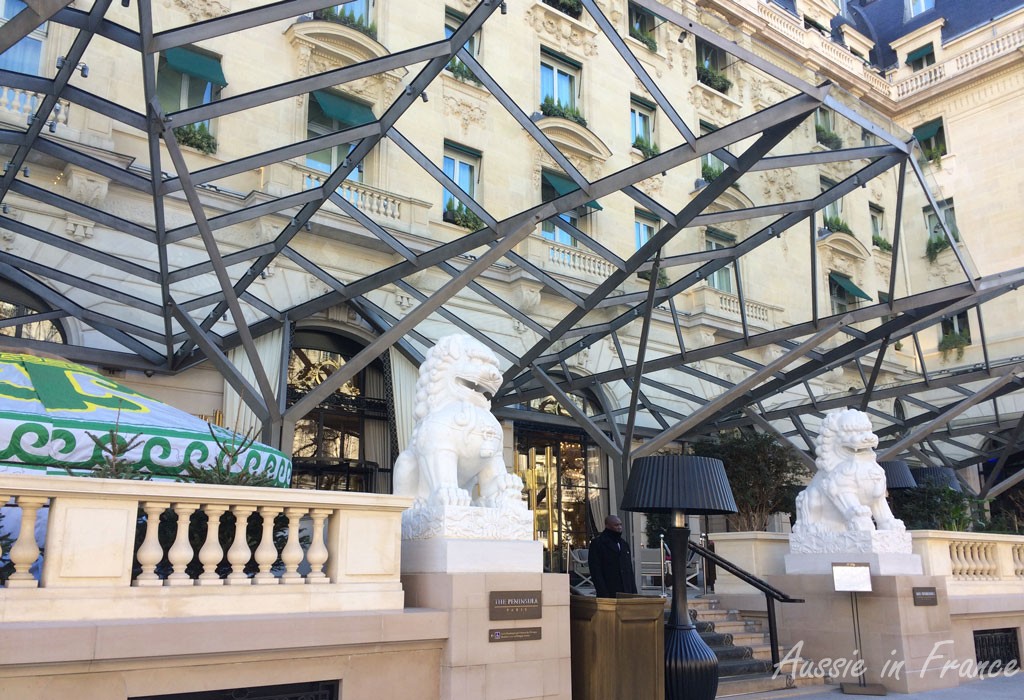
The Peninsula Hotel
The Peninsula Hotel

After 5 years of renovation, the lobby of the Peninsula is, indeed, a splendiferous setting. The welcome and service, of course, are impeccable. I can even forget my iPhone on the table while I wash my hands and find it still waiting for me.

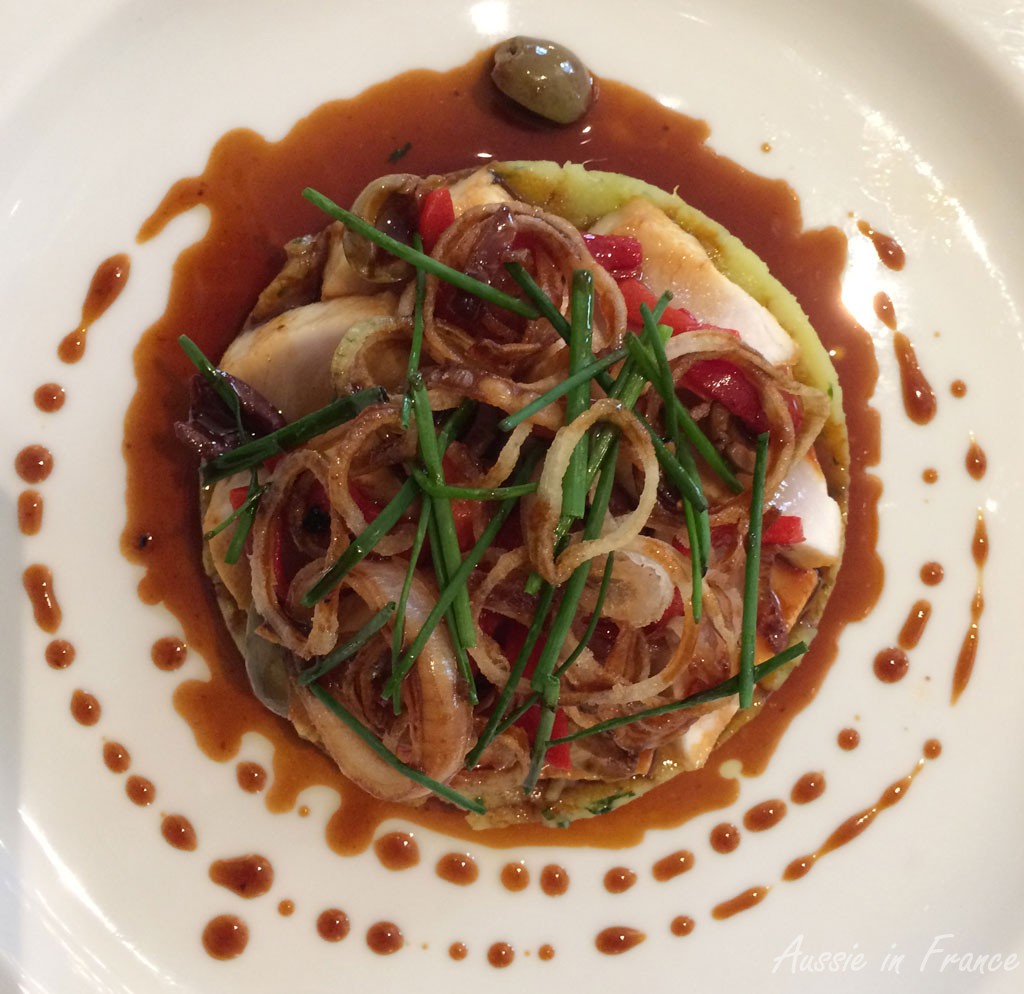
Our sword fish to rhyme with sworn

We choose the 60 euro set meal that includes a glass of wine and bottled water. A very tasty Jerusalem artichoke and foie gras soup is followed by beautifully cooked sword fish (which the waiter pronounces to rhyme with sworn) on a bed of vegetables. We finish with cheesecake on a strawberry crust which is somewhat disappointing especially as I’m not a big fan of France’s favourite fruit.

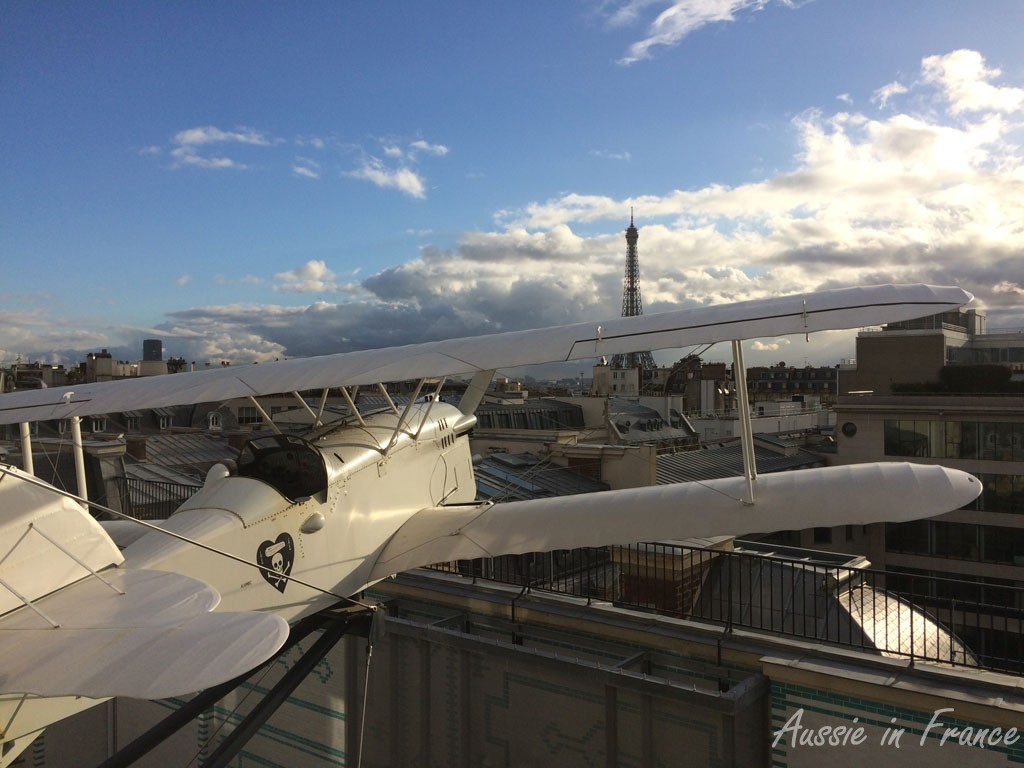
The Oiseau Bleu biplane on top of the Peninsula

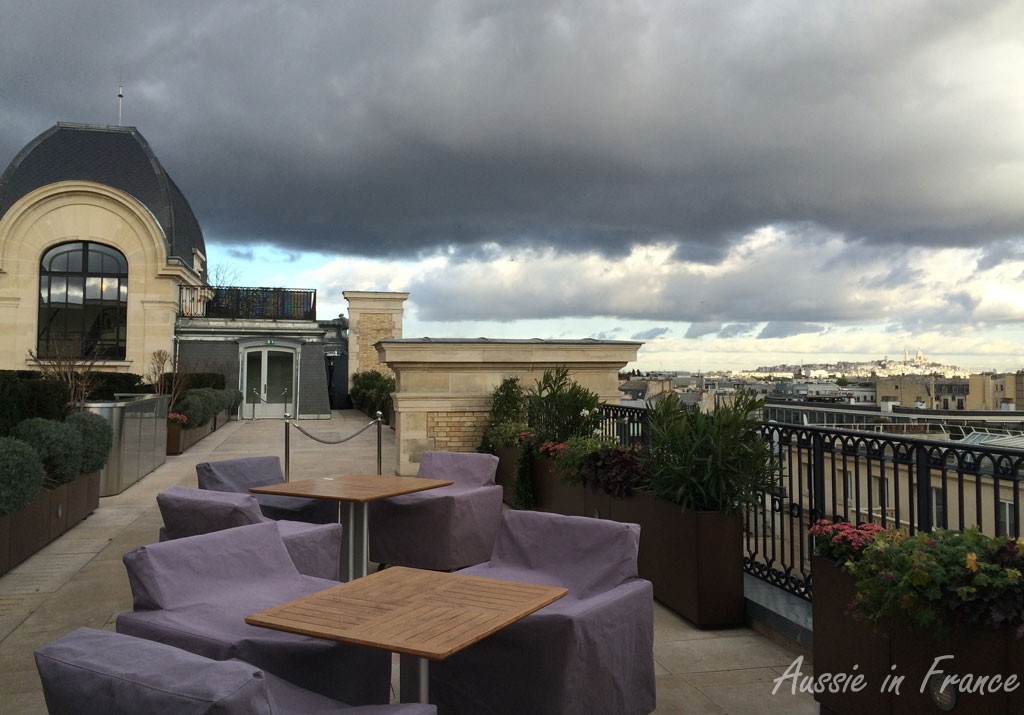
Mary Kay, who has been to the L’Oiseau Bleu restaurant and bar several times then takes me up to the roof of the building. The view of the rooftops of Paris with Sacré Cœur in the distance is stunning. I make a vow to come back here for a drink in the summer.

The Oiseau Bleu summer terrace with Sacré Coeur in the background

L’Oiseau Bleu is named after the biplane that disappeared on 8th May 1927 with its two French pilots, Charles Nungesser and François Coli, during the first attempt to fly non-stop across the Atlantic from Paris to New York. Less than two weeks after their disappearance, Charles Lindbergh was the first to make the crossing, but in the other direction, on board the Spirit of St Louis. No trace of the Blue Bird has ever been found. There is a replica of the plane on the roof.

The main square in Paris alive with music
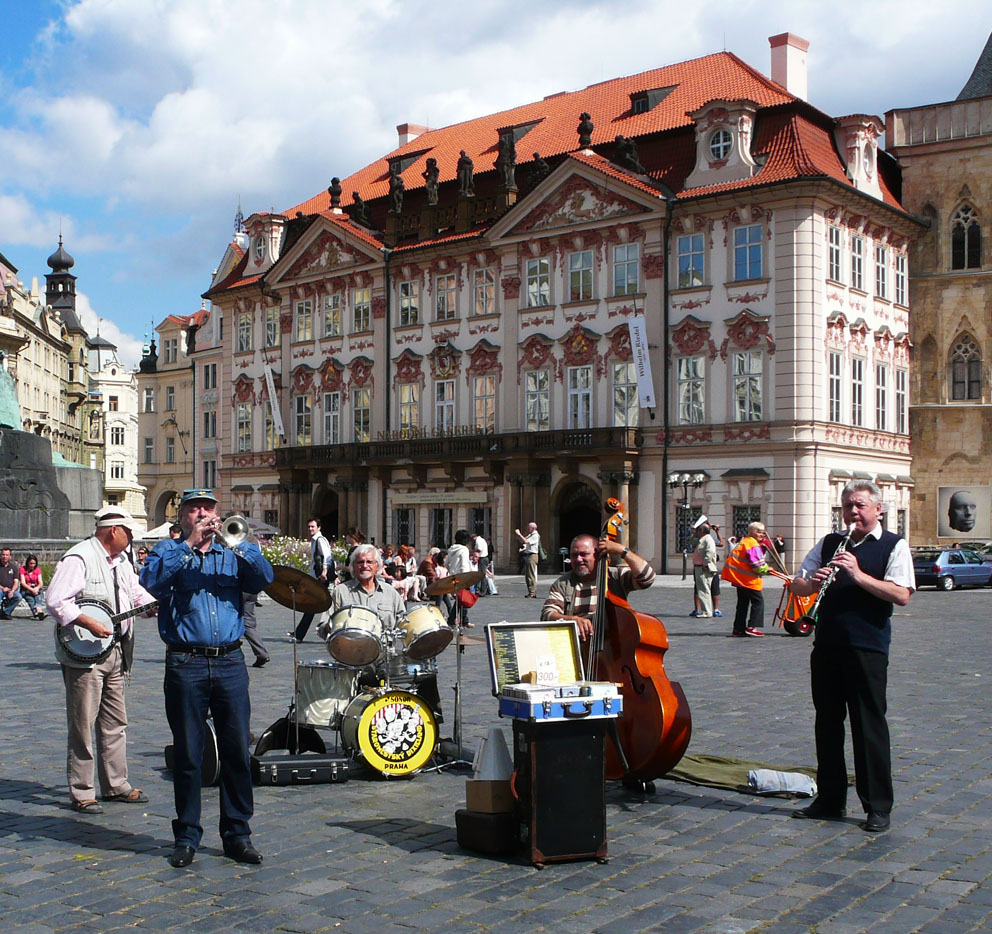
The main square in Prague alive with music

I am sad to leave to leave Mary Kay but hope to see her again before too long, perhaps in Boston or New York now that Leonardo and Black Cat are both living there. Much as I enjoyed the week I spent in Prague several years ago, it isn’t on the agenda again for the moment, but who knows?

Friday’s French – Content, contented, satisfait, satisfied, heureux, happy

Content is another one of those words that does not necessarily have the same meaning in French and in English.

Je suis contente de te voir = I am happy to see you. You can also say Je suis heureuse de te voir but I’d say it’s more emphatic. Heureux (heureuse) is usually reserved for expressing happiness: Je suis heureux d’être là = I’m happy to be here. Note that in this context, means “here “and not “there”. I’ve written another post about here and there.

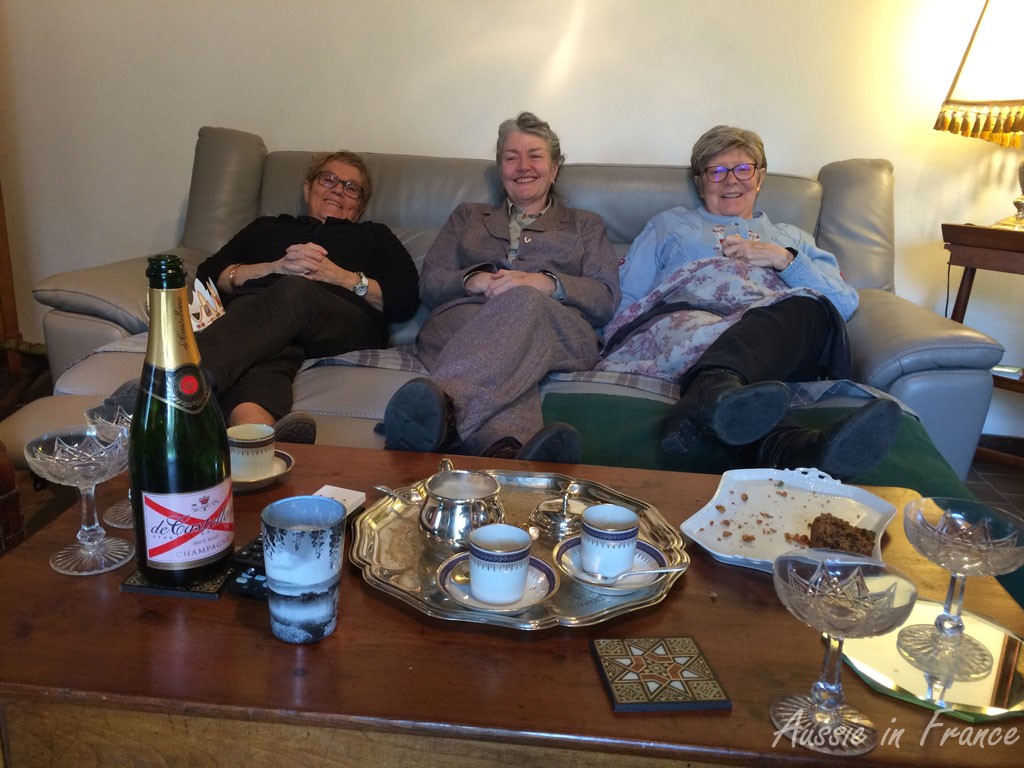
Trois amies bien contentes !

Content in French can also have the meaning of the English contented. Je suis contente de rester là = I am content to stay here or I am happy to stay here. Contentment can also be expressed by using satisfait. Je suis satisfait de mon choix – I am contented with my choice.

I just run not race, I am contented to just jog. – Je cours, je ne fais pas la course. Faire un jogging, ça me suffit.

The above sentence is a good illustration of how different French and English constructions can be be. Also, the English jog has been borrowed as jogging and not jog (like the old footing which doesn’t even exist in English!). J’ai mis un jogging actually means I put a track suit on!

Il a l’air content = He looks happy/pleased, but not “He looks content” which would be “Il a l’air satisfait” which can also mean “he looks satisfied”. 🙂 Are you confused? The trick is deciding when the meaning is the same. There is no real difference between “he looks happy/pleased”, is there? But “content” and “satisfied” in English have the added meaning of being quietly happy, of having achieved peace of mind which is not included in the French verb.

There is, however, an entirely different use of satisfied in English which needs a different verb in French i.e. to be free from doubt.

I’m satisfied that her death was accidental means that I’m convinced about it. You would not use satisfait in French but convaincu (from convaincre = to persuade) : je suis convaincu que sa mort a été accidentelle.

I’m satisfied that I’m right = je suis convaincue d’avoir raison. This is another example of a different construction. In English, we use the conjunction “that”. It’s possible to say Je suis convaincue que j’ai raison” but it wouldn’t really “sound” French. What do my French readers think?

Heureux and happy are fairly synonymous (isn’t that lucky?) except justement (in fact) when heureux means fortunate or lucky. Someone who is heureux au jeu or en amour is lucky at cards or in love. Heureusement qu’il est là = Lucky thing he’s here. A very popular expression in French is “Encore heureux” which means “Good thing” or “Luckily” and has nothing to do with being happy. An example would be “Encore heureux qu’il soit arrivé de bonne heure ou il aurait perdu sa place” which means “Luckily he arrived early or he would have lost his place”. Note the use of the subjunctive “soit” which is correct but you wouldn’t near many people using it.

Friday’s French: poireaux & oignons – leeks & onions

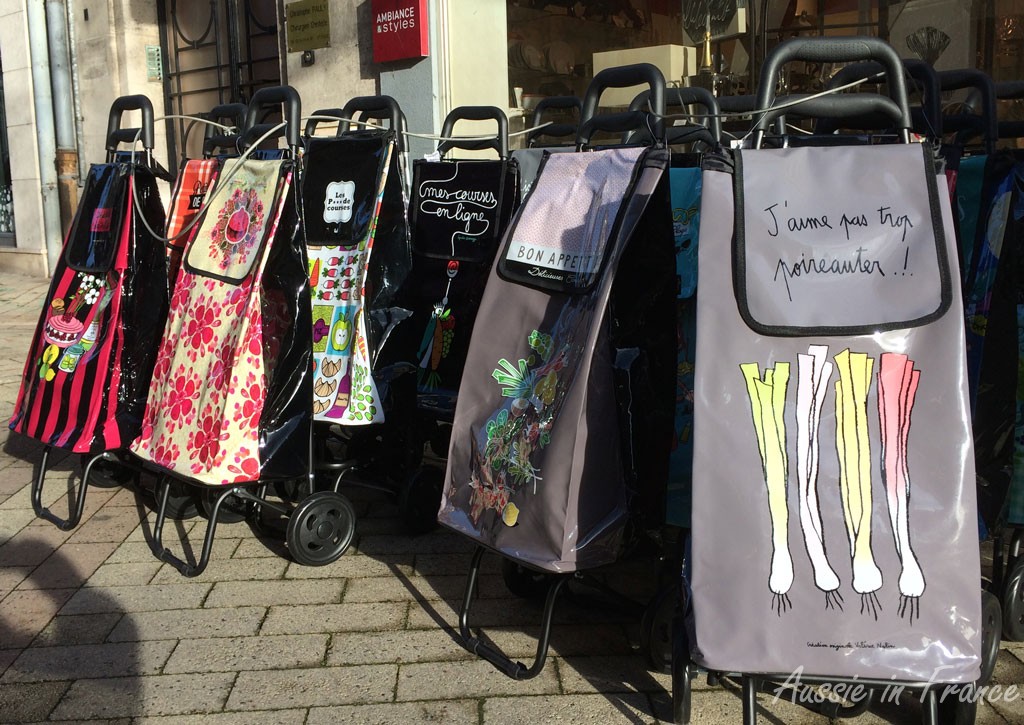
I was so excited at the market last Saturday when I saw this wonderful shopping trolley. In response to my post on navets (turnips), a reader suggested several expressions including arrête de poireauter from poireau meaning leek. And here is a wonderful example: j’aime pas trop poireauter, which means I don’t like waiting around, very appropriate for the type of trolley that most people take to the market where you often have to wait in a queue.

poireauter

So what is the connection with leeks which, incidentally, is the national emblem of Wales ?

It was in 1866 that planter son poireau meaning “to plant one’s leek” was first recorded. Although poireau means the male member (I’m using a euphemism to avoid attracting unwanted spam), the expression has no erotic connotations. It simply meant “waiting for a long time”, based on the image of the leek sticking up straight from the ground, and the influence of the expression rester planter (stay planted) meaning immobile or unable to move, like our English expression, “he planted himself next to her”.

About ten years later, the expression faire le poireau appeared as an extension to the one above and with exactly the same meaning. The verbal form – poireauter – was soon formed.

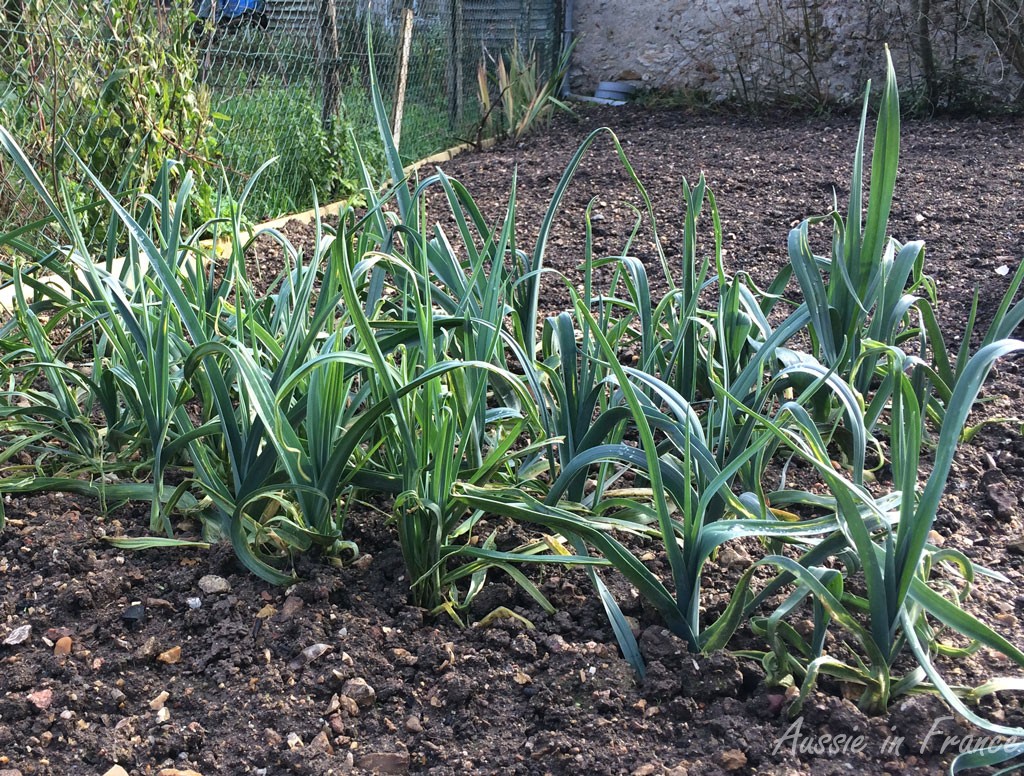
leeks

Now I don’t want to dispute this explanation given by expressio.fr, but I’d like to offer my own personal interpretation. We planted leeks this year for the first time. I grew them from seedlings and we then replanted them. They do not stand up straight as you can see from the photo. In fact they are very floppy. They do, however, seem to be taking absolutely ages to grow so maybe that is the origin of poireauter. We certainly seem to be hanging around waiting for them!

An expression mentioned by another reader is qu’il s’occupe de ses oignons meaning that he should mind his own business. I dropped in again at expression.fr which gives two explanations. I prefer the second one because it’s a little more elegant.

In the centre of France, one of the signs of a woman’s independence was her right to cultivate a corner of the garden where she grew onions to sell on the market and make some money of her own. Men were often heard to say to women who wanted to stick their noses in their husbands’ business occupe-toi de tes oignons (go look after your onions) or ce n’est pas tes oignons (they’re not your onions). Considering that you only get one onion for each little bulb you plant, I don’t think they could have made much money …

Happy New Year 2016 – Bonne année à tous !

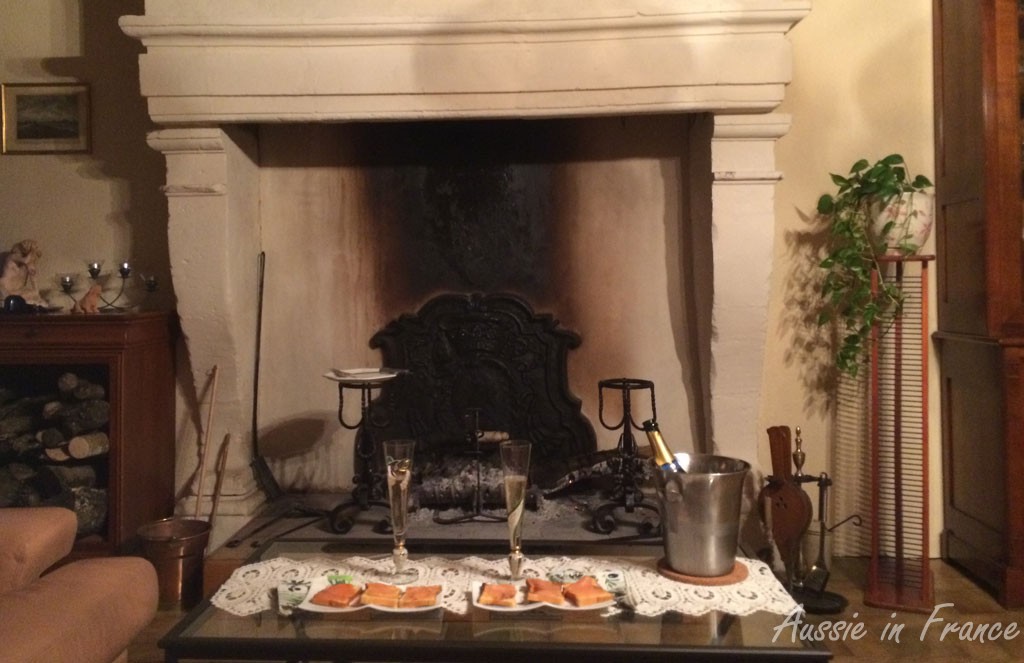
It’s New Year’s Eve and there are just the two of us, in front of our fireplace. We’re not having anything complicated to celebrate the New Year. I once spent all day making a special dish that took forever and I didn’t think it was worth the trouble so we’re mainly having Christmas leftovers (unfortunately, we’ve finished our homemade foie gras). We’re having champagne though.

Christmas leftovers in front of the fire

I ask Jean Michel if he remembers his resolutions for 2015 and he just looks at me. “I have the bits of paper I wrote them on”, I say. So we have a look. Out of Jean Michel’s six resolutions, only one has come to fruition, but it’s the most important: “finding a better balance after retirement”. The last is also taking shape at the moment, namely improving his English. As we’re off to Australia for a month in mid-February, it’s more than important – it’s essential.

I then take a look at my five and burst out laughing. My score is even worse.

The first was to average 10,000 steps a day. I check it out on my iPhone app – 5,500. I try and console myself that for someone who spends a lot of the day in front of a computer, it isn’t too bad.

The second was to make a video for each Friday’s French post. Well, that’s a laugh! I don’t even write a Friday’s French post every week. I’m lucky if I write one a month though I wrote two recently in the same week J.

Number 3 was to sign up for Italian lessons. Yes, well, that didn’t get very far! January didn’t seem the ideal time to start because the class was already well underway and in September we went away for a month’s holiday. I might wait until I retire!

My fourth resolution was to help Jean Michel improve his English but he was far too busy all summer to be learning another language. However, now that he’s started listening to Michel Thomas again, I’m being very supportive.

Number 5 was to stop complaining and look on the positive side of life. I’m not sure about this one so I ask Jean Michel and Black Cat. They seem to think that I am positive on the whole and don’t complain most of the time so I guess that I can see it’s been mostly achieved.

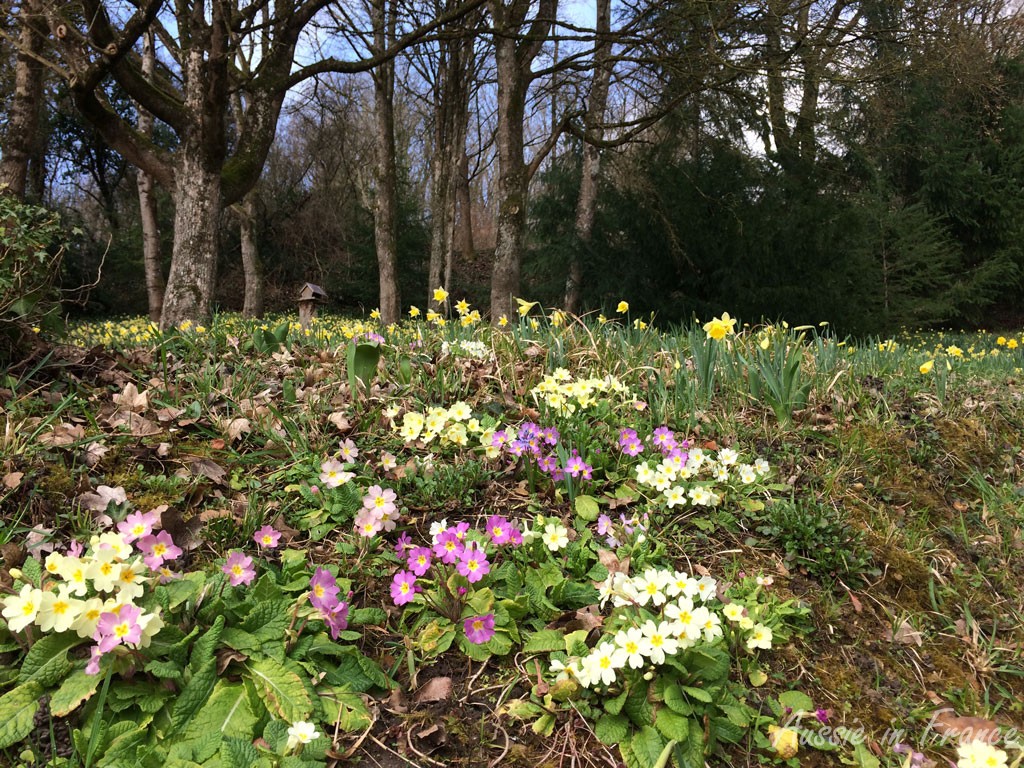
Spring in our little wood - one of the bright sides of life
Spring in our little wood – one of the bright sides of life

So now I’m wondering what resolutions I can put on the agenda this year and, do you know, I can’t think of any so I thought I might make a quick review of the year instead.

The most important thing is Jean Michel’s adjustment to retirement. I’d love to join him but I still have another 3 years and 4 months to go unless I suddenly strike it rich which doesn’t seem likely.

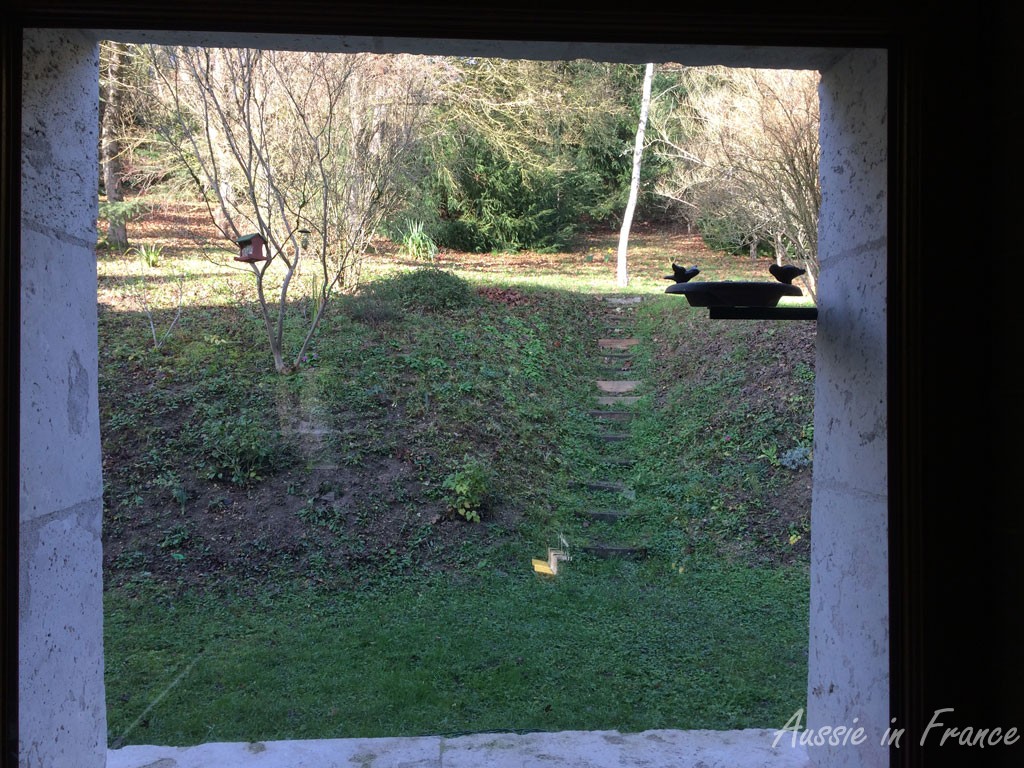
Bird watching from our wonderful window

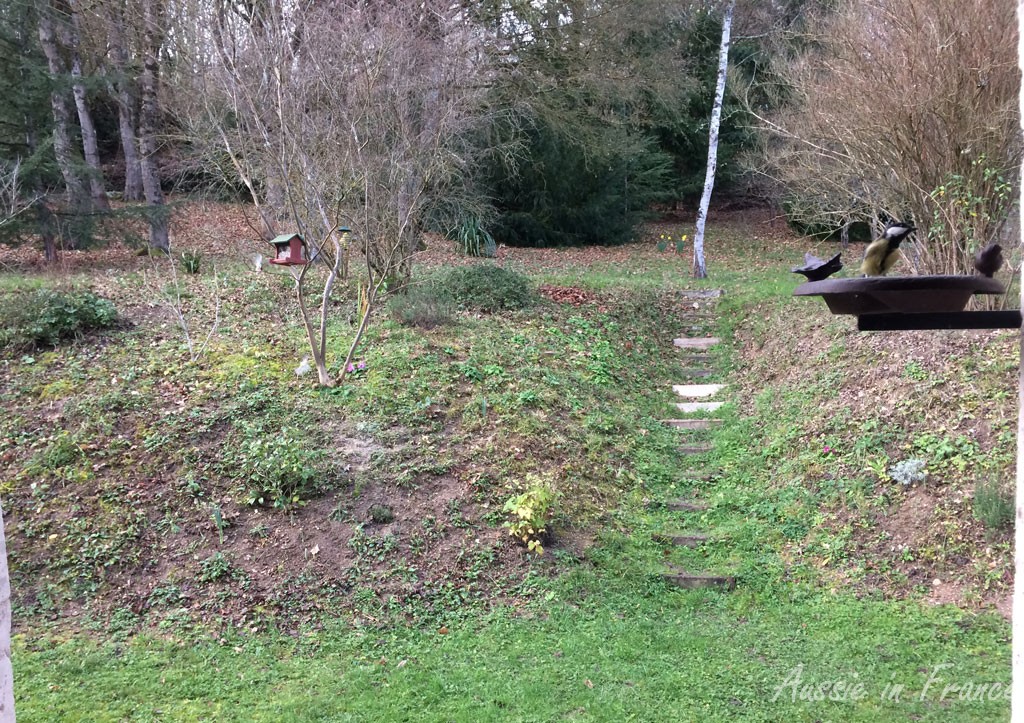
After all Jean Michel’s hard work, we now have a wonderful kitchen window that looks out onto our little wood and gives us endless pleasure, especially bird watching now that we have outwitted the neighbour’s cat.

I don’t miss my life in Paris even remotely though I do miss my friends. I have been there only four times since we moved at the end of October 2014.

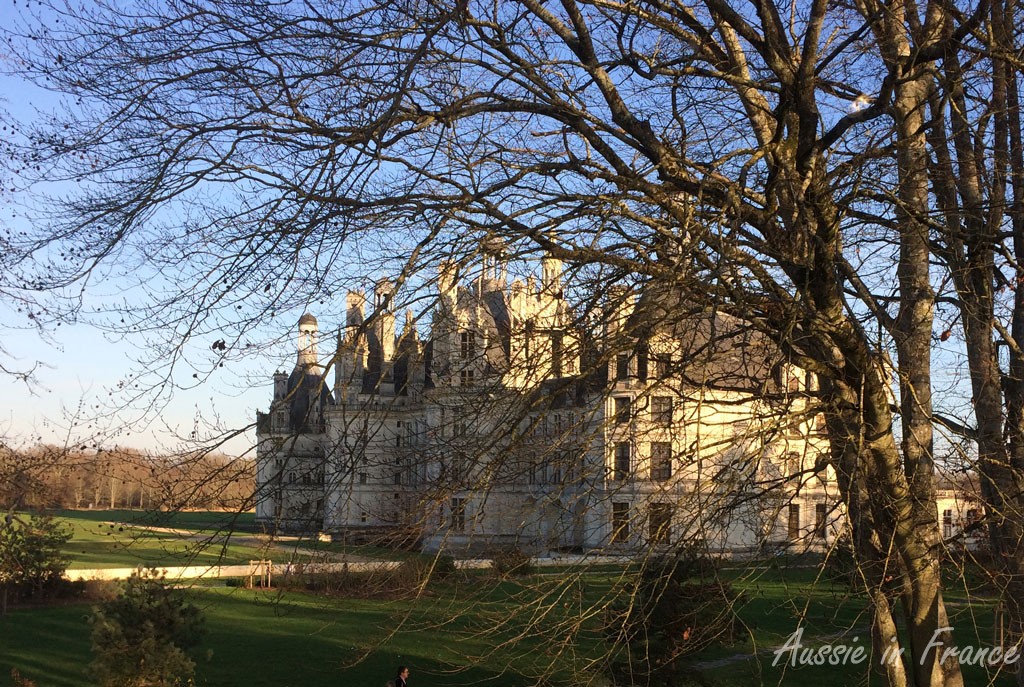
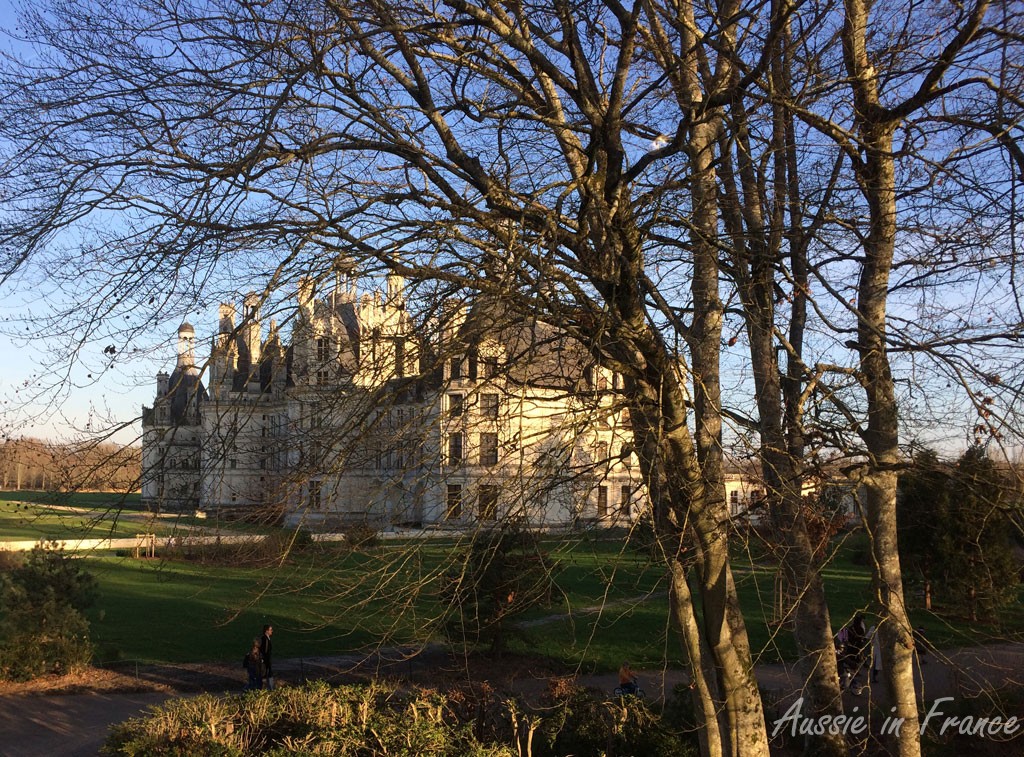
View from the window of thecrêperie during our most recent visit to Chambord on boxing day

We try to make the most of living (almost) in the country and among some of the most beautiful châteaux in the world. Chambord remains our favourite because you can go there any time for a walk, a bike ride, an ice-cream or a crêpe. We have taken full advantage of all the cycling possibilities offered to us.

I don’t blog a lot any more as you may realise. My readership went from 12,000 views a month in December 2014 up to 18,000 in May 2016 then down to 10,000 in December 2015. I lost a few subscribers in December but I quite understand that my reflections on bird feeding and walking in Blois are not nearly as exciting to most people as living in the Palais Royal! My “star” post is still “The Best Area to Stay in Paris”.

loire_daily_photo

My other blog, Loire Daily Photo, dropped from 1200 in December 2014 to 1,100  in December 2015 after climbing to 1,600 in May. I wonder what was going on in May last year? However, despite the small audience, having a daily photo blog makes me much more aware of my surroundings and more interested in local history.

I don’t feel I have quite found my rhythm yet, but I can feel it coming.

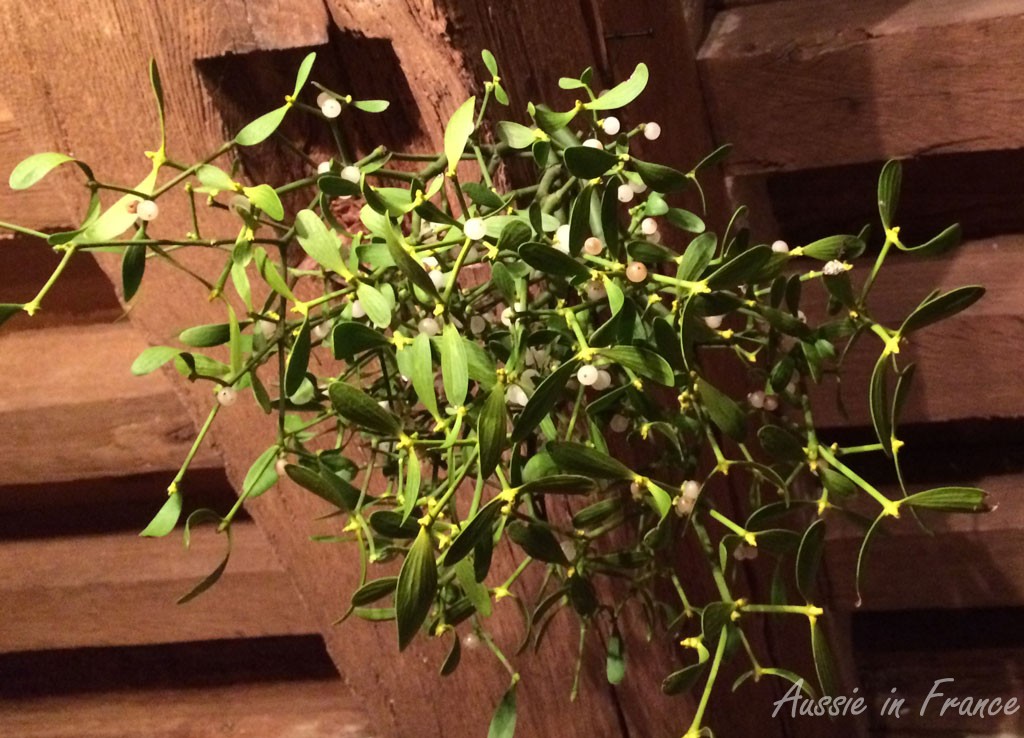
Our New Year mistletoe

In any case, I’d like to wish all my readers a wonderful 2016 and thank you for stopping by.

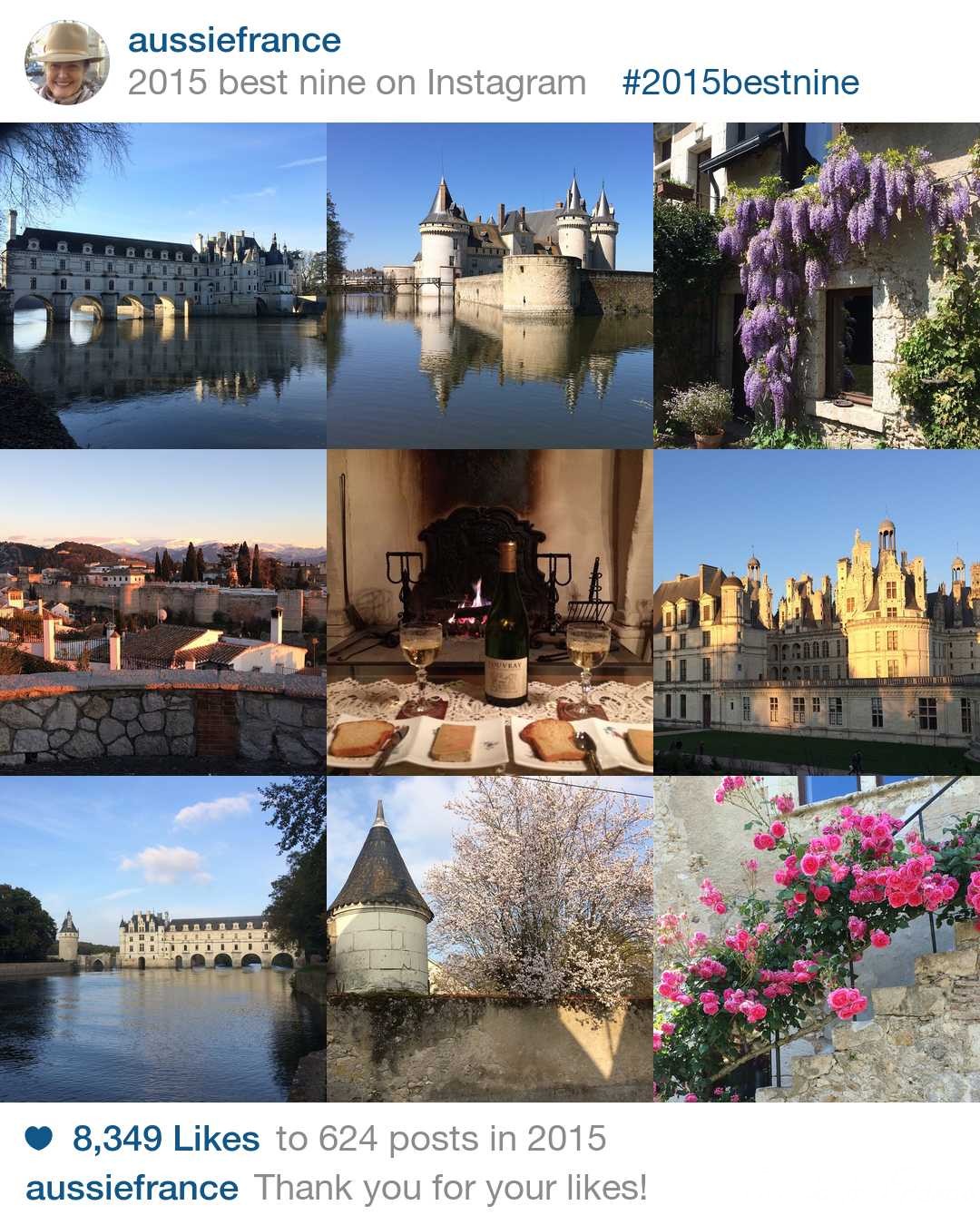
Best Nine Instagram Photos for 2015

aussiefrance_full

These are my nine most “liked” photos on Instagram for the year. Four are châteaux of the Loire and two are the flowers in my garden!

Top: Chenonceau, Sully, my wisteria

Middle: Grenada, foie gras and vouvray in front of our fireplace, Chambord

Bottom: Chenonceau (from the other side), spring blossoms in Chouzy, our Pierre Ronsard roses

Which is your favourite?

Friday’s French – Trêve des confiseurs

I heard a new expression on France Info this week – “l’entre deux fêtes” – which literally means “between two celebrations”, the first being Christmas and the second New Year. It’s the same construction as ‘l’entre-deux-guerres”, which is what the French call the interwar years.

We're spending the "trève des confiseurs" walking off the confectioners' ware at Chambord
We’re spending the “trêve des confiseurs” walking off the confectioners’ ware at Chambord

When I mentioned it to Jean Michel, he said it wasn’t new but I checked it out on google and “l’entre deux fêtes” only has 4,000 hits whereas “l’entre-deux-guerres” has 576,000 so it can’t be that popular. Then he told me something much more interesting. The period between Christmas and New Year is also called “la trêve des confiseurs“. “the confectioner’s truce”. Now that’s intriguing!

The expression first appeared in France around 1875 during a period of lively discussion in the National Assembly (lower house of parliament) between the monarchists, Bonapartists and republicans about the future of the constitution of the Third Republic. In December 1874, all the groups in the National Assemblee agreed that the New Year was not a good time for this sort of debate. To promote peace and harmony, they decided to go their separate ways and take a holiday until the New Year.

The confectioners were delighted and business boomed! As a result, the satiric press coined the expression “trêve des confiseurs”.

Today, the expression is also used to describe the traditional period of slack on the stock exchange and on the football field at the end of the year.

There is another meaning as well – the period in teaching hospitals when medical students devote their time entirely to caring for the sick and are dispensed from university classes.

I don’t know any similar expressions in English to describe the period between Christmas and New Year. Do you?

And just in case you didn’t know, there is no Boxing Day in France!

AllAboutFranceBadge_bisI’m contributing this post to Lou Messugo’s All About France Link-Up. Click here to find out more about Christmas in France! 

Friday’s French – navet

“What’s a navet?” someone asked on Facebook this week. “It’s a film that’s a flop”, I answered. But a navet is actually a vegetable – a turnip in fact. So how did we get from turnip to a dud film? Good old expressio.fr came to the rescue.

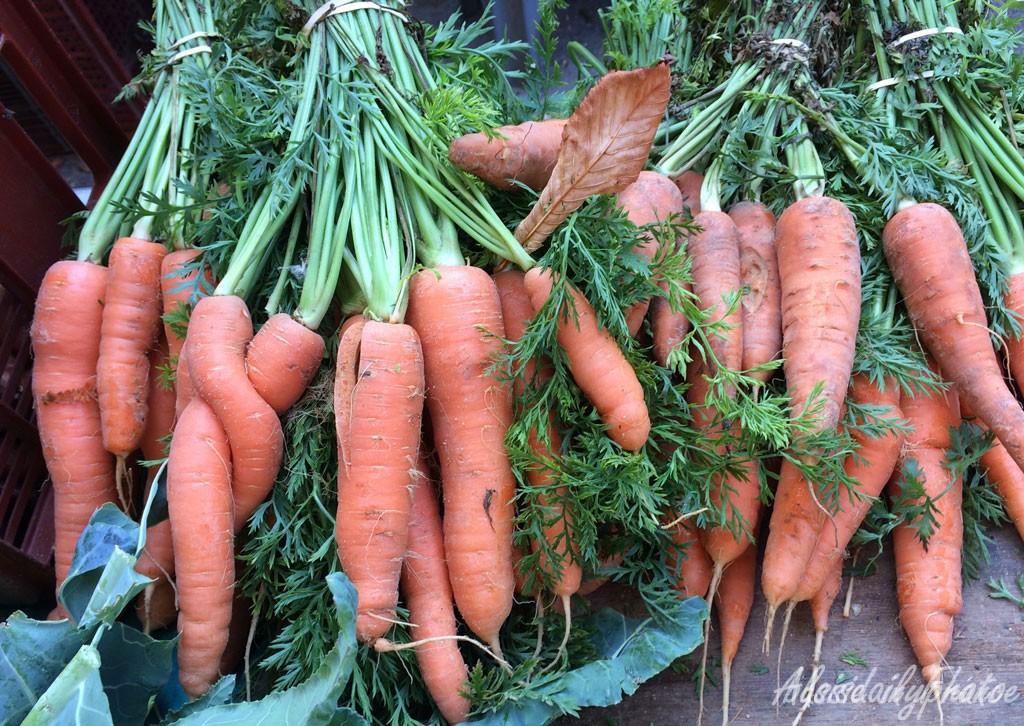
I know these lovey-dovey carrots aren't turnips but I don't have any turnip photos and I love this one!
I know these lovey-dovey carrots aren’t turnips but I don’t have any turnip photos and I love this one!

Certain sources say you have to go back to the 13th century when the word was already used figuratively to indicate something that wasn’t worth much, perhaps because turnips are cheap and plentiful.

The meaning was never completely lost. “Des naveaulx”, a variant of the word “navet” in the 16th century, meant “not likely” or “nothing doing” and it was not until the mid 19th century that a bad painting was first called a “navet”. The expression was later extended to plays and films.

The French writer and language historian Duneton gives another explanation that isn’t incompatible with the previous one, at least with regard to its 19th century meaning.

In the Belvedere gardens in Rome, there was a statue of Apollo, that was for a long time considered to be a symbol of perfection.

But at the end of the 18th century, a group of young French artists disagreed and nicknamed it “le navet épluché” (the peeled turnip) due to its paleness and the long, smooth form of the limbs which don’t seem to have any muscles.

When the statue was transferred to Paris by Napoleon in 1798 (it has since been returned to Rome), its nickname followed it. In the mid 19th century the term was applied paintings and drawings that didn’t pass muster.

When the cinema came into vogue, the term “navet” was quite naturally used for films that were slapdash, of little interest or didn’t come up to the audience’s expectations.

Fruit and vegetables are used in a lot of expressions in French. I’ve already talked about prunes and aubergines.

Do you know any metaphorical uses of vegetables in French?

Outwitting the Cat

I used to have a German friend and every time she came to my house in Fontenay sous Bois, she would look out the window and say “there’s a blue tit” or “there’s a nuthatch”  which always made me very envious so when we came to live in Closerie Falaiseau in Blois I decided that I would learn to recognise the birds in my garden too. I checked with my friend Susan from Days on the Claise whether we should feed them because you’re not supposed to do so in Australia for survival reasons but she reassured me that we could feed them in winter without any problem as long as we did so regularly.

When it's this cold, garden birds need all the help they can get
When it’s this cold, garden birds need all the help they can get

So we waited until we came to live here permanently last winter. We bought some bird seed and some fat balls as well as a couple of feeders to put up in our rose of Sharon tree in the front yard. We also put a feeder on the window sill outside the downstairs living room. We already had a bird bath. Soon we had lots of blue tits and great tits, mostly in the rose of Sharon tree.

The rose of Sharon tree is on the right. The nesting boxes are under the eaves above the wisteria in the middle of the photo
The rose of Sharon tree is on the right. The nesting boxes are under the eaves above the wisteria in the middle of the photo.

This summer while the new kitchen window was being made, we ate outdoors every day and spent a lot of time watching the tits during mealtime. We were delighted when we saw that they had made a nest in the nesting boxes under the eaves above the wisteria. We soon saw some fledglings poking their little faces out of the holes. I might add that below the wisteria we were surprised to see wheat growing – obviously from the seeds the birds didn’t eat last winter!

The view from the kitchen window in autumn

When we came back from our holiday in Eastern Europe in October we started seeing birds from our new kitchen window although it was too early to feed them. One day I saw a large black and white bird with a red bit under its tail on the tree outside. I was so excited to learn that it was a great spotted woodpecker.

You can see the difference between this photo and the last one. Most of the leaves have gone.

The weather started getting colder so Jean Michel put out the fat balls and some mixed bird seed in a new hanging feeder. We also bought some sunflower seeds that we put in a feeder on the sill in front of the kitchen window. The birds soon discovered the feeder and we started to identify new ones.

We now have blue tits, great tits, marsh tits and crested tits, green woodpeckers and great-spotted woodpeckers, red robins, nuthatches, jays, common chaffinches, magpies and blackbirds. They are so quick that you can’t take photos of them but I discovered that it’s easy to film them.

Our new sunflower seeds turned out to be full of debris – little twigs and such – that the birds throw out of the feeder onto the windowsill. We’re not buying birdseed from Gamm Vert any more! We whiled away many delightful moments watching the antics of our little feathered friends.

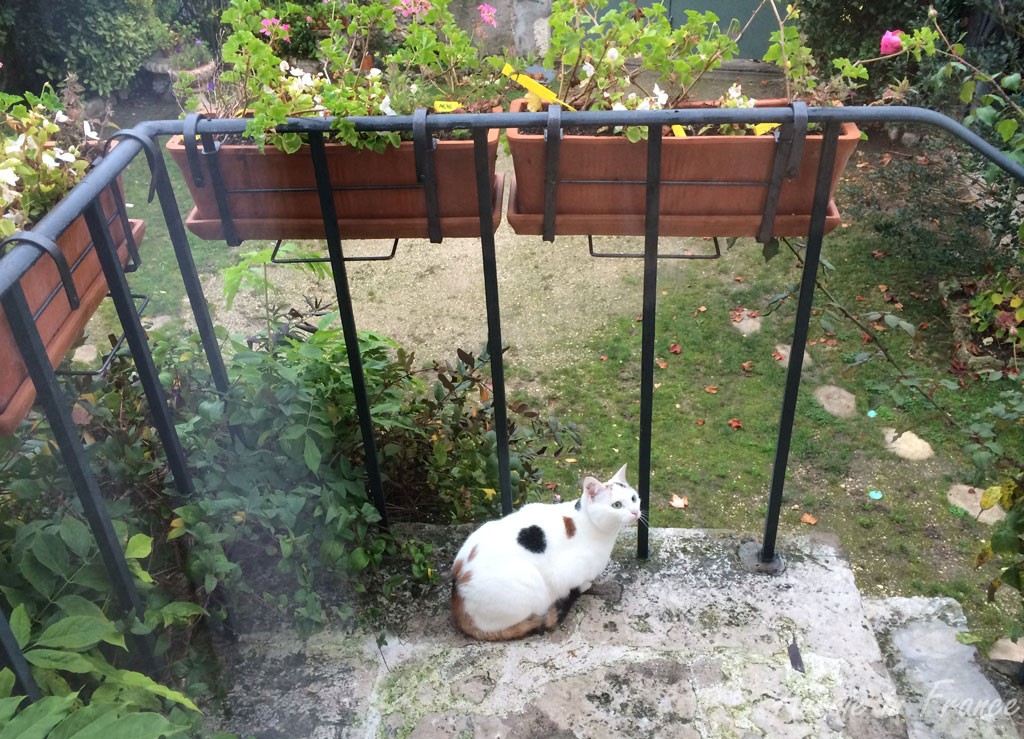
Java, sitting at the top of our stairs,  pretending she's not there
Java, sitting at the top of our stairs, pretending she’s not there

Then disaster struck. Our neighbours have a white cat called Java that seems to spend more time at our place than theirs. We suspect that some of our paying guests gave her a little nourishment in September. She is a hunter and loves our little wood where she runs after mice and lizards.

When I saw her face peering over the kitchen windowsill one day, it didn’t occur to me that she might be after the birds. Jean Michel found her pulling apart two blue tits on the ground below the window one morning before I went outside thank goodness. I was devastated when he told me what had happened. Now, I know that’s what cats do but we get a huge amount of pleasure watching these little birds and it was terrible to discover we had inadvertently exposed them to danger.

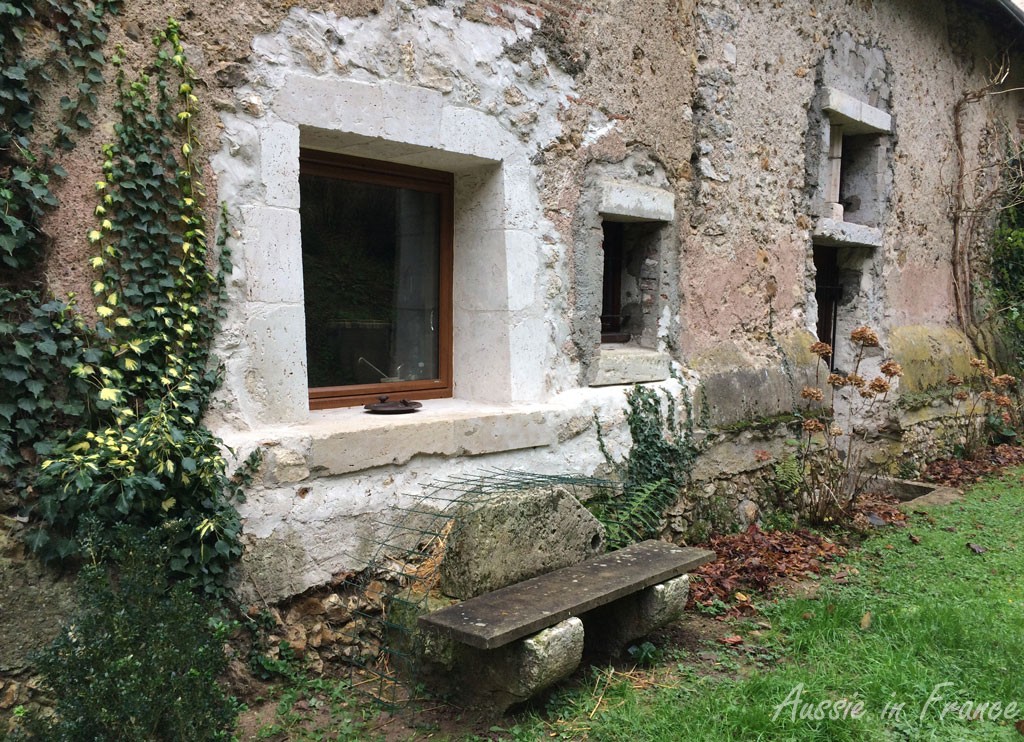
You can see the netting over the bench under the window

Jean Michel found an excellent solution – he used some wire fencing to cover the stone bench outside the window that the cat was using to spring on the unsuspecting birds  Now she has nothing to grip on. After two or three days the birds started coming back, first the blue tits and then the little crested tit who is my favourite.

But Java is no Sylvester and is a lot more cunning. Because she’s white, she can blend perfectly into the stone around the window. Without using the bench, she managed to sit on the window sill, apparently, staying perfectly still until an unsuspecting little blue tit came along and we had another death.

We were reduced to only putting out seed while we could monitor the presence of Java so we looked for another solution. Someone suggested putting a bell round her neck but Jean Michel says we’ll traumatise her (not that I really care!). He doesn’t want to put cat repellent out either because it might frighten away the birds as well and we’ll never get rid of the smell.

New wall solution
New wall solution

On Sunday, we went to Truffaut, the big gardening store and had a look at the options. There was nothing at all suitable but Jean Michel came up with another idea and here it is! Within a very short time the birds were flocking to the feeder and staying longer each time. We really don’t see how it’s possible for a cat to jump that high. I hope not anyway.

Great Things about Christmas in France

Phoebe from Lou Messugo –  traveller, francophile, expat, mum and foodie now living in Roquefort les Pins near Nice where she runs a gîte after many years of travelling and living in Asia, Eastern Europe and Australia – has come up with the brilliant idea this year of asking other bloggers what they like about Christmas in France.

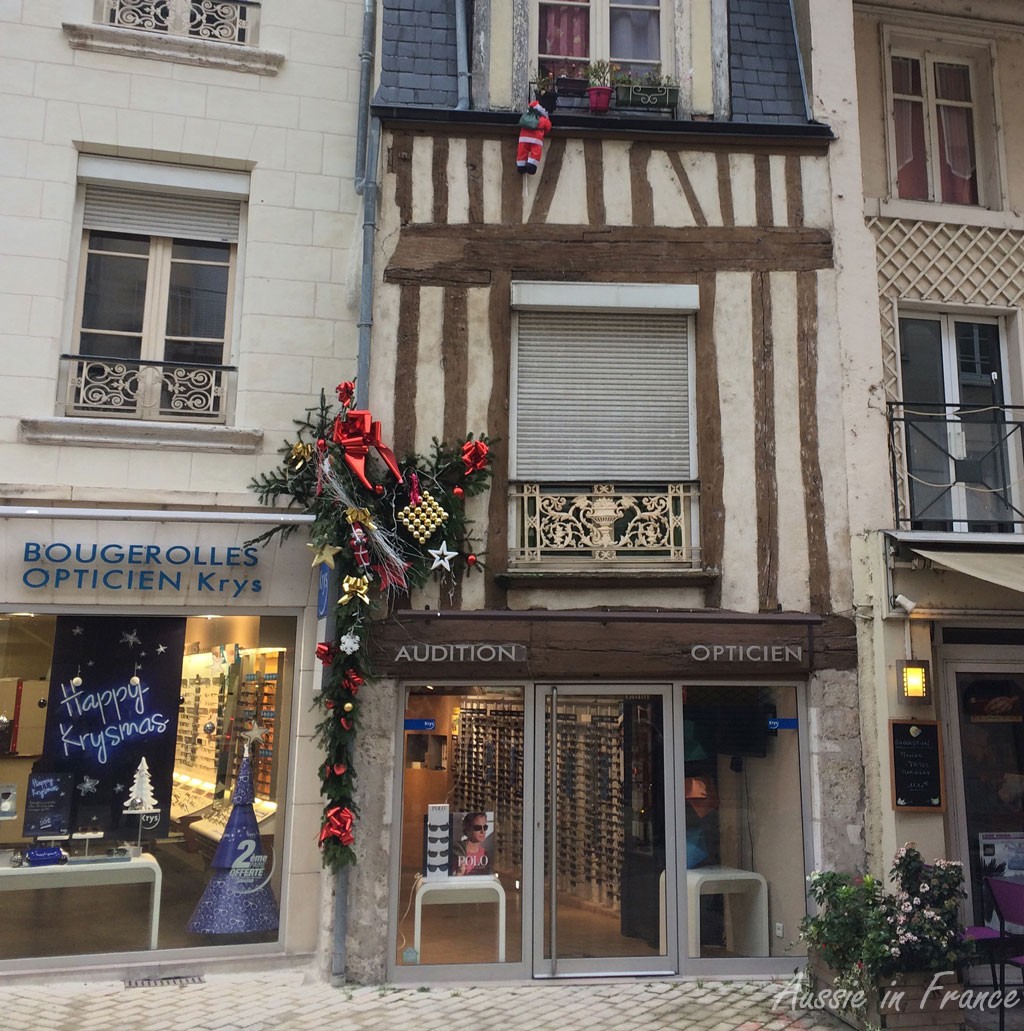
photo_350_santa_window

The result is a post called 24 Reasons to Love Christmas in France that I’m sure you’ll enjoy immensely. Here’s a little introduction.

Christmas in France, what’s it all about, is it any different to elsewhere and is there anything special to enjoy?  I’ve written about it previously describing how the build up is slow and calm even under normal circumstances, but this year we’ve had to contend with tragic terrorist attacks in Paris, the resulting state of emergency nationwide and potentially worrying regional election results as well, meaning it hasn’t been the most festive of times recently.  Add to this a sense amongst many expats that Christmas is “better” at “home” surrounded by familiar traditions, sights and sounds and rather than feel happy and excited many find themselves feeling low and missing home. Read more.

from the Tropics to the City of Light