I haven’t been reading many blogs this week with the move but I’m sure you”ll get a kick out of Mary Kay’s chocolate fashion show on Out and About in Paris – not exactly what we saw at Château Villesavin! And Margo Lestz is back in Nice with lots of writing and reading suggestions for November on The Curious Rambler. Enjoy!
Chocolate Fashion Show at the 20th Annual Salon du Chocolat in Paris!
by Mary Kay from Out and About in Paris, an American by birth, Swiss by marriage, resident of Paris with a Navigo Pass for the metro that she feels compelled to use
French fashion doesn’t get much sweeter than the fabulous creations seen gracing the runway during the 20th annual Salon du Chocolat in Paris last week. The inaugural gala featured a retrospective collection of 60 mouth-watering designs worn by French television stars, singers, athletes and models.
I spotted quite a few of my favorite gowns from previous years: a mythological looking garment with diaphanous wings, a dress with four white doves enclosed in a delicate chocolatey flounce at the back and a Hindu goddess style costume with an ornate headdress. Read more
November News: Happy Halloween
by Margo Lestz from The Curious Rambler, who lives in Nice, France where she likes to bask in the sunshine, study the French language and blog
I’m finally back to Nice after travelling for two months. I have basically been on the go since April and now, I just want to stay home. Travelling is nice, but sometimes it’s just good to get home and stay there for a while. So I am planning to stay home all winter long (or at least for a while) and write.
Because November is for writing!
All across the world, writers dedicate November to their craft. There are several organizations that help to keep those fingers tapping away at the keyboard. If you are interested, check out the following: Read more
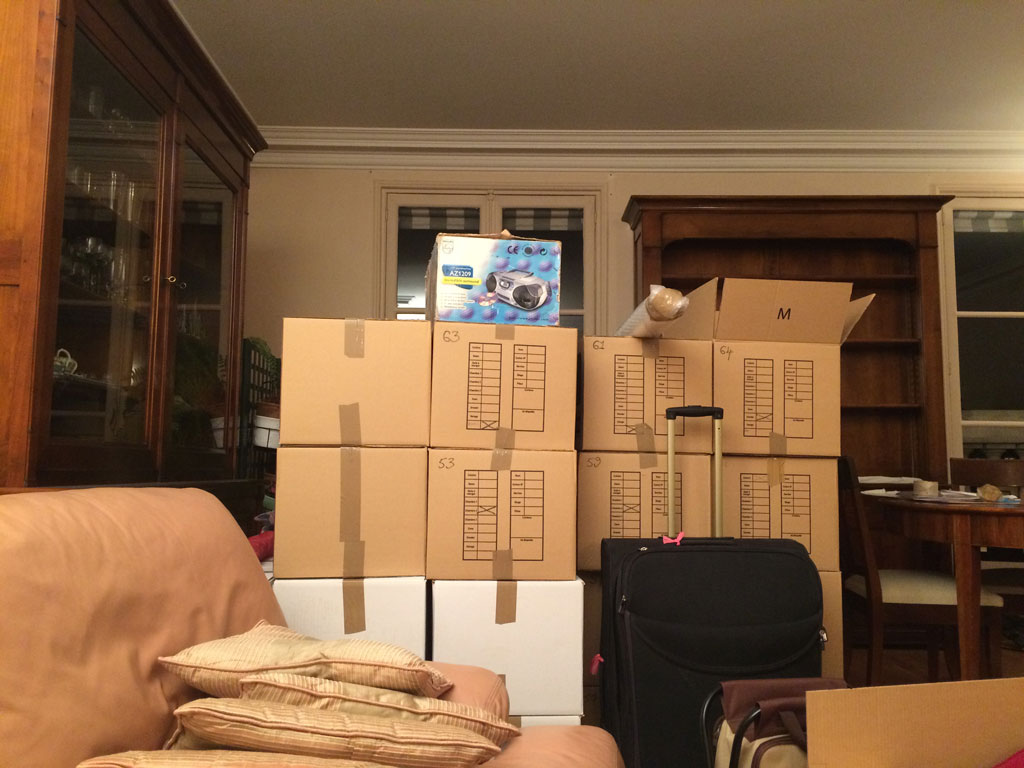
It’s 8 am on Tuesday and the removalists are already here (4 Russians, an Algerian and a Tunisian). They start with the apartment down the road from us where Jean Michel’s sons have been living for the last 9 years, just giving me time to pack up the last cartons (our bedding, bedroom curtains, toiletries, etc.)
Cartons stacked the night before the removalists arrived
The Algerian is assigned to the kitchen and the first thing he does is ask me to make him coffee! I’ve already cleaned the espresso machine but I make the coffee anyway …
One of the Russians is assigned to packing up all the crockery, glasses and other breakables, while the others start taking all the cartons down. When the bookcase cupboards are empty, they start wrapping them up in thick blankets.
Sofa and armchair all wrapped up
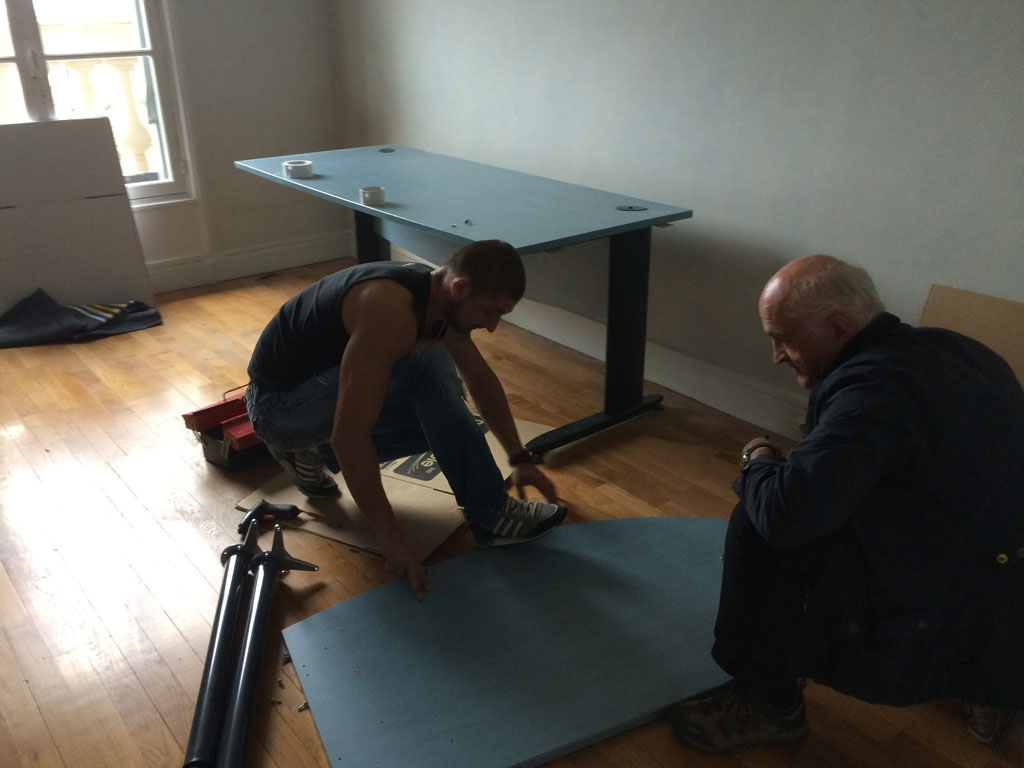
My entire office is dismantled before my eyes probably the most time-consuming part of the move. Gradually everything disappears and by 3 pm, the apartment is completely empty and most of the dust and dirt vacuumed up. My trusty cleaner is coming next day to finish off. She calls by to say goodbye and we’re both in tears!
The end of my office
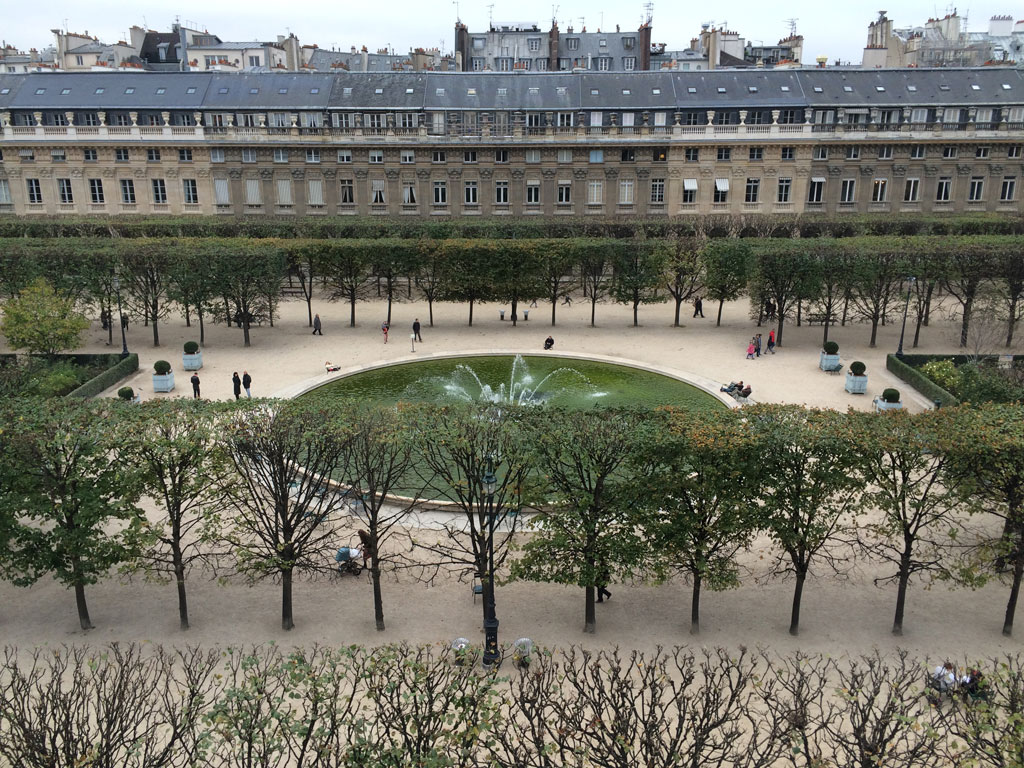
I take one last photo of my view of the Palais Royal Gardens.
Last photo of the Palais Royal gardens from our balcony
We finally arrive in Blois around 7 pm and unpack the car. I reheat the dinner I’ve prepared in advance and we celebrate with a glass of vouvray, the local natural sparkling wine. We sink thankfully into bed.
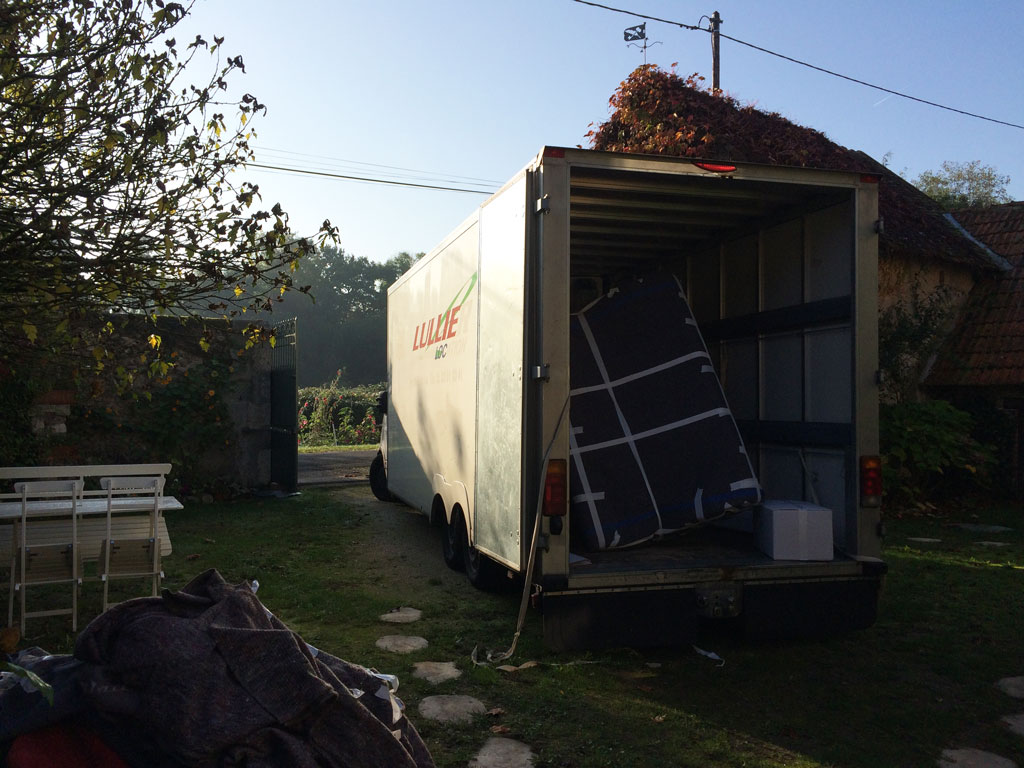
Having got up at 5 am to drive from their depot in the Paris suburbs, the removalists arrive bright and early at 8 am. This time there are three of them, all Russian. They just manage to get the truck into the front yard and we show them round the house including the two large pieces of furniture (a cupboard and a dresser) that we want them to switch around. Groans all round.
The first truck in our garden
All the cartons we packed are labelled but not the ones they looked after or the furniture so we have to be constantly ready to direct them. A lot of the stuff is going into the little house as well to await the future gite that Jean Michel is going to renovate in one of the other buildings.
It’s fairly chaotic particularly as one of the men speaks very little French. At 10.30 I suggest coffee, tea and biscuits in the garden. They welcome the break and we learn a little more about their lives. One of them started out on the streets of Paris but as he explained there was no work in Russia and a man has to provide for his family.
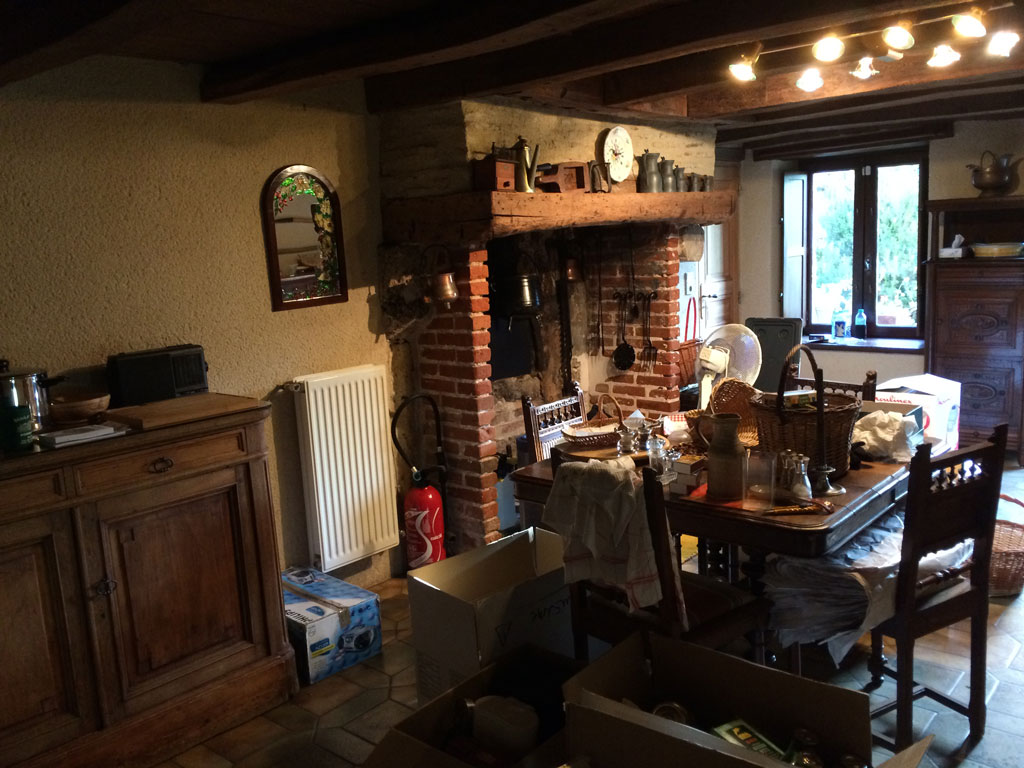
Chaotic kitchen
All the furniture is remounted and I unpack the glasses from a special high carton called a tonneau or barrel with dividers inside. I also remove the clothes on hangers from the cardboard wardrobes so they can take them back.
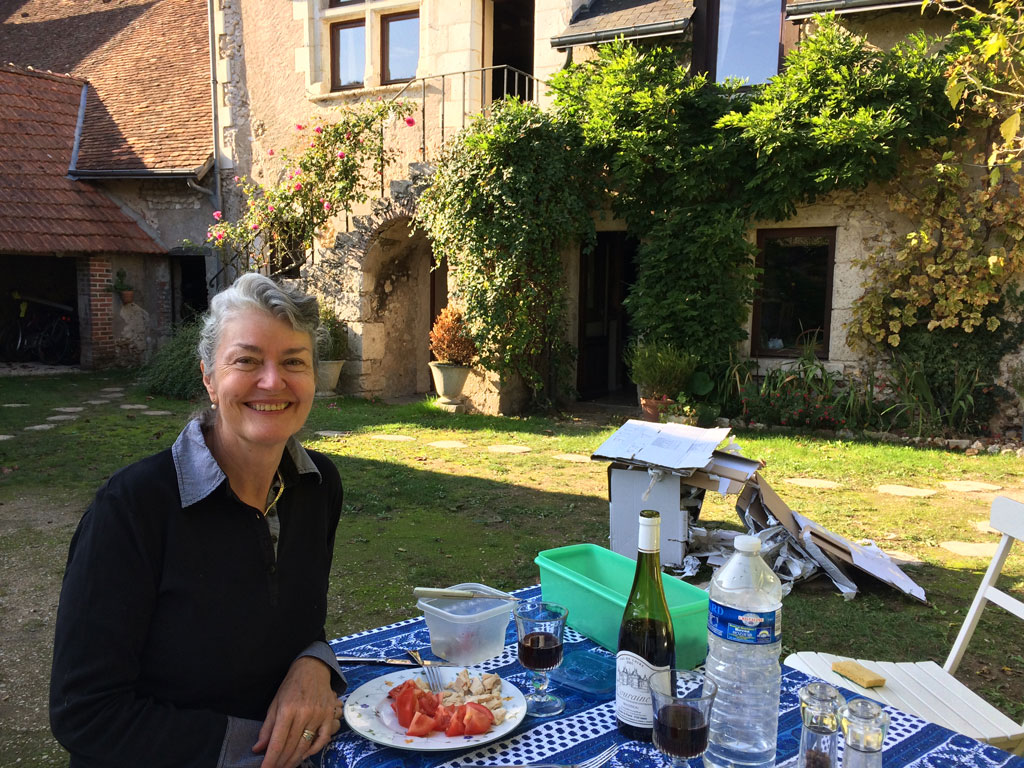
By 2.30 pm everything has been unloaded and reinstalled and we are eating lunch in the sun in the garden.
Lunch in the garden with the remaining rubbish behind me
Inside it looks like a disaster area except for our bedroom and the downstairs living room which I have purposely keep carton-free. We have a welcome siesta and start on the most urgent unpacking.
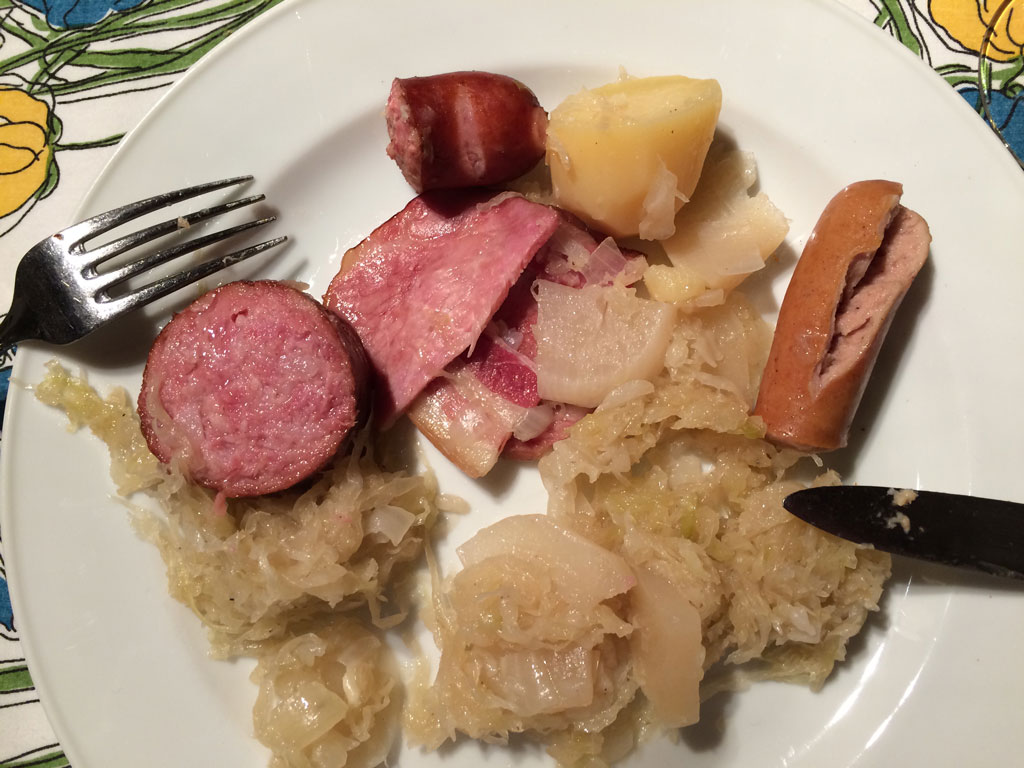
Fortunately our friends and neighbours Françoise and Paul have invited us for choucroûte with morteau sausage. Never has a meal tasted better!
Much appreciated choucroûte!
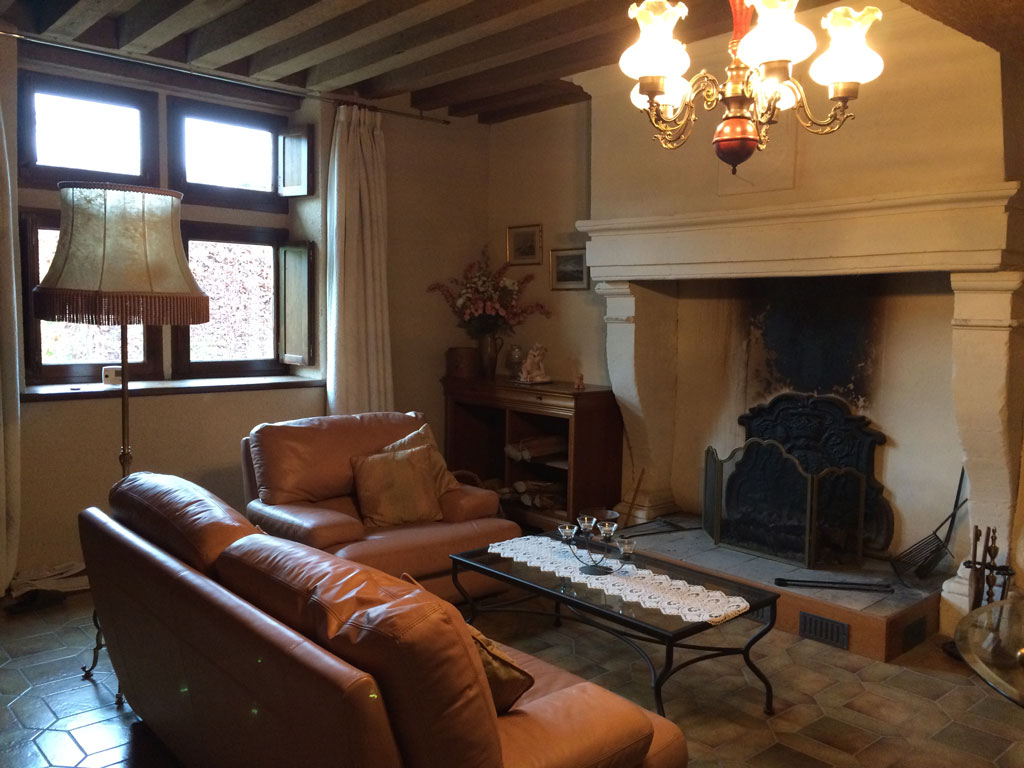
Five days later the house is starting to look normal. Jean Michel has done a lot of drilling and only the office is still full of cartons. None of our pictures are up on the wall except for those that were already there before the move. I’ve finally found the carton of dirty sheets and towels but the notebook in which I so carefully noted the contents of all the boxes has still not turned up.
The upstairs living room free of cartons
Nothing is broken but we are very sad to discover that a 6-bottle box of wine is missing including a bottle of 1999 corton charlemagne and a ladoix from the same year. I wonder at what point they disappeared. I just can’t believe the Russians took them.
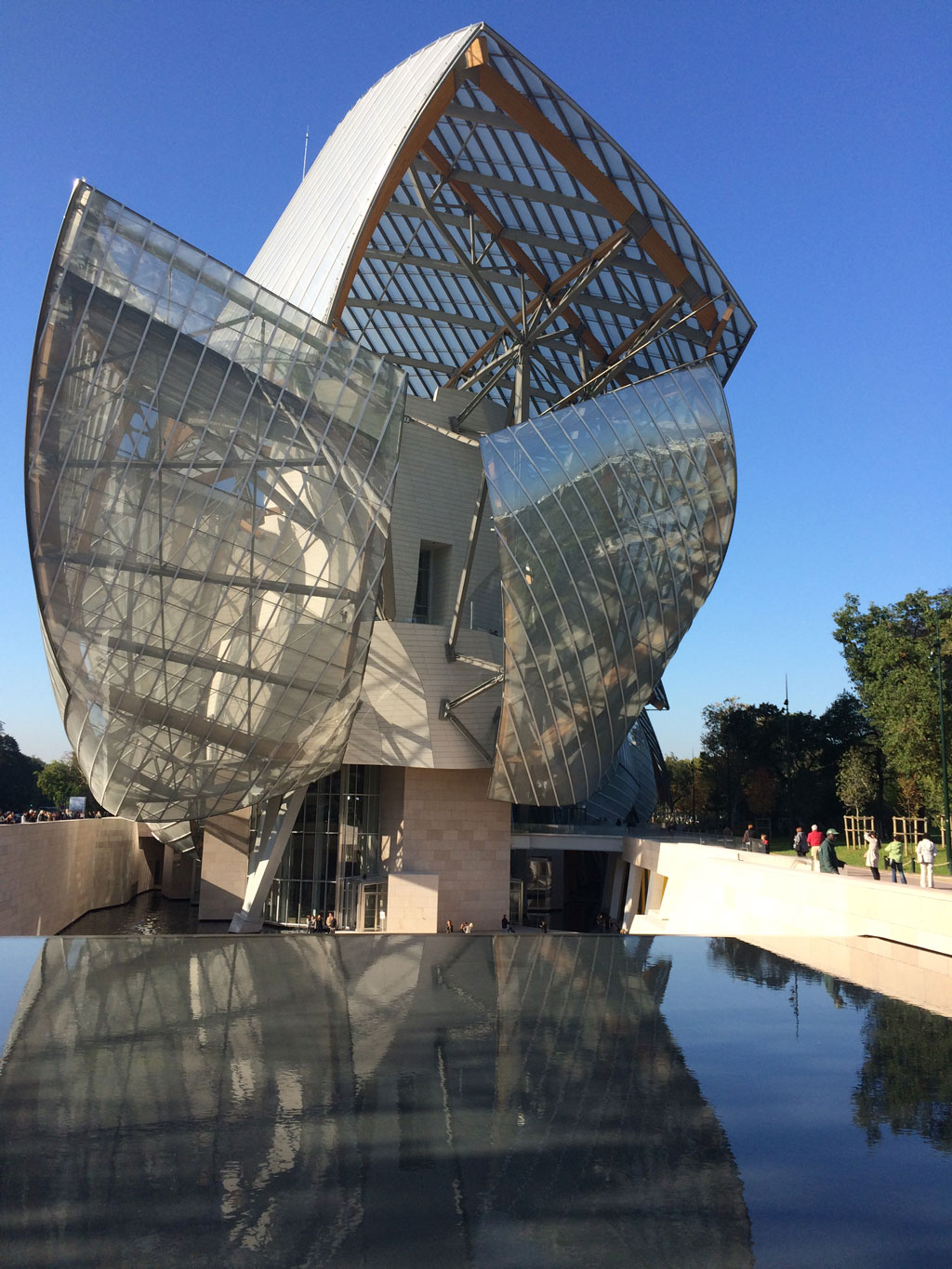
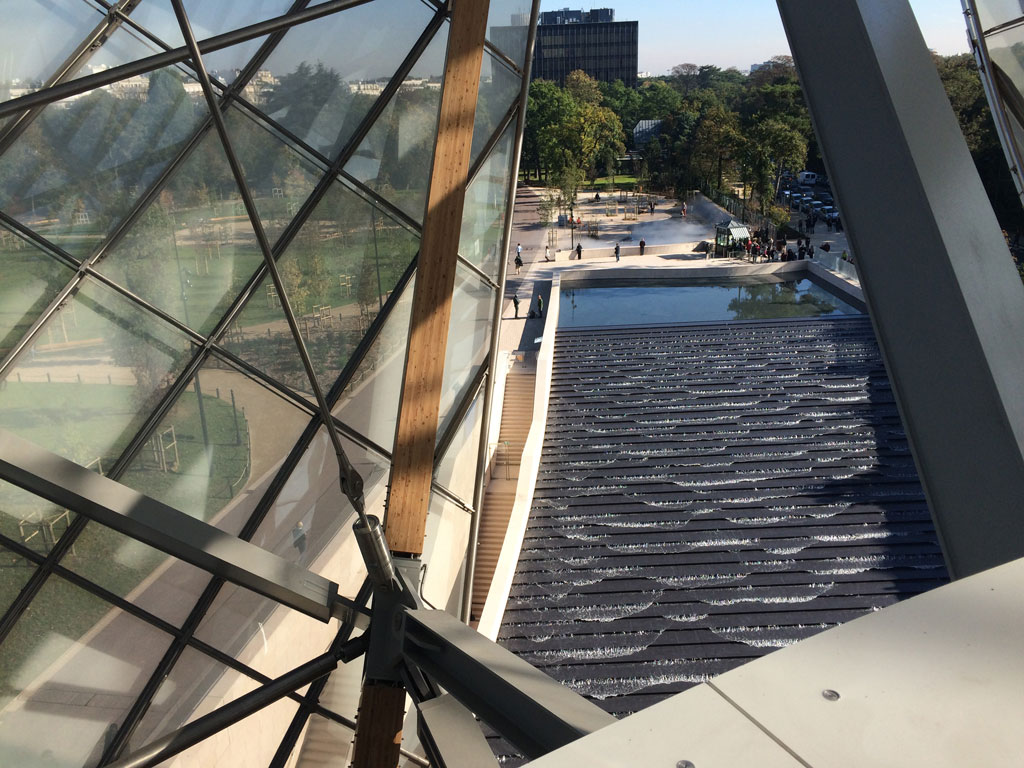
For the last week, I have been packing, moving and unpacking virtually non-stop, with the wonderful exception of Monday between 10 am and 2.30 pm which I spent with my daughter on a flying visit from New York visiting the Fondation Louis Vuitton, an extraordinary building that I will describe when I am not feeling quite so exhausted. In the mean time, here are a couple of photos. For any of you who read my other blog, Loire Daily Photo, I have a technical problem that is keeping me from posting. I hope it will be resolved soon.
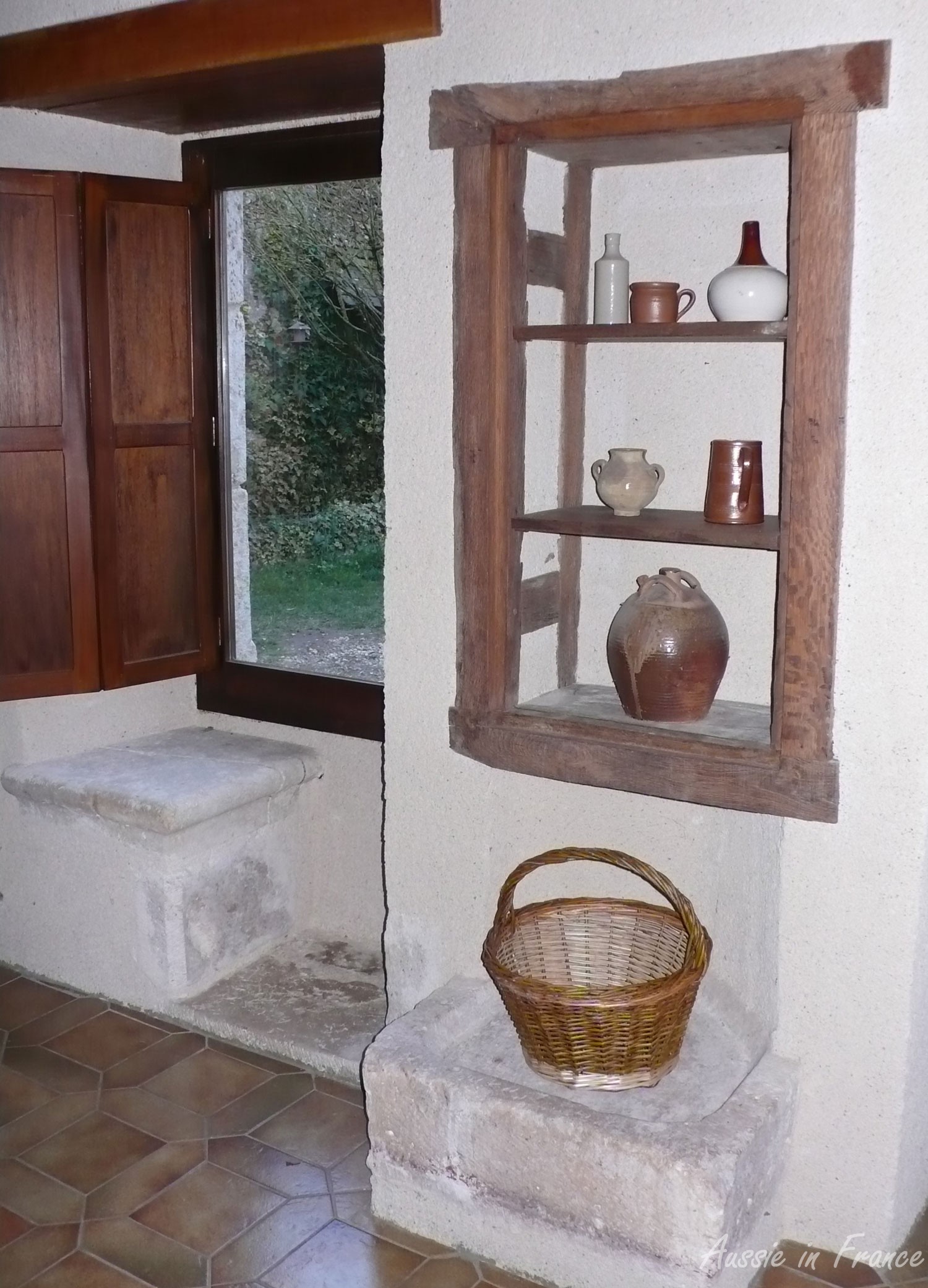
In Closerie Falaiseau our late 16th century house in the Loire Valley, we have a little stone seat in the alcove formed by the 70 cm wall next to the window. In a 17th century house we used to rent at Christmas in Normandy, there was one each side of the window.
Last weekend we visited château de Fougères in the Loire Valley and I was delighted to learn there is actually a name for this little seat – un coussiège.
Usually made of stone, they were common in mediaeval constructions and formed part of the wall. They were covered with wood and cushions (coussins).
Now this got me thinking about where the word coussin comes from. I wondered whether it came from the word coudre which means “to sew” in French, because the ladies often sat next to the window with their embroidery watching the world go by because there was more light. A coussiège in that case would be a “sewing seat”.
But in fact, it comes from Vulgar Latin coxinus, which comes from coxa (thigh) and –inus, and means a stuffed object originally placed under the thighs. It might also come from the Latin culcita meaning mattress.
Cushion, which appeared in English in about 1300, comes from Old French coissin (12c., Modern French coussin), probably a variant of Vulgar Latin coxinum, from Latin coxa “hip, thigh”. Someone has counted more than 400 spellings of the plural of this word in Middle English wills and inventories. I can’t even begin to imagine that many spellings for the same term.
Also from the French word are Italian cuscino, Spanish cojin.
Coudre on the other hand, comes from Vulgar Latin cosere and Latin consuere, to sew (con means together). So much for the sewing seat theory!
So far, the only term I’ve found in English for coussiège is window seat which is most unimaginative and doesn’t conjure up mediaeval ladies sewing in the castle window. One day, a friend came buy with her little girl and showed her the coussiège. Some time later, my friend and I were having tea and wondered where she’d got to. You guessed it – she was downstairs on the coussiège being a mediaeval lady!
Three very different destinations are on the agenda for this week’s blogger round-up. First Rosemary from Le Chic en Rose, shares an aperitivo with us on Lake Como, a must if you go to Italy. Next Abby from Paris Weekender takes us cycling along the Nantes-Brest Canal in Brittany and finally Sara from Simply Sara Travel invites us to Iceland and shares some of the most stunning photos imaginable. Enjoy!
Aperitivo Hour at Hôtel du Lac
by Rosemary from Le Chic en Rose, initially from Yorkshire, now in Perth in Western Australia who writes of the many things that inspire her including travel, fashion, history, learning languages and spending time with her family
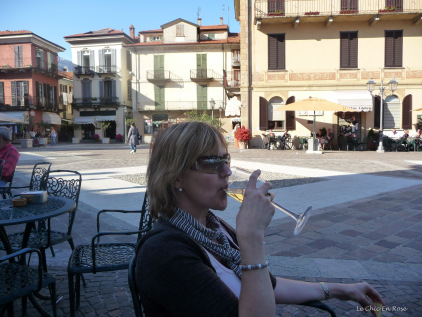
One of the most civilised Italian customs is their love of the late afternoon/early evening aperitif. Both in the Italian speaking part of southern Switzerland and in northern Italy at 5pm on the dot (sometimes 6pm depending on where you are) their version of “Happy Hour” begins. We found when staying there, however, that the emphasis was as much on the food as the drink (though it was admirably washed down with a glass or two of prosecco or pinot grigio). Aperitivos, as they are called in Italian, always constitute an opportunity for food and plates of olives, prosciutto, bruschetta and even small salads and grilled meats would appear along with our drinks. Read more
Cycling the Nantes-Brest Canal
by Abby from Paris Weekender, an American living part-time in New York and part-time in Paris who offers suggestions for Paris weekends, either staying put or getting out of town
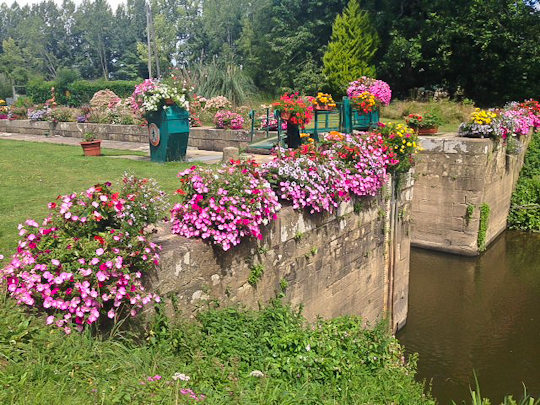
For some time now, I’ve been wanting to cycle the full length of the Nantes-Brest Canal. Technically, the classic cycling route actually runs from L’écluse de Quihex, about 25km north of the city of Nantes, along the canal to Carhaix, then parts from the canal and heads north until it hits the English Channel at Roscoff. All in all it’s approximately 350km or about 220 miles.
I figured that ideally I would need about 4 or 5 days to complete the full route. But then I realized that with a bit of logistical complication, I could actually complete the first half of the trail during the week (while still going home in the late afternoon to work and sleep in my own bed!) and the second half over the weekend, with just one night in a hotel. Read more
Cruisin’ Through Iceland
by Simply Sara Travel, a girl from New Jersey who traded in her bagels for baguettes and moved to Paris. The aim of her blog is to inspire readers to travel, embrace a new culture, and open their minds to new perspectives
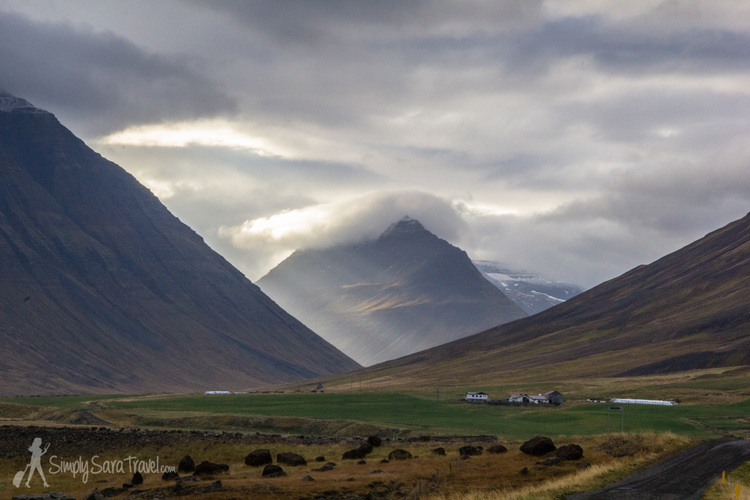
1 Toyota Land Cruiser
4 Tanks of gas
2 Volcanic craters
8 Waterfalls
5 Days
And 1,800 km of Icelandic roads covered. (Or 1,100 miles and change. Or for those like me who numbers don’t register much, the equivalent of over a third of the way from coast to coast of the United States.)
Any way you choose to look at it, it’s certainly a considerable distance for two people to cover. Especially two people who rarely drive these days being city dwellers and all. Read more
We can’t believe that it’s mid-October and the temperature is going to be 25°C in the afternoon! Absolutely unheard-of. We can’t wait to get out on our bikes. It’s also the 9th Rendez-vous du Chocolat at Château de Villesavin so we choose Itinerary n° 5 on the Châteaux à Vélo route called “Shadow and Light” and drive the 20 minutes to Cour Cheverny, about halfway along the 30 kilometre loop.
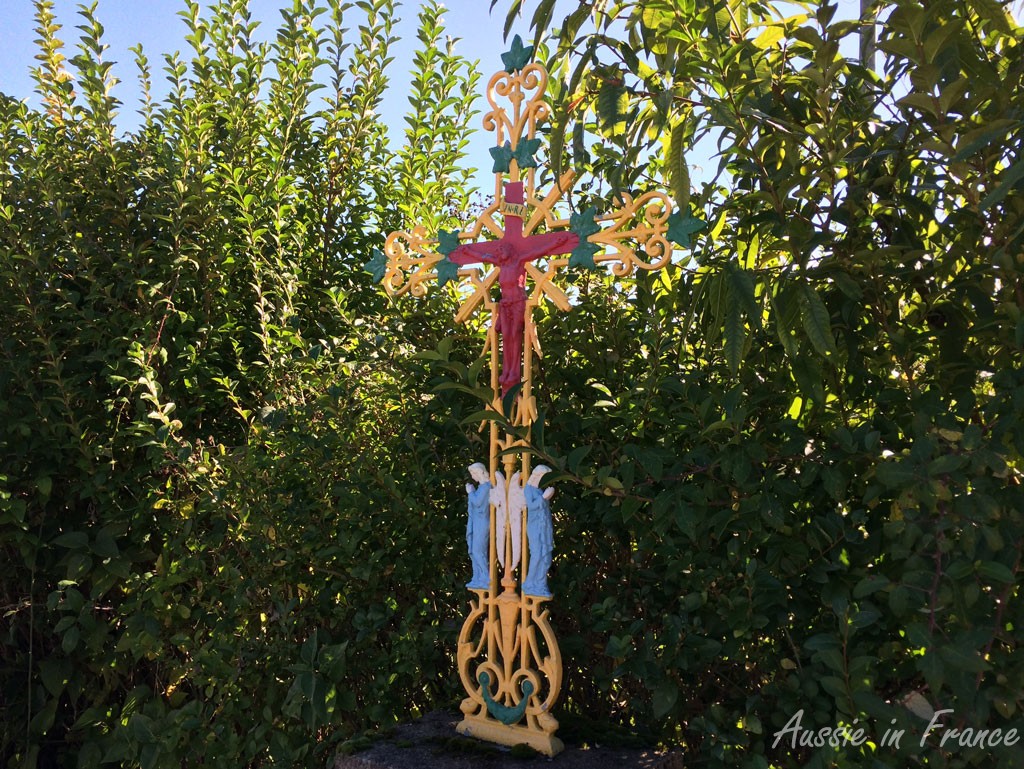
Colourful roadside cross
We cycle through typical Sologne countryside, mainly fields and ponds, and come across several several roadside crosses. I’ve never seen one as colourful as this before!
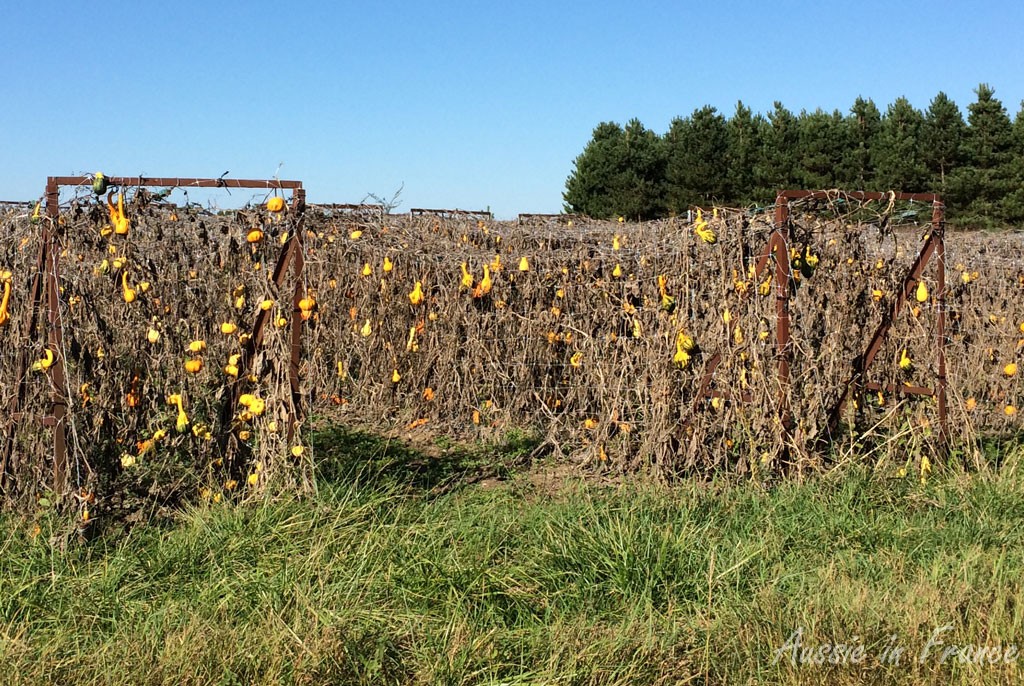
Mini squashes for Halloween
Further along, we see an unusual crop of small squashes which are very popular at Halloween and make great indoor decorations.
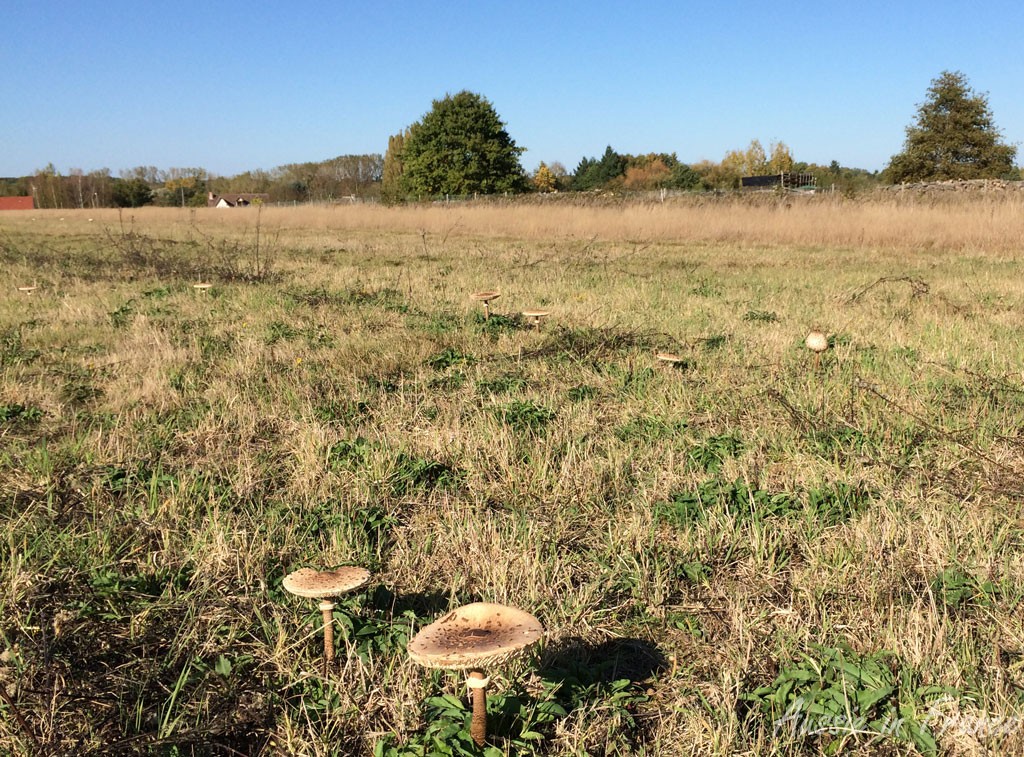
A field of parasol mushrooms
Suddenly Jean Michel calls out “champignons!” and we stop next to a field with the stubs of a cereal crop after harvesting. It’s full of umbrella mushrooms which is a nice surprise because we haven’t found any mushrooms for ages due to the lack of rain in September. As there is no fence, we pick all the half-open mushrooms we can see.
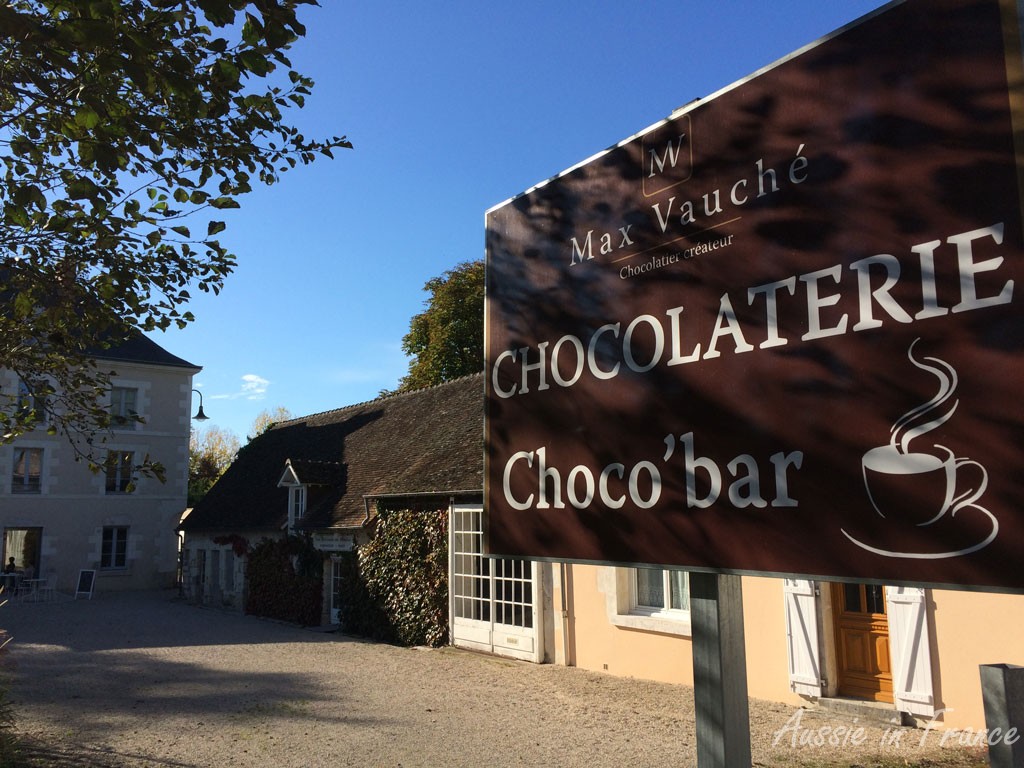
Chocolaterie Max Vaucher
In Bracieux, with its beautiful halles, where we once attracted the comment “at your age and in love“, we ride past Max Vaucher’s chocolate factory, but it is not our destination today. We’ll go back on a cold winter’s day!
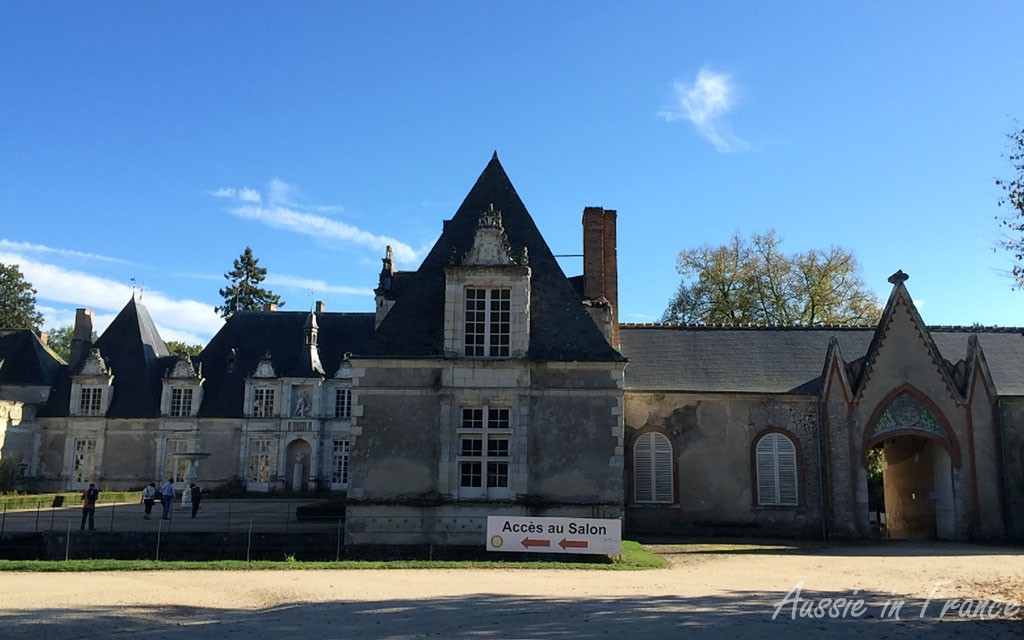
Château de Villesavin where the Rendez-vous du Chocolat is held every year with Rotary sponsorship
A couple of kilometers further on, we arrive at Château de Villesavin and are told that cyclists can ride ride right up to the entrance. Now that’s one of the things I really like about arriving somewhere on a bike! After securing our bikes we continue on foot to the entrance of the Rendez-vous. We pay 4 euros each and are given some documentation.
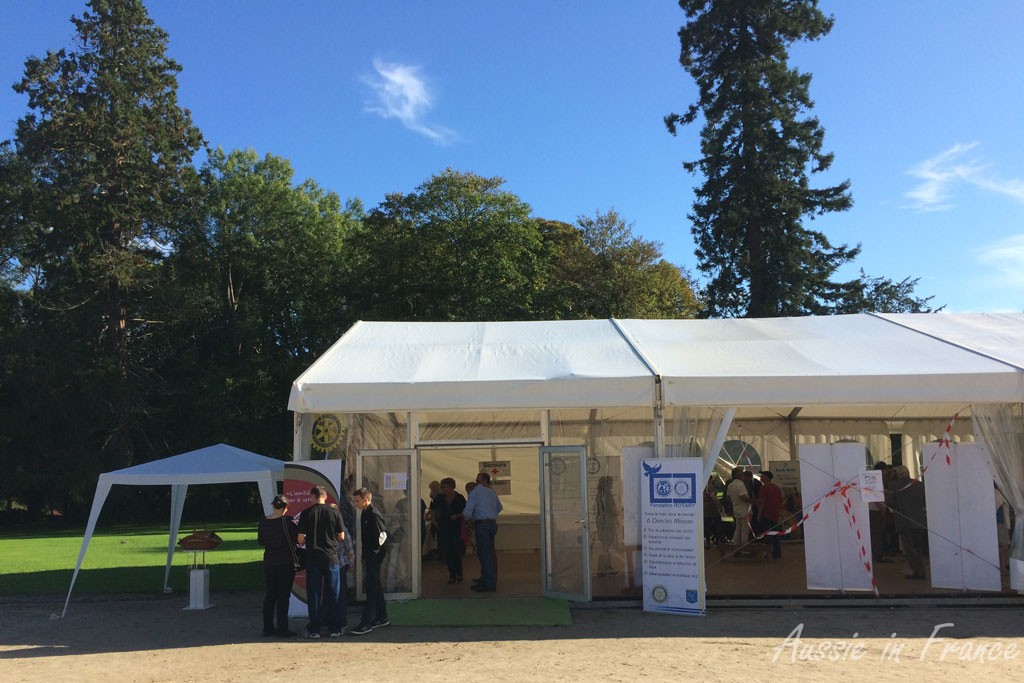
Main tent at the Rendez-vous du Chocolat
I’m not sure exactly what I was expecting (maybe those chocolate dresses they have in Paris that Mary Kay told us all about in Out and About in Paris?) but it is really like any other food fair except that everyone is selling chocolate.
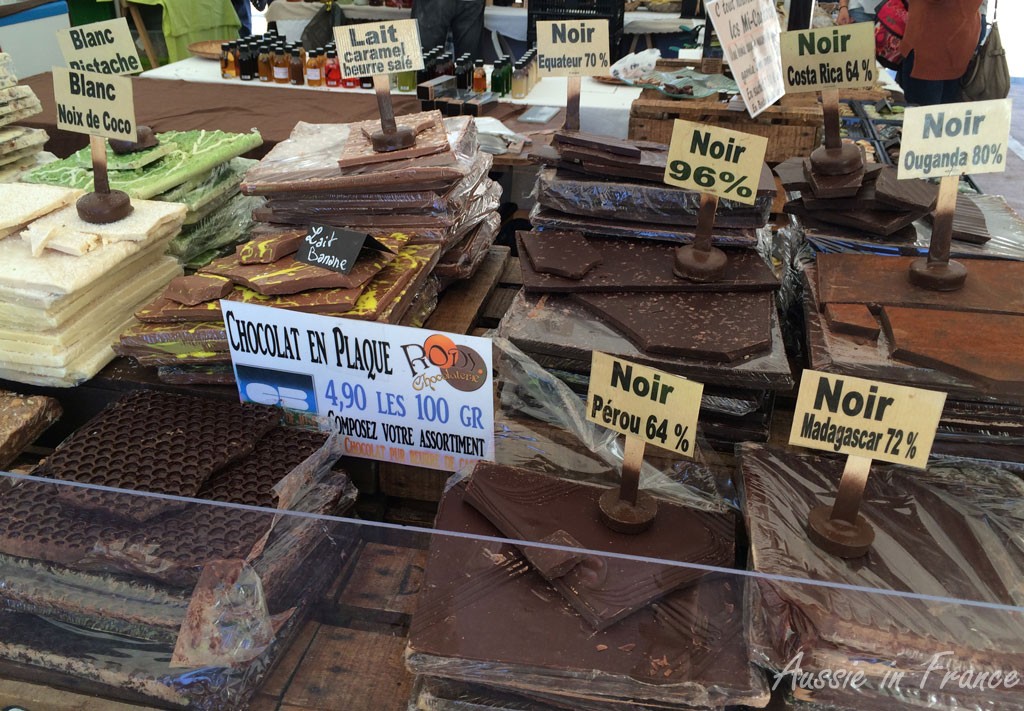
Different types of chocoalte
We taste our way around the large tent and are particularly interested to see what chocolat sans sucre and 96% chocolate are like. The chocolate without sugar tastes like any other chocolate. The young man explains that the sugar is replaced with malitol and it’s designed for diabetics. We don’t buy any.
The 96% chocolate is less bitter than I imagined but not particualrly tasty. We don’t buy that either although I’ve read that it’s an excellent appetite suppressant.
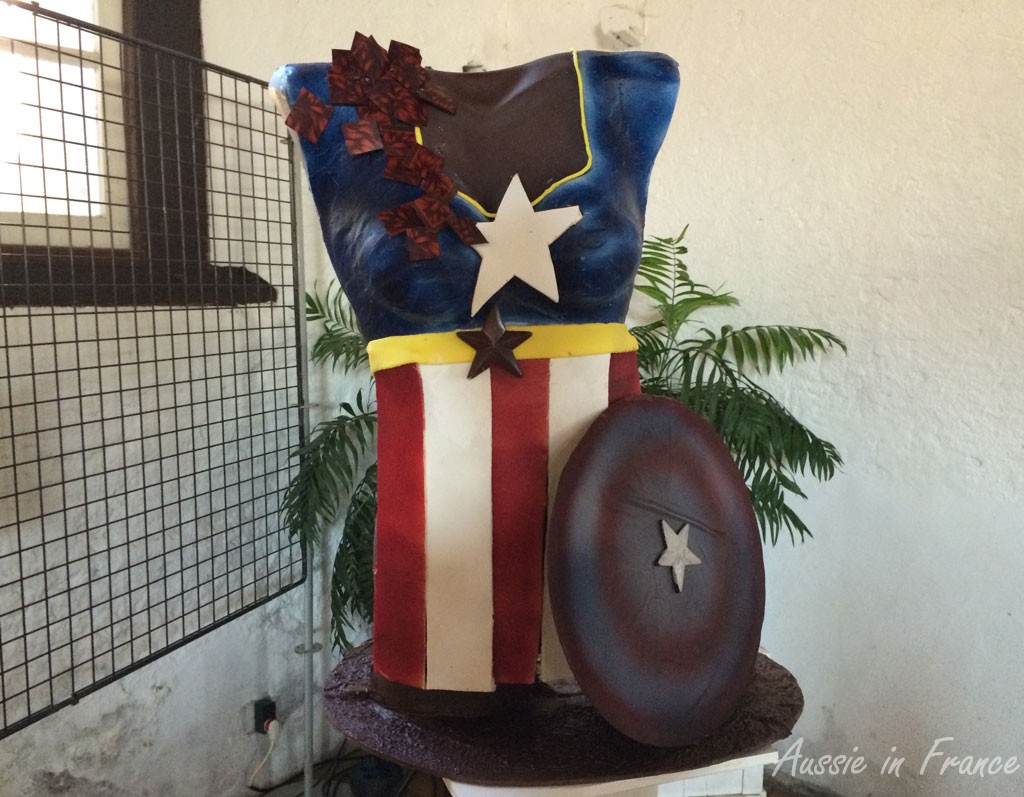
A chocolate torso!
In the château itself, there are several demonstrations going on and we see a malleable sort of chocolate that can be flattened with a rolling pin and several torso sculptures.
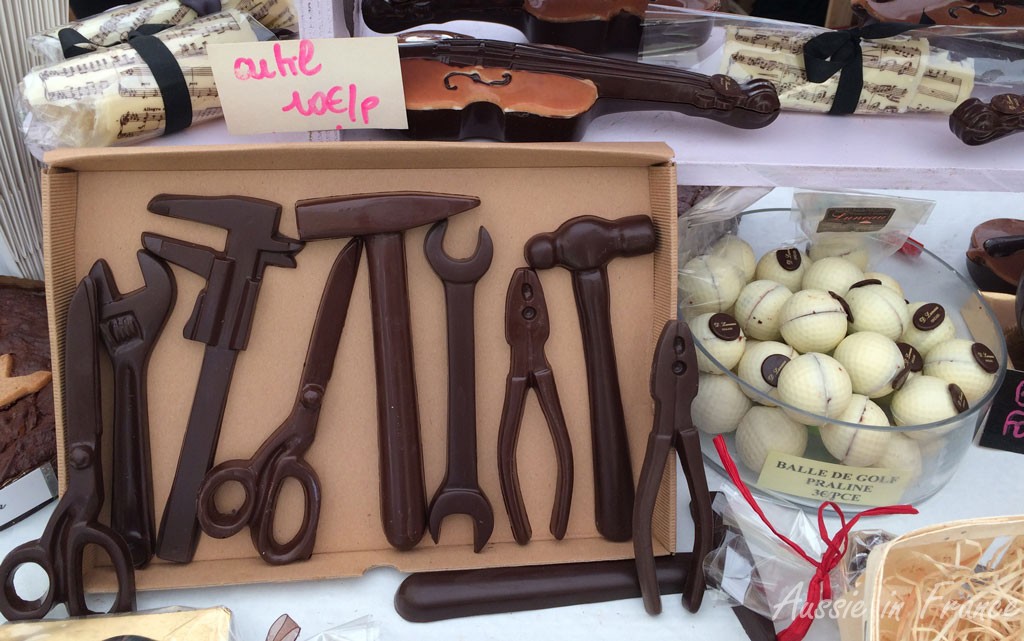
Set of chocolate tools – not to mention the violin and sheet music
At one stage, I look around and who do I see? The lady who used to live in our “house of happiness” as a child! Running into someone we know at a local event gives us a sense of belonging in our new home in the Loire.
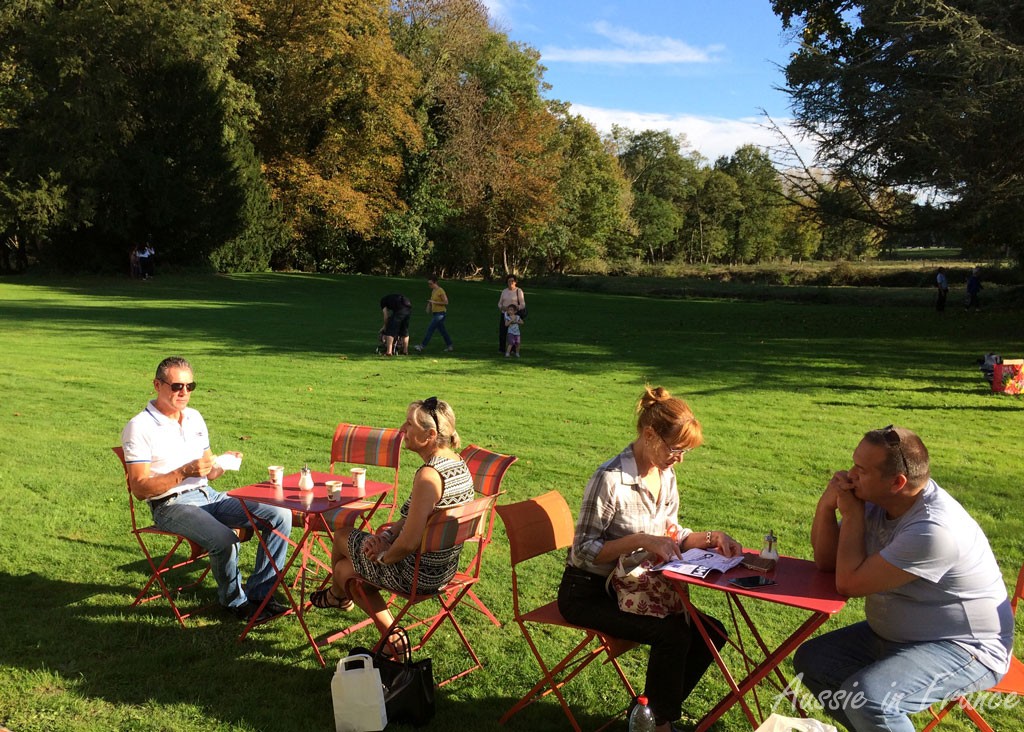
Tea time in the sun!
We go to the afternoon tea tent and get a glass of rosé each and a slice of cake. Jean Michel chooses chocolate while I prefer the apple, which is a much better choice! We find a seat looking out over the lovely grounds of the château.
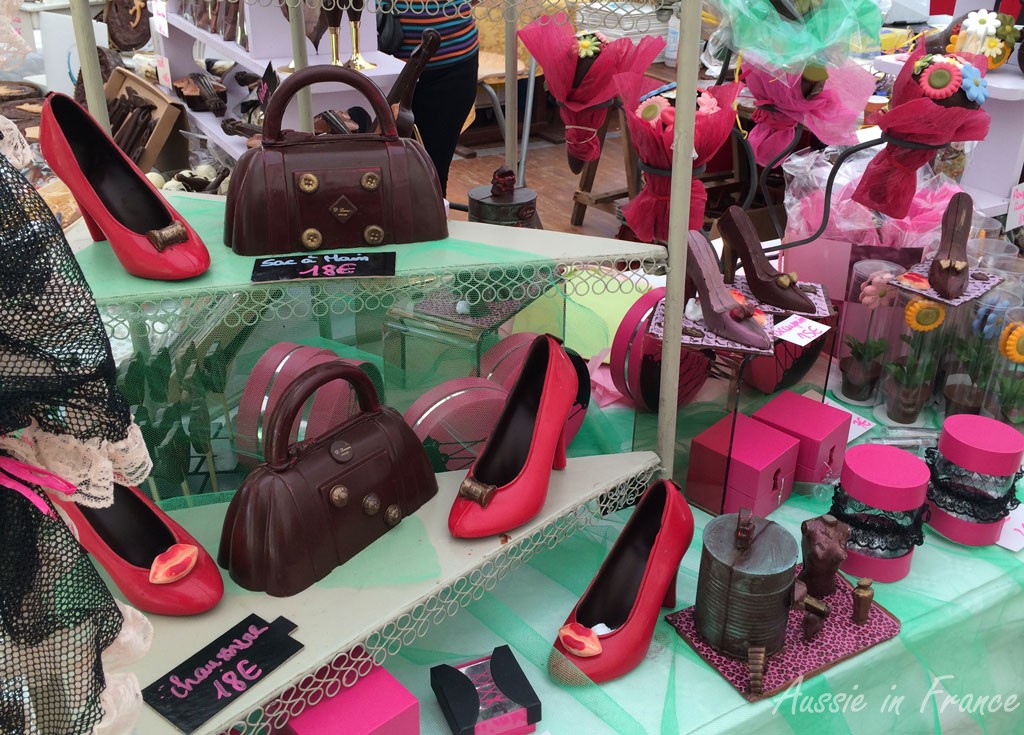
Chocolate shoes and bags
We then do the rounds again and find some blocks of chocolate to accompany our coffee. I love the chocolate shoes and bags but we don’t buy any of those either!
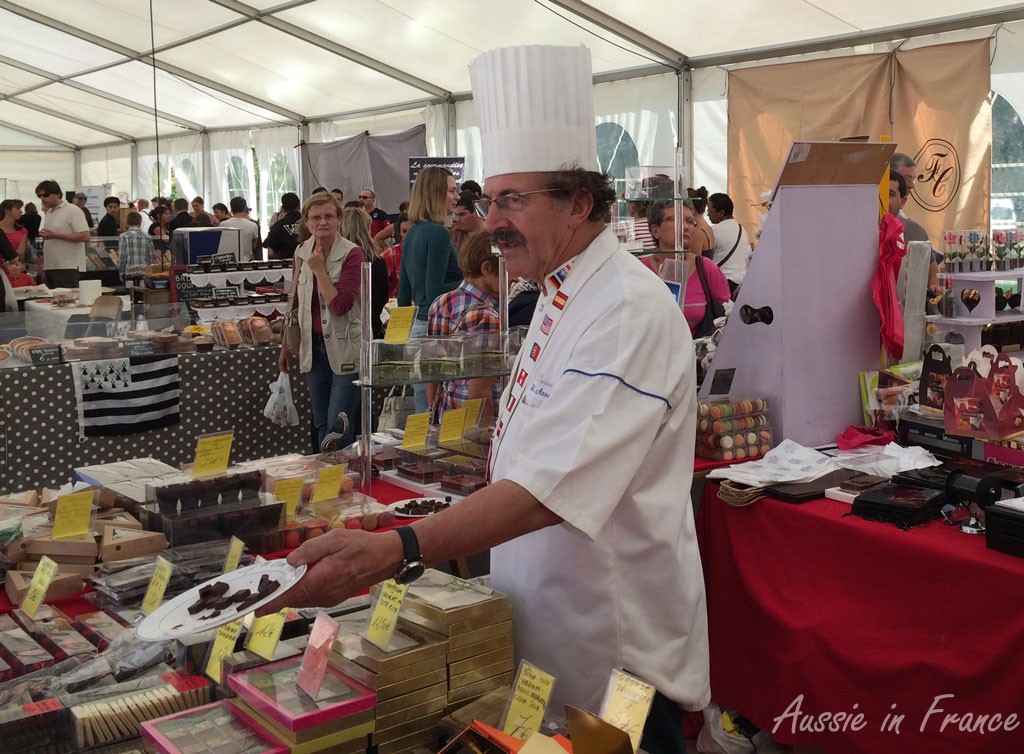
World Chocolate Champion, Mickaël Azouz
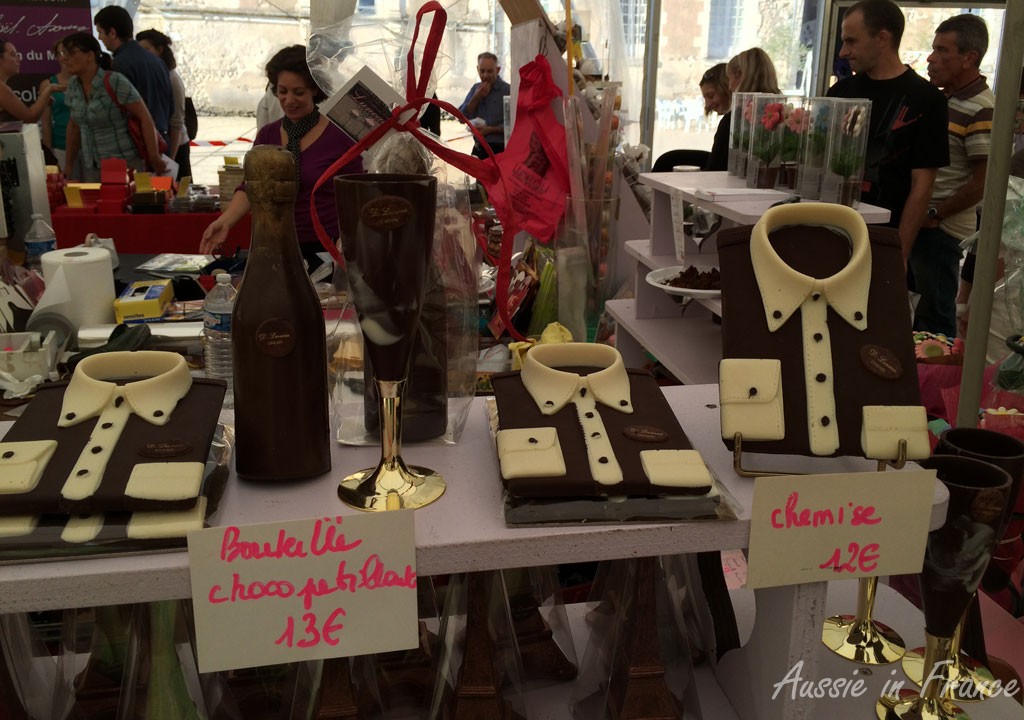
There is even a world chocolate-making champion among us but his products are very sophisticated and I only like plain dark chocolate … I’m almost tempted by the chocolate shirts and glasses on another stand though.
Chocolate shirts, bottles and glasses
We get back on our bikes and cycle the 15 km back to the car. At Cour Cheverny, we find a butcher and buy a côte de bœuf for the barbecue to accompany our mushrooms. Surely in mid-October, it must be the last of the season!
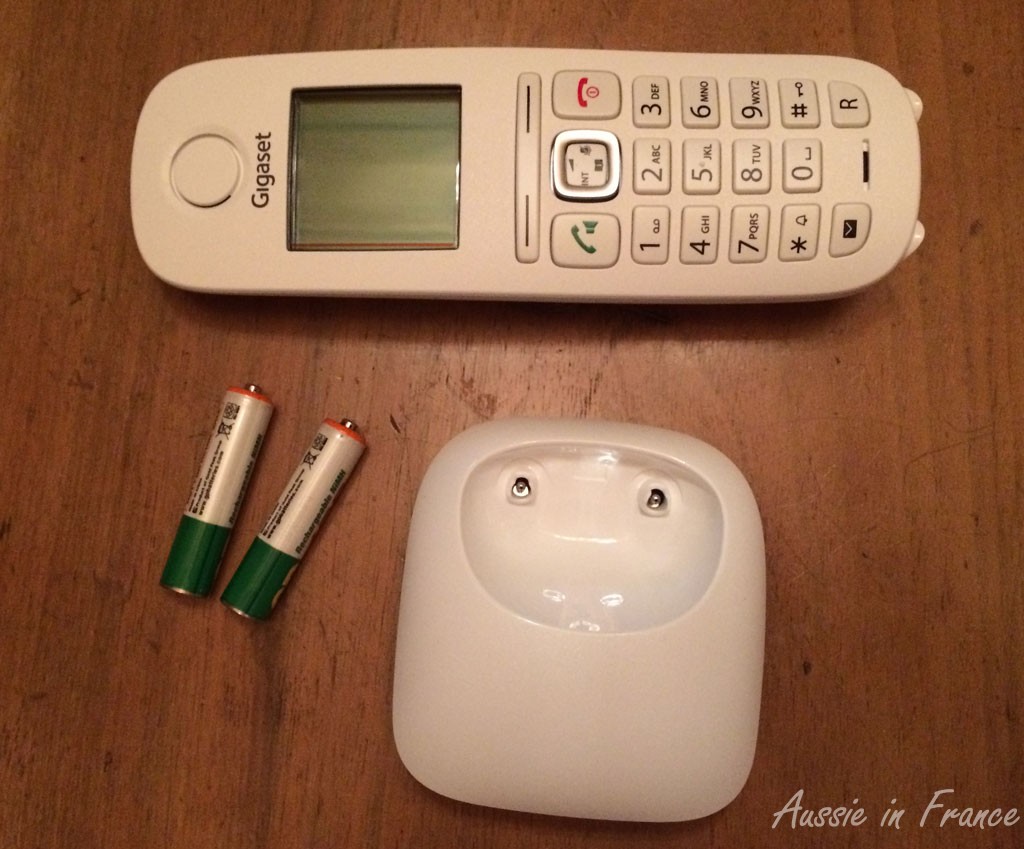
We’ve just bought a set of telephones and are setting them up. “Est-ce qu’ils ont fourni les piles?” I ask. “Non“, says Jean Michel, “il y a des batteries.”
Téléphone avec base à batteries
He is not correcting my French. Pile is the word I first learnt for the English battery back in the seventies and I was surprised when I started hearing people say batterie which has several totally different meanings. I assumed they were just using the English word.
But no, like many English borrowings, it has acquired a specific meaning. A batterie is not just any battery, but a rechargeable battery. It is also correct to say pile rechargeable but batterie is certainly more common in the technical world.
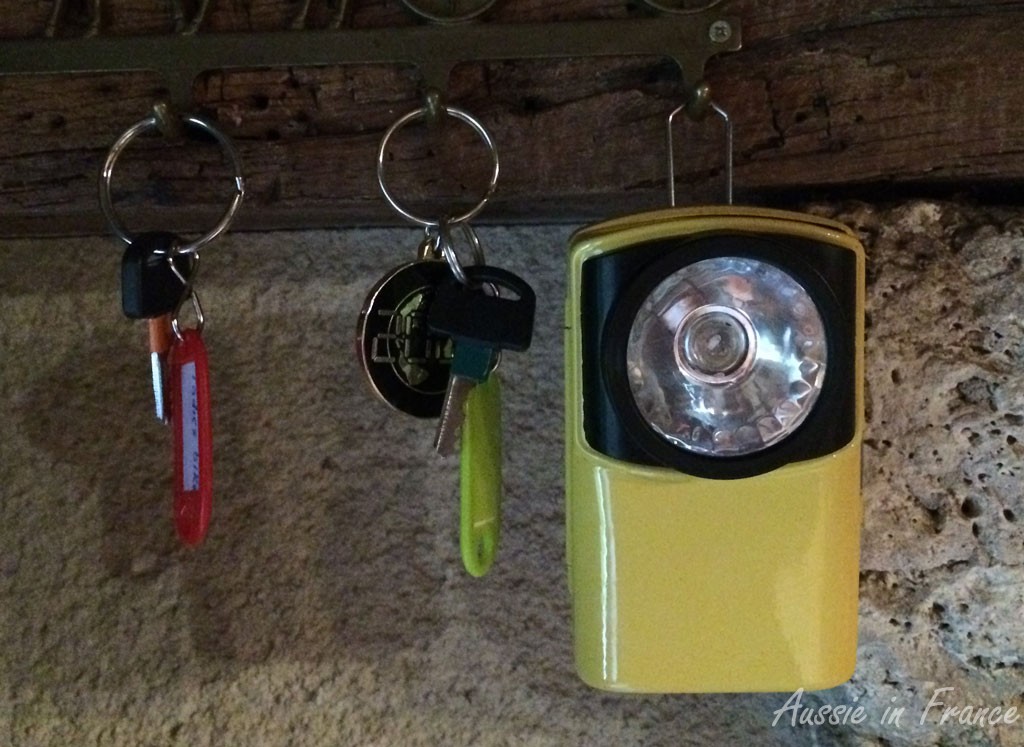
Une pile ou lampe de poche
Another meaning of pile that I learnt early on is a square flashlight or torch as we call it in Australia, in any case. I had never seen them before I came to France. I don’t know if they are common in the other English-speaking countries. It’s real name of course is a lampe de poche, though it’s certainly far too big to put in my pocket!
Une lampe torche or just une torche
A torche or, more correctly, une lampe torche is something else again. It’s a long flashlight, what for me is a normal torch.
Torche also means a torch in the sense of an Olympic torch and what we call a flare on an oil rig.
Just to make matters more complicated you can have a batterie de piles, which is a serie of batteries, because batterie means a series of apparatus of the same type designed to be used or operated together, such as accumulators, condensers and electric ovens.
Une batterie de cuisine, for example, is a set of saucepans and frying pans.
A drum set is also called a batterie. You’d never say mon frère joue des tambours but mon frère joue de la batterie even though a tambour is an individual drum.
To go back to pile, it also means a pile in the English sense of a pile of dirty washing (une pile de linge sale).
A pile is also a bridge pier and sometimes a bridge pile, but the nuances are too complicated to go into here because some bridges have both piers and piles and others just have piles!
In the electrical sense, it can be a cell as well e.g. une pile solaire = solar cell, une pile bâton = pencil battery, une pile bouton = watch battery (I love that one – bouton literally means button) and une pile atomique = nuclear reactor or atomic pile.
If you want to say that an appliance is battery-operated, you say à piles or fonctionnant sur piles e.g. un jouet à piles (a battery-operated toy).
This week’s Blogger Round-Up starts with a great discovery. Every month, well in advance, The Good Life France gives a list of national events in France. I know we’re already halfway through October, but you can take a look at November while you are over at their website. Next, Chrissie from Riviera Grapevine invites us to participate in the annual grape harvest festival at Saint-Paul-de-Vence. To finish up, Anda from Travel Notes and Beyond shares her trip to the Citadel of Alba Iulia in Romania. Enjoy!
Major Events France October 2014
by The Good Life France, an independent on-line magazine about France and all things French, covering all aspects of daily life including healthcare, finance, utilities, education, property and a whole lot more
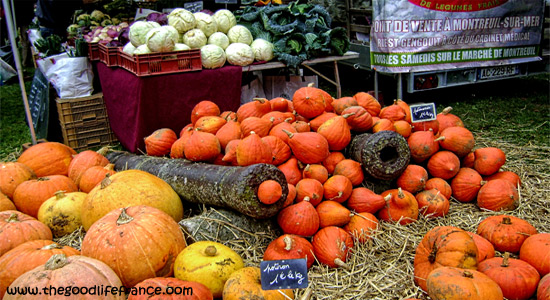
National Event in Paris – Nuit Blanche 4th October 2014. Held annually on the first Saturday night in October when museums, public buildings, monuments, swimming pools, cinemas, parks, universities and historic sites are open to the public all night – an art an culture party!
National Event: Semaine du Gout – Taste Week: 13-19 October. In Paris and throughout France, a foodie event featuring original and varied cuisines. Taste Week is an opportunity to learn more about the art of gastronomy, taste and learn to appreciate the diversity of flavours, and it also aims to increase public awareness of a healthy lifestyle. As part of the event, workshops for the public include cooking classes, tastings and entertainment. Website for details: www.legout.com. Read more
EVENT 06: Fête des Vendanges et des Châtaignes
by Chrissie from Riviera Grapevine, a Sydney girl living in Nice with an insatiable thirst for the wines of the Var, Alpes Maritimes and Liguria. She happily sells, drinks and blogs about wine.
What have you got planned for Sunday?
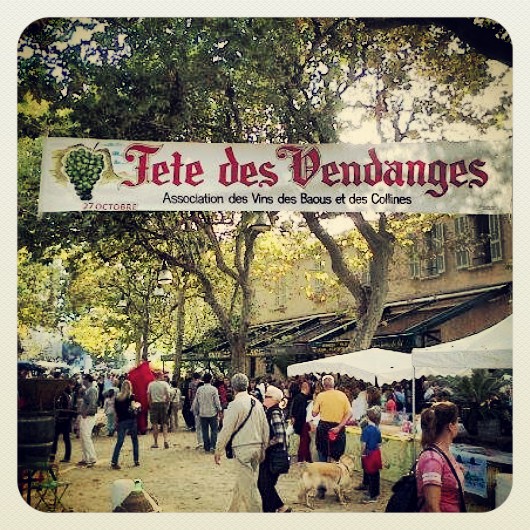
If you happen to be in the area, and fancy a chance to sample some of the unique wines of the Alpes-Maritimes, why not pop into the annual Fête des Vendanges et des Châtaignes in Saint-Paul de Vence?
October 19th marks the 2014 edition of this annual harvest festival for theVins des Baous et des Collines. Translated into normal speak, this term refers to the three vineyards found high in the hills behind the Riviera coastline, near the imposing cliff face above Saint-Jeannet. Read more
Reborn From Its Ashes – The Citadel of Alba Iulia
by Anda from Travel Notes & Beyond, the Opinionated Travelogue of a Photo Maniac, is a Romanian-born citizen of Southern California who has never missed the opportunity to travel.
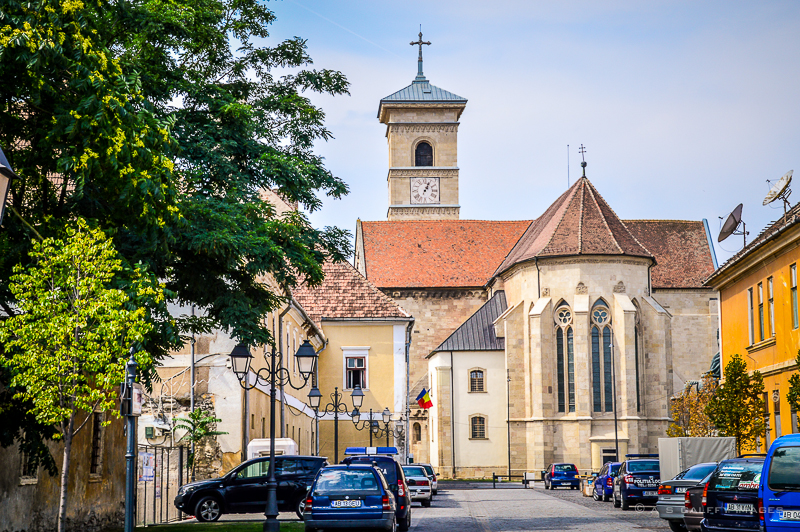
Although a land of natural beauty, Romania wasn’t exactly the ideal tourist destination until after the fall of Communism in 1989. The country was struggling badly with poverty and the tourism industry was almost inexistent. The historic sites were badly neglected, the roads poorly maintained, food was scarce and lodging was primitive. So in spite of its great history and beautiful scenery, Romania remained in the often overlooked chunk of Balkan countries.
Although things have improved considerably lately, Romania is still largely unknown to the western traveler. Such is the case of the beautiful Citadel of Alba Iulia (also known as Alba Carolina), one of the biggest fortresses in Eastern Europe. Read more
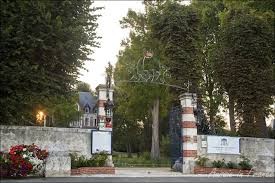
Entrance to Manoir de Contres (photo courtesy of http://www.manoirdecontres.com)
I’m always on the look-out for new restaurants to try so when my friend and neighbour Françoise mentions the Manoir de Contres in Sologne, I immediately note the name in my iPhone for Jean Michel’s next most significant birthday – the one corresponding to his retirement and our move to Blois!
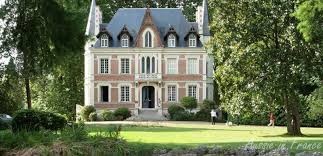
Contres is about 45 minutes by car due south of Blois so night is falling when we arrive. As we drive into the grounds, we can just see the beautiful early 19th century brick and stone manor house with its many turrets and gables. It was built in 1818 in the style of Louis XII and modelled on the Louis XII wing of the Blois Royal Castle combining the Gothic tradition with the early Italianate influence.
Day time view of the Manoir (photo courtesy of http://www.manoirdecontres.com)
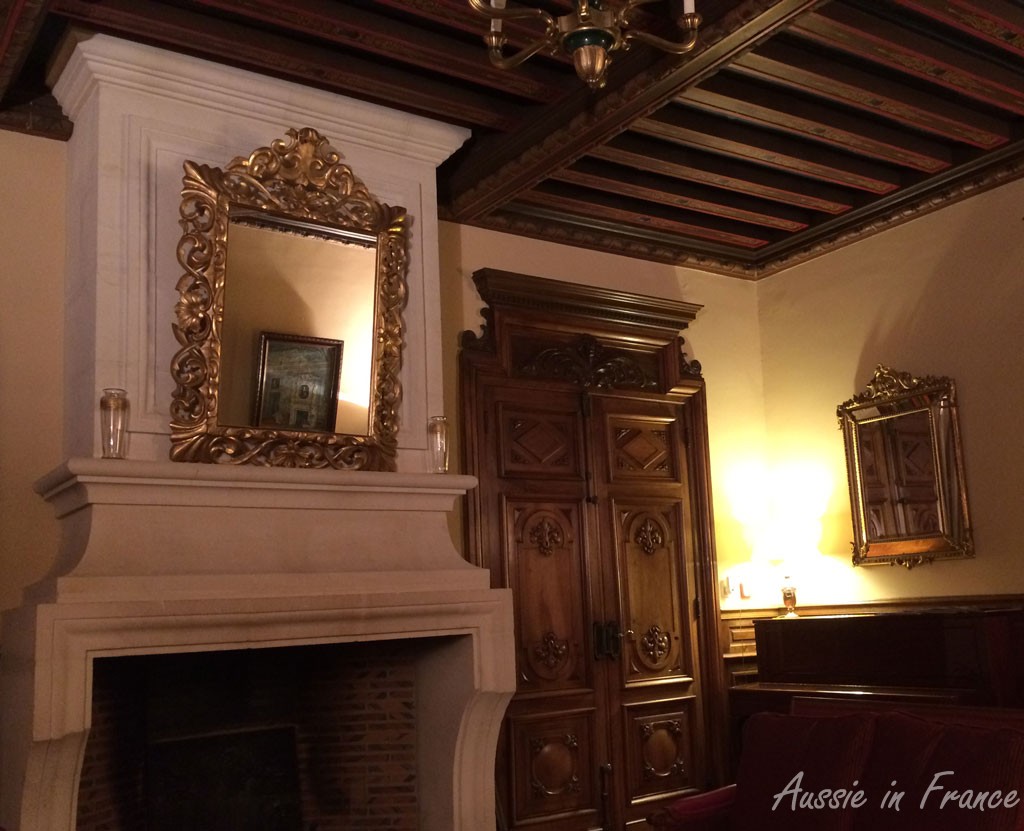
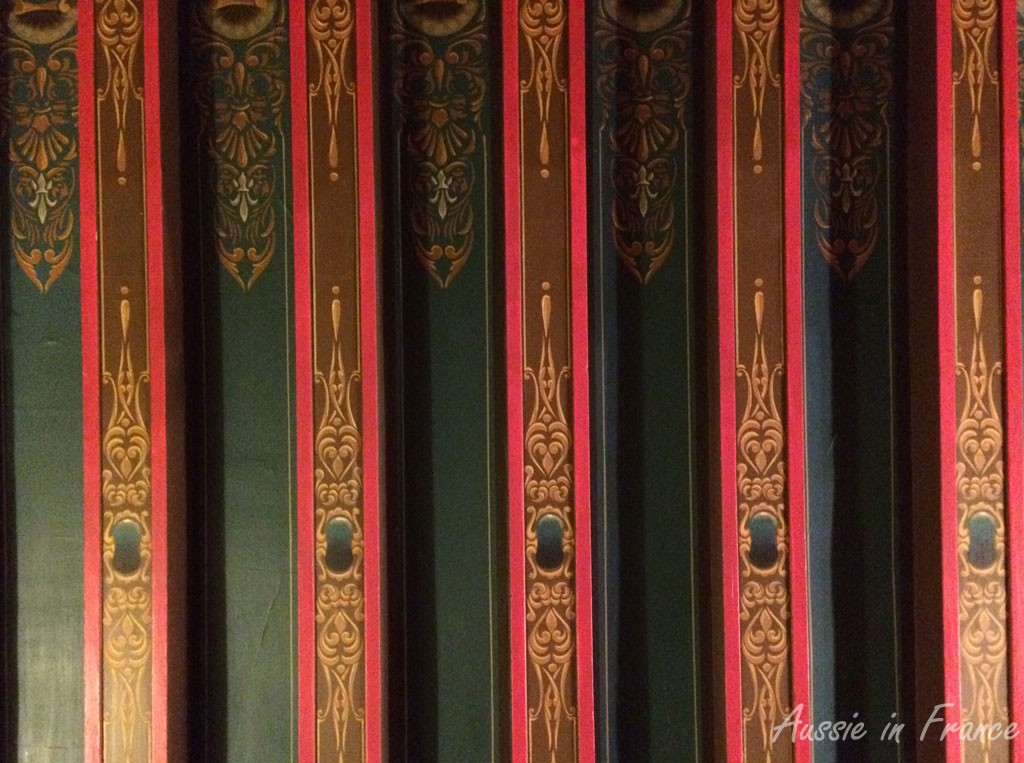
We are welcomed by the owner, Maria Orsenne, originally from Hambourg, and taken through to the beautiful living room with its large fire place, sculpted doors and painted ceiling, which we later see is actually papered. What a clever idea!
The manoir has had a somewhat chequered existence, we learn, changing hands every 30 or 40 years. Maria and her husband Victor bought the château in 2010 and turned the main house and garden pavilion into a hotel. We are sorry not to be able to visit the lovely grounds.
The living room with its carved doors and painted ceiling
We sip our fine bulles (fine sparkling wine) from Saumur and read about the history of the Manoir then we consult the menu. We can choose between the Menu of the Day (3 courses, 32 euro, starter + main or main + dessert 35 euro) or the 4-course Autumn Menu for 43 euro. We are told that everything is prepared in the manoir kitchens from fresh produce by Victor Orsenne and his team.
A close-up of the painted ceiling which is actually papered.
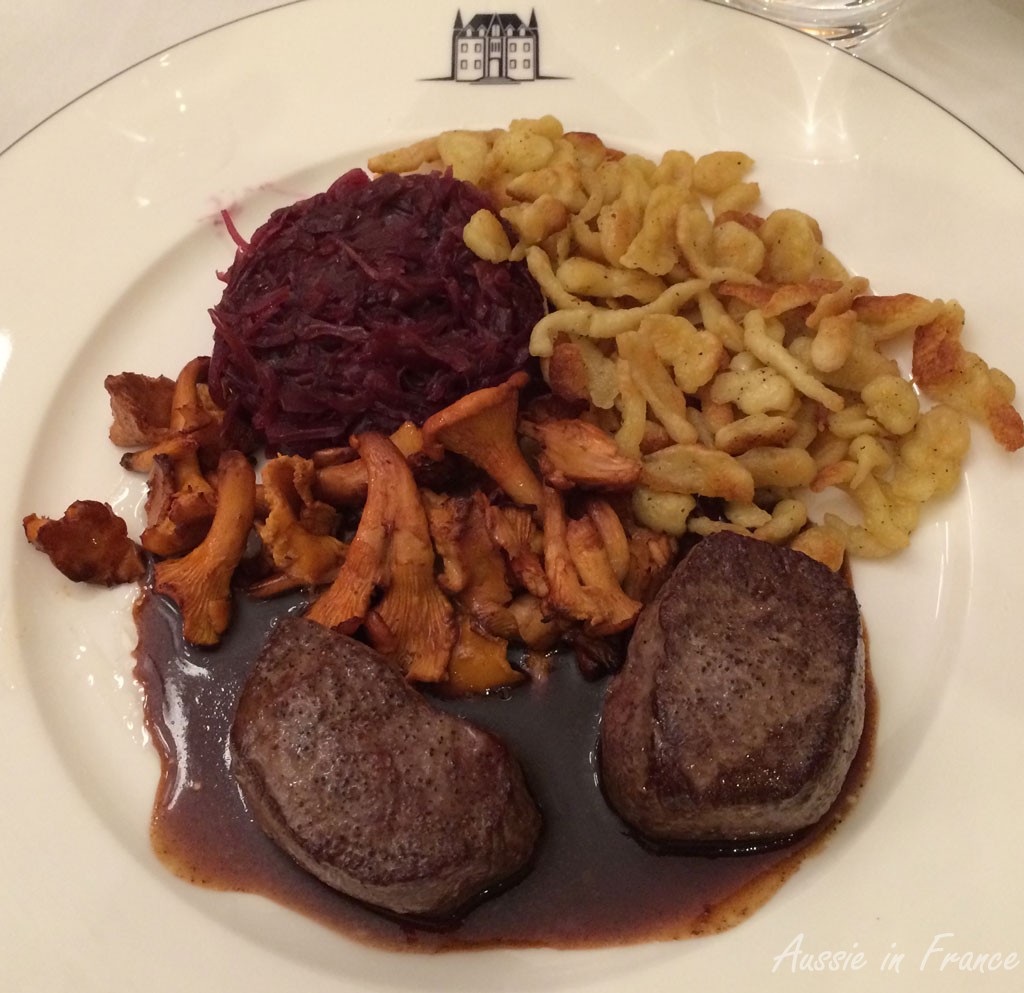
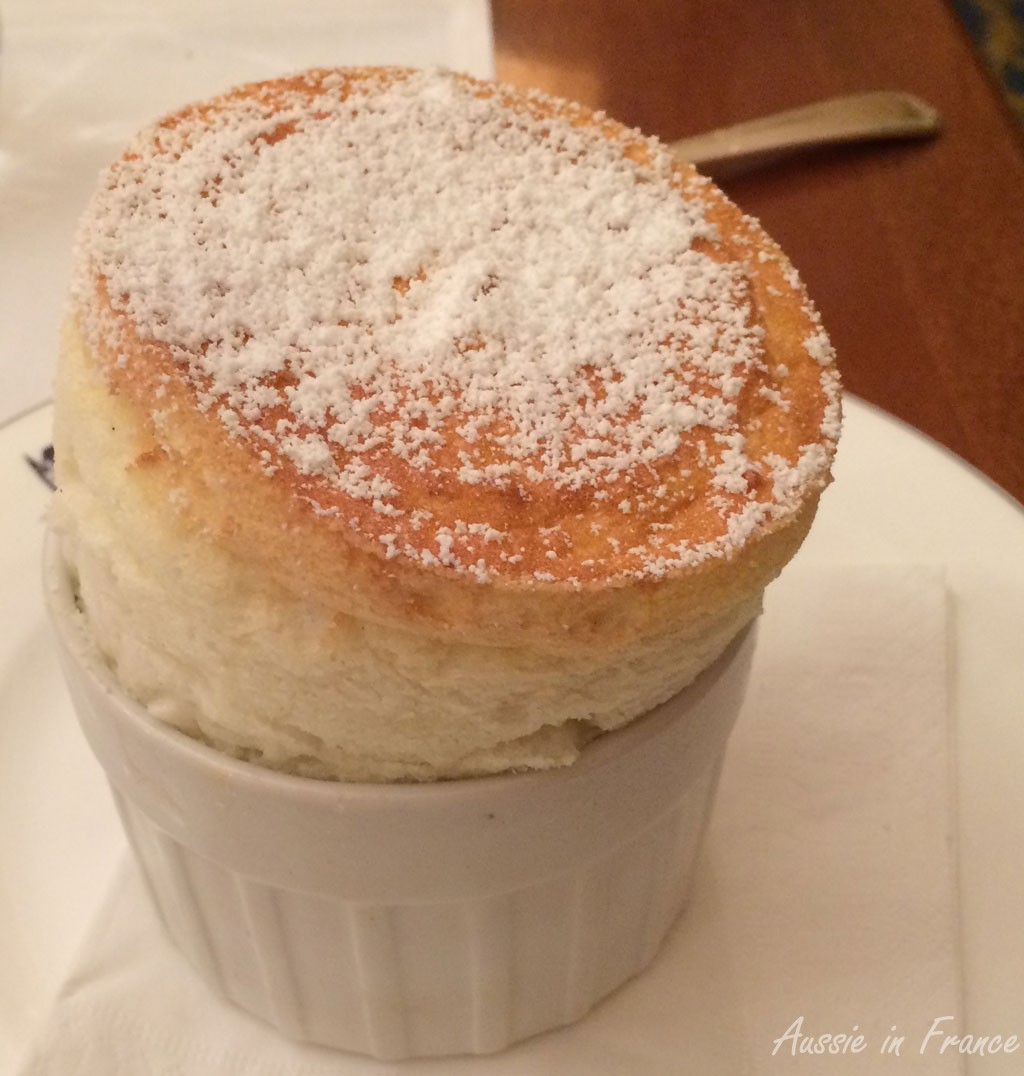
We choose the Autumn Menu, starting with foie gras, followed by medallion of venison with chanterelle mushrooms and spaetzle (the hunting season has begun), a selection cheeses and a hot vanilla soufflé.
Maria suggests we have a glass of semi-sweet local wine with our foie gras and a glass of côt de Touraine with our venison. We’re happy with the choice.
Venison with chanterelle mushrooms and spaetzle
Our meal is enjoyable and the service is friendly and discreet. The venison is not too strong and the spaetzle (noodles boiled in water or broth then pan fried in butter) remind us of our recent cycling holiday in Germany. The vanilla soufflé is mouth-watering!
Jean Michel’s enticing vanilla soufflé
When I take the bill, I explain to the young man serving us that it is Jean Michel’s retirement birthday. Maria then appears with a little Villeroy & Bosch dish with the logo of the manor house on it as a souvenir.
We are able to reassure Françoise that her recommendation was worth taking up. We plan to come back again in the summer and have lunch on the terrace!
Today I learnt a new word – bernache – used in Touraine and particularly in Anjou, to designate what is known in other parts of France as vin nouveau, i.e. grape juice at the beginning of its fermentation.
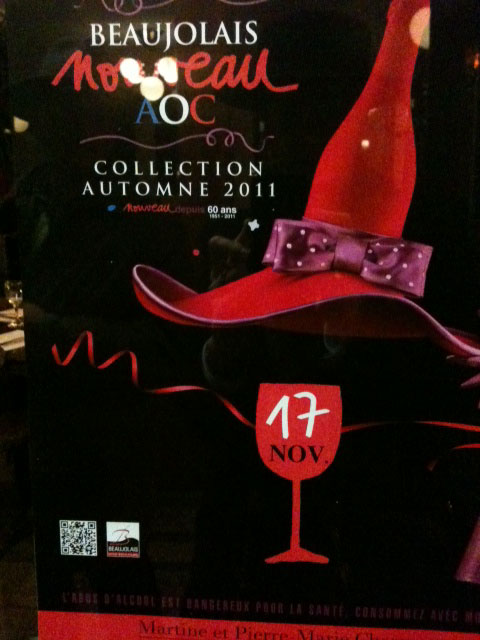
I’ve already recounted our experience with vin nouveau in Alsace and the famous beaujolais nouveau tradition that is sadly dying out in France, but I had never heard of bernache.
Like any vin nouveau, bernache is only available for a short period at the end of the grape harvest (vendange), that is, from about the end of October to mid-November and is usually served with roasted chestnuts (marrons grillés).
It is mainly produced in Montlouis and Vouvray. Cloudy, a little sweet and sometimes very bubbly, it can’t be transported very far. It’s a transitional stage of traditional vinification.
In the Saumur area, further along the Loire, where Jean Michel grew up, it’s called beurnoche.
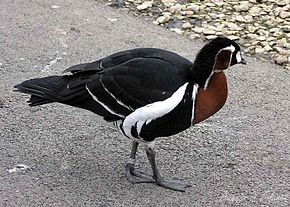
Bernache has another meaning – a barnacle goose (from the benus Branta . Not that I have ever seen a barnacle goose! Unfortunately, my Robert etymological dictionary is currently in a carton in Paris waiting to be moved to Blois or I might have been able to find out if the two words are connected.
In any case, I am going to try and find a vineyard where I can try some bernache vin nouveau!
 French fashion doesn’t get much sweeter than the fabulous creations seen gracing the runway during the 20th annual Salon du Chocolat in Paris last week. The inaugural gala featured a retrospective collection of 60 mouth-watering designs worn by French television stars, singers, athletes and models.
 I’m finally back to Nice after travelling for two months. I have basically been on the go since April and now, I just want to stay home. Travelling is nice, but sometimes it’s just good to get home and stay there for a while. So I am planning to stay home all winter long (or at least for a while) and write.