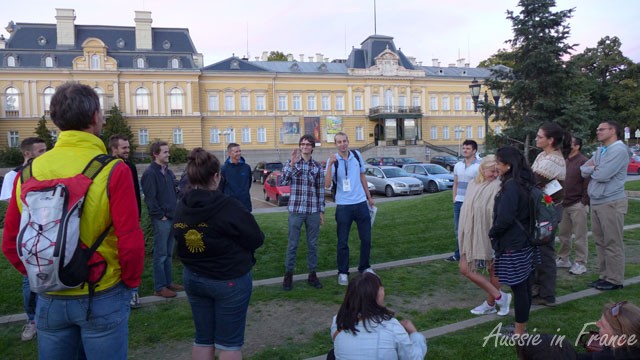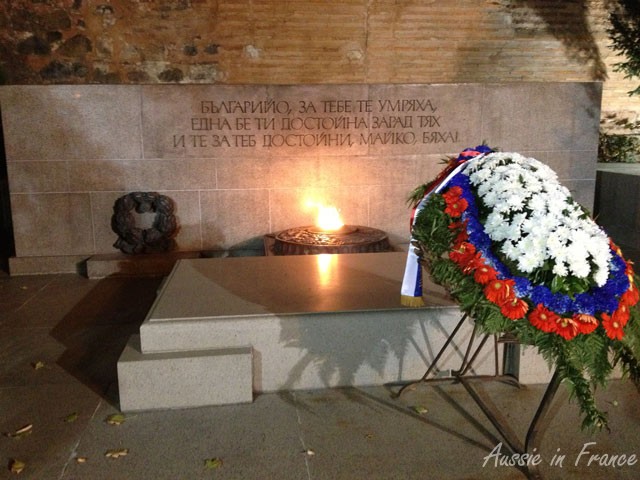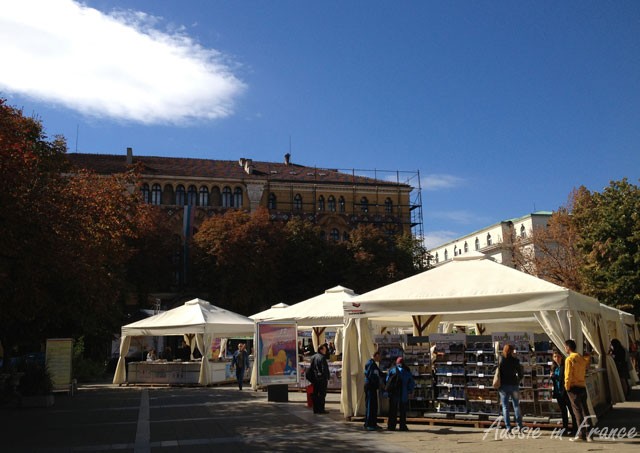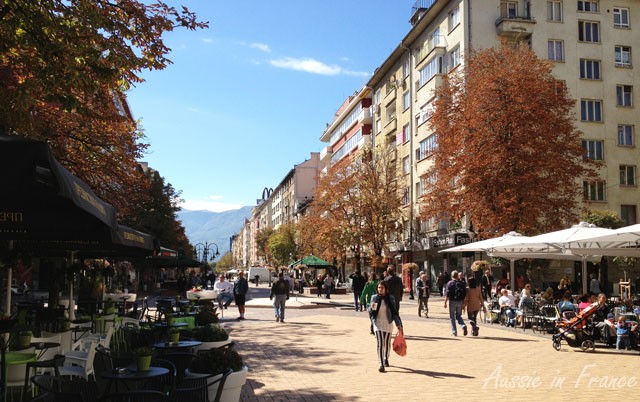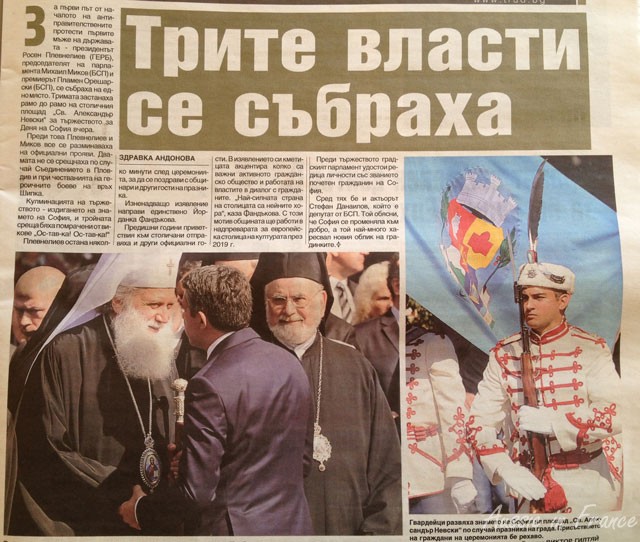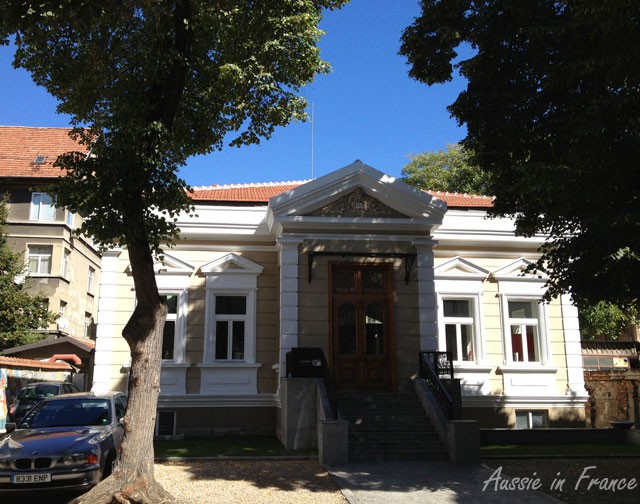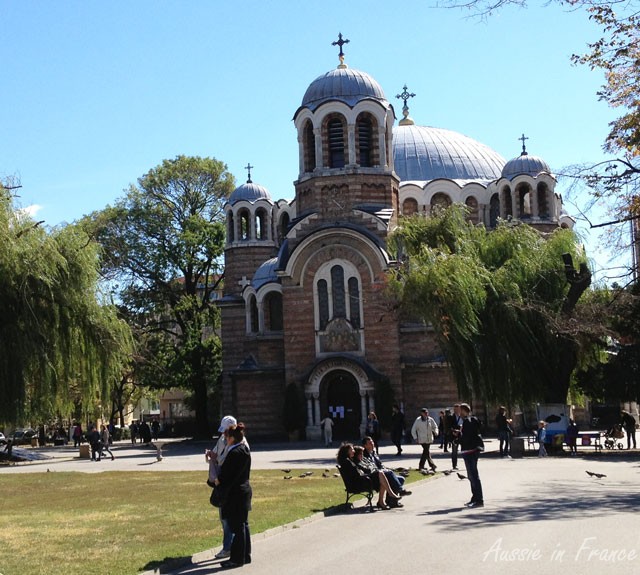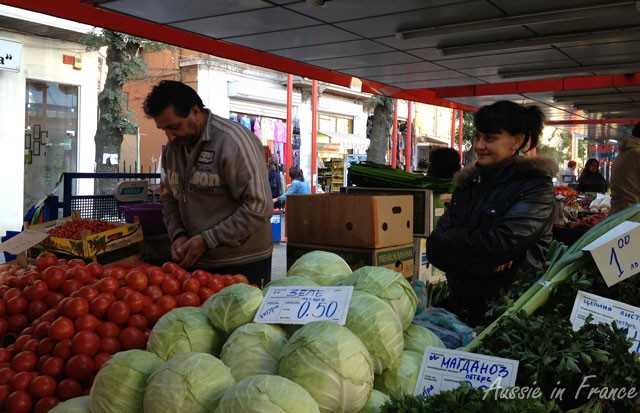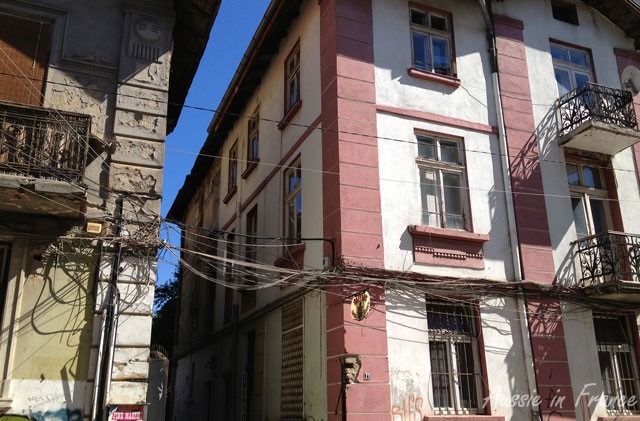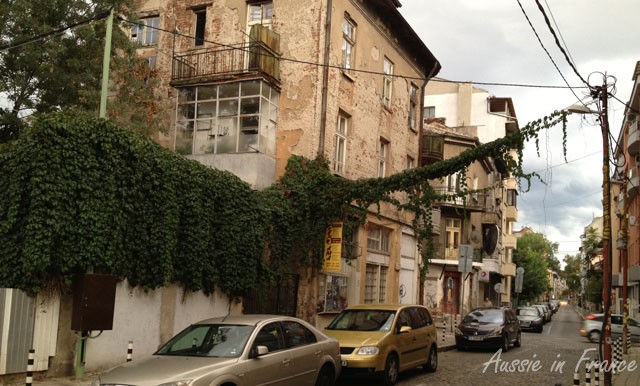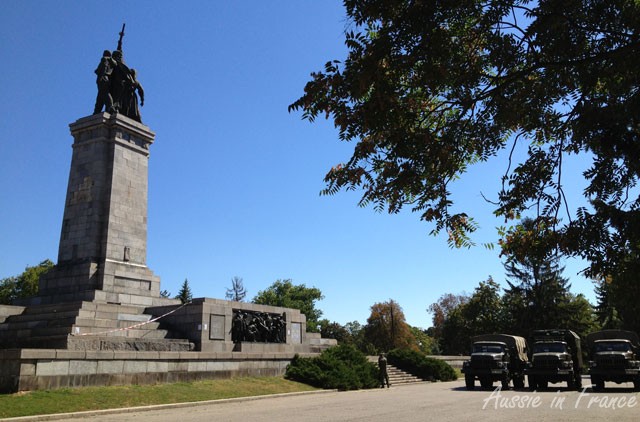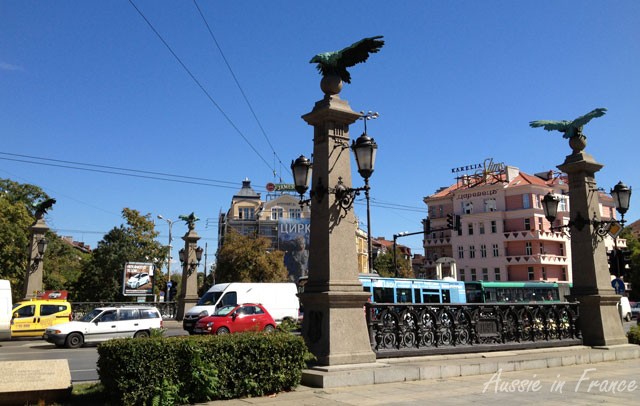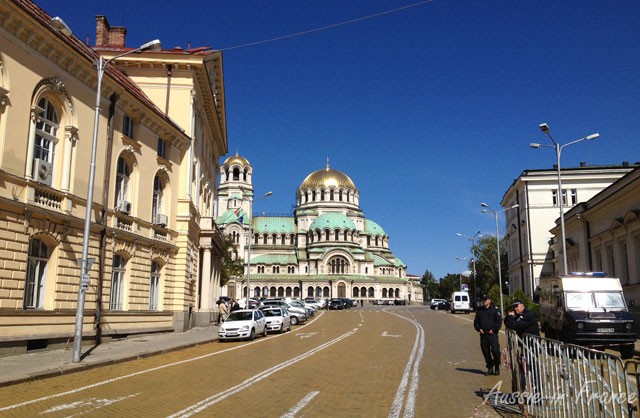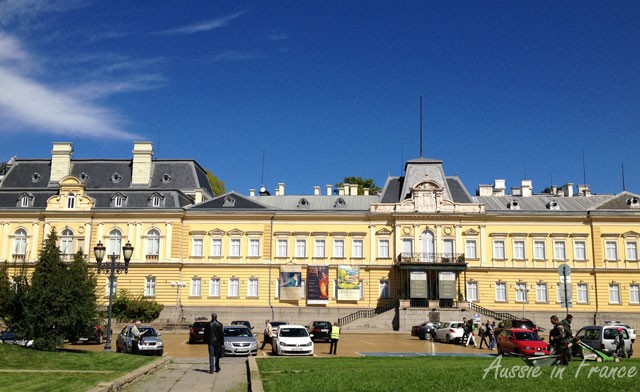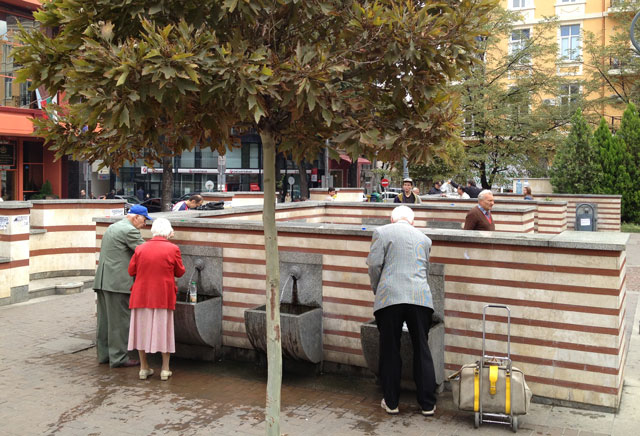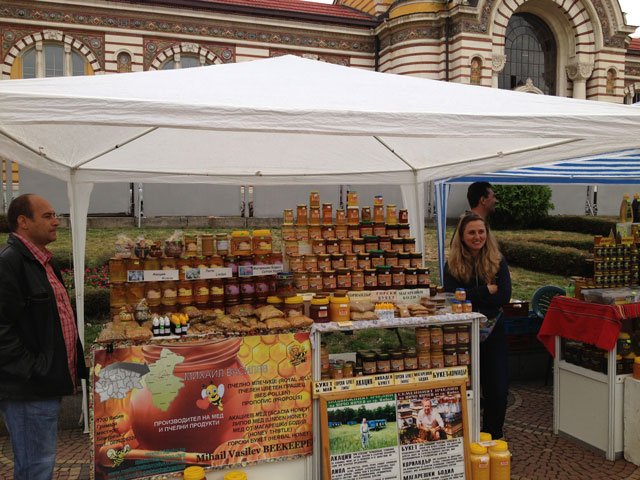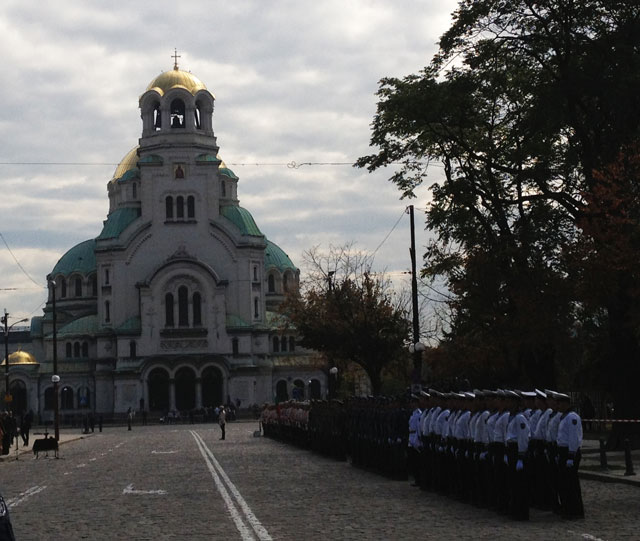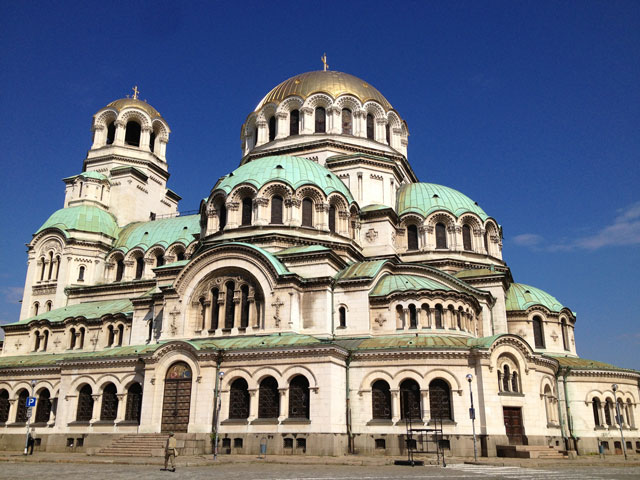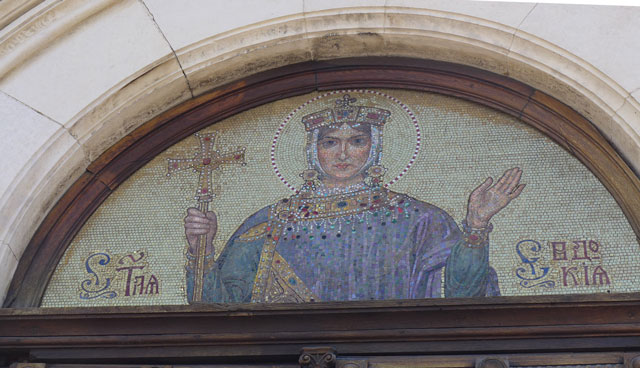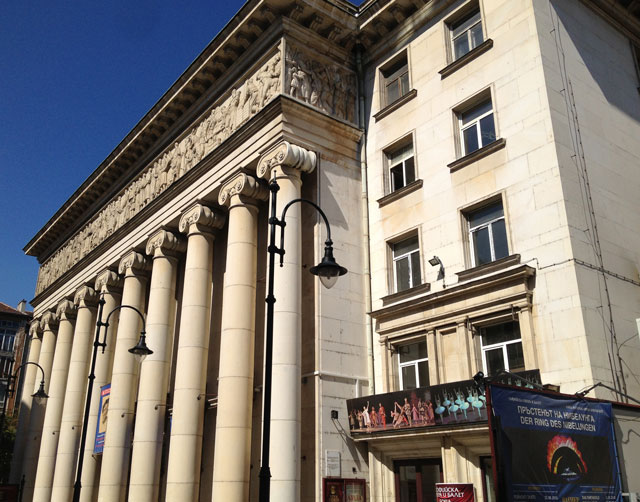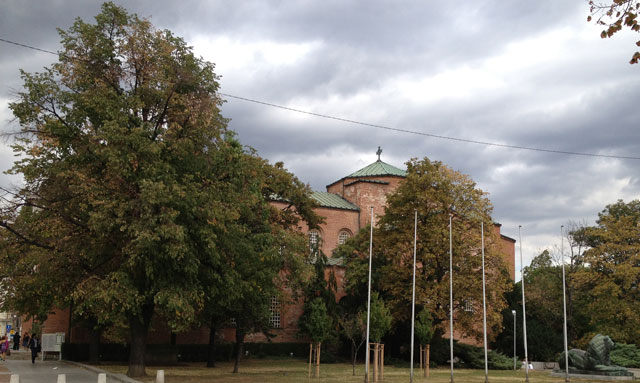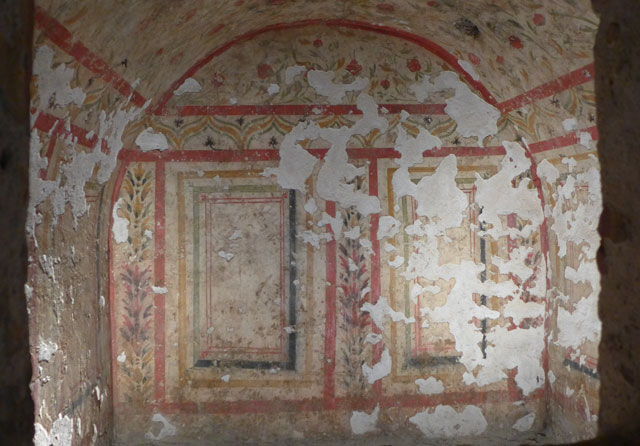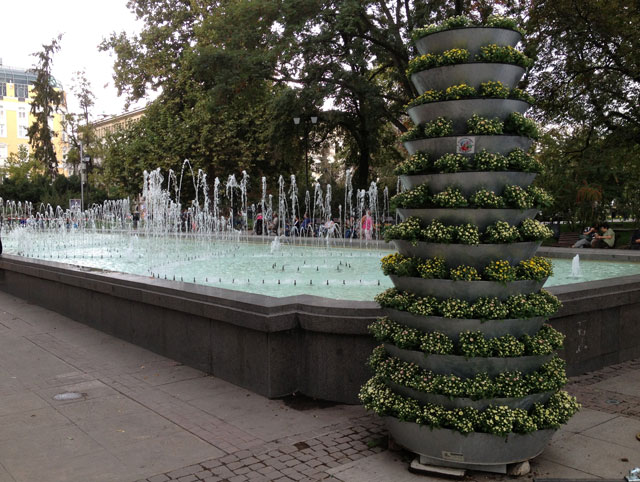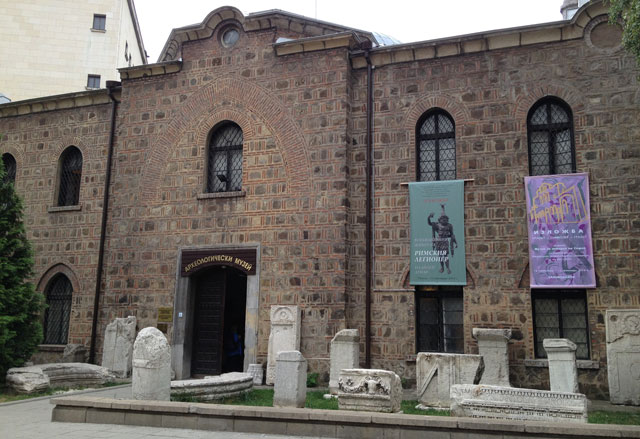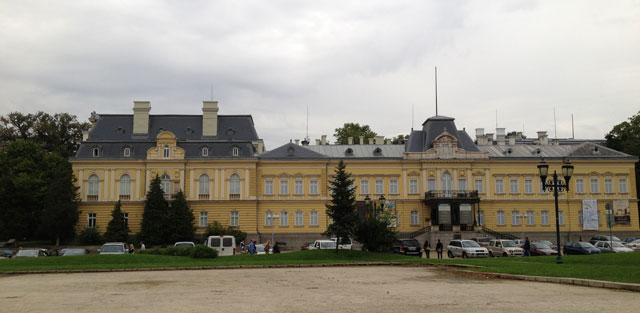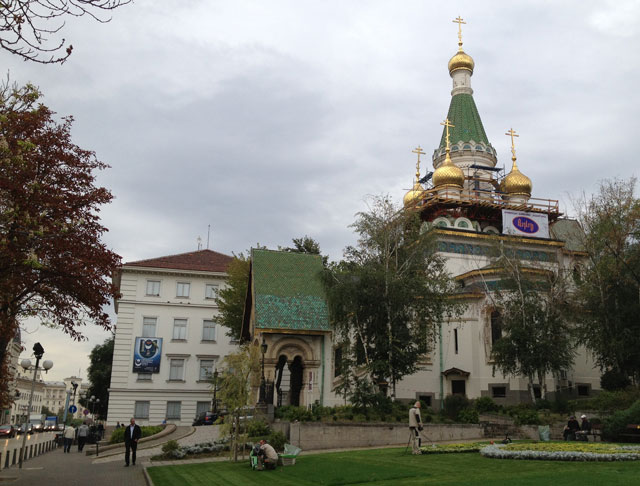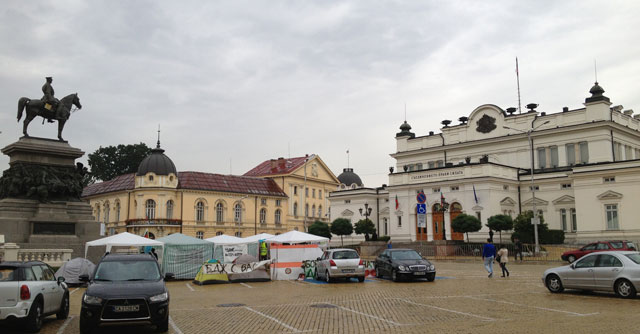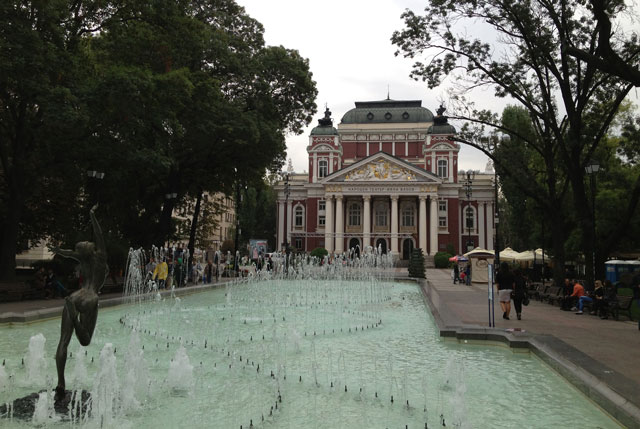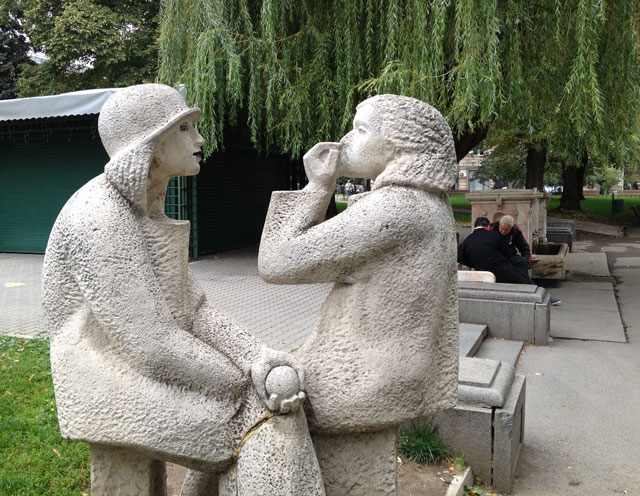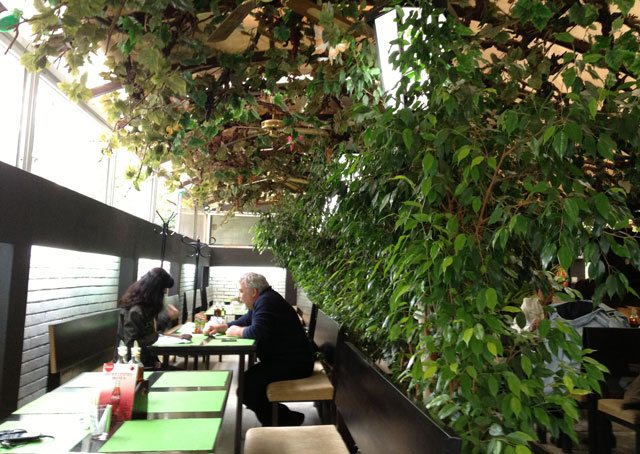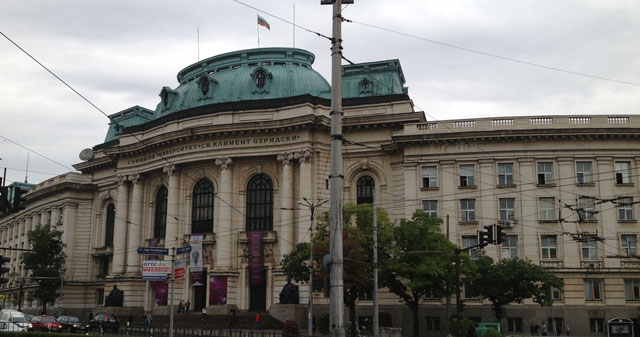
When we were first offered a home exchange in Bulgaria, we said, “Why not?” But as the time got closer and I had time to take a closer look at what was awaiting us, I began to have doubts particularly after visiting Slovakia and Hungary during the summer. My first impressions of Sofia confirmed my reticence. The poverty and standard of living are devastating. The newly restored religious buildings seem to accentuate them even further. These photos were taken during our first walk around the neighbourhood where we are staying in a comfortable recently decorated flat.
The view from the balcony of our modern building when we look leftThe view from our balcony when we look right
Our street name, Veslets, in cyrillic
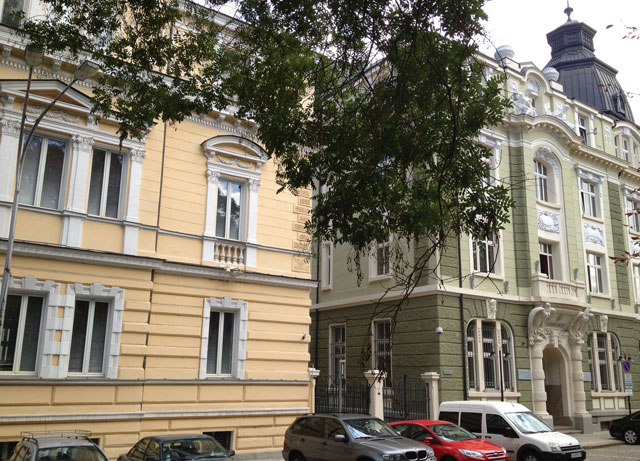
A building in our street, which shows how beautiful some of the apartment buildings must have been in the pastA corner shop in our streetThe first monument we saw, the former Party HouseThe formerly magnificent baths of Sofia whose restoration has been dragging on for many years. They will eventually house a museum of the history of Sofia. On either side, families with bottles of beer and vodka, were having a before-dinner drink …The Banya Bashi mosque built in 1576, next to the baths. Note the street light and electrical installations on the leftA typical street corner. The streets are not very busy and there are not many cars.The Sofia Synagogue, built between 1905 and 1909 is a smaller replica of the Sephardic synagogue in Vienna destroyed during WWII and now the largest in Europe.Typical local shops displaying their wares on the pavement
The Halite, or former food market,built in 1909 has been restored with a rather dismal attempt at creating a food court
If you enjoyed reading this, don’t forget to subscribe to new posts using the subscription form on the top right – that way you’ll get them directly on your smart phone or in your mail box! And I love to hear your comments!
With the journées du patrimoine coming up, I thought I’d take a look at the word patrimoine. It’s an interesting word because it has so many different meanings all connected with its Latin origin of patrimonium meaning property inherited from a father.
Let’s start with the journées du patrimoine, which is part of the European Heritage Days initiative launched by the Council of Europe in 1991. The meaning is the same as the Unesco World Heritage List except that in French it’s just patrimoine mondial. You don’t need to follow it with “list” or “site” e.g. Capitale de la Chrétienté au Moyen-âge, Avignon a gardé de son Histoire un patrimoine d’exception dont une grande partie est inscrite au Patrimoine Mondial de l’Unesco. Points for the person who finds a decent translation for that sentence!
Wachau, a Unesco world heritage site in Austria
Then we have patrimoine héréditaire – inheritance – which obviously means that a patrimoine is not necessarily inherited. Any one can have a patrimoine immobilier, for example, and it doesn’t have to be inherited. In this case, we’d talk about property or real estate in English. Patrimoine social, on the other hand, designates public housing.
While we’re at it, we can have a look at immobilier which is opposed to mobilier. You’ve no doubt seen “Agence immobilière” on what is obviously a real estate office. The root is mobilis from the very movere to move which means that immobilier can’t be moved. In French, it’s both an adjective and a noun: investir dans l’immobilier – to invest in real estate.
There’s another word that home owners in France will be familiar with and that’s foncier as in taxe foncière or property tax. The word comes from fonds de terre, fonds having the same root as our fund, and terre meaning earth. A property owner is a propriétaire foncier and income from property is revenus fonciers (note the plural).
Mobilier is the opposite: it can be moved, and is the usual word for furniture. It also has the more technical meaning of personal or movable property. Mobilier de bureau is office furniture, as you would expect and mobilier urban is street furniture, which always seems less strange to me in French than in English.
And what do we with fixtures and fittings in French? The usual term is aménagements intérieurs while fixtures in a building in legal terms is bien immeuble. But you may already have heard immeuble in another context.
In legal terms, it means real estate, but is generally used to mean a block of flats or offices i.e. un immeuble d’habitation or un immeuble de bureaux. Un immeuble de sept étages has a ground floor and seven upper floors, known as an eight-storey building in the US, if I’m not mistaken and a seven-floor building in the UK and Australia. And just in case you are thinking of investing here, an investment property is un immeuble de rapport.
And if you’re in France or Europe on 14th or 15th September, enjoy the journées des patrimoine.
If you enjoyed reading this, don’t forget to subscribe to new posts – that way you’ll get them directly on your smart phone or in your mail box! And I love to hear your comments!
Surprisingly for an old city, Paris has very few mediaeval houses and when someone asked me recently where the oldest house was, I had absolutely no idea even though I later learnt that I had actually been inside!
3, rue Volta, long thought to be the oldest house in Paris
For very many years, it was thought that the house at n°3 rue Volta in the 3ème arrondissement was the oldest in the capital. All the history manuals showed it to be the oldest and it was depicted in thousands of postcards. It wasn’t until 1979 that an historian finally proved that it was a copy built in 1644 by a Parisian bourgeois. That must have been a rude shock, particularly as the historian was a woman!
Mini Chinatown in rue Volta
I trekked off to have a look and found myself in a mini Chinatown. The half-timbered house with its stone pillars is now home to a Vietnamese restaurant called Taing Song-Heng where the same family has been serving two dishes, Pho and Bo Bun for twenty years.
L’Atelier d’Alexandre with its bike menu holder
I had also been told that there were two other mediaeval houses at n° 11-13 rue François Miron in the 4ème arrondissement. This is not an area I know well, and I found all sorts of intriguing things on the way such as this bike doubling as a menu holder. A young man was leaning against a car smoking, dressed in chef’s attire. “It’s a very old bike”, he said. “And a very unusual way of presenting a menu,” I replied. “I saw the idea in Malta. You won’t copy it, will you?”
Mediaeval houses at 11 & 13 rue François Morin
I eventually reached N° 11 which used to have a sign with a reaper while n°13 had a sheep. The oldest records show their existence at the beginning of the 16th century but they might have already been there in the 14th century. In 1508, a royal decree prohibited jettied upper floors because of the risk of collapse. As a result, the gable was removed from n° 13 in the 17th century. It was rebuilt in 1967 when the two houses were being restored. In 1607, an edict ordered the timbering on this type of houses to be covered with plaster to prevent fire. Original drawings were used to guide restoration.
Street level of 11 & 13 rue François Morin
My last visit was to n°51 rue de Montmorency, back in the 3ème arrondissement, to Nicolas Flamel’s house. As soon as I saw it, I remembered a Gargantuan meal there with French friends a few years ago. I suggested we have the food and wine pairing. It was excellent but I definitely wouldn’t recommend our choice. We still talk about it!
Nicolas Flamel’s house at 51, rue Montmorency, the oldest known house in Paris, dated 1407
So, the oldest house in Paris only dates back to 1407. No half-timbering here. The façade is entirely made of stone, all straight lines and no curves. It was built by Nicolas Flamel, a scrivener and manuscript seller. The money he earnt from renting out the ground floor shops was used to house labourers and vegetable gardeners from the surrounding area.
The façade of Nicolas Flamel’s house with its inscription
The inscription on the wall says, “We, working men and women living beneath the porch of this house, built in 1407, must each say an Our Father and an Ave Maria every day, to ask the grace of God to forgive poor sinners their trespasses. Amen.”
L’Auberge Nicolas Flamel, 51 Rue de Montmorency, 75003 Paris, 01 42 71 77 78
L’Atelier d’Alexandre, 26 rue de Beaubourg, 75003 Paris, 01 40 27 08 31
Taing Song-Heng, 3 rue Volta, 3 Rue Volta 75003 Paris, 01 42 78 31 70
If you enjoyed reading this, don’t forget to subscribe to new posts – that way you’ll get them directly on your smart phone or in your mail box! And I love to hear your comments!
I’ve added this post to Lou Messugo’s All About France link-up. Click to find other posts about France from other bloggers
Three very different posts for this Wednesday’s Blogger Round-up. French Moments takes us to visit 10 unusual churches in Paris; Heather from Lost in Arles takes us walking on the paths of Van Gogh; while Guide 2 Paris offers a very helpful and detailed analysis of discount passes in Paris. Enjoy!
10 most unusual churches in Paris
by French Moments, a Sydney-based organisation with an international focus which promotes the French language and culture to English-speakers worldwide. Their French team is all about the language, culture and experience
Today, let’s have a look at 10 most unusual churches in Paris! When we think about churches in Paris, famous sanctuaries promptly come to mind: the Notre-Dame cathedral and its fantastic buttresses, the Gothic masterpiece of the Sainte-Chapelle, or the church of Saint-Germain-des-Prés with its Romanesque bell tower.
But there are far more interesting churches to discover while staying in the City of Light, some of them not very well-known. Follow this guide to a chronological discover of the 10 most unusual churches in Paris… Read more
Walking in the Paths of Van Gogh
by Heather Robinson from Lost in Arles, an American writer and photographer living in Arles who offers us meanderings through all that makes life in a small town in Provence worth while.
When Remi first made the fateful suggestion that we swing by the town of Arles on our way home from the Visa Pour L’Image Photography Festival in 2003, one name flashed into my mind: Vincent Van Gogh. It was reason enough for me to quickly agree, as I used to regularly visit his masterpieces at the Metropolitan Museum of Art and MOMA in Manhattan (and I still make pilgrimages to say hello whenever I return for a visit). I was only vaguely impressed by the town’s Roman monuments but was immediately transported by the light, his light. It was one of the reasons why we fell in love with this small Provençal town. Read more
Paris Discount Passes
by Guide2Paris which aims to be the complete source of information in English about the Ile-de-France region of France which includes the city of Paris. Designed specifically for English speakers visiting Paris or the region of Ile-de-France, contemplating buying property in Paris or those already living in Paris
There are a number of different Paris discount passes which are intended for tourists to maximise their holidays in the City of Light and sometimes significant savings can be made. Most cards will allow cheaper entry into museums and monuments, discounts on tours and in some cases includes free travel on public transport. It is important to discover what is included in each of the discount passes listed below as sometimes you need to fit in a lot of activities to actually save money. The best advice we can give is to carefully consider what you would like to do in Paris and then see if this corresponds with what is available with the card. Read more
If you enjoyed reading this, don’t forget to subscribe to new posts – that way you’ll get them directly on your smart phone or in your mail box! And I love to hear your comments!
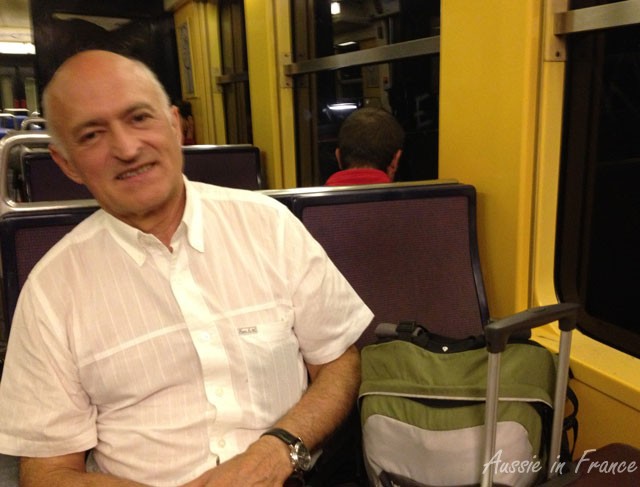
We’re about to miss the European heritage weekend in Paris for the second year in a row. However, we’ll be in Blois so I’m hoping to make some new discoveries.
Poster on the window of the Ministry of Culture with its not very inventive graphics
The wonderful thing about the heritage weekend or journées du patrimoine is that buildings usually closed to the public open their doors, mostly free of charge. One of the drawbacks is the crowds, particularly at venues such as the presidential palace at Matignon and Paris city hall (Hôtel de Ville).
The front of the Banque de France at n° 31
But if you take a look at the list on the paris.fr website you’ll see that there are a lot of other places you’ve never heard of and that are definitely worth a visit.
Looking down to the fireplace with the bust of Louis XIV
One of my favourites, which is never crowded, particularly in the morning, is the French reserve bank or Banque de France, in the 1st arrondissement, which contains the beautiful Hôtel de Toulouse built in the mid 17th century by Mansart for Louis Phélipeaux, seigneur de la Vrillière and so called after it was bought in 1713 by the Count of Toulouse, the second legitimised son of Louis XIV and Madame de Montespan.
Inner courtyard seen from the Gallery
From the outside, it doesn’t look anything special, but it has several treasures, not the least of which is the Galerie Dorée or Golden Gallery, 40 m long by 6.50 m wide. It was initially designed to present De la Vrillière’s collection of Italian masters. When the Count of Toulouse came along, he kept the paintings and incorporated them into the new decor which is a stunning example of the Régence style.
End of the gallery leading to the main entrance
The ceiling is a fresco by François Perrier and represents the sun surround by the four elements. In the centre, we have Apollo the sun god in his chariot, on the right of the door, Water represented by Neptune and Thetis, on the left, Air represented by Juno asking Aeolus to set the winds free. On the right of the magnificent fireplace, Earth represented by the abduction of Proserpine by Pluto and on the left, Fire represented by the cupids of Jupiter and Semele.
One of the sparkling clean chandeliers
Mouldings, chandeliers, mythological allegories, trophies and animal motifs abound fully expressing the Régence style, which formed a transition between the rich solemnity of the Louis XIV style and the baroque elegance of Louis XV.
Wood panelling hiding a door into the Gallery
You’ll also see the Council Dining Room which its sculptured wooden panels which is thought to come from the former Château de Quincy-sous-Sénart, a hunting lodge owned by the Count of Provence, Louis XVI’s brother. This is definitely my favourite after the Golden Gallery.
Tapestries in the Council Room
But I also love the Council Room with its 5 Brussels tapistries from the mid 17th century, forming a sort of winter garden popular in Flanders throughout the century.
A close-up of Louis XIV
The beautifully decorated governor’s offices are also open to the public. The main entrance at n° 31 is through the new atrium, which is considered to be somewhat of a technological feat.
For those who won’t be in Paris next weekend, you might like to go on a virtual visit of the Golden Gallery on the website of the Banque de France.
Banque de France 31 rue Croix-des-Petits-Champs, 75001 Paris.
Saturday 14 and Sunday 15 September, 10 am to 7 pm (last entry at 6 pm)
If you enjoyed reading this, don’t forget to subscribe to new posts – that way you’ll get them directly on your smart phone or in your mail box! And I love to hear your comments!
Regular readers will know that I have the great fortune to actually live in the Palais Royal overlooking the fountain. I shall never tire of taking photos. Here are some taken on a sunny afternoon at the beginning of September. This time next year, we will be in the throes of moving permanently to Blois to live in our beautiful Renaissance home, Closerie Falaiseau which is currently a holiday rental.
Restaurant du Palais RoyalYou can just see the time canon on the rightI snapped this while the photographer was still getting readyJust relaxing!Our appartment is directly opposite the fountainGalérie VivienneOysters on Sunday on our balconyLooking down towards rue de BeaujolaisTaken looking left from my balcony
If you enjoyed reading this, don’t forget to subscribe to new posts – that way you’ll get them directly on your smart phone or in your mail box! And I love to hear your comments!
It took me a while to realise what bonne question actually means in French. Initially, I took it to literally mean “good question” as in English. But it’s not exactly the same.
For example, I asked the following question of an American company recently: “Can you tell me the difference between air conditioning and air treatment?”
The answer came back: “Good question! Air Conditioning typically refers to cooling the air while Air Treatment can refer to cooling, heating, filtering, purifying, humidifying or dehumidifying the air.”
I took that to mean that he thought my question was appropriate and that it was important to know the difference and that he knew what it was.
Now, in French, if someone says bonne question, it usually means that they haven’t the foggiest idea of the answer and are playing for time. They may have a stab (typically French, particularly if you are male) but by saying bonne question, they are telling you that it’s only guess work.
Before writing this post, I checked out the internet just to make sure I wasn’t making it up and was surprised to learn on www.urbandictionary.com that it can have the same meaning in English. Here’s the entry:
“That’s a good question: A phrase usually indicating that the speaker has absolutely no idea how to answer said question. Often used to stall for time.
Photography teacher walking in on students who should be at pep rally: What are you doing here?
Sreya: That’s a good question!”
So there you go. I know that whenever Jean Michel says bonne question that the question has never even occurred to him before and he certainly doesn’t know the answer.
How about you? What is your experience in the matter?
If you enjoyed reading this, don’t forget to subscribe to new posts – that way you’ll get them directly on your smart phone or in your mail box! And I love to hear your comments!
I have often quoted paragraphs from Kathy Stanford’s blog Femmes Francophiles in my Wednesday’s Bloggers Round-up. Kathy’s permanent home is in Adelaide, but she comes to France as often as she can. In my contribution this month to My French Life, the global community & magazine for francophiles & French, I tell the fascinating story of how she manages to reconcile her love for France and her life in Australia. Enjoy!
Meet Kathy, a francophile with big dreams
Thirteen years ago, when she was preparing for a trip to France, Kathy became enthralled with the French language and culture.
This was the start of her French dilemma, because her home and husband are in Adelaide and her French connection has grown stronger with the passing years.
She began learning French at the Alliance Française in Adelaide to ressurect her dim memories of school French. She has done several courses in France; in Rouen, Toulouse and Vendôme – as well as Noumea. She has worked as a volunteer for the Alliance Française in Rouen. Read more
Another all-Australian bloggers round-up this Wednesday, with advice from the ever-practical Jo Karnaghan from Frugal First Class Travel on safe travel for solo women travellers; a report from Carolyn from Holidays to Europe on her recent cycling tour in a different part of Austria from us; and tips on transferring from Orly airport to various train stations in Paris from A House in France, written by an Aussie couple living in the south of France. Enjoy!
Travelling safely – A guide for solo woman travellers
by Jo Karnaghan from Frugal First Class Travel, an Australian who loves to travel – especially in Europe – and who has gradually learned how to have a First Class trip on an economy budget, without missing out on anything!
One of my lovely readers, Linda, recently contacted me about hotels in Paris that would be safe for her as a solo traveller. Now, most of the time I travel in Europe I also travel alone. It therefore got me thinking about the things I do to make sure I keep myself safe when I’m travelling solo. Travelling safely is an important travel skill to master, so here are my top tips for safe and confident solo travel:
1. Pack light
I know, I say this all the time, but packing light is travelling safe. If you pack lightly you have less stuff to worry about. On the train, it is easier to keep track of your luggage. Read more
Scenery, sunshine and saddle bags: My Austrian Lakes cycling tour
by Carolyn from Holidays to Europe, an Australian based business passionate about sharing their European travel expertise and helping travellers to experience the holiday in Europe they have always dreamed of
There are some countries that hold a special place in a traveller’s heart and to me, Austria is one of those places. So what better way to get a closer look at a part of Austria I hadn’t visited before than on a cycling tour? I spent nine fantastic days in July doing just that, discovering some wonderful scenery and an appreciation for ‘slow travel’ along the way.
After comparing a few different itineraries offered by various companies I selected the 9 day Austrian Lakes Hike and Bike tour sold through UTracks in Australia. One of the big sellers for me was the fact that this tour spends two nights at Hallstatt, a town I had long wanted to visit. As the itinerary featured both walking days and cycling days, it also gave me the opportunity to have a ‘rest’ day on the walking days should I decide to. Read more
Paris-Orly train transfer tips
by A House in France – 2 Aussies living part-time in France who share their experiences
We had always flown in and out of Paris from Charles de Gaulle (CDG) airport until recently.
Our regional train down to our house in central France departs from Gare d’Austerlitz, and on one of our many jaunts through that train station we noticed that there were signs indicating the way to catch a train to Orly airport.
So when we found some cheap flights departing from Orly we thought it would be a good chance to check it out and compare it with the ease of getting to and from CDG. Read more
It’s Black Cat’s last day in Paris before she goes to New York to look for a job. I’m delighted for her, of course, because she’s following her dream, just as I did 38 years ago, but I am very sad to see her go. We’ve decided not to say goodbye at the airport so we part ways in the street. I go back upstairs and try to work. When Jean Michel phones at five to say he’s finished for the day, I suggest we go cycling along the Marne.
Looking towards Pont de Bry
The cycle path from Pont de Bry to the old chocolate factory in Champs sur Marne remains our favourite ride and is filled with happy memories of when we lived in Fontenay sous Bois and could easily go there at the end of the day.
And we love stopping off on the way back for a barbecued côte de boeuf at La Pergola.
The inauspicious façade of the Pergola
As it’s the last Friday in August, there is very little traffic so we only take about three-quarters of an hour to get there. We’ve already phoned La Pergola to check they’re open and make sure our côte de boeuf will be ready when we arrive after cycling for an hour along the Marne. The owner recognises knows us as le couple en vélo even if we haven’t been there since last summer.
Swans on the Marne
As soon as we get on our bikes, I start feeling better. It’s a lovely day and the Marne is full of swans. We ride down to the chocolate factory and back to La Pergola. Our favourite table in the garden is waiting for us.
The Pergola garden
The côte de bœuf arrives and it’s enormous. Since we began intermittent fasting in June , our appetite has diminished somewhat. We manage to finish it anyway particularly as the meat is delicious. Jean Michel even orders tarte tatin for dessert! Fortunately it doesn’t have any cream with it.
Wearing my headlight
It’s completely dark by the time we finish and we still have a 20-minute ride back to the car so we don our headlights and windcheaters and off we go. On the way, we pass the other, more recently opened La Pergola with its bright neon lights. I think it’s an eyesore.
The other neon-lit Pergola
Next morning we’re not even remotely hungry so decide to have a fast day. Today is the first day of Black Cat’s new life! Good luck!
La Pergola, 87, promenade Hermann Régnier, 93460 Gournay Sur Marne, 01 43 05 36 56