All posts by Rosemary Kneipp

Bread Baking Day in Les Grouets

The sky is overcast and we’re hoping it’s not going to rain because we’re about to attend the 8th annual bread-making day in our neighbourhood, Les Grouets. It’s all happening at a bread-oven I’ve already photographed in the past.

8th annual bread baking day at Les Grouets
8th annual wood-fired bread baking day at Les Grouets

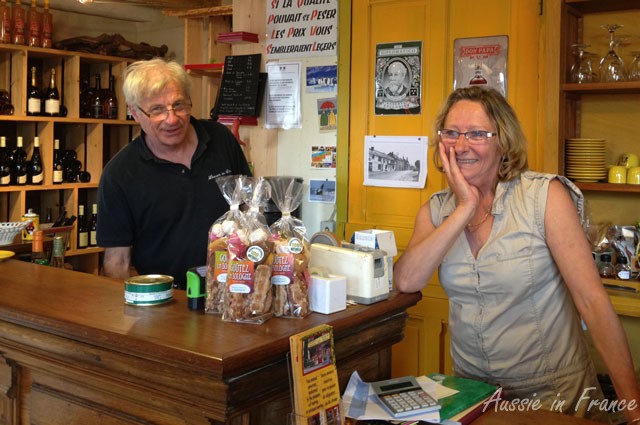
We didn’t expect to be in Blois this weekend so we’re not sure of the programme. We arrive about 11 am and things are already in full swing. The baker is busy baking, the man who sells Les Grouets biscuits on the market is busy talking, the local caterer is busy selling his wares, the local wine grower is busy pouring glasses of wine and the other female members of the Amis des Grouets association are busy selling loaves of grouetin bread and brioche.

Our neighbours talking to the biscuit baker
Our neighbours talking to the biscuit maker

After talking to the biscuit maker and the wine grower, we make our way to the main tent to buy some bread. We are welcomed by the president of the association who is squeezing an endless succession of limes for the midday apéritif – for all those present, though it’s better if we buy something, he explains.

Sellng grouetin loaves and brioche

Some of our neighbours arrive to buy pizzas so we put in an order too. Jean Michel goes off to put the bread and brioche in the car while I continue talking to the neighbours. Then I spy the lilac lady who used to live in our “house of happiness”

The temporary baker discussing his trade

I go over to see her and see exclaims in surprise, “Oh, how lovely ! You said you wouldn’t be here this weekend. Let me introduce you to everyone.” It turns out the baker (who’s not a baker the rest of the time, just the owner of the bread-oven) is her brother.

The bread oven the rest of the year

She then introduces us to her sister-in-law and two nieces who used to live in our little house. She is very generous in her praise of us and tells them all that we are très sympathiques. We recount our lilac story and they soon start reminiscing about the little house and the middle house. We learn that their aunts lived in the house on the other side of ours as well.

Who's for some wine?
Who’s for some wine? And maybe some of that paella?

We all go into the tent for our aperitif and the lilac lady insists that we stay with them. We buy some little freshly-baked bread rolls with rillettes and sardines to go with our lime, sparkling white wine and dash-of-cointreau cocktail. Better not have too many of them!

Our pizza in the oven

Somehow the pizza orders have gotten well behind but at 2 pm, we eventually collect ours and take it home to eat in the little house which has taken on a new dimension now that we have met the last people to have lived there!

And in the oven it goes!

We’re looking forward to the next event when we’re living full-time in Les Grouets – the end-of-year dinner at the little château at the end of our street. And next year, I’ll be able to take my own bread along to bake as there is little chance of our own bread oven being functional for some time yet!

Photos of the Week – Tuileries Gardens and a Royal Rose

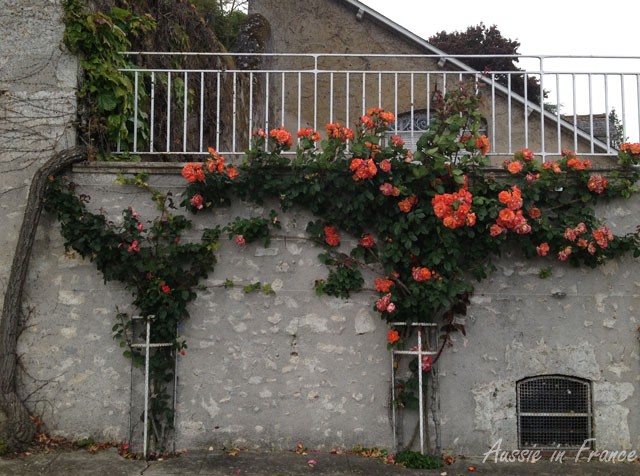
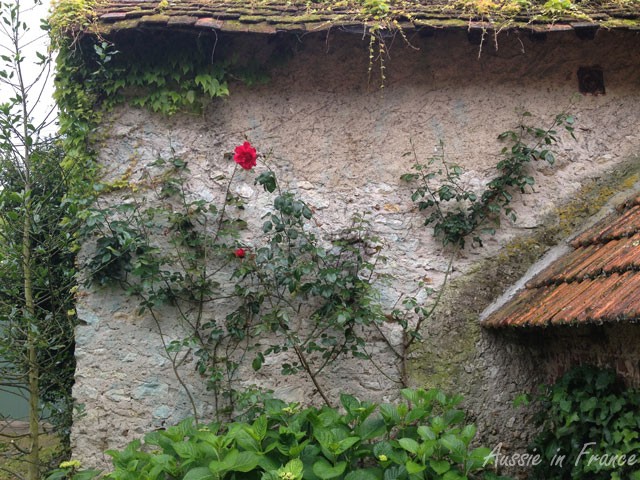
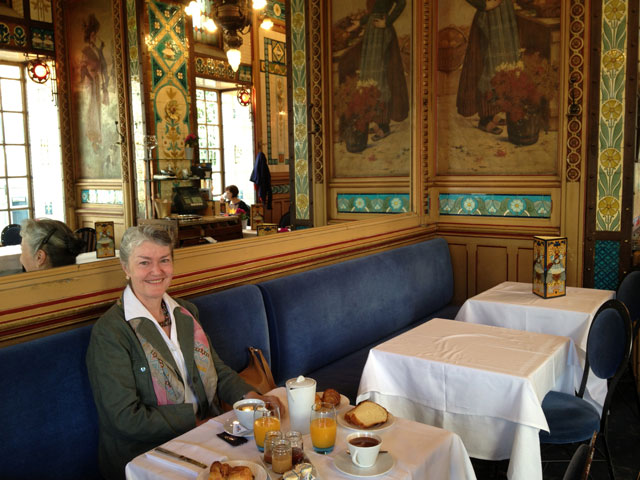
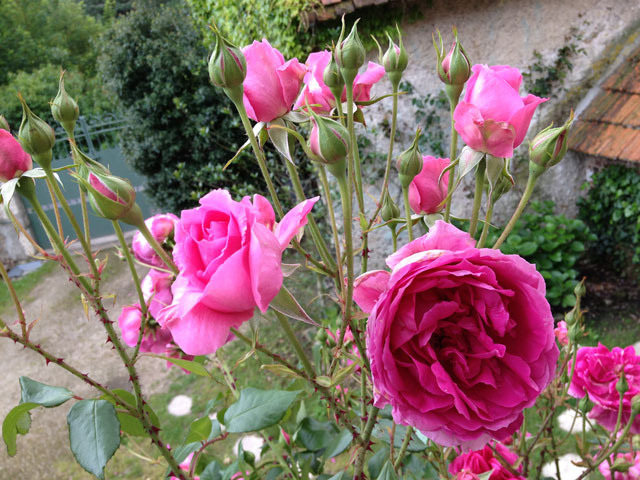
A meeting with some Australian friends on a sunny day took me to my favourite café in the Tuileries – Chez Diane. On the way back, I went to see my favourite rose in the Palais Royal gardens. I don’t know what it’s called but it has the most amazing fragrance. We’re going to have another try at growing it from a cutting in August.

Boats on the pond in the Tuileries Gardens
Sailing boats on the pond in the Tuileries Gardens
Irises in the Tuileries Garens with the Louvre in the background
Flower in the Tuileries Gardens with a cloudy sky
My favourite rose in the Palais Royal Gardens


Friday’s French – livret de famille, fiche, fichier

When I first got married in France and saw our livret de famille I thought it was very neat although I didn’t realise its importance. It’s a little book in which the details of your marriage are written and which is completed with each child. When you get divorced, your livret is updated as well. If you are not married, you are issued a livret de famille when your first child is born. If you separate or divorce, you get another one.

Each town hall chooses its own cover. The Paris one is velvet!

The first thing I discovered when my children when to school was the fiche d’état civil which was a piece of paper delivered by the town hall containing the information about an individual child taken from the livret. I even needed one when Black Cat started ballet! What a waste of time. What busy mother (or father) wants to go to the town hall and sit around waiting for a civil servant to copy information by hand onto a piece of paper?

At the time, the only ID in Australia was a drivers licence or passport and children certainly didn’t need ID if they stayed within the country! Fortunately, the fiche d’état civil was abandoned in the year 2000 and the carte d’identité became compulsory and free even for children.

Inside the livret. If you're not married, it starts with the mother's or father's details of birth. If the parents are separated or divorced, each can have a livret.
Inside the livret. If you’re not married, it starts with the mother’s or father’s details of birth. If the parents are separated or divorced, each can have a livret. The one on the right shows my divorce details.

So what exactly is a fiche, you might be wondering (état civil = civil status). It’s one of those funny words that has several meanings and no satisfactory translation usually because we don’t often have an equivalent concept.

The fiche d’état civil was a flimsy bit of A4 paper. A fiche can also be made of stiff paper or cardboard such as a fiche-cuisine which is a recipe card. Those cards we used to take notes on and put in a filing box in the old days were called fiches. Index cards, if I remember rightly.

At the doctor’s, you might be asked to fill out a fiche which I guess we would call a form. But there is also the word formulaire. I asked Jean Michel to explain the difference between fiche and formulaire. “Bonne question”, was his typical reply.

Its seems that a fiche is used to contain basic data whereas a formulaire is used to make a request, such as a passport or enrolment formula (fiche d’inscription).

Another popular fiche is the fiche de paie or pay slip which you are supposed to keep for your entire life if you want to get your pension.

A fiche technique is a specification sheet or spec.

A fichier is a set of fiches and therefore a file and that includes computer files which are also fichiers. If you want to be specific, you can say fichier informatique. Although ordinateur means a computer, the word informatique is used in most other contexts: informatique = computer science; il est dans l’informatique = he’s in computers; l’industrie informatique = computer industry.   By extension fichier d’adresses is a mailing list.

And to go back to livret, when else do we use the word in French? A livret de caisse d’épargne is a savings bankbook (pretty rare these days), and a livret scolaire is a report book, though I don’t know if they have those any more. Livret can also be used to describe any booklet and even a catalogue for an art show, for example.

An opera libretto is a livret d’opéra.

Perhaps you know other meanings of the word fiche?


Weekly Blogger Round-Up: Secret hot chocolate spots in Paris – The blue church in Bratislava – Good & bad in Istanbul

This week’s Blogger Round-Up starts with a post by Judy MacMahon from My French Life who shares 4 secrets spots for hot chocolate – I shall be the first to try! Next Phoebe from Lou Messugo takes us to visit the Blue Church in Bratislava – I’m so jealous because I didn’t know of its existence when I visited the city last summer. Anda from Travel Notes and Beyond then tells us the good and bad of Istanbul which will stand me in good stead when I go there in September. Enjoy!

Paris off the beaten path: 4 secret spots for hot chocolate

hot-chocolateThe French know their chocolat chaud like no one else: it’s how they begin their day! After all, there’s nothing quite like a proper French hot chocolate – except perhaps drinking said French hot chocolate in Paris…

There are the classic, well-known spots to sip a hot chocolate in Paris. And then there are those little cafés that the Parisians would love to keep for themselves; but secrets have a way of getting out. Read more

The Blue Church, Bratislava

by Phoebe from Lou Messugo, a traveller, francophile, expat, mum and foodie now living in Roquefort les Pins where she runs a gîte after many years of travelling and living in Asia, Eastern Europe and Australia

Blue_Church_Bratislava_2After two years of writing exclusively about France, mostly about the area where I live and French culture, I’m diverging into wider pastures, so this, my friends, is my first offering not about France. I’ve been itching to write about other places I’ve been and having just returned from a trip to Vienna, Budapest and Bratislava I’ve decided it’s now or never!
Bratislava, the tiny capital of Slovakia, is only an hour’s drive from Vienna, making it perfect for a day trip.  I had done a little research about the place and knew that I wanted to see the Blue Church, no matter what. And in this case the “no matter what” was a big black cloud and rumbles of thunder coming from the general direction of the church.  Read more

The Good and The Bad of Istanbul

by Anda from Travel Notes & Beyond, the Opinionated Travelogue of a Photo Maniac, is a Romanian-born citizen of Southern California who has never missed the opportunity to travel

istanbul_andaIt is difficult to judge a city of the size of Istanbul after a 5 day trip, but if I were to describe the little that I saw of it in just a few words, I would say: huge, crowded, majestic and uniqueHuge, because the city boundaries cover almost 2,000 square kilometers, while the metropolitan region, or the Province of Istanbul, covers 6,220 square kilometers. Crowded, because everywhere you go in Istanbul you walk almost shoulder to shoulder with thousands of other people. Read more


Secret Venice – Burano Lace

After visiting Erasmo and having lunch in Treporti, we are on the vaporetto to Burano along with a lot of other people. They all get out and we join the throng. I didn’t remember it being this crowded seven years ago.

Crowded streets in Burano near the vaporetto

We enter what looks like a very expensive lace and household linen shop and see a lady making lace by hand. Burano claims to have the oldest tradition in Europe for embroidered/needle lace which was created in about 1500 using a needle and thread.

Lace making in a shop in Burano

When we come out, we take the first turn to the right and find ourselves surprisingly alone. This is the Burano I remember from seven years ago, with its gaily coloured houses and quiet streets.

Gaily coloured houses in the back streets of Burano

We wander around the back streets for a while then down to the lagoon and back through the canal until we rejoin the main square Piazza Galuppi. I want to visit a shop we went to last time that has a lace museum inside but we can’t seem to find it.

One of the canals in Burano

On the right there is a sign for the Venetian Museo del Merlotto housed in the historic palace of Torcello which houses the Burano Lace School from 1872 to 1970, but it’s not what we’re looking for. All I can remember from last time is that it was about midday and was very hot!

Burano lace museum
Burano lace museum

I decide to ask so we go into a shop called Dalla Lidia Merletti and I explain what I’m looking for. Yes, the museum is down the back of the shop! Cabinets containing lace line the long corridor and at the end is a room full of more lace ncluding lace dresses.

A lace dress made of traditional Burano lace

At the top of a wooden staircase is another part of the collection, including French lace. In the 1600s Burano embroidery became increasingly complicated and it soon spread through the rest of Europe. France imported Burano lacemakers to work in the lacemaking areas of France, particularly Normandy. We see an example of French lace.

French lace
French lace

Back in the shop, we are asked in French if we want to buy anything. I would like to find a piece of local lace to make a fabric panel to use as a bedhead in Blois. A table runner would seem to be a good solution. We finally settle on a very expensive piece but Jean Michel easily manages to bring the price down by one-third! The shop is not very busy and we are soon talking about home exchanges with the entire staff.

We walk out very pleased with ourselves and make our way back towards the ferry. A crowd has gathered around a band of gondoliers with accordeons and other instruments, all singing very loudly, particularly one man in ordinary clothes wearing a gondolier’s hat. At the end, the gondoliers all applaud and he walks off into the crowd. He was just a passer-by!

Another canal
Another canal

An ice-cream seems a fitting way to end the day while waiting for the vaporetto to go back to Venice.

Travel Photos – Bridges in Venice

You can’t think of Venice without bridges and the ones at canal-level all humpbacked to let the gondolas and other boats through. I loved them all! These are a few of my favourites.

The iconic Rialto Bridge
The iconic Rialto Bridge on the Grand Canal
An unusual wooden bridge
One of the smallest bridges
Tall and metal.
Imagine walking out your front door onto a bridge!
Two bridges side by side. The one in the foreground is private of course.
Two bridges side by side. The one in the foreground is private of course and has its own little gate.
Washing over the canal.
There are fewer overhead bridges that you would imagine
There are fewer overhead bridges that you would imagine – it’s a tight squeeze for the gondola
A market boat with a sail!
The bridge at Campo Santi Giovanni e Paolo
I was surprised to see so many women with strollers rather than baby carriers
I was surprised to see so many parents with strollers rather than baby carriers
Look, no railings!
Look, no railings!
Another gondolier on his cell phone!
Bridge in the old ghetto quarter
A favourite resting place for gondoliers
The Bridge of Sighs from the canal side
The greenery on the right is wisteria. We just missed it!
The greenery on the right is wisteria. Unfortunately it was no longer in flower when we were there!


Friday’s French – terrible & formidable

“I love your blog. It’s terrible”. This comment was left on my daughter’s blog. I’d hate to think what the comment would be if she didn’t like the blog!

Un restaurant terrible dans la rue Montorgueil

The reader making the comment is French of course and not aware that terrible is something negative in English. Like formidable. Telling someone they are formidable in French means they’re great whereas in English it’s means you wouldn’t like to get on their wrong side. Hardly the same, is it? In French you’d say redoutable or even terrible.

Il est terrible can mean that he’s fantastic or awful depending on the context. That makes it easy to remember, doesn’t it?

Although terrible comes from the Latin terribilis which in turn comes from terrere, to frighten, it now has several meanings in French:

1. Inspiring terror or fear e.g. Une terrible catastrophe

2. Reaching a violent or considerable force e.g. Il s’est produit une terrible secousse – There was a terrible earthquake

3. Very unpleasant e.g. Il a un caractère terrible – He has an awful character

4. Representing a large quantity e.g. J’ai un travail terrible à faire – I’ve got an enormous amount of work to do

5. And more familiarly, out of the ordinary, inspiring admiration or surprise e.g. Il est arrivé avec une fille terrible – He turned up with a terrific girl.

And there you have it – the English version of terrible meaning something positive, namely terrific, which is usually positive in English, except for expressions such as “There was a terrific storm”.

Un autre restaurant dans la rue Montorgueil qui a l'air terrible
Un autre restaurant dans la rue Montorgueil qui a l’air terrible

Formidable, which comes from the Latin formidabilis, which in turn comes from formido, dread or terror, has kept its original meaning in English, whereas as its meaning in French is always positive, whether the idea is colossal or imposing e.g. Une volonté formidable – Incredible determination, inspiring admiration e.g. un type formidable – a terrific person, or something astonishing e.g. C’est quand même formidable qu’il ne vous ait rien dit – It’s really astonishing that he did say anything to you.

So if someone tells you about un restaurant terrible, you can add it to your list of places to go!

Weekly Blogger Round-Up: Mussels & Bread

This week’s blogger round-up is all about food. Paula McInerney from Contented Traveller reports on eating mussels in Brussels, which it’s a very popular food in France as well. We buy them on the Sunday market. And it’s the Fête du Pain in France, so I have two posts for you: first we have an historical explanation by The Good Life France then the ever-active Mary Kay from Out and About in Paris gives us Paris’ take on the bread festival including the best baguette competition. Enjoy!

Mussels in Brussels

by Paula McInerney from Contented Traveller. When they are not living in Australia, she and her husband Gordon travel the world, trying out houseboats, tatami mats, cave houses and over water bungalows, with serendipity as their watchword

mussels-in-brusselsI had to use the phrase Mussels in Brussels because it is a term that we have heard often and one that is quite amusing in a strange way. When we hear of a countries signature dish, we want to try it and we did.

I think that we fell for Brussels pretty much straight away and wondered at why so many people are so sceptical of this city as a destination. These are 2 posts where I stand up for Brussels as being a new hot spot for travellers Brussels: the new hot spot for travellers  and Brussels – a little taste leaves me hungrier. Add to the mix that you get to try the mussels in Brussels and you cannot go wrong in my opinion. Read more

Celebrating Bread in France

by The Good Life France, an independent on-line magazine about France and all things French, covering all aspects of daily life including healthcare, finance, utilities, education, property and a whole lot more

bread-2Bread, as everyone knows, plays a big part in the daily life of the French people – in fact 12 million people a day in France visit a bread shop.

From baguettes to boules – the long thin sticks of light bread, to the round tasty balls of bread, bread in France is part of the daily fabric of life.

Since 1996 a festival of bread has been held to celebrate the art of making real, traditional French breads. Taking place across France the festival runs for a week each May starting on the Monday before the 16th May – which is the Saint’s day of Saint-Honoré – the Patron Saint of bakers. Read more

Follow Your Nose to the Annual “Fête du Pain” (Bread Festival) in Paris

by Mary Kay from Out and About in Paris, an American by birth, Swiss by marriage, resident of Paris with a Navigo Pass for the metro that she feels compelled to use

best_baguette

Mmmm! If you’re planning to attend the annual “Fête du Pain” (Bread Festival”) in Paris, just follow your nose to the large tent in front of Notre-Dame Cathedral from May 8 to 18. It’s where French bakers and pastry chefs invite visitors to learn about one of France’s most revered professions. Not surprisingly, the celebration coincides with the name day of Saint-Honoré, the profession’s patron saint. Read more

Getting a Good Cappuccino in Venice

If you have been reading this blog for a while, you’ll know that I am a cappuccino freak and have finally managed to produce something fairly decent at home. In most French cafés, however, the cappuccino leaves something to be desired. So you can imagine how much I was looking forward to a good cappuccino in Venice.

First cappuccino near the Naval Museum
First cappuccino near the Maritime Museum

My first experience entirely lived up to expectation. We chose a small café opposite the lagoon, just down from the Maritime Museum. At the first sip, I knew it was good. Smooth and creamy the way I like it. Jean Michel had chosen some little cakes to go with it. Delicious.

A complimentary liqueur
Our complimentary liqueur in its cute little glass

So I was not prepared for the awful frothy one I got in one of our favourite restaurants, but since Italians don’t have cappuccino after midday, I forgave them. I did mention it however when we paid so they gave us some complimentary liqueur.

Disastrous frothy cappuccino

The next cappuccino was also a disaster. Instead of going back to the first place, we stopped at bigger café/restaurant next to the Zaccharia vaporetto station. As soon as I saw it, with that awful froth on top, I knew it was not the real stuff. We ate our cakes, paid the bill (which was twice that of the first place) and left.

Cappuccino at the pasticeria
Cappuccino at the pasticceria

The next place we tried was a pasticceria bar near the Ospedale. I went in and asked if they had “cappuccino vero“. The waiter looked askance but a second waiter – the one using the espresso machine said “si, cappuccino vero” – and it was!

Jean MIchel in front of the pasticceria near the Ospedale

So if you want real cappuccino in Venice, go to a small bar or a pasticceria and don’t order it after noon! Of course, now that I’ve tasted the real stuff again, I am no longer satisfied with my own efforts. I need to find an instructor!

Travel Photos – Venetian Doors

We did a lot of walking in Venice and saw a lot of doors with often intricate decorations. These are just a few!

This was my favourite, that we passed several times. I'd love to know who he is!
This was my favourite, that we passed several times. I’d love to know who he is!
We saw quite of few of these - the traditional forcula or oarlock from the gondolas
We saw quite of few of these – the traditional forcula or oarlock from the gondolas
Typical intercom cum letter box, with only one letter box, as usual.
Love these heads!
Love these heads!
Two somewhat intricate doors on a very old façade
Two very intricate doors on a very old façade
Iron door flanked by medallions
Iron door flanked by wrought-iron oculi
Metal door with decoration
Metal door with two laughing heads
Related Posts Plugin for WordPress, Blogger...