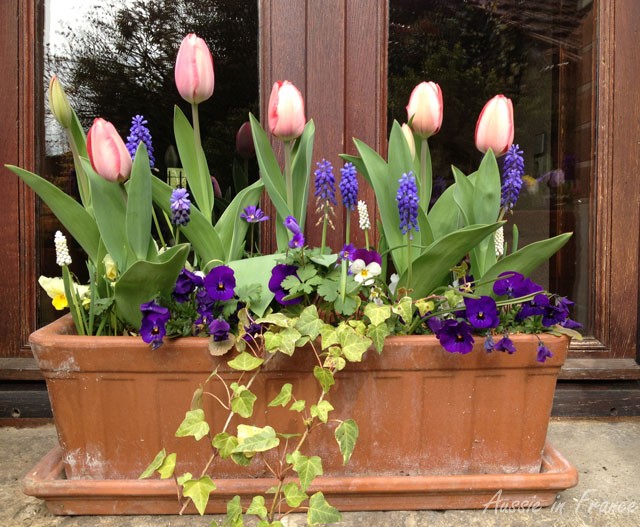
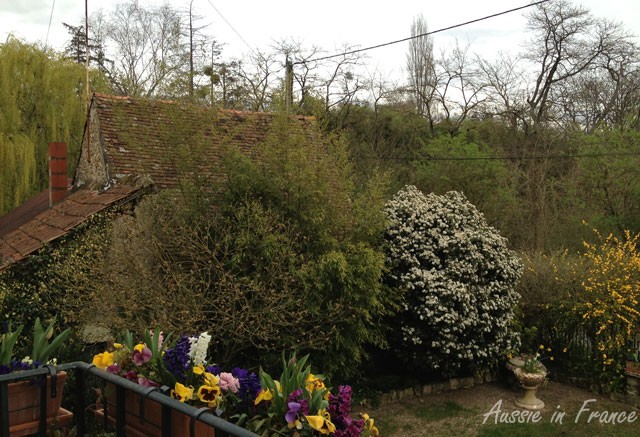
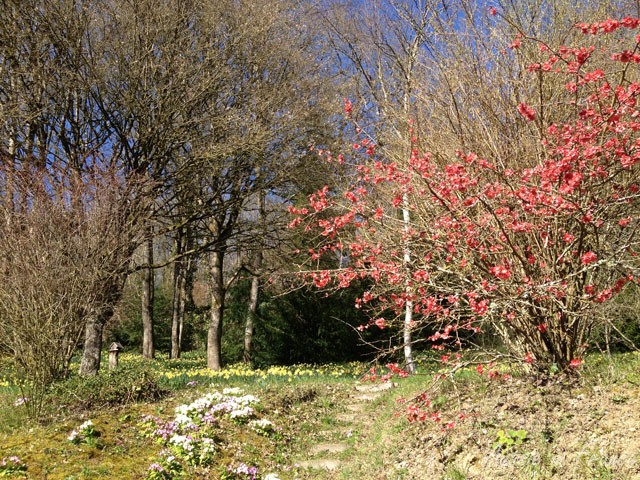
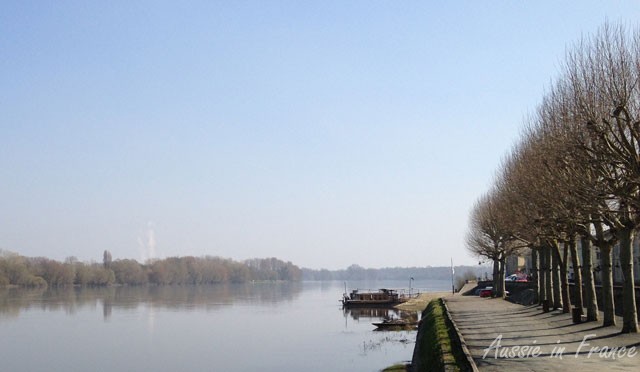
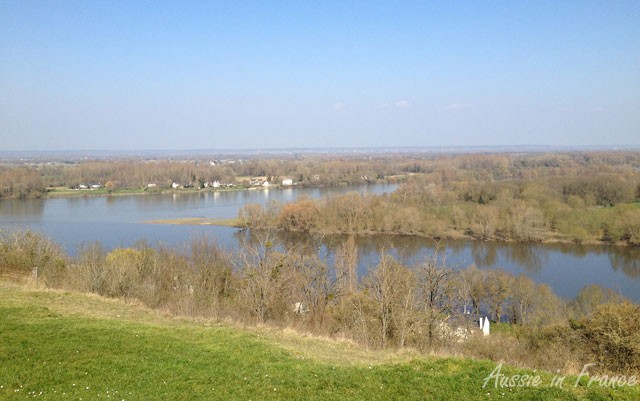
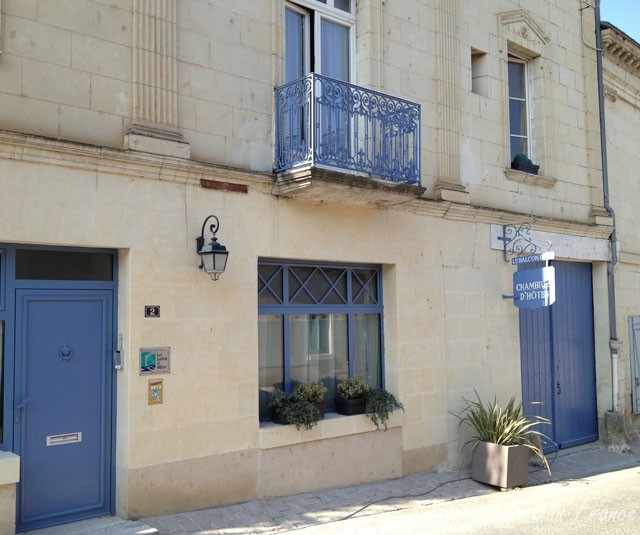
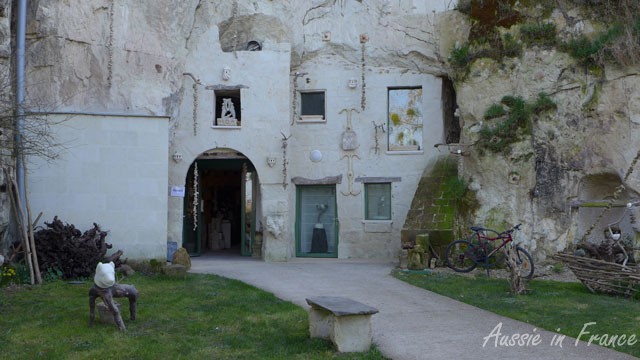
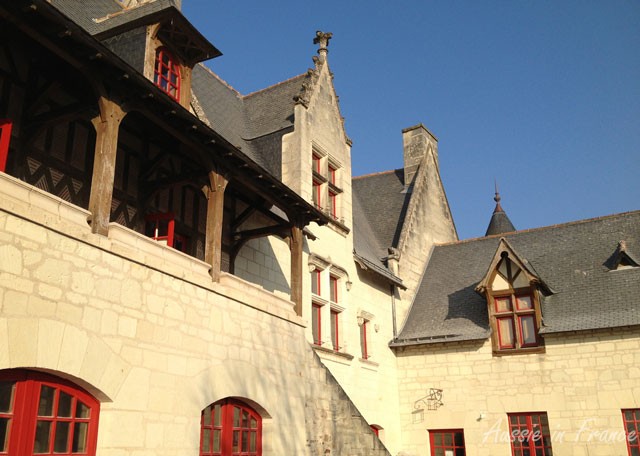
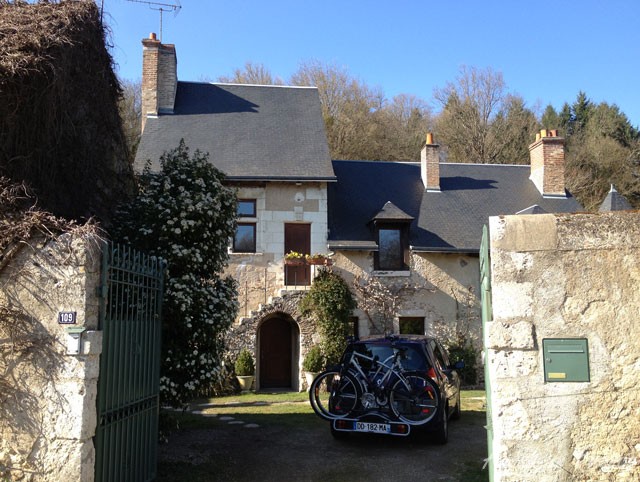
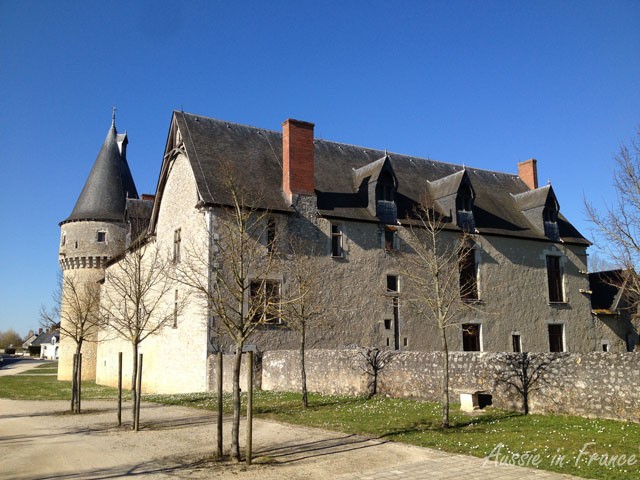
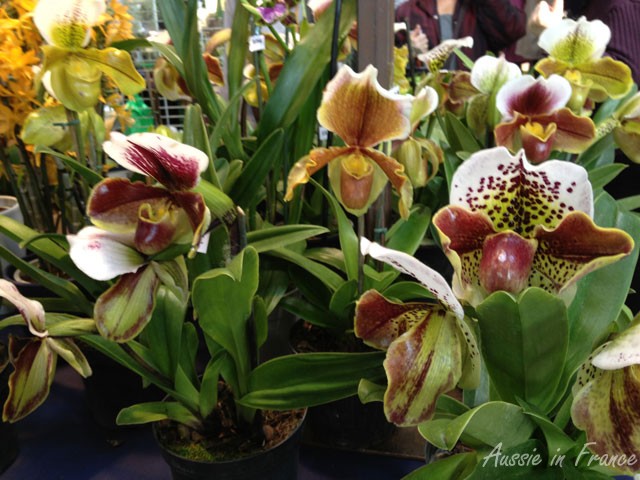
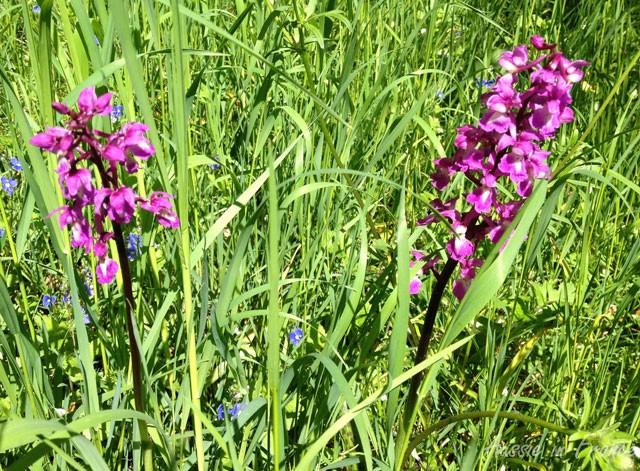
It’s now officially spring and we’re back in Blois for another couple of weeks. We couldn’t get over the difference in how many leaves have appeared on the trees in such a short time. The tulips are out as well so a visit to Château de Cheverny is scheduled for this week to see the 60,000 tulips planted every year. In the meantime, here are my favourites at Closerie Falaiseau and the view from upstairs.
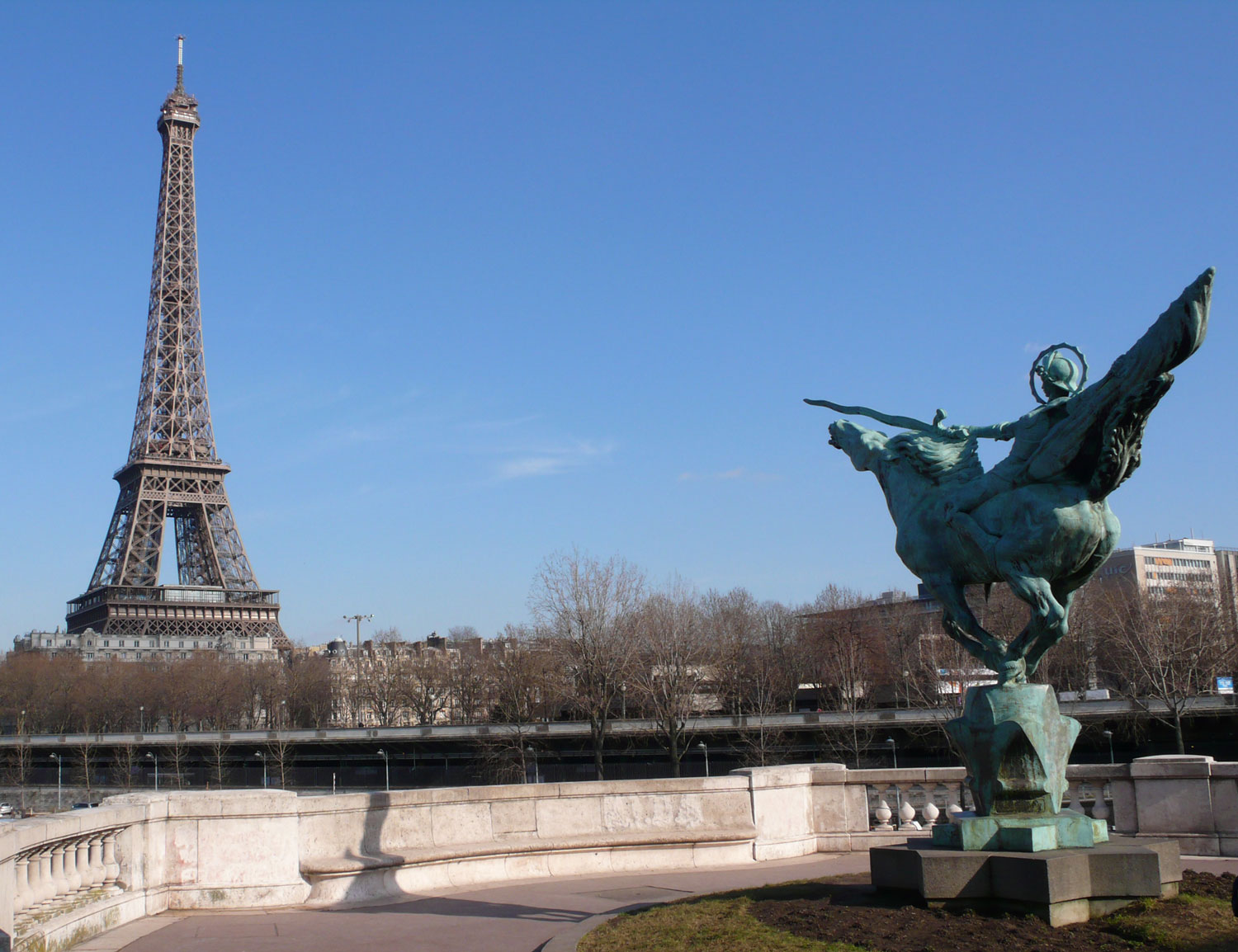
Viens ! Je t’emmène à la Tour Eiffel. Apporte des sandwichs, nous pouvons faire un pique-nique sur place. J’amènerai ma cousine avec moi.
Come on! I’ll take you to the Eiffel Tower. Bring some sandwiches – we can have a picnic there. I’ll bring my cousin with me.
Ce bus vous emmènera jusqu’à la Tour Eiffel
Now before we go any further, I’d just like to mention that the differences between these three verbs in French can be very subtle. Also, in English “bring” and “take” are not always used correctly e.g. “bring me the ball” but not “take me the ball”. “He took me to the cinema” and not “he brought me to the cinema”.
Emmener is fairly simple and corresponds to “take” used correctly in English:
Le bus vous emmènera jusqu’à la Tour Eiffel = The bus will take you to the Eiffel Tower
Je vous emmène dîner au restaurant = I shall take you out to eat
Il a emmené un livre dans sa chambre = He took a book to his room.
Amener and apporter are a diffcrent kettle of fish.
Apporter is used in the following cases:
N’oubliez pas d’apporter vos CD = Don’t forget to bring your CDs.
Un jeune homme a apporté ces fleurs = A young man brought these flowers.
Je vous apporte des bonnes nouvelles = I have some good news for you (literally I’m bringing you some good news).
Il doit nous apporter des preuves = He has to bring us proof.
Cette réforme apportera des changements = This reform will bring changes.
What do you notice about all the above sentences (taken straight out of my Larousse French dictionary, I might add)? They all refer to things such as CDs, flowers, proof, changes and sandwiches, and not people.
If people are involved, then amener must be used and not apporter.
Amenez votre ami à la maison = Bring your friend home
Dites-moi ce qui vous amène = Tell me what brought you.
Ce bus vous amène à la gare = This bus takes you to the station.
I can hear you jumping up and down! What about the other bus, the one that takes you to the Eiffel Tower? Ce bus vous emmènera jusqu’à la Tour Eiffel. All I can say is that if there is a difference, it’s so subtle that you won’t ever have to worry about it!
Most of the other uses of amener correspond to the idea of provoking a result.
Cette crise économique risque d’amener des problèmes sociaux = This economic crisis could cause social problems.
Amener l’eau à ébullition = Bring water to the boil.
Il a amené la conversation sur le problème de chomage = He steered the conversation towards the problem of unemployment.
Vous nous avez amené le beau temps = You brought us the good weather.
You might wonder with this last one why you wouldn’t say Vous nous avez apporté le beau temps. It’s because you can’t literally bring good weather the way you can with sandwiches, but cause the good weather to happen.
I wrote this post at the request of a reader so will be interested to know whether it has helped!
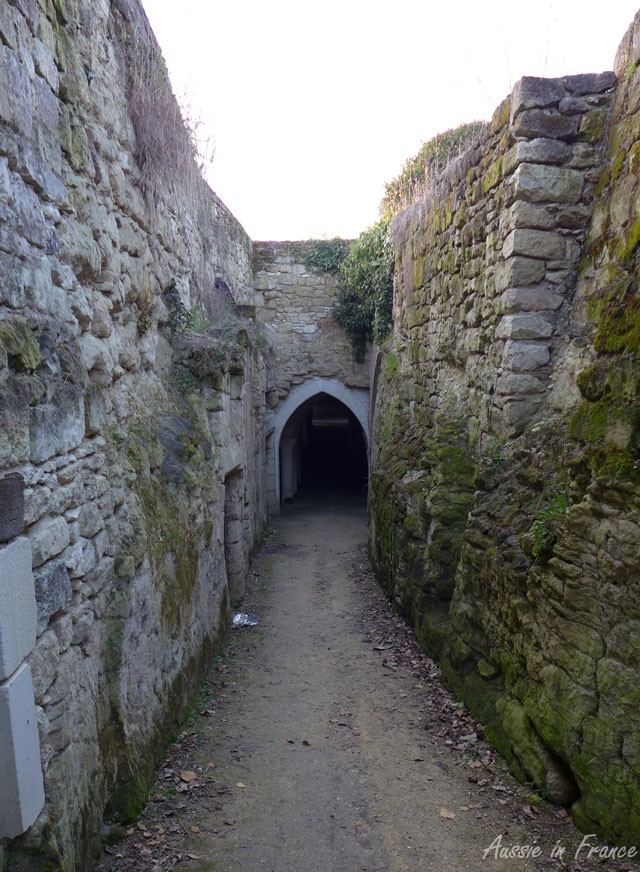
We’re on our way back from Saumur to Turquant, having just cycled up hill and down dale in the opposite direction. We’re on the riverside cycle path on the Loire à Vélo route, which has just taken us through a series of troglodyte houses parallel to the river when another hilly path takes us up a winding street on the other side of the village of Souzay.
The tunnel on our cycle bath
We have doubts – are we really supposed to go through that tunnel?
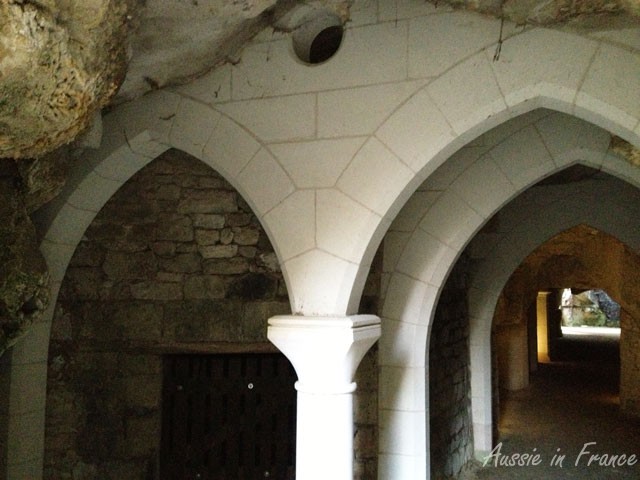
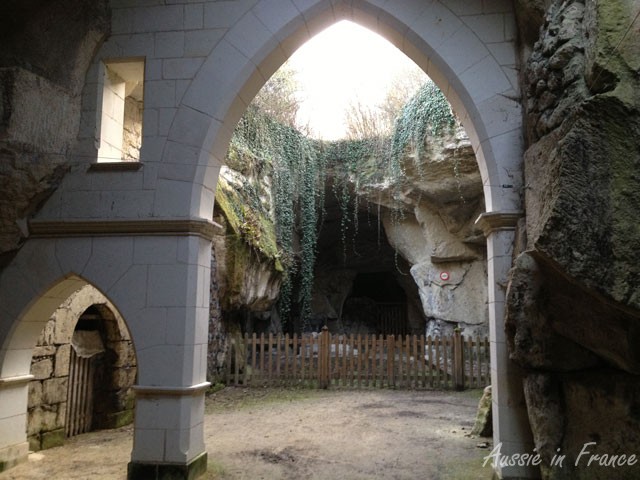
Vaulting at the entrance to the 11th century troglodyte shopping centre
We stare in amazement as we get closer. A vaulted troglodyte village!
Wine press shaft called a “jitte de pressoir”
The first thing we see is a “jitte de pressoir”, a sort of stack through which grapes were poured onto the wine presses below. Jean Michel explains that his grandfather used to have one.
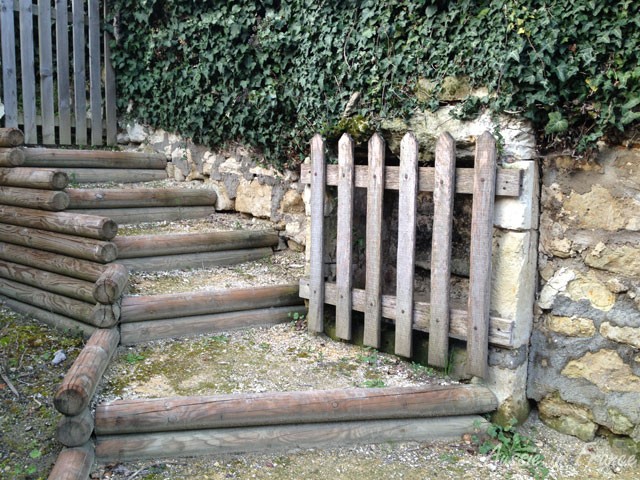
Village well now fenced off
The next thing we see is the village well which was shared by the villagers
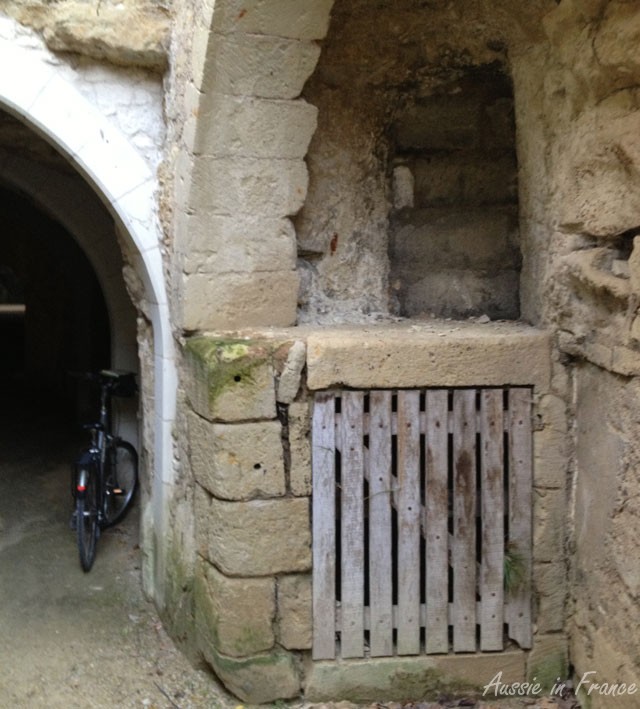
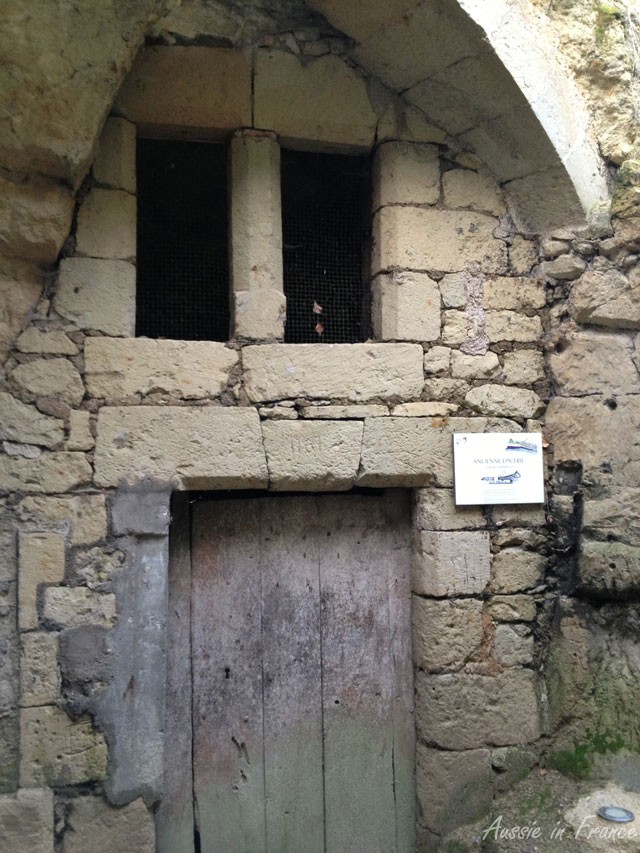
Mediaeval troglodyte grocery shop
We then come to a mediaeval grocery shop with mullion windows on rue de Commerce which, the sign tells us, operated as a busy trading street from the 11th to the 19th century! More shops follow. A troglodyte shopping centre!
A typical platform
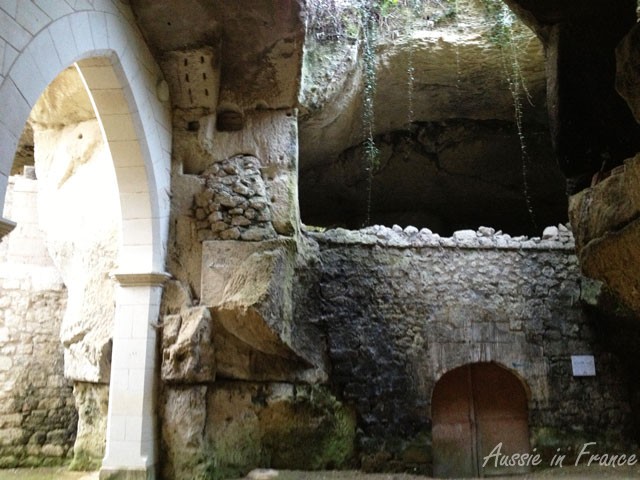
We continue through the underground labyrinth, with its many empty shops and overhead caves. It’s very eerie as it is late afternoon in spring and not another soul in site.
Subsidence has endangered some of the caves
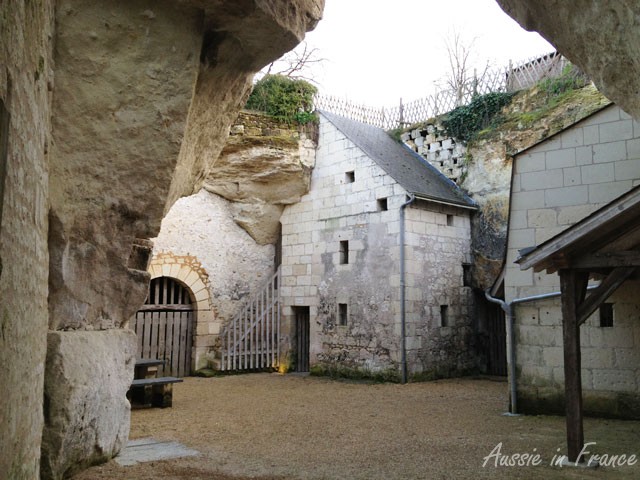
A more open area follows with an 18th century pigeon house. There is an oven with a long table and benches.
An 18th century pigeon house
Signs along the way explain consolidation techniques used since renovation began in 2002, the subsidence that produced the open areas and the quarrying of local tufa stone for construction, which is how the village originated .
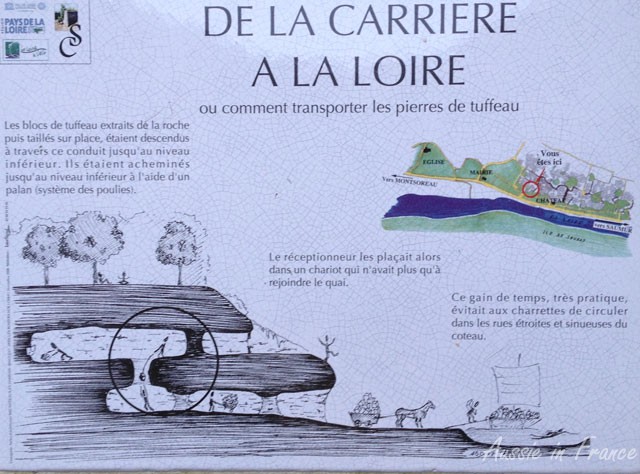
Taking quarried stone down to the Loire
The blocks of tufa extracted from the rock and cut to size were taken out through a shaft to the level below using a pulley system. The next person in line placed them in a cart that took them down to the river. This very practical timer saver meant the carts didn’t have to jostle their way through the narrow, winding hillside streets.
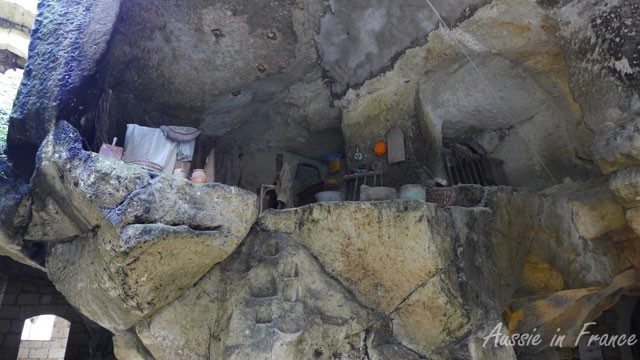
If you look closely, you can see table and chairs, cooking utensils and even a bed!
It’s easy to understand why the villagers quickly took over the resulting cavities once the stone had been removed. Certainly a cheap way to get a house. I’d like to know how they got across the shaft in the sketch though!
This post is an entry in Lou Messugo’s All About France montly link-up. For more posts about France from other bloggers, click here.
I originally thought the equation was arbre = tree, arbuste = shrub and buisson = bush. Well, I was wrong. The first time I saw a lilac bush, I thought it was a tree. It looked like a tree to me and certainly not like a bush (a lot of the flowers are way above my head), but when I used the word arbre I was immediately corrected. Non, c’est un arbuste.
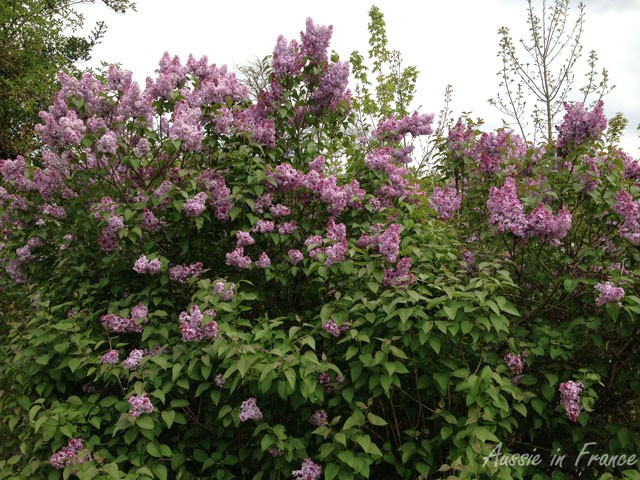
Le lilas est un arbuste
With the arrival of spring, there are lots of flowering shrubs, so I asked Jean Michel to define arbuste for me. “Un petit arbre“, he replied. “No it’s not.” I replied, “You could call a young conifer un petit arbre but it still wouldn’t be an arbuste.” So I checked my Larousse app. An arbuste is a woody perennial plant less than 10 metres in height whose branches don’t grow from the base.
Then it says in brackets that a young arbuste looks like an arbrisseau (oh dear, I hadn’t even thought of that one !) then starts looking like a tree when it loses its lowest branches.
An arbrisseau has branches coming from the base and doesn’t grow more than 4 metres high. No examples given for either of course.
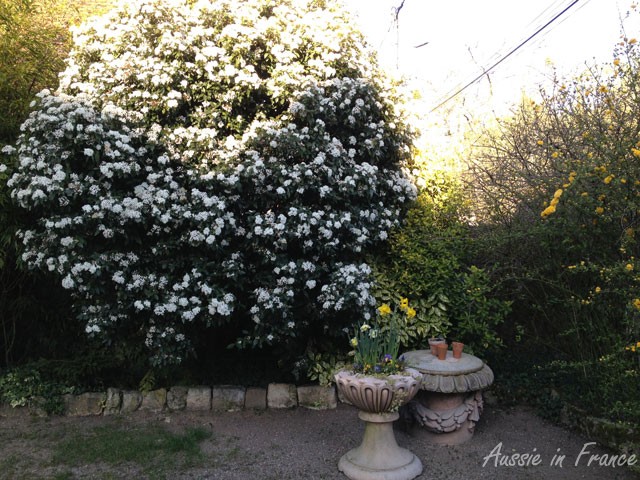
Le laurier tin est un arbrisseau
According to my Longman Dictionary of Contemporary English, a shrub is a small bush with several woody stems. A bush is a plant with many thin branches growing up from the ground.
Guess what an arbre is ? A woody perennial plant with branches that grows to at least 7 metres (where did they pull that one from?) and has permanent branches that only start a certain distance from the ground. It’s all relative, isn’t it ?
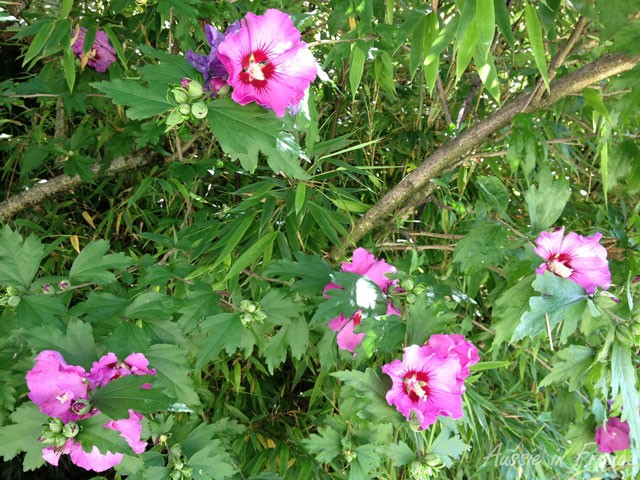
L’althéa est un arbuste.
A tree is a very tall plant that has branches and leaves and lives for many years, to quote the Longman. That’s a definition? “Very tall”? “Many years”? Hardly precise.
I then consulted my New Shorter Oxford in two volumes just in case it’s more cluey. Well, it’s not. A bush is a shrub or clump of shrubs with stems of moderate length. A shrub is a woody plant, smaller than a tree. A tree is a woody perennial plant, typically having a single stem or trunk growing to a considerable height and bearing lateral branches at some distance from the ground.
But listen to the next bit : More widely, any bush or shrub of erect growth with a single stem. Which explains my confusion between trees, shrubs and bushes!
Le cognassier japonais est un arbuste mais peut être taillé en buisson
I went through a few plants with Jean Michel to see what category he would put them in. Let’s see. Lilac is an arbuste, Japonica quince is either an arbuste or an arbuste buissonnant. Oh no, not something else! I’d forgotten about buisson.
The Larousse says it’s an arbuste or group of arbustes with branches growing up from the ground and is difficult to get through. Hey, that sounds like a hedge, doesn’t it ? I thought hedge was haie. Haie is a line of arbres or arbustes forming a limit between two parcels of land. A hedge is a row of small bushes or trees growing close together, usually dividing one field or garden from another. So we can safely say hedge = haie.
I think we’ll just have to forget about the English and concentrate on the correct words to use in French, don’t you ?
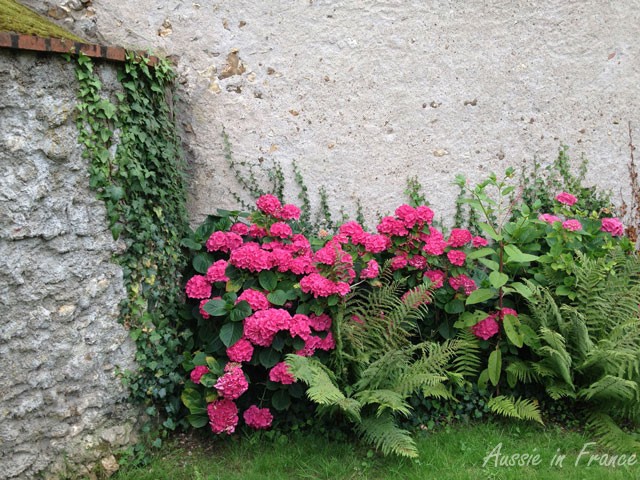
L’hortensia est un arbuste.
So, an arbuste looks like a tree only it’s smaller and has low-growing branches e.g. a lilac bush or a holly bush. An arbrisseau has branches growing up from the ground e.g. viburnum tinus (laurier tin), only no one ever says arbrisseau so we can call them arbustes as well, like Japonica quince (cognassier du Japon) and weigela or arbustes buissonnants or even buissons if they are small enough and are trimmed to form a hedge.
If you want to say arbre, check the plant is at least three times your height and has no low branches!
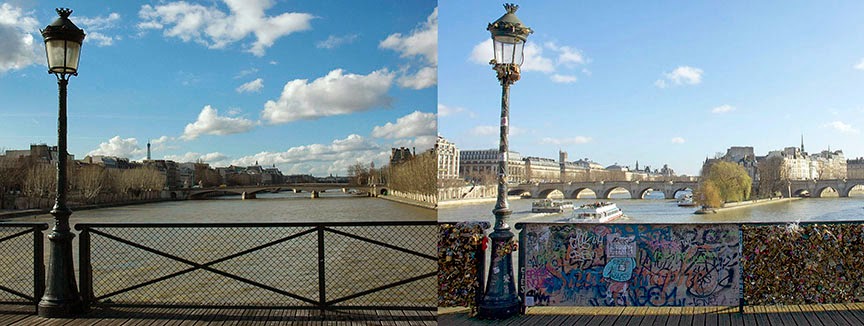
Already time for my Weekly Blogger Round-Up. I’m sure you know about the love locks on the Pont des Arts in Paris. Lisa Anselmo and Lisa Taylor Huff, guest posting for Out and About in Paris, explain why they are causing a problem. Chrissie from Riviera Grapevine gives us very helpful information on developing our palate in the world of wine, while Bread is Pain reflects on the differences between Anglosaxons and French when it comes to clothing and physical exercise. Enjoy!
Why We Need to Unlock Our Love from the Bridges of Paris (Guest post by Lisa Anselmo and Lisa Taylor Huff of No Love Locks™)
by Mary Kay from Out and About in Paris, an American by birth, Swiss by marriage, resident of Paris with a Navigo Pass for the metro that she feels compelled to use
You’re in Paris on the Pont des Arts with your sweetheart. Maybe it’s your anniversary. You hang a lock engraved with your initials on the bridge, and toss the key in the Seine. Then you walk away.
It’s a year later and that lock is corroded by rust, buried under thousands of other locks and covered in graffiti. The piece of the parapet where you hung your lock gives way, over-burdened by the tonnage it was never designed to hold, and lands squarely on a sightseeing boat passing below, full of tourists. Read more
Help, I’ve lost my palate!
by Chrissie from Riviera Grapevine, a Sydney girl living in Nice with an insatiable thirst for the wines of the Var, Alpes Maritimes and Liguria. She happily sells, drinks and blogs about wine
Pallet, palette, palate: Three of the English language’s most commonly confused words, which all have a place in our wine vocabulary.
For instance, if you sell wine in Southern France, it’s not inconceivable that you may order a pallet of rosé from the AOC Palette in Provence. Yep, definitely confusing.
Of the three, however, the one which has the most resonance with wine lovers worldwide is palate, or that part of our mouth which receives and defines taste sensations.
by Bread is Pain, a 30-something American living in the Rhone-Alps, getting her master’s degree, learning French and slowly eating and drinking herself through the country
“Oh. Okay,” I think to myself as I wave at the friend I am meeting. “So THAT is what we are wearing.” I walk across the street, briskly, in my spandex pants, sports bra top, and tennis shoes.
After the obligatory kisses hello, we begin our stroll towards the Bastille.
“Are you going to be able to hike in those,” I ask her, looking at her feet. She is wearing ballet flats, skinny jeans, a fashionable sweater, and a floral scarf whereas I look like I’m about to rip open a protein pack with my teeth while simultaneously checking my heart rate. Read more
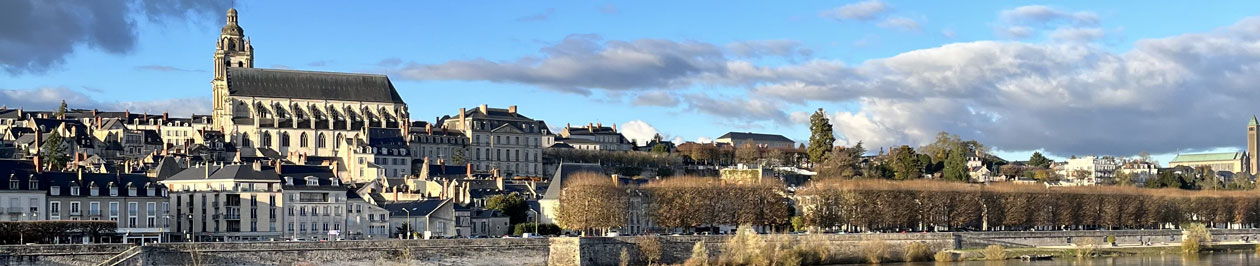
We’ve decided to take advantage of the wonderful spring weather and do some more cycling further along the Loire. I’ve been wanting to go back to Fontevraud Abbey for some time so we book a chambre d’hôte in Turquant which is on the Loire about two hours west of Blois.
Montsoreau
We have a picnic lunch in nearby Montsoreau which was a thriving port for the transport of tufa stone, wine, timber and grain until the railways took over in the mid 19th century. Today, it’s a sleepy little village with a château that livens up in the summer.
Panorama near Candes overlooking the confluence of the Vienne and Loire Rivers
Then we drive up to one of our favourite panoramas just outside the neighbouring village of Candes overlooking the confluence of the Vienne and the Loire. Not as striking as it is in the summer, but still breathtaking.
Le Balcon Bleu, chambre d’hôte in Turquant
After checking into our lovely chambre d’hôte, Le Balcon Bleu, we take the bikes off the back of the car and set off for Saumur where Jean Michel lived from the age of 3 to 17. We take the “high” cycle route overlooking the Loire which takes us past an amazing collection of troglodyte dwellings that have been converted into artists’ and artisans’ studios.
Troglodyte dwellings converted into artists studios in Tursquant
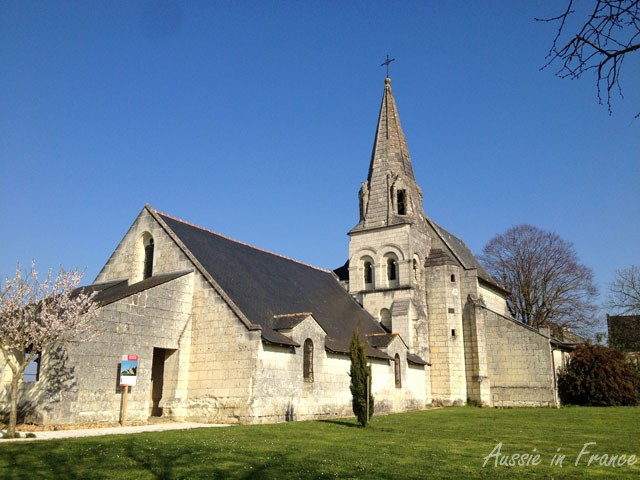
We cycle through the vineyards of saumur champigny and up and down an exhausting number of hills with an occasional stunning view of the river such as the vista from the narthex of the little church of Saint Pierre in Parnay built in the 10th century.
Saint Pierre de Parnay
Some time later, I spy a picnic table and suggest a pause. I’ve remembered the biscuits and water this time, which is a good thing because there is no other sustenance along the cycle route. Jean Michel says we are very close to his old home and tells me who owns the surrounding vineyards. A little further on, there are a lot of new houses which he’s never seen before.
The back of Jean Michel’s house showing the original cavier mill
We arrive at his old home which was originally a cavier windmill like the one in Bléré and he shows me the roof he used to climb up on to read and look at the panoramic view. I can’t see any sign of a windmill but at the back of the house, he shows me part of the circular wall. Many additions have been made over the years so the house is quite a hotchpotch.
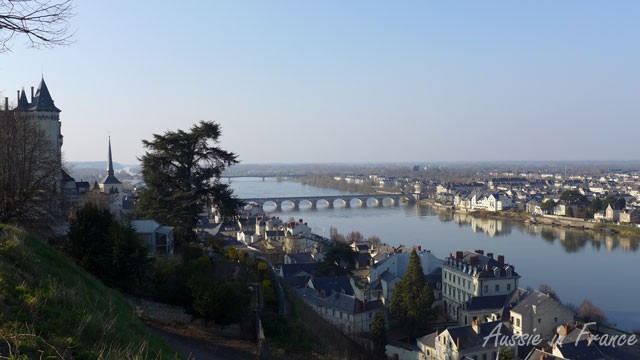
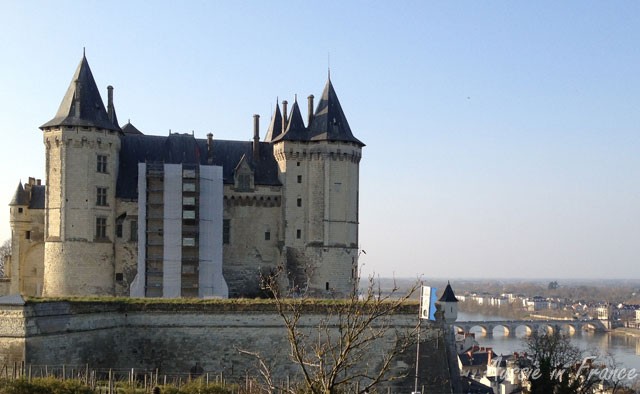
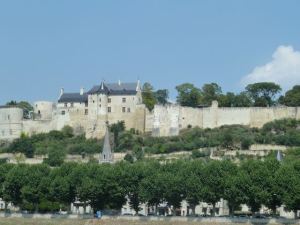
After turning right into the aptly named Rue des Moulins, we see the remains of several similar windmills, before coming out on Jean Michel’s favourite view of Saumur, the Loire and 14th century château. Unfortunately, it’s being renovated so the view is marred by scaffolding.
The bike path leads through a surprising mix of old and new buildings, including the beautifully renovated Maison des Compagnons (guild house) where the apprentice stone cutters are all chipping away in the open courtyard.
Maison des Compagnons (guild house)
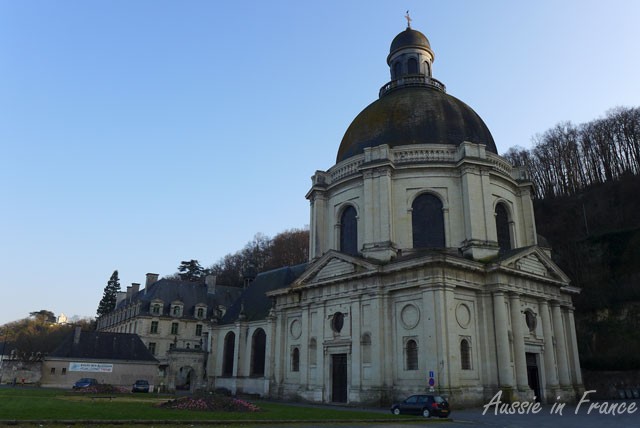
We cycle through Place Saint Pierre with its half-timbered houses and down to the Loire then turn right along the river, with the castle towering above us until we reach the imposing 17th century church of Notre Dame des Ardilliers which I remember from a previous visit.
Notre Dame des Ardilliers
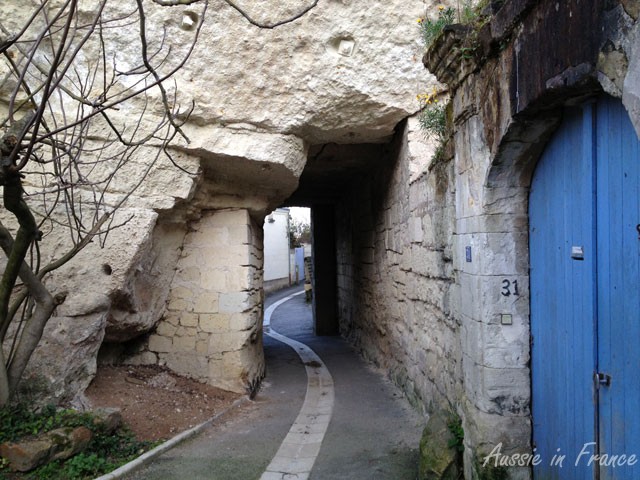
The cycle route takes us up another hill and through a sort of tunnel, then past a series of troglodyte houses, much more sophisticated this time. Signs along the path point out architectural features such as mullion windows, watchtowers and arrow slits.
The cycle path goes through a tunnel
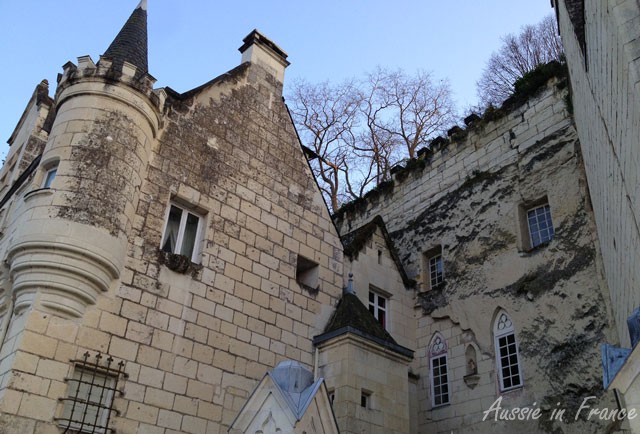
One of the troglodyte dwellings is actually a feudal castle owned by Marguérite d’Anjou, the French wife of Henri VI of England, in the 15th century!
Semi-troglodyte castle
Just when I think the cycle route is going to join the river again and spare my knees, another hilly path takes us up a tiny winding street and we begin to have doubts. But an amazing sight is awaiting us! Stay tuned.
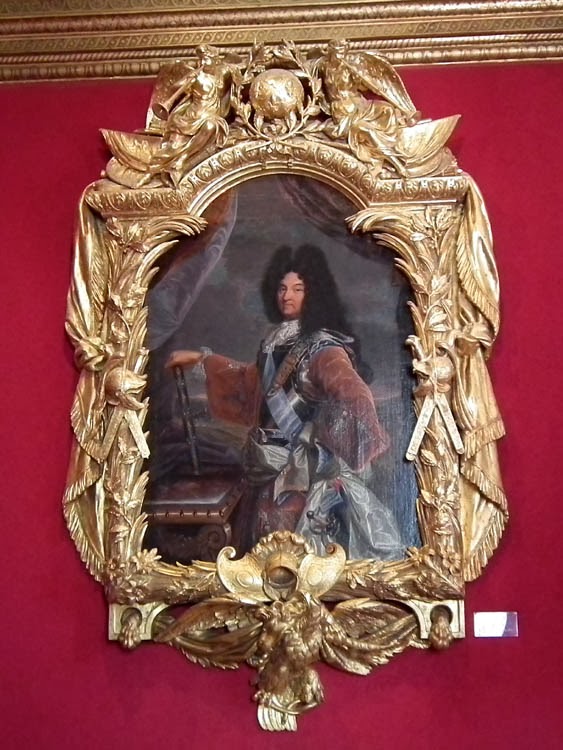
This week’s blogger round-up starts with Mary Kay from Out and About in Paris, who takes us behind the scenes of French lingerie, Maggie LaCoste from Experience France by Bike shares her favourite cycling itineraries in France while Susan from Days on the Claise presents a portrait of Louis XIV, “The King of Bling” by Hyacinthe Rigaud in Chenonceau Castle. Enjoy!
“Behind the Seams of French Lingerie” with Paris Lingerie Tours
by Mary Kay from Out and About in Paris, an American by birth, Swiss by marriage, resident of Paris with a Navigo Pass for the metro that she feels compelled to use
Let’s start with a quick survey. Raise your hand if you think that lingerie is a rather silly subject, something that doesn’t merit your attention. Even though I’m ashamed to admit it, that’s exactly how I felt before the start of Kate Kemp-Griffin’s highly informative “Behind the Seams of French Lingerie” tour yesterday morning. When Kate, The Lingerie Journal’s Associate Editor for France, asked why we had signed up for the two-hour tour, I quickly denied any personal interest in the subject by explaining that I was planning to write a blog post about lingerie. It was a misguided attempt to distance myself from what I incorrectly considered to be a frivolous topic. Read more.
Bicycling in France 2014: Itineraries to Consider
by Maggie LaCoste from Experience France by Bike, an American who loves biking anywhere in Europe, but especially France, which has the perfect combination of safe bike routes, great food, great weather and history.
I’ve had a really hard time narrowing down my favorite itineraries in France this year. So many regions of France are improving existing bicycle paths and building new ones and great choices are springing up across the country. This makes it really tough to narrow down possible choices to a manageable few. At this rate, I could miss the whole summer bicycling season, mired in route research and conversations with local tourism officials! It’s time to get the list out! I’ve made a big pot of coffee, and am ready to make some decisions. With the list complete, I can settle down to providing you with details on each of the itineraries, and why each of them would be a perfect choice for an upcoming bicycle trip to France. Each choice will be featured in an upcoming post including: top ten reasons to choose the itinerary, bicycle rental options, and best resources for trip planning. Read more.
The King of Bling
by Susan from Days on the Claise, an Australian living in the south of the Loire Valley, writing about restoring an old house and the area and its history and running Loire Valley Time Travel.
It doesn’t take much knowledge of history to guess correctly that this is a portrait of Louis XIV. The more is more frame gives it away even if you don’t recognise the man. It hangs in one of the salons at the chateau of Chenonceau and was originally a gift from Louis to his uncle Césare de Vendôme, once owner of the chateau. Like the rest of the objects at Chenonceau, it hasn’t always been here, but has been acquired by the current owners because of its significance to the chateau.The portrait is by Hyacinthe Rigaud, Louis’ court portraitist and painted about 1700. Like any of Rigaud’s portraits it is a magical mixture of completely accurate character representation and ideal ego boosting likeness. I don’t know how he did it. Couple that with his superb technique with luxury textiles, and any portrait by Rigaud is worth looking at, drooling at the silks and velvets and musing about what the artist thought of the sitter. However, I’d be willing to bet most people hardly give the portrait itself a second glance. It is totally overshadowed by the astonishing carved gilt frame, which was created for the painting. Read more. Read more.
The weather is absolutely wonderful not only in the Loire but right across France and most of Europe so we’re back on our bikes after a six-month break. I suggest we find choose a nice flat bike path out in the open as a warm up. It’s 2.30 pm and an unbelievable 19°C which must be practically a record for 8th March.
Ready to go with the bikes on the back of the car
So we pump up the tyres (well, Jean-Michel does), check the paniers and handlebar bags (that’s my job) and put the bikes on the back of the car. We drive to our preferred starting point along the Loire between Blois and Saint Dyé on the Route Historique de la Vallée des Rois, just opposite the turn-off to Saint Claude de Diray.
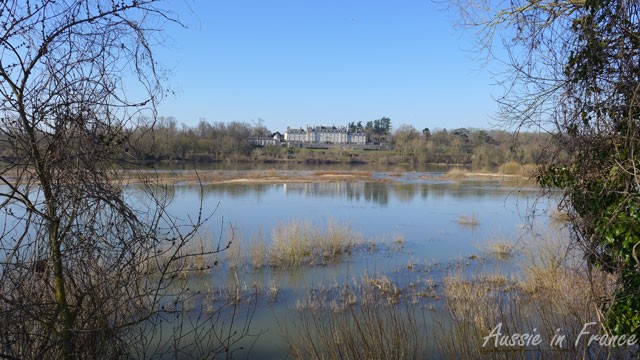
Château de Menars
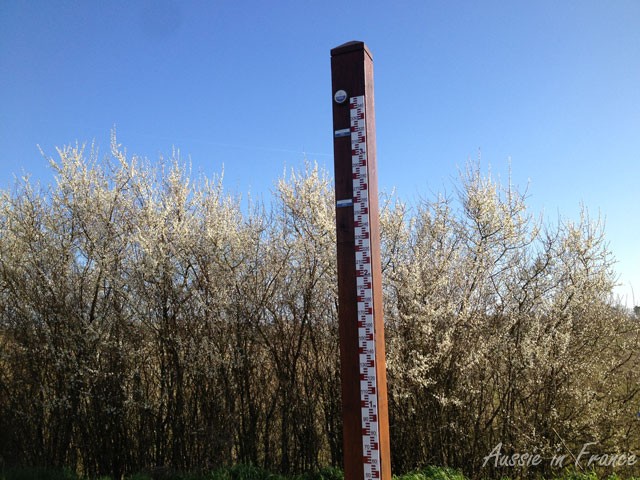
It feels great to be back in the saddle! Château de Menars stands out clearly on the opposite bank and we discover a new sign post opposite Montlivaut showing the flood levels of the Loire. In 1856, it reached 3.4 metres, in 1866, 3.2 metres and in 1846, 2,6 metres.
Flood post opposite Montlivaut
We soon arrive in Saint Dyé where a flock of swans is attracting attention on the river bank. Further on, we see lots of different trees in blossom. On the path towards Muides, we see the most delightful tree house.
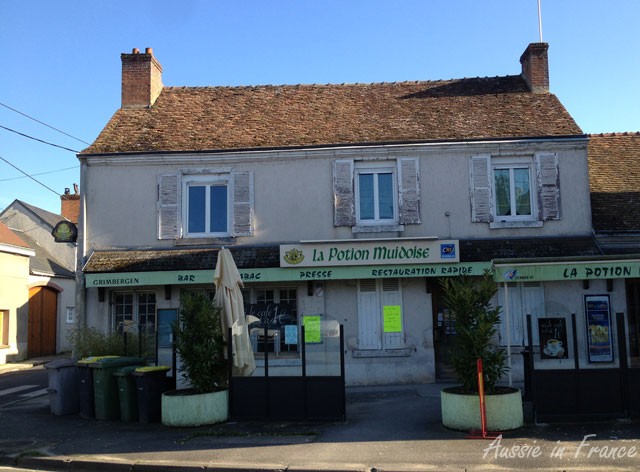
La potion muidoise which is a reference to the druid’s magic potion in Astérix
I’ve scheduled a stop at La Potion Muidoise so are somewhat disappointed to discover it’s closed in the afternoon at the moment. I can’t imagine why you’d open a bar in the morning only, particularly on the finest Saturday we’ve had in months. But it’s school holidays, I guess.
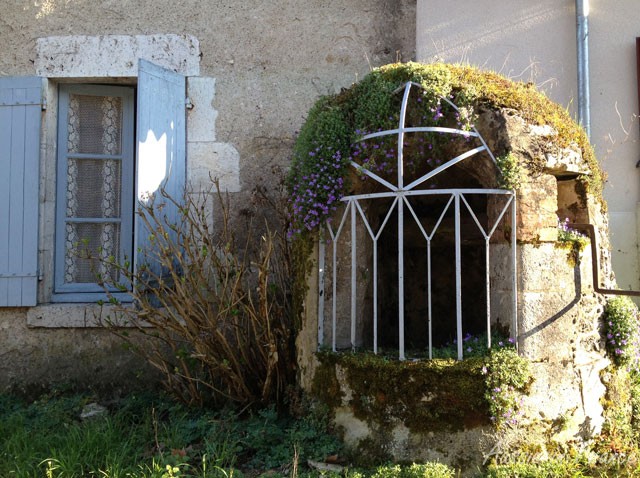
This type of well is typical of the region
We take a new route back to the river and see the most picturesque little well covered in wild flowers. I can’t wait to see it in the summer when the hydragea is in bloom.
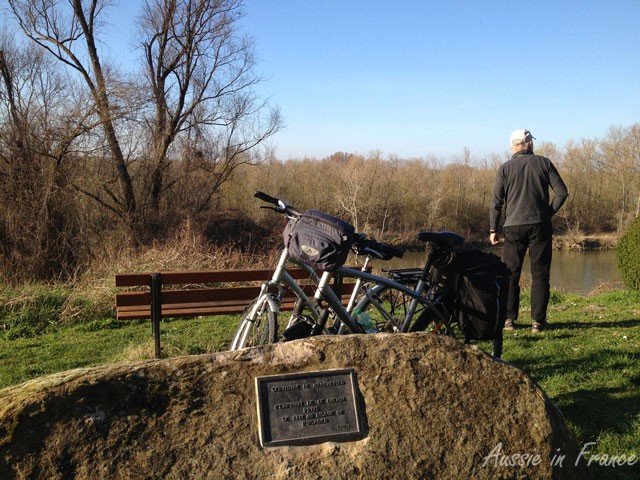
Riverside bench on the cycle path between Saint Dyé and Muides
We eat our biscuits on a bench overlooking the Loire. Next time I’ll have to remember to pack a thermos with tea!
By the time we get back to the car, we have ridden 25 kilometers and I am wishing it hadn‘t been quite so flat!
Monthou-sur-Bièvre cemetary
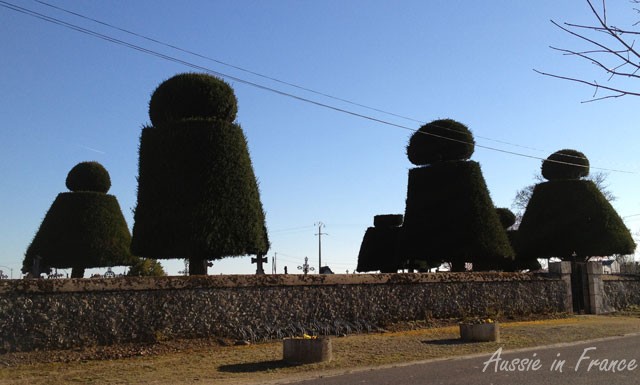
It’s next day and we’re planning another ride. The temperate is expected to reach 21°C. I’ve learnt my lesson and have suggested a few small hills so we head for Monthou-sur-Bièvre with its unusual cemetary. The cycle route has a lot of little villages along the way which should mean plenty of flowering trees and shrubs. I wince with pain as I ease myself into the saddle.
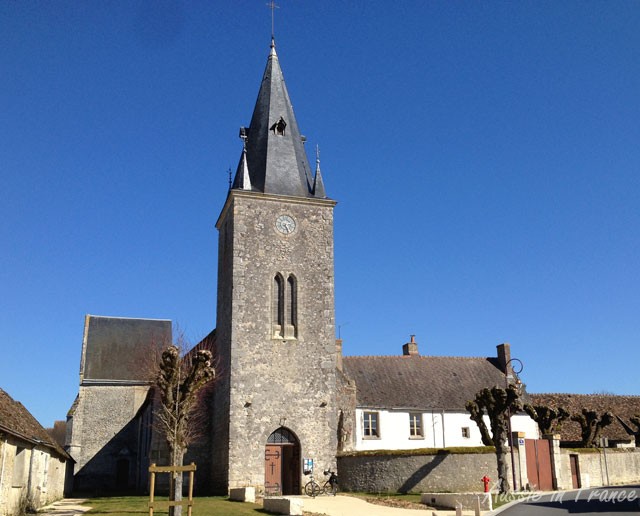
Saint Pierre d’Ourchamps
The little church in Ourchamps is open so we go inside and are amused to see a document dated 1882 saying that the chairman of the church council of St Pierre expressly forbids the sexton from letting any one other than the church employees ring the bells. It makes you wonder what had been going on.
Tents made by pine processionary larvae
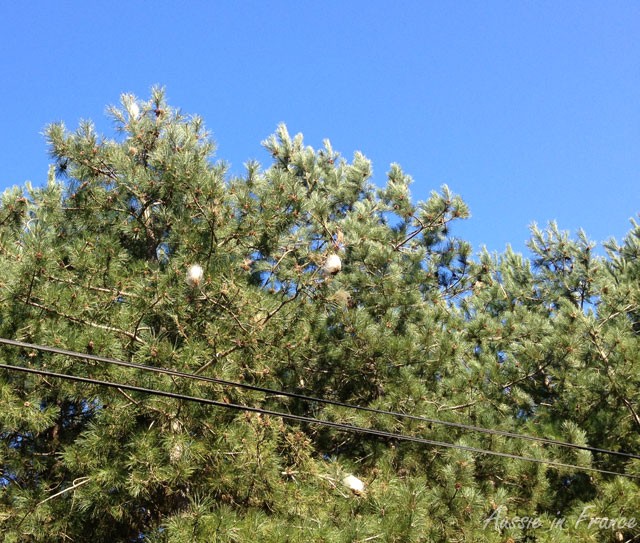
As we go past a small wood of pine trees Jean Michel points out “tents” made by the larvae of the pine processionary moth which is an economic pest. The urticating hairs of the caterpillar larvae cause harmful reactions in humans and other mammals (I looked that up!). I’ve never even heard of them before!
This time I have scheduled a stop in the little town of Fougères-sur-Bièvre with its well-preserved 15th century castle and I’m hoping there’s a café open because I have forgotten to replenish the biscuit supply. You guessed – it’s closed for the afternoon, although it was obviously open at lunchtime, and I don’t have the promised thermos of tea either.
Château de Fougères built in the 15th century.
After 30 kilometres, we arrive back at our starting point and I’m rather glad that next day is Monday and the only seat I’ll have to sit in is my ultra-comfortable desk chair! I’m still happy to have had such wonderful weather to cycle in. In a couple of days’ time, I should be ready to get back in the saddle.
This week’s Blogger Round-Up takes us to Lisbon in Portugal with Jenny and John in Brittany, a place that is definitely on my shortlist while Adelina from Pack Me To visits the inside of the Parliament Building in Budapest which we didn’t see on our visit to Hungary last summer. Margo Letsz from The Curious Rambler, whom you met last week explains the importance of being polite in France, which you may remember from my post on bonjour. Enjoy!
Things to see and do in Lisbon, Portugal
by Jenny and John in Brittany, who recently left Stockport, England to live in France where they are renovating a house to create a B&B.
Lisbon is an amazing city, there is so much to do and so many places to visit, I am not going to go into much detail as the pictures say more than a thousand words.
The one thing I would recommend though is to go on the trams, we did not work them out and just jumped on one we saw, you can pay on the tram or get a day pass (the day pass is highly recommended as this allows you to travel all day and costs approx the same as two rides when you pay on the tram).
We travelled to the end of the line and then back again, the tram ride is fascinating as at times you can touch the buildings you are passing it gets so close. Read more
Inside the Hungarian Parliament Building
by Adelina from Pack Me To, a Chinese American who’s been traveling for as long as she can remember and has lived in the Netherlands and Hungary. She loves telling stories, and eating and exploring her way around the world.
Visiting the Parliament building in Budapest has been on my to do list for a long time. I had seen photos of the inside of the Hungarian Parliament building, which looked spectacular, and I wanted to see it for myself. A building that looks so magnificent on the outside is sure to look glorious inside right? I was not wrong.
I had a bit of a false start on my visit to the Parliament. The first time I went, I was informed that the tour for the day was only 30 minutes long instead of the regular 45 minutes, but the price was the exactly same. I decided to go back another day. Read more
It pays to be polite in France
by Margo Letsz from The Curious Rambler, who lives in Nice, France where she likes to bask in the sunshine, study the French language and blog
At this café in Nice, France, minding your manners can significantly reduce the price of your coffee.
Of course, this was meant as a humorous way to remind customers to be polite, but it’s a great illustration of the French attitude toward good manners.
In France the “courtesy words and phrases” are very important and NOT optional. Fortunately, they’re easy to master, but if you can’t manage them in French, at least say them in English. More than likely, the French will understand you and think that you’re a polite person who doesn’t speak French – which is, of course, much better than being thought of as a rude person who doesn’t speak French. So if you want to be polite in France (and I’m sure you do), here are some easy words and phrases (along with my attempt at phonetic pronunciation) to help you on your way. Read more
I was delighted when I discovered we had orchids in our garden in Blois. I had thought they were strictly tropical plants but it turns out that France has quite a large number of wild orchids and our region alone has about sixty. We have found three different ones in our little wood. So when Susan from Days on the Claise, who is quite a specialist in the field, suggested we go together to an orchid fair in Blois, I didn’t hesitate.
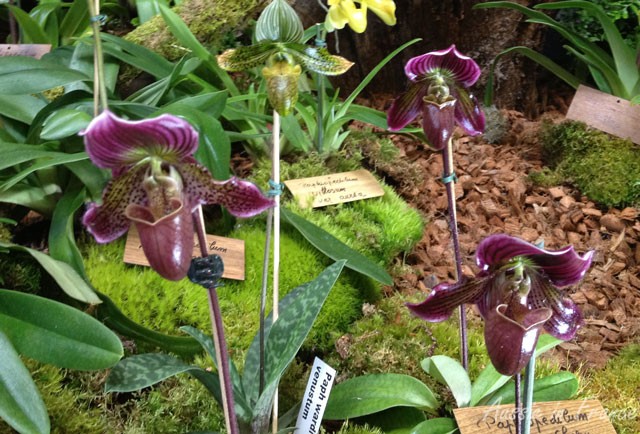
Cultivated orchids on display
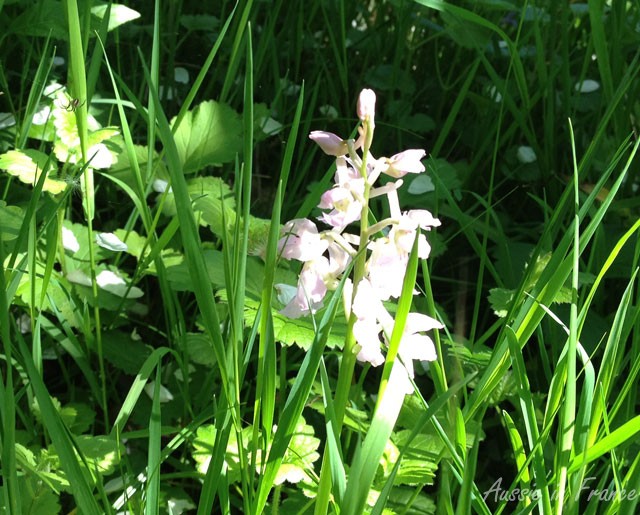
All the orchids on display were of the cultivated variety of course. I learnt that it’s virtually impossible to grow the local orchids. Either they turn up in your garden or they don’t because they need a special kind of fungus to grow. So I’m very honoured that orchis mascula and two other varieties I have yet to identify, have chosen our garden.
Purple orchis in our little wood in May last year
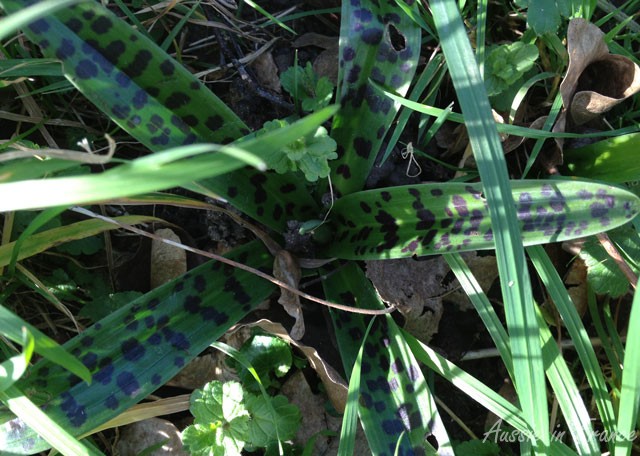
I also learnt the orchis mascula, or purple orchis, derives its name from the testicle-like formation underneath the roots. In English, it’s also called Gethsemane because it is said to have grown at the foot of the Cross and received drops of blood on its leaves!
Purple orchid leaves with their blood spots in February
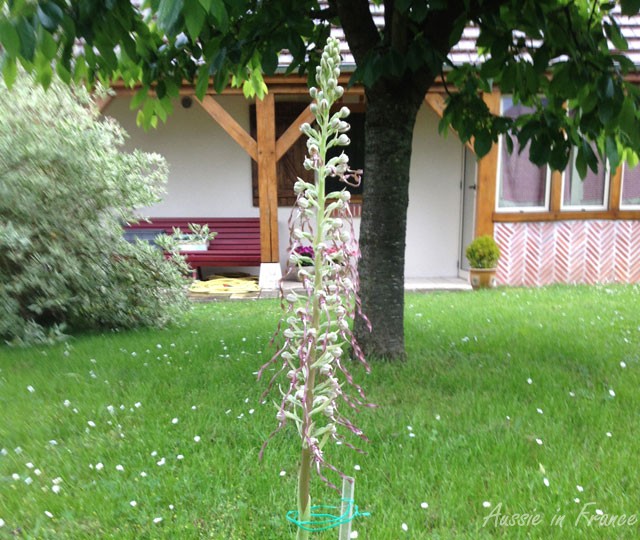
Mr and Mrs Previous Owner have an orchis bouc (bouc means billy goat) in their garden, so-named because of its smell. In English, it’s called a lizard orchid, which is much nicer! It has the most amazing flowers and grows to be very tall.
A white orchid in our wood
Most of the exhibitors at the Orchid Exhibition were Dutch with a couple of local growers thrown in. There was a stunning collection that drew a very large crowd and also an excellent poster exhibition where I learnt all sorts of interesting things. Vanilla, for example, is an orchid, to my amazement.
I think these look like dolls on a stick, like the ones we used to get at the Show when I was a child in Australia
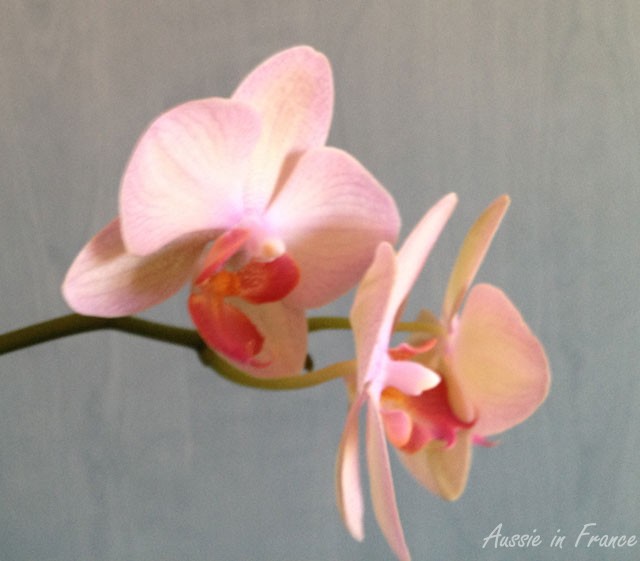
When we are living in Blois permanently and I have found the best location in the house for my cultivated orchid collection, I’ll venture into some more exciting ones. At present, the only ones that I get to rebloom are phalaenopsis or moth orchids.
My latest reflowering moth orchid in Paris
After the orchid exhibition, the first thing we saw as we got home was that our new neighbours had moved in. The moment of truth! Chicken yard or not chicken yard ? I went into our vegetable garden pretending to be checking out the sorrel (it being the only thing growing at the moment) and saw a friendly-looking blond woman a few years younger than us.
Mrs Previous Owner’s photo of their lizard orchid. The stem is as long as the flower and you can see they’ve staked it.
I waved and she came over the say hello. She and her Spanish husband both have grown children and are at work all day. The chicken coop will eventually be turned into a garage and they had already been informed that they would need to keep their willow pruned so that it won’t damage the new slate roof of our barn.
We both called our husbands over and by the end of the conversation we’d established that we were all the perfect new neighbours! Great relief all round.
Another excellent piece of news is that I have also found a Portuguese cleaner for the gîte which opens again in April. It turns out that she used to own the house next door, and that her husband, also Portuguesue, actually built the house himself. Thank you Mr and Mrs Previous Owner for the tip!