This is going to be a very short post because we are up to our necks in travaux. Travaux, the plural of travail is, interestingly enough, from the low Latin trepalium, instrument of torture, derived from the Latin tres, three, and palus, stake.
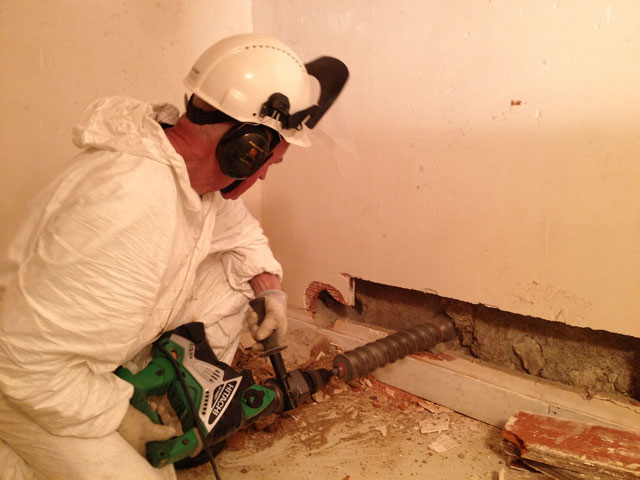
Jean Michel en pleins travaux : percement d’un mur de 70 cm.
Well, I can tell you, the pain in both my hands (being left-handed I am fairly ambidextrous) from wielding spatulas, trowels, paint brushes and rollers for the last week certainly makes it feel like torture! The end result will be a laundry, initially without a sink.
Travaux is a very useful word and covers practically anything. Note that in French, it is always used in the plural and never in the singular, in this context. And you can use it by itself without any explanation. Nous faisons des travaux = We doing renovation works/alterations/plumbing and so on.
renovation work = travaux de rénovation
roadworks = travaux routiers
woodwork = travaux sur bois
plumbing work = travaux de plomberie
alterations = travaux d’aménagement
major projects = grands travaux
farm work = travaux de la ferme
metalwork = travaux sur métal
I’m sure you can find plenty of others! Je dois reprendre mes travaux de peinture!
This week’s Blogger Round-Up is all-Australian, starting with Carolyn from Holidays to Europe with practical suggestions as usual, this time on how to get to and from Europe’s major airports. Phoebe from Lou Messugo gives a detailed description of a mediaeval festival on the French Riviera while Jo Karnaghan from Frugal First Class Travel gives more packing tips, based on other bloggers’ suggestions (including mine). Enjoy!
Getting to and from Europe’s main airports (part 1)
by Carolyn from Holidays to Europe, an Australian based business passionate about sharing their European travel expertise and helping travellers to experience the holiday in Europe they have always dreamed of
After a 24 hour (or longer) flight to Europe from Australia, the last thing you probably feel like doing is working out how you are going to get from the airport into the city, and I don’t blame you! I’ve been there and somehow miraculously found my way from Paris’ Charles de Gaulle airport to my apartment via public transport and let me tell you, it was no fun – especially with one husband, two kids and assorted luggage in tow and only a miniscule understanding of French. Read more
Medieval Festival – Knights Templar on the Côte
by Phoebe from Lou Messugo, a traveller, francophile, expat, mum and foodie now living in Roquefort les Pins where she runs a gîte after many years of travelling and living in Asia, Eastern Europe and Australia.
For three days every year in early April the lovely village of Biot (pronounced Bi-otte not Bi-oh as you may think if you know anything about French pronunciation) goes back in time to the 13th century. The setting couldn’t be more perfect as the old centre of Biot is a fortified medieval hill village, perched just a couple of kilometres inland from the Mediterranean sea, commanding sweeping views out to sea one way and over to the mountains the other, creating the perfect backdrop for this historical event. Read more
Travel Bloggers Share Even More Great Packing Tips
by Jo Karnaghan from Frugal First Class Travel, an Australian who loves to travel – especially in Europe – and who has gradually learned how to have a First Class trip on an economy budget, without missing out on anything!
Hi Frugalistas!
My travel blogger friends are back with more great packing tips. Take it from the experts, and you too can pack like a travel pro! Your key to successful one bag packing is here…..
Vanessa (@turnipseeds) at Turnipseed Travel is a crafty one. She’s got two great recommendations for travelling successfully with just a tiny carry on bag:
“Burp” the extra air out of your toiletry bottles before you fly so they have room to expand with the air pressure of the plane. Otherwise you’ll have a messy leak! Read more
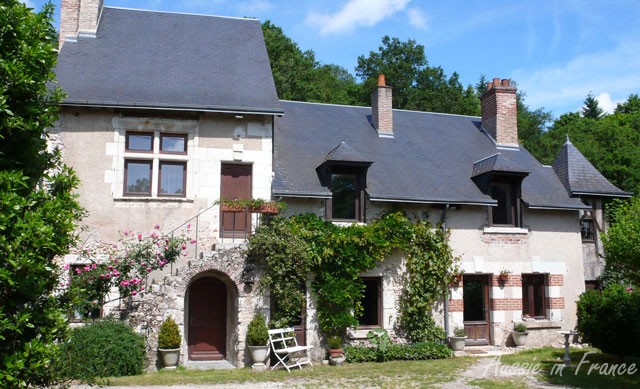
There is a beautiful lilac bush just across the road from our house in a large vacant lot followed by meadowland that goes down to the Loire. Our rainwater flows into the vacant lot so Jean Michel keeps the area free of brambles and nettles. He has also cleared a parking space next to it. The lilac bush is on the left.
The lilac bush from our bedroom window when we get up in the morning
The weather is lovely and we’re having our tea in the garden, making the most of the spring flowers. Jean Michel suddenly gets up and says, “More people cutting the lilac”. He opens the gate, sees an elderly lady and a young man and says “Hello. I would really appreciate it if you could cut the lilac from the back of the bush and not the front. That way, everyone can appreciate it.”
The lady looks surprised. “Ah”, she says, “but figurez-vous (which means something like believe it or not), the lilac was planted by my father. I used to live in this house”. “Well”, we say, “that’s quite different”. “Won’t you come in”, I add, trying not to seem too excited, “I have lots of questions to ask you”.
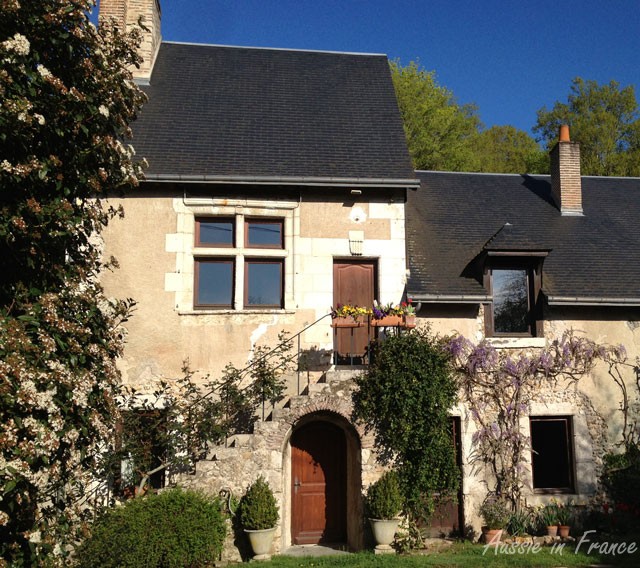
Closerie Falaiseau in June
The lady is loquacious, to say the least, while her 30-year old son is more reserved. She explains how the garden and the house were divided into two. There was a stone wall separating the garden starting at the drain pipe on the left of the last door on the right and ending where my planters are now. She and her parents and six siblings lived in the left half.
The wall ended on the right of the photo where you can see the two planters
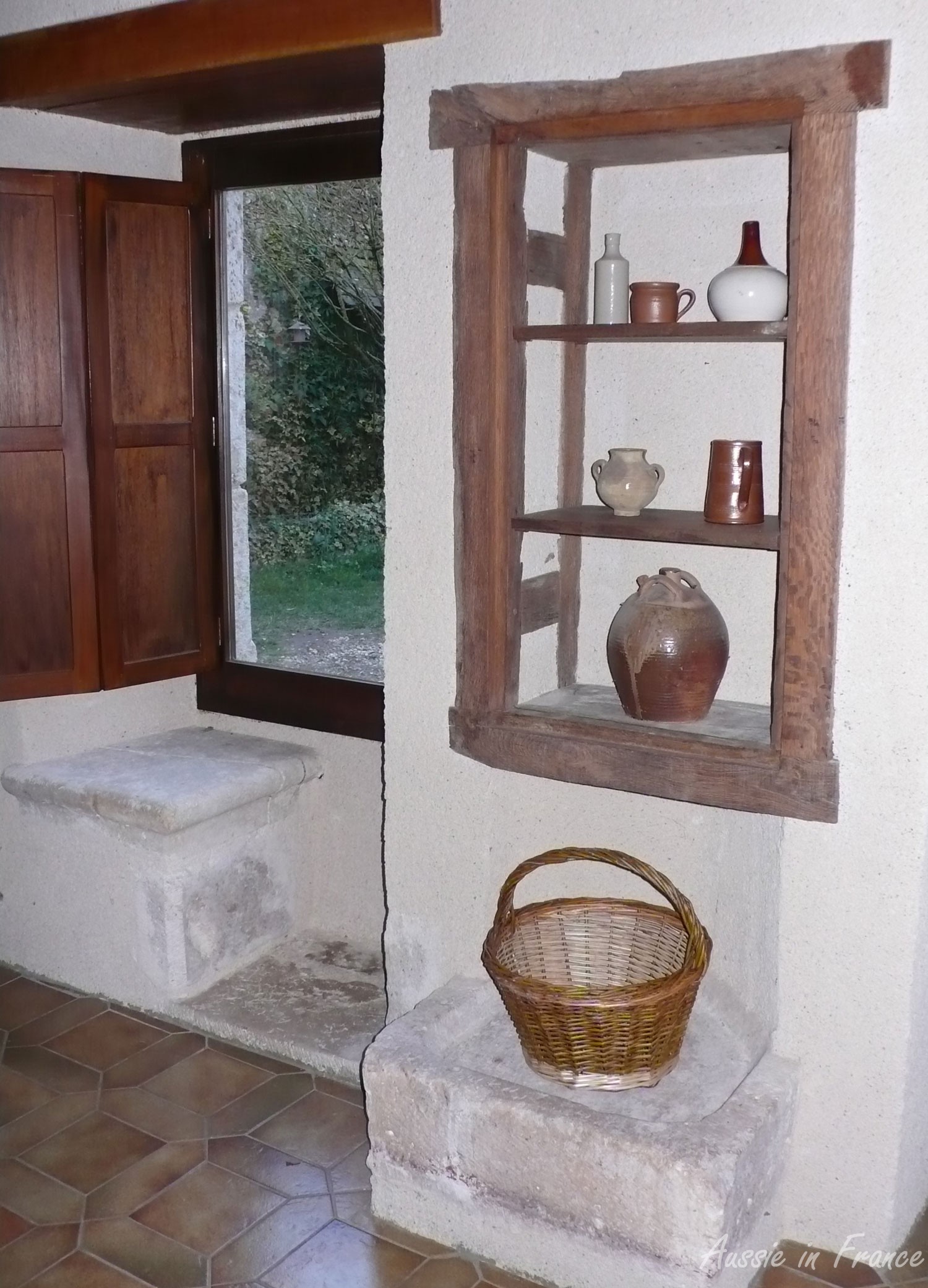
Downstairs, the room corresponding to the archway on the left was a combined living room and kitchen with a bathroom behind and the boys’ bedroom was on the right. I learn, to my disappointment, that the stone sink and bench, which I thought were original features of the house, were added by the people who began restoring the house before our previous owners bought it.
Stone seat and sink that I thought were original!
Upstairs, where she loved to sit and read, were the other bedrooms. Her father was a bricklayer and had a large vegetable garden in the vacant alotment across the road. She tells us that she had the most wonderful parents imaginable, that the house was always full of people and that at Christmas, they had parties where everyone sang and danced until 6 o’clock in the morning.
“I call it la Maison du bonheur (the house of happiness)”, she says. She now lives in a flat in Blois, overlooking the Loire, “because”, she explains, “I love the Loire almost as much as this house. There used to be a sandy beach on the edge of the river and we used to love going there to play and sunbake.”
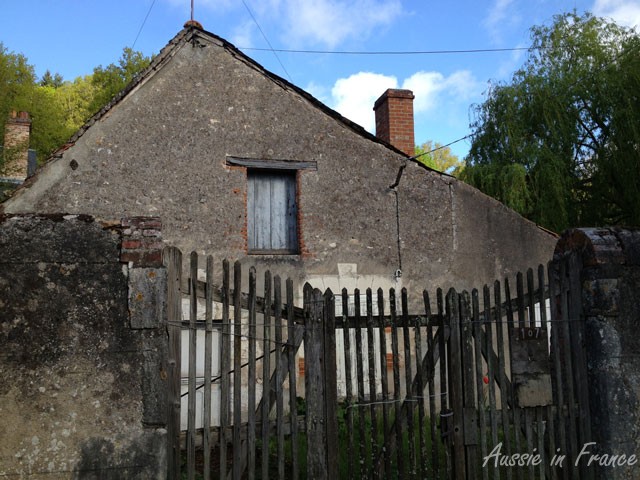
The little house that the parents moved into after their children grew up
But the children grew up and married and the house was too big for her parents so they moved to the little house next door. Her son explains that his grandparents used to look after him during the day and he went to the school down the road, which is now closed. Now in his early thirties, he confesses that it has always been his dream to buy the house one day.
The school in our street which is now closed
Their nostaglia is palpable. The little old lady talks non-stop and is obviously delighted to be able to share her memories with us and not at all interested in seeing the inside of the house which she doesn’t recognise. She is obviously disorientated so we go outside again. In response to something she says, I ask her how old she is. She looks a little surprised and replies 64.
I try not to look as shocked as I feel. I would have said she was 80! I think about it later and I finally come to the conclusion that her nostalgia for the past has prevented her from entering the modern world. She looks the age her mother would have had.
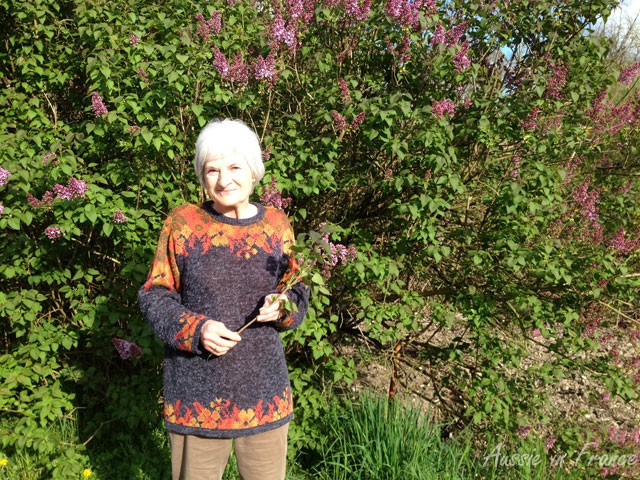
The little old lady in front of the lilac bush
Jean Michel takes his secateurs and cuts her a huge bouquet of lilac from behind the bush this time. She promises to come back again at the end of the year after we’ve moved here for good to show us her old black and white photos of the inside of the house. We promise in the meantime to make the most of our House of Happiness.
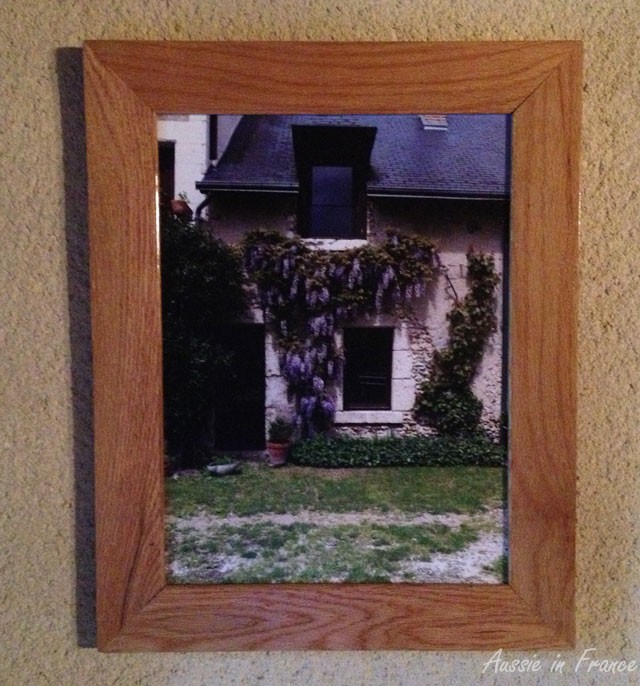
Each time our wisteria blooms I fall in love with it again! This year, it’s early of course, but it means we get to enjoy it for longer before we have to go back to Paris.
Below is a photo taken last year by a lovely American couple from North Carolina who rented Closerie Falaiseau from mid-April to mid-May. Because they knew how much we love the wisteria, they had this photo mounted on canvas, framed it themselves and sent it to us as a wonderful surprise. Wasn’t that a lovely thought?
And I’ve only just realised that it is when the leaves grow that the wisteria looks its best!
I am a firm believer in learning vocabulary if you want to speak another language with any fluency. However, it has the disadvantage of giving the impression that A always equals B. Which is not true of course.
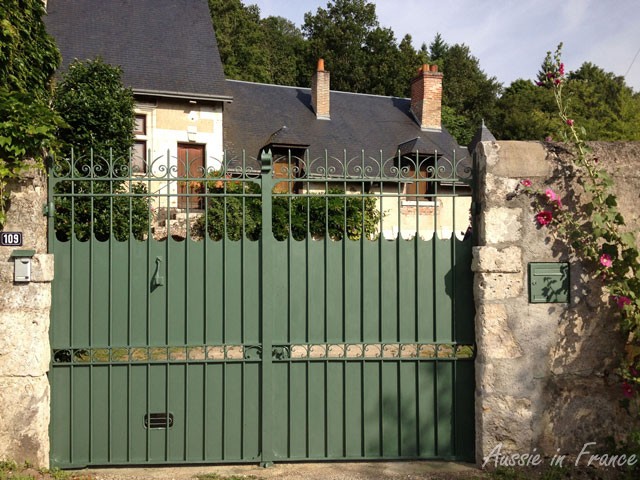
Notre portail vert qu’on a repeint pendant une vague de chaleur
I still remember learning that gate = barrière = and fence = clôture and find it difficult not to automatically say “barrière” and “clôture” each time The problem is that they are not always equivalents !
Our house in Blois has a portail (which we repainted in a heat wave), which is used to designate a large metal or wooden gate. The bits on either side of our portail are murs or walls because they are made of stone. Our little house also has a portail but it’s wooden.
No barrières in sight! So I asked Jean Michel , “qu’est-ce que c’est qu’une barrière“. He thought about it and very helpfully said “Je ne sais pas”. So I’ll tell you what I think it is. As far as I can see, it refers to a barrier, such as the Great Barrier Reef in Australia (grande barrière de corail), a safety gate or a crowd barrier (une barrière de sécurité), a language barrier (barrière de la langue – now that’s useful!) and more important still, a level crossing gate (barrière de passage à niveau) – you may remember my close shave in Germany last summer.
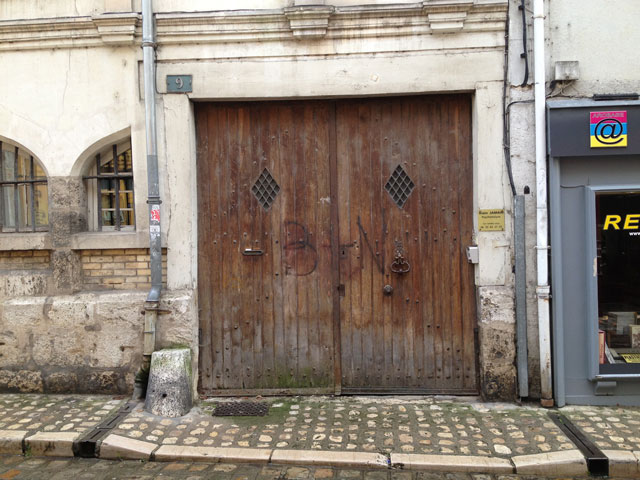
Une porte cochère
A gate can also be a porte, such as the town gates or gate to a castle or even a garden gate if it looks like a door. Those enormous gates that you see on the façade of many buildings in France originally designed to take a horse and carriage through are called portes cochère.
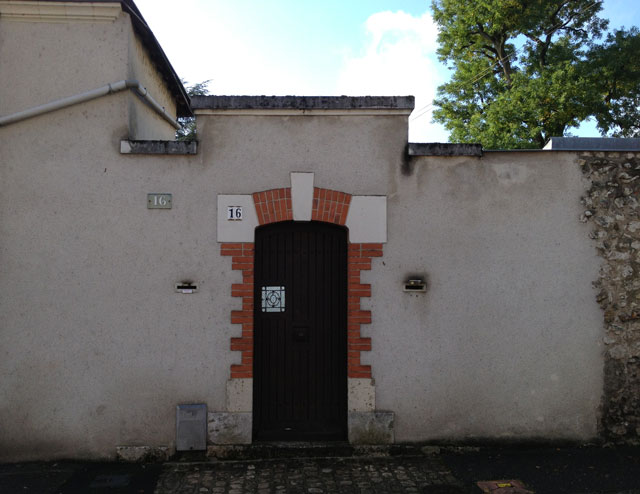
Une porte de jardin
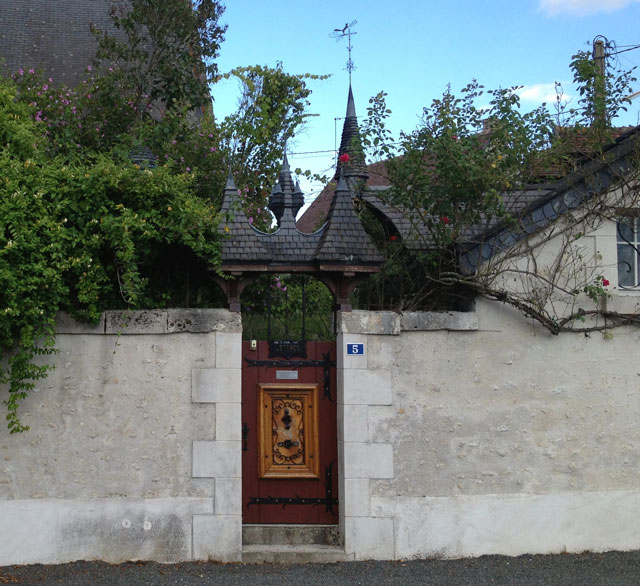
If it’s not enclosed on all sides by a wall and not big enough to let a vehicle through, it’s a portillon.
Un portillon
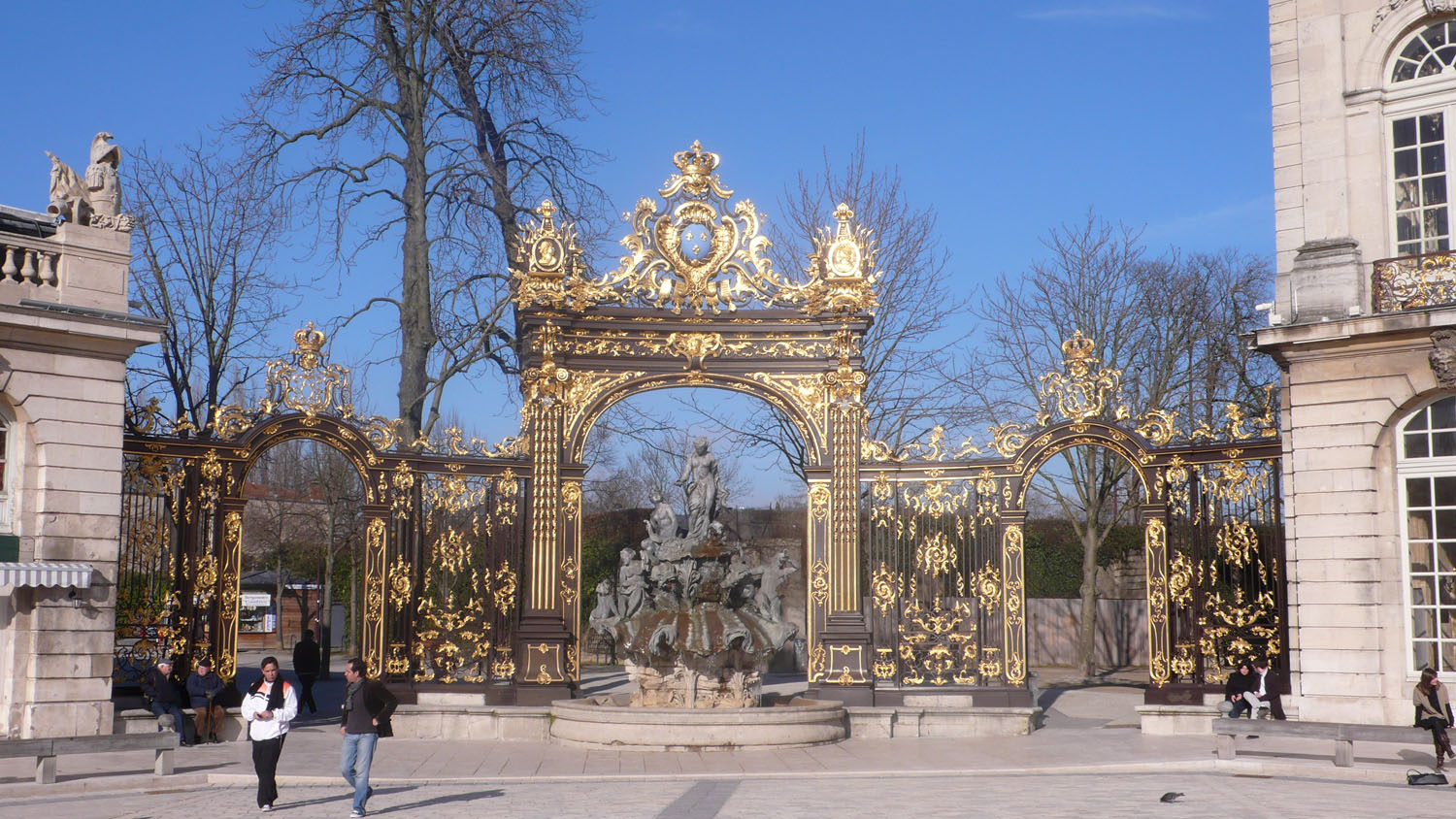
A large metal gate that doesn’t have any solid parts the way our green gate does is called a grille d’entrée.
Une grille d’entrée à la Place Stanislas in Nancy (though the actual gates are missing!)
Fortunately, fence isn’t quite as complicated. Below, you can see a clôture which is definitely a fence, but the stone wall behind it is a mur d’enclos.
Une clôture en fer devant un mur en pierre
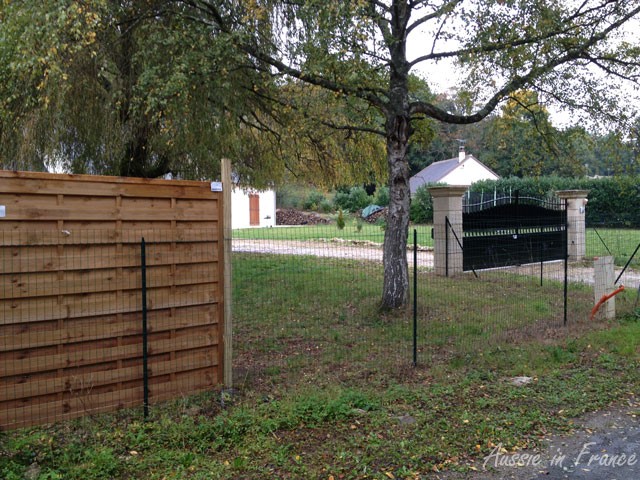
Theoretically, you can have a clôture en bois such as the one the neighbours used for their chicken yard below, but most people would call it a palissade. The wire fence next to it is a clotûre though.
Une palissade, suivie d’une clôture, suivie d’un portail.
So next time you want to say “fence” or “gate”, I hope you’ll do better than me!
It’s the second day of our spring cycling weekend near Saumur. We wake up in time for 9 am breakfast at our B&B, Le Balcon Bleu, having slept very soundly in a comfortable bed after all our hills and dales of the day before.
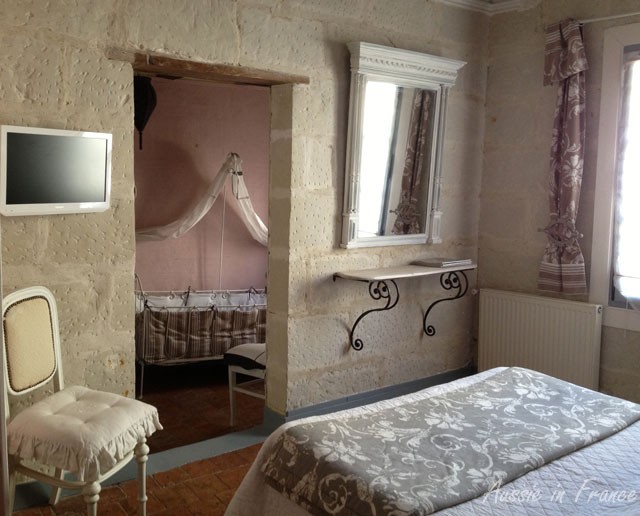
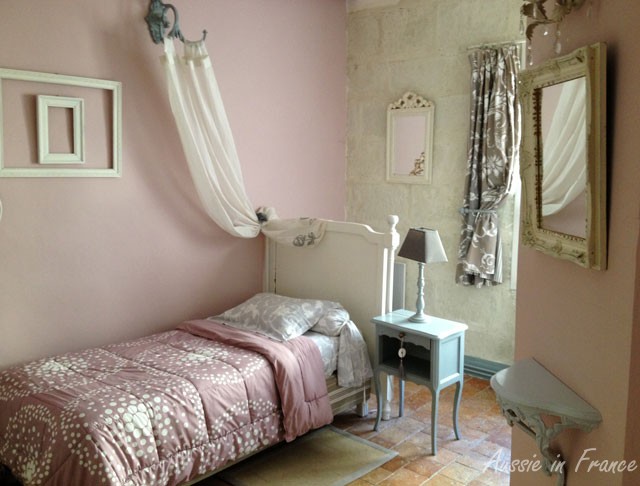
Our suite consisted of four separate rooms – a single bedroom, a double bedroom, a baby’s room and bathroom.
We pass through the inner courtyard with its stunning Clematitis armandii and into the breakfast room. Well, you’ve already seen the photos – a cross between a brocante and an art gallery. Certainly a lovely room in which to start the day.
The single bedroom with the most typical decoration
Breakfast is standard French fare, but of good quality: orange juice, fresh baguette, butter, several home-made jams and home-made yoghurt. Certainly not what Bread is Pain likes to see on the breakfast table though. We soon start chatting to our hostess who is a mine of information and since the other guests have not yet arrived, we invite her to sit down with us.
The view from Château de Villeneuve winery in Souzay-Champigny
After breakfast, we pick up some local saumur-champigny vieilles vignes from Château de Villeneuve and drive to Fontevraud l’Abbey which is why we chose to stay in Turquant, as it is only a short distance away. The sky is deep blue but it’s still a little chilly to cycle.
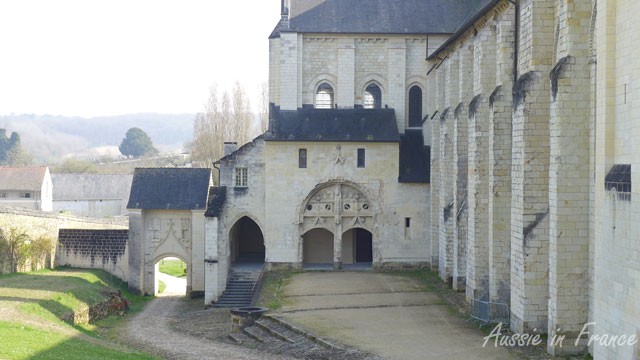
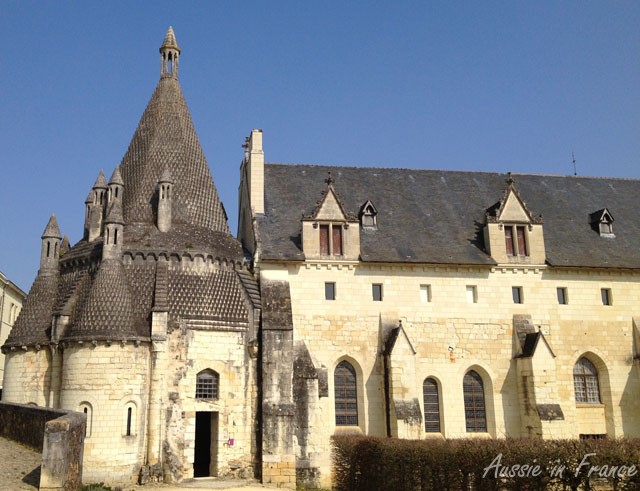
The first view of Fontevraud when you enter the abbey, with the church on the right
We’re just in time for a guided tour suggested by our hostess, which turns out to be really excellent. They even have very light folding seats you can take around with you.
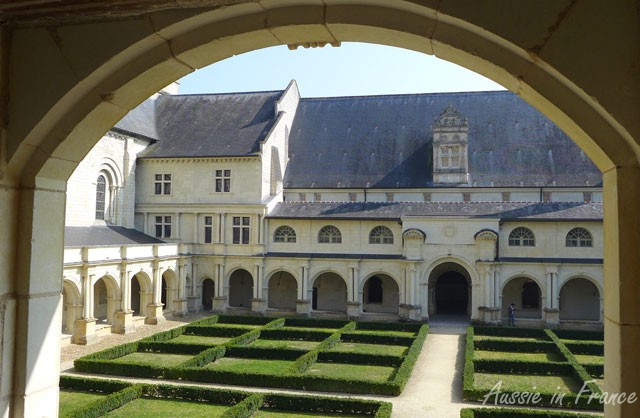
The cloisters
The monastery, which was actually a group of four monasteries, was founded in 1101 by a wandering preacher called Robert d’Arbrissel who had such a following that he was ordered to settle somewhere. There was a monastery for women, one for men, another for repented women and another for lepers.
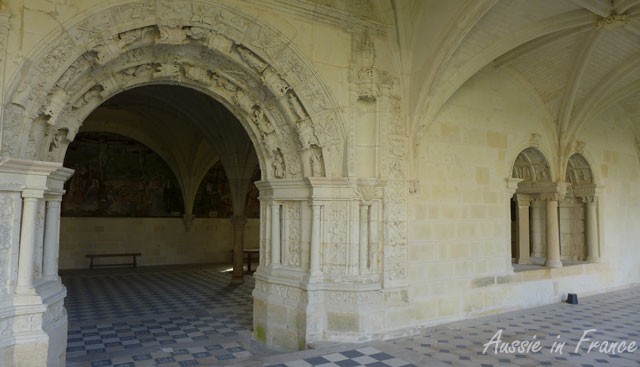
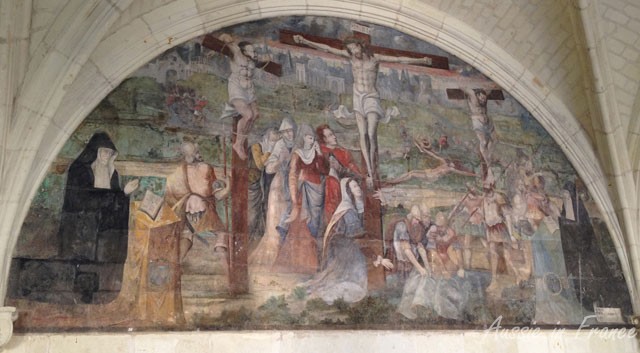
The room in which the nuns had to confess to their misdemeanours
Thirty-six abbesses ruled the abbey during seven centuries of monastic life, many of royal birth. The women’s lives entailed mostly hardship from what I gather as very few were there by choice. One of the nuns tried to poison another three times before being sent to solitary confinement (forever, I might add).
The abbesses usually managed to wend their way into the paintings in the confession room
The French Revolution closed the abbey in 1792 until it was turned into one of France’s most severe prisons from 1804 to 1963. The thousand or so inmates provided the manpower to convert the abbey into a fortress, learning all the trades needed to do so.
Restauration began after the prison was closed and the abbey was open to the public in 1985.
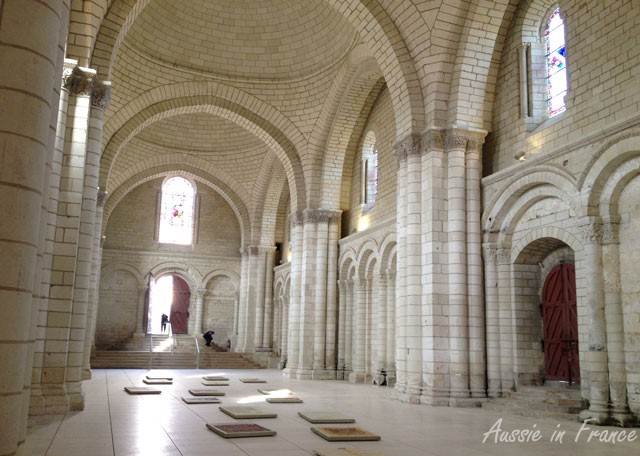
Inside the abbey church
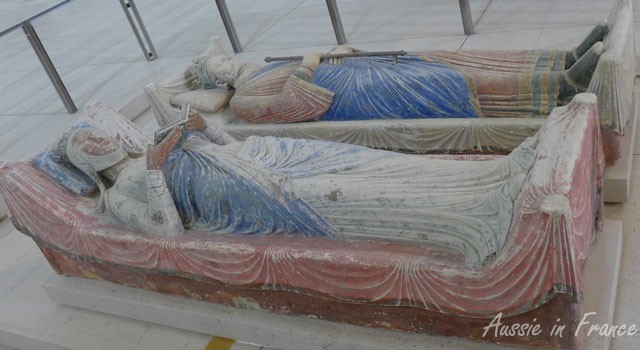
We visit various rooms, starting with the church which contains the recumbent statues of Aliénor d’Aquitaine, one of the countries most illustrious figures in the twelfth century, along with the smaller statues of her husband, the future Henry II Plantagenet of England, their son Richard the Lionheart, and his sister-in-law, Isabelle d’Angoulême who was married to Richard’s brother John Lackland.
The recumbent statues of Aliénor dAquitaine and Henry II
Next comes the cloister followed by the confession room in which the nuns had to own up to their misdemeanours including the aforementioned poisoning!
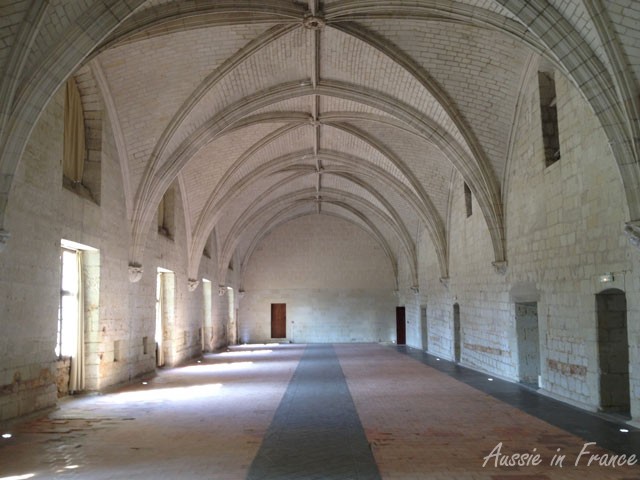
The refectory where the nuns survived on a very frugal diet of smoked fish and little else
After visiting the enormous refectory to which a floor was added to create prison cells and most of the doors blocked up, we come out into the open.
The famous kitchen at Fontevraud l’Abbaye
Here it is at last – the most recognisable part of Fontevraud l’Abbaye – its strange octagonal kitchen 25 metres high with its many pointed roofs made of stone from Charente and not the local tufa which is much softer.
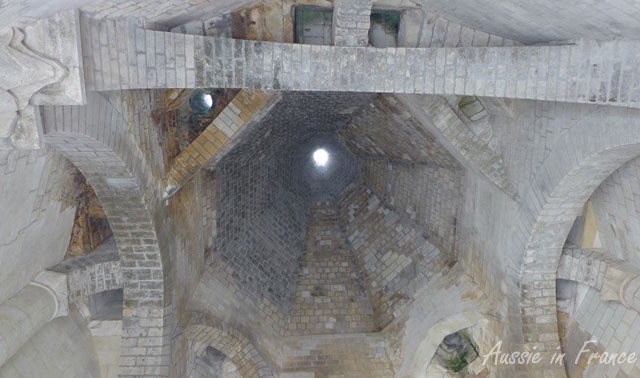
Inside one of the 21 chimneys
Its Byzantine style brought back from the crucades is very different from the other buildings. The 21 chimneys covered with fish-scales were used to evacuate the smoke from the smoked fish below, the monastery’s staple diet.
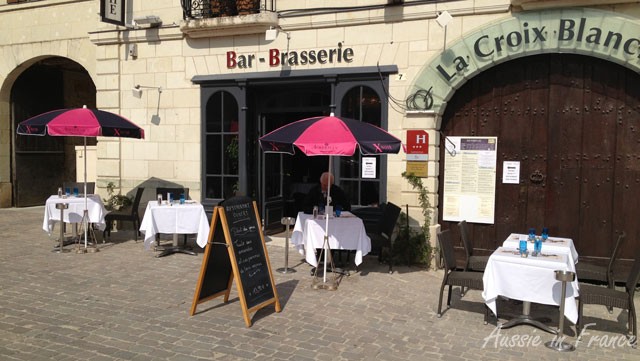
Terrace at La Croix Blanche
Although there are two restaurants within the Abbey, we decide to see what’s offering on the main square and are delighted to find there are plenty of outside tables free at La Croix Blanche. Nothing extraordinary but we like the setting.
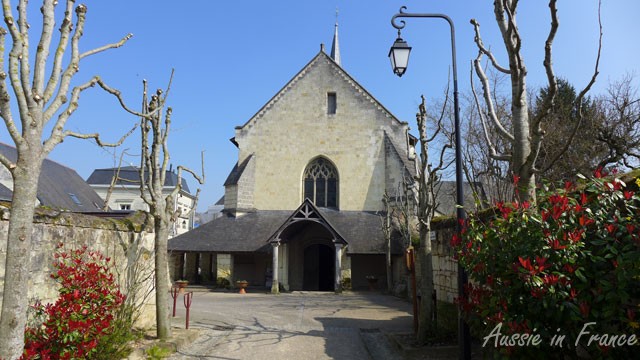
Parish Church at Fontevraud
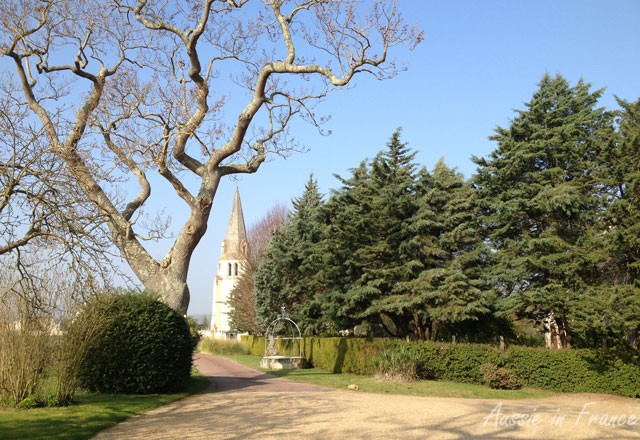
Before going back to the car, we wander around and find the little parish church of Saint Michel in Fontevraud-l’Abbaye with its “chat room” built in the 12th century for the large contingent of labourers employed to build the abbey and was financed by Henri II Plantagenet and Alienor d’Aquitaine. It was extended in the 15th and 17th centuries.
Thinking of the hills that no doubt await us when we get back on our bikes in Saumur, I somewhat regret the entrecôte, French fries and wine!
Château de Villeneuve vineyard, 3 rue Jean-Brevet, 49400 Souzay-Champigny. Tel: 02 41 51 14 04. jpchevallier@chateaudevilleneuve.com. Open from 9 am to 12 noon and 2 pm to 6 pm. Closed Sundays and public holidays.
Le Balcon Bleu B&B, 2 rue de Martyrs, 49730 Turquant. Tel 02 41 38 10 31. lebalconbleuturquant@free.fr
I’m including this post in Lou Messugo’s ALL ABOUT FRANCE blog link.
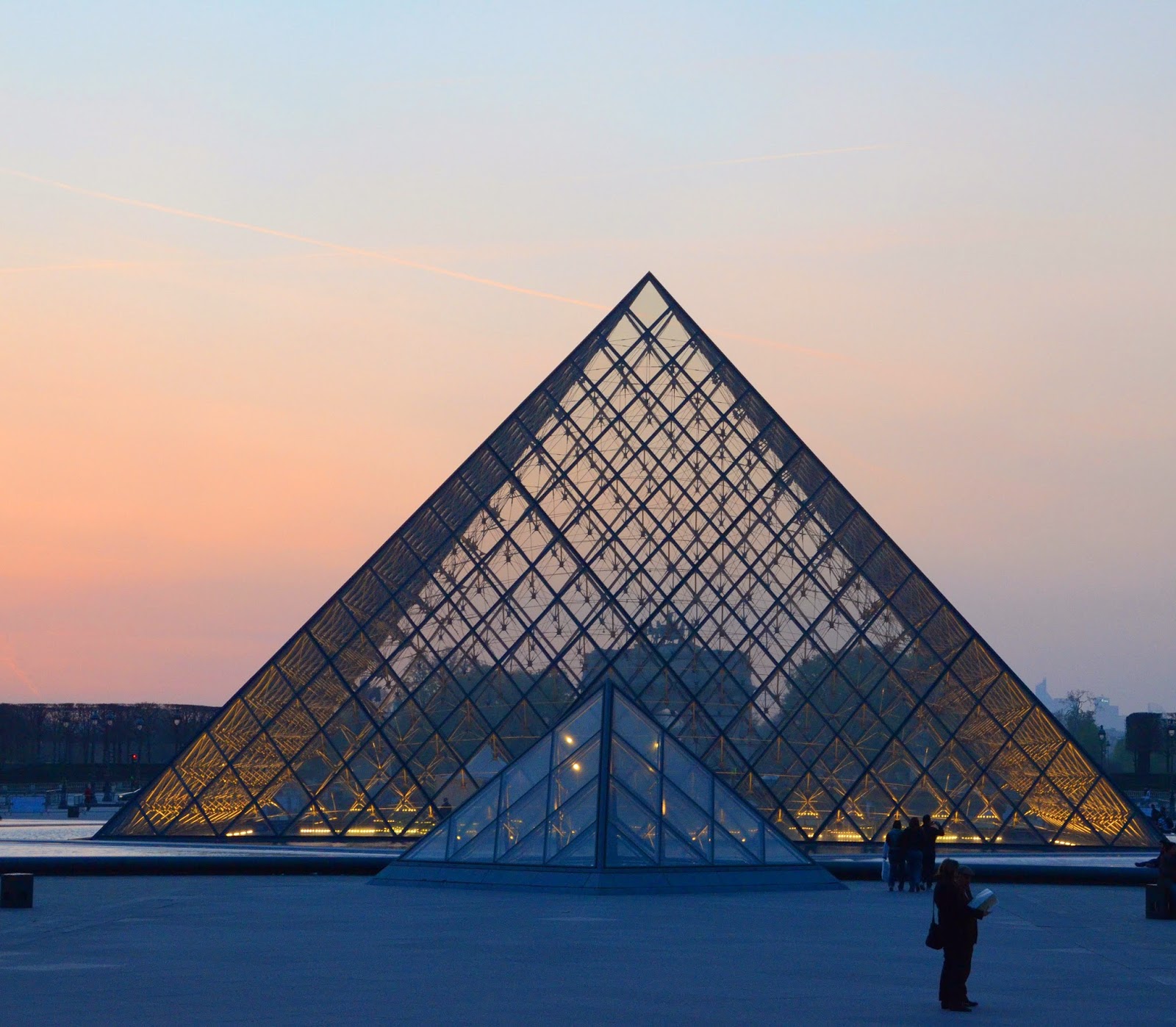
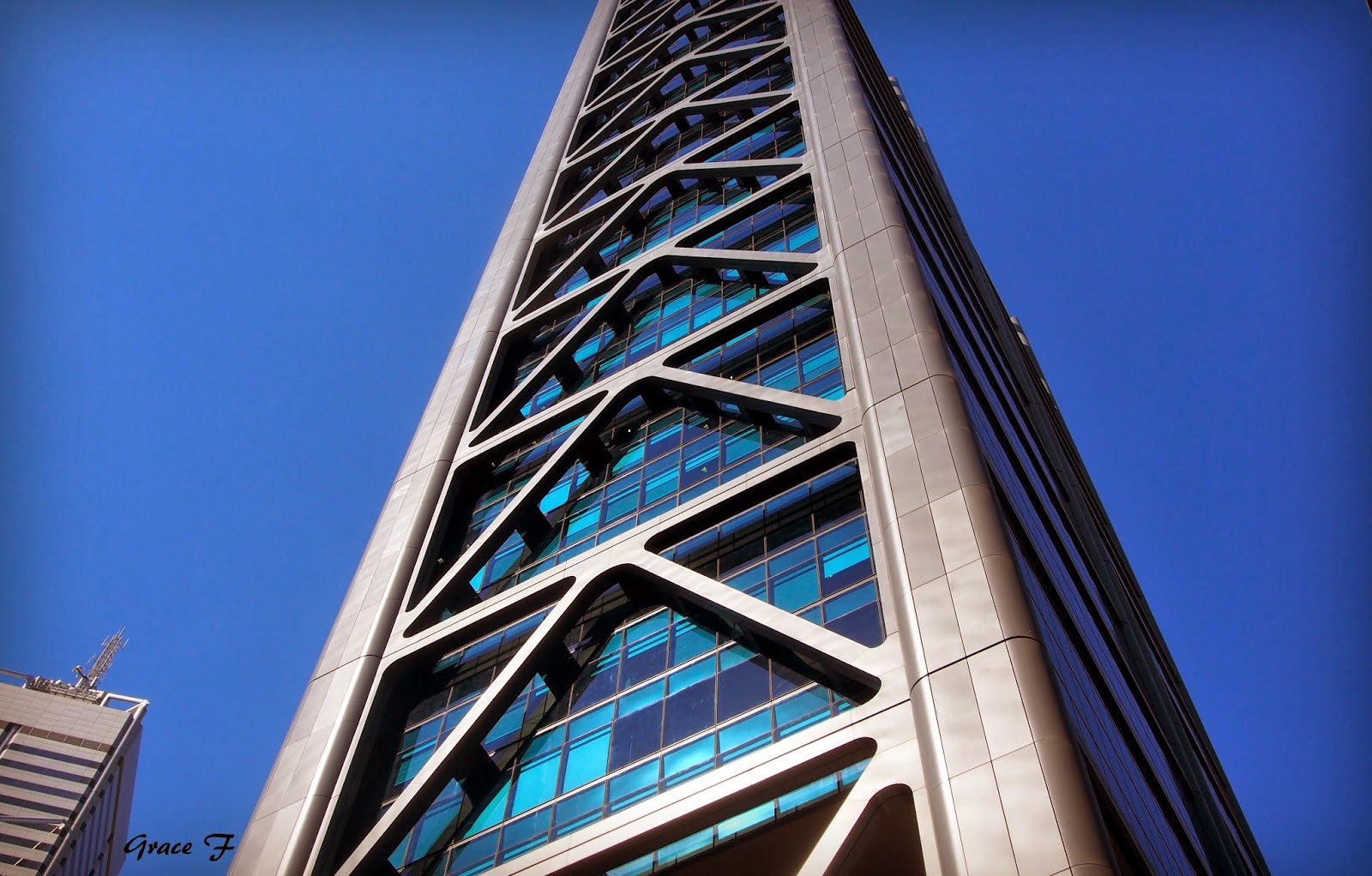
For this week’s Blogger Round-Up, I’ve chosen fellow participants in the City Daily Photo theme day to which I also contribute on the first day of the month with the blog that Jean Michel and I write together: Blois Daily Photo. This month, the theme is triangles. First, Amboise Daily Photo – Stuart lives just down the river from our house in Blois, in the royal city of Amboise. Next, Genie from Paris and Beyond, with her stunning photo of the Louvre Pyramid. And to finish off – because I’m Australian – I’m including Gracie from Perth Daily Photo, who loves everything French and whose favourite city is Paris, presenting the masculine triangle. Enjoy!
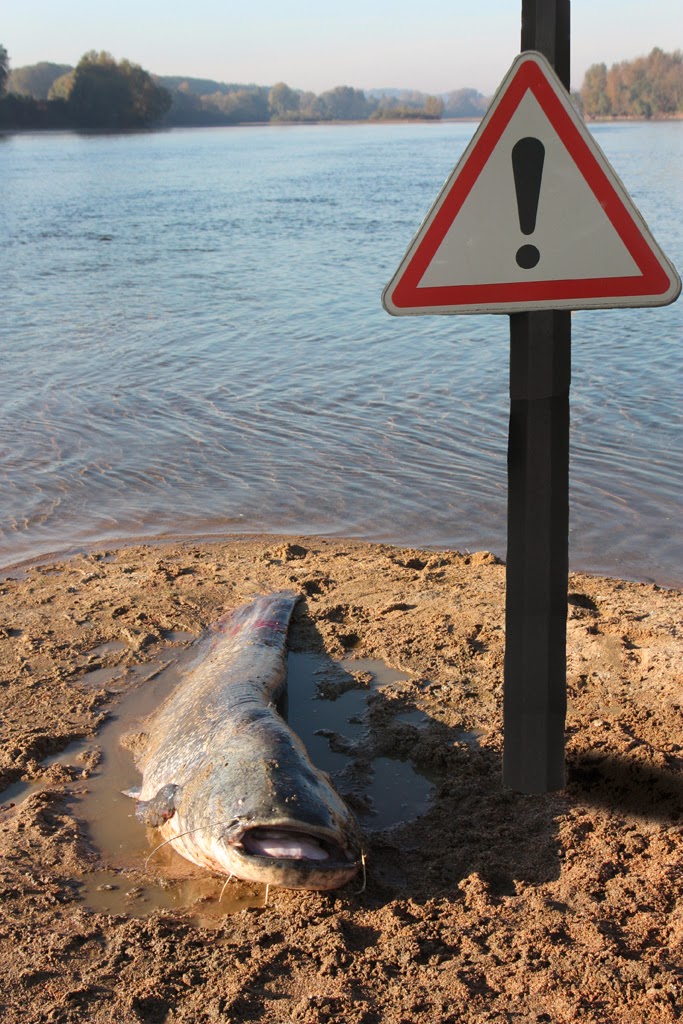
Poisson d’avril – Happy April 1
by Stuart from Amboise Daily Photo, an American who retired from technology and moved to Amboise to pursue his hobbies of photography and woodworking and to share the good life with his wife Elizabeth.
For an explanation of these expressions, you can look here. And for you non-Europeans, the sign is the international road sign for Danger! Since I am studying now to get my French driver’s license, these triangular signs are seared into my consciousness.
by Genie from Paris and Beyond, who lives in Mobile and has loved Paris, its people, its architecture and all of France since she was eight years old. She has a photo blog about Paris and occasionally other places in the world
The first day of the month is Theme Day for the City Daily Photo community, and the theme for April is “triangles.” In Paris there are two obvious and very large architectural structures which would pass the test: La Tour Eiffel and I M Pei’s Pyramide du Louvre, seen here.
by Gracie from Perth Daily Photo who feels so much younger than she really is, loves everything French and always looks at the glass as half full rather than half empty…
Heading into the city in search of triangles for April’s theme I was a little worried that it may not be that easy.. When really looking I couldn’t believe how many times the triangle features in Perth architecture, old and new. Discovering that the triangle pointing upwards is a strong masculine sign the BHP Billiton offices above takes on an almost phallic presence n’est pas 🙂 but if you look at the Central Park building in the background below there’s a whole lot of triangle action going on also! Read more and see the photo in full
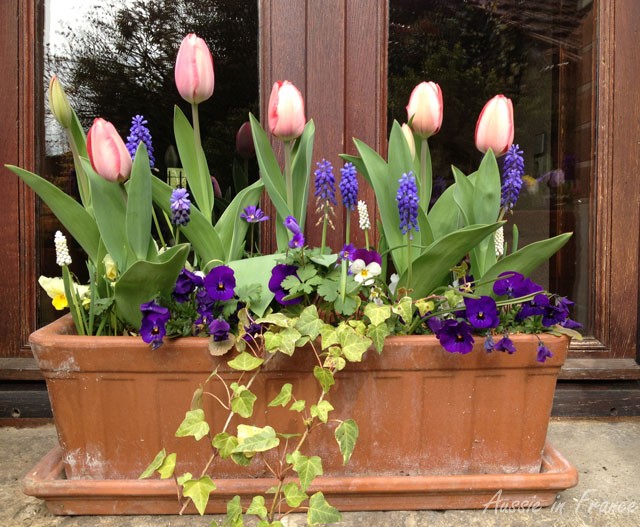
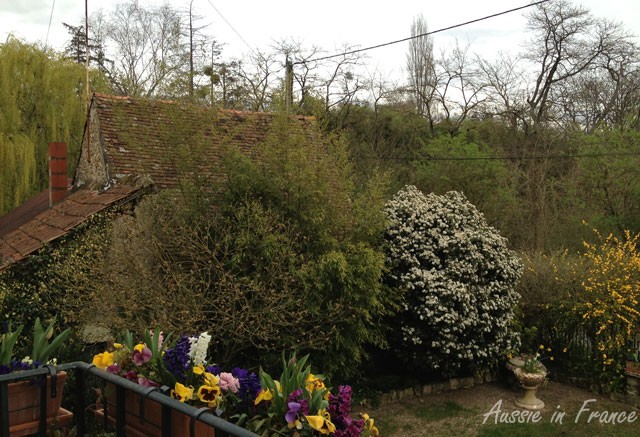
It’s now officially spring and we’re back in Blois for another couple of weeks. We couldn’t get over the difference in how many leaves have appeared on the trees in such a short time. The tulips are out as well so a visit to Château de Cheverny is scheduled for this week to see the 60,000 tulips planted every year. In the meantime, here are my favourites at Closerie Falaiseau and the view from upstairs.
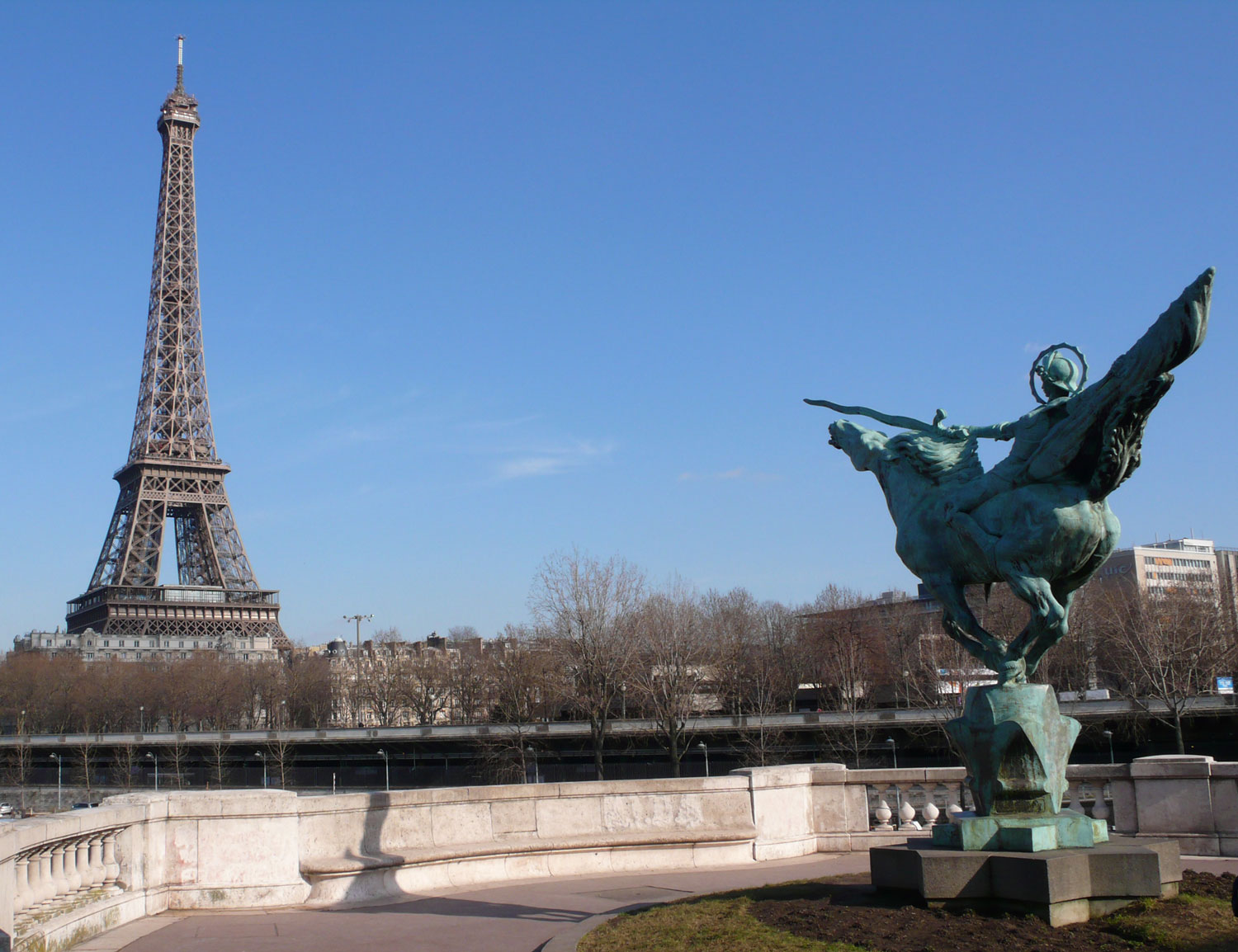
Viens ! Je t’emmène à la Tour Eiffel. Apporte des sandwichs, nous pouvons faire un pique-nique sur place. J’amènerai ma cousine avec moi.
Come on! I’ll take you to the Eiffel Tower. Bring some sandwiches – we can have a picnic there. I’ll bring my cousin with me.
Ce bus vous emmènera jusqu’à la Tour Eiffel
Now before we go any further, I’d just like to mention that the differences between these three verbs in French can be very subtle. Also, in English “bring” and “take” are not always used correctly e.g. “bring me the ball” but not “take me the ball”. “He took me to the cinema” and not “he brought me to the cinema”.
Emmener is fairly simple and corresponds to “take” used correctly in English:
Le bus vous emmènera jusqu’à la Tour Eiffel = The bus will take you to the Eiffel Tower
Je vous emmène dîner au restaurant = I shall take you out to eat
Il a emmené un livre dans sa chambre = He took a book to his room.
Amener and apporter are a diffcrent kettle of fish.
Apporter is used in the following cases:
N’oubliez pas d’apporter vos CD = Don’t forget to bring your CDs.
Un jeune homme a apporté ces fleurs = A young man brought these flowers.
Je vous apporte des bonnes nouvelles = I have some good news for you (literally I’m bringing you some good news).
Il doit nous apporter des preuves = He has to bring us proof.
Cette réforme apportera des changements = This reform will bring changes.
What do you notice about all the above sentences (taken straight out of my Larousse French dictionary, I might add)? They all refer to things such as CDs, flowers, proof, changes and sandwiches, and not people.
If people are involved, then amener must be used and not apporter.
Amenez votre ami à la maison = Bring your friend home
Dites-moi ce qui vous amène = Tell me what brought you.
Ce bus vous amène à la gare = This bus takes you to the station.
I can hear you jumping up and down! What about the other bus, the one that takes you to the Eiffel Tower? Ce bus vous emmènera jusqu’à la Tour Eiffel. All I can say is that if there is a difference, it’s so subtle that you won’t ever have to worry about it!
Most of the other uses of amener correspond to the idea of provoking a result.
Cette crise économique risque d’amener des problèmes sociaux = This economic crisis could cause social problems.
Amener l’eau à ébullition = Bring water to the boil.
Il a amené la conversation sur le problème de chomage = He steered the conversation towards the problem of unemployment.
Vous nous avez amené le beau temps = You brought us the good weather.
You might wonder with this last one why you wouldn’t say Vous nous avez apporté le beau temps. It’s because you can’t literally bring good weather the way you can with sandwiches, but cause the good weather to happen.
I wrote this post at the request of a reader so will be interested to know whether it has helped!
In this week’s Blogger Round-Up, Gigi from French Windows explains her love/hate relationship with French articles, while Maggie LaCoste from Experience France by Bike gives us a detailed explanation of French rail’s new site for cyclists in English. To finish off, Anda from Travel Notes and Beyond takes us to a most unusual place in Dresden that has singing pipes. Enjoy!
Feminine Articles
By Gigi from French Windows, failed wife and poet, terrible teacher and unworthy mother of three beautiful girls, who has lived in France for over twenty years and gives glimpses of her life with a bit of culture thrown in.
It’s International Women’s Day so I thought I’d write a piece about my struggle, here in France, with all things feminine.
Well, not all things feminine. Nouns mostly. After twenty-seven years in this country, you’d think I’d have got the hang of this le/la, un/une business but pas du tout. I provide endless amusement for my French friends and colleagues because I still get it wrong.
I mean, some words just sound feminine to my worryingly gender-stereotyped (I’ve just realized) mind. Like nuage…soft and fluffy, it’s actually masculine. Or pétale, which is also masculine. And then there is victimeand personne, which are feminine. So when the newsreader refers to a male murder victim as ‘elle’, I get terribly confused. Read more
New French Rail Website for Bicyclists
by Maggie LaCoste from Experience France by Bike, an American who loves biking anywhere in Europe, but especially France, which has the perfect combination of safe bike routes, great food, great weather and history.
SNCF, operator of France’s national rail service has a new website designed to help bicyclists navigate the train network. The website is easy to navigate, is full of information you should know if you plan to carry a bike on a train while bicycling in France and it’s in English. The website doesn’t make it any easier to take your bike on a train, it does help you understand the rules. Since there has never been a centralized source of information for travel on French trains with bikes, this website is a huge step forward.Whether you need information on bringing a bike into France on a train, traveling via train with a bike while in France, where to rent a bike near a train station or where to ride, this website will provide you with the basic information you need. Here’s a basic rundown of information on the website, and quick links if you need more information. Read more
The Singing Drain Pipes of Kunsthofpassage
by Anda from Travel Notes & Beyond, the Opinionated Travelogue of a Photo Maniac, is a Romanian-born citizen of Southern California who has never missed the opportunity to travel.
I didn’t know anything about this site before our trip to Germany. One day, as I was searching the net for places of interest in Dresden, I stumbled upon a picture of a strange, funny building with a big giraffe on it. It was the Kunsthofpassage. I tried to find out more about this curious spot, but the information at hand was scarce and very conflicting: some called it a “masterpiece”, others “a waste of time”. But the picture of that building was very intriguing so I wanted to visit it. Read more