Confusing is a word we use quite a bit in English to mean that something is unclear and difficult to understand. e.g. “The information he gave me is confusing.” If I confuse John and Paul, it means that I wrongly think that John is Paul and Paul is John. Now I hope I’m not confusing you too much!
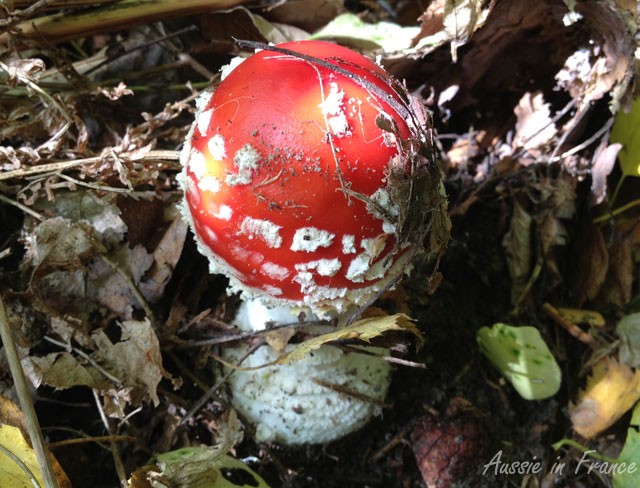
Un champignon qu’il ne faut jamais confondre ! The fly agaric – reputed poisonous and hallucinatory – but also said to be edible if cooked the right way.
Now, to say the same thing in French is a little bit complicated. The verb confondre does exist and can be used in the second example: Je confonds toujours John avec Paul. That’s easy. It can also be used without avec as in the caption above where it’s understood that you mustn’t confuse the fly agaric with any other mushrooms (not that you can – it’s very distinctive).
However, to say that “information is confusing” requires a slightly different approach. Les informations sont confuses is not quite the same meaning. [Note the plural in French and the singular in English]. In the first case, the information has not been presented correctly, while in the second, it may be the person’s lack of knowledge of the subject that prevents them from understanding. A bit confusing, huh?
Les informations ne sont pas claires is probably the most usual way of expressing the idea. You may already have noticed that French often uses a negative when a positive would be used in English.
So how are we going to translate “a bit confusing”? I would tend to say difficile à comprendre or pas vraiment clair but you might have some other ideas.
Now if you say to someone, je suis confuse, it doesn’t mean you are confused at all, but that you are embarrassed about something you’ve said or done! It’s actually a veiled apology.
How about “You’re only confusing the issue”? Vous compliquez tout! Vous ne faites qu’embrouiller les choses. In fact embrouiller which means obscurcir, compliquer une question, une affaire, y mettre la confusion often conveys the same meaning as the English verb confuse. Tu ne fais que m’embrouiller: you’re confusing me. Il s’embrouille: he gets muddled, he gets confused. We could say les informations sont embrouillées to mean that the information is not presented clearly.
Now it’s over to you. Let’s have some suggestions on how to translate the following sentences:
1) Are you still confused about how to use confuse in French?
2) I was confused when nothing happened.
3) Imminent and eminent are easily confused words.
Are there any other examples of confuse that you don’t know how to say in French?
If you have enjoyed reading this, don’t forget to subscribe to new posts using the subscription form on the top right – that way you’ll get them directly on your smart phone or in your mail box! And I love to hear your comments!
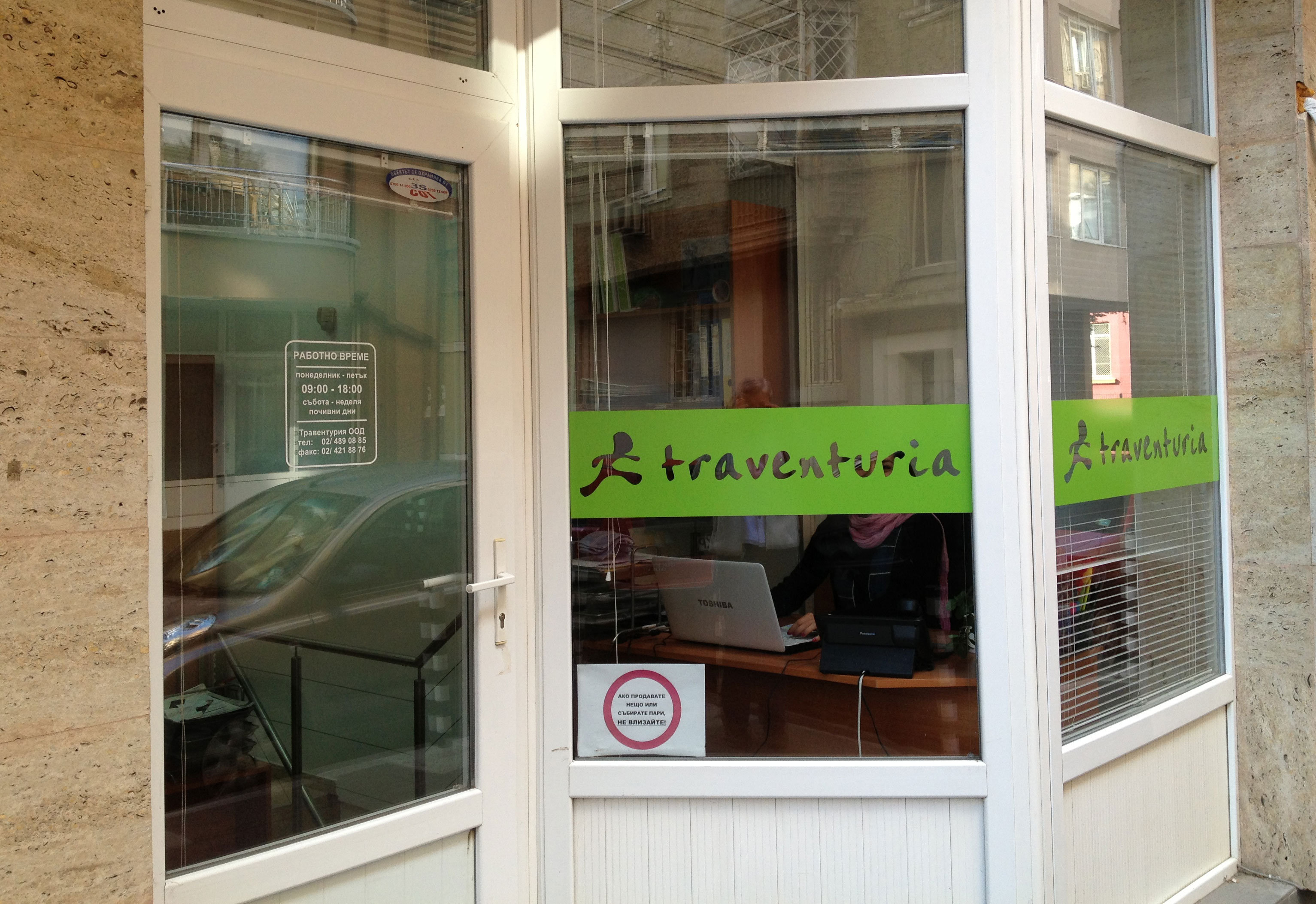
We’re debating about a day trip from Sofia to Rila Monastery because it’s a 2 to 2 ½ hour bus trip each way (120 K) but various friends have encouraged us to go and the photos are certainly encouraging. It’s also a World Heritage site. We also want to go to Boyana Church in the suburbs of Sofia. After a search on the Internet I find a company called Traventuria offering a day trip including both destinations for 25 euro per person, which is an attractive price. I check out Trip Advisor and the fact that the coach drivers are reputed to be careful cinches it for me.
Traventuria’s office on Veslets Street
As I start booking, I notice the address at the bottom of the screen. Unbelievably, it’s the same address as ours – their office is on the ground floor of our home exchange building in Veslets Street. We decide to go and pay in cash next morning. The girl is very friendly, speaks excellent English and even gives us an aluminium water bottle each.
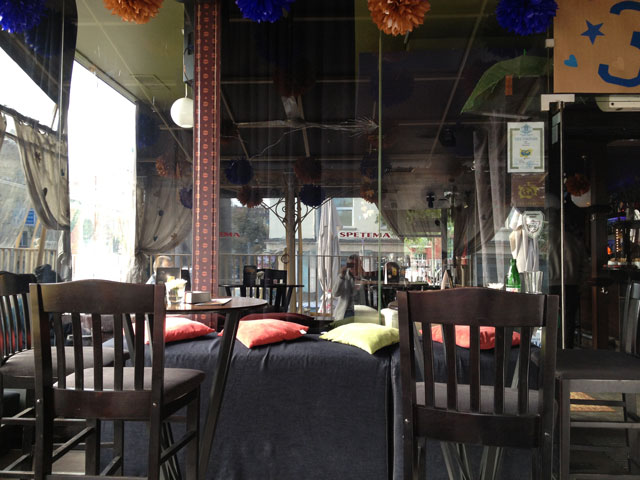
Spetema Café near the university of Sofia
We set off at 8.15 to be well in time for our 9 am rendez-vous behind Nevski Cathedral. Sofia is quite different at that hour, we discover, with everyone hurrying to work. We have time for a coffee at a trendy bar called Spetema just opposite the university.
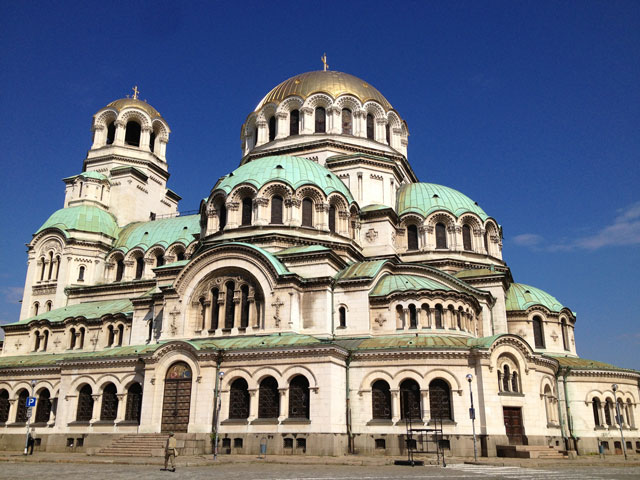
Alexander Nevski Church
Our 12-seater mini-bus pulls up on time but we wait for a couple of people who never come and finally move off at 9.15 am. There are eight of us altogether. Our young guide tells us the programme: a two-hour drive with a ten-minute rest-stop on the way, two hours at Rila, then back towards Sofia and Boyana where we stop for half an hour. We’ll be back in Sofia by 5 pm.
On the road from Rila from Sofia
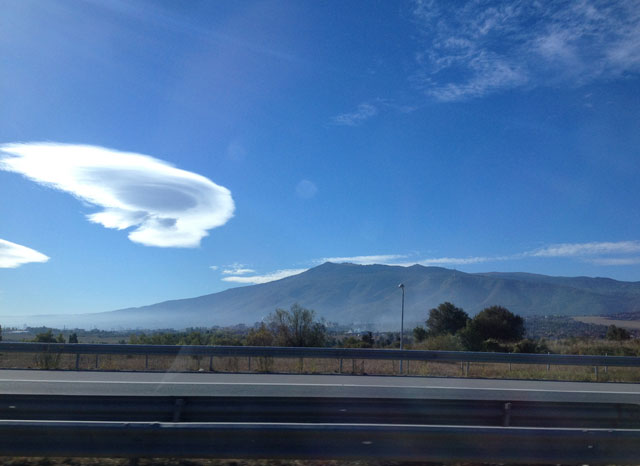
We’re soon on a recent 4-lane highway going at a reasonable pace. I’m reassured. The countryside looks surprisingly like Australia, minus the gum trees. There is little agriculture and only a few weedy looking cows. The cloud formation is quite unique. Jean Michel says there must be a lot of wind. The sky is a deep blue.
Grape vines on the otherwise unattractive houses
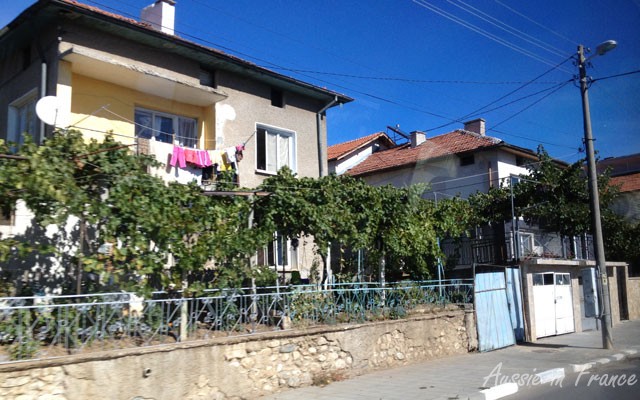
After our rest-stop, we soon turn left and begin circumnavigating Rila Mountain, before making the ascent. I’m amazed at how many houses in the villages have grape vines. The monastery is 1147 metres above ground level (the highest peak on Rila is 2925 metres). We go through mountain forest most of the time. The driver is going quite slowly and I’m not afraid.
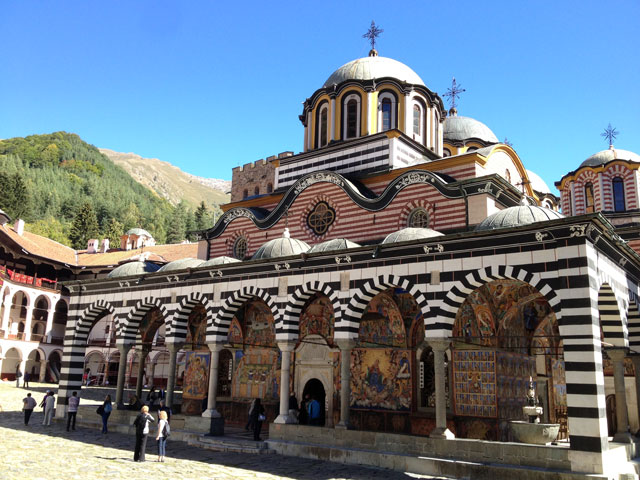
Stunning view of Rila Monastery as you walk in
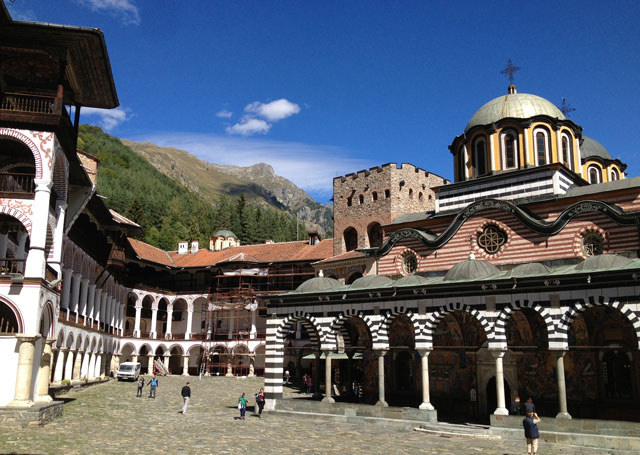
At the top, he pulls up and we get out. The initial impression is quite fabulous and we are not disappointed with the rest of our visit. We expected more people, but are pleasantly surprised to see that if we wait long enough, we can take photos without tourists in brightly coloured clothing taking photos of each other.
The Hrelyu mediaeval tower (1334-1335) on the left and church on the right
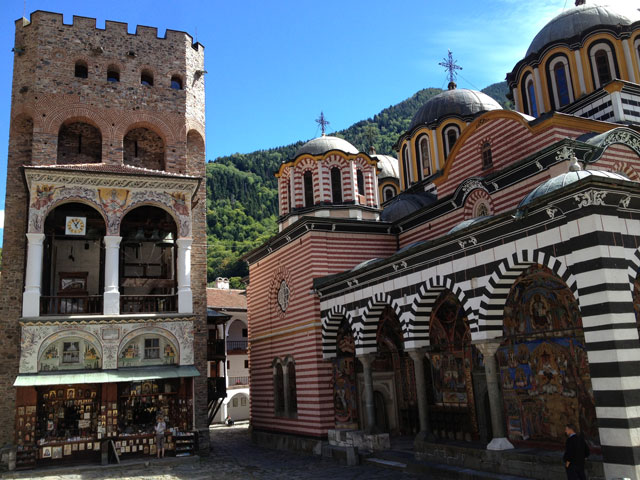
Jean Michel finds a booklet in French and we track down all the things to see because it’s a bit tedious to translate my audio-guide. Rila was founded in the 10th century by the hermit St John of Rila. It was destroyed by fire in the 19th century and rebuilt between 1834 and 1862 and is a characteristic example of the Bulgarian Renaissance (18th-19th centuries), symbolising the awareness of a Slavic cultural identity following centuries of occupation.
The main church with its 19th century frescoes
At the end of our visit, there are still three things on the list we haven’t seen, one in the koprivchtitsa room, one in the priory and the other in the tower chapel. We ask in the religious shop and are told to inquire at the museum which we have already visited and contains the most fabulous carved cross I’ve ever seen (81 x 43 cm) by a monk called Rafail, with 104 religious scenes and 650 miniature figures and 12 years in the making. Hardly surprising that Rafail lost his sight in the process. No photographs allowed however.
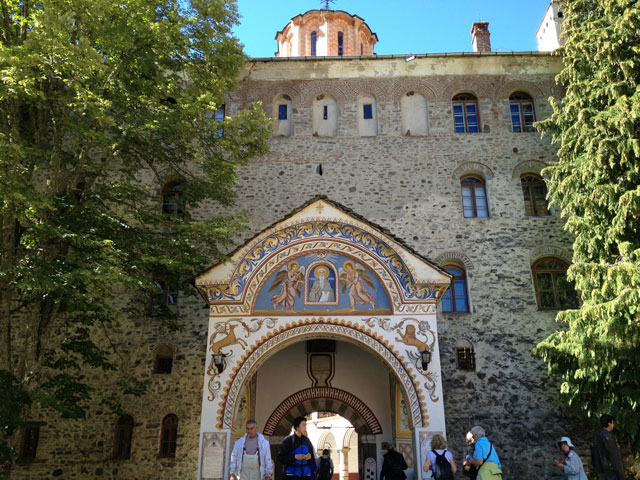
The rear entrance to Rila Monastery
First, we are told no, then the lady at the cash desk picks up her phone, puts it down again and says “30 minutes”. By that time our mini-bus will have left. Disappointed we didn’t ask earlier, we go and wait for our bus which soon appears.
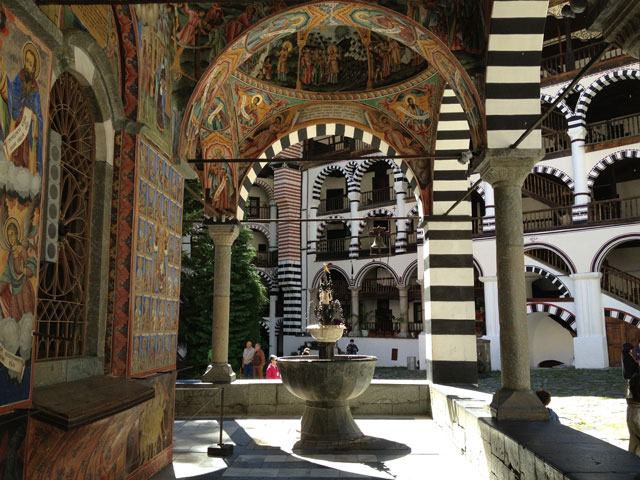
The fountain and frescoes on the church
One and a half hours later, our guide tells us we are nearing Boyana Church and that two large coach-loads are expected. If we want to get in before them (only 12 people are allowed in the church at a time for a maximum of 15 minutes), we have to hurry. He collects our entrance fee (10 lev per person) and when we arrive, he buys our tickets and takes us down to the little church.
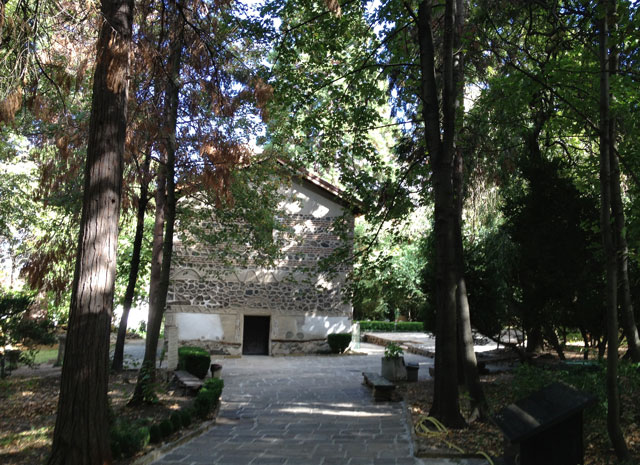
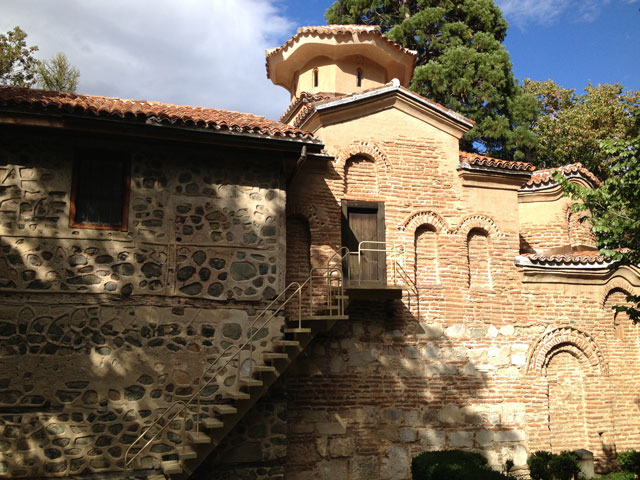
The leafy approach to Boyana Church
There are three churches, each joining onto the other, built in the 10th to 11th, 13th and early 19th centuries. The frescoes are all from the 14th century. To quote a UNESCO review of this World Heritage site, those painted in 1259 “possess a rare freedom, realism, harmony in the proportions, liveliness and warmth that already foresaw the birth of the Italian Renaissance. The site is one of the most complete and perfectly preserved monuments of east European mediaeval art.”
The three churches that form Boyana with the most recent on the left and oldest on the right
The faces are extremely expressive and the figures include Sebastocrator Kaloyan and his wife Desislava who commissioned the 13th century extension and the frescoes. Our party didn’t choose a guided visit, but I definitely recommend you to do so. As usual, photos of the interior were not allowed, but the website Pravoslavieto has excellent illustrations and descriptions.
This is definitely our best day in Bulgaria so far.
Traventuria Ltd., 45 Veslets Str., 1202 Sofia, BULGARIA, 0035924890884 (Monday – Friday, 08:30 – 16:30 CET), Fax: 0035924917352, www.traventuria.com, info@traventuria.comIf you have enjoyed reading this, don’t forget to subscribe to new posts using the subscription form on the top right – that way you’ll get them directly on your smart phone or in your mail box! And I love to hear your comments!
Wednesday’s Bloggers Round-up time again. After visiting Budapest and Sofia and reading Andrea’s post on Bucharest in Rear View Mirror, I’m ready to add Romania to my travel destinations. As you know, I’m not a fashionista, but fortunately, other bloggers are covering Paris Fashion Week. I’m referring you to Sylvia’s first post on the subject in Finding Noon but don’t stop there – check out her other more recent posts. And so that you won’t stop using the train to go from Charles de Gaulle airport to the city centre just because we nearly had a backpack stolen, here’s a comparison of travelling methods by Jill from Gigi’s French Window. Enjoy!
Romania’s Outrageous Palace of the Parliament
by Andrea from Rear View Mirror (formerly Destination Europe), a fellow Australian who, after 6 years of living in France, has given up herParis apartment to live a nomadic life slowing travelling around Europe, experiencing each destination like a local.
Upon setting eyes on Bucharest’s Palace of the Parliament, I was slightly underwhelmed. Yes, it’s a massive building but it didn’t strike me as being particularly remarkable or memorable. It didn’t have that grandiose feeling I had experience when seeing photos in the past. But when entering the first of countless marble filled halls I realised just how extravagant this 370,000 sq.m. building really is. Read more
Paris Fashion Week SS 14
by Sylvia from Finding Noon, an American living in Paris who appreciates fine art, good music, succulent food, and breath taking scenery
SS 14 is fashion speak for Spring/Summer 2014, and this being fall 2013, its that time of year again… Fashion Week. I’ve got Le Gastro, which is a charming local way of saying a tummy bug, so it wasn’t sure that I was going to be able to drag myself out into the glorious Paris sunshine and start shooting, but I had worked so hard getting the fashion show invites and I really do love seeing all those creative types out there doing their thing, I simply could not stay put. So while all the other girls were out there sporting their ‘it’ bags, I was sporting the bags under my eyes and taking as many clichés as I could get away with. Here is what I saw yesterday: Read more
Charles de Gaulle airport to city centre
by Jill from Gigi’s French Window, French ponderings from an Australian who must have been French in another life
The first couple of days on arrival in Paris are always a mixed bag….EXHAUSTION being the first thing that comes to mind!
But then there is also that feeling on stepping from the flight into Charles de Gaulle airport… for me, it’s a wonderful sensory overload……
I close my eyes and breathe in deeply…..there is nowhere else I could be….this is Paris! There is a certain something in the air and I love it! Below is a Charles de Gaulle airport promo video you may enjoy…must admit they paint a very ‘friendly’ picture…….;) Read more
If you have enjoyed reading this, don’t forget to subscribe to new posts using the subscription form on the top right – that way you’ll get them directly on your smart phone or in your mail box! And I love to hear your comments!
We’re on our way back from Sofia. A couple of people asked us whether we had any safety issues in Bulgaria but we didn’t. Apart from an insistent beggar in Plovdiv, we always felt perfectly safe, even walking through deserted streets at night (except for the pavements which are treacherous).
Jean Michel in the train with his backpack and the handle of the roll-on.
We have a large suitcase, a smaller roll-on bag, a backpack and a handbag (which I don’t usually carry when I travel but it’s easier than putting it in my roll-on). We’re sitting in the RER train that goes from Charles de Gaulle Airport to Châtelet-les-Halles in the city centre. We are sitting in the aisle opposite each other. I have the handbag on my lap with my hands on it. My iPhone is in the zipper closest to my lap because I’ve had that stolen before. The suitcase is on the floor near the window with the roll-on on top of it. The backpack is on the seat next to Jean Michel. His wallet, etc. are in his shirt flap-pocket. My wallet is in my bag.
Jean Michel then does something stupid (his admission). As we’re nearly home, he removes a little purse from the backpack and takes out his keys. He puts the now empty purse back into the backpack.
The train stops and a young man drops some coins on the floor next to us. While the door is still open, he bends down to pick them up. He indicates that one has gone under Jean Michel’s seat. Instinctively clutching my handbag (at least I’ve acquired that reflex at last!), I’m looking for the coin.
Suddenly, I see Jean Michel’s hand reach out to clutch another man’s sleeve next to us and then see his backpack on the floor. Both of the men dash out of the train just as the door closes.
Somewhat shaken, I ask Jean Michel what happened. The second man came from behind him and plucked the backpack from the seat. He then made the error (for him, not us!) of trying to leave the train from the door in front of Jean Michel. Had he left from the door behind, in the next wagon, he would have got away with it. Jean Michel immediately realised what was happening and grabbed his sleeve. The man was forced to let go and run for the door.
These are not organised professionals, in our opinion, just petty thieves used to working together whence the exit mistake.
The carriage is buzzing. Everyone is astounded but, you may be sure, not one of them would have tried to stop the thieves.
The moral is this: watch your belongings at all times. Make sure you don’t have too many bits of luggage. You can use a ribbon or shoelace or something to tie your luggage together until it’s time to get out the train. Don’t be silly enough to remove a purse from your backpack or bag in public transport.
AND DON’T BE FOOLED BY PEOPLE DROPPING COINS ON THE FLOOR!!!
N.B. Do read the comments to this post – there are other scams to be aware of too.
If you have enjoyed reading this, don’t forget to subscribe to new posts using the subscription form on the top right – that way you’ll get them directly on your smart phone or in your mail box! And I love to hear your comments!
Having walked our feet off exploring Sofia in the morning, we’ve come home to recuperate. After a couple of hours, I notice a leaflet on the dining table of our home exchange hosts advertising free English-speaking tours of Sofia every day starting at 11 am and 6 pm and lasting around 2 hours. It’s 5 pm, so I suggest we join a tour since we don’t have to reserve in advance. I can translate for Jean Michel if necessary.
Martin at the start of the tour, greeting each person as they arrive
When we arrive at 5.50 pm there are three other people waiting. Martin Zachev, a gregarious and larger-than-life Bulgarian from Free Sophia Tour, arrives and introduces himself. By the time he has finished his little speech, there are over 40 of us from an impressive number of countries, including Latvia, the Netherlands and Spain, each of whom he has greeted personally.
The lion with the non-physiological legs
The first point of interest is a statue of a lion just above our meeting place at the corner of the Law Courts. Offering a traditional Bulgarian sweet as an incentive, Martin asks what’s wrong with the lion. It turns out that its legs, which should be diagonally in sync, are not, and he demonstrates what would happen if it tried to walk! He also reminds us that the lion is the symbol of Bulgaria.
Even the bikes stop for pedestrians in Sofia
When we cross the road, we learn that drivers can lose their licence for six months if they hit a pedestrian. We have noticed how Bulgarian drivers stop for us even when we aren’t on a pedestrian crossing. Now we know why!
The coat of arms of Sofia
We stop in front of the coat of arms of Sofia in front of the Sheraton Hotel, a shield divided into four. On the upper right quarter is the church of St Sofia which gave its name to the city (sofia in Greek means wisdom), on upper left is a humanised picture of the ancient town of Serdica (Sofia’s Roman name), on the lower right is a golden canopy and a statue of Apollo Medicus representing the mineral springs found around the city while Vitosha, the mountain just behind Sofia, is on the bottom left. In the middle is a smaller shield with a rampant lion. The motto is “Расте, но не старее” – “Ever Growing, Never Aging”, though I’m not sure how appropriate that is!
The erroneous statue of Sofia
Martin then points out the recent statue of Sofia we have already seen before and explains that the people who erected the statue actually made a mistake. They didn’t realise that the town is called after the church of Hagia Sofia (Holy Wisdom) and not the saint called Sophia. Many churches in Eastern Europe are called St Sofia, but in fact, they are all Holy Wisdom.
The Eastern Gate of the city of Serdica and old Via Romana
He then takes us down a staircase and we find ourselves on the old Via Romana with its large flat stones that have come through the ages much better than the modern footpaths. We’re at the former eastern gate of the city of Serdica.
The budding tree with its martensiti (the photo was taken next day when there was more light)
A little late, bending down under a tree, he shows us that it is covered with red and white braided bracelets. On 1st March, it is the tradition to give people martensita, in honour of the end of winter and coming spring. You wear the bracelet until you see the first budding tree and hang it there to bring luck and a productive spring and summer. There are several regional variations that you can read more about on the Study English Today website.
Demonstrating the changing face of modern Bulgaria in front of the former Tzar’s Palace
We all sit down on the grass opposite the Tzar’s Palace and Martin asks for six volunteers – an Austrian prince, a German prince, an Italian princess, a Bulgarian, a communist and another Bulgarian. He then very cleverly demonstrates the recent history of Bulgaria showing how various people have been thrown out and reinstated up until the present day.
The church bell in the tree opposite Hagia Sofia
Our last stop is the church of St Sofia which stands on a mound that people could see from afar. As they approached the city of Serdica, they would say There’s Sofia, which is how the name of Sofia came to be used instead of Serdica. In those days there were no bell-towers so the bell was erected in a tree opposite the church. Well, that’s what I understood anyway.
The eternal flame at the Monument to the Unknown Soldier
We finish the tour in front of the Monument of the Unknown Soldier to commemorate the hundreds of thousands of Bulgarian soldiers who died in wars defending their homeland, and more lions symbolising Sofia. We feel that Martin’s tour has rounded off our visit of the city well and are ready for Rila Monastery next day.
N.B. These are not all the places that Martin took us to, but I have already described the others in previous posts.
If you have enjoyed reading this, don’t forget to subscribe to new posts using the subscription form on the top right – that way you’ll get them directly on your smart phone or in your mail box! And I love to hear your comments!
I’m walking along the street near the Louis Philippe Café behind a young man of about 30, talking loudly on his iPhone and madly gesticulating. “600 euros“, he says, “Un truc de ouf!” and I immediately think of my daughter in New York because it’s one of her expressions.
Truc, truc muche, machin truc, have all been around for a while, but truc de ouf is more recent. So what, exactly, is a truc?
First, it’s a substitute word, like our thingumajig, thingummy, whatsis or even just thing or contraption. Machin is a less trendy synonym. Je trouve pas le truc = I can’t find the whatis. T’as vu le truc de la télé? Have you seen the remote control? Il portait un truc moche. He was wearing something really ugly.
Machin and its feminine, machine, are also used as name substitutes. Le père Machin = Mr what’s-his-name. Machine était là aussi = What’s-her-name was there too.
You can combine it with chouette too, as in machin chouette or go the whole way and say machin truc chouette. You may remember about chouette from my previous post on Spanish cows.
However, truc is also used more specifically, in contexts such as les trucs du métier, meaning the tricks of the trade, or on le connaît, leur truc = we know what they’re up to. Il n’a pas compris le truc means he hasn’t got it. Here, it’s no longer a substitute but an actual expression. Il y a un truc! there’s a trick to it! or something’s gone wrong (depending on the context).
Why trucmuche? Muche, it seems, is a (little used) suffix added to any word to make it more incomprehensible. I don’t know what its origin is though.
Truc de ouf is actually verlan, which is a particular kind of French backslang. You invert the syllables and then cut off anything you don’t like to make it sound like a word. Meuf = femme, keuf = flic (slang for police), keum = mec, beur = Arabe.
The word verlan itself comes from à l’envers meaning back-to-front. So truc de ouf = truc de fou = crazy thing.
I may use truc (not often, though, and only when it’s not a substitute, because I’m a maddening purist most of the time), but I would never use truc de ouf or I’d sound like mutton dressed up as lamb, for which I have never found an equivalent in French, by the way, probably because it doesn’t seem to be a concept here. My grey hair makes me stand out in the crowd!
If you have enjoyed reading this, don’t forget to subscribe to new posts using the subscription form on the top right – that way you’ll get them directly on your smart phone or in your mail box! And I love to hear your comments!
The sky is a stunning blue although the temperatures have dropped a little. We go directly to the imposing church of St Nedelya, just across from the statue of Sofia and the little church of St Petka, with the School of Theology in the background. As we approach it, we see a lot of activity under white tents. It turns out to be a book fair. We notice there are very few book stores but lots of book markets.
Book fair in Nedelya Square
St Nedelya, or Holy Sunday, is a mediaeval Eastern Orthodox Church that has been destroyed and reconstructed many times throughout the ages. It was razed in an assault in 1925 that claimed over 150 victims. The tzar, Boris III, who should have been the main victim, escaped because he turned up late, a typical Bulgarian trait so I am told later by a Bulgarian. It was restored between 1927 and its inauguration in 1933. What a chequered existence!
Vitosha Boulevard with Vitosha Mountain in the background
If you look straight ahead as you come out the church, you will see Vitosha mountain in the distance. Vitosha Boulevard is Sofia’s most expensive shopping street. The population is dressed very differently and there are lots of French and other foreign stores but they are hardly big names: Adidas, Promod, Le Coq Sportif, etc.
Newspaper report on the Sofia Day celebrations
What we like are all the sidewalk cafés with the mountain as a backdrop, though they are twice the price of the others we’ve been to, but still much cheaper than Paris. We pay 4 lev for 2 espressos at Vitosha Street Café. We take a look at the local paper and I see a report on yesterday’s festivities but unfortunately I can’t read it.
Renovated19th century mansions
We then head in the direction of Eagles’ Bridge, wandering through a much more upmarket area than our own neighbourhood. Ultra-modern buildings juxtapose renovated 19th century mansions.
Sveti Sedmochislenitsi, initially the Black Mosque built in 1528 but completely restructured in 1901 to 1903. It once included a Turkish school for priests, a caravanserai and a bath which were temporarily used as a prison before being destroyed around 1929.
Yet another church, Sveti Sedmochislenitsi, and another market appear as we get closer to the university where we intend to find a sunny bench in a nearby park to have lunch (it’s an intermittent fast day for us) because the weather has become surprisingly chilly.
Ladies’ market where two vendors shall a stall, each selling two types of vegetables.
We’ve been back to the Ladies’ market to buy the day’s vegetables – 4 tomatoes, 1 eggplant, 1 zucchini, 1 capsicum, 1 cucumber and a couple of handfuls of green beans, all for an amazing 2 lev. White and black grapes are 1.20 lev a kilo. That’s about 60 euro cents.
Overhead wiring that doesn’t seem to obey any safety rules
Jean Michel stops to admire the external wiring on some of the houses.
Vegetation-covered wiring in our neighbourhood
Not nearly as good as the ivy-covered cables I saw last night on our way to dinner though!
The Soviet Army Monument
We sit next to the Soviet Army monument and are surprised to see several army vehicles on one side and canons on the other. I learn afterwards that the monument is used as a place of artistic expression e.g. in 2011, it was painted overnight by unknown artists who dressed the soldiers as American comic heros such as Superman, Joker, Santa Claus and Wonder Woman with the caption (in Bulgarian) Abreast of the Times.
Eagles Bridge
After lunch we go to Eagles’ Bridge (Orlov Most), spanning another tiny sliver of water – the Perlovska River. The bridge was built in 1891 by the same Czech architect as Lions’ Bridge. The four bronze eagles symbolise the citizens of Sofia returning from exile and being welcomed by their families. The bridge itself stands at an important crossroads in Sofia.
Street leading to Nevski Cathedral cordoned off by police
Our route then takes us past Nevski Cathedral which is completely cordoned off by police. Good thing we visited it yesterday. We have no idea what’s going on of course. Then we see a cavalcade of motorbikes approaching from the other direction. They don’t even take the street that’s been blocked off. Ah, if only we could communicate.
National Art Gallery (former Tzar’s Palace) with grass cutters busy on the right
We reach the National Art Gallery, which also contains the Ethnographic museum that I’m very keen to visit. The lady at the ticket office asks if we’re seniors and gives us cheap tickets (3 lev each). This is the first time I’ve been given a reduction for being a senior. Not sure how I feel …
Ballroom in the National Art Gallery with the musician’s gallery at the far end
I’m disappointed to discover the Ethnographic Museum is closed for renovation but some of the rooms, particularly the ballroom, are well worth the visit.
Shepherds in Brezovo by Zlatyu Boyadzhiev (1902 – 1976)
I also enjoy some of the more traditional 19th and 20th century Bulgarian artists, especially Vladimir Rilski, Vassil Stoilov and Zlatyu Boyadzhiev with their wonderful depiction of Hungarian rural life.
Old Woman with Apples (1933) by Vassil Stoilov (1904-1990)
We walk back to our home exchange apartment and don’t seem to notice the poverty as much. I guess we’re getting used to it! Sofia seems to be one of those places that grows on you.
If you have enjoyed reading this, don’t forget to subscribe to new posts using the subscription form on the top right – that way you’ll get them directly on your smart phone or in your mail box! And I love to hear your comments!
Since I have been writing quite a bit about Sofia in Bulgaria recently, I thought you might like a more French focus for this Wednesday’s Bloggers’ Round-up. Kathy Stanford from Femmes Francophiles reviews the phone app Memrise for learning and improving your French vocabulary; Phoebe from Lou Messugo takes us on a day trip by train from Nice to the Valley of Marvels; while Mary Kay from Out and About in Paris explains all about Dijon mustard. Enjoy!
Plant your Language Garden with Memrise
by Kathy Stanford from Femmes Francophiles, an Australian who has an ongoing passion for France and the French language currently on holiday in Europe
During the more than 10 years that I have been learning French I have tried many online applications in my quest to improve my French vocabulary. I have found Memrise particularly effective with its scientific basis and combination of learning with fun. The competitive aspects as you climb leader boards can become addictive. I have even lost track of time sometimes when learning vocabulary (playing). If you love using mnemonics and find them helpful you will love Memrise.
Memrise has been designed to help you connect with the new words that you choose to add to your sets. It does this with mems. Read more
Wonderous mountain train – a day trip from Nice
by Phoebe from Lou Messugo, a traveller, francophile, expat, mum and foodie now living in Roquefort les Pins where she runs a gîte after many years of travelling and living in Asia, Eastern Europe and Australia.
Train journeys are my kind of thing; trains and I, we go way back. Apparently, or so the family folklore says, I was on a miniature train in Delhi when the then Prime Minister Indira Gandhi turned up for a bit of political campaigning and I was chosen to sit next to her for the film shoot. I must have been about 7 years old. Now whether this was the beginning of my love of train travel I can’t say but since then I have taken some pretty interesting and scenic train journeys in Asia, Europe and Australia. So it was with great excitement that we recently took the grandly name “Train des Merveilles” from Nice to Tende and back. Read more
Searching for mustard in Dijon, France
by Mary Kay from Out and About in Paris, an American by birth, Swiss by marriage, resident of Paris with a Navigo Pass for the metro that she feels compelled to use
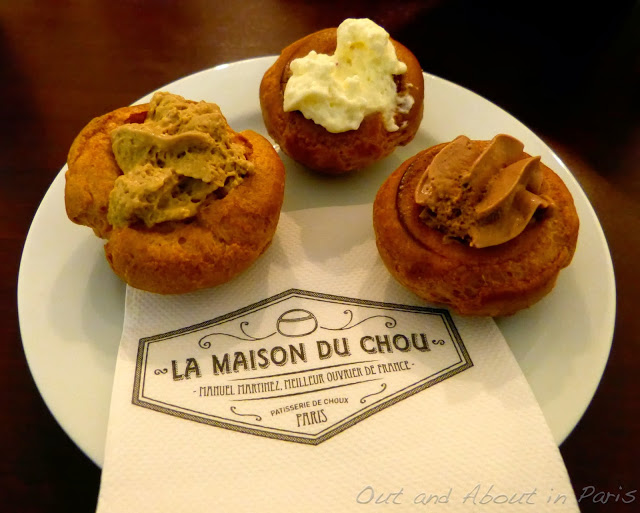
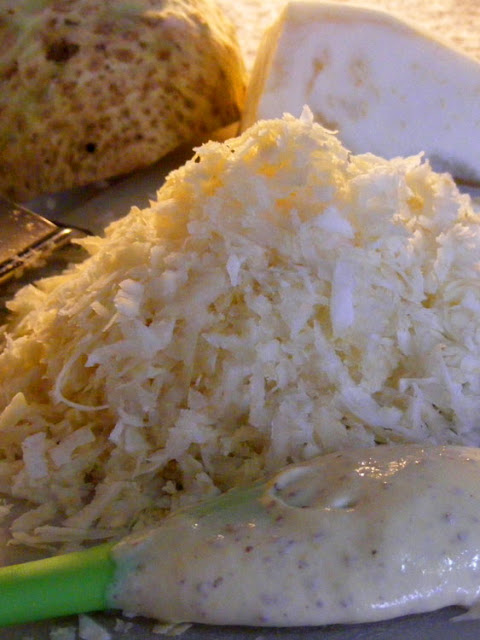
Mustard, Crème de cassis and wine – that’s what popped into my mind when we finally decided that Dijon would be a good place to spend the night on our way home from Switzerland last weekend. Given my mother’s penchant for all kinds of mustard and the fact that an entire shelf of her refrigerator was formerly reserved for the exclusive storage of this yellow condiment, visiting a mustard factory was at the top of my “to do” list. The only problem, as a search of the internet quickly revealed, is that Dijon’s oldest mustard factory was forced to close its doors in 2009 after demand for mustard declined in France. Read more
If you enjoyed reading this, don’t forget to subscribe to new posts using the subscription form on the top right – that way you’ll get them directly on your smart phone or in your mail box! And I love to hear your comments!
We wake up very late and I am relieved that my toe is no longer swollen and painful. I can now move it which is reassuring. The Nurofen, the three ice-cold foot baths and not going out for dinner and walking on it again yesterday seem to have worked. Alexander Nevski Cathedral and Saint Sofia are on the programme today.
People filling bottles with spa water near the old Baths
The first thing we do is to go back to the Baths to find the warm mineral water springs where the locals apparently form long queues. There are no queues today but quite a lot of people are filling up water bottles of all shapes and sizes. We test the temperature and it does indeed seem to be 37°C. Maybe I should get some for my toe!
The honey market in front of the old Baths
Just next to the springs is a honey market. Yes, just honey – about 25 to 30 stalls. It turns out that honey is very popular in Bulgaria and this is honey week.
Sculptures in the National Art Gallery grounds
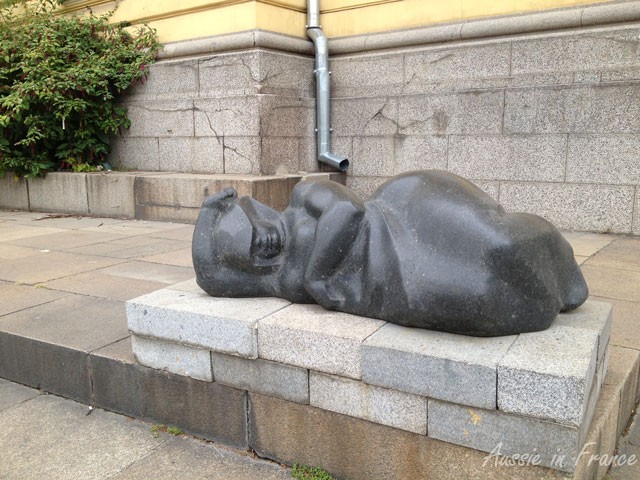
This time, we walk behind the former Tsar’s palace, now the National Art Gallery, towards Alexander Nevski’s Cathedral. The park behind the gallery has a lot of outdoor sculptures, some very modern.
Viennese-style houses behind the National Art Gallery
The Viennese-style houses lining the street are in much better repair than the ones in our neighbourhood.
Celebrations in front of Alexander Nevski Church on St Sofia’s feast day
As we near the Cathedral, which is just next to the church of Saint Sofia, we see that something is going on and we can’t access the church. There are rows of soldiers in different uniforms and people are crowding towards a podium. Soon, someone starts speaking over the PA system and an official-looking man starts walking past the soldiers. I am later informed by an American tourist who’s part of a group that it’s the feast day of Saint Sofia and the man is the Mayor but it turns out this is incorrect because the current mayor is a woman: Yordanka Fundakova.
Alexander Nevski Cathedral – this photo was taken about 15 minutes after the previous one – the change in the sky is quite astonishing
We head off down the road behind Saint Sofia to Alexander Nevski Cathedral. Built between 1882 and 1912 in the neo-Byzantine style typical of 19th century Russian churches, it is quite spectacular with its green and gold domes. Seventy-six metres long and 53 metres wide, it is said to up between 5,000 and 7,000 people.
Close-up of the tympanum on Alexander Nevski Cathedral
It takes a while for our eyes to adjust to the light inside. We can finally see the beautiful murals. The ones closest to the cupola are being renovated and the colours are quite striking. Photographs of the inside are not allowed unfortunately so I can’t show you. There are three altars and people are standing in line with a candle in their hands to touch the icons.
Sofia Opera House
After leaving the cathedral, we walk towards the Opera house on the corner of Rakovski and Vrabcha Streets, a perfect example of Stalinian architecture with its enormous columns and friezes built in 1950.
The AHTPE restaurant near the Opera House in Vrabcha Street
We find a restaurant called AHTPE (well, in Cyrillic anyway) close by, with a terrace next to a construction lot. Fortunately the pneumatic drill stops while we’re eating. A much better choice than yesterday with fresh grilled trout and salad with an 18 cl bottle of wine each for 30 leva. As an added bonus, while we’re eating, the chorus in the Opera House next door is practising.
St Sofia, largely camouflaged by trees – the sky has become cloudy again
By the time we have finished, the festivities at Saint Sofia are over and we’re able to visit. The simple red brick church is the oldest Eastern Orthodox church in the capital and dates back to the 5th and 6th centuries. During Ottoman rule, it was turned into a mosque but after the minaret was toppled in 1818 during an earthquake and the Imam’s two sons were killed in a second earthquake 40 years later, it was abandoned and restored as a church after liberation.
Brick vaulting inside St Sofia
The crypt below is far more interesting and a real labyrinth, explained by the fact that the current church is the fifth to be built over the ancient necropolis of the Roman town of Serdica. There are several murals and mosaics. We go through the whole crypt twice because Jean Michel says we’ve missed some mosaics but we still can’t find them.
Mural in the crypt underneath St Sofia
When we come out, we walk through yet another market, this time a local flea market.
Dalek Christmas trees which are actually planters
We go home via the Theatre and what should I see near the fountains by another of Susan’s Daleks which is, in fact, a tiered planter with little white flowers up the sides!
If you enjoyed reading this, don’t forget to subscribe to new posts using the subscription form on the top right – that way you’ll get them directly on your smart phone or in your mail box! And I love to hear your comments!
The starting point for our third walking tour of Sofia is the Archeology Museum opposite the Presidential Palace and the changing of the guard which I described in my Second Impressions of Sofia. The oldest museum in Bulgaria (formerly the Big Mosque) has been in its present location since 1899. The building itself dates back to the 15th century and has been recently restored and the museum has an excellent reputation. We will no doubt go back another day.
The archeology museum
Next on the list is Alexander Battenberg Square, once the site of the mausoleum of Georgi Dimitrov, Bulgaria’s first Communist leader, now completely reduced to rubble. The former Tzar’s Palace, built in 1873, stands on the other side and is now an art gallery and ethnographic museum that we’ll visit another day when my foot is not as painful.
The former tzar’s palace, now the National Art Gallery
Just next door we see a beautiful building with five gold bulbs, the very ornate Russian Church built from 1912 to 1914 apparently to appease a Russian diplomat who was afraid to worship in Bulgarian churches! But maybe that is just heresay. The bulbs were recently re-guilded with gold leaf donated by the Patriarchate of Moscow.
The Russian church
A beautiful Renaissance-style building on the other side of Rakovski Street turns out to be the Bulgarian Academy of Sciences.
Parliament on the right and the Bulgarian Academy of Sciences on the left with some sort of sit-in in the middle of the square
As it’s starting to spit, we head for the area in which the Routard gives the most addresses. On the way, we go past a statue of a dancer in front of a series of fountains with the Ivan Vasov National Theatre in the background. We’re definitely in a different neighbourhood. The footpaths are still full of holes, but most of the buildings are new and the people are dressed differently.
Vasov National Theatre
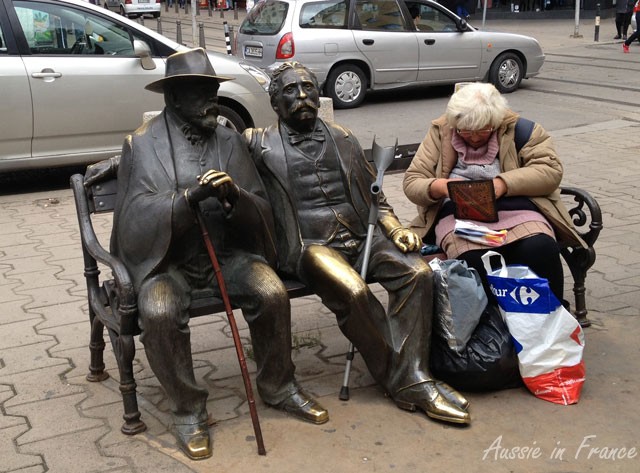
We see a couple of tables set up for chess and two men are playing behind a large statue with two figures. There is a lot of modern sculpture in Sofia.
Statues in the park with chess players in the background
Our restaurant is the Warsteiner, which is described as having a pork knuckle, stuffed capsicum and sausage ambiance with an eclectic clientele. It has a covered veranda which sounds like a good idea.
The Warsteiner restaurant
At another table, the locals are eating a copious vegetable dish served on a hot grill so I ask for one of those. We choose pork spare ribs, which turn out to be cold and lamb shank, which is luke warm. We have a local red. I have to go closer to the main dining room to get the wifi to work. Overall, not a very good address although cheap at 40 leva (about 20 euro). We later learn that it is part of a chain. We much preferred our meal last night at the local Dom Doman recommended by our hosts even though half the dishes were off the menu.
Sofia university
I get up and my foot screams out in pain. We head for the tourist office at Sofia University underground station to get some brochures for our travel diary and ask for a pharmacy. We follow instructions but have trouble finding it. I whip out my Bulgarian app for help. I find “Where is a pharmacy” with a recording in Bulgarian. I stop a lady in the street but she shakes her head and looks afraid.
I stop another woman and she says, “Oh, a pharmacy. You speak English?” and directs us to one near the Radisson Hotel. I can’t see any sign of an apoteka so ask reception. She sends us back in the other direction and we find one with Pharmacie on the window in addition to apoteka. I ask the lady behind the counter if she speaks English or French. “Ne”, she says. So I ask if anyone else does. She calls over a colleague who admits to speaking a little bit of English.
Radisson Hotel, one of Sofia’s landmarks opposite the Parliament building
She gives me some Nurofen, but no instructions on how to take it. It turns out that the leaflet is written in Bulgarian. Thank god for the Internet! At the end of the conversation, she asks where we come from. I indicate Jean Michel – French – and say I’m Australian. A large smile lights up her face. “Ah”, she says, “You’re not French. French people don’t speak English. Why don’t French people speak English?” “Bad teachers”, I answer. “Yes”, she agrees. “French people are lovely people. France is a lovely place. But no English!” Which is exactly what we were told in Ljubliana in Slovenia.
If you enjoyed reading this, don’t forget to subscribe to new posts using the subscription form on the top right – that way you’ll get them directly on your smart phone or in your mail box! And I love to hear your comments!