Five Places to Lunch near the Louvre in Paris

Visiting the Louvre can be tiring particularly when you try and take in too much at a time. When your feet are aching and you’re hungry, you want to find a place to relax that’s hassle-free and has friendly service. As a rule, it’s always best to have your main meal in France at midday because many of the restaurants offer excellent specials that are no longer on the menu in the evening as they cater to local businesses.

Café Diane in the Tuileries Gardens

My all-time favourite in good weather is in the Tuileries Gardens. I used to imagine it would be expensive and full of tourists. Not so. There are tourists, of course, but a lot of business people and office workers as well. I prefer Café Diane, the first outdoor restaurant you come to on the right when you walk from the Louvre towards Concorde because the waiters are very friendly. On a hot day it’s wonderful to sit under the trees and take in the splendid and unrestricted view of the Louvre and gardens. There’s quite a big turnover so you never have a problem getting a table but you can still stay as long you want. There’s  a choice of salads, quiches and a hot dish of the day all for around 11 to 13  euros. The food is cooked on-site and even when it’s very busy, the service is fast. Great too if you have a baby in a stroller or someone in a wheelchair. There are some sparkling clean public  toilets (50 euro cents) over towards Rue de Rivoli. Open every day, same openings hours as the gardens.

Café Louise on Rue Croix de Petits Champs

However, if the weather isn’t too  wonderful, you might prefer to be indoors or on a covered terrace. Put your back to the river and go towards the Palais Royal. Turn right into rue Saint Honoré and walk past the strange building on your left covered with a silver metal net (Minister of Culture) and then left into rue Croix des Petits Champs (not to be confused with rue des Petits Champs). On the next corner on your right, you’ll find Café Louise. This is a little restaurant mainly used by people working at the Ministry but Louise, her daughter Lilie and the Indian waiter all speak English and the service is warm and friendly. A bit more expensive than the Tuileries Gardens but good value for money and the food is always very fresh. We prefer the lobster salad and souris d’agneau (lamb shank). Excellent desserts made by Lilie. This is our local restaurant. Open from 12 to 10 pm weekdays. Closed in August. NOT TO BE CONFUSED WITH LOUISE JUST OPPOSITE THE LOUVRE.

Véro Dodat in the Galérie Véro Dodat

A little further down on your right is the Galerie Véro Dodat, one of the first galleries in Paris to have gas lighting. There is a little restaurant called the Véro Dodat about halfway down (not to be confused with the Belle Epoque at the entrance). It’s an excellent compromise if it’s raining or cold but you don’t want to eat indoors. They have a set menu at € 16.50 or € 13 for a main course. French cooking, fresh produce and good value for money. It’s worth going to the Ladies or Gents upstairs to have a closer look at the top of the arcade and the frescoes. Friendly service once again. Midday weekdays only. Closed in August.

Royal Valois in Rue de Valois

Another possibility is the Royal Valois, which also caters to people working at the Ministry. With your back to the Louvre and the Conseil Constitutionnel in front of you, you take the street on your right, Rue de Valois. The Royal Valois is on the next corner. It has a heated terrace and two rooms inside. Very fresh products and friendly service. Excellent value for money with the day’s special at 14 to 16 euros, salads at 14 to 15 euros and hot dishes at 15 and 16. Open from 7 am to midnight weekdays. They speak English. Closed in August.

Café de L’imprimerie, just off Rue du Louvre

If it’s the weekend, however, Louise, the Véro Dodat and the Royal Valois will be closed so you can try Café de l’Imprimerie. From the Véro Dodat gallery, you continue walking down Rue du Bouloi, then cross Colonel Driant ; Café de l’Imprimerie is on the left on the next corner. It has a heated partly-closed-in terrace on one side and an open terrace on the other. They have an interesting range of salads including a good stir-fry vegetable dish (wok de légumes)  and vegetarian lasagna, both for about 13 euros. The food is good and the service is friendly and helpful.  Very popular with the locals. Open from 12 to midnight on weekdays and weekends with brunch on weekends.

Café Diane, Jardins des Tuileries, 75001 Paris – every day, same opening hours as garden
Café Louise, 8 rue Croix des Petits Champs, 75001 Paris – weekdays, 12 noon to 10 pm
Royal Valois, 1 Place Valois, 75001 Paris – weekdays, 7 am to midnight
Véro Dodat, 19 galérie Véro Dodat, 75001 Paris – weekdays at lunchtime
Café de l’imprimerie, 29 Rue Coquillière, 75001 Paris – every day, midday to midnight


Buses in Paris

Real Parisians don’t take the metro. They take the bus. Also, they don’t go out of their arrondissement unless they’re just going to the next one over. And they think the suburbs are the end of the earth. I have a friend who was born in the 17th, went to school in the 17th, went to uni in the 16th (there isn’t one in the 17th), bought a flat in the 17th and set up her business in the 17th. She moved recently – to another street in the 17th. One day, I talked her into coming to the 1st for lunch and she was surprised she survived the journey!  Now she comes more often …

Ile-de-la-Cité with Notre Dame: am I looking upstream or downstream?

You are only Parisian, of course, if you live inside the ring road that contains all the arrondissements, which, as you may have noticed, are arranged in a clockwise spiral, starting with 1 at Palais Royal and ending with 20 over near Père Lachaise cemetery. What you may not know is that the street numbers always start at the Seine. Take rue du Louvre, for instance, which runs perpendicular to the Seine. N° 1 is next to the river and the numbers climb as you move north. Now what happens, you may ask, if the street is parallel to the Seine? Ah, ha! It’s in the direction of the current no less.  If I stand on the Pont des Arts, Notre Dame is upstream and the Eiffel Tower is downstream. On Quai de la Mégisserie (you know, the street on the Right Bank where all the pet shops and plant shops are), the higher numbers are at Pont Neuf and the lower numbers at Châtelet. I won’t even pretend that I remember that. I have to get Relationnel to explain it to me all over again each time.

There’s a logic behind the bus numbers too would you believe. In most cases, if they start with 2, they go to Gare Saint Lazare, if they start with 3, they go to Gare de l’Est and if they start with 4 they go to Gare du Nord. Most of the 6’s go to Gare de Lyon, the 7’s go to Hôtel de Ville and the 9’s go to Gare Montparnasse. Guess why I prefer to use my RATP iPhone app? Now that I have it, I can be a real Parisian too. In the metro, everyone ignores everyone else, whereas in the bus, you’re allowed to make comments to your neighbours, particularly when it’s not rush hour, without being considered a freak. It’s even encouraged.

The 27 bus outside the Louvre

The articulated buses are fun and can obviously contain more people. We take one from Palais Royal (27) that goes past the Glass Pyramid at the Louvre (great view with the Louvre on one side and the Tuileries Gardens and Arc of Triumph on the other) and across Pont Neuf into the Latin Quarter. I can take the 72 in front of the Louvre and go down to Place de la Concorde, then right along the river to the Eiffel Tower, for example. Sometimes, though, when there’s not much traffic, the drivers go tearing along at the most incredible pace and everyone holds on for dear life. It’s a wonder they don’t hit someone.

Leonardo, who’s now been in Sydney for 3 weeks, is NOT impressed with the public transport there. Apart from its chronic unreliability, he says that the bus seats are too close together and that he can’t actually fit his legs in front of him. He’s fairly tall – 1 m 86 – but so are a lot of other Australians! I asked our Aussie exchange student about it (he’s tall too) and he said it’s because there is a lot more standing room in Parisian buses and not so many seats so they can give you more room for your legs!

The biggest advantage of buses compared with the metro of course is that you get to see where you’re going and I think I could safely say that Paris has one of the highest numbers of monuments per square kilometers in the world. The downside is that despite the many bus lanes you’re never sure you’ll be on time because of the traffic, not to mention an (occasional) demonstration that sends the bus on an unexpected route!

French Oysters on Sunday

They have a lot of rules about food in France.  One of the most intriguing is that you can only eat oysters during months with the letter “r”.  So that rules out “mai”, “juin”, “juillet” and “août” (note that circumflex indicating a lost “s” again – remember in Blèsoise? The word for oyster, “huîtres” also once had an “s”).  Now that just happens to coincide with summer when the cold chain is easily interrupted and you’re more likely to find oysters that haven’t survived the journey from the coast. Today, with modern refrigeration, there’s absolutely no reason not to eat them but you’ll find they disappear entirely from most fish mongers, markets and restaurants in Paris!

So we eat oysters every Sunday except during months with the letter “r”!

I had two contacts with oysters when I was growing up in Townsville. Mum used to buy them in bottles which I found very unappetizing and we used to scrape them off the rocks on Magnetic Island (or “the Island” as we called our little paradise) during the summer. Already a step in the right direction, although they were pretty salty. So nothing prepared me for oysters in France.

First, they are always alive, whether you buy them on the market or eat them in a restaurant.  That’s not necessarily true in Australia where I’ve eaten them dead in their shells on a bed of ice. Not exactly to my taste. Now, if you don’t like oysters, you should stop here as some people are a bit squeamish about the details. To check that an oyster is alive (you have to shuck it first), you take a sharp knife and tease the outer edge. You can use a squeeze of lemon too. If it retracts a lot, it’s probably lost a lot of water already and is getting old. If it doesn’t retract, it’s dead and you should throw it out.

Our favourites are the ones they call “spéciale”. They’re fattened in small numbers in deep oyster parks and have a sort of sweet salty lingering taste they call « noisette » (hazelnut) in French. The most exclusive is the “gillardeau” which is cultivated for four years and is grossly overpriced but there are plently of others from the Cotentin area of Normandy. We like the « spéciales » from Blainville that we buy from the oyster vendor at the bottom end of the Sainte Eustache market on a Sunday. For a little extra, you can have them shucked.

Oysters in France are numbered from 3 to 1, with 3 being the smallest, and the ones from Normandy are usually sold by weight.  The “spéciales” have this nice little pinkish plump bit while the regular “fines de claires”, so-called because they are fattened  in oyster beds called “claires”, have a greenish tint to them and are much saltier or “iodé” (full of iodine) as they say here. I’ve never been able to get anyone to really explain the difference between “iodé” and “salty”.

We had a disappointing experience in Australia with fresh oysters. We were at Tea Gardens on the northern coast of New South Wales and were told, to our great surprise, that we couldn’t buy live oysters ourselves and had to have them opened by a licensed oyster seller. We were directed to “The Oyster Hut” where we were able to buy some local oysters which we ate at a picnic table with a nice cold bottle of sauvignon. We didn’t have glasses but the girl in the bottle shop found us some long-stemmed plastic ones.  The oysters were disappointing though. Not very tasty and not particularly fresh. It was only 10.30 in the morning, I have to confess.

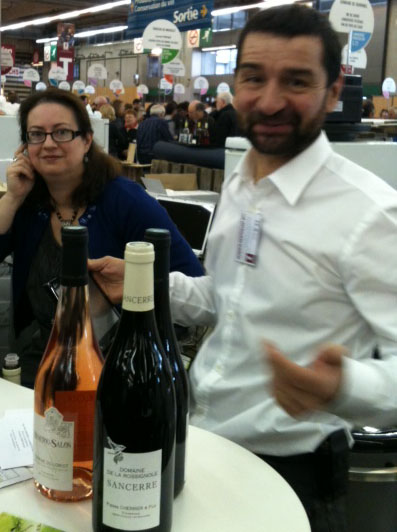
On Sundays, we eat a dozen “spéciales” each, with bread and butter, home made for me (the bread, I mean!) and baguette traditionnelle for Relationnel (see Beret and Baguette) and drink Sancerre, which is a delicious sauvignon from the east end of the Loire. Our favourites, both bought directly at the vineyards, are Domaine de la Rossignole and Paul Prieur.

On ne s’emmerde pas, as they say.

Patrick Liron oysters
17 rue des Petits Carreaux, Paris 2nd arrondissement, Friday, Saturday, Sunday, 10 am to 10 pm
28 rue des Archives, Paris 4ème arrondissement, Saturday 9 am to 10 pm
54 rue Cler, Paris 7th arrondissement, Friday, Saturday, 9 am to 9 pm, Sunday, 9 am to 2 pm
65 rue de la Motte Picquet, 15th arrondissement, Friday 4.30 pm to 9 pm, Saturday 10 am to 9 pm, Sunday 9 am to 2 pm
Domaine de la Rossignole, rue de la Croix Michaud Chaudoux, 18300 Verdigny en Sancerre, 02 48 79 34 93, cherrier@easynet.fr
Paul Prieur et Fils, Route des Monts Damnés,18300  Verdigny, 02 48 79 35 86, paulprieurfils@wanadoo.fr 
Thalassa distribution: street markets 9 am to 1.30 pm
Sainte Eustache, rue Montmartre, Paris 1st arrondissement, Metro Les Halles, Sunday
Villette, Boulevard de la Villette, Paris 10th arrondissement, Metro Belleville, Wednesday and Saturday
Bastille, Boulevard Richard Lenoir, 11th arrondissement, Metro Bastille, Thursday and Sunday
Vincent Auriol, Boulevard Vincent Auriol, 13th arrondissement, Metro Nationnale, Saturday 
Maisons Blanches, (75013) Avenue D’Italie, 13th arrondissement, Metro Tolbiac, Sunday
Mouton Duvernet, Rue Mouton Duvernet, 14th arrondissement, Metro Mouton Duvernet, Friday
Villemain,  Rue D’Alésia, 14th arrondissement, Metro Plaisance, Sunday
Saint Charles, Rue St Charles, 15th arrondissement, Metro Boucicaut, Friday
Belgrand, Rue de la Chine, 20th arrondissement, Metro Gambetta, Wednesday and Saturday
 

Three Reasons to Live in Blois

Having lived in the city of light for many years now, I’ve become immune to the general attitude of Parisians so it comes as a surprise when people act differently outside the capital. We were in Blois for a few days last week and had three encounters that reinforced our decision to move there in three years time.

It was Monday and most places were closed. We had lunch then set out to find a cybercafé to continue our house hunting. Every address on my iPhone turned out to be closed. A chef was smoking a cigarette outside a little restaurant called Au Coin d’Table so Relationnel tipped his Akubra and asked whether he knew of an internet café that was open. “No, I’m not from here, I’m sorry. I’ll ask the boss”. The boss came out and he repeated the question. “No worries (well, he didn’t quite say that because he was talking French), I have a computer behind the counter. Come in and use it.” Relationnal explained that we needed to do some research that could take a bit of time. “No problem. I’ll bring my laptop down. Is a Mac OK ?”. So he set us up and the waitress brought us a coffee each.

I heard her talking to the last straggler and saying they usually closed around 3 pm, so we wound up our search and turned off the Mac. Then we thanked the boss and asked how much we owed. “Nothing. You only had a coffee.” We protested, but he said, “I’m from the North”. (Northerners in France are reputed as being more friendly and it’s true. You’ll remember I’m a northerner too). So Relationnel gave the waitress a 5-euro note and off we went to find a real estate agent open.

And then we really scored! Our first viewing was a beautiful stone renaissance house built in 1584. A little bigger than we intended, a little more expensive than we had budgeted for, a little bit early (by 2 ½ years!) but it was love at first sight for both of us. Perfectly located, wonderfully restored, with a little house next to it just waiting to be renovated for use as a gîte and for friends and family. There’s even wisteria and a holly bush with red berries.

Later on, completely subjugated by the house, we parked in the middle of the city and I was going over to get a ticket from the parking meter. A lady pulled up next to us and explained that we didn’t have to pay because we were in a special “20 minute” zone. All we needed was a “blue disk”. She told us we could get the disk from the police station. She insisted that we didn’t need and ticket and could just leave a note with the time of arrival on the windscreen. As we were walking along, we saw two mounted policewomen (mounted on bikes that is) so we asked where the police station was so we could get a blue disk. “It just so happens I have one in my saddle bag.” So now, we are all set to go. Free 20 minute parking in Blois. Next time we’re there, we’ll definitely be eating at “Au Coin d’Table”!

Au Coin d’Table, 9, rue Henri Drussy 41000 BLOIS Tél : 02 54 74 20 20
12 to 2.30 and 7 pm to 11 pm. Closed Tuesday and Wednesday.

Coffee & Cappuccino in France and Italy

One’s perception of good coffee is highly personal. I know that DrummerBrother will go to the other end of Sydney to get a good cup of coffee.  I was not a natural coffee drinker in my younger years. When I was at uni, I had to train myself to drink black Nescafé (how could I? I’ve had a blackban on Nestlé for years now for ethical reasons) so that I could be cool when I went to other people’s places. When I first tasted coffee in France, I was not keen but I could drink it to be sociable.

My real liking for coffee developed when we moved into Paris and I was introduced by Relationnel to Verlet on rue Saint Honoré, one of Paris’ oldest coffee vendors.  They have an amazing selection that they roast themselves. You can sit down and order from a long list. It comes in a little green cup on a leaf-shaped saucer with a choice of sugar from different places and a chocolate. I soon discovered that the type I like is colombie and that it musn’t be too bitter.

Coffee tree at Skybury

The coffee served in regular Parisian cafés is consistently thick and bitter. Dad was convinced that it was laced. When he came to visit me in France, he’d go down to the corner café, prop himself up at the bar and watch the locals. He said he’d see some businessman suddenly rush in, order a coffee, steep it with sugar, down it in one go, put his money on the counter and rush out again. He couldn’t possibly just be drinking coffee. I was too innocent and didn’t know what was really in it! That’s fathers for you.

View from Skybury

It was at Verlet’s that I first tasted Australian Skybury which I now buy as an alternative to my regular colombie. When we were in Australia last time, we went up to the Atherton Tablelands and visited their coffee plantation. They also grow bananas and langons to keep the staff busy all year. The property is very beautiful and they have the most wonderful building on stilts with a verandah that has a spectacular widesweeping view where you can eat lunch and drink coffee before you go on a tour.

What I really love though is cappuccino. Italian cappuccino. I used to limit my consumption because I thought it was made with cream. When I discovered it was actually steamed milk foam, I was delighted! I was not entirely wrong about the cream though. In Normandy in particular, but in a lot of other provincial areas in France as well, they do make it with cream. I’ve now learnt to check first if it’s made with “mousse de lait” and if it’s not, I don’t order it. In Blois the other day, when I asked the question, the waiter said, “No, it’s not usually made with milk foam, but I can do it for you”. Now that’s what I call service.

The very best cappuccino experience I have ever had was in Rome. We’d seen a TV programme on “Secret  Rome” and Ginevra, the commentator/photographer, took us to Alfreddo’s on via Giulia, just opposite some administrative office. The employees regular duck over and since there are only two tiny tables on the pavement, we had to wait our turn. After he set the cappuccino on the table, the waiter added a heart and a little face. Relationnel told him we’d seen Alfreddo on TV in France so out he came with big smiles and shook our hands enthusiastically saying “Bonjour ! bonjour”. All other cappuccinos pale in comparison.

Café Verlet: http://www.cafesverlet.com/ (including an on-line boutique)

Skybury: http://www.skybury.com.au/ (including an on-line boutique)

Secret Rome by Ginevra Lovetelli http://www.gounusual.com/SecretRome.aspx

Caffè Alfreddo 84 via Giulia 00186 Roma

Battling with French Administration

I just hot-footed it over to the tax office to file a new declaration because my accounting software made a mistake with my depreciation expenses (well, I might have had something to do with it). The tax office closes at 4 of course. I arrived with 3 minutes to spare only to discover it’s moved. Now why haven’t I been told about this? I file VAT (GST) every month, over the internet admittedly, but I reckon I should have been told anyway. 

French administration is very annoying and complicated. They also write letters and instructions in incomprehensible French. None of this plain language for them. I couldn’t believe it when I filled in my last Australian passport form. It’s obviously written for dummies. I approve of that. At least you know what to do. A few years ago, when my office was in Nogent sur Marne, I had an Algerian neighbour. I was always helping her to fill in forms and write letters. She spread the word and I was soon helping another Algerian and a family from Mali.

After participating in a lobby to have the Australian constitution changed so that Australians living oversees could have dual citizenship, I applied for French nationality a few years ago. I went along to the Court to get all the forms and sent in my application. One of the things you always need in France is a birth certificate (well, an extract) less than 3 months old. This is because your life history is written on your birth certificate here  – naturalisation, change of name, marriage, divorce, legal decisions relating to legal incompetence and death. So I explained in my covering letter that Australian birth certificates don’t give that sort of information (I didn’t want to have to get another certificate plus have it translated officially at great expense).  Relationnel was convinced that they’d ask for more papers (they always do).

However, all went well and after a few months, I was contacted by a police officer who came to visit me at my office to make sure that I was really living in the country and spoke French. Another few months went by and I had to go to the local police station with my diplomas. The man who interviewed me had no idea what he was doing. He admitted he’d never done it before! I also had to prove I was well integrated into the community. Then exactly one year from the date of application, on 2nd December 2002, I was declared to have French nationality. On 29th March 2004, I received a FRENCH BIRTH CERTIFICATE . Isn’t that too much ?

Now I have two passports – French and Australian!

Outdoor swimming at 4°C in Normandy

‘Twas the day before Christmas and the ground in Normandy was covered in snow. So we decided to try the outdoor pool in Rouen. We had a lot of trouble finding it, despite the Tom-Tom because it was in the middle of an enormous housing estate. We picked our way carefully along the path from the car, making sure we didn’t break our legs on the ice and slush before we got to the pool.

Inside, there was a 25-metre pool and a smaller children’s pool. The 50-metre was outside. You got to it by going down into a pool on one side then swimming through one of those plastic strip curtains out to the other side where you could see the steam rising off the water. Relationnel, who’s happier walking up mountains than swimming, remained inside to “warm up”. When the cold air struck my head despite my swimming cap, I started swimming energetically. After about 300 metres, I decided to go indoors. Every time I took my head or a limb out of the water, I was cold despite the fact that the water was 28°. And the snow-laden fir trees I’d somehow imagined as a backdrop were missing. Just urban suburban.

I met Relationnel on my way back through the strip curtains but he only did about a half a lap before scuttling back inside. I was much happier doing my laps out of the cold I can tell you.

Suzanne Berlioux Pool

I usually swim in the Suzanne Berlioux pool in Les Halles in the middle of Paris. I discovered recently when taking some Aussie friends for a walk in the area that you can actually look down on the swimmers from above. It was a bit eerie. When you’re swimming, you can’t imagine it. In any case, you’re so busy making sure that you don’t get drowned by people (mainly men – why aren’t they swimming in the fast lane?) pounding their way past you that you don’t have time to notice your surroundings. I’ve finally discovered a time when it’s reasonably safe – Tuesday afternoons. I once suggested to one of the monitors that they should have a special lane for brutes. She replied that they would need too many!

I find it difficult to imagine how you can be breastroking away and someone actually backstrokes into you. And how they can bang into you when you’re backstroking and they’re breaststroking is even more incomprehensible. I was swimming away the other day perfectly happily on the right side of the lane (as I should have been) when I saw someone coming towards me at a fast crawl (ha! ha!) in MY LANE for no apparent reason. It was difficult to know where to go but they swerved back at the last moment thank god.

The people I dislike the most are the ones that swing up and down like monkeys from the ring at the end of the pool. It’s OK it you’re doing breaststroke or freestyle but if you’re doing backstroke you can be walloped in the head by their rear end as they swing back.

What I’d really like is to have the pool to myself.

Miss Bibi and the Palais Royal in Paris

cannon in Palais RoyalOw! that was loud! I always forget. At 12 noon every Wednesday, the time cannon in the Palais Royal gardens goes off. Initially installed in 1786 on the Paris meridian by a clockmaker called Rousseau who had a shop on one side of the gardens, it would go off at exactly midday on sunny days. The simple mechanism was ingenious. A fuse under a  small magnifying glass was sparked by the sun’s rays. At the time, it was used to adjust all the clocks in Paris. It was stolen in 1998 but was eventually replaced and has been working again since the beginning of the year. Sadly, it doesn’t have the magnifying glass system anymore and doesn’t depend on the weather.

There are lots of other surprising things in the Palais Royal galeries. All sorts of interesting boutiques. One day I even saw a fur coat made of teddy bears! Today, the shops are very chic, with Stella McCartney and La Petite Robe Noire (but where would I wear a little black dress ?), Delage and Corto Moltedo, all way over my price range of course.

In the galerie Beaujolais, there’s a shop that sells ribbons for medals. You know, decorative medals like the legion of honour. It’s next to another speciality shop called Le Magasin à l’Oriental, opened in 1818, a real Ali Baba’s cave that sells pipes and other things of that ilk. In the Galerie Montpensier on the other side, there’s a beautiful toy shop with the most wonderful collection of dolls and wooden toys. And just opposite, a shop called Anna Joliet that sells hand-painted music boxes. You can pick your box and pick your music. Mine plays the theme from Doctor Zhivago. L’Escalier d’Argent, run by madame Danou Jacquard, possesses a unique collection of over a hundred men’s vests made out of 18th century-inspired fabric and tailored according to the period of Louis XVI. It also sells silver jewellery.

Anna Joliet music boxesBut my favourite is Miss Bibi. L’Escalier d’Argent used to have a tiny showroom in the Galerie Valois with a dusty collection of bow ties. One day, we saw they had taken everything out and were redoing it. The sign came down and after a while we saw them putting in a sort of shadow box. It was hard to imagine what sort of shop it could be, it’s literally about two metres square. But it’s turned into an increasingly popular jewellery store called Miss Bibi. “Bibi” is short for “bibelot” or knick-knack. But it’s the clever window dressing that attracts the customers.  The shadow box with its tiny shelves fills up almost the entire window and the jewellery, “inspired by the world of childhood and nostalgia”, is displayed on miniature items of furniture and little houses and other original items. I didn’t believe for one minute it could work but it’s always full.  At 50 to 200 euros apiece, maybe it’s the only shop in the Palais Royal that’s affordable for most people.

miss bibi's shop in the Palais Royal

 Don’t forgot to sign up and receive the latest posts in your mail box or on your smart phone!

Summer Time and French Time

Sunset over the Volga

I really love the long summer days in Europe when it doesn’t get dark until 11 pm. Of course the midnight sun is even better. We went to Saint Petersburg a few years ago in July and it was quite magic to actually watch the sun set at midnight. The problem is that on the last Saturday of October, we have to put our clocks back again and it’s so hard to have night suddenly fall at 6 pm even if it’s lighter in the morning. It completely upsets my biological clock and I’m tired for days on end.

Talking about time, that reminds me of another difference between France and Australia. When I was first invited to dinner here, I used to turn up on the dot in good Australian style. However, I soon realised that no one ever seemed ready when I arrived – they even seemed quite surprised to see me – and they certainly didn’t ever turn up on time when I invited them.  It has now been explained to me that if you’re invited at 8, you must get there at 8.20 at the earliest and 8.40 at the latest!

Imprecise versus precise

My own relationship to time is somewhat rigid I must confess. I was brought up by a father who was always on time and a mother who was chronically late – she would have done very well in France.  Relationnel is exactly the same. He doesn’t even wear a watch on weekends. I know why people are late of course. I’ve had time to study it over the years. They always think they can do one more thing before they go, such as shine their shoes or send an email (typing with just two fingers of course), take the rubbish out (not that I really mind, that is one job I am allergic to), while people who are on time know they can’t. It used to exasperate me terribly with Relationnel because there are some things where you need to be on time such as movies and planes.  One day he told me “Je ne suis pas à une heure près” which roughly translates as “give or take an hour”. Five minutes, OK, even ten minutes, but an HOUR? After that I realised that I would have to change my way of thinking altogether.

Among English speakers, we always check when giving a time, “Do you mean French time or English time ?” It’s safer !

Halloween and Pumpkins in France

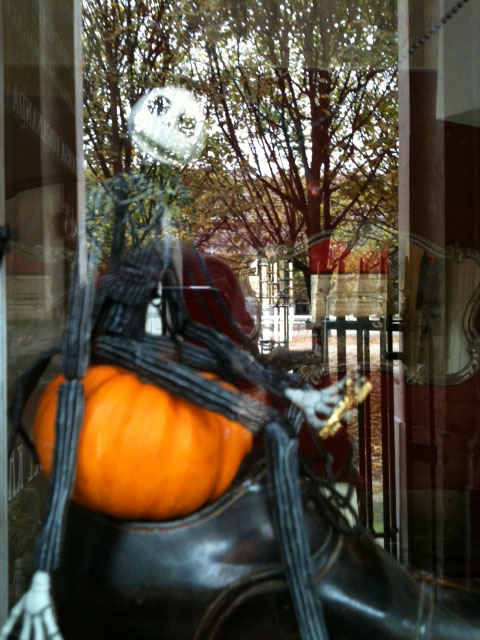
I can remember being in Troyes one year at Halloween and was surprised to find a restaurant decked out in black and orange because although Leonardo was born on 31st October, I had never seen any sign of Halloween in France. Then I heard the explanation on France Info. I love that radio because it keeps repeating the same news all day. If you get distracted by something else (and I always do), you know you’ll hear it again a little while later. It has lots of lifestyle and other interesting tidbits as well. I get a lot of my scattered knowledge from there. Far better than watching the 8 o’clock news with one of those annoying news readers who wear tons of make-up and carry on like film stars. Also, you don’t get the horrific pictures that you do on TV. I have still not seen any videos of 7/11. I’d be having nightmares if I did.

So, back to Halloween. In 1992, a costume company called Cézar bought out an American firm and found itself with a huge number of Halloween costumes. It opened a mask museum in Saint-Hilaire-Saint-Florent near Saumur in the Loire and did an amazing publicity campaign and that was the beginning of Halloween in France. It boomed in the late nineties before gradually fizzing out, probably because it lacks tradition here.

On Sunday, I heard an English woman at the market asking if there were any appropriately sized pumpkins but no one seemed to know what she was talking about. Speaking of pumpkins, they are excessively disappointing in this country. Usually big and tasteless. I bought a butternut in Romorantin last week – didn’t think you could go wrong with a butternut – but it was just like a bland squash. They only make soup with pumpkins here, but I’m not into soup. Some places have started selling what they call “potimarron”. I looked it up in the dictionary and it says « red hubbard squash, red kuri squash », not that I’ve ever heard of it. It’s not bad, but nothing like the Queensland blue. I still have a scar on one of my fingers from cutting up a pumpkin.

They do sell these neat little inedible squashes though. I found some in the Loire at 0.30 euros a piece. A real bargain. They’ll probably last a couple of months and are great decoration next to my forest floor with its autumn leaves, holly, pine cones and acorns. I even brought some moss home.

One of the first things I’m going to do in my new vegetable garden is plant some Australian pumpkins. That and raspberries.

Related Posts Plugin for WordPress, Blogger...

from the Tropics to the City of Light