On this Wednesday’s blogger round-up, we have Wendy Hollands from Le Franco Phoney giving us tips on how to make the most out of a visit to the Eiffel Tower, Jill from Gigi’s French Window giving her interpretation of French decorating styles and Abby from Paris Weekender describing a visit to Méry and Auvers-sur-Oise, where Van Gogh lived his last days before taking his own life. Enjoy!
Acting French in Paris
by Wendy Hollands from Le Franco Phoney, an Australian who writes about all things French in La Clusaz, Annecy and Haute Savoie as seen by an outsider by Wendy Hollands from Le Franco Phoney, an Australian who writes about all things French in La Clusaz, Annecy and Haute Savoie as seen by an outsider
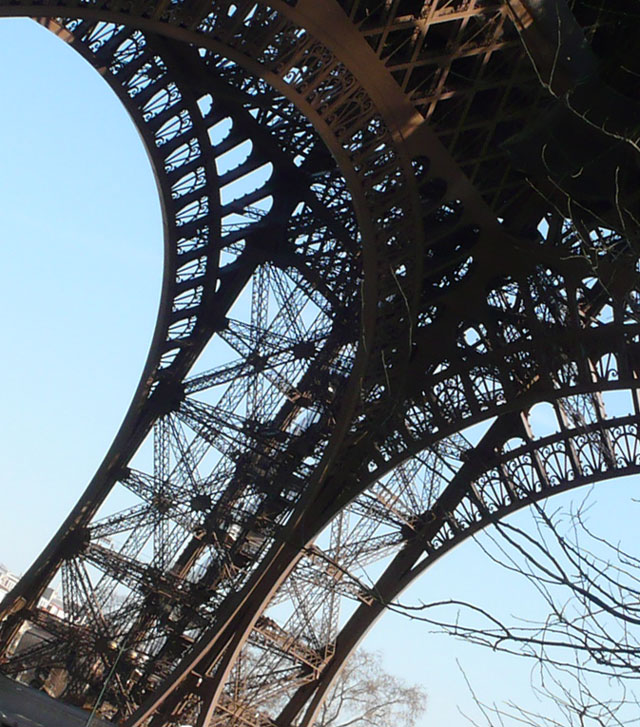
One of the great things about living in the French Alps is that it’s so totally different to life in big French cities. When I go to Paris, I’m a tourist: loud noises grap my attention, the Metro is confusing, and I need a map to know where I’m going.
If this alternative angle photo of one of the world’s most recognised landmarks doesn’t already give it away, I spent the weekend in Paris with the French in-laws who live there. Read more
Creating the French look
by Jill from Gigi’s French Window, French ponderings from an Australian who must have been French in another life
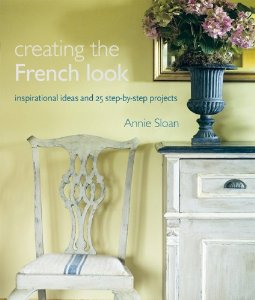
At the moment I’m working my way through a book titled Creating the French look by Annie Sloan, which covers eight different french decorating styles, inspirational ideas and 25 step-by-step projects. A great read.
I purchased it because I was curious to see which would stand out to be MY favourite style, but as it so happens , I appear to have a ‘mélange’ of french tastes. I should have known it wouldn’t be as clear cut as that! I mean to say, there are EIGHT different styles……and none are exactly what I would choose??? Let’s have a look together, and you tell me which style resonates with you :). Read more
Château de Méry and Auvers-sur-Oise
by Abby from Paris Weekender, an American living in Paris who offers suggestions for Paris weekends, either staying put or getting out of town
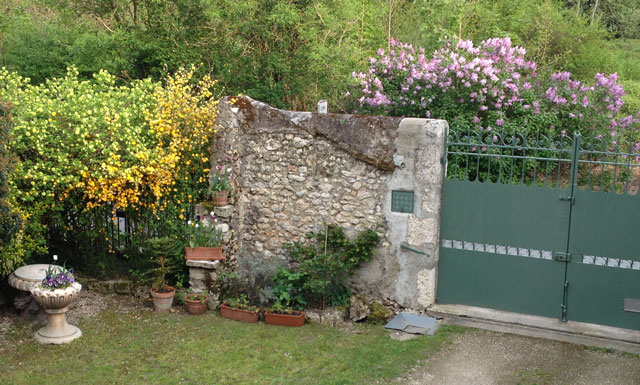
This weekend, I was invited to the beautiful wedding of two close friends at the Château de Méry in Méry-sur-Oise, located about 30 kilometers or 45 minutes north of Paris on the SNCF (local train) in the Parc Vexin. With its traditional château and chapel and ultra-modern hotel on the château grounds, this made for the perfect wedding venue. Congratulations, my friends!
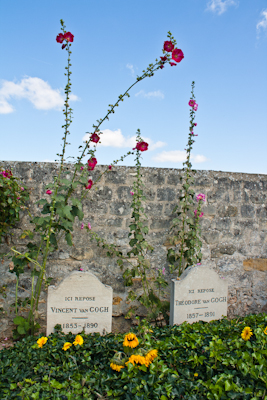
As the wedding was in the evening, a friend and I decided to take advantage of the first sunny day in the Paris area in three weeks, so we headed to the Val d’Oise (Valley of the Oise River) in the morning. After leaving our bags at the château, we walked about 15 minutes through the town of Méry and across the Oise River to Auvers-sur-Oise, famous as the residence and final resting place of Vincent Van Gogh and his younger brother Theo. Read more
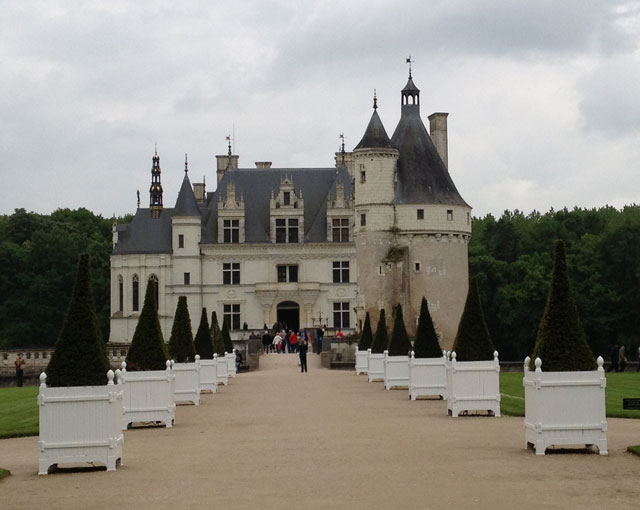
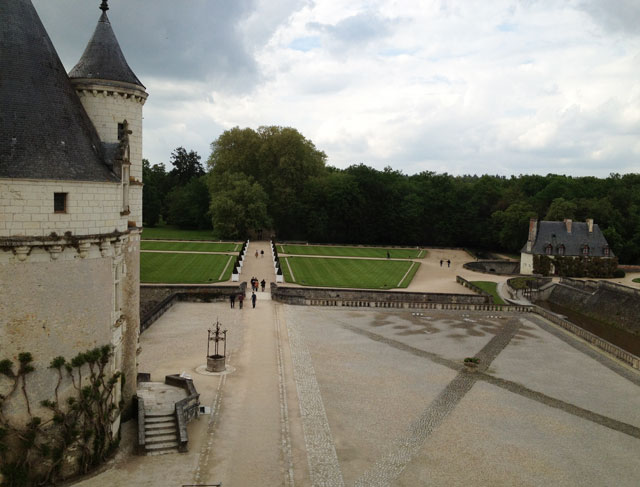
The weather was supposed to be better but it turned out to be too cold to cycle (14°C) with occasional light showers, despite the fact that we’re already in the second half of May. So we decided to visit Chenonceau which is 40 minutes from Closerie Falaiseau.
Front view of Chenonceau on a rainy day in May 2013
We were surprised to see the parking lot was quite full. There seemed to be a lot of older people milling around, no doubt with guided tours. There are automatic ticket machines though which meant we didn’t have to queue.
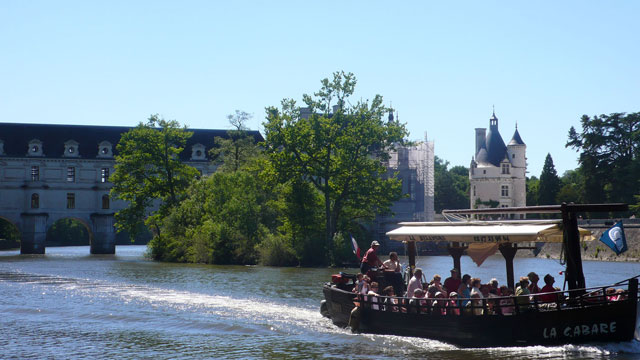
Tourist boat at Chenonceau in May 2012
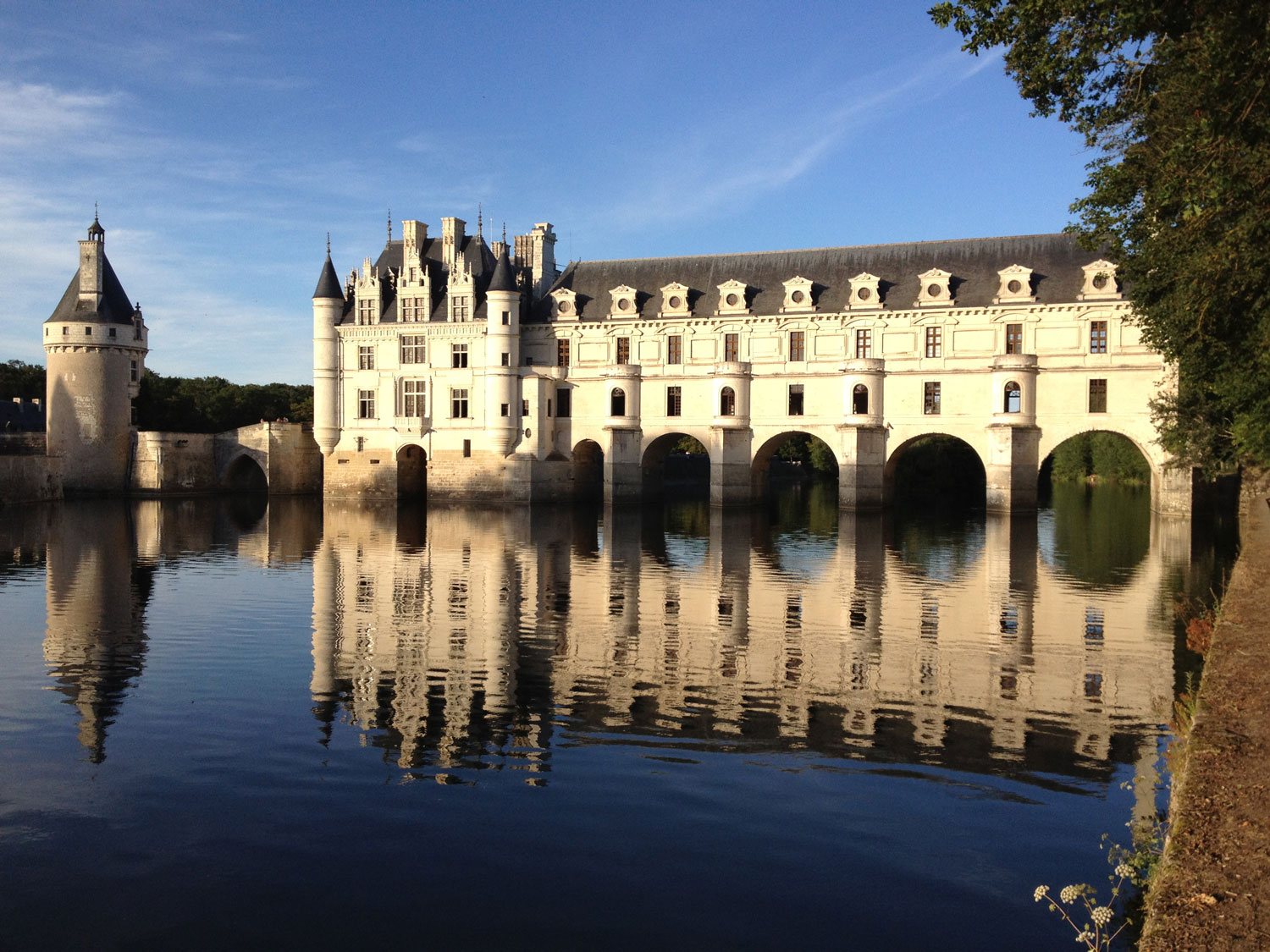
Chenonceau is a ladies castle, as I’ve already mentioned in another post with photos of the outside of Chenonceau from the bike path. It was built in 1513 by Katherine Briçonnet, decorated by Diane de Poitiers some 30 years later, extended by Catherine de Médicis, used as a place of reclusion by Louise of Lorraine after the death of her husband Henri III, saved by Louise Dupin during the French Revolution, restored by Marguerite Pelouze in the mid-19th century and turned into a temporary hospital during WWI by Simone Menier. Whew!
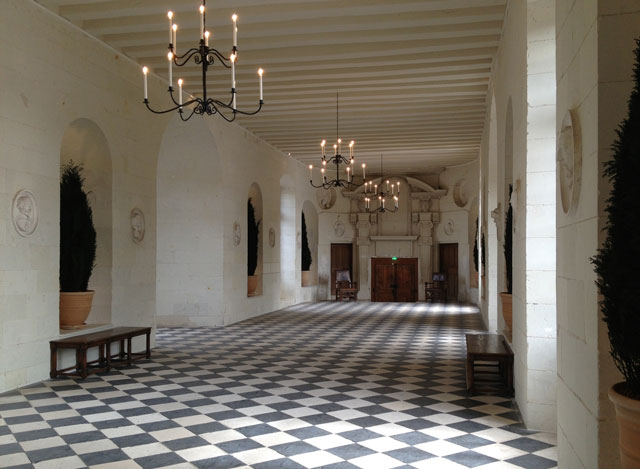
60-metre gallery spanning the Cher River
Its location on the Cher River is unique. The main gallery, 60 metres long, built by Catherine de Medicis, with its chequerboard slate-tiled floor and magnificent Renaissance fireplace at each end, spans the river, offering incredible vistas on both sides.
The keep and Catherine de Medicis’ garden
The original keep is still standing, on the other side of the bridge from the château, and is covered with thick vines of trumpet creeper.
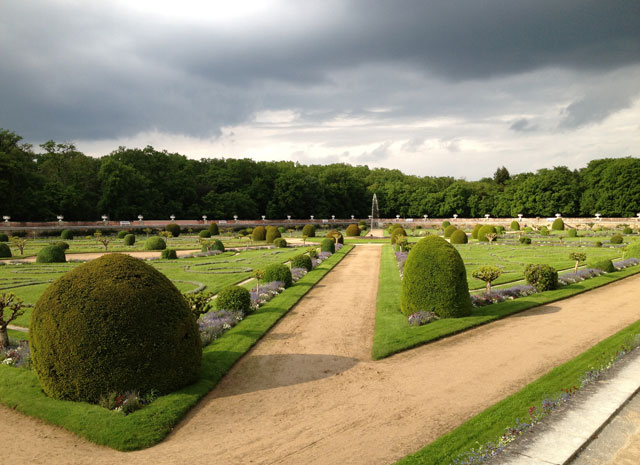
Diane de Poitier’s garden
Diane de Poitier’s garden with its eight triangular lawns and climbing iceberg roses can be seen to the left of the château while Catherine de Medici’s more intimate garden, with only five lawns, is on the right. Both offer wonderful views of the château but the best, in my view, are still across the other side.
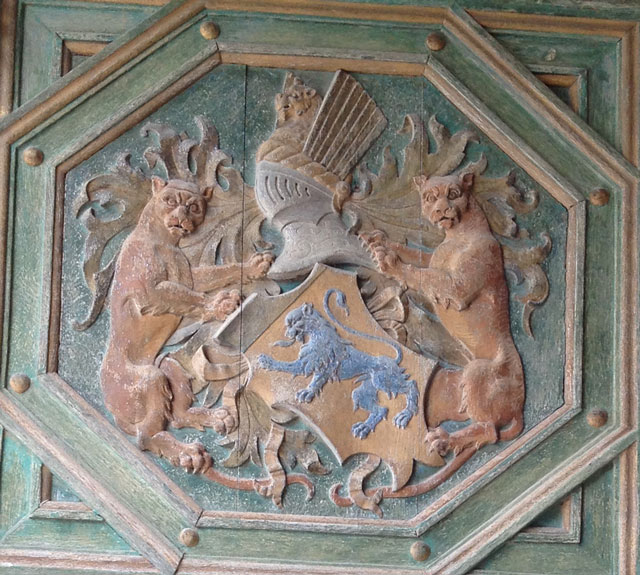
Carved and painted door with the arms of Thomas Bohier and Katherine Briçonnet
Each room is more sumptuous than the last, although little of the original furniture and furnishings remain, one notable exception being the beautiful painted, sculpted wood door bearing the arms of the first owners, Thomas Bohier and Catherine Briçonnet.
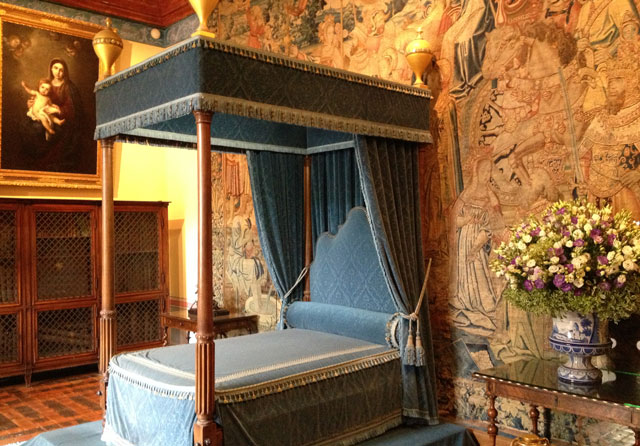
Diane de Poitier’s Bedroom
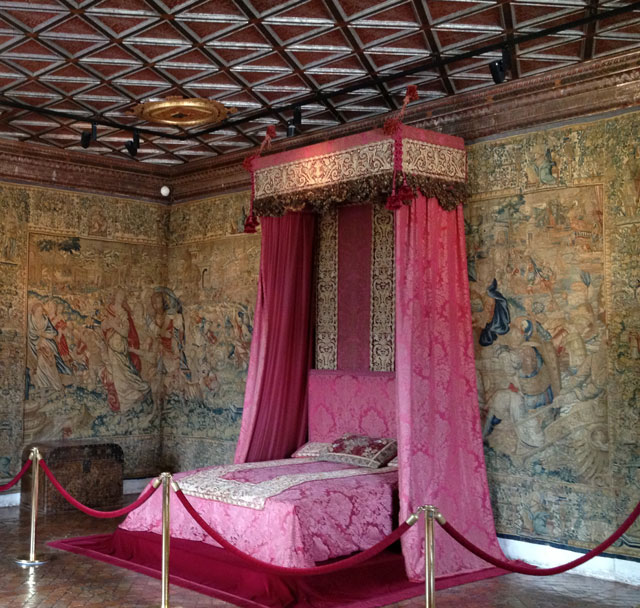
Diane de Poitier’s bedroom with its magnificent 4-poster bed was restored by Madame Pelouze. The fireplace is engraved with the initials of Henri II and Catherine de Medicis, H and C, which, when intertwined can form the D of Diane de Poitiers, Henri II’s favourite – and incidentally the mistress of his father, François I – to whom he gave the château which originally belonged to Catherine de Medicis.
Catherine de Medicis’ Bedroom
After his death, however, Catherine claimed it back, in exchange for Chaumont. Her bedroom has magnificently carved furniture and a rare set of Flanders Tapestries remarkable for their borders of animals symbolizing proverbs and fables. A painting by Correggio depicting The Education of Love, is one of the château’s many masterpieces, and my favourite.
François I’s drawing room
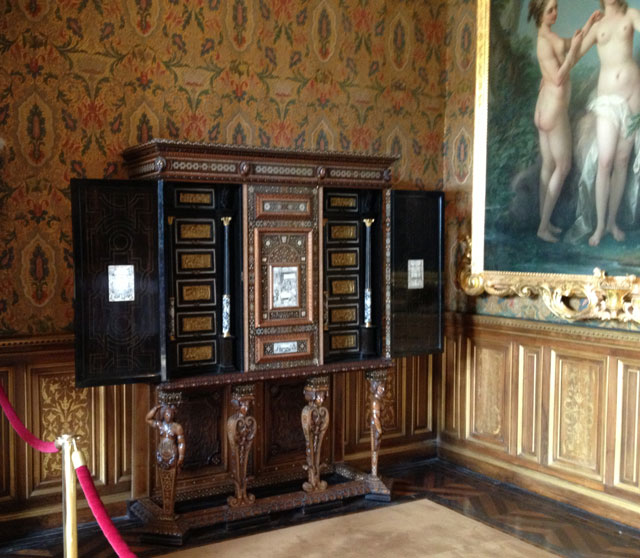
In addition to an exceptional Renaissance fireplace and a remarkable 16th century Italian mother-of-pearl and ivory incrusted cabinet, François I’s drawing room has paintings by Van Dyck, Mancini, Ribera and Van Loo and a portrait of Diane the Huntress by Primaticcio.
Louis XIV’s drawing room
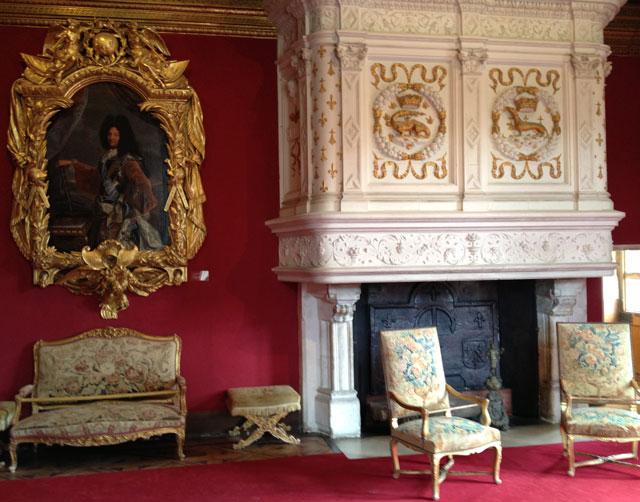
The salamander and ermine, the emblems of François I and Queen Claude of France on the gold-embossed Renaissance fireplace in Louis XIV’s drawing room, almost pale in contrast with Rigaud’s portrait of the king its extraordinary gold frame. There is another collection of 17th and 18th century French paintings.
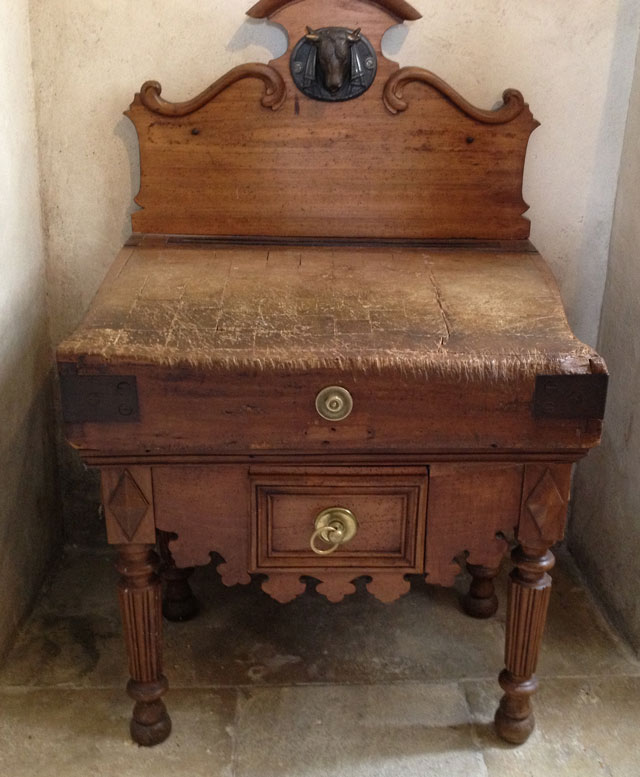
Beautifully carved (and well-used) butcher’s block in the kitchens
The kitchens at Chenonceau, built in the bases of the piers under the gallery spanning the Cher, are quite remarkable and include a very elaborate butchery. The kitchens were modernised when the château was used as a hospital during WWI. Deliveries were made directly from boats on the river.
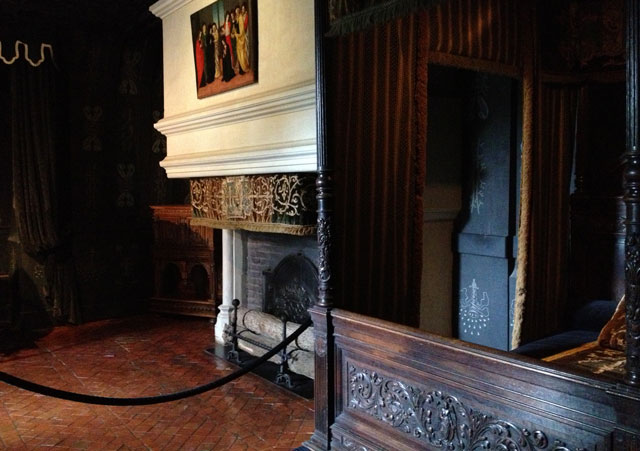
The White Queen’s bedroom in which she mourned Henri III
The second floor contains the “gothic” bedroom of the “White Queen”, Louise of Lorraine, where, dressed in the royal mourning colour of white, she prayed and meditated after the assassination of her husband, Henri III.
The Five Queens’ Bedroom with its beautiful ceiling
I haven’t described the equally sumptuous bedrooms of César of Vendrôme, Gabrielle d’Estrées and the Five Queens, or the Green Study, the Library, Katherine Briçonnet’s Hall, the Exhibition Room and the Second Floor Hall, but all contain the same high quality furnishings, furniture and masterpieces.
View of château from the cafeteria at Chenonceau
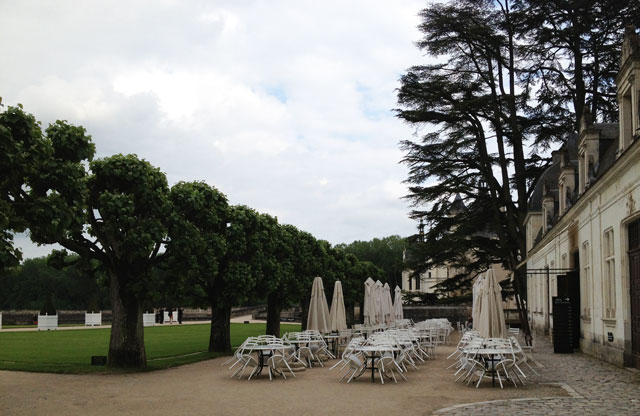
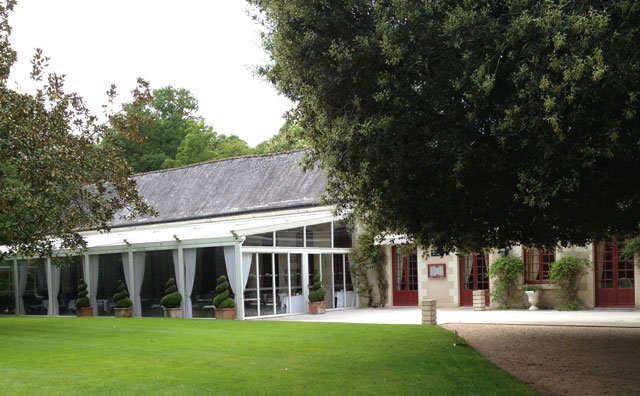
At about 5.30, when we finished visiting the interior, we had a coffee and a disappointing patisserie sitting outside the cafeteria looking toward the château. There were very few people by then, but given the very reasonable prices, I imagine it’s packed at lunchtime. There is also a gourmet restaurant in a beautiful setting (the former Orangery) on the other side of the building with a set menu of 29 euro. Unfortunately, we were too late for teatime (3 to 5 pm).
Orangery gourmet restaurant
We passed through the wine cellar, where tastings are 2 euro per person. We have a wonderful memory of drinking vintage chenonceau in the Orangery restaurant which we then bought from the cellar, but this time, they were only selling wines from 2010 and 2011 (8 and 10 euro a bottle).
Diderot’s salon at the Wax Museum
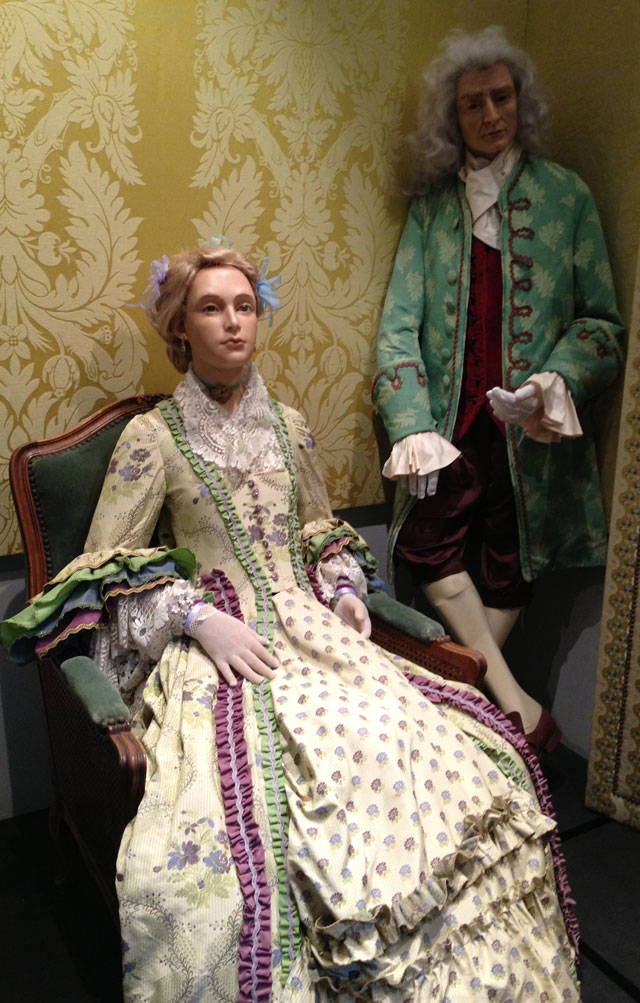
Our visit to the wax museum was very disappointing, except for the costumes which are quite beautiful; the wax models are not of very good quality and don’t resemble the people portrayed. Given the number of foreign visitors, I thought the video at the beginning could have been offered in English as well.
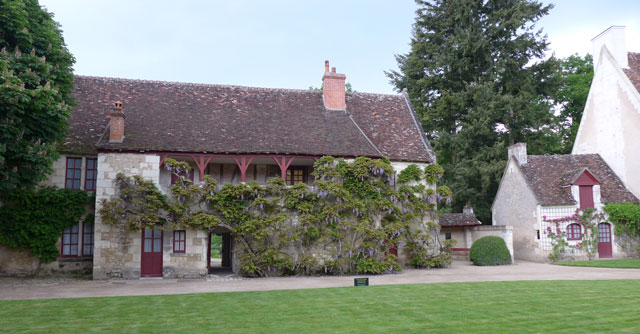
16th century farm at Chenonceau with wisteria and climbing roses in bloom
But the biggest surprise was the 16th century farm, including Catherine de Medici’s stables, which I had never seen before. At 7 pm, we were the only visitors. Wisteria, climbing roses and trumpet creepers grace several very charming little houses organised around a circular lawn.
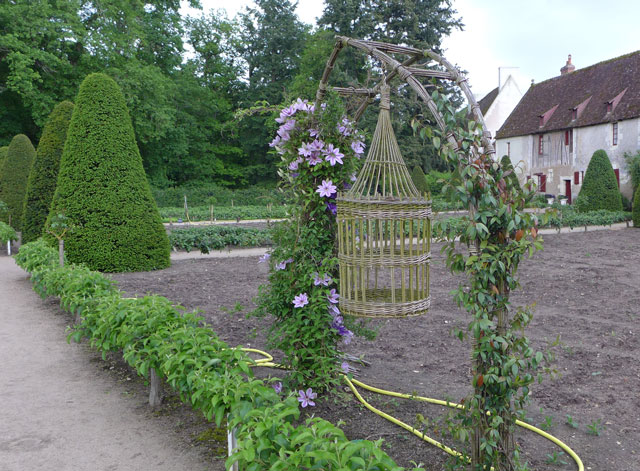
Flower & vegetable garden at Chenonceau with clematis in bloom
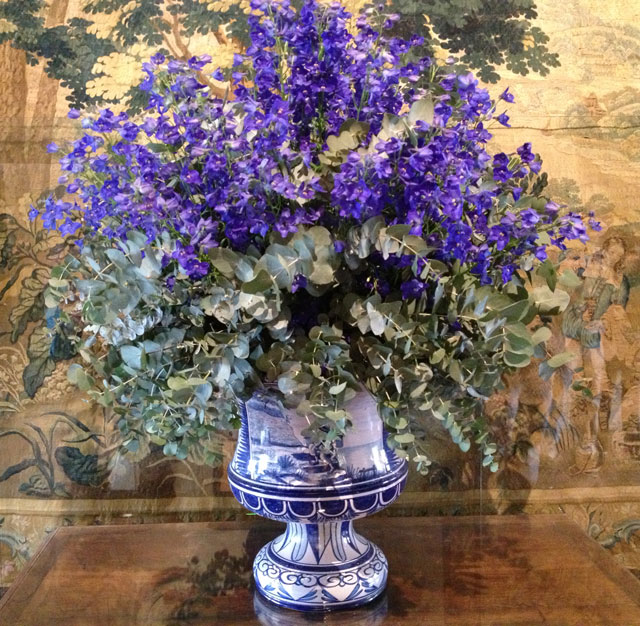
Behind the farm is the vegetable and flower garden which supplies the château’s superb floral arrangements, one in each room, which are worth a post of their own.
One of the many bouquets at Chenonceau
We didn’t see Catherine de Medici’s Italian maze as we ran out of time, but we’ll make sure we see it next time!
Open all year round, 9 or 9.30 am to 5 to 8 pm, depending on the season. 11 euros for the château and grounds, 13 euros including the wax museum, plus 2 euros for an audioguide.
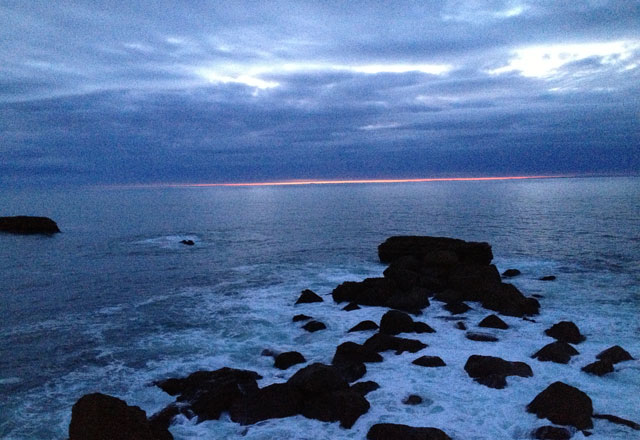
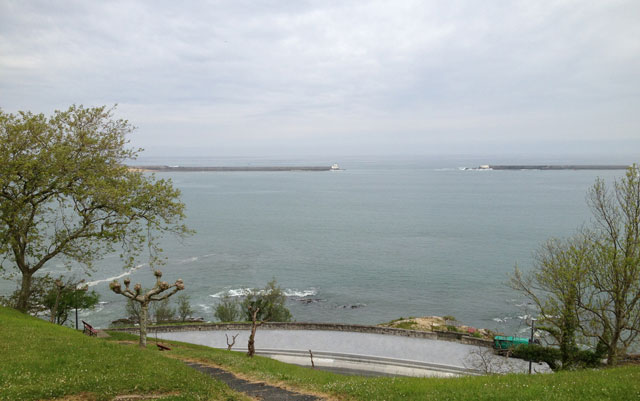
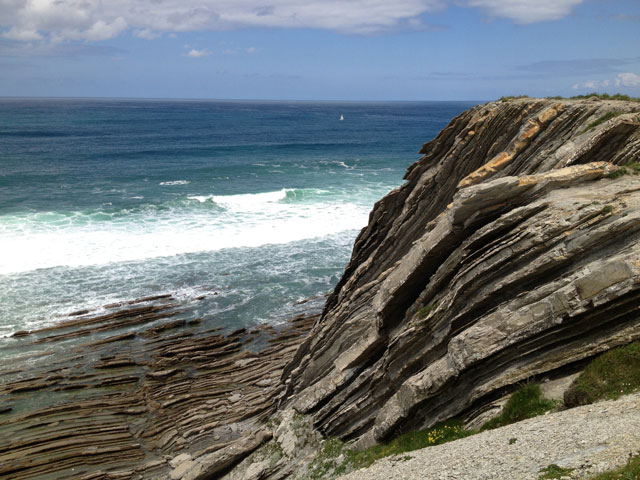
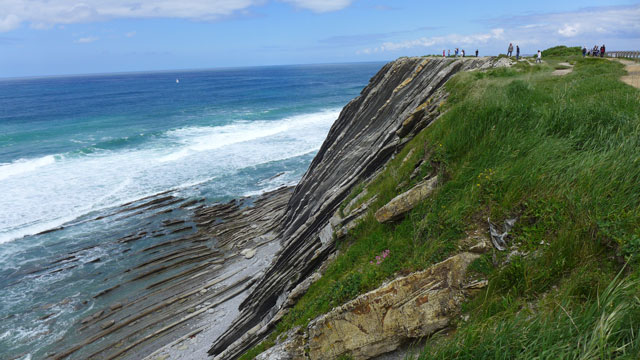
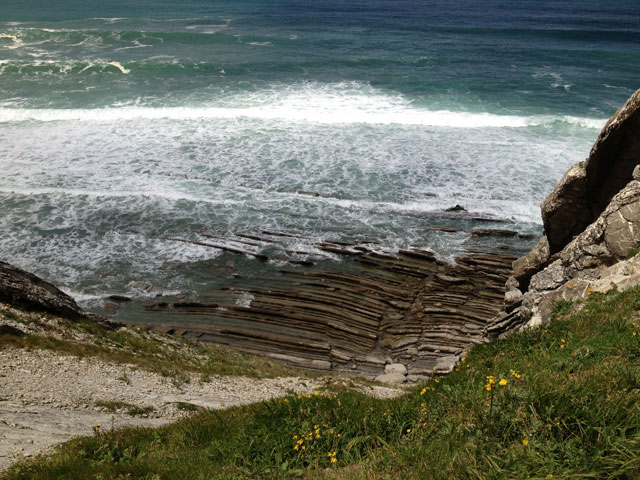
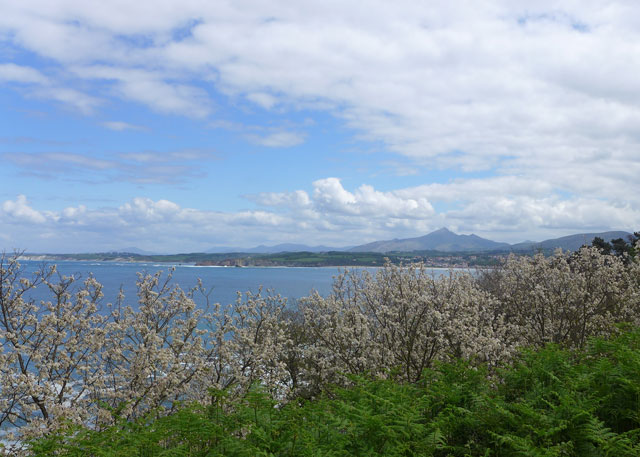
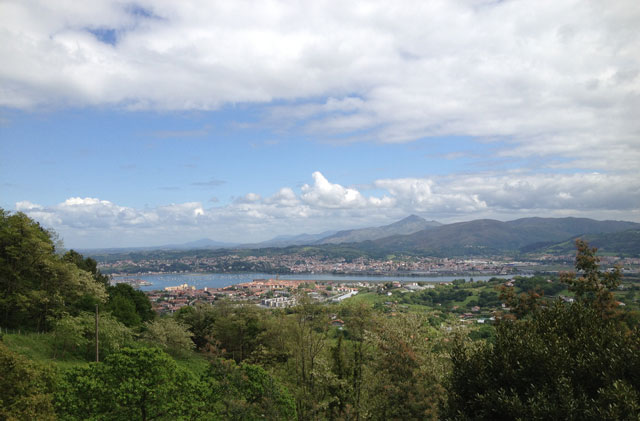
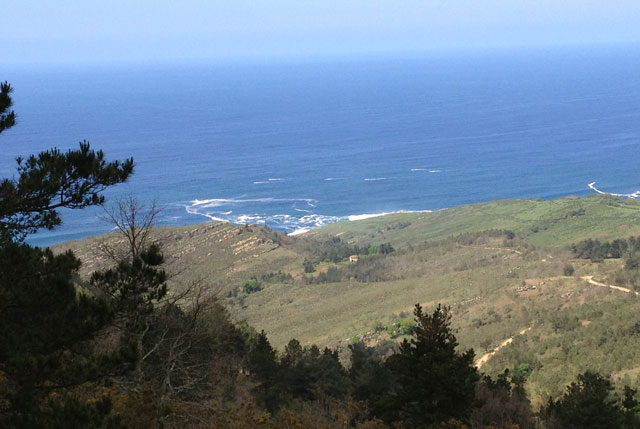
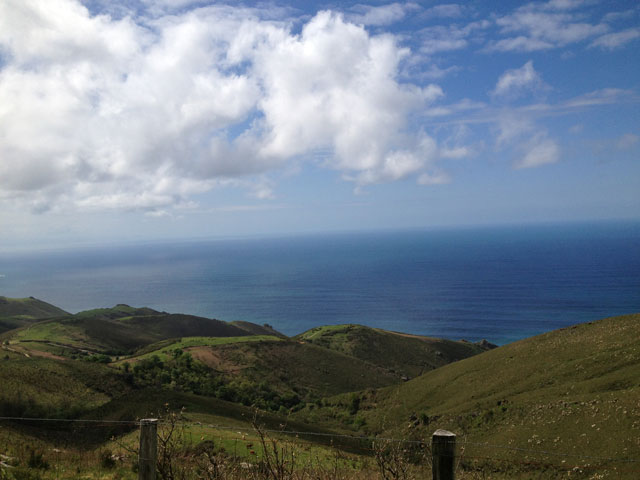
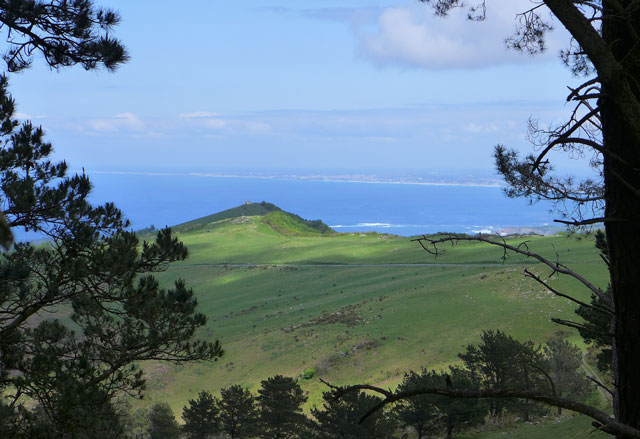
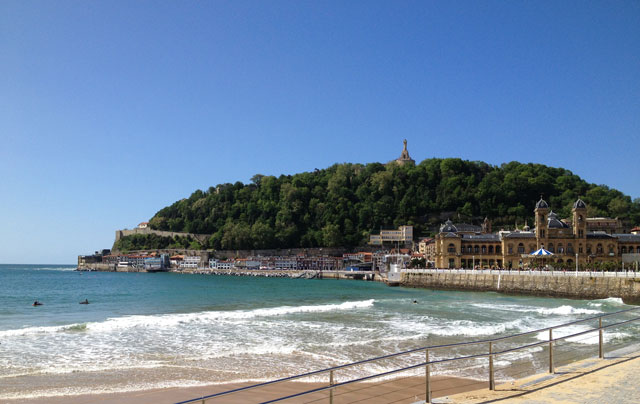
The Basque Coast extends from Bayonne in France to San Sebastian or Donostia in Spain and contains some of the best surfing beaches on the Atlantic, the best known of which is Biarritz. There is a walking path from Ciboure to Hendaye with spectacular views that we were not able to take because of the rain but on the last day of our stay, the sun came out and we were absolutely enchanted by the coastal drive from Hondarribia to San Sebastian with its beautiful muted landscapes and plunging views.
BiarritzTaken from the heights of CiboureBetween CIboure and HendayeBetween CIboure and Hendaye with people this timeBetween Ciboure and HendayeBetween Ciboure and Hendaye with Jean de Luz in the background
Above HondarribiaCoast between Hondarribia and San SebastianBetween Hondarribia and San SebastianBetween Hondarribia and San SebastianBetween Hondarribia and San SebastianSan Sebastian
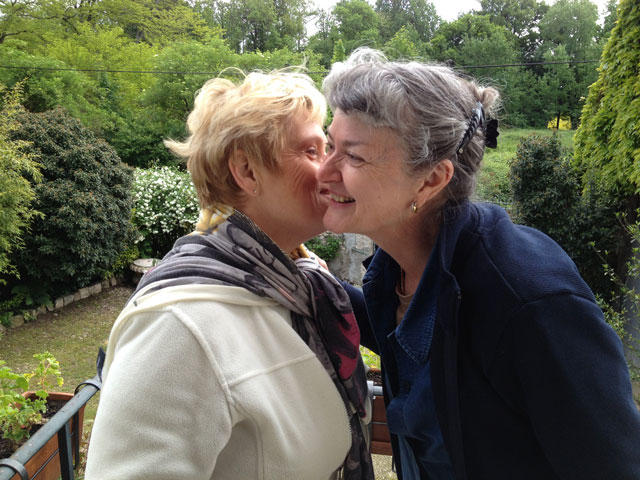
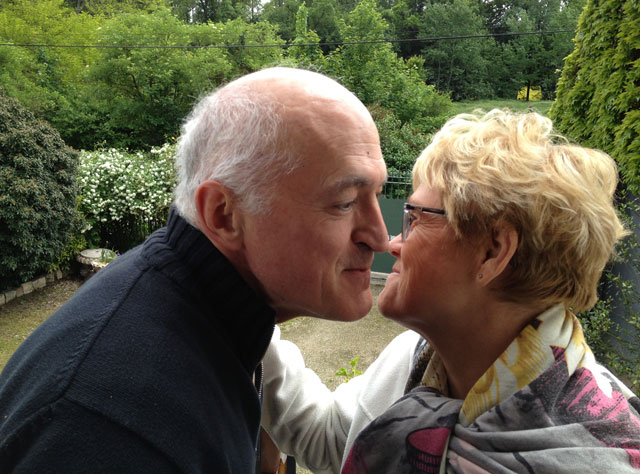
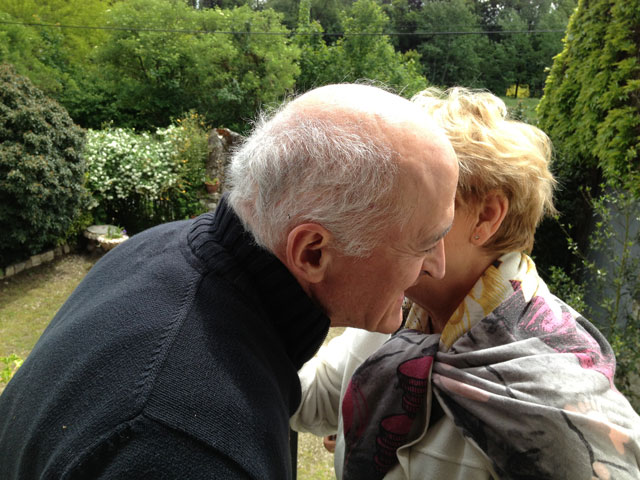
After my post on Bonjour, I’ve been asked to write about la bise, one of the great mysteries of French social interaction. I’ve heard it described as the air kiss which isn’t a bad definition. You lean over towards the other person and touch first one cheek and then the other with your own cheek, kissing the air with or without a smack or a movement of the lips as you do so. The number varies from two to four and is both regional and personal.
Me giving the bise to Françoise – note my right hand
I’d like to start by saying that the more casually you deal with the situation, the easier it will be.
One of the great dilemmas facing Anglosaxons is HOW MANY.
Well, it’s up to you to decide. Why should the other person always determine the number of bises and not you just because they’re French? Yet that is what most Anglosavons believe.
Going towards the left cheek
You can choose the usual number practised in the area you live in – a map has even been drawn up! – and if someone doesn’t reciprocate with the same number, just laugh and say moi c’est deux or moi c’est quatre or whatever. Or you can wait and see what the other person does because the number is not only regional, but also depends on social class, the number being less the higher you go.
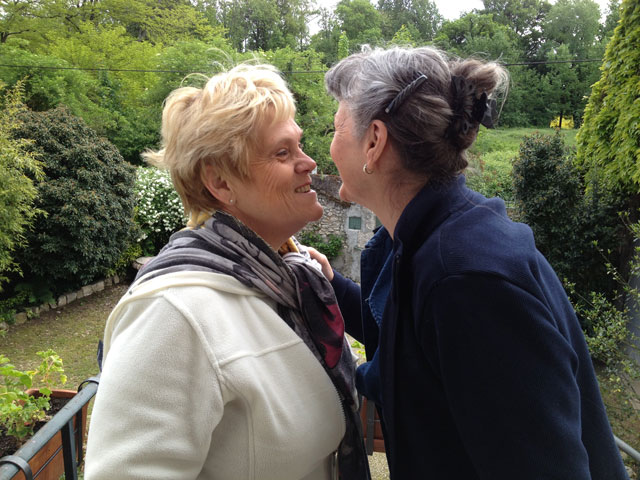
Which side to start with can be a problem as well. It’s very strange, in my opinion, that not everyone starts on the same side. I always go to the left first (right cheek), which seems to work most of the time, but occasionally you have someone who starts on the right. It would seem that left-handers have a tendency to go in the other direction. Once again, you can let the other person initiate the procedure is you’re worried. It can also be a question of size and personality!
Jean Michel giving the bise to Françoise, starting on the rigth
The bise is part of a whole ritual among young people, especially teenagers and you’ll see them arrive at school and do the rounds of all their friends. Even some of the boys do it among themselves which surprise Anglosaxons.
La bise is not restricted to female/female and female/male but male/male is usually only practised among men who know each other well, particularly family members. A friend told me a very funny story about an American friend visiting her who witnessed two men – firemen at that – affectionately greet each other with the bise. She nearly keeled over with surprise!
Middle of bise – changing sides
Jean Michel only kisses male members of his immediate family (father, brothers, sons) and one male friend who doesn’t have any family of his own and always insists on giving the bise. It seems to be a generational thing as well, becoming more prevalent among the younger generations.
During my personal bise survey (and thank you for all your answers), many friends of my generation (50 +) complained about the fact that it has become too systematic among people who hardly know each other, such as in a gym class or other activity. Feel perflectly free just to say Bonjour tout le monde if you don’t want to do the rounds. If challenged, you can say Je ne suis pas bisous, which roughly means means “I’m not the kissy type”.
The big no-no is kissing anyone apart from your partner on the lips and even on the cheek. It feels so strange to me now that even with my Australian family I just can’t do it and always say We’ll do it the French way.
If you’re not sure whether or not you should give someone a bise, you can wait for them to take the initiative if they are older and take the initiative yourself if they’re younger. If they are the same age, you can choose. If you’re hesitating, it’s best to announce what you’re going to do, je vous fais la bise ou je te fais la bise so that the other person knows what’s going on.
A woman can show she doesn’t want a bise from a man by body language – not offering her cheek, extending her hand instead, avoiding eye contact, keeping her distance. A man should respect that.
Children are often taught to give kiss everyone and will sometimes proffer their lips. I personally only told my children to say bonjour verbally because I remember my French tutor at university explaining once how she hated being forced to kiss people she didn’t know as a child.
Another question is health of course. If you have a cold sore (herpes), you should, of course, not have any contact with another person, but I am always surprised to see how many people don’t respect such as simple rule. All you have to say is J’ai un bouton. The same applies is you are sick, including colds. And don’t hesitate to refuse is the other person has the sniffles.
I haven’t touched on la bise in the workplace but I need another post for that!
This week’s blogger round-up takes us to two very different parts of the world. Jo Karnagan from Frugal First Class Travel gives tips to eating well in the Cinque Terre, that wonderful area on the west coat of Italy that I’ve blogged about in the past and where I probably had the best seafood meal ever, while Laurence and Vera from Finding the Universe take us on a self-guided tour of Copenhagen, home of the Little Mermaid and definitely on my wish list, illustrated with their usual stunning photographs. Enjoy!
Eating Well in the Cinque Terre
by Frugal First Class Travel, an Australian who loves to travel – especially in Europe – and who has gradually learned how to have a First Class trip on an economy budget, without missing out on anything!
The Cinque Terre is, like much of Italy, pure joy for frugalfirstclasstravellers. It is easy to eat well on fantastic local, seasonal food, and drink fabulous local wines, all at a bargain price! What’s not to love? So, here is the official frugalfirstclasstravel guide to eating and drinking well in the Cinque Terre:
Food – The Cinque Terre is all about fish and other fresh seafoods. Red meat and poultry is not well represented (and in some places not represented at all) on restaurant menus, so seafood is the way to go here. Read more
A self-guided tour of Copenhagen
by Laurence from Finding the Universe, of British origin who, with German-born Vera are travellers, into writing and photography, slowly exploring the world.
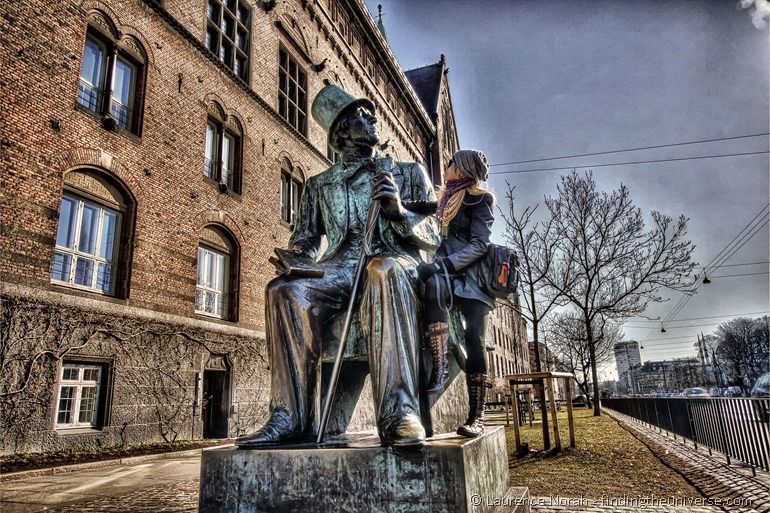
There are definitely more comfortable places to sit than on Hans Christian Andersen’s left knee. On top of that, instead of telling me a story out of the book that is resting on his right knee, he is staring over to the Tivoli, the famous theme park, completely ignoring me.
Well, I can’t say that’s good manners but I do understand why he is like that. Who even knows how many people sit on his lap on a daily basis to have their picture taken. Apart from that, it’s a really nice sunny day in Copenhagen, with the first flowers announcing that spring might finally have arrived after this long cold winter. So maybe Hans is just day-dreaming.
I, on the other hand, ain’t got time for that! I arrived here in Denmark’s capital yesterday and I have only today to see the city. Luckily it’s very walkable. Hey, why don’t you guys tag along? Yes? Cool! But I’m warning you: I’m a fast walker… Alright, let’s go! Read more
I don’t understand where those extra kilos come from. I don’t even have a sweet tooth! I hate to think what would happen if I did. Between November 2009 and January 2011, I lost 20 kilos. They stayed off for about 18 months, then very slowly, five crept back on. In January this year, I went back to see my nutritionist Dr Séjean and was determined to lose them. I even blogged about it!
But they are still there. The warmer weather has been slow in coming this year with only one advantage – I must just have time to fit back into my summer clothes before we go on holidays. I’m currently pouring myself into two pairs of stretch jeans, having alternated between two pairs of trousers all winter!
It’s Sunday night and we’re driving back from the Basque coast where I had hoped that cycling every day might help, but the weather dictated otherwise. “I can’t even remember what we used to eat before I put that weight back on”, I say to Jean Michel.
“Well”, he says, “you used to serve the meal in the kitchen and take the plates out to the dining room. That way, we couldn’t have seconds.” Ah, I had forgotten about that. With the ongoing renovations on our balcony in Paris, we had started eating in the kitchen to get away from the noise and then I spent quite a lot of time alone in Blois which disrupted my eating habits.
“Then we used to eat more fish”, he adds. That’s definitely true. Half our meals were based on fish and not meat but we haven’t found a good fishmonger in Blois yet. We used to buy fish at the Saint Eustache market every Sunday but we’ve had so many weekends away that the habit has been lost. But we’ll be spending the next three weekends in Paris so we can stock up.
Then there are the apéritifs. Our former diet Indian Tonic and canned button mushrooms or carrot sticks have somehow evolved into white wine and pringles. I groan inwardly. But I prefer white wine and pringles … I debate whether it’s better to give up the apéritif altogether or go back to the diet version. We’ll see.
“And maybe we’ve got back into the habit of having a glass of wine with our meal at night, particularly since we’ve been eating more meat.” Sigh. I like wine. I would love it to be calorie and alcohol-free! But I know that when I eat fish I don’t feel the same inclination to drink wine as I do when I have an entrecôteor côte de veau.
Maybe I could listen to that weight loss hypnosis recording again? It certainly helped the first time. I could listen to the relaxation and sleep ones as well. It’s much easier to lose weight when you’re not tired and stressed.
“And what about exercise?” says Jean Michel. “Are you still using the exercise bike and going power walking?” Hmm, when was the last time I use the exercise bike? And what happened to the power walking? I know what the problem was there – the terrible weather – but it’s getting a bit warmer now and I can use the exercise bike when it rains. It’ll put me in good training for cycling along the Danube in a month’s time.
And there you go, I have one month to lose 5 kilos. Wish me luck!
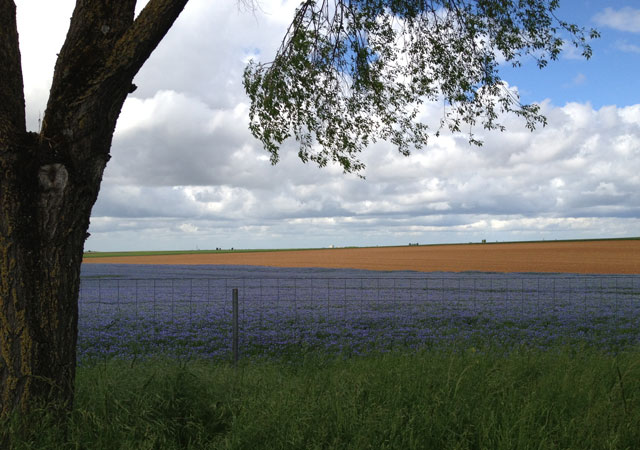
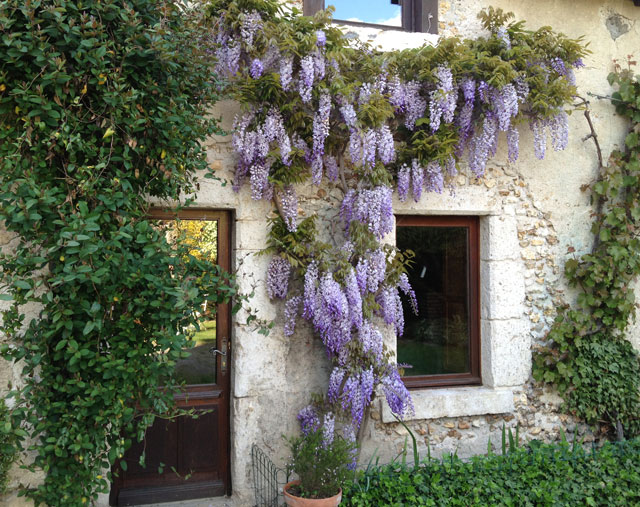
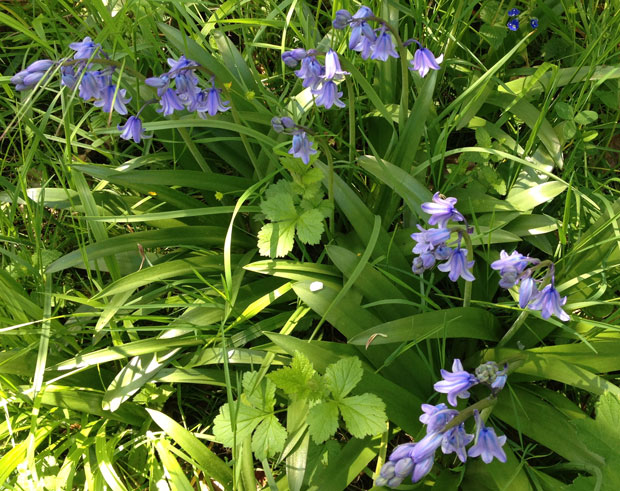
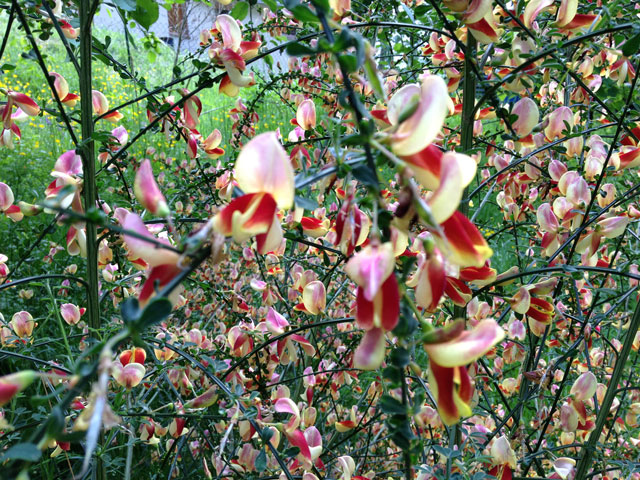
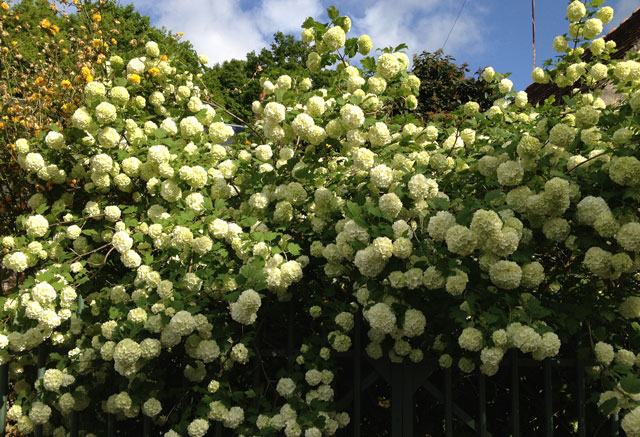
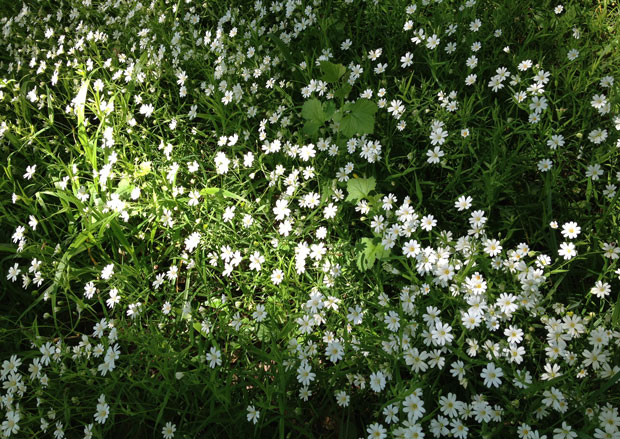
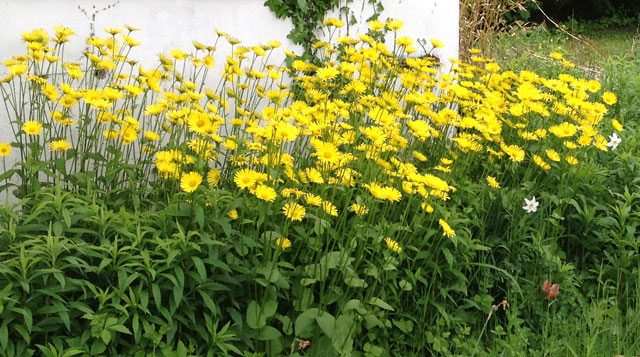
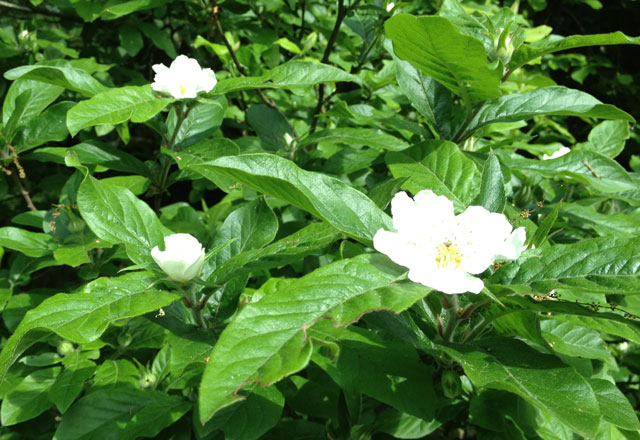
Coming from North Queensland, I have remained amorous of spring flowers ever since I saw my first field of buttercups back in 1975 in the south of France. These are photos taken recently in the Blois and when we travelled back from the Basque Coast. I had never seen flax (linen) in bloom and had no idea it was lavendar. I’m amazed in fact at how many spring flowers are lavendar, white and yellow. I’m not sure of all the names – maybe more knowledgeable readers can fill in the gaps.
Linen flax near NiortWisteria at Closerie Falaiseau in BloisSpanish Bluebells (Hyacinthoides histpanica) in my little wood in BloisWeiglia in our garden in BloisOrnamental broom in our little wood in BloisGuelder rose (or snowball bush – Viburnum opulus) in our front garden in BloisWhat I thought were daisies but which are really Greater Stitchwort (Stellaria holostea), in the same family as carnationsA yellow daisy that’s a bulb but I don’t know it’s name – ostensibly véronique in FrenchMedlar in our little wood – the fruit are a great favourite with deerGuelder roses before blooming, keria japonica and lilac
It took me a while to actually understand what this expression is all about. Autant usually means “as much as” or “as many as”, such as prenez autant que vous voulez – take as much as you want. Autant pour moi may be short for C’est autant pour moi with the general idea being “so much for me”.
I have since discovered a more plausible explanation. It seems that the real expression is au temps pour moi, of military origin where temps is the precise moment in time at which certain movements are made and distinguished by a pause when using a weapon. It’s the same idea as “marching in time” or “clapping in time”. Saying au temps pour moi is like admitting you weren’t in time.
But the origin remains a controversy and today, autant pour moi is found at least as often as au temps pour moi. The Collins-Robert bilingual dictionary gives “It’s my mistake” as a translation, which is pretty close to the idea being conveyed.
However, the real meaning is a lot subtler than that, as I have come to realise over the years. It is actually a male substitute for an apology about being wrong.
I don’t know about other Anglophone countries, but Australia is a very apologetic nation. People are always saying they’re sorry about something, even when it’s not their fault.
It’s not very French though. Je suis désolé(e) exists of course, and is used, when a woman, in particular, wants to express commisseration e.g. je suis désolée d’avoir appris que vous avez été cambriolée – I’m sorry to learn you have been burgled.
Very often, only the past participle is used, without the verb, and the meaning is much more cursory, e.g. désolé d’être en retard – sorry I’m late.
More often than not, it is used to convey exactly the opposite, Je suis désolé mais je n’irai pas – I’m sorry but I’m not going, which is also a perfectly acceptable English usage as well, the difference being that it is used more often in French.
The reflexive verb s’excuser is far more frequently used than désolé in the apologetic sense. Excusez-moi d’être en retard – literally “forgive me for being late” but more like our “I’m sorry I’m late” in terms of frequency and register.
You can also say je vous demande pardon or je vous demande de me pardonner, both of which are sincere apologies for having done something undesirable. Ditto for je vous présente mes excuses.
To apologise for being wrong is something altogether different and seems to go against the grain. This is where autant pour moi comes in. Someone makes a blatant error, insisting upon it until you prove they’re wrong. When you finally produce evidence, they say with a shrug autant pour moi.
There is another version of excusez-moi which is typically French as well : je m’excuse – literally “I excuse myself!” At least that way there is no fear of their apology being refused … It’s usually used when you’ve finally managed to wring out an apology from some one. The polite form is je vous prie de m’excuser or voulez-vous bien m’excuser. Now je m’en excuse is slightly different and conveys the idea of “I’m sorry about that”.
There are a few other synonyms out there such as contrarié , chagriné, confus, embêté and navré, each conveying a slightly different meaning.
Je suis contrariée d’être en retard : I’m sorry I’m late, with the idea that I really did want to come on time but something prevented me that I couldn’t do anything about.
Je suis chagriné d’apprendre le décès de votre père : I’m sorry to learn of your father’s decease, with the idea of being emotionally affected. It would be a bit OTT to say Je suis chagriné d’être en retard!
Je suis en retard ; je suis vraiment confus, I’m late; I’m really sorry, gives the idea that I am embarrassed about being late. It doesn’t mean “confused” of course. If you want to say “Everyone’s telling me something different. I’m confused”, you could say Tout le monde me dit quelque chose de différent. Je ne sais pas quoi penser. Confusing, huh?
Je suis embêté d’arriver en retard, I’m sorry I’m late, meaning that I am personally annoyed about not being on time and have probably missed out on something.
Je suis navré d’être en retard : I’m sorry I’m late, but I’m polite and well-educated and sincere about it, not just paying lip service.
Sorry about all that confusion – have you got it straight now? What do my French friends think?
We’re now up to 8 home exchanges and ready for more but I’ve drawn up a little list of do’s and don’t’s. If I have been remiss in any of these areas in the past, I hope that my exchangers will forgive me. I now know better!
So, in addition to a good bed, a clean house and a decent shower, here are my personal suggestions.
Do wash new towels: it’s great providing a set of new towels for guests, but remember to wash them first or your poor guests won’t be able to dry themselves.
Don’t leave perishables in the fridge or in the kitchen that won’t survive until your return. Not everyone eats the same food as you do. A bottle of wine, a vase of flowers or a frozen meal in the freezer will be appreciated more than fruit and vegetables that might end up in the bin.
Do leave a shelf in your pantry free: your guests may not be dining out every day and may prefer to be able to put their food away rather than leave it on the bench or table during their entire stay.
Don’t provide a washing machine that doesn’t work properly: you may know the trick of how to get your machine to spin properly, but your guests are not going to be happy if it takes 3 days to get their clothes dry.
Do leave hanging space with hangers: perhaps you don’t hang up any clothes yourself, but your guests may wear shirts every day – and don’t forget to provide enough hangers (count one shirt hanger per person per number of days’ exchange up to a week and two or three skirt/trouser hangers per person).
Don’t leave your fridge ¾ full: your guests need to have space to put their own food without having to shop every day. At least two empty shelves, including door shelves, should be left free.
Do provide a blanket as well as a dooner for the bed: you may be freezing at 15°C because you used to live in Africa, but your guests may prefer a light blanket at that temperature. Give them the choice.
Don’t use photos that don’t correspond to your listing, particularly as the cover photo: if you don’t live within walking distance of the sea, a picture of a fishing boat is not appropriate. Neither is a monument two metro stops away.
Do leave adequate instructions about your house: guests need to know when to put the rubbish out, how to work your expresso machine, and what the wifi code is (and why not change the original 26-character code to something easier for your guests?)
Don’t leave dirty sponges in the kitchen: provide a clean sponge for each new set of guests.
Do you have any other suggestions that will make your home exchange a more pleasurable experience?
This week, in my bloggers’ round-up, Pierre from Paris on Demand suggests some original souvenirs from Paris, Sylvia from Finding Noon takes us to a Chagall exhibition in Paris that is on until 21st July and Mary Kay from Out and About in Paris describes her last-minute trip to Belgium, especially Ghent and Antwerp, instead of a boat trip along a canal in Burgundy, cancelled due to severe flooding. Enjoy!
Original souvenirs from Paris…
by Pierre from Paris on Demand, aimed at helping tourists and Paris lovers to get to know the city of Light under a different perspective, offering news and updates on exhibitions, museums, restaurants, off-the-beaten-track addresses, events and tips to prepare their trip and understand the Parisian way of life.
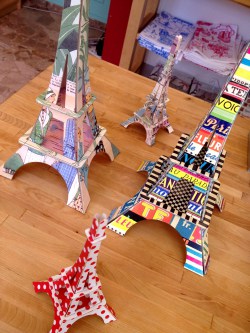
If you’re looking for chic and trendy souvenirs from Paris, look no further, “Les Parisettes” is for you! “Les Parisettes” is a concept store specialized in different types of products: kitchen accessories, stationery, tote bags, jewelry, candles, games, cushions and home decoration ideas. Everyone can find an original gift, in the colors of Paris and the Eiffel Tower. Maryse Bazzoli and Sophie Ollé-Laprune, the creators of the store, pay a lot of attention to select refined, Eiffel-Tower fashioned, quality items, only for you! Read more
A hymn…
by Finding Noon, an American living in Paris who appreciates fine art, good music, succulent food, and breath taking scenery
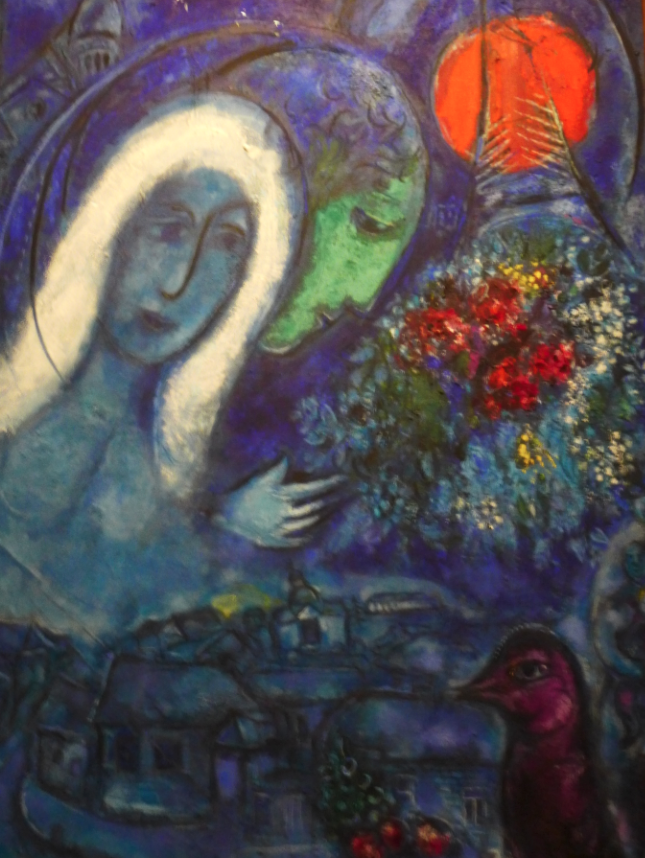
Rich blue sapphires, golden topazes, apple red rubies…. No, I did not go jewelry shopping this weekend, rather I spent a lovely hour (or so) with a fairly dense crowd at the Musée du Senat in the Luxembourg gardens diving into the sumptuous colors at the Chagall exhibit.
I like Chagall. I am aware that he is not for everyone. Upside down chickens and flying musicians do not reflect classical realism, nor modern abstract purity and it all requires a willing suspension of disbelief. But I love his gem stone palette, and I find his fantastical characters, often dancing, kissing, playing music absolutely delightful. His work has been known to make my make heart do a little jig. I suspect I am not the only one and that this is perhaps why he was chosen to paint the ceiling at the Opera Garnier. His stained glass windows add the perfect counterpoint of colorful light to the cold grey stones at the Cathedral of Notre Dame in Reims, making it my favorite cathedral in France. Read more
Last minute change of plans from Burgundy to Belgium and from wine to beer…
by Mary Kay from Out and About in Paris, an American by birth, Swiss by marriage, resident of Paris with a Navigo Pass for the metro that she feels compelled to use
“I just spoke with someone at Le Boat. They had to cancel our reservation because the water level in the Nivernais Canal is too high. Can you find somewhere else for us to go?”
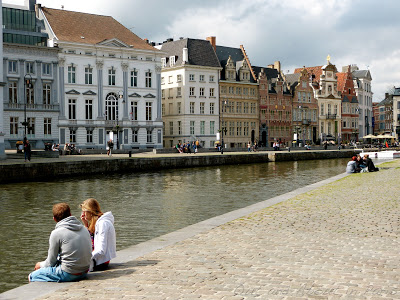
My heart sank when Stéphane called last Monday to tell me that our much anticipated boating trip in Burgundy with our daughter had been cancelled. Gone were visions of the three of us cycling to quaint villages for lunch and leisurely sipping red wine on the deck in the evening. Instead, I was charged with the task of finding an affordable last minute alternative during one of the busiest travel weeks in Europe. Even after hours spent scouring the internet, Sara and I couldn’t find a getaway that cost less than 1,790 euros per person. In desperation, I called Stéphane and told him that we were going to have to get creative, to think outside the box. “How about driving to Belgium?” I proposed. Read more
 One of the great things about living in the French Alps is that it’s so totally different to life in big French cities. When I go to Paris, I’m a tourist: loud noises grap my attention, the Metro is confusing, and I need a map to know where I’m going.
 At the moment I’m working my way through a book titled Creating the French look by Annie Sloan, which covers eight different french decorating styles, inspirational ideas and 25 step-by-step projects. A great read.
 This weekend, I was invited to the beautiful wedding of two close friends at the Château de Méry in Méry-sur-Oise, located about 30 kilometers or 45 minutes north of Paris on the SNCF (local train) in the Parc Vexin. With its traditional château and chapel and ultra-modern hotel on the château grounds, this made for the perfect wedding venue. Congratulations, my friends!