Universities in France and Australia

When I enrolled at Dauphine University in Paris to do my post-graduate translation diploma at ESIT many long years ago, I was rather shocked at the environment. It was located in a  high-rise building (and the toilets were disgusting). When I started teaching there 15 years ago, it was no better. Only the toilets were slightly cleaner.They finally spruced up the outside and did up the wing I work in and are now renovating the entrance hall. They also refurbished the canteen area a couple of years ago.

I did French honours at James Cook University in North Queensland. It has a magnificent campus practically out in the bush. The wallabies used to come in from the surrounding hills in the evening. The library takes up a whole building. The library at Dauphine takes up one floor and there are certainly no individual desks for the students to work at. During exam periods, you see them all sitting on the floor in the corridors. Our wing is a bit better because we are actually a school within a school and have fewer students. Compared with the Dauphine students, we have luxury surroundings.  At least they don’t have to sit on the floor.

When Black Cat did her first year of post-grad at the University of Queensland a few years ago, she used to skype me from one of the cafés on campus. I couldn’t believe it. At the time, we didn’t even have wifi inside our building. So I campaigned until we got it. A couple of years back, I lectured in terminology and needed an internet connection for the course. I was assigned a lecture theatre in a new area downstairs where the walls were too thick for a wireless connection. I asked for a cable connection and it took THREE MONTHS to get them to connect it during my 1 ½ hour weekly class. They were afraid of the students using it. I couldn’t believe it. OK, ESIT is not part of Dauphine (for historical reasons, we are part of Paris Nouvelle Sorbonne University which is over the other side of Paris) but even so, I thought that was pretty inefficient.

I then pushed to have a room equipped with computers to hold our translation classes. I even got the quotes (we’re multi-task here). A computer is a compulsory tool for a translator today, as you may well imagine. It finally happened and I immediately claimed the room before anyone else did. All last year, I was allowed to use it as a special favour because the student security system wasn’t functioning. This year, that problem has been solved but they still haven’t connected up the permanent video projector so I have to count on our somewhat moody technician to set up the laptop and portable projector for me. This involves getting there early and checking that he hasn’t forgotten me. And when he’s not there for some reason, I have to do it myself.

The e-learning platform we’re supposed to use has been down since classes went back in September. Fortunately I have a cluey student who suggested zoho docs so I’m using that. At least I’m sure it’ll work. Whenever I complain and point out that the facilities in Australia are much better, I get the answer that the students are not paying the same fees. They did in my day, but that’s changed now of course. In France, the yearly fees range from 174 to 564 euros (230 to 750 Australian dollars) a year plus compulsory social security which is about 150 euros (200 dollars). I gather the fees are a little higher than that in Australia … President Sarkozy has a big plan to develop university campuses, make each university autonomous and charge much higher fees. This has understandably met with a lot of opposition and the latest news is that two of the universities have gone broke. Haven’t noticed any campuses yet.

Ah well, only another semester to go because I’ve decided this will be my last year of teaching.

A Barge on a Cycle Path in the Loire Valley

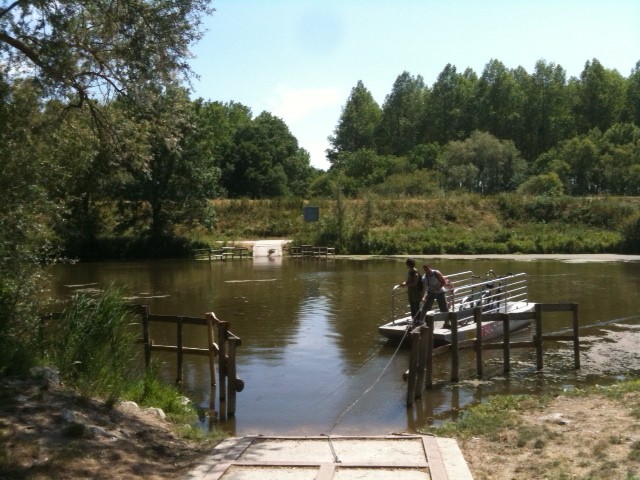
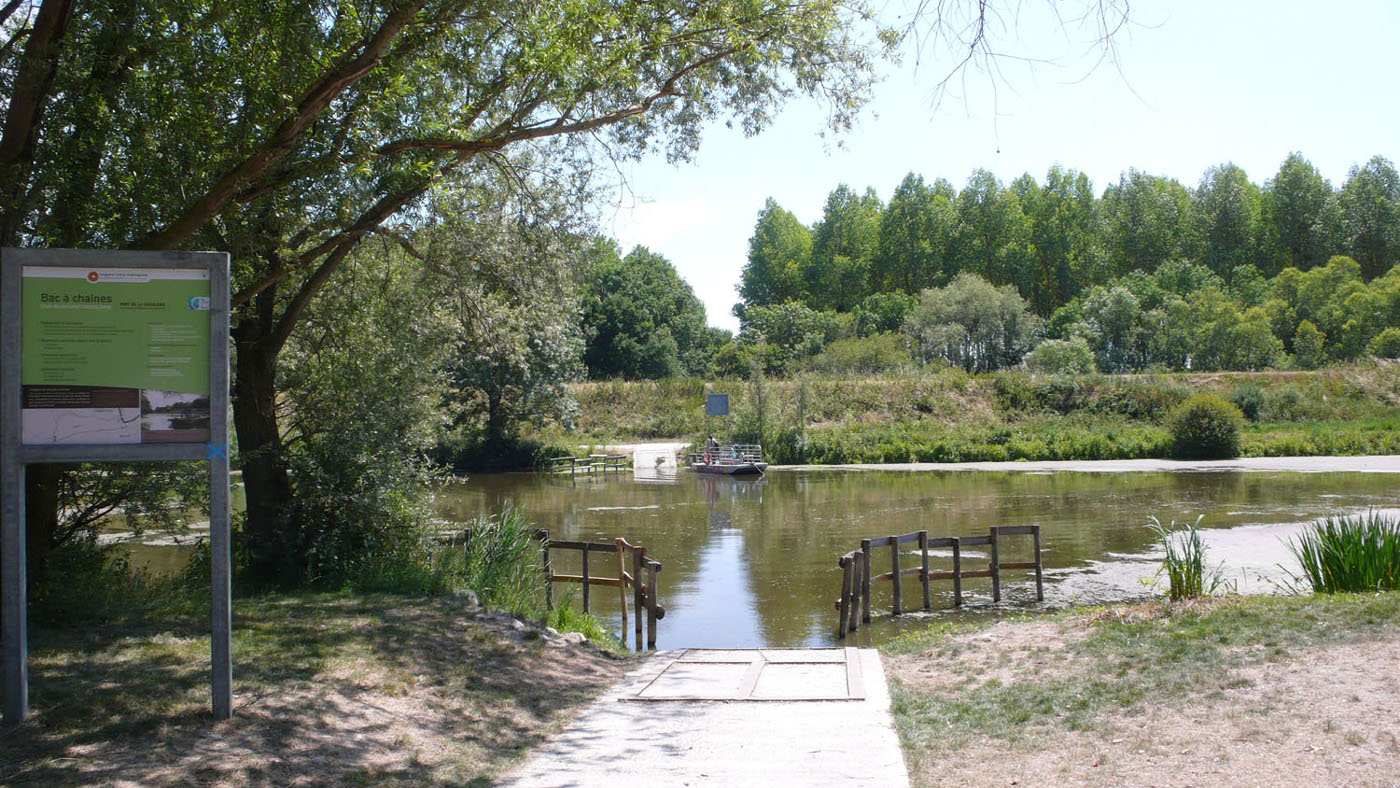
Writing about cycling along the canals in Brittany and the Loire reminded me of another trip in the Loire Valley. We have this book called (in French) Freewheeling from the Atlantic to the Black Sea and one of the bike paths really took my eye. In the photo, you could see this couple, with their bikes, crossing the Authion River on a little chain-operated barge. I wasn’t going to miss that!

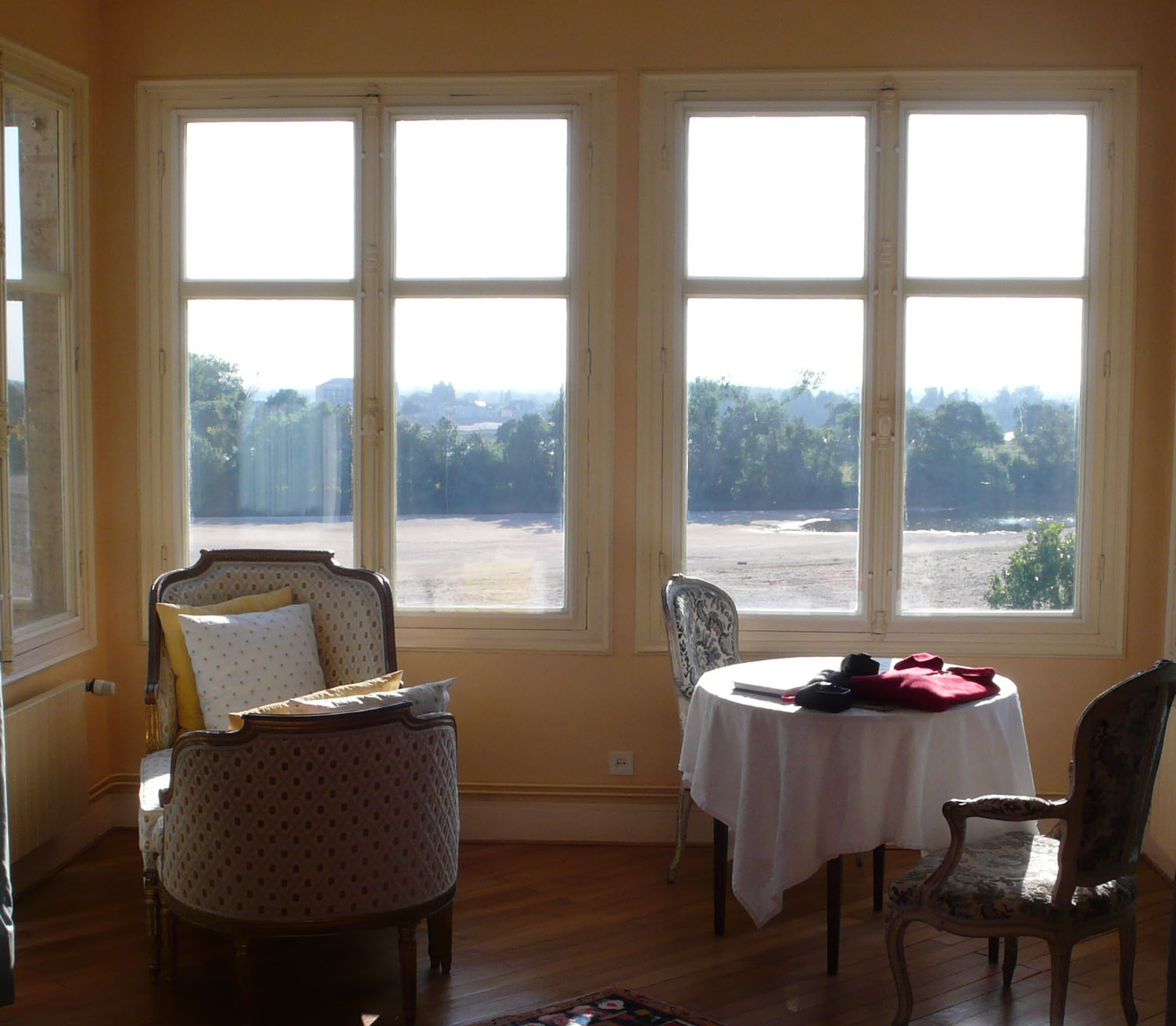
So we found ourselves a lovely B&B called Le Beauregard at Cunault. Mme Tonnelier was away so her husband looked after us and proved an excellent host. The only other guests, a family of 6, were charming. Our room, down the other end of the house, had an oriel window with a spectacular view of the Loire. The next day we visited the castle in Angers which has a wonderful tapestry of the Apocalypse. We left the car there and set out on our bikes. We started off in a rather desolate-looking old slate mining area with enormous pieces of slate all over the ground and quite a bit of dust.

Then came the exciting bit when we got to the banks of the Authion. We could see a young couple in the barge about halfway across, pulling frantically on the chain but the barge seemed to be going further and further down the river instead of across, pulled by the current and the strong wind. Relationnel took charge and shouted instructions on how to get the barge over to our side. It eventually worked and the couple invited us onboard to my surprise; I was expecting them to get off. But in fact they were trying unsuccessfully to get across to the other side when we arrived. There wasn’t much rain in spring this year and the low water level had caused too much slack on the chain.

So, with the four of us tightly backed onto the barge, the stronger members of the party pulled us across to the other side with no further mishap.

We continued down past La Daguenière, Saintes Gemmes sur Loire and Bouchemine. We stopped for a welcome drink and a rest in a café and then went back to Angers via the lake rather than going through the slate again. The round trip was about 40 K.

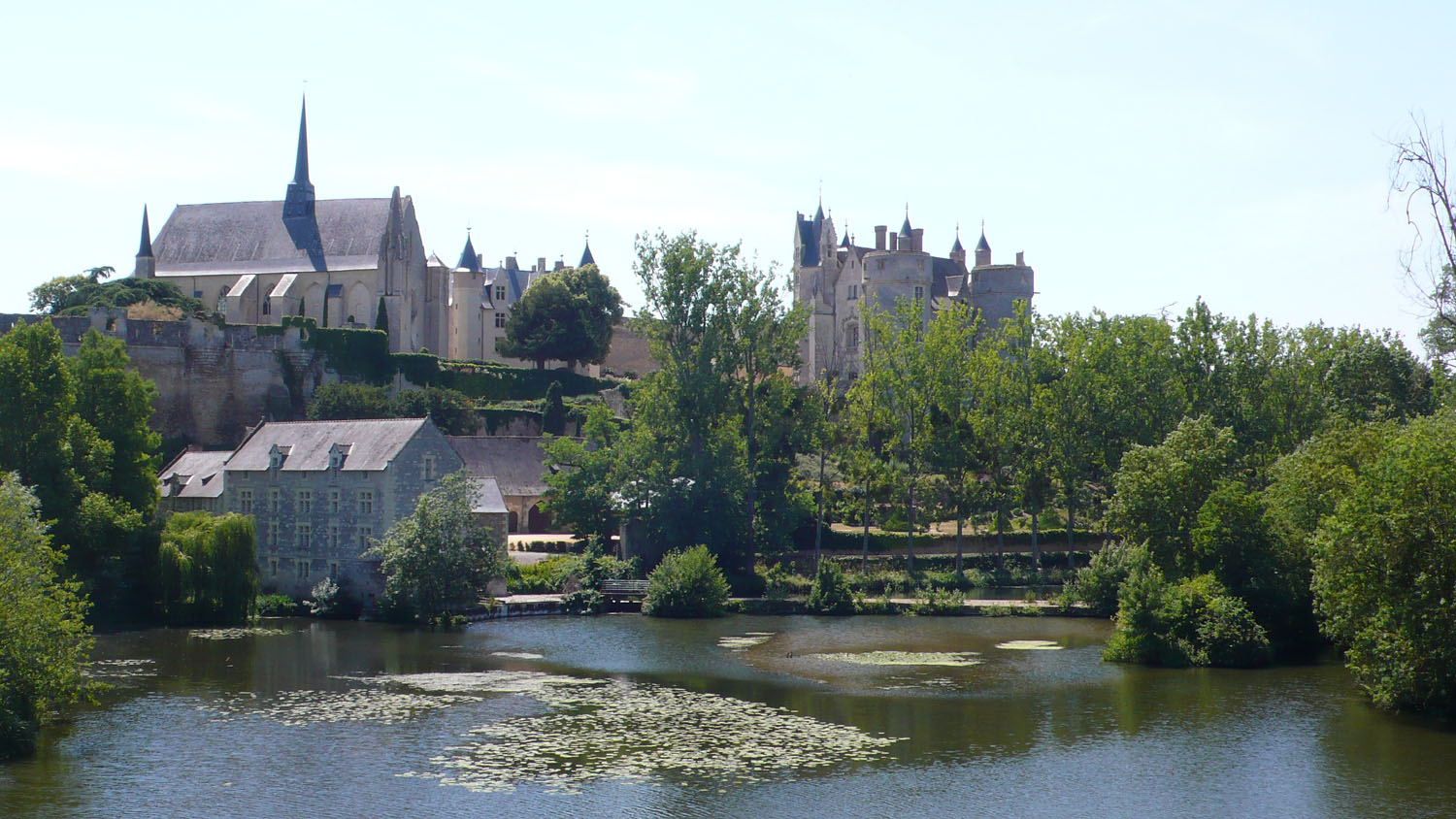
The next day, we set off from Artannes sur Thouet near Saumur where Relationnel was born, in the direction of Montreuil Bellay. It was a pleasant ride with a lovely surprise at the end. The view of the Thouet River from the bridge as we reached the mediaeval town was absolutely stunning.  And then this wonderful new outdoor restaurant called Auberge des Iles was just waiting for us! We weren’t the only ones though so we attached our bikes and reserved a table and went off to explore the little town.  Still no table on our return so we sat down in the shady armchairs provided and enjoyed the view of the river.

Rose-covered ladies’ tower

After lunch we visited the very beautiful castle with its century-old Lebanese cedar and its rose-covered towers then continued on our way to Saint Martin de Sanzay where, miraculously, we found another café open. Quite often in the smaller villages in France, the cafés have all shut down. By the time we had clocked up our usual 40 ks, we were back to our starting point.

The next day, we moved onto Loches, but that’s another story!

 
B&B Le Beauregard
Fanny et François TONNELIER 
22, rue Beauregard
49350 CHENEHUTTE-TREVES-CUNAULT 
hmcbeauregard1@club-internet.fr
http://beauregard49.com/index2.html
Auberge des Isles
312 rue de Boëtie
49200 Montreuil-Bellay
02 41 50 37 37
www.auberge-des-isles.fr

Boletus Eatus

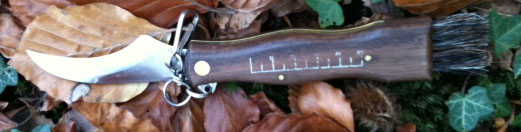
Mushroom knife

So now that we’ve found all these wild mushrooms and cut them with our nifty mushroom knives rather than yanking them out of the ground so that we’ll find more next year), how do we cook them?


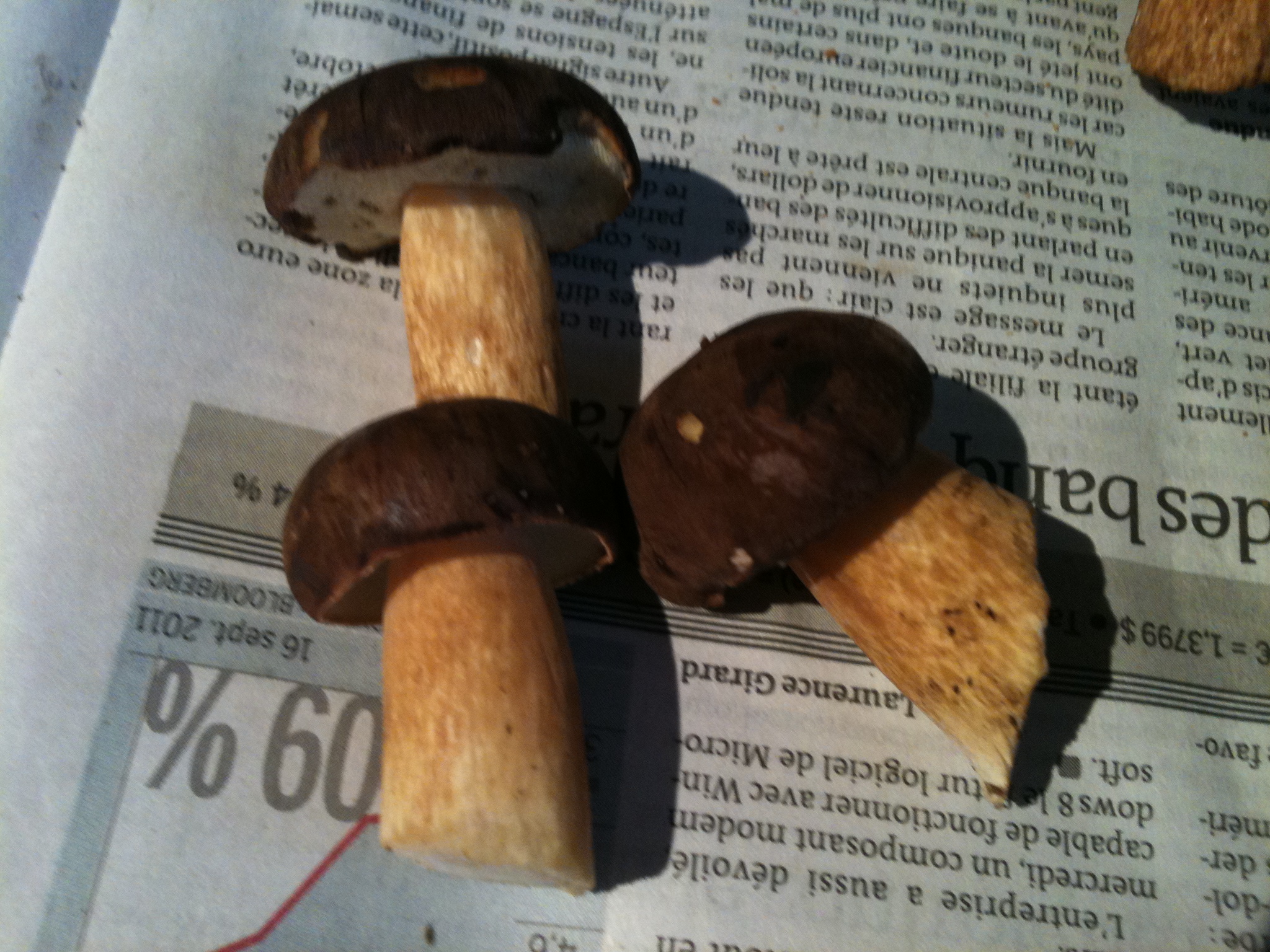
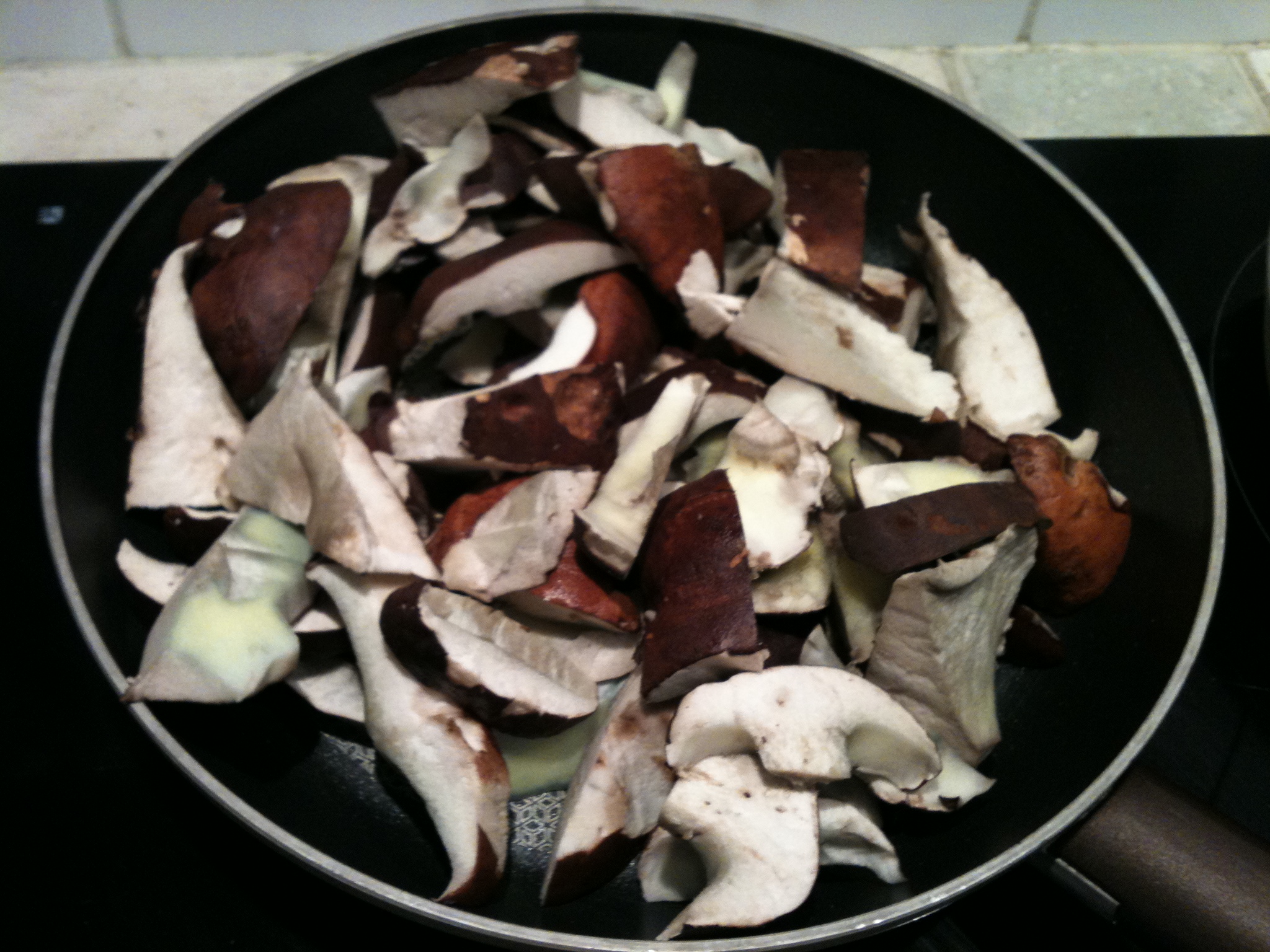
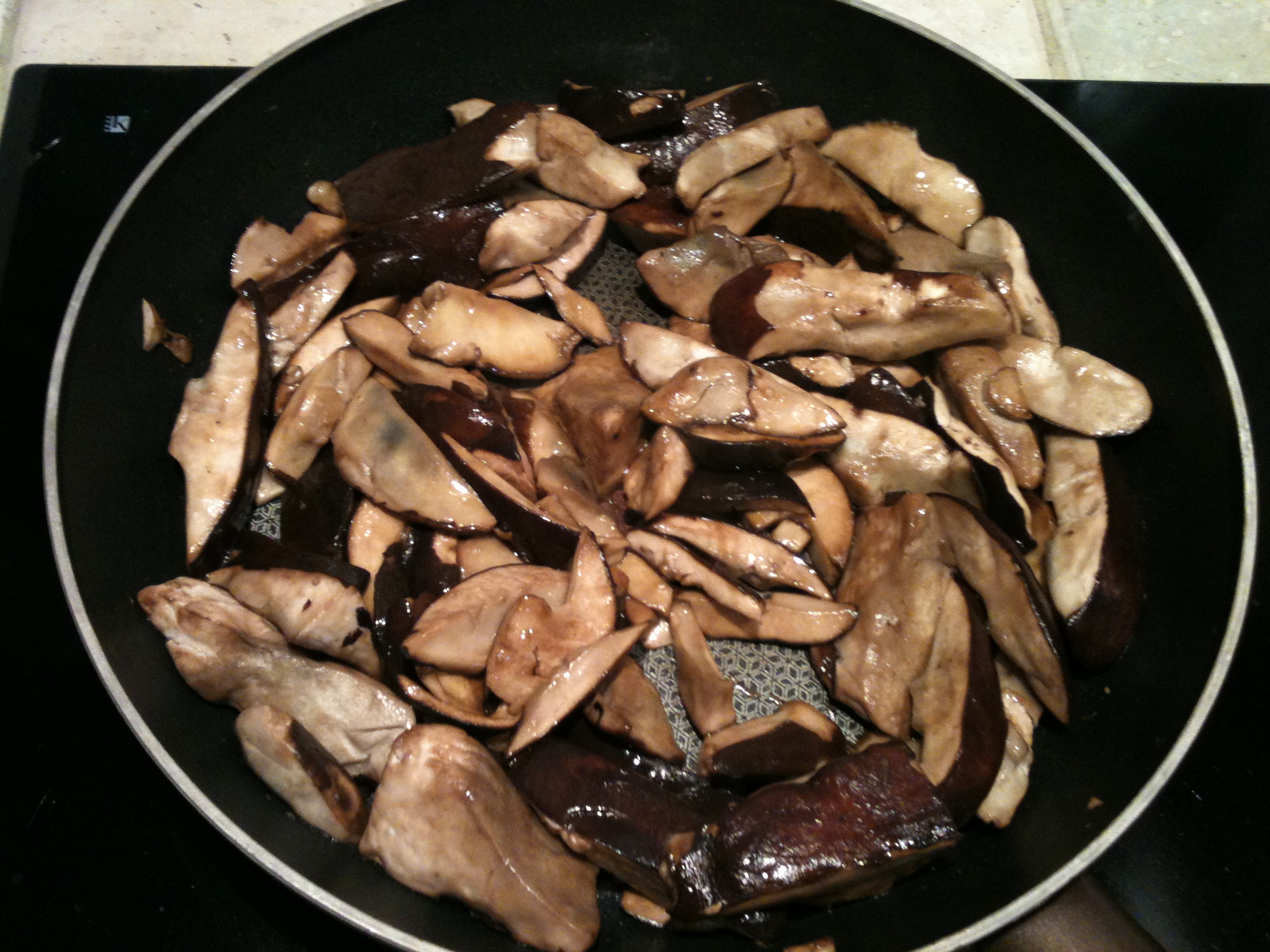
Ceps and the more compact boletes such as boletus aureus and  boletus pinophilus can be stand alone as an entrée, used in omelettes or served with meat or fish.  If the spores aren’t too spongey, all you need to do is brush off any dirt and cut the mushrooms into slices. You can keep the stems of ceps but those on the boletes need to be cut off. Fry on medium eat in a little bit of olive oil until cooked. Some people add parsely and garlic but I think it destroys the natural taste. Great on toasted break at aperitif time, particularly with beaujolais nouveau or Alsatian vin nouveau!

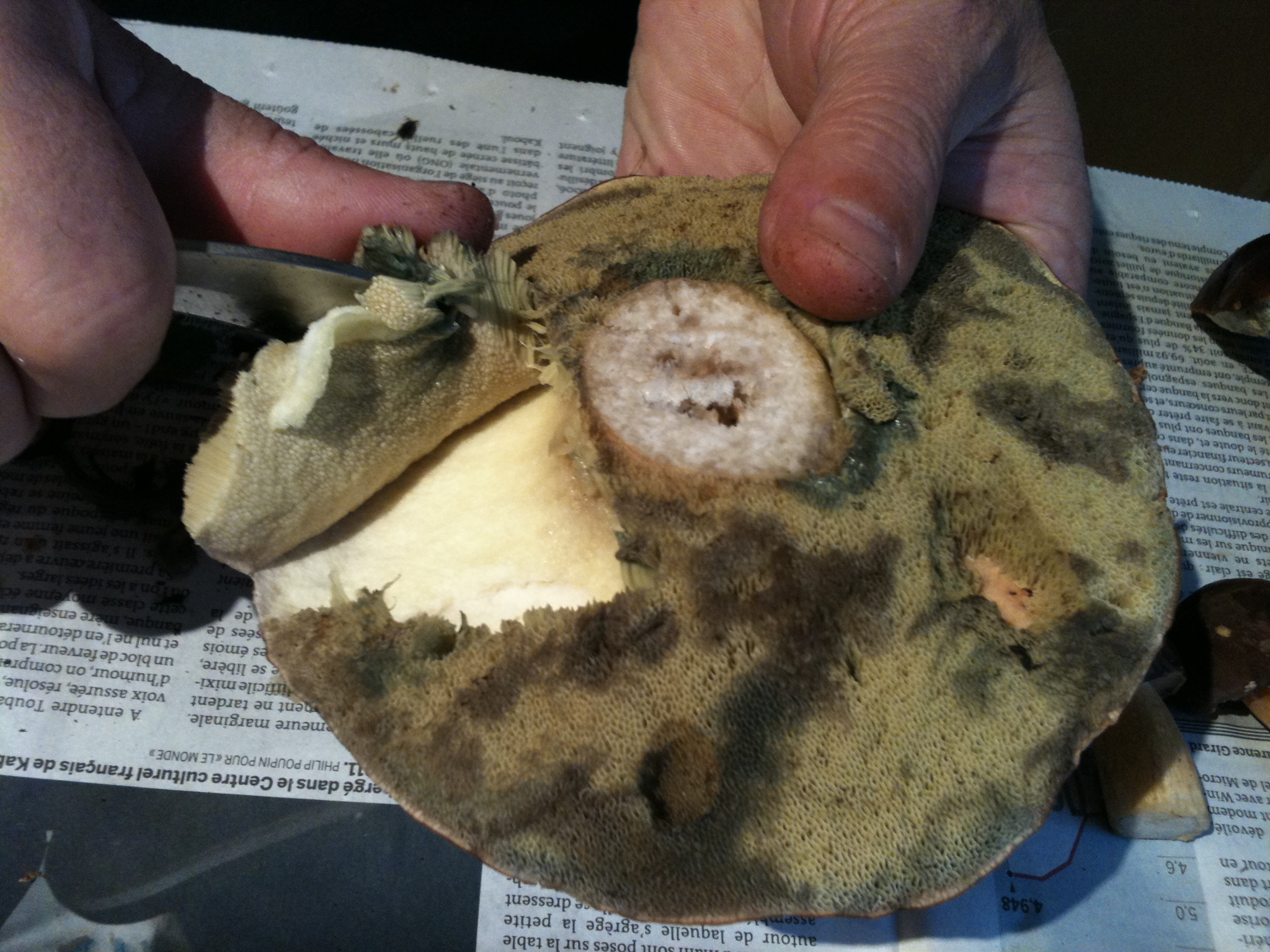
Peeling off the spores

You’ll need to peel off the spores on the more spongey boletes. Using a sharp knife, cut the mushroom in half to make it easier to handle and you’ll see that you can peel off the spores all at once. Then chop into fairly big chunks or slices. Cook in the same way as ceps, but a little longer, about twenty minutes or more to make sure that the more laxative ones don’t pose problems.

Chanterelles, amethysts and boletus


Trumpet chanterelles and horns of plenty just need to be brushed down and the horns of plenty cut lengthwise if they’re large. Cook in the same way as the ceps and boletus. You’ll see that they give off a lot of water which usually indicates they’re cooked. Horns of plenty are excellent with white fish and veal. Chanterelles are a good accompaniment to beef.


All the other mushrooms, such as grisettes, amethysts, parasol mushrooms and horse mushrooms, can just be brushed, the stems removed and cooked as above.

If you’ve picked more than you need, just cook them and freeze them in freezer bags.


For more information and recipes, Rogers Mushrooms is a fund of information:

www.rogersmushrooms.com


Ever Navigated on a French Canal?

A lock on the Rance canal

When I learnt French at school, we used to watch a programme on TV once a week about a family of four who lived on a barge and used to travel throughout France along the canals. They had bikes and would go off and visit the neighbouring towns and villages whenever they stopped. It looked like heaven to me. I knew all about locks that raise and lower the boats when there’s a difference in the level of the water. Imagine that you are going from a higher to a lower area. The lock is like a big rectangular open tank. They close off both ends, using winding gear, fill the tank with water, then open the sluice gate in front of you. You take your boat in and they close the gate behind you. Then they empty the water until it’s low enough to open the gate on the other side (your boat goes down as the water does) and you sail out. If you’re coming in the other direction, the process is obviously reversed. It seems that Leonardo da Vinci invented this type of lock.

A summer's day on the Rance

Sadly, I’ve never fulfilled my dream to spend a week or two on a house boat, but we’ve cycled along many canals. The most interesting for the spectator is probably the Ille-et-Rance Canal in Brittany. No doubt hell for the boats though because at Hédé, there are eleven locks over a distance of just 2 km. You can imagine the time it must take filling up and emptying all the locks. The canal was actually built during the first half of the 19th century by volunteers during the reign of Napoleon 1st. It seems that a few Spanish war prisoners and quite a large number of convicts and deserters were roped in as well. Sounds like Australia, doesn’t it? The locks on this canal are still hand-operated. The lock houses are beautifully decorated with masses of flowers and some have realistic outdoor scenes from the olden days.

Canal at Briare

Another place where we cycled along a canal is Briare on the eastern end of the Loire Valley. There’s actually a bridge to take the canal over the Loire River, designed and built by Gustave Eiffel no less. There’s a footpath on each side so we cycled across it several times. Stunning at sunset. I was a bit worried about falling into the canal, which is rather stupid because the footpath is actually quite wide. They have a wonderful ice-cream parlour at one end of the bridge where they serve the ice-cream in edible chocolate dishes. Plus a highly appreciated jug of iced water. We were staying in a B&B right on the edge of the canal that even had a barbecue we could use. So, côte de boeuf, ice-creams, cycling along the canal at sunset, having picnics on the water-edge at lunchtime. Not bad.

Ice-cream next to the bridge canal

Since I haven’t had the boat experience myself yet, I’d like to share a blog written by a Canadian couple, Marnie and Graham Scholes, who spent two weeks on a boat on the Baise Canal, which is a branch of the Midi Canal system, in September 2007 and then another eight weeks in 2008 on the Nivernais and Loire canals, including Briare. Lots of wonderful photos including a series on bridges, one on doors, another on ducks, one on wells and so on. My favourite shows fishermen (and women) along the canal and their more or less sophisticated installations.  Not to mention the beautiful watercolours and sketches at the end. The first trip they took was a 50th anniversary cruise! So all hope is not lost …

Anyone else been on a river trip?

Briare bridge canal by Graham and Marnie
Marnie and Graham’s bloghttp://www.woodblockart.ca/francecanalboat/NevernaisCanal.html


What I Bought at the Wine Fair in Paris

Nearly forgot to go to the Independant Wine Growers Fair at Porte de Versailles this weekend and pick up some more Sancerre for our oysters on Sunday before we ran out which would have been a disaster! Most of the wine in our cellar was originally bought directly from the vineyard when we used to go on one-week wine-tasting holidays around France. We finally filled up the cellar and turned to cycling holidays instead with an occasional tasting of course. Now we just top up at Versailles in November and Mailly-en-Champagne during the Whitsunday weekend.

The Porte de Versailles fair is always very crowded so it’s best  to choose a weekday or morning. This time we got there about 11.30 on Sunday. We had sorted out our many free invitations beforehand so were able to make a beeline for the stands on our list. Each invitation entitles you to two standard INAO wine tasting glasses. As you can imagine we’ve collected a fair number over the years – great for parties. The Versailles ones are pretty mundane but those from Mailly-en-Champagne are much more original. Then you use this neat little gadget to hang them around your neck (2 euros for one, 3 euros for two) to keep your hands free. They usually last for a couple of years but they eventually break.

Our first stop was François Cherrier from Domaine de la Rossignol, a family-owned vineyard on the eastern end of the Loire Valley, founded in 1858 and steeped in tradition where they still hand pick their grapes. This year’s sancerre (sauvignon) has a completely different nose from last year’s – a very distinct pineapple. It’s a very « mineral » wine due to the nature of the soil with a powerful bouquet. When we first visited the vineyard about ten years ago, Mr Cherrier shared his passion for wine-growing and showed us samples of the different types of soil and rocks that make all the difference to the way the wine smells and tastes. We have a preference for his AOC sancerre at 8.90 euros a bottle.

Just next door was our favourite margaux – Château Haut Breton – which we discovered on our very first « wine week » back in 1999 in the Bordeaux area. That day, we tasted « merlot », « cabernet sauvignon »  and « cabernet franc » straight from the vat for the first time. Not very palatable, but a wonderful learning experience. Their 1996 margaux was superb. The last time we bought their wine was in 2005 – we’ve been disappointed ever since. This year, however, we tasted their 2009 and were delighted. It has its wonderful prune nose, full body and good persistence again. I see it won a Silver Medal at the fair this year. Excellent value at 28 euros a bottle. We’ll be able to dip into our 2004 and 2005 stock now knowing  we’ll have something to replace it in a few years’ time. What better accompaniment to a côte de boeuf roasted on an open fire enhanced with a copious serving of freshly-picked wild mushrooms?

Next on the list was Domaine Cauhapé from the south-west of France, in Béarn near the Pyrenees which makes an excellent jurançon. The grapes are mainly gros menseng, petit menseng and camaralet with a bit of lauret and corbu thrown in for good measure. We decided to take a mixed carton of Geyser 2010 with its powerful palate, at 13.50, Sève d’Autonne 2008 with its exuberant nose, at 14.50 and La Canopée, fresh and aromatic, at 22.50. Excellent with fish and seafood and even veal cutlets. I was amused when the wine grower, Mr Ramonteu said, with his strong Béarn accent, « You can drink this wine when you don’t have anything else! » I don’t suppose that’s what he really meant. We initially discovered Domaine Cauhapé at a food and wine tasting in Paris and were able to visit their vineyard when holidaying in the area last spring.

The trolley was starting to fill up by then and even though we’d been spitting out the wine, the alcoholic fumes were starting to take their toll so we bought a foie gras sandwich (what else?) before tasting another red, this time a vacqueyras (grenache, chiraz, cinsault and mourvèdre), oaked for about 12 months, from Domaine Le Pont du Rieu in the Vaucluse in the south-east of France along the Rhone Rivier. An excellent accompaniment to barbecued pork loin chops and spare ribs. We took the 2009 which despite its bargain price (8 euros) is well-structured with concentrated aromas. We’ve just finished off our last bottle of 2003 so it was time to restock. It will be perfect in 3 or 4 years time.

Last stop, Domaine Jacques Rouzé, whose quincy we find very pleasant. This is another sauvignon, from an area close to sancerre, with mainly silica soils. Jacques Rouzé is an advocate of sustainable and integrated vine growing methods and his wine reflects that choice. We took his 2010 Tradition at 7 euros to have with fish or as an aperitif. Watch out for quincy on restaurant menus. It’s not as well-known as sancerre but just as aromatic and definitely worth trying.


Domaine de la Rossignole, rue de la Croix Michaud, 18300 Verdigny, Tel 02 48 79 34 93 cherrier@easynet.fr 
 
Château Haut Breton Larigaudière, 3 rue des Anciens Combattants 33460 Soussans/Margaux Tel 05 57 88 94 17  contact@de-mour.com  www.de-mour.com 
 
Domaine CAUHAPE, 64360 Monein Tel +33 (0)5 59 21 33 02 Open house 2nd Sunday in December  contact@cauhape.com http://www.jurancon-cauhape.com/en/
 
Le Pont du Rieu, route de Montmirail, 84190 Vacqueyras faraud@le-pont-du-rieu.com  www.le-pont-du-rieu.com
 
Domain Jacques Rouzé, 18120 Quincy. Tel +33 248 513 561 rouze@terre-net.frhttp://www.jacques-rouze.com/english/swf/index.htm
 

Driving in Paris

Place de l'Etoile NOT at peak hour

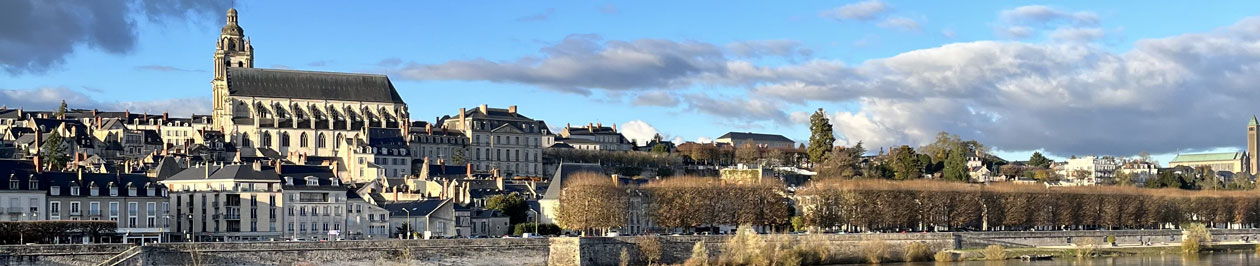
One thing I won’t miss when we move to Blois in 2 ½ years time is Parisian traffic. Not that I mind driving in Paris. When all’s said and done I think it’s pretty organised despite appearances to the contrary. The people know what they’re doing. They may not be particularly polite but it works and they don’t blow their horns much either. What you can’t do is hesitate. As you’re charging across Place de l’Etoile with its 12 avenues (no one calls it Place Charles de Gaulle by the way, just as they always call the airport Roissy), you just have keep your eyes on the right and judge the speed of the cars and you’ll have no problem. But if you don’t know exactly where you’re going to get off, it’s better to take the outer circle around the Arc de Triomphe.  It may take longer, because you’ll have to wait for the lights every time, but it’s less stressful when you’re a beginner. That’s what I did until I accidentally got onto the Place itself.

I love taking my Aussie visitors there. I remember Paul Casita from Townsville. I could feel him cringing at my side in terreur (the passenger on the right often feels more vulnerable I must admit) but he was determined to give it a try himself. So he went and sat in a café up the top end of the Champs Elysées (pronounced shonz-elizay by the way) and watched the people go by. When he saw a little old lady whizz up Avenue Kleber, shoot across half the Place at breaknecking speed in virtually a straight line and zip off down Avenue McMahon on the other side without turning a hair, he decided he could do it too. And he survived!

And it’s not the street parking that’s really a problem. Ever noticed how close the cars get to each other when they parallel park? Well, that’s what bumper bars are for. You gently nudge the car in front (no one puts their hand brake on unless they’re on a slope) and then the car behind as you worm your way in. Just leave 5 centimeters on either side and you’ll be fine. The funny thing is that parking is largely ignored when they teach you to drive. I got Black Cat to spend hours on a vacant parking lot during weekends so she could learn how to do it properly. It paid off. She can park with the best of them.

Velib at Dauphine University

What I don’t like is the number of cars on the road. The Greenies have been trying to do something about it, with dedicated bus lanes, Vélib’ bikes (you know, the ones they’ve stupidly put in Brisbane) and soon Autolib’ cars (coming on 5th December). The trouble is that it’s just made more traffic jams because there’s one lane less for the cars on most of the main avenues. The people like me who are going to obstinately drive their car when they go outside the city centre certainly don’t rent Vélibs and Autolibs. They’re used by people who would have taken the bus or the metro or the train. Admittedly I don’t drive to uni at Porte Dauphine any more, even though I have free underground parking at the other end. The trip back down the Champs Elysées  (shonz-elizay, remember) at 6 pm can be dauntingly slow and you have to keep your eyes peeled for the tourists who stand in the middle of the road taking photos of each other with the Arc de Triomphe behind them.

So, just remember, the clue to driving in Paris is knowing where you’re going. So bring your Tom-Tom!

Australia: A Culture Shock

Leonardo’s now been in Sydney for a month and has started a new job. He’s finding the situation in the workplace very different from France. The thing that bothers him most is that people don’t take time to socialise. He says he doesn’t understand it because if people don’t know each other, he doesn’t see how they can work together efficiently.

The first thing is saying “hello” in the morning. If you’re ever been in France, I’m sure you’ve seen people arrive in a bar and give everyone they know a kiss on both cheeks (even twice in some cases). When kids get to school in the morning, they do the same. At work, you always do the rounds of colleagues when you arrive, saying “bonjour” and shaking hands or kissing them (depending on which sex you are, how well you know the people and how casual the atmosphere is). And if you run into someone a second time during the same day, you say “re” meaning “rebonjour”» to show you’ve already seen them and said the first “bonjour”.

It took me a while to learn this when I started teaching at uni. I thought I was being perfectly polite when I said, “Excuse me, do you think I could have the key to the class room?” But no. I hadn’t greeted the person. One woman in particular would always reply “Bonjour” in an insistent sort of way. Then I’d say “bonjour” back. After that, I could ask for the key. I felt foolish, I must confess, but she was no doubt doing me a favour. Everyone probably thought I was rude! Now I go and say « bonjour » to everyone when I arrive.

Here, you say “bonjour” or “messieurs dames” to the people waiting in the doctor’s surgery for instance (only using “messieurs dames” if the company’s mixed obviously). You throw out a general “bonjour” when you walk into a bakery or a butcher’s or anywhere else where you intend to buy something. Clothes shops are not the same because you might just be browsing although saying “bonjour” will always be appreciated.

And with all this “bonjouring” you obviously have to say “au revoir” when you leave. Dashing off at the end of the day without saying goodbye to all your colleagues is definitely frowned upon.

Practices seems to be very different in Australia, though, according to Leonardo. Yesterday, one of his co-workers suggested he and another co-worker go grab a coffee. They all walked down to the coffee machine. Leonardo then expected them to take five or ten minutes for a chat around the coffee machine the way they do in France. No such luck. To his amazement, they all went back up and drank their coffee in front of their computers!

Another problem he’s come up against is that all the shops close at 6 pm so he doesn’t know when he can do his shopping.  He said there’s late closing on Thursdays but that’s all. They close even earlier on Saturdays. In Paris, shops tend to open later and close later, often staying open until 7.30 or 8 pm and even later if they sell food. Saturday is a full day and they’re often closed on Monday because the law regulations say all employees must have two days off in a row each week. It’s a bit different outside Paris where opening times tend to be stricter, 9 am to 12.30 and 2 pm to 7 pm.

Anyone got any suggestions to help Leonardo adjust?

3 iPhone Apps for Paris and WiFi

Black Cat told me about the most wonderful iPhone App called What’s App. You can send text messages for free throughout the world to anyone with an iPhone and What’s App. Wish I’d known about it last summer when I clocked up a nice little bill texting Black Cat from the 9 different countries we went to in Europe! It’s a pity Relationnel has that Bathtub because it could be very useful when we’re both outside France and need to connect up. The app costs 79 euro cents which is about one Aussie dollar I guess.

Now the next app that I also used for the first time yesterday is Mobiletag. This one’s free. You can use it to scan the QR codes at the bus stops in Paris (you know, those little black and white square things that are everywhere these days) to find out when the next bus is coming. There was someone else waiting for the bus as well so I proudly told her, “The bus is coming in 3 minutes”. “Oh, really, mine says 4 minutes. I hope it comes soon. I’m running late but I really hate the metro at peak hour”. I explained it was the first time I was using the app and she said she used it all the time. A real Parisian, obviously.

The third app is My Airport which, despite the name, is in French. It gives flight times and useful information about Charles de Gaulle airport to help you negotiate what a CNN survey said recently is the worst airport in the world. Although it’s in French, the vocab’s pretty basic : Horaires Vols Départ (departure times – vol means “flight”), Horaire Vols Arrivée (arrival times), Compagnies (airlines), Formalités (you can guess that one), Services pratiques (ditto), Services Affaires (business services), Accès (that’s a challenge) and Parking. Don’t forget to download a French/English dictionary before you go too.

But you have to be able to use all these apps, of course. Fortunately Paris has set up a free wifi system with about 400 hotspots: in town halls (one in each of the 20 arrondissements), public gardens, libraries and state-owned museums from 7 am to 11 pm. There’s an interactive map on http://plan.paris.fr/. Just click on the W icon up in the tool bar.  Don’t be phased by the fact that wifi access screen is entirely in French. Just follow the instructions at the end of this post.

There are also lots of cafes with free wifi access in Paris. You’ll find them on http://www.cafes-wifi.com/. Once again it’s in French, but you can use the  interactive map.

You can find other suggestions for iPhone aps for Paris on liligo.com

How to connect to Paris Wi-Fi

1. Municipal buildings and gardens with a wi-fi access have an easily identifiable sign that says “Zone Wifi”.

2. Turn on your laptop or smart phone and select Wi-Fi ORANGE.

3. Open your usual web browser and enter the address of any website. You’ll be automatically sent to the free wifi access page. You then select “SELECTIONNEZ VOTRE PASS” in the orange box on the right.

4. Fill in the form, accept the general conditions of use by ticking the box and click on [me connecter]. If you’ve already signed in before, use the box “Vous avez déjà vos codes d’accès” (you’ve already got and ID and password (mot de passe).

5. The Paris Wi-Fi home page will reload and you’ll get a message saying you are connected and how long your session will last.  Make sure you leave the window open because it indicates the remaining time. Each session lasts 2 hours. You can renew it simply by repeating the connection process.

Monkeys in the Louvre and Other Strange Things in Paris

And there he was, just hanging out the window of the Louvre with absolutely no one taking any notice of him, up to some monkey business no doubt.

And today, I walked past Stella McCartney’s shop in the Palais Royal and the dummies had lost their heads (not to mention the reflection of the gallery gates on their torsos).


At Place de l’Etoile the other night, I came across a huge Christmas cracker!

At Halloween, Miss Bibi had the most intriguing little man sitting on a pumpkin.


And get this statue walking through a gallery on the Champs Elysees looking like the Invisible Man!

Where else but Paris?

Things that Disappear and Reappear

Are you one of those people (like me) who has a problem with things that mysteriously “disappear”? I wouldn’t say I actually lose them. They just don’t seem to be where they should. The gold bracelet Relationnel gave me when we got married fell off a while ago. Fortunately, I felt it happening and saved it. I then carried it around in a zippered pouch in my bag for ages with the intention of getting it fixed. When I finally managed to get to the jeweller’s, it had disappeared. I was most upset of course and didn’t want to tell Relationnel about it but finally admitted it. Then recently, we were in Dieppe around my birthday and he bought me another one which is really lovely.

Today, I was looking for something else that had diappeared – my mp3 player – and, lo and behold, what should I find in the bottom of a bag I sometimes take away with me: a little jewellery box with my broken bracelet in it! I looked at my wrist and to my horror, the other bracelet was gone. However, it didn’t take long to retrieve it. I try to remember to take off my jewellery at home before I go to the swimming pool and sometimes I forget so put it in a zippered pouch in my swimming bag. Thank god it was still there.

And then the strangest thing. I looked in the drawer next to my desk where I usually keep the mp3 and it had turned up again. Now how do you explain that? It wasn’t there last time I looked I’m sure …

Recently, I did actually lose something. I had put two cheques in an envelope with a deposit slip – they’re pre-filled in here so your name and address is on the slip. When I got to the bank, the cheques had disappeared. I didn’t really pay much attention because I had actually taken them out of one envelope and put them in another before I left home so I just assumed I’d picked up the wrong envelope.  We hadn’t been home long when my work phone rang. Strange on a Sunday. A man introduced himself and said he’d found my cheques with the deposit slip on the pavement.  He said he’d send them to me by post. He’d tracked me down in the Yellow Pages.

I hesitated to tell Relationnel. He’s one of those people who always puts things immediately back in their place after he’s used them for instance. No way would he be walking around with an unsealed envelope containing two cheques.  He’s always annoyingly checking up on me about that sort of thing. I eventually told him though and he was surprisingly supportive saying I must be over-tired! Anyway, I followed the Australian tradition and bought a “lotto” ticket and sent it off, explaining what it was all about. In France, they don’t have any equivalent way of thanking someone for doing you a favour.

What’s the tradition in your country?

from the Tropics to the City of Light