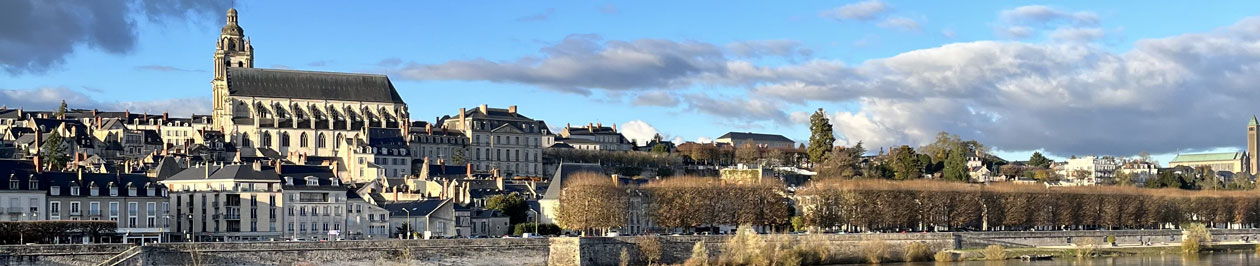
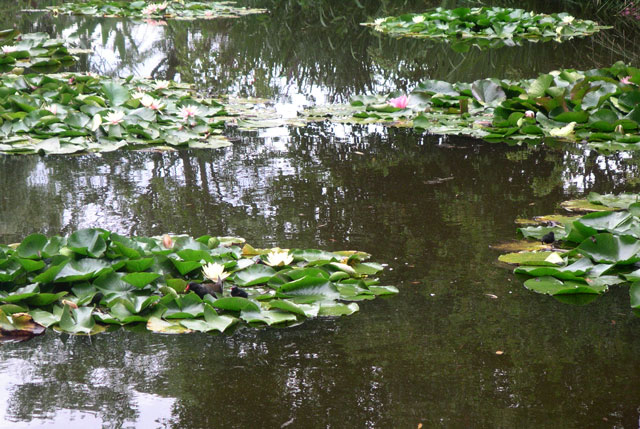
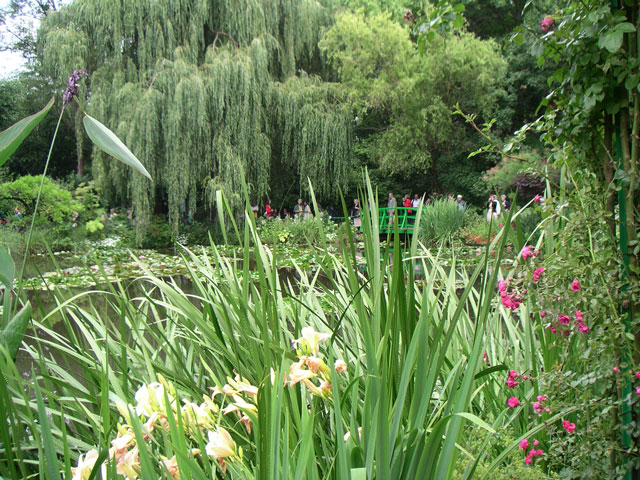
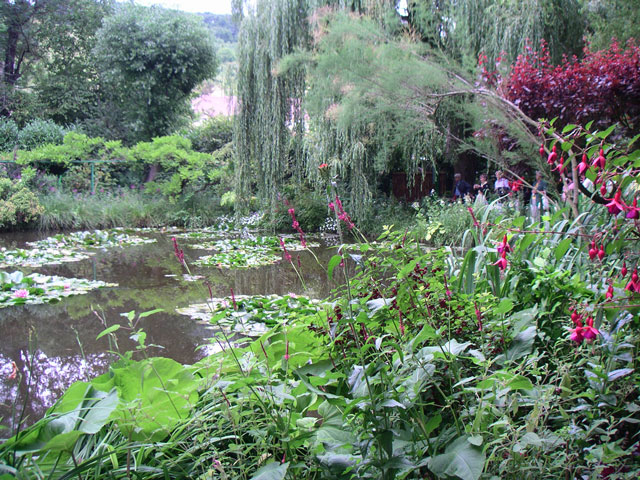
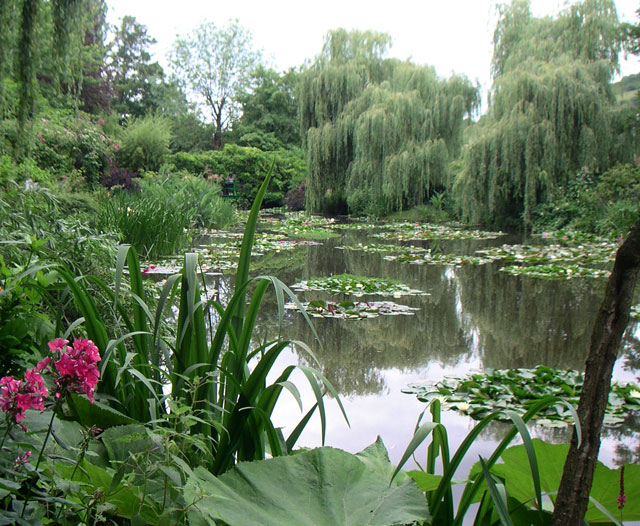
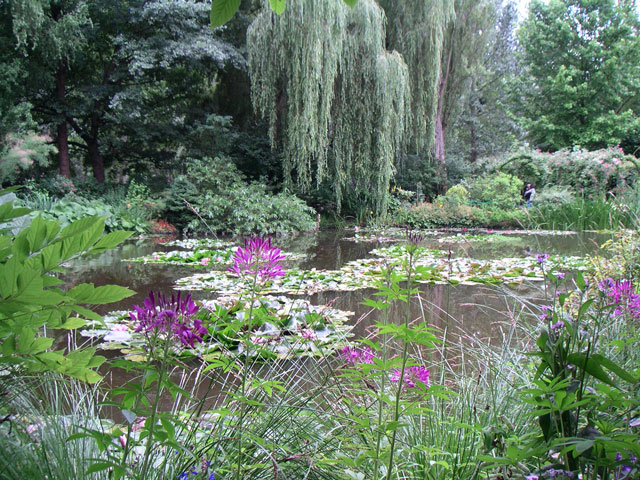
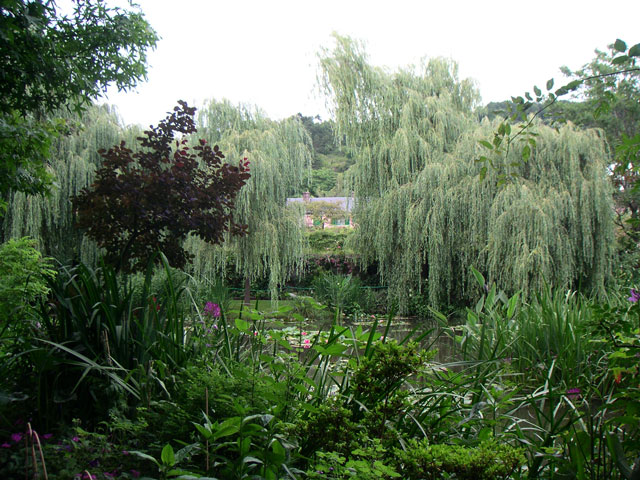
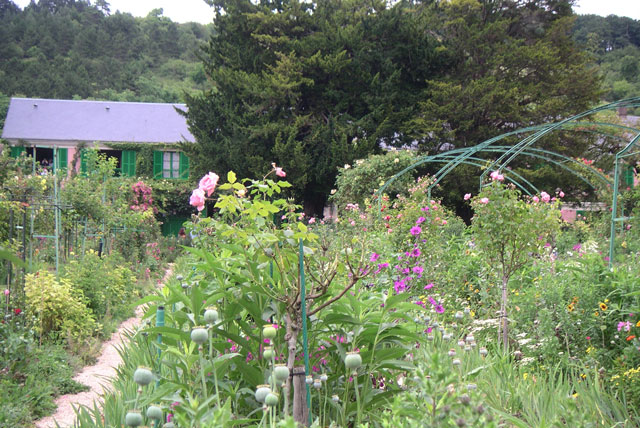
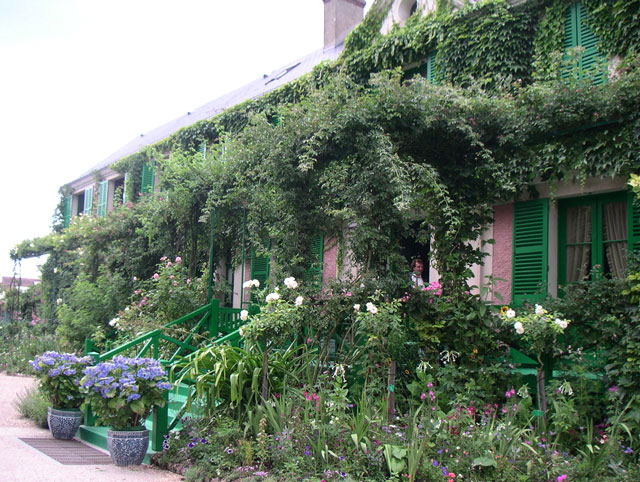
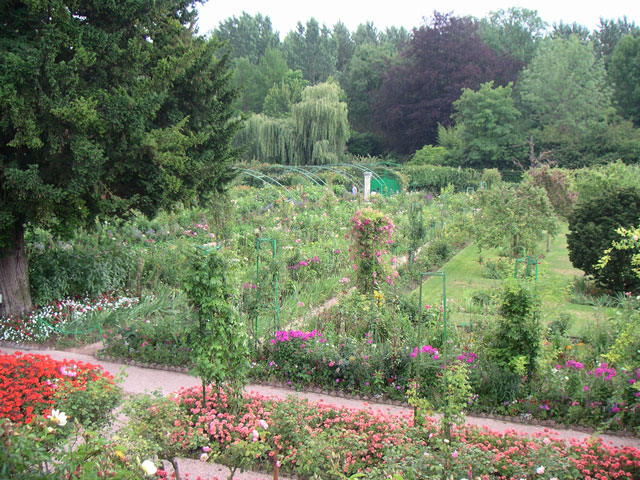
For years, I didn’t go to Monet’s garden in Giverny because I was told there were too many people. Now we go at least twice a year! The best time to visit is at lunch time, when there aren’t any groups and few people queuing. And to avoid the queues altogether, you can either go to the Impressionism Museum (an offshoot of the Orsay Museum) first and buy a double ticket, or buy your ticket on-line. Both the garden and museum are open from the beginning of April to the end of October. These photos were taken in July when the famous nympheas are in bloom, but every month is beautiful. The tulips in April are stunning and the roses in June are out of this world. Then you can eat outside under the trees at the historical Restaurant Baudy down the road (don’t forget to check the inside).
Nympheas in Monet’s gardenYou can see the famous bridge in the backgroundNymphea pond with fuscias in the foregroundFrom the other side of the nymphea pondI love the weeping willowsThe house from the nymphea gardenFrom the bottom of the garden looking towards the houseMonet’s houseView from the window of Monet’s bedroomClaude Monet Foundation, 84 rue Claude Monet: open every day from March 29th until November 1st included 2013 from 9.30 a.m. till 6 p.m. – last admission 5.30 p.m. http://fondation-monet.com/en/Musee des impressionnismes Giverny, 99 rue Claude Monet:openMarch 29th to October 31st, 2013 every day
from 10am to 6pm last admission at 5:30pm. Open on Public Holidays www.museedesimpressionnismesgiverny.comRestaurant Baudy, 81 rue Claude Monet – Musée Hôtel Baudy 27620, Giverny, Tel 02 32 21 10 03,http://www.restaurantbaudy.com/
Since we’ve come back from Barcelona, I have got a bit sidetracked, what with fireplaces that smoke and snow in March. But I still have a couple more posts to write, and one of them is Gaudi’s La Pedrera. I’ve already talked about the chimneys and the façade.
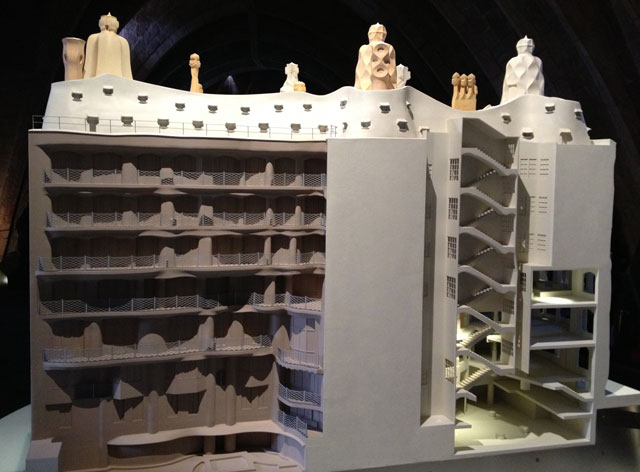
Scale model of La Pedrera
You may remember that La Pedrera was built between 1906 and 1912 by Pere Milà and Roser Segimon and is a six-storey apartment building of which they occupied the main floor. The building has two vestibules, both of which are big enough to allow vehicles to go down to the basement, amazing foresight when you consider the year of construction.
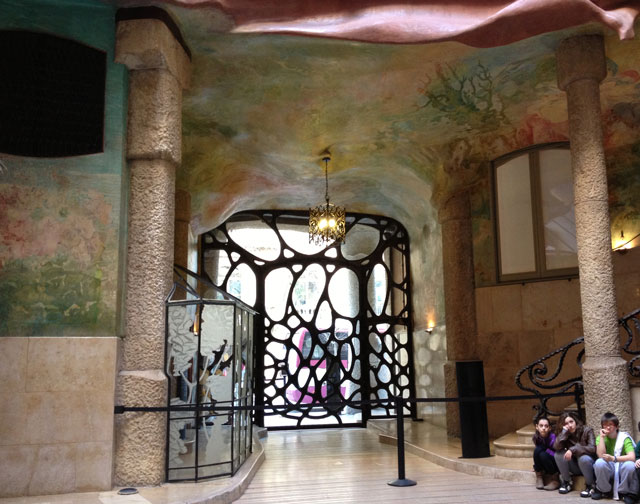
Provença Vestibule
The Provença vestibule has a lift, a staircase going down to the basement and another going up to the first floor. It also houses the caretaker’s loggia. The ceilings and walls are decorated with paintings inspired by Ovid’s Metamorphoses, especially the seven capital sins.
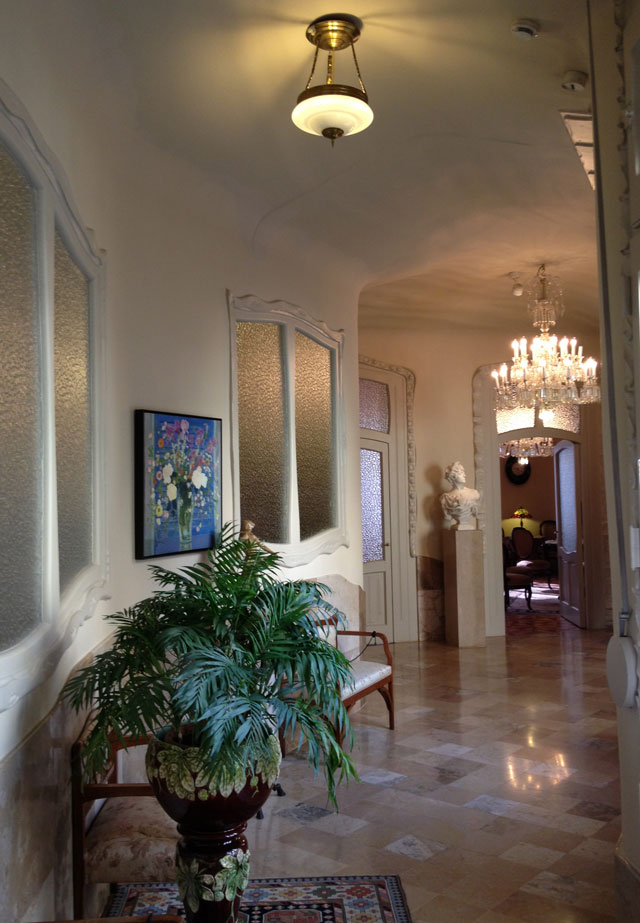
Large corridor providing access to the different rooms
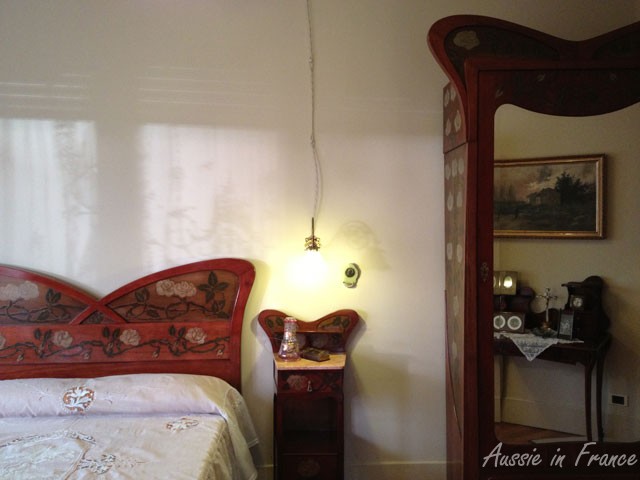
Today, the fourth floor apartment is the only one open to visitors. The home and life of a bourgois Barcelona family during the first third of the 20th century have been re-created, including all the original elements of a typical La Pedrera apartment, such as the door knobs, drawers, mouldings, doors and flooring.
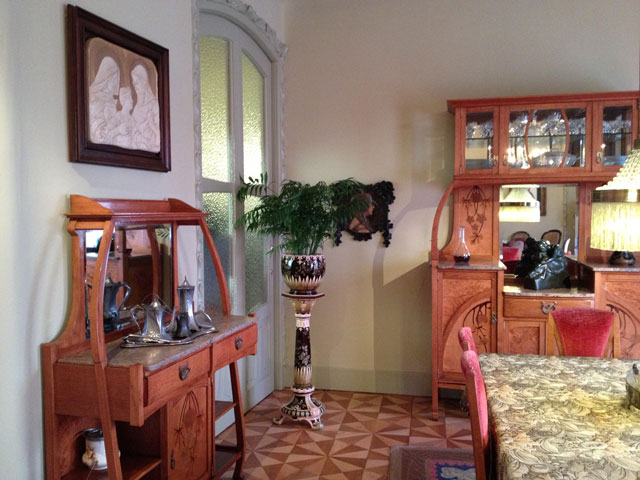
Dining room
Appropriate furniture, works of art, decorative elements, fabrics and household items of the time have been added to give visitors an idea of what it was like to live there.
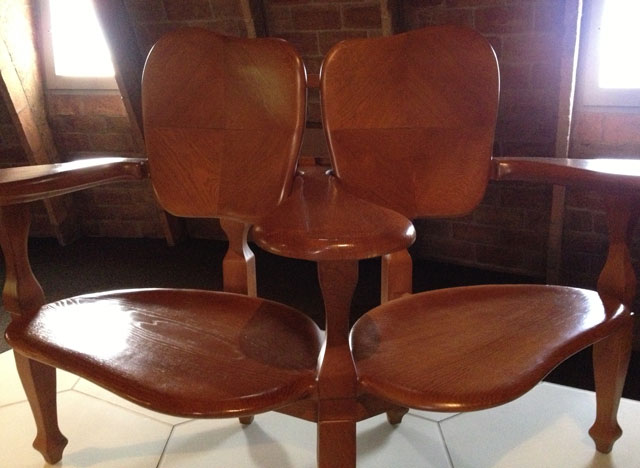
Double Bench by Gaudi
As I mentioned in another post, Gaudi designed furniture as well, and a couple of pieces are exhibited, plus a video showing how to use them. He was into ergonomics way before his time!
The actual design of the apartment is open plan, with much larger volumes than usual. However, rooms such as the utility room and the maid’s room are surprisingly small.
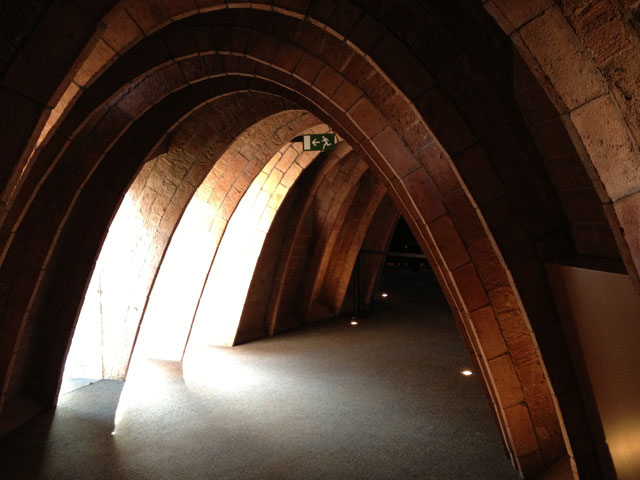
Attic with its catenary arches
The attic area, which was designed to house the water tanks and washing lines, consists of no fewer than two hundred and seventy catenary arches of different heights that hold up the roof. Today it’s used as an exhibition area for Gaudi’s life and work.
When I woke up and saw the snow yesterday, I was not happy. I was already in spring mode and the idea of temperatures below zero AGAIN was not appealing in the least. As it was, we were very lucky to have got home from Blois without being trapped for hours like many weekenders from Normandy.
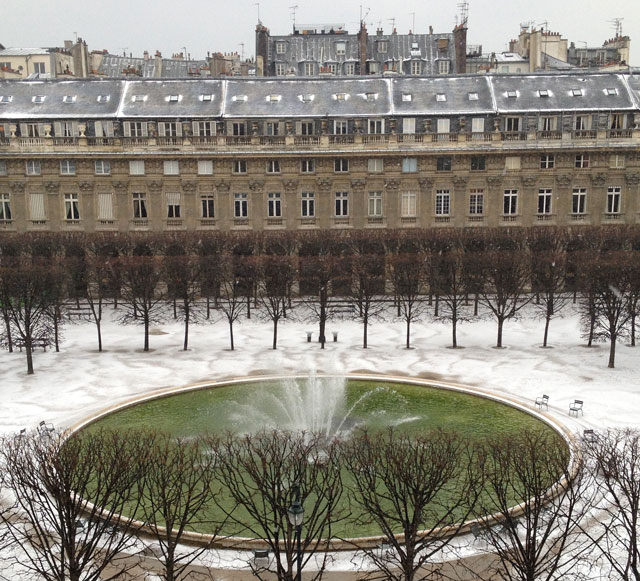
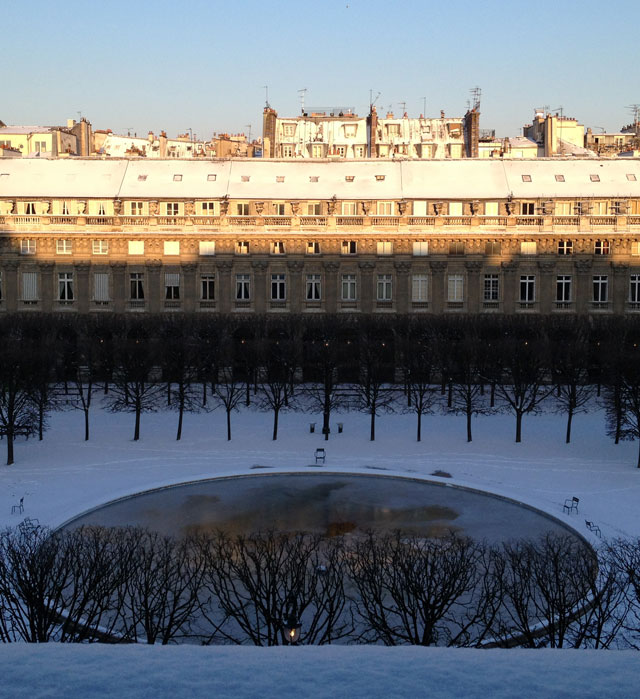
Snow in the Palais Royal yesterday morning
It snowed ALL DAY and I was not tempted to go outside. However, I had signed up for a Tweet-up organised by Tom and Monique Reeves from Discover Paris and since it was being held in Caveau Montpensier just across the Palais Royal gardens, I donned my warmest clothes and set out in the falling snow.
Snowing in the Palais Royal in the afternoon
Not surprisingly, there weren’t many of us there but small numbers have their advantages because I was able to talk to most of the people present. Afterwards, Adrian Leeds who runs a real estate agency for expats, Lisa from Flavors of Paris who runs walking/tasting tours in Paris, Donna Morris from Best Friend in Paris, who gives localised tours of the city, and Mary Kay from Out and About in Paris, whose very interesting posts I’ve often featured in my Wednesday’s Blogger Round-Up, walked down the road to have Japanese food at Higuma.
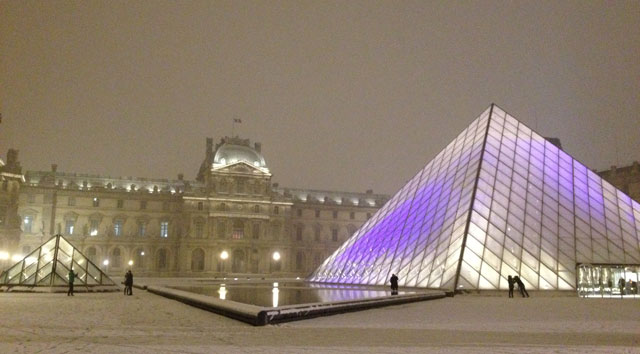
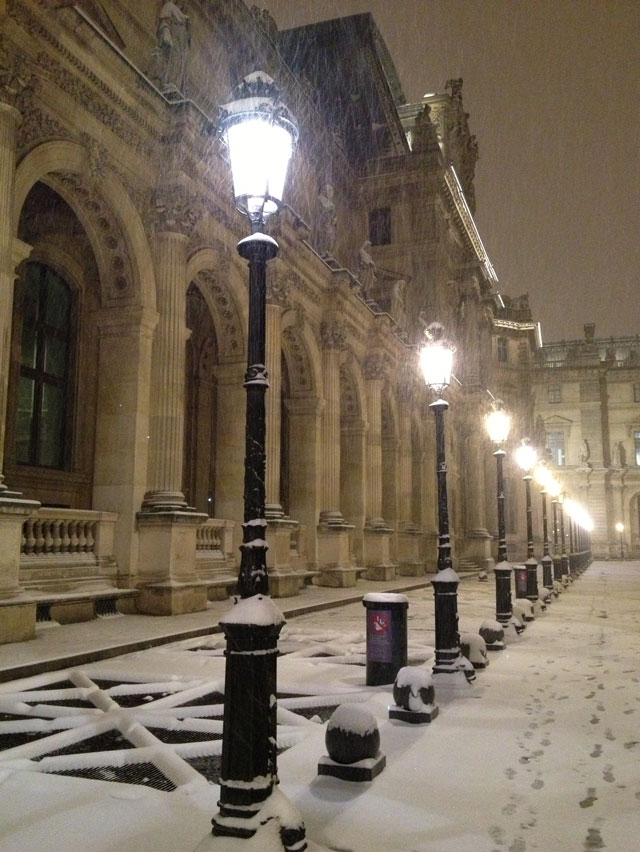
Snow on the pyramid at night
As we left at about 9 pm, despite the wind and sleet, Mary Kay said she was going to the Louvre to take photos. I couldn’t resist and shall be eternally grateful. Otherwise, I would NEVER have taken this photo! Our hands were excessively cold by the time we left but it was certainly worth it.
Snowing on the Louvre
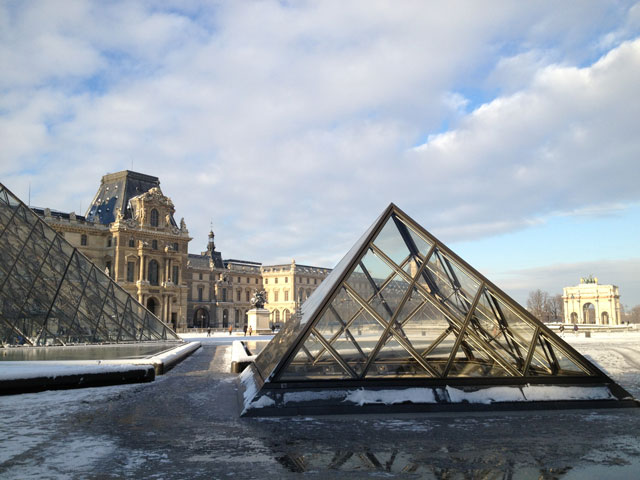
Mary Kay then suggested that I come back again early next morning because the pyramids would be looking great with the snow and ice in the sun. When I fell out of bed at 8 am (I am not an early bird by any manner of means), I must say that the view outside my window was very tempting despite the fact that it was zero degrees.
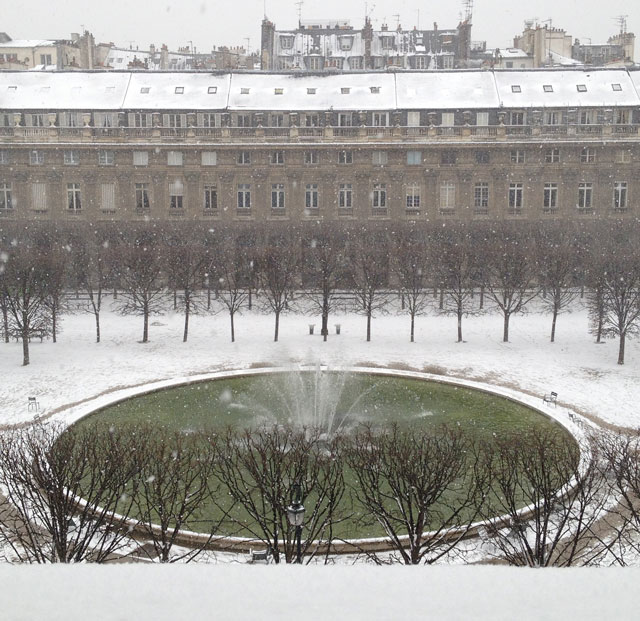
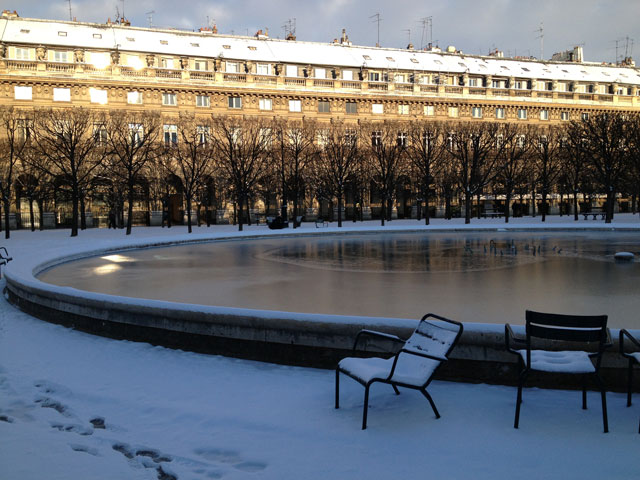
Snow in the Palais Royal gardens this morning
So after a quick breakfast I put on my heavy-soled walking shoes and set out, walking gingerly over the icy patches like everyone else. I felt sorry for the smart executives with their high heels and leather soles but I didn’t see anyone actually fall. There were some young Japanese tourists sliding across Rue de Rivoli but I wasn’t taking any chances.
Empty chairs in the Palais Royal garden this morning
The sun over the icy pyramids really was wonderful but I had to keep putting my hands back in my pockets after each photo to stop the frost bite.
Sun on the Louvre pyramids
When I got back to the appartment, I drank a whole pot of hot tea!
I don’t know how it got to be 10th March when just a couple of days ago, it was still February. All that R&R we were supposed to have this week doesn’t seem to have happened. Even though the fireplace smoked, we still could have spent time stretched out on our new sofa or relaxing in our armchairs reading.
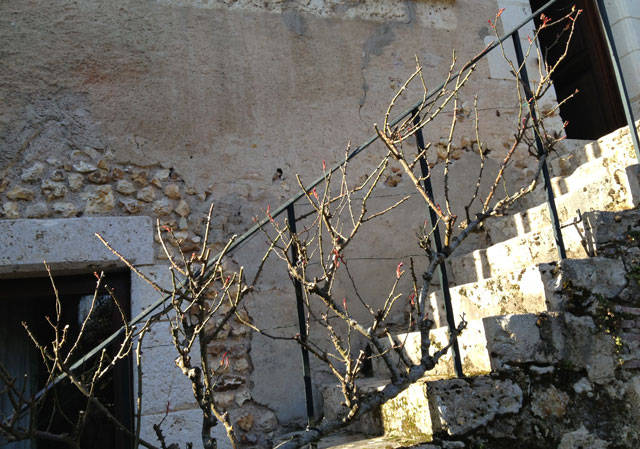
The Pierre Ronsard rose bush after pruning
So what did we do? Well, we made the most of spring. When the weather suddenly got warmer – 15°C – and the sun came out, we dashed into the garden where we discovered we were late with most of our pruning. We cut back the Pierre Ronsard and Meilland roses which already had new buds sprouting. We pruned the grape vine (not that the grapes are edible), the wisteria and honeysuckle.
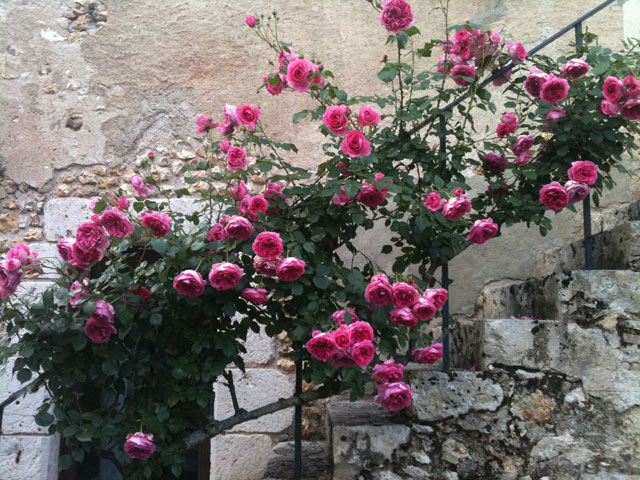
Our Pierre Ronsard roses last June
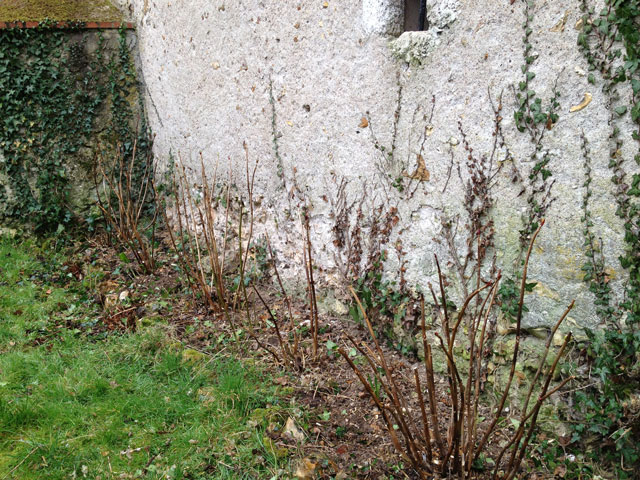
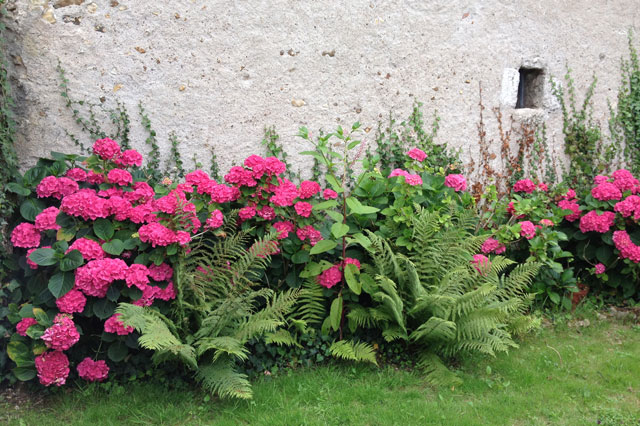
We cut back all the hydrangeas in the hope that they will flower again as well as they did last year. The timing seemed to be right in any case. We cut down the remainders of the tall-stemmed daisies. I’d already pruned the hollyhocks in the autumn and they all seem to be doing well.
Hydrangeas after pruning
Jean Michel planted potatoes, onions and garlic in the rain by himself this year while I was upstairs working. But it’s OK, I didn’t really feel I was missing out on anything …
Our hydrangeas in bloom in July
We couldn’t resist a visit to the nursery though. Our aim was to buy a clematis for the wall you can see on the other side of the front yard when you’re having breakfast. We nearly didn’t plant it because it turns out there’s a lot of water under that flowerbed but there was absolutely nowhere else to put it so we’ll see what happens. The lavendar and Saharan rose seem to be doing OK.
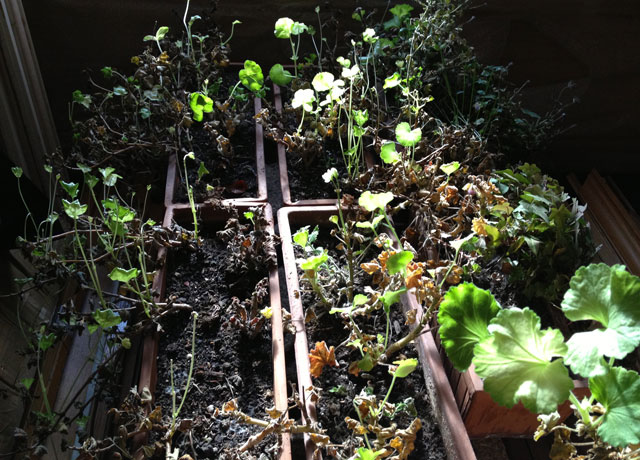
Geraniums with bright green shoots
I spent a couple of hours trimming back all the geraniums we’d left inside the little house for the winter. When Jean Michel saw them the day we arrived in Blois, he said I was going to be disappointed because they were all dead. Not so. After only a week, there were new bits of green sprouting everywhere. However, since it’s going to get cold again this week, with temperatures below freezing, I cut them back, gave them a bit of water and let them in the little house until our return.
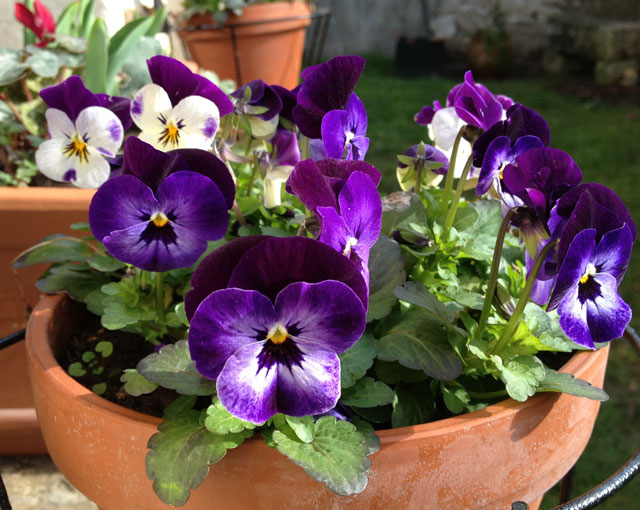
Hardy little pansies
We also wanted some peonies. I love pink peonies.The man at the nursery said to plant them in pots and put them with the geraniums. That way we can plant them in garden when we come back in a month’s time. I’m not really sure where though. We really do seem to be running out of room.
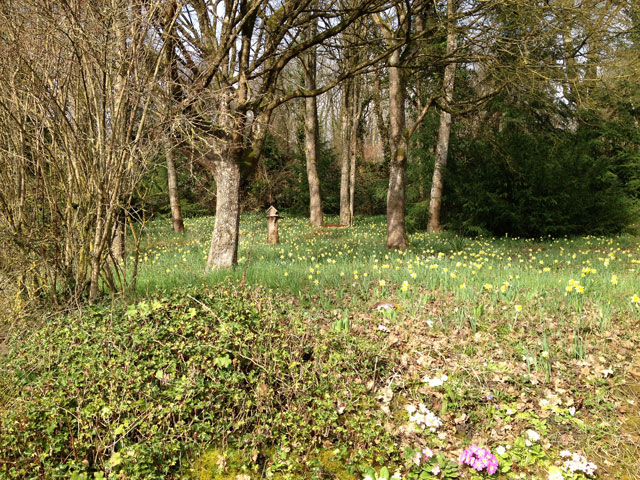
Our little wood full of daffodils and primroses
In the meantime, the little wood is a mass of daffodils so we were very sad to leave. There are two lilacs we should have pruned in the autumn so I don’t know it we’ll get many blossoms. That’s another flower I love. We’ve started a garden book so we’ll do all the pruning at the right time next year. I’m looking forward to seeing the native Touraine orchids bloom in May.
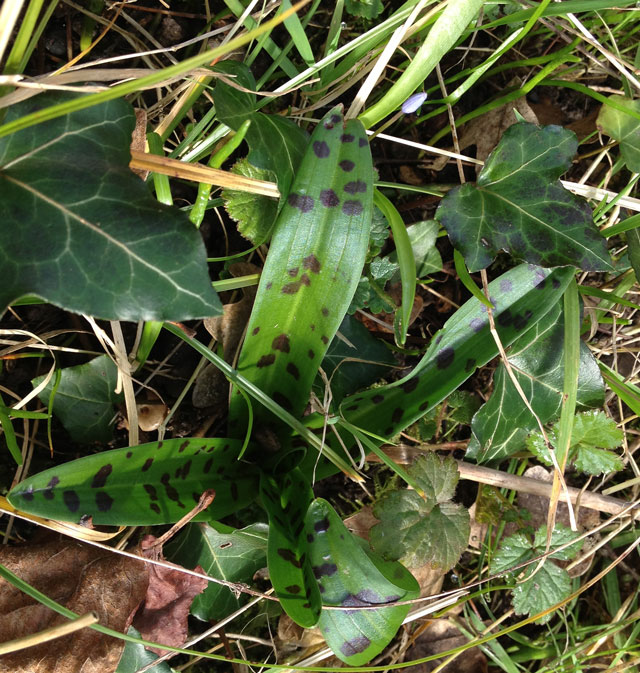
A native Touraine orchid with spotted leaves
All the bulbs I planted in autumn are starting to come up and last year’s fuschias are just sprouting as well. However, we decided not to plant any gladiolis. They look a bit messy when you aren’t there to look after them all the time. I’ll wait until we live there permanently. The little pansies came right through winter without batting an eyelid.
The wisteria and vine after pruning
We’re supposed to be going down to Blois again in a month’s time, but I don’t know if we’ll be able to resist that long. I just love watching everything coming out of the ground in the spring! Driving back to Paris, we’ve just learnt that we’re in for a very cold week, with snow expected tomorrow. The temperature has already dropped from 8° to zero. I’m glad we made the most of spring in Blois!
This week’s blogger round-up features three very different posts. Carolyn Barnabo from My Sydney Paris Life, unable to take the Eurostar back to Great Britain, perfectly echos what a lot of us in Paris feel about yet another fall of snow. Maggie LaCoste from Experience France by Bike brings us one of her usual exhaustive cycling posts, this time on launching of the new EuroVelo website, while Abby from Paris Weekender, oblivious to the snow – but then, she’s in New York at the moment – has updated her very useful Paris restaurant and bar guides which I strongly recommend that you download. Enjoy!
Change of Plans in Snowy Paris
by Carolyn Barnabo from My Sydney Paris Life, writing about global families and change and life in special geographic places that have captured her heart.
March snow in Paris. No Eurostar. No UK friends to greet at Gare du Nord.
What else to do when the weather thwarts our plans than venture outside for a walk in the quartier? We last enjoyed a snowy walk in January, which seemed appropriate then. The 12th of March isn’t that late but still, today’s snow seemed out of place to me, perhaps because Saturday — was it only three days ago? — was so wonderfully warm. Read more
New EuroVelo Website Launched
by Maggie LaCoste from Experience France by Bike, an American who loves biking anywhere in Europe, but especially France, which has the perfect combination of safe bike routes, great food, great weather and history
Bicycling in Europe just keeps getting better and better! The European Cyclists’ Federation has announced the debut of the new EuroVelo website, a long-awaited resource for the long distance European cycling network.
As promised, the new website will be a great source of information for trip planning on the 14 EuroVelo routes. Each of the EuroVelo routes will have its own page with information ranging from route maps showing the status of stages along the route, lodging and support services and things to see along the way. There will also be links to more detailed information from each country along the route. The website is available in German, French, Dutch and English. Read more
Updated Restaurant Guides
by Abby from Paris Weekender, an American living in Paris who offers suggestions for Paris weekends, either staying put or getting out of town
It’s that time again – time to share my latest Paris food & drink finds. Below are the latest bars and restaurants that I have added to my guides. As always, “**” signifies some of my real favorites. Purchase the updated print-ready PDFs of my bar and restaurant guides, as well as my Mini Guide to Parishere.
French:
L’absinthe (1st) 24, Place Marché St Honoré, Tel. 01 49 26 90 04. Located in the lively Place Marché St Honoré, this restaurant offers friendly service and a mix of traditional and modern cuisine in a traditional setting. Outdoor seating also available. Read more
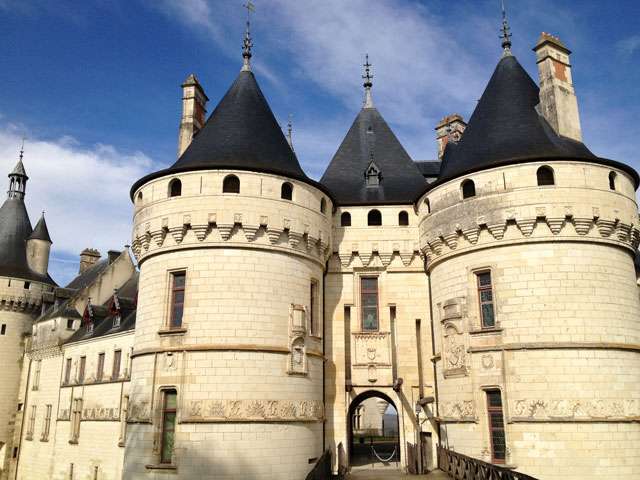
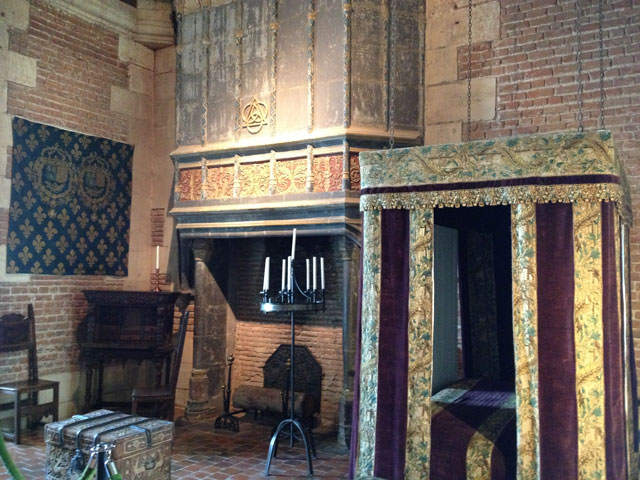
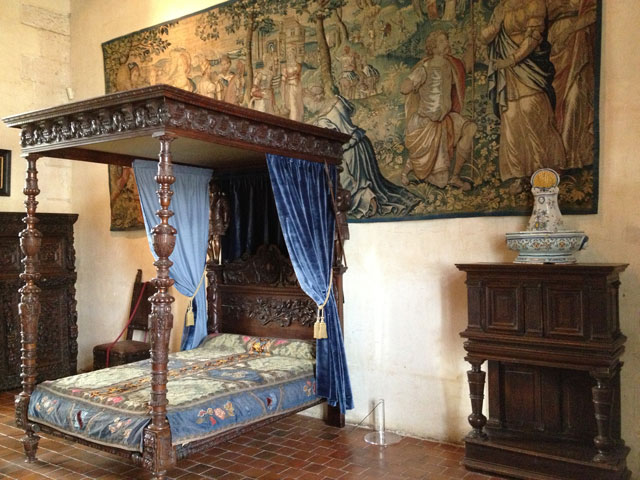
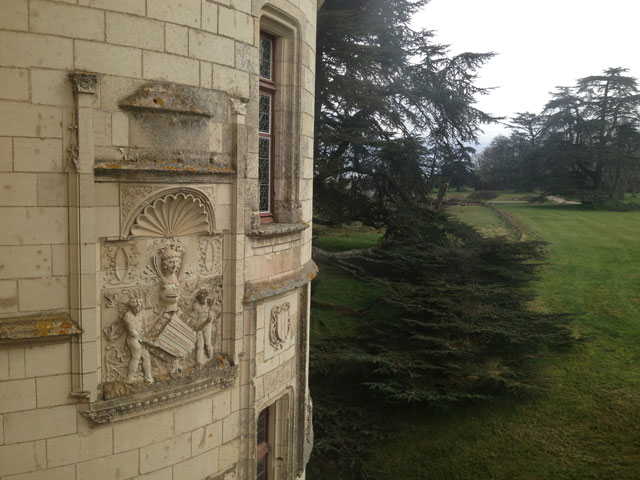
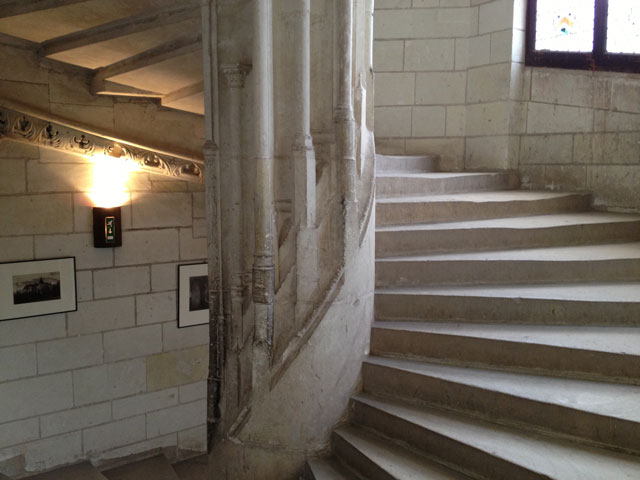
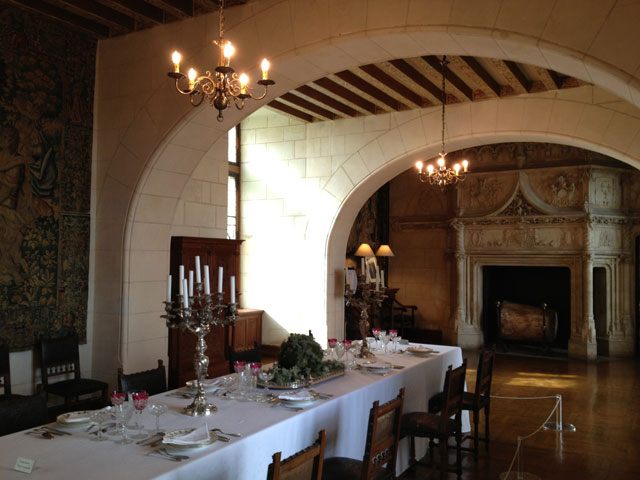
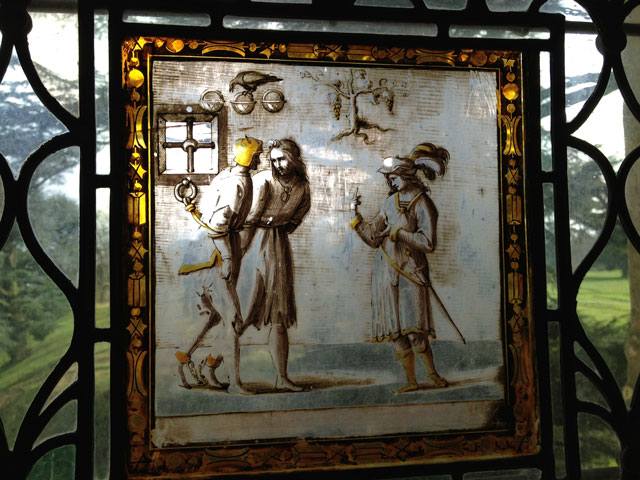
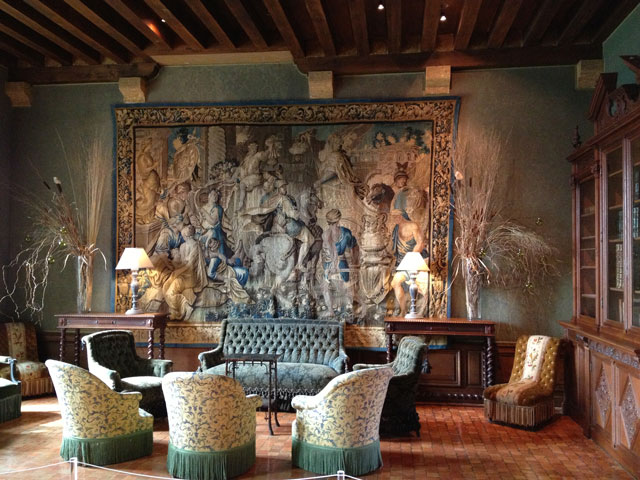
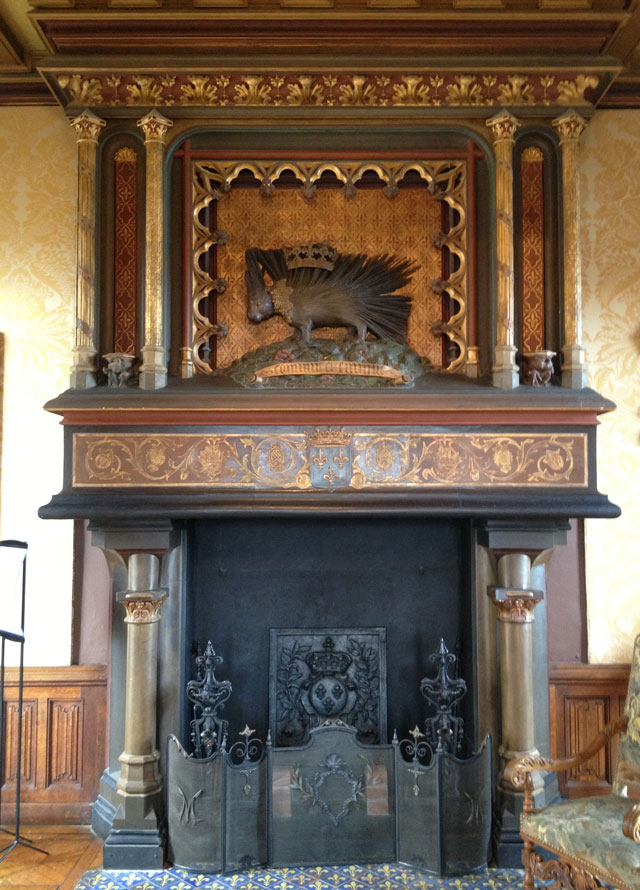
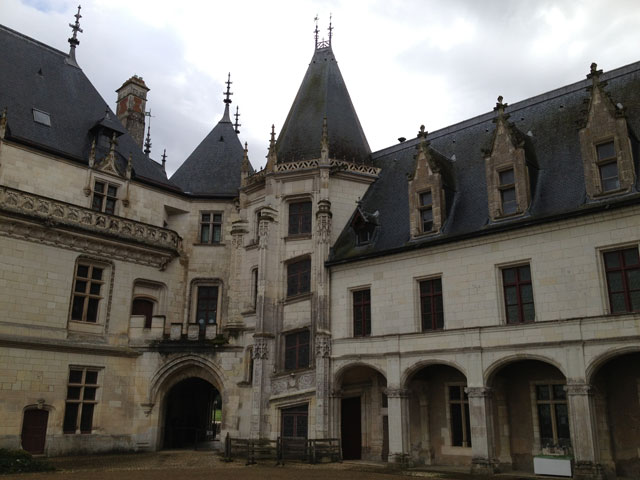
When I first visited Château de Chaumont in 1997, I found it very delapidated. Last summer we spent a wonderful afternoon there during the annual garden festival. I discovered yesterday that it has been totally renovated inside and is now quite stunning! The château as it stands today was rebuilt by Pierre Ier d’Amboise en 1468, then by Charles II d’Amboise from 1498 to 1511. The construction was continued in 1562 when Diane de Poitiers was ousted from Chenonceau by Catherine de Medicis. It was restored by Prince de Broglie between 1875 and 1900 at which time the stables were also added.
Chaumont in summerThe entrance to the château with its stone friezeThe bedroom of Cosimo Ruggieri, one of Catherine de Medicis’ astrologistsCatherine de Medicis’ bedroomA view of the Loire showing an allegorical bas reliefThe main staircase with its beautifully sculpted central pillarThe dining room with its Gothic fireplaceOne of the many grisaillesThe library with its Aubusson tapistriesMonumental fireplace in the Grand SalonThe inner courtyard with its Renaissance staircaseStables built by Prince de Broglie in 1877
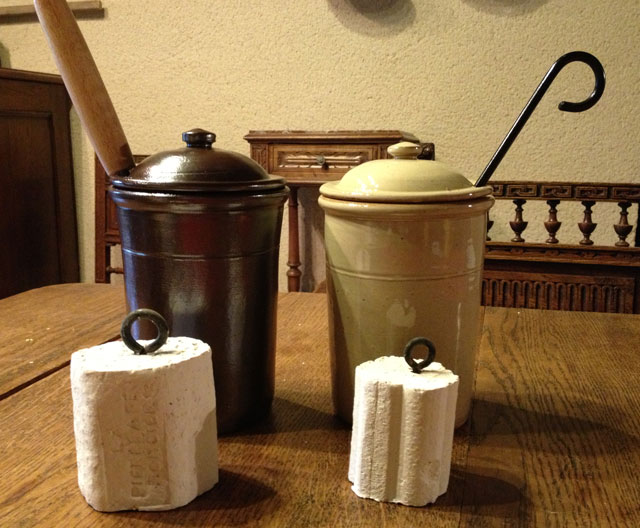
Last Friday night when we still thought we might be able to have a fire in the renovated fireplace upstairs in Closerie Falaiseau, we thought we would order a fire starter on-line. We first became acquainted with the Cape Cod fire-starter, under the name of pierre à feu (fire stone) when staying in Valérie’s beautiful gîte in Mesnil Jourdain, which incidentally is no longer available for rental.
Cape Cod fire starters
The principle is simple: a pumice stone soaked in lamp oil is placed under the logs in the fireplace and lit with a match. After 15 to 20 minutes, the stone is removed using a special hook and set aside. When it’s cool, it’s returned to its ceramic (or cast iron) pot. This eliminates the need to use newspaper (which is now coloured and no longer burns properly), small firewood or briquettes. Neither of us had ever heard of it before. I thought it might be French but Jean Michel couldn’t imagine rural France coming up with such an invention so I’ve tracked it down and discovered that it’s an American invention.
We found an on-line store (Roncier) and ordered one which we found quite expensive at 69 euro including shipping but when we tried to pay, my Visa card was refused. I tried another one card and it didn’t work either. After checking my emails to make sure the order hadn’t gone through, we went searching for another website. It turned out there is actually a huge choice of fire-starters and Roncier is among the most expensive! This time we chose a Turgis which costs 33,46 euro plus 10 euro shipping. The whole process must have taken about an hour!
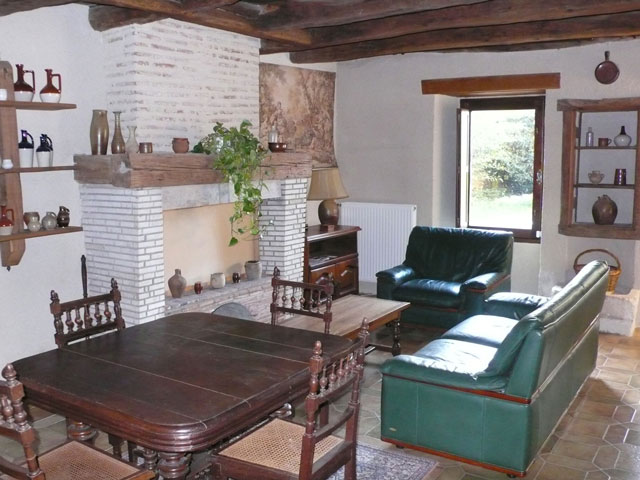
Downstairs living room fireplace
Next morning, I received an email from each of the websites saying my order had been registered. However, since Roncier said it would only be shipped when payment had been accepted, I wrote and cancelled the order. On Monday, I again received emails from both sites saying that the order had been processed and was on its way.
This morning, both turned up within a half an hour of each other, one by carrier and one by post. When we didn’t answer the door bell straight away (do I dare admit we were both asleep?), the delivery man climbed halfway up one side of the fence, put the parcel over the top with one hand then used his other hand to lower it as far as he could on the other side, before letting it drop to the ground. Fortunately it didn’t break! By the time the postman arrived, I was dressed and could go and open the gate for him.
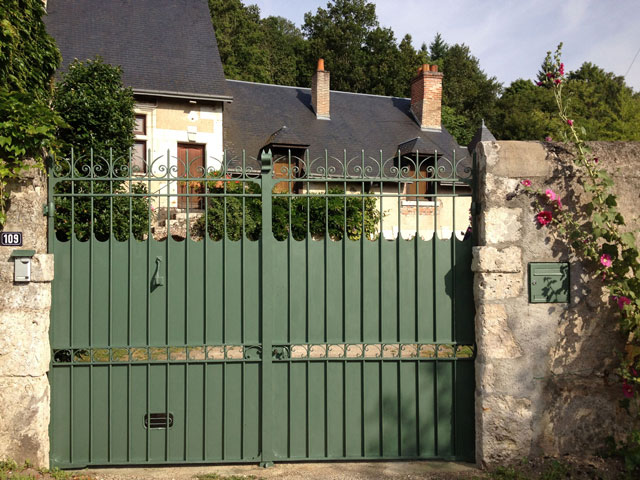
Front gate
We can’t quite work out the 23 euro price difference although the more expensive one has a wooden handle which Jean Michel rather favoured until I pointed out that it looks remarkably like another type of recipient I know, so we’re going to put the one with the iron handle upstairs and the wooden handle downstairs where it will be less conspicuous.
So now we have four fireplaces, two fire starters and no fire.
We seem to be having a run of bad luck and are hoping we’ve come to the end of it!
The first thing we did after we got to Closerie Falaiseau late Wednesday afternoon was to turn up the heating. Then we went to buy an espresso machine to replace the cheap-O one that gave up the ghost last time we were here. You may remember that I have a super-duper Italian one in Paris which grinds the coffee beans and now makes excellent espresso, cappuccino and latte. We had decided on a De Longhi for Blois which uses both ground coffee and pods and is reputed to be sturdy.
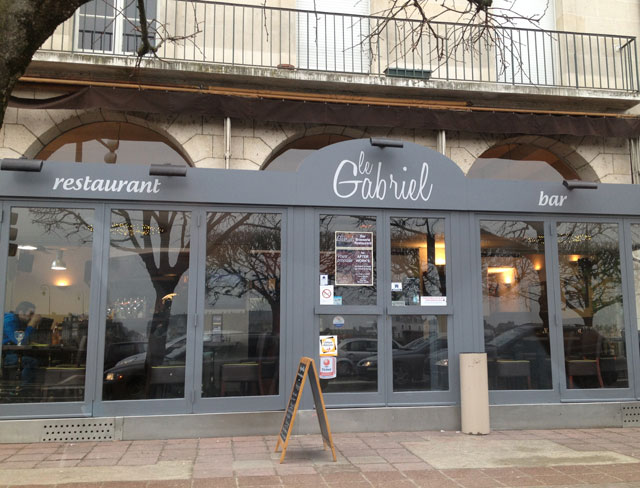
The ex-Penalty – Chez Gabriel
Neither of us felt particularly keen on going home to cook and eat in a cold house so we went to Au Coin d’Table. It was closed. Since it’s winter it’s only open from Thursday to Sunday. So we went to Le Penalty instead, which isn’t quite the same. Also it’s changed owners since we were here last and is now called Chez Gabriel. I’m not convinced that the French fries are really home-made as claimed.
The second time we used the espresso machine, the on/off pilot light stopped working. Jean Michel took it back to Darty to have it replaced but they didn’t have any others in stock. We have to go back again later in the week, but we’re using it in the meantime, of course. Either I have become a foamed milk expert or the wand is much better than any others I’ve tried but soon I’ll be doing latte art!
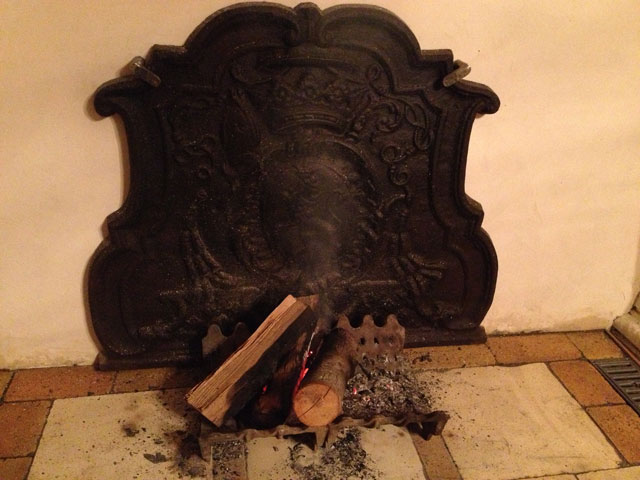
The fire that wouldn’t burn
The most disappointing thing on the bad luck list is the fireplace of course As you know, it smokes. After the first try with green, damp wood, Jean Michel went off next day and bought some dry firewood. This time, he couldn’t even get it to burn! And there was still smoke. We called the roofer.
The roofer came on Saturday afternoon, took one look at the fireplace and said, “Le tablier est trop petit”. According to him, the fireplace is not deep enough for its size and, as a result, will never work properly. He thought maybe we had changed it in some way. He also explained that we have a hill behind us which does not help and that grey days such as we’ve been having recently aren’t conducive to a good fire either. He did agree, though, that opening up the top of the chimney might make a difference. He obviously can’t come this week, but will come in our absence. It turns out it will be a lot cheaper than we thought.
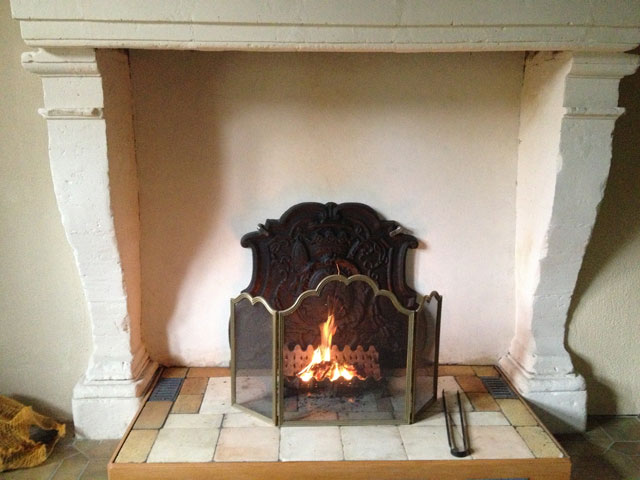
A little fire at last
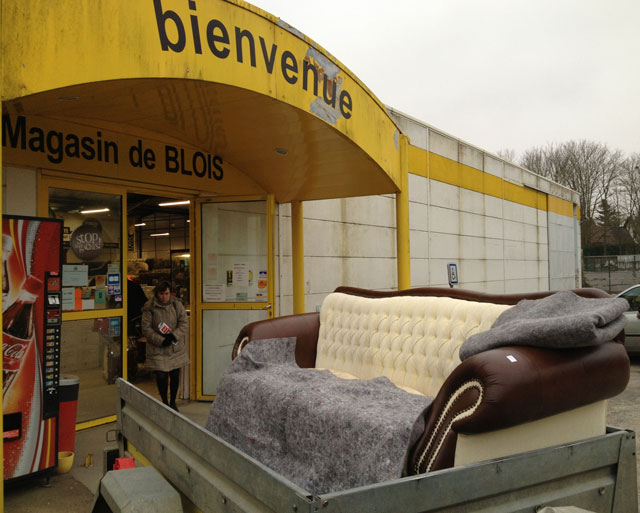
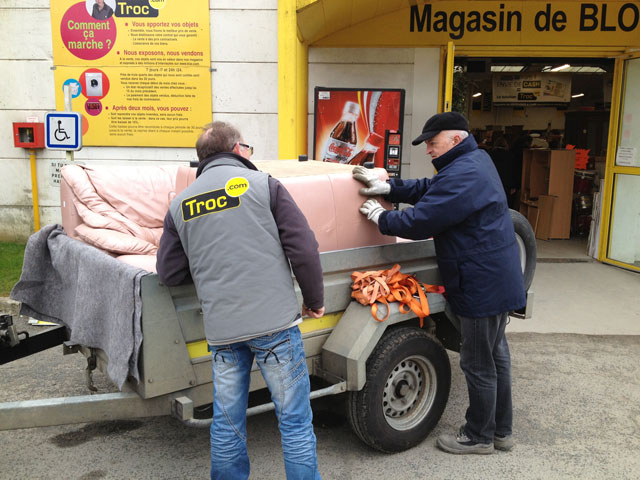
Next day, the sun came out and the clouds lifted so Jean Michel split the wood into smaller pieces and we eventually had a small fire going without too much smoke. Feeling more optimistic, we went rushing off to Troc de l’Ile to find a sofa. Jean Michel wanted two sofas so we could both lie and read in front of the fire. The first person we saw was Mrs Previous Owner. We found two likely looking candidates that were cheap enough to throw away in a year and a half when we bring our furniture down from Paris. However, they were pretty massive, so Mrs PO very kindly phoned Mr PO to come and help take them up to the living room as I certainly couldn’t. We strapped them into the trailer and set off home.
The first sofa
On the way, Jean Michel suddenly said, “I think they are too big to take through the door.” It was also the first thing Mr PO said when he arrived. We measured all the doors and windows and had to face up to the sad fact that there was no way we’d get them upstairs or even downstairs for that matter. I phoned Troc de l’Ile and told them we were coming. We got there just as they were closing. Everyone was standing around waiting for us! We took our credit note and said we’d be back next day.
Loading up the second sofa
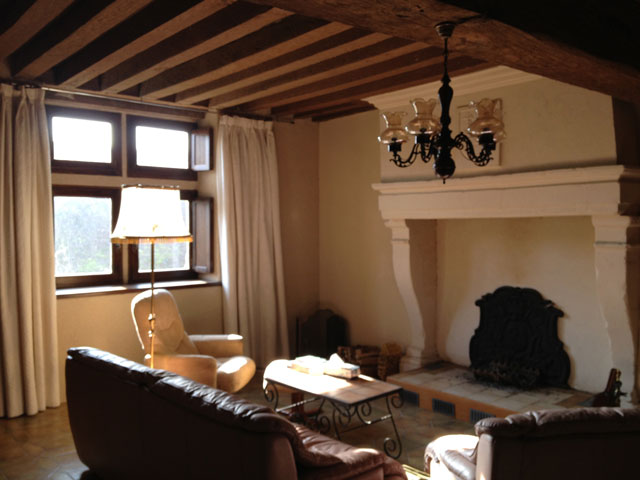
We managed to find a matching leather sofa and armchair and a second armchair with a footstool that Jean Michel is happy with. They were also not as heavy which meant that I could help take them upstairs. But the fireplace still smokes and we’ve given up any further attempts until the roofer has been because the smoke actually made me sick (headache and nausea). We are, however, enjoying our newfound living room and it makes it feel much more like a real home.
Our present fire-less living room
I nearly forgot. We went to dinner at Au Coin d’Table on Saturday night after the wrong sofa episode. I phoned and made a reservation. When we got there, however, there was no trace of it. It turns out there is a restaurant called “Le Coin de Table” in Tours (an hour away) and I made a mistake when I looked up the number in the Yellow Pages. I suspect it isn’t the first time because I remember this happening another time. I phoned the other restaurant to cancel of course. The lady found it most amusing!
This week, in Wednesday’s blogger round-up, Mary Kay from Out and About in Paris takes us to a pop-up bar (a new concept for me) in Paris where she was tempted by the sin of gluttony. I can’t wait to try it out! Andrea from Rearview Mirror shares her top 12 patisseries in Paris from a host of wonderful neighbourhoods while Niall and Antoinette from Chez Charmizay explore an intriguing “monument historique” in the Loire Valley. Enjoy!
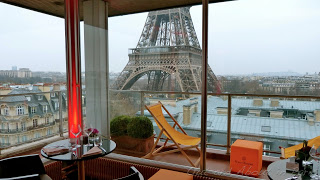
The hottest new pop-up bar in Paris with a stunning view of the Eiffel Tower: 180 Restaurant and Bar at the Pullman Hotel
by Mary Kay from Out and About in Paris, an American by birth, Swiss by marriage, resident of Paris with a Navigo Pass for the metro that she feels compelled to use
Better hurry! The clock is ticking and there are only 126 days, 13 hours and 26 minutes left to enjoy one of the most spectacular views of city from the hottest new pop-up bar in Paris.
Situated on the 10th floor of the Pullman Hotel, the bar offers an intimate encounter with the Eiffel Tower in all its sparkling glory. Watching the day fade into night as we sipped glasses of Veuve Clicquot champagne with friends visiting from the States yesterday evening, Stephane and I regretted that we hadn’t reserved a table for dinner. In keeping with the theme, the pop-up bar has specially concocted drinks and menu items honoring the seven deadly sins. With offerings like le Charnel (the carnal), a savory cheesecake, and le Sensual (the sensual) a sweet cheesecake, I was sorely tempted by the sin of gluttony. Read more
Top 12 Patisseries in Paris
by Andrea from Rear View Mirror (formerly Destination Europe), a fellow Australian who, after 6 years of living in France, has given up herParis apartment to live a nomadic life slowing travelling around Europe, experiencing each destination like a local
I naively thought I could list my top 10 favourite patisseries in Paris but there are too many great places to choose from so I decided to share my top 12. All are located in fantastic neighbourhoods ideal for a city break in Paris. If you’re planning a visit to Paris and want to live like a local, Go with Oh have a number of apartments perfect for a short stay. Read more
Scallops & St Peter
by Niaill, a Scotsman, and Antoinette, a Dutch American, from Chez Charnizay, who live in the village of the same name in southern Touraine and blog about their adventures in the Loire Valley.
The town of L’Île-Bouchard straddles the river Vienne and we’ve written about the capitals of the ruined Prieuré de Saint-Léonard there before. On the south side of the Vienne river, just before you reach it, is a small village called Parçay-sur-Vienne.
We decided to have a quick look to see if the village church was of interest before heading on towards L’Île-Bouchard and Chinon: it was a another case of one of those slightly battered and faded ‘monument historique’ signs which intrigued us. Read more
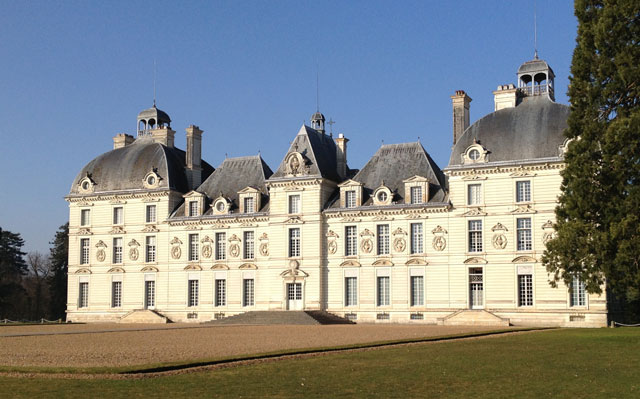
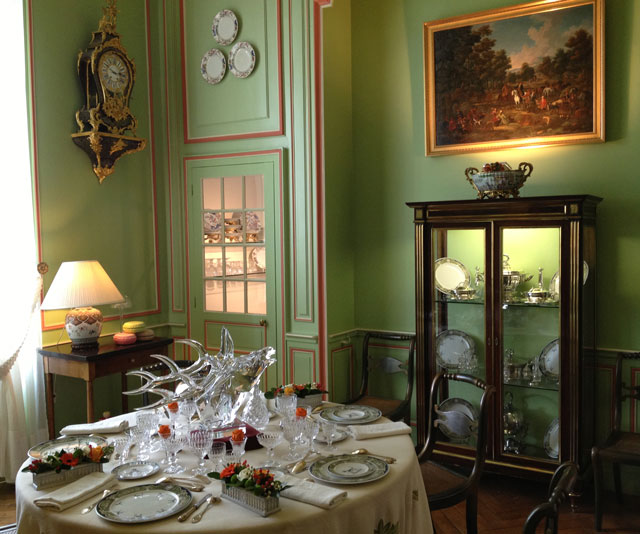
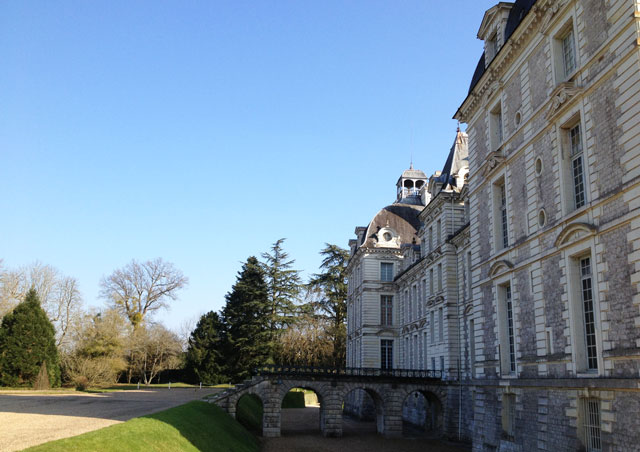
When we visited Cheverny today, I was amazed at how beautiful it is inside. I did not remember any of the state rooms, only the bedrooms which I found disappointing during my last visit over ten years go. The domaine has been in the same family for six centuries and open to the public since 1922. The château as it stands today was built between 1624 and 1640 by Count Henri Hurault and his wife Marguerite Gaillard de la Marinière. The sumptuous interior decoration is by Jean Monier from Blois. It is the only major château to have retained its original furniture. Fifteen thousand bulbs are planted in the gardens each year, so if you can, time your visit for spring!
Front façadePainted ceiling in the Grand Dining Room
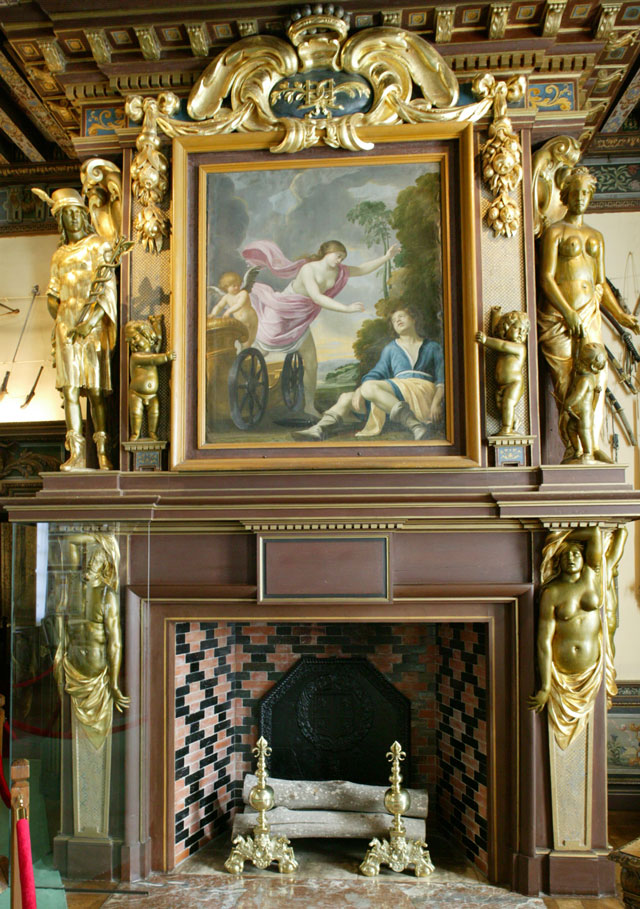
Fireplace in the Arms Room
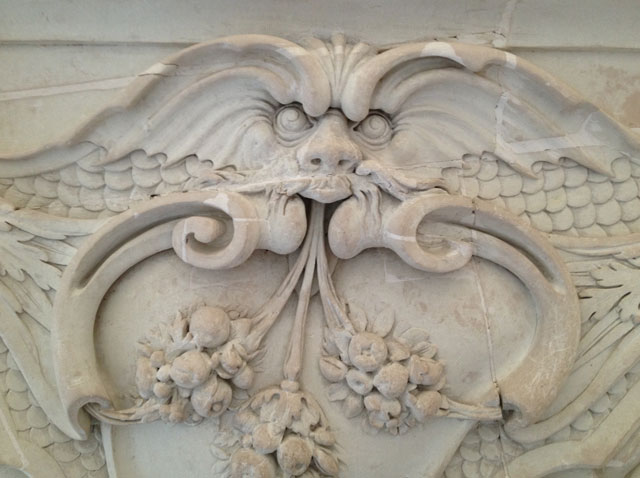
Stone sculpture on main staircase
The family dining room with its matching table cloth and porcelain with the family arms
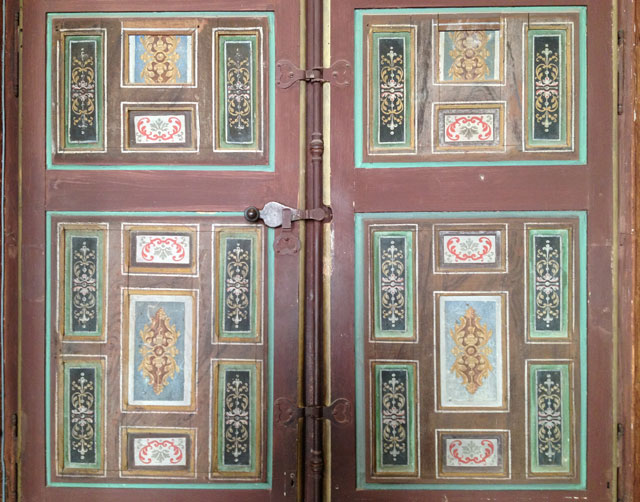
Painted shutters in the Arms Room
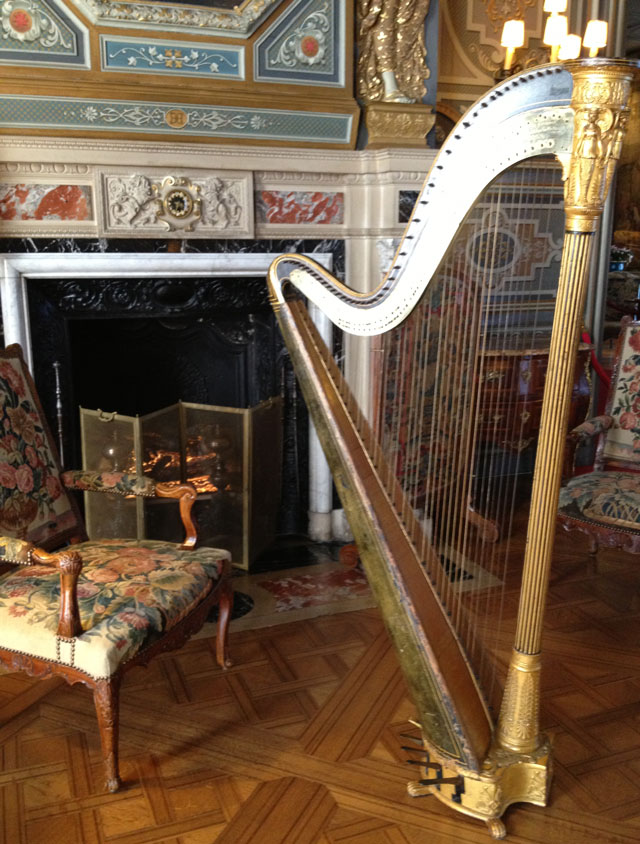
Late 18th century Erard harp in perfect working order
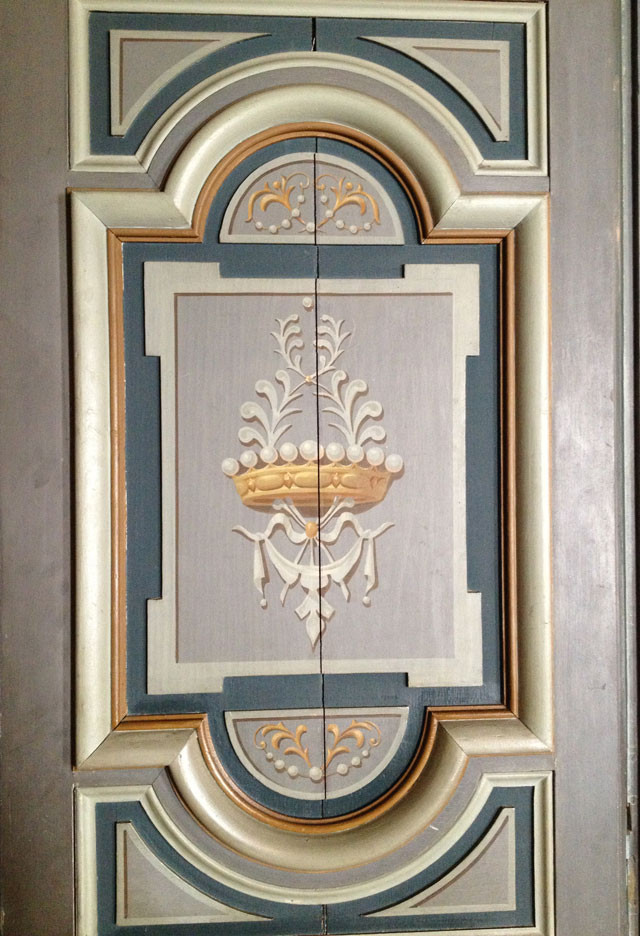
Painted door in the Grand Drawing Room
North façade of Cheverny
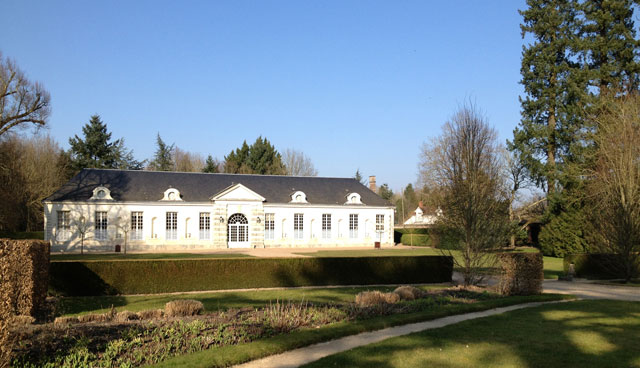
The Orangery
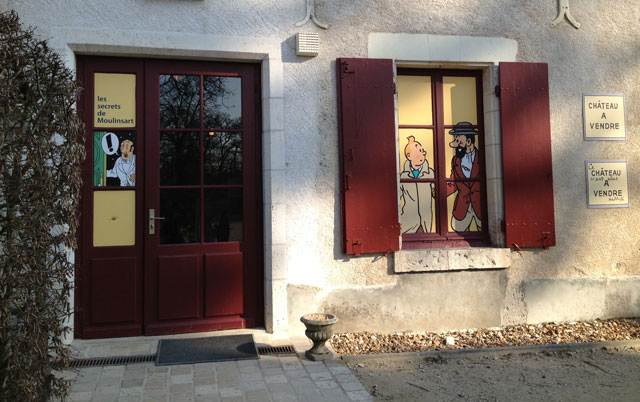
Tintin exhibition – Cheverny is the “model” for Marlinspike Hall (Moulinsart in French), Captain Haddock’s residence in the Tintin comics, created by the Belgian author and illustrator Hergé