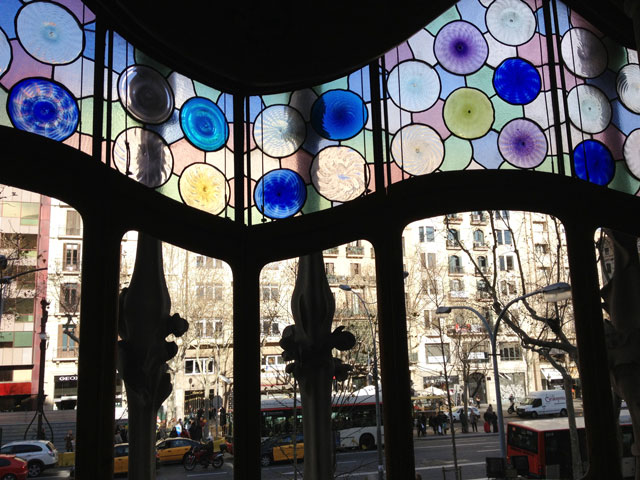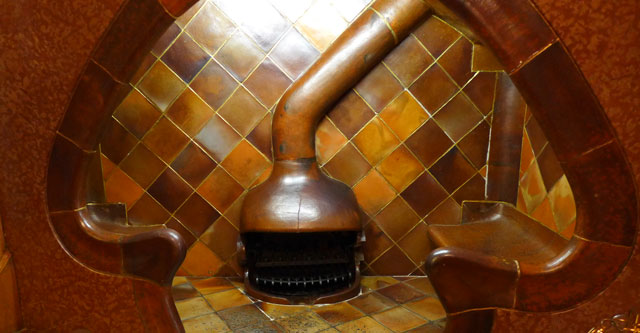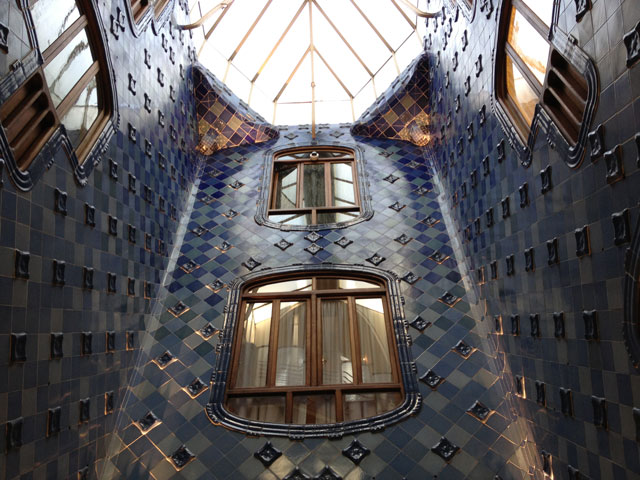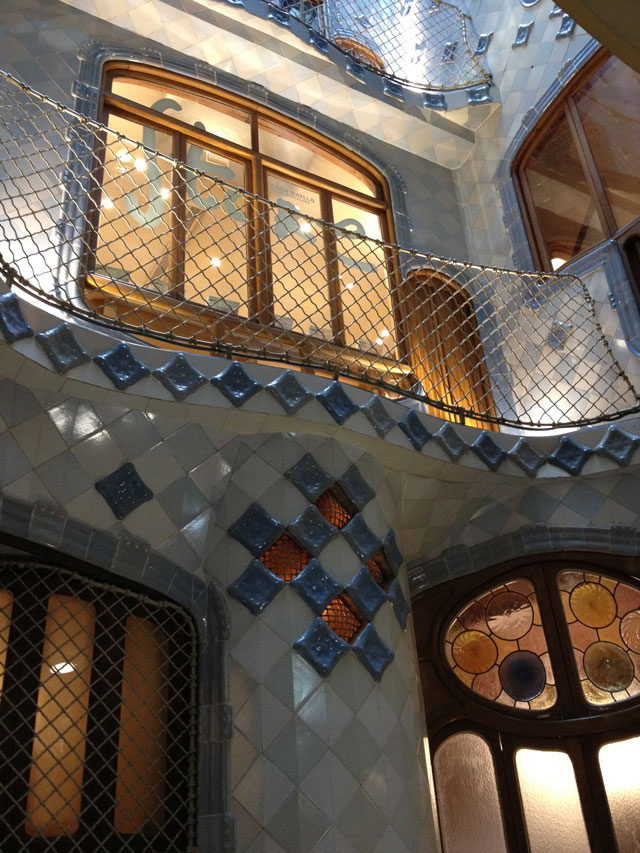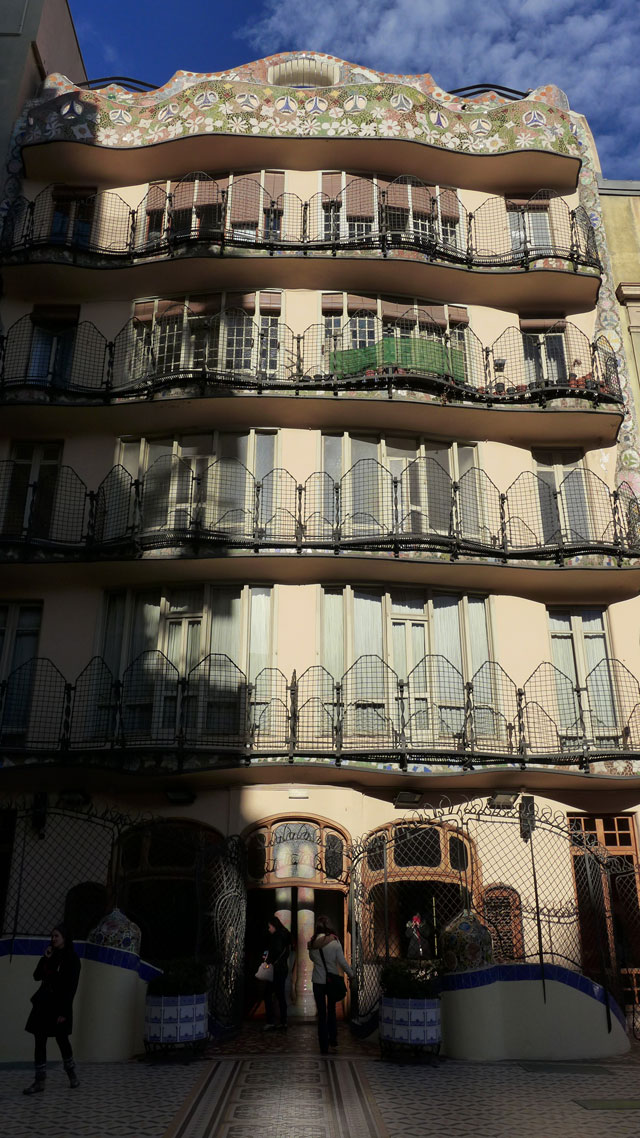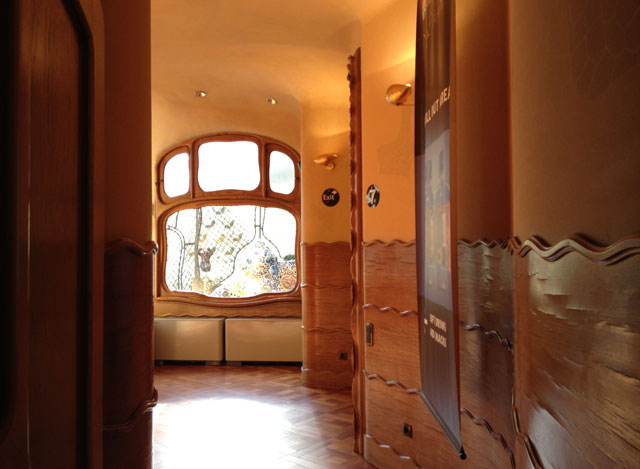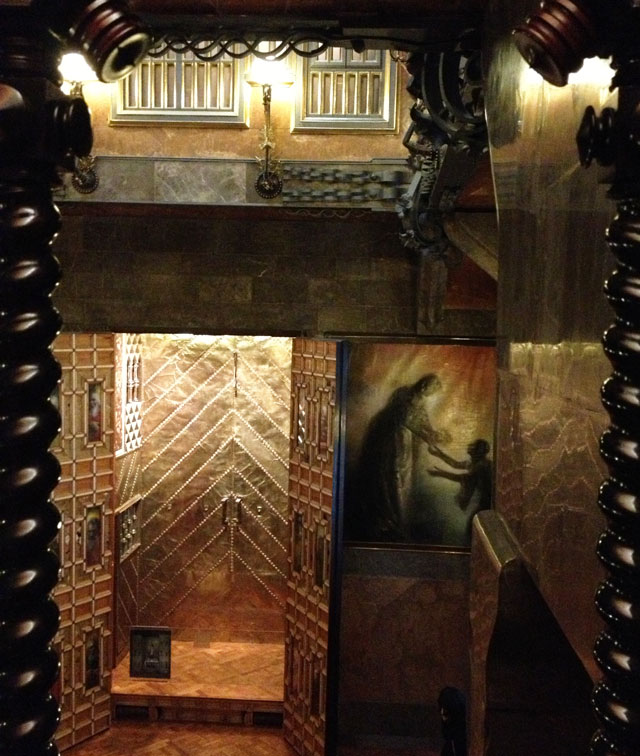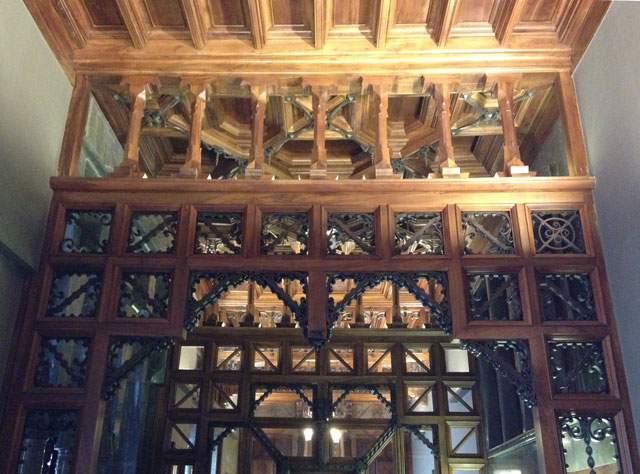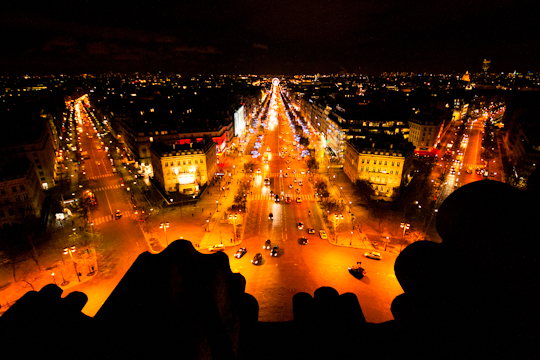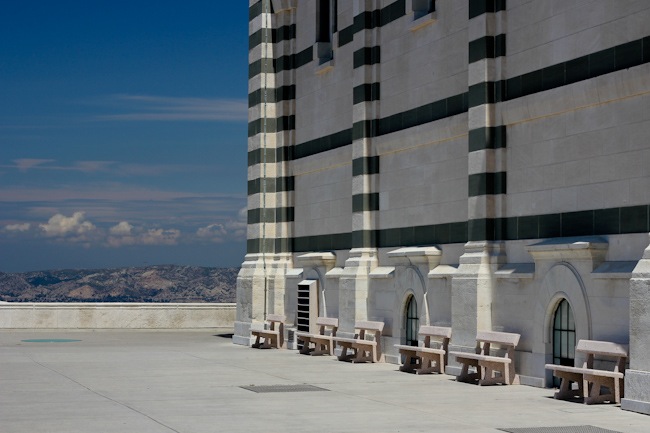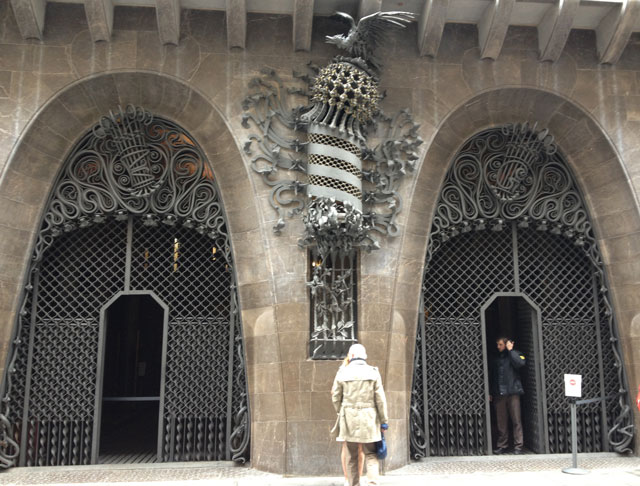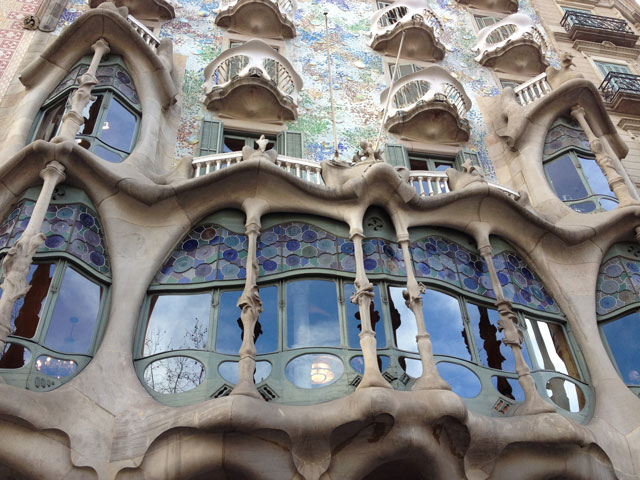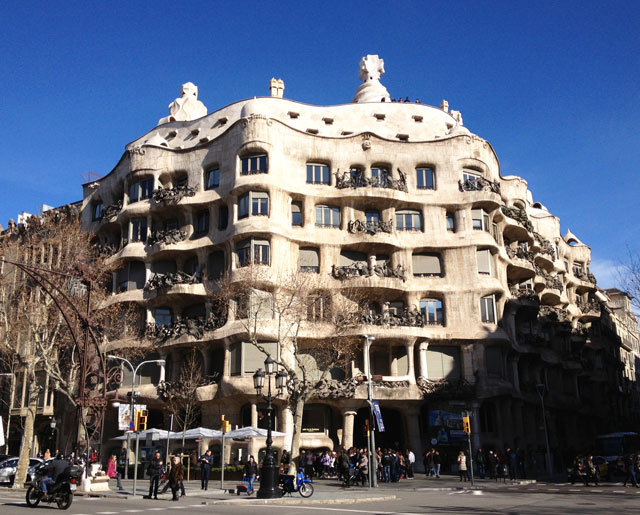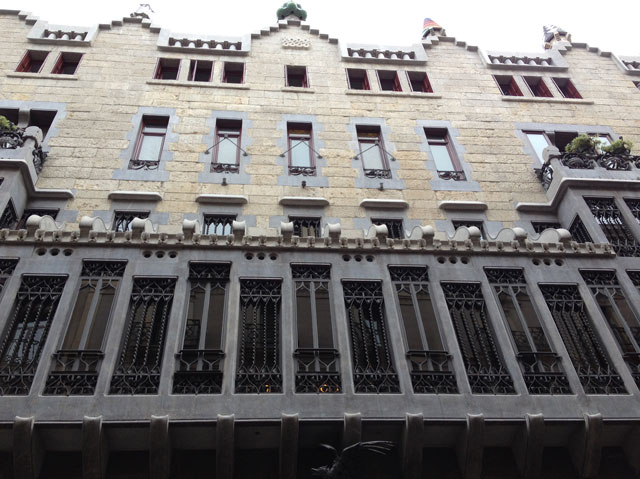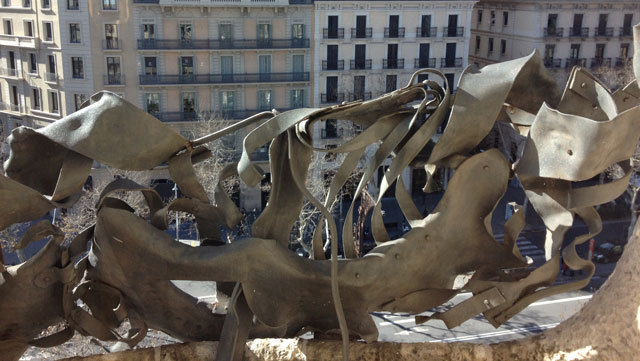
Like so many others before us, we’ve become Gaudi fans and fascinated, amongst other things, by his chimneys. All of the houses designed by Gaudi that we visited included the roof with their marvellous chimneys. Gaudi believed that all things useful should also be aesthetically pleasing. Some of the chimneys are used to evacuate smoke while other are for ventilation. They are often highly colourful, and sometimes made with salvaged materials, including broken champagne bottles!
On top of Guell Palace
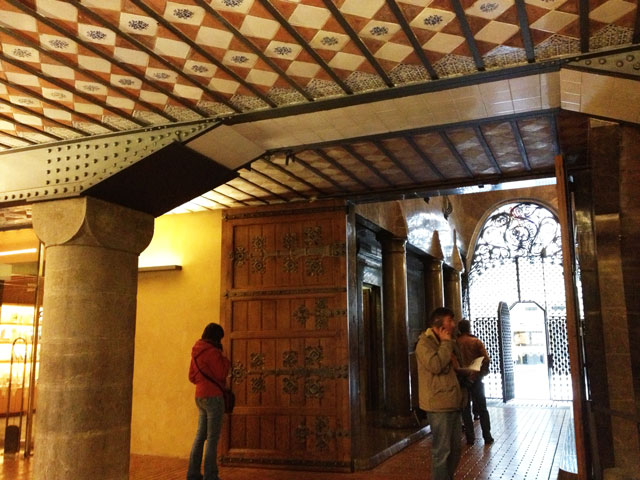
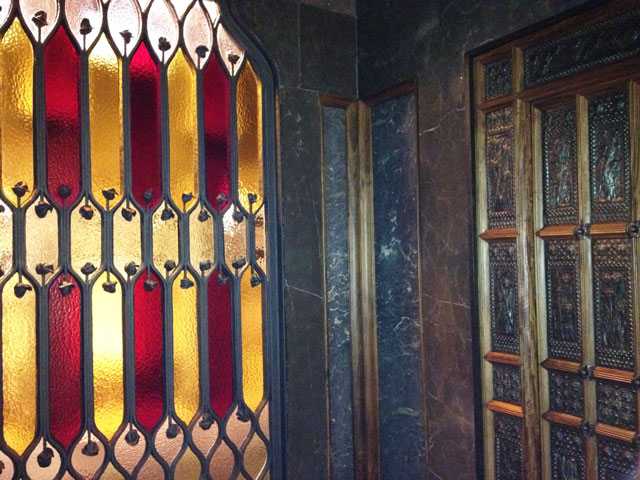
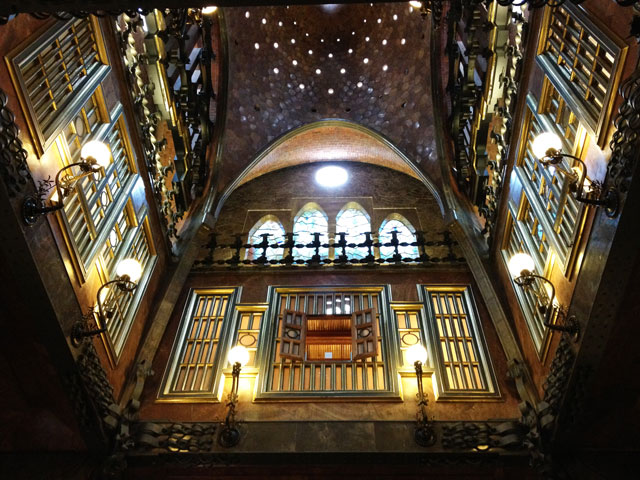
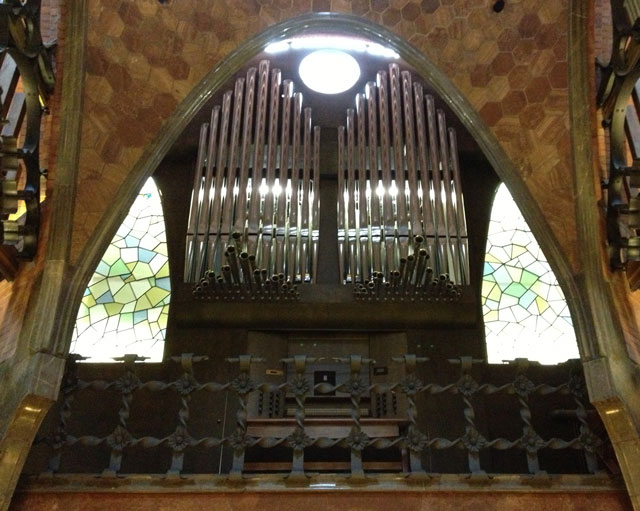
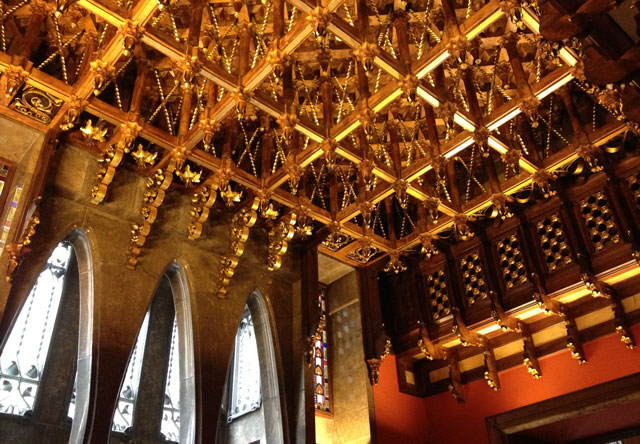
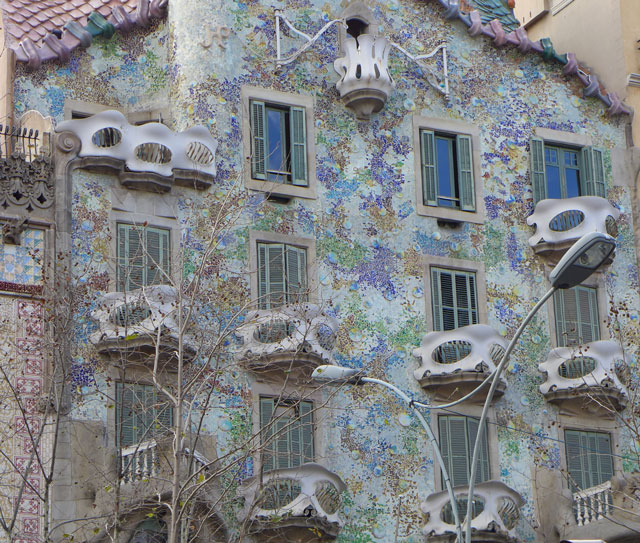
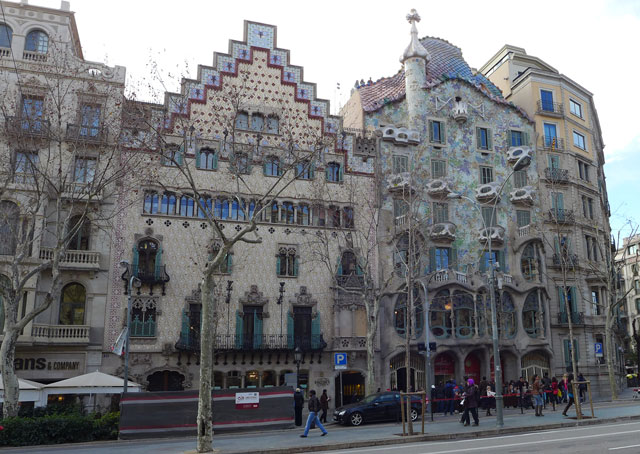
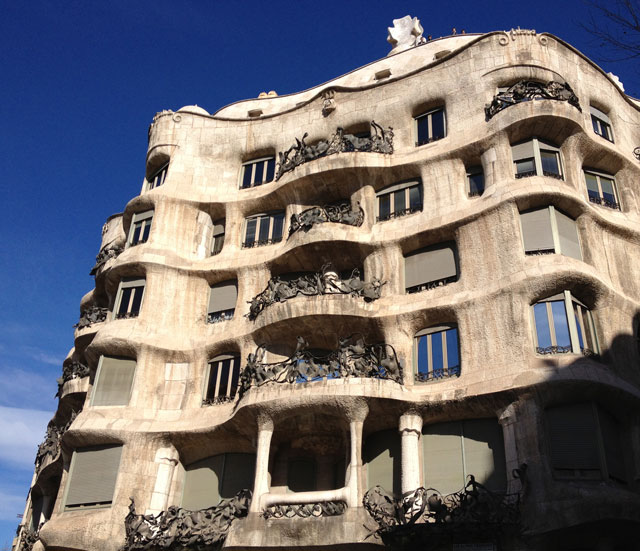
We visited the inside of Guell Palace, Casa Batllo, Casa Mila (also known as La Pedrera) and the Guell Pavilions from the outside only. Our home exchange host, Pep, who’s a musican, tells us that they hold concerts on top of La Pedrera. It must be a truly unique experience.
On Guell Palace looking over the cityOn top of Guell Palace with a modern tower on the left
Chimneys on top of Casa Batllo
Chimneys on Casa Batllo
Chimneys on top of La Pedrera – the one on the left is covered in broken glass from champagne bottlesChimneys on La PedreraHuman-looking chimneys on La Pedrera
Ok, just forget what I said yesterday about not being sure what I think about Gaudi’s basilica. It is the most wonderful construction I’ve ever seen. Inside it is absolutely dazzling, breathtaking, overwhelming. There are no words to describe it and no photo to do it justice. It is the most amazing well of light imaginable. The brightly colourful stained glass windows which anywhere else would be gaudy, are quite superb.
End of the transept on the Passion side
Gaudi was just only 31 when he began working on the cathedral in 1883. It evolved considerably during his lifetime, becoming more and more audacious. Sadly, he was run over by a tram at the age of 73. Some of the mock-ups and nearly all the plans were destroyed by fire during the Civil War in 1936.
The main nave
Although it felt like the biggest church I’ve ever been in, it’s amongst the highest but not the longest. The longest of the five naves is 90 metres long and 45 metres wide while the transept is 60 x 30 metres. The highest point is 45 metres from the ground. In comparison, Notre Dame is 127 metres long x 48 m wide, the transept is 48 x 14 metres and the height is 35.5 metres. Beauvais in the north of France holds the world record with 48.5 m.
Keystone on the nave
The pillars, which split into two halfway up to remove the need for flying buttresses, represent trees in a forest with leaves at the top but the symbolism isn’t all that obvious. The pillars themselves have a special spiral design with fluting that increases in number as it gets higher.
End of the transept on the Nativity side
Although the inside is fairly complete and two of the façades – the Nativity and the Passion – are finished, there is a still a third façade, the Glory, under construction along with the central spire. Up closer, the seemingly naive statues on the Passion façade are true works of art by a controversial Catalan sculptor and painter, Josep Maria Subirachs. Those on the Nativity side are much more conventional and characteristic of Gaudi’s naturalistic style, very ornate and decoratd with scenes and images from nature.
Organ reflecting the colours from the stained glass windows
Surprisingly, the crypt, which was built first, by another architect, is very classical. It can be seen through glass walls. We didn’t visit the towers.
Just one of the magnificent stained glass windows
In the photos, I’ve tried to convey the impression of height and light, but it seems impossible. Even when we went back inside after looking at the two façades, we no longer had the same overwhelming impression that we had when we first went in. It’s difficult to take photos of the outside because you can’t stand back far enough. It’s a pity there isn’t an esplanade around it. There are parks across the road, but traffic in-between.
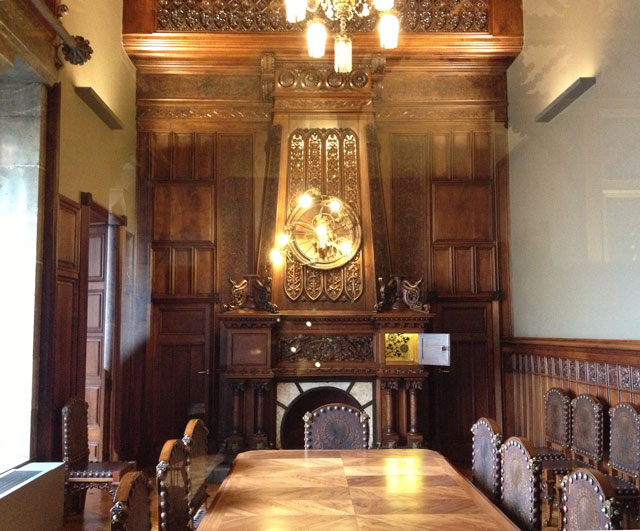
Flower-like vaults
On a purely practical level, given the very long queues, it’s best to buy your ticket on-line. There are lots of different websites, all of which charge a lot extra. You need to go to the official website of the Sagrada Familia which takes you to www.ticketmaster.es. Either you print out your tickets or you go to a Caixa bank with a ServiCaixa machine. You insert the bank card you used to pay on-line, then follow the instructions starting with « Collect tickets ». We went to the bank just opposite the very helpful tourist office next to Plaça Jaume but there are plenty of others.
What appears to be stained glass is actually its reflection in a glass wall
The tickets were 14.80 euro per person without the audio guide, slightly more than you pay if you queue for an hour. In retrospect, I think we should have taken the audio guides because they included the underground exhibition. We decided not to because 1 ¾ hours seemed a long time, but in fact we spent more than 2 hours there altogether. You are given a one-hour slot during which you must enter at a special gate just next to the regular ticket office and there is absolutely no queue.
Scuptures on the Passion façade
There is a queue for the toilet however but I discovered a second lot right down the far end of the underground exhibition where I could go straight in.
Ornate Nativity façadeConceptua design of the Sagrada Familia
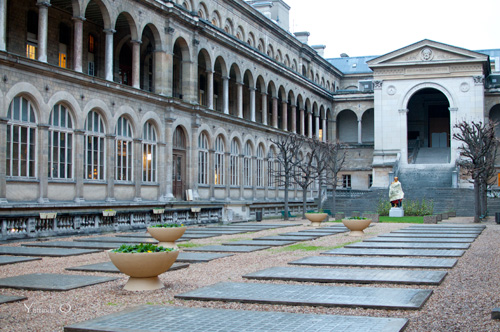
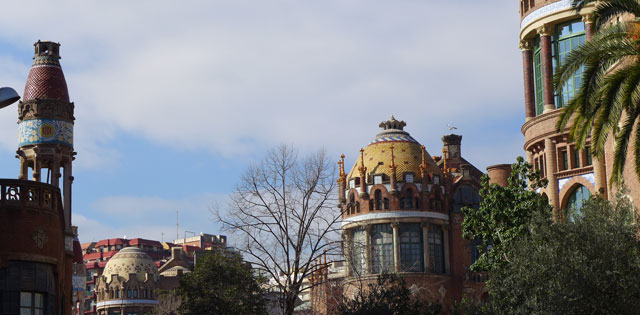
The trip with Easy Jet went perfectly and we even arrived early at our home exchange which gave us time to have a look around us. We’re just across the road from the former Hospital de la Santa Creu i Sant Pau in the El Guinardo neighbourhood, built between 1901 and 1930 and now a UNESCO World Heritage site. It ceased to be a hospital in 2009 and is undergoing restoration for use as a museum and cultural centre.
Santa Creu i Sant Pau Hospital
When you turn your back to Sant Pau you are looking straight at Gaudi’s famous Sagrada Familia cathedral. Our flat is on the 5th and last floor and a small flight of stairs leads onto a terrace where we have a spectacular view of the hospital. Unfortunately it’s a little cold to take our deck chairs up or we could have breakfast there!
The Sagrada Familia at the end of our street taken early morning
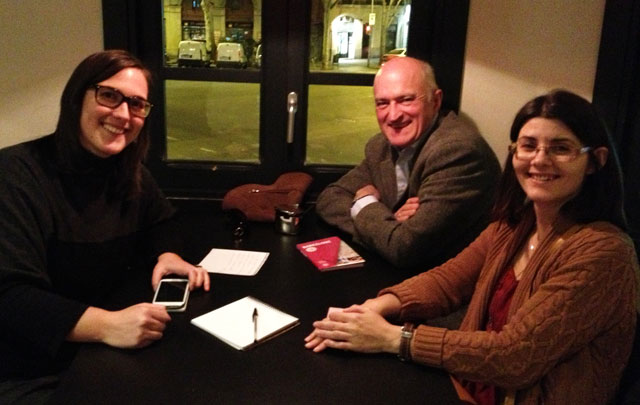
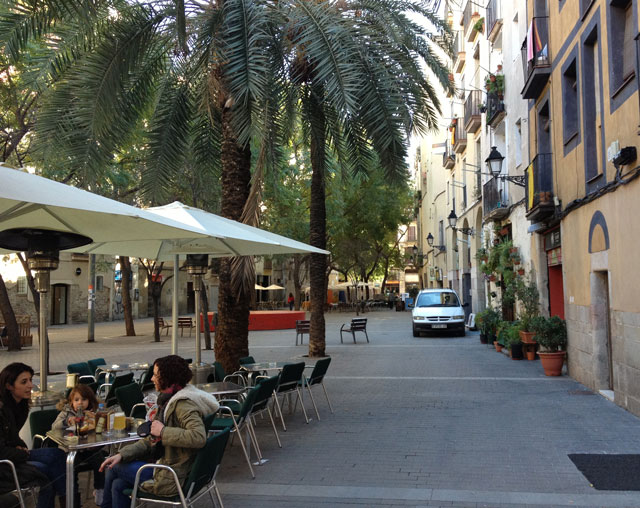
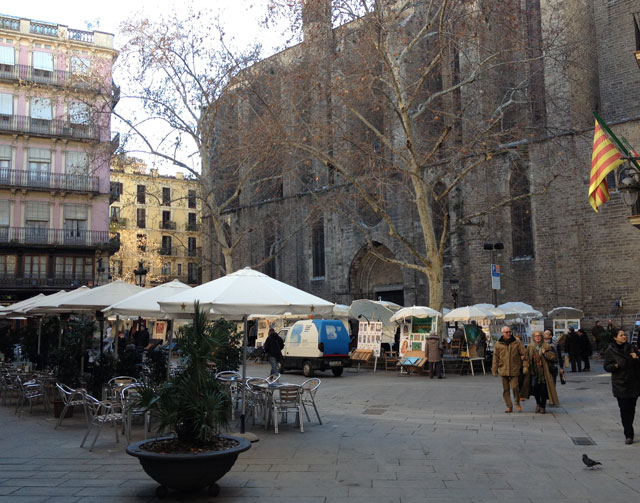
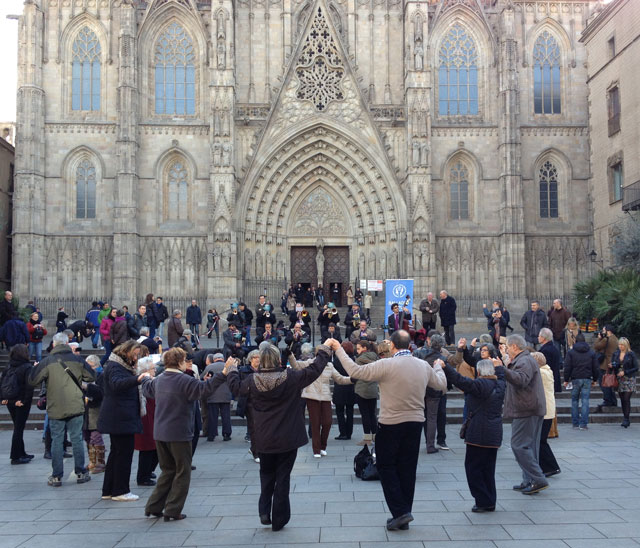
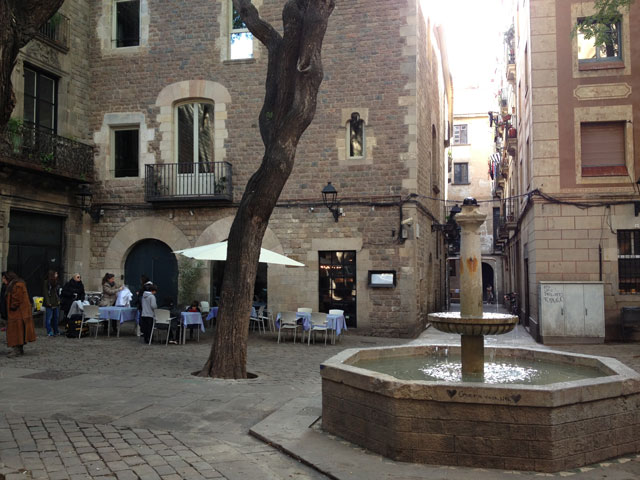
In the evening, at Pep’s suggestion, we went into the Barri Gotic which is the historical quarter of Barcelona. We decided we’d walk and it took an hour and a half! We were justly rewarded though. Pep had recommended a tapas restaurant called Bilbao Berria on the corner of Plaça Nova with its beautiful Gothic cathedral. We weren’t able to visit the inside because it was just closing.
Bilbao Berria on Plaça Nova in Barcelona
We found the restaurant and it was so good that I have a sneaky suspicion that we are going to be disappointed wherever else we go. Theoretically, they weren’t tapas, but « pintxos », which are hot or cold finger foods with a skewer through them which you choose yourself from the bar. They all cost 1.65 euros a piece and from time to time, the waiter comes around and puts the skewers in a glass. At the end, he counts them all up. So much easier than looking at a menu!
Our first pintxos
After all that walking, I stayed put and let Jean Michel choose the tapas. The variety was amazing. There were even mini hot dishes, one octopus and the other veal. My favourite had two sea scallops and 3 prawns! I have to confess we had second helpings, then I went and chose a couple of desserts! We decided to take a taxi home. They’re very reasonably priced here.
Gaudi’s Sagrada Familia Cathedral
Next morning we went and had a closer look at Gaudi’s unfinished cathedral but when we saw the queues of people waiting to get in, we decided to get tickets on line and come back another day. I’m not sure yet what I think of the cathedral. It’s very impressive, like a series of enormous stelactites but I’m not sure I like the naive sculptures and gaudy colours. I did wonder whether the word comes from the artist, but apparently it doesn’t.
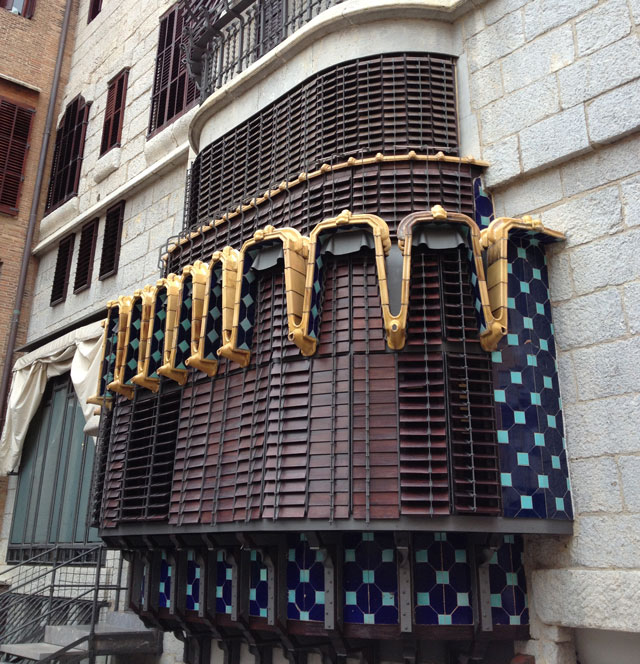
Pavillon at the entrance to Guell Park
We then took the very modern metro to Guell Park, also decorated by Gaudi. A 10-ticket card that can also be used for the bus costs just under 10 euros, which is much cheaper than Paris. It took about 20 minutes to walk up the hill to the park from the metro station but despite the cold, the sun was out.
Inside Guell park
I really liked the park, which was never finished, like a lot of Gaudi’s work, because Count Guell eventually ran out money. When we got there, there weren’t many people but by the time we left, it was crowded. Initially though it was very still and peaceful, with musicians scattered about playing classical music and Spanish guitar. From the top there are sweeping, though a little hazy views of the city of Barcelona and the sea. So when we left the park, that is where we headed.
View of Barcelona from Guell Park
Bilbao Berria, Plaça Nova 3, Barcelona 93 317 01 24, Monday to Thursday, 9 am to 12 pm, Friday and Saturday, 9 am to 1 am, Sunday 9.30 am to 1 am.http://www.bilbaoberria.com/en/home
On the way to the Sainte Eustache market on Sunday, delighted to have sun at last, we walked past a garden bed of primroses. I couldn’t believe it! The vendors at the market were bright and cheery this week as well. It’s amazing what a little sun can do to the morale of the population in the throes of winter.
Newly planted primroses in Rue du Louvre
However, by 3 pm, when I joined my Australian cousins from Armidale who are visiting Paris at the moment, the sun had disappeared and it was biting cold. We met up in a café just near Paris’ beautiful Gothic town hall and I suggested that even if they were stilling feeling a bit cold, it would be better to remove their anoraks inside so that when they went outside again, they wouldn’t feel the cold as much.
Sporting shorts at the market despite the temperature!
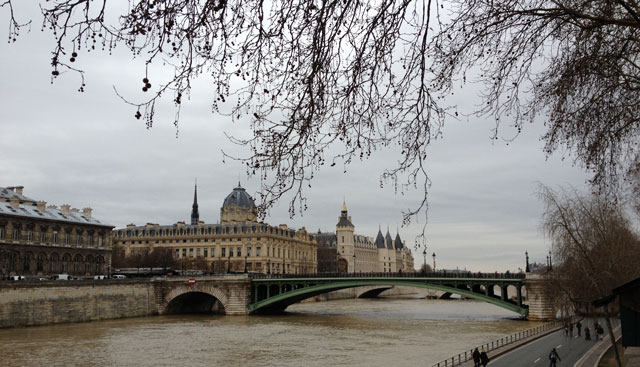
When we came out, we could see the newly renovated golden spire of the Conciergerie in the background. We crossed the bridge towards Notre Dame where I was surprised to see a grandstand, then I remembered the bells. Notre Dame is celebrating its 850th anniversary this year and one of the major events is a new set of bells.
Conciergerie in the distance with its golden spire
Marie, Gabriel, Anne-Geneviève, Denis, Marcel, Etienne, Benoît-Joseph, Maurice and Jean-Marie arrived in Paris last Thursday on two 43 tonne trailers from Villedieu-les-Poëles in Normady with a motor cycle escort. They’ll be on exhibit in the nave of Notre Dame until 25th February, which probably explains and longer than usual queue ! Their first peal is scheduled for 23rd March.
Notre Dame from the temporary grandstand
The grandstand, which can seat 800 people, is designed to offer visitors a unique view of the cathedral’s three porches and rose window, whose details are difficult to see from the ground. It certainly is spectacular although you can no longer stand back and fully appreciate its majesty. It seems that all sorts of sound and light shows are scheduled up until 24th November. I shall wait until it’s a little warmer and go and have a look.
Last week’s bloggers’ round-up had a single theme – Barcelona – but this week, the subjects are completely different. Chez Charnizay from the Loire Valley offers us a very complete description of the danse macabre, a mediaeval allergory for death, depicted in a local chapel in Touraine. Katerina Forrester, posting on My French Life, examines all the different things that “quand même” can mean, while Bread is Pain comments on French hospital food, very far from the pizza and jello she remembers having in the US as a child. Enjoy!
A bittersweet treat: La Chapelle de tous les Saintes
by Niaill, a Scotsman, and Antoinette, a Dutch American, from Chez Charnizay, who live in the village of the same name in southern Touraine and blog about their adventures in the Loire Valley.
A little while back, friends Susan and Simon who write the blog Days on the Claise ran into Marc Dimanche, an acquitance of theirs. A devoted member of the Preuilly archaeological society, he offered them the opportunity to visit the Chapelle de tous les Saintes [All Saints’ Chapel] which is located on the left as one drives into Preuilly-sur-Claise from the direction of Le Grand Pressigny. They had written a post about the chapel before here, but had never had the opportunity to see inside. Read more
Speak like a local: quand the French use quand même
By Katerina Forrester, Australian born but always longing to be French, posting on My French Life, the global community of French and francophiles connecting like-minded people in English & French.
It’s a phrase that stops a nation, or more so, a young girl at the ripe age of 16 on her first trip to France. This common French expression would continue to stump me for years to come, and I’m ashamed to add that the first time I heard this phrase, I transcribed it as ‘comme même’.
However, I shouldn’t be disheartened by my cultural linguistic naivety. This typical French expression, quand même, may be easily translated into English, but the translation changes drastically depending upon the context!
So let’s identify and explore quand même on the dissecting table…through hypothetical situations. Read more
Of Hospitals and Cheese Courses
by Bread is Pain, a 30-something American living in the Rhone-Alps, and slowly eating and drinking herself through the country
Yes, I am being a slacker this week. MB is having some health issues and afternoons at the hospital have proved to be uninspiring…except for the meals.
Now granted, I haven’t been in the hospital in the U.S. since the 80′s so my information isn’t at all up to date but what I remember of the food was pizza and jello (I was also 8 years old which might account for what stands out in my mind). At the hospital here in Grenoble, however, MB’s meals are somewhat more sophisticated. There is a potato soup, there is a tuna pasta, a freshly baked roll, fromage blanc. These may show up all at the same time but this is basically a 3 course meal…in the hospital. Yesterday he had saucisson…how is that a healthy choice? Read more
I’m a great believer in having a couple of culinary specialities up your sleeve that you can make standing on your head and everyone oohs and ahs about. It doesn’t even matter if you always serve up the same thing to the same people because they usually look forward to it. Jean Michel’s great specialty is his thin-crust apple tart.
Jean Michel’s apple tart
The first time I ate it was when he invited me to dinner at his place for the first time. He’s convinced it’s low calorie. I’m not so sure about that, but it’s definitely delicious. I have never learnt to make it – I would hate to rob him of his fame (and it would also mean I’d find myself making it more often than him!). Also, I don’t think I have the patience to cut the apple thinly enough.
I once helped him in the early days of our acquaintance and I could see I was not doing it the right way. So I bowed out gracefully and left him to get on with it.
Here’s the recipe :
Ingredients:
250 g of plain flour (we only have unbleached)
1 to 2 g of ground Guérande sea salt (that is the only type he likes!)
30 g of fine brown sugar
100 to 150 g of butter
1 egg
3 to 4 large Golden Delicious apples (or any other non-floury apple)
1. Mix the dry ingredients in a large bowl
Putting curls of butter into the flour
2. Scrape the butter into the bowl with a serrated edge knife
3. Incorporate with the finger tips
4. Create a well in the middle and break in the egg
5. Blend well with the fingertips
6. Add a little water depending on the moistness of the flour
7. Form a uniform ball and put in a cool place for at least 30 minutes but preferably several hours
Forming a circle from the ball of dough
8. Place the dough on a marble plaque and press it into a circle by working around it
Rolling dough towards the inside
9. Roll the dough out with a rolling pin first from the outside in, then from the inside out until it forms a circle with a diameter of 38 to 40 cm
Transferring the dough onto the rolling pin
10. Roll the dough around the rolling pin and place gently onto a 35 cm shallow anodised aluminium tart plate.
Placing the dough on the tart plate
11. Prick the bottom with a fork
12. Turn the edge over
Forming a roll around the outside
13. Create a decorative edge with a fork
Decorating the edge with a knife
14. Harden the tart shell in a 220°C oven for 2 minutes
The empty shell ready for the oven
15. Spread a thin layer of apple compote on the bottom of the shell
Spreading compote onto the base
16. Carefully eel and slice the apple thinly and evenly
Cutting up apple into thin slices
17. Overlap the apple slices to form a pattern
Overlapping the apple slices
18. Make the rosette in the middle and sprinkle lightly with sugar
We were staying near Stein am Rhein in Switzerland and on our way back from visiting Schaffhausen and its Rheinfall, the spectacular waterfall on the Rhine, I suddenly spotted the most amazing church in the distance. It turned out to be the Klosterkirche Rheinau monastery church, one of Switzerland’s most significant religious buildings. The original 12th century basilica, built on an island on a strategic bend in the Rhine River was rebuilt in the Baroque style in the first part of the 18th century and turned into a monastery church. The inside is quite stunning.
Klosterkirche in the distanceKlosterkirche monastery churchRheinau villageBaroque interior of KlosterkircheBaroque altar close upAnother view of Rhinau
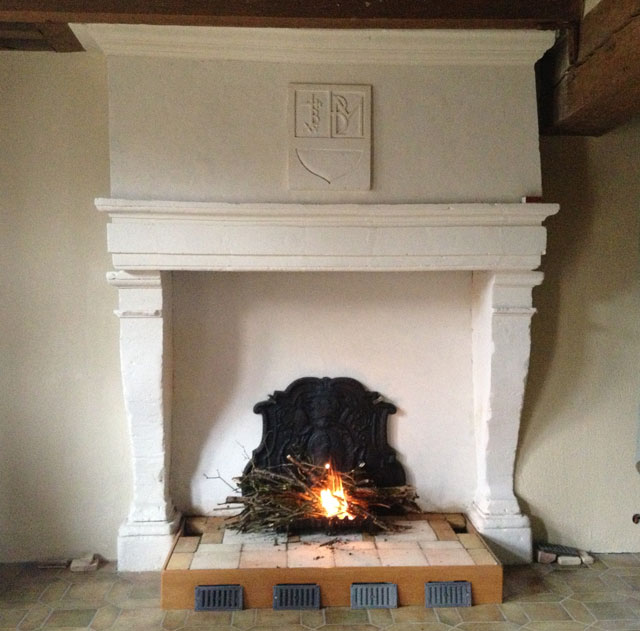
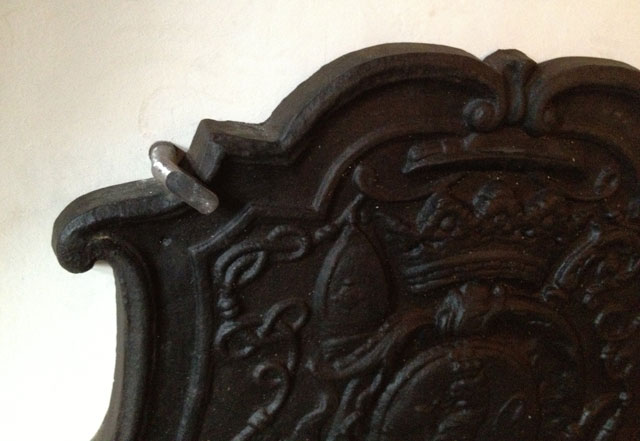
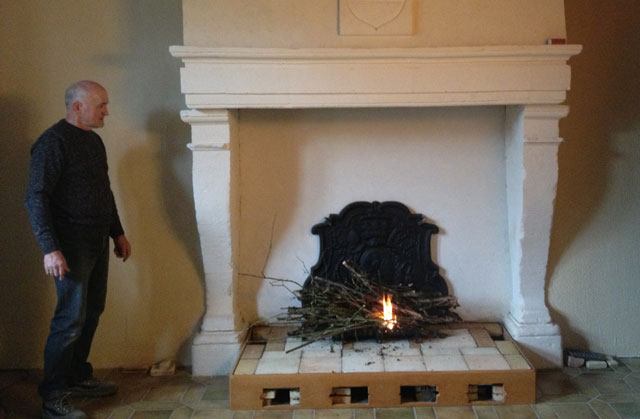
I thought I would use my guest post on My French Life this month to do a recapitulation of the renovation of our Renaissance fireplace in Closerie Falaiseau, our 400-year old house in Blois. I know that some of you waited with bated breath as we converted it from a “bandy-legged monster” as Barb Hall so aptly called it in a comment, to a straight and dignified fireplace ready to use.
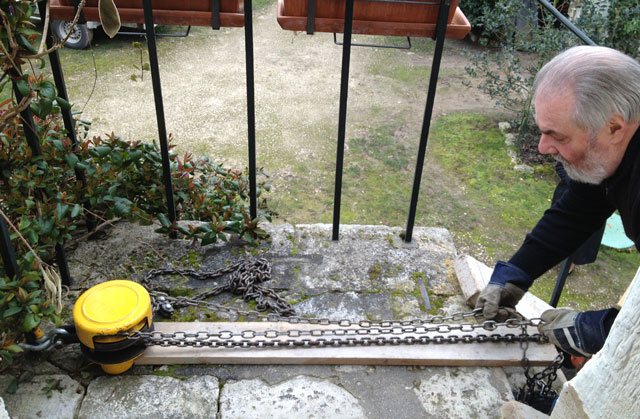
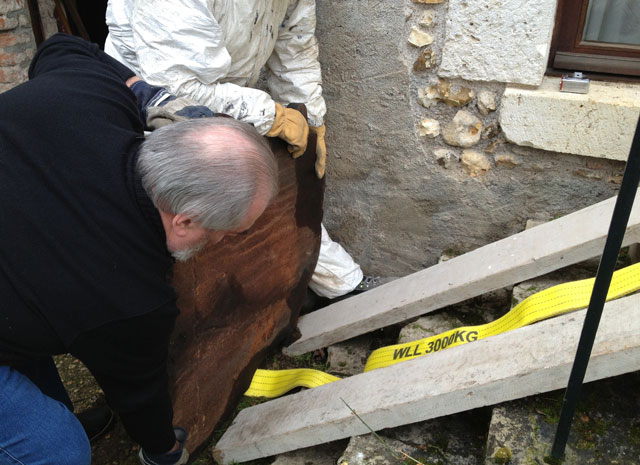
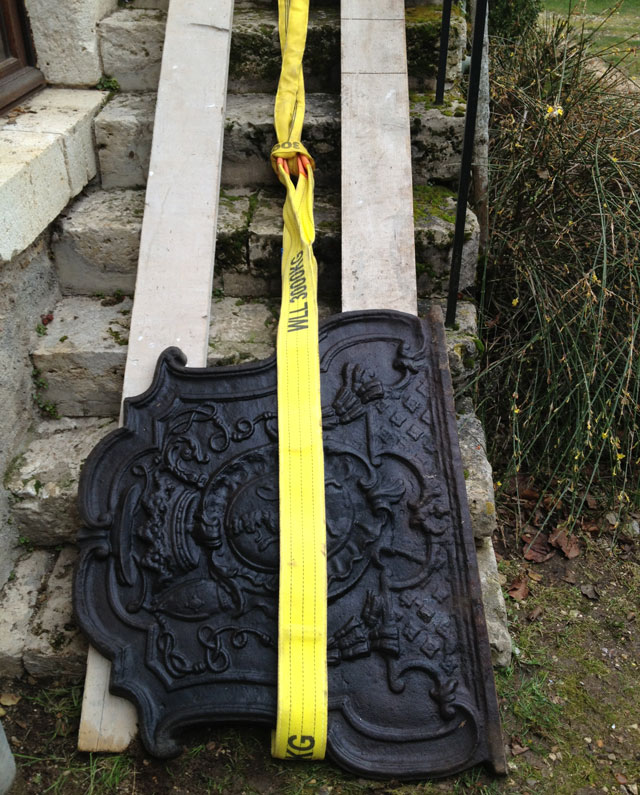
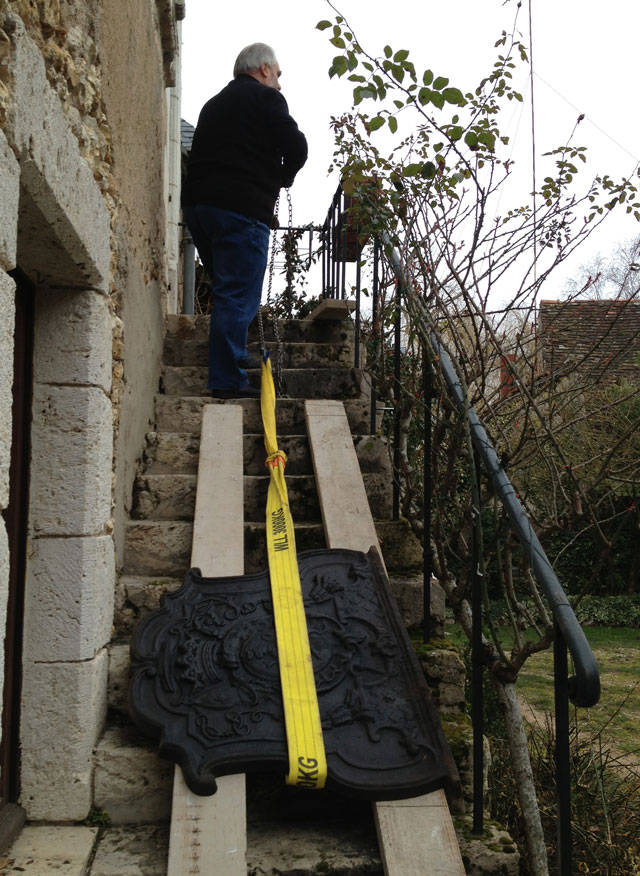
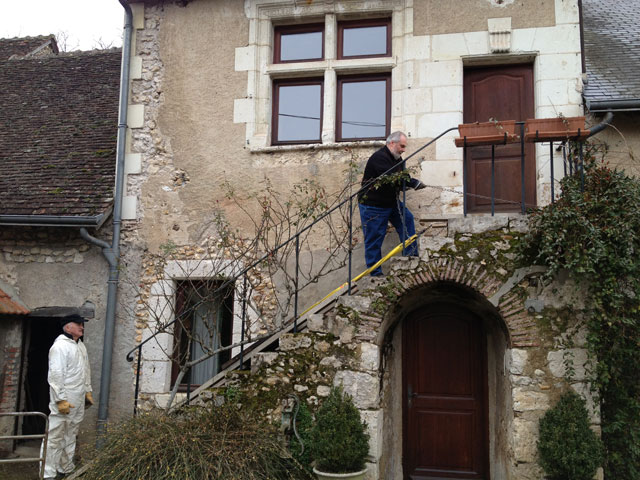
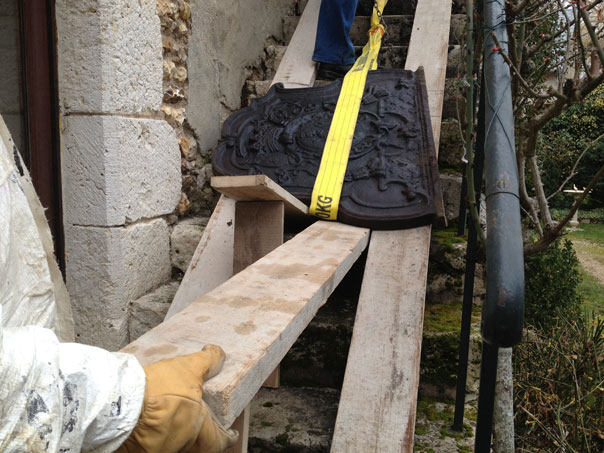
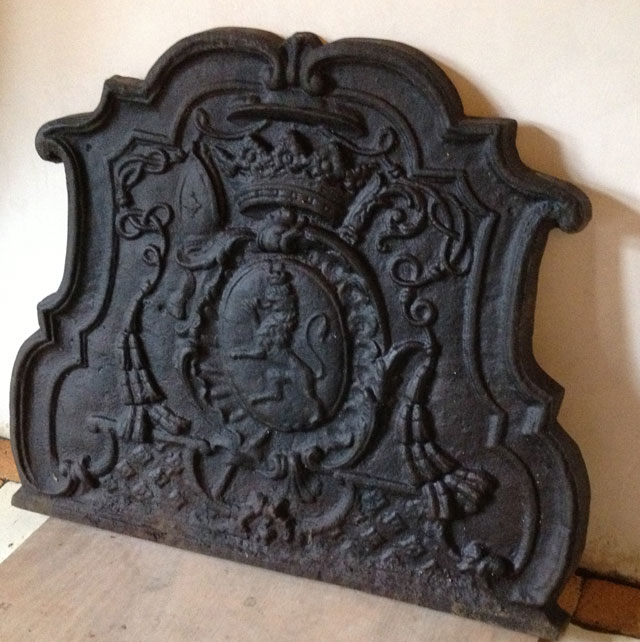
The hearth looks a bit stark at the moment but once the fireback is in and the logs are in place and there’s a roaring fire going, it should look a bit more attractive!
French Renovations in the Loire Valley
posted on My French Life, the global community of French and francophiles connecting like-minded people in English & French
The first time we visited Closerie Falaiseau, a beautifully restored Renaissance home built in 1584 near Blois in the Loire Valley, we didn’t see the upstairs fireplace.It was almost completely covered up with a large wardrobe.
So on the second visit, we asked if the cupboard could be moved. But it was very heavy and we only had a partial view. It was not until we signed the final deed of sale and saw the house empty that we had any real idea of the state of the fireplace and even then, it turned out that a large rattan fan was hiding a gaping hole filled with cement. Read more
When I first started writing this blog in October 2011, I was worried about my university students and possibly my translation clients being able to track down my private life so I came up with the pseudonym of Fraussie. When I created the Facebook fan page for Aussie in France, I discovered that I needed a “real” person behind it. What I didn’t understand was that fan pages and Facebook accounts are kept separate anyway and that someone who joined the fan page did not see the person who was behind it.
Front staircase at Closerie Falaiseau in winter
Anyway, when I set up the account, Fraussie was not enough. I needed a family name as well. We’d just found Closerie Falaiseau which is in the Grouet neighbourhood of Blois, whence the name. It was not until later that we learnt the name of the house or I would have called myself Fraussie Falaiseau and not Fraussie Grouet.
But I have been having more and more trouble keeping my own Facebook account, Rosemary Kneipp, separate from Fraussie Grouet’s. I never remember who I am and I need to keep logging out of one and into the other. It’s good practice for warding off incipient Alzheimer’s of course, but not always convincing. The fan page problem was really quite simple to solve as it turned out: I just had to change administrators!
I’m now no longer teaching at uni and my clients only care about whether my translation is any good or not so I’ve decided to get rid of Fraussie Grouet although I must confess I’ve become somewhat attached to her. Relationnel has also decided he’d like to come out. He’ll now appear as Jean Michel. Without a hyphen.
I’ve often been asked where the name Relationnel comes from. When we first met and I introduced him to my children, then 12 and 15, Leonardo, the oldest (he wanted to be a genius when he grew up and used to read a French comic book series called Léonard hence the pseudonym) was impressed by Jean Michel’s ability to always say the right thing to people, so he started calling him Relationnel and it stuck.
My daughter, Black Cat (explained in another post), would like to keep her pseudonym. It’s bad enough having a mother that writes a blog without it spilling over into your private life as well! I haven’t asked Leonardo because he’s asleep in Sydney at the moment, but I think he rather likes being considered a genius. My kids have a different family name altogether, I might add, which keeps them safe.
Having said all this, I should point out that Kneipp is my father’s name. My married name is Avril, but in France, you always officially keep your maiden name. Using your husband’s name is only a convention, though few people know this. I use Avril when people only know me as Jean Michel’s wife (the concierge, for example) or for friends we meet together. Sometimes Jean Michel gets called Kneipp as well, which further confuses matters.
When asked for your name here, you write KNEIPP Rosemary épouse (spouse of) AVRIL. Family names are always capitalised in this country and in formal circumstances you give them first. My French students would always say DUPONT Marie, for example, whereas the Anglosaxons would say Mary Brown. It can get a bit confusing, but the capitals help if you are not familiar with the person’s given name.
Notice I’m using “family name” and “given name” here as opposed to first name (or Christian name) and surname, since they are no longer politically correct and, above all, can lead to confusion. The terms in French are nom de famille (family name), prénom (given name, which literally means pre-name, which is a bit contradictory considering what I’ve just said) and nom de jeune fille (maiden name).
But, revenons à nos moutons, as my father used to say in his schoolboy French. I shall henceforth be known as Rosemary. However, do keep using your own pseudonyms, such as Maple Leaf, Kiwi, Jane’s cousin and Jane’s cousin’s friend, if you’re happy to keep them!
The posts on my Wednesday Bloggers’ Round-Up today are all by Australians (or people with Australian connections) and all on the subject of Barcelona. Kathy Stanford from Femmes Francophiles has suggestions for both fine dining and casual dining in Barcelona, Craig Makepeace from Y Travel Blog offers lots of insider tips on things to do while Laurence from Finding the Universe offers us spectacular photos of Gaudi’s monuments that I can’t wait to visit! So let’s go to Barcelona!
Barcelona: Gastronomic Dining
by Kathy Stanford from Femmes Francophiles, an Australian who an ongoing passion for France and the French language just back in Australia after a holiday in Europe
I visited Spain for the first time in 2001 as part of a whirlwind tour around Europe. I couldn’t understand people who raved about Spanish food. The food served to tourists on bus trips is generally lacking flavour and unexciting. All this changed last year when I stayed with Isa and Julio in Andalusia. What a revelation.
In January this year, in addition to tapas, I was fortunate to dine in the Michelin starred Cinc Sentits restaurant in Barcelona. Read more
Things to do in Barcelona
By Australian blogger Craig Makepeace from Y Travel Blog, who, with Caz, believes that life is about creating great memories and making it a story to tell, and they do that through travel.
Looking for tips on things to do in Barcelona? As part of our city guides series, we interviewed Mariana Calleja from Travel Thirst who has been in Barcelona since January 2010, fell in love with the place, and decided to stay longer. Mariana shares with us her insider tips on the best things to do inBarcelona plus where to eat, sleep, drink, shop and explore. Why Visit Barcelona? Barcelona is a very rich city in many aspects. The easiest way… Read more
Gaudi’s Barcelona
by Laurence from Finding the Universe, of British origin who, with German-born Vera, are both travellers, into writing and photography, slowly exploring the world.
Gaudí. It’s kind of hard to visit Barcelona without spending your time gaping in awe at the architectural and artistic genius that he left behind all over the city.
A great deal of my week in Barcelona was therefore spent, gaping in awe, at his many truly incredible constructions. As well as gaping, I was also taking the odd photograph, which I’m sharing with you today. I wasn’t able to visit every bit of work he did, but I’d like to think that I took in the serious highlights.
In a future post I’ll be going more into the details of what to see and do in Barcelona. For now though, less detail: more eye candy.