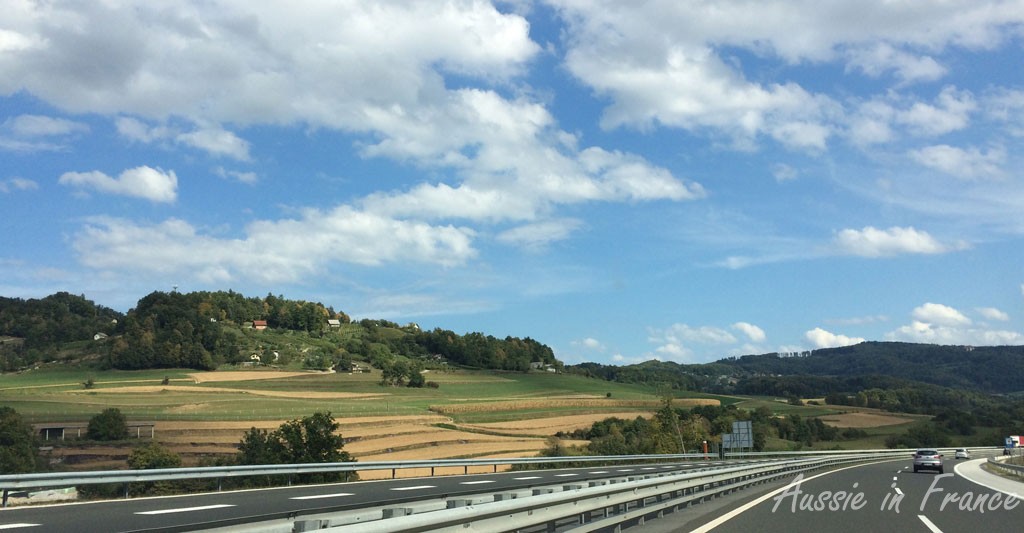
Whizzing past typical Slovenian countryside on the motorway
We’re staying two nights in an apartment in Zagreb because there are practically no hotels in the centre. Parking also seems to be a problem but there is a cheap covered parking lot less than 10 minutes walk from the apartment which is another 10 minute walk in the other direction from the historical centre.
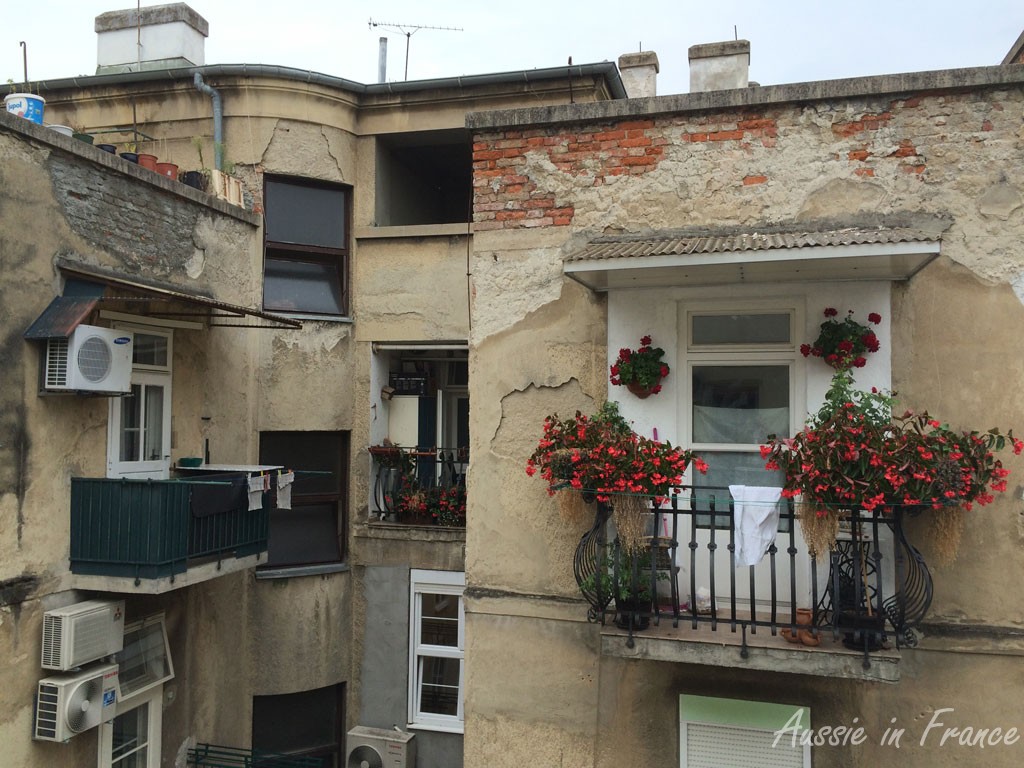
Our view from the little balcony of our apartment
This is not Italy as far as apartments go, but it’s not the same price either. In Arqua Petrarca, we paid 100 euro a night against 66 euro here. Our Aba Zagreb apartment is spacious and clean (except for the windows), the bed is comfortable, the shower head needs soaking in vinegar to unplug the clogged holes, the floor between the bedroom and bathroom is warped and cracks at night when you walk on it and there is only two or three of everything (cups, plates, etc.) but otherwise it’s fine because we have our own vegetable peeler, kitchen knives and bread knife. I’m not quite sure how the apartment got it’s 9+ rating on booking.com!
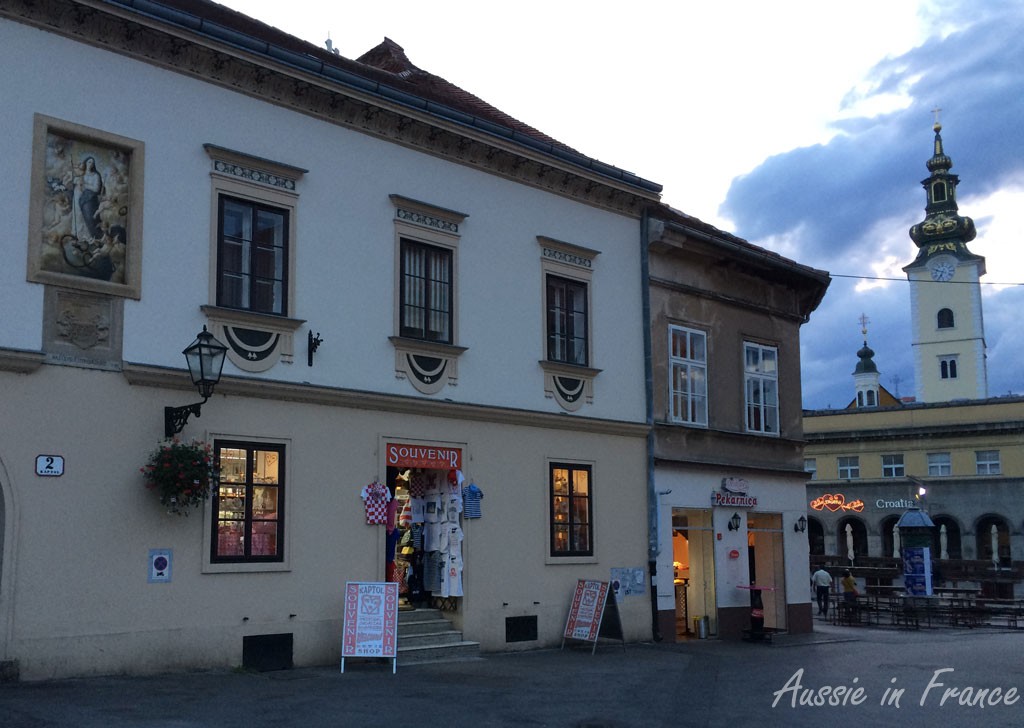
Zagreb at dusk
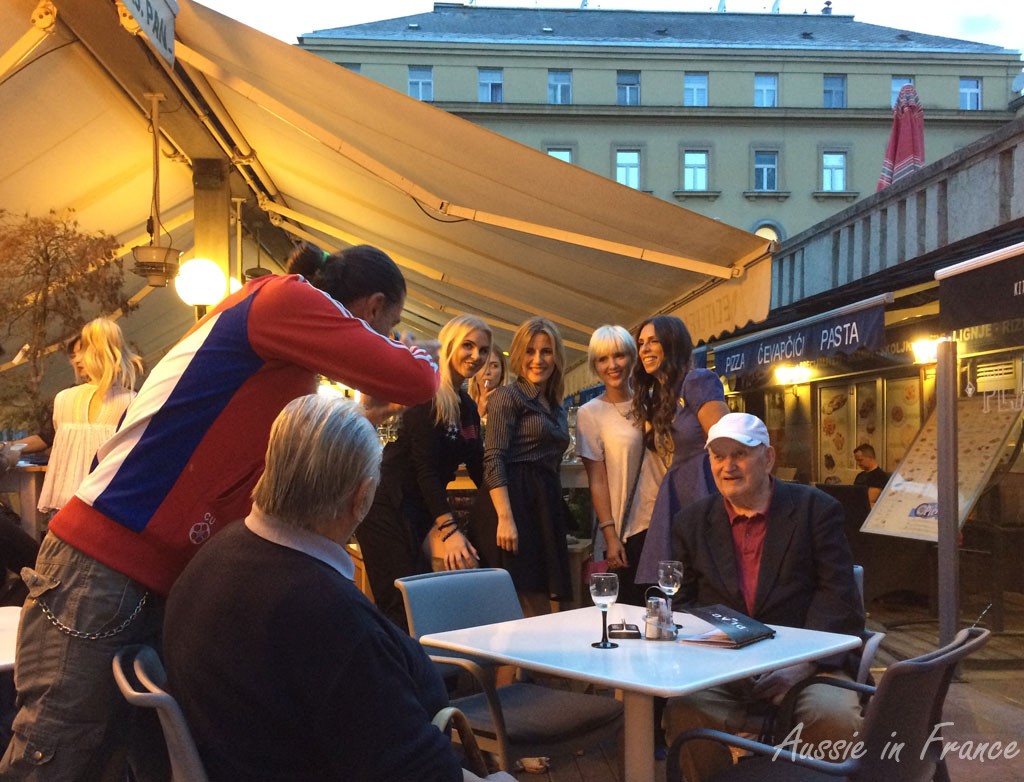
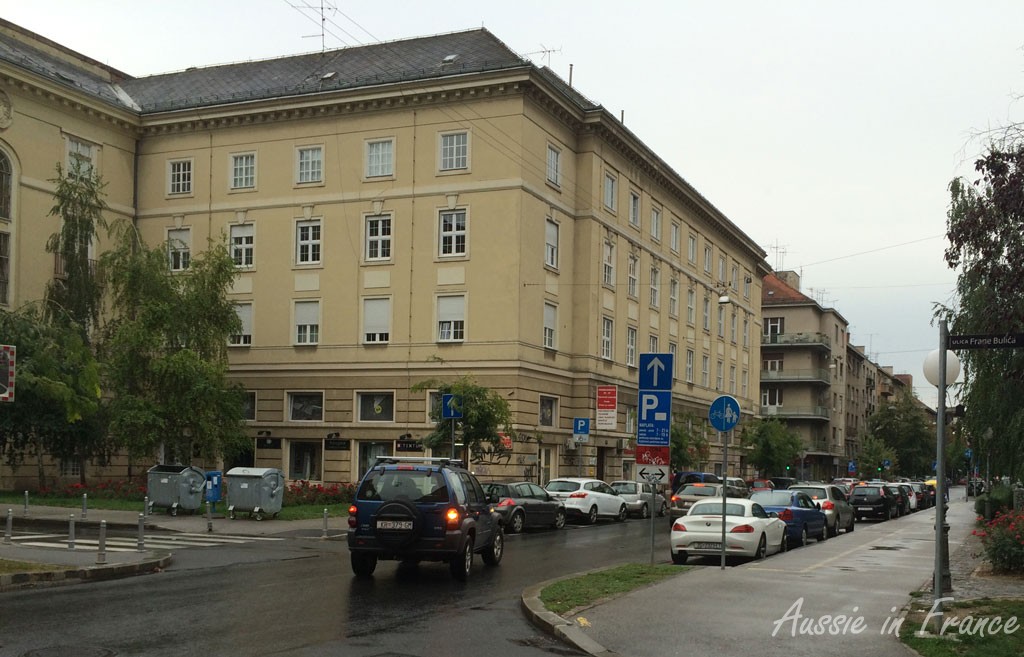
By the time we get settled, it’s dusk so we make for the old town. I always find that a bit of an adjustment is needed when we enter a former eastern block country because of the many contrasts between old and new, delapidated and renovated. Zagreb is no exception The historical centre is appealing though and we have a glass of wine near the market. – the glasses are 0.10 l and there are no nibbles to go with them. Next to us, a dozen or so young women are obviously celebrating something and have a photographer with them.
Maybe a hens’ party?
We make a mistake about dinner and end up paying 60 euro in a restaurant recommended by Le Routard (Balthazar) as being “medium priced” and serving local dishes. My entrée is frankly awful but Jean Michel has delicious pasta and freshly picked boletus mushrooms. We then have a small entrecôte with grilled vegetables accompanied by a house wine.
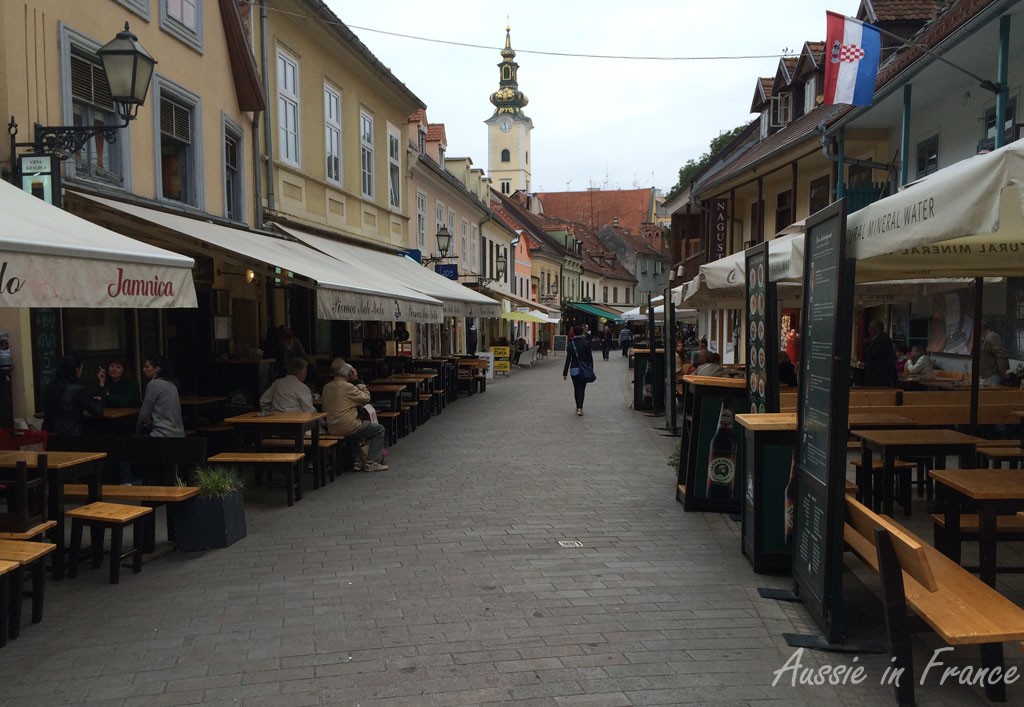
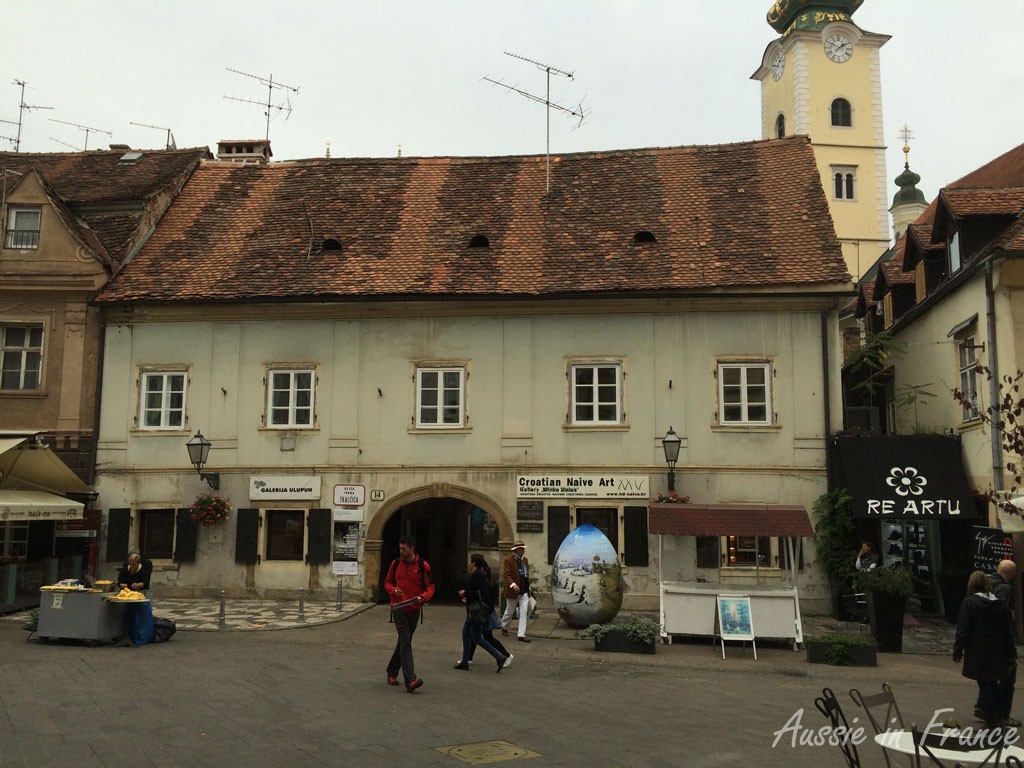
The “café” street, Tklaciceva
It’s next morning and we start with a cappuccino in the “café” street , Tklaciceva, which was once a river separating the Kaptol and Gradec quarters.
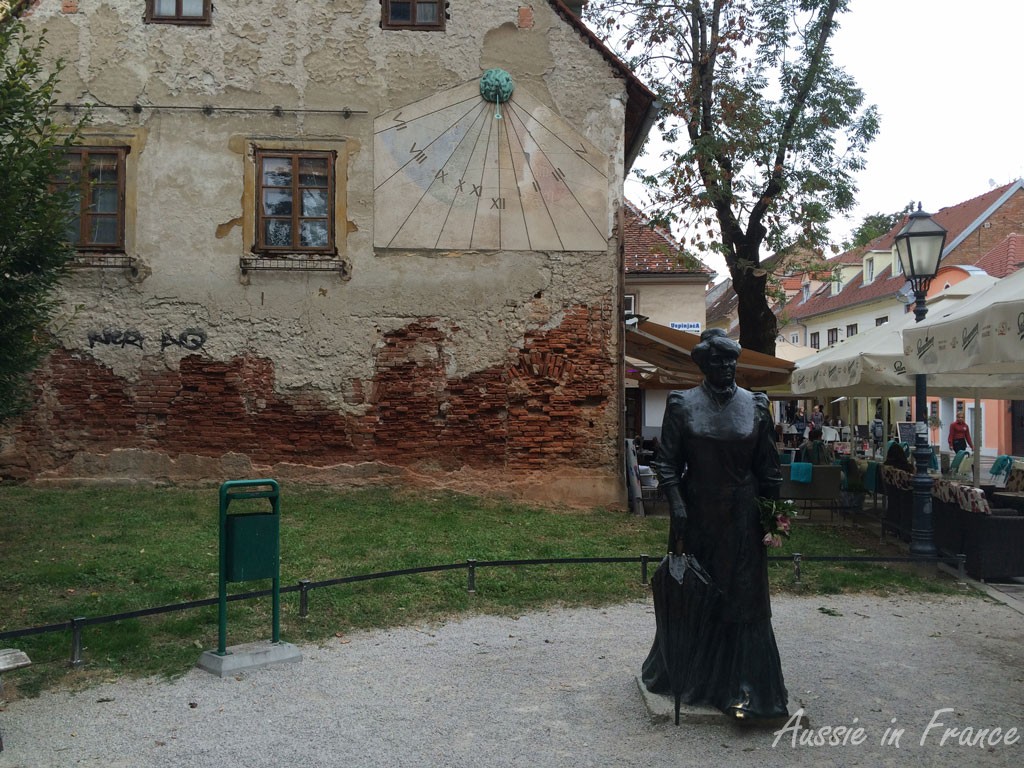
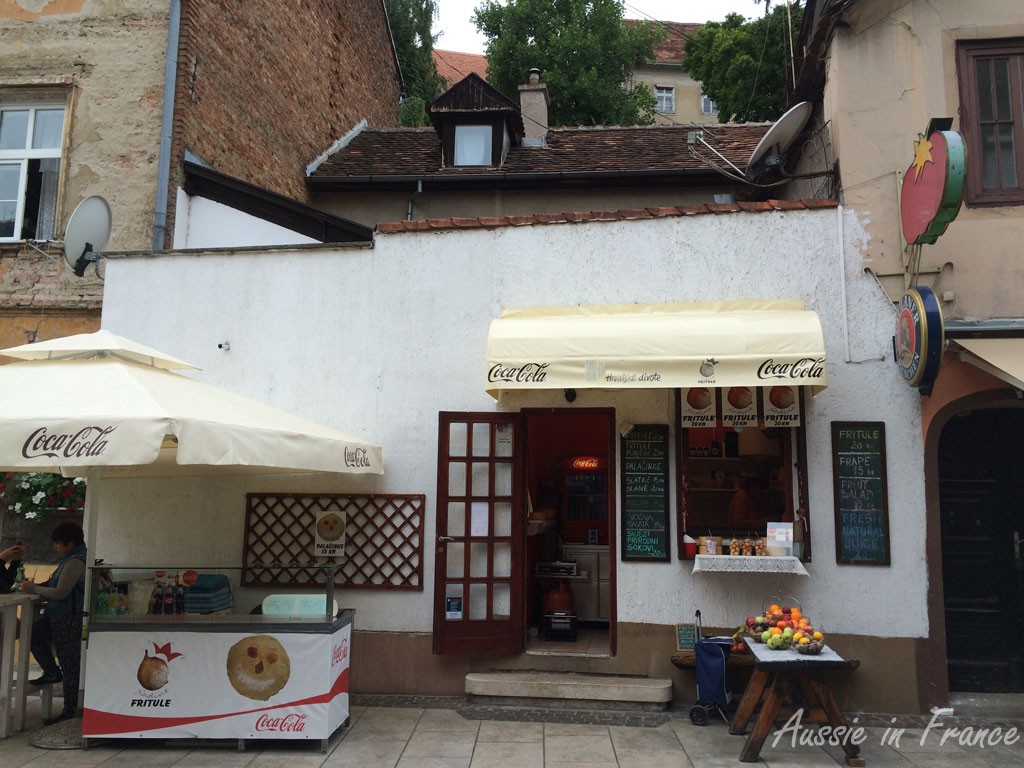
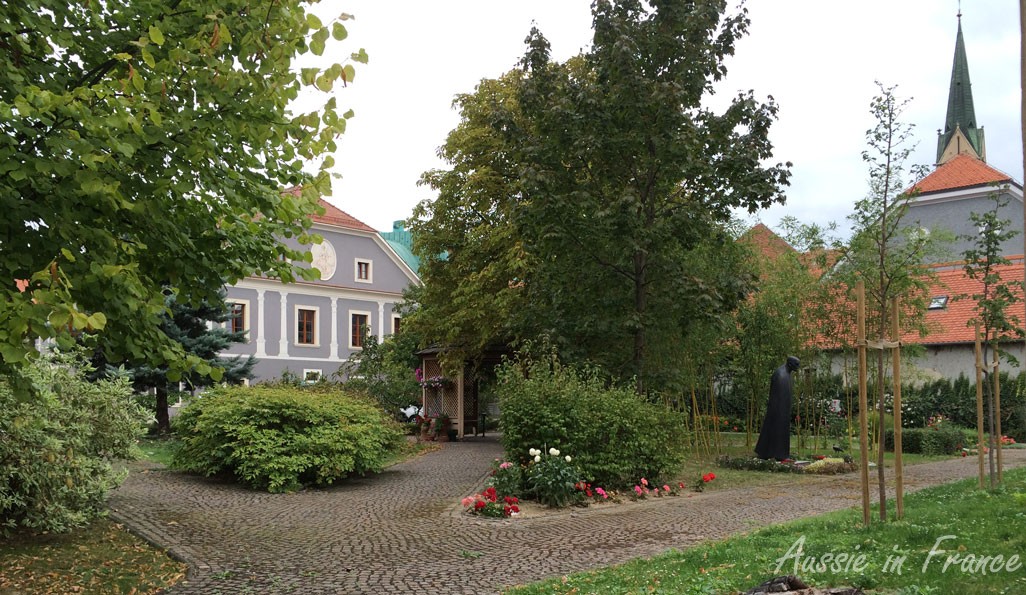
The first female journalist in Croatia, Marija Juric Zagorka, 1887-1957I love this little café which seems to have grown out of the wallA house and chapel just next to the cathedral hidden behind an iron fenceZagreb cathedral
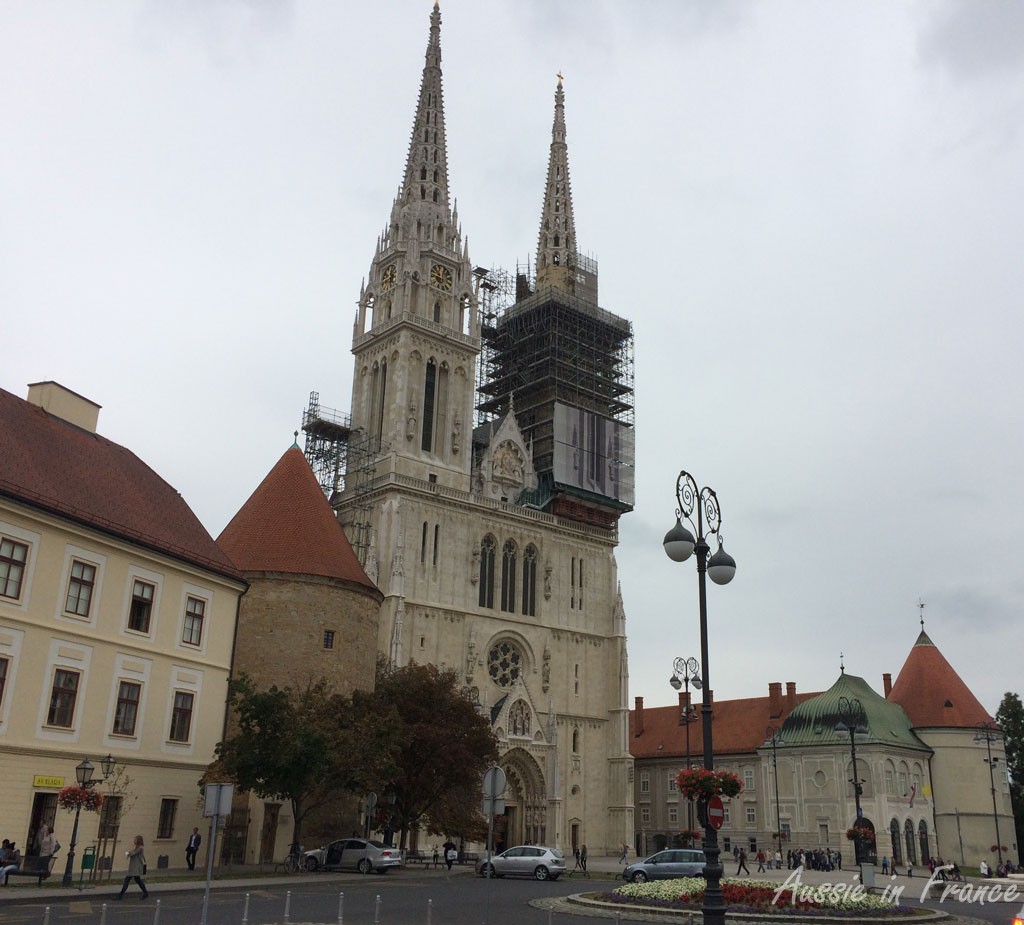
We go back to Zagreb Cathedral to visit the inside. It has led a chequered existence and was once at the mercy of the Ottaman invaders, which explains the towers on each side which are part of a fortified wall , the front part of which has been demolished.
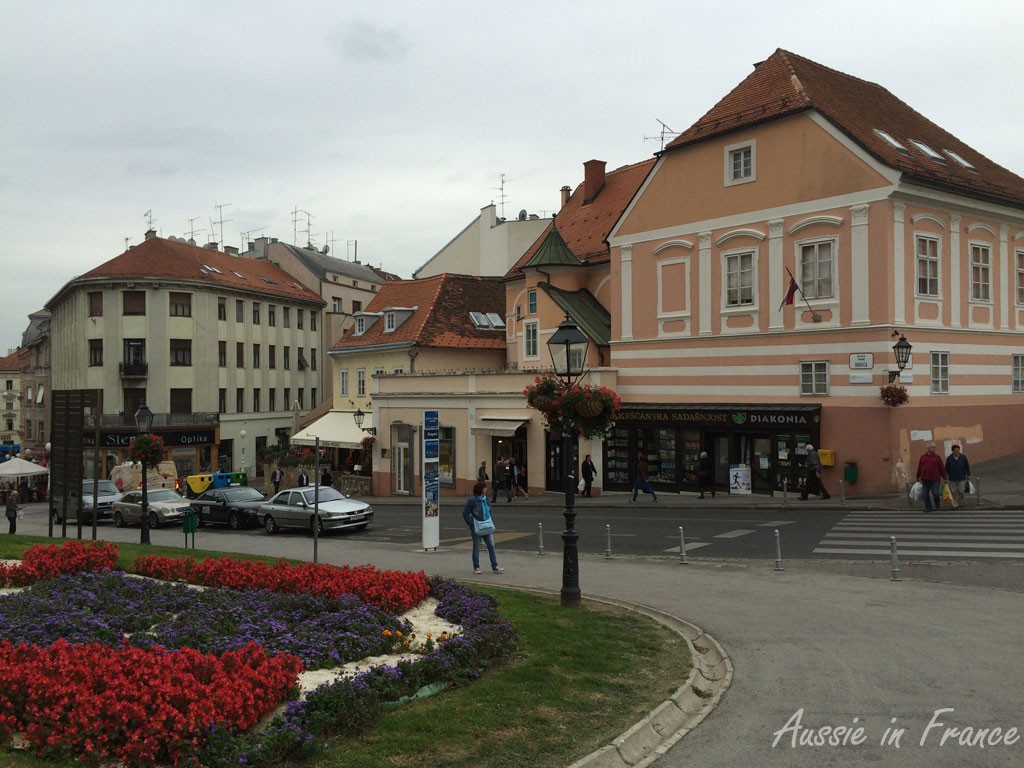
The buildings on the other side of the cathedral squareComparison of renovation and non-renovation
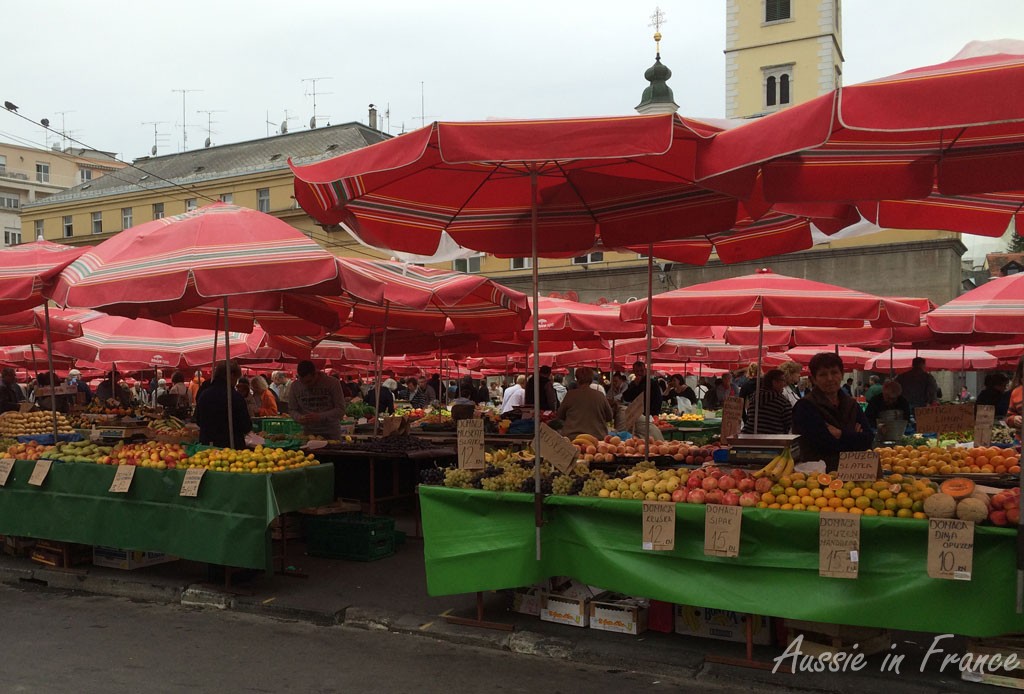
We return to Dolac market and are surprised to see so many local producers selling their own fruit and vegetables, We buy some figs, grapes and green beans from three different vendors.
Dolac market
We find a place for lunch called Nokturno that costs a quarter of last night’s meal and is just as satisfactory. It’s certainly “local” in any case.
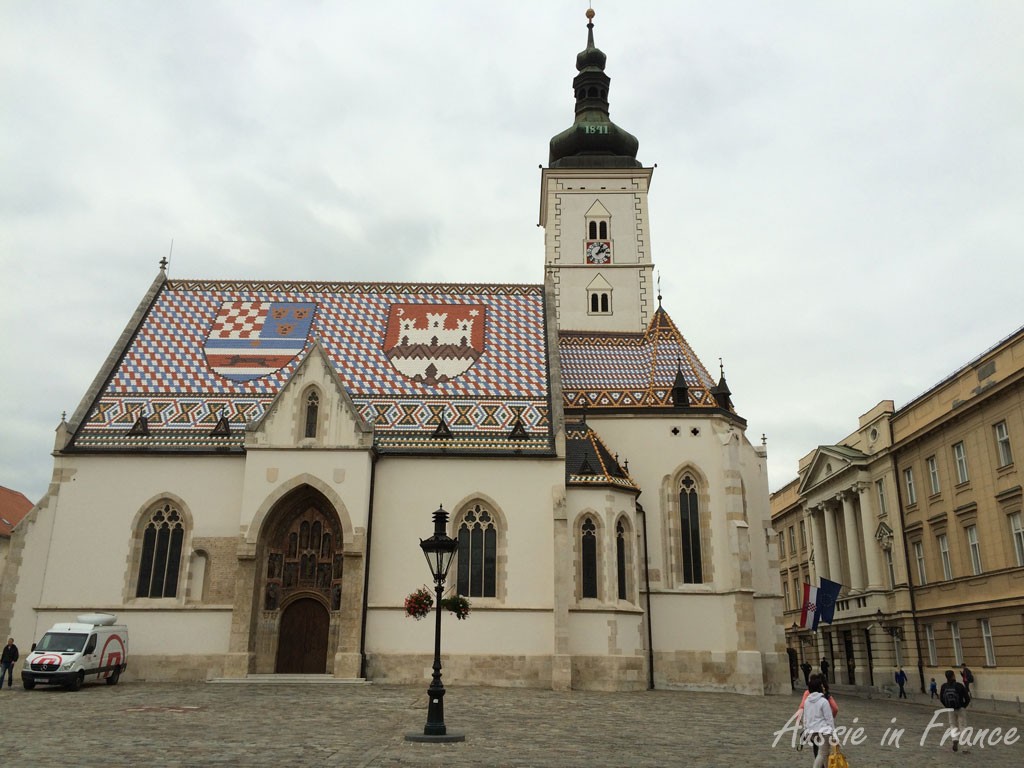
We Markov Church
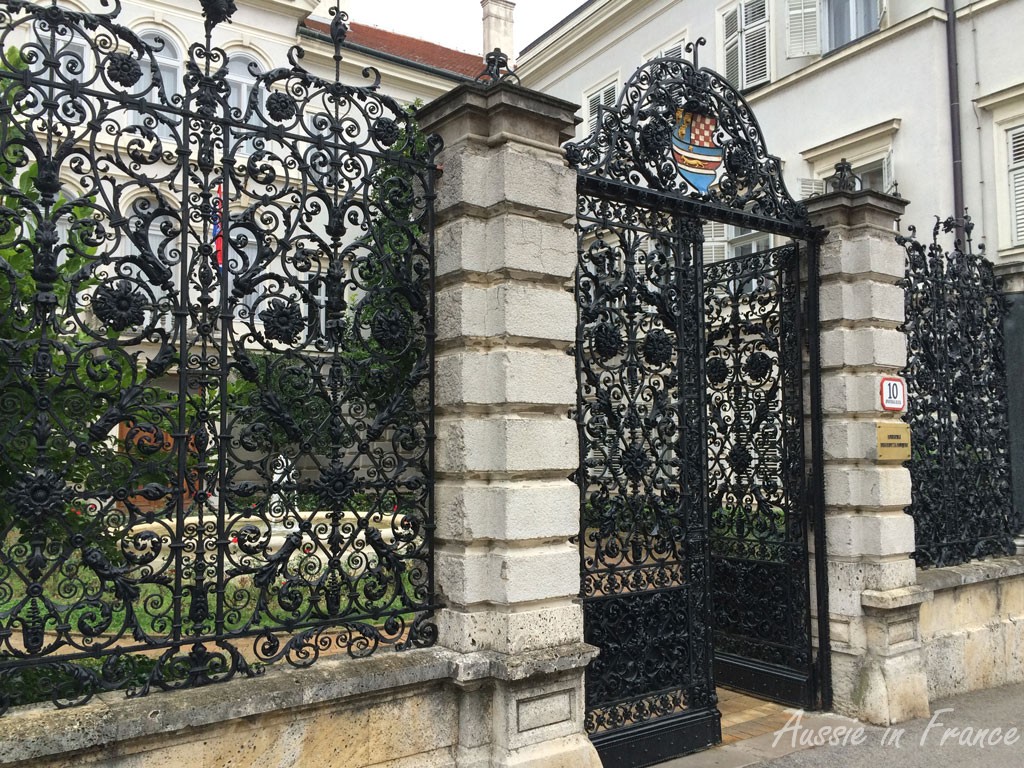
We walk up the hill to Saint Mark’s with Parliament House on one side and Ban Palace on the other. Something is going on. There is a TV reporter and a small group of demonstrators. I hear the word “discrimination”. We go in search of a wrought-iron gate mentioned in our guide book and designed by Herman Bollé. Just then a downpour begins and we duck under a porch. The weather forecast said overcast but no rain so we don’t have an umbrella. Sigh.
The wrought iron gate designed by Herman BolléSweet corn sellers at the end of Tkalciceva street
We make a dash for a café and have an espresso while waiting for the rain to stop. We talk about our next destination. This morning we had decided to drive to Split on the Adriatic and take the ferry across to Ancona in Italy, because of the current immigrant problems and the large number of border controls being restored in this part of the world but we now think we should go to Serbia anyway and resume our cycling itinerary along the Danube.
The outside of our apartment building
We go home and check the weather forecast. We learn that the temperatures are going down in most places along the Danube in this area over the next few days, then going up again next week. So we book a hotel for a night on the Danube in Belgrade for an astonishing 31.50 euro. The Serbian capital is only about 3 hours away so we’ll be able to cycle along the river and visit Belgrade by bike in the afternoon then move on further the next day, perhaps to Vidin where it’s supposed to be warm and sunny. Keep tuned!
After a rest day at our flat in Arqua Petrarca, the town where the famous Italian poet, Petrach, chose to spend his last five years (he died in 1374), we are back on our bikes.
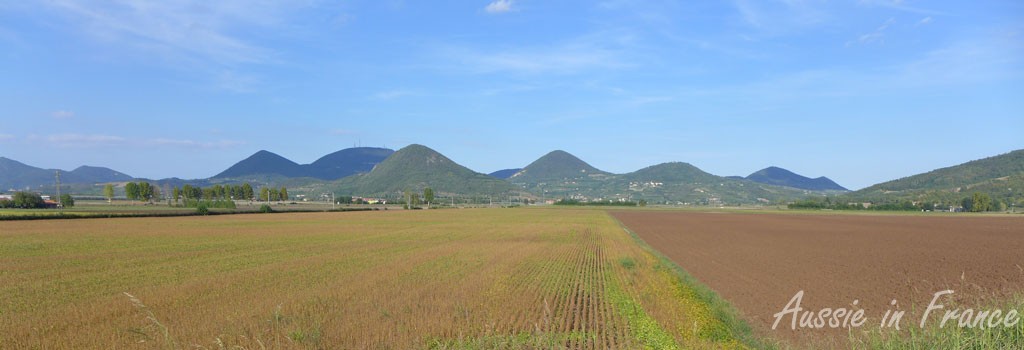
The view of hte Euganei Hills from the bike path leaving Monselice
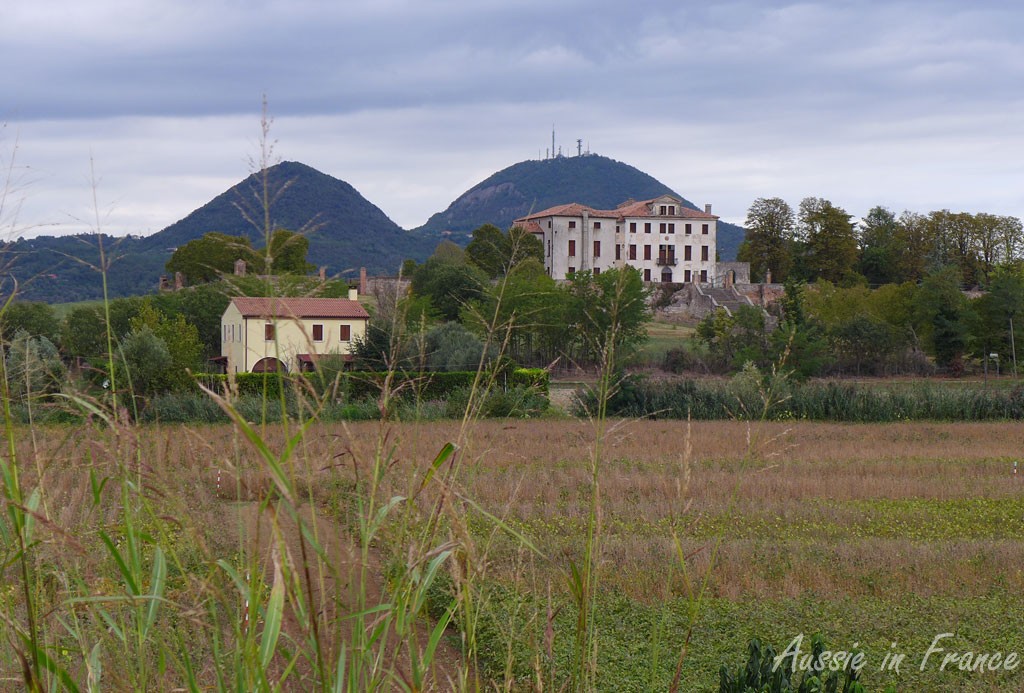
We’ve driven the 6 or 7 kilometers to Monselice and are following the official cycling itinerary that links up the walled cities of Monselice, Este and Montagnana and should total about 30 k. We set off on a sealed road along the Bisatto Canal which looks promising.
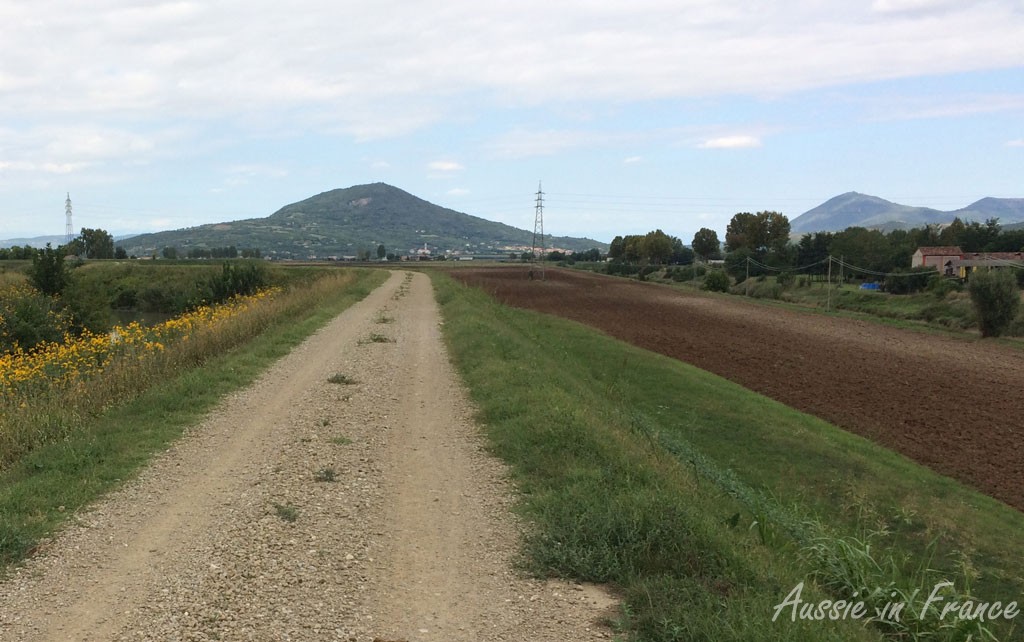
The easy gravel path along the Bisatto Canal
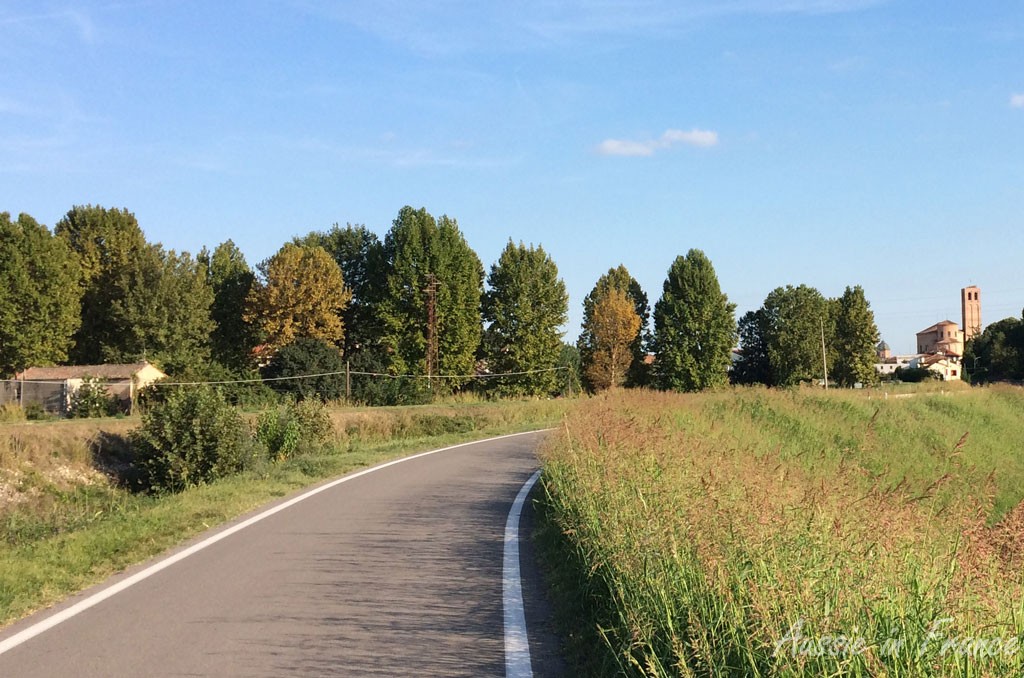
It lasts for 3 kilometers and then we are on a gravel road which soon becomes somewhat worse for wear. We come to a fork and see a big sign announcing the Colli Euganei route but nothing to indicate our road. We eventually find it after crossing a bridge over the Frassine river.
The narrow bike path with the Euganei Hills in the background
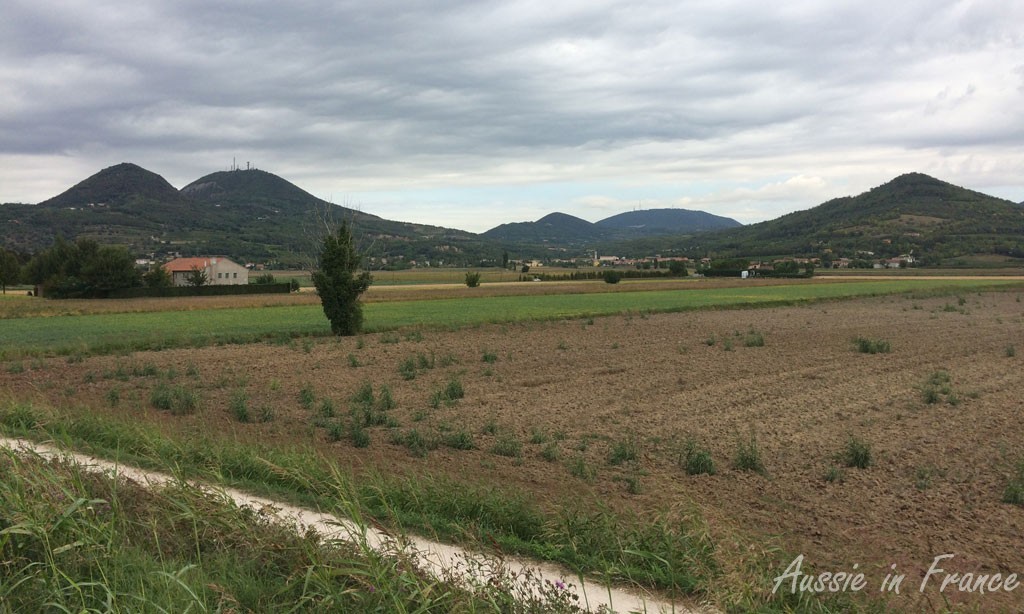
The bike road gets worse and it’s slow going but we have the Colli Euganei in the background to inspire us.
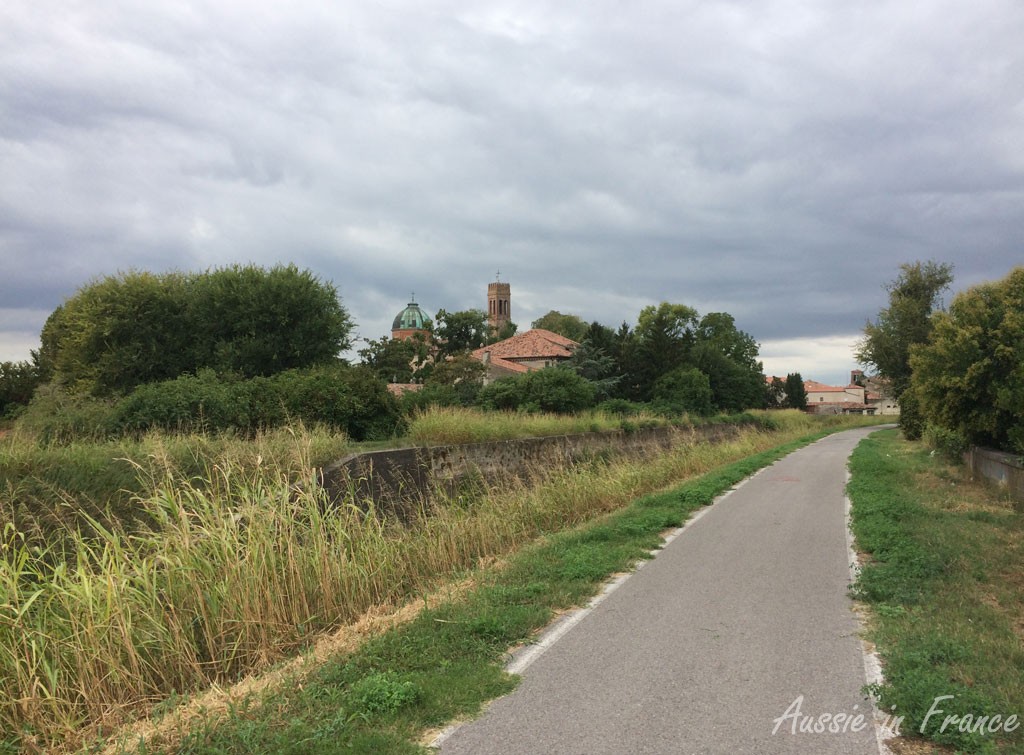
The sealed road approaching Este
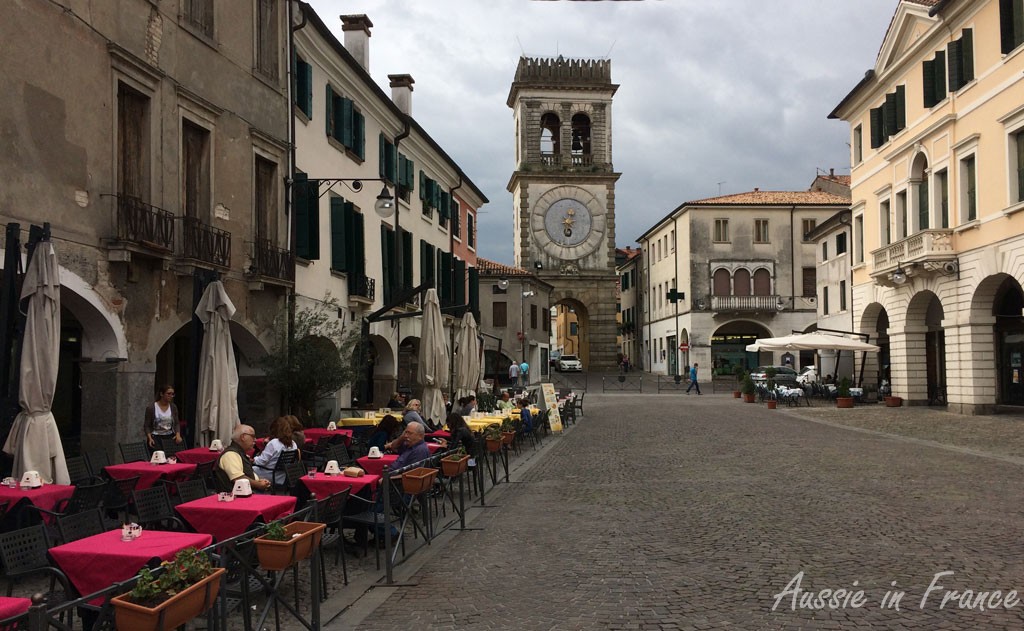
As we approach the mediaeval town of Este, about 10 K from Monselice, the road improves and despite the lack of sun, we appreciate the little town with its castle on one side and vast Piazza Maggiore with its municipal clock tower on the other.
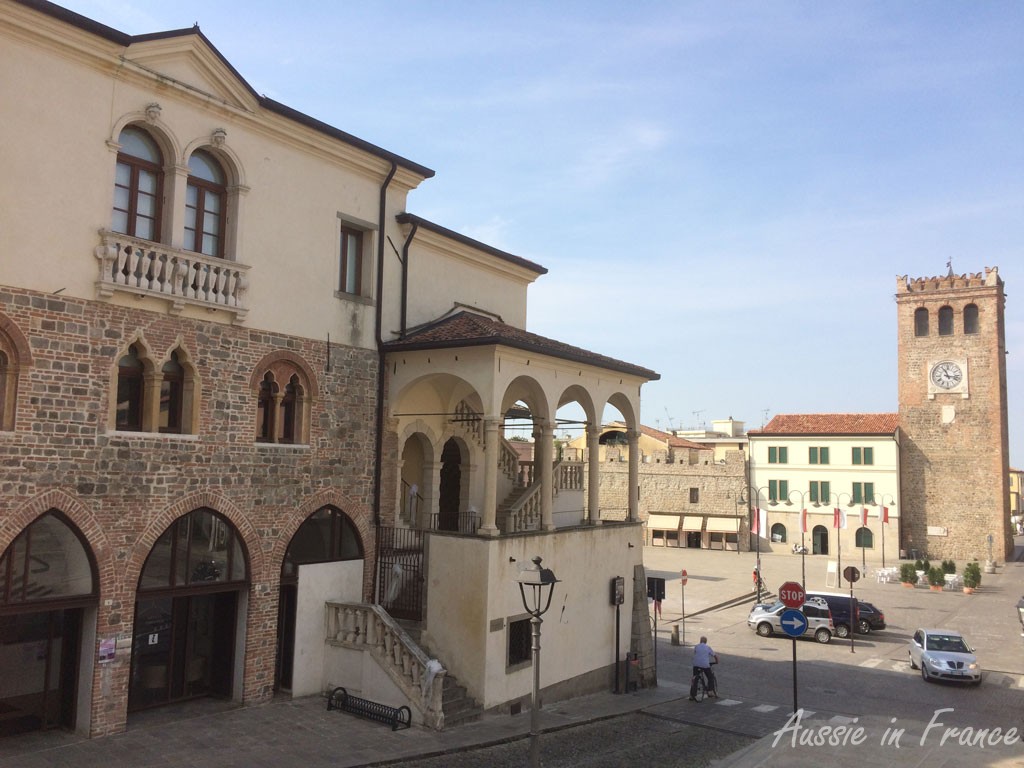
The town clock and main square in Este
We buy some food for lunch (it’s an intermittent fast day) and set off again.
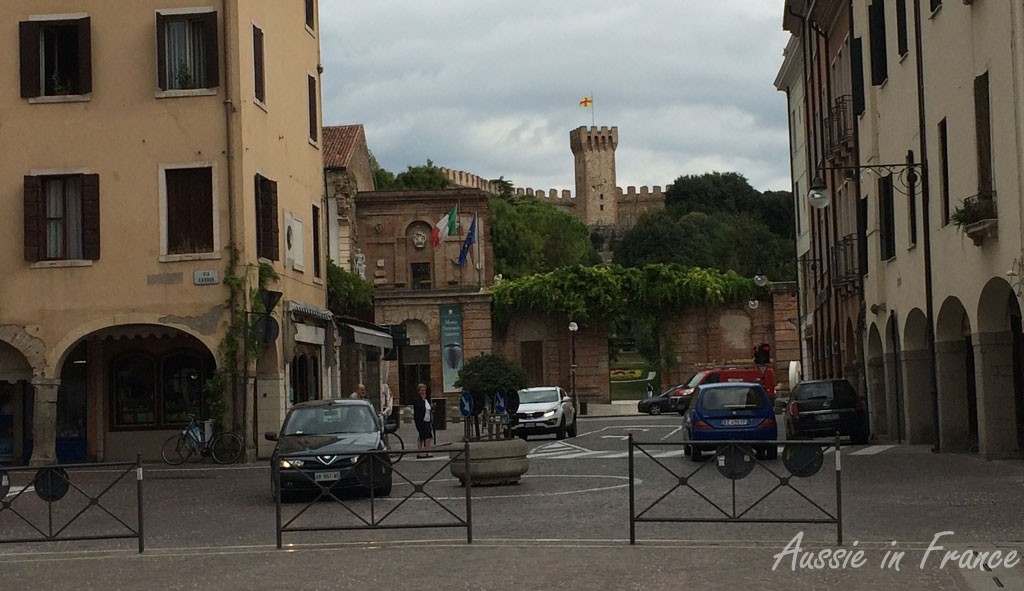
The castle in Este
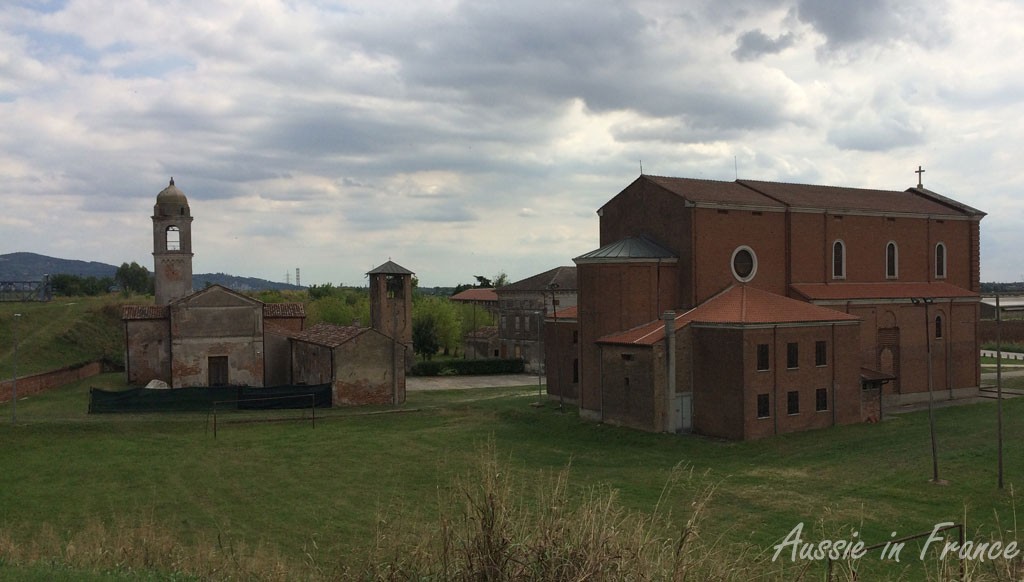
After a couple of kilometers of sealed road, we find ourselves on another gravel road along the river which slows us down again. We come across two churches side by side, one little and old and the other big and new. We have our picnic on a low wall. There is not a soul in sight.
The little church and the big church
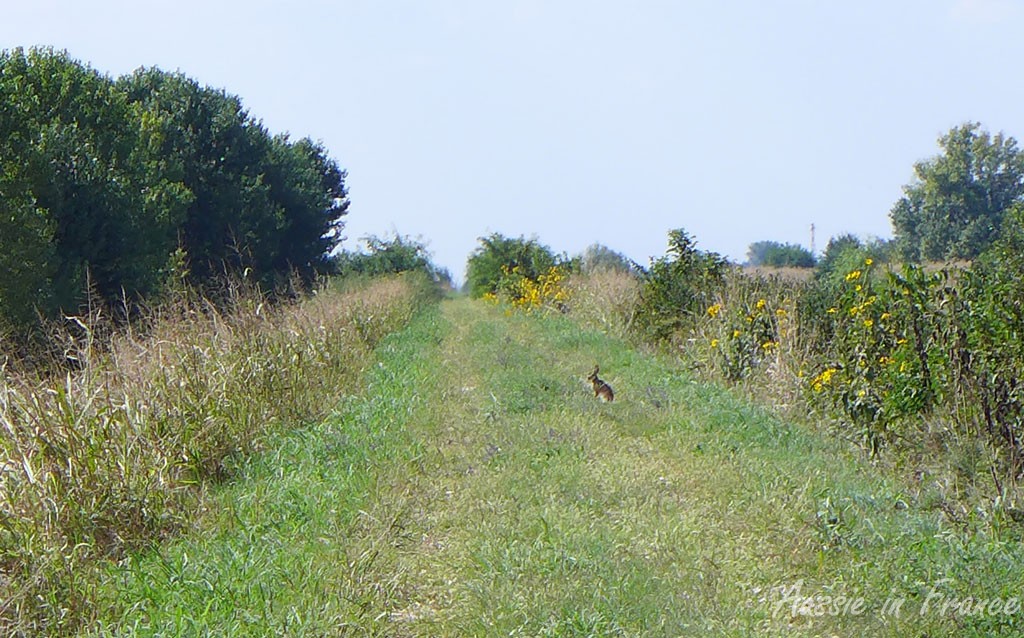
We continue the path along the river and it gets so bad that even Jean Michel, a truly seasoned cyclist, has to get off and walk part of the way because the stones are so big. We see a wild rabbit on the track that doesn’t run away until we’re practically on top of it. We eventually find a very steep stony road leading down to a sealed road and head for what we think is Montagnana.
Rabbit on the track
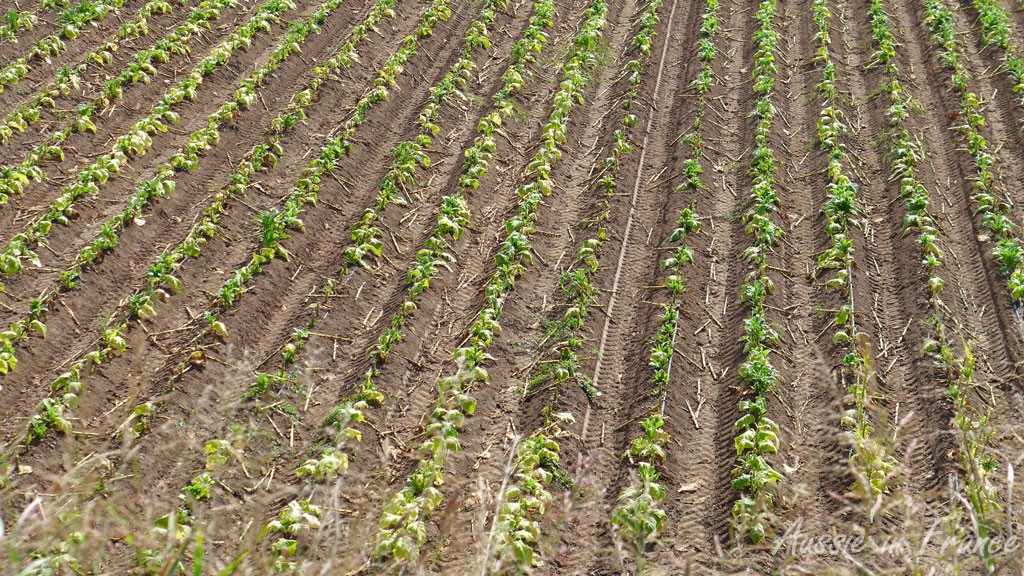
On the way, we stop and ask a farmer what his crop is. Jean Michel, a true country boy, has been intrigued for some time about the local crops. Soy, we are told. Ah, that’s it. However, we later realise that the crop Jean Michel actually meant is tobacco. We keep going until we finally come to a town called Saletto that is not on our map. Hmm.
Tobacco crop
We ride around the town until we see a sign saying 6 k to Montagnana. We ride along a busy road with large trucks whizzing past us at 90 kph, cursing the people who dreamt up the itinerary. They were obviously not cyclists !
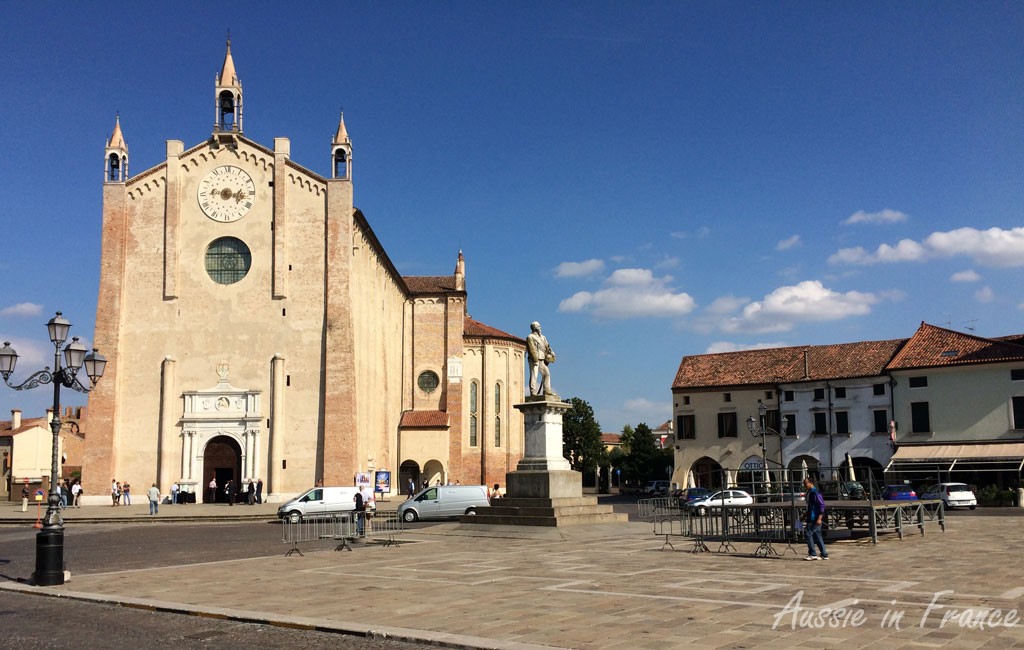
The cathedral in the main piazza in Montagnana
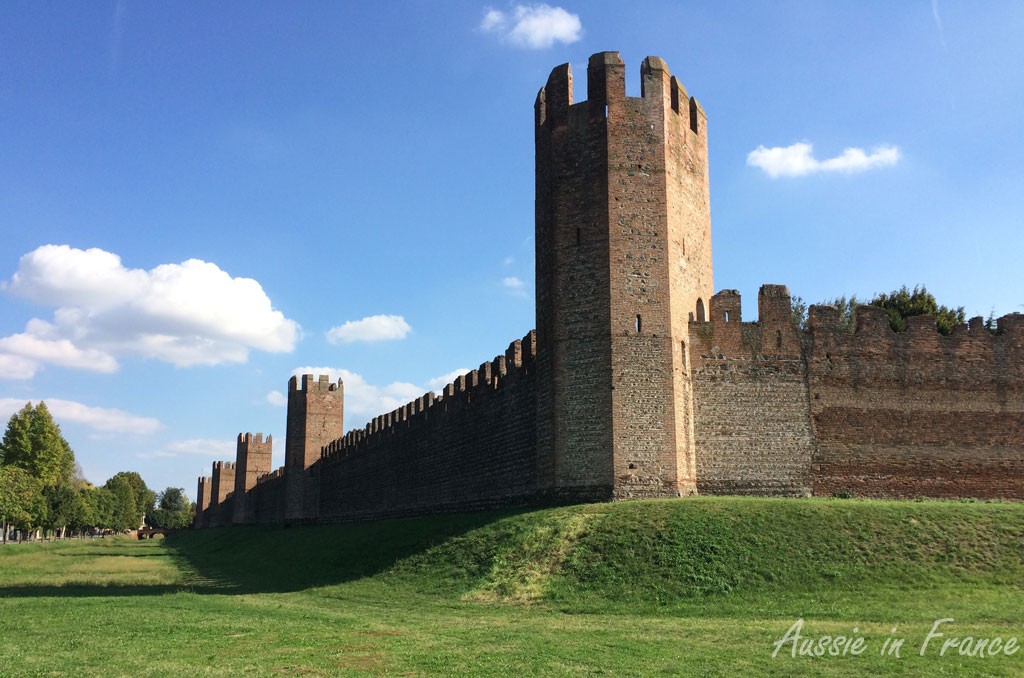
Montagnana turns out to be a 14th century walled city whose 24 x 17 metres high towers are still in perfect condition. We ride through one of the four gates and into the main square with its impressive cathedral and historical houses. There is obviously an important funeral going on so we don’t visit.
The walled city of Montagnana
We then ride halfway around the walls to have a more complete view of the town. By now, we have clocked up 39 k which is our usualy daily average. We still have to ride back again and it’s already 4 pm. We’ve identified an alternative route and are hoping it will be better than the official itinerary we have just taken.
Our alternative route home with sealed roads and no gravel
As we ride past farms and tobacco fields on a quiet sealed road running roughly parallel to the gravelly river path, we wonder why on earth anyone would even suggest using the other one. Our road starts getting busier as it approaches the motorway and we debate whether or not to rejoin the gravel road (we’re about level with our picnic spot) or cross the bridge over the river and try the road on the other side.
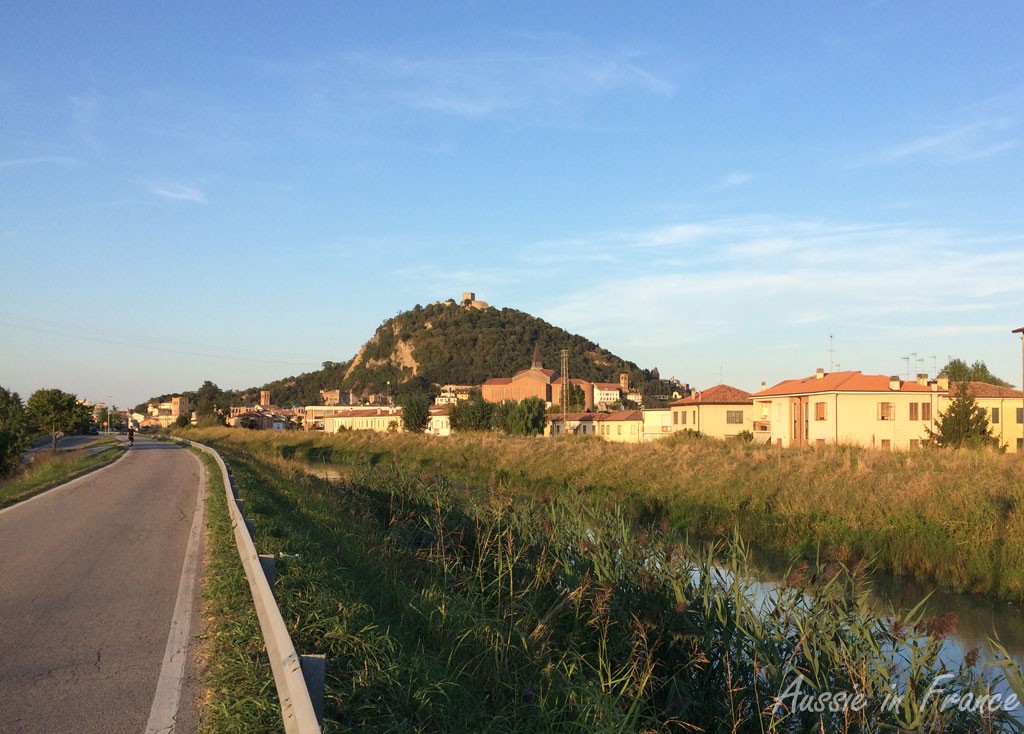
The hill on which Monselice castle is built
We vote for the alternative route and congratulate ourselves on our choice. We eventually have to leave the sealed road when it veers off to the left. We take another gravel road but this time it’s acceptable. When we reach the Bisatto Canal again, we have a sealed road once more. It’s then plain sailing until we reach the car.
The Euganei Hills just before Monselic on the way home at dusk
All in all, it took us 3 hours to cover the 39 kilometers to Montagnana and 2 hours to cover the 31 kilometers back – a total of 5 hours’ cycling and 70 k, the most I’ve ever ridden in one day! I can’t wait to get back to our flat but we have food shopping to do first.
The town clock in Monselice
It’s next day and we’re feeling a little sluggish after our long ride yesterday so decide to drive down to Monselice which we didn’t have time to visit yesterday.
The castle in Monselice
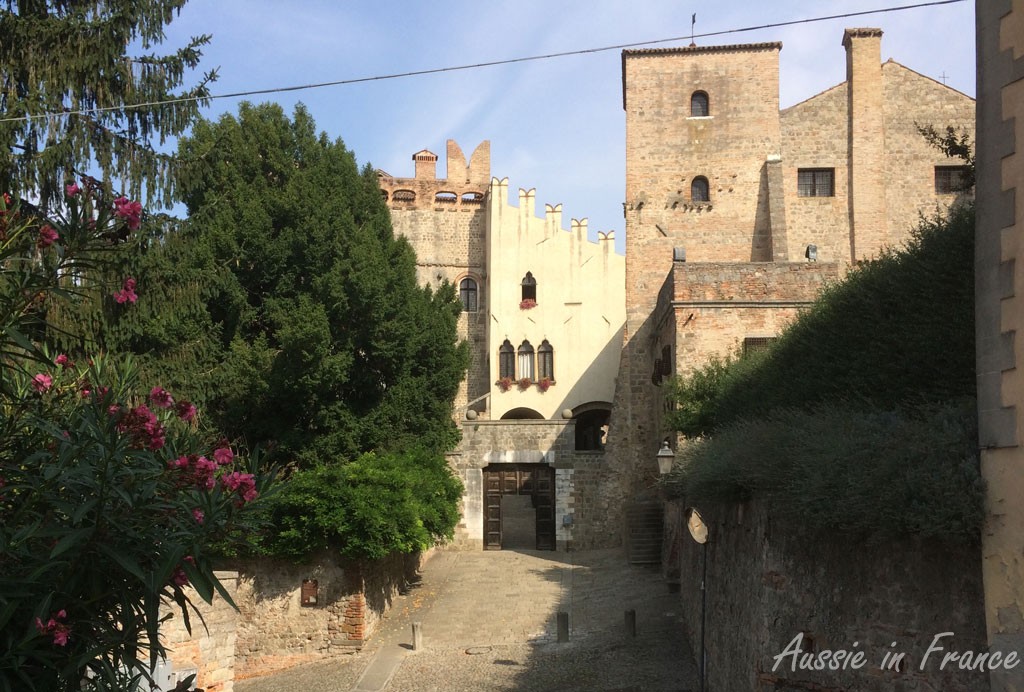
After a cappuccino and a pastry in what looks to be a favourite caffè with the local ladies, we explore the town. We walk up a side street to the Castello, a fortress dating from the Middle Ages and rebuilt in the 13th century.
The dwarfs on Villa Nani-Mocengio
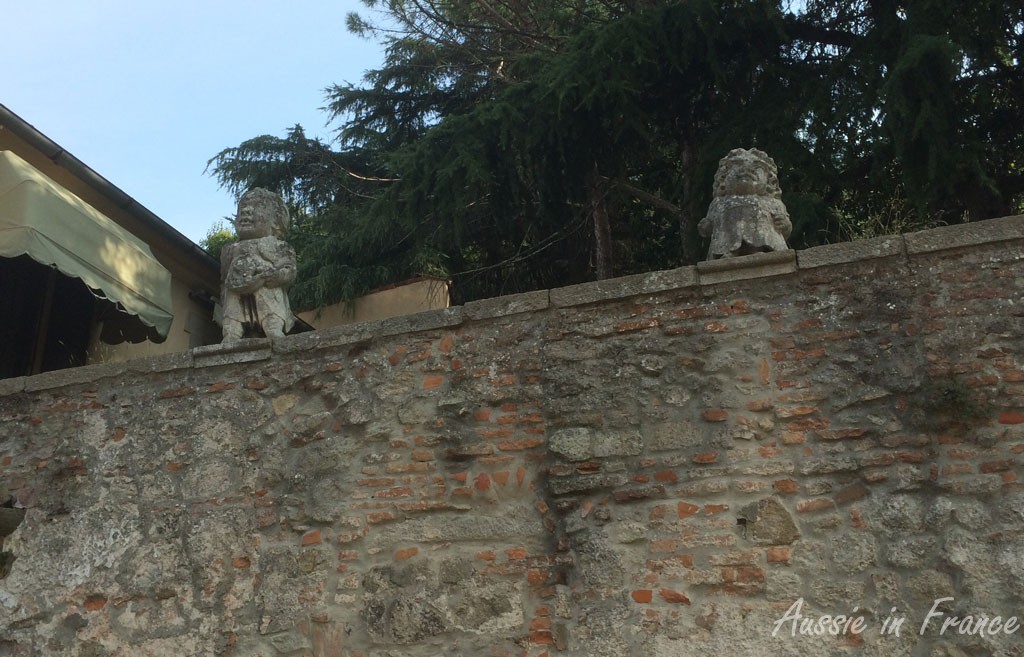
A little further up the hill is the Villa Nani-Mocengio, whose statues of dwarfs on the outer wall are most intriguing. They are an illusion to the noble family that commissioned its construction (nani means dwarfs).
Castello Catajo
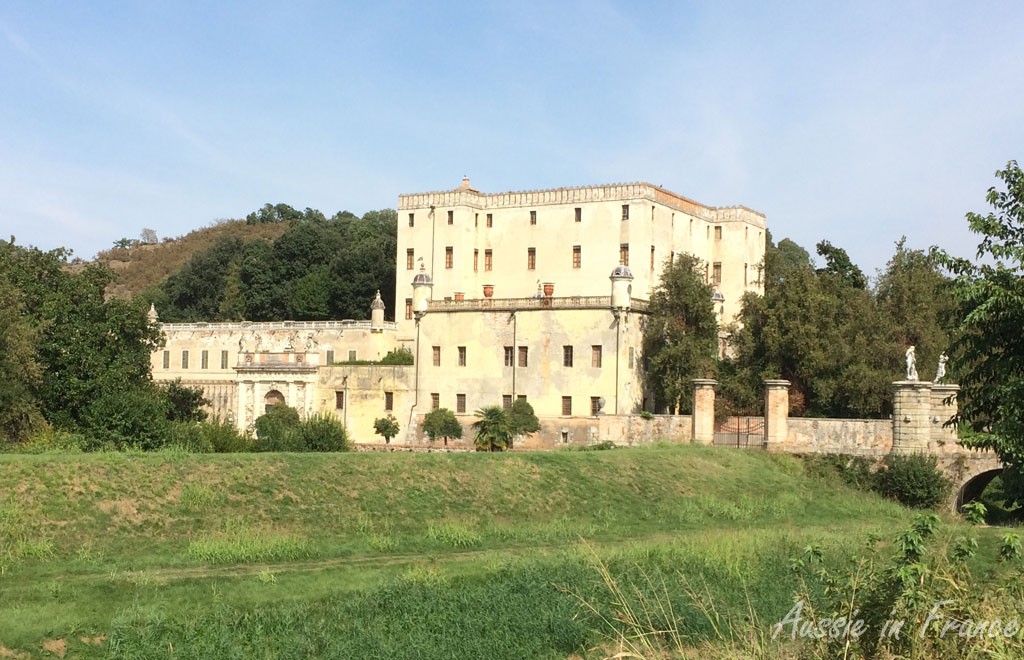
We have studied the bike route carefully this time and are avoiding any paths that are not sealed so we drive to Battaglia Terme 6 k away to leave the car. We take the incredibly comfortable sealed road along the canal to Montegrotto Terme past numerous vineyards and soy and tobacco fields not to mention to occasional castello.
Jean Michel and the bootmaker discussing Vespas
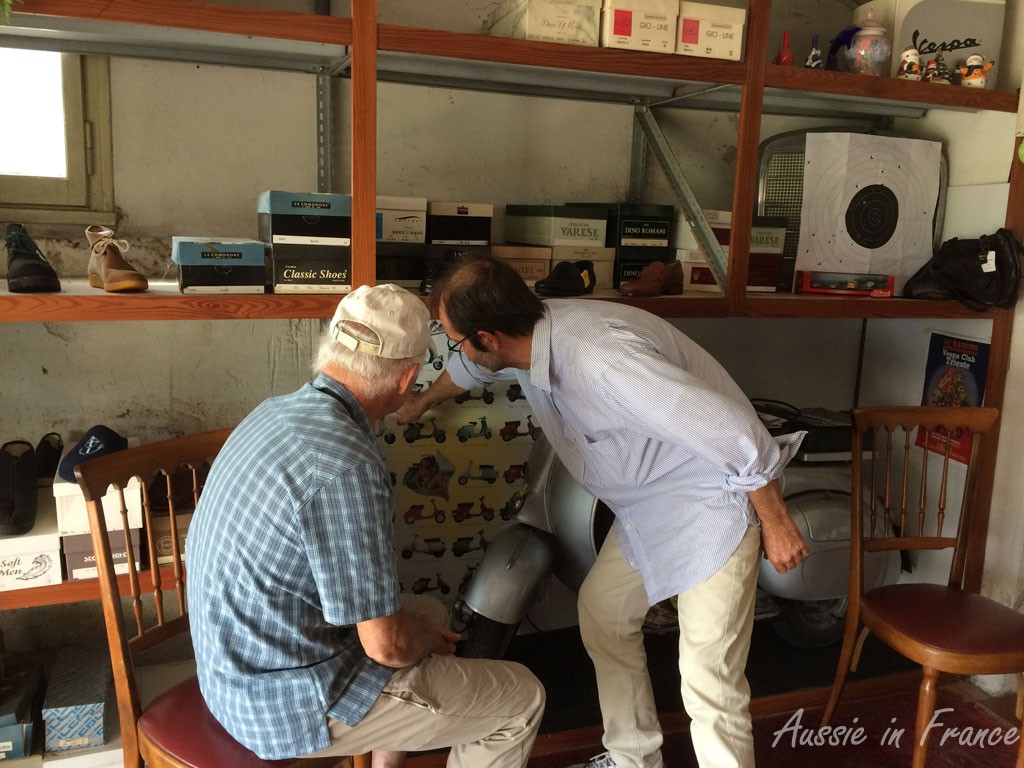
At the entrance to the town I spy a shoe repair shop and we stop to have the leather covering on my orthopaedic soles restuck – all in Italian, including a discussion about Vespa scooters between Jean Michel who speaks about 10 words of Italian and the shoemaker who is a self-proclaimed Vespa passionato.
Lunch at Osteria dei Fradei in Montegrosso Terme
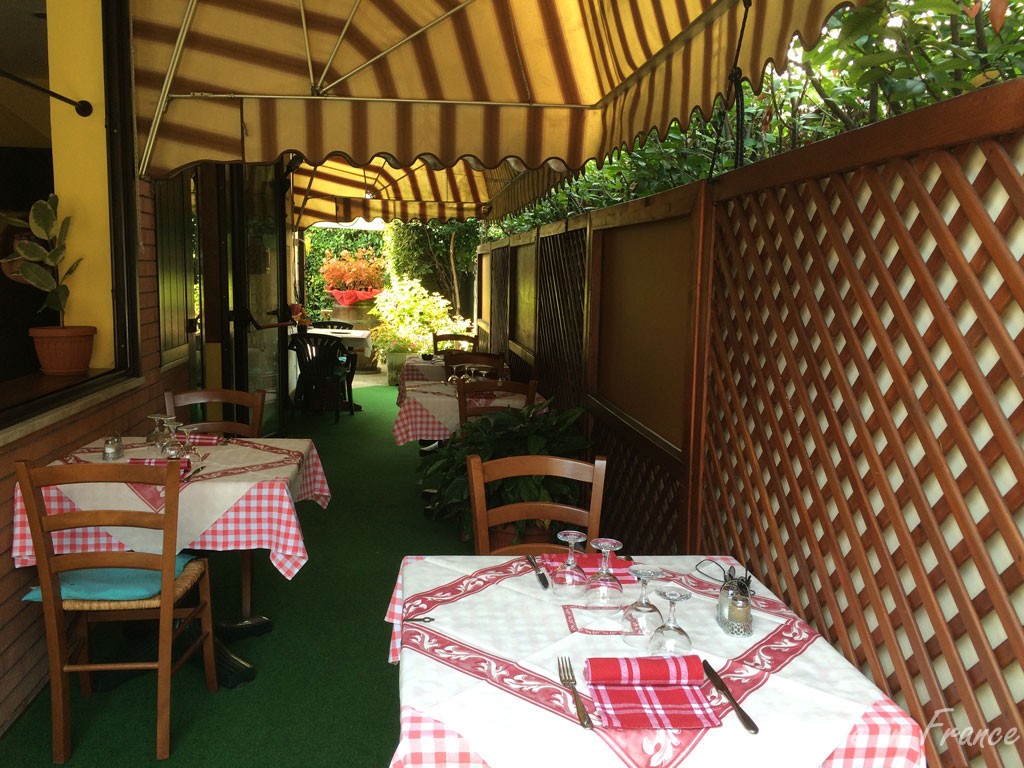
We continue into the town which is of absolutely no interest but we find a small osteria for lunch. The prices are the lowest we’ve seen yet – 6 euro for primi piatti and 8 to 12 euro for secondi. I ask what braciole is and am told it comes from the animal’s rib. Jean Michel immediately swaps from his mixed fish grill, thinking it’s rib steak. It turns out to be a small pork chop served with excellent chip potatoes.
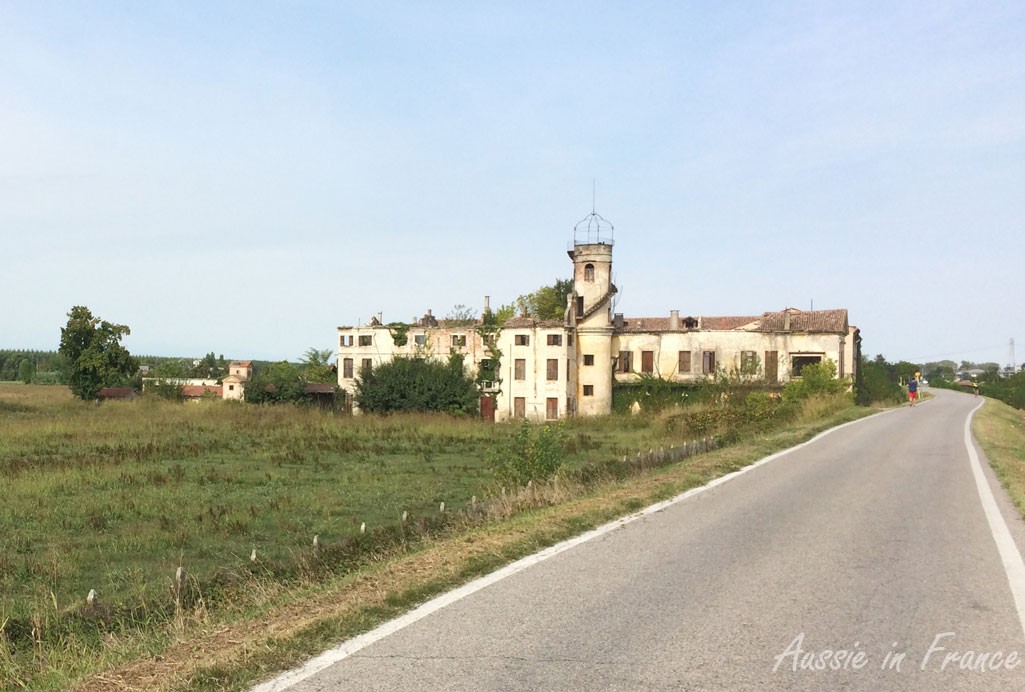
A delapidated building on the bike path
After also eating a side salad, we’re still hungry so order fusilli with basil and datterini, another new word for me. It means cherry tomatoes. Very tasty.
Building of Austrian influence at Piazza del Sole e Pace in Abano Terme
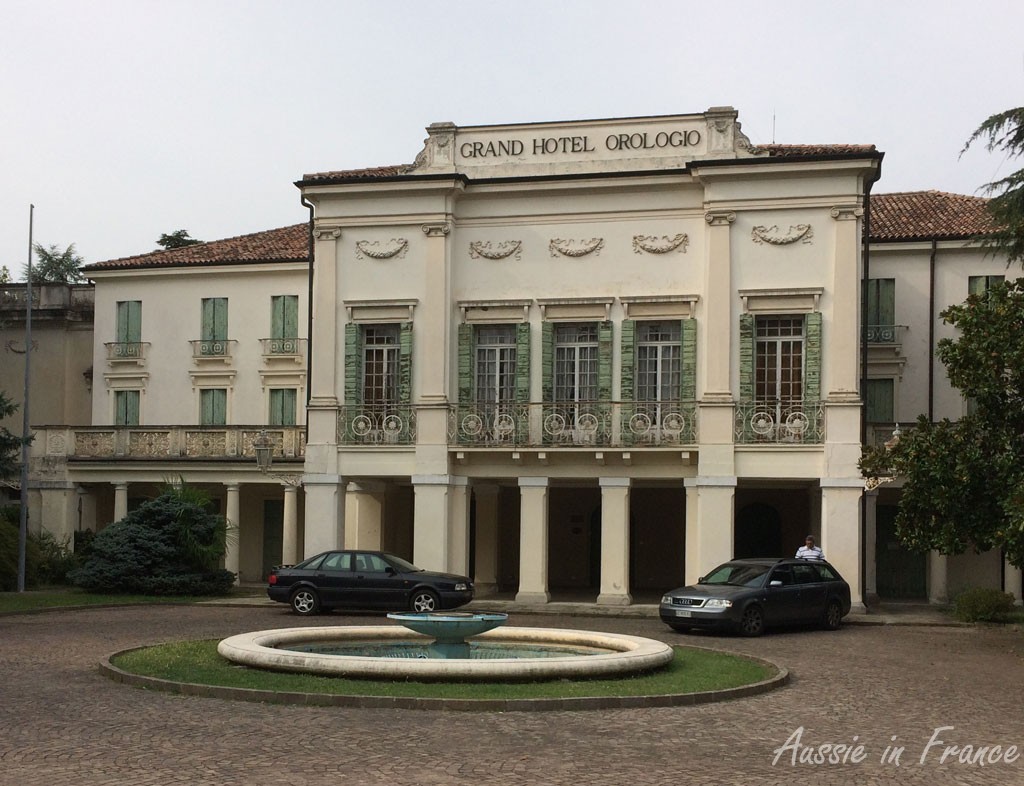
We then continue on to Abano Terme which I thought was just down the road. By the time we get there, once again on an easy sealed road, we’ve clocked up 20 kilometers. So much for an easy day! It turns out to be a spa resort with absolutely nothing to redeem it. I ask a policeman to direct us to the Piazza del Sole et Pace which the tourist office brochure indicates is of interest. He gives us directions and tells us we shouldn’t be riding our bikes in the centre. Hmm.
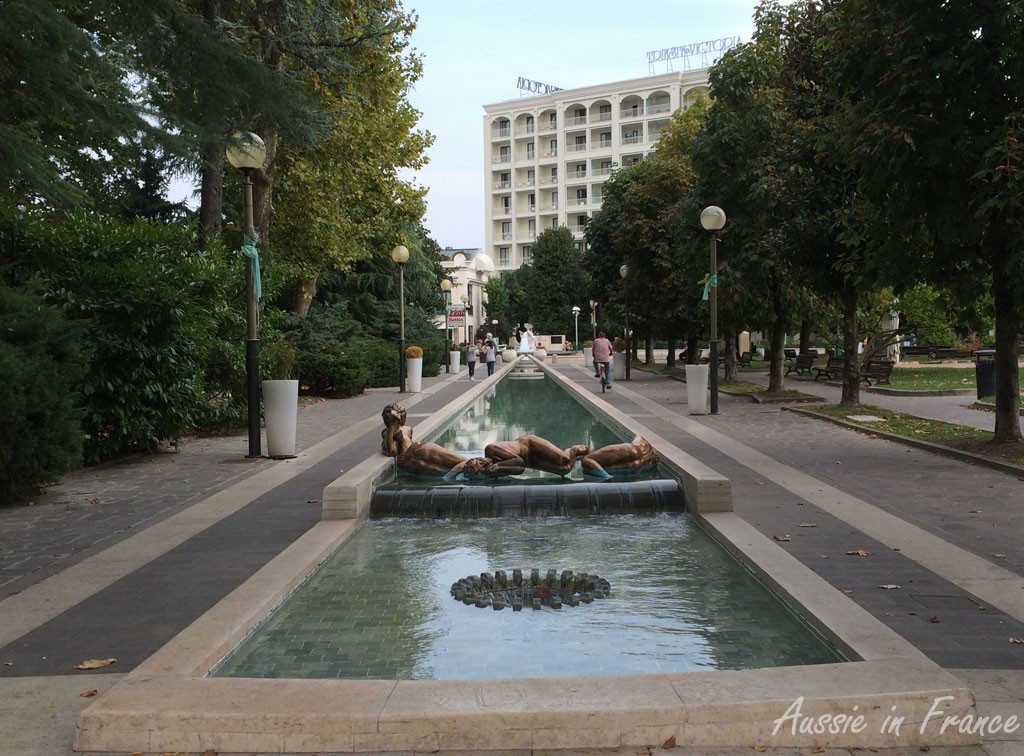
Sculptures in Abamo Terme
We decide to take the quickest route back to Battaglia for an ice-cream, then home. The ride along the canal is fast so we only take 2 ½ hours to cover a total of 49 kilometers, much better than yesterday’s slow going.
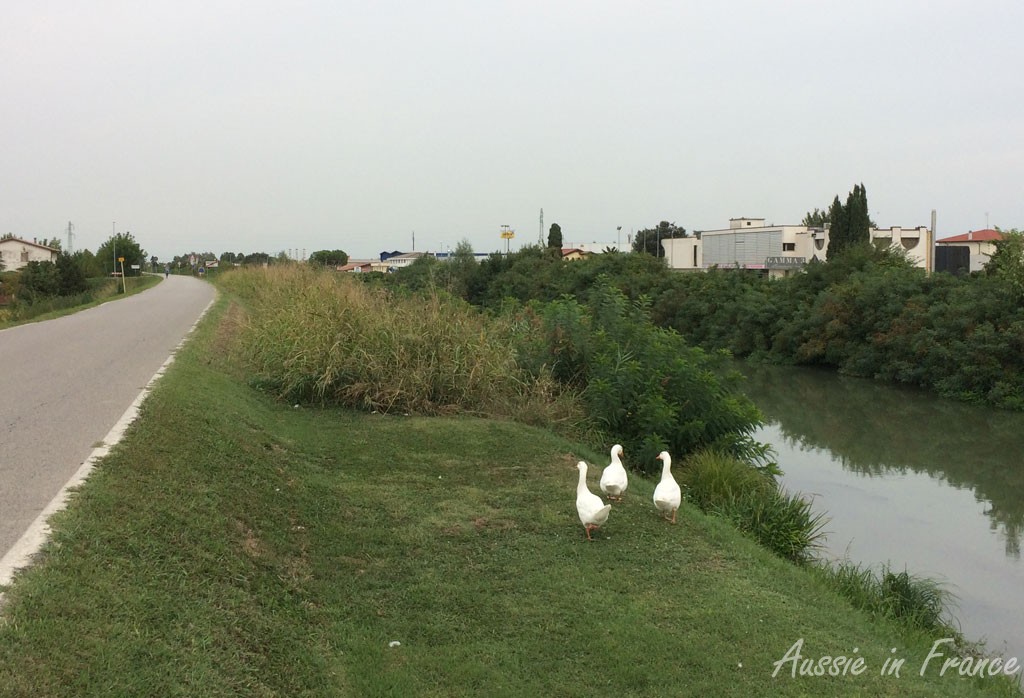
Three geese ont the bike path
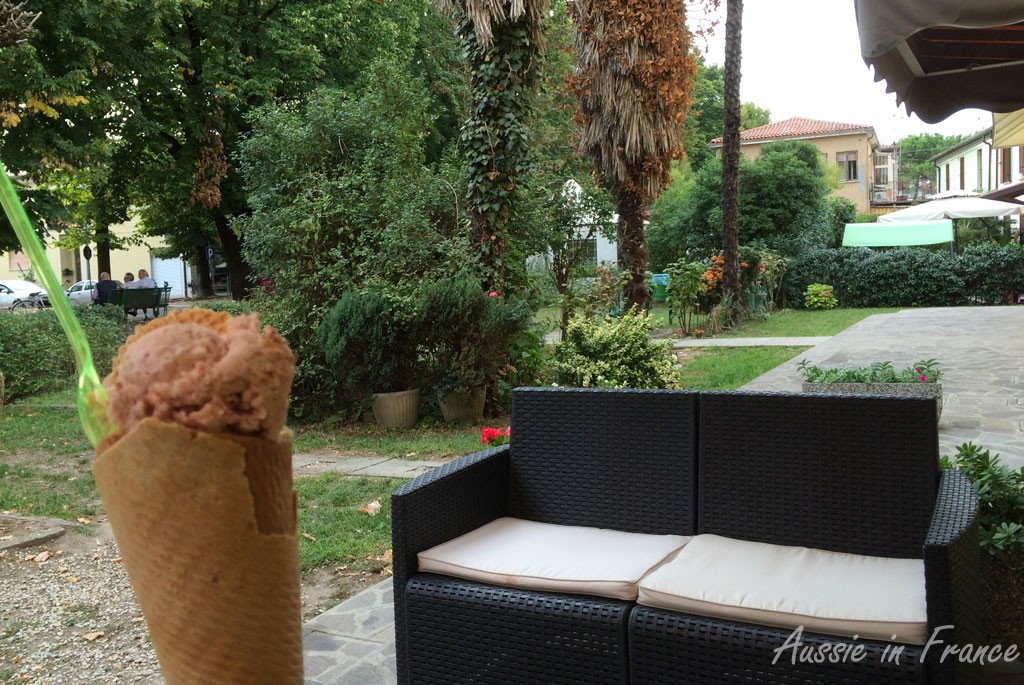
The ice-cream is delicious (chocolate, fiori di latte and fig in a very good cone) and according to the newspaper clippings in the window, has won many prizes. What a lucky find!
Ice-cream at the prize-wining ice-cream parlour in Battaglia Terme
Meanwhile, my bike speedometer is no longer working because the sensor has fallen off. I think I know when it happened yesterday, just as we arrived back in Monselice, but there is little chance of finding it so I ask in the ice-cream shop for a bike shop. The lady looks at me with astonishment. In Battaglia, she says, I don’t think so, then asks her husband who’s chatting with a customer. Of course, he says, and the customer starts explaining how to get there.
I ask him to come outside an point the way, lentamente per piacere I understand it’s on the other side of the canal. Bingo! We are able to buy a new speedometer and a second tyre because Jean Michel says the other one on my bike is pretty worn as well and we need to be prepared for another puncture.
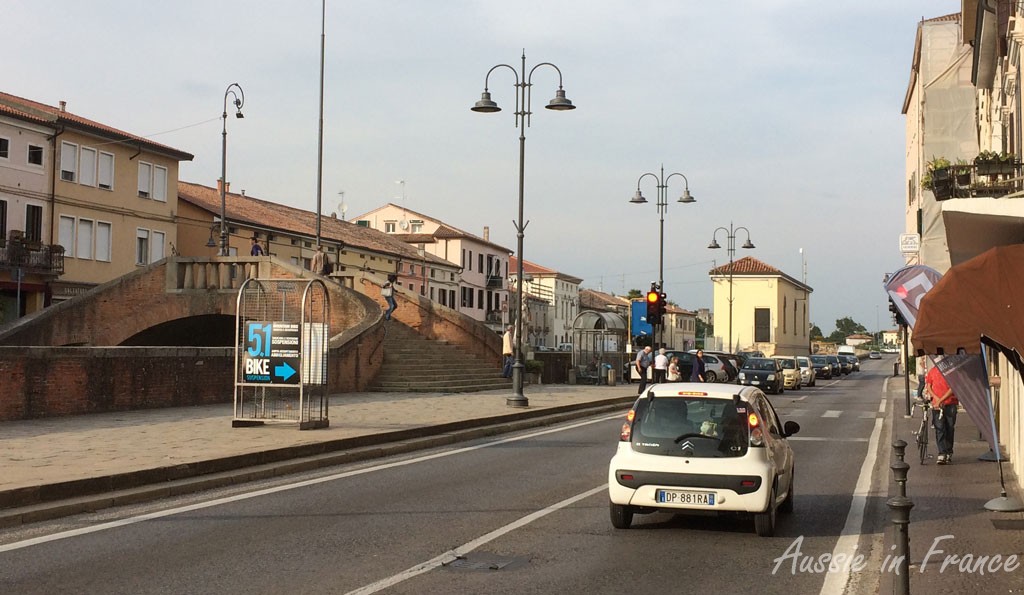
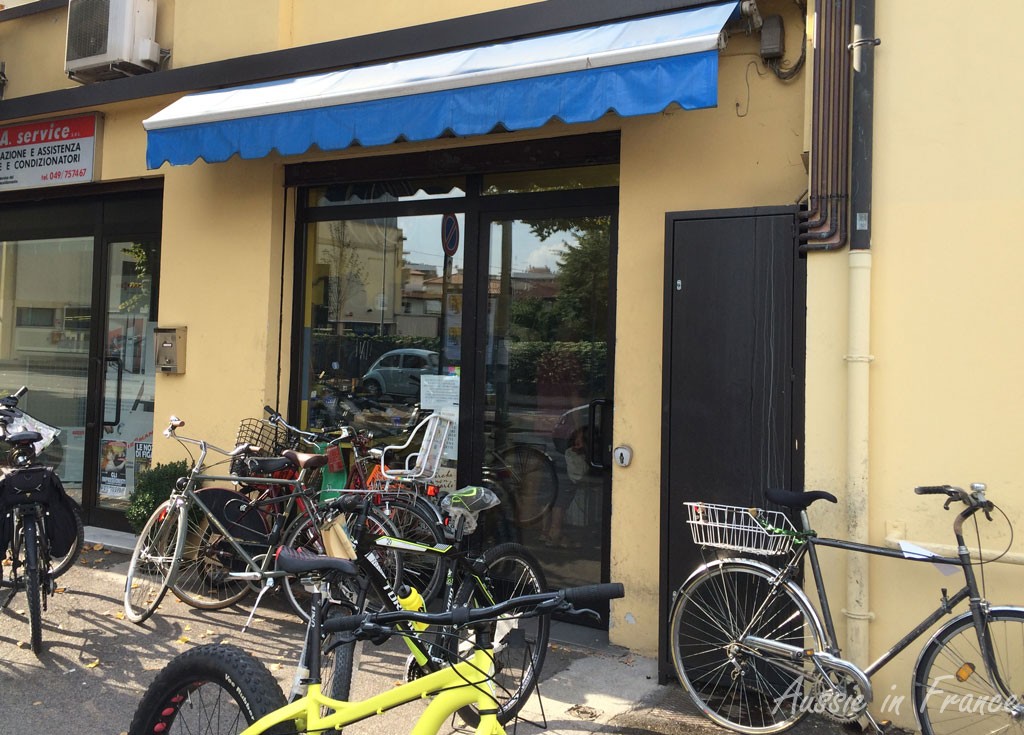
The 51-bike shop on the main road in Battaglia Terme
We arrive back at Zorzi apartments in Arqua Petrarca at 6 pm, practically a record these days and are able to spend some time in our little garden. We’ve decided on the next stage of our trip – two nights in Zagreb, which is 5 hours away, then onto to the Danube, starting at Nova Sad if the weather is fine, or further along if it’s not! The current immigrant events may also force us to take another route.
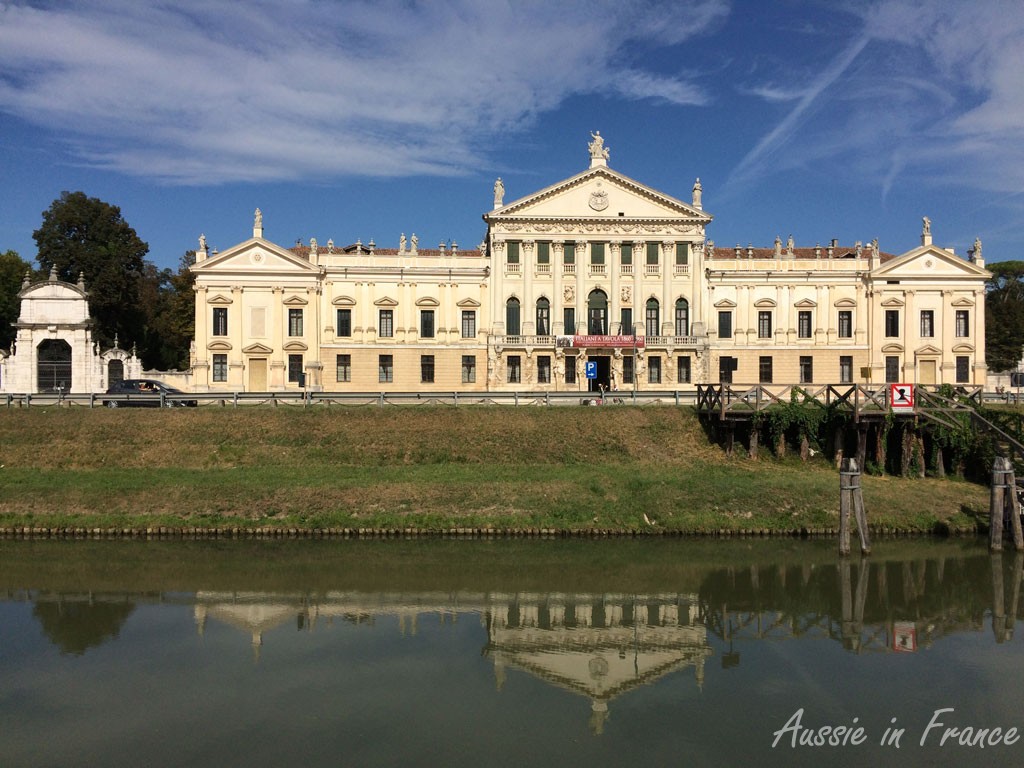
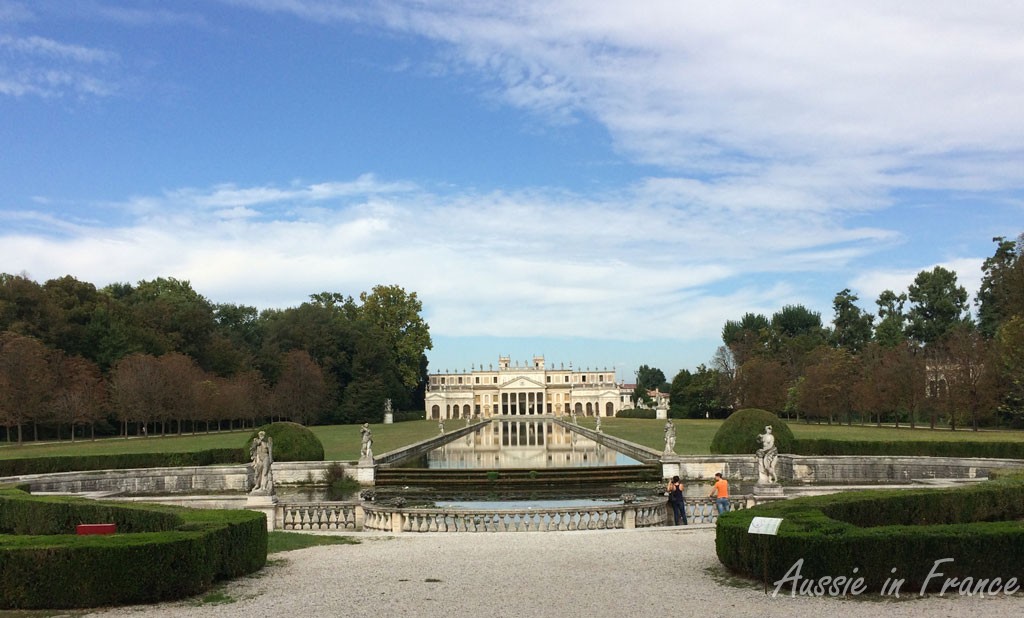
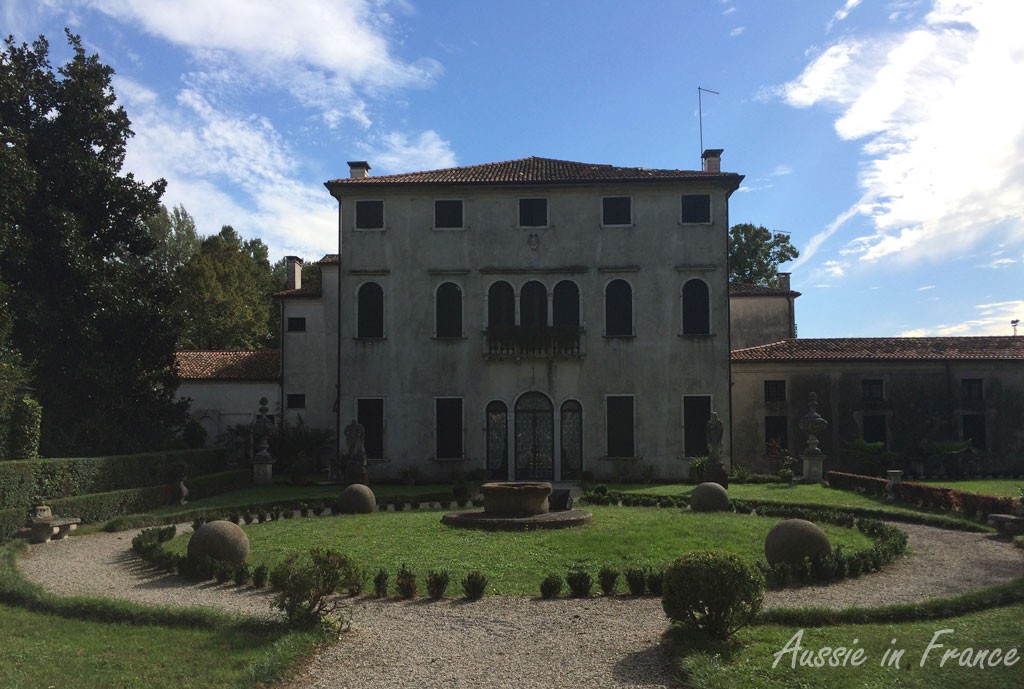
As promised, Paola, our lovely hostess at La Casa di Paola e Marco, the B&B where we are staying in Noventa Padovana near Padua, gives us scrambled eggs, ham and cheese for breakfast so we are ready to start a hard day’s cycling. We are off to the Brenta Riviera, with its Palladian villas between Padua and Venise. We park the car at Stra in front of the first Palladian villa on our list, Villa Pisani, which looks more like a palace than a villa.
The front façde of Villa Pisani in Stra
Built in the first half of the 18th century, it has 114 rooms. We begin the visit at 11.15 and considering the size of the second villa that I can see at the bottom of the grounds, I make my way through the rooms quite quickly.
The second villa at Villa Pisani which turns out to be the stables
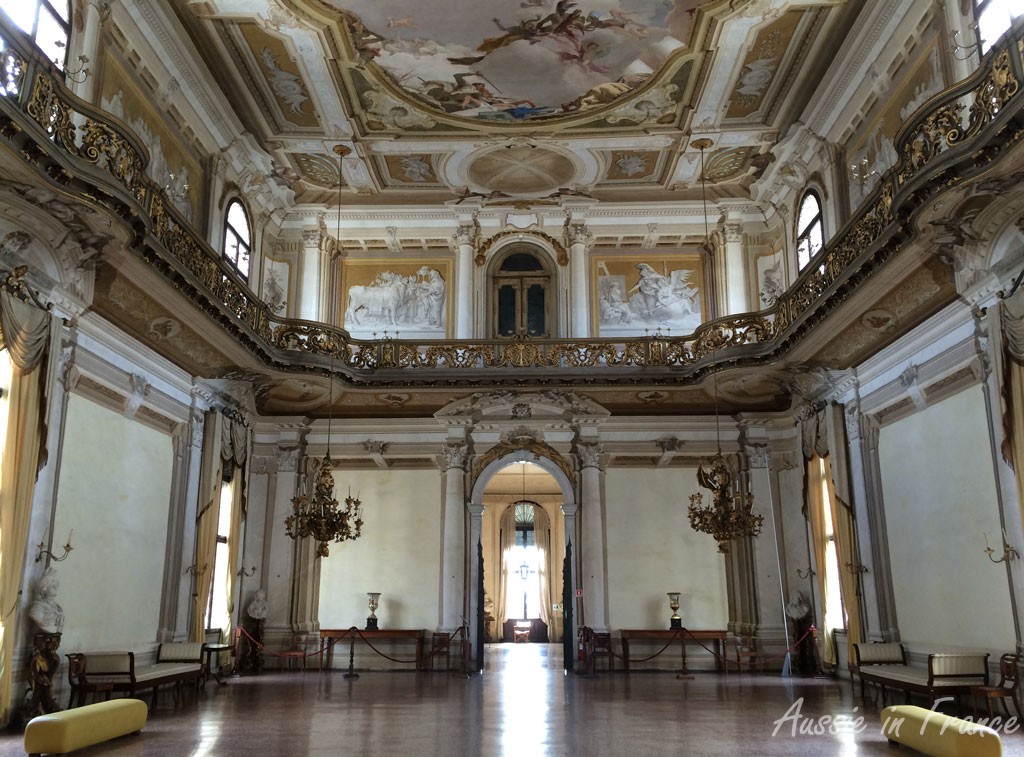
Some are richly furnished but the frescoes on the walls and ceilings are what really take the eye. They are quite sumptuous.
The Grand Ballroom at Pisani
It’s not until we get to the end of the visit that I discover that the second villa is not a villa at all but the stables, and designed soley to provide a harmonious view from the first building. It’s actually only one room deep! I think that is amazing.
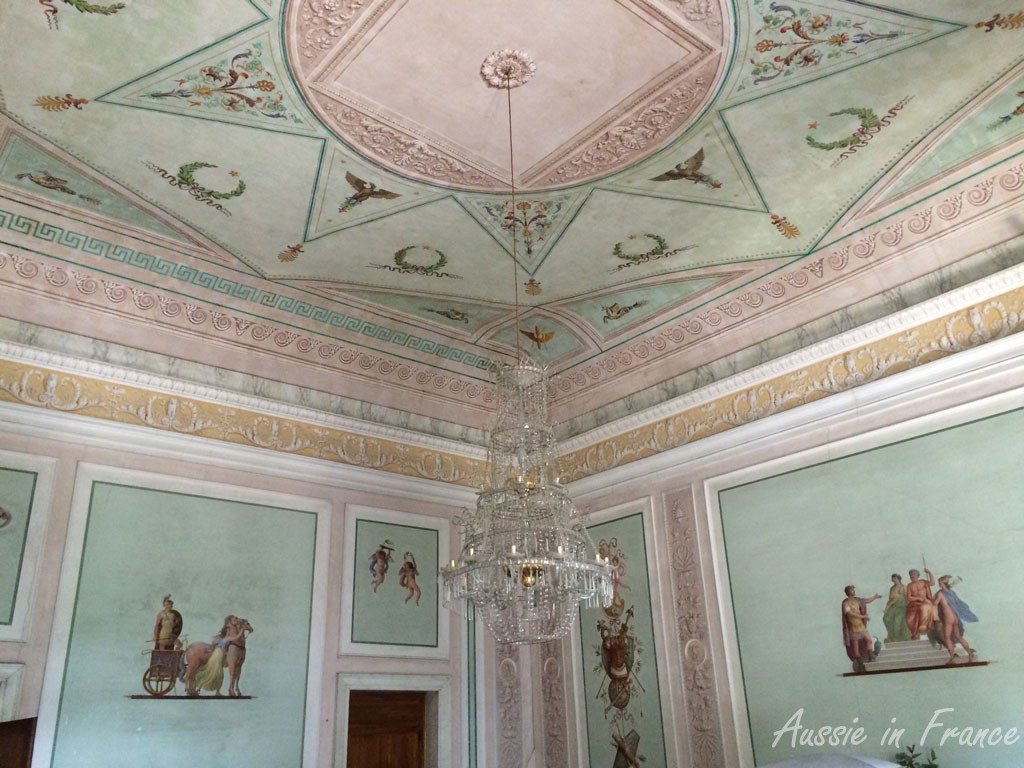
One of the more delicate ceilngs at Villa Pisani
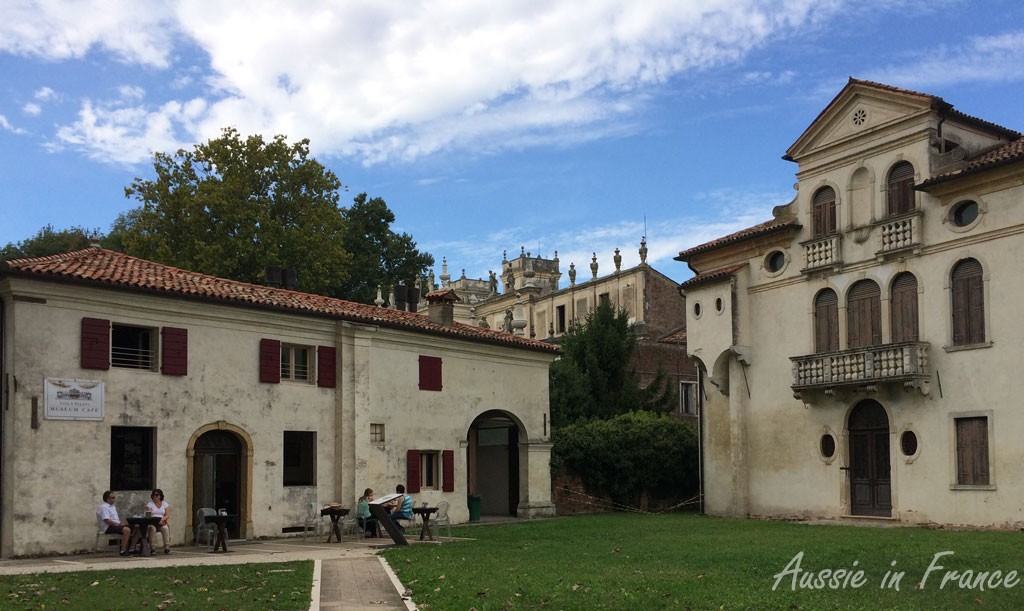
Time for cappuccino so we walk down to the bottom of the gardens to the Museum Café which is in the old donkey stables.
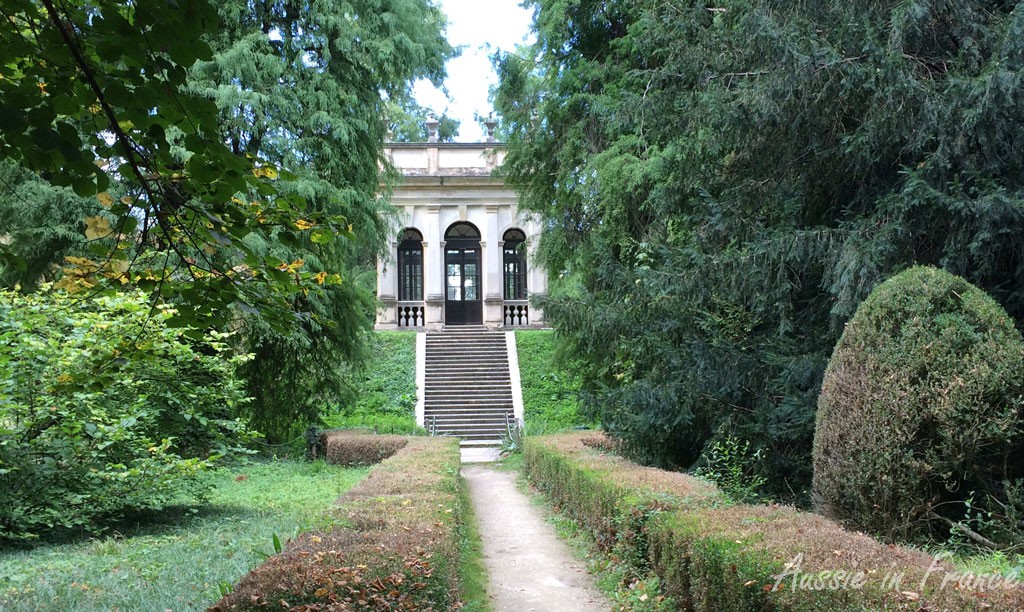
The Coffee House (ice-house) at Villa Pisani, an early version of refrigerator
On the way, we pass the Ice House, built at the same time as the villa and which served as a refrigerator in the summer back. During the winter, snow and ice were stored in the area under the man-made hill and used to keep food and drink cold throughout the hot summer. Holes in the ceiling provided air-conditioning in the room above where the inhabitants of the villa came to keep cool. It reminds me of the Tivoli Gardens near Rome.
The museum café, in the donkey’s stables
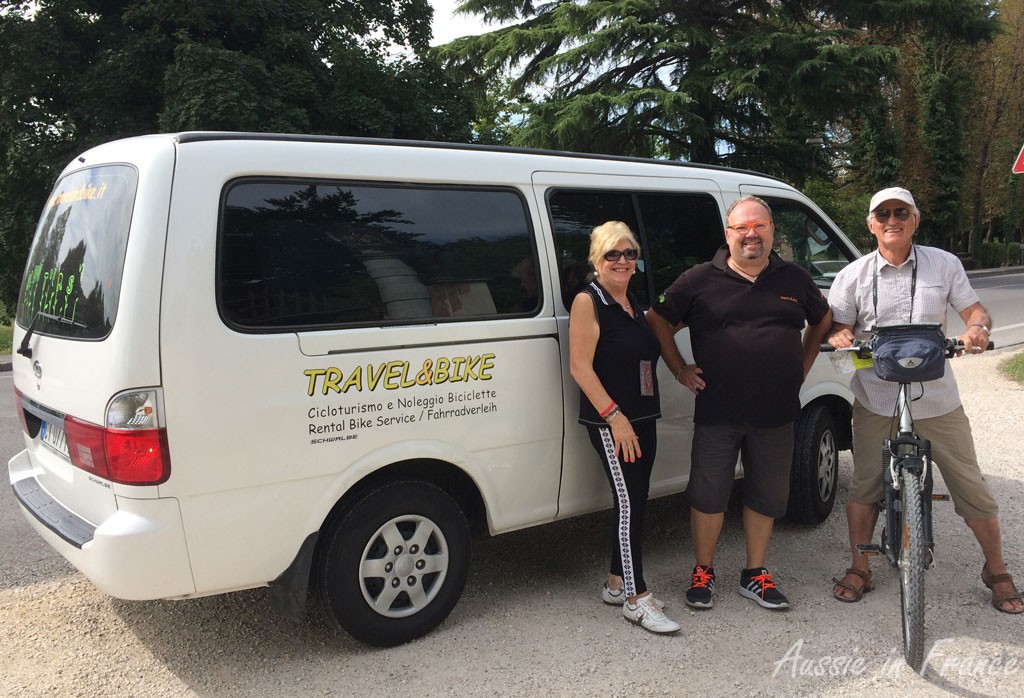
We’re now back in the parking area which seems a good place to leave the car for the day. There is a group called Travel & Bike next to us so I ask the man running the show where the bike route starts because our map isn’t detailed enough. He starts directing me, then says, “Here take this map”. I show it to Jean Michel who suggests I ask for a second one.
The Travel & Bike team with Jean Michel
I wait until the T&B organiser has looked after all his cyclists , making sure they have what they need and that their bikes are properly adjusted, and ask him for another one. He’s still in a bit of a hurry so asks his mate to give me one. By now it’s nearly 1 pm.
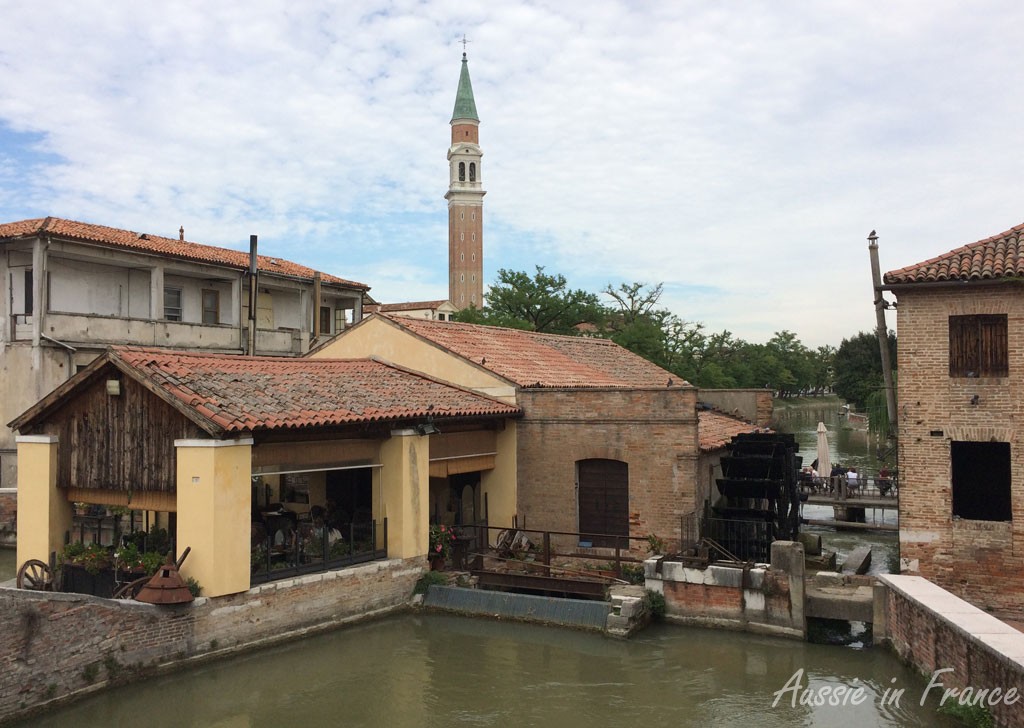
The back of the watermill in Dolo
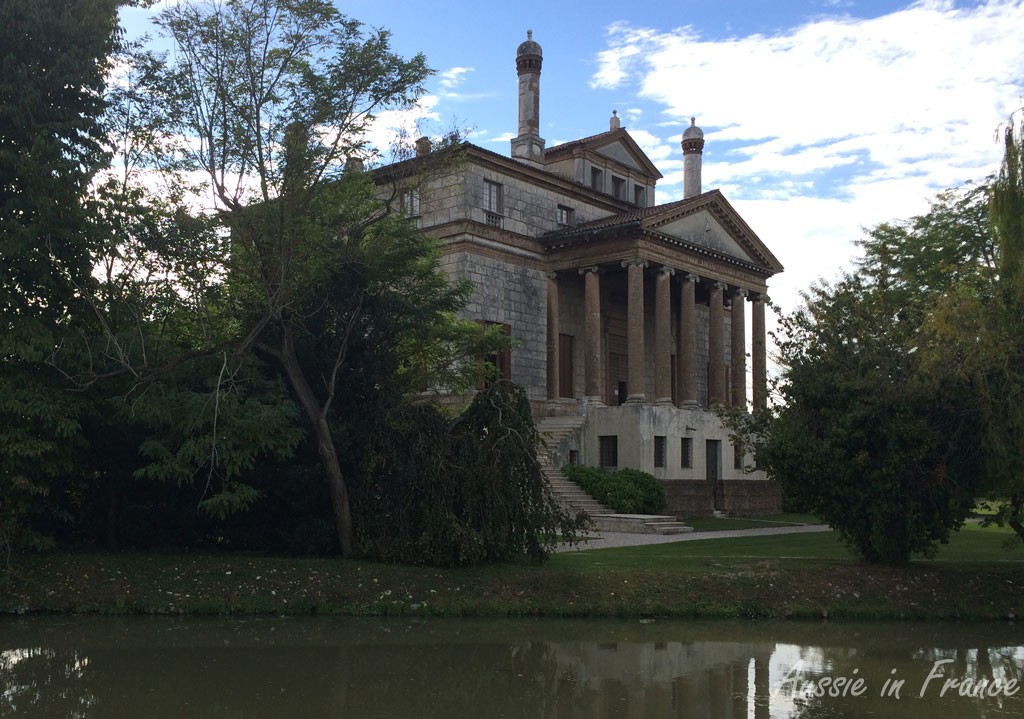
We lock the car and set off, as instructed, passing in front of the villa and down to the bridge 300 metres away. When we arrive at the end of the path, the Travel & Bike van is there. The organiser comes over and apologises for not taking more time with us earlier. He has a few suggestions to make : we should stop in Dolo where there is a 16th century watermill and old dockyard, leave the path at Malcontenta to see Villa Foscari, another Palladian villa, and then go the extra 5 k to see Venice from the boat terminal at Fusina.
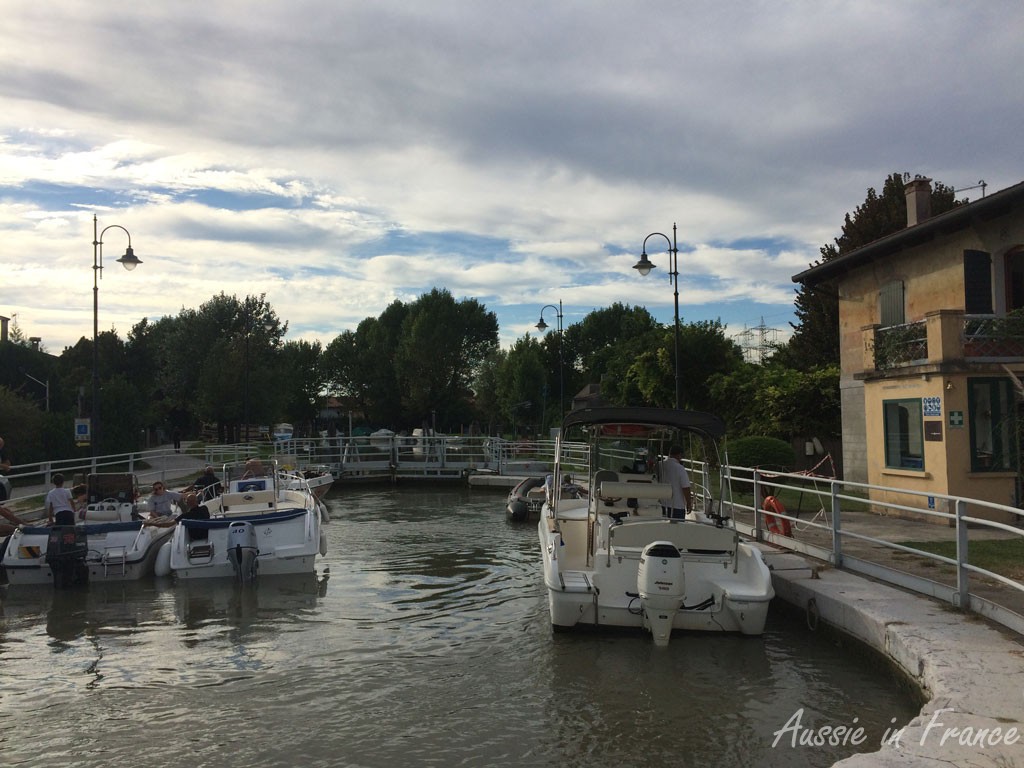
On the Brenta just before taking the main road to Fusina
His bike tour seems extremely well-organised. He’ll be picking up the bikes at Fusina so the cyclists can take the vaporetto to Venice. He already has their luggage as they’ll be staying overnight.
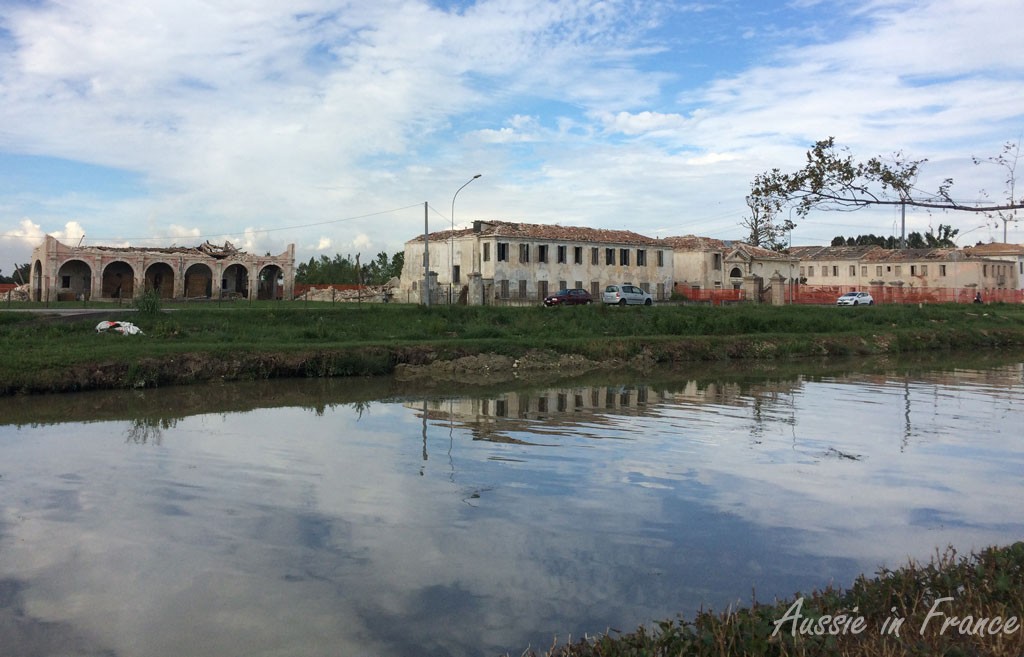
Villa Badoer Fattoretto closed after a tornado in July 2015
Meanwhile we are limited, once again, by the fast diminishing number of daylight hours. It’s already 1.30 pm. Our bike route takes us along the south side of the Naviglio di Brenta along a tranquil road, past many villas owned by rich Venetians, which explains why the area is called the Brenta Riviera. Some of the villas are in better shape than others, Villa Badoer Fattoretto, built in the 17th century being one of the better ones.
The old dockyard or squero in Dolo
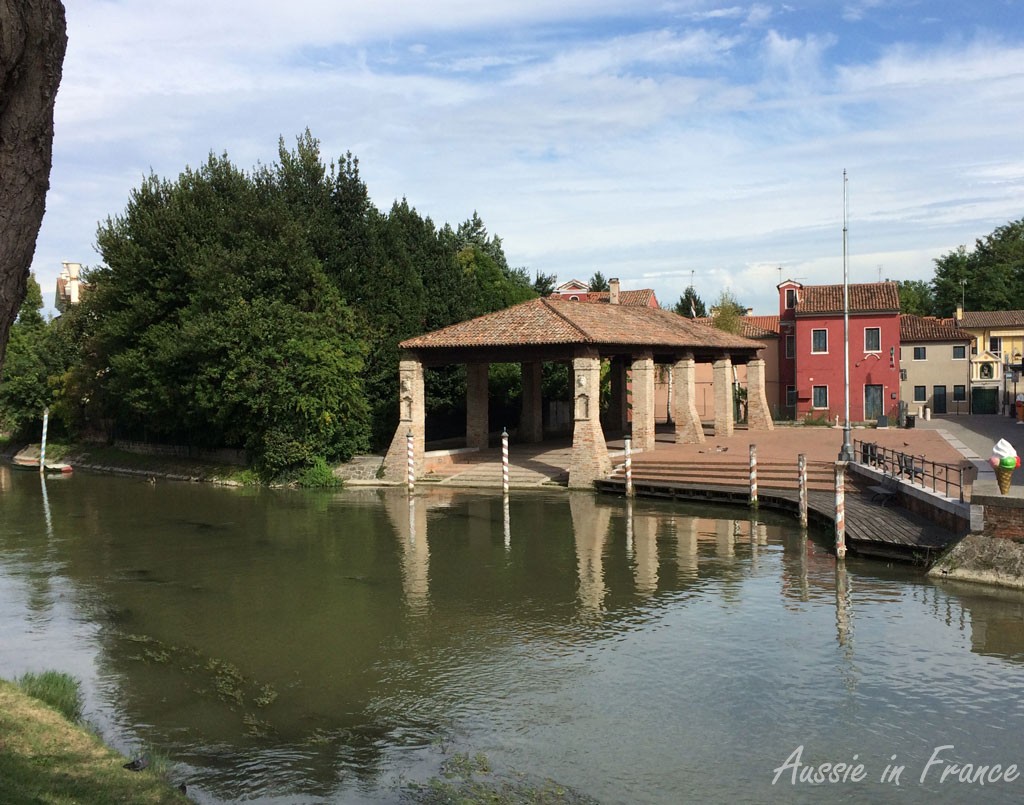
We stop at Dolo as suggested and have lunch at the Mulino di Dolo restaurant on the little esplanade which has a view of the dockyard (squero) and church.
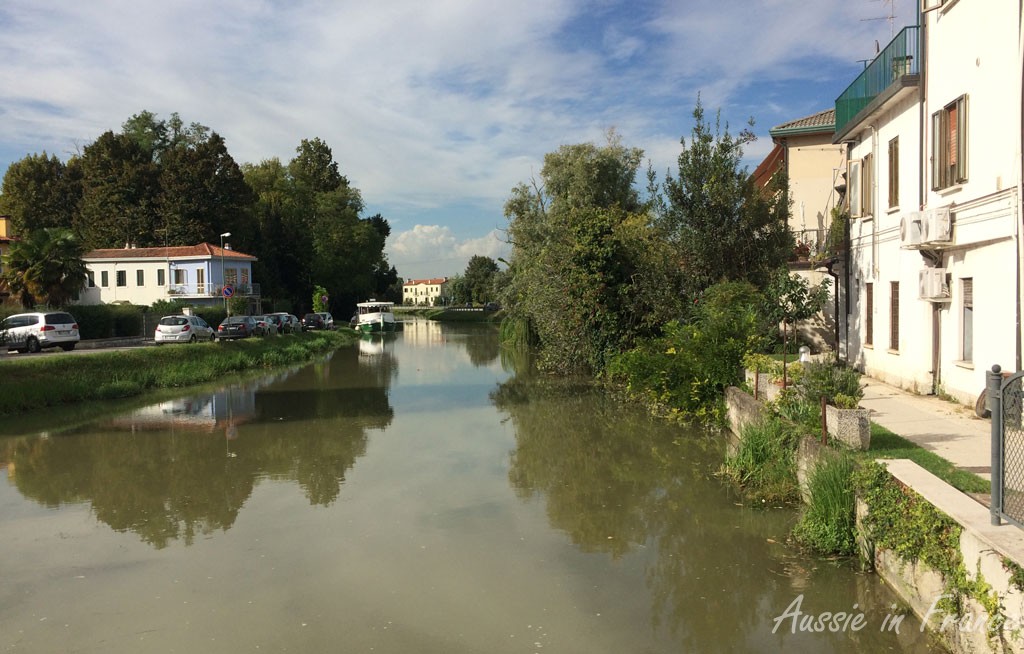
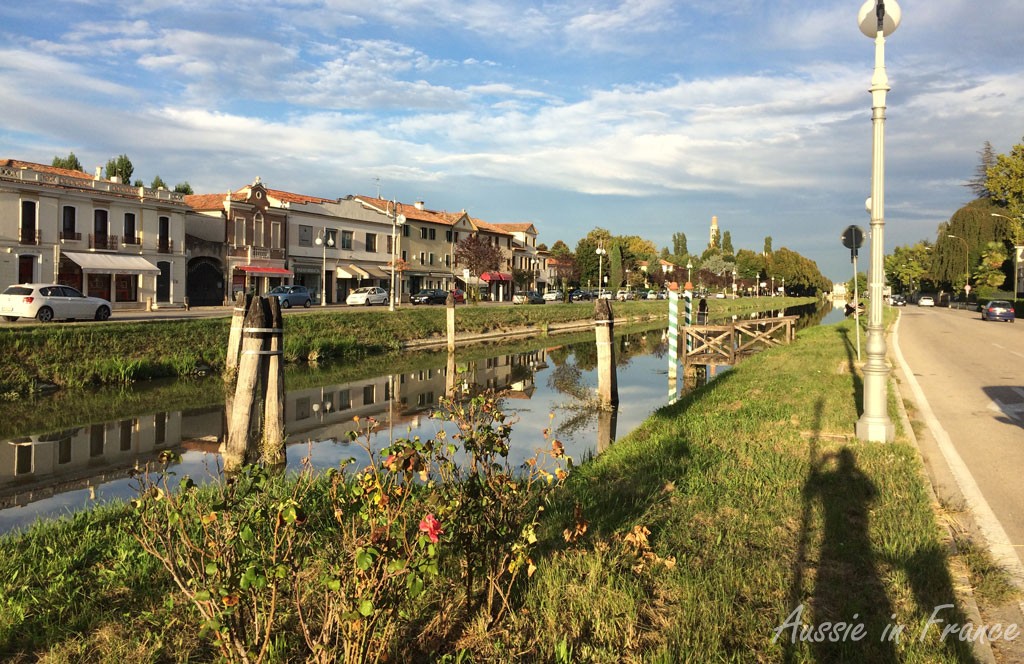
Along the Naviglio Brenta
After Dolo, the bike route runs along the river and we see more villas. The route takes us through Oriago until we come out on a main road. Fortunately the T&B organiser has explained where to go or we would have been lost! The group turns out to be just in front of us and we follow them to Villa Forcari a few hundred kilometers off the main path.
Villa Foscari
Unfortunately, it’s closed on Sunday afternoons but we are able to see it from the outside. Not that we would have had time to visit.
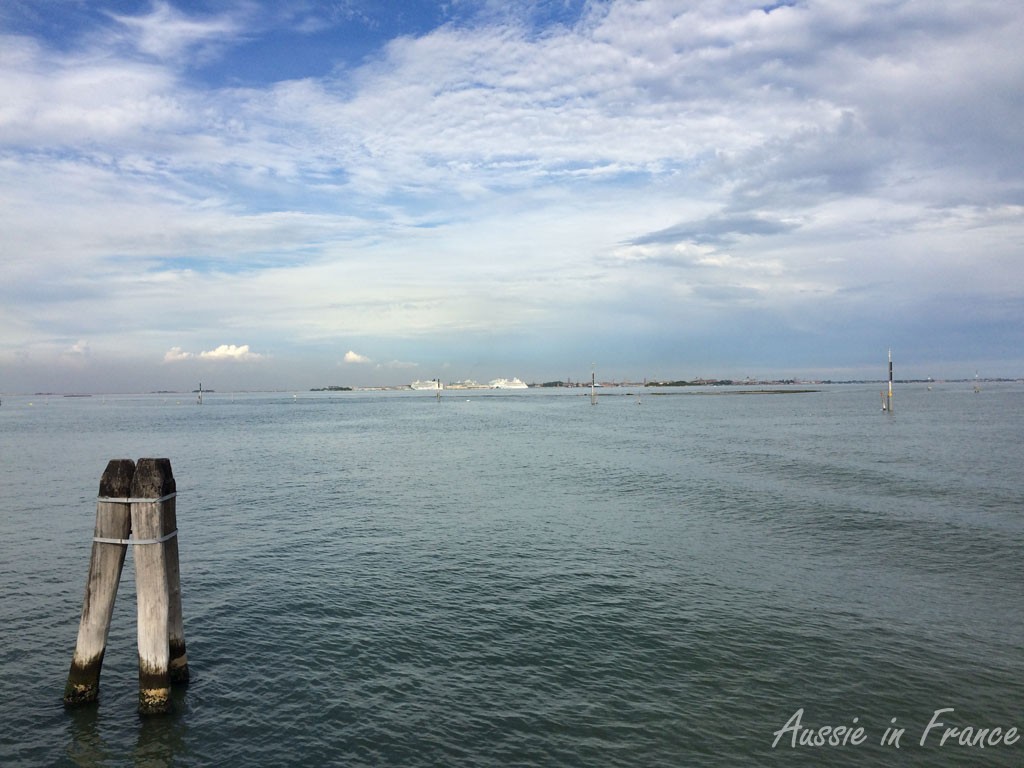
The Venetian Laguna
The remaining 5 kilometers to Fusina mainly run along the Brenta except for the last couple which take us on the main road leading to Fusina terminal. We arrive at the esplanade and can pick out some of our favourite places in Venice with our binoculars. We’re glad we made the extra effort. However, the 30 kilometers have taken us 2 hours and it’s 5 pm. Nightfall is at 7.15 pm at the moment …
Some of the dilapidated villas along the Brenta
We start the return journey, intending to eat a gelato in Malcontenta where I spied a gelateria on the way. When we arrive, there is only one table left (out of two!) and it’s in the sun. The owner immediately sees the problem and moves the table. We go in to choose our gelati. “No”, she says, “we don’t have any ice-cream, only cakes”. Well, I am not a great fan of Italian cakes. so it’s a bit of a disappointment, especially after cycling for 25 K without a break Jean Michel chooses one but I prefer to eat the biscuits we always carry with us.
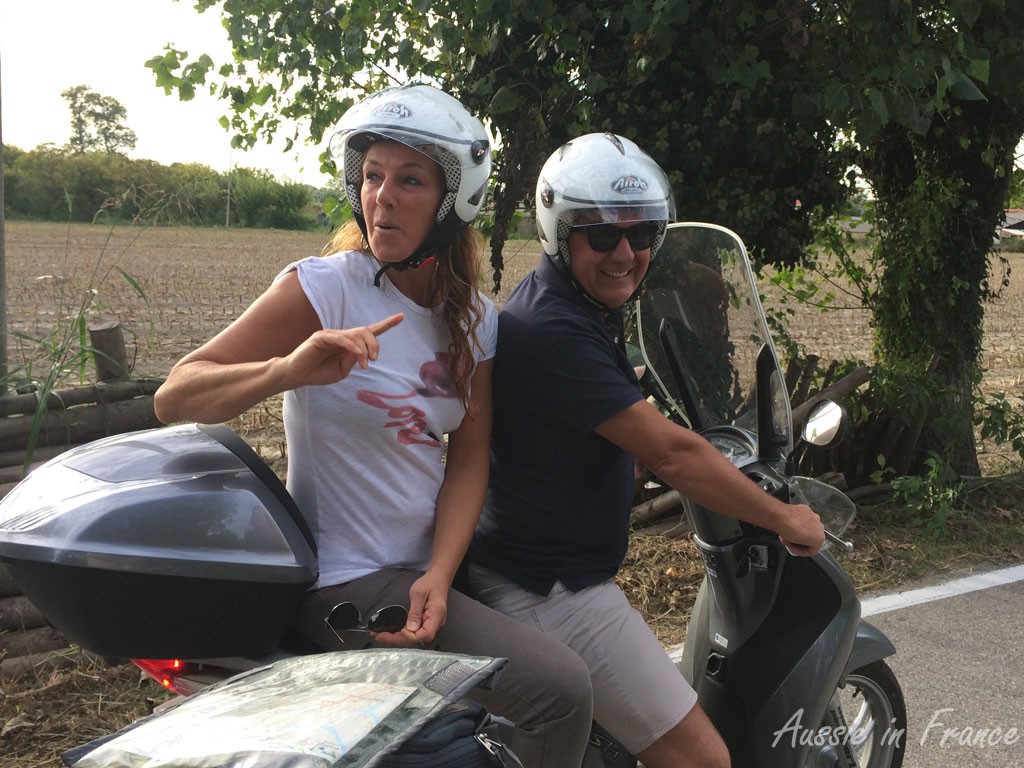
Paola and Marco on their scooter
There is an alternative bike route that skirts around Oriago and will save a couple of kilometers so we decide to take it. We’re cycling along the canal again when we hear a horn blowing behind us. We stop and who do we see – Paola and Marco from the B&B in Noventa Padovana! They’re on their motorbike bound for Venice for the evening. When they went past several minutes earlier, they thought it was us so doubled back. What a coincidence!
Along the bike path at Mira
At kilometer 43 out of 58, we come to a fork near Mira and I choose the right hand path. Jean Michel, who’s just behind, calls out “no, to the left.” I brake, without realising I’m on gravel and over I go. I try to save myself by getting free of the bike and only have a few grazes on my hands and knees. No holes in my pants, thank goodness.
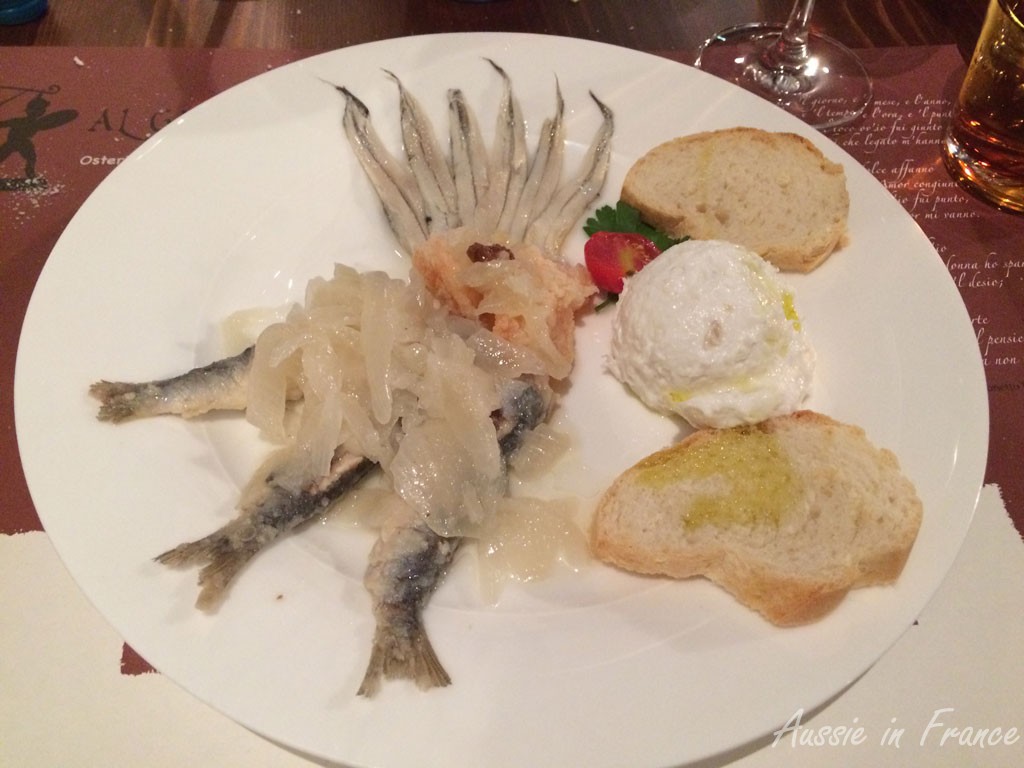
Dinner at Osteria al guerriero
We get back to the car at 7 pm, just before nightfall. We arrive at our next location, Arqua Petraca, an hour later, just in time for an excellent – and well-deserved – dinner at the Osteria al Guerriero, run by the owners of the appartment we are renting for the next four nights. – Casa
In front of our rental appartment in Arqua Petrarca
We are delighted with our accommodation – a 2-bedroom flat on the ground floor with our own table and chairs in the garden just in front. Tomorrow is a rest day and we’re pleased to at last have more space than just a bedroom.
We set out on our bikes at 10.30 am after having a typical Italian breakfast at our B&B. A bit too high carb for cyclists. Our hostess spontaneously suggests eggs and cheese for tomorrow.
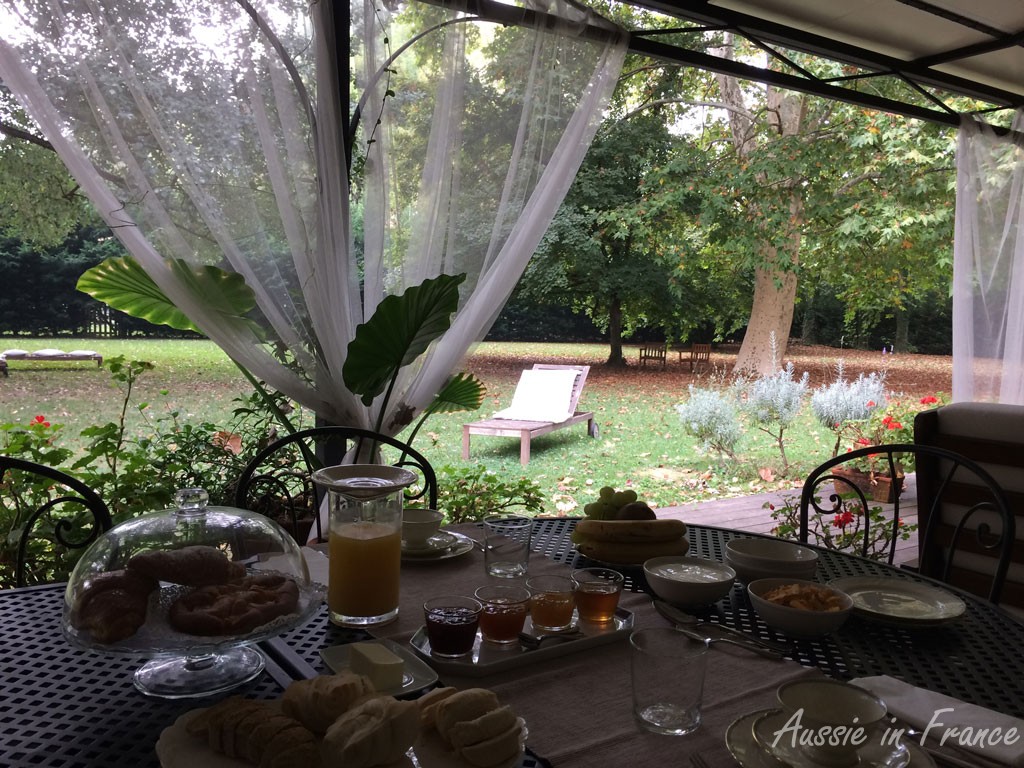
Our typical Italian breakfast
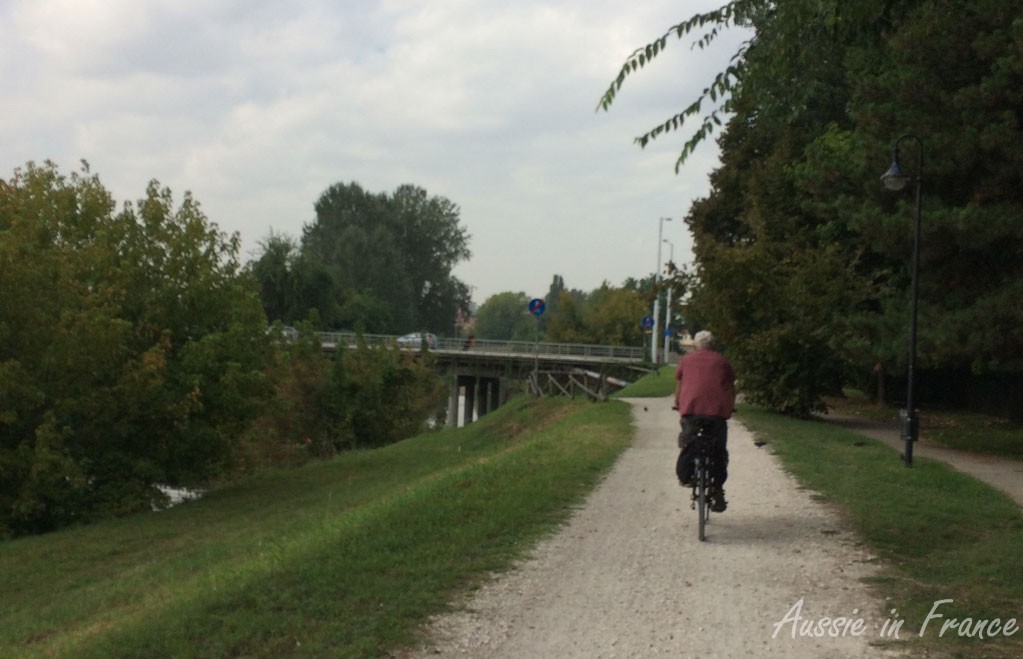
It’s a little muggy to start with but not at all cold. This time, when we get to the canal, we don’t cross the bridge as we did yesterday and discover a very different path – either gravel or asphalt the entire way.
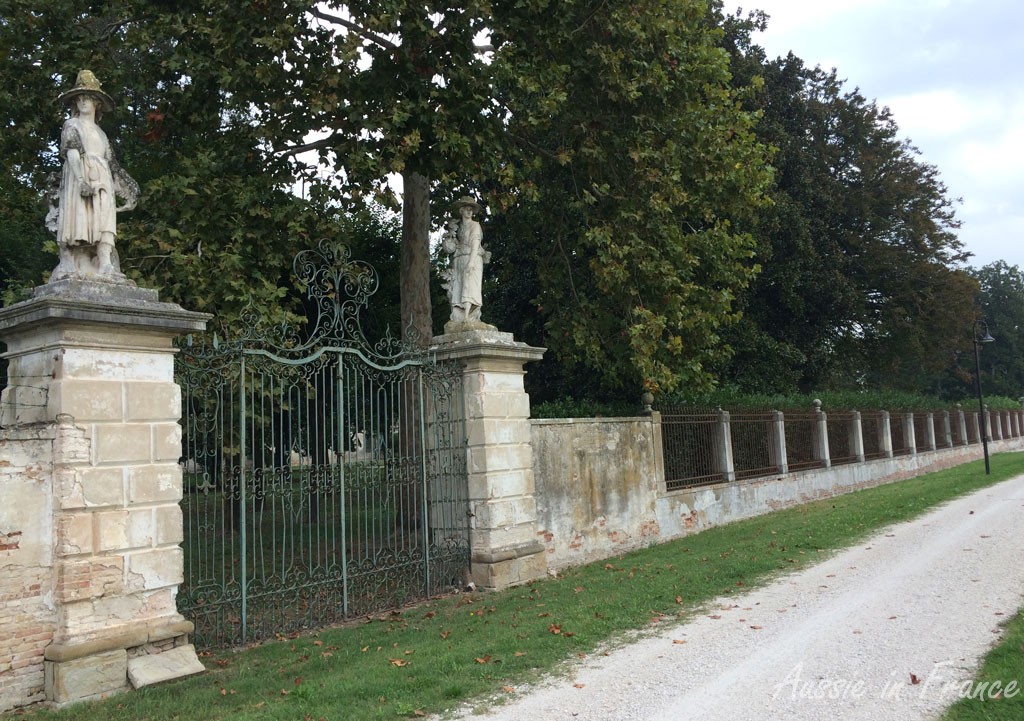
Statues on the Villa Giovanelli gates
We go past the Villa Giovanelli again but the view is better from the other side of the canal. It affords a close-up view of the statues though.
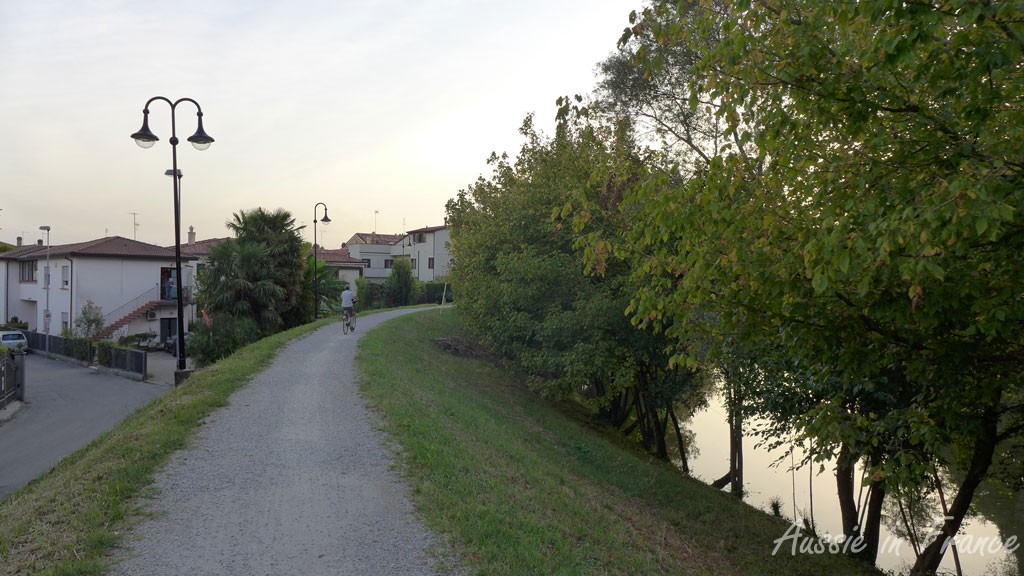
The bike path just before the second bridge
We also avoid the narrow passageway across the second bridge because we come out on the other side. Just before the bridge, we turn left until the zebra crossing then join the path on the other side.
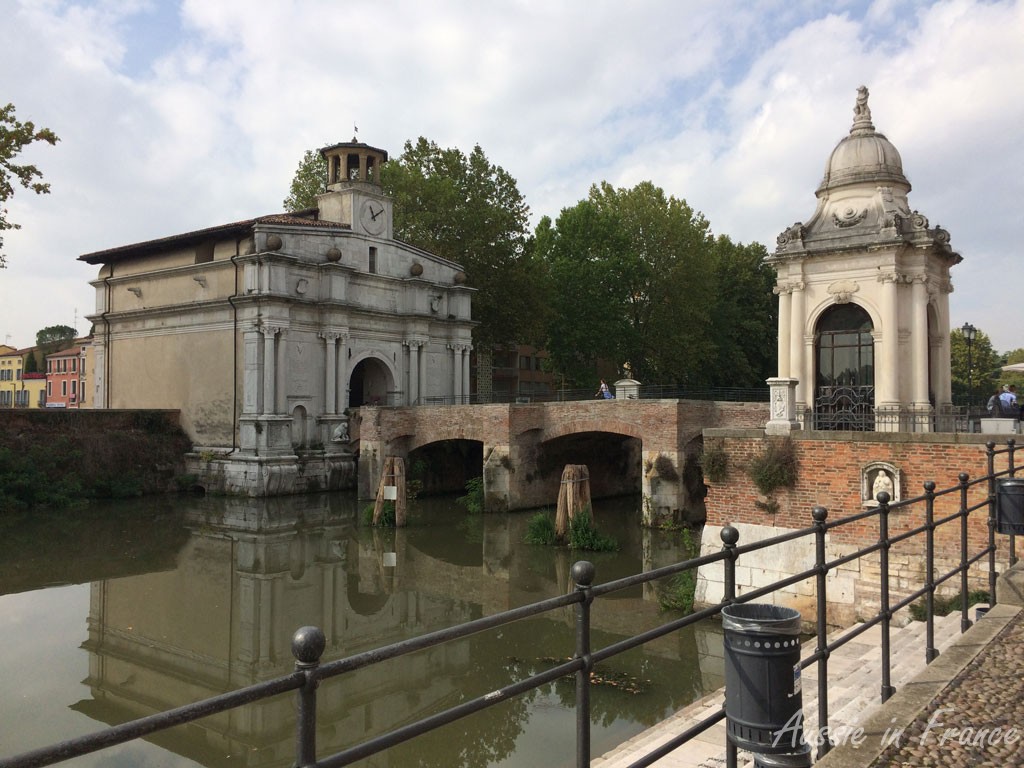
Portello or Porta ogni Santi
We decide to keep going along the canal and enter the city of Padua from the entrance closest to Cappella degli Scrovegni so we can pick up our tickets. We go past Porta Ogni Santi also known as Portello, which is a meeting place for the students who frequent the nearby university.
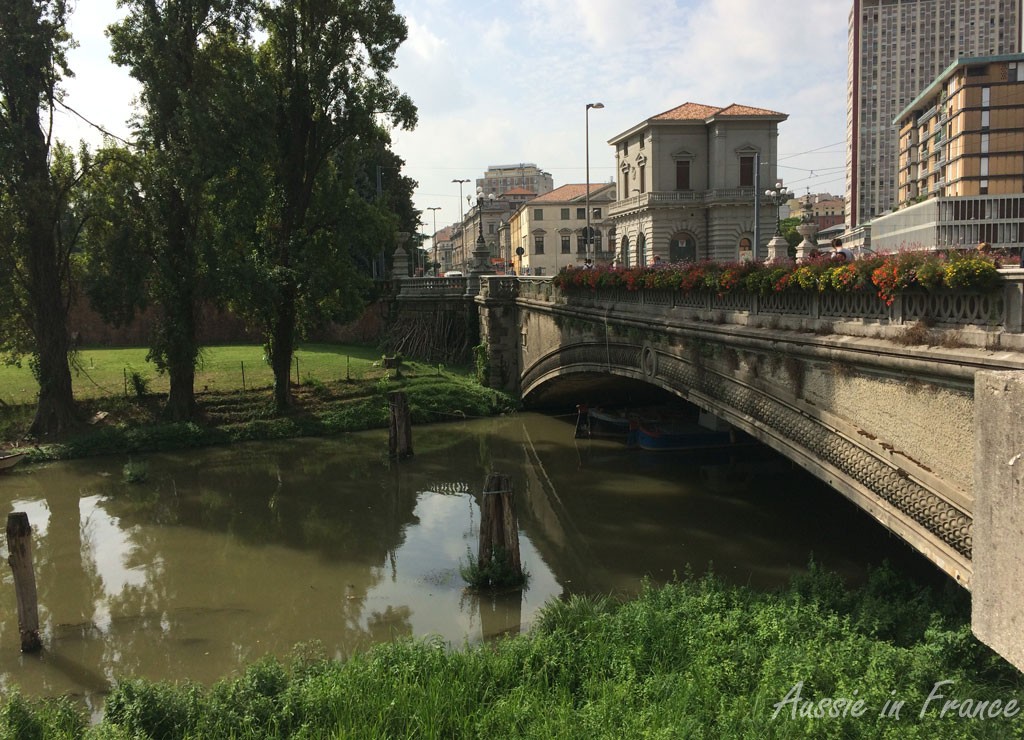
The bridge near Arena park
The chapel is just next door to Arena park where we had our lunch yesterday. I get our tickets without even having to stand in line (we reserved yesterday for 2.30 pm today) and we head for Porta Specola. En route we stop for a cappuccino near Piazza della Fruta.
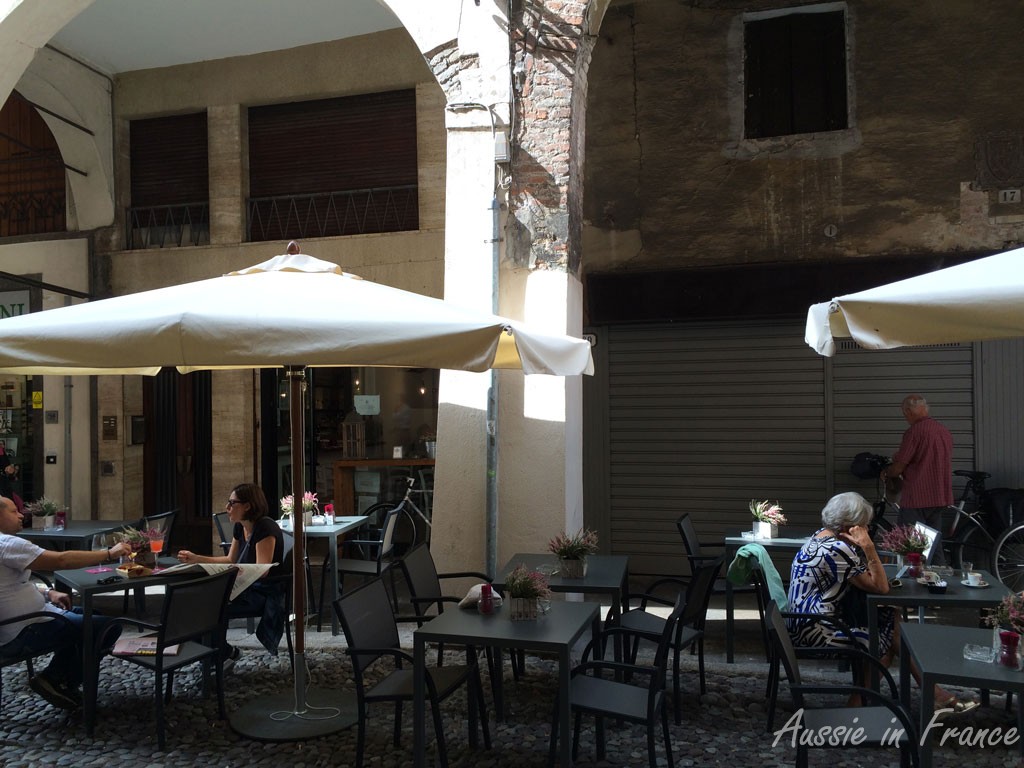
First cappuccino since our arrival in Italy
As we’re cycling along one of the little paved streets off the Piazza, I realise I must have a puncture. Jean Michel pumps it up (we always carry a puncture kit) and we go to a little square nearby so he can repair the puncture.
Jean Michel repairing the puncture
It turns out one of my tyres has a big tear in it. While Jean Michel’s repairing the inner tube a lady comes by walking her dog. I ask her if she knows where there is a bike shop to buy a new tyre. She phones her son and directs us to the Duomo – all in Italian! A young girl and her mother come by and ask if they can help. The other lady relays the message about the bike shop to the young girl who explains it to me in English adding that the shop will be closed during lunch time.
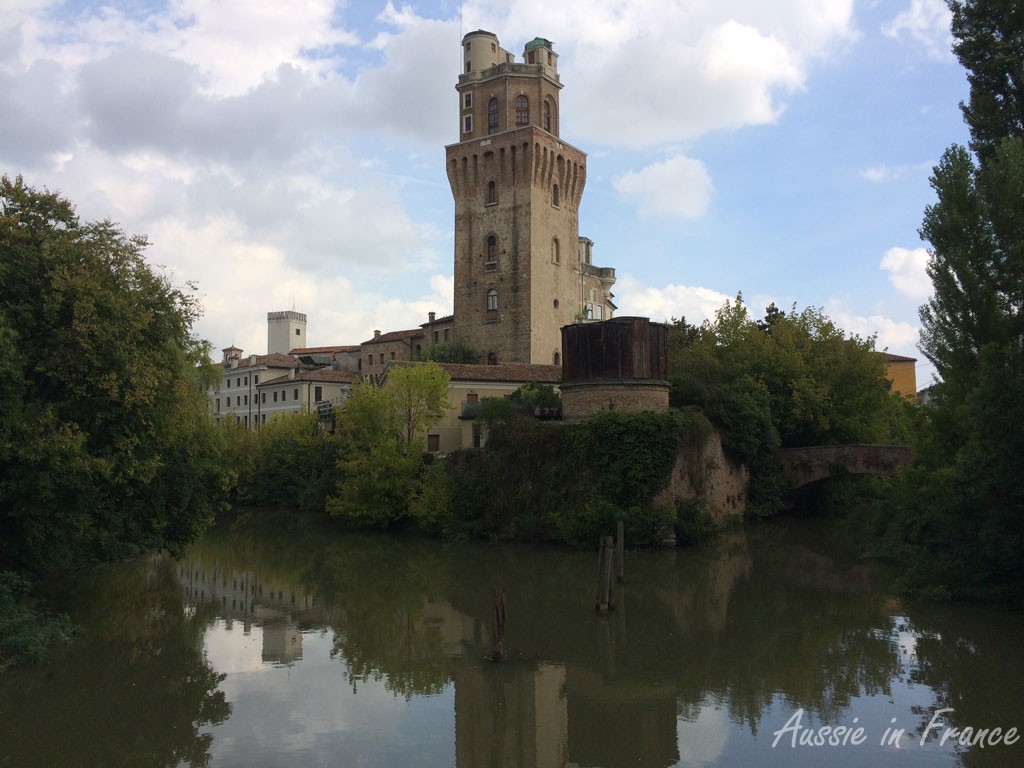
The old observatory tower
That’s OK. We’ll have lunch first, visit the chapel, then find the shop. So we set off for the old Observatory tower built in the 18th century to experiment with astronomic theories.
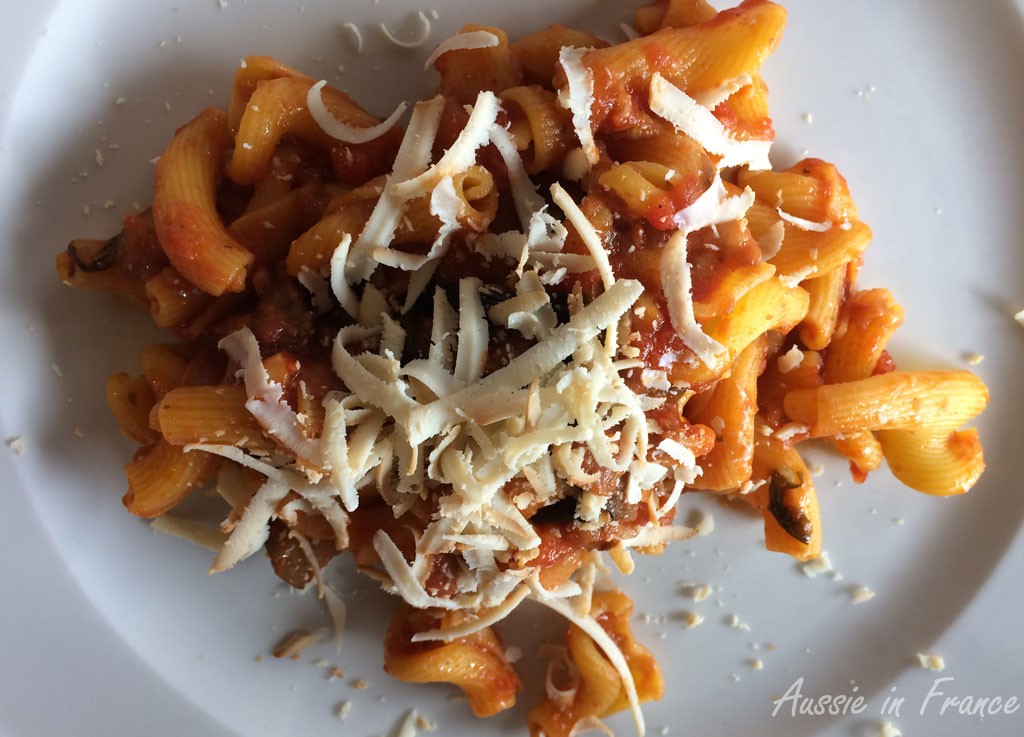
Maccheroni al torchio alla norma
We then keep our eye open for somewhere to have lunch and I spy a little Trattoria under the arches of a gallery called Savonarola that looks just right. We order the pasta of the day – maccheroni al torchio alla norma which I later discover is a dish of Sicilian origin with a tomato sauce to which fried eggplant, ricotta and basil have been added.
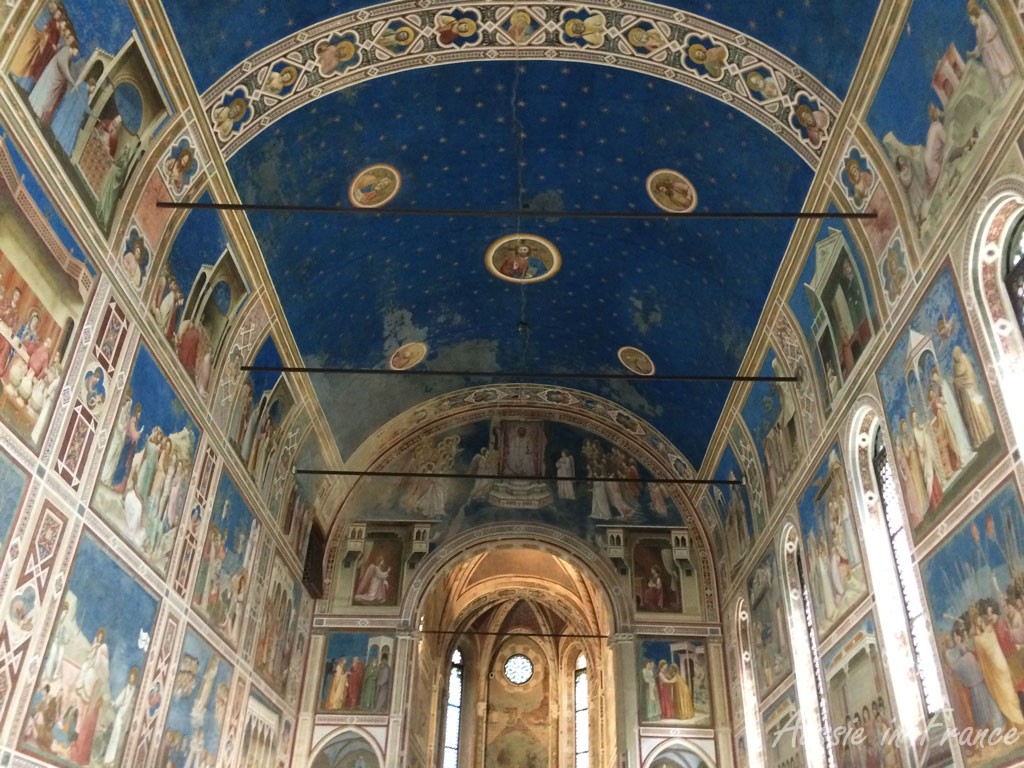
The starry sky of the Cappella degli Scrovegni
At the chapel, we arrive with 10 minutes to spare. Only 25 people can enter at a time and prior reservation is compulsory. We watch a 20-minute video in Italian first, with subtitles in English and German. It explains the origin of the chapel and some of the frescoes. I’m a little disappointed in some of the paintings. Giotto finished only took 2 years to paint the entire chapel and I guess he rushed through some of the scenes …
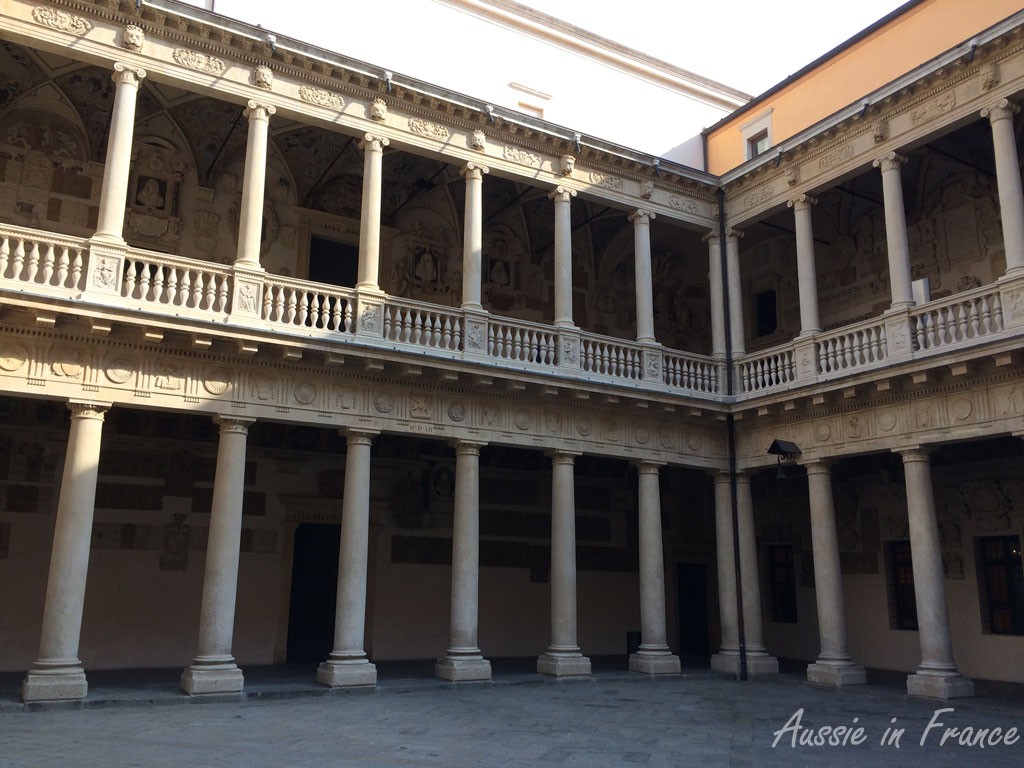
Palazzo del Bo university founded in 1222.
Next stop is the duomo but no one has heard of a bike shop there so we go back to the tourist office where we are directed to another shop not far from our next stop, Saint Anthony’s basilica. L’Angolo del ciclo is on via Facciolatti, 22. We stop by the Palazzo del Bo on the way, but don’t have time to visit.
L’angolo del Ciclo bike shop
We soon have a new tyre and two bike locks because the one that Jean Michel uses to protect our bikes when they’re on the bike trailer takes quite a long time to attach. It’s better to have a faster system when you’re visiting a town centre by bike. He manages to put the tyre in one of the paniers and we start look for a gelateria.
The Byzantine cupolas at Saint Anthony’s basilica
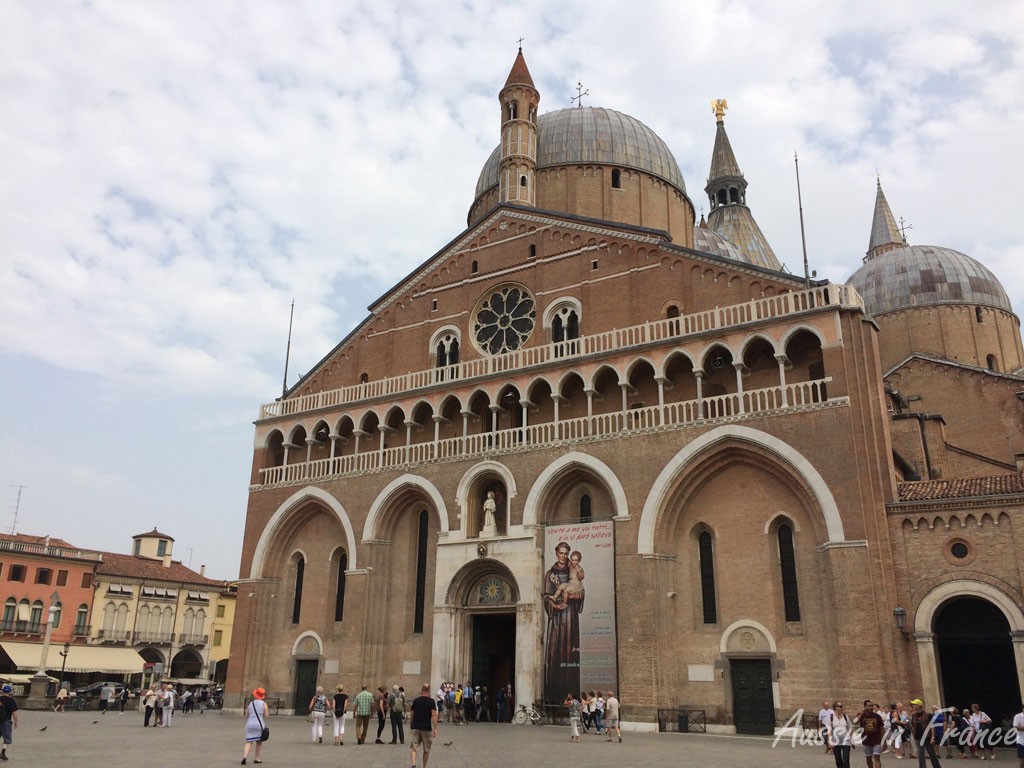
After our ice-creams, we visit the Basilica, which I consider is the most interesting monument in Padua. It is quite sumptuous. It has a Roman façade, Byzantine cupolas, a Gothic central tower and bell-towers and a late Renaissance chapel containing the tomb of Saint Anthony. Photos are not allowed inside.
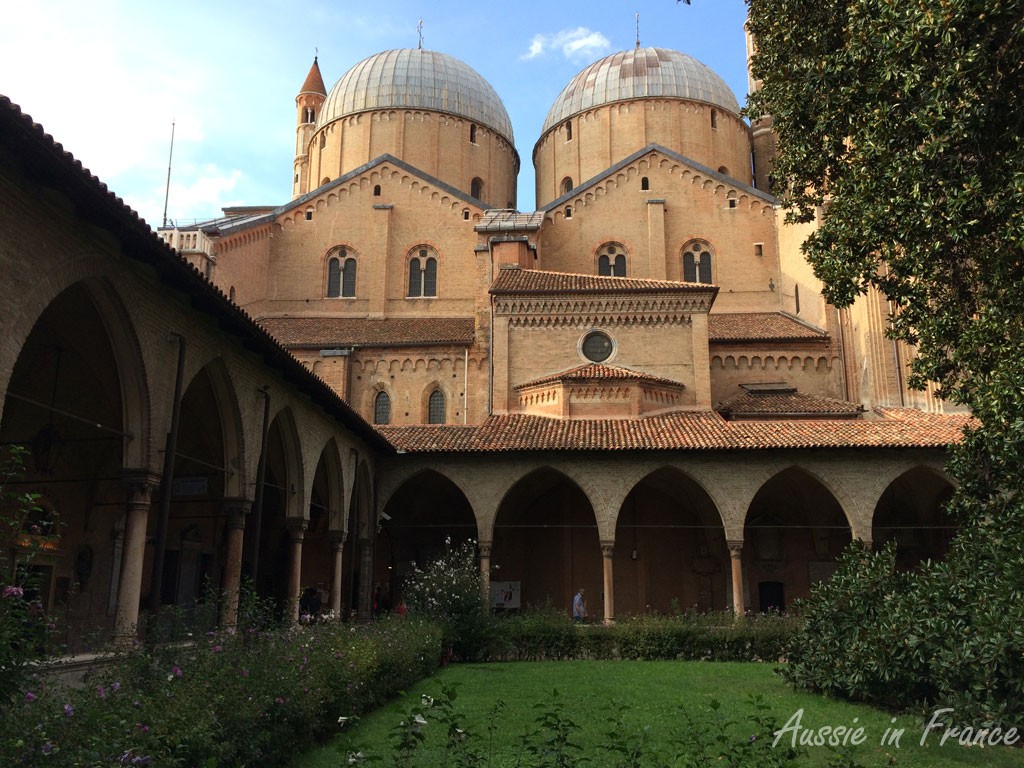
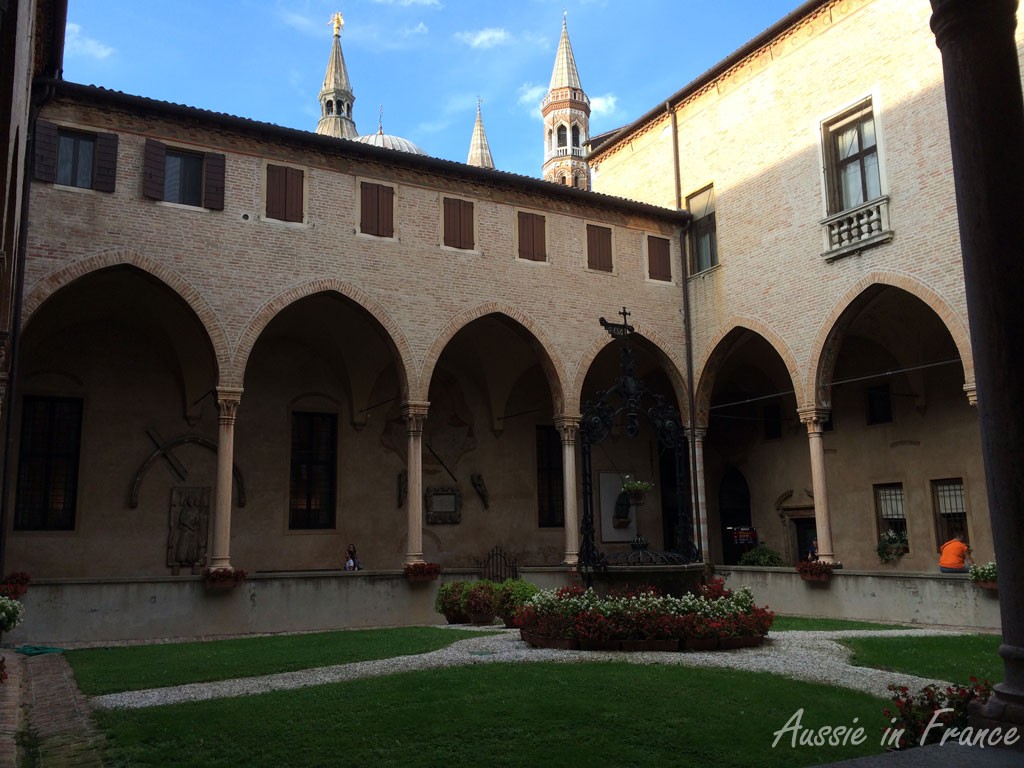
Second set of cloisters at the Basilica di Sant’Antonio
We continue the visit with two cloisters offering wonderful views of the outside of the basilica.
By the time we get back to our bikes, it’s 5.40 pm. We debate about when Jean Michel will change the tire since it’s a bit cumbersome. However, the decision is out of our hands. My tyre is completely flat again. I am a bit worried about the time because we need a good 40 minutes to get back to our B&B and the sun sets at around 7.15 pm. We don’t have our lights with us. As it turns out, I needn’t have worried. We even have time to stop at the supermarket and bancomat.
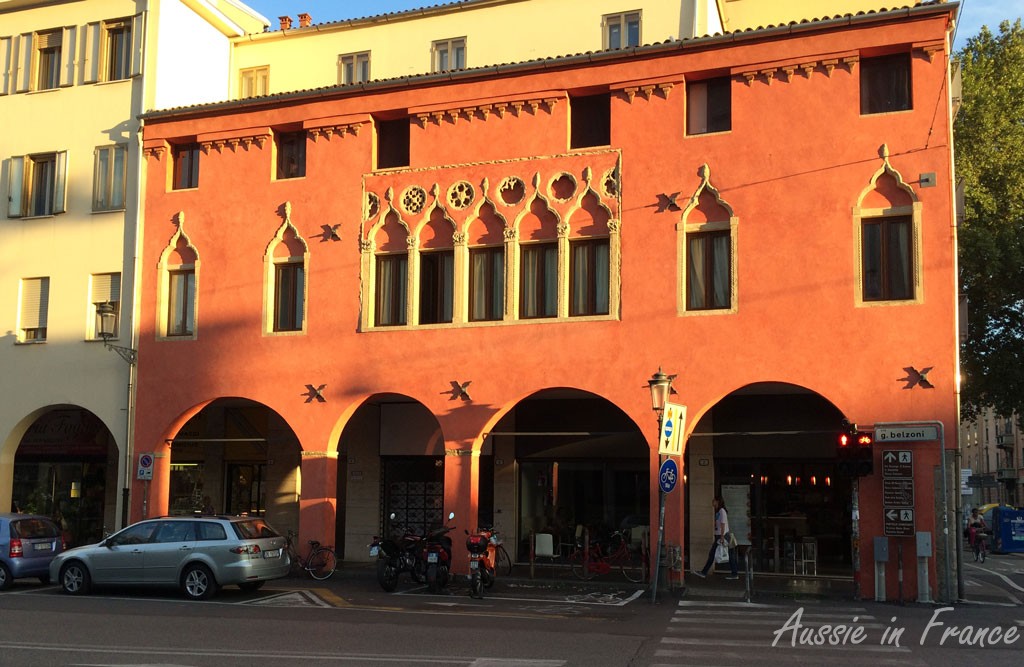
A Venitian palace at dusk
The light as we cycle home is quite lovely.
The second bridge just before sunset
We’ve really enjoyed our stay in Padua. It has a good feel to it and is very relaxing. Despite its popularity, it feels like a place where people live and not just a tourist attraction like Lake Garda. Visiting it by bike is perfect despite the puncture. Staying out of the main area is also a good solution as it has enabled us to see another part of the city.
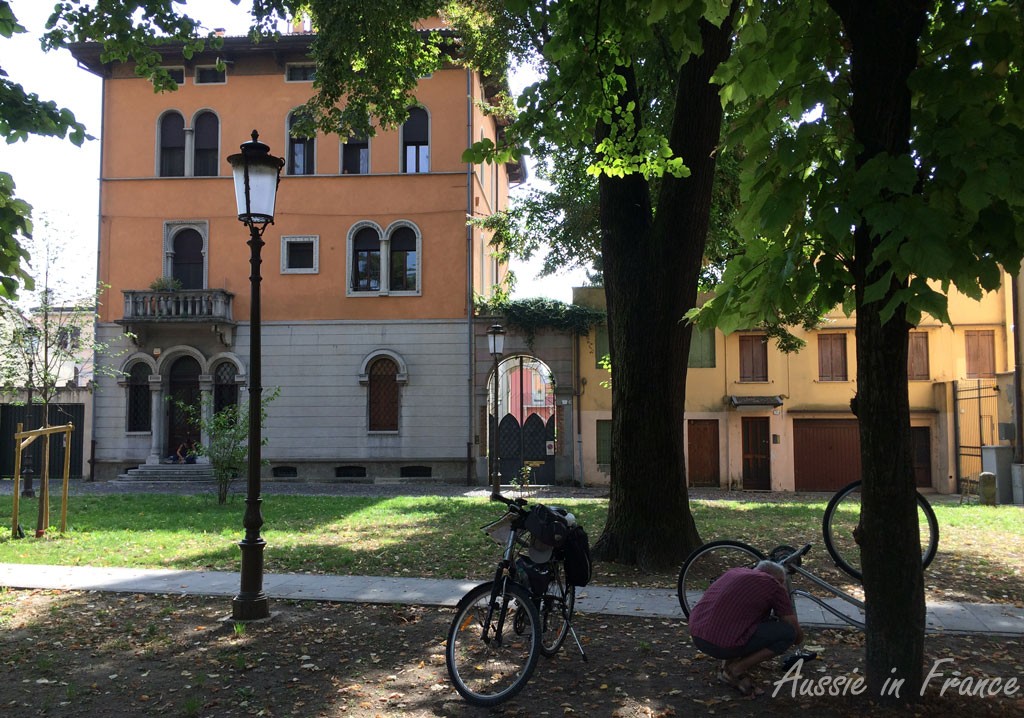
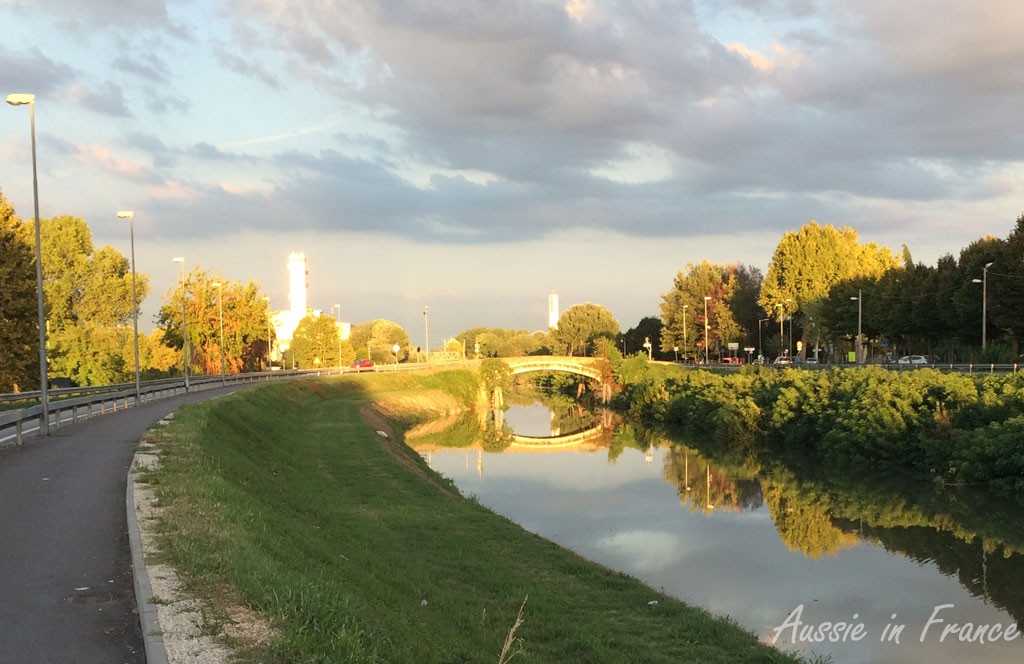
A part of Padua we wouldn’t have seen if we hadn’t been cycling
Tomorrow, we’re moving to an appartment at Arqua Petrarca 25 kilometers away for three days of cycling – the Palladian villas, the fortified towns of Mnselice, Este and Montagnana, and the Euganei hills. Fine weather is forecast for Saturday and Monday, with a maximum of 25°C, but we might have a bit of rain on Sunday morning.
I’ve been wanting to visit Padua for a very long time. Many years ago, we toured northern Italy and got as far as Vicenza. We can’t remember why we didn’t go any further. Our Routard guidebook tells us that the best way to visit Padua is by bike. Jean Michel is a little dubious, especially after Lake Garda which is not really geared towards cyclists, even though we made the most of the bike paths that do exist, particularly on the eastern side.
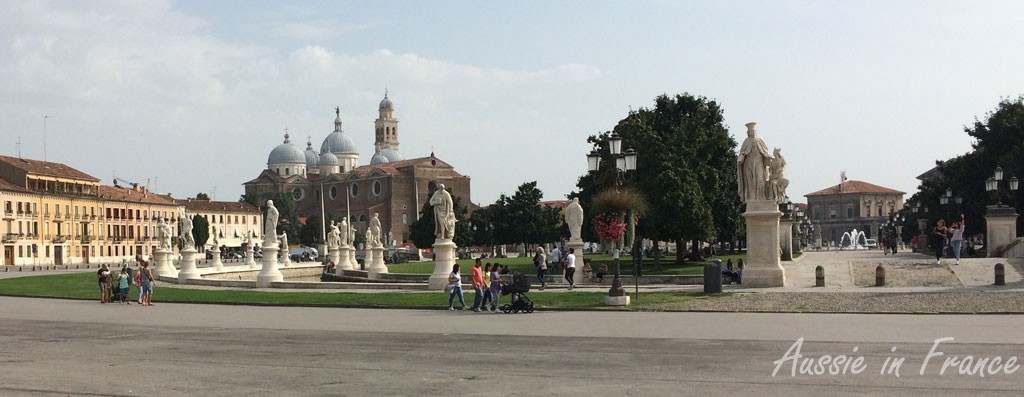
Our first glimpse of the 18th century Prato della Valle, once the site of an immense Romain theatre
We’ve reserved a B&B seven kilometers from the centre and I’m hoping we’ll be able to cycle into the old town. The Routard also says that if we buy a Padova (Padua) Pass, we can park for free in the Rabin car park just outside the historical centre. The only catch is that you have to park first, then buy the pass at the tourist office.
A close-up of some of the 78 statues of famous men, philophers, writers, men of science and doctors.
It turns out that you enter your registration number in the ticket machine, then insert one euro. You pay the balance when you come back to get the car. We set off and are very impressed by the number of people on bikes. Most of the roads have a bike path on one side, though it is usually only separated from the road by a yellow line. It doesn’t seem to pose a problem.
The second monument we see – Basilica di Sant’Antonio built in the 13th century
We get to the pedestrian only area and see that everyone is wheeling their bike. I ask at the tourist office, which is just nearby, and the lady explains it only concerns the immediate vicinity (Piazza Cavour). Elsewhere, you can cycle wherever you want. You just have to watch the pedestrians. Which we do.
Our pass costs 16 euro for 2 days and also includes free public transport and free entrance to several monuments, the most important of which is the Scrovegni Chapel which already costs 13 euro so it’s worth it. The lady then reserves our entrance to the Chapel at 2.30 pm next day which seems to me a very civilised way of doing things.
Our lunch park
We head off for the Parco dell’Arena to have our picnic lunch (it’s an intermittent fast day) and decide what to do next. Although the old town isn’t that big, having our bikes gives us a much better choice than if we reon foot.
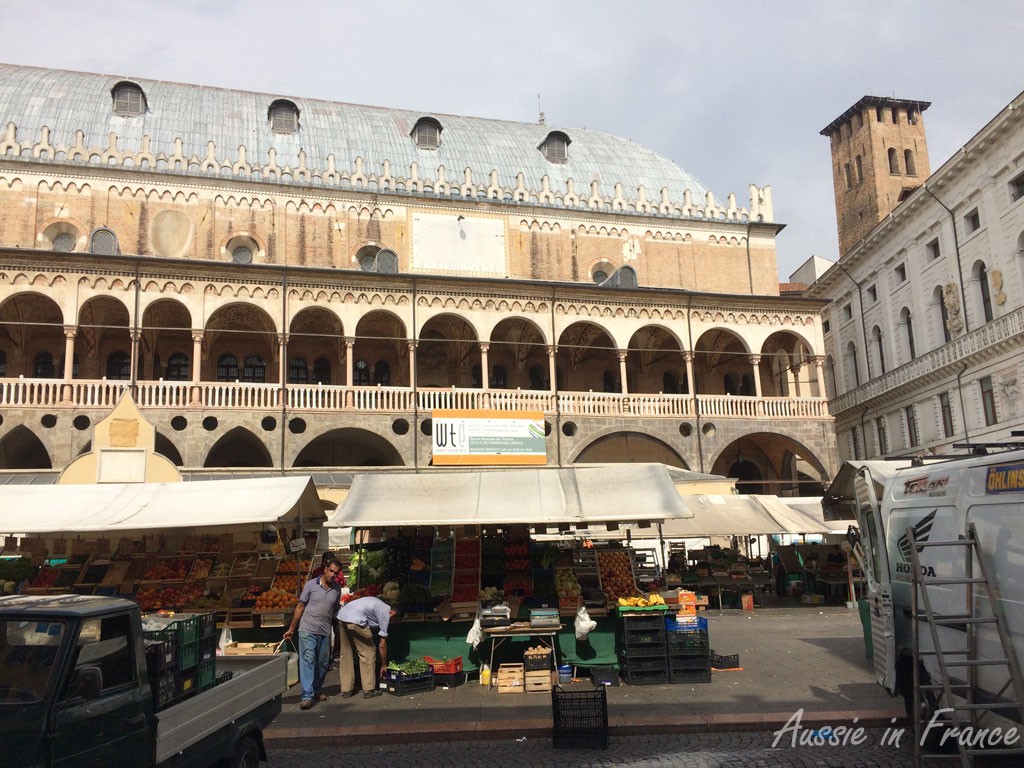
The 13th century Palazzo della Ragione with its sundial
We visit the Piazza della Fruta and the Piazza delle herbe where they are starting to pack up after the daily market, including a visit upstairs.
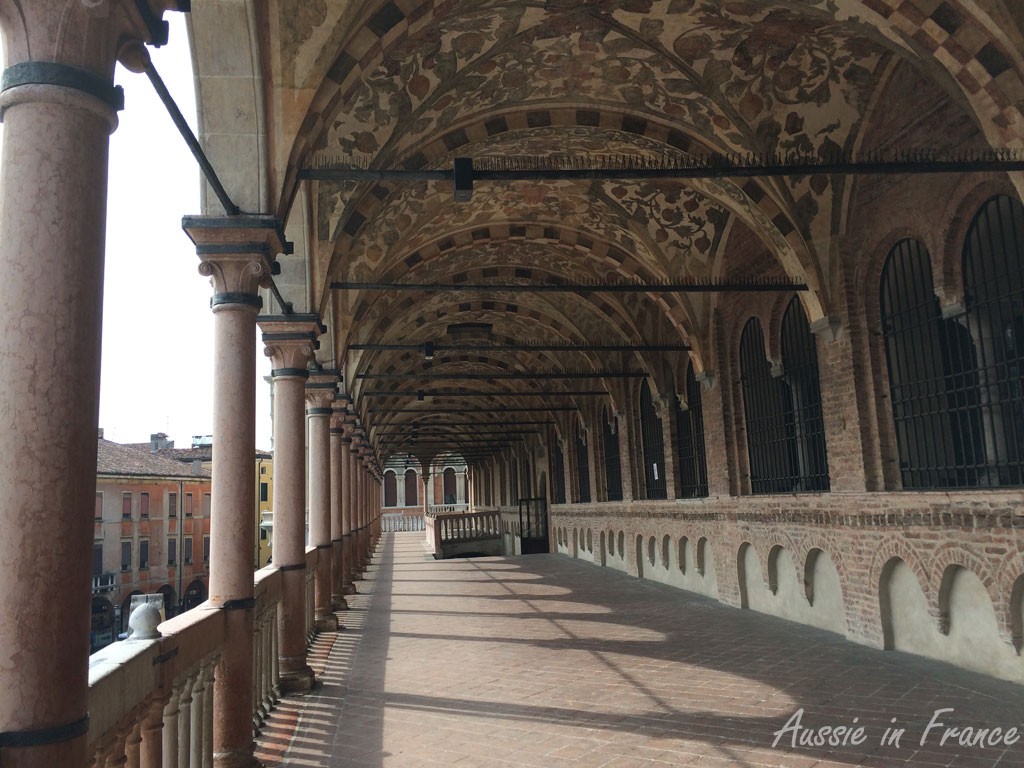
The first-floor gallery of the Palazzo della Ragione
The 13th century Venetian-style building has both a clock and a sundial.
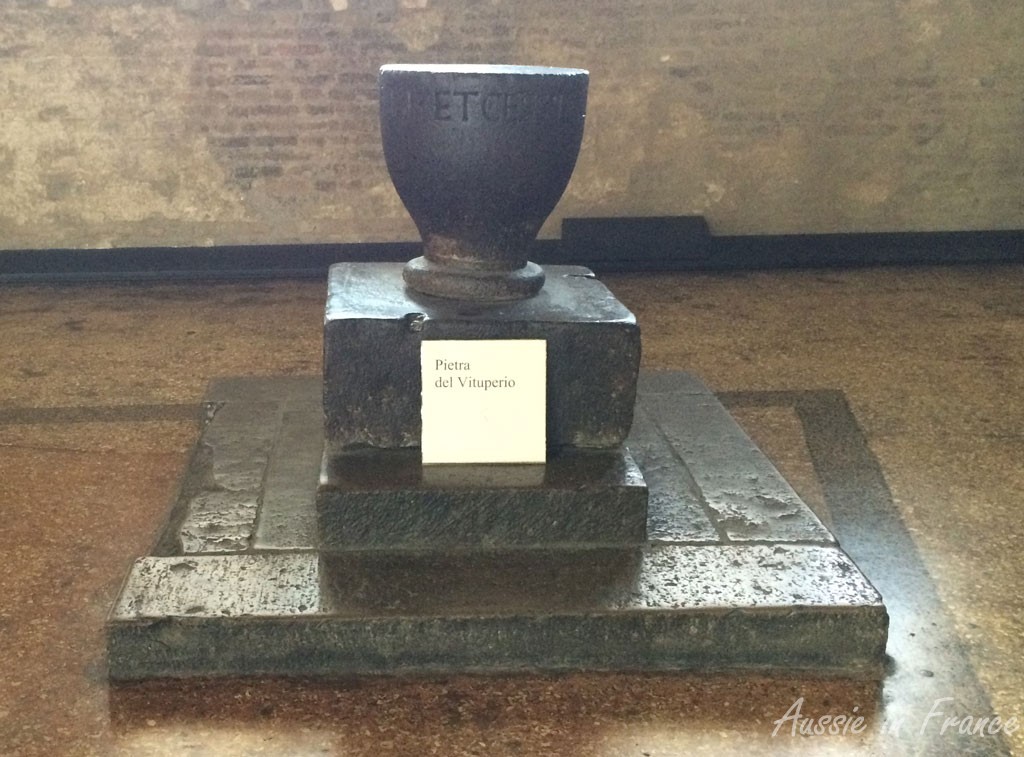
The “stone of shame” inside the Palazzo della Ragione on which insolvent debtors were exhibited in their underwear!
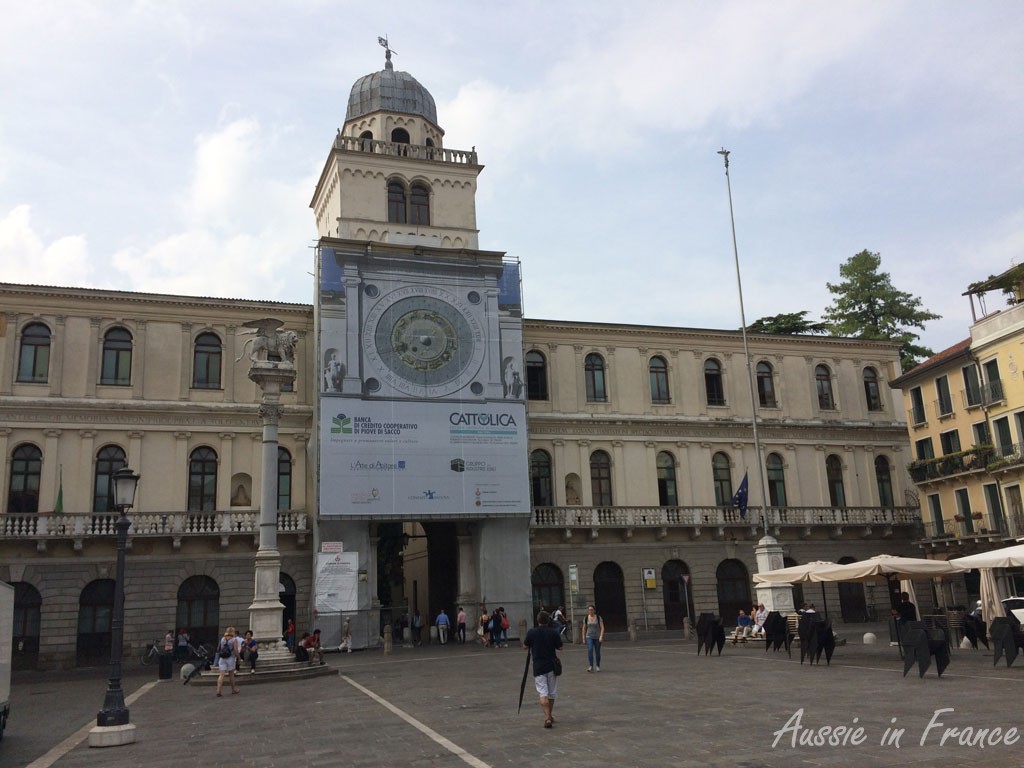
But the oldest clock in Italy is in the nearby Piazza dei Signori, unfortunately being restored.
The oldest clock in Italy (14th century) on the Venitian-style Piazza dei Signori
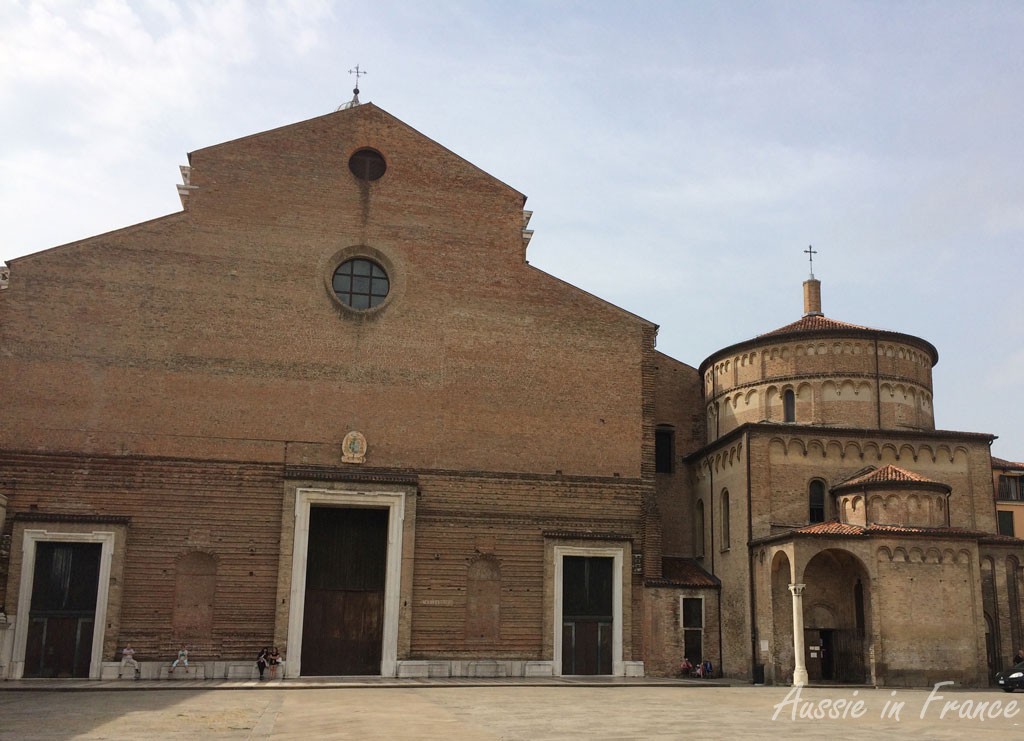
At the Piazza del Duomo, we visit the Baptistry next to the cathedral with its lovely frescoes. Entrance is covered by our Padova Pass.
The 12th cedntury Battisero della Cattedrale
We’ve had enough visiting for one day so head back to the car. I have to press the SOS button on the ticket machine and give the car registration number and Padova Pass number so we can get out the car park.
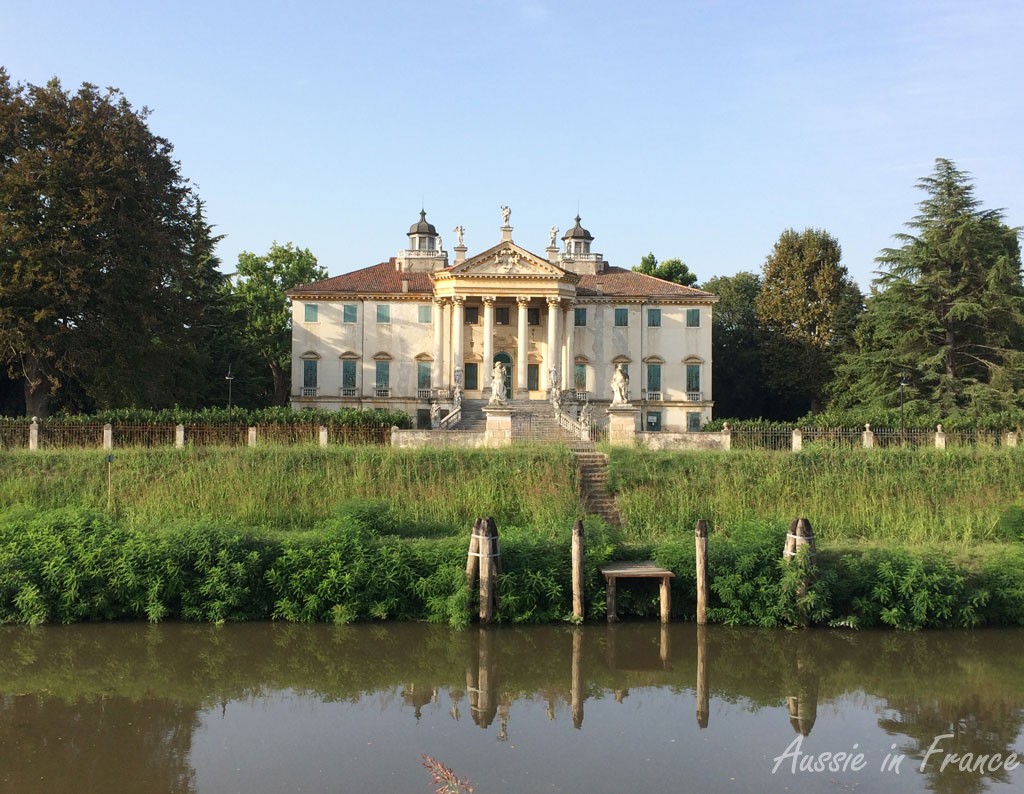
Villa Giovanelli
The B&B is in a residential area called Noventa Padovana and has a large garden. As soon as we’ve taken our things up to the room, we take our bikes off the tailer and, following our hostess’ instructions, cycle down to the canal. So far, so good. It seems we can take the path on either side. Not far along we see the most amazing building which turns out to be Villa Giovanelli, a Paladian villa built in the 17th century.
Riding along the rutted canal road
After that, the road narrows to a couple of deep ruts and we’re no longer sure if we chose the right bank. We eventually come out on a road and don’t know whether to turn left or right. I ask another cyclist for the centro historico and he sends me to the right. We go over a bridge and see the Brenta on our left. By now it’s about 5.30 pm and people are obviously coming home from work. We follow the path along the river hoping we’re going the right way.
The road along the Brent
I ask for directions again and am told to go left over the bridge and straight on. Jean Michel is his usual doubting-Thomas self but we eventually reach an intersection that he recognises. He then takes me back to Piazza dei Signori for a cold drink.
The other end of Piazza dei Signori
The ride home is less eventful and takes a little over a half an hour. Wonderful ! We won’t have to take the car tomorrow to visit Padova.
The weather is rather overcast when we set out but the forecast says it’s going to improve. We’re a bit disappointed because we don’t have the magical light we had yesterday when we cycled to Malcesine.
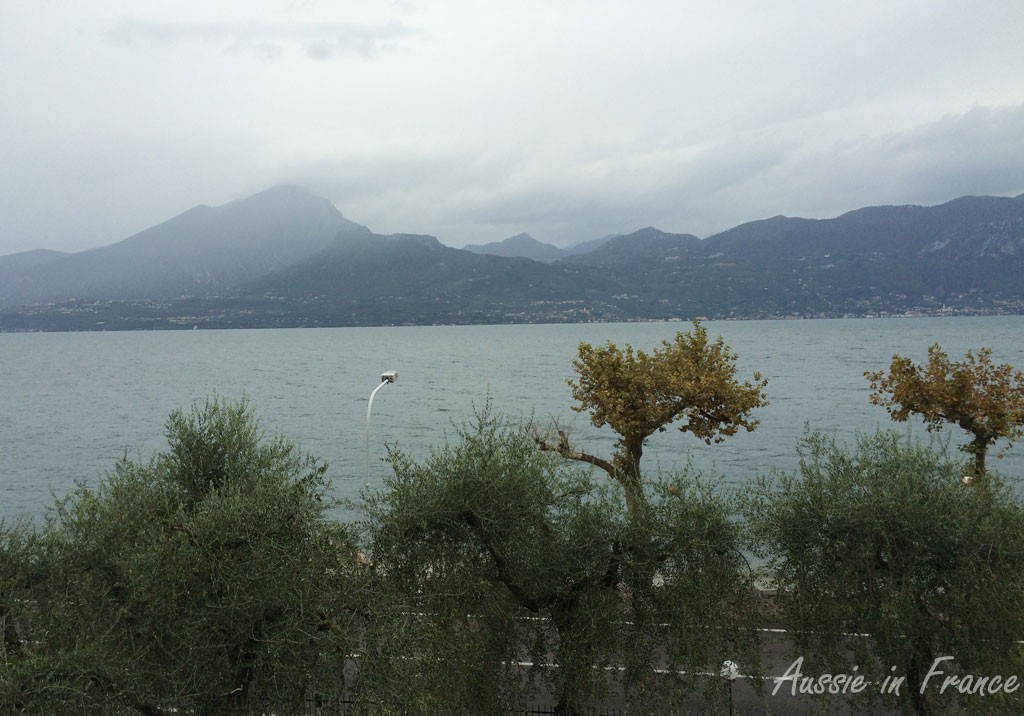
The view from our balcony this morning
We decide to drive to Garda 9 k to the south and stop and visit Torri del Benaco on the way. It is our closest village, after all.
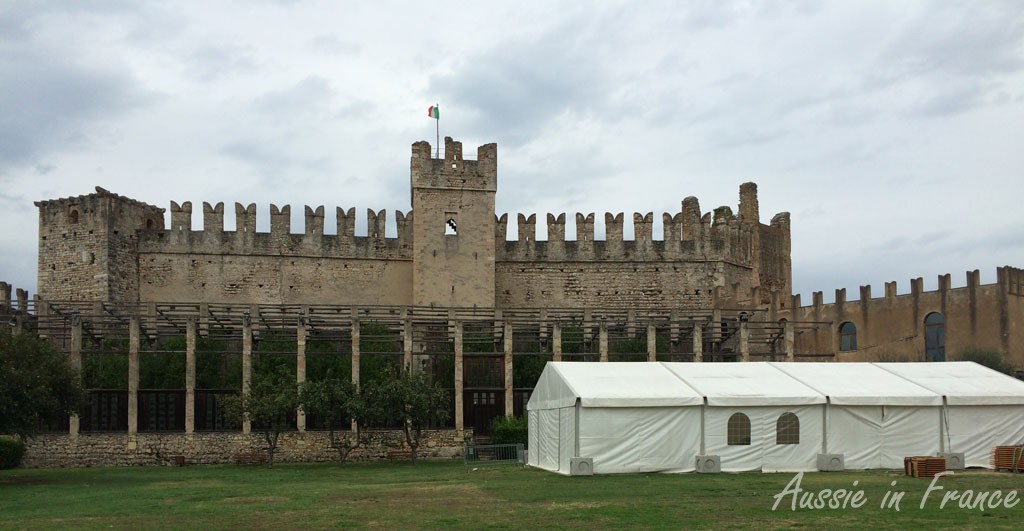
The typical crenellated towers in Torri del Benaco
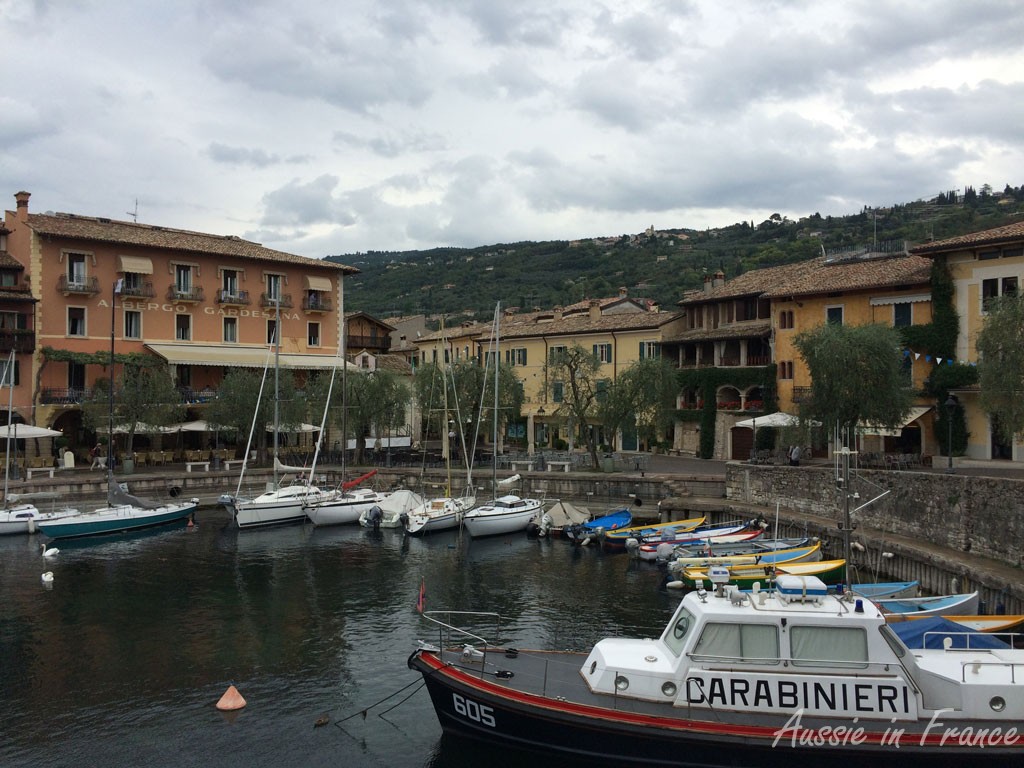
We admire the 14th century castle with its typical crenellations and the usual little rectangular port but the threatening rain doesn’t encourage us to linger.
The port in Torri del Benaco
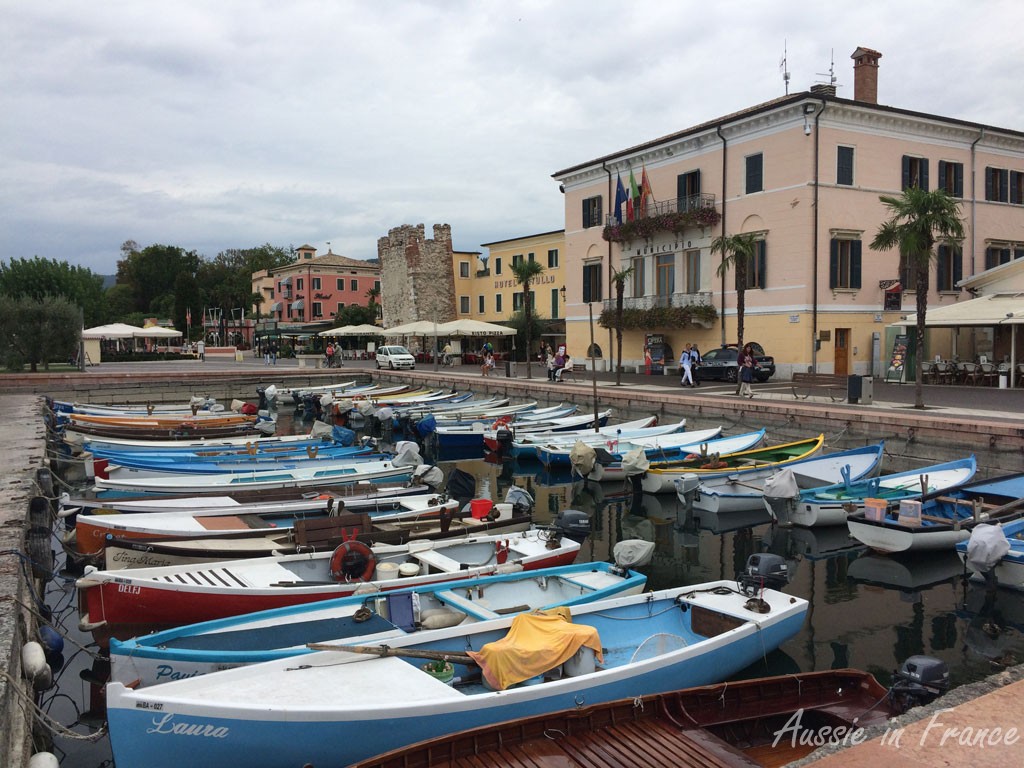
There is a lot of traffic at Garda and not much hope of free parking so we push on to Bardolino another 3 K south. We find a place to park on the side of the main road just before the town and set off on our bikes into the centre. After a couple of kilometres on the main road, we find a very pleasant bike path and discover a most delightful little town, though very different from the villages between Torri and Malcesine.
The port in Bardolino
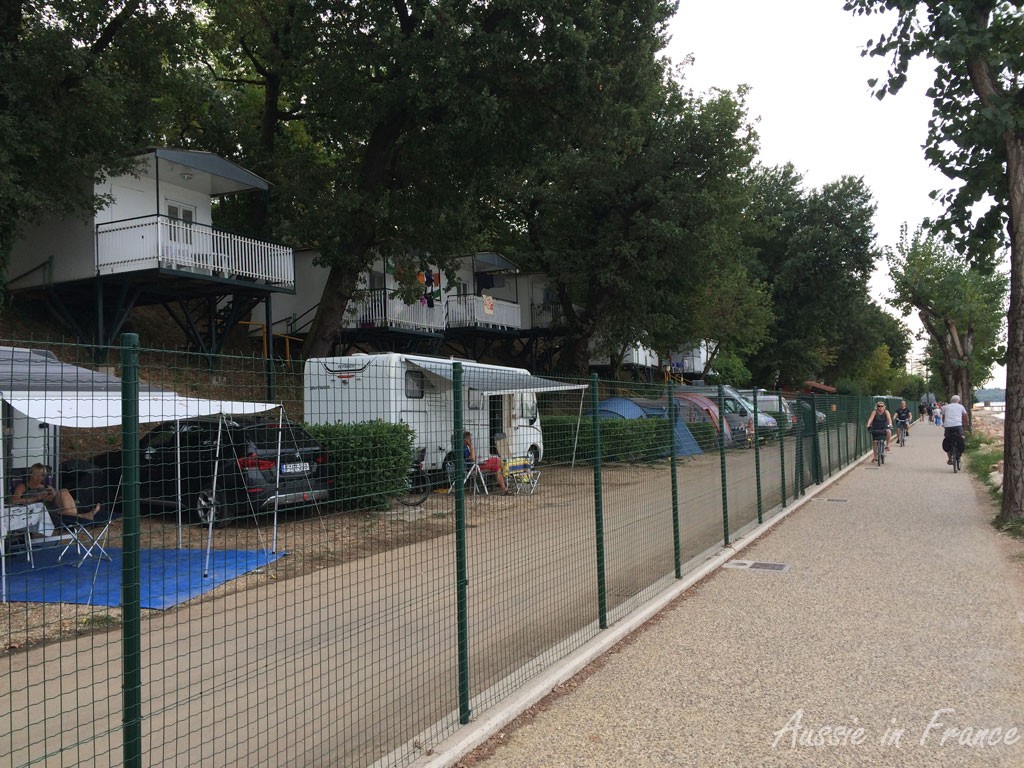
We continue along the edge of the lake passing a series of camping grounds all full of German and a few Dutch campers. Our hotel is full of Germans as well. Ours is the only car without a D on it!
One of the many camping grounds along the waterfront. This one has little hillside bungalows!
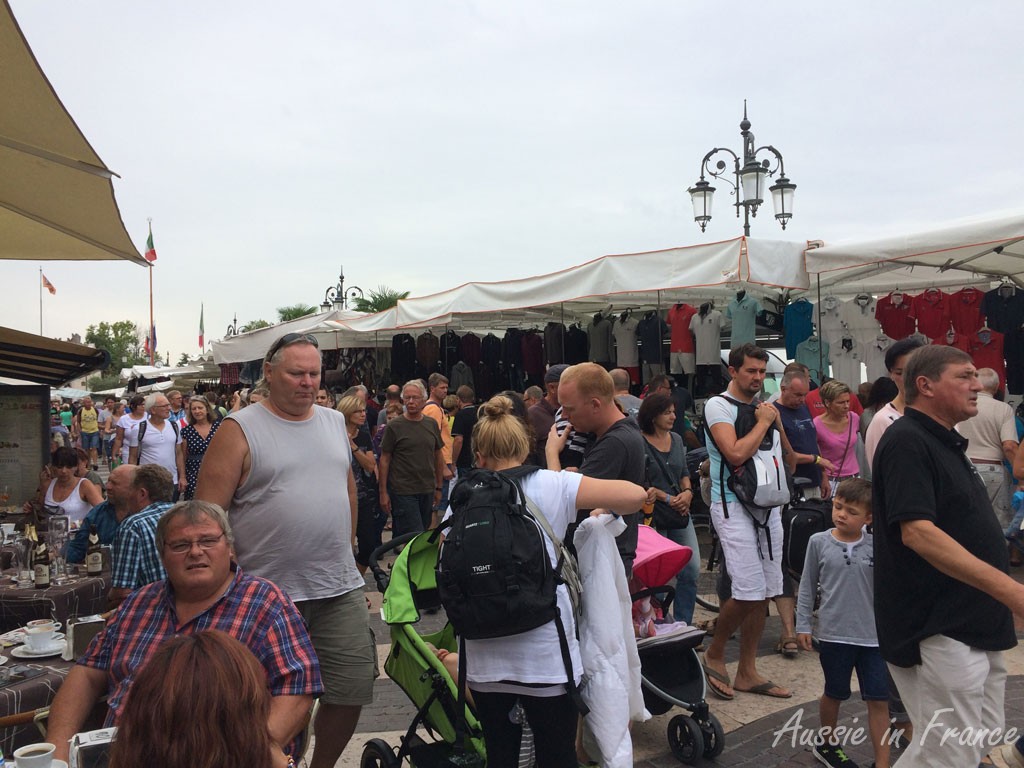
As we approach Lazise, there are more and more people on the path, which is no longer reserved for bikes. We often have to get off and walk. As we finally reach Lazise, we understand why. There is a huge market and the whole town is full of people. We have trouble getting through with our bikes.
The market crowds in Lazise
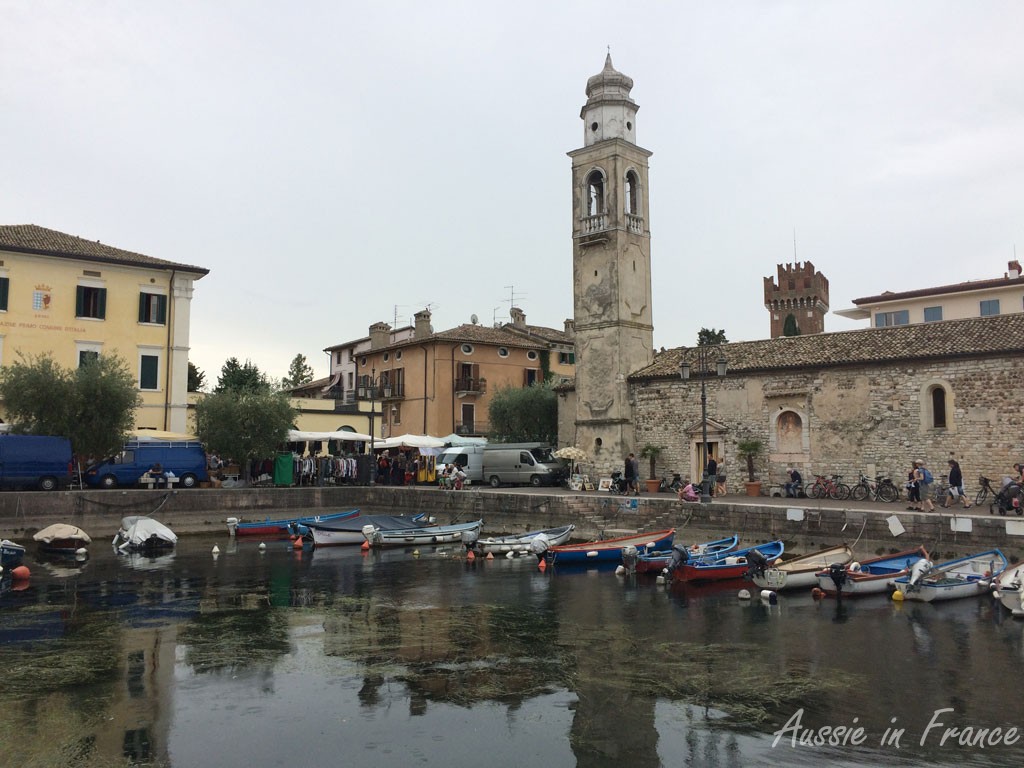
The market spreads so far that we find it difficult to even see the town!
The market on two sides of the port in Lazise
We find our way out as quickly as we can and finally come to a bike path again. The sky is clearing and the light is improving reminding us of yesterday’s magic.
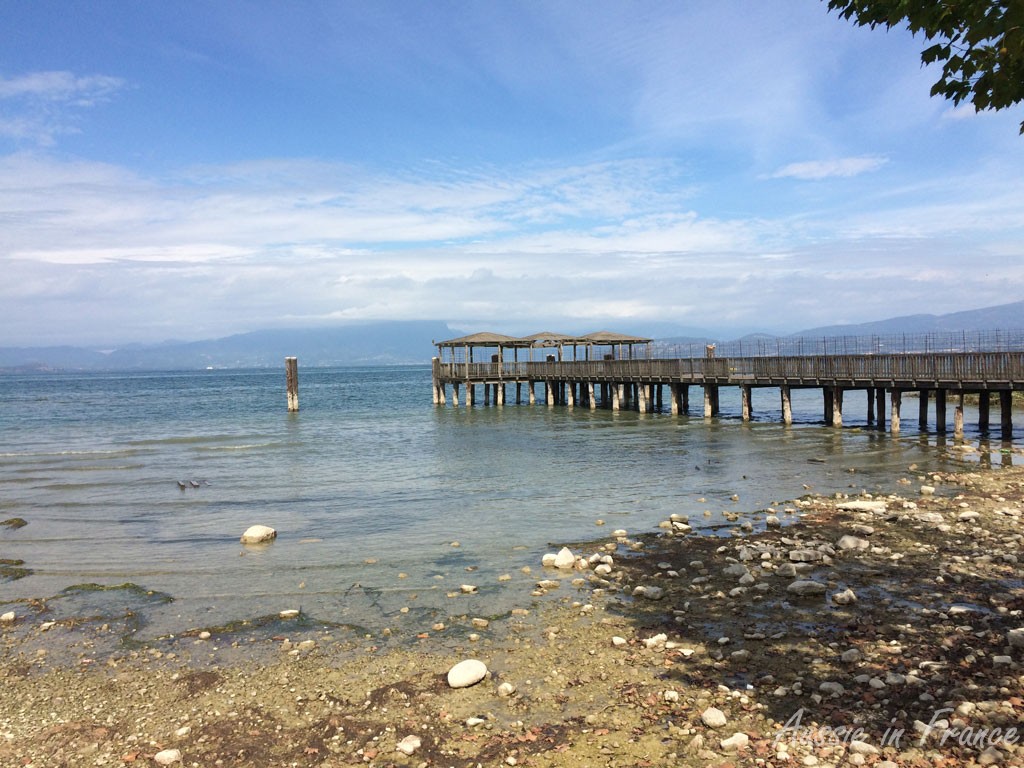
One of the many jetties after Lazise.
The path peters out and becomes a beach. The only way out is through a camping ground that takes us up to the main road again. A bike path along the edge goes past the Caneva World and Gardaland entertainment parks but it’s not very scenic to say the least !
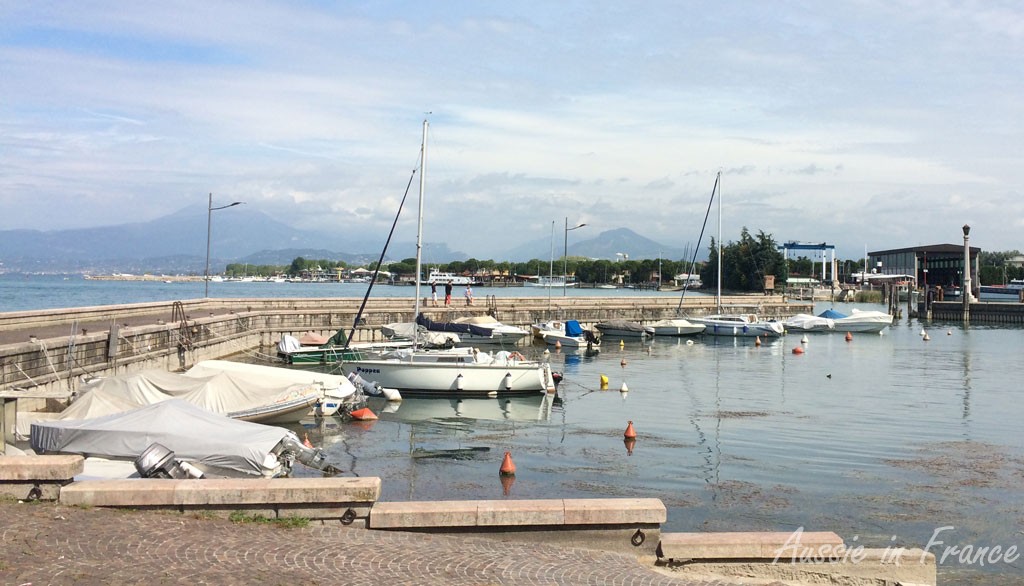
One of the marinas near Peschiera
We finally arrive at what we think is Pescheria but is actually a marina outside. We hesitate to have lunch there but Jean Michel wants to go on to Pescheria and find something more typical. However, when we get there, it seems so full of tourists that we don’t go into the town and continue along the edge of the lake.
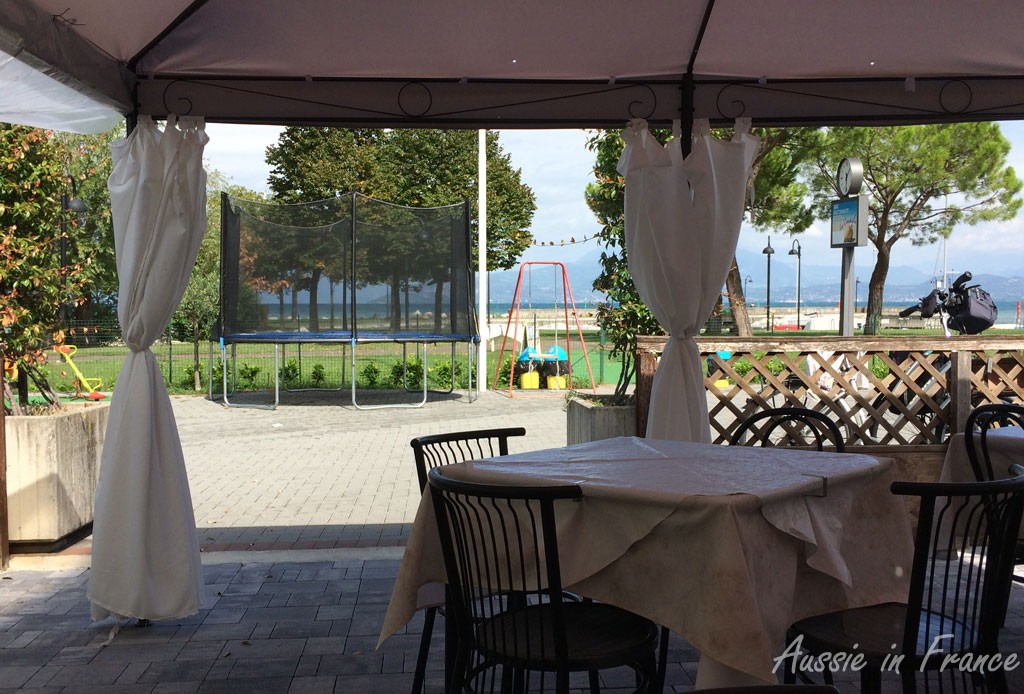
The view from La Conchiglia
We’re forced back onto a bike path along the main road again, and eventually veer off to the right where we find a restaurant with a terrace called La Conchiglia which we later discover also fronts onto the main road! We’re nearly at Sirmione by then. It’s 1.30 pm and we’re hungry! We appreciate the excellent rib steak and cold house red.
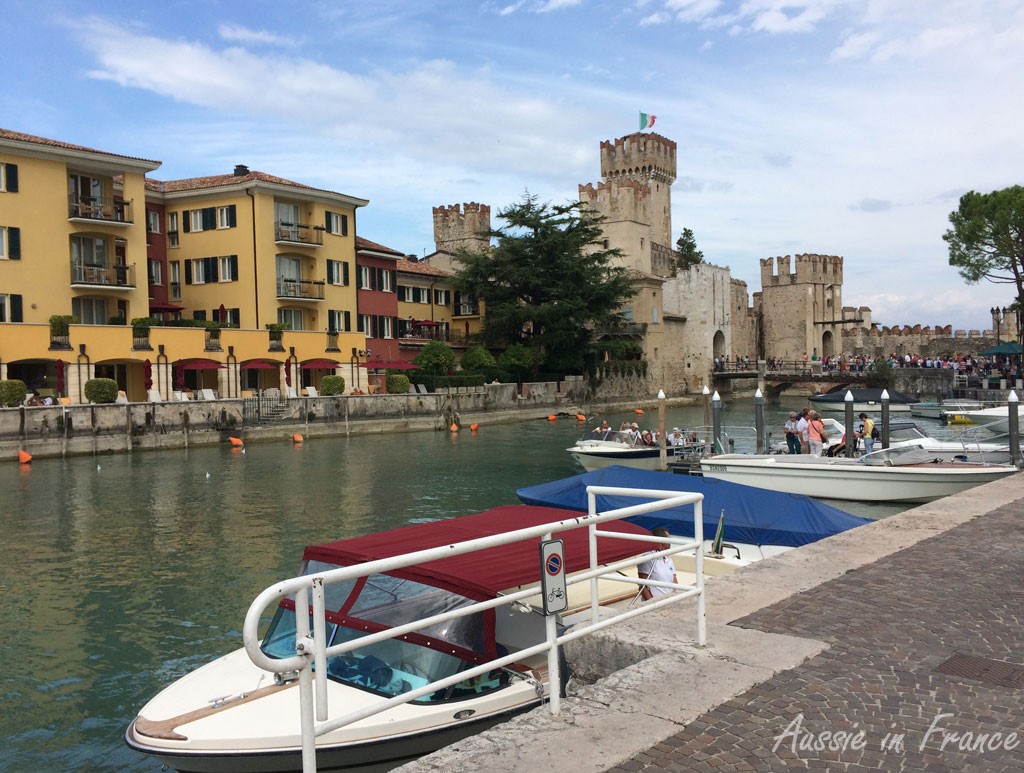
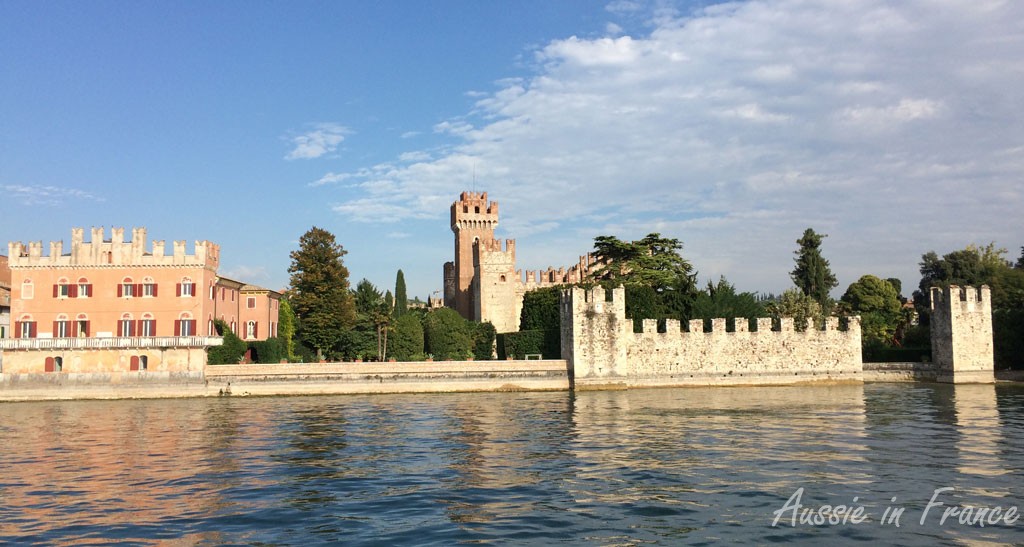
Sirmione castle from the port
A bike path along the main road then takes us up the peninsula to Sirmione which is once again packed with tourists. It’s hard to really appeciate the surroundings with so many people in every direction. We buy our ferry tickets to back to Bardolino (28 euro for us and our bikes for a one-hour-trip), find somewhere to leave the bikes and vist the town.
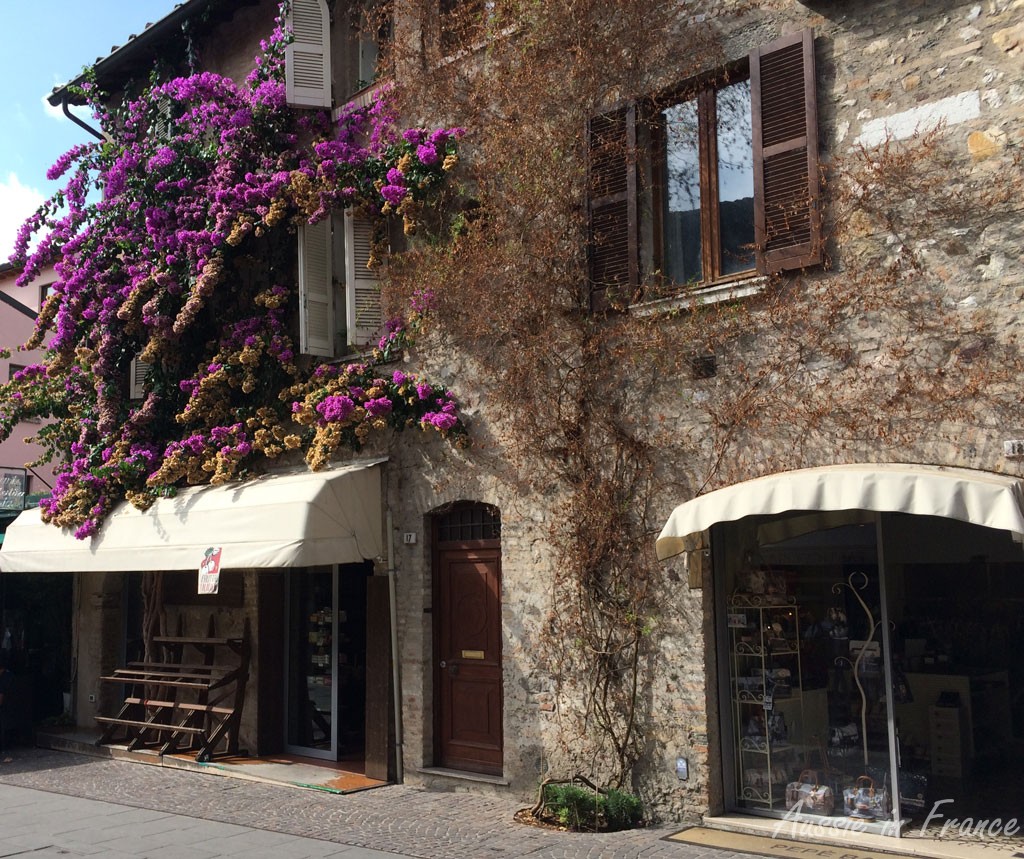
It’s nearly the end of the bougainvillea season but it’s still stunning
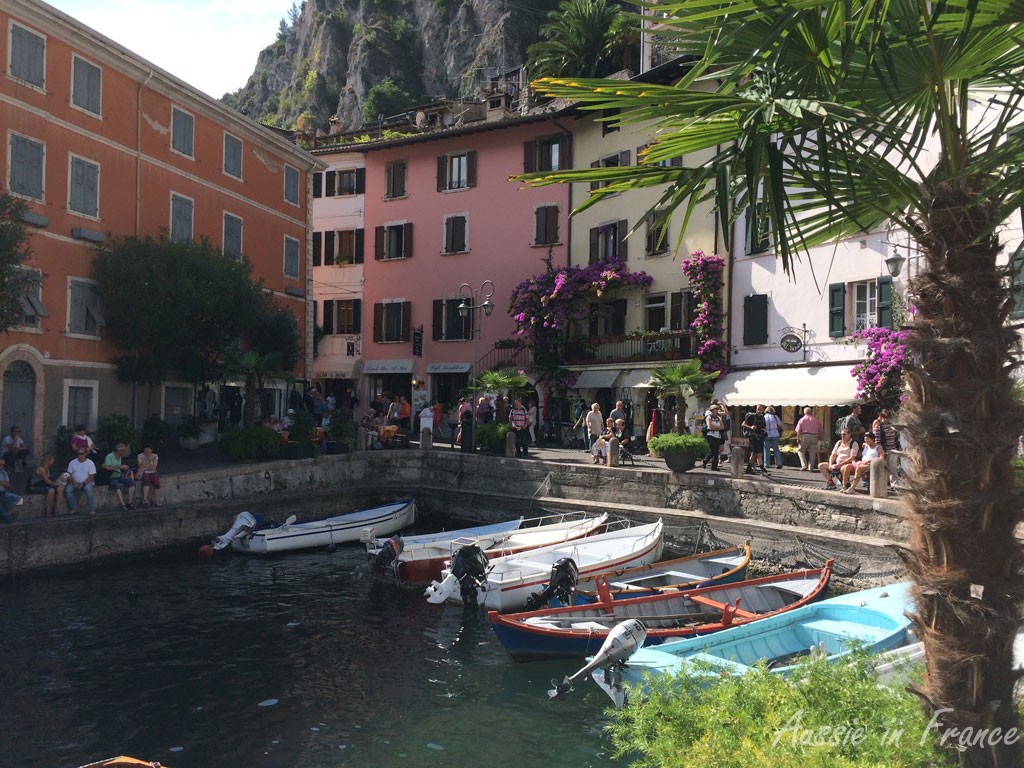
There is bougainvillea everywhere and despite the crowds and the shop fronts we can make out some lovely old buildings.
The Grottoes of Catullus built in Roman times
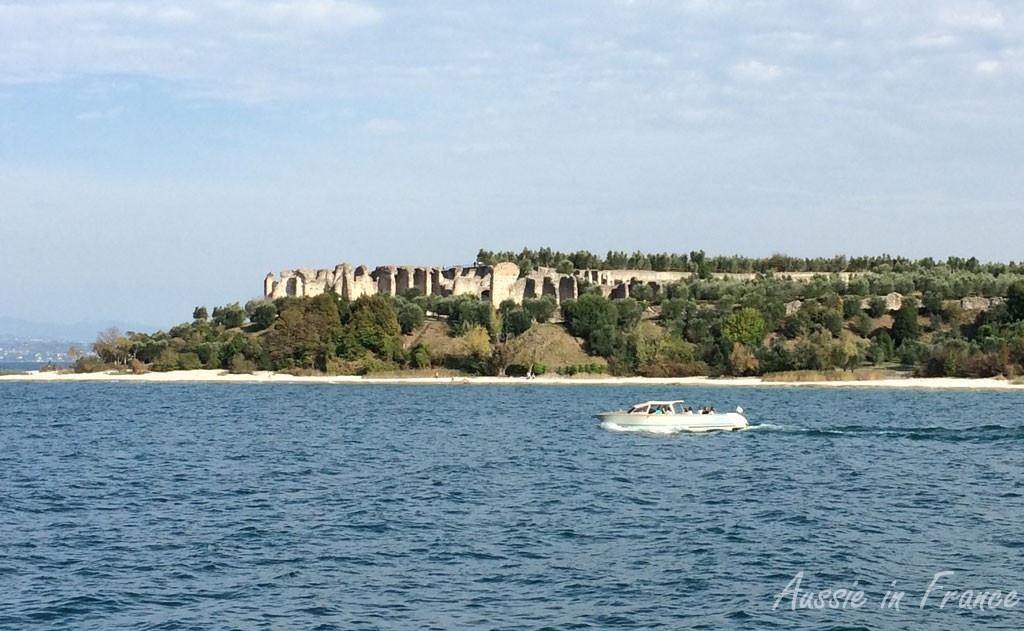
After the obligatory gelato, we wait for the ferry. Because we have bikes we’re taken to the top of the queue and get excellent seats on the top deck. We get a bird’s eye view of the Roman ruins of the Grottoes of Catullus and immediately regret we didn’t visit them.
Lazise from the ferry, looking much better without the market and the crowds
As we approach Lazise from the ferry, we are able to get a better view of the castle and waterfront that was obscured by the crowds in the morning. The streets are practically empty. Advice: always visit in the afternoon!
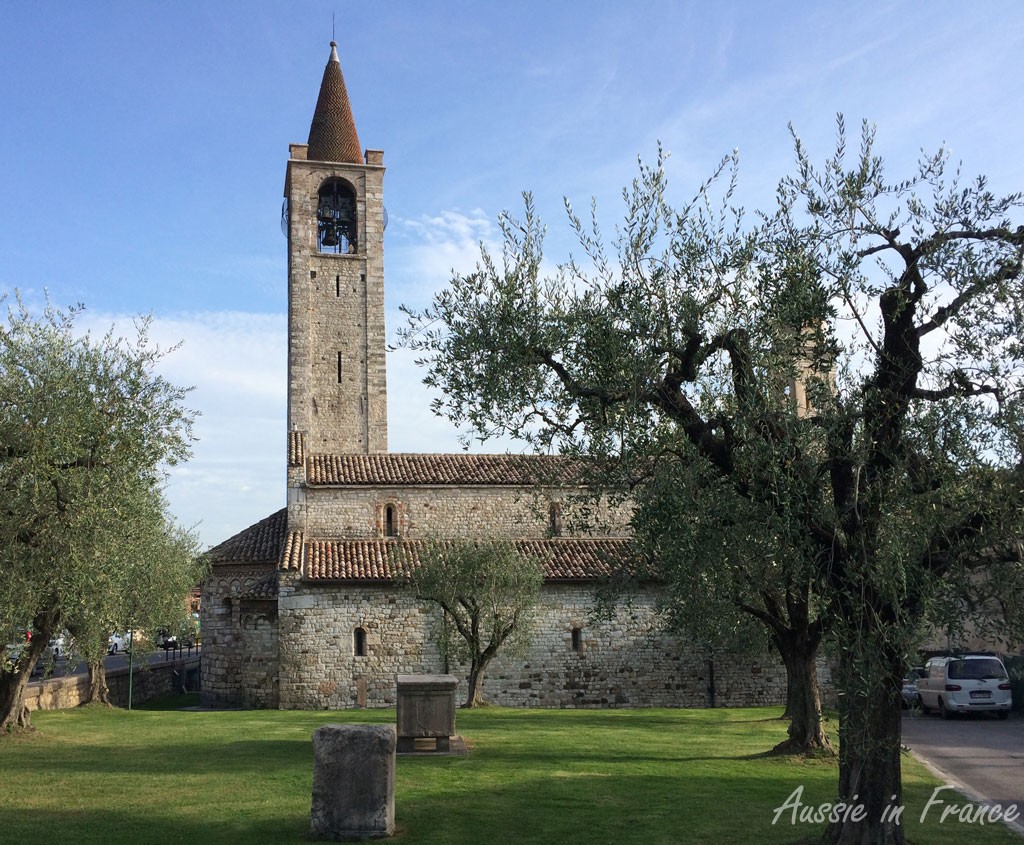
The Romanesque church of San Severo with its olive trees
We soon arrive back in Bardolino and set out in search of the little Romansque church of San Severo. We visit in turns to avoid having to lock our bikes and the second time I go past I hear singing. I assume it must be recorded music although it’s very powerful. “No”, says Jean Michel, “it’s a young girl.” I go back in but she has stopped singing. “Encore,” I say hopefully and she obligingly sings again. Her voice brings tears to my eyes.
We cycle back to the car and are soon ensconced on our balcony with the usual glass of white wine. Although today is somewhat of a disappointed after yesterday, the sunset turns out to be the best so far. and the singing is unforgettable. Tomorrow we’re off to Padua.
Off on our summer holiday at last ! The window and the kitchen are finished and a well-deserved month is awaiting us. We are starting with Lake Garda in Italy and hoping to go to Slovenia and onto Zaghreb in Croatia and eventually to Bucarest to continue cycling along the Danube where we left off last time (Budapest). But with immigration and border problems in eastern Europe at the moment, we’re not sure how far we’ll get.
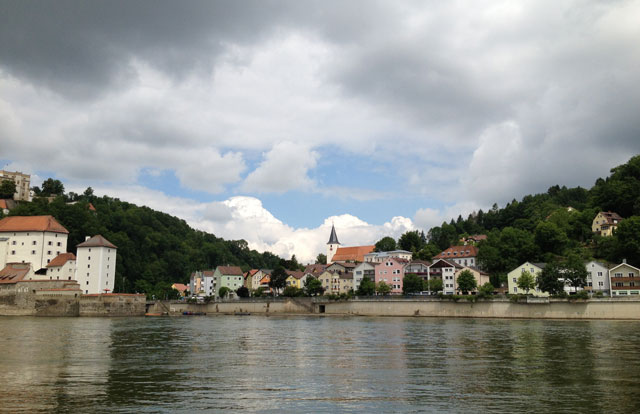
Along the Danube
We arrive in Torri del Benaco on Lake Garda around 6 pm and head for the tourist office because our Tom-Tom can’t find the address of the hotel. At the same time we ask about cycling paths. The girl looks askance then hastily circles a few towns on the map and says “You can cycle from there to there and from there to there. Otherwise it’s on the main road.” We’ve been driving on the main road and the traffic does not look encouraging.
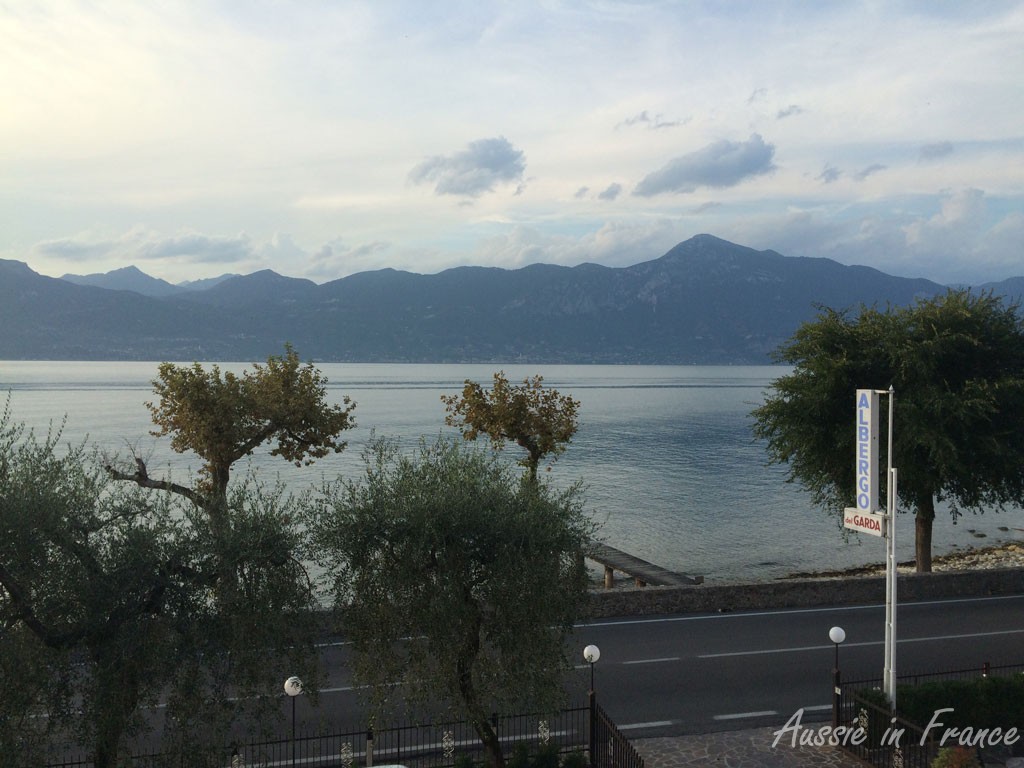
View from the balcony
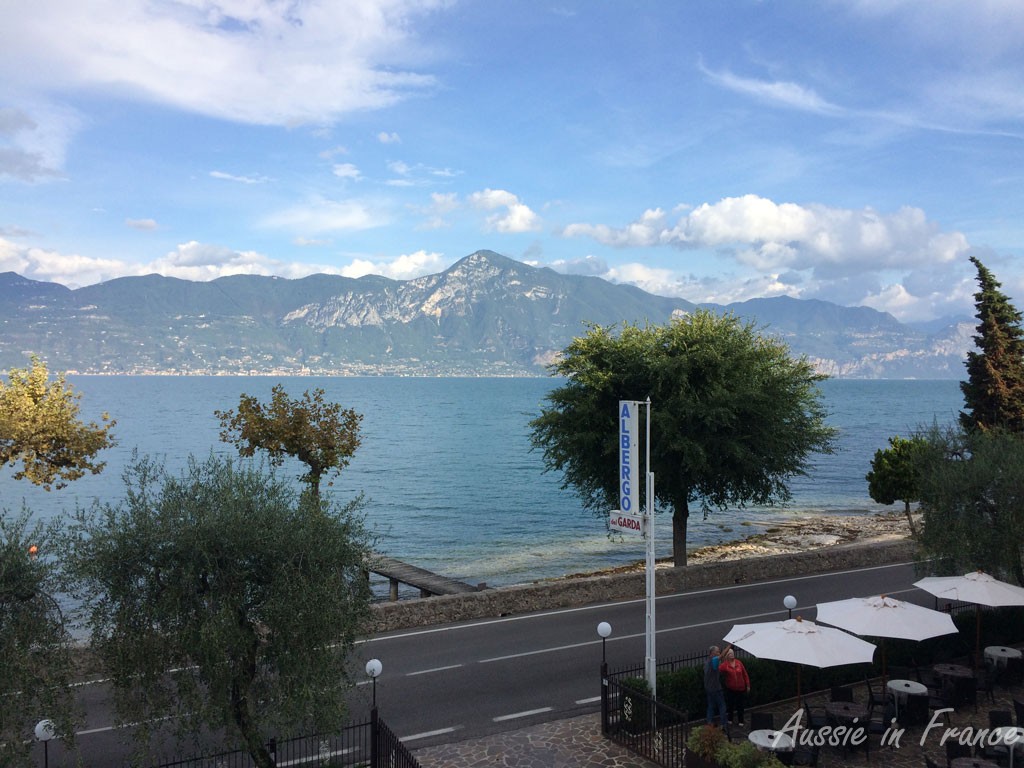
Our hotel, Albergo del Garda, turns out to be 4 k to the north. I had understood it was in the village itself. The idea was NOT to have to take the car for 3 days. Hmm. We arrive and see that the hotel is located directly on the main road. We receive a very stony welcome and are shown our room on the second floor without a lift. The room is very spartan and small. However, it has a balcony overlooking the lake and the view is stunning.
Our balcony view in the morning
It has been a very fraught day (I had an attack of orthostatic hypotension at lunchtime and we had to rush out of the restaurant in Aosta and driving on the Italian motorway is not very relaxing even for a good driver like Jean Michel). I suggest that we unpack the car later and have a cold drink of wine and some olives on the balcony first. As we sit and look at the view of the lake and mountains opposite, the magic begins to work.
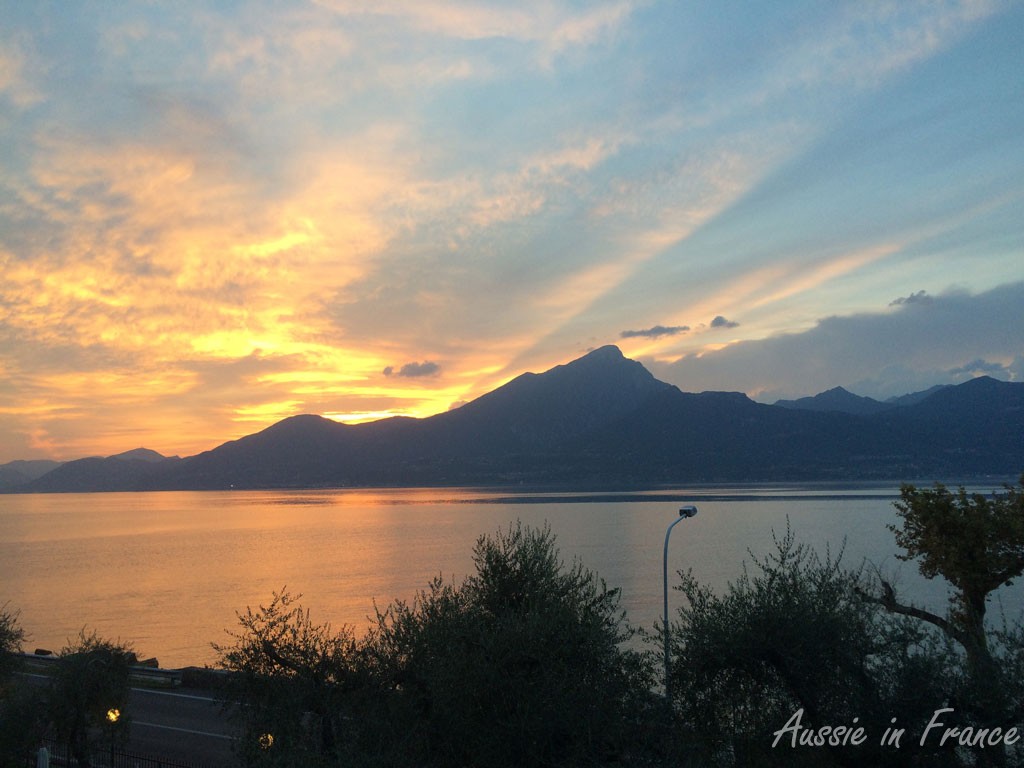
Sunset from our balcony
The sunset turns out to be quite spectacular and we at last feel we are on holidays. Rather than go out again, we eat some of my home-made bread, tomatoes from the garden and our cycling biscuits.
The lake from the cemetary in Pai looking across the main road
We wake up next morning at 8 am (early for us) due to the extremely thin walls (I could hear the man next door snoring in the night) and have breakfast, which isn’t bad for Italy which is not renowned for its prima colazione but all the guests except us are German which probably explains why it’s better than usual …
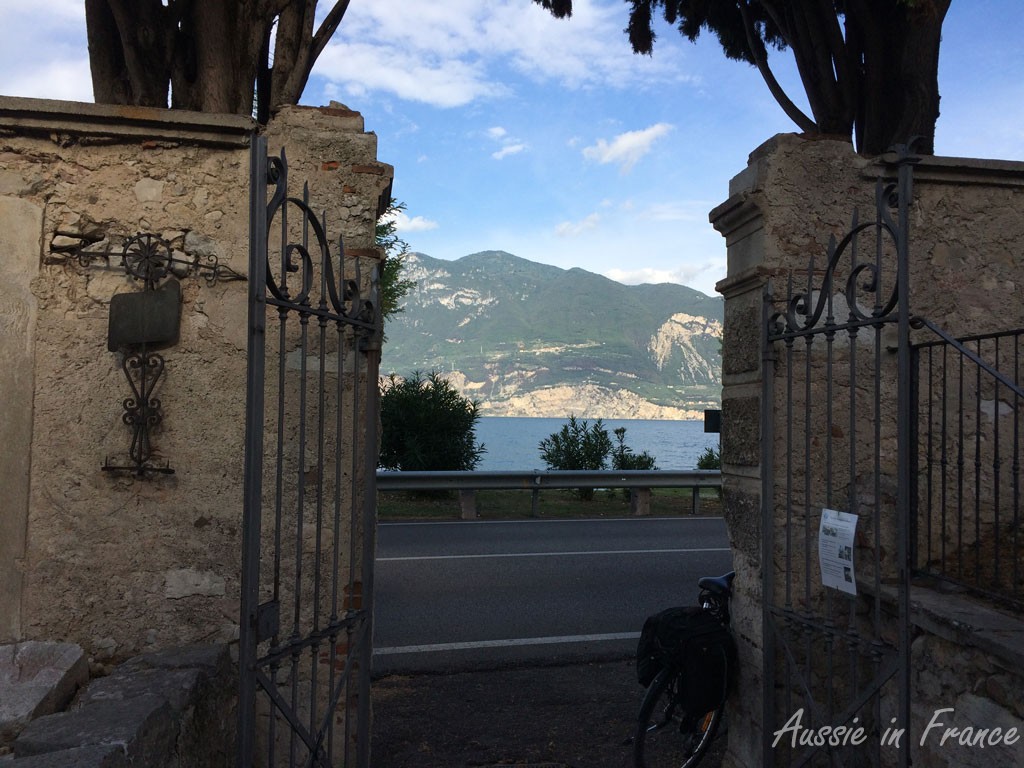
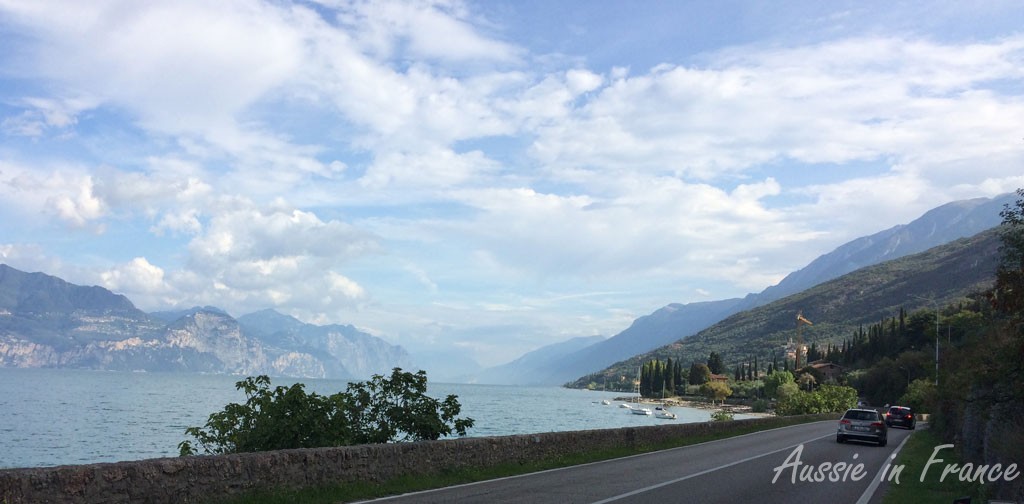
The view of the lake from main road
By 9.15 am we are on our bikes, on the main road, heading for Malcesine 18 K to the north where we’re taking the ferry to Limone on the other side of the lake. The view is so wonderful that I forget to be nervous as cars speed past at 90 kph. We stop several times to take photos.
The view from our first attempt at finding the cycle path
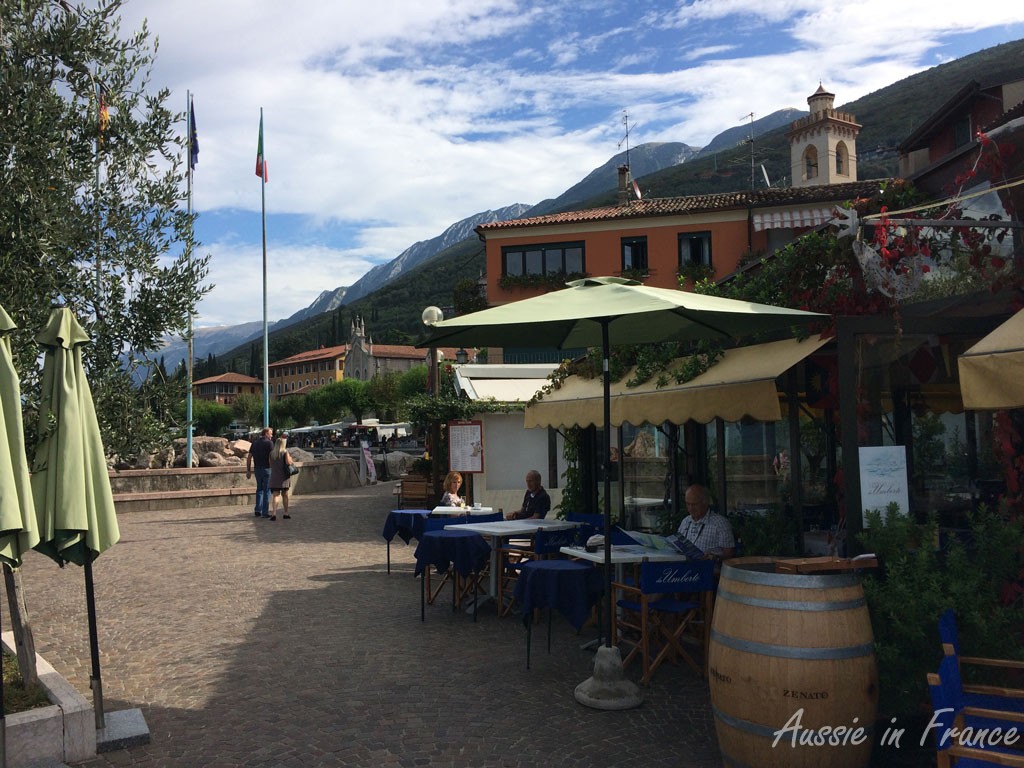
There’s supposed to be a cycle path at Castelletto di Brenzone 6 k from along the route but we have a little trouble finding it. We eventually do (there are no indications) and stop for a cold drink at Ristorante di Umberto right on the lake. It feels like heaven.
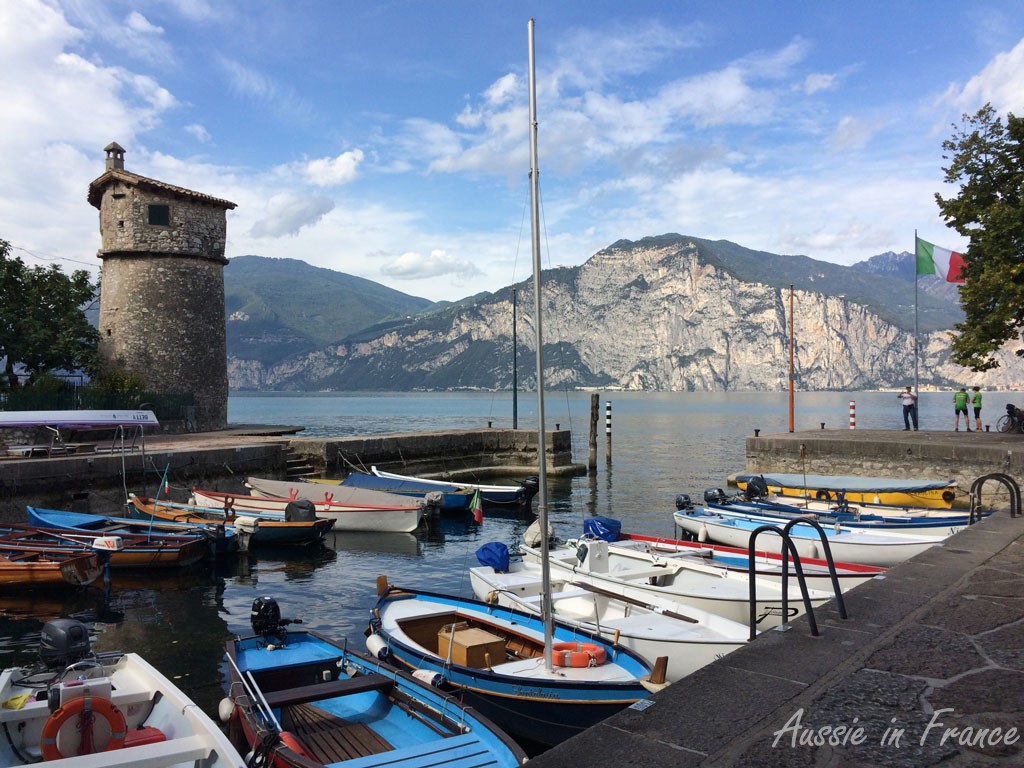
Our first stop for the day at Castelletto
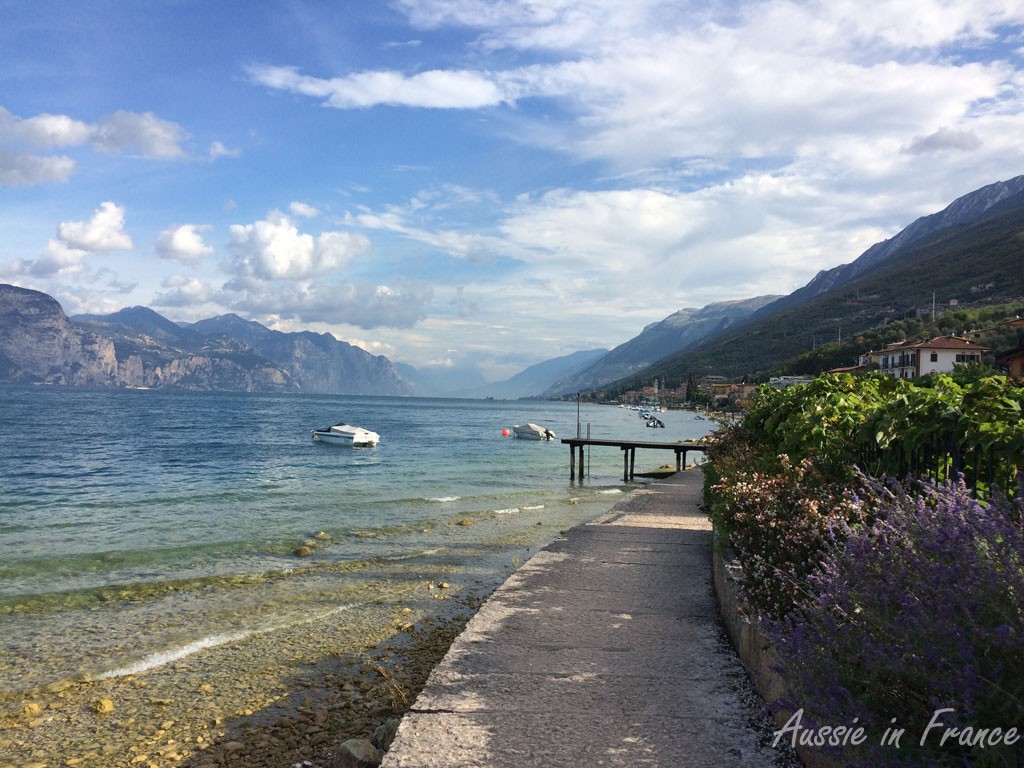
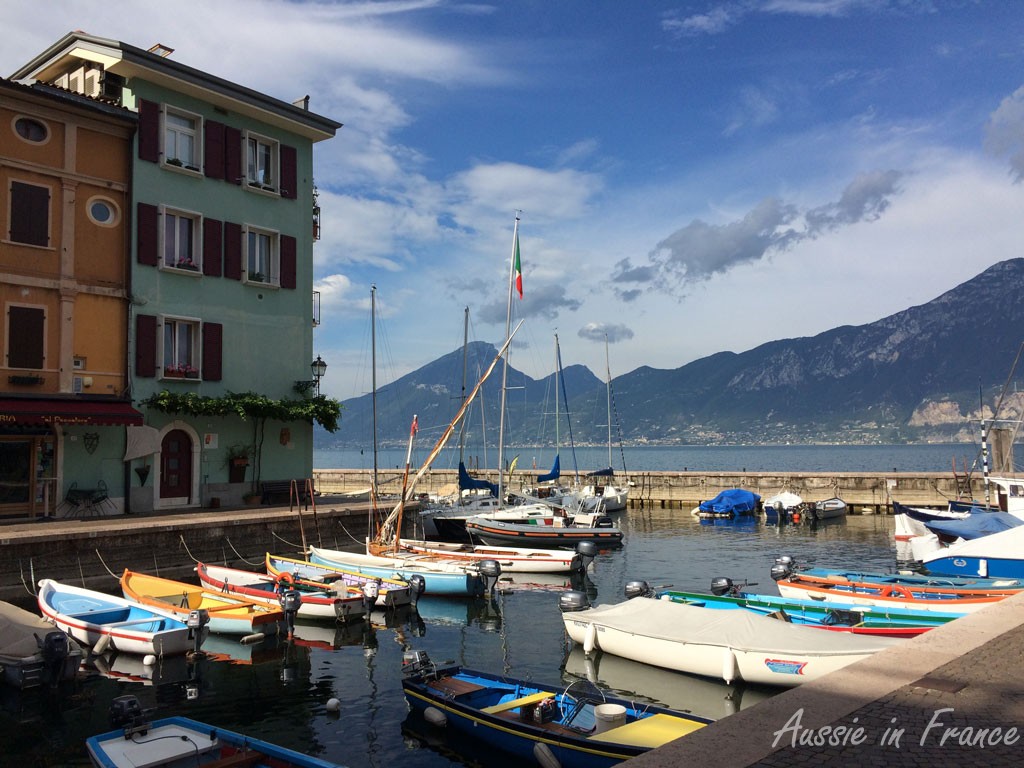
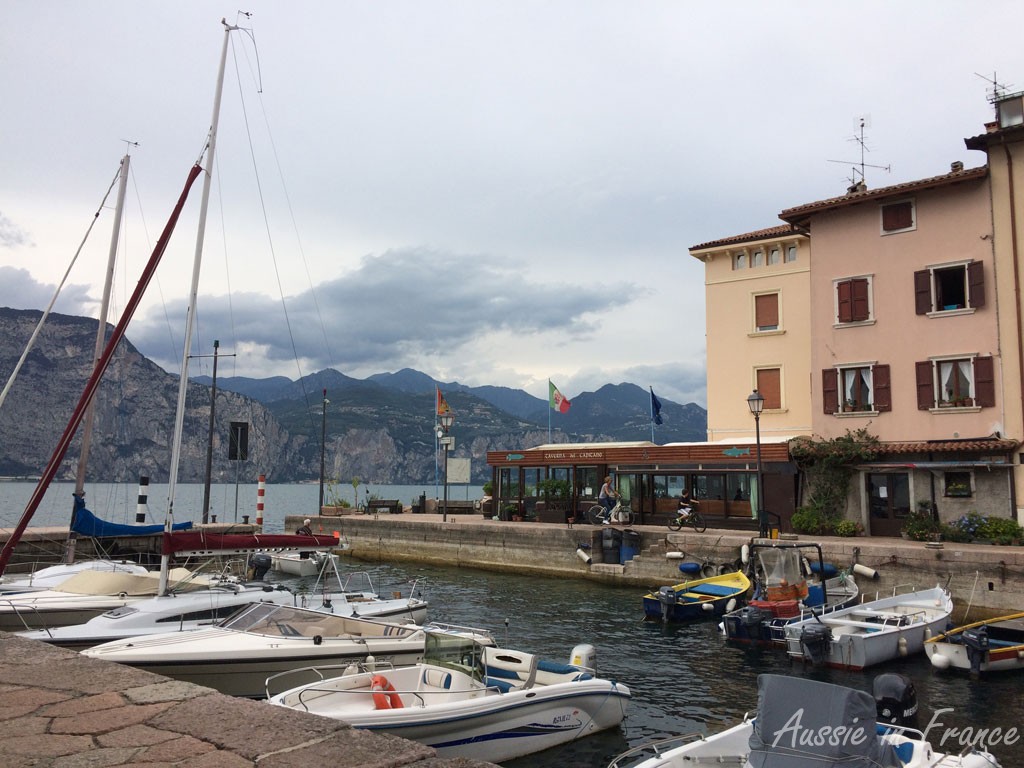
We continue along the path past a busy market. It then becomes very pebbly and we hope it’s going to improve. It does and from then on, we are riding along the lake, past lovely little fishing villages with their tiny rectangular ports.
The first rectangular port in Castelletoo
The light and the colours of the lake are quite wonderful. We couldn’t hope for a better start to our holiday.
The tower and port in Cassone
At Cassone, the last village before Malcesine, we visit a small museum devoted to life on the lake. I check the ferry timetable and see that we only have a half an hour before it departs and the next one is two hours later. We leave post haste and arrive in Malcesine with 5 minutes to spare. There is a queue for the tickets but we make just in time. We’re stunned at the price – 19.40 euro for two people and two bikes!
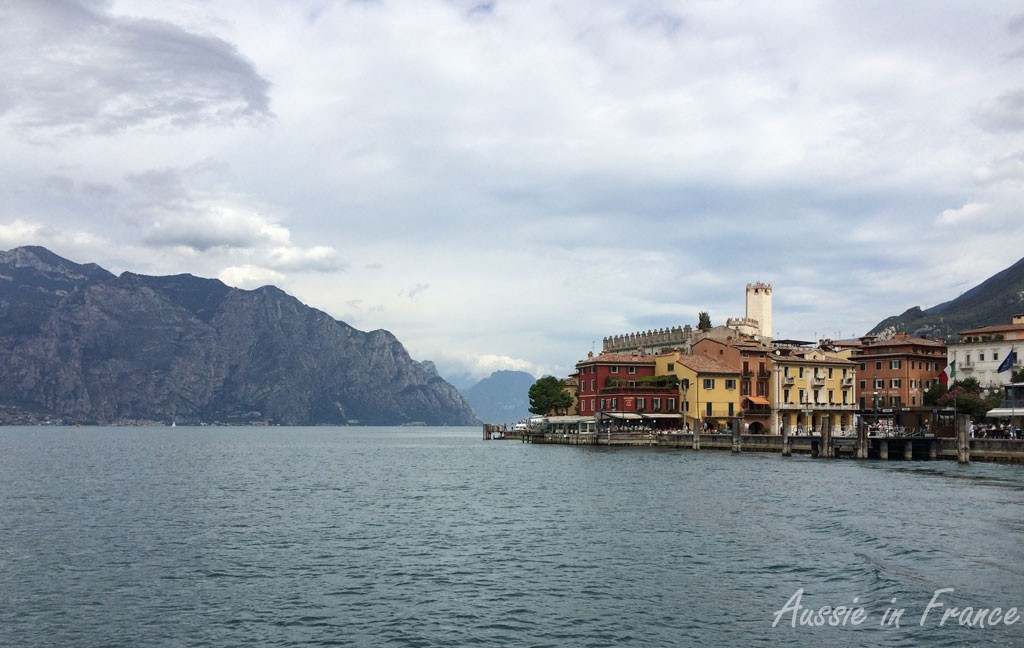
Malcesine from the ferry
It takes a half an hour to go across the lake to Limone. It’s lovely being on the lake with lovely views in every direction. After starting out in the morning at 19°C it’s now 25°C and feels quite hot. We get off the ferry and are overwhelmed with the number of tourists. Everyone seems to have come to Limone for lunch, like we have!
Alla Noce restaurant in Limone
We find a place to leave our bikes because it’s hard going with so many people and so many steep streets. We walk up a hilly street away from the main eating area in the hope of finding something a little less crowded. We eventually come to a shady restaurant overlooking the lake called Ristorante Alla Noce.
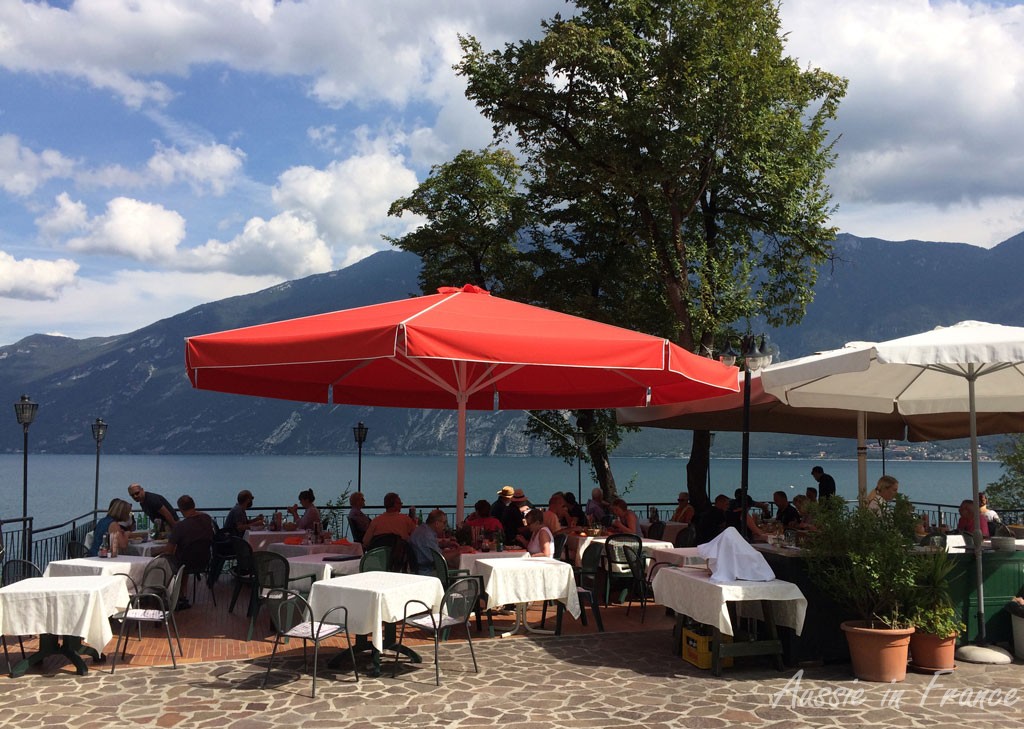
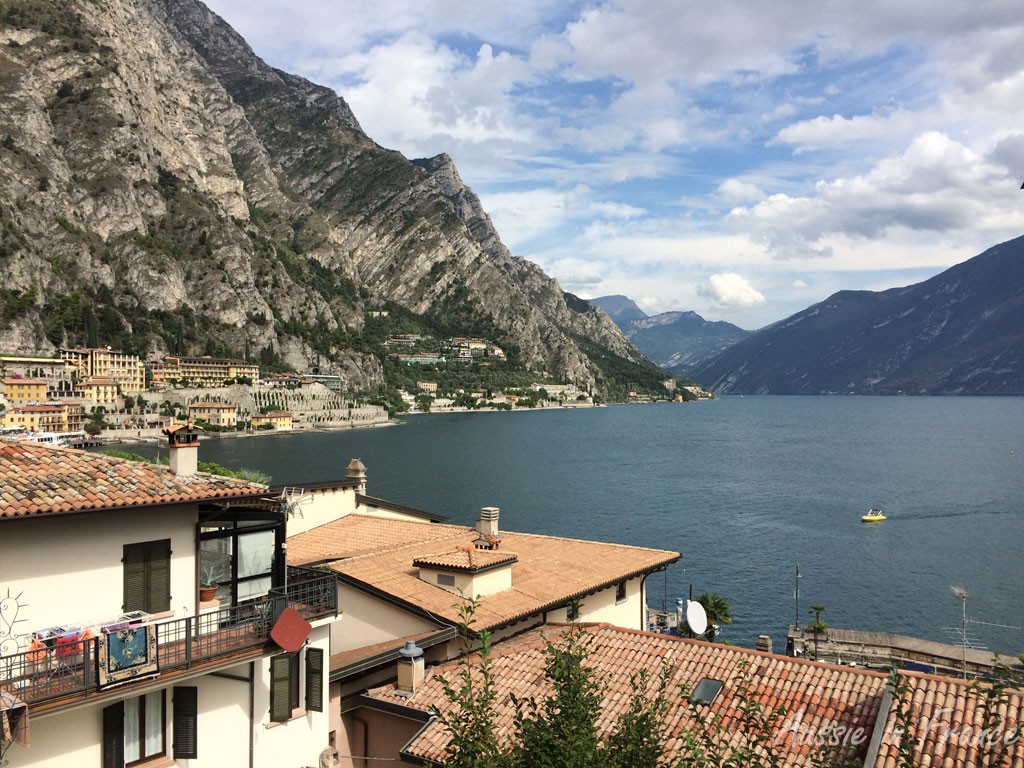
The view from Alla Noce in Limone
The sour-looking waiter finds us a table and brings us a menu but the view is lovely so we ignore his attitude. We share a seafood antipasto, followed by grilled lake fish for Jean Michel and a steak for me because I’m not feeling at all adventurous after yesterday. We have house wine which is very slightly frizzante like a lot of the Italian wines. The bill comes to 59 euro.
The little port in Limone
After coffee, we head back into the madding crowd and then look for our ferry which leaves from a different quay it seems. On the way, we see another boat going to Malcesine which turns out to be a bit cheaper than the official ferry (18 euro) and we don’t have to queue for tickets. The engine is very noisy and we get sprayed a bit but we enjoy the ride. We later learn that it’s 9 euro per person return but we don’t know what they usually charge for bikes.
The fresco on the Palazzo dei Capitani in Malcesine
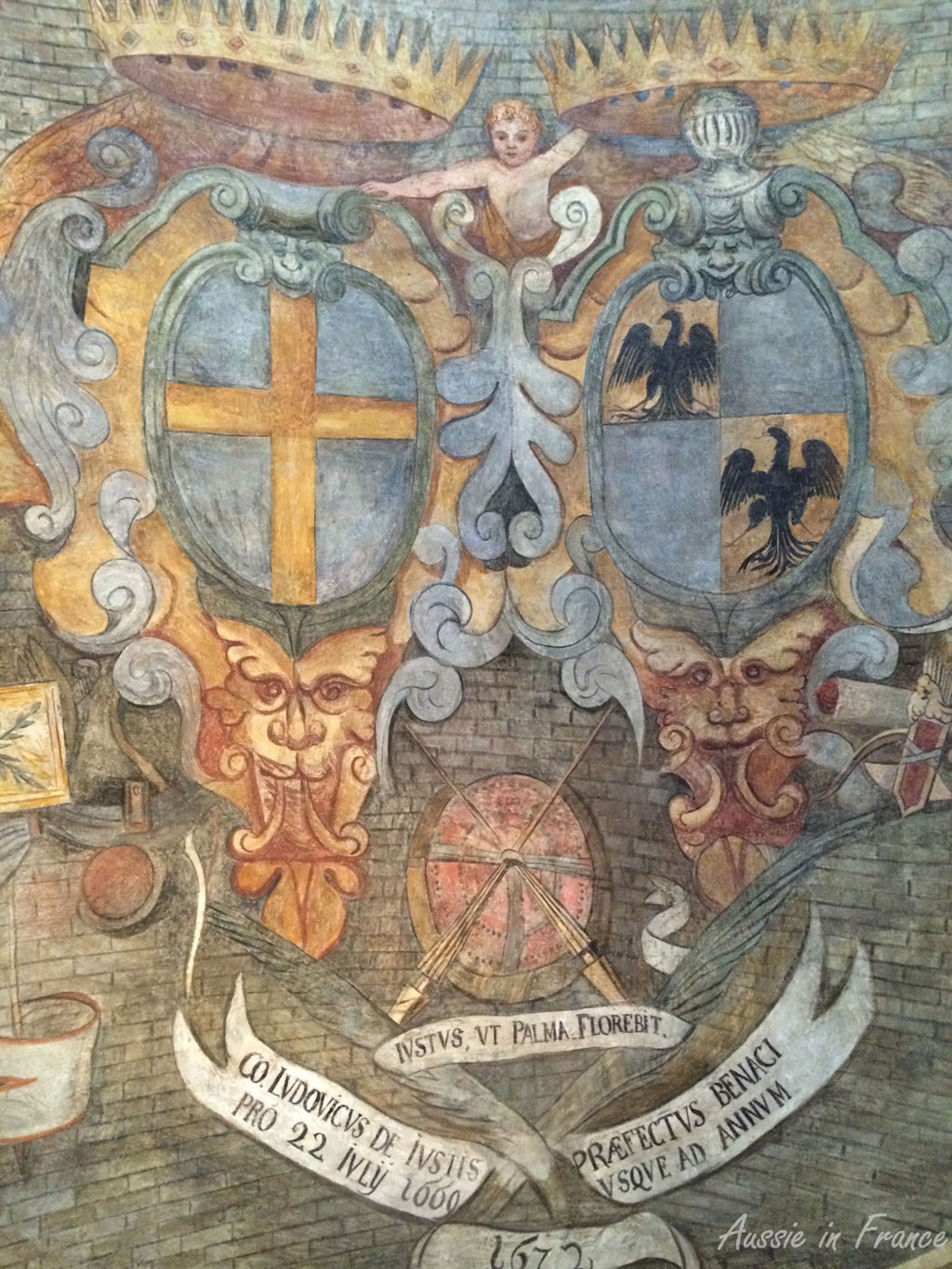
We do a quick tour of Malcesine which, like Limone, is full of tourists and shops. It has several historical buildings including the Palazzo die Capitani built in the 13th and 14th century. You can just walk into the main room with it’s 17th century fresco.
The view while eating our ice-cream at Porto di Brenzone
We then set off home again, stopping for a gelato at one of the little ports along the way, Porto di Brenzone.
Typical view from the bike path on the way home
The views are still lovely though we’ve lost the magical light we had in the morning. The bike path eventually gives out and we’re on the main road again. We reach our hotel at 6 pm, after cycling 39 k and a total time of 3 hours 20 mins. Nearly time for an apertif on the balcony again!
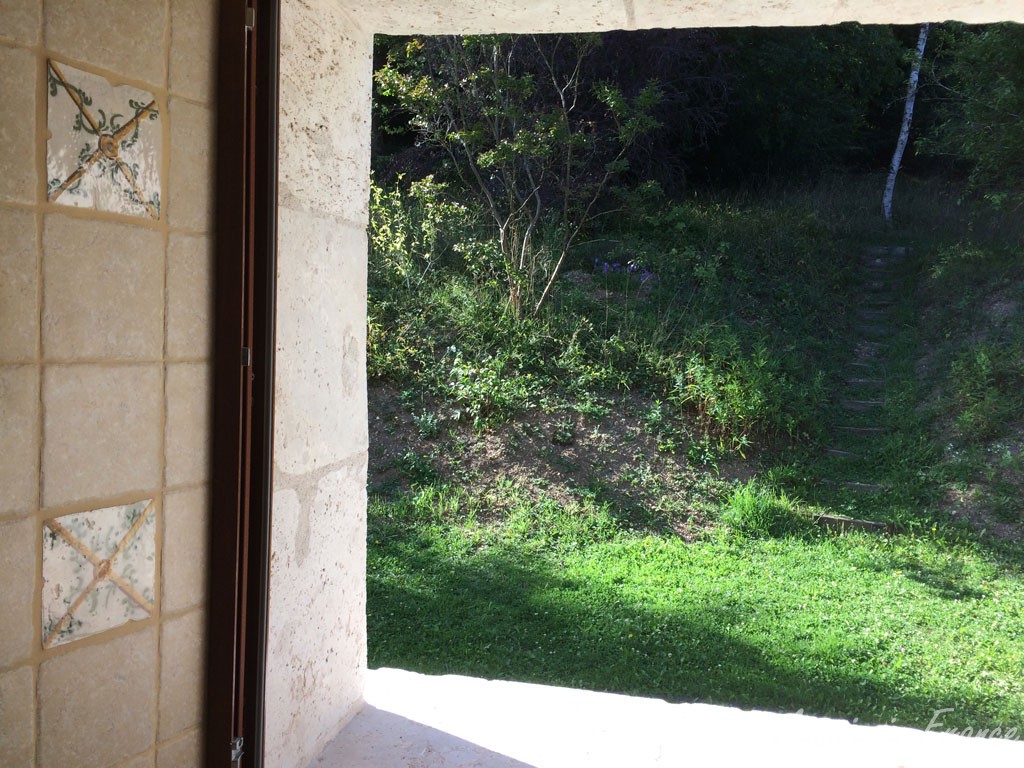
At 2 am this morning, we finished the kitchen after exactly 3 months. Jean Michel has done a splendid job but we are both exhausted! The tiles on the left of the window are the 18th century tiles we bought in Portugal last September.
The rest of this week will be spent getting the house ready for the paying guests who are coming while we are on holiday. In fact, our favourite guests, Sandy and Bill, who are coming to stay for the 4th year in a row, will get to try out the new kitchen before we do. I want to apply a special protective coating to the grouting between the tiles and I need the grouting to dry for 3 days and then for the protective coating to dry 36 hours which takes us to our departure on Sunday.
Our first stop is Lake Garda for at least 3 days, cycling along the eastern side, then we’ll work our way across Italy – we’ve never been to Padua – through Slovenia and then Croatia (Zaghreb) and maybe onto Bucharest or Budapest to continue cycling along the Danube. We will be guided by the weather and possible cycling areas. I will be drawing inspiration from all Anda’s posts on Romania in her wonderful travel blog Travel Notes and Beyond.
Until we leave, you may not hear from me again but once we get going, I’ll probably be posting every second day. While Jean Michel writes up the travel journal, I write my posts.
I have just received emails from two Sydney readers asking about visiting Paris in December so I decided to answer them in a blog post so that other travellers could benefit from my responses and experienced readers give their opinion.
Marie asks:
Can you tell me how cold it is in Paris in early December compared to our Sydney winter? I want to be sure I am prepared and I want to know if wearing thermal undergarments and jeans and Australian winter coat would be enough to keep us warm.
I have seen snow in Paris in December so it can be cold, i.e. close to zero. Indoors, there will always be heating, sometimes quite high, especially in cafés and museums where people’s body heat adds to the temperature.
The secret is wearing several layers because warm air builds up in-between the layers of clothing which means that two thin pullovers are warmer than one thick one. It also means that you can take off layers if you are too hot.
Thermal underwear or even tights or leggings under jeans should keep you warm. I did not wear thermal underwear in Paris – I would have been too hot – but I find it useful now I am living in a house in the country which is not overheated.
Make sure you have decent hats and gloves. Silk gloves under woollen or leather gloves will add an extra layer. You can buy silk gloves cheaply in sports stores (Go Sport, Decathlon) in Paris as they are used for skiing.
Are the cafes, attractions, museums all opened in December?
Paris is popular venue all year round and nothing closes in the winter as far as I know.
Some sites say (and I may be understanding it wrong) that there is fewer daylight hours during the day. Is this true?? if so can you tell me how many hours I can walk around while the sun is still out.
In the summer, with daylight saving, it doesn’t get dark until 11 pm while in December, which has the shortest hours of the year, it doesn’t get light until 9 am and then gets dark again around 4.30 pm. However, everything is well lit at night so you wouldn’t have to worry about safety issues. It may not necessarily be sunny though. You could find yourself with only pale light all day if it’s rainy or overcast.
Are the supermarkets and groceries similar to Australian products? Are the labels in French or English?
Some products are similar, some are different. It all depends on what sort of food you are looking for. Very often, the ingredients are also in English, but not always. You’d have to go to a special store for Vegemite, for example.
My daughter is prone to getting sick and has asthma. If I had to buy medication would I find brands that I know eg. panadol, codral, vicks.
Medication around the world is more or less the same these days, but the brand names are different. You need to know the name of the “molecule”. For example, Panadol is paracetamol and comes under the brand name of Doliprane here. Codral, on the other hand, is a mixture of ingredients and is mainly sold in Australia and New Zealand. You should bring a box with you. Vicks is readily available. I always travel with small amounts of the medication I use most frequently. That way, you can take something immediately and then take a sample to the pharmacy. You will find someone to speak English in most pharmacies in Paris, particularly in the tourist areas.
Elaine asks:
My 19-year old daughter and I arrive on Sunday 6 December in Paris. We are having difficulty finding a clean, warm, budget hotel with twin beds and an ensuite. This is my first trip overseas without my husband and I am a bit nervous about booking, paying and regretting. I have been considering the Latin district as I think my daughter would fit in as she is a university student. Was hoping around the $1200 mark (750 euro) for the 7 nights, don’t mind paying more or less if location is going to save time and transport hassles. I’m assuming they would have heating, particularly for this time of the year.
Yes, there will be heating. Your budget seems a little low to me though I may be wrong. I don’t have any personal recommendations, but I suggest that you consider renting an apartment through AirBnB as it would probably be cheaper for a week. I assume you have read my post on The Best Area to Stay in Paris. Fodor’s forum is also an excellent source when looking for hotels.
Wondering if I should book a shuttle from airport to hotel as we would have been flying for 19 hours and may be very tired. Or perhaps the metro?
There is a high-speed train (RER) from Charles de Gaulle to the middle of the city. It costs 10 euro per person. It depends on where you’ll be staying. Booking a shuttle could take some of the stress out of the trip.
When we came 10 years ago, the queue at the Louvre Museum was enormous last time and with children was not worth it.
It’s very easy to buy your tickets in various places ahead of time. Click here for more information.
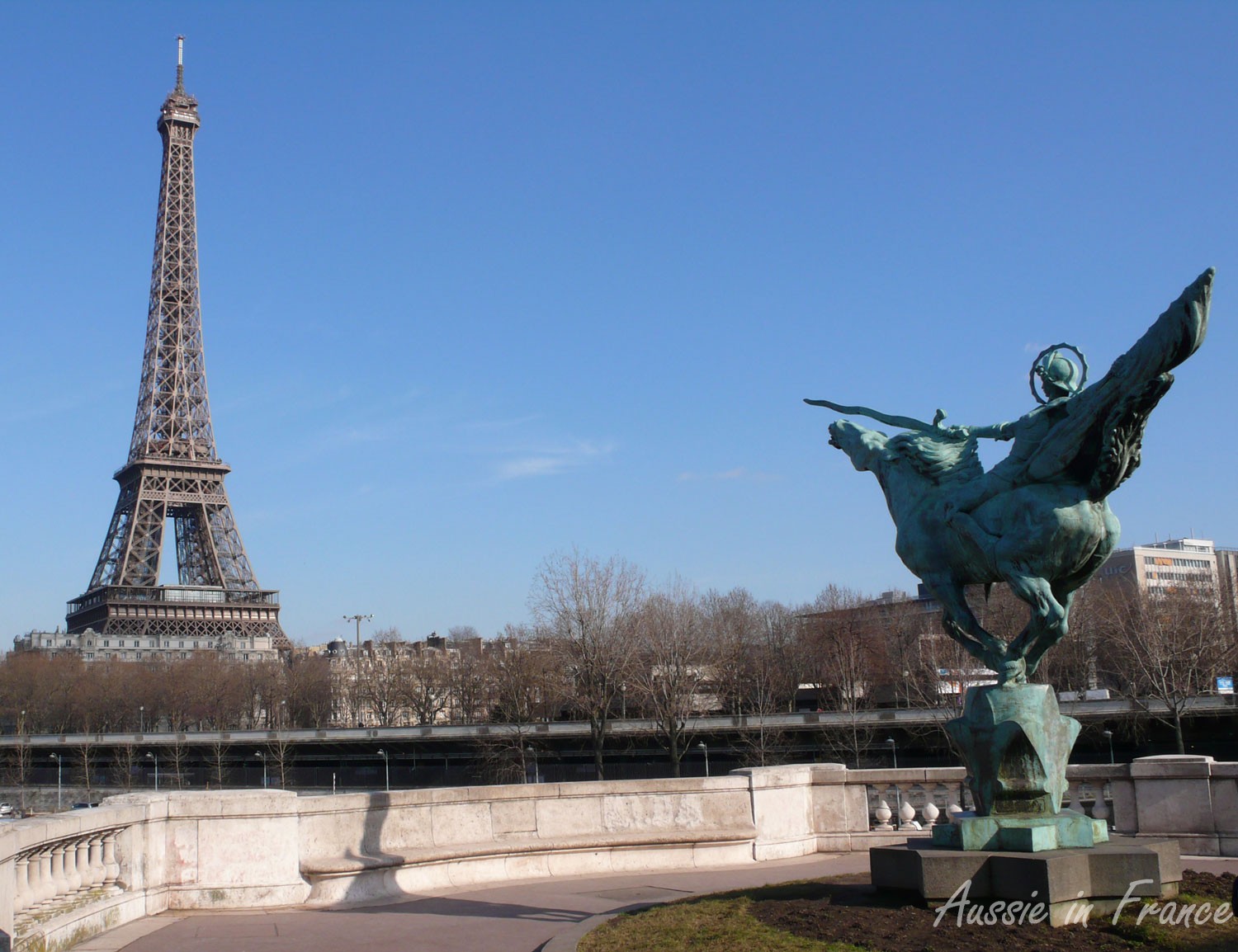
The Eiffel Tower from Bir Hakeim bridge in winter
Eiffel Tower – I believe it is not very visible in the winter, so from the ground would be ok Everything depends on the weather.
A clear sunny day in winter is just as good as summer! If you don’t go up, the best view is from Bir Harkeim bridge. Click here for a fun local bus ride from the Louvre.
Segway Paris Tour (not sure if this would be appropriate for December, what do you think?
I don’t have an anwser for this one. Any readers have any experience with segways?
Moulin Rouge Show (Booked Thursday 10 December 9pm) Not sure how to get there? Although we have all day to find our way!
Very easy – you just take the metro to Blanche on line 2.
Paris Latin quarter walking tour – I think we would love this, although most websites are in excess of $300 AUD before we start shopping, can you recommend anyone? I’ve also read something about the Marais Neighbourhood, do you think we could find these areas on our own?
There are FREE walking tours of Paris. Just give the tip at the end that you think it deserves: http://www.discoverwalks.com/paris-walking-tours/. I haven’t tried one in Paris but have appreciated them in other European cities. The Left Bank tour, for example, is at 11 am and 2.30 pm every day. No need to book – you just turn up at the meeting point. There is a tour of the Marais at 2.30 pm and 5 pm every day but you could find your way there easily yourself. You could check out my post on the Marais. If you’d like to explore the area around the Louvre, you can also read my Powerwalking posts! Just enter powerwalking in the search box.
Christmas Markets – Saint-Sulpice etc. Be good to do some Christmas shopping while in Paris.
The Christmas markets have gone very much downhill in recent years. I don’t know the one at Saint Sulpice but my friend Sylvia Sabès, whose judgment I would trust recommends it in a post for Girls Guide to Paris on how to shop the Christmas markets.
There are two flea markets in Paris – Saint Ouen, which is a permanent market, and Porte de Montreuil which is only on Sundays. Follow the crowd when you get out at the Porte de Clignancourt metro and watch your purses!
There is a saying in France that 15th August which is a public holiday heralds the end of summer and with 15°C at 11 am on Sunday 16th, it seems as though it might be true. At least it’s sunny.
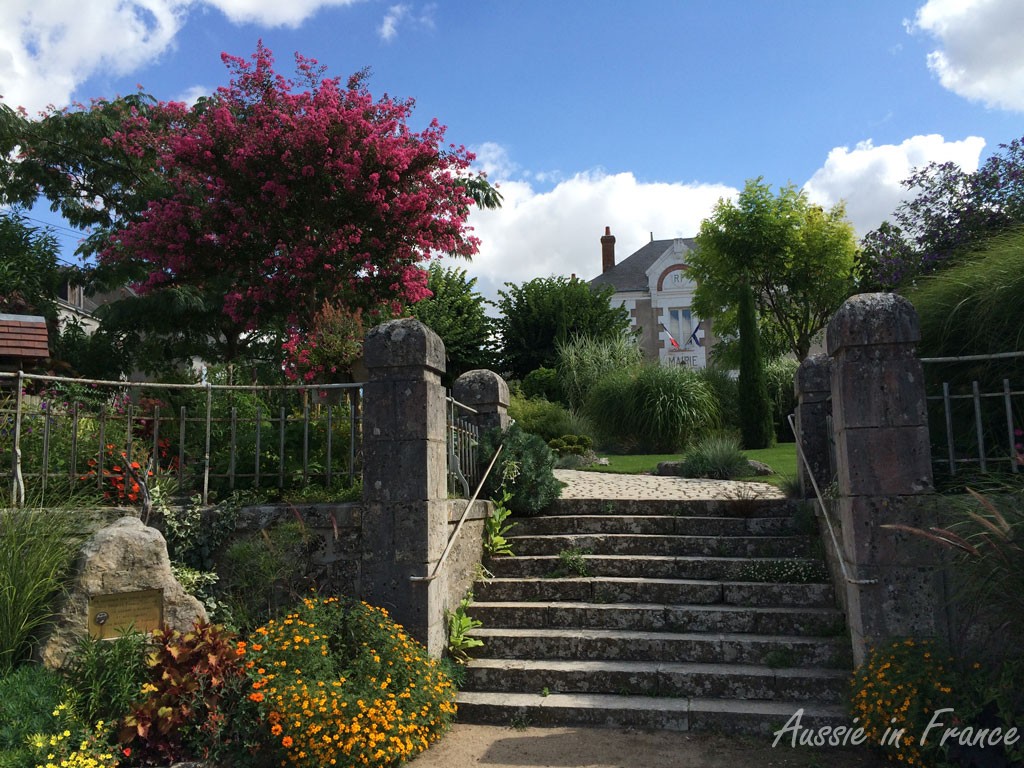
The town hall in Tavers with its garden
We arrive in Tavers, 40 minutes by car from Blois, around midday. We’ve chosen Tavers as our starting point rather than Beaugency in order to add on a few kilometers to reach our usual 40 K return. We’re not disappointed. It’s a pretty little town with a well-decorated town hall and the short cycle path to Beaugency is very pleasant, especially the view of the oldest bridge over the Loire as we approach the town.
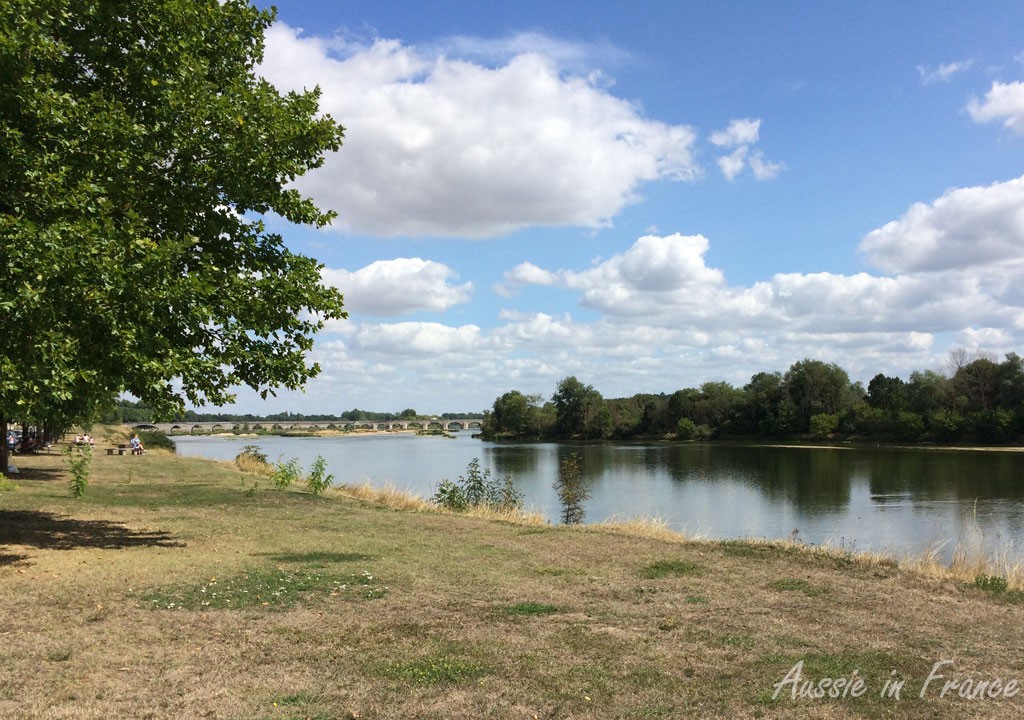
Beaugency bridge from the bike path coming from Tavers
We’ve already cycled to Beaugency before but from Mer. We’ll visit the town again on the way back particularly as I recently came here with an Australian friend and discovered a few things I hadn’t seen before and would like to show them to Jean Michel. We’re intending to have lunch in Meung-sur-Loire and don’t want to get there too late.
Vineyards along the cycle path between Beaugency and Meung-sur-Loire
It’s a good cycle path mainly running along the river past vineyards and other crops. On the way, we suddenly come across a local fête in what seems like the middle of nowhere. There aren’t many people so we hope things will liven up during the afternoon.
A local fête on the bike path in the middle of nowhere
As we enter Meung, we see the main road is closed off. It’s the end of the Sunday morning market which mainly revolves around the old Halles or covered market. I later learn it was built in 1940 and renovated in 1985.
Arriving in Meung at the end of the market
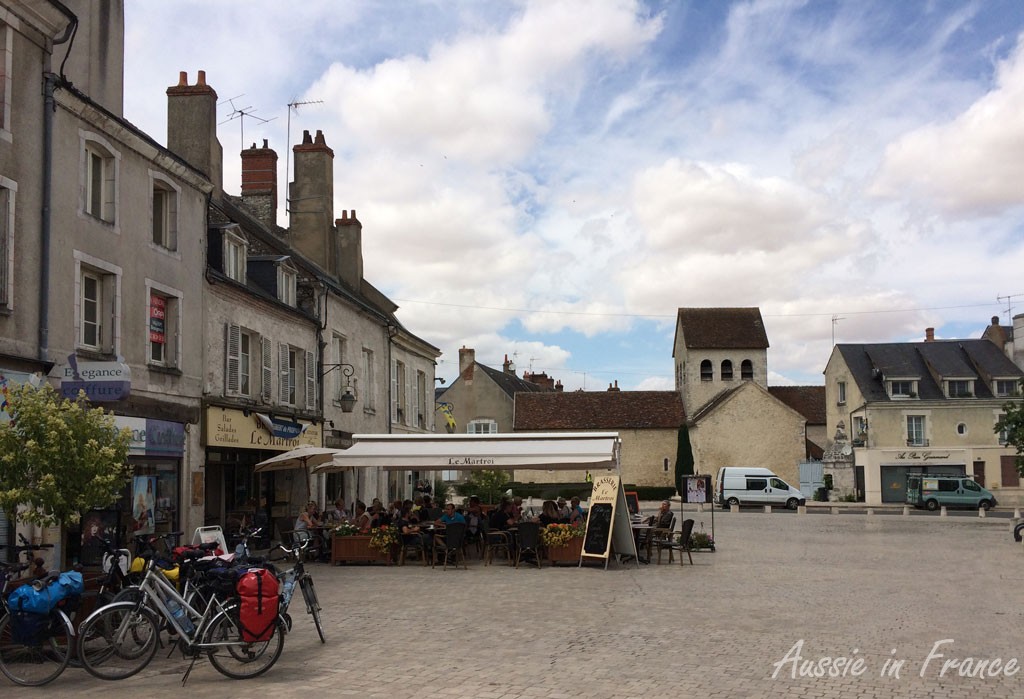
We cycle up the little hill to Place du Martroi in front of Saint Liphard collegiate church and castle that we intend to visit after lunch. The last stragglers are still buying produce at the market stalls. We find a table at Le Café du Commerce, a traditional brasserie, and order fish and chips, a dish which has become very popular in France in recent times and varies considerably in quality. It’s not wonderful but still OK.
Lunch at the Café du Commerce
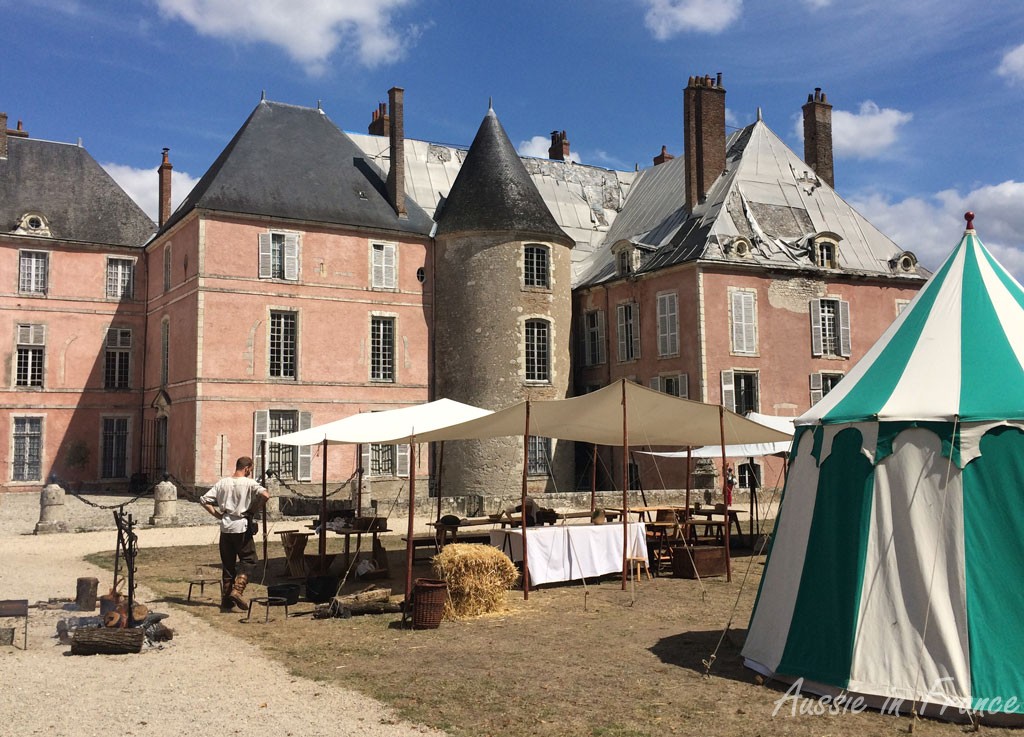
Next stop, the château, where we learn there are jousting matches today. There are a few people in mediaeval dress and a circle of spectators around the jousters. It all looks very amateurish and good fun. The kids and jousters are certainly getting a kick out of it. We hope there will be more people as the afternoon wears on.
Meung-sur-Loire is a privately owned castle which claims to be one of the largest and oldest châteaux in the Loire. It is badly in need of major renovation, especially some of the roofs. It isn’t a princely castle but the owners have gone out of their way to attract visitors. Many kings, including François I and Louis XI stayed here, it seems.
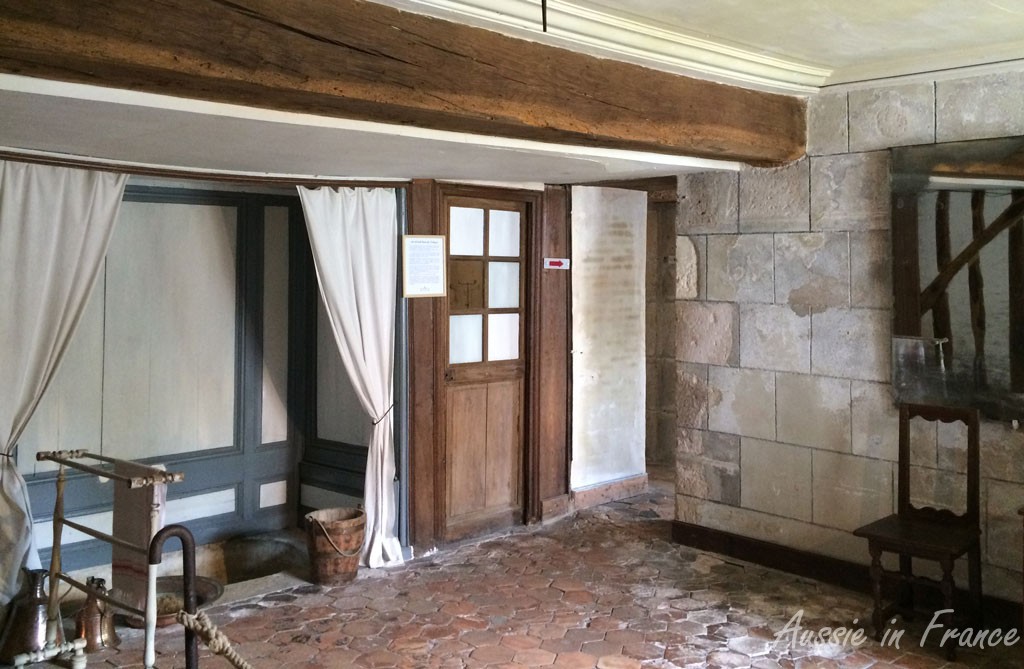
The bishop’s bathroom in Meung castle – very modern at the time
There are several unusual exhibitions, including a bishop’s bathroom, very luxurious for the times.
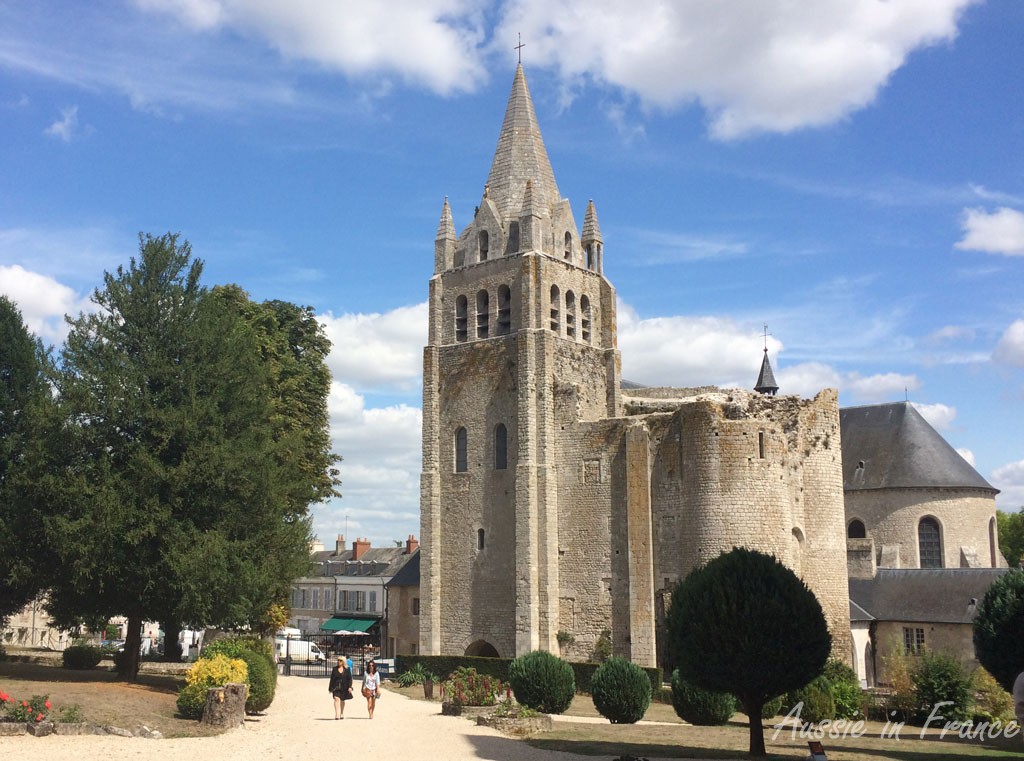
The church tower in Meung seen from the grounds of the castle
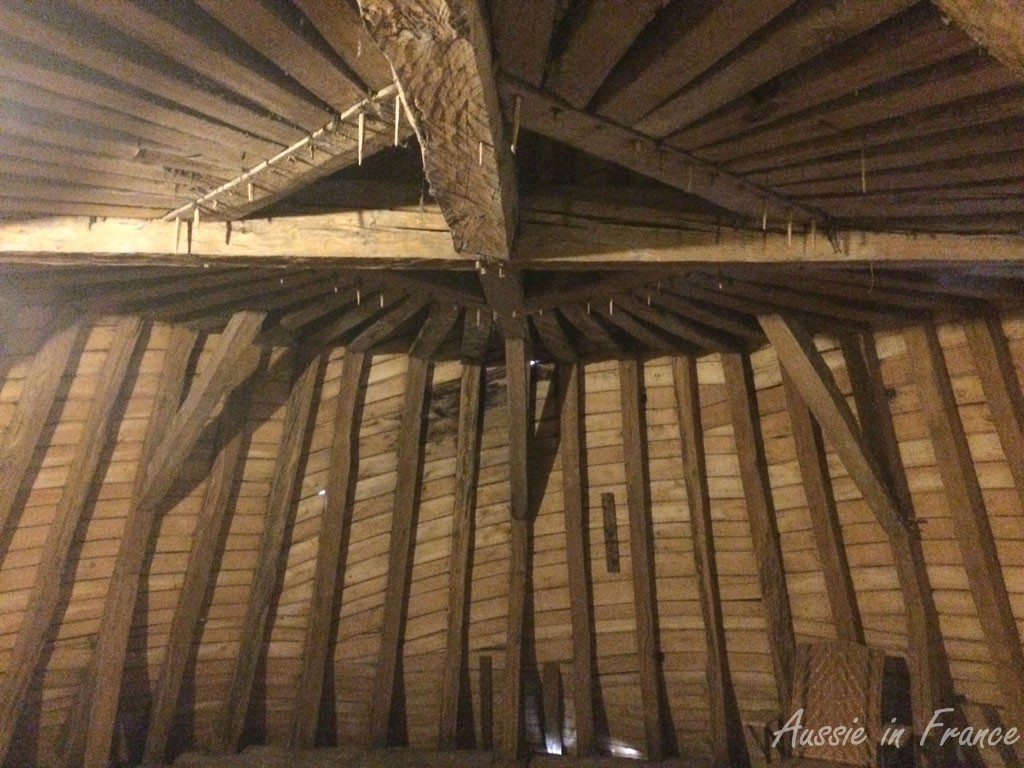
After climbing up to the rafters, we go down into the dungeons which explain why it once served as a prison.
Under the roof at Meung castle
More people are arriving as we leave in the hope of seeing jousting on horseback but it’s already 3.30 pm and it was supposed to start at 3. There are no sign of the horses.
Mediaeval tents in front of the castle in Meung next to the jousting ring
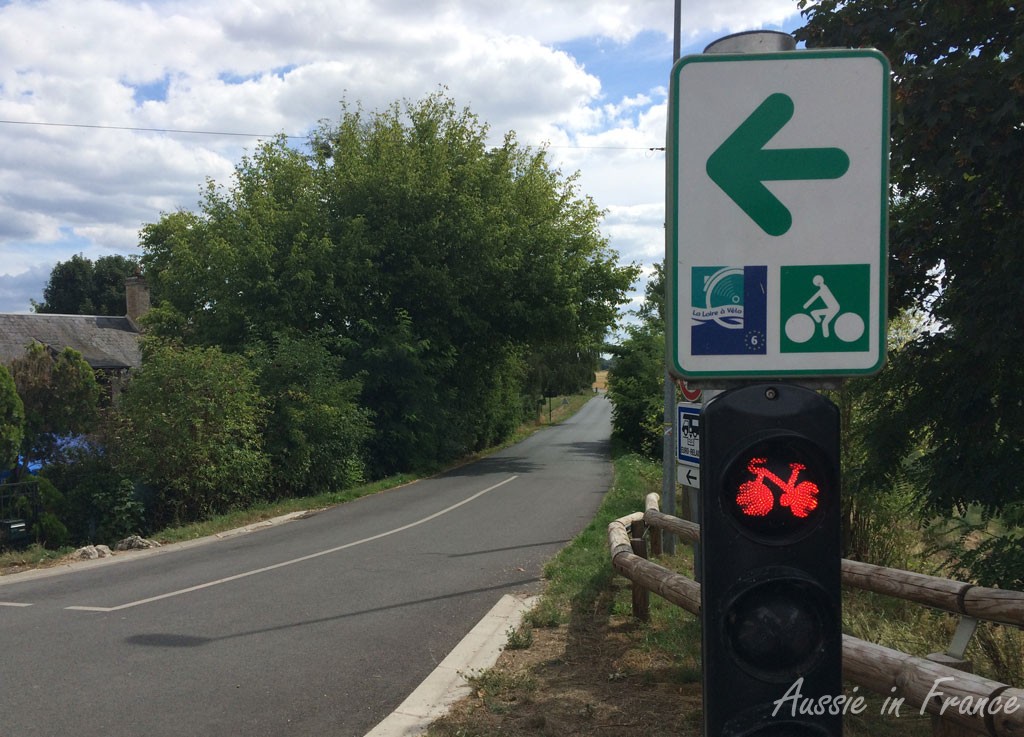
We cross the river to the other side and I am surprised and delighted to see a special traffic light for bikes.
The special traffic light for bikes just outside Meung
After a few kilometers along the river, we branch off to Cléry-Saint-André to visit the Notre Dame Basilica which is also a collegiate church and royal chapel. After many trials and tribulations it was reconstructed in the 17th century. We’ve been here before but it was cold and wet and the church was closed. The town is rather deserted but more attractive than last time.
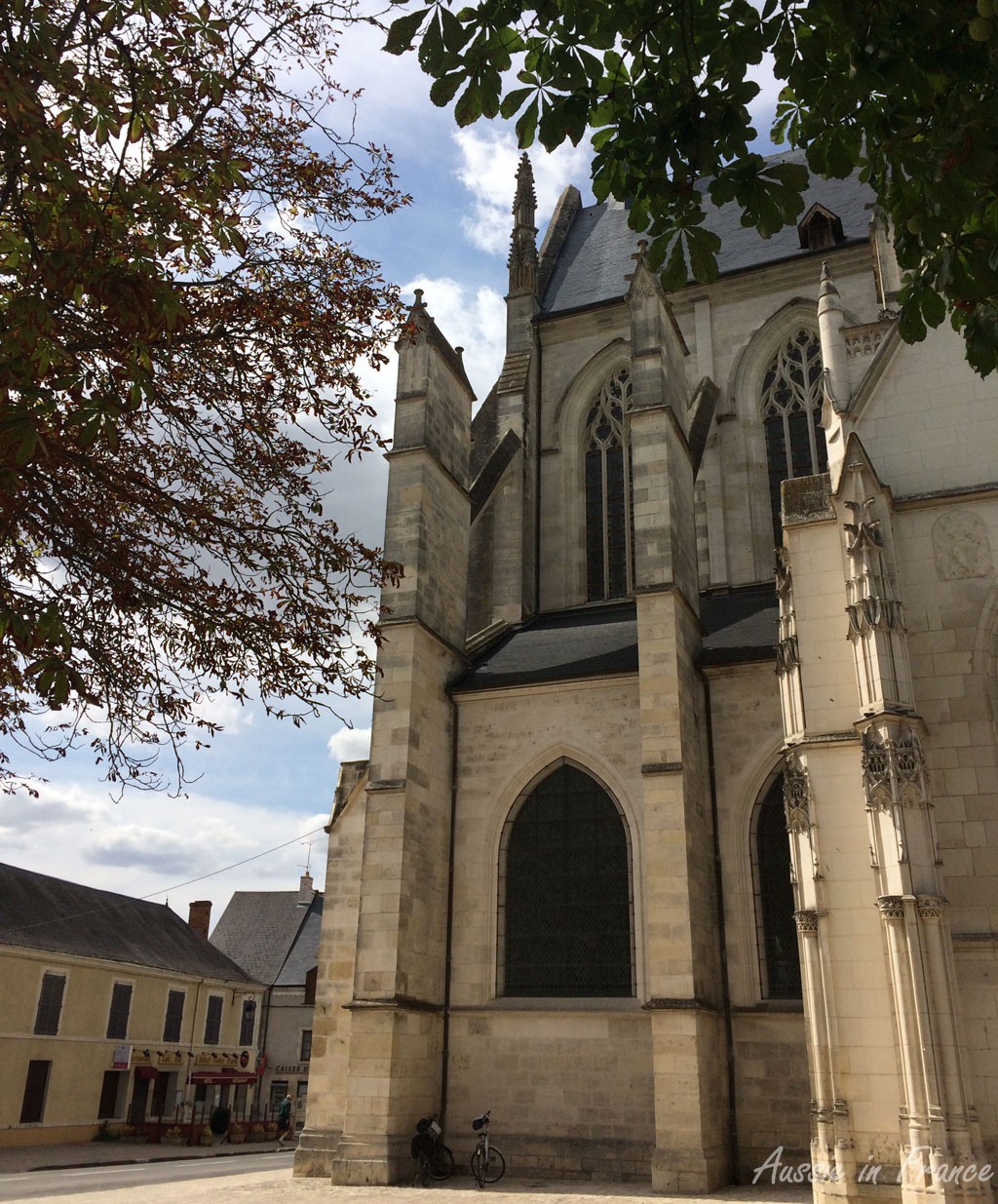
The church of Cléry Saint André
Rather than go back the way we came, we decide to follow the loop indicated by the tourist office, which turns out to be a mistake. There is nothing very attractive about the return trip and we are pleased to get back to Beaugency, especially as the last 3 kilometers are on a busy road.
The square in Beaugency that we missed last time
At Beaugency, I take Jean Michel past the castle and on to the square we missed last time. There is a brasserie there and I’m hoping for an ice-cream. Unfortunately it’s closed and we don’t find anywhere else open that’s selling decent ice-creams so we have a cold drink instead.
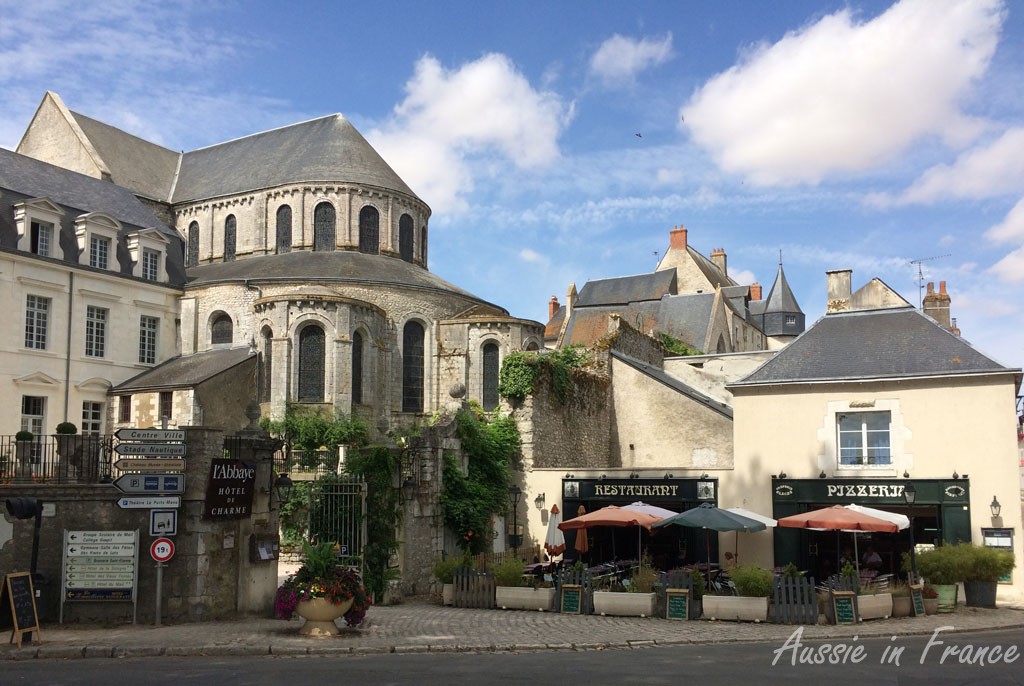
The abbey church seen from the café where we didn’t have an ice-cream
It doesn’t take long to get back to Tavers. We’re very happy to have visited the castle in Meung and seen Beaugency again – but we won’t do the loop again!