You may remember my desperate attempts to make cappuccino during the winter. Well, now I know the truth. It’s the espresso machine that makes all the difference.
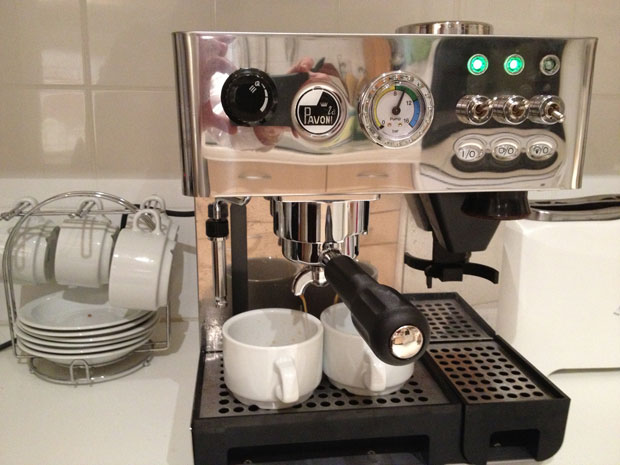
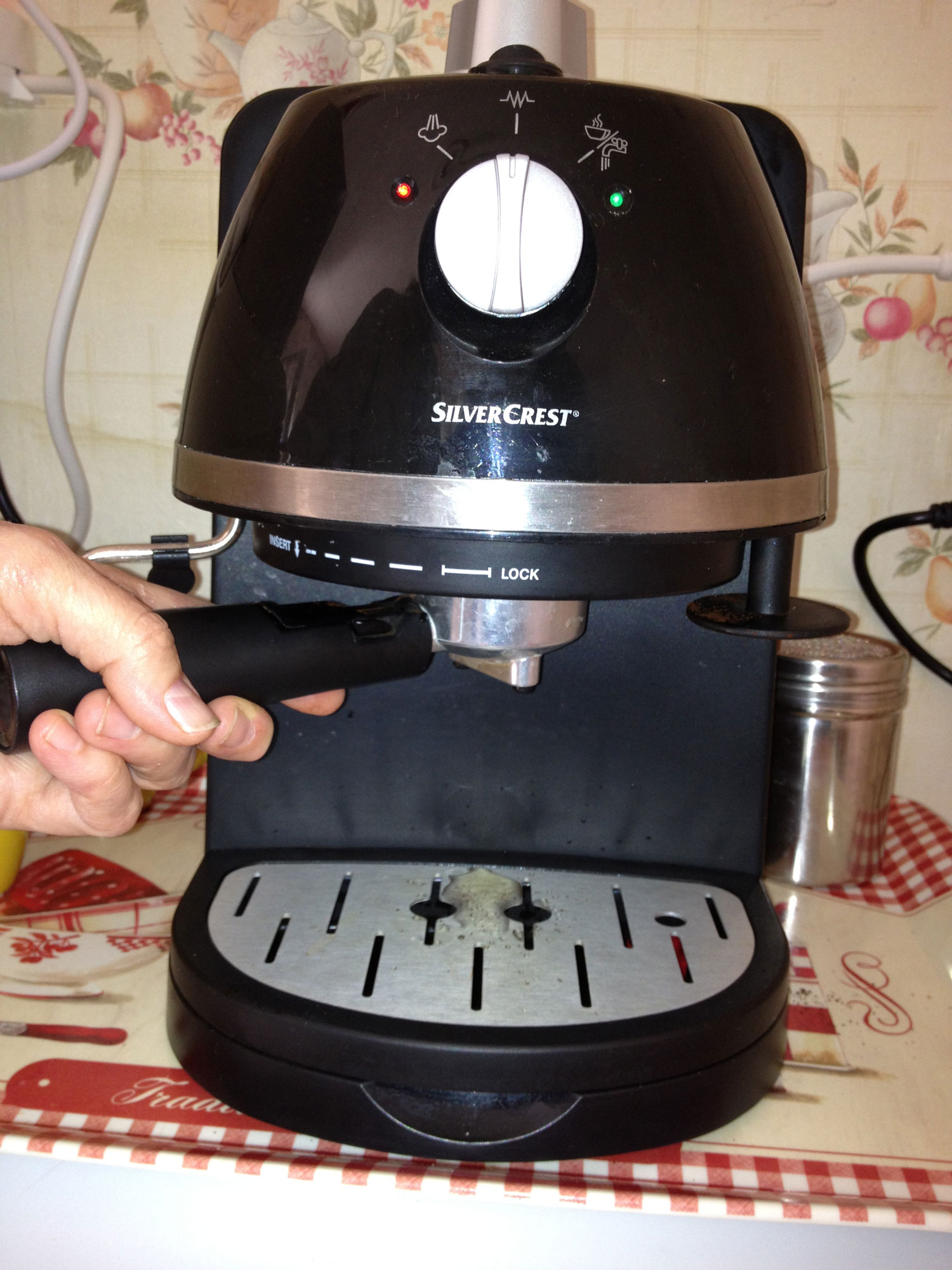
I now have intimate knowledge of three different machines: the cheap-O model we bought new in a second-hand shop somewhere near Blois, the superduper expensive Pavoni that grinds the coffee as well and a mid-range non-grinding DeLonghi bought for Closerie Falaiseau when the cheap-O one gave up the ghost. From the very first cup, the DeLonghi produced perfect milk foam.
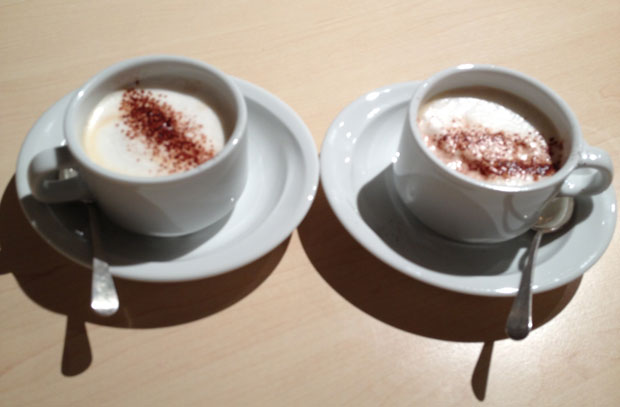
Perfect foam with the Delonghi
Initially, I thought it was because I had acquired the requisite skills but when our first guests arrived at the Closerie and we moved into the kitchen of the little house, I used the cheap-O one that Jean Michel had repaired in the meantime. The first foam was a complete failure. Just sticking the milk jug under the wand no longer worked.
The superduper Pavoni
We got back to Paris and I used the superduper Pavoni again, the results were just as disastrous. It took me a few days to remember the method I had precariously developed previously. But the results are still not as good as they are with the DeLonghi.
Now what is it that makes the DeLonghi so much better than the others?
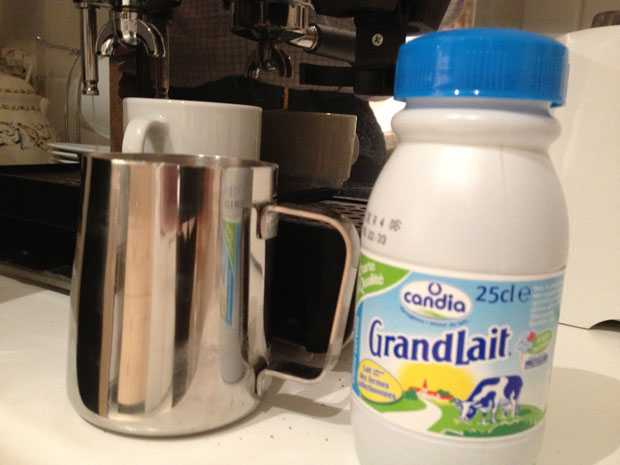
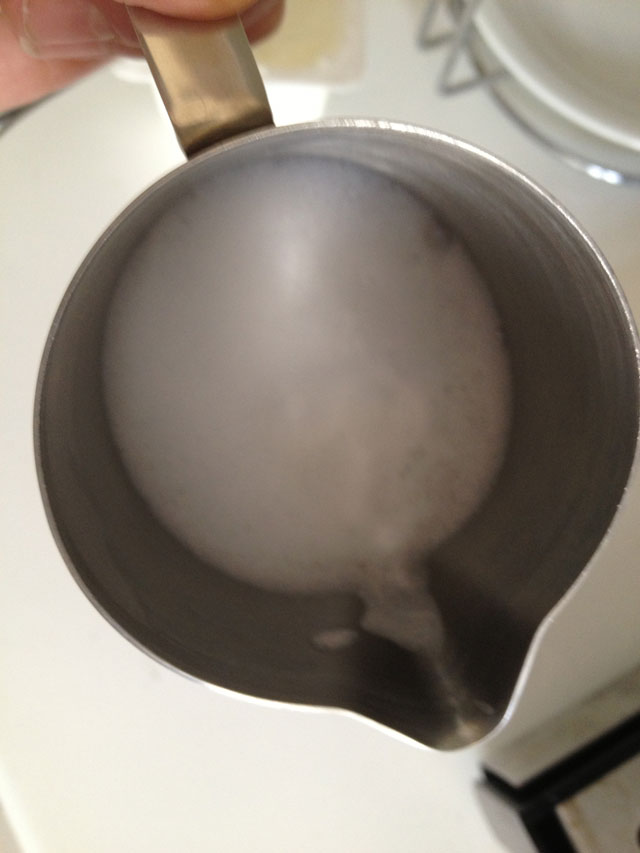
Stainless steel jug and half-cream milk
For all three, I’m using half-fat milk and I’m putting my little stainless steel jug in the fridge. All three wands are straight although I’ve read that they’re supposed to be at a 45° angle. I still can’t see why tipping the jug to form the same angle with the milk doesn’t achieve the same result, by the way, but maybe someone can supply the reason.
When I first saw the DeLonghi in the shop, I was very dubious. The wand is much shorter than the other two and has a thick almost cone-shaped skirt but the guy selling it at Darty in Blois assured me it would be perfect. He said he’d worked as a garcon de café in Paris in his previous life. Not that that was really a recommendation. We all know how terrible coffee is in most French bars.
One of my early attempts
Anyway, when I tried it out, it was perfect. It’s also very easy to clean – you just unscrew the skirt and rinse it under the tap. With the cheap-O one and the Pavoni, you need a wet cloth to wipe off the milk immediately.
Cheap-O machine
So what do you do if you don’t have a wand with a little cone-shaped skirt? The trick is to keep the tip of the wand just under the level of the milk, so that it’s not making big bubbles. You can see the milk sort of being sucked into the tip of the wand. As the foam develops and the milk takes up more volume, you have to move the jug down so that the tip remains just below the surface.
Once you feel the milk heating up (you need to keep your hand around the jug), you have to turn off the steam quite quickly or you’ll scald the milk which gives it a sickly sweet taste. With the Pavoni, it happens really quickly. I don’t have the same problem with the DeLonghi.
Substitute foam with detergent
Of course, it’s not that easy to practice without using up lots of milk but someone came up with a brilliant substitute. Just one tiny drop of washing up liquid in water will, astonishingly, produce the same results. Well, at least it gives you a better feel of what’s going on without wasting lots of milk.
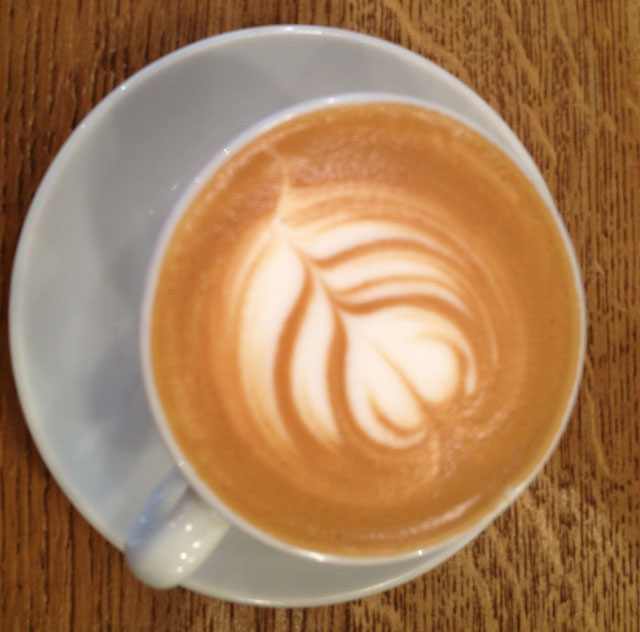
The real thing – Tom’s latte at Telescope
I haven’t made it to latte art yet. What I really need is a lesson. And I’m not even sure what the difference between cappuccino and latte really is! So I’m off to Téléscope in rue Villedo to find out. I’ll tell you all about it in Part 2 next week.
It’s Wednesday again already! Burgundy is a wonderful place to visit and Carolyn from Holidays to Europe gives us an excellent introduction to its charms. It has beautiful countryside, fantastic wine and amazing bike paths. Abby from Paris Weekender interviews Daisy de Plume of THATLou who organises treasure hunts in the Louvre. I haven’t had a chance to join her yet, but I certainly intend to. Susan from Days on the Claise tells us about surveying local butterflies in Touraine. That’s another thing I’d love to do. Her photos are bewitching. Enjoy!
The French wine region of Burgundy
by Carolyn, from Holidays to Europe, an Australian based business passionate about sharing their European travel expertise and helping travellers to experience the holiday in Europe they have always dreamed of
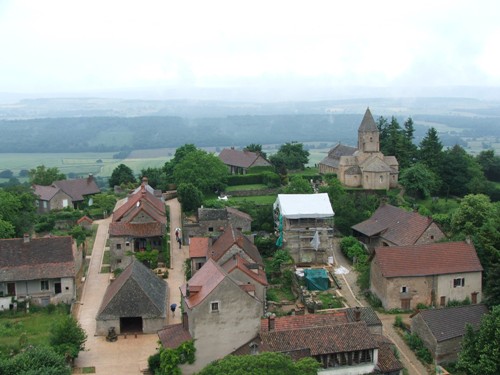
I had heard many a travellers tale of France; of the beautiful green countryside, fields of blooming sunflowers and red poppies, depending on when you travel, medieval buildings and ancient ruins, and produce as fresh as you will find anywhere; but after a few wonderful days in Paris, I have to admit I wondered would the French countryside reach the bar? We were heading to Chaudenay, a little village not far from Beaune, the regional capital of Burgundy, and we were in for a very pleasant surprise.
It wasn’t long after leaving the urban sprawl of Paris that rural France began to take its hold on us! Yes, the countryside was green; yes, there were plenty of medieval castles and ruins atop hills; but there was also plenty more. Read more
Interview: Daisy de Plume of THATLou
by Abby from Paris Weekender, an American living in Paris who offers suggestions for Paris weekends, either staying put or getting out of town
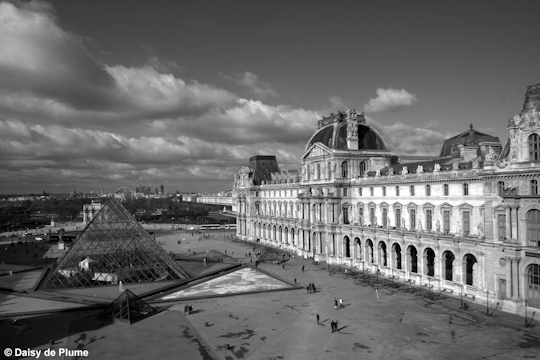
Many of you may already be familiar with Daisy de Plume from my post about the Treasure Hunt at the Louvre I enjoyed over the summer. Daisy is the creator of these amazing scavenger hunts, a unique and exciting way to visit this classic museum. But she has also been up to a whole lot more recently, including the launch of THATd’Or (Treasure Hunt at the Musée d’Orsay) and even the coming-soon THATMet – yes, you guessed it. Treasure Hunt at New York’s Metropolitan Museum of Art! So I asked Daisy to share with us an update on these exciting developments, as well as some background on her innovative creations. For more information on Daisy’s events, as well as the most current updates, I also invite you to visit her site: THATLOU.com.
The following is Part I of my interview with Daisy. Part II will follow next week! Read more
Official butterfly report for 2012
by Susan from Days on the Claise, an Australian living in the south of the Loire Valley, writing about restoring an old house and the area and its history, and running Loire Valley Time Travel (remember Célestine?)
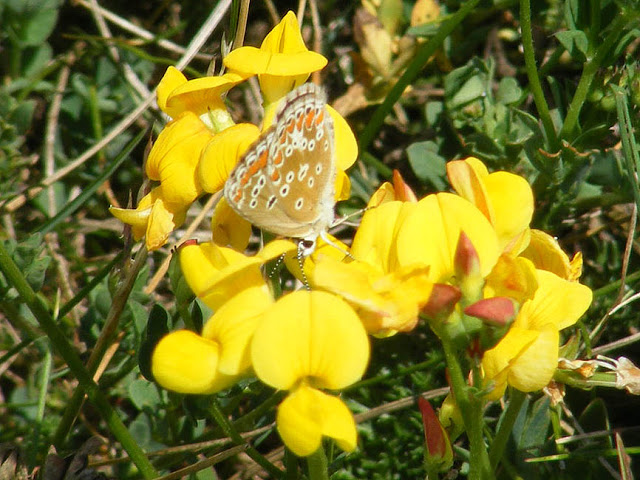
Just as I am gearing up to start surveying my local butterflies for 2013, waiting and watching for the weather to improve sufficiently to make it worthwhile, the official STERF report on last year’s national survey has landed in my email inbox…with a covering message from Luc Manil, who co-ordinates us STERFistes, saying ‘Don’t even think about going out and doing your first survey until the last 10 days of April. The weather forecast is awful and there will be nothing flying but those few species that hibernate as adults…’
The French national butterfly survey has been going since 2005. From an initial 14 survey sites it is now 215 sites. 44% are allocated randomly and can be anywhere within 10km of the surveyor’s home base, 56% are chosen by the surveyors (and are usually nature reserves). Last year both my survey sites were randomly allocated. Read more
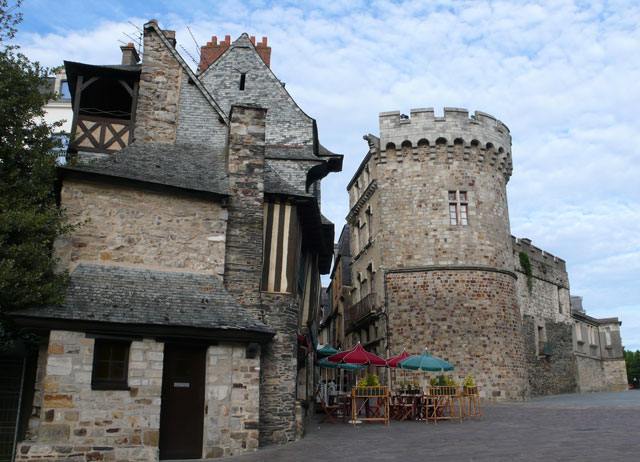
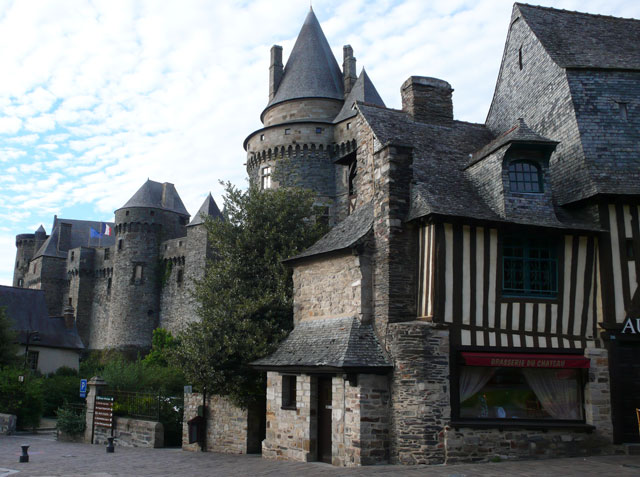
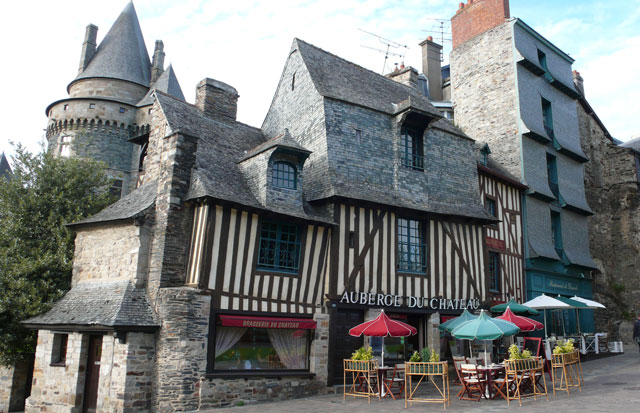
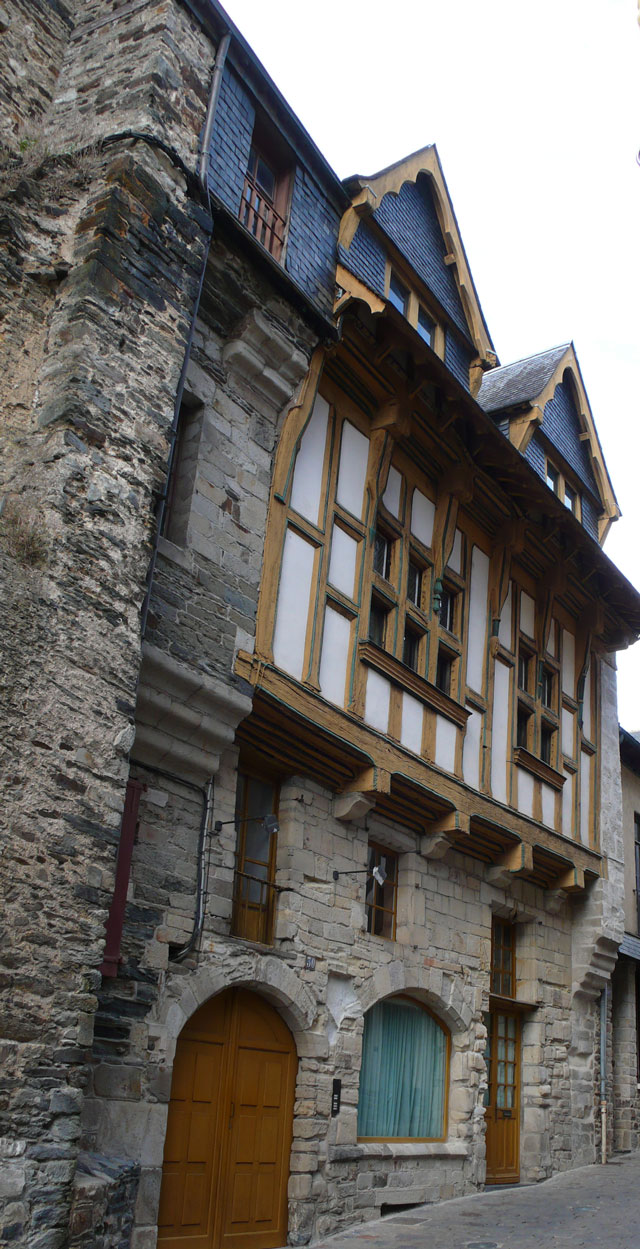
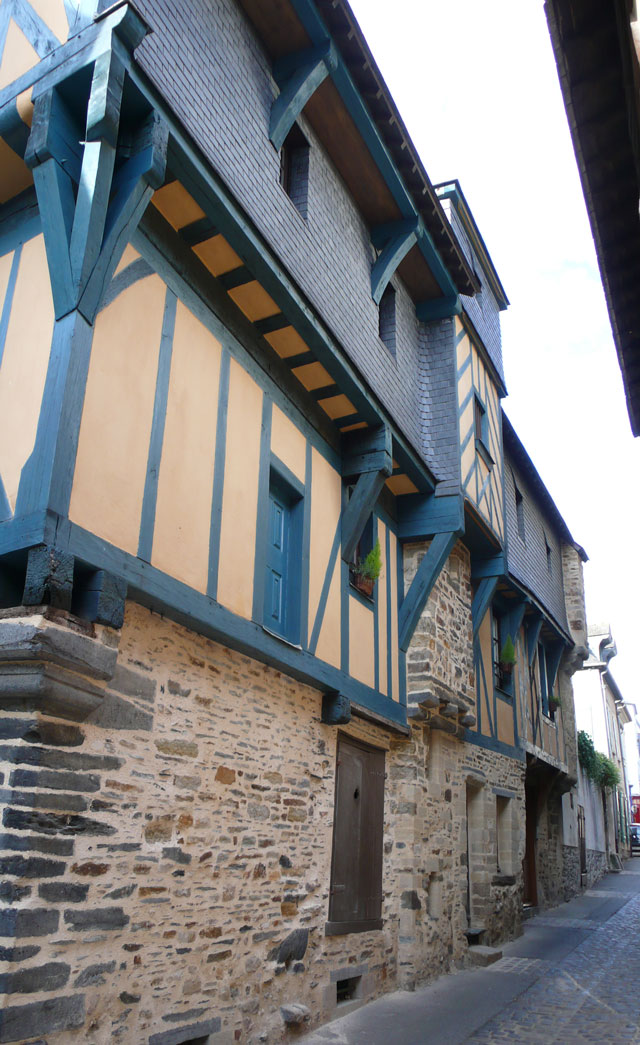
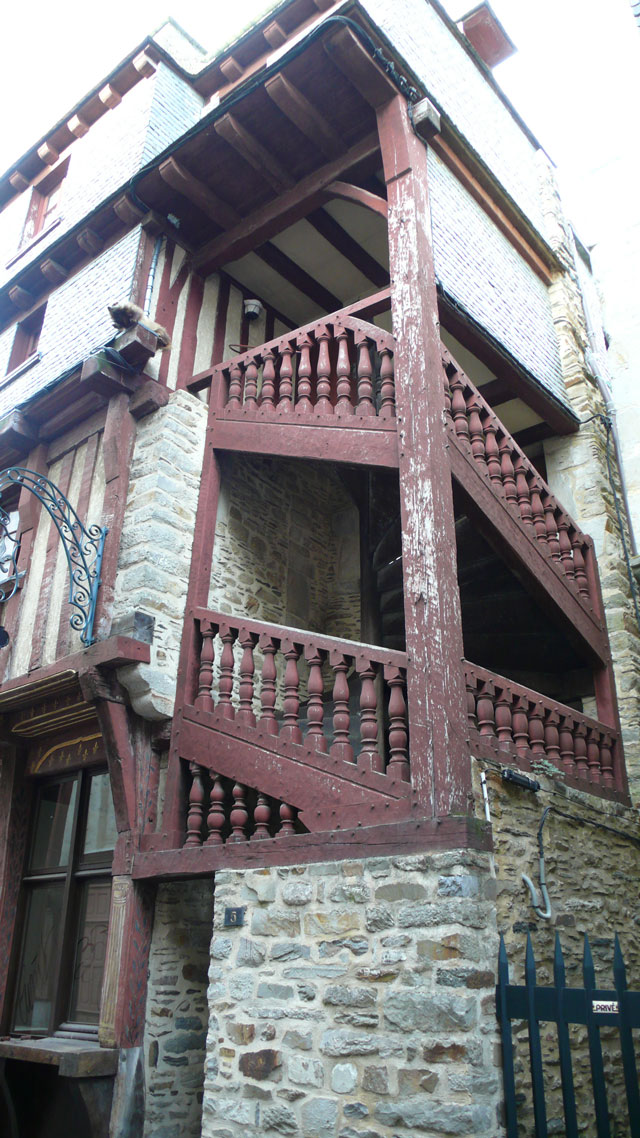
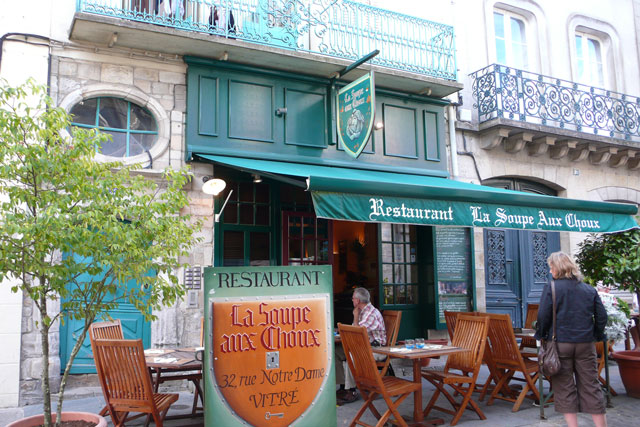
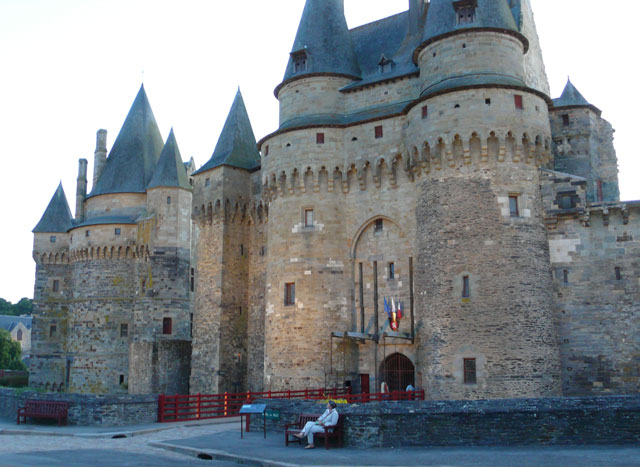
We stopped for the night in Vitré, about 40 K east of Rennes, on the way back from Brest on the western tip of Brittany one summer. We discovered a very pretty little town with a mediaeval granite castle, one of the first castles in France to be classified as a monument historique. There are many beautiful granite, slate and half-timbered houses and colourful façades, mainly in Rue de la Baudrairie. I can’t remember the name of the hotel as it was nothing outstanding, but we had a view of the castle from our window. However, we were given a very useful free Michelin guide to “secondary” towns in France that we’ve been exploring ever since.
The castle in Vitré is one of the most imposing mediaeval castles in France. Here you can see one of the towers of the old ramparts
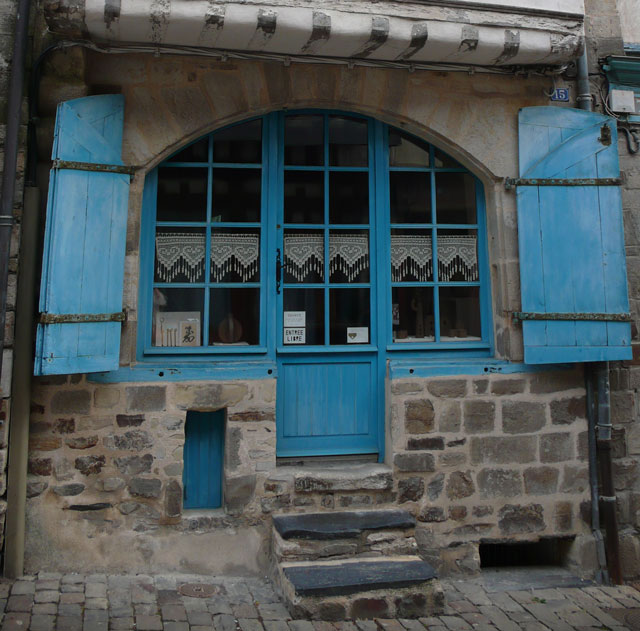
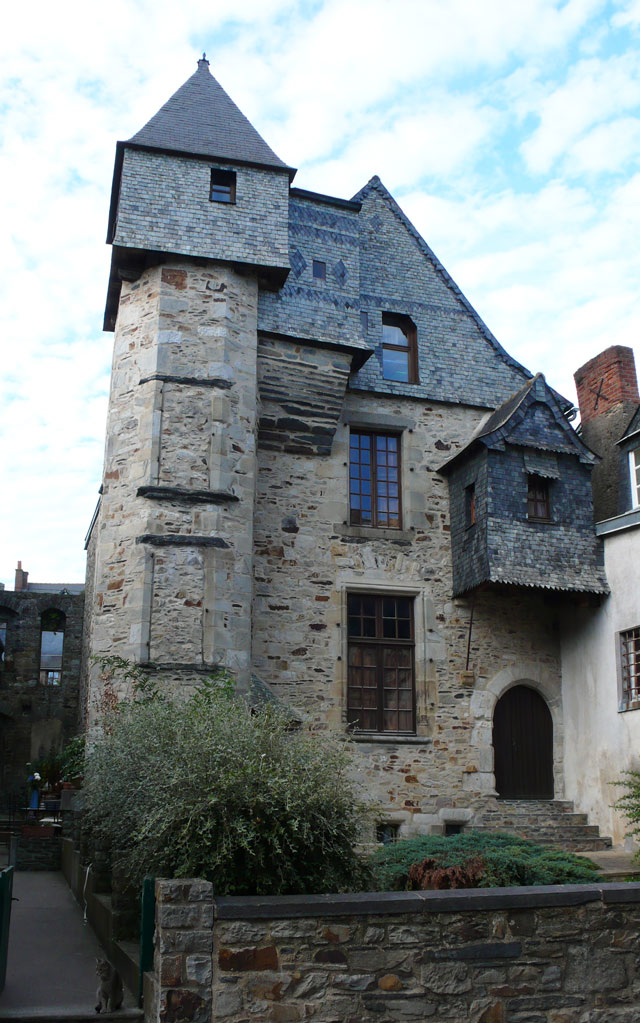
South façade and Place Saint YvesRue de la Baudrairie, from the French “baudroyeurs” or leathermakersTypical juxtaposition of granite, slate and half-timberingTypical colourful street windowMediaeval manor houseMore granite, slate and half-timberingInteresting outside staircaseLa Soupe aux Choux where we had a very pleasant mealGatehouse and Saint-Laurent Tower at dusk
Our lovely friends from Sydney, Redfern and Saint Vincent are staying with us in Closerie Falaiseau. They’re spending a couple of months visiting different parts of France and improving their French which is wonderful for Jean Michel because it means they can communicate directly.
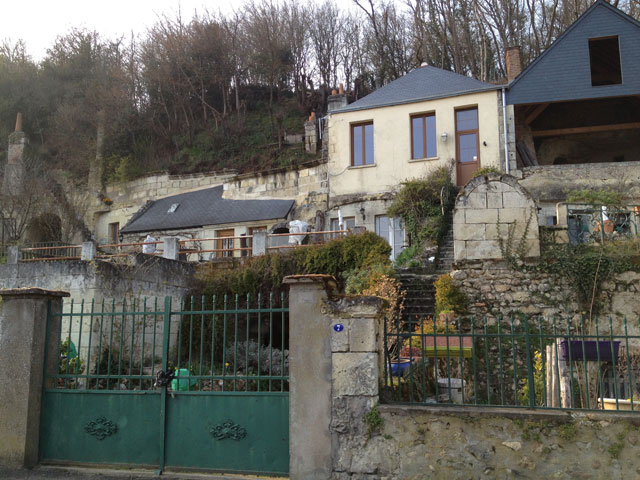
Troglodyte houses in Rochecorbon when it wasn’t raining
We’ve been wanting to buy some wine in Vouvray and try out a troglodyte restaurant there. After closing for winter, Les Gueules Noires has just reopened so we book a table then phone Monsieur and Madame Freslier whose wine we first discovered over ten years ago through our trusty independant wine growers’ guide Gilbert & Gaillard.
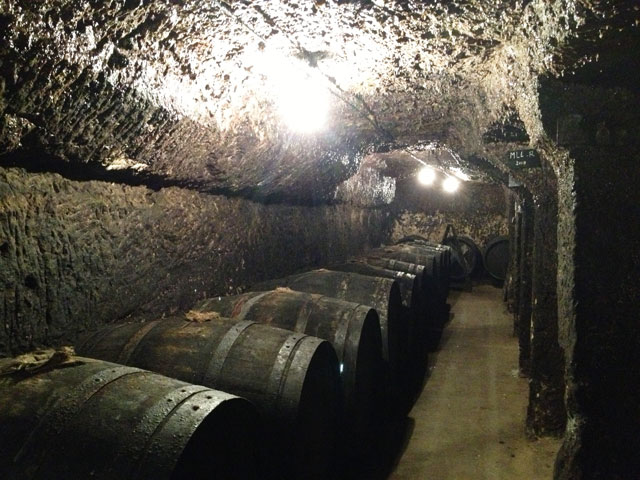
Tonnes in the Freslier limestone cellar
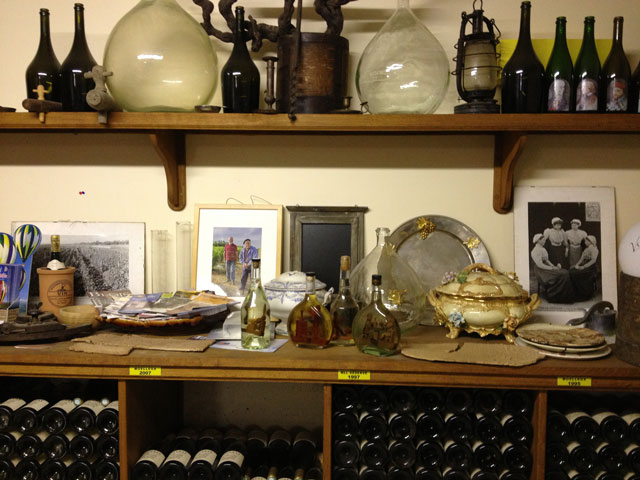
It’s pelting with rain when we arrive at the cellar door. Mr Freslier senior, 88, shuffles out to meet us. He tells us how he and his uncle dug the wine cellars themselves out of the limestone cliffs. Madame Freslier arrives and takes us to visit the oak tonnes as they call the barrels here. We pass stacks of bottles glued together with drippings from the limestone ceiling.
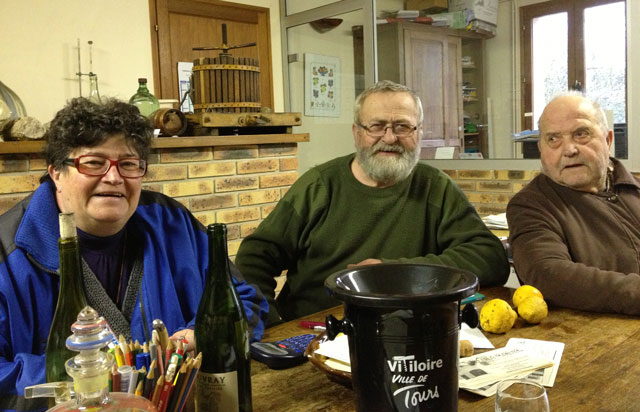
Mr and Mrs Jean Pierre Freslier and Mr Freslier senior
Mr Freslier Junior joins us and we all sit around a long table tasting different types of white wine made from the local chenin grape. The sweetest of the still wines (vins tranquilles) is the vendanges tardives (last harvest), followed by moelleux, then demi-sec and sec. Then there are two sparking wines : pétillant is a natural sparkling wine with less pressure than the mousseux which is made using the méthode champenoise.
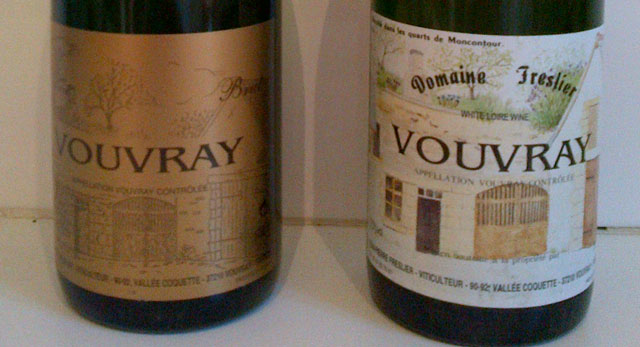
Old and new labels
We mainly buy the mousseux because it seems to be the most popular apéritif in the region and at 5.80 euro a bottle, it’s certainly a bargain. I’m disappointed to see the labels have changed. I really like the old ones.
Domaine Freslier – a family affair
During the tasting, we mostly talk about dinosaurs and fossils of which the limestone cliffs have preserved an amazing number (not the dinosaurs of course). We also talked about corks. Most corks these days come from Portugal. Mr Freslier is very reticent about using screw tops on his bottles because he says they don’t breathe which means the wine won’t keep while Madame Freslier says she would miss popping the cork!
Les Gueules Noires
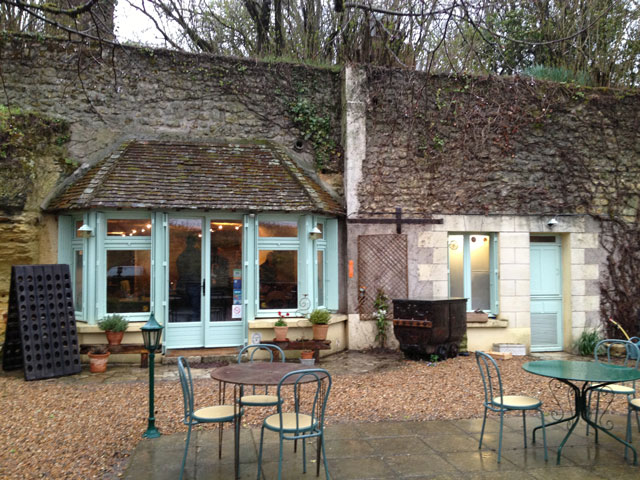
The rain’s still going strong when we leave but Les Gueules Noires is just around the corner. It turns out that Jean Michel and I came here the first time we went to see the Fresliers, but it changed hands two years ago and the cuisine is more inventive.
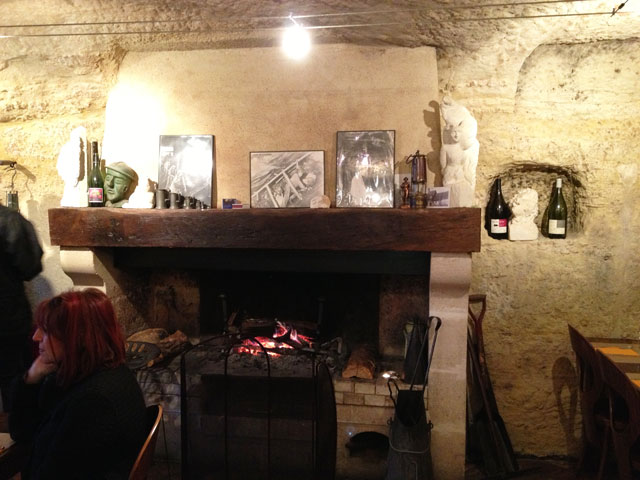
Fireplace in Les Gueules Noires
The dining room is typical of troglodyte dwellings which, like Monsieur Freslier’s cellars, are made by digging directly into the limestone cliffs. There are only windows on the façade of course. There’s a fireplace but the room is quite chilly, which is not surprising with the awful weather we’ve been having. I don’t imagine they’re the warmest places in winter!
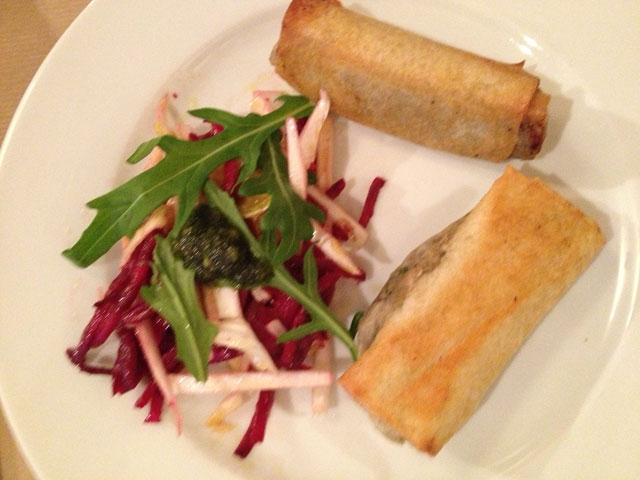
Sardine rillettes in filo pastry
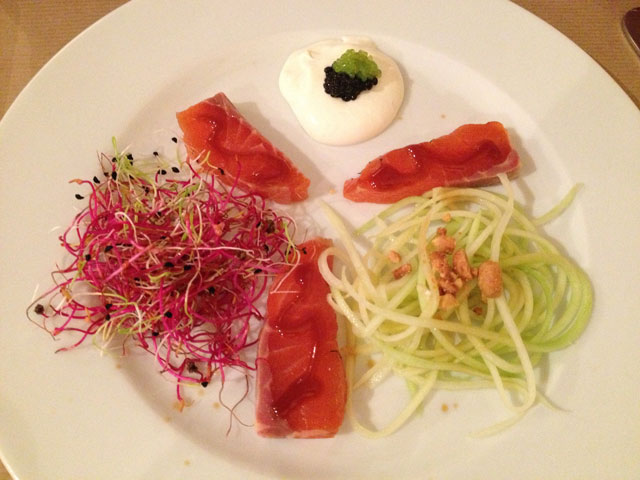
The menu is on a blackboard and the waitress explains the different dishes, which seem to have a both a Belgian and Japanese influence. Among the entrées, we choose sardines rillettes in filo pastry and gravlax salmon with horseradish with some other interesting bits and pieces.
Irish gravlax with beetroot and leek sprouts, horseradish cream and roe
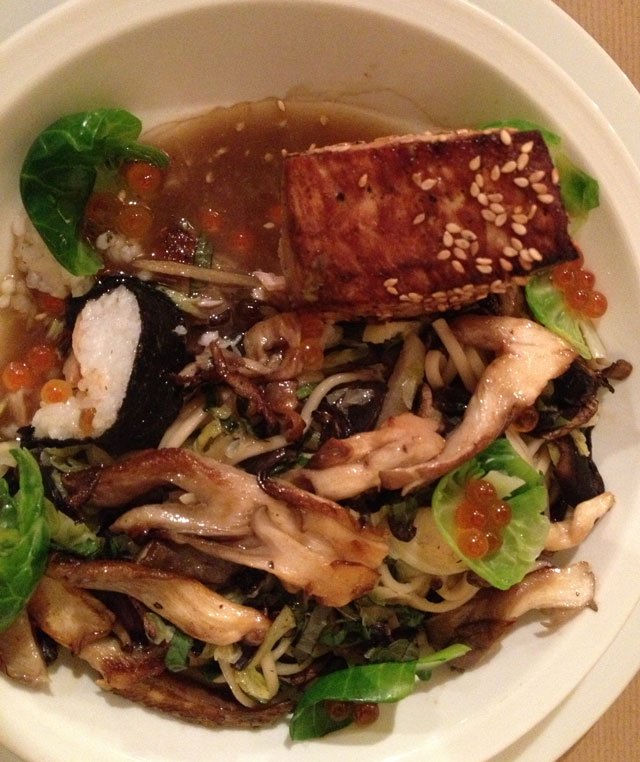
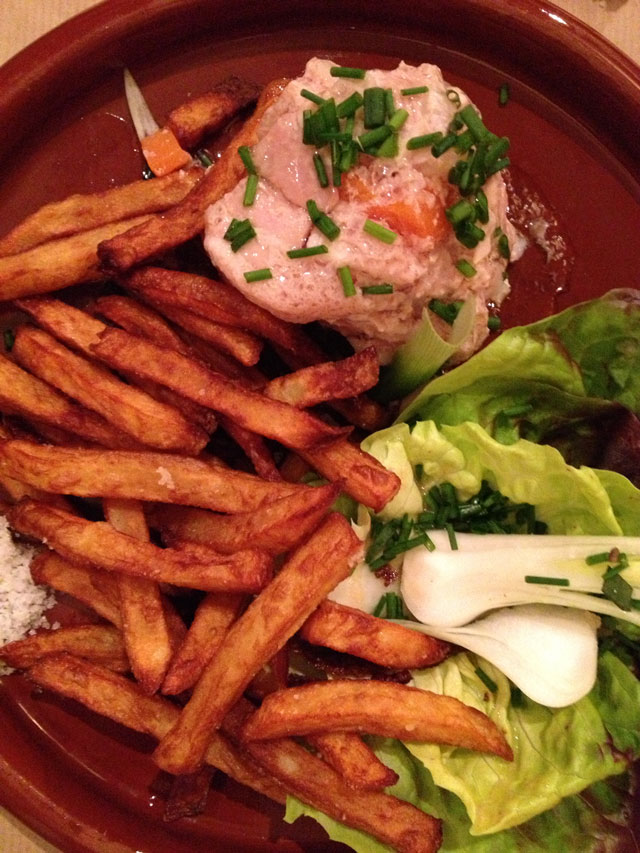
The main dishes include swordfish with mushrooms and maki, waterzooi (a Belgian chicken stew) and cold meat in aspic with French fries (well, probably Belgian).
Sword fish with mushrooms and maki
The desserts we chose are speculoos mousse (speculoos are sort of brown ginger sugar biscuits) and chocolate fondant with banana icecream.
Mixed meat in aspic with Belgian fries
I personally find the entrees the most interesting and the desserts a little heavy. The food is innovative and the ingredients obviously very fresh but the result is a little disappointing. The service is friendly and there is a good selection of local wines (we choose a bourgueil). The prices are reasonable, with the entrees and desserts at less than 10 euros, the main courses less than 15 and the desserts.
Les Gueules Noires, 66 rue de la Vallée Coquette, 37210 Vouvray, 02 47 52 62 18
Domaine Freslier, 92 rue de la Vallée Coquette 37210 Vouvray, 02 47 52 76 61
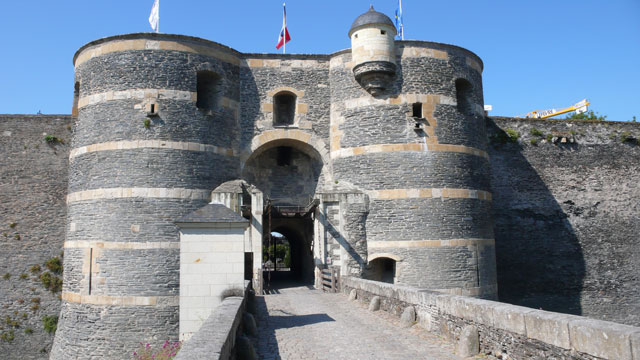
Donjon and dungeon are so obviously of the same origin that I was curious to know why the meanings are so different although both relate to feudal castles. What the French call donjon is what we call a keep in English, whereas the places where prisoners are kept is called oubliettes, from the verb oublier, to forget. No need to go into etymology there!
Angers Castle Keep or donjon
Donjon, also written dongun, doignon and dangon in the past, is from the Gallo-Roman dominiono, attested in various forms (dunjo, dungeo, domniono, domnio, etc.), in turn derived from the Latin dominus meaning “master”. It was used for the part of the castle reserved for the master and his family. It was well-protected against seiges and also included strategic food and weapon stocks. Prisoners who needed to be particularly guarded were also kept there.
It seems that the first recorded instance of the word in English near the beginning of the 14th century also meant “an underground prison cell beneath the castle keep”. But it actually seems that it is more likely that the word derives from the Frankish *dungjo, *dungjon- (“dungeon, vault, bower”), from Proto-Germanic *dungijōn, *dungō (“an enclosed space, treasury, vault”), from Proto-Indo-European *dʰengʰ- (“to cover, hide, conceal”),related to Old Saxondung(“underground vault, cellar”), Old High Germantung (“a cellar, underground living quarter”), Old Englishdung (“a dungeon, prison”), and Old Norsedyngja (“a detached apartment, lady’s bower”). (Thank you Wikipedia!)
So there you go, dungeon doesn’t seem to come directly from donjon at all which is disappointing somehow!
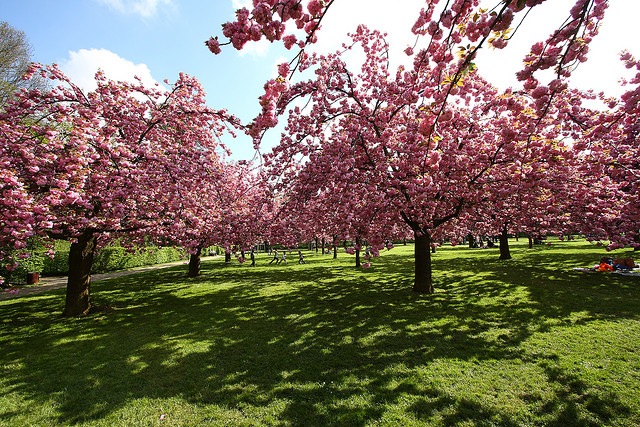
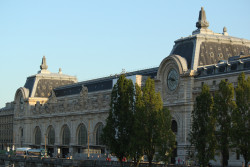
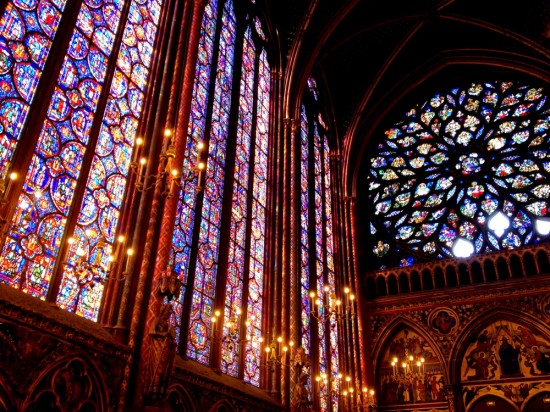
This Wednesday’s Bloggers’ Round-Up starts with a trip to Parc de Sceaux in Greater Paris with Andrea from Rear View Mirror to see the spectular cherry blossoms in bloom at the moment. Pierre from Paris on Demand invites us to the Orsay Museum to see an amazing collection of works from the 19th and 20th century from an private American collection. Marie from Europe Trip Tips, a new blog on my list, gives us a photographic tour of the Sainte-Chapelle in Paris. Enjoy!
Paris Day Trip: Parc de Sceaux
by Andrea from Rear View Mirror (formerly Destination Europe), a fellow Australian who, after 6 years of living in France, has given up herParis apartment to live a nomadic life slowing travelling around Europe, experiencing each destination like a local
If you can bear to leave Paris for the day but still want a typically French experience, Parc de Sceaux is a great spot for a classic picnic of baguette, cheese and wine. Although the park is a popular weekend destination for Parisians, it’s not widely known to visitors of the city. It’s worth a trip if you’ve already visited much of Paris and are looking for something different or if you want to see the stunning cherry blossoms in spring. Read more
A passion for France
by Pierre from Paris on Demand, aimed at helping tourists and Paris lovers to get to know the city of Light under a different perspective, offering news and updates on exhibitions, museums, restaurants, off-the-beaten-track addresses, events and tips to prepare their trip and understand the Parisian way of life
Starting on April 16th, the Orsay Museum will host one of the most awaited exhibitions of the 2013 Spring as it has gathered 70 masterpieces from the Marlene and Spencer Hays Collection. The Hays are an American couple from Nashville, Tennessee, who have developed a passion for art and France. Spencer has become a business mogul by selling, among other things, men’s suits, books and health insurance. Since the 1980’s century and as his fortune grew, he and his wife have gathered an amazing collection of works from the 19th and 20th century. Read more
The Sainte-Chapelle of Paris – in Photos
by Marie-Eve from Europe Trip Tips is a something Canadian, full-time travel blogger, amateur photographer, translator and copywriter living as an expat in France who’s been to over 17 European countries and keeps adding new ones every other week.
The Sainte-Chapelle had been a long standing item on my Paris to-do list, but for some reason, I’d never got around to it. I had deemed Notre-Dame and Sacré-Coeur more worthy of my attention – the former for its free entry, and the latter for the views.
It wasn’t until my most recent trip to Paris that I finally managed to visit the gorgeous Ile de la Cité, skip Notre-Dame altogether, and focus my visit on the well-hidden Sainte-Chapelle. Read more
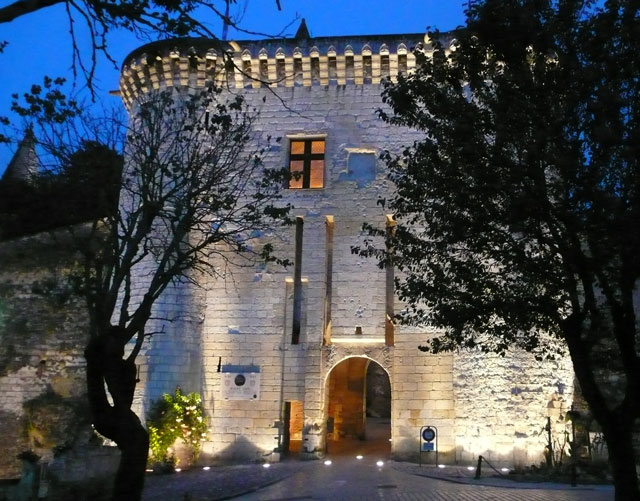
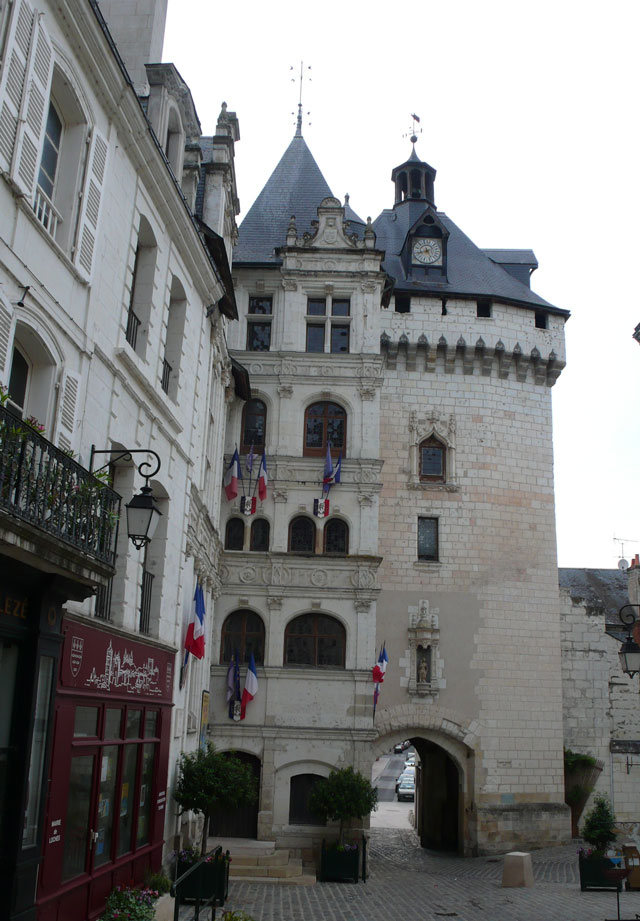
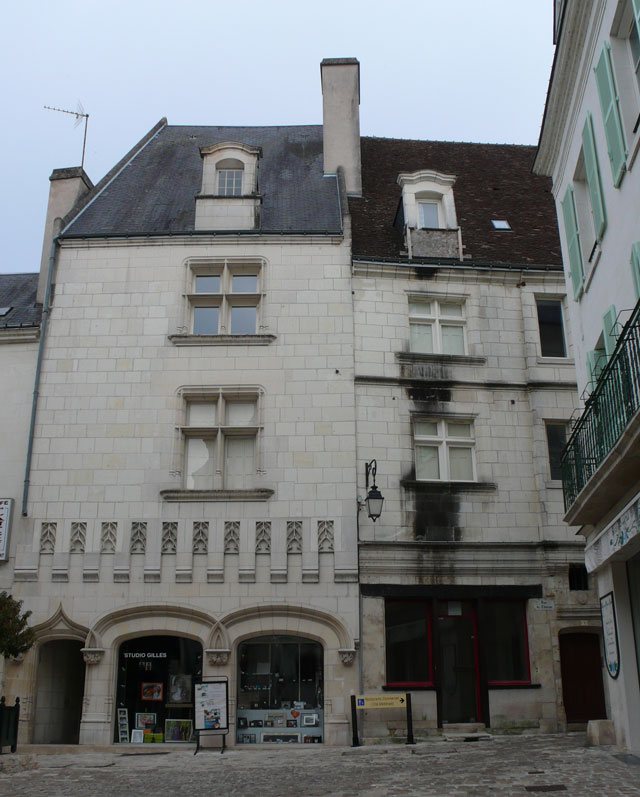
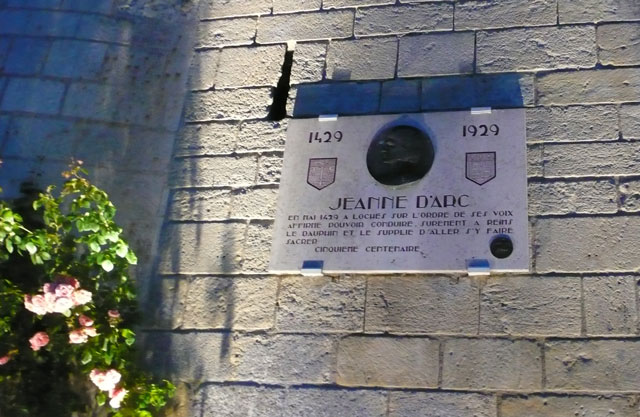
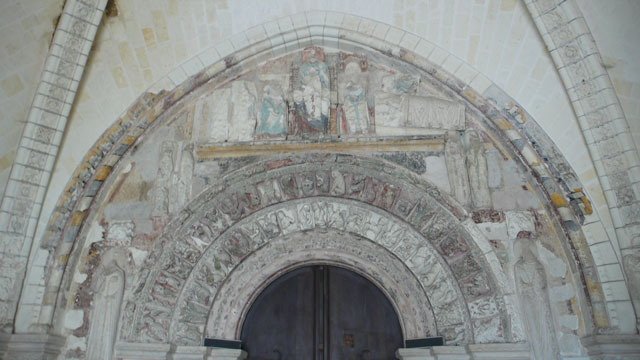
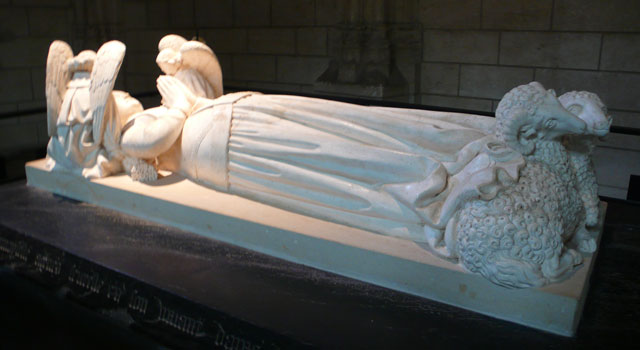
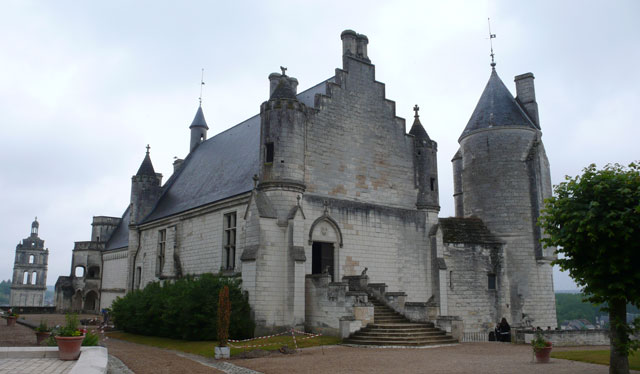
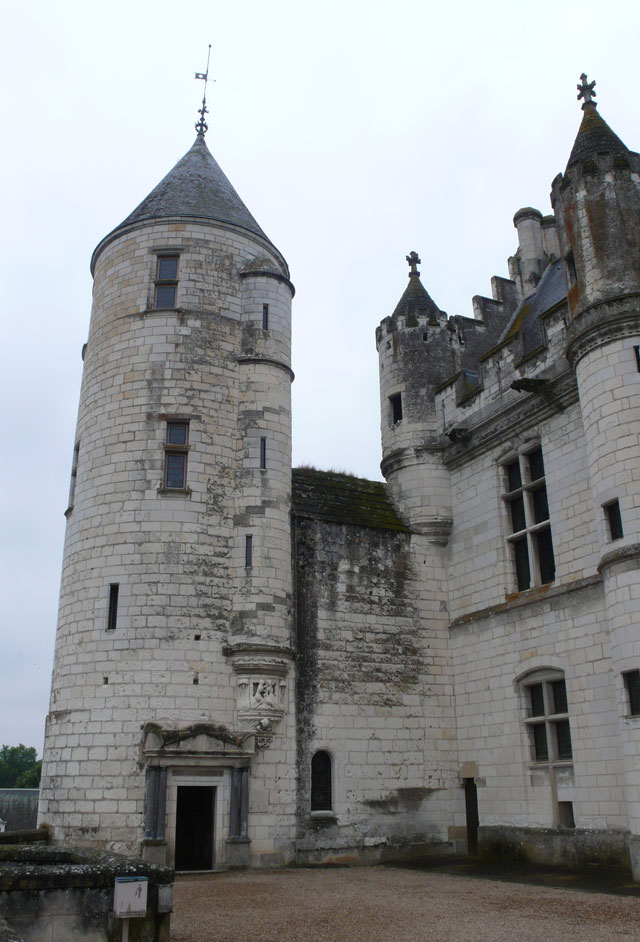
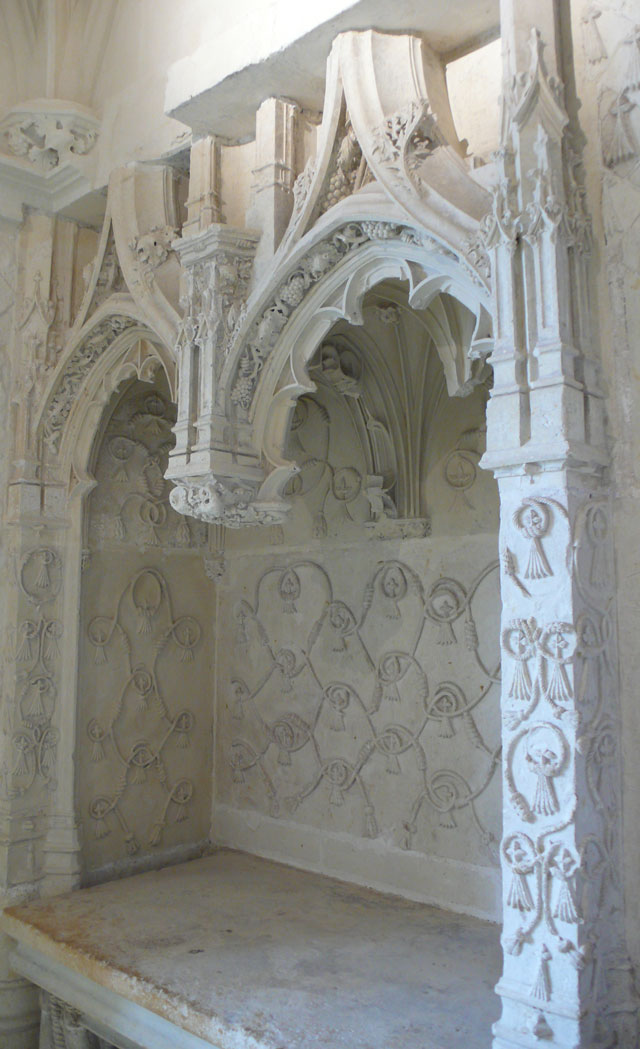
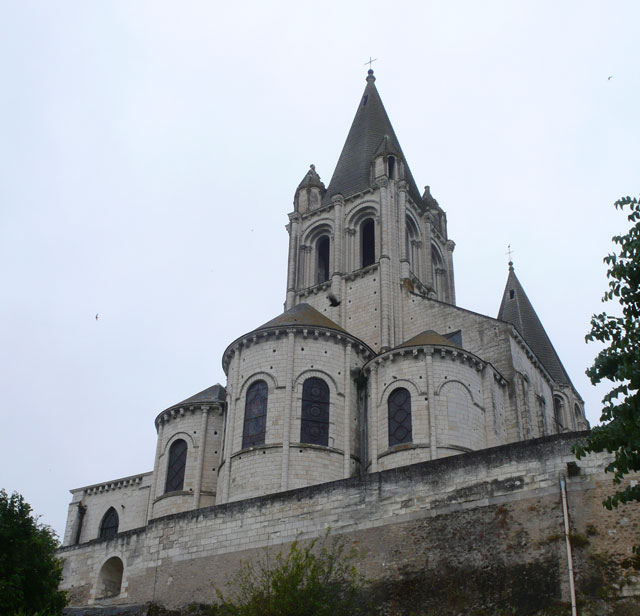
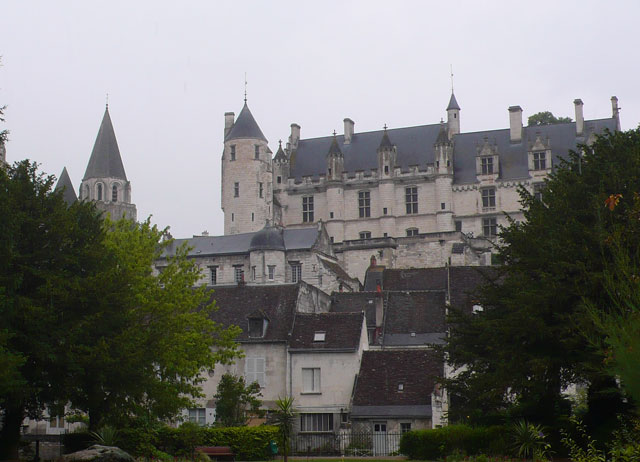
Loches, like Azay-le-Rideau, is on the banks of the Indre. Château de Loches, which consists of the 10th to 12th century collegiate church of St Ours, the early 15th century Logis Royal built by Charles VII and the 12th century keep, said to be the first stone built castle keep in France, surrounded by a very thick wall, stands on a rocky promontory overlooking the very picturesque town which has several Renaissance houses. It is beautifully lit up at night. Jeanne d’Arc arrived here on 11th May 1429 after her historic victory at Orleans to meet the king. The local market, on Wednesday and Saturday mornings attracts people from throughout the region.
Mediaeval gate to Loches Castle lit up at night
Porte Picois and Town Hall in Loches, examples of Renaissance architecture
Typical street in Loches
Joan of Arc’s plaque
Tympanum of Saint Ours
Tomb of Agnès Sorel, Charles VII’s mistress, known as the Dame de Beauté (
Château de Loche, governor’s lodge
Château de Loches, royal dwellng and Agnes de Sorel’s tower
There are so many wonderful places to visit in the Loire Valley that newcomers to the region often need guidance. It’s pointless saying “Chenonceau is my favourite. You should go there” or “Forget about Chambord, there’s nothing to see”. Each of the châteaux is different and visitors will be attracted to one or the other according to their own individual tastes. My aim here is to give an idea of what each has to offer so you can make your own choice.
Château de Chenonceau
I only intend to talk about the “pleasure castles” here, and not fortified castles such as Chinon and Loches, or religious edifices such as Fontevraud l’Abbaye, or mansions such as Clos Lucé. I’ll start with the four “Cs”: Chenonceau, Chambord, Cheverny, Chaumont, followed by the royal castles of Amboise and Blois, all of which are located in the same general area, then Azay le Rideau, Ussé, and Villandry, which form another geographical group, with Valençay off on its own to the south. You can see more photos and further detail about each château by clicking on the corresponding name.
Chambord
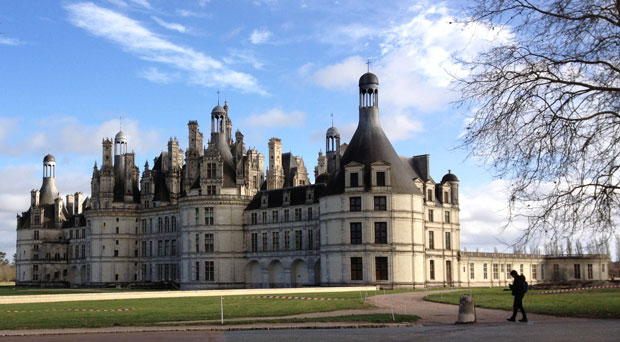
Château de Chambord
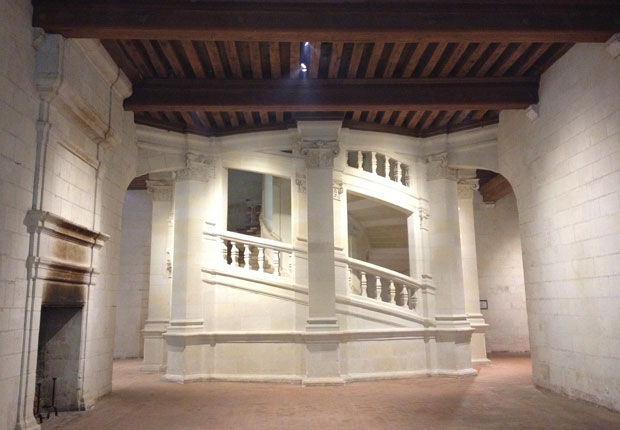
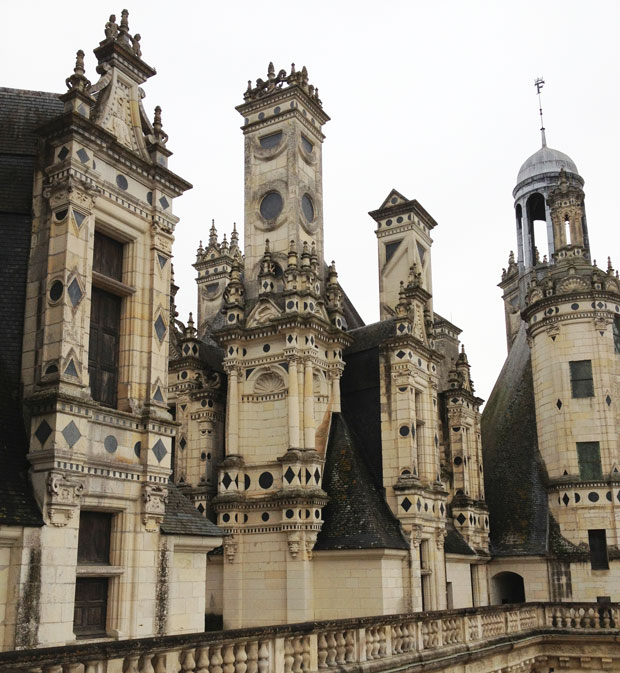
The rooftops of Château de Chambord, along with its famous double staircase, are its best known features and must be one of the most stunning examples of architecture I’ve ever seen. François I, the star of the French Renaissance, was only 25 when he commissioned the château in 1519. Unfortunately, despite the presence of 2000 workmen, it wasn’t completed in his lifetime and he only stayed there for 72 days out of his 32 years on the throne! He used it as a hunting lodge of course and it was not furnished – he used to travel around with everything and everyone he could possibly need. But his son, Henri II, as well as Louis XIV, who also loved hunting, turned it into the château we know today.
Double staircase in Château de Chambord
There is a series of furnished rooms in one wing that can be visited as well. In the mid-nineteenth century, the Count of Chambord decided to open the château to the public and furnish some of the apartments with his own private collection, mainly consisting of royal portraits and other rather disparate pieces of furniture. On 1st May every year, there is a wonderful antique and second-hand fair in the extensive castle grounds that is certainly worth attending. There are several restaurants and souvenir shops in view of the château.
Rooftops of Château de Chambord
Open all year except 1st January, 31st January, 25th December. From 20/01 to 31/03 and 01/10 to 31/12: 10 am to 5 pm; 01/04 to 30/09: 9 am to 6 pm. 16 euros.
Le Saint Louis, Place Saint Louis – 41250 CHAMBORD
Au Fil du Temps, 11 Halle, 41250 Bracieux, France Tel. 0254460384 (8 km from Chambord)
Chaumont
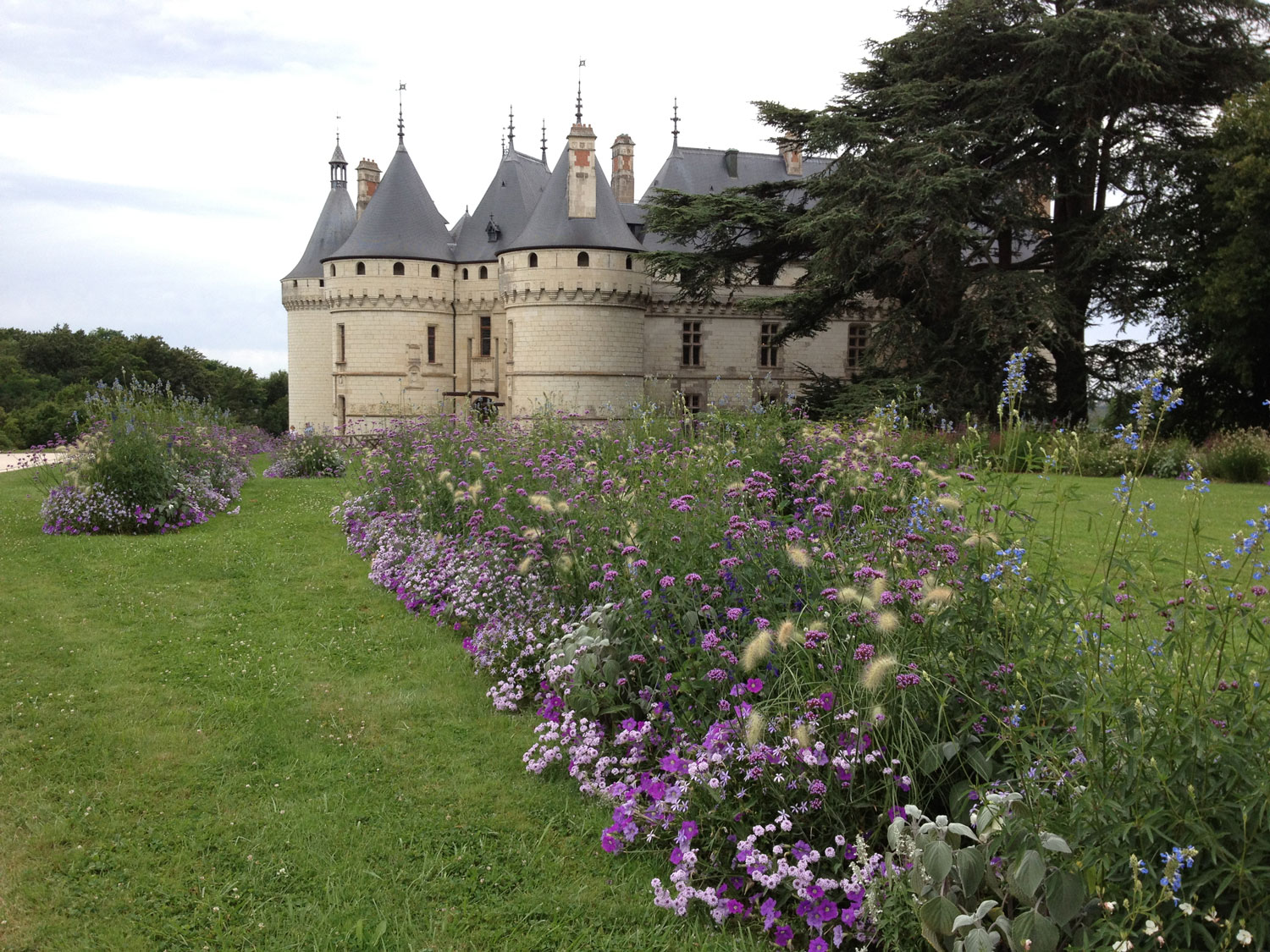
Château de Chaumont
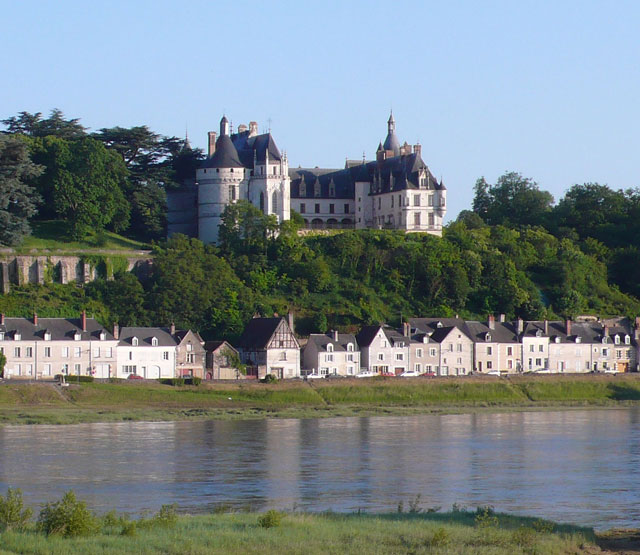
Château de Chaumont stands in a prize position overlooking the Loire and is best seen from the other side of the river. From April to October, it hosts a wonderful garden festival with a different theme each year. The château as it stands today was rebuilt from 1468 to 1511. It was bought by Catherine de Medicis, wife of Henri II (son of François I) in 1550. On his death, she forced her husband’s paramour, Diane de Poitiers, to swap Chenonceau, a gift from Henri, for Chaumont.
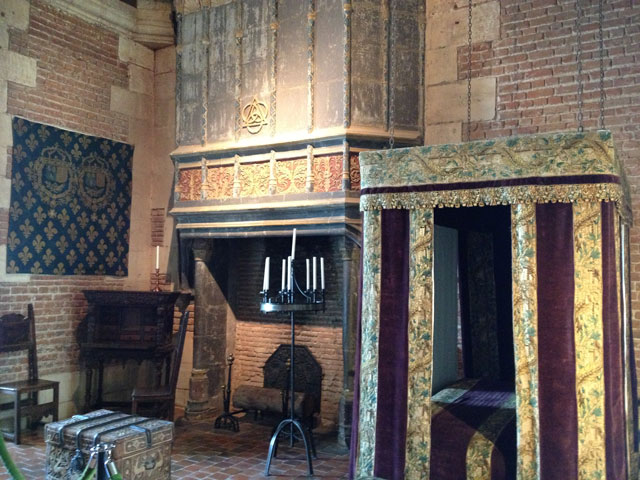
The bedroom of Cosimo Ruggieri, one of Catherine de Medicis’ astrologists, at Chaumont
The château was later restored by Prince de Broglie between 1875 and 1900, including the beautifully furnished state rooms and luxury stables with their exercise ring. The top floor of the château, currently in a somewhat derelict state, can also be visited, as well as the basement kitchens. Between the château, the stables, the grounds and the garden exhibition, you can easily spend the day on the Domain, which has no fewer than four different restaurants.
Chaumont from the garden
Open all year round, from 10 am to 4.30, 5.30 or 6.30 depending on the season. 15 euro for the château, park and stables, and 20 euros if you include the garden festival.
Places to eat
If you want to combine your visit to Chaumont with a gastronomic experience in one of the finest restaurants in the region.
Domaine des Hauts de Loire, Route de Herbault, 41150 Onzain (across the Loire from Chaumont), 02 54 20 72 57, hauts-loire@relaischateaux.com, www.domainehautsloire.com
Chenonceau
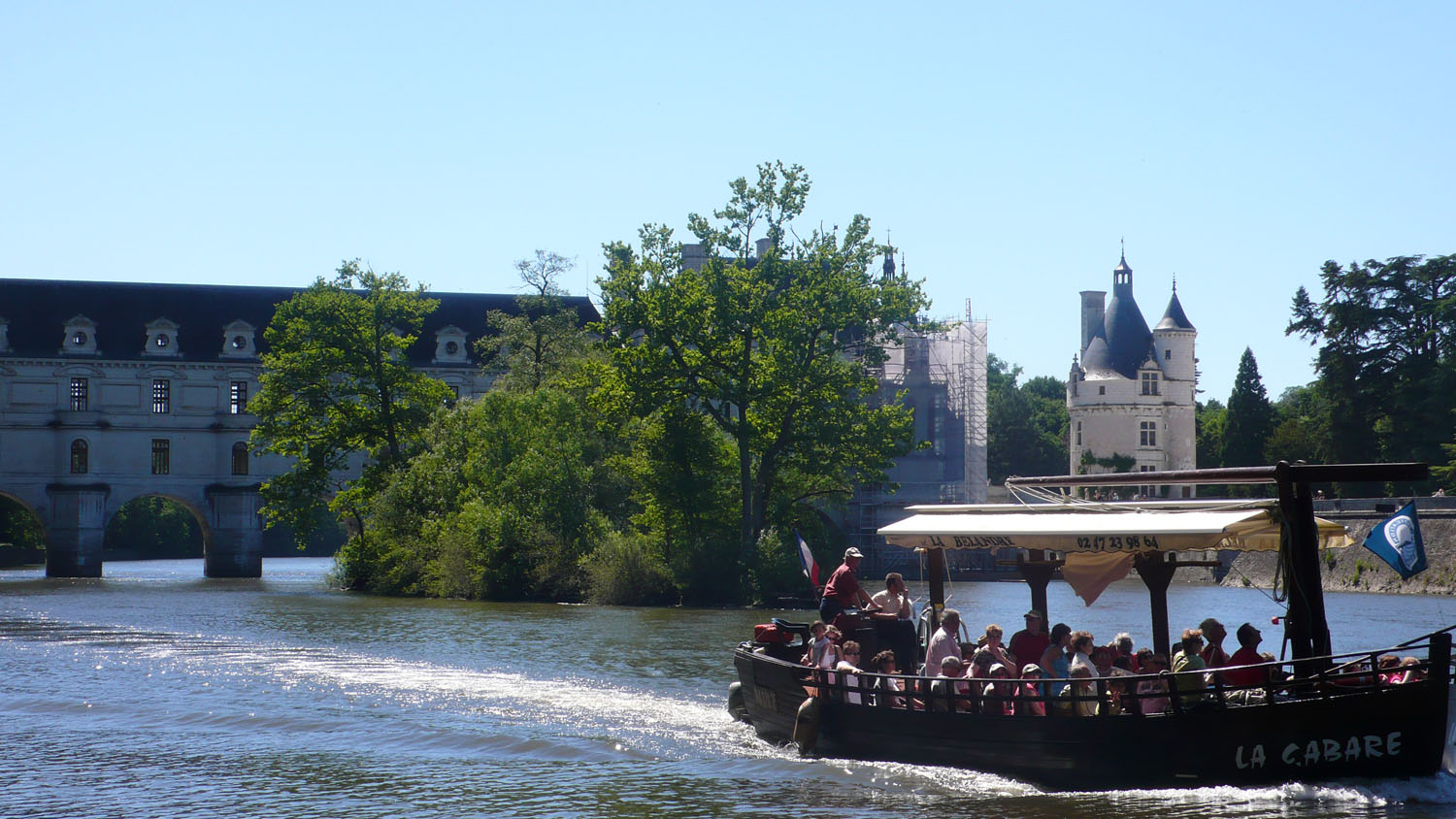
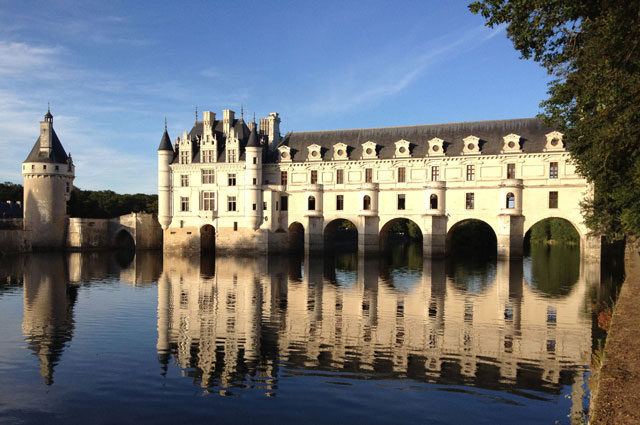
Château de Chenonceau
Built from 1513 to 1521 and celebrating 500 years of existence this year, Château de Chenonceau spans the Cher River. It’s a ladies’ castle, built in 1513 by Katherine Briçonnet, decorated by Diane de Poitiers, extended by Catherine de Médicis and saved by Louise Dupin during the French Revolution! All four are featured in a wax museum in a separate building. The château should be viewed from all sides, so you should allow time to walk around the grounds themselves, which include Diane’s and Catherine’s gardens, a vegetable garden and a labyrinth. You can also walk (or cycle) along the south bank of the Cher River or hire a rowing boat in summer.
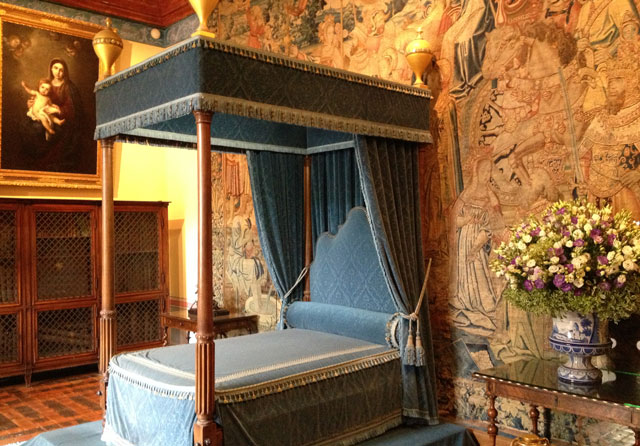
Diane de Poitier’s Bedroom
The sumptuous inside is completely furnished with several masterpieces and includes a visit of the basement kitchens. A free iPhone app (Découvrir Chenonceau) offers an introductory visit in 11 languages! You can taste the château’s own wine in one of the restaurants inside the grounds. Every weekend in June and every evening in July and August, the gardens are illuminated at night.
Open all year round, 9 or 9.30 am to 5 to 8 pm, depending on the season. 11 euros for the château and grounds, 13 euros including the wax museum, plus 2 euros for an audioguide.
Cheverny
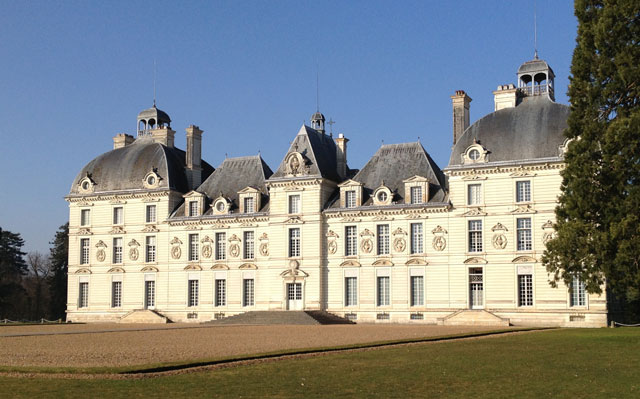
Château de Cheverny
Château de Cheverny is another experience altogether. The domain has been in the same family for more than six centuries and open to the public since 1922. The château as we know it today was built between 1624 and 1640 by Count Henri Hurault and his wife Marguerite Gaillard de la Marinière. The sumptuous interior decoration is by Jean Monier from Blois. It is the only major château to have retained its original furniture and furnishings. Fifteen thousand bulbs are planted in the gardens each year, so if you can, time your visit for spring!
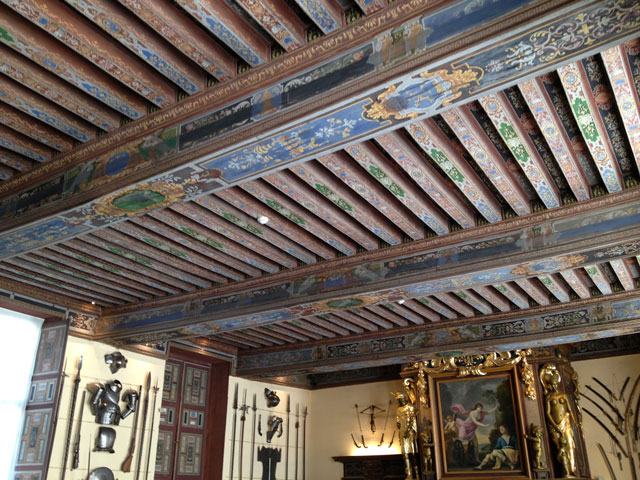
Painted ceiling in the grand dining room at Cheverny
Cheverny has two other attractions. The feeding of its 100 hunting dogs is very popular with visitors during the summer (although the kennels are currently closed for refurbishment) and there is a Tin Tin exhibition – Cheverny was used as a model by Hergé for Marlinspike Hall, Captain Haddock’s residence in the Tin Tin comic books.
Just next to the château is the Maison des vins de Cheverny et Cour-Cheverny, where you can taste and buy the local wines.
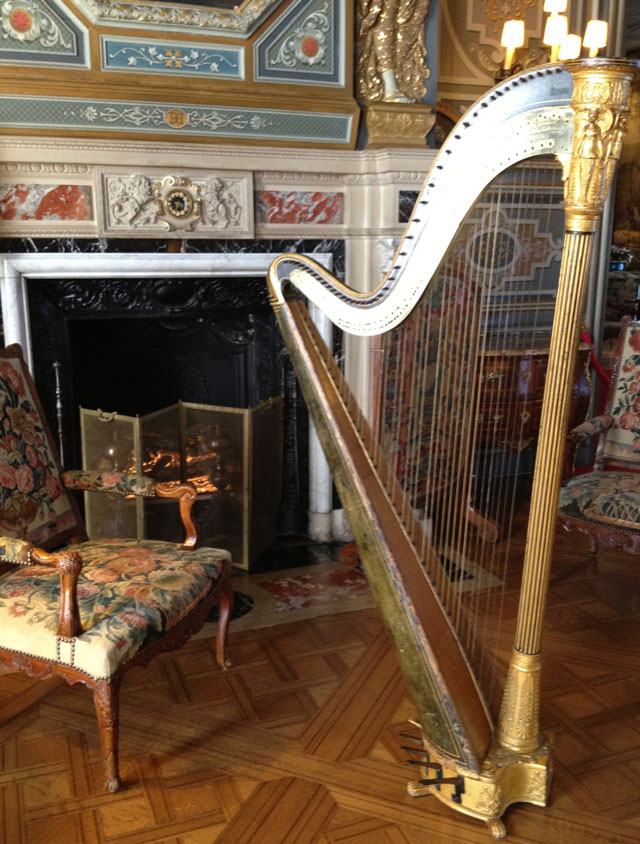
Late 18th century Erard harp in perfect working order
Open all year round. 9.15 to 9.45 am to 5 pm to 18.45 pm depending on the season. The dogs are fed from 1/04 to 15/09 every day at 5 pm and from 01/01 to 31/03 and 16/09 to 31/12 at 3 pm on Tuesdays, Wednesday, Thursdays and Fridays. Château and gardens, 14.50 euro, with Marlinspike museum 19 euro, with boat and electric car trips 19.50 euro, plus Marlinskpike 24 euro.
Amboise
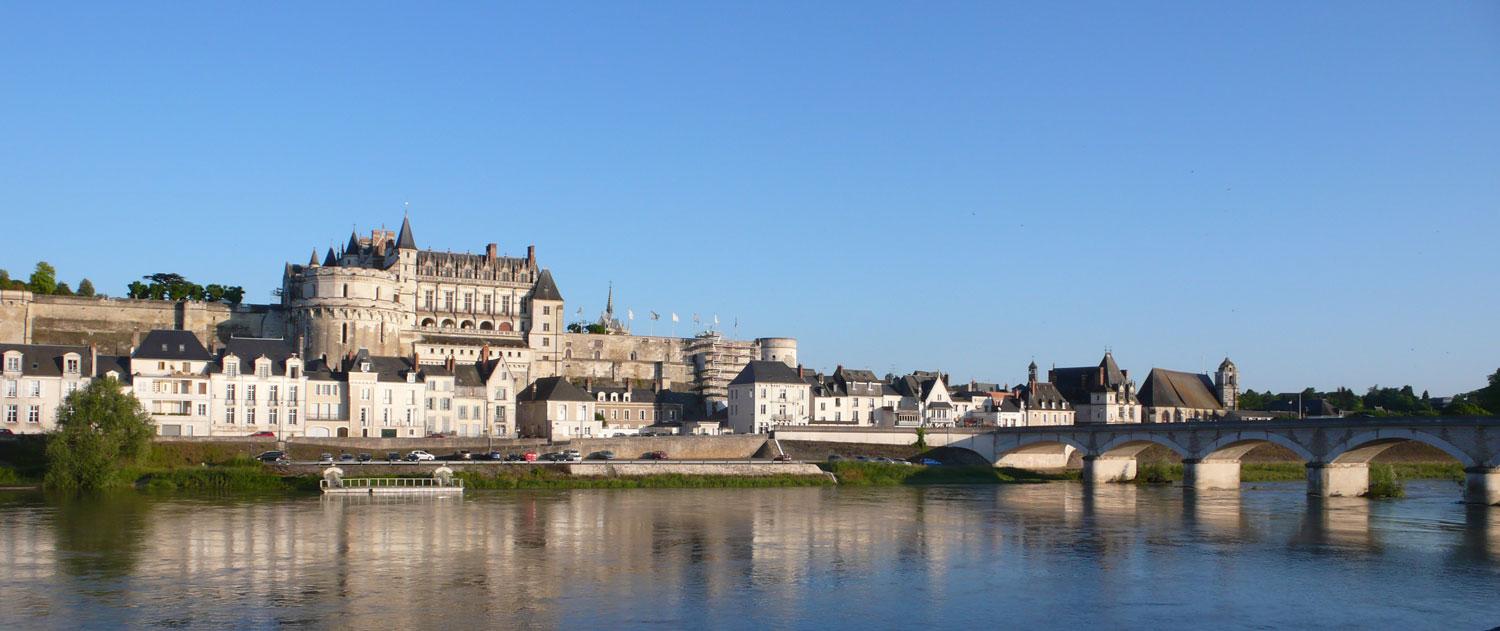
Château d’Amboise
The Royal Château of Amboise stands in a stunning position overlooking the Loire, best seen from the little island called l’Ile d’Or in the middle of the river. It became a royal residence in the mid-14th century and was a favourite with many French kings, from Louis XI to François I. It has an exceptional collection of Gothic and Renaissance furniture. An unusual feature is a wide ramp inside the château used directly by horses and carriages. Saint Hubert’s chapel is thought to be the last resting place of Leonardo da Vinci whose home in Amboise, Le Clos Lucé, contains scale models of many of his inventions.
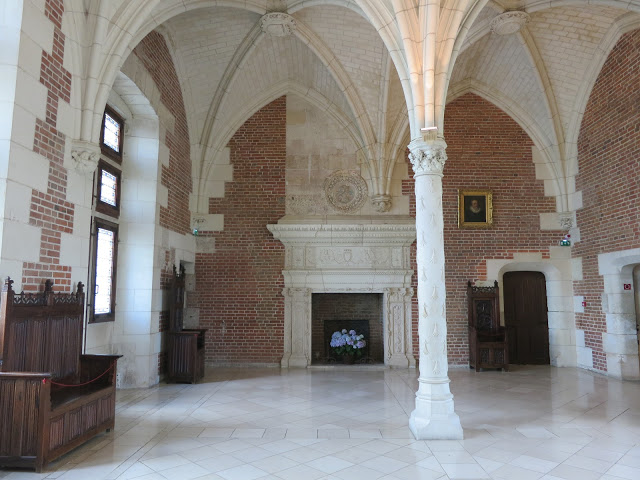
Amboise interior – photograph by Kathy Stanford
The beautiful panoramic gardens afford wonderful views of the Loire, the old town with its half-timbered houses and the surrounding countryside. The very extensive Friday and Sunday morning market along the river is one of the best in the area.
Open all year round from 9 am to 12.30 pm and 2 pm to 4.45 pm from 15/11 to 28/02 and from 9 am to 5.30 to 7 pm from 1st March to 15th November. 14.60 euro.
Places to eat
Chez Bruno, 38-40 Place Michel Debré 37400 Amboise, tel 0247577349, cell 0620562551 or 0617844228, http://www.bistrotchezbruno.com (just opposite the château)
Le Shaker, 3 Quai François Tissard, 37400 Amboise, 0247232426 (on l’Ile d’Or, the island in the middle of the Loire with a breathtaking view of the château)
Blois
Château de Blois
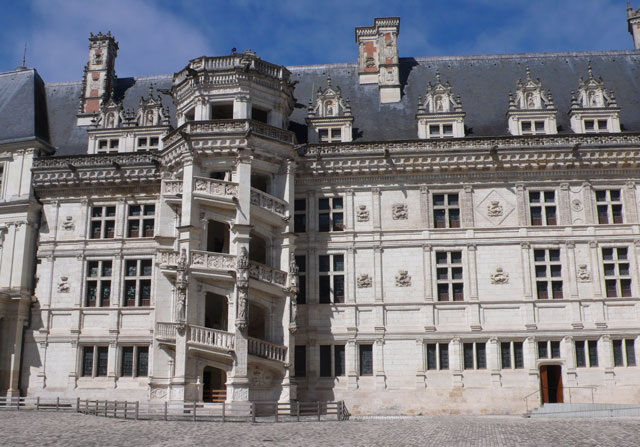
Like Amboise, the Royal Château of Blois is built on a promontory right in the middle of the town overlooking the Loire River, and encompasses several different architectural styles from mediaeval times to the 17th century. At the end of the 14th century, the château was bought by the Orleans family and nearly a century later, Duc Louis d’Orleans became Louis XII and brought his wife, Anne de Bretagne, and his court to Blois. They modernised it all, so to speak, with stairs at each end and balconies on the first floor, decorating it with their emblems, the porcupine for Louis and the ermine for Anne.
Guardroom in Blois
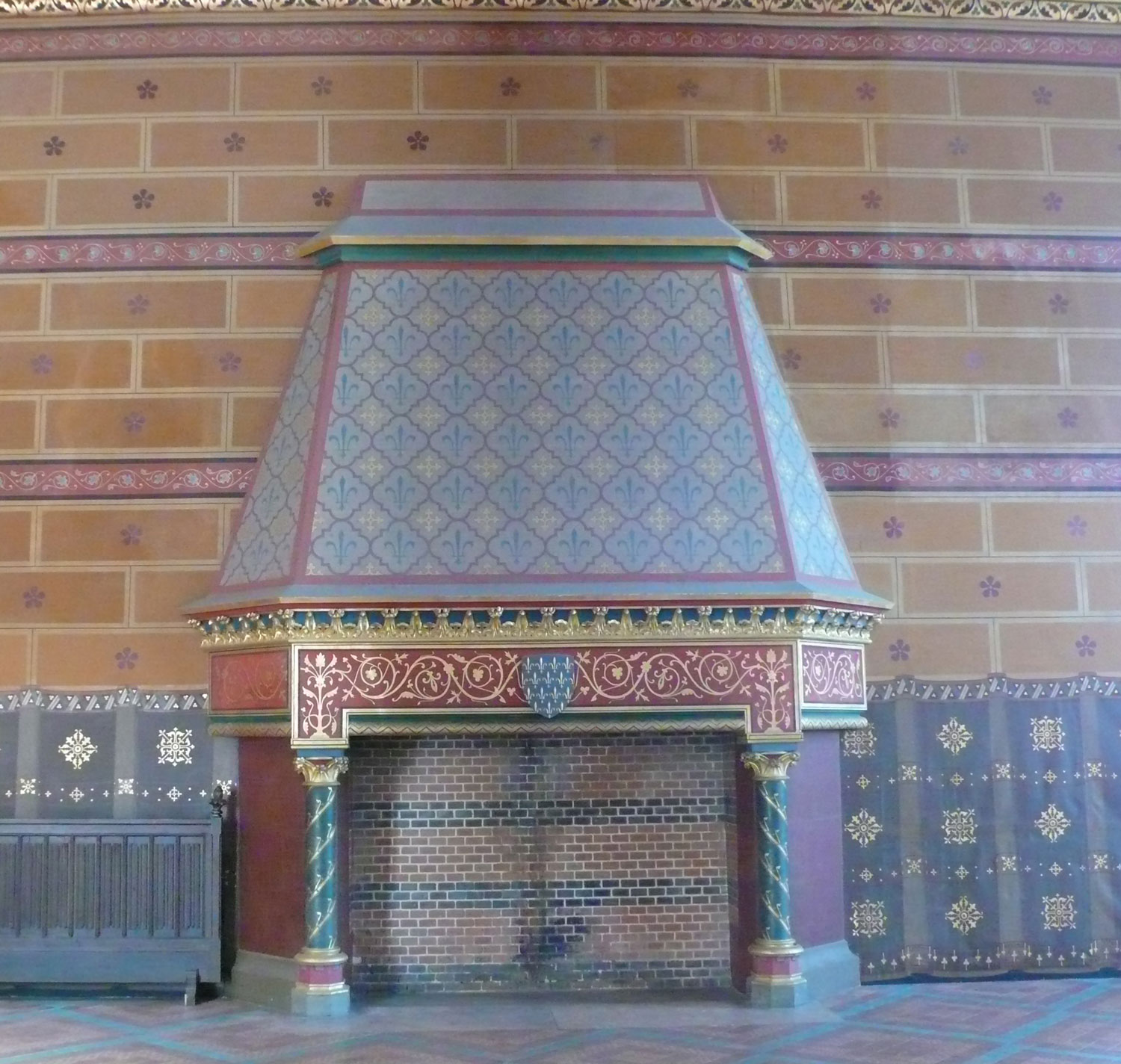
François I, whose salamander is a recurring theme, lived in the château after he ascended to the throne in 1515. The Duc de Guise was assassinated in the King’s Chambers on the orders of Henri III in 1588 after plotting to take over the throne and Catherine de Medicis, wife of Henri II (son of François I) and mother of Henri III, died there the next year at the age of 70. The interior is extremely rich and colourful with many fine fireplaces and majestic pieces of Renaissance furniture. There is also a lapidary section with gargoyles, statues, pediments and other bits and pieces taken from buildings on the site. There is a sound and light show in the summer.
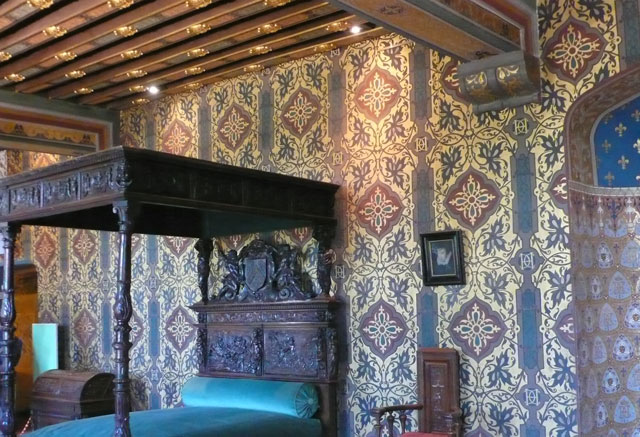
One of the sumptuously decorated bedrooms in Château de Blois
Open all year round from 9 am to 12.30 pm and 1.30 to 5.30 pm in the winter months and 9 am to 6 or 7 pm from 01/04 to 31/10. Sound and light show at 10 or 10.30 pm. Château 14 euro; château + sound and light show 21 euro.
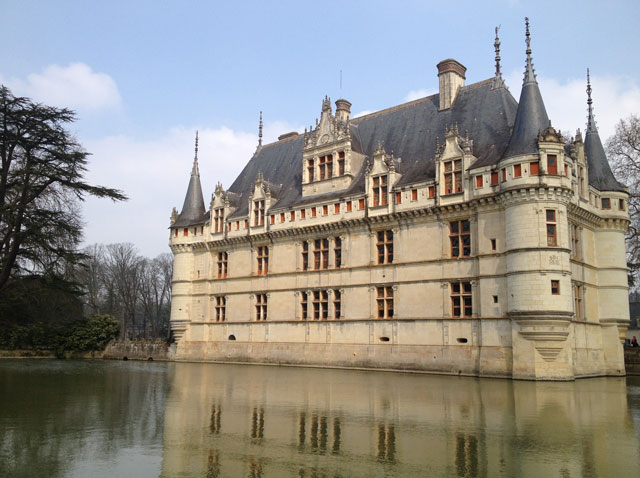
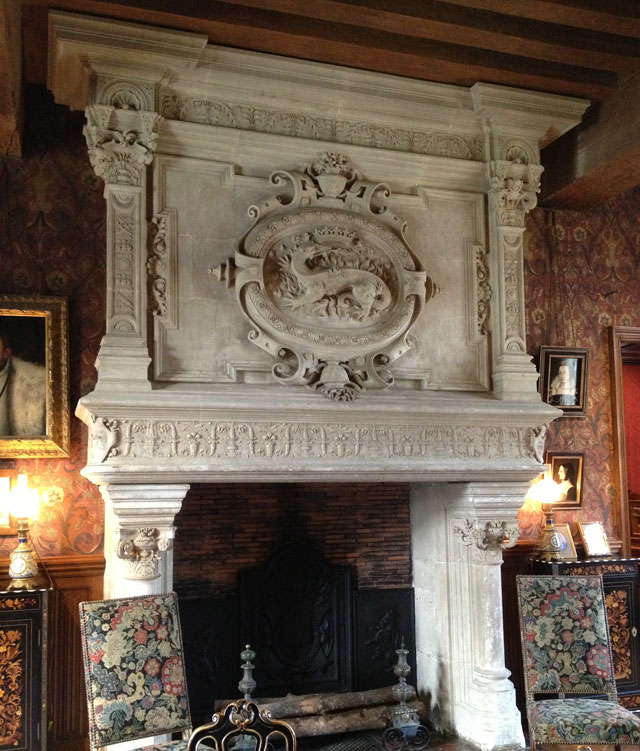
Considered by many to be a “jewel of the French Renaissance”, Château d’Azay le Rideau was built on an island in the Indre River by a rich financier in the early 16th century during the reign of François I and combines the Italianate and French styles. It is more sober than the larger châteaux and one of its most striking features is its monumental fireplaces. The château was abandoned after the French revolution and redecorated by the Marquis de Biencourt. In 1898, the 4th Marquis had to sell out and it was not until it was bought by the State in 1905 that renovation began.
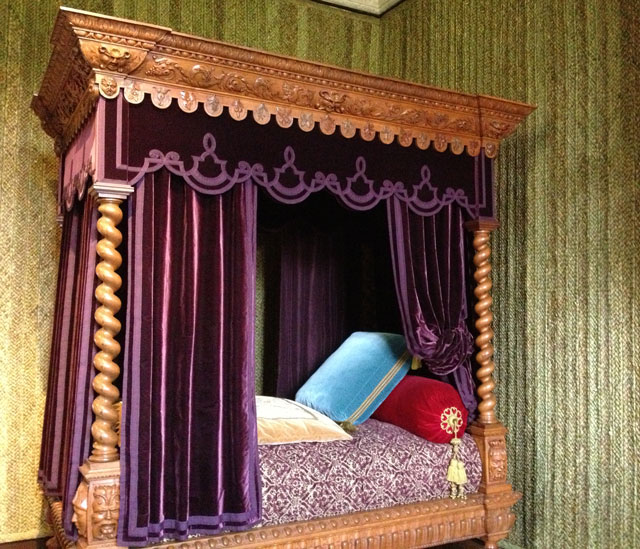
Philippe Lezbahy’s Renaissance bedroom in Azay-le-Rideau
Now most of the rooms are decorated in the 19th century neo-Renaissance style, but the royal apartments still have some older pieces. A wonderfully reconstructed Renaissance bedroom with copies of authentic soft furnishings and rush-matting on the walls is accompanied by a very instructive video. The roof space, opened a couple of years ago after major restoration, is the most remarkable example of Renaissance master carpentry now on show.
One of the monumental fireplaces with François I’s emblem, the salamander, in Azay-le-Rideau
The natural moat forms two “mirrors of water” reflecting the ornately sculpted frontons and pointed roofs of the château. The lovely jardin à l’anglaise or landscaped garden is the perfect place to wander on a fine day and affords stunning views of the château.
Open all year round. Every day from 10 am to 5.15 from October to March, from 9.30 to 6 pm in April, May, June and September, from 9.30 to 7 pm in July and August. Closed 1st January, 1st May, 25th December. 13 euro.
Places to eat
Le Lavoir in the castle grounds and a large choice of restaurants in the town itself.
Ussé
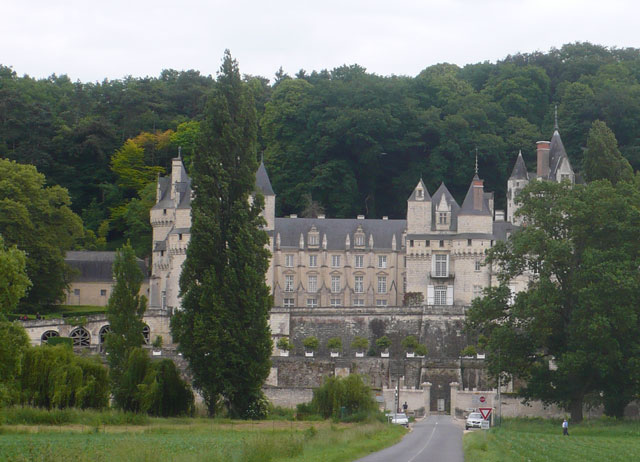
Château d’Ussé
Known as “Sleeping Beauty’s castle” because it was one of the châteaux that inspired Walt Disney, Château d’Ussé overlooks the Indre River. Cycling towards it in summer with sunflower fields on either side is an unforgettable experience. The original 11th century castle has been rebuilt several times, which explains its 16th-17th century aspect today. The grounds were redesigned in the 17th century by André le Notre, Louis IV’s landscape architect, who masterminded the gardens of Versailles.
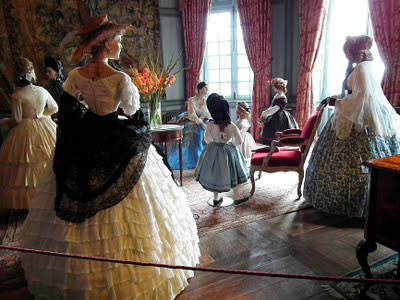
Costume exhibition at Ussé – photograph by Loire Valley Time Travel
Inside, monumental fireplaces and beautiful 18th century furniture and tapestries offer a backdrop to a life-like exhibition of mannequins in period costume which changes each year. The parapet walk offers access to rooms containing scenes from Sleeping Beauty and everyday life in the 19th century. A lovely Renaissance chapel stands outside the château.
Open from mid-February to mid-November, 10 am to 6 pm 17/02 to 31/03 and 1/09 to 11/11, and 10 am t 7 pm 01/04 to 31/08. 14.50 euros.
Valençay
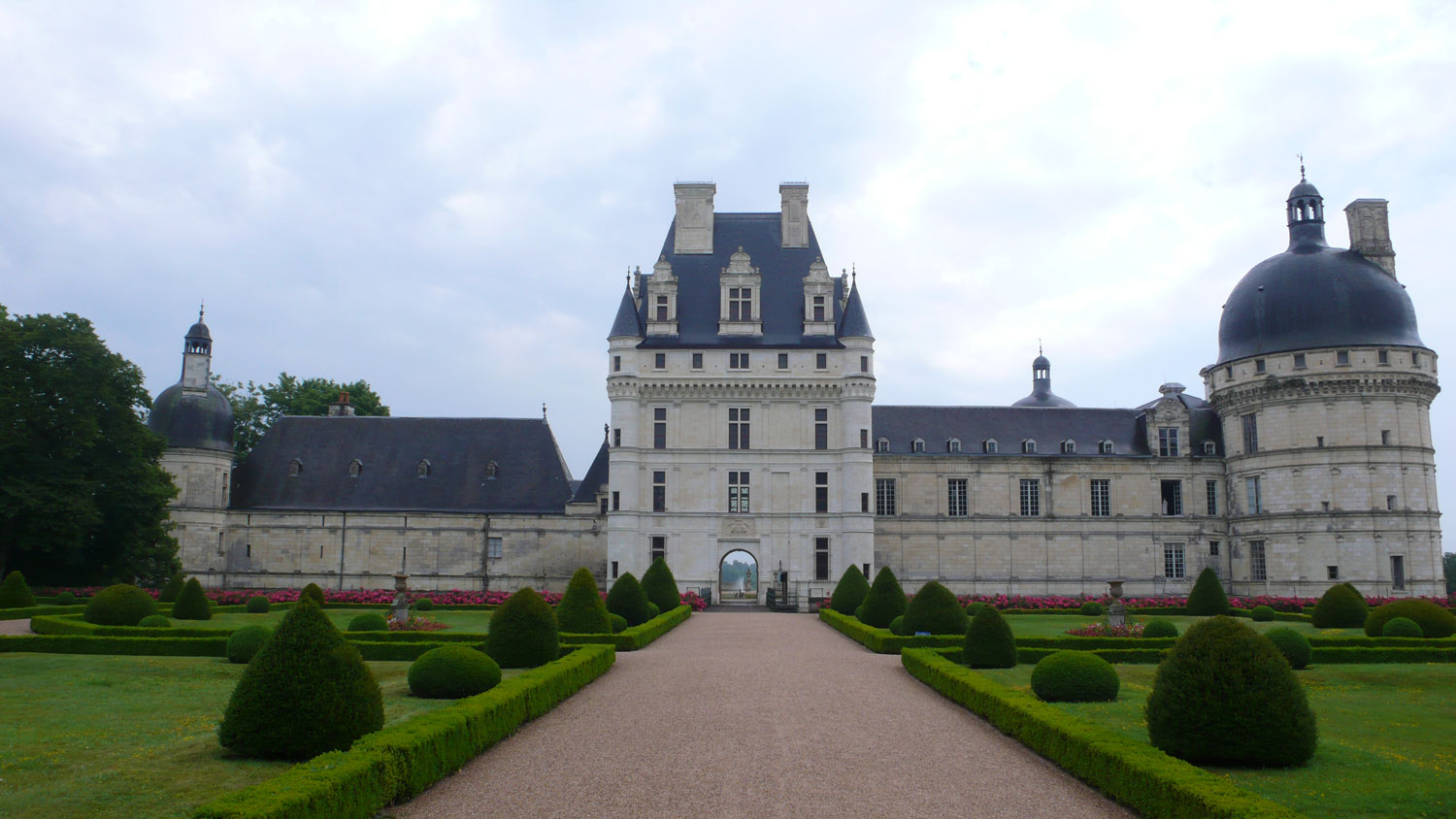
Château de Valançay
Valençay, rebuilt in 1520 by Jacques 1er d’Estampes and extended in the 17th and 18th centuries, was bought by Talleyrand in the 19th century at the instigation of Napoleon to welcome foreign dignitaries. Its sumptuous Italian arcaded gallery makes it a reference in the field of Renaissance architecture while its domed towers, dormer windows and bull’s eyes are perfect examples of the neo-classical style.
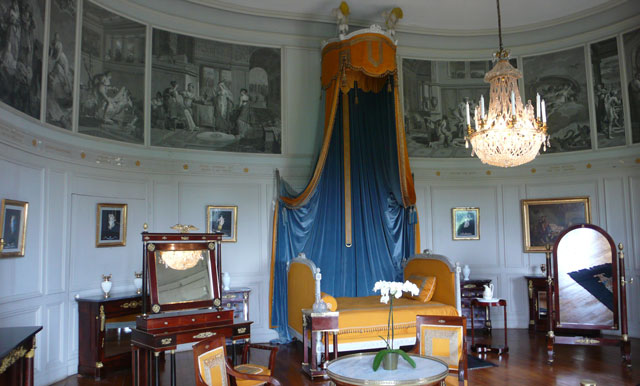
The King of Spain’s Chamber at Château de Valançay
The inside is furnished just as it was during Talleyrand’s time, with elaborately embroidered Empire chairs, ornate tables and sumptuous chandeliers. Magnificent vaulted cellars house the kitchen, pantry and cellar in which one of the best tables of Europe was prepared.
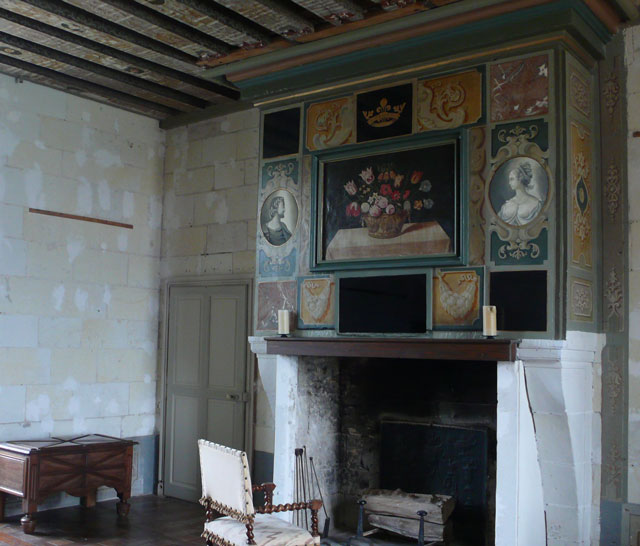
Renaissance Room in Château de Valançay
The château is surrounded by a lovely formal garden and a landscape garden. Two nights each summer, the château is illuminated with 3,000 candles, and costumed actors and trumpeters revive the imperial celebrations of the past.
Open all year round. Every day from 16/03 to 11/11 from 9.30 to 10.30 am to 5.30 to 7 pm. 14.50 euros.
Villandry
Château de Villandry
Also built overlooking the Loire, Château de Villandry is a château for garden lovers and the last of the major Renaissance castles to be built in the Loire Valley. It was the home of neither a king nor a courtesan but of Jean Le Breton, François I’s finance minister. He demolished the old feudal fortress, except for the keep, in 1532 and replaced it with an extremely elegant and richly decorated purely French Renaissance château. When the Marquis of Castellane bought it in 1754, he revamped the interior in the neo-Classical style. Unfortunately, he also destroyed the harmony of the outside, adding balconies, balustrades and trompe l’œil windows.
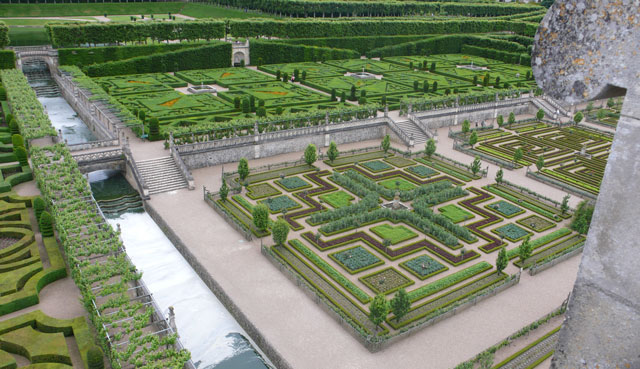
Villandry gardens
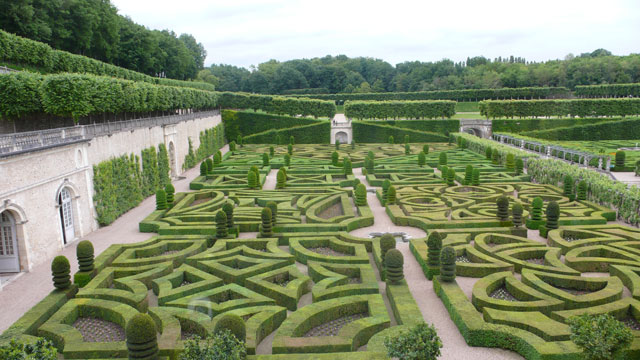
The gardens were much more successfully refurbished in the early 20th century to recreate the ambiance of a Renaissance garden. An arbour of grape vines leads to a large parterre, designed as a Garden of Music. The Garden of Love is on the other side of the canal. The garden combines flowers and vegetables and its true glory can best be experienced from the top of the château. A shop sells seeds and plants and other garden-related items.
Another view of the gardens at Villandry
Open all year round. The gardens are open every day from 9 am to 5 pm to 7.30 pm depending on the season. The castle is open from 9 am to 9.30 am to 4.30 to 6.30 pm from 16/02 t 11/11 and during the Christmas holidays. 13 euro, gardens only 8 euro.
ACCOMMODATION
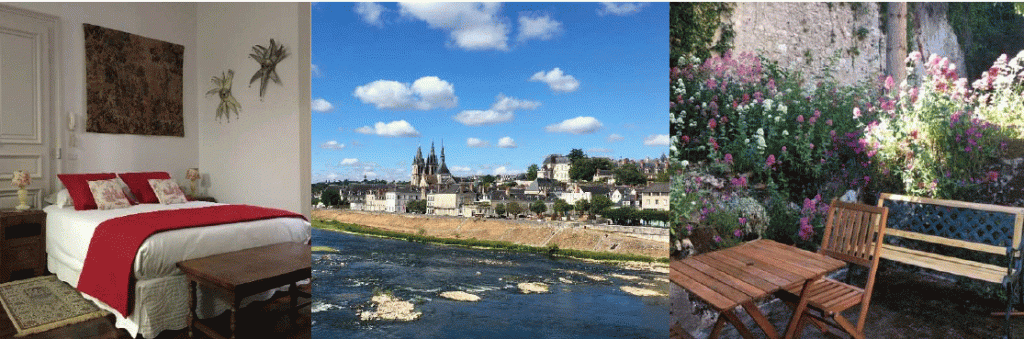
And if you’re looking for an authentic place to stay in a central location, why not check out our rental accommodation for two in the mediaeval quarter of Blois – Châtel Rose. Click here for more information.
FURTHER READING
For more articles about France from other bloggers, see All About France
Anyone who has been involved in buying (or selling) a house or appartment in France will know who the notaire is but may not be aware of exactly what they do, mainly because the equivalent does not exist in the Anglosaxon world. According to the Chambre des Notaires, which has a very useful English version of their website, by the way, “a Notaire is a legal specialist with a public authority mission who draws up authenticated contracts on behalf of his clients. He is self-employed”.
Notaire’s office in Montrichard with its easily recognisable insignia
The word “notary” exists in English, but has a very different meaning. According to the British Notaries Society, “A Notary is a qualified lawyer primarily concerned with the authentication and certification of signatures and documents for use abroad … and also authorised to conduct general legal practice (excluding the conduct of court proceedings)”. Very different from the French notaire.
So what does the notaire do exactly? He/she is involved in all real estate transactions, as well as wills, marriage contracts and other similar legal documents. Many French people consider that notaires charge too much but it is not their fees that are expensive – it’s the taxes levied by the French government. Doing your own conveyancing in France is simply not possible.
What a lot of people don’t know is that they can consult the notaire free of charge on a variety of matters. Before I bought my first house in the suburbs of Paris, I went to see the notaire to ask what sort of price I should pay because they keep very strict statistics on real estate transactions. He gave me the average “price per square metre” for a house in the area I was looking in and that is exactly what I paid. When I sold it ten years later, the price had doubled.
I went back to see him again of course when I was selling the house after my divorce and buying an apartment instead. Once again, the price had doubled when I sold it ten years’ later. When Jean Michel and I got married, we went to see him so he could advise us on our marriage contract and wills since we each have two children from another marriage and it was important to protect their interests.
After that, I did several interpreting/translating jobs for another notaire whom we subsequently adopted, particularly as the previous one had retired by then. When we bought Closerie Falaiseau, I naturally asked that she be involved in the sale as I knew she would look after my interests. If each party has a separate notaire, they split the fees, so it doesn’t cost any more to have your own.
It was actually quite amusing when we signed the final deed for the house. My notaire was not available on the day and time chosen by the notaires in Blois, who obviously were not going to go out of their way to accommodate a Parisian notaire. They had already been a bit difficult about sending her the deed (and then she picked up a few errors which they didn’t like) so she very apologetically sent her very competent clerc instead. Since the clerc would have had to get up at the crack of dawn to get to the office notarial by 10 am by train, we offered to take her with us in our car.
She was very chatty and we had a most interesting ride, stopping at Paul’s along the motorway to have breakfast. We were very pleased to have her present at the signature. It wasn’t that our previous owners were not honest – they are the loveliest people you could imagine – but they had asked to stay another two weeks in the house after the final signature. We knew they would leave in time, but imagine what might happen if they both had a fatal car accident and their heirs (they don’t have any children) refused to leave the house?
Our notaire was able to make sure that we were completely covered by the law in the event of a problem, an issue which the previous owners’ notaire had not bothered to address.
So my advice is to make sure you have your own notaire, who will look after your best interests, and not just go along with the one suggested by the sellers or the real estate agency. Go and see the notaire in advance and explain your situation and what you’re looking for. I’m sure you’ll find them very helpful.
And if you need help seeing a notaire because your French isn’t good enough, I’ll be happy to help if you live in my area (Loire Valley) or your notaire is willing to use their visio system. As a certified translator, I am qualified to do so.
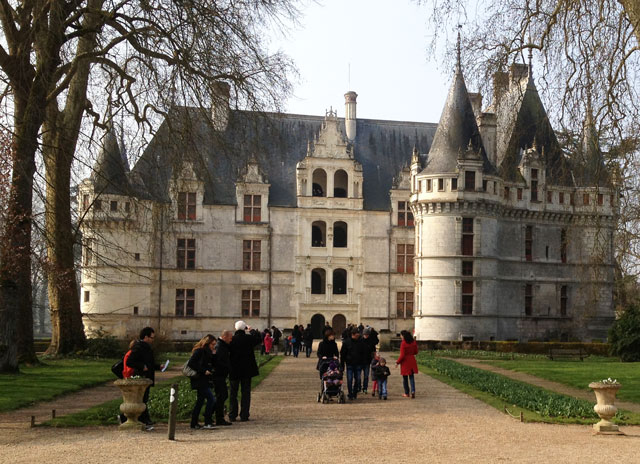
Azay-le-Rideau has always been one of my favourite châteaux in the Loire Valley although it doesn’t have the majesty of Chambord, Chaumont or Chenonceau, which is not surprising because it’s not a royal castle. The original fortress was bought by a rich financier called Gilles Berthelot in 1510. After marrying Philippe Lesbahy, a rich heiress – Philippe was a popular woman’s name in Renaissance times – he embarked on a flourishing career under François I.
Front entrance to Azay-le-Rideau on Easter Sunday
Built on an island in the Indre River and considered by many to be a “jewel of the French Renaissance”, Azay-le-Rideau combines the Italianate and French styles. The main central staircase with its three levels of loggias was one of the first examples of straight rather than spiral stairs in France.
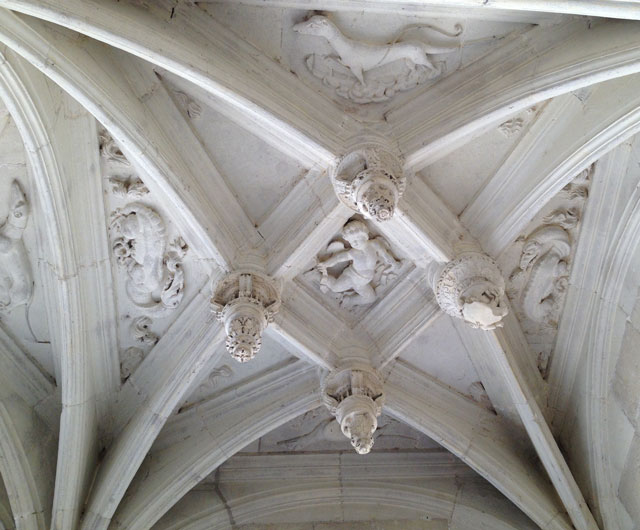
One of the ceilings over the main staircase
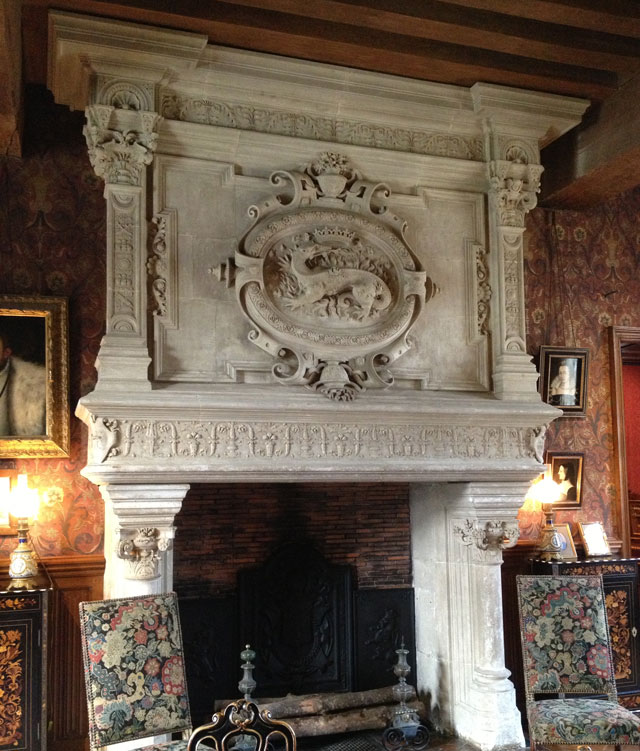
The interior of Azay-le-Rideau is more sober than most of the larger châteaux and one of its most striking features is its monumental fireplaces of which there are many different types.
One of the monumental fireplaces with François I’s emblem, the salamander
The château was abandoned after the French revolution and redecorated by the Marquis de Biencourt. In 1898, the 4th Marquis had to sell out and it was not until it was bought by the State in 1905 that renovation began.
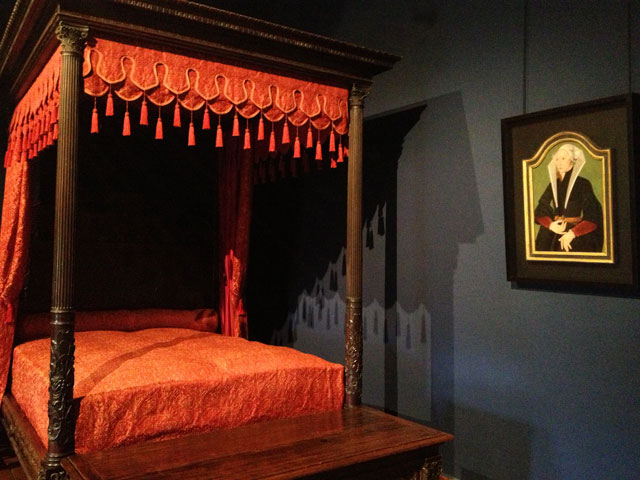
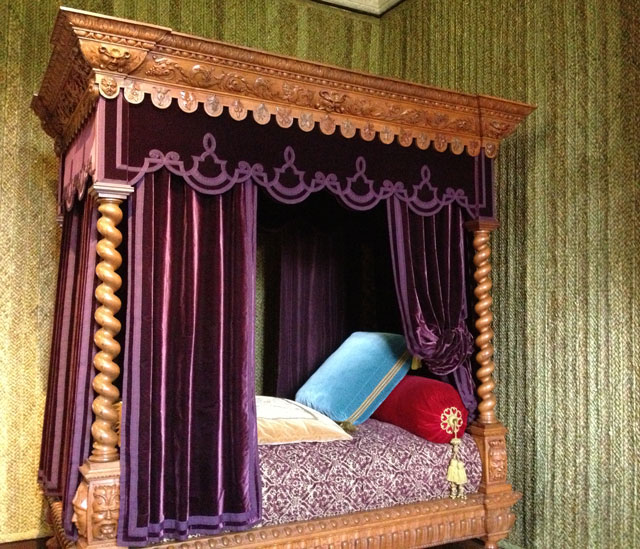
Four-poster bed in the master bedroom
Now most of the rooms are decorated in the 19th century neo-Renaissance style, but the royal apartments still have some older pieces.
Philippe Lesbahy’s bedchamber
A recent and extremely interesting addition as I mentioned in Easter Sunday in Château country, is Philippe Lesbahy’s bedroom. The beautiful neo-Renaissance four-poster bed dates from the 1840s and is sumptuously decorated. All the brightly coloured soft furnishings are copies of originals depicted in contemporary paintings. The large blue cushion, for example, is identical to that in Maître de Flore’s La Naissance de l’Amour. The trimmings are all handcrafted.
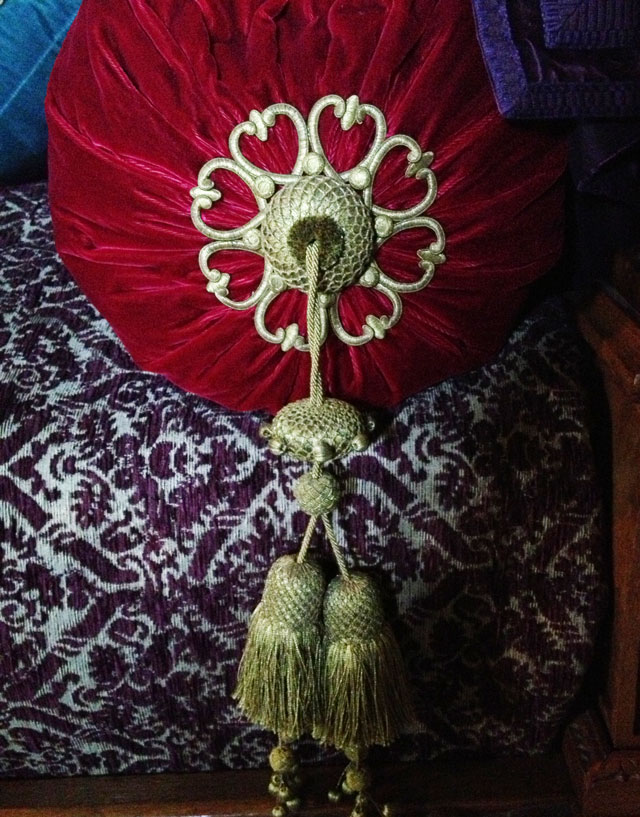
Cartisane on red velvet bolster
The extraordinary cartisane at the end of the red velvet bolster is a work of art in itself. The original can be seen in Toussaint Dubreuil’s Hyante et Climène. It alone required 58 hours of work! The feather counterpane cover is made of “oignon-skin” silk velvet and has intricate hand-made buttons.
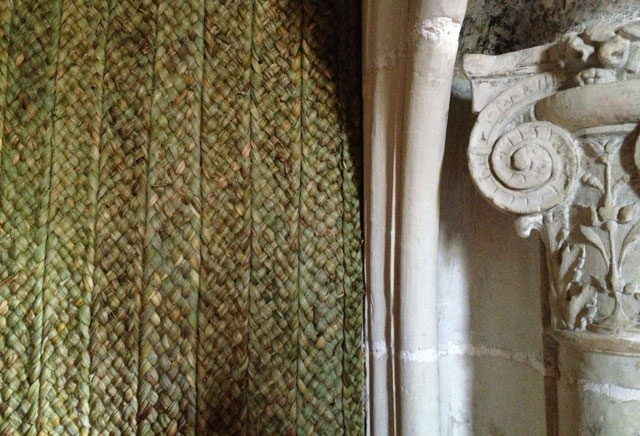
Rush matting next to monumental fireplace
The walls are covered with traditional braided rush matting very popular in France in Renaissance times because it kept the room warm in winter and cool in summer. In the painting entitled Dame au Bain in the next room, you can see herringbone rush matting in the background. No examples of rush walls have survived in France, but there is one at Hampton Court in England, which was used as a model. The hand-braided rushes were collected in Bedfordshire.
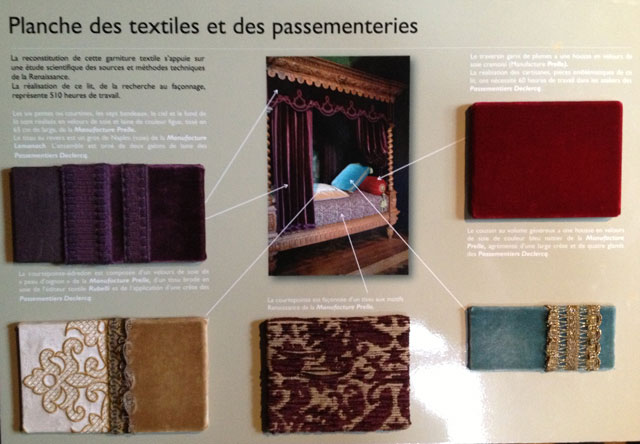
Panel showing soft furnishings
There is a fascinating and extremely informative video in the bedroom showing how all the different furnishings and matting were made as well as a panel with samples of the materials used.
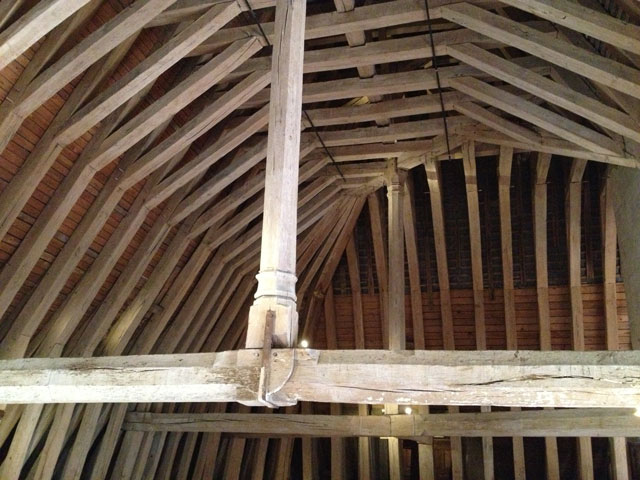
Renovated roof space
Another exhibition has been added since my last visit as well. The roof space, opened a couple of years ago after major restoration, is the most remarkable example of Renaissance master carpentry now on show.
Azay-le-Rideau reflected in the “mirror” moat
The actual location of Azay-le-Rideau contributes very largely to its charm. The natural moat forms two mirrors of water reflecting the ornately sculpted frontons and pointed roofs of the château. The lovely jardin à l’anglaise or landscaped garden is the perfect place to wander through on a fine day.
Open every day from 10 am to 5.15 from October to March, from 9.30 to 6 pm in April, May, June and September, from 9.30 to 7 pm in July and August. Closed 1st January, 1st May, 25th December. 8.50 euro + 4.50 for an audioguide.