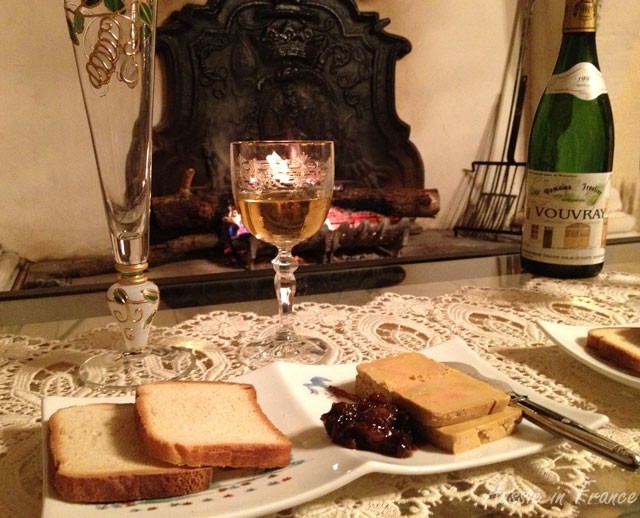
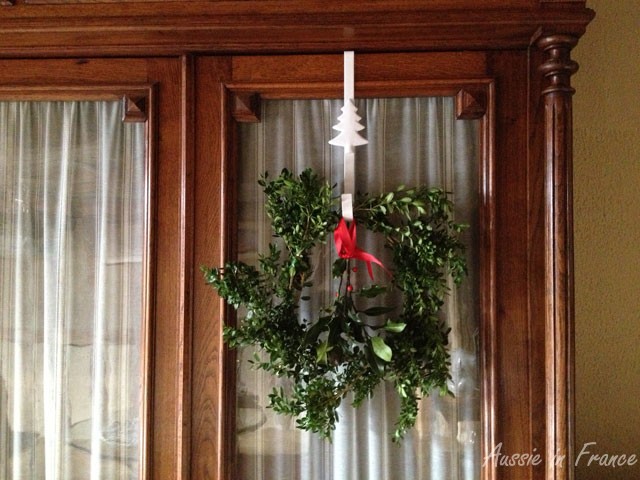
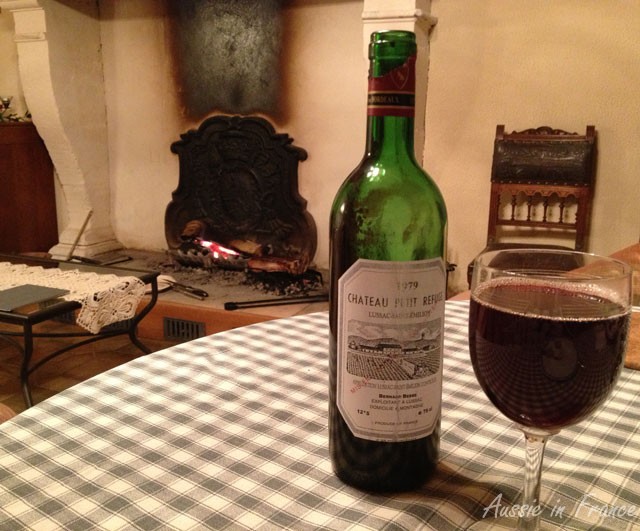
I couldn’t resist the temptation to take a look at new year’s greetings in France particularly since I overheard my father-in-law explaining the tradition of mistletoe in France to Jean Michel and it didn’t seem very clear to me so I checked it out.
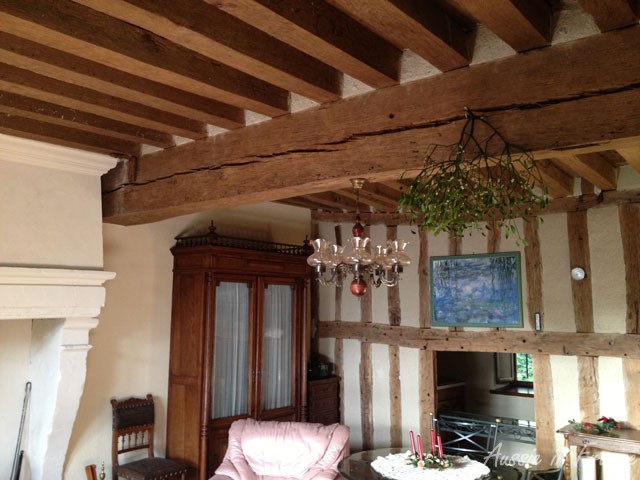
There are several different explanations but it seems that the Druids used to say o ghel an heu, meaning “may the wheat germinate”, when they cut the sacred mistletoe at the winter solstice. This seems to have gradually muted into kissing under the mistletoe at new year and saying au gui l’an neuf which is a corruption of the original Celtic expression and doesn’t have any obvious meaning on its own. I’ve never actually heard anyone say it.
Later, the expression became Bon an mal an, Dieu soit céans, i.e. good year, bad year, may God be with you. By itself bon an mal an means on average as in our expression taking one year with the other. Bon an mal an, l’immigration se maintient au Québec = Immigration in Quebec is about the same each year.
Nowadays the most common new year expression is bonne année ou bonne et heureuse année often followed by et la santé surtout as you get older and health becomes more of an issue. You wish people bonne année the first time you see them throughout the month of January. You can also say meilleurs vœux (best wishes), je vous souhaite une excellente année 2014 (I wish you an excellent 2014), que vos vœux les plus chers se réalisent (may your dearest wishes come true). Santé, joie and bonheur (health, joy and happiness) are usually in there somewhere as well. Jean Michel’s favourite is Bonne année et bonne santé physique et morale. He says that way he’s covered everything.
Note that you don’t say nouvel an except when you’re referring to new year’s eve or new year’s day e.g. je vous verrai au nouvel an : I’ll see you at New Year or nous avons fêté la nouvelle année en famille : we celebrated new year at home. A new year card is une carte de nouvel an or une carte du nouvel an but it’s probably more correct to say une carte de vœux de/du nouvel an. You don’t see them much any more but when I moved to France in 1975, people used to send tiny cards about half the size of a normal envelope.
Something I find interesting is that Jean Michel never bothers to contact his family at Christmas but makes sure that he talks to everyone on New Year’s day. For me and my Australian family, it’s quite the opposite. Christmas is more important.
And there is an unwritten rule that the younger members call the older members first. As Jean Michel’s the oldest, he only has to call his father.When I sent messages to both my children at midnight on New Year’s Eve this year, he was quite surprised that I didn’t wait until they contacted me.
Today the galette des rois or kings’ cake is probably the greatest symbol of the new year in France. A galette was originally a buckwheat pancake from the country of the Gauls (Gallois) and by extension any thick, flat cake or biscuit. I’ve described the tradition of the galette des rois in another post. Today I’m only looking at the linguistic aspect.
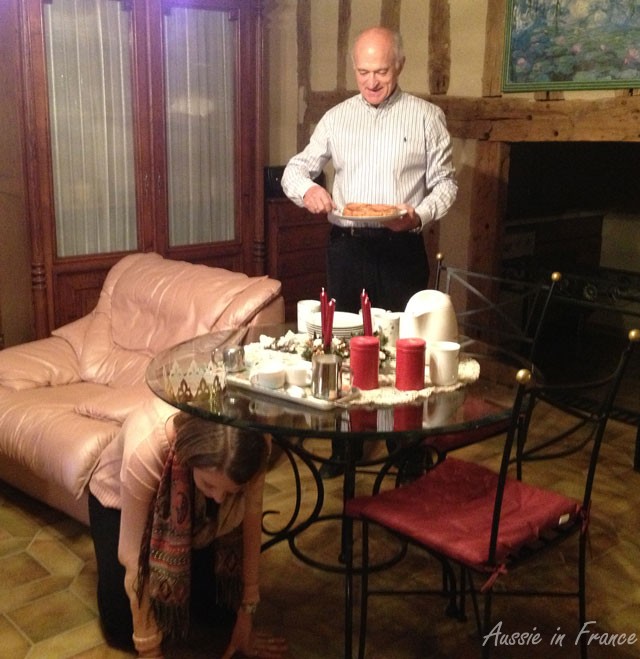
A popular expression connected with the galette des rois is tirer les rois. Tirer means to draw stakes, so tirer les rois means that people are going to share a galette and see who gets the token or fève inside.
But each region of France is different so you may know of other new year traditions.
 This post is a contribution to Lou Messugo’s All About France link-up. Feel free to pop over and have a look at the other posts this month by clicking here.

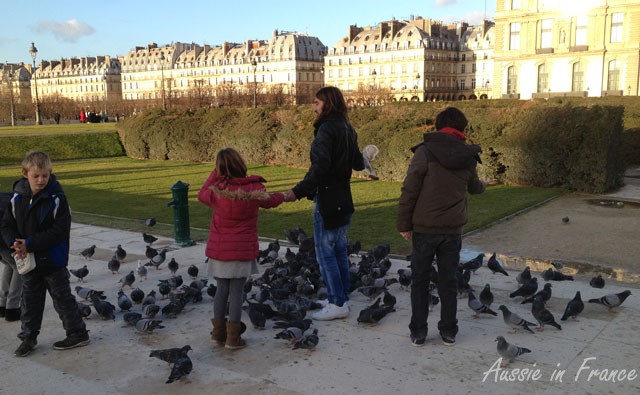
For this week’s Blogger Round-Up, I have two posts related to Christmas and one from a new member of the blogosphere on Budapest. Phoebe from Lou Messugo explains the do’s and don’t’s of wishing people a merry Christmas and happy new year in France while Susan from Days on the Claise takes us to the last market before Christmas – but it’s not too late because the same scenario will be repeated for New Year. Our new blogger is Anda from Travel Notes and Beyond whom you have already seen in one of my earlier posts. You’ll love her suggestions for authentic restaurants in Budapest. Enjoy!
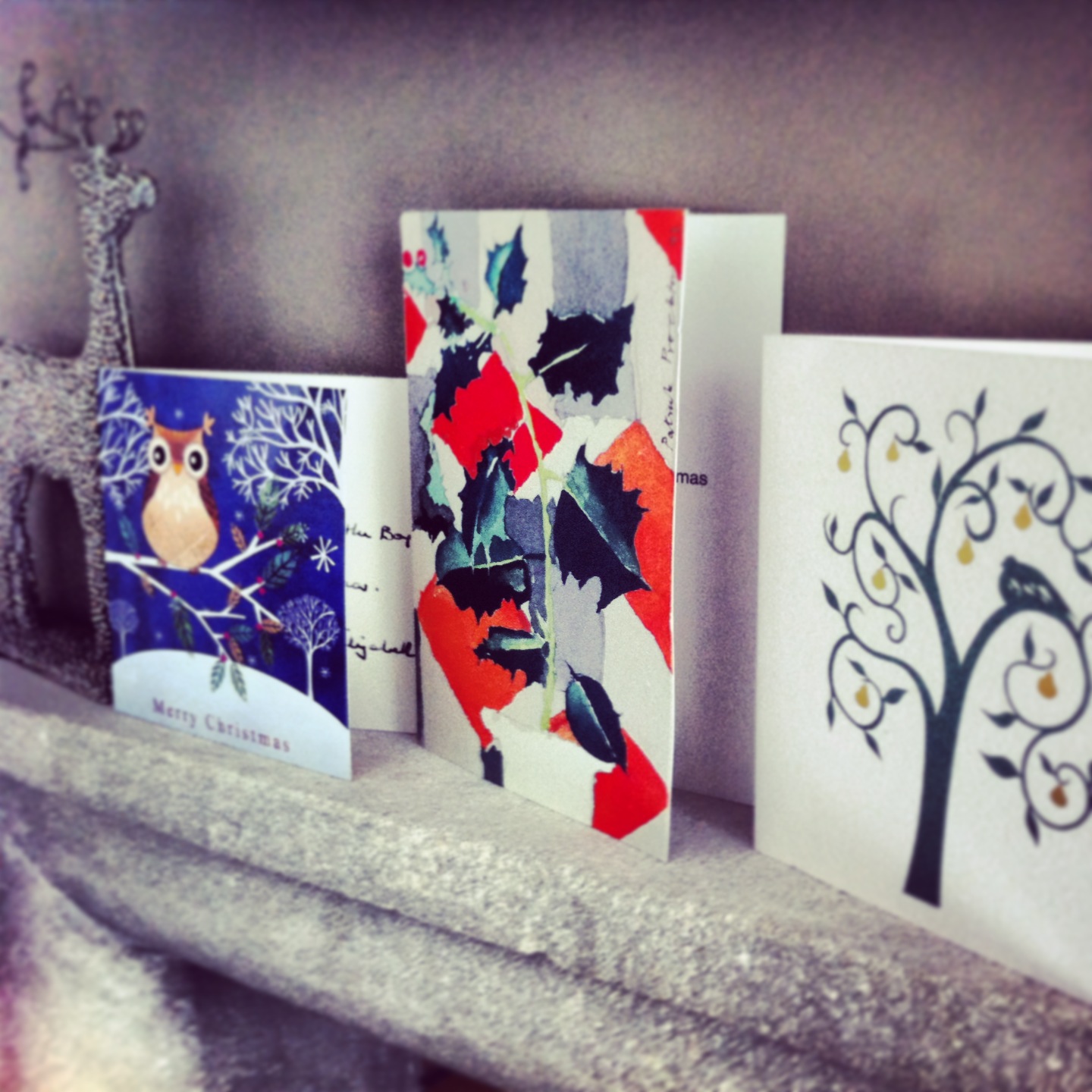 It’s the build-up to Christmas and every time I see someone I won’t see again until after the new year I wish them a Merry Christmas and Happy New Year…if I’m speaking in English to a non-French friend. However, if it’s in French to a French friend then it’s a more generalised greeting “bonnes fêtes de fin d’année” which means happy end of year celebrations and is more like the American “Happy Holidays”. I could say “joyeux noël” (happy Christmas) though it’s less common but I mustn’t wish them a Happy New Year. It’s considered bad luck to wish Happy New Year before midnight on the 31st. Read more
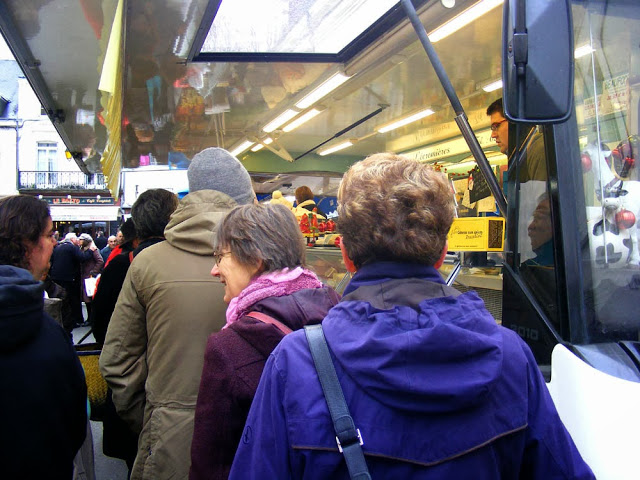 Saturday was the last market day in Loches before Christmas. I took a few pictures to try and give a sense of market shopping, but to be honest, it isn’t easy to take photos and shop at the same time.
Standing in line at the cheese stall. Note the pair in the background exchanging the standard cheek kisses in greeting. The cheese stall had twice as many staff as usual and there was still a queue, so they were doing good business. Read more
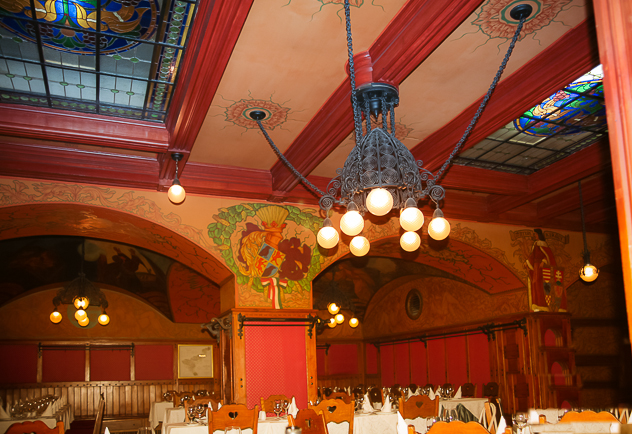 Budapest is not short of good restaurants, cafés, and bistros, but finding real authentic ones that are also a good value for your money is not easy. As in any big city with a plethora of choices, visitors get confused by the internet reviews and recommendations, often sponsored by the restaurants themselves. Like many others ahead of me, I had my fair share of disappointments and paid my price for the knowledge I gained in this field. Below is my list of recommendations, based on what I feel makes a good value restaurant. Read more
Apparently fried onion rings are an important part of Thanksgiving in America but most people buy them in cans which I can’t even begin to imagine. It would be like buying tinned battered fish surely. But I checked it out on the Internet and would you believe it, one of the popular brands is called French’s and they are called French fried onions which I have never seen in France …

I got the Thanksgiving information from the Bread is Pain Food blog but more importantly, I also learnt how to make them. Now in the past, this is not the sort of thing I would have even thought about making because of the calories. However, now that we practise intermittent fasting, I don’t have any qualms.
I want to give Jean Michel a surprise which is easier in a large house than in an apartment. He’s in the workshop trying to flush out the sludge from our in-floor heating system which has not been working very well this winter.
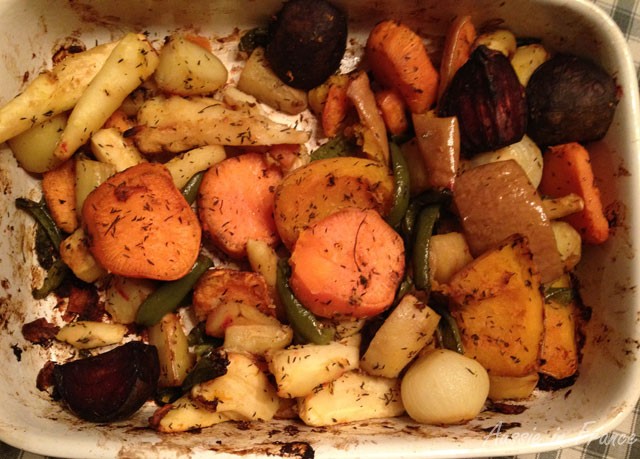
I’ve already prepared the baked vegetables – potatoes, sweet potatoes, sliced green pepper, parsnips, butternut pumpkin and beetroot. Yes, beetroot, bought raw and baked. I’d never heard of it until I had lunch at Susan and Simon’s from Days on the Claise. Delicious.
I’ve sliced the onion (you only need one for two people) and beaten the egg yolk and milk together in a soup plate. Bread is Pain’s recipe helpfully says “a little milk” so I put the equivalent of an egg yolk. I’ve put flour in another plate.
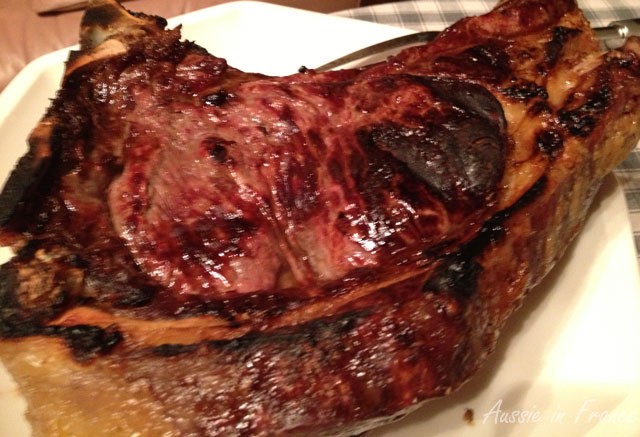
As soon as I hear Jean Michel raking the embers in the fireplace upstairs in order to grill the côte de bœuf, I put a centimeter of oil in a deep frypan (sauteuse) and turn on the heat. I dip the onions in the egg mixture and then roll them in flour after which I put everything in a zip lock bag and shake to get rid of any surplus flour as per Bread in Pain’s recipe.
When the oil is hot (I test with a small onion ring to see if it sizzles), I add a layer of rings to the pan. I turn them over and start to get a bit worried. They do not look like the photo in the recipe. I turn them again and lo and behold, they are starting to be golden. I had turned them too soon.
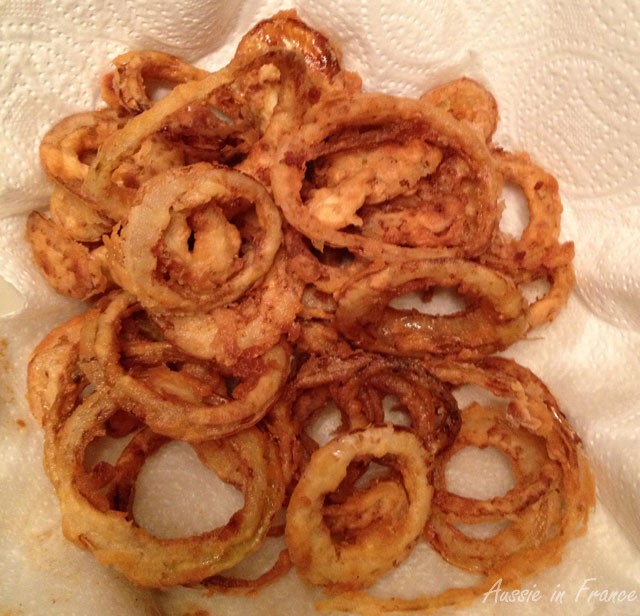
I scoop them all out when they’re done and put them on a paper towel then proceed with the next batch. This time, I am more expert. I try one. Out of this world! When they are all done, I take them triumphantly upstairs to an amazed Jean Michel. He doesn’t know they are onions and it takes him a couple to identify what they are!
I had thought they would be a bit greasy and heavy but they’re not. The taste is actually quite delicate. I’m going to make them for Christmas and stun the kids as well.
I love the 5:2 fast diet!
With Christmas approaching, the theme for this week’s Blogger Round-Up was easy to find! Phoebe from Lou Messugo takes us to the Provençal village of Lucéram famous for its Christmas cribs, while Carolyn from Holidays to Europe introduces us to various European Christmas foods; meanwhile Mary Kay from Out and About in Paris explains why the lights on the Christmas tree in front of Notre Dame are vertical. Enjoy!
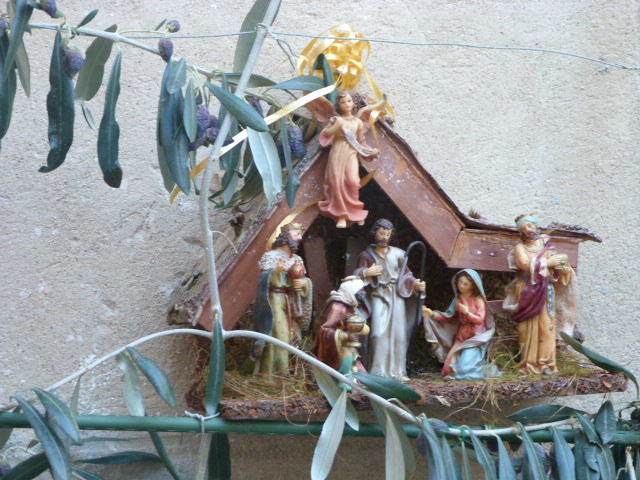 In our quest to get into the Christmas spirit, we recently spent a day in Lucéram, a pretty medieval hill village north of Nice and less than an hour from Lou Messugo. Why? Because it comes alive in December with its “Circuit des Crèches”. Literally every tiny alley, every balcony, every doorway and every nook and cranny is decorated with pine branches, red and gold ribbons, and nativity scenes in every conceivable shape and size. These scenes (the creches) are made out of wood, paper, glass, pinecones, traditional santons (earthenware figurines), clothes pegs, matches, wool, twigs and even bread. They come in every size from minute tucked into holes in the wall to a 10m long replica of the village and everything in between. Even the village’s numerous fountains and old wash-houses are all decked out with their own floating creches. Read more
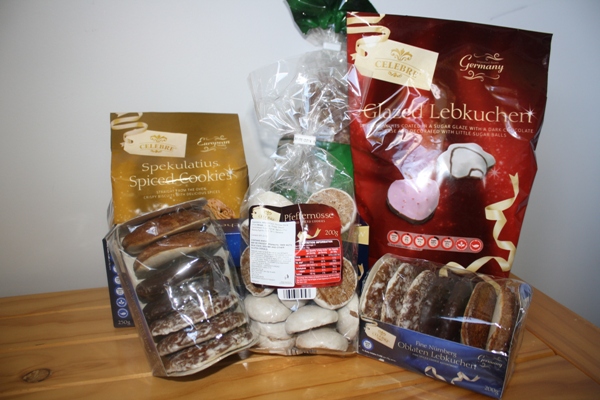 The lead up to Christmas can be one of the best times to travel to Europe, not only to visit the amazing Christmas Markets that are held each year but also to sample the delicious food that plays a big part in the festivities.
Marrying into a German family many years ago, I’m now well accustomed to some of the German Christmas treats and I always look forward to indulging in my favourites when the festive season comes around. Read more
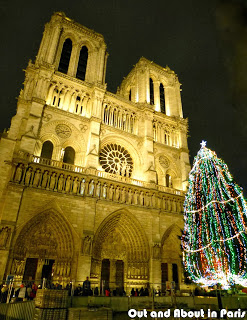 For a bi-cultural couple, celebrating Christmas and other holidays can be liking walking through a cultural minefield. Christmas stockings, decorations and traditional foods can all provoke heated debates. If your spouse is from Switzerland, he may claim that Baby Jesus delivers presents to the good little girls and boys around the world when you know for a fact that it’s a jolly man dressed in a red suit. As an American, I find it somewhat hard to believe that a tiny baby could handle the stress of landing a sleigh on a steep Parisian rooftop without bursting into tears. After all, Santa has a hard enough time maneuvering through the city traffic, and he’s a robust man accustomed to managing an entire village of elves. Read more
Now I bet most of you don’t know what this post is about. Père de famille, you say, “father of the family”? Don’t all fathers have families? And why not mère de famille? Aren’t père and mère enough?
Well, there is an added meaning. Of course. Un père de famille ne doit pas prendre de risques means that a man who has a wife and family to think about shouldn’t be taking any risks. We could say a family man as well in English. Une mère de famille pense toujours à ses enfants. Funny, but we don’t say a “family woman”. I can think of a “woman with a family” or maybe “a wife and mother” and even “housewife” in some contexts. You may have other suggestions.
But that’s not really what I want to talk about. Believe it or not, père de famille and more specifically, bon père de famille, is also a financial term, which always amuses me.
Yesterday, I came across it when I was translating a takeover bid: gestion de la Société en bon père de famille. “Management of the company like a good family man” would be a literal translation but you certainly wouldn’t find it in a contract! I decided on “good, safe management of the Company”.
The expression often goes hand-in-hand with investment: placement de père de famille is what we call a gilt-edged or safe investment. Valeurs de père de famille are gilt-edged or blue-chip securities.
The masculinity of the expression is not surprising – French women were kept out of money matters for a very, very long time. It was not until 1965 that women no longer needed their husband’s consent to choose their own profession or open a bank account. Astonishing, isn’t it?
And it was much later – only I can’t find the date – that women were finally entitled to see and sign the family’s tax declaration. Up until then, the husband en bon père de famille, n’est-ce pas declared both his and his wife’s revenue and could refuse to even show her the declaration!
Women were given voting rights in New Zealand in 1893, in Australia in 1902, in the UK in 1918 (but you had to be 30, equal suffrage only came in 1928) and in the US in 1919 (though women could vote in Wyoming as early as 1868) while French women finally voted in 1944. Enough said.
We’re debating about a day trip from Sofia to Rila Monastery because it’s a 2 to 2 ½ hour bus trip each way (120 K) but various friends have encouraged us to go and the photos are certainly encouraging. It’s also a World Heritage site. We also want to go to Boyana Church in the suburbs of Sofia. After a search on the Internet I find a company called Traventuria offering a day trip including both destinations for 25 euro per person, which is an attractive price. I check out Trip Advisor and the fact that the coach drivers are reputed to be careful cinches it for me.
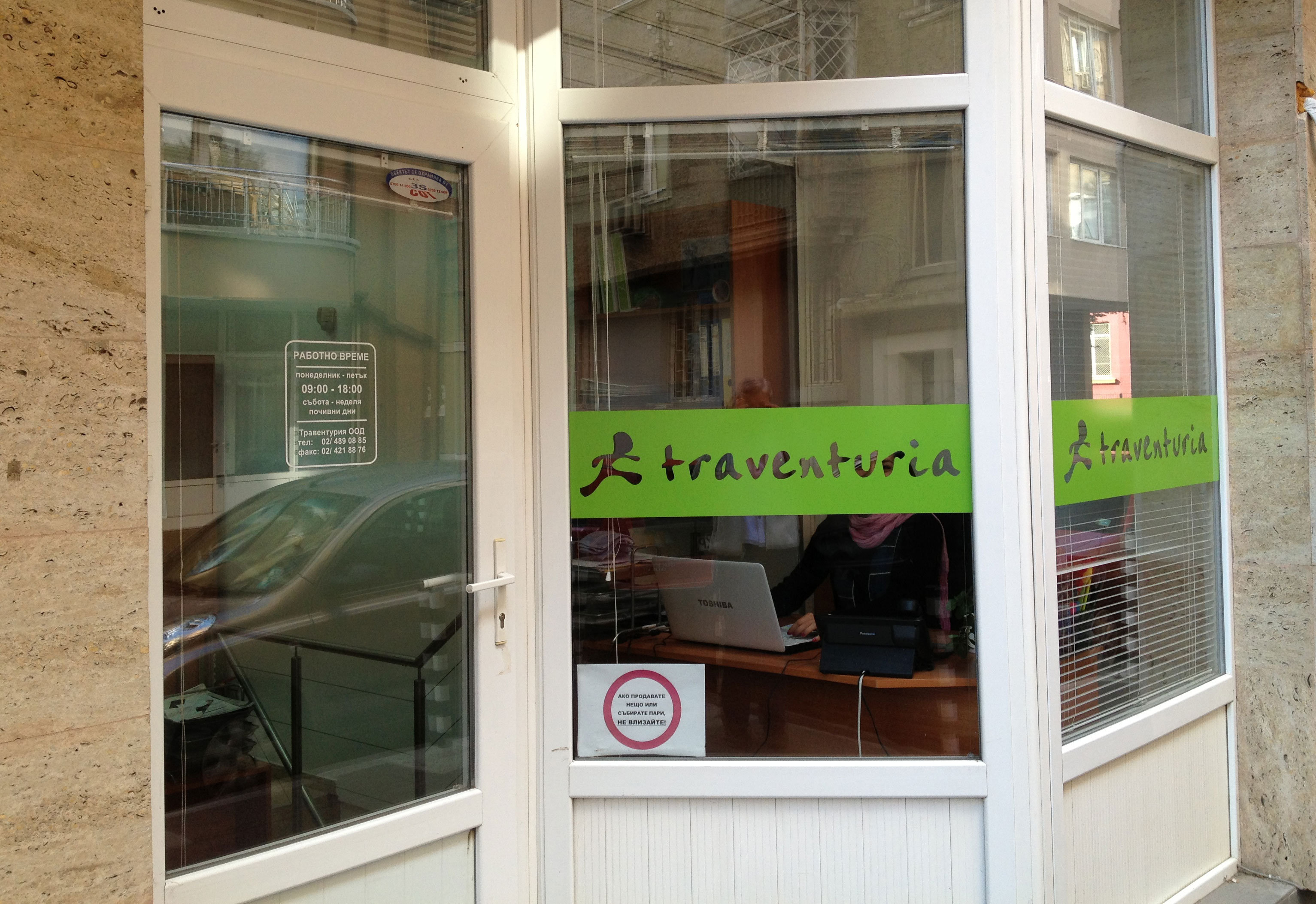
As I start booking, I notice the address at the bottom of the screen. Unbelievably, it’s the same address as ours – their office is on the ground floor of our home exchange building in Veslets Street. We decide to go and pay in cash next morning. The girl is very friendly, speaks excellent English and even gives us an aluminium water bottle each.
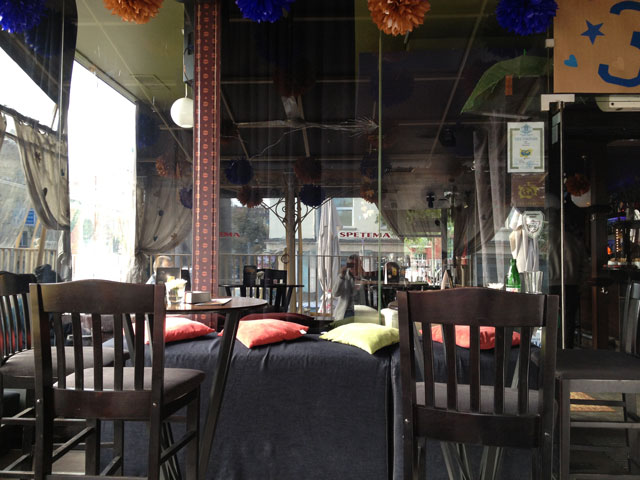
We set off at 8.15 to be well in time for our 9 am rendez-vous behind Nevski Cathedral. Sofia is quite different at that hour, we discover, with everyone hurrying to work. We have time for a coffee at a trendy bar called Spetema just opposite the university.
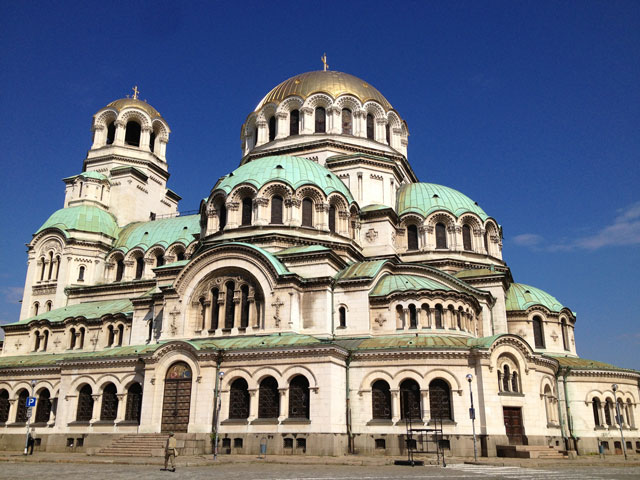
Our 12-seater mini-bus pulls up on time but we wait for a couple of people who never come and finally move off at 9.15 am. There are eight of us altogether. Our young guide tells us the programme: a two-hour drive with a ten-minute rest-stop on the way, two hours at Rila, then back towards Sofia and Boyana where we stop for half an hour. We’ll be back in Sofia by 5 pm.
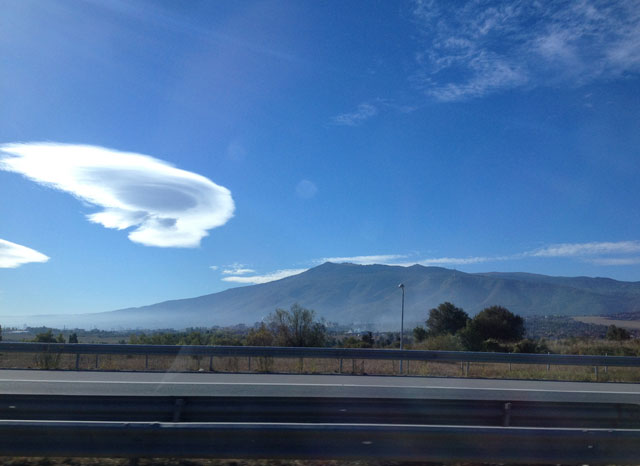
We’re soon on a recent 4-lane highway going at a reasonable pace. I’m reassured. The countryside looks surprisingly like Australia, minus the gum trees. There is little agriculture and only a few weedy looking cows. The cloud formation is quite unique. Jean Michel says there must be a lot of wind. The sky is a deep blue.
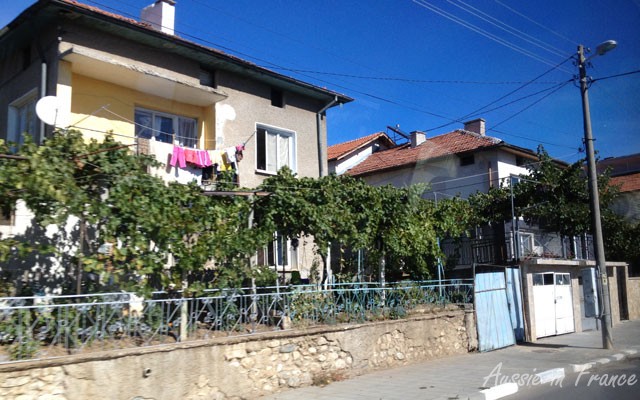
After our rest-stop, we soon turn left and begin circumnavigating Rila Mountain, before making the ascent. I’m amazed at how many houses in the villages have grape vines. The monastery is 1147 metres above ground level (the highest peak on Rila is 2925 metres). We go through mountain forest most of the time. The driver is going quite slowly and I’m not afraid.
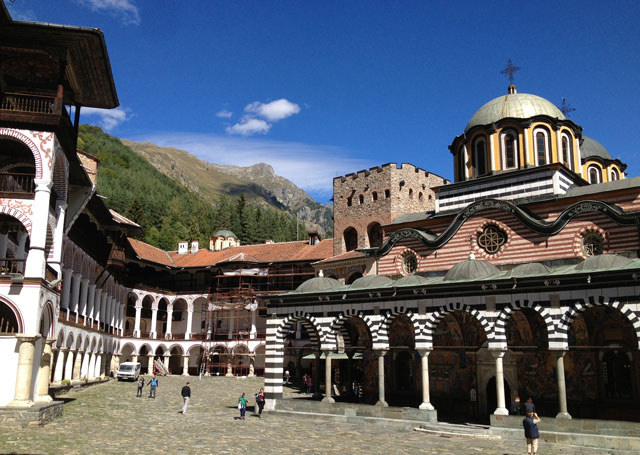
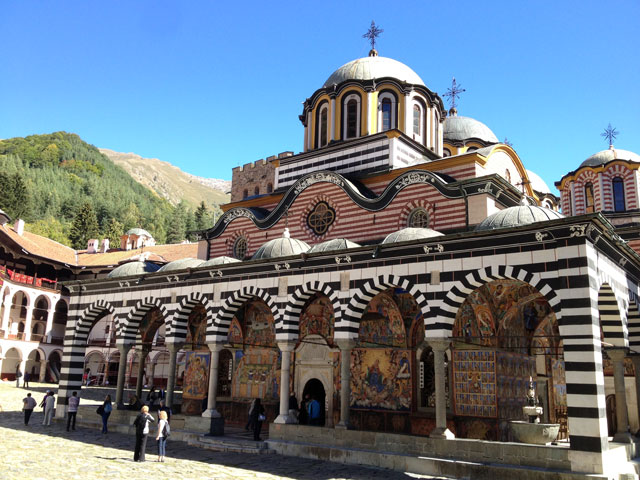
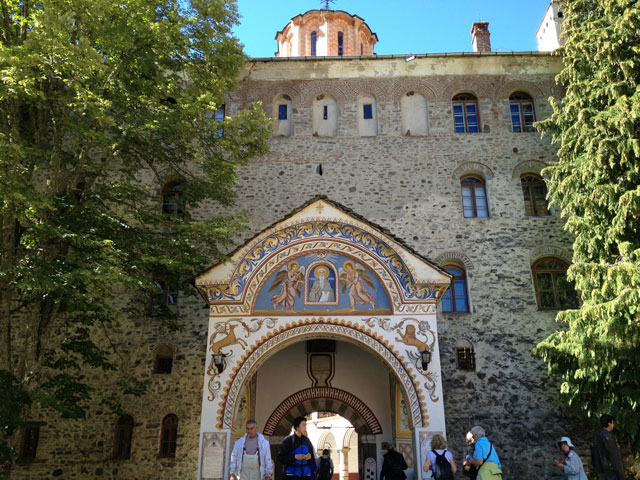
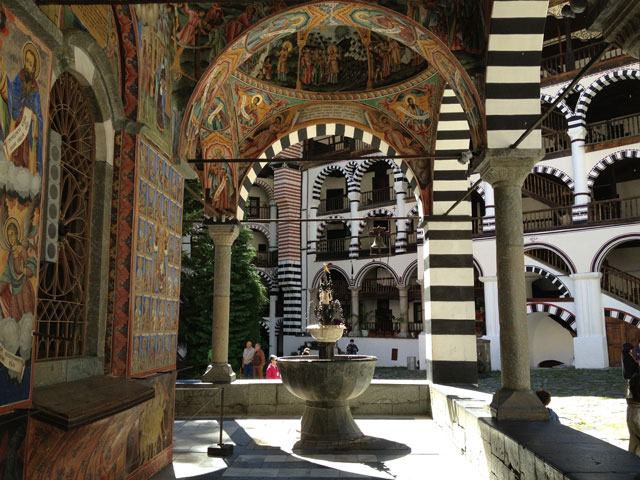
At the top, he pulls up and we get out. The initial impression is quite fabulous and we are not disappointed with the rest of our visit. We expected more people, but are pleasantly surprised to see that if we wait long enough, we can take photos without tourists in brightly coloured clothing taking photos of each other.
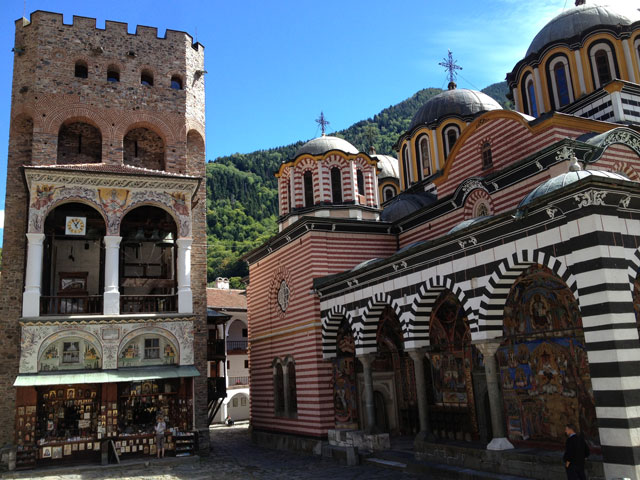
Jean Michel finds a booklet in French and we track down all the things to see because it’s a bit tedious to translate my audio-guide. Rila was founded in the 10th century by the hermit St John of Rila. It was destroyed by fire in the 19th century and rebuilt between 1834 and 1862 and is a characteristic example of the Bulgarian Renaissance (18th-19th centuries), symbolising the awareness of a Slavic cultural identity following centuries of occupation.
At the end of our visit, there are still three things on the list we haven’t seen, one in the koprivchtitsa room, one in the priory and the other in the tower chapel. We ask in the religious shop and are told to inquire at the museum which we have already visited and contains the most fabulous carved cross I’ve ever seen (81 x 43 cm) by a monk called Rafail, with 104 religious scenes and 650 miniature figures and 12 years in the making. Hardly surprising that Rafail lost his sight in the process. No photographs allowed however.
First, we are told no, then the lady at the cash desk picks up her phone, puts it down again and says “30 minutes”. By that time our mini-bus will have left. Disappointed we didn’t ask earlier, we go and wait for our bus which soon appears.
One and a half hours later, our guide tells us we are nearing Boyana Church and that two large coach-loads are expected. If we want to get in before them (only 12 people are allowed in the church at a time for a maximum of 15 minutes), we have to hurry. He collects our entrance fee (10 lev per person) and when we arrive, he buys our tickets and takes us down to the little church.
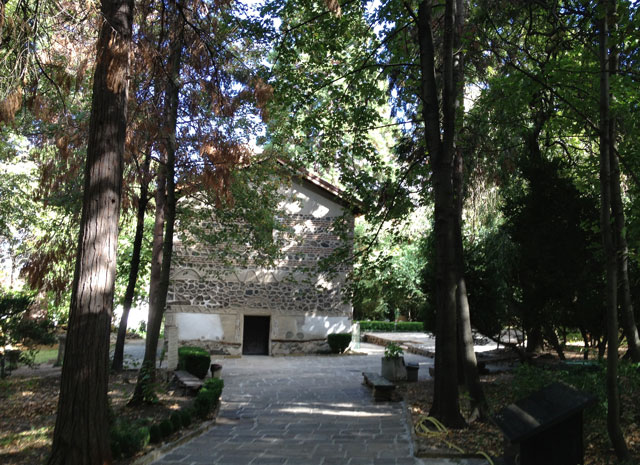
There are three churches, each joining onto the other, built in the 10th to 11th, 13th and early 19th centuries. The frescoes are all from the 14th century. To quote a UNESCO review of this World Heritage site, those painted in 1259 “possess a rare freedom, realism, harmony in the proportions, liveliness and warmth that already foresaw the birth of the Italian Renaissance. The site is one of the most complete and perfectly preserved monuments of east European mediaeval art.”
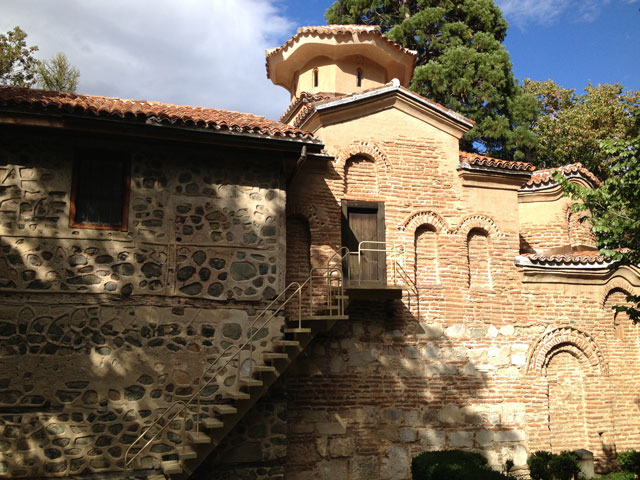
The faces are extremely expressive and the figures include Sebastocrator Kaloyan and his wife Desislava who commissioned the 13th century extension and the frescoes. Our party didn’t choose a guided visit, but I definitely recommend you to do so. As usual, photos of the interior were not allowed, but the website Pravoslavieto has excellent illustrations and descriptions.
This is definitely our best day in Bulgaria so far.
Traventuria Ltd., 45 Veslets Str., 1202 Sofia, BULGARIA, 0035924890884 (Monday – Friday, 08:30 – 16:30 CET), Fax: 0035924917352, www.traventuria.com, info@traventuria.com If you have enjoyed reading this, don’t forget to subscribe to new posts using the subscription form on the top right – that way you’ll get them directly on your smart phone or in your mail box! And I love to hear your comments!I’ve showcased three Australian blogs on this Wednesday’s Bloggers’ Round-up. Susan from Days on the Claise explains about stinky French cheese, while Kathy from Femmes Francophiles recounts a very exciting experience in Provence. Carolyn from Holidays to Europe takes us on a brief tour of the beautiful region of Alsace. Enjoy!
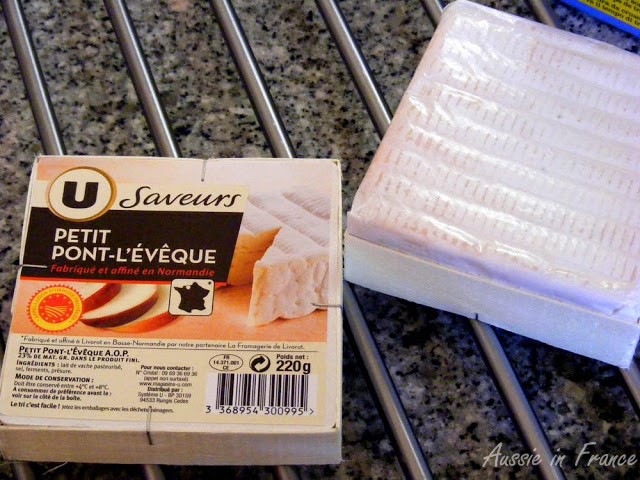 France is famous for its cheese, and quite a few French cheeses are distinctly aromatic. One of the stinkiest comes from the area between Deauville and Lisieux in Lower Normandy. Simon loves to tell people the story of us spending Christmas in the area and taking a block of the local Pont l’Eveque cheese home on Eurostar.
The other day he announced that the fridge smelled, as if there was stinky cheese in there, but he couldn’t see the source of the aroma and was mystified. Read more
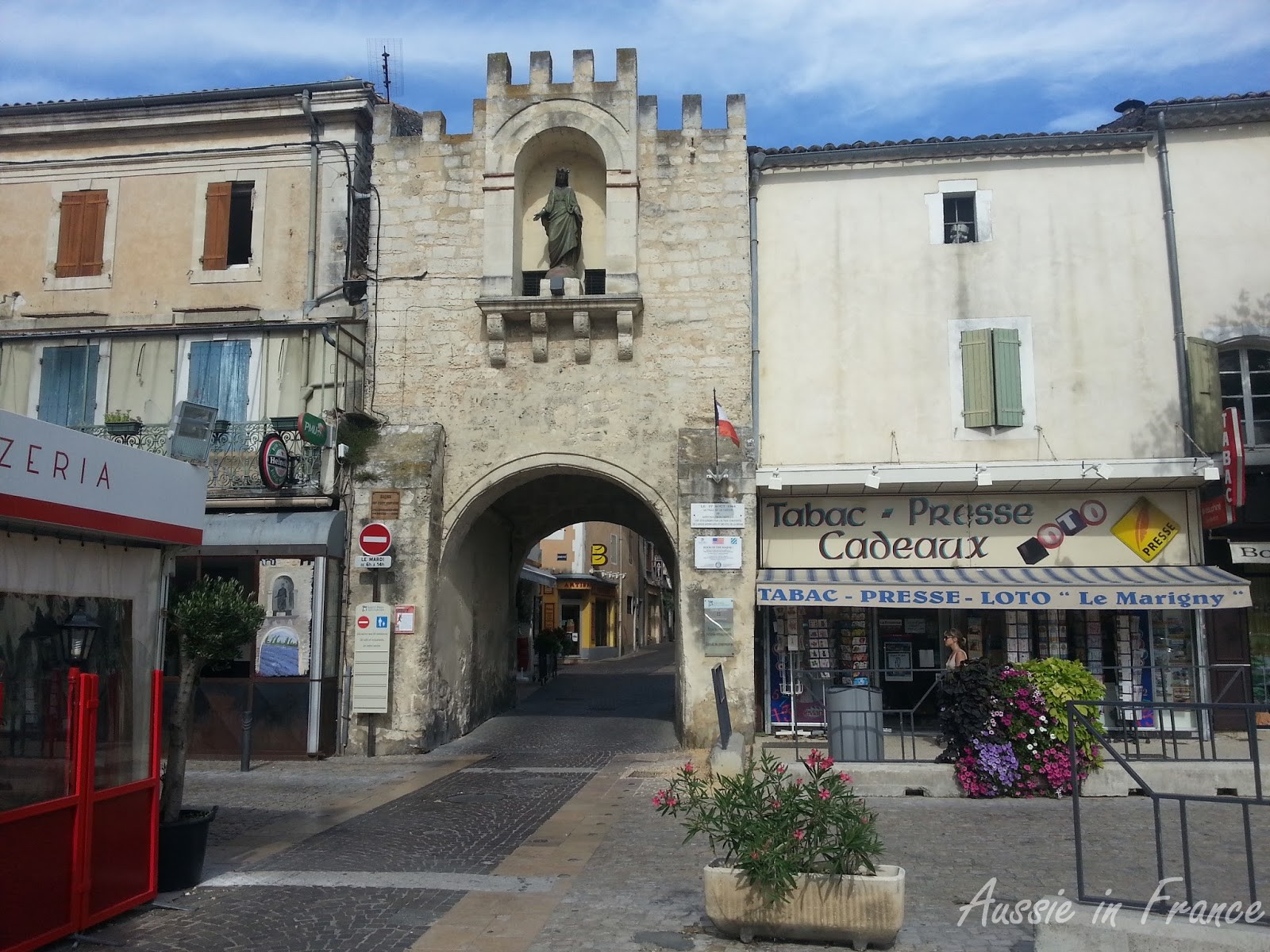 Last week I returned to Catherine’s large home near the village of Sarrians in Provence having spent a week in her Paris apartment. I met Catherine earlier this year to arrange a home exchange in 2014. I consider myself extremely fortunate to house and cat sit for her for her. Catherine picked me up from the very modern Avignon TGV station which reminds me more of an airport than a railway station.
We drove directly to the village of Saint-Paul-Trois-Châteaux where she had an appointment. I was looking forward to exploring the village’s picturesque historic centre. Read more
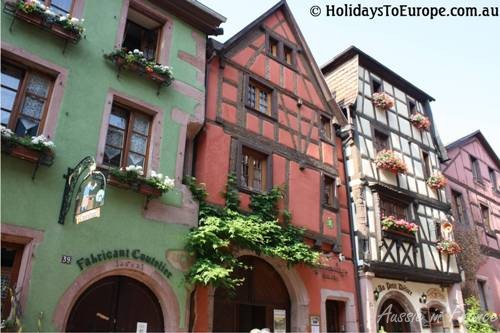 Lakes or mountains (and often both) are usually essential reasons that make me fall in love with a town or region and include it on my ‘absolute favourites’ list. On my most recent trip to the UK and Europe, however, two regions without either a significant lake or mountain have knocked me for six and stolen my heart. The first region is the Cotswolds in England and the second, France’s stunning Alsace region. Read more
I didn’t realise when I started looking for a home exchange in Barcelona that Paris might not be a peak time from people used to a warmer climate – particularly since our main motivation for going to Spain in February was to get away from the grey skies and cold of Paris! Home exchanges can be either simultaneous or non-simultaneous, depending on various factors. Considering the other home exchanges we were planning this year, a non-simultaneous exchange didn’t seem possible. However, I shall take this factor into account in the future.
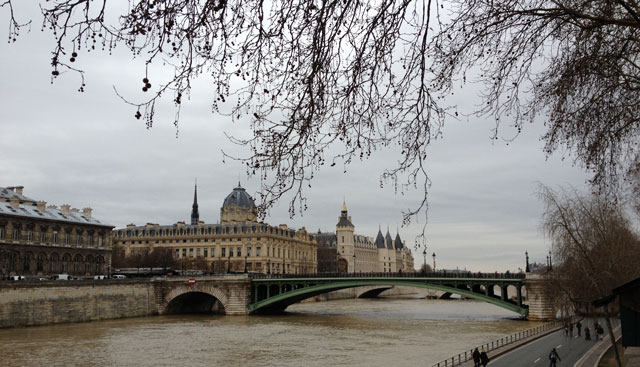
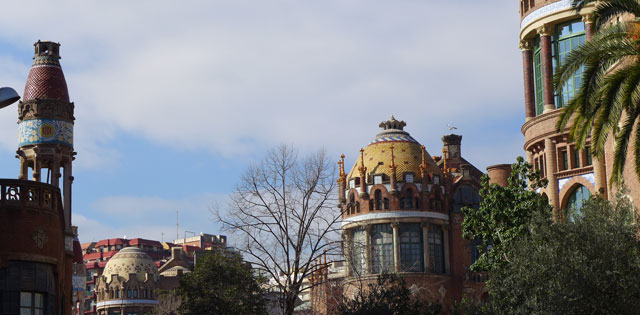
I received several refusals but Pep, who lives outside Barcelona and has a one-bedroom flat near Sant Pau Hospital and the Sagrada Familia, fortunately agreed to the swap, although he wasn’t sure until the last minute that he would be able to come to Paris and then, it was only for 2 nights as opposed to our 6 nights. Having a second home definitely makes it easier to juggle with dates.
When Pep saw our listing, he immediately said that his flat was “modesto”. It’s true that we usually try to find equivalent accommodation, but the most important thing is that it is comfortable and clean and has an internet connection. That was certainly the case and we felt very welcome. We weren’t intending to do any cooking so not having a dish washer was not a problem, for example. When we stayed with my brother, sister-in-law, 3 kids and my son in a home exchange on the Gold Coast in Australia, it was a necessity!
When we arrived, Pep was waiting for us with a French-speaking friend in case we had difficulties communicating. But Pep’s French is more than adequate. He told us his favourite places to wander around and where to have pintxos. He also said that the neighbourhood eating places weren’t very interesting although we had a very “local” experience one evening in the bar opposite when we didn’t feel like going into the centre. It’s true that the food wasn’t anything special, but it was certainly authentic and the staff were extremely friendly and helpful. The ambiance more than made up for the quality.
The only drawback was the distance from the centre but, as I mentioned in previous post, Jean Michel worked out the buses and we probably got to see more of the city than we would have otherwise. Since we had 6 nights, it was not really a problem but for a shorter period it would have been less convenient.

Pep reached our appartment in Paris without mishap and was able to take the key from our code box next to the front door. These boxes are common pratice in Australia, but little known in Europe, although you can buy them in France without difficulty. It’s absolutely impossible to open the box without the code. Even if you managed to pull the box off the wall you still wouldn’t be able to get into the box. We find it’s a perfect solution.
When we were preparing for our holiday, I tweeted about off-the-beaten track places to visit in Barcelona and received an answer from Roser who lives in Barcelona and works for www.intercambiocasas.com, the Spanish version of the www.homeexchange.com website I use, inviting us to meet up for a coffee. I was delighted!
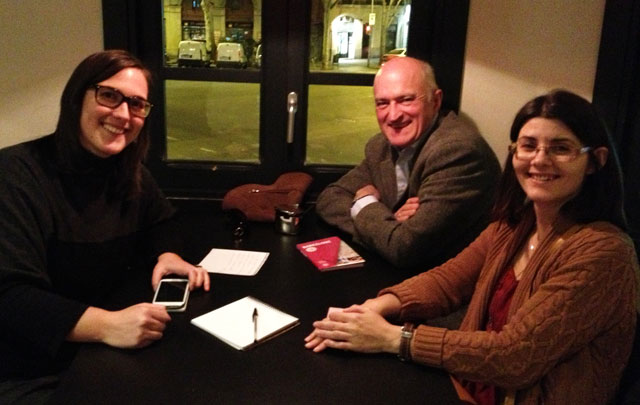
The very dynamic Roser came along with her blogger friend Isabel (http://www.diariodeabordoblog.com), about to embark of her first home exchange. We were able to ask all the questions that had been building up about Catalan and Barcelona over the previous few days and since Roser speaks excellent English and French, Jean Michel was able to launch a very interesting discussion about Catalan independence. Roser also has a blog (http://www.sempreviaggiando.com).
Roser and Isabel gave us lots of suggestions for places to eat but we ran out of days before we could use them all! Roser is also very interested in improving the website and service of homeexchange.com so would love to have feedback. In particular, she would like to know what is the most important thing when looking for a home exchange – location, size of the home, nearby attractions, etc.
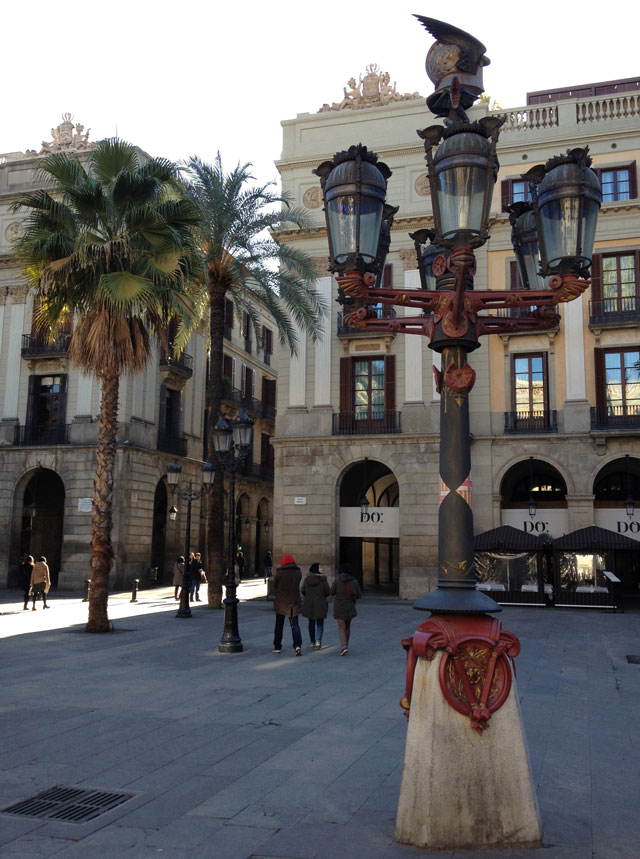
The day before we left Barcelona, we were sitting outside at a terrace café in Plaça Reial admiring Gaudi’s lampposts when I received a message from Pep who had just got back from Paris, suggesting we have a coffee. We were soon able to exchange our impressions of Barcelona and Paris and talk about what we’d be doing in our respective cities. Pep had enjoyed being right in the centre of Paris even though he found it a little cold!
Now we’re busy organising our next set of home exchanges – one in France in May then a series in Germany, Austria and Hungary for June/July as we’re going to cycle along the Danube. It’s proving a little difficult to find people outside large cities who are interested in coming to Paris, where we can only provide accommodation for two people. So if anyone has a two-person swap in Ulm and Linz, let me know!
