Cycling in Germany #17 – Windmills and Dykes

Windmills and dykes, I can hear you saying. Aren’t they Dutch? Well, we are in the north-east of Germany, near the North Sea, in East Friesland in Lower Saxony which is only separated from the Netherlands by a small stretch of water. From what I gather, the Dutch province of Friesland and the German province were both occupied by the Frisians until the 15th century.
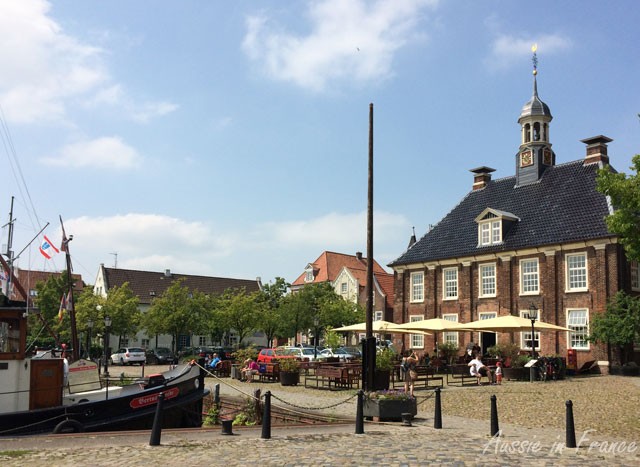
The Waage und Börse in Leer

Day 1Bremen to Norden takes about 2 hours so we’ve scheduled lunch at  Leer. There’s a photo on the cycling map of a restaurant called Zur Waage und Börse in front of the town’s most historical building, the Waage, which my dictionary says means “scales” so I guess it’s a weighing station. We have an excellent dish of plaice which I learn is Scholle, which is going to be a useful word because it is the local dish.
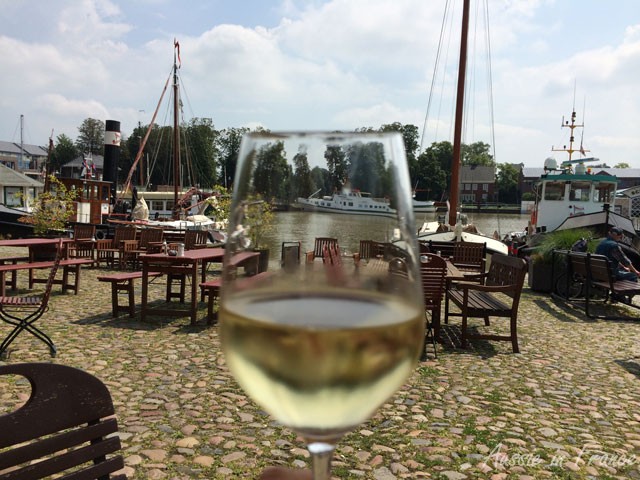
Lunch in Leer
Lunch view in Leer

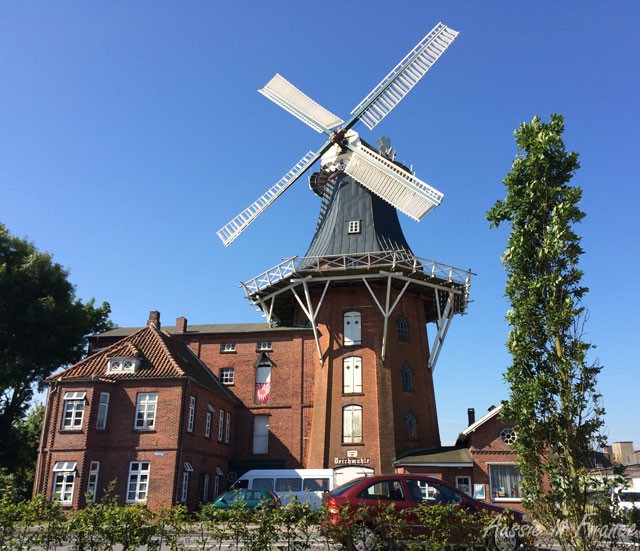
When we arrive in Norden, the first thing we see are two windmills, on either side of a shopping centre. We buy supplies for our evening picnic.
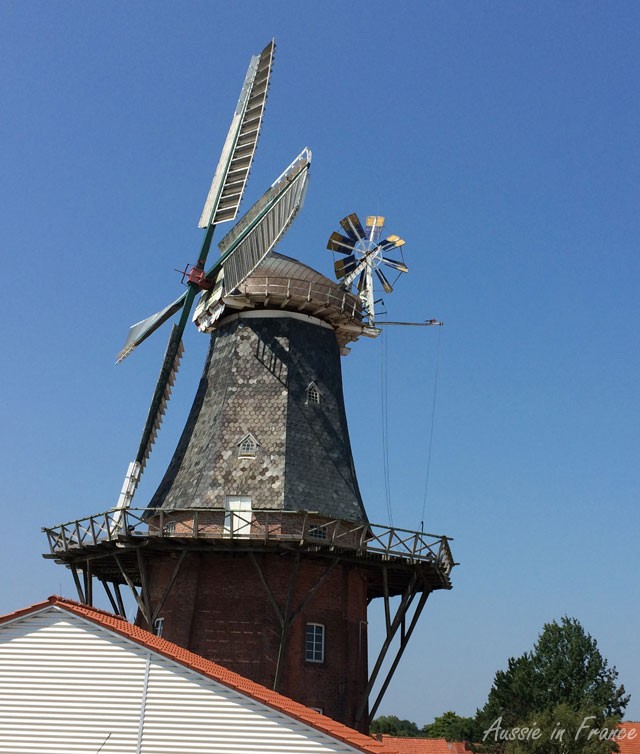
Gnurre-Mühle Frisia 1700
Deichmühle
Deichmühle built in 1900

Hotel Stadt Norden, although well-located, turns out to be a disappointment. It’s the most expensive so far at 110 euro/night, rather run-down with frayed towels, despite being a 4-star hotel! The young boy on reception seemed outraged that we didn’t guess the entrance to the parking lot was in a back street. Later when I ask for help with my wifi connection, he also seems to take it as a personal affront.
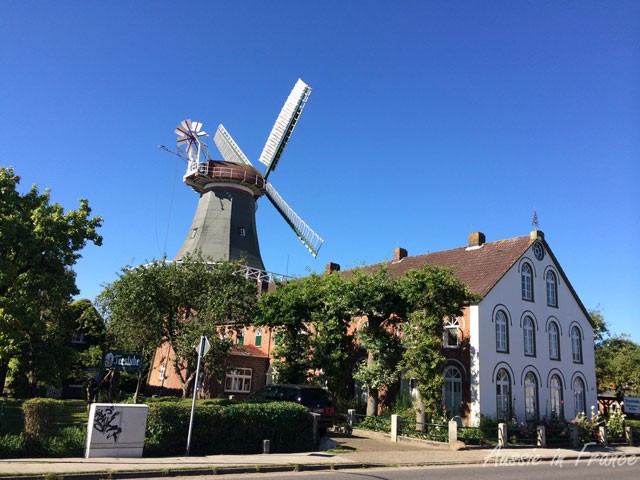
Westgaster Mühle in Norden built in 1863

But we pack our picnic and by 6.45 pm are on our bikes. The weather is beautiful so we head for the coast (well, for the end of the polder on the other side of the dyke), passing another windmill on the way out of Norden. After reaching Nord-deich (deich means dyke), we ride parallel to the dyke rather than on top because of the sheep and we know how I attract sheep! We also see an amazing number of wind turbines.
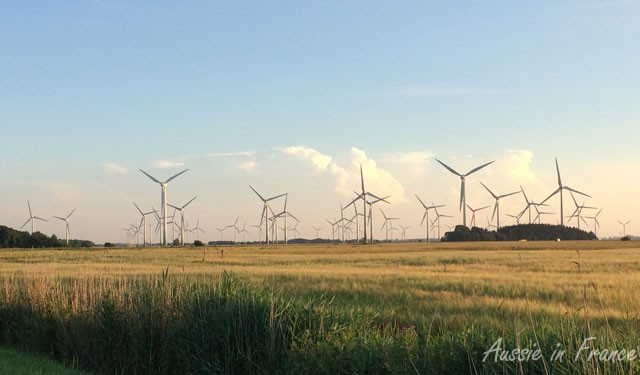
A field of wind turbines

Jean Michel has a great time watching the tractors and other farming equipment which he claims are performing tasks he’s never seen in France and thinks may contribute to the biomass process.
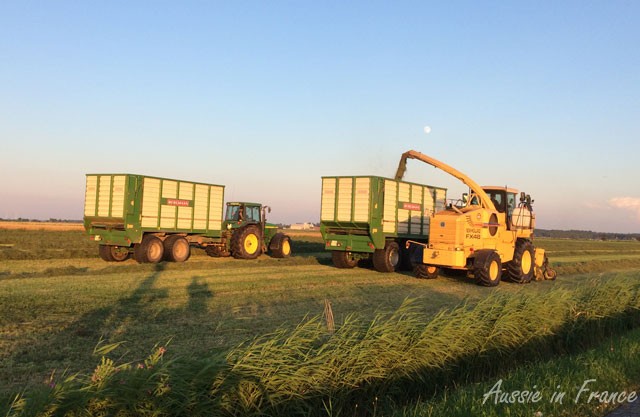
Tractors involved in the biomass process

Three hours and 32 Km later, we are back at our hotel, ready to sink into bed!

Day 2. The blackout curtains are effective in keeping out the light so we reach the breakfast room around 9 am after the rush. The selection is quite good with scrambled, fried and boiled eggs and smoked salmon in addition to the usual cheese and pork cuts. There is even champagne but I don’t see anyone drinking it …
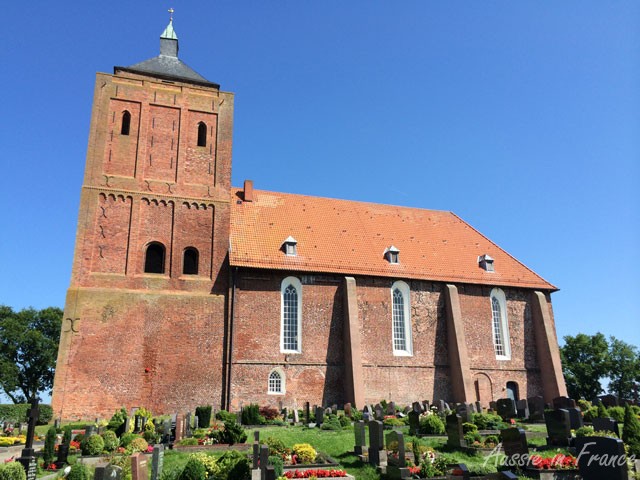
Marienkirche built in
Marienkirche built in 1230

This is to be a big day, with a 57-km circuit. We set out from Norden to Marienkirche in Marienhafe. Hafe means port which is interesting because we’re inland but the church was built in 1230 before the dykes and polders added large stretches of farming land.
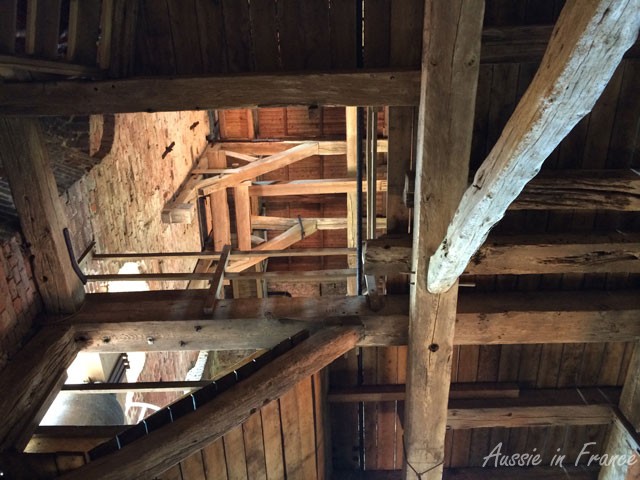
First floor of the Marienkirche tower

The church doesn’t appear to be open but there is a sign indicating a museum. We climb up to the first floor and see a winding staircase going up to the tower. I rashly suggest we buy tickets and we start walking up. By the time we get to the first floor, I’m feeling weak at the knees. There’s still another couple of floors to go. “I’ll just wait here”, I announce.
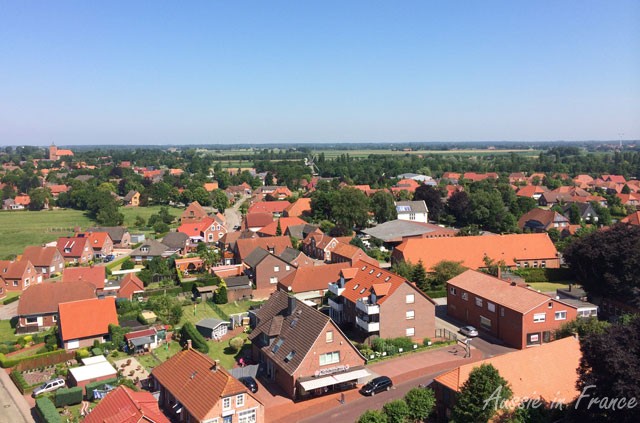
View from the Marienkirche tower

But I decide I may as well continue now that I’ve got this far. Now, that’s a bad move. The steps are narrower and steeper. I stay glued to Jean Michel’s patient back until we finally reach the top. The view is magnificient but I’m not really sure it’s worth it. Coming down is even worse. I have to follow Jean Michel, once step at a time. The last flight is a breeze compared with the other two. We learn the tower was so dilapidated in the 19th century that the top two floors were removed. What a relief!
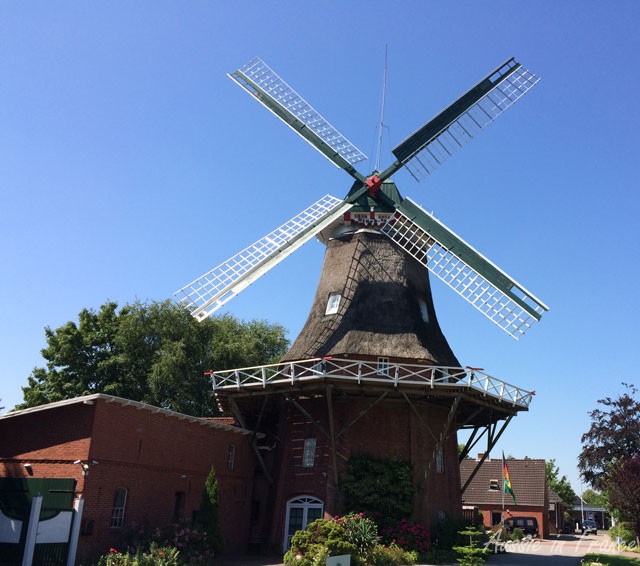
Tjücher windmill in Marienhafe with its thatched roof

There seem to be no cafés around for a morning break so we get back on our bikes to visit two more windmills. I’m still not feeling all that confident. Just as we reach the second windmill, I hear a car behind me and realise that I’m on the street and not on the bike path. I panic and don’t mount the footpath at the right angle. Next moment I’m crashing into the hedge.
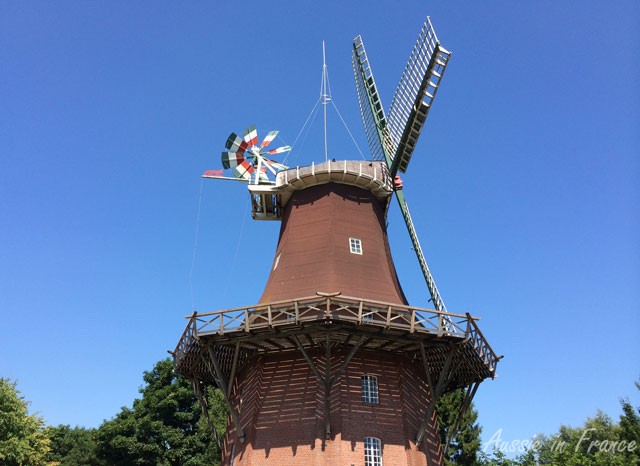
Windmühle Sterrenberg in Marienhafe

The boy driving the car stops and gets out but I can’t even explain it’s not his fault! I get up and pull my bike up to show I’m not hurt and limp round the corner to a handy bench. I’ve grazed one knee badly and given myself a terrific bruise on the other leg. My pride is also severely wounded. Jean Michel is very reassuring and helps me clean the wound with our first-aid kit. I haven’t fallen off my bike since Jean Michel tried to kiss me cycling along the Marne.
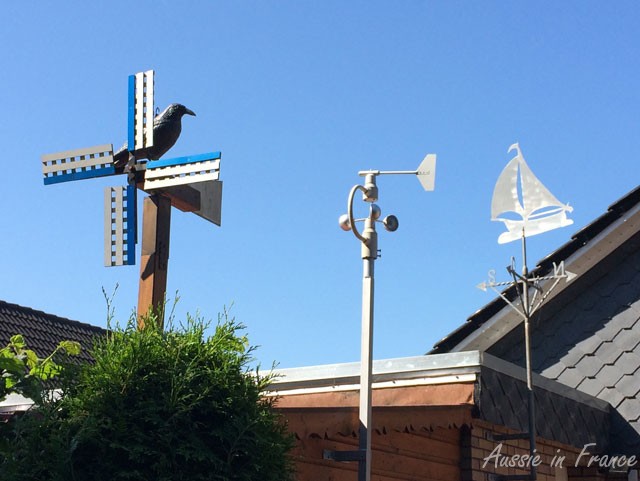
Three windvanes on the same property

After a few photos of the windmill, we mount our bikes again. My knee is quite painful for a while but it doesn’t actually stop me cycling.
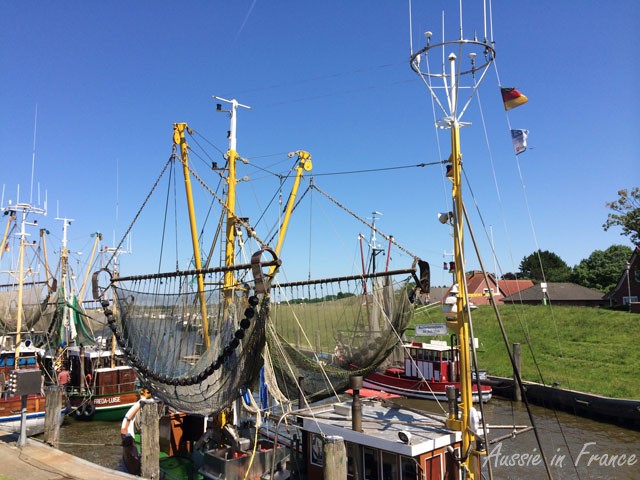
Fishing boats in
Fishing boats in

Next stop is the very pretty little port of Greetsiel with its traditional fishing boats.
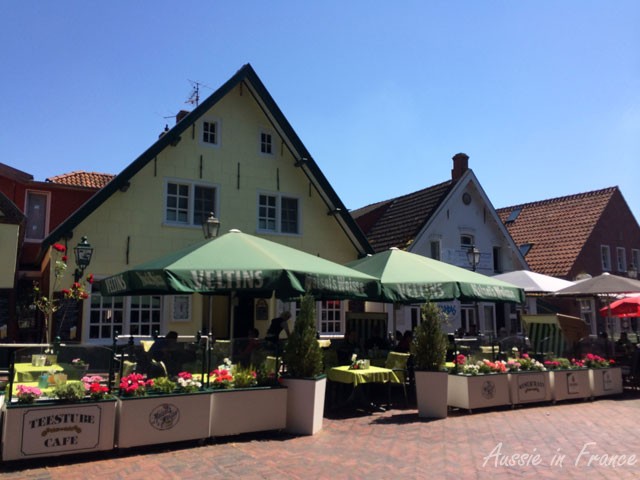
Captains Dinner in Greetsiel

We have scholle at the Captains Dinner but Jean Michel is convinced it’s not the same fish as the one we ate in Leer the day before, even though it’s the same word in German. The waitress speaks English which is a relief. We are buffeted about by the wind but it’s still warm and sunny. I hate to imagine what it must be like in winter.
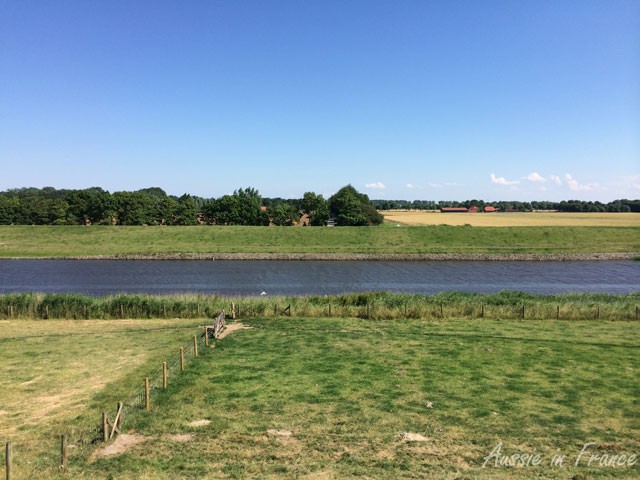
Canal on one side, dyke on the other

After exploring the little town, we start the return journey to Norden, passing more dykes and wind turbines, both of which are synonymous with wind. Fortunately, it’s about 26 or 27°C so at least it isn’t a cold wind. At one stage, we have a canal on the other side as well.

By the time we get back at 6.30 pm, we’ve clocked up 57 km and all I want to do is  have a cold drink and stretch out on the bed! I’m thankful that I didn’t do myself any greater harm.
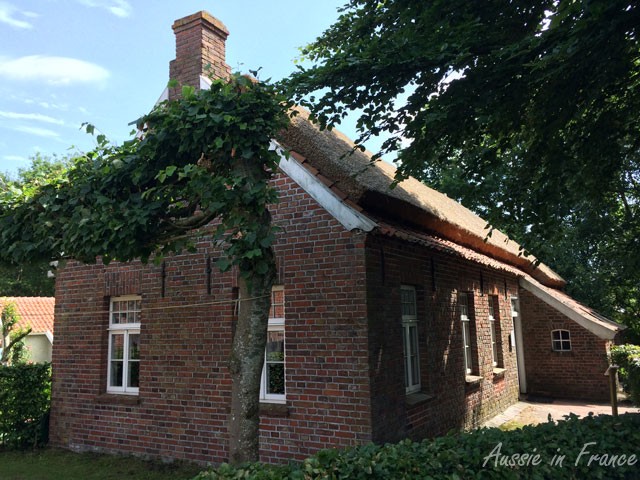
Thatched-roof brick cottage

Day 3. It’s our last day in Norden and we’ve exhausted the immediate surroundings so drive to Marienhafe to take the 37-km thatched roof circuit. The thatched roofs are all  in an outdoor peat bog museum. We’ve seen some from time to time but the thatch doesn’t go to the end of the roof so Jean Michel is not convinced of their authenticity.
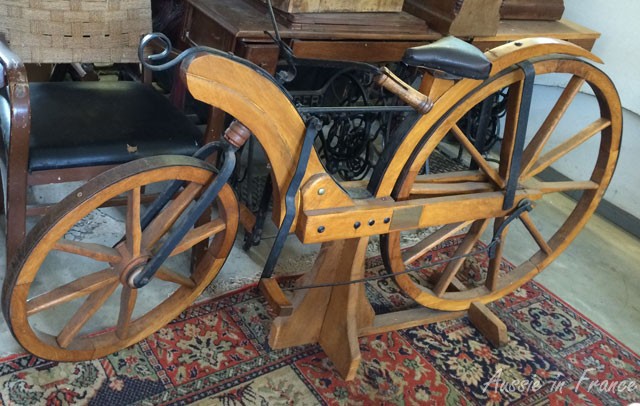
Early wooden bike built in the early 19th century

On the way, we see another windmill in Münkeboe, whose adjacent house contains various objects, including a couple of wooden bicycles. I hate to think how many falls I could have on those!
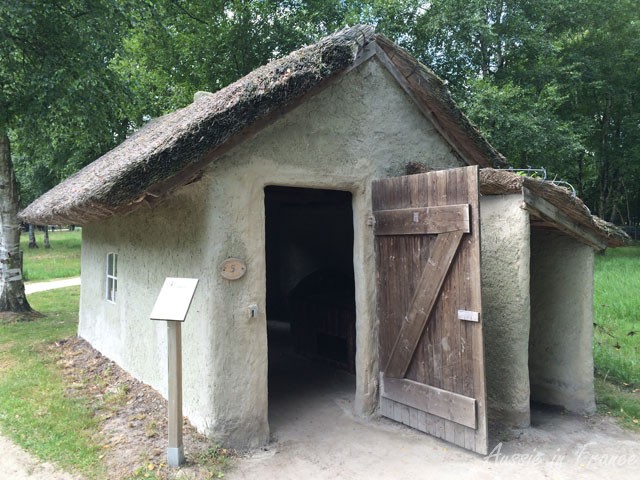
Small reed-thatched clay house in Moormuseum

The Moormuseum in Moordorf proves to very interesting. The lady at the ticket counter obligingly finds us document in English and in French and although the little video they’re showing is in German, it is quite understandable.

It’s hard to imagine living in such terrible poverty. The houses are tiny, damp and isolated.
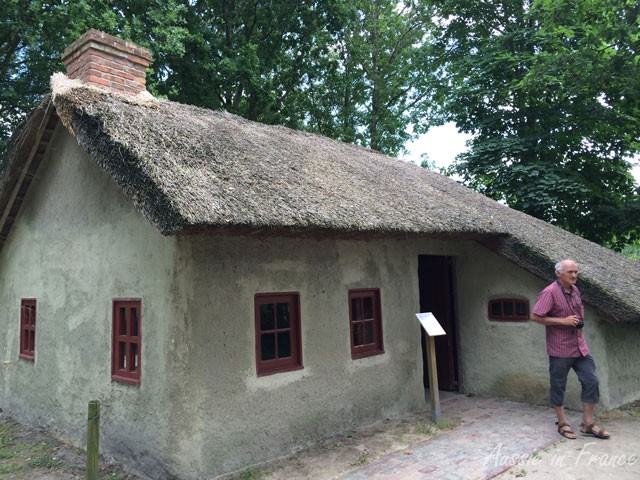
Large reed-thatched clay hut in the Moormuseum
Large reed-thatched clay hut in the Moormuseum – you can see how small the people must have been

Demonstrations of various crafts such as spinning, knitting and ironwork are held on Saturday afternoons. Jean Michel finds himself invited to share a pot of pork and split pea stew by some of the demonstrators and calls me to join him.

That is the last food we see until 4.30 pm. There is a teestube but there are a lot of people and apart from matjees (herring), we can’t work out what else there is to eat. There is only beer and brannwein (which I later discover is a sort of vodka) so we decide to push on.
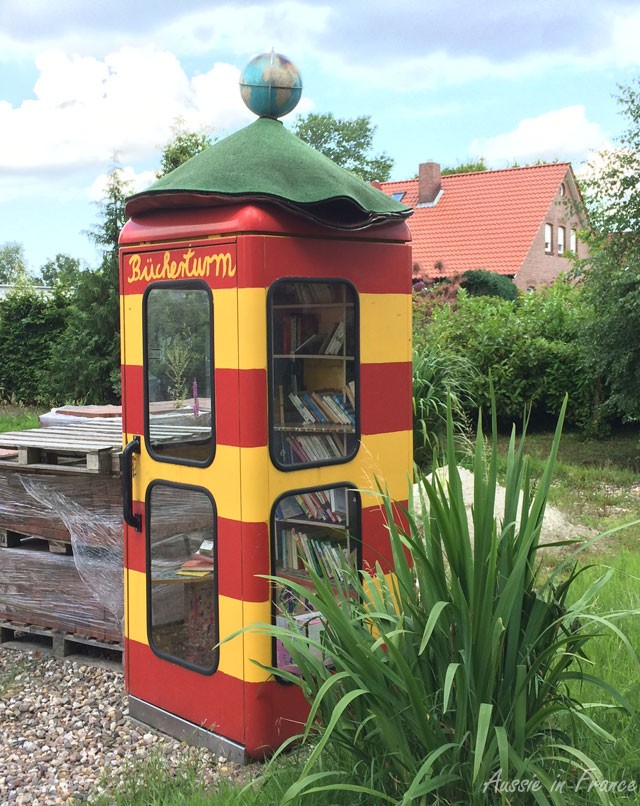
A book tower in the middle of nowhere

It is not until we have made several wrong turnings and encountered this strange “book tower” that we arrive back in Marienhafe (we’re now up to 44 km) and console ourselves with a triple ice-cream because everything else is closed.

We have a third type of scholle at the hotel restaurant which also serves complementary pea soup and a moka cream affair with our decaffeinated coffee.
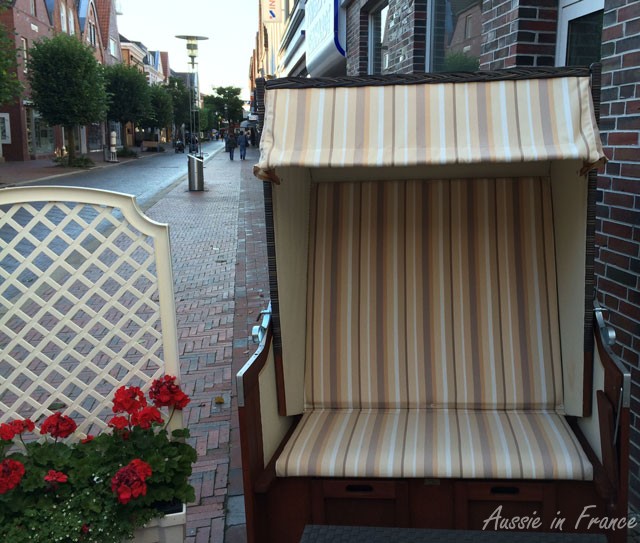
A typical shady seat at Hotel Stadt Norden
A typical shady seat at Hotel Stadt Norden – these comfy covered basket chairs can also be found on the beach.

Three great days of sun and cycling but tomorrow we’re expecting rain clouds so are off to another destination.
OTHER POSTS ABOUT CYCLING IN GERMANY

Cycling in Germany – Tips & Tricks
Cycling in Germany #1 – Kobern-Gondorf on the Moselle
Cycling in Germany #2 – Rhine from Saint Goar to Lorch
Cycling in Germany #3 – Cochem to Zell on the Moselle
Cycling in Germany #4 – Koblenz where the Moselle meets the Rhine
Cycling in Germany #5 – Bad Schaugen to Pirna along the Elbe
Cycling in Germany #6 – Bastei Rocks, Honigen and over the border to Czech Republic 
Cycling in Germany #7 – Dresden: accommodation & car trouble and Baroque Treasure  
Cycling in Germany #8 – Dresden Neustadt: Kunsthof Passage, Pfund’s Molkerei, a broom shop & trompe l’oeil
Cycling in Germany #9 – Country roads around Niderlommatzsch on the Elbe
Cycling in Germany #10 – Meissen on the Elbe
Cycling in Germany #11 – Martin Luther Country: Torgau on the Elbe
Cycling in Germany #12 – Martin Luther Country: Wittenberg on the Elbe
Cycling in Germany #13 – Wörlitz Gardens and the beginning of neo-classicism in Germany
Cycling in Germany #14 – Shades of Gaudi on the Elbe: Hundertwasser
Cycling in Germany – Turgermünde, the prettiest village on the Elbe
Cycling in Germany #16 – Celle & Bremen
Cycling in Germany #17 – Windmills & Dykes
Cycling in Germany #18 – Painted façades from Hann. Münden to Höxter
Cycling in Germany #19 – Bernkastel on the Moselle: a hidden treasure
Cycling in Germany #20 – Trier & the Binoculars Scare
 
Cycling along the Danube – A Renaissance festival in Neuburg, Bavaria
Cycling along the Danube – Watch out for trains!
Cycling along the Danube – Regensburg & Altmuhle
Cycling along the Danube –  The Weltenburg Narrows
Cycling along the Danube – from its source to Ehingen
Cycling along the Danube – Ehingen to Ulm
Cycling along the Danube – Singmarigen to Beuron
Cycling along the Danube – Binzwangen to Mengen including  Zwiefalten
Eurovelo 6 – Cycling around Lake Constance
Eurovelo 6 – Moos to Stein am Rhein and Steckborn on Lake Constance
Heading home to France after a month’s cycling holiday

Cycling in Germany #16 – Celle and Bremen

Bad weather has struck so we’ve studied the weather report and after a day of R&R at Kunsthof Pension in Dahrenstedt we’re off to Bremen via Celle which has over 400 timber-framed houses.

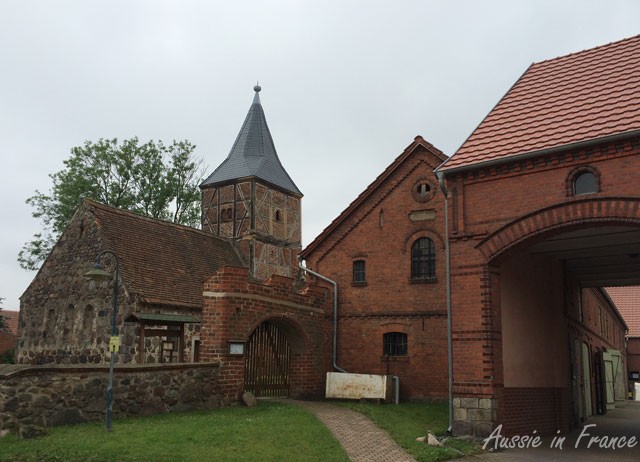
Church and farm building in Dahrenstedt
Church and farm building in the little village of Dahrenstedt

We are going back into the former West Germany today and wonder whether it will be noticeable. Nothing could be more flagrant! The houses are different, there are more gardens and trees, more shops in the towns and village. Everything is neat and tidy again, there are no more ruins. However, there is also a small forest with prostitutes’ vans from one end to the other, which is a little worrying.

Painted faces and hair in Bremen

The first thing we see when we arrive in Celle are teenagers with colourfully dyed hair and faces. The lady in the tourist office tells me they are celebrating the end of high school. She doesn’t speak enough English to tell me whether it is only a custom in Celle or something that happens throughout Germany.

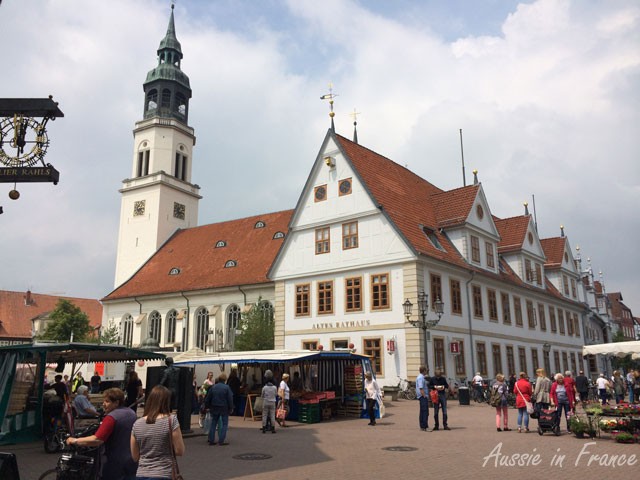
The Rathaus in Celle

Miraculously the grey clouds have made way for the sun so we take lots of photos before lunch just in case it starts raining again.

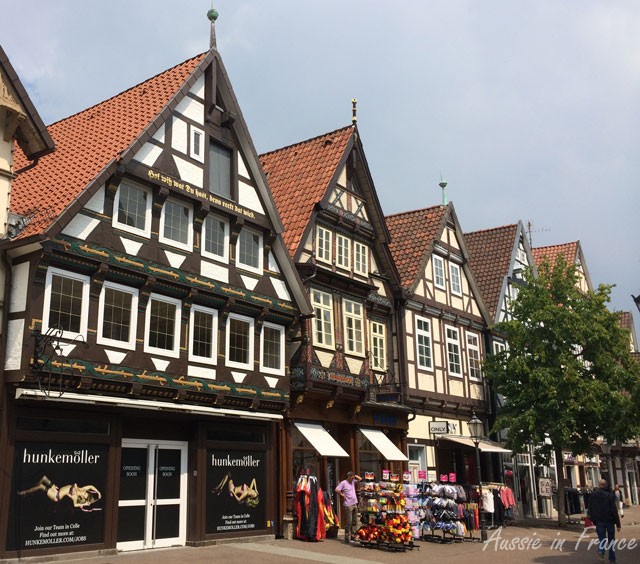
Painted façades in Celle

From 1378 to 1705, Celle was the official residence of the Lüneburg branch of the dukes of Brunswick-Lüneburg. In 1534, the Reformation was introduced into Celle. From 1655 to 1705 Celle experienced a cultural boom under Duke George William mainly due to his French wife Eléonore d’Olbreuse who brought fellow Hugenot Christians and Italian architects to Celle.

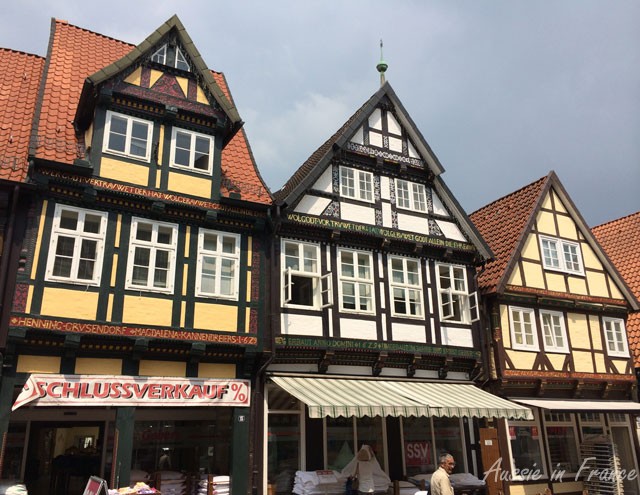
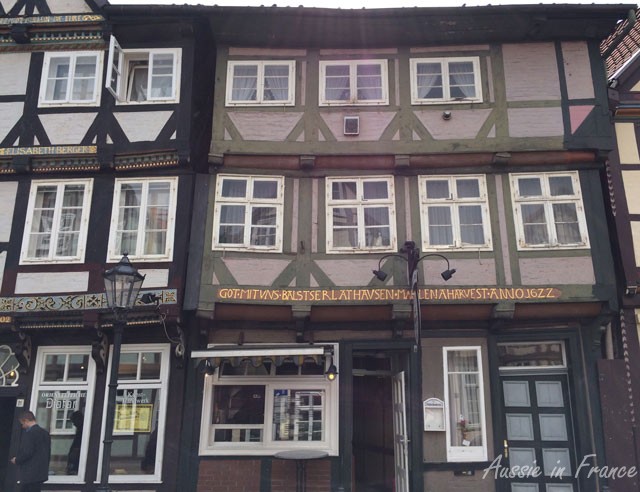
House built in 1622
House built in 1622

The result is a wonderful collection of colourful timber-framed houses with learned German inscription on them. They are often dated so we set out to find the oldest – 1526 – but it is nowhere to be seen.

House in Celle built in 1622

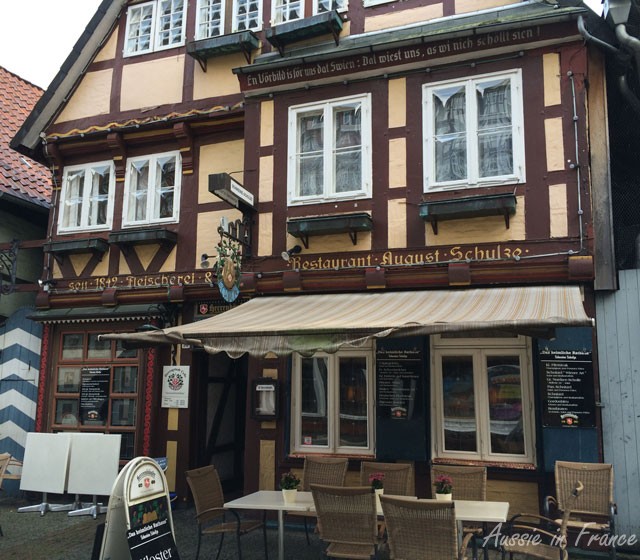
We look for a place to eat and finally settle on the Schweine-Schulze which has a terrace in a shady street and is serving kotelett und pfifferlings. Our trocken weiss wein has just arrived when there is a sudden downpour. Everyone is swept inside and we finish our excellent meal at a rough wooden table. We discover we’re not the only famous people to eat here – Helmut Khol and Gerhard Schröder are also patrons.

Schweine restaurant in Celle

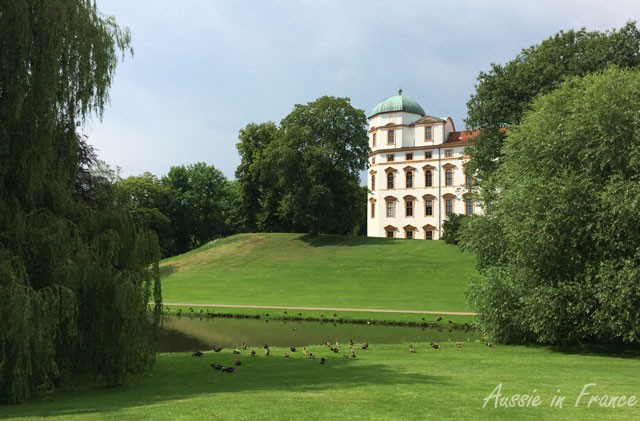
By the time we finish, the sun has come out again so we finish our visit, ending with the French gardens attributed to Eléonore d’Olbreuse. We don’t have time to visit the castle.

The French garden in Celle with the castle in the background

Bremen is only about an hour away but unbeknown to us, it has been the victim of a violent storm and trees are now covering some of the roads into the city causing an immense traffic jam.

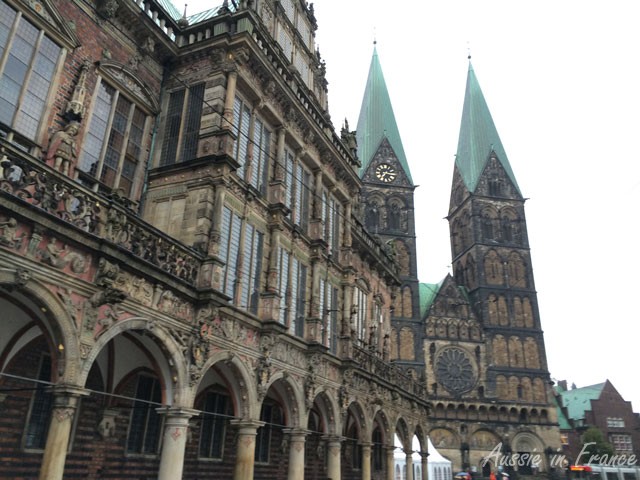
The Rathaus and Cathedral in Bremen, in the Weser Renaissance style

We finally reach the Prizehotel, recommended by Andrea from Rearview Mirror in her post on Bremen, at about 6 pm. It’s an ultra-modern budget hotel, but has everything we need, including friendly, helpful staff, soundproof rooms, excellent wifi, light-blocking curtains and a comfortable bed. It even has decent pillows, which we had stopped expecting in East Germany.

Guild house in Bremen
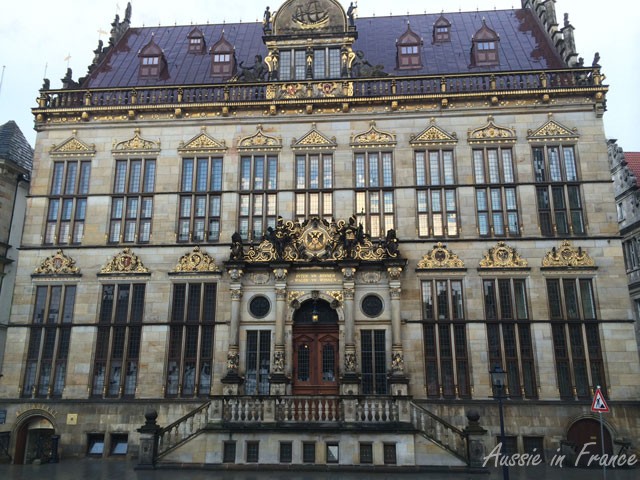
My favourite buildng in Bremen – Schütting, an elegant home built in 1535-37 for the merchants’ guild

We set out to explore the city, which is a short walk away. We reach the tourist office in the train station just as it’s about to close and learn the existence of a Radstation (bike shop) nearby where we’ll be able to buy maps for the next part of our trip in Friesland, the only part of the Germany where it’s going to be fine for the next three days!

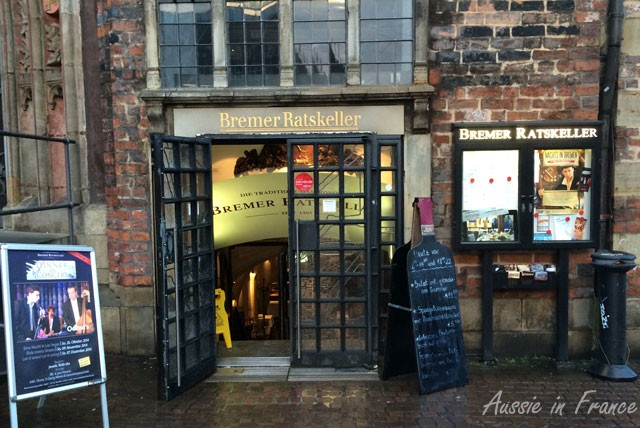
The Ratskeller restaurant in Bremen

It starts raining but we take photos anyway despite the fact that the main square is full of white tents, and look for somewhere to have a drink. I see a sign saying Ratskeller. A ratskeller (meaning council’s cellar) is a bar or restaurant in the basement of the city hall in Germany and you see them everywhere.

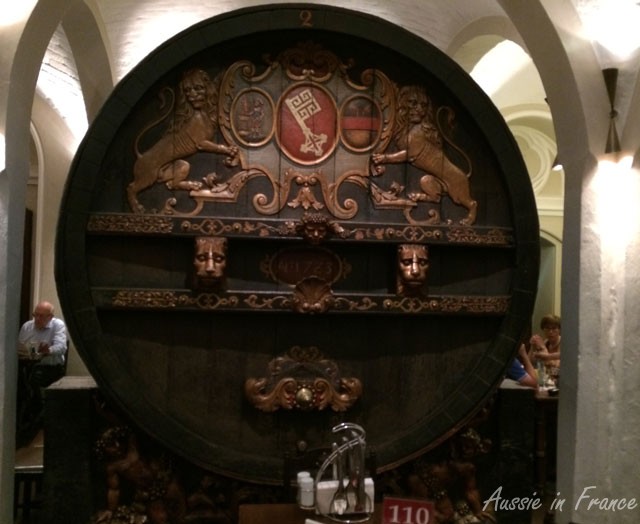
One of the beautiful vats in the Ratskeller in Bremen

It turns out to be one of the places in our tourist brochure and we can see why. Built in 1405, it is one of the oldest wine cellars in Germany with huge wooden vats, each with a different decor. I love the private booths and can imagine the town councillors hatching their plots behind closed doors.

Renaissance façade in Bremen
Another Weser Renaissance façade in Bremen

We have a glass of wine each with bruschetta and a dip because we’re not really hungry after our schwein kotelett lunch. That’s one of the great things about Germany – you can order as little or as much as you want.

Böttcherstrasse in Bremen with its art nouveau architecture

When we emerge from our cellar, the sky has cleared up completely so we take our photos all over again and go looking for the places we haven’t seen yet, in particular, Böttcherstrasse and the Schnoorvietel.

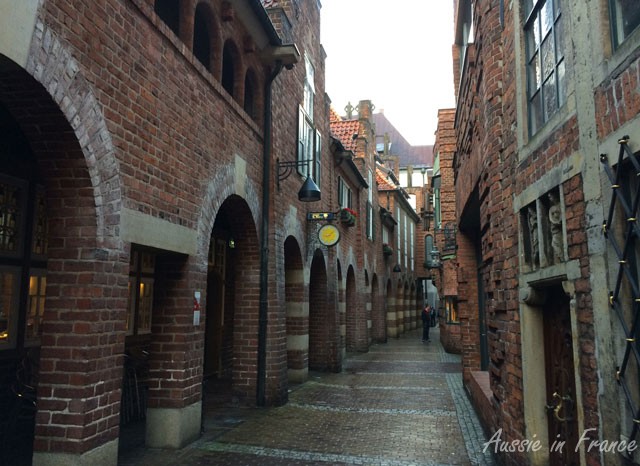
Typical street in the Schnoor district

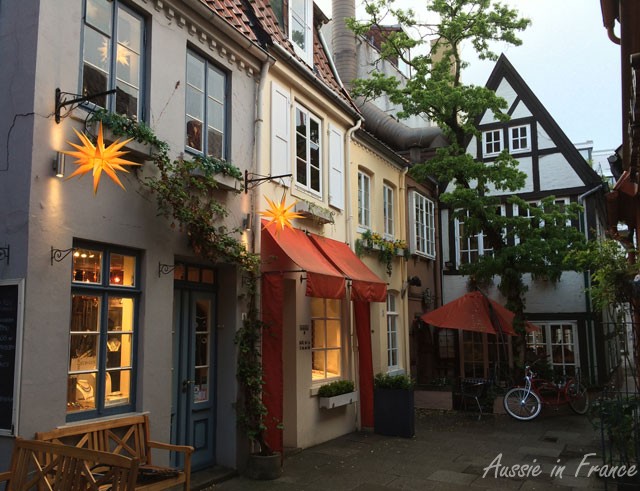
I love Schnoorvietel which is full of tiny little streets with quaint houses built in the 15th to 17th century for sailors and fishermen. Since it has been raining, there is practically no one around so we have it to ourselves.

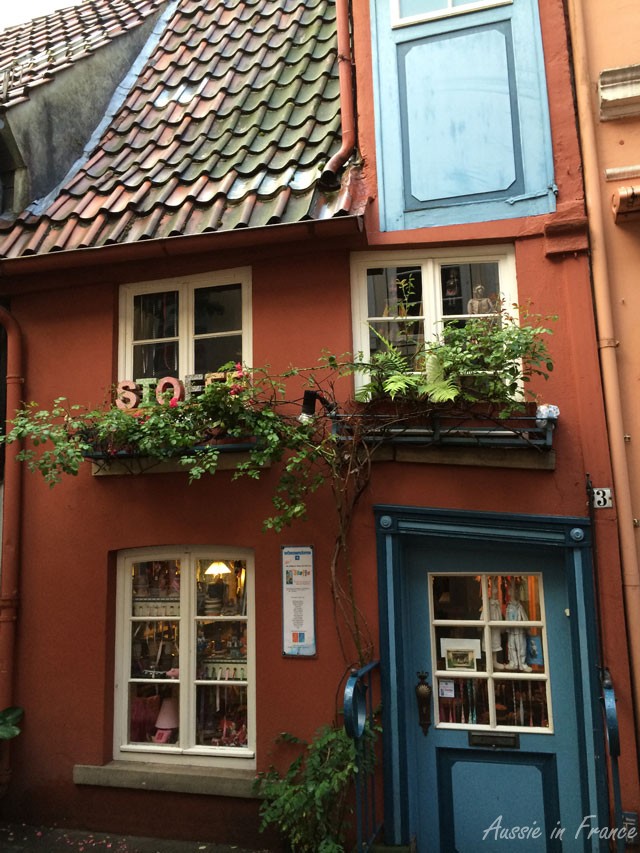
The little blue door

Just as we finish our visit, it starts raining again. We think we’ve done pretty well with the weather today all things considered.

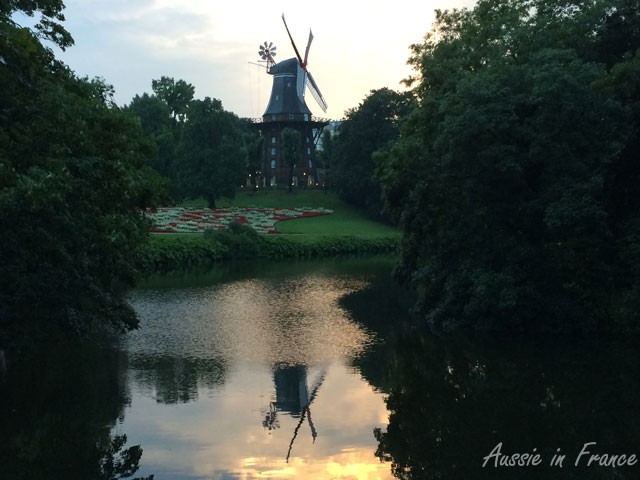
Windmill in Bremen on the way home to our hotel

Tomorrow we’re off to Friesland near the North Sea, land of windmills and dykes, which is the only part of Germany where it’s going to be sunny for the next three days and we can do some more cycling. Hope to see you there!

OTHER POSTS ABOUT CYCLING IN GERMANY

Cycling in Germany – Tips & Tricks
Cycling in Germany #1 – Kobern-Gondorf on the Moselle
Cycling in Germany #2 – Rhine from Saint Goar to Lorch
Cycling in Germany #3 – Cochem to Zell on the Moselle
Cycling in Germany #4 – Koblenz where the Moselle meets the Rhine
Cycling in Germany #5 – Bad Schaugen to Pirna along the Elbe
Cycling in Germany #6 – Bastei Rocks, Honigen and over the border to Czech Republic 
Cycling in Germany #7 – Dresden: accommodation & car trouble and Baroque Treasure  
Cycling in Germany #8 – Dresden Neustadt: Kunsthof Passage, Pfund’s Molkerei, a broom shop & trompe l’oeil
Cycling in Germany #9 – Country roads around Niderlommatzsch on the Elbe
Cycling in Germany #10 – Meissen on the Elbe
Cycling in Germany #11 – Martin Luther Country: Torgau on the Elbe
Cycling in Germany #12 – Martin Luther Country: Wittenberg on the Elbe
Cycling in Germany #13 – Wörlitz Gardens and the beginning of neo-classicism in Germany
Cycling in Germany #14 – Shades of Gaudi on the Elbe: Hundertwasser
Cycling in Germany – Turgermünde, the prettiest village on the Elbe
Cycling in Germany #16 – Celle & Bremen
Cycling in Germany #17 – Windmills & Dykes
Cycling in Germany #18 – Painted façades from Hann. Münden to Höxter
Cycling in Germany #19 – Bernkastel on the Moselle: a hidden treasure
Cycling in Germany #20 – Trier & the Binoculars Scare
 
Cycling along the Danube – A Renaissance festival in Neuburg, Bavaria
Cycling along the Danube – Watch out for trains!
Cycling along the Danube – Regensburg & Altmuhle
Cycling along the Danube –  The Weltenburg Narrows
Cycling along the Danube – from its source to Ehingen
Cycling along the Danube – Ehingen to Ulm
Cycling along the Danube – Singmarigen to Beuron
Cycling along the Danube – Binzwangen to Mengen including  Zwiefalten
Eurovelo 6 – Cycling around Lake Constance
Eurovelo 6 – Moos to Stein am Rhein and Steckborn on Lake Constance
Heading home to France after a month’s cycling holiday

Cyclng in Germany #15 – Turgermünde, the prettiest village on the Elbe

After Magdeburg and the Green Citadel, we continue on to our next location in the little village of Dahlenstedt near Stendal, where we are to spend 3 nights, including a rest day. We first heard of this little town from guests who came to stay at Closerie Falaiseau last year. Henri Beyle, the author of Le Rouge et le Noir took the pseudonym of Stendhal, in hommage of his great passion for Wilhelmina de Grisheim in 1807 and 1808.

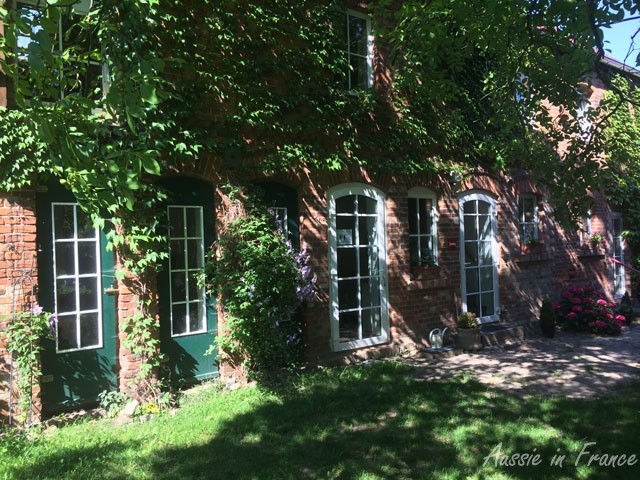
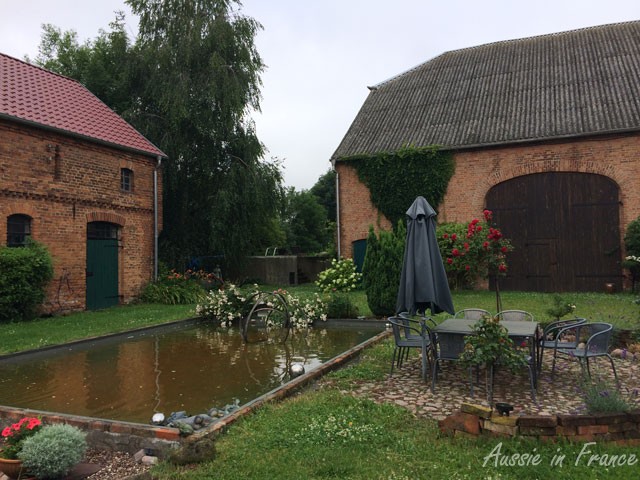
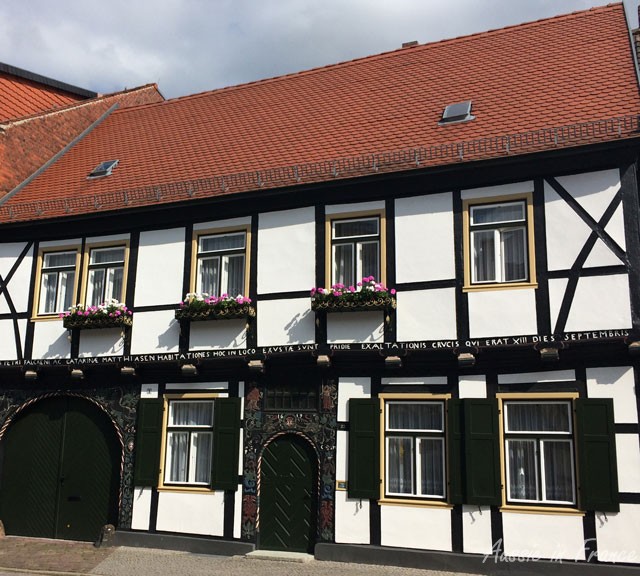
Pension Kunsthof with our door on the far right

When we arrive, it is blazing hot and Kunsthof Pension with its shady trees is very inviting. Several old restored red brick farmhouse buildings form a grass-covered inner courtyard. Our large room has a kitchen corner, with a sink and electric jug. My heart sinks when I see that only the windows on one side have proper curtains. On the other side, there is a flimsy white curtain on the glass door and a window with no curtains at all. As it turns out, the ivy-covered wall opposite keeps out the 4 am sunlight.

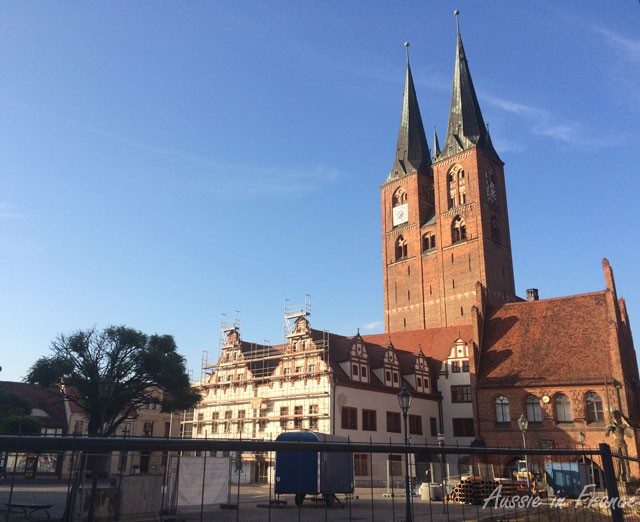
St Jacob''s Gothic cathedral in Stendal with the rathaus in front
St Jacob”s Gothic cathedral in Stendal with the rathaus in front

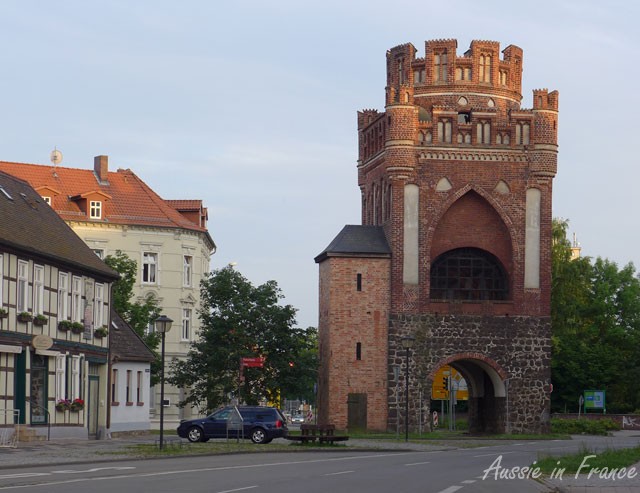
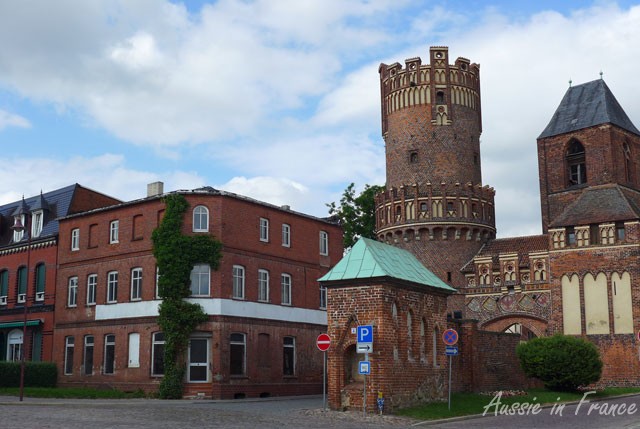
It’s too hot to even think about cycling, it’s Sunday and we’ve forgotten to buy something to eat so we drive into Stendal for dinner. We’re relieved we didn’t choose a hotel there! The only landmarks are a large church with roadworks in front and the Uengling Gate, a red-brick tower regarded as one of the most splendid late medieval town gates in northern Germany.

The Uengling Gate, reputedly built by masterbuilder Steffen Boxtehude ca. 1450 to 1460 is regarded as one of the most splendid late medieval town gates in northern Germany.
The Uengling Gate, reputedly built by masterbuilder Steffen Boxtehude ca. 1450 to 1460

We can choose between Asian, Italian and a steakhouse. Surprisingly, the waitress speaks English and we order a glass of rosé and an entrecôte and chips with side salad. The entrecôte is very thick and served in a red-hot pan.

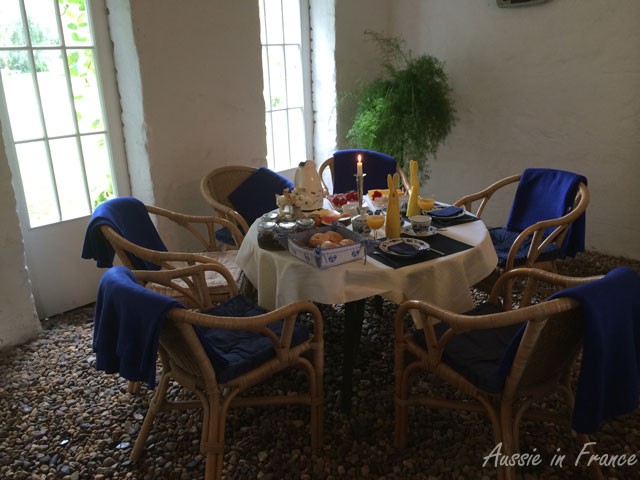
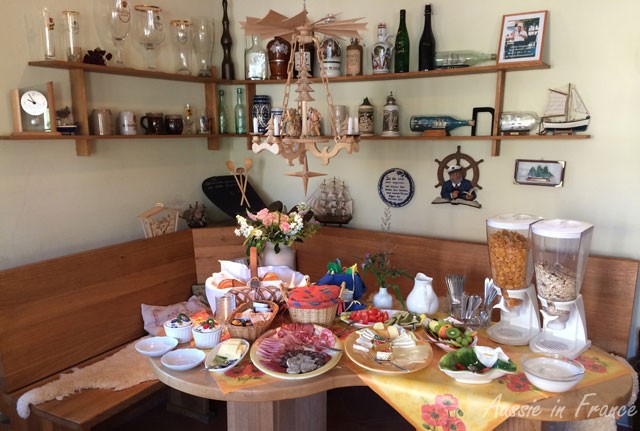
The breakfast room at Kunsthof Pension

We sleep well, despite the paving stones outside our window that make the passing trucks and cars sound like a thundering train and have a good breakfast in a very pleasant room with large windows overlooking the courtyard. We are the only guests.

The view from the breakfast room

It’s very overcast and the weather report says it will rain in the afternoon so we drive to Turgermünde and park near the bike path, leaving our visit of the town until our return.

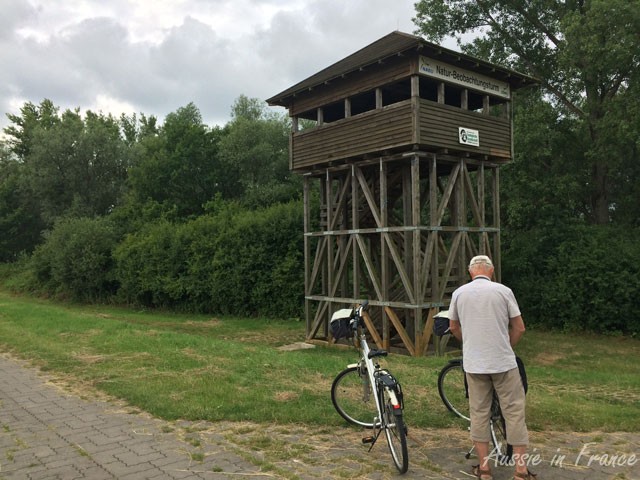
Bird observatory along the bike path

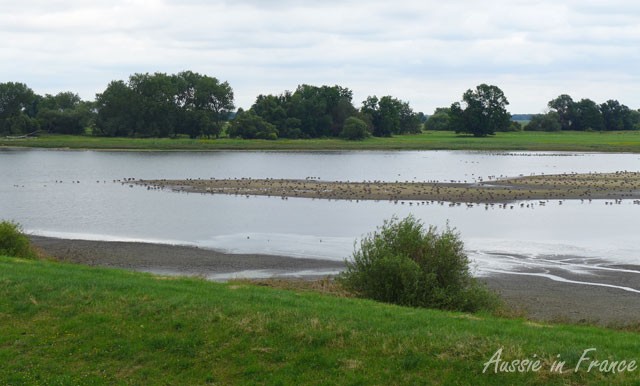
At this part of its course, the Elbe divides into several branches, making it perfect for wildlife. We stop at a bird observatory and take our binoculars up.

The view from the bird observatory

We also see stork nests along the way which reminds us of the Danube last year.

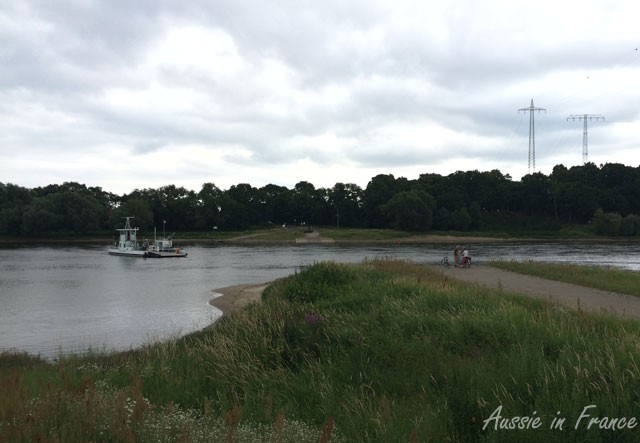
The ferry crossing
The ferry crossing

At Grieben, we find a biergarten full of other cyclists sitting down to lunch at 11.30 am which is a little early for us. We have a not-very-good (and expensive) cappuccino instead. After crossing on the ferry near Ferchland, we go north to Jerichow, a very dull little town.

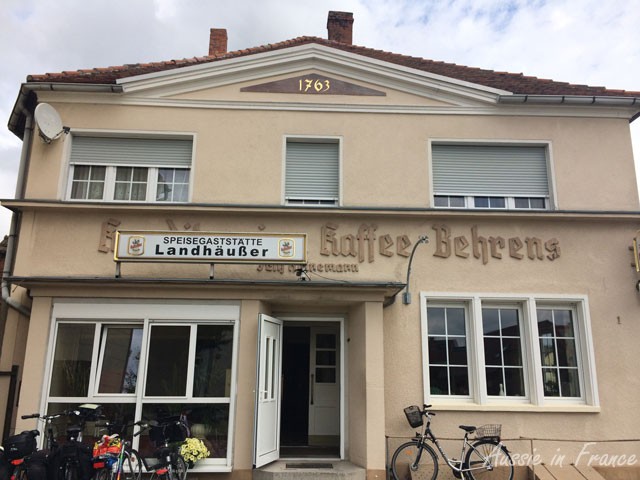
Kaffee Behrens in Jerichow

By then, we’re hungry so we choose not to eat at the imbiss (Turkish snack bar) but, encouraged by the number of bikes outside, at Kaffee Behrens, built in 1763. It turns out they belong to the local soaks!

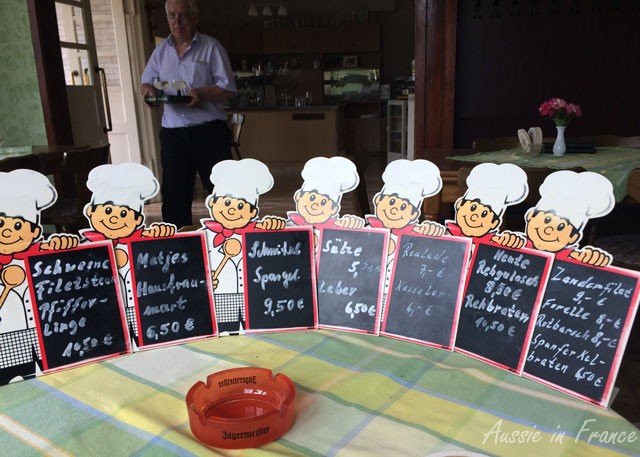
The lunch menu cards at Kaffee Behrens

The owner comes over with a set of menu cards which he flicks open and places in a hemisphere on the table. Our schweinfilet and pfifferlings (pork fillet and chanterelle mushrooms) are a good choice.

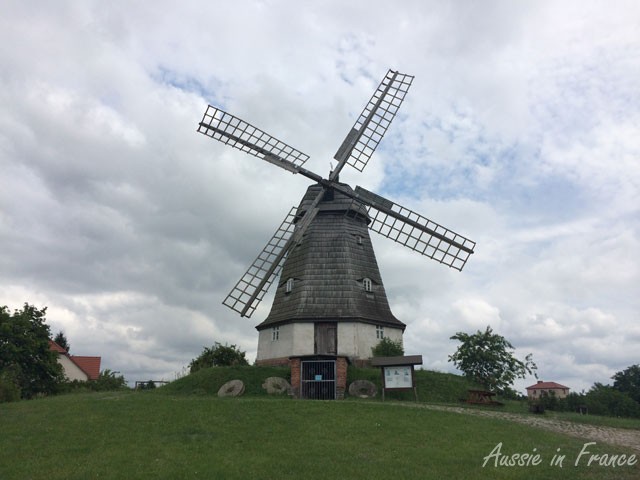
Höllanderwindmühle in Jerichow

Afterwards we visit the local windmill (there are so few places to see that we follow up every lead).

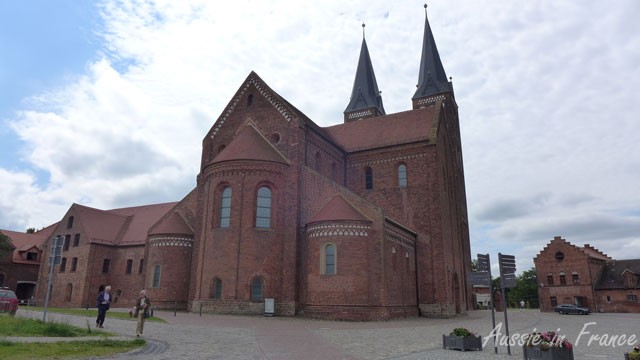
Kloster Jerichow, a Romanesque abbey

We also check out the red-brick Romanesque kloster which is on the Compostela route. Unfortunately, it’s closed.


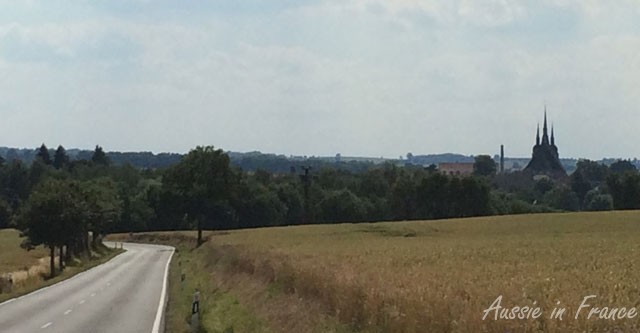
First view of Tangermünde

After cycling a total of forty-five kilometers we arrive back at Tungermünde and I’m very saddle sore!

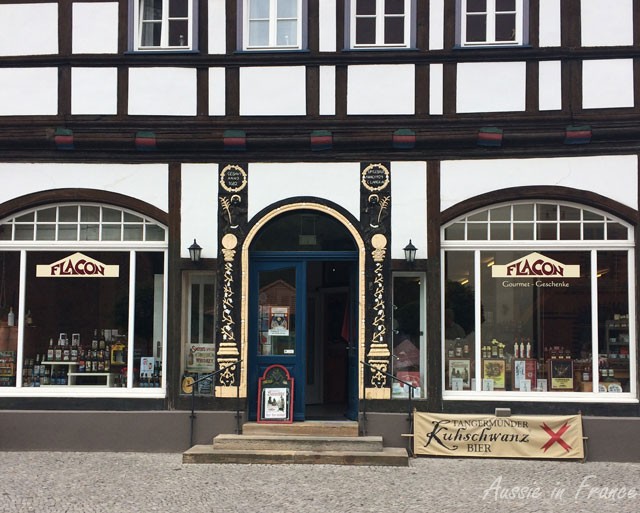
Shop façade in Tangermünde

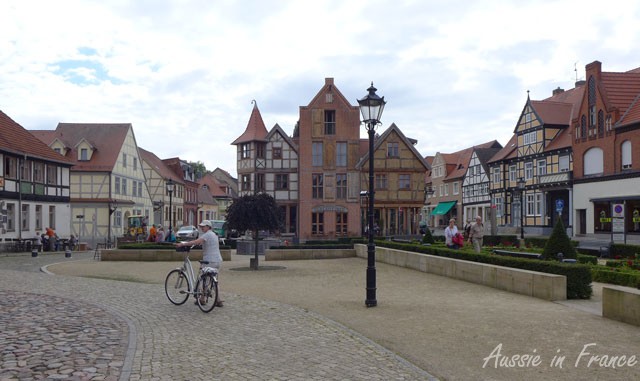
And here, to our immense surprise, we discover that Tangermünde is the prettiest village we have seen on the Elbe! This charming little mediaeval Hanseatic town is hardly mentionedin our guidebooks and there is hardly a tourist in sight.

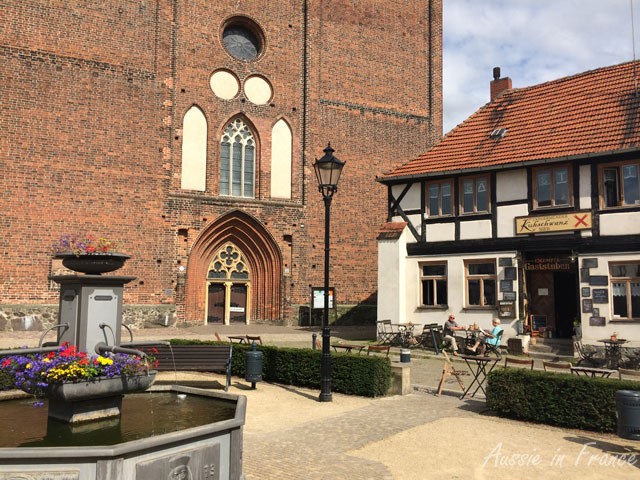
Church and restaurant
St Stephan’s Church and Exempel Gastuben

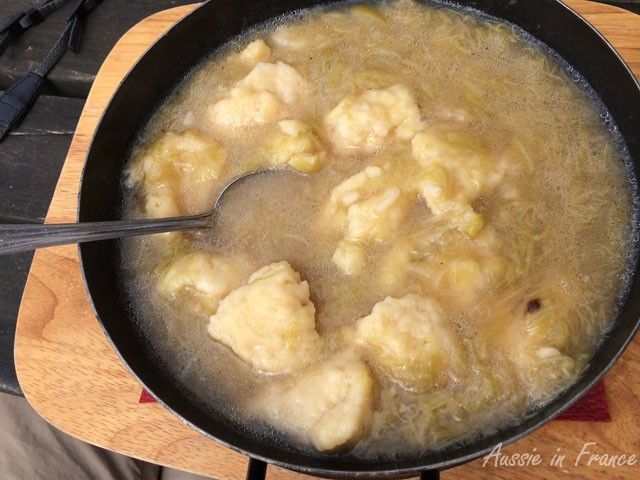
We have kaffee and kuchen at the first café we come to. Jean Michel insists on having the only two desserts on the menu (I later see they have large cakes inside). The Petit Feodora is fine – a rather rich fudge-like cake but the Süsser Klump, a regional speciality, does not appeal to me at all.

Klump, the local speciality
Süsser Klump, the local speciality

It has some sort of thick dumplings floating in thin rhubarb soup. Jean Michel valiantly eats half of it along with half the Feodora.

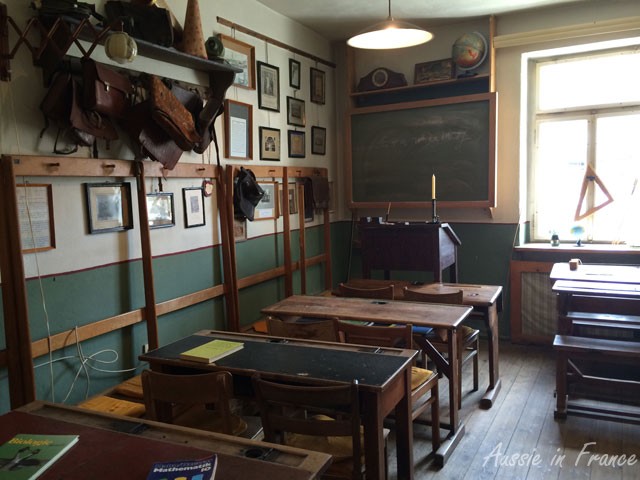
Scboolroom inside the Exempel Gastuben

The café-restaurant turns out to be an old school with the original classroom set-up (or so I understand).

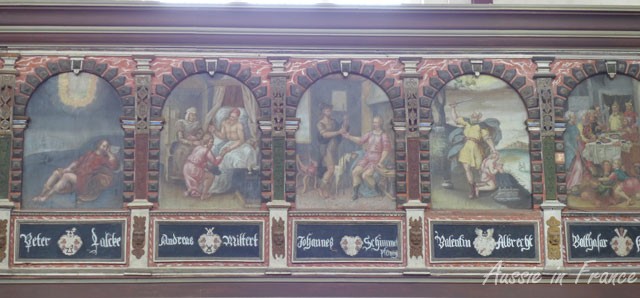
Painted gallery in St Stephan's
Painted gallery in St Stephan’s

We visit the red-brick church of St Stephan’s with its painted gallery. The church was completely rebuilt after being destroyed by fire in 1617.

Typical painted arch
Typical painted arched doorway

But what we really like are the beautiful arched doorways on the half-timbered houses.

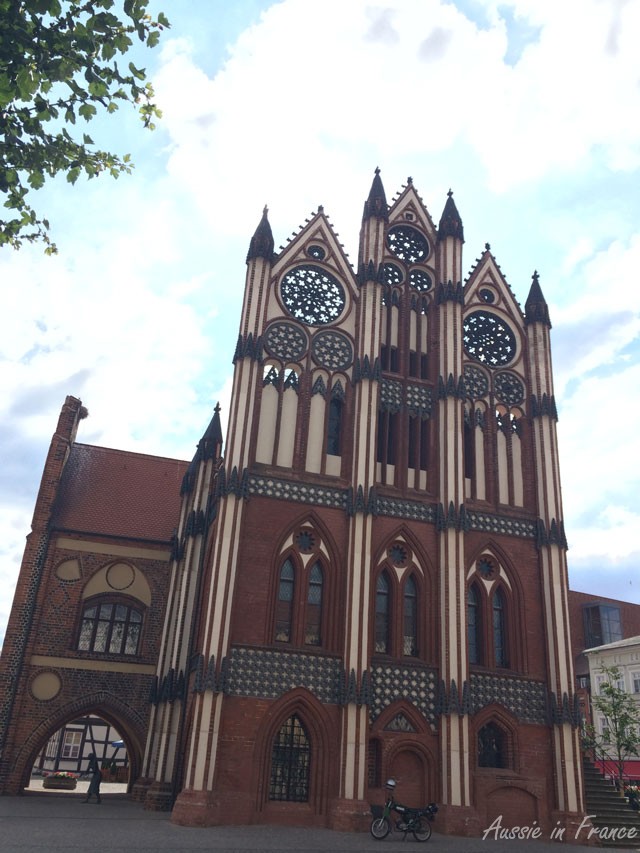
The Rathaus with its complex gothic architecture

The rathaus, built in the 1430s, with its gothic and Romanesque structural elements, is also very striking. The façade has three staggered gables each with a miniature spire. reminiscent of the gothic architecture on cathedral exteriors.

The town gate
The town gate

The impressive entrance to the town, with its round tower, has the same type of features, including the off-white contrast on red brick.

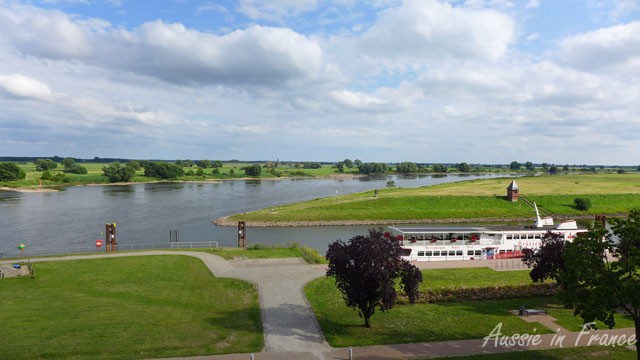
View of the Elb from Tangermünde

The Schloss Hotel in the ramparts has a little garden behind it with a view of the Elb so we cycle back along the river to the car, having managed to escape the rain altogether. What a wonderful day!

OTHER POSTS ABOUT CYCLING IN GERMANY

Cycling in Germany – Tips & Tricks
Cycling in Germany #1 – Kobern-Gondorf on the Moselle
Cycling in Germany #2 – Rhine from Saint Goar to Lorch
Cycling in Germany #3 – Cochem to Zell on the Moselle
Cycling in Germany #4 – Koblenz where the Moselle meets the Rhine
Cycling in Germany #5 – Bad Schaugen to Pirna along the Elbe
Cycling in Germany #6 – Bastei Rocks, Honigen and over the border to Czech Republic 
Cycling in Germany #7 – Dresden: accommodation & car trouble and Baroque Treasure  
Cycling in Germany #8 – Dresden Neustadt: Kunsthof Passage, Pfund’s Molkerei, a broom shop & trompe l’oeil
Cycling in Germany #9 – Country roads around Niderlommatzsch on the Elbe
Cycling in Germany #10 – Meissen on the Elbe
Cycling in Germany #11 – Martin Luther Country: Torgau on the Elbe
Cycling in Germany #12 – Martin Luther Country: Wittenberg on the Elbe
Cycling in Germany #13 – Wörlitz Gardens and the beginning of neo-classicism in Germany
Cycling in Germany #14 – Shades of Gaudi on the Elbe: Hundertwasser
Cycling in Germany – Turgermünde, the prettiest village on the Elbe
Cycling in Germany #16 – Celle & Bremen
Cycling in Germany #17 – Windmills & Dykes
Cycling in Germany #18 – Painted façades from Hann. Münden to Höxter
Cycling in Germany #19 – Bernkastel on the Moselle: a hidden treasure
Cycling in Germany #20 – Trier & the Binoculars Scare
 
Cycling along the Danube – A Renaissance festival in Neuburg, Bavaria
Cycling along the Danube – Watch out for trains!
Cycling along the Danube – Regensburg & Altmuhle
Cycling along the Danube –  The Weltenburg Narrows
Cycling along the Danube – from its source to Ehingen
Cycling along the Danube – Ehingen to Ulm
Cycling along the Danube – Singmarigen to Beuron
Cycling along the Danube – Binzwangen to Mengen including  Zwiefalten
Eurovelo 6 – Cycling around Lake Constance
Eurovelo 6 – Moos to Stein am Rhein and Steckborn on Lake Constance
Heading home to France after a month’s cycling holiday

Cycling in Germany #14 – Shades of Gaudi on the Elbe: Hundertwasser

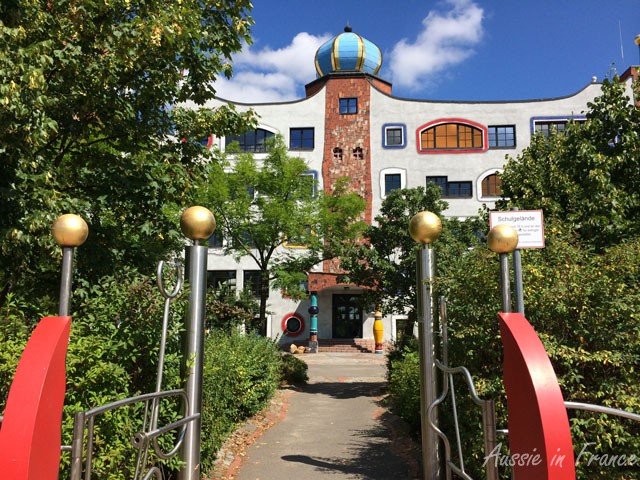
“I mustn’t forget to show you something before we leave Wittenberg tomorrow”, says Jean Michel, “a modern building, the Martin Luther Gymnasium” (which means high school).

Entrance to the Martin Luther Gymnasium

Wow, I am bowled over when I see it, tucked away behind the vegatation in a side street. It’s Sunday so there is no one about. What an inspiring place to go to school.

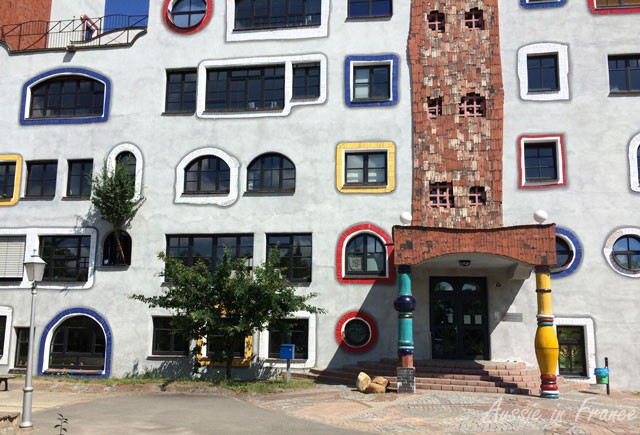
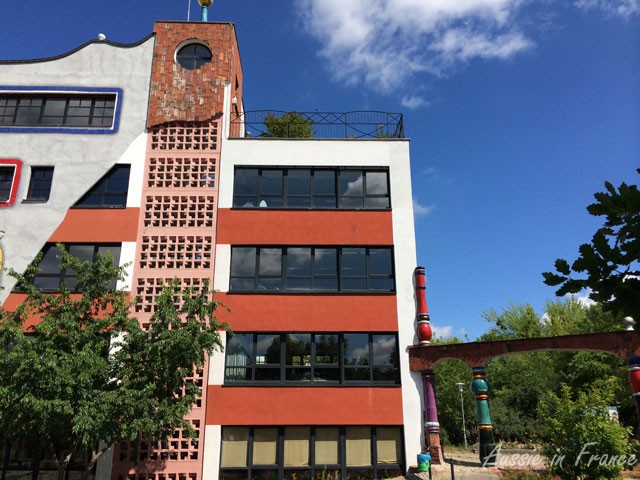
Close-up of the Martin Luther Gymnasium from inside the gate

According to the official website, the architect, Hundertwasser, a visionary and reponsible creator, mobilizes the power of his art in order to spread his message for a life in harmony with nature and individual creativity.

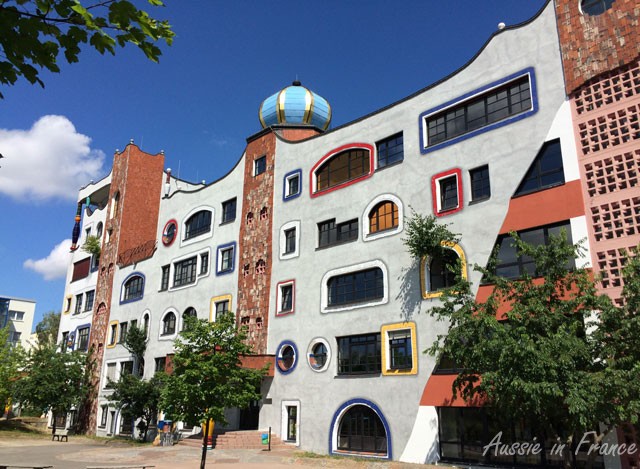
The façade taken from the right corner

He is a symbolic figure for a non-conformist way of life, a forerunner of environmental protection and an ambassador for a self-determined alternative existence.

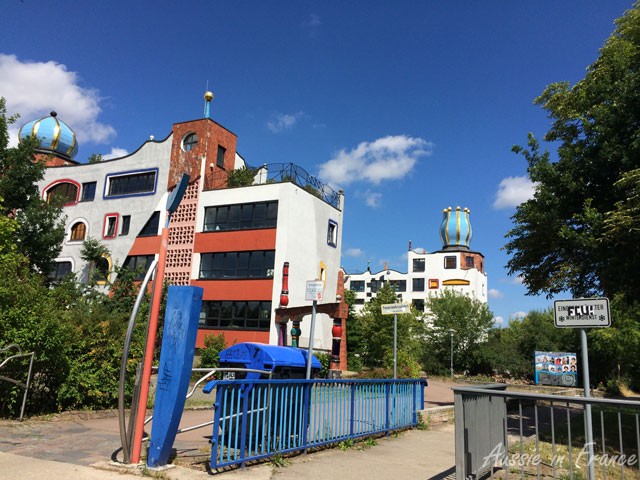
The gymnasium showing the second buildling behind
The gymnasium showing the second buildling behind. We didn’t like to venture  too far into the school.

Friedensreich Hundertwasser Regentag Dunkelbunt LiebeFrau was born in Vienna on 15th December 1928 and died on board the Queen Elizabeth 2 on 19th February 2000 on his way back to his home in New Zealand.

Close-up of the right side of the gymnasium

He was an artist, thinker and architect or, as he claimed in his manifesto of 24th January 1990, a doctor of architecture with a passion for water and colours. His deeply environmentalist message was expressed early on in everything he created: paintings, posters, postage stamps, houses, buildings, books.

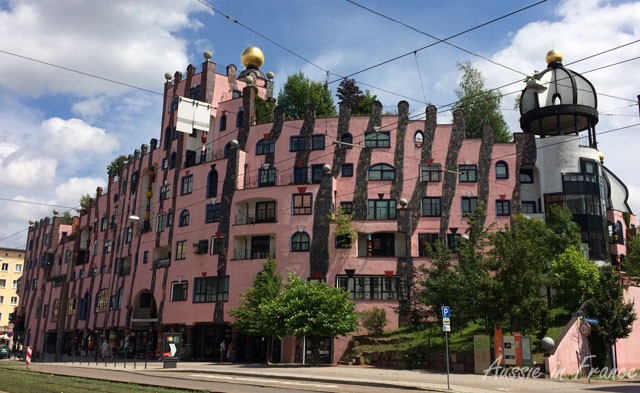
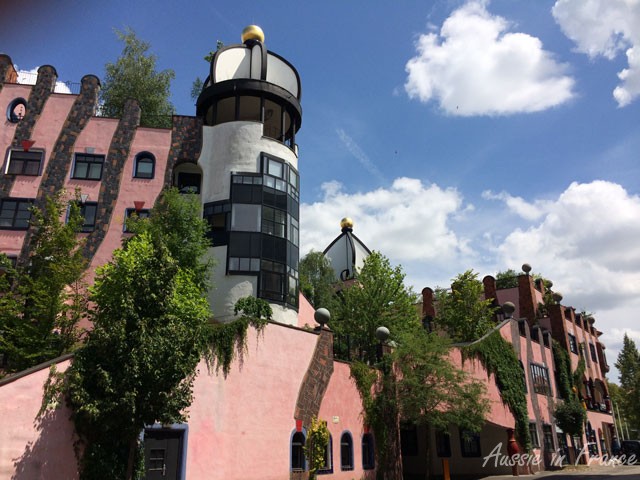
The street façade of the Green Citadel.

Our next stop is Magdeburg, It’s already 31°C. We park just in front of the Green Citadel, in the middle of the city, another work by Hundertwasser, and said to be his architectural masterpiece.

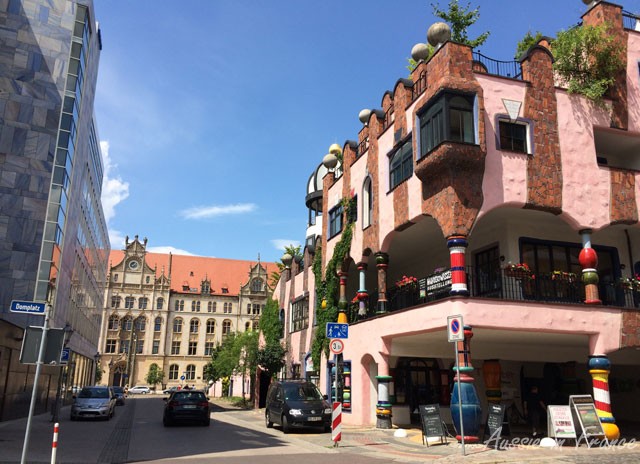
The right façade, showing a second modern building  and the Neogothic law courts and post office buildlng
The right façade, showing a second modern building and the Neogothic law courts and post office buildlng

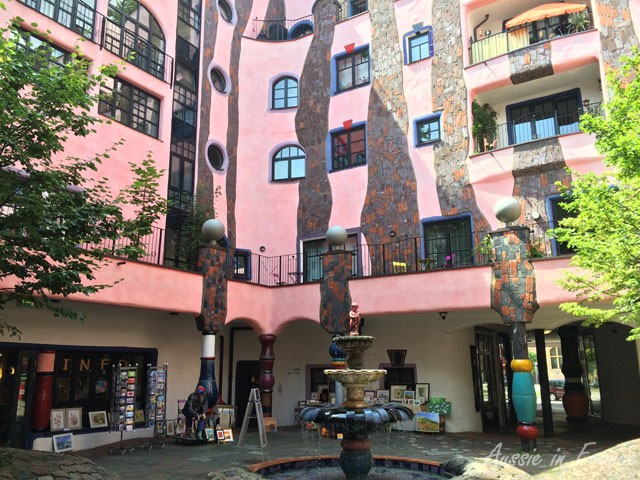
For me, it’s love at first sight: golden globes on top of towers, “tree tenants” looking out of “dancing windows”, meadows of wildflowers on the roofs, “foot melodies” taking strollers through the inner courtyard.

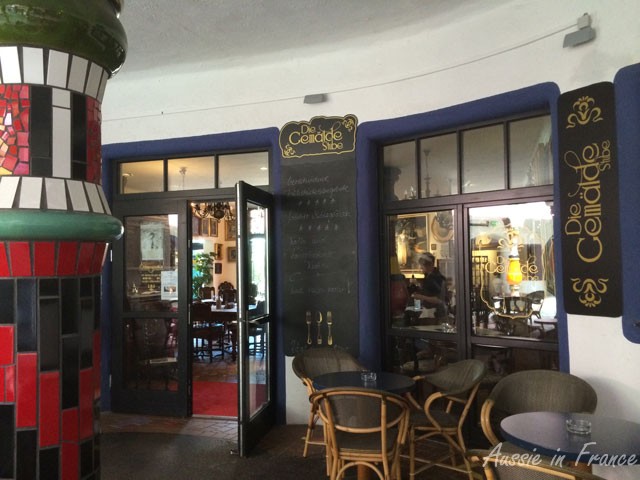
Die Gemälde Stube in the courtyard of the Green Citadel

We go round the other side and discover there is a restaurant inside, along with a hotel, shops and private apartments. The courtyard is cool and shady.

Fountain and shops in the main courtyard

For a total of twenty euros, we have a glass of Riesling and the dish of the day brought by a friendly waitress speaking excellent English. We take our time to soak in the atmosphere of the courtyard with its little fountain.

Pay-for public toilets, free if you eat at the restaurant

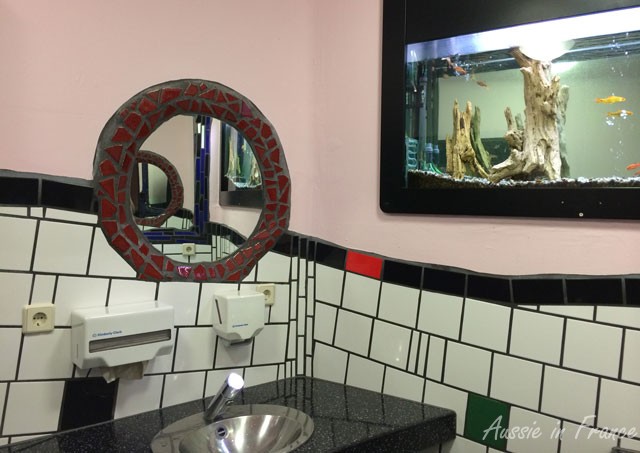
Even the pay-for public toilets are part of the decor. The waitress gives me a token.

A rear view of the Green Citadel

Reminiscent of the colourful works of the Gaudi in Barcelona, Hunterwasser’s buildings are quite unique. My photos do not do them justice.

OTHER POSTS ABOUT CYCLING IN GERMANY

Cycling in Germany – Tips & Tricks
Cycling in Germany #1 – Kobern-Gondorf on the Moselle
Cycling in Germany #2 – Rhine from Saint Goar to Lorch
Cycling in Germany #3 – Cochem to Zell on the Moselle
Cycling in Germany #4 – Koblenz where the Moselle meets the Rhine
Cycling in Germany #5 – Bad Schaugen to Pirna along the Elbe
Cycling in Germany #6 – Bastei Rocks, Honigen and over the border to Czech Republic 
Cycling in Germany #7 – Dresden: accommodation & car trouble and Baroque Treasure  
Cycling in Germany #8 – Dresden Neustadt: Kunsthof Passage, Pfund’s Molkerei, a broom shop & trompe l’oeil
Cycling in Germany #9 – Country roads around Niderlommatzsch on the Elbe
Cycling in Germany #10 – Meissen on the Elbe
Cycling in Germany #11 – Martin Luther Country: Torgau on the Elbe
Cycling in Germany #12 – Martin Luther Country: Wittenberg on the Elbe
Cycling in Germany #13 – Wörlitz Gardens and the beginning of neo-classicism in Germany
Cycling in Germany #14 – Shades of Gaudi on the Elbe: Hundertwasser
Cycling in Germany – Turgermünde, the prettiest village on the Elbe
Cycling in Germany #16 – Celle & Bremen
Cycling in Germany #17 – Windmills & Dykes
Cycling in Germany #18 – Painted façades from Hann. Münden to Höxter
Cycling in Germany #19 – Bernkastel on the Moselle: a hidden treasure
Cycling in Germany #20 – Trier & the Binoculars Scare
 
Cycling along the Danube – A Renaissance festival in Neuburg, Bavaria
Cycling along the Danube – Watch out for trains!
Cycling along the Danube – Regensburg & Altmuhle
Cycling along the Danube –  The Weltenburg Narrows
Cycling along the Danube – from its source to Ehingen
Cycling along the Danube – Ehingen to Ulm
Cycling along the Danube – Singmarigen to Beuron
Cycling along the Danube – Binzwangen to Mengen including  Zwiefalten
Eurovelo 6 – Cycling around Lake Constance
Eurovelo 6 – Moos to Stein am Rhein and Steckborn on Lake Constance
Heading home to France after a month’s cycling holiday

 Cycling in Germany #13: Wörlitz Gardens and the beginning of German Neo-classicism

After a standard breakfast, we set out on our bikes at about 10 am for Wörlitz, 25 k away. I’m feeling rather sluggish and the somewhat dull countryside doesn’t help. We’re finding it a little hard to adapt to the difference between the Elbe and the Danube where nearly every bend brings a change of scenary. We like the red brick buildings with their intricate details though.

Red-brick factory converted into flats
Red-brick factory converted into flats in Wittenberg

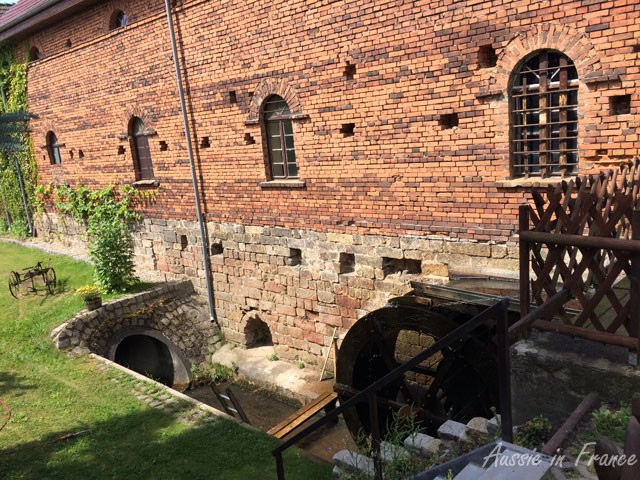
We eventually come to a pretty little village with a watermill and an excellent cappuccino at the top of a steep climb restores my energy.

Griebo waterwheel built in about 1845

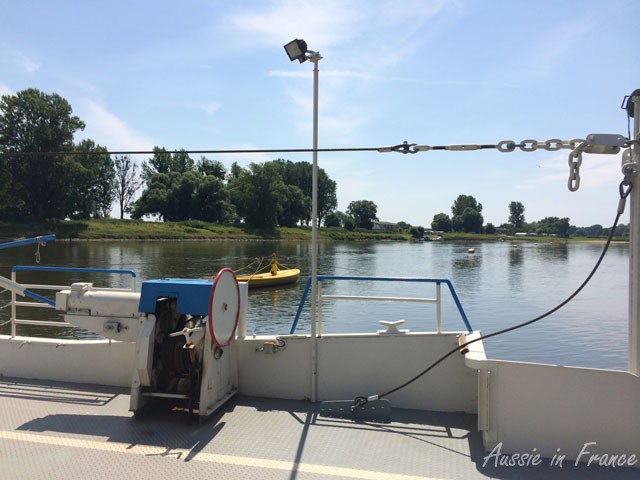
We arrive at Coswig and take the cable ferry. Jean Michel explains how the current and the length of cable are used to cross the river.

Cable and winch system on the car ferry

Worlitz is another 5 km along the river. By then it’s lunchtime so we follow the advice of Le Routard and eat at Grüner Baum. Jean Michel chooses fish and I go for the schweiner schnitzel which is excellent.

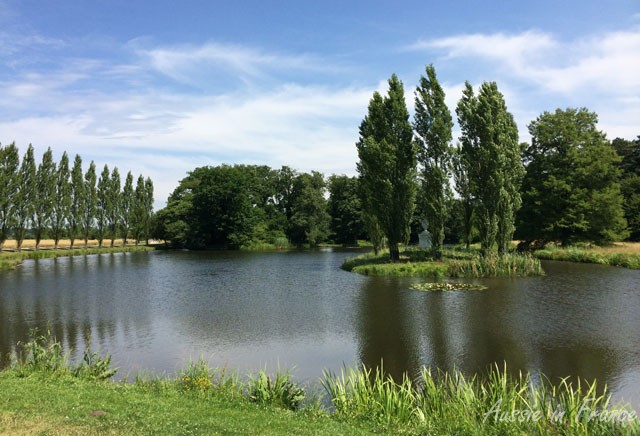
Wörlitz artificial lake

We leave our bikes in a courtyard next to the tourist office which is locked at night and set off for the castle on foot. We are delighted at what we see. The 277-acre Wörlitz Garden was mainly developed between 1764 and 1800 and is one of the largest and earliest landscape parks in Europe. It was masterminded by Prince Leopold III Friedrich Franz of Anhalt-Dessau and his architect friend Friedrich Wilhelm von Ermannsdorf.

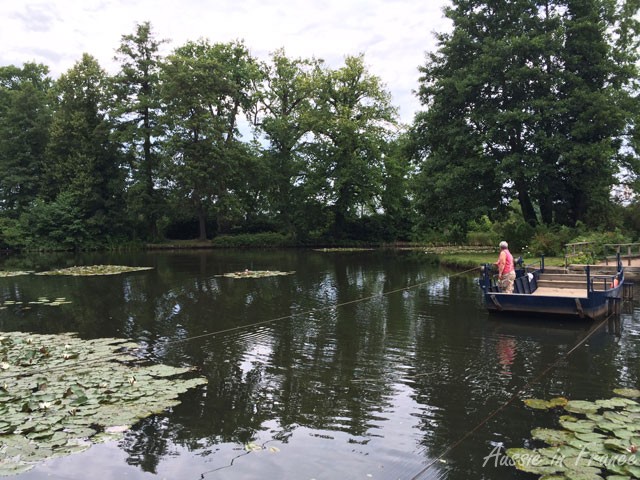
Cable ferries surrounded by waterlillies

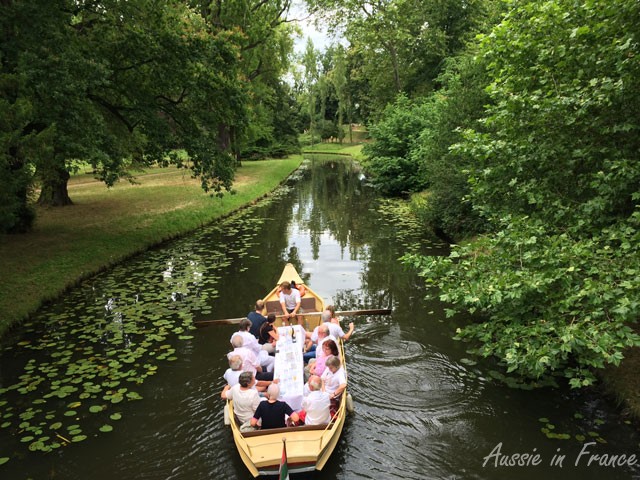
The two of them went on a grand tour of Europe which included England, France, Italy, Switzerland and Holland over a period of sixteen years and put their innovative ideas and ideals into practice in a series of buildings and naturalistic landscapes containing several lakes, around which there is no enclosure whatsoever. Small cable ferries take you across the water in the middle of waterlilies or you can take a so-called gondola like the German group below.

A gondola with a table in the middle for drinks!

We choose to visit the palace (landhaus), the Gothic House and Hamilton Villa, all of which have guided tours in German with, we are told, documentation in French and English.

Cable ferries surrounded by waterlillies

We love the gardens, which are very peaceful and bucolic and we love taking the little ferries.

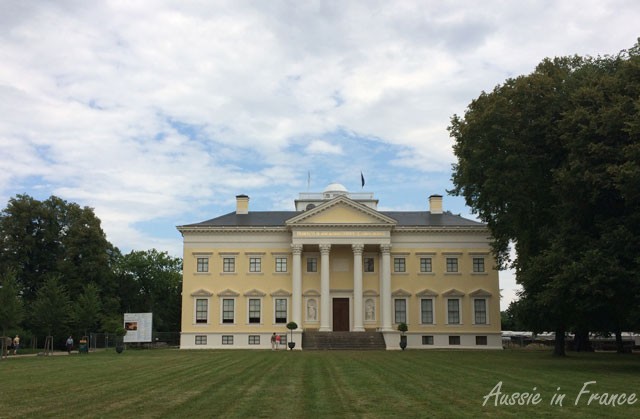
The landhaus
The landhaus, the first Neoclassical building in Germany

It turns out we are the only people on the tour of the landhaus and the guide only speaks German. She gives us documentation in French and tries her very hardest to share her enthusiasm about the house by articulating clearly and repeating the words we seem to recognise. At the end of the ¾ hour visit, I’m exhausted!

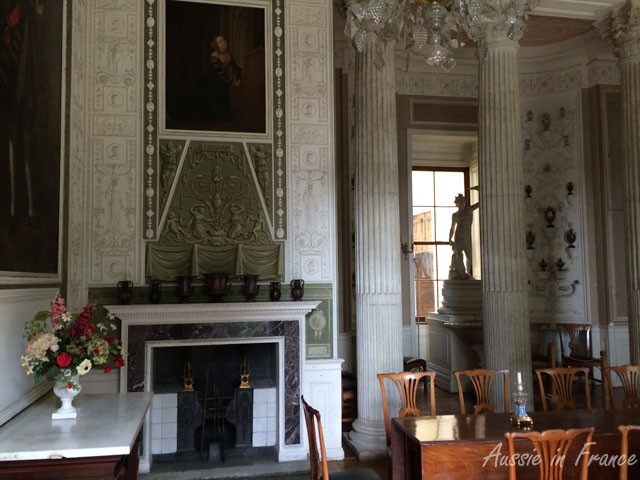
A most unusual fireplace inside the landhaus
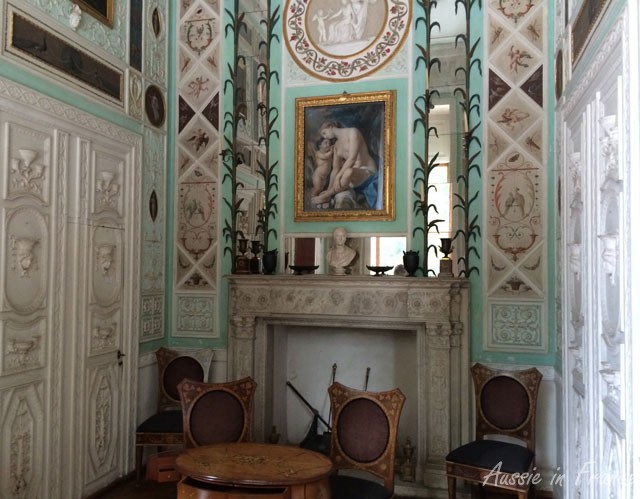
Another room in the landhaus
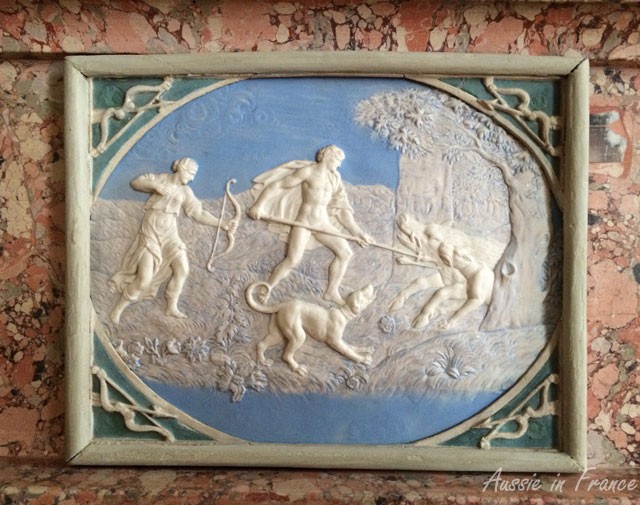
A Wedgwood plaque
A Wedgwood plaque

The landhaus, finished in 1773, was the first Neoclassical building in Germany. It contains a large collection of Wedgwood porcelain and many innovative features such as pull-out beds.

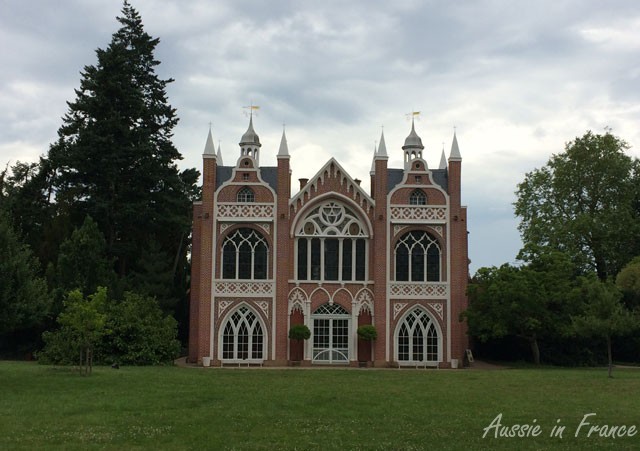
The Gothic House
The Gothic House, one of the first Neogothic structures on the European continent

Since it’s already 4 pm we only visit the Gothic House from the outside. Started by Erdmannsdorff in 1774 and modelled on Horace Walpole’s villa on Strawberry Hill, it was one of the first Neogothic structures on the continent.

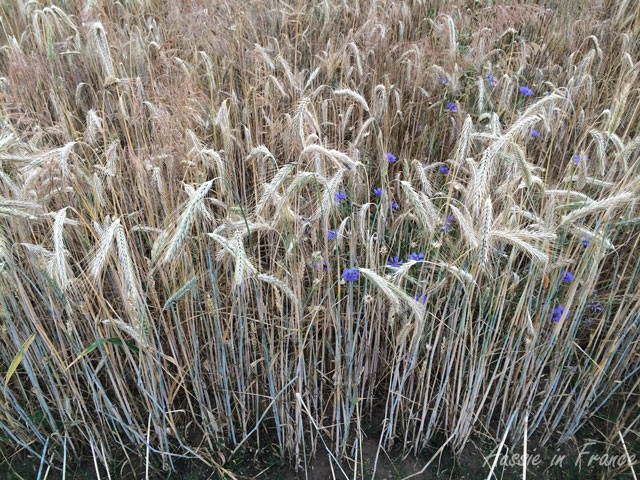
Cornflowers in a field of wheat, rye and barley

We start walking towards Hamilton Villa and the path takes us around a never-ending field of rye, wheat and barley.  An hour later we arrive at the Villa which is overrun by a wedding party we saw when we first arrived. We are told by a helpful man in English that there is another compulsory guided tour in German so decide not to enter after all. However, as we walk away, the man comes after us and gives us a brief rundown on the what there is to see and says we can explore on our own.

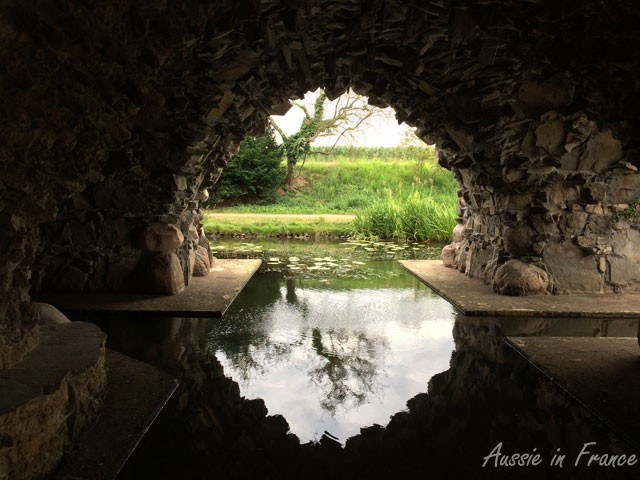
Looking out from under Vesuvius

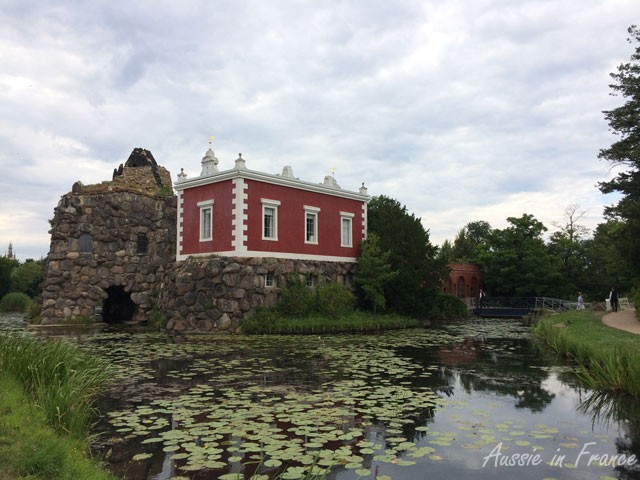
When Leopold III was off on his grand tour of Europe in 1760, he was capitivated by Mount Vesuvius and the newly discovered of Pompei so 22 years later he built his own little volcano on an island of local rock. A hollow cone at the top contained a chamber with three fireplaces and a roof with an artificial crater that could be filled with water.

Villa Hamilton next to Vesuvius

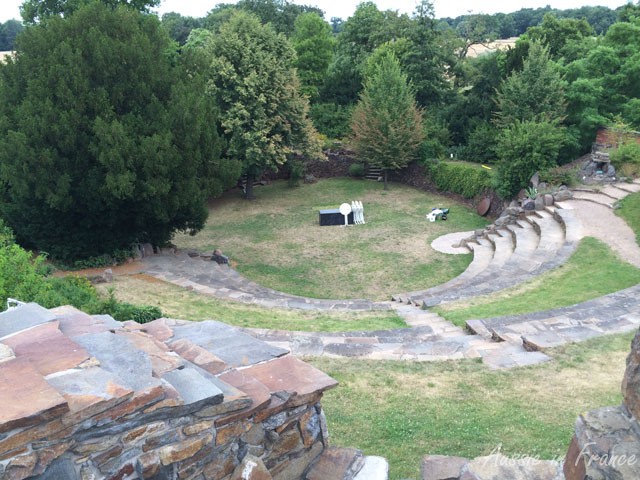
He then built a lake around the volcano and invited his friends over to watch the eruption. Ah, the advantages of being a rich prince! There is also an amphitheatre, Roman baths and various chambers underneath the volcano.

The Roman amphitheatre where the Prince held concerts

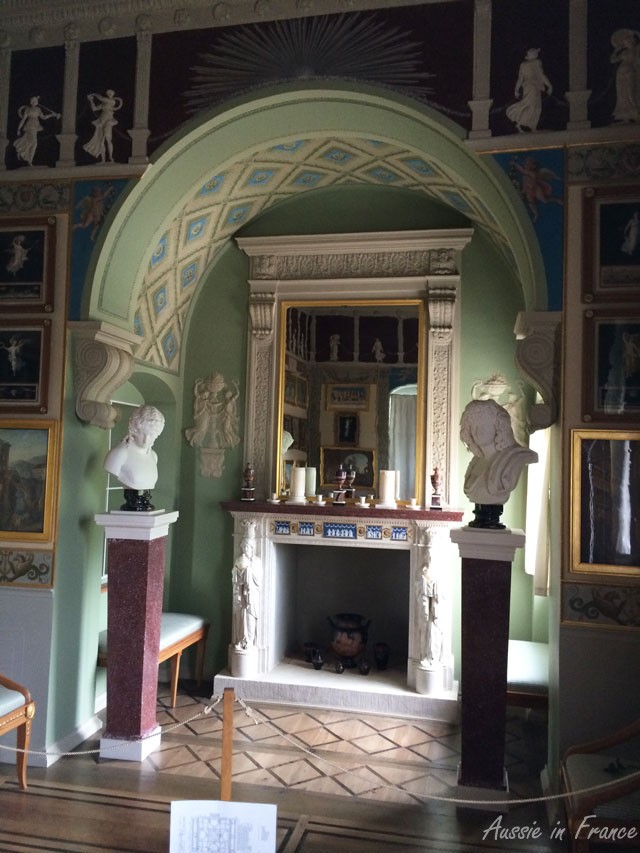
The little Neo-classical villa at the foot of the volcano symbolises the friendship between the prince and the British diplomat, Sir William Hamilton, who was also a geologist and collector of antiquities. It, too, was designed by Erdmannsdorff. We pay an extra 3 euro to take photos which I think is a little exaggerated given that the entrance is 4 euro per person.

The fireplace inside Villa Hamilton

We walk back along the artificial lake to the tourist office, suddenly worried that it might close before we get there. What will happen if our bikes are locked up for the night ? Fortunately, we make it with ten minutes to spare.  It’s 6 pm and we’ve still got a 2 hour ride home! It’s been a long day …

OTHER POSTS ABOUT CYCLING IN GERMANY

Cycling in Germany – Tips & Tricks
Cycling in Germany #1 – Kobern-Gondorf on the Moselle
Cycling in Germany #2 – Rhine from Saint Goar to Lorch
Cycling in Germany #3 – Cochem to Zell on the Moselle
Cycling in Germany #4 – Koblenz where the Moselle meets the Rhine
Cycling in Germany #5 – Bad Schaugen to Pirna along the Elbe
Cycling in Germany #6 – Bastei Rocks, Honigen and over the border to Czech Republic 
Cycling in Germany #7 – Dresden: accommodation & car trouble and Baroque Treasure  
Cycling in Germany #8 – Dresden Neustadt: Kunsthof Passage, Pfund’s Molkerei, a broom shop & trompe l’oeil
Cycling in Germany #9 – Country roads around Niderlommatzsch on the Elbe
Cycling in Germany #10 – Meissen on the Elbe
Cycling in Germany #11 – Martin Luther Country: Torgau on the Elbe
Cycling in Germany #12 – Martin Luther Country: Wittenberg on the Elbe
Cycling in Germany #13 – Wörlitz Gardens and the beginning of neo-classicism in Germany
Cycling in Germany #14 – Shades of Gaudi on the Elbe: Hundertwasser
Cycling in Germany – Turgermünde, the prettiest village on the Elbe
Cycling in Germany #16 – Celle & Bremen
Cycling in Germany #17 – Windmills & Dykes
Cycling in Germany #18 – Painted façades from Hann. Münden to Höxter
Cycling in Germany #19 – Bernkastel on the Moselle: a hidden treasure
Cycling in Germany #20 – Trier & the Binoculars Scare
 
Cycling along the Danube – A Renaissance festival in Neuburg, Bavaria
Cycling along the Danube – Watch out for trains!
Cycling along the Danube – Regensburg & Altmuhle
Cycling along the Danube –  The Weltenburg Narrows
Cycling along the Danube – from its source to Ehingen
Cycling along the Danube – Ehingen to Ulm
Cycling along the Danube – Singmarigen to Beuron
Cycling along the Danube – Binzwangen to Mengen including  Zwiefalten
Eurovelo 6 – Cycling around Lake Constance
Eurovelo 6 – Moos to Stein am Rhein and Steckborn on Lake Constance
Heading home to France after a month’s cycling holiday

Cycling in Germany #12 – Luther Country : Wittenberg

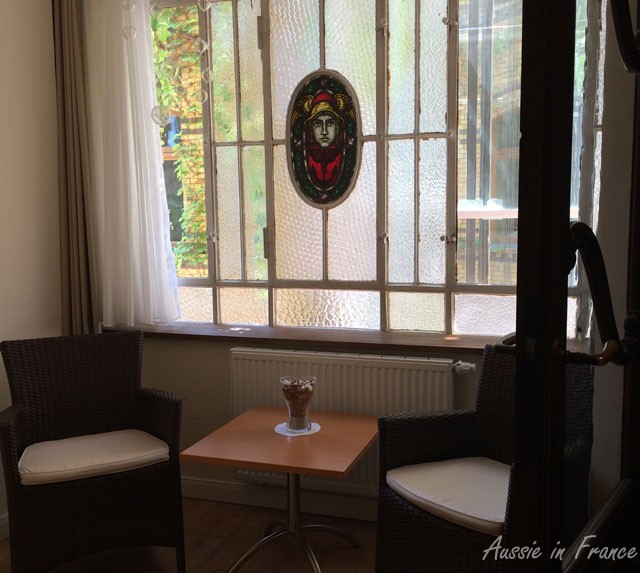
We arrive at our Black Bear Hotel (Schwarzer Baer) about 2 pm in stifling heat and appreciate the coolness of the rooms. We don’t have a terrace but we have a little closed-in verandah afffair with a leadlight window which is very neat. Even neater is the fact that the curtains are of the total blackout sort. The room will not be flooded with light from 4.30 am onwards as it was at the Radhaus!

The leadlight in our alcove at Stathotel Wittenberg Schwarzer Baer

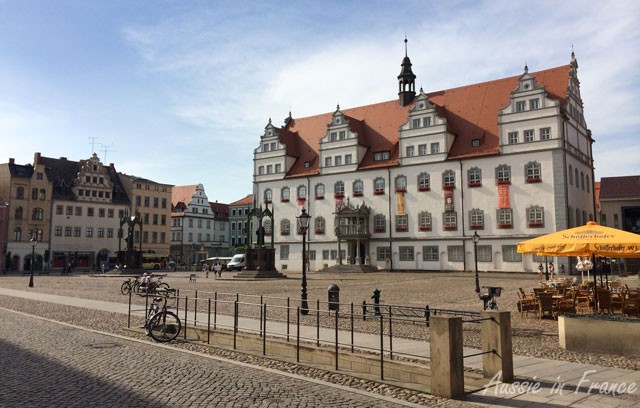
After a long siesta, we explore the town. It is very attractive with its renovated Marktplatz appropriately adorned with statues of Luther and fellow reformer Melanchthon. Like most town centres, Wittenberg is pedestrian (and bike) only.

Rathaus with statues of Luther and Melanthon

Unlike Dresden, Wittenberg was mostly spared in the Second World War, but it doesn’t have many historical buildiings because it was bombarded by the Austrians in 1760 during the Seven Years War during the Prussian occupation. It was later occupied by the French in 1806 and stormed by the Prussian Army the next year.
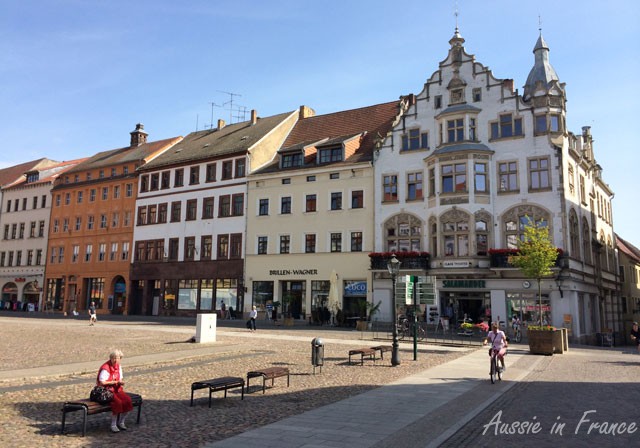
Other side of Marktplatz

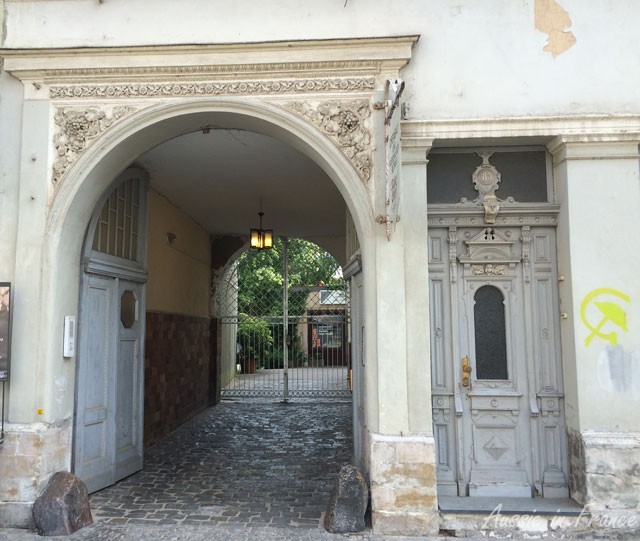
As we walk through the streets, we nevertheless discover several 16th century entries some of which have been restored, others not.

Renaissance doorway
Renaissance doorway

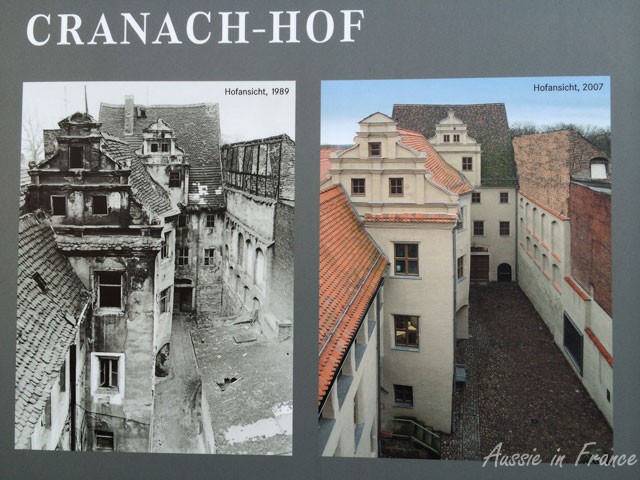
In front of one building, we see a before and after photo of the house where the painter Cranach once lived. The difference is stunning.

Restored courtyard before and after

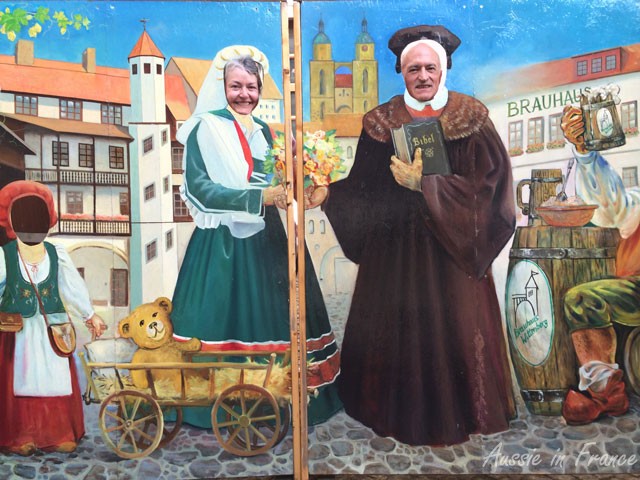
We also see a lot of leafy courtyards often containing biergartens. In one, there is a scene painted on a wooden panel representing life-sized figures of Katharina and Martin Luther and two of their children, with holes instead of faces so Jean Michel and I take turns to stick our heads through. A man seated at a nearby table comes over and offers to take our photo!

Katharina and Martine Luther

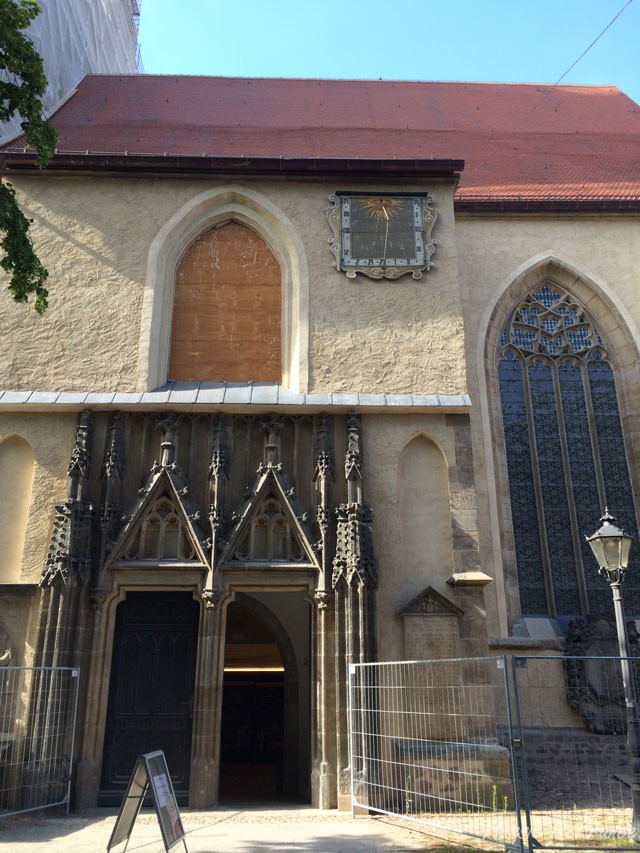
Unfortunately both of the town’s churches are being renovated in preparation of the 500th anniversary of the Reformation which will take place in 2017.

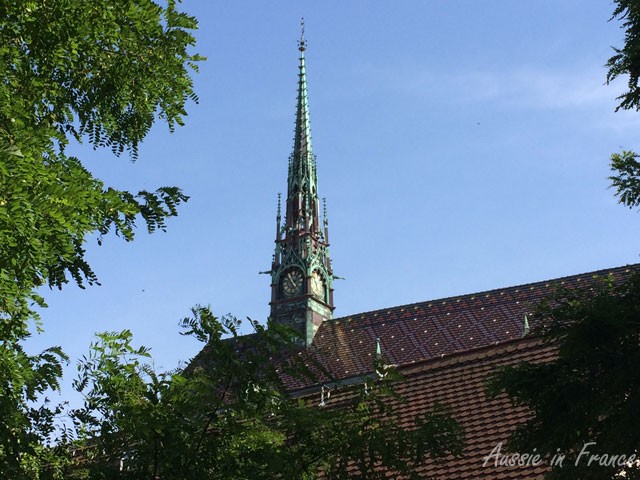
The roof of the ?
The roof of the Schlosskirche, the only part not being restored, taken from the little memorial garden next to the Tourist Information office.

In 1517, Luther nailed his 95 theses on the doors of the Schlosskirche which was badly damaged by fire in 1760 as a result of the Austrian bombardment. It was rebuilt and later restored at the end of the 19th century. The orignal wooden doors were replaced in 1858 by bronze doors with the Latin text of the theses. Inside are the tombs of Luther and Melanchthon, but we are not able to go inside.

The Parish Church of Saint Mary's, also undergoing renovation
The Parish Church of Saint Mary’s, also undergoing renovation

The parish Church of Saint Mary is also being renovated so we aren’t able to see Lucas Cranach the Elder’s Last Supper, Baptism and Confession. There’s a slide show though so we are able to get an idea of what we are missing.

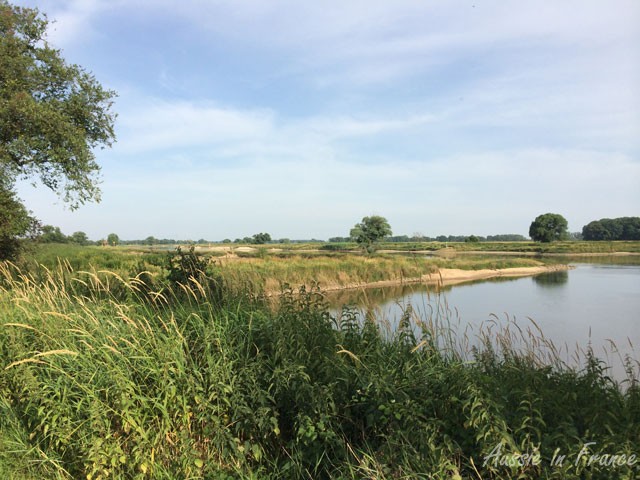
Marshland around the Elbe

As the heat has died down somewhat, we pack a picnic dinner (it’s an intermitttent fast day) and cycle 15 kilometers to Elster. The countryside is rather marshy, quite different from what we have seen along the Elbe so far.

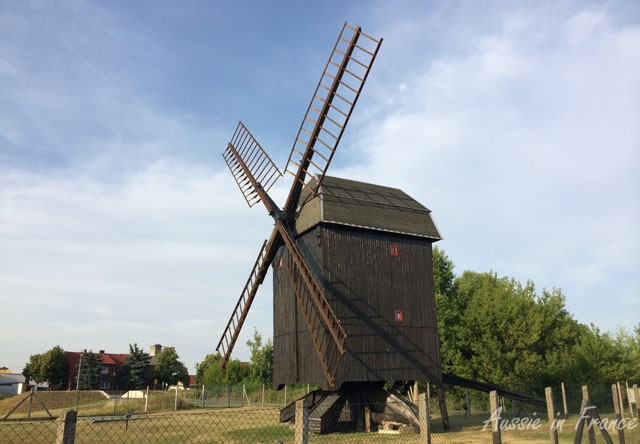
Bockwindmühle built in 1895 and restored in 1995

As we get closer to Elster, we see a restored windmill with a picnic table next to it but without a drop of shade!

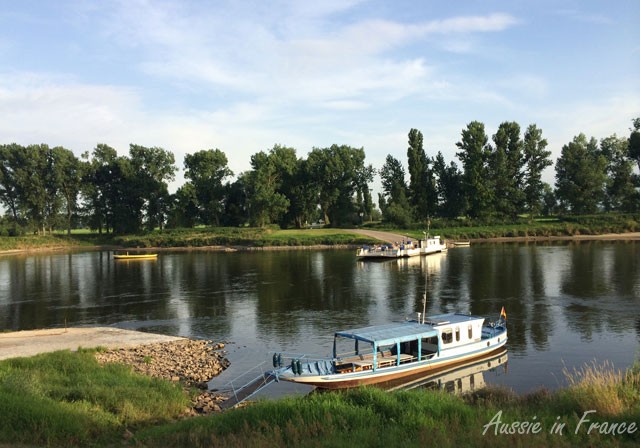
Ferry at Elster
Ferry at Elster

We end up having our picnic on a bench in the centre of Elster, watching the ferryman closing up for the night with the France-Germany soccer match in the background. When its over, there is no reaction from the adults but the children clap. Hmm.

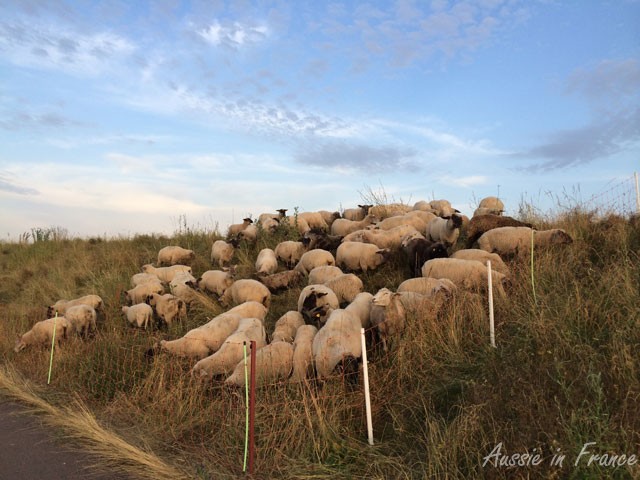
Sheep on the levee
Sheep on the levee

On the way home, I stop to take a photo of the sheep scattered along the levee. Within one minute, they’re all clustered together, baaing at me! By the time we get back to the Black Bear, we are exhausted which explains why yesterday’s post only talked about Torgau.

OTHER POSTS ABOUT CYCLING IN GERMANY

Cycling in Germany – Tips & Tricks
Cycling in Germany #1 – Kobern-Gondorf on the Moselle
Cycling in Germany #2 – Rhine from Saint Goar to Lorch
Cycling in Germany #3 – Cochem to Zell on the Moselle
Cycling in Germany #4 – Koblenz where the Moselle meets the Rhine
Cycling in Germany #5 – Bad Schaugen to Pirna along the Elbe
Cycling in Germany #6 – Bastei Rocks, Honigen and over the border to Czech Republic 
Cycling in Germany #7 – Dresden: accommodation & car trouble and Baroque Treasure  
Cycling in Germany #8 – Dresden Neustadt: Kunsthof Passage, Pfund’s Molkerei, a broom shop & trompe l’oeil
Cycling in Germany #9 – Country roads around Niderlommatzsch on the Elbe
Cycling in Germany #10 – Meissen on the Elbe
Cycling in Germany #11 – Martin Luther Country: Torgau on the Elbe
Cycling in Germany #12 – Martin Luther Country: Wittenberg on the Elbe
Cycling in Germany #13 – Wörlitz Gardens and the beginning of neo-classicism in Germany
Cycling in Germany #14 – Shades of Gaudi on the Elbe: Hundertwasser
Cycling in Germany – Turgermünde, the prettiest village on the Elbe
Cycling in Germany #16 – Celle & Bremen
Cycling in Germany #17 – Windmills & Dykes
Cycling in Germany #18 – Painted façades from Hann. Münden to Höxter
Cycling in Germany #19 – Bernkastel on the Moselle: a hidden treasure
Cycling in Germany #20 – Trier & the Binoculars Scare
 
Cycling along the Danube – A Renaissance festival in Neuburg, Bavaria
Cycling along the Danube – Watch out for trains!
Cycling along the Danube – Regensburg & Altmuhle
Cycling along the Danube –  The Weltenburg Narrows
Cycling along the Danube – from its source to Ehingen
Cycling along the Danube – Ehingen to Ulm
Cycling along the Danube – Singmarigen to Beuron
Cycling along the Danube – Binzwangen to Mengen including  Zwiefalten
Eurovelo 6 – Cycling around Lake Constance
Eurovelo 6 – Moos to Stein am Rhein and Steckborn on Lake Constance
Heading home to France after a month’s cycling holiday

Cycling in Germany #11 – Martin Luther Country: Torgau

Today, we’re off to Wittenberg Lutherstadt as it now seems to be called everywhere. It’s 100 km away and there is only one point of interest in-between – Torgau. We had thought of passing via Leipzig but the photos on google images aren’t very encouraging. We get off to a false start because our Radhaus in Niederlommatzsch doesn’t take Visa card and we have to drive about 10 km to get some cash.

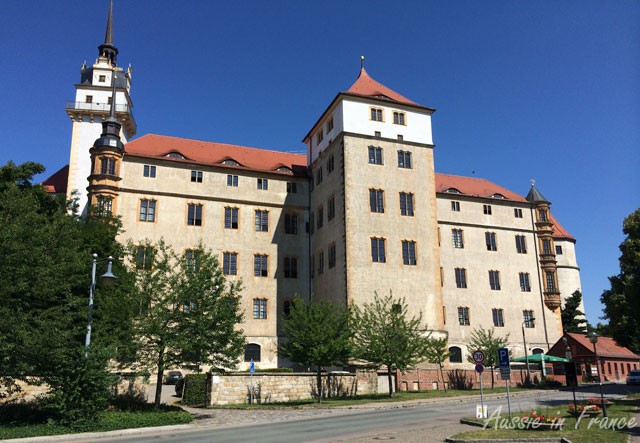
Tolenfels Castle was built in 1534.
Hartenfels Castle was built in 1534.

The first thing we see when we approach Torgau is Hartenfels Castle overlooking the Elbe. We park in the shade and put on our straw hats because it is already 28°C in the shade at 11 am!  As soon as we walk into the walled town, we see preparations going on. A Renaissance festival like the one we accidentally went to last year in Neuburg on the Danube is obviously in the making.

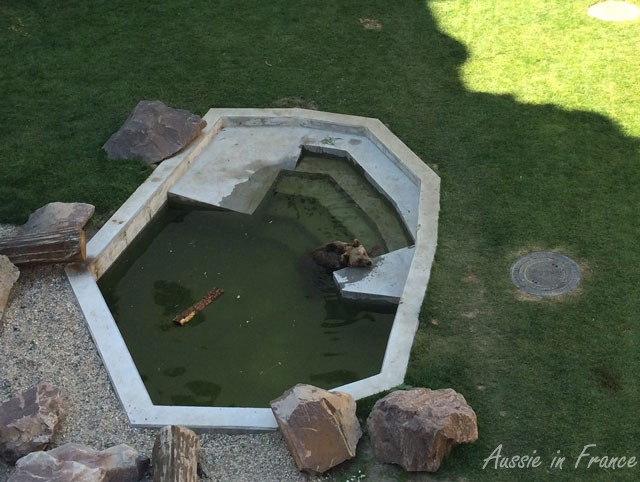
The unexpected bear pit

Unfortunately, the castle is undergoing renovation but we walk towards the courtyard which is open to the public. We go across a moat and I look down. What do I see? A brown bear! Poor thing, it looks very hot, even in its pool. It reminds me of Bern in Switzerland which also has a bear pit. We later see there is a second bear who is also completely flaked out.

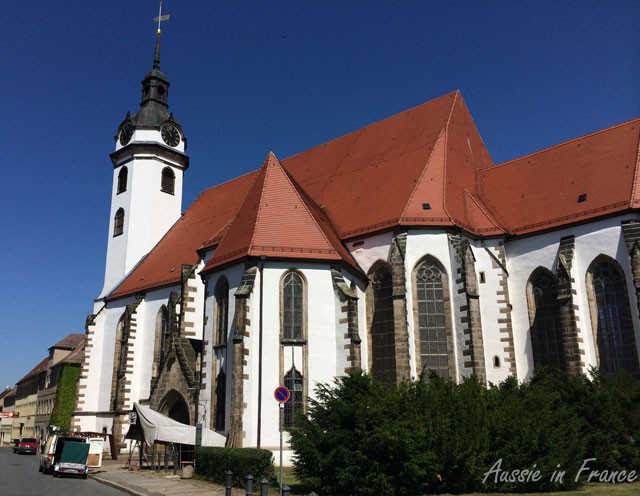
Marienkirche - you can see some of the Renaissance festival preparations
Marienkirche – you can see some of the Renaissance festival preparations

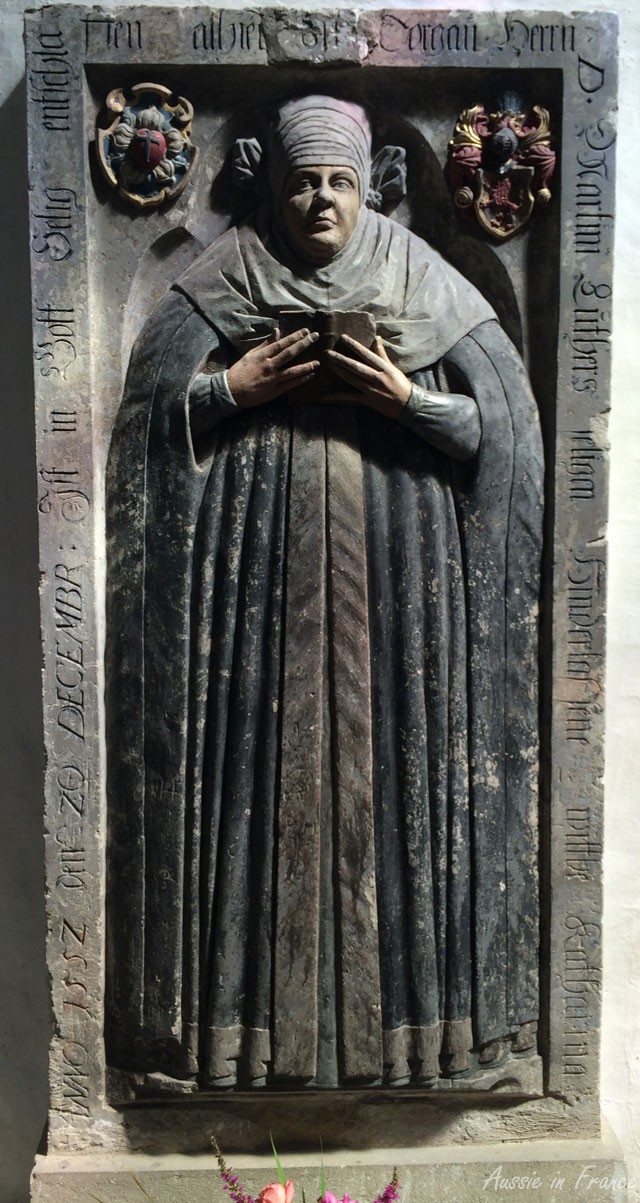
We visit Marienkirche in which there is a mural tombstone of Katharina Luther who died in Torgau. Now that’s an interesting story. Katharina’s parents were of noble birth but had fallen on hard times, so they put her in a convent at the age of 5. When she was 24, she and 11 other nuns escaped from the convent to Wittenberg, encouraged by Martin Luther’s denunciation of convents and monasteries. There she met her future husband, 16 years older than her. They had six children and lived happily ever after. Five hundred years later, there is a Katharina’s Day celebration just for her.

Mural tombstone of Katharina Luther

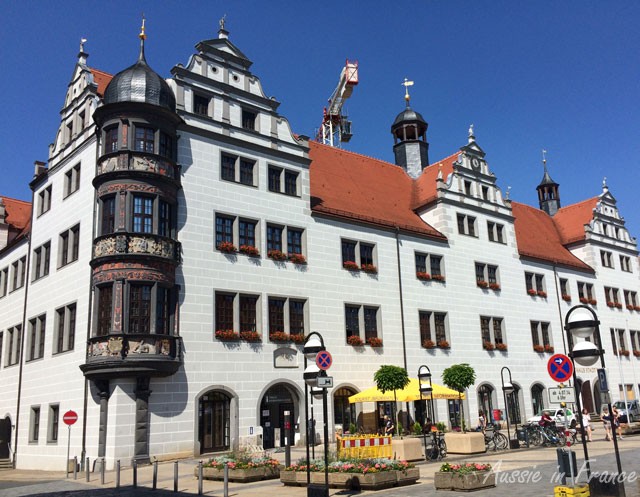
Torgau is a pretty little town with a large market square. A white rathaus takes up most of one side and is flanked by well-retored buildings around the other three sides. There is a lot of renovation going on and it’s obviously trying to capitalise on nearby Wittenberg and the Martin Luther connection.
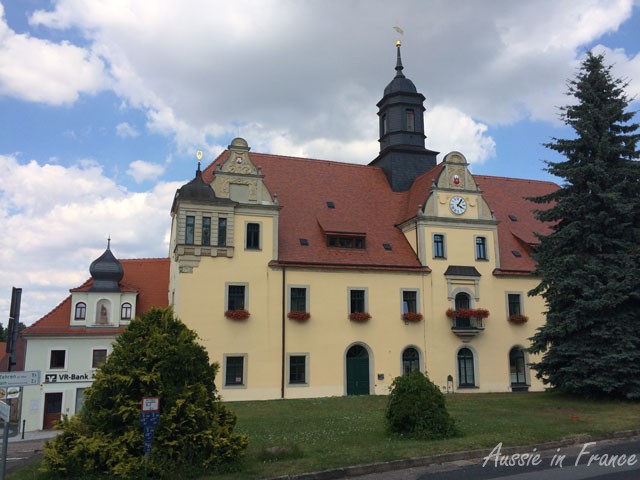
Torgau Rathaus
Torgau Rathaus

After a nice cold Diet Coke (Coca-Cola Light in German), we continue our route to Wittenburg. Stay tuned.

OTHER POSTS ABOUT CYCLING IN GERMANY

Cycling in Germany – Tips & Tricks
Cycling in Germany #1 – Kobern-Gondorf on the Moselle
Cycling in Germany #2 – Rhine from Saint Goar to Lorch
Cycling in Germany #3 – Cochem to Zell on the Moselle
Cycling in Germany #4 – Koblenz where the Moselle meets the Rhine
Cycling in Germany #5 – Bad Schaugen to Pirna along the Elbe
Cycling in Germany #6 – Bastei Rocks, Honigen and over the border to Czech Republic 
Cycling in Germany #7 – Dresden: accommodation & car trouble and Baroque Treasure  
Cycling in Germany #8 – Dresden Neustadt: Kunsthof Passage, Pfund’s Molkerei, a broom shop & trompe l’oeil
Cycling in Germany #9 – Country roads around Niderlommatzsch on the Elbe
Cycling in Germany #10 – Meissen on the Elbe
Cycling in Germany #11 – Martin Luther Country: Torgau on the Elbe
Cycling in Germany #12 – Martin Luther Country: Wittenberg on the Elbe
Cycling in Germany #13 – Wörlitz Gardens and the beginning of neo-classicism in Germany
Cycling in Germany #14 – Shades of Gaudi on the Elbe: Hundertwasser
Cycling in Germany – Turgermünde, the prettiest village on the Elbe
Cycling in Germany #16 – Celle & Bremen
Cycling in Germany #17 – Windmills & Dykes
Cycling in Germany #18 – Painted façades from Hann. Münden to Höxter
Cycling in Germany #19 – Bernkastel on the Moselle: a hidden treasure
Cycling in Germany #20 – Trier & the Binoculars Scare
 
Cycling along the Danube – A Renaissance festival in Neuburg, Bavaria
Cycling along the Danube – Watch out for trains!
Cycling along the Danube – Regensburg & Altmuhle
Cycling along the Danube –  The Weltenburg Narrows
Cycling along the Danube – from its source to Ehingen
Cycling along the Danube – Ehingen to Ulm
Cycling along the Danube – Singmarigen to Beuron
Cycling along the Danube – Binzwangen to Mengen including  Zwiefalten
Eurovelo 6 – Cycling around Lake Constance
Eurovelo 6 – Moos to Stein am Rhein and Steckborn on Lake Constance
Heading home to France after a month’s cycling holiday

Cycling in Germany #10: Meissen

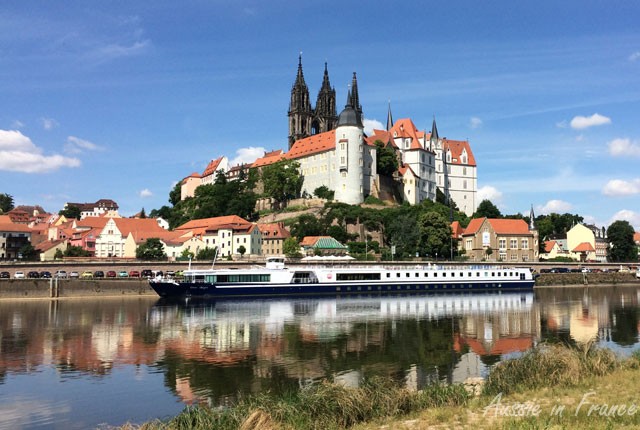
We’ve left Meissen for the best day weather-wise. It’s already 16°C by the time we set out at 9.45, taking the ferry in front of Elbklause, our “bike hotel” across the Elbe, and the sky is bright blue. It’s 14 km to Meissen mainly along the river. The castle can be seen quite a long way away.

Meissen from the cycle path on the east bank of the Elbe

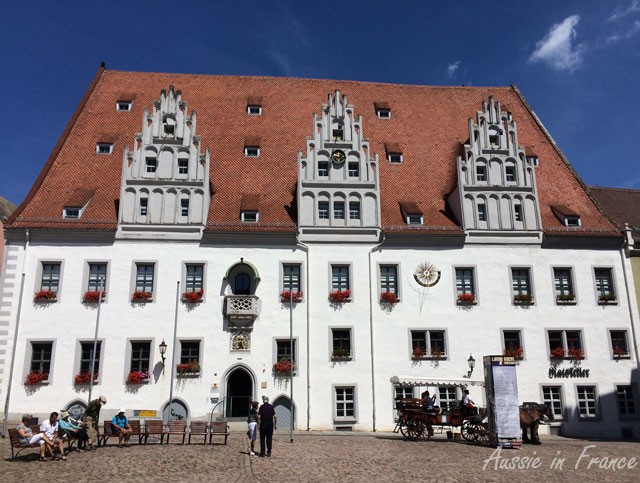
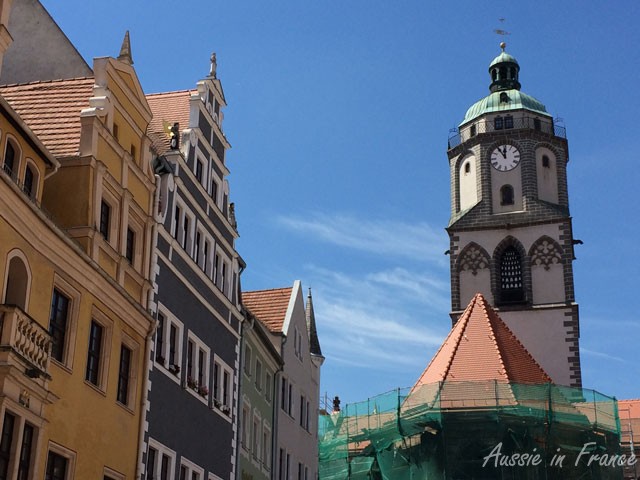
Marktplatz, flanked on one side by the Rathaus (town hall) and on the other by Frauenkirche church, is our first stop. We hear the porcelain bells chiming. Unfortunately the church is undergoing renovation so we can’t visit the inside.

The Town Hall (Rathaus) in Meissen
The Town Hall (Rathaus) in Meissen with its sundial
The bell tower of Frauenkirche with its porcelain bells

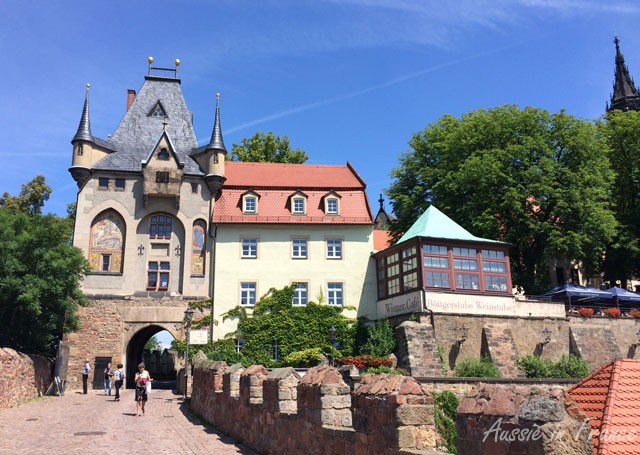
We wheel our bikes up to the late Gothic Albrechtsburg Castle. We pass several historical houses on the way. On the right of the gatehouse, I see what looks like a great restaurant for lunch.

The entrance to the Albrech.
The entrance to Albrechtsburg Castle.

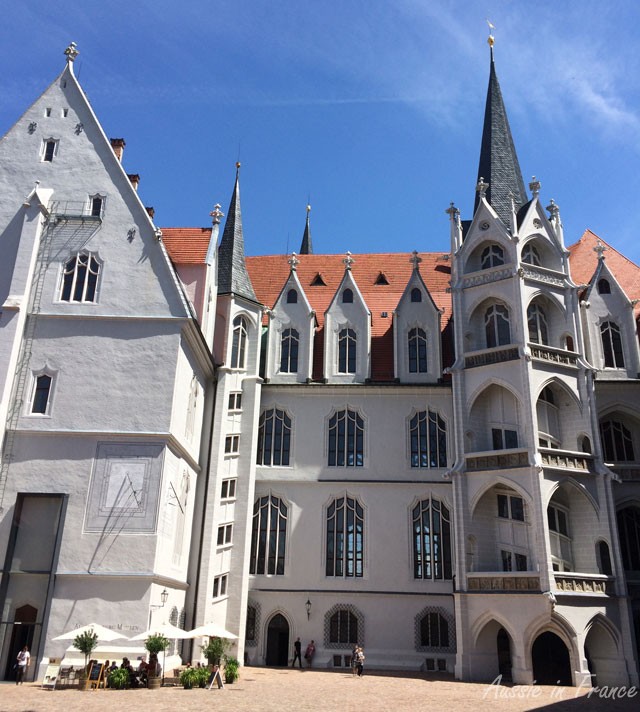
Built in the 15th century, the castle is considered to be Germany’s oldest castle. There is a double sundial on the façade which also has a spiral staircase with a Renaissance-like gallery that reminds me of Blois.

Castle façade with its double sundial and spiral staircase

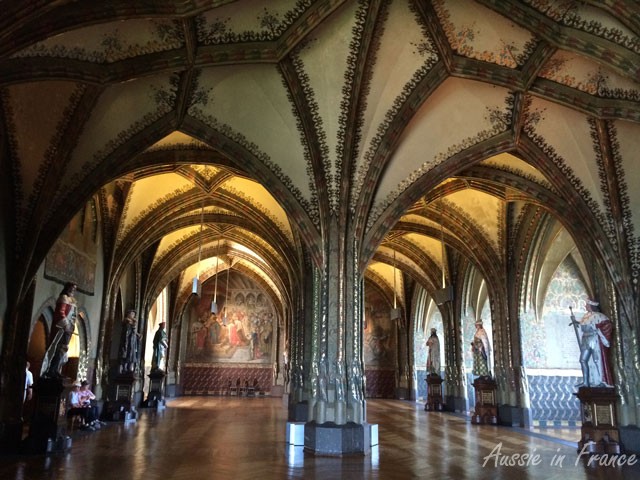
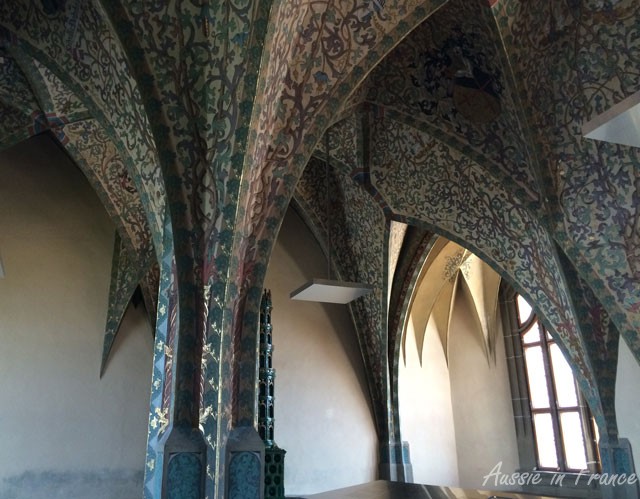
The most striking feaures are the vaulting and the wall paintings. There is no furniture. There are not many people so our extra 2 euro per person to take photos proves to be worth it.

The main banquet room
The smaller vaults are most unusual
The smaller vaults on the right are most unusual
A royal wedding for political reasons - the bride was 9 and the groom 17!
A royal wedding for political reasons – the bride was 9 and the groom 17!
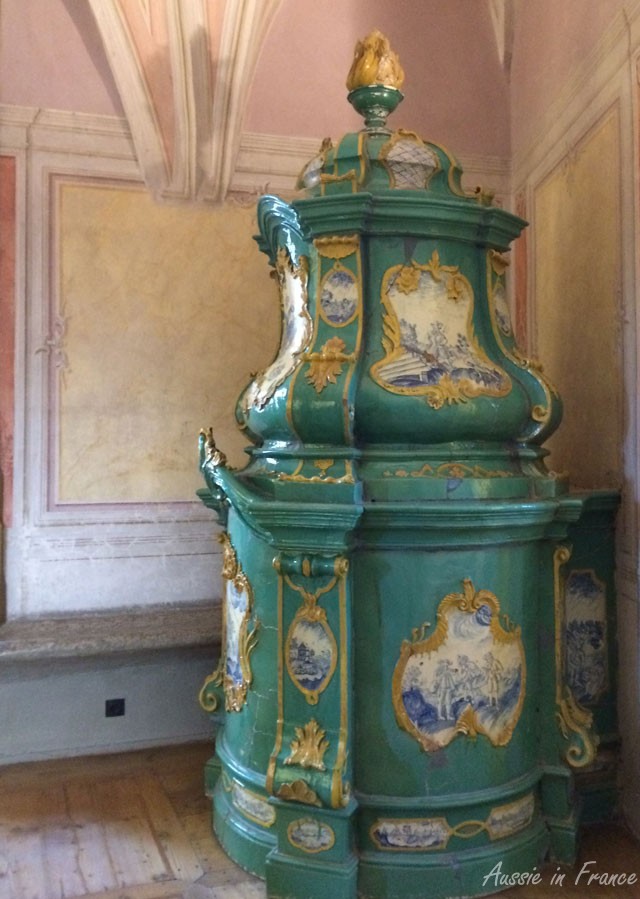
One of several porcelain stoves. There are practically no fireplaces.

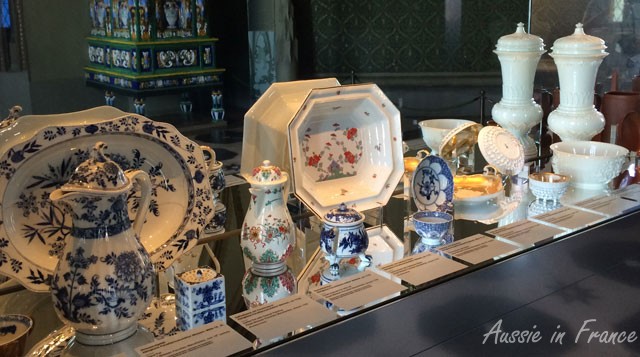
Meissen, of course, is famous for its 300-year old porcelain faatory. There are several showcases throughout the castle displaying a fine collection. We initially thought we’d visit the factory but after seeing the pieces displayed here, we decide not to go.
One of the porcelain showcases in the castle
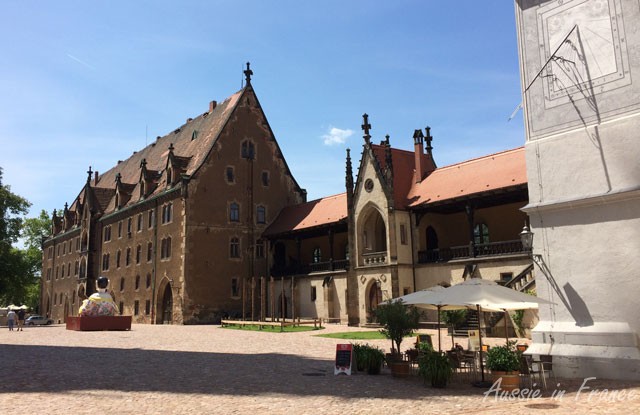
THe buildings on the right of the courtyard leaving the castle.
The buildings on the right of Dom Platz leaving the castle with one of the sundials on the right.

By now it’s after 1.30 pm but that’s not a problem here. It seems you can get a meal any time. We locate the restaurant I saw on the way up and take a table overlooking the city and river.

The view from the Burgkeller which is also a Romantik Hotel

Although the waitress doesn’t speak any English, the menu has a translation so we order pork medallions with chanterelle mushrooms (pfifferlings – isn’t that a great word?) and potato cakes. A bit salty, but otherwise excellent. We had our usual Meissen white wine which tasted like riesling.

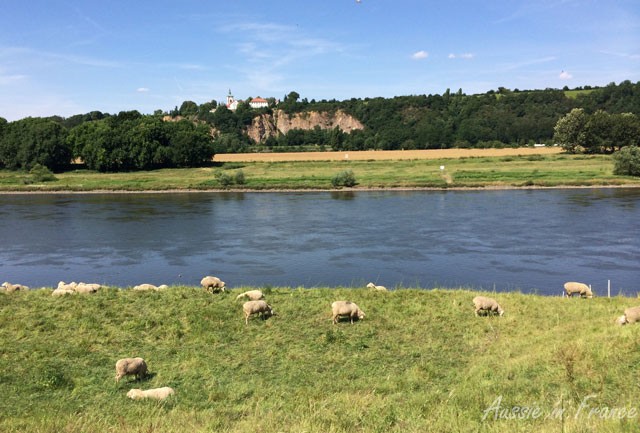
Sheep grazing right on the edge of the Elbe opposite Diera
Sheep grazing right on the edge of the Elbe opposite Zadel

The weather is as warm as promised – 23°C. We’re soon back at our hotel, eating Schwarzwald (black forest) ice-cream sundaes on the shady terrace of the hotel restaurant. Tomorrow we’re off to Wittenberg. And to help you locate the different places we go to, I’ve added a Google Map widget on the right.

OTHER POSTS ABOUT CYCLING IN GERMANY

Cycling in Germany – Tips & Tricks
Cycling in Germany #1 – Kobern-Gondorf on the Moselle
Cycling in Germany #2 – Rhine from Saint Goar to Lorch
Cycling in Germany #3 – Cochem to Zell on the Moselle
Cycling in Germany #4 – Koblenz where the Moselle meets the Rhine
Cycling in Germany #5 – Bad Schaugen to Pirna along the Elbe
Cycling in Germany #6 – Bastei Rocks, Honigen and over the border to Czech Republic 
Cycling in Germany #7 – Dresden: accommodation & car trouble and Baroque Treasure  
Cycling in Germany #8 – Dresden Neustadt: Kunsthof Passage, Pfund’s Molkerei, a broom shop & trompe l’oeil
Cycling in Germany #9 – Country roads around Niderlommatzsch on the Elbe
Cycling in Germany #10 – Meissen on the Elbe
Cycling in Germany #11 – Martin Luther Country: Torgau on the Elbe
Cycling in Germany #12 – Martin Luther Country: Wittenberg on the Elbe
Cycling in Germany #13 – Wörlitz Gardens and the beginning of neo-classicism in Germany
Cycling in Germany #14 – Shades of Gaudi on the Elbe: Hundertwasser
Cycling in Germany – Turgermünde, the prettiest village on the Elbe
Cycling in Germany #16 – Celle & Bremen
Cycling in Germany #17 – Windmills & Dykes
Cycling in Germany #18 – Painted façades from Hann. Münden to Höxter
Cycling in Germany #19 – Bernkastel on the Moselle: a hidden treasure
Cycling in Germany #20 – Trier & the Binoculars Scare
 
Cycling along the Danube – A Renaissance festival in Neuburg, Bavaria
Cycling along the Danube – Watch out for trains!
Cycling along the Danube – Regensburg & Altmuhle
Cycling along the Danube –  The Weltenburg Narrows
Cycling along the Danube – from its source to Ehingen
Cycling along the Danube – Ehingen to Ulm
Cycling along the Danube – Singmarigen to Beuron
Cycling along the Danube – Binzwangen to Mengen including  Zwiefalten
Eurovelo 6 – Cycling around Lake Constance
Eurovelo 6 – Moos to Stein am Rhein and Steckborn on Lake Constance
Heading home to France after a month’s cycling holiday

Cycling in Germany #8 : Dresden Neustadt – Kunsthof Passage, Pfund’s Molkerei, a broom shop &  trompe l’oeil

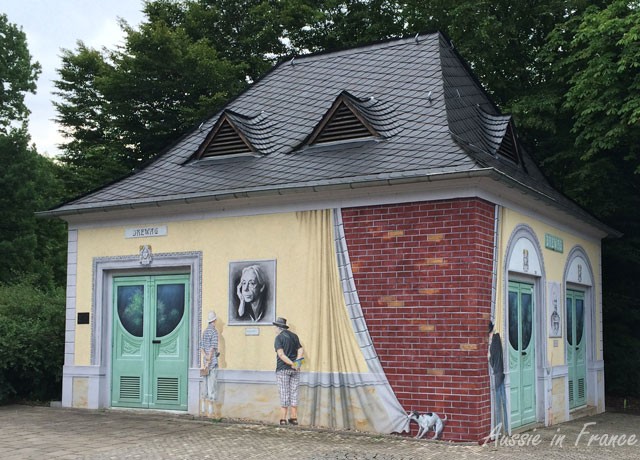
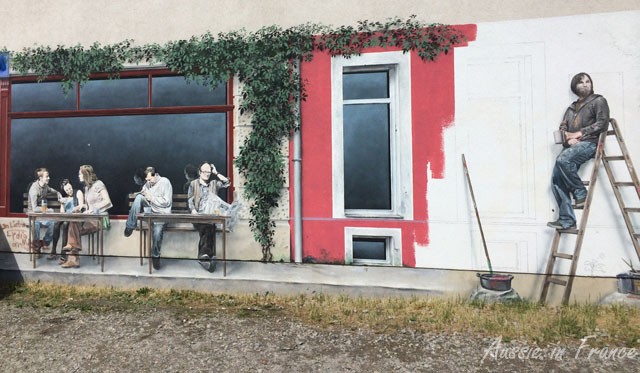
We’re up early due to the lack of shutters – it’s light at 5 am at the moment – so we have breakfast, pack up and cross the bridge to Neustadt or New Town as opposed to Altstadt or Old Town where we’re been staying. On the way, we see a wonderful trompe l’œil building. The Germans love painting their façades but I haven’t seen anything this sophisticated before.

Trompe l'oeil house along the Elb on the Altstadt side of Dresden
Trompe l’oeil house along the Elb on the Altstadt side of Dresden

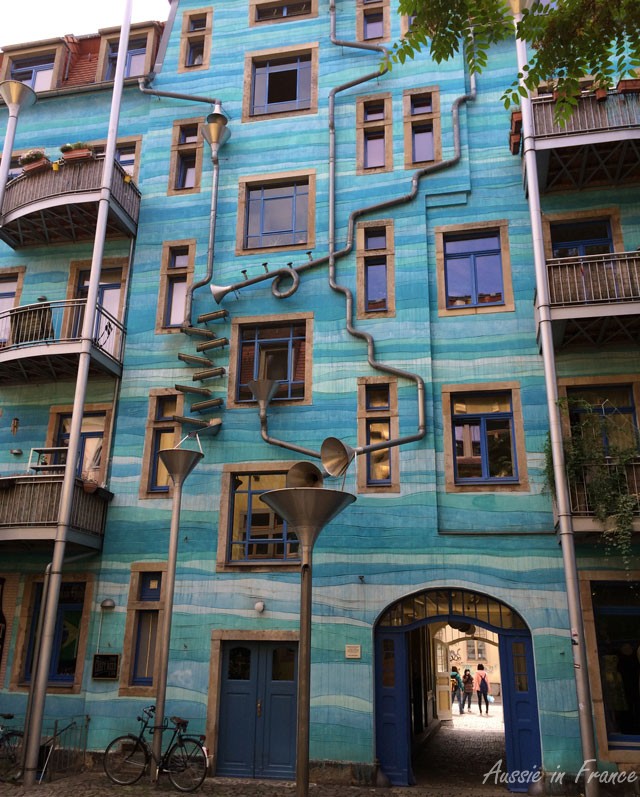
After reading Anda’s post about the singing drain pipes in Travel Notes and Beyond, I am eager to see Kunsthof Passage in the student district. We are not disappointed.

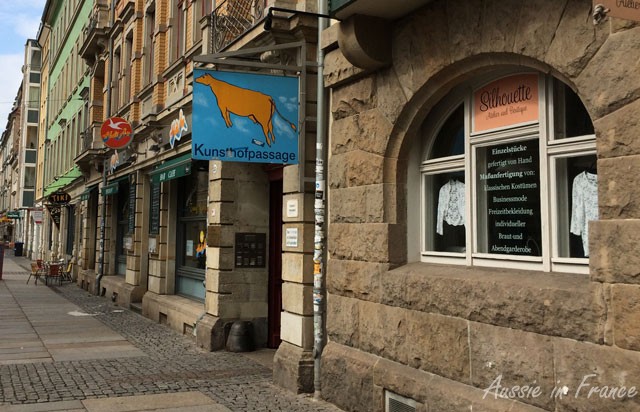
The entrance to Kunsthofpassage

To quote Anda, “Kunsthofpassage is one of Dresden’s best kept secrets. The passage is actually a series of five small courtyards  – not visible from the street – that were turned into an art experiment, called the Ginkgo project. A group of artists – sculptors and designers – took a bunch of old buildings and redesigned their façades, giving each building and courtyard specific motif and a theme of its own. The project was completed in 2001.”  I shall let you read Anda’s post for more details and just provide a few photos.

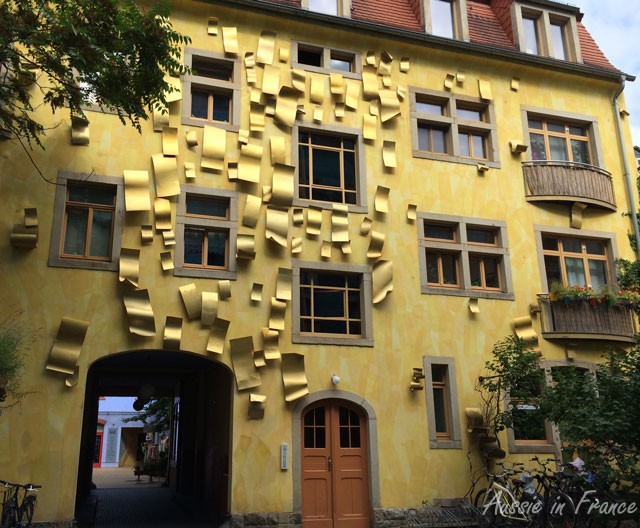
The Courtyard of the Light decorated with metal mirrors
The Singing Drainpipes that make music wwhen it rains
The Courtyard of Metamorphoses

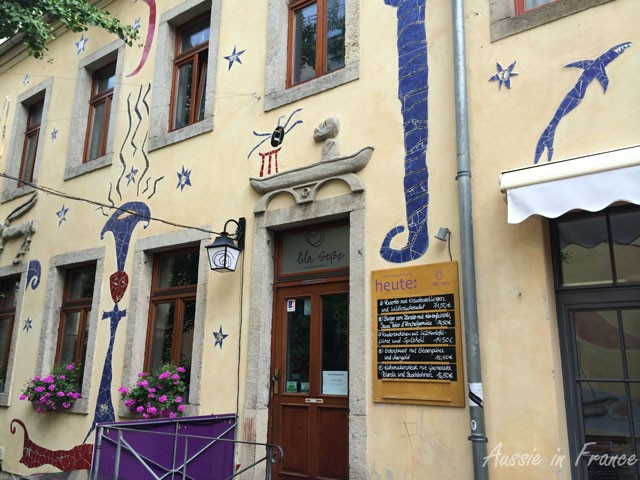
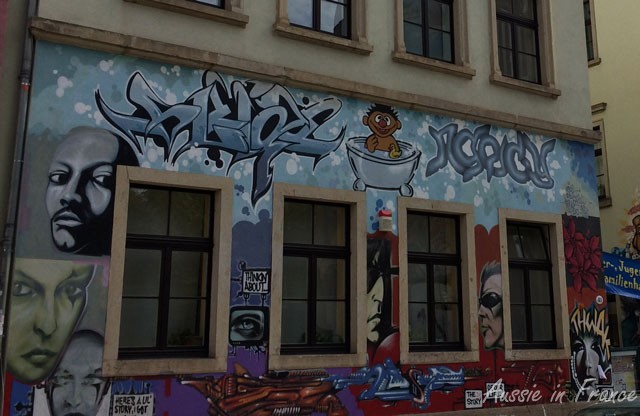
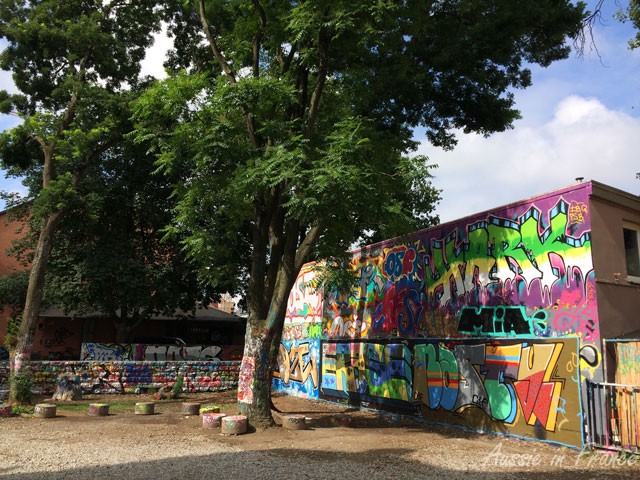
We walk through the passage and out onto the other side, then turn left twice. On the way, we see lots of other fun street art. We are reminded of Budapest in particular.

The façade of Louise's which appears to be a kindergarten
The façade of Louise’s which appears to be a kindergarten
More artwork in Neustadt
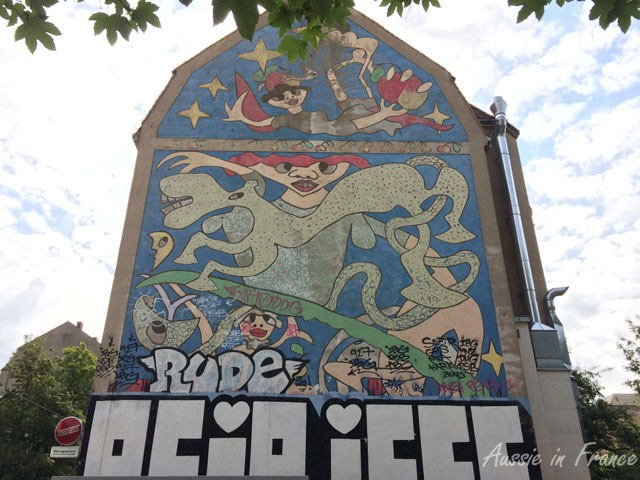
A wonderful way to decorate a blind wall

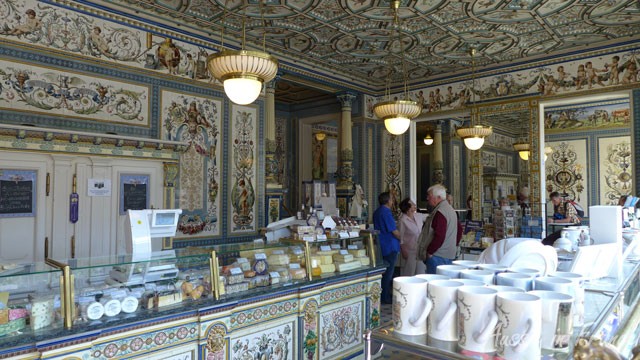
Our next destination is Pfund’s Molkerei, founded in 1880 and said to be the world’s most beautiful dairy shop. Its hand-painted tiles and enamelled sculptures are all handmade by Villeroy & Boch. You can buy wine, cheese and other dairy products and eat in the upstairs café restaurant. It is, indeed, very beautiful.

Inside Pfund's Molkerai dairy shop
Inside Pfund’s Molkerai dairy shop

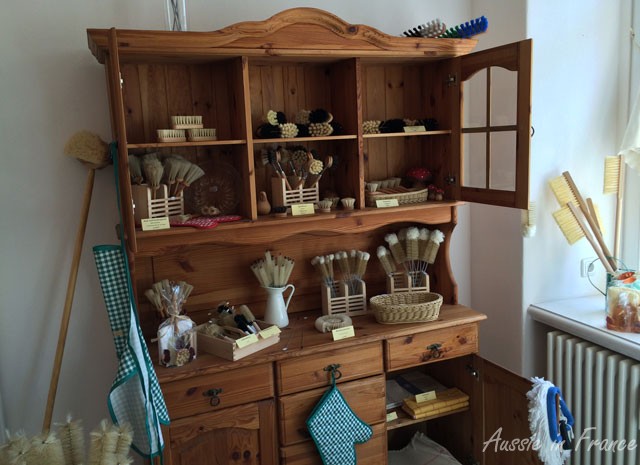
But next door is more fun – a brush and broom store. I could buy half the shop. Germany is a very clean country and I can see why. There is a broom for every household task! We settle for some wooden clothes pegs, a nail brush and a sort of mini-rake to clean Velcro. The saleswoman is very enthusiastic about all her products and gives us several demonstrations.

Inside the broom shop

We go back to the car park further along the street where there is another exceptional example of trompe d’oeil. It seems wasted on a parking lot!

Trompe l'oeil all in the parking lot on Bautznerstrasse
Trompe l’oeil all in the parking lot on Bautznerstrasse

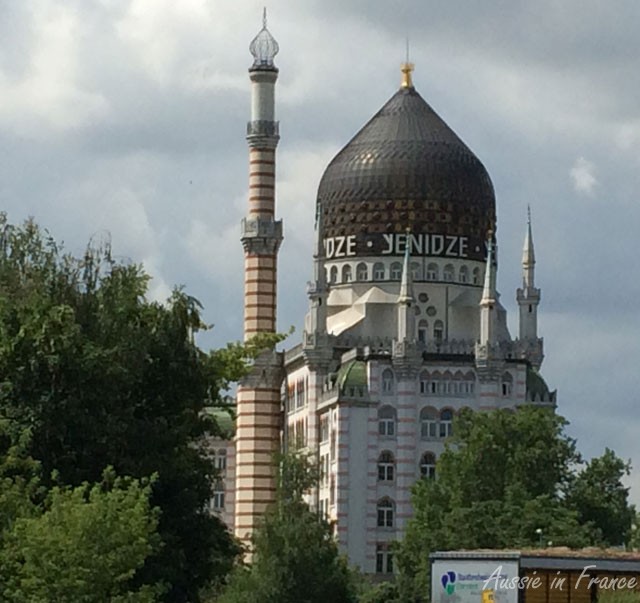
As we drive towards Meissen, we see a very impressive mosque which is surprising because I haven’t seen any women in veils or other signs of Muslims, but then, we haven’t ventured any further than Altstadt, Neustadt and Renault! I learn later from Anda that Yenidze is a former cigarette factory that functions now as an office building. “Yenidze” was the name of a tobacco company that imported tobacco from Yenidze, in Greece. So there you go!

The Dresden Mosque
Yenidze, once a cigarette factory and now an office building
Bürsten-Manufaktur Dresden, Bautzner Strasse 77, Dresden Neustadt, www.buerstenmanufaktur-dresden.de
Pfund’s Molkerei, Bautzner Strasse 79, Dresden Neustadt
Kunsthof Passage, between 23 Görlitzerstrasse and 70 Alaunstrasse, Dresden Neustadt
 

OTHER POSTS ABOUT CYCLING IN GERMANY

Cycling in Germany – Tips & Tricks
Cycling in Germany #1 – Kobern-Gondorf on the Moselle
Cycling in Germany #2 – Rhine from Saint Goar to Lorch
Cycling in Germany #3 – Cochem to Zell on the Moselle
Cycling in Germany #4 – Koblenz where the Moselle meets the Rhine
Cycling in Germany #5 – Bad Schaugen to Pirna along the Elbe
Cycling in Germany #6 – Bastei Rocks, Honigen and over the border to Czech Republic 
Cycling in Germany #7 – Dresden: accommodation & car trouble and Baroque Treasure  
Cycling in Germany #8 – Dresden Neustadt: Kunsthof Passage, Pfund’s Molkerei, a broom shop & trompe l’oeil
Cycling in Germany #9 – Country roads around Niderlommatzsch on the Elbe
Cycling in Germany #10 – Meissen on the Elbe
Cycling in Germany #11 – Martin Luther Country: Torgau on the Elbe
Cycling in Germany #12 – Martin Luther Country: Wittenberg on the Elbe
Cycling in Germany #13 – Wörlitz Gardens and the beginning of neo-classicism in Germany
Cycling in Germany #14 – Shades of Gaudi on the Elbe: Hundertwasser
Cycling in Germany – Turgermünde, the prettiest village on the Elbe
Cycling in Germany #16 – Celle & Bremen
Cycling in Germany #17 – Windmills & Dykes
Cycling in Germany #18 – Painted façades from Hann. Münden to Höxter
Cycling in Germany #19 – Bernkastel on the Moselle: a hidden treasure
Cycling in Germany #20 – Trier & the Binoculars Scare
 
Cycling along the Danube – A Renaissance festival in Neuburg, Bavaria
Cycling along the Danube – Watch out for trains!
Cycling along the Danube – Regensburg & Altmuhle
Cycling along the Danube –  The Weltenburg Narrows
Cycling along the Danube – from its source to Ehingen
Cycling along the Danube – Ehingen to Ulm
Cycling along the Danube – Singmarigen to Beuron
Cycling along the Danube – Binzwangen to Mengen including  Zwiefalten
Eurovelo 6 – Cycling around Lake Constance
Eurovelo 6 – Moos to Stein am Rhein and Steckborn on Lake Constance
Heading home to France after a month’s cycling holiday

Cycling in Germany #9 – Country Roads around Niederlommatzsch on the Elbe

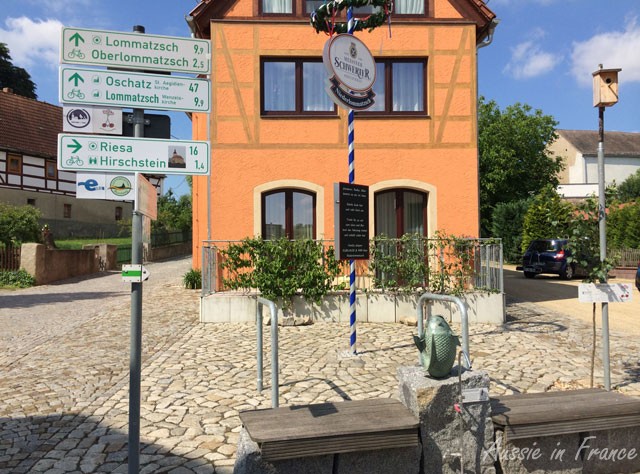
We reach Elbklause, our Radhaus (bike hotel), in Niederlommatzsch around 12.30. Our room is new, large and airy with a wonderful view of the Elb. The wifi works immediately and doesn’t require endless codes. We are directly on the bike path.

Our bike hotel on the bike path

The hotel’s restaurant on the river looks very inviting. We order two local white wines – a Muller-Thurgau and a goldriesling. We prefer the Muller-Thurgau. I work out from the all-German menu that pork is the local speciality so we order pork cutlets. They are king-size and served with a large variety fresh vegetables – one of the best meals so far.

The view from the terrace of the restaurant and from our window

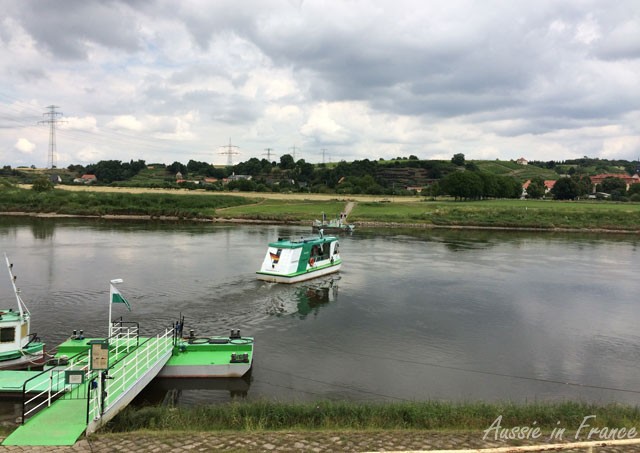
We set off on our bikes for Riesa, theoretically 14 km away but we end up doing 36 km there and back due to a detour. The ferry is just outside our hotel so we begin with the east bank. Having gone for two days without cycling in Dresden has improved my saddle soreness. Good thing because the initial paths are a sort of crazy paving which is even worse than cobblestones.

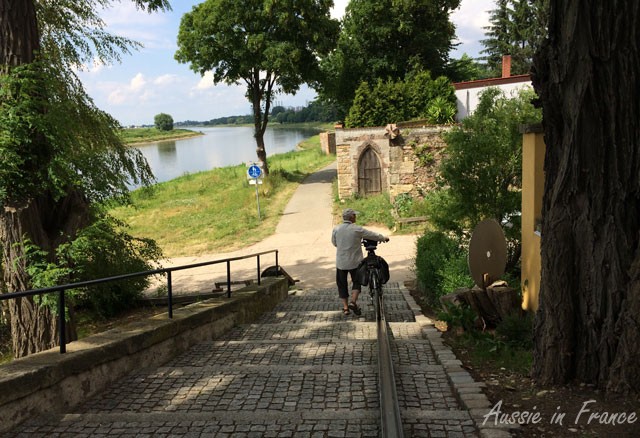
The cobblestones are bad enough but the crazy pavement (not shown here) is worse. Sometimes, we have to take our bikes down a steep slope with a bike runner

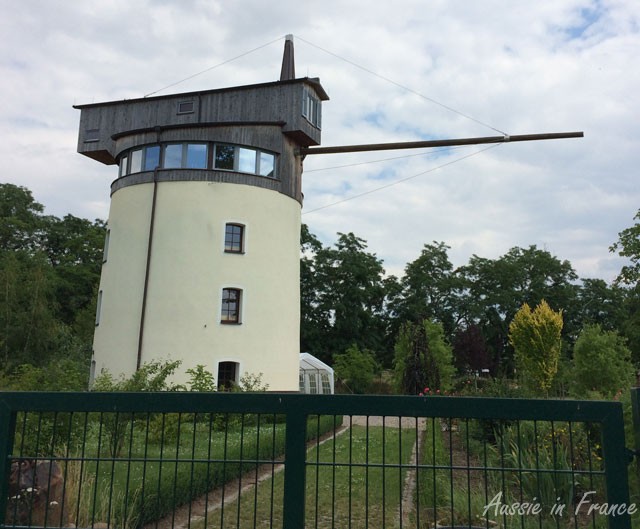
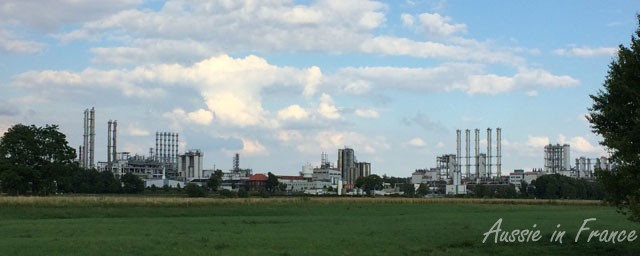
The countryside is very tranquil and takes us past back gardens with their own machinery exhibitions, a surprising building that turns out to be a sawmill with a crane, a renovated windmill without sails and an absolutely enormous chemical refinery that employs 1400 people. I find it very colourful – typically German – but Jean Michel explains that the different coloured pipes are compulsory and indicate what they contain. Ah well. You learn something new every day!

The sawmill and crane built in the late 19th century and recently restored
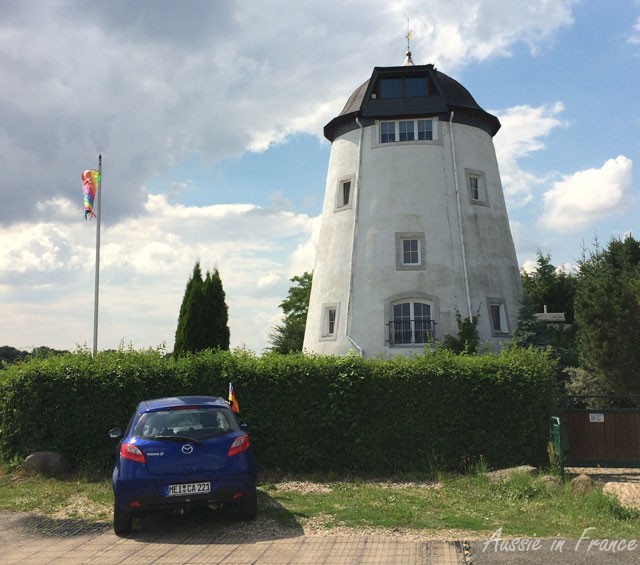
Restored windmill of the Dutch type
Restored windmill of the Dutch type – note the patriotic car
Wacker chemical refinery, mostly connected with silicone

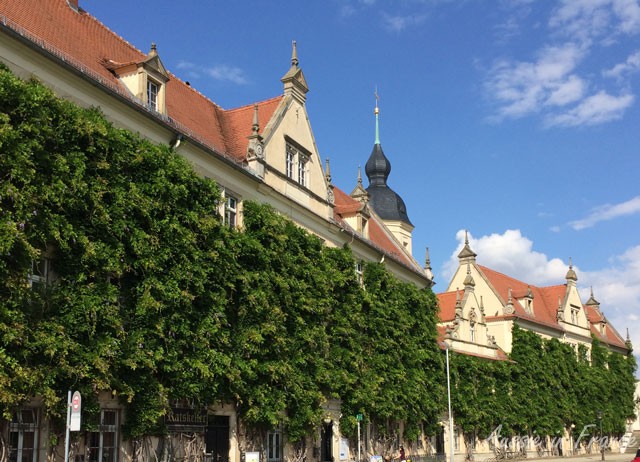
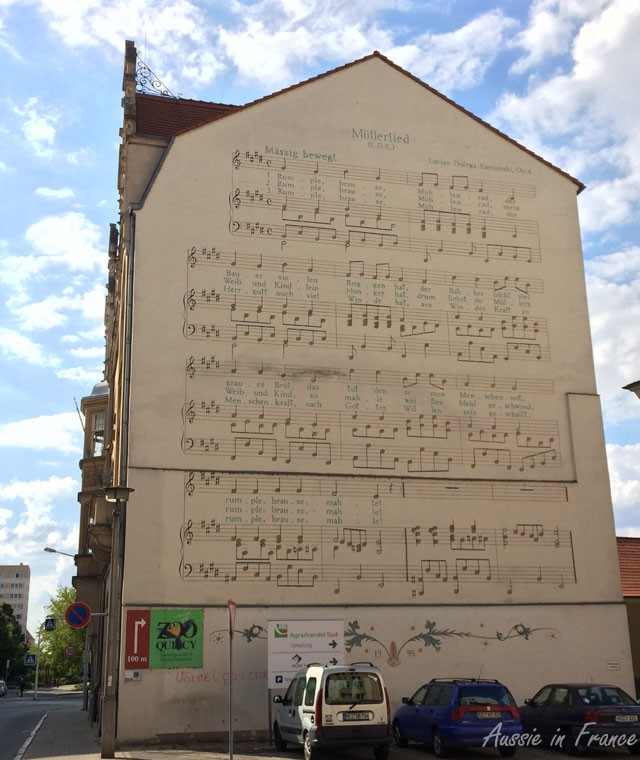
Riesa, our destination, is obviously a new town that drains the refinery workers and its only redeeming features are the biggest wisteria I have ever seen, the town hall and an amazing blind wall with a music store painted on it.

Magnificent wall of wisteria in Riesa
A musical wall in Riesa

We do however find an excellent eiscafé where we manage to order icecream and mineral water in German. The East Germans, who are obviously not used to foreigners, understand my German even less than the Bavarians! I’m amused by the fact that a man stops me in the street and asks in English where the police station is. Jean Michel knows of course so sends him in the right direction.
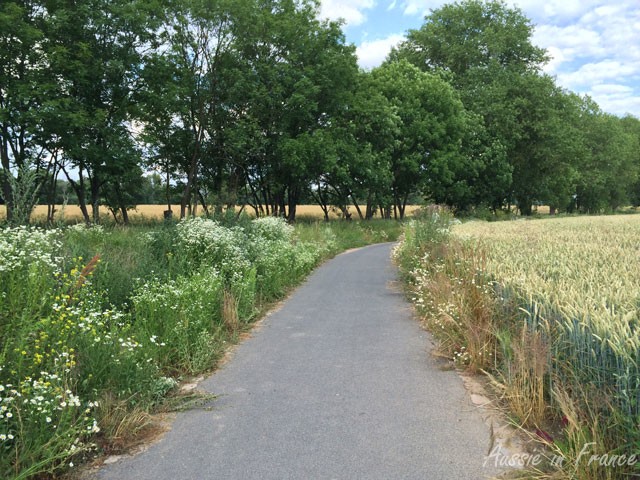
Rape and wheat with wild flowers on both sides

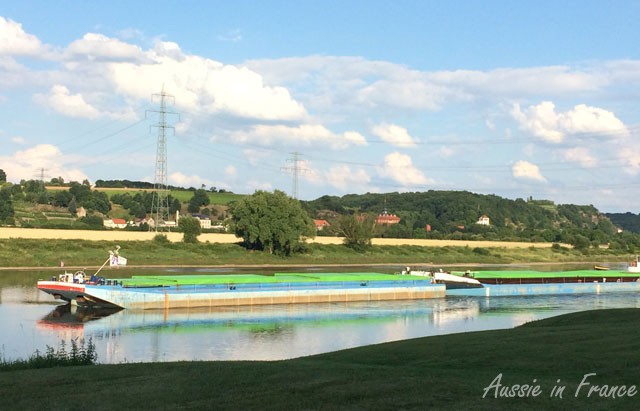
Having crossed the bridge at Riese, we are able to cycle back on the other side of the river, through cultivated fields lined with wild flowers. We see corn, wheat, barley, rye, rape, sunflowers, potatoes, peas, sugarbeet and runner beans, and a few sheep and cows. We also smell numerous pigsties. Also an incredibly long barge.

An extremely long barge

It’s nearly 8 pm when we get back so we finish off the sweet wine we bought in Bad Schandau followed by a cucumber, tomato and cheese salad. We eat the cherries we bought along the way for one euro outside someone’s house. We sink thankfully into bed at 10.30 pm after an unsuccessful attempt to find a hotel for our next stop at Wittenberg.

Breakfast at Elbklause, the best yet, according to Jean Michel

It’s next morning and we learn the downside of our river view. The curtains are thin and the windows are facing east which means maximum light from 5 am onwards. There is also a street light outside which seems to stay on all night. So after the best breakfast so far according to Jean Michel (the usual cold meats and cheese but a better selection, boiled eggs, very compact dry bread, cereal, yoghurt, tomato, butter & jam and fresh fruit), we decide to stay at home to catch up on our travel log and blog and deal with such mundane things as washing and repairing Jean Michel’s inner tube.

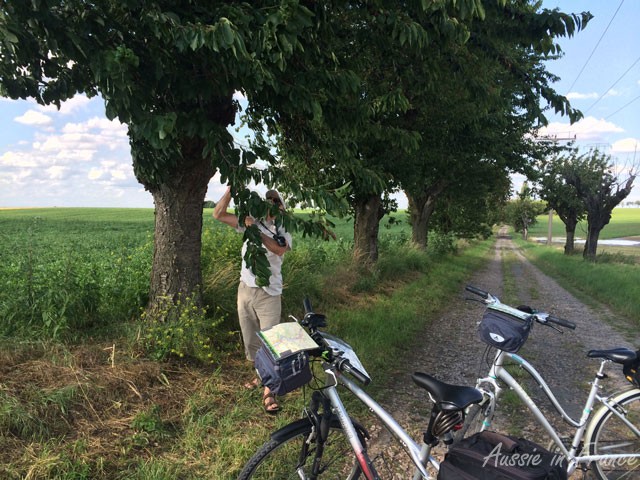
Jean MIchel picking cherries along the way but they weren't very good
Jean MIchel picking cherries along the way but they weren’t very good

We have lunch again at the hotel restaurant overlooking the Elb. Jean Michel chooses some sort of pork and sauerkraut and I have duck with cooked shredded beetroot which is excellent. We have the Müller-Thurgau again and try the Weissburgunder (white burgundy) but it’s a bit green.
At least there's a view after that hilltop climb
At least there’s a view after that hilltop climb

As we’re keeping Meissen for tomorrow, we choose to go west of the Elb to Lommatzsch. I don’t think I’ve ever climbed so many hills in such a short time. I’m as red as the beetroot I ate at lunch.
Town hall in Lommatzsch

Not much to see in Lommatzsch. The town hall looks exactly the same as the wooden village I had as a child. I feel I deserve the ice-cream at the Konditorei more than other. We’re amused to see that it comes from large containers of Carte d’Or ice-cream.

Jean MIchel picking cherries along the way but they weren't very good
Jean MIchel picking cherries along the way but they weren’t very good

The ride home after shopping for dinner at Netto is much easier, mainly downhill of course. Jean Michel stops at practically every cherry tree along the way to see if the cherries are edible. He can never resist free food, particularly in the country. All he manages to do is to get stains on his shirt …

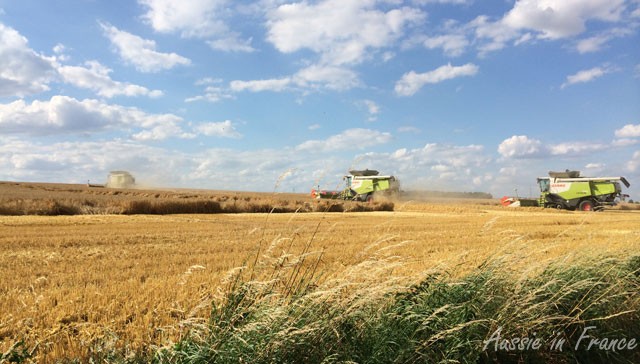
Three combine harvesters all in the same field of barley

We’re amazed to see three massive combine harvesters in a barley field. We also see a hare.

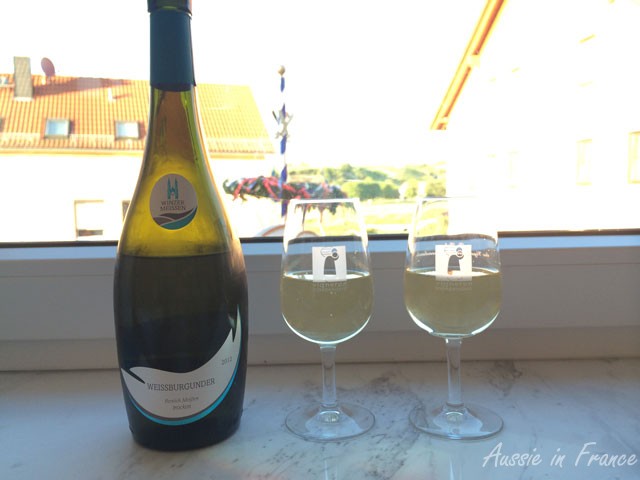
Our Meissen weissburgunder aperitif on the window-sill

For our apertif we try the Winzer Meissen weissburgunder (pinot blanc) we bought in Reise for 11.50 euro the day before in a most unlikely looking shop. It’s much better than the one I had a lunchtime – certainly not as green – but no nose to speak of.

Elbklause Hotel, Niederlommatzsch
 

OTHER POSTS ABOUT CYCLING IN GERMANY

Cycling in Germany – Tips & Tricks
Cycling in Germany #1 – Kobern-Gondorf on the Moselle
Cycling in Germany #2 – Rhine from Saint Goar to Lorch
Cycling in Germany #3 – Cochem to Zell on the Moselle
Cycling in Germany #4 – Koblenz where the Moselle meets the Rhine
Cycling in Germany #5 – Bad Schaugen to Pirna along the Elbe
Cycling in Germany #6 – Bastei Rocks, Honigen and over the border to Czech Republic 
Cycling in Germany #7 – Dresden: accommodation & car trouble and Baroque Treasure  
Cycling in Germany #8 – Dresden Neustadt: Kunsthof Passage, Pfund’s Molkerei, a broom shop & trompe l’oeil
Cycling in Germany #9 – Country roads around Niderlommatzsch on the Elbe
Cycling in Germany #10 – Meissen on the Elbe
Cycling in Germany #11 – Martin Luther Country: Torgau on the Elbe
Cycling in Germany #12 – Martin Luther Country: Wittenberg on the Elbe
Cycling in Germany #13 – Wörlitz Gardens and the beginning of neo-classicism in Germany
Cycling in Germany #14 – Shades of Gaudi on the Elbe: Hundertwasser
Cycling in Germany – Turgermünde, the prettiest village on the Elbe
Cycling in Germany #16 – Celle & Bremen
Cycling in Germany #17 – Windmills & Dykes
Cycling in Germany #18 – Painted façades from Hann. Münden to Höxter
Cycling in Germany #19 – Bernkastel on the Moselle: a hidden treasure
Cycling in Germany #20 – Trier & the Binoculars Scare
 
Cycling along the Danube – A Renaissance festival in Neuburg, Bavaria
Cycling along the Danube – Watch out for trains!
Cycling along the Danube – Regensburg & Altmuhle
Cycling along the Danube –  The Weltenburg Narrows
Cycling along the Danube – from its source to Ehingen
Cycling along the Danube – Ehingen to Ulm
Cycling along the Danube – Singmarigen to Beuron
Cycling along the Danube – Binzwangen to Mengen including  Zwiefalten
Eurovelo 6 – Cycling around Lake Constance
Eurovelo 6 – Moos to Stein am Rhein and Steckborn on Lake Constance
Heading home to France after a month’s cycling holiday

from the Tropics to the City of Light