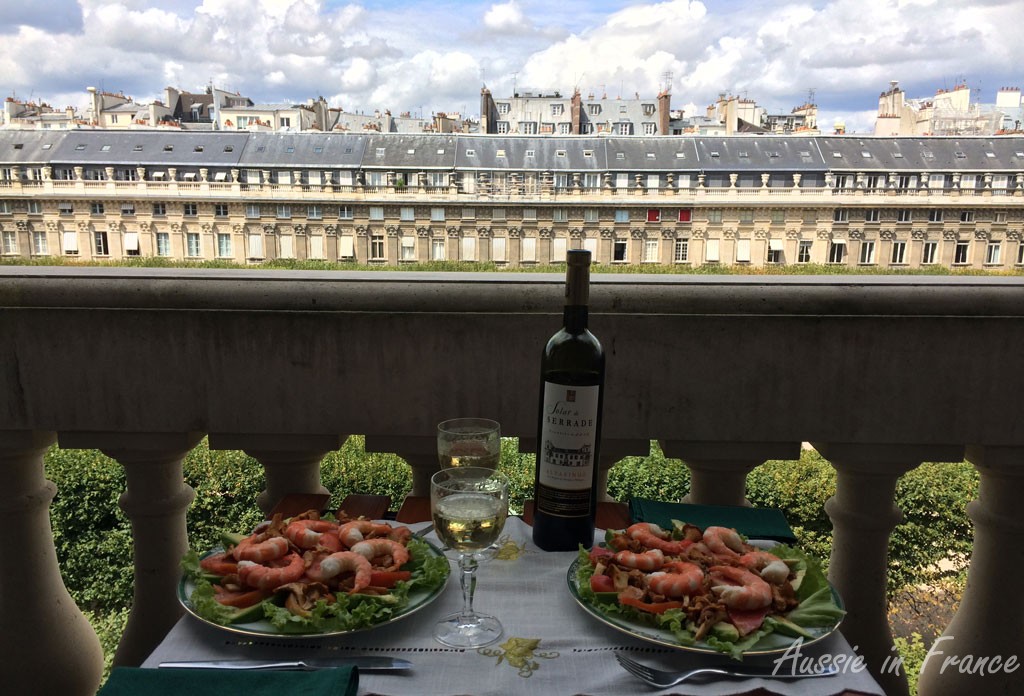
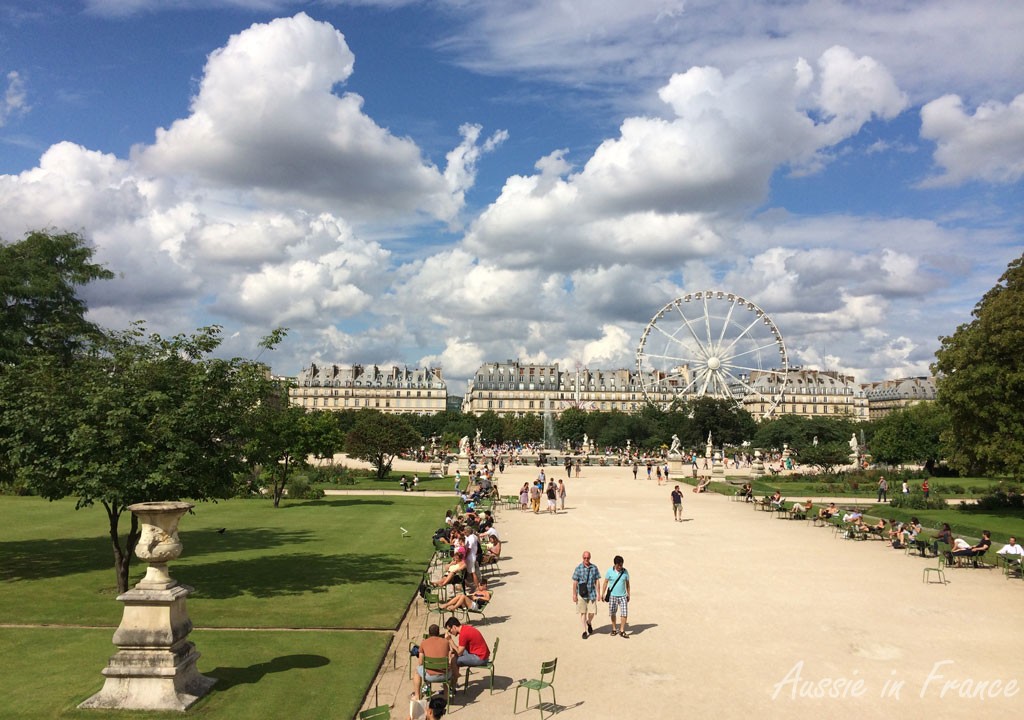
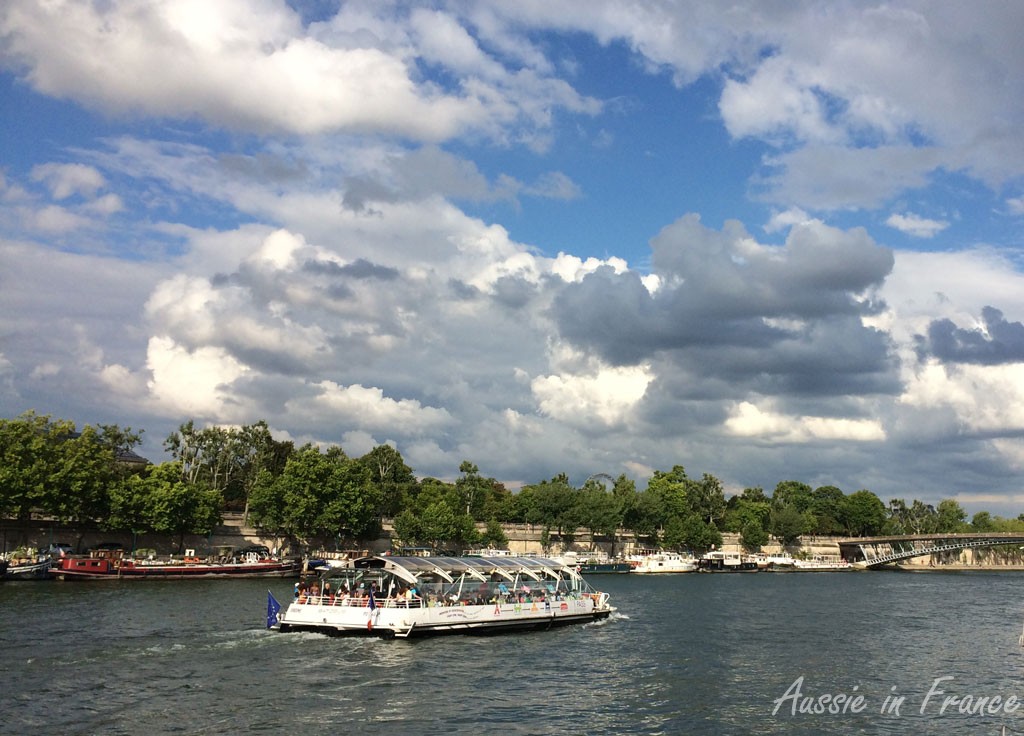
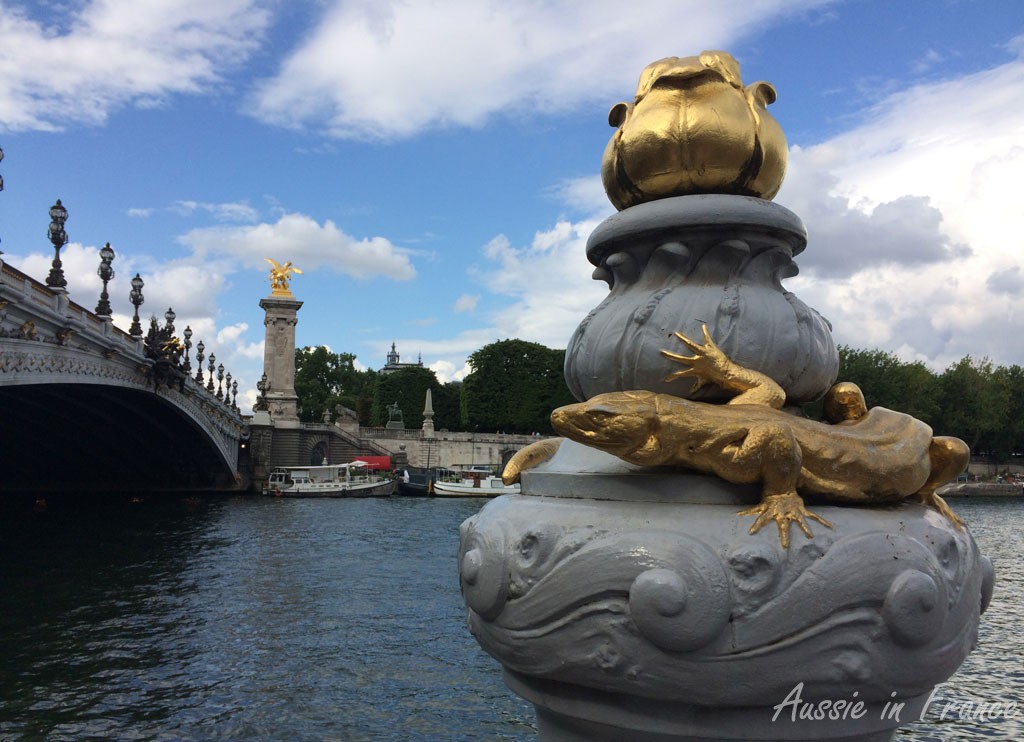
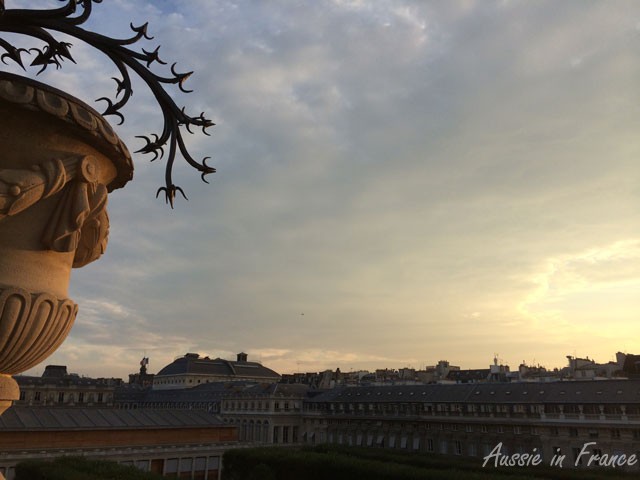
We don’t often find ourselves in Paris on a sunny Sunday in August without our bikes, so after a leisurely lunch on the balcony, testing a new vinho verde, we went for a walk along Berges de Seine from the Orsay Museum to the Floating Gardens. I have to say we were a little disappointed compared with last year, perhaps because there was nothing new. But the sky was amazing.
Lunch on our balconyThe Tuileries GardensBoats on the SeineThe Alexandre III Bridge
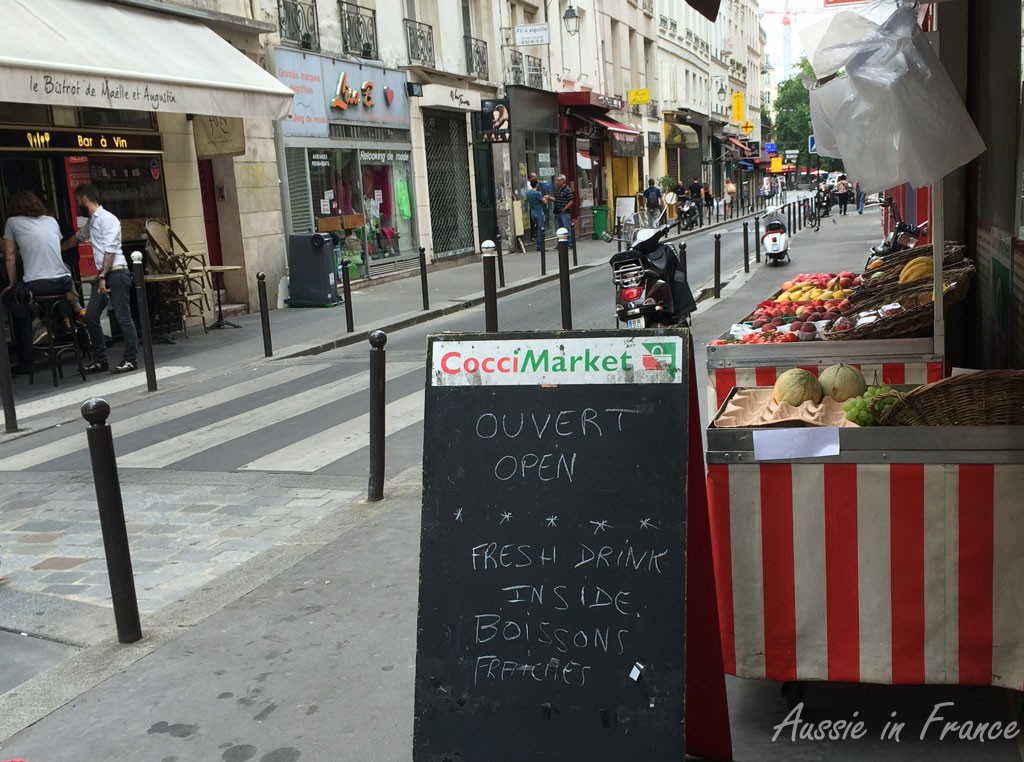
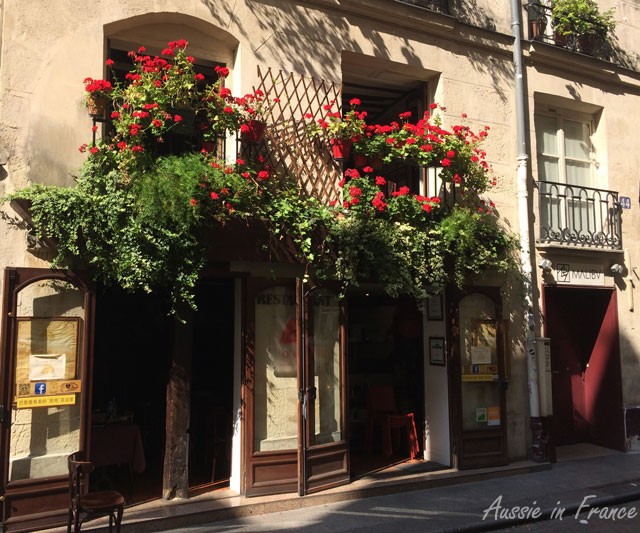
I keep walking past this little grocery store in our neighbourhood and seeing the sign: “fresh drink inside – boissons fraîches” and wondering whether tourists really understand that he’s selling cold drinks.
Tu as de l’eau fraîche? does not mean “Do you have fresh water?”, but “Do you have cold water?” L’eau froide is used as opposed to l’eau chaude, that is, cold water out the tap and not hot water. You can also say l’eau glâcée (iced water) to mean cold water out the fridge. And fresh water (as opposed to salty water) is eau douce.
L’air frais, on the other hand, means fresh air while l’air froid means cold air, as you would expect.
You can have légumes frais (fresh vegetables), oeufs frais (fresh eggs), pain frais (fresh bread) and peinture fraîche (fresh paint). However, a fresh coat of paint is une nouvelle couche de peinture.
In fact, nouveau or nouvelle is always used when the intended meaning is new e.g. une nouvelle feuille de papier = a fresh sheet of paper, to make a fresh pot of tea = refaire du thé, to make a fresh start = prendre un nouveau départ, a fresh face = un nouveau visage (as in someone you haven’t seen before) and fresh fields and pastures are nouveaux horizons, which is rather amusing. I wonder to what extent it reflects French and English thinking?
Nouvelles fraîches means recent news – we’d hardly talk about fresh news, would we?
Je ne suis pas très frais ce matin means I’m not feeling the best today (probably as the result of a late night).
Argent frais can mean either ready cash or fresh money depending on the context.
To say it’s cool or chilly, we also use frais – il fait frais. And servir frais means serve cold or chilled.
In weather-related contexts, grand frais is, surprisingly, used for near gale while joli or bon frais is a strong breeze. But those are nautical terms.
If you’re talking about fresh coffee that has just been ground, you have to say café moulu and not café frais, which means freshly made coffee.
When fresh means cheeky, you never use frais, but rather impertinent or familier. I tried to find out from Jean Michel how to say “don’t get fresh” in French but he couldn’t think of anything. I can imagine a teenager responding with something like, “Ca va pas, non?”
I didn’t have much time to read other blogs when cycling in Germany, but now I’m home, I’m catching up! I’m starting with a very interesting post by Anda from Travel Notes and Beyond about what she has learned from travelling the world. It certainly got me thinking. Next comes some excellent advice from Maggie at Experience France by Bike about the best SIM card to use in France. And to finish off, a fun post by Mary Kay from Out and About in Paris who tested the self-guided Twiztour cars in Paris. Would you be game? Enjoy!
Ten Things I Learned from Traveling the World
by Anda from Travel Notes & Beyond, the Opinionated Travelogue of a Photo Maniac, is a Romanian-born citizen of Southern California who has never missed the opportunity to travel.
If you type “things learned from traveling” into the Google search, you’ll come up with enough reading material for an entire week. Before I sat down to write this post I was curios about other people’s approach to this popular subject. I noticed that in spite of the broad range of opinions, there is one common thread: people who travel don’t remain stuck in their own ideas. They change, they evolve and learn something from their travel experiences. So, with this in mind, here is my rendition of this subject:
1. High expectations may ruin your trip
We all have expectations, lots of expectations. It’s our human nature, whether we are aware of it or not. And when it comes to our vacation we feel entitled to have them. Read more
Using a Sim Data Card to Stay Connected When Bicycling in France
by Maggie LaCoste from Experience France by Bike, an American who loves biking anywhere in Europe, but especially France, which has the perfect combination of safe bike routes, great food, great weather and history.
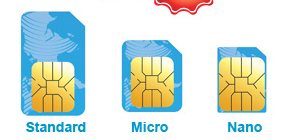
We’re spoiled by how easy and affordable it is to communicate, text and tweet to family and friends, post to Facebook, get the latest news and restaurant recommendations and get directions when we get lost. Until we go overseas. Unless you have a European phone or SIM card, communication overseas can be difficult and very expensive. A Google search of anything having to do with saving money communicating overseas yields pages and pages of articles and advice. Regardless of how many of these you read, there really isn’t a simple solution. For phone calls, you can use one of several internet apps like Skype. But for me, the problem has always been data. If ever there was a time you needed data it’s traveling overseas. Read more
Whizzing around Paris in Twiztour cars: #EmbraceParis ice-breaker
by Mary Kay from Out and About in Paris, an American by birth, Swiss by marriage, resident of Paris with a Navigo Pass for the metro that she feels compelled to use
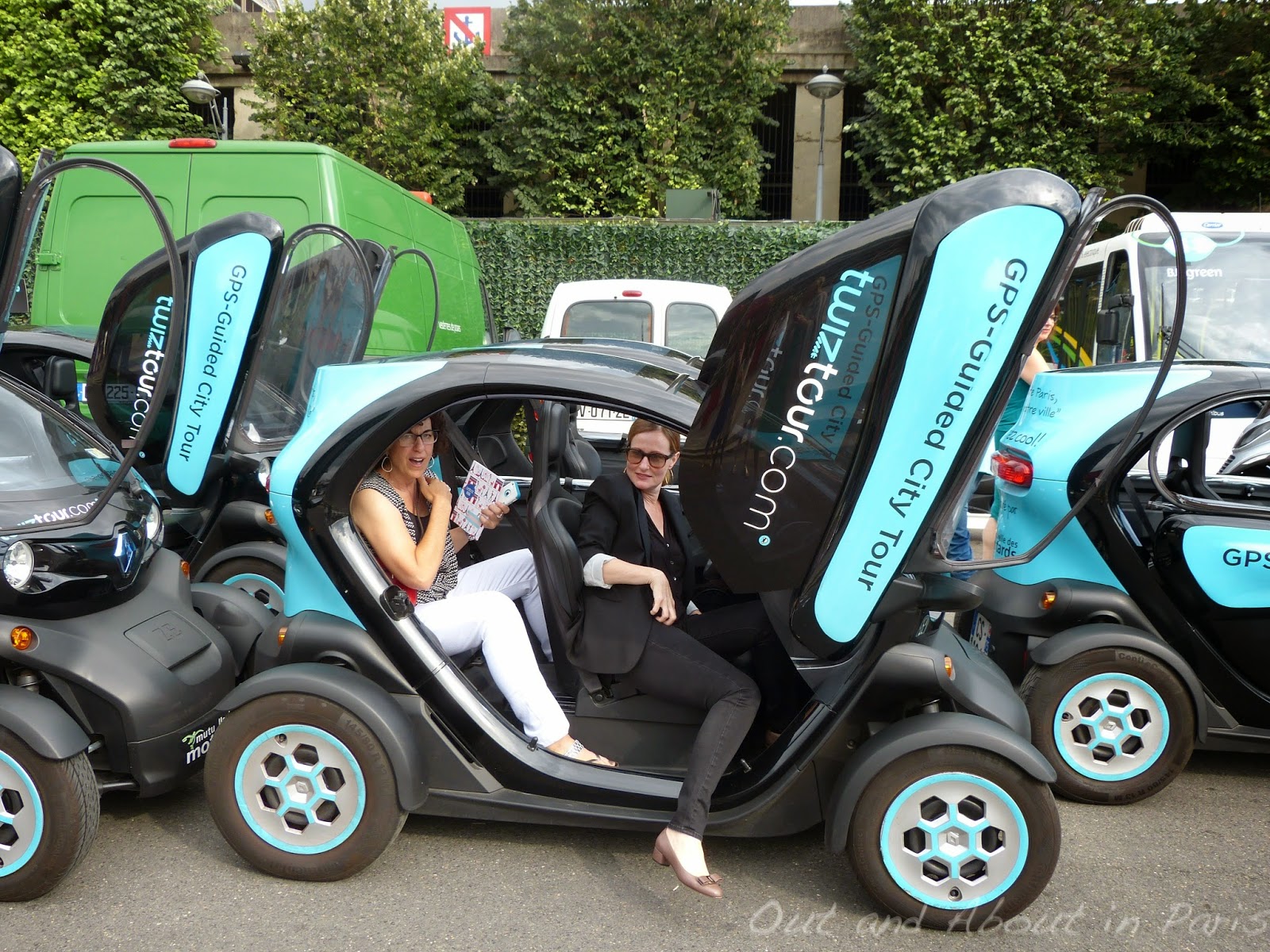
Ladies, start your engines! Or, in this case, turn on your electric, ecologically friendly Twiztour car for one of the most thrilling tours of Paris.
Only hours after meeting each other over a lovely afternoon tea at Le Meurice last Sunday afternoon, taxis whisked the #EmbraceParis ladies to the foot of the Eiffel Tower for our first activity — a Twiztour GPS guided tour of some of the most impressive monuments of Paris.
Assuring Brooke, who’s from Australia, that I had complete confidence in her ability to navigate the streets of Paris on the right side of the road, I squeezed into the back seat of the car with the walkee-talkee. True to their names, “Leader of the Pack” and “Jessica Rabbit” set off at a brisk pace. The four other Twiztour cars made their way across pont de Bir-Hakeim, one of my favorite Parisian bridges, behind them. Read more
We are well and truly back from our cycling holiday in Germany. It’s amazing how far away it already seems. Our next holiday, a six-day home exchange in Lisbon, is scheduled for September.
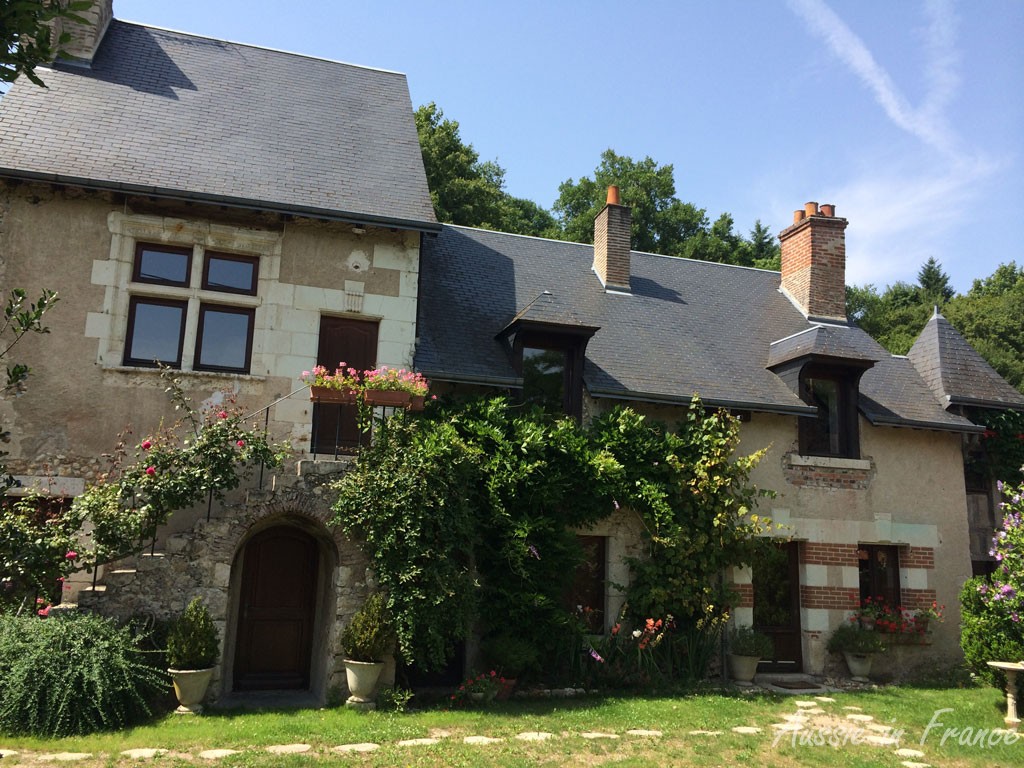
Closerie Falaiseau in Blois last time we were there at the end of our holiday
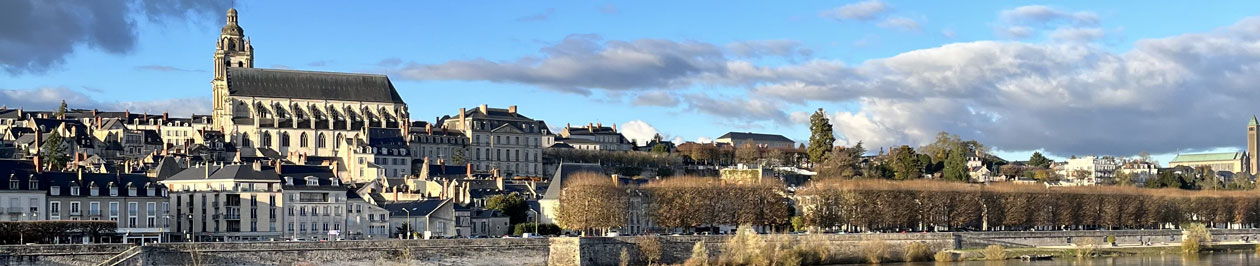
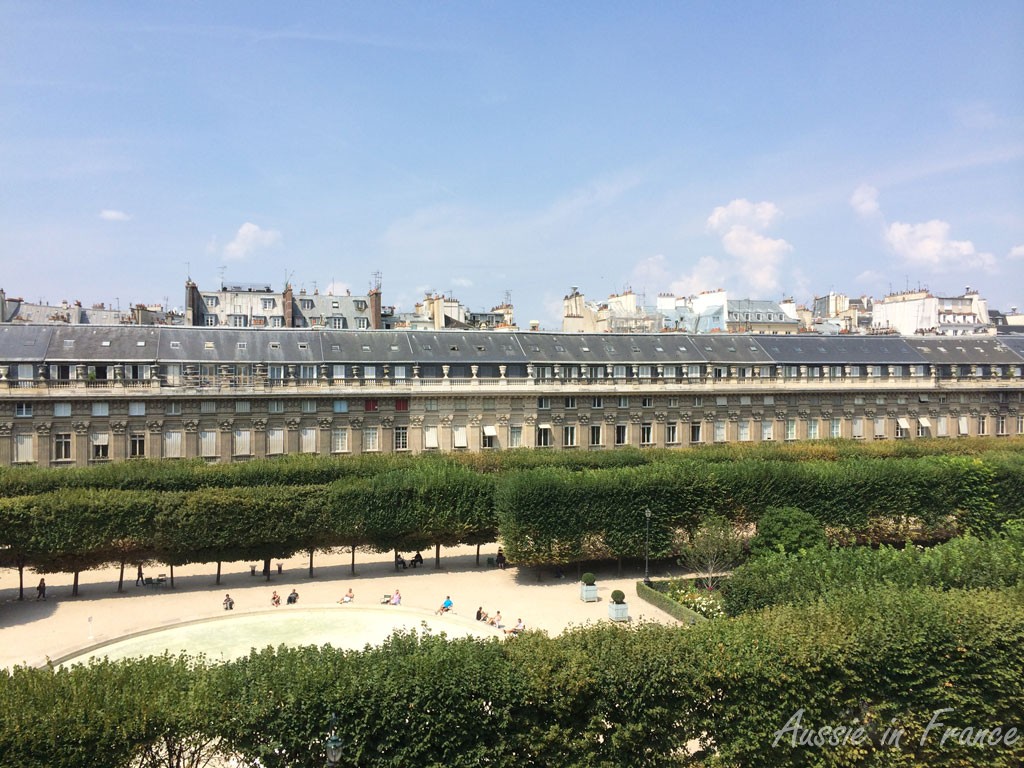
Now we have to get ready for our move to Blois at the end of October, which means we only have three months left. It’s a bit daunting even though I’m ready to leave Paris (though I might occasionally miss the view from our balcony). Closerie Falaiseau will be our own home, as opposed to our apartment in the Palais Royal which is part of Jean Michel’s job.
As we have guests in our gîte up until 6th October, we’ll be going down for a couple of weeks after that to get everything ready for the movers.
The current downstairs bedroom will become our combined study which means redispatching the furniture, putting some of it in the little house while waiting for re-use either in the future gîte or an investment I’m hoping to make in Tours.
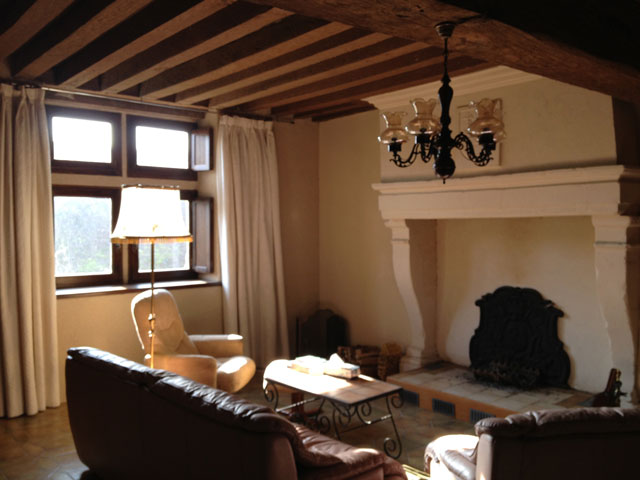
The upstairs living room with its secondhand sofa
The furniture in the other rooms will also have to be moved around to take the content of our apartment in Paris. Some, such as the upstairs sofa and chairs we bought at Troc de l’Ile, will be resold.
I’ve been planning what will go where and I think I have everything sorted out. Despite the fact that it is a big house, the rooms are very large and we don’t have much storage space so I don’t want to take anything we’re not sure we’ll use again.
The view from our balcony which I might miss …
It’s a pity that I will still be working as a freelance translator for the next 5 years – I could have got rid of the entire content of my office! But I’m having a change of furniture and am resolved to only take what I really need.
Many people have asked me if I’ll miss Paris. I don’t think so. What I will miss is seeing my friends who live here and those from further away who will come to Paris but not to Blois. But we’re not that far away (less than 1 ½ hours by train) so we can schedule regular visits.
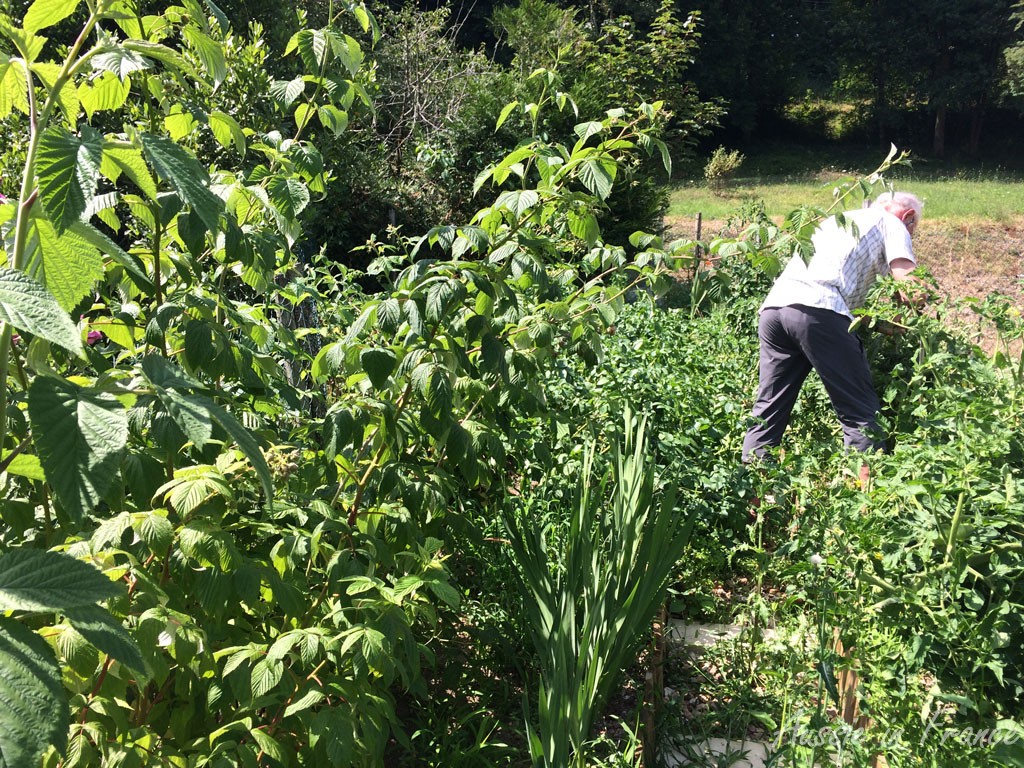
The overgrown vegetable patch when we got back from Germany
What I’m looking forward to is the garden and the nearby forest, less traffic and more friendly people in shops and restaurants.
I’d say that the only real drawback of Closerie Falaiseau is that it’s on the edge of town and there are no shops within walking or even cycling distance. I’ll have to plan more carefully. Since I make my own bread, it doesn’t matter that we don’t have a bakery close by. Even living in the middle of Paris, we practically never go and buy fresh croissants …
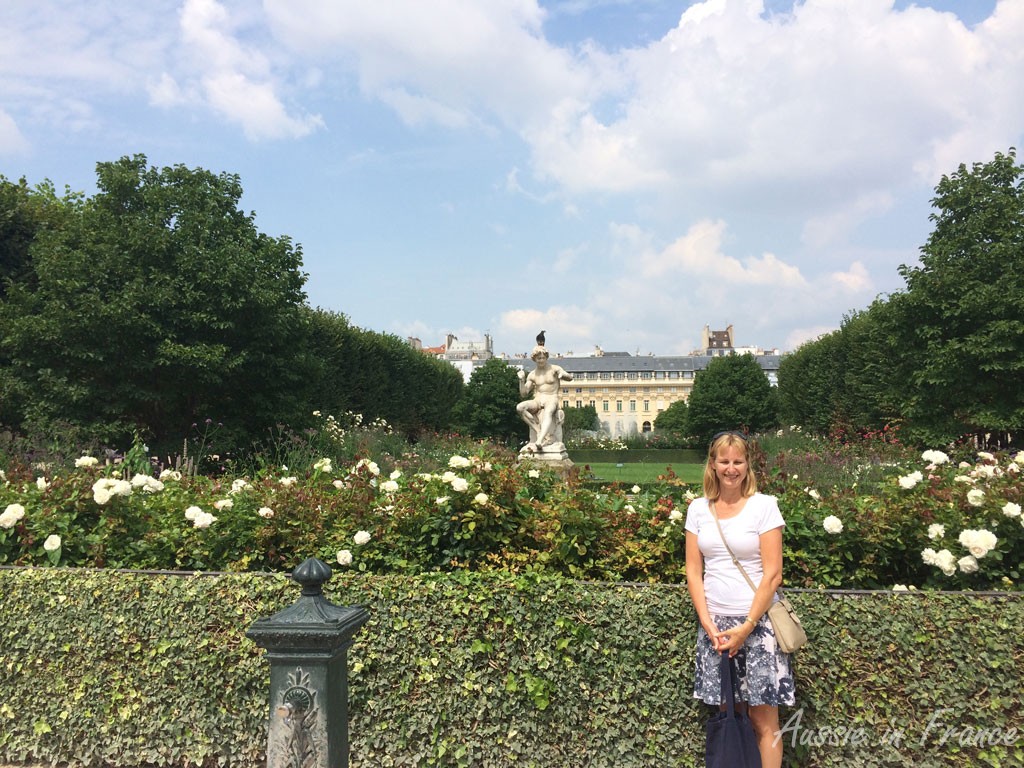
Catching up with Australian friends in Paris – Carolyn from Holidays to Europe in the Palais Royal Gardens
As I’ve always worked from home, I’m used to spending the day by myself, but it will be different for Jean Michel who will need to plan activities that involve other people.
We’ve already make several friends in and around Blois, especially through the Loire Connexion, so I’m not worried about our social life as a couple.
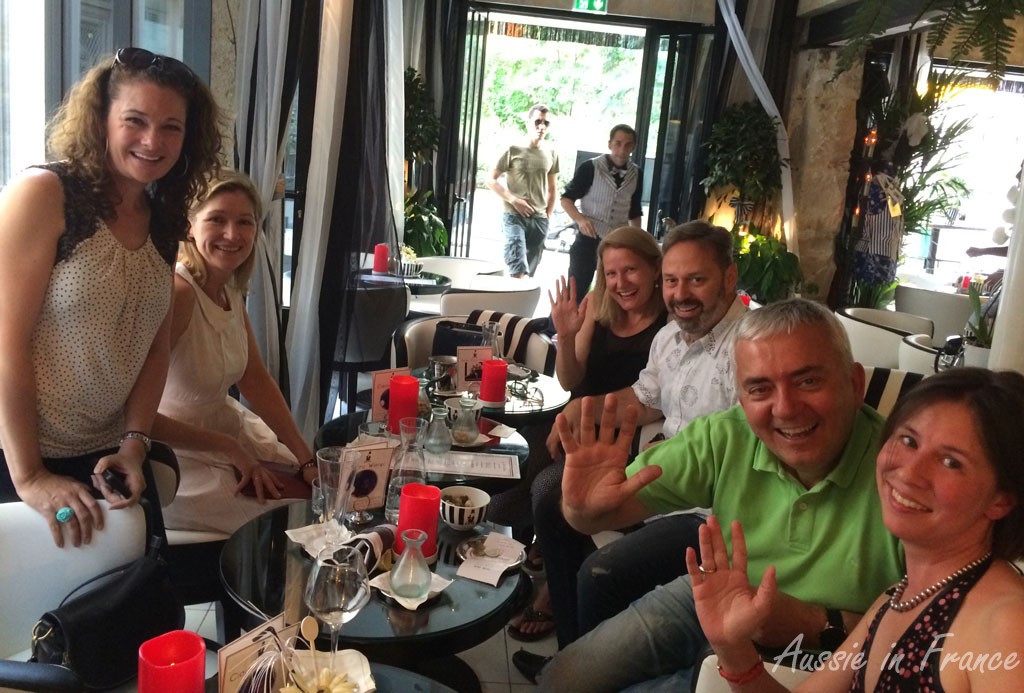
A drink with fellow bloggers and friends in Paris
We both love the house and garden and would presently much rather be there than in Paris, so I think that’s a good start, don’t you?
Back in Paris after a month’s cycling holiday in Germany, we’re having lovely weather so I’ve been catching up with friends especially in my neighbourhood, the first arrondissement, so I have some new photos of Paris.
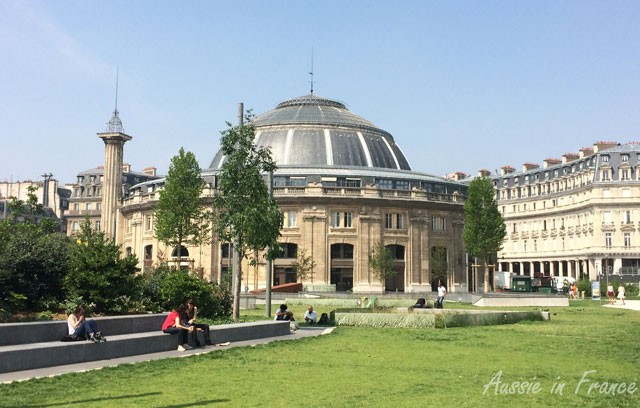
Bourse du Commerce (commodities market) on rue du Louvre seen from the back opposite Sainte Eustache
You may remember another photo I published of the front of the Bourse du Commerce (commodities market) after renovation. If you go past, just drop in. It’s now the Chamber of Commerce. The dome has a wonderful series of murals and if you stand right in the centre of the room, your voice will be heard everywhere. Note the semi-circular building on the right, which has also been refurbished.
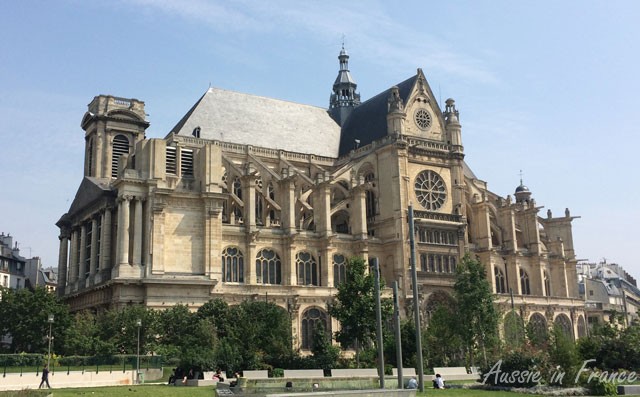
Sainte Eustache
Now that the area in front of Sainte Eustache has been renovated, its beauty is much more apparent.
Sunset over the Palais Royal from our balcony
Only 3 more months before we move to Blois and lose this view forever! On Saturday, to our great delight, we were able to have dinner on the balcony – the sun is usually too strong in the evening.
In a very amusing post, Abby from Paris Weekender talks about her new pet peeve as opposed to her previous one which is normalement that got me thinking about how it is used in French.
Totally irrelevant photo taken in Rue Tiquetonne. I wish my geraniums would grow like that!
Abby gives the example of normalement meaning that something should happen :
Le magasin est ouvert demain ? Normalement, oui. – The store is open tomorrow? It should be, yes.
Another context you’ll frequently find is normalement il vient jeudi – he normally/usually/generally comes on Thursday. Alternatives are d’habitude il vient le jeudi and en général il vient le jeudi.
C’est normal and ce n’est pas normal are also common expressions. The first means “it’s only natural” while the second means “there must be something wrong”.
Merci de m’avoir aidé ! C’est normal. – Thank you for helping me. It’s only natural. Or in Australian parlance “No worries, mate!”
Il est en retard. C’est pas normal. – He’s late. Something must be wrong/that’s not like him.
Ce n’est pas normal qu’ils soient libérés de prison si tôt. – It’s not right that they’ve been let out of jail so soon.
Note the use of the subjunctive soient and not sont (not that everyone uses it!)
Sometimes you can avoid the subjunctive without ambiguity, but it’s not always possible.
Il n’est pas normal d’attendre trois semaines pour avoir un RdV chez l’ophthalmo – You shouldn’t have to wait three weeks to get an appointment with the eye specialist.
(Unfortunately in France it always seems to be the case particularly in the country. Same for gynaecologists, I might add.)
So when would we say “normal” in English and not in French ?
He got there at the normal time : Il est arrivé à l’heure habituelle if you mean he got there at the time he usually does and il est arrivé à l’heure précisée/réglementaire if you mean that he got there at the time he was supposed to.
To get back to normal is revenir à la normale and not revenir à normal.
Which makes me think of norm. It’s the norm = C’est la norme.
Norme also has the meaning of standard e.g. normes de fabrication = manufacturing standards
Ce produit n’est pas conforme aux normes françaises : This product does not comply with/conform to French standards.
Have you heard normal or normalement used in other contexts ?
And, normalement, this blog will be back to it’s usual format next week!
We have now been on four cycling trips to Germany, first on the Rhine near Lake Constance, second along the Danube from its source to Budapest, third on the Moselle, Rhine, Elbe and Eiser Rivers through former East Germany and north-west Germany and fourth along the Romantic Road in Bavaria and the Neckar Valley. My preference goes to the Rhine and Danube for various reasons. Here are my suggestions and conclusions which mainly concern people who do not speak more than very basic German.
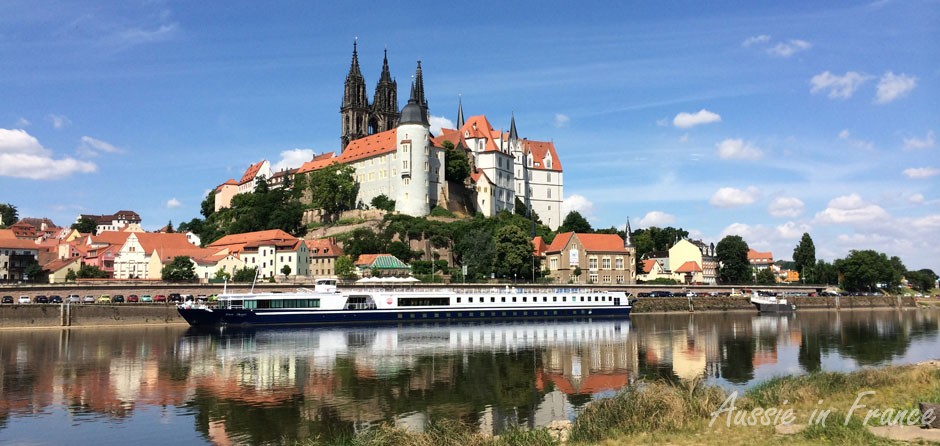
Meissen from the bike path – the best way to discover a town!
BIKE PATHS
In our experience so far, Germany is the country that offers the most possibilities to cyclists, not only in small and large cities but also in country areas. Bike routes are usually well signposted and cyclists are well-respected by motorists. They are mostly dedicated routes often separated from car traffic by a low concrete wall.
CYCLING MAPS
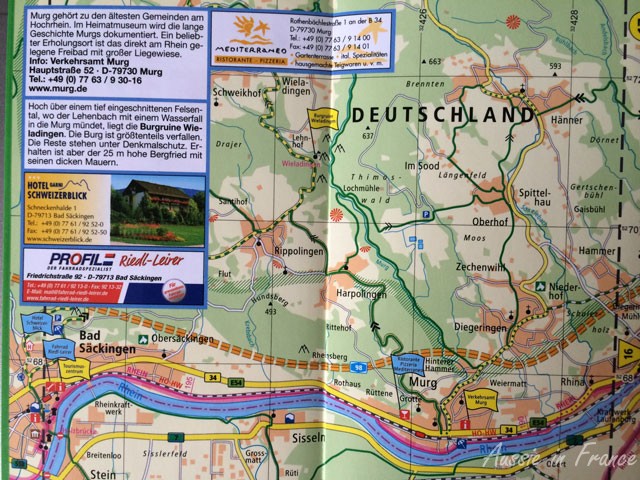
Bikeline, Kompass, Bergstrasse, Public Press and the ADFC all have excellent detailed maps and plasticised guidebooks, but only a couple are available in English which means that you lose a lot of the information. The German versions can be found in most tourist offices and bookshops. In some cities such as Bremen, there are Radstations which have a large collection on sale. However, it is best to order the English versions on-line. The local tourist offices often have free maps of cycling paths in their area.
Rhein-Radweg 2 Radwander Karte www.schwalbe.com
ACCOMMODATION
First, a note on what we are looking for: a good bed, a clean, quiet, reasonably spacious room, a good shower, a balcony or terrace, and if not a lounge corner with two chairs and a table, a good wifi connection, attractive but not luxurious furniture and furnishings, blackout curtains, easy parking and pleasant surroundings. Also, a good breakfast when it’s not a self-catering flat. We don’t need a TV or hi-fi equipment, toiletries or even a hair dryer. If possible, we like an electric jug. If staying in a town, we like to be in the centre so that we can walk everywhere as most town centres are pedestrian-only. A garage for our bikes can be useful.
The Bikeline and Public Press maps have accommodation suggestions, especially along the Danube. We often rode past signs for zimmer (B&Bs) and ferienwohnung (holiday flats) but were rarely able to obtain any lists that indicated facilities and prices. We did not want to knock on someone’s door, have them show us the room, then refuse. In the end, we preferred using booking.com which has two types of bookings: either your accommodation is guaranteed up until 6 pm and you don’t give need a credit card, or it is non-refundable usually with a special offer using your credit card. We also used www.hotel.de but one of my bookings wasn’t registered.
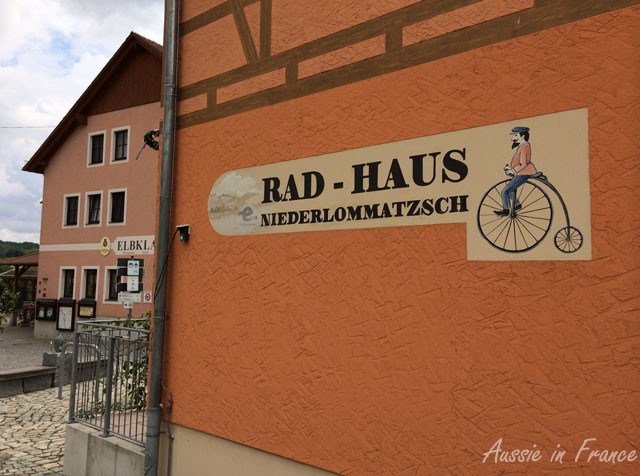
The Rad-Haus hotel
We found that you can usually book the night before unless it’s a weekend or a very popular venue (watch out for local events especially in summer) but we often had to spend a couple of hours searching with no real guarantee of results. In general, former West Germany offers more spacious and comfortable accommodation than former East Germany.
Our budget is 60 to 100 euros a night. The only time we went over that amount we were disappointed in the accommodation but it was a very touristy area.
LUGGAGE
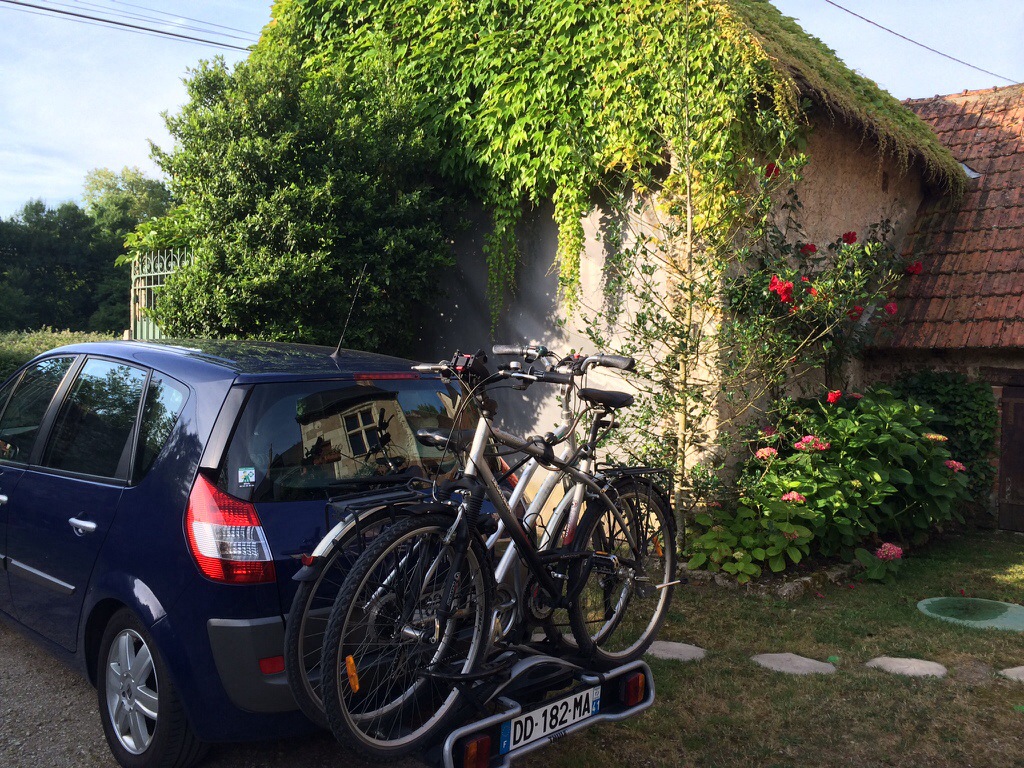
We travel by car with a Thule bike rack that enables our bikes to be attached in such a way that they can’t be stolen (or stripped). We choose a half-way point where we stay 2 to 4 nights, fanning out in each direction, sometimes doing a loop, sometimes returning along the same route and sometimes taking the train back. As a result, we do not have to worry about luggage. On the Danube, special rad hotels, such as the Draxler, will take your bags from one place to the next for a fee but I imagine it would have to be organised beforehand.
Our bikes on our Thule bike rack which enables you to open the boot of the car with the bikes attached
WEATHER
The reason we go by car is that it means we can follow the good weather as we don’t like cycling in the rain! We choose mid-June to mid-July to avoid the crowds and benefit from the very long twilight. If it’s too hot, we can avoid being out in the midday sun and if the mornings are still a little chilly we can sleep late. An occasional rainy day gives us well-needed R&R.
MEALS
We try to alternate staying in B&Bs, hotels and flats. Most places offer a fairly copious breakfast, particularly if you like cold cuts (which we don’t). The buffet always includes bread, boiled eggs, cheese, cold cuts, fruit, sometimes yoghurt and juice, often tomatoes and cucumber. You can often ask for a fried egg (spiegel ei).
Most restaurants have bike stands. This one is next to a bike ferry across the Elb.
Except on our twice-weekly intermittent fast days when we don’t have breakfast and have a picnic lunch, we eat in a local restaurant in the middle of the day. The food is fairly standard with a lot of pork and potatoes, usually served with a side salad. We have a glass of wine each and the bill is usually between 20 and 40 euros.
We have a car fridge that we can plug into a wall socket in our room if there is no mini-bar, so at night, we usually have a picnic on the balcony of our room, consisting of raw vegetables such as tomatoes, cucumber, baby peppers, carrots and asparagus, in addition to cheese or smoked salmon, bread and fruit. We usually have a glass of wine with pistachios first.
CLOTHING
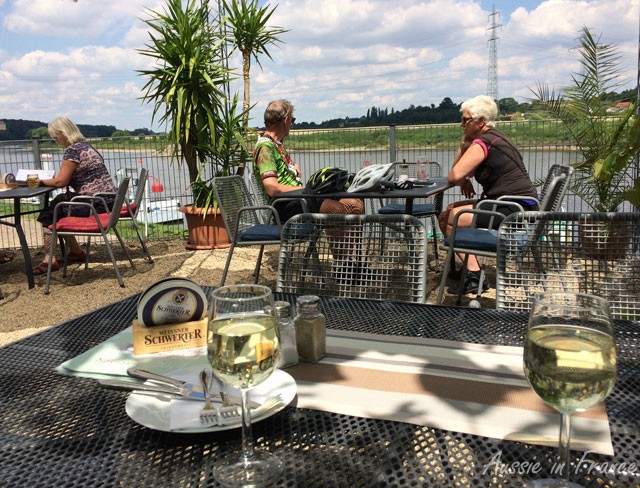
We have now discovered the perfect solution to the clothing and washing problem. We have found several brands of clothing in France and Germany that are specially designed and made to keep you dry and eliminate smells (Fusalp, Columbia, Wolfskin). You can easily wash them out at night and they are usually dry by morning. We make do with two pairs of ¾ pants and 4 shirts each without having to resort to the usual multi-coloured lycra cycling outfits worn by the cyclists in the photo above. I can highly recommend them despite the price (watch out for end-of-season sales). They are extremely comfortable and never stick to your body. They don’t look like cycling clothes so you can wear them when not cycling as well. We were able to wear the pants 2 or 3 days in a row and the shirts twice without any smells at all. We have long-sleeved “overshirts” in the same material.
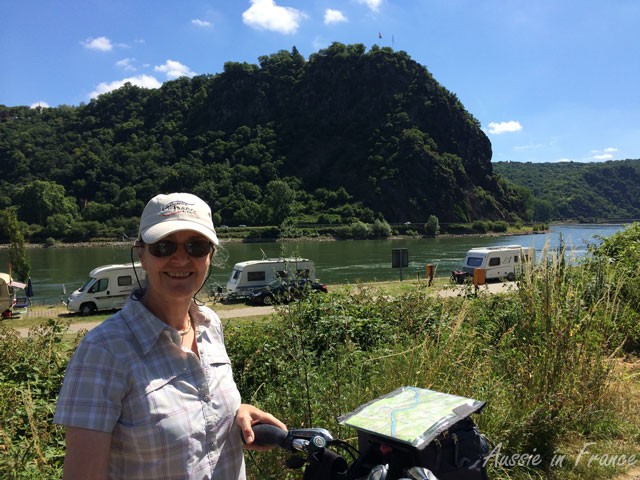
I’m wearing a Columbia sun protection, keep-dry, quick drying shirt and my Experience France by Bike cap. Although I don’t usually wearing a cord on my sunglasses, I do when cycling. Photosun are the most practical.
I also use a “mechanical” washing machine I once read about in a book by Steinbeck called Travels with Charley. You need a small plastic rubbish bin with a secure lid. You add water, washing powder (buy the special travelling sort in a tube) and a couple of shirts and underwear and put it in the boot of the car. When you arrive at your destination, you rinse the clothes and hang them on hangers in the shower to drip. If they are not completely dry next morning, you can either hang them in the car or in the wardrobe. It is an extremely efficient method!
CASH AND CREDIT CARDS
We only have Visa cards which were often not accepted so we had to juggle with having enough cash to pay for accommodation and meals. Maestro seemed to be more widely accepted.
CYCLING DISTANCES
We usually cycle 40 to 60 kilometers a day, taking frequent breaks to visit or have refreshments. Many of the riverside paths are flat, which is good on the knees and bad on the rear end. Make sure you have been cycling regularly before you go. Due to bad spring weather on one occasion, we hadn’t done much cycling and I was saddlesore for two weeks. Take some nappy rash cream with you!
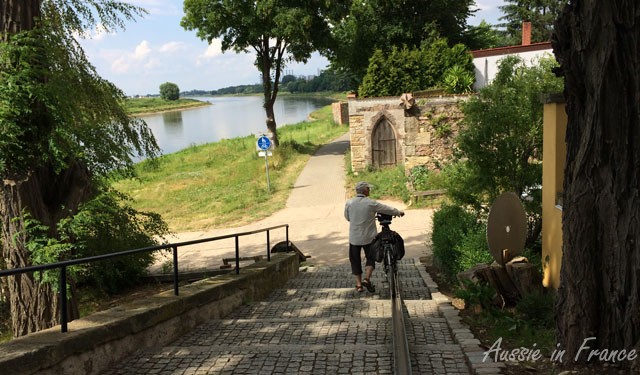
The bike paths sometimes have steps with bike wheel runners
BIKE EQUIPMENT
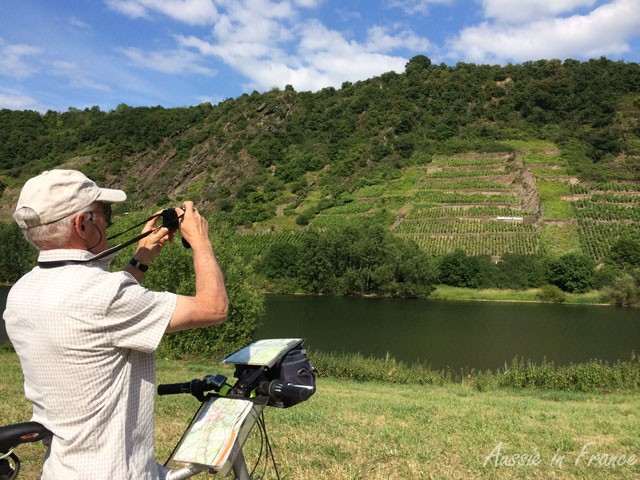
We each have a front bag with a Click Fix attachment and map holders. Jean Michel’s bag contains a full repair kit while I carry the first aid kit as well as our personal effects and a bike pump each. We also have a distance recorder and I have an iphone stand.
Jean Michel has two different-sized map holders, one that is attached to the handle bar bag by Velcro and the other attached to the handle bars by Velcro loops. He is wearing a Fusalp breathable shirt.
We then have expandable saddle bags that slide onto the bike rack, containing a long-sleeved shirt, a windcheater, a poncho and plastic trousers depending on the weather. We also carry sunscreen, biscuits and mosquito repellent. The poncho isn’t ideal but we haven’t found anything better. We use ½ litre plastic Evian-type water bottles with screw tops that we refrigerate overnight and put in stubby coolers inside the side pouches.
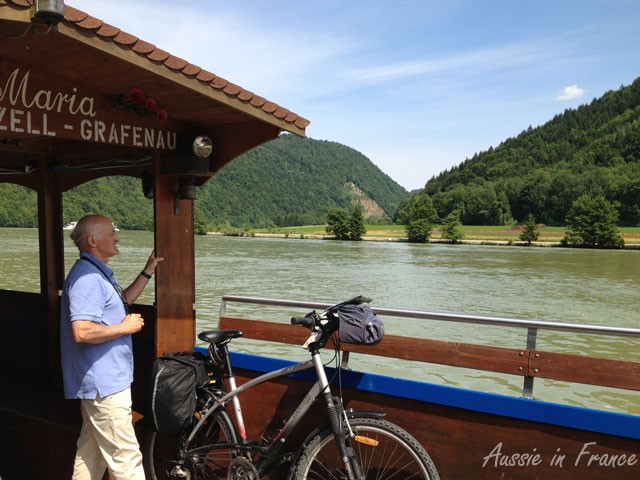
Jean Michel on a ferry on the Danube. You can see the saddle bag and front bag. The photo was taken last year before we bought our special outdoor wear.
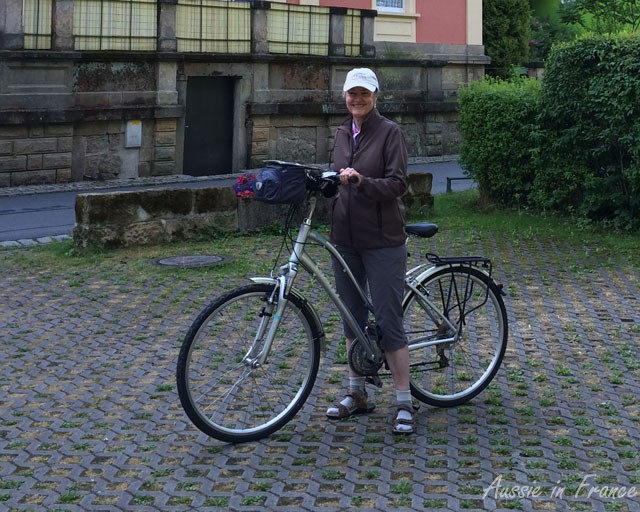
We don’t wear helmets which are not compulsory in Europe but we always wear caps and use sunscreen. We wear MEINDL and TEVA walking sandals that seem to last forever, because we like to alternate cycling and visiting. If it’s a little frisky, you can add socks and look very German!
When it’s chilly, socks and a windcheater do the trick. I’m wearing Fuaslp lycra outdoor 3/4 pants.
FERRIES
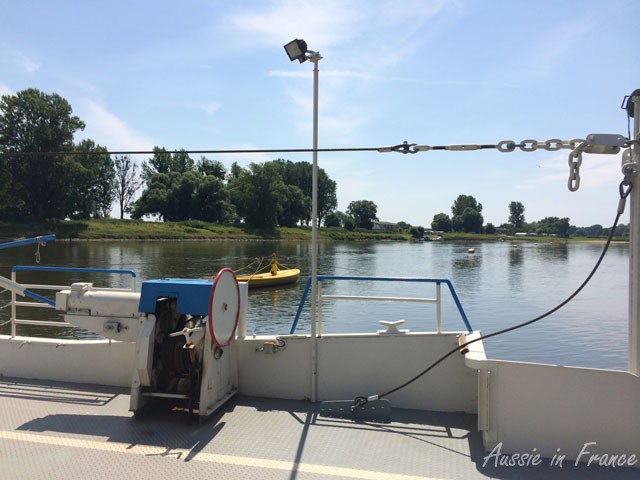
In Germany, ferries that take people, bikes and sometimes cars across the river are very popular. They usually cost 1 or 2 euros per person with a bike. There is no set schedule. The ferryman crosses when there are enough people. Sometimes there is an intercom you can press if there is no one in sight. The car ferries are usually cable-operated while the people/bike ferries can also be motorised. Bridges don’t always have a dedicated bike lane.
Cable and winch system on the car ferry
You can read more about our cycling intineraries in Germany, France and other European destinations by entering “Cycling in Germany” or “Danube”, “Elb”, “Rhine”, “Moselle”, etc. in the search box. Another excellent source of information is the Bicycle Germany website. Below is some useful vocab. I’d love to hear about your own experience or answer any questions you may have. Happy cycling!
CYCLIST’S VOCAB
Rad, Farhhad – bike
Radweg – bike route
Radler – cyclist
Radfarher – cyclist
Radfarhen – to bike/cycle
Radtour, Radfahrt – bike ride
Radhotel – hotel that especially caters to cyclists
Fahrradabsteigen – get off your bike
Zimmer – B&B (literally means bedroom)
Ferienwohnung – holiday flat
Färhe – ferry
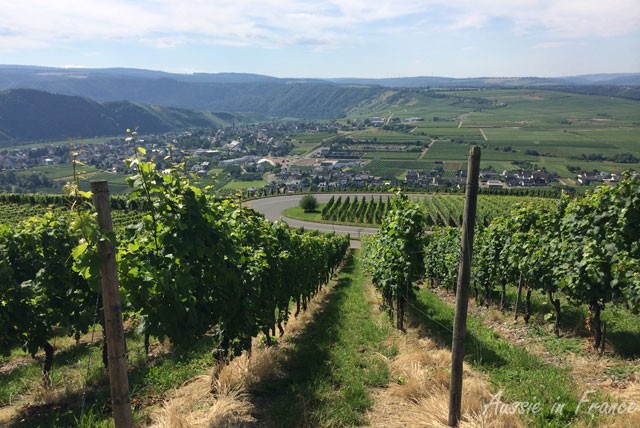
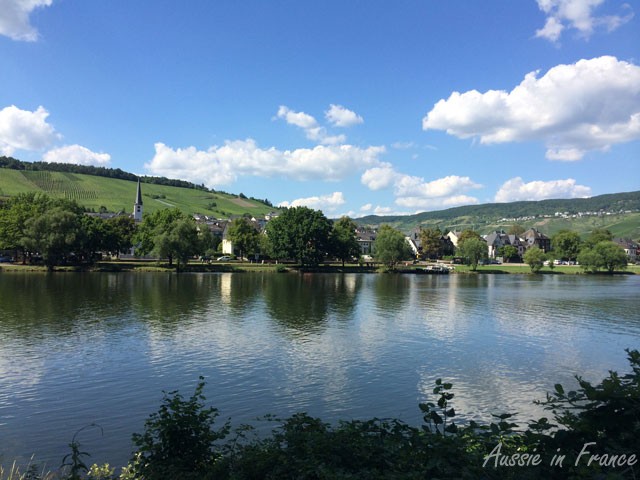
It’s the last day of our cycling holiday in Germany and we’re going to visit Germany’s oldest town – Trier – then cycle from Thörnich to Neumagen-Dhron. We’re not cycling around Trier itself because the bike paths in and out of the city look as though they go through industrial areas. On the way, we drive up a winding road near Piesport to have a view of the Moselle below.
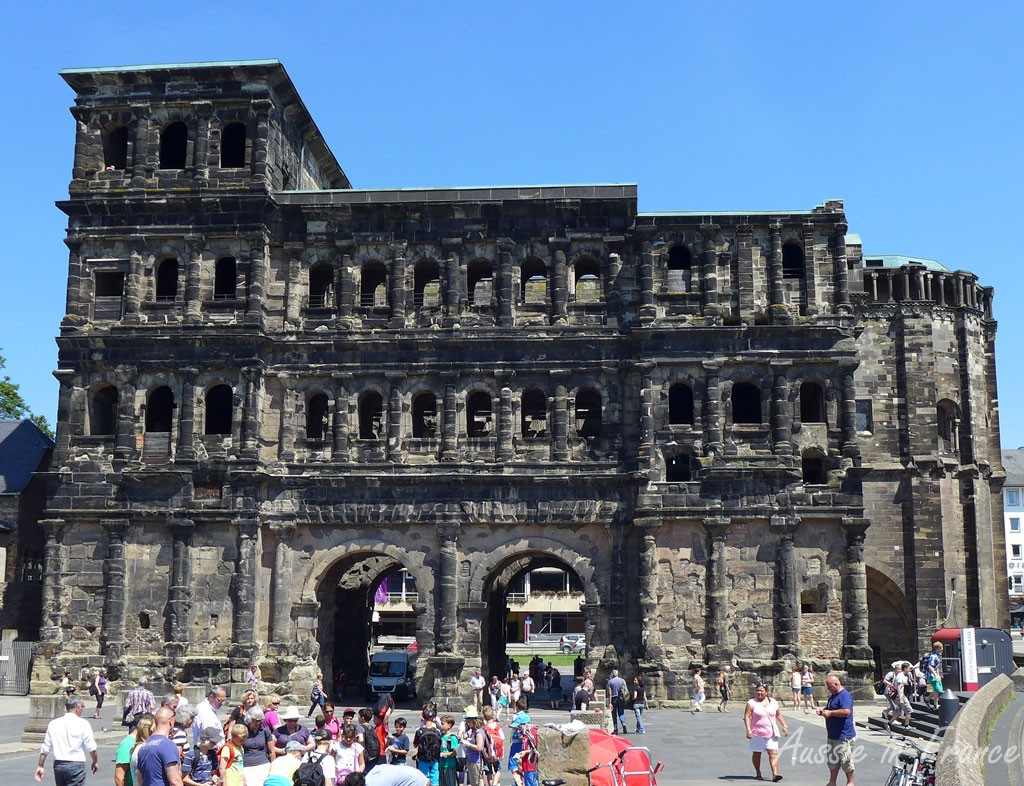
We’ve been to Trier before, during a wonderful holiday in Luxembourg over 15 years ago but it was just for dinner one night and the only thing we remember, apart from an excellent entrecôte, is the Porta Nigra which today is the largest Roman city gate north of the Alps.
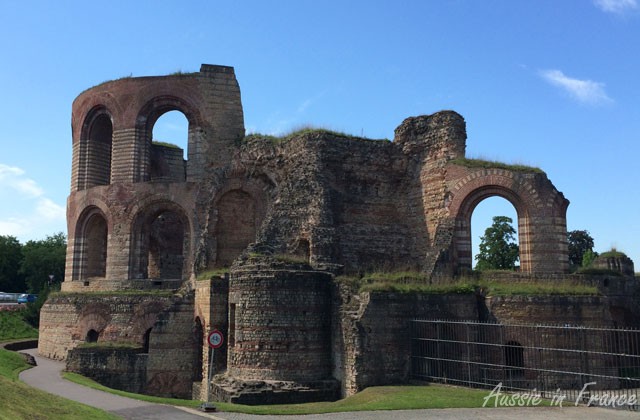
As we approach the centre, we see the ruins of three Roman baths. It really is astonishing that Jean Michel has no recollection of them at all, not so surprising for me though because I have such a terrible memory for places.
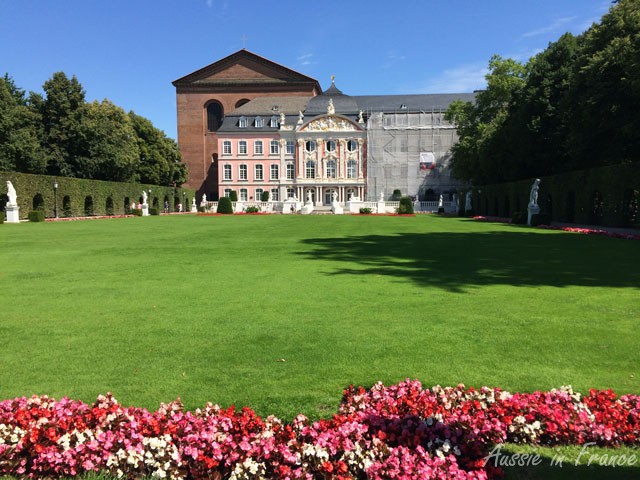
We park in an almost empty parking place not far from the baths and within easy walking distance from the centre through a lovely garden, the Palastgarten. From what I can work out, the parkschein (parking metre – see all this useful vocab I’ve learnt) is only for tourist buses. As there are other cars parked there, I assume it’s free if you’re not a bus.
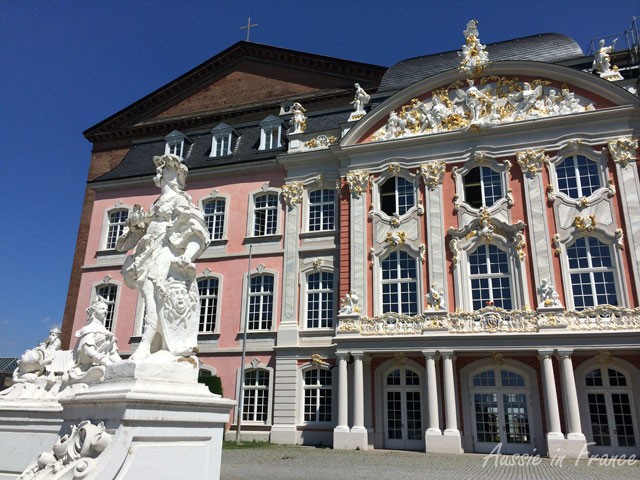
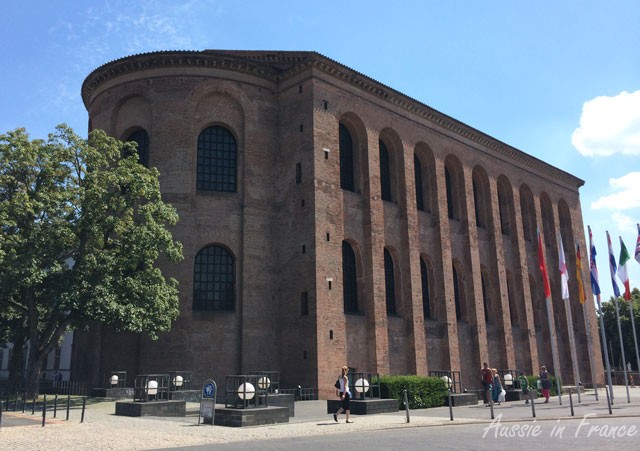
After a welcome drink at the Zeitspuring Café which would have a perfect view of the almost obscenely baroque 17th century Kurfürstliches Palais, if it wasn’t being refurbished, we head for the Neolithic-looking Constantine Basilica behind it.
A basilica in the Roman sense, it was actually the 67 m long throne hall of the Roman Emperor Constantine. Today, it is used as a Protestant Church.
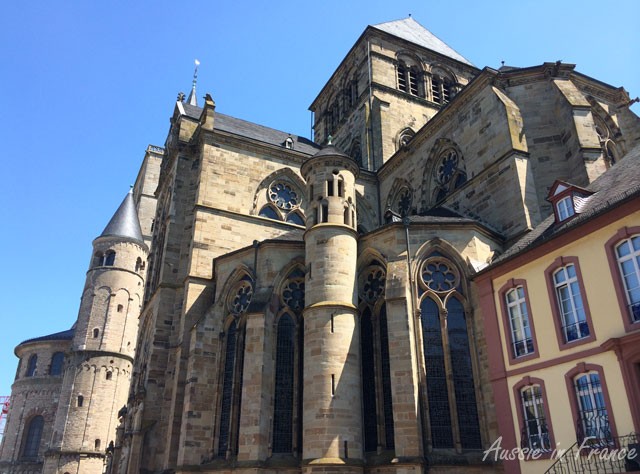
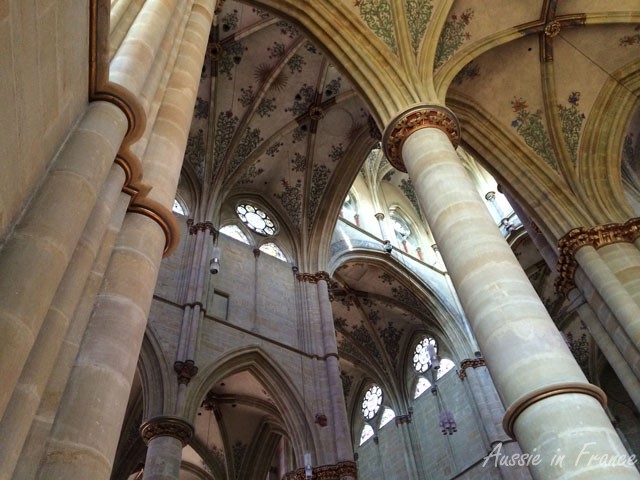
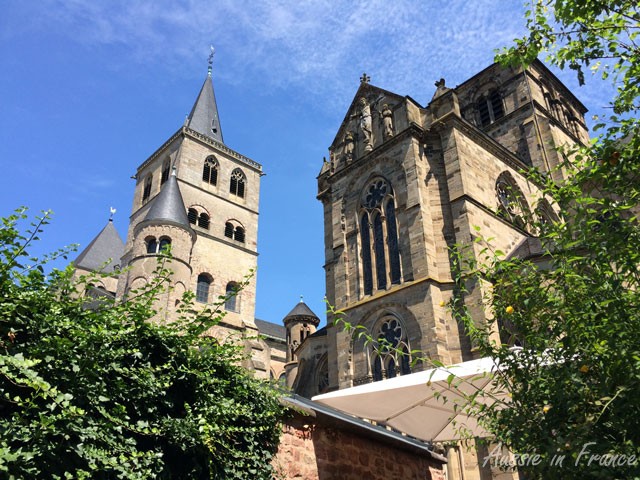
Next on the list are two churches, sort of interwoven. The 13th century Gothic Liebfrauenkirche is one of the most important early Gothic cathedrals in Germany but doesn’t look anything like a French Gothic cathedral with its little towers and no flying buttresses.
Inside it certainly looks Gothic though, except for the painted vaulting.
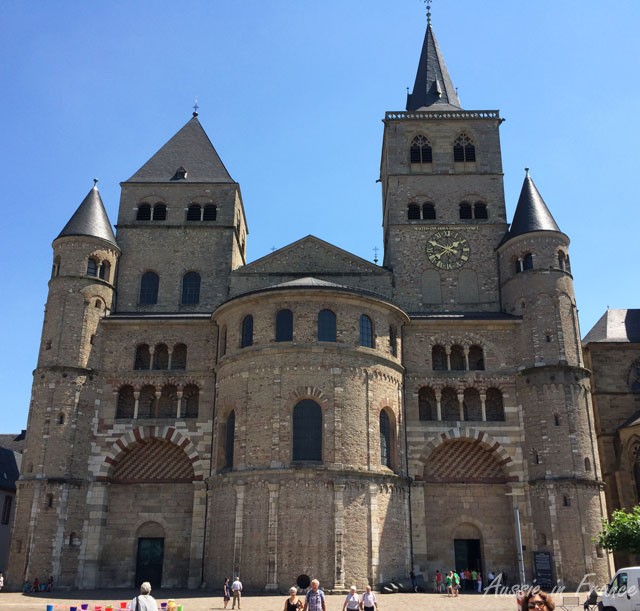
When we enter the 4th century Romanesque Cathedral next door, we’re pleased we saw the other one first because it would have paled in comparison otherwise!
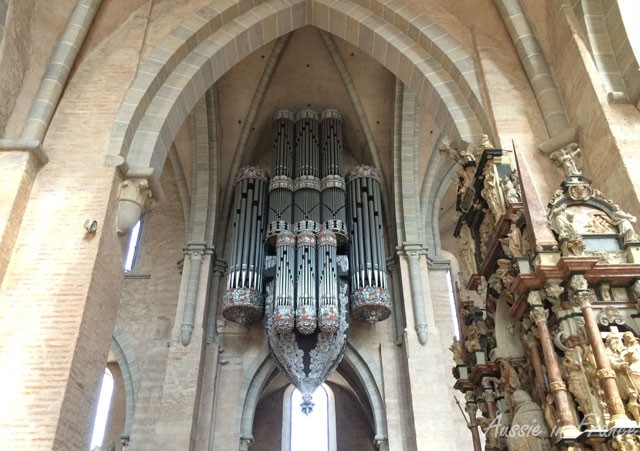
It has several very eclectic features including a most unusual organ. Even with our binoculars, we can’t work out exactly what it’s made of. It looks like mother-of-pearl to me.
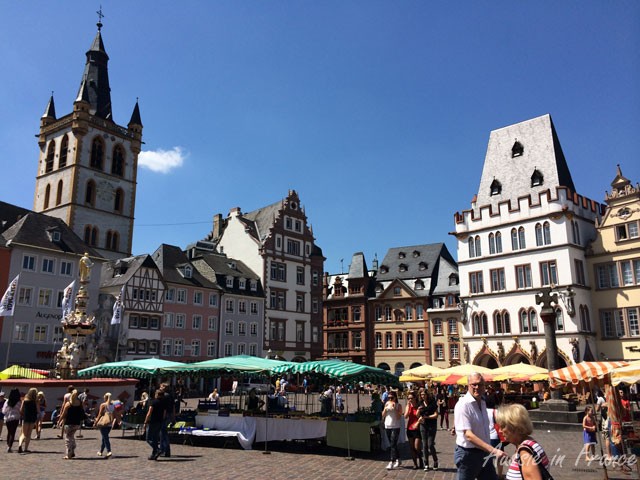
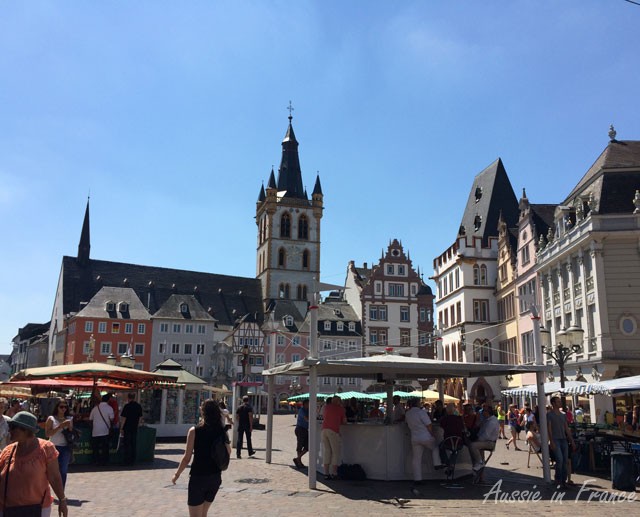
After leaving the church, we turn left towards marktplatz which is very crowded and lined with colourful façades.
From the square, you can see the Porta Nigra, built of grey sandstone in 200 AD. It acquired its name (black gate) in the Middle Ages because of its colour. It originally consisted of two four-storied towers and was one of four. I have a vague memory of it …
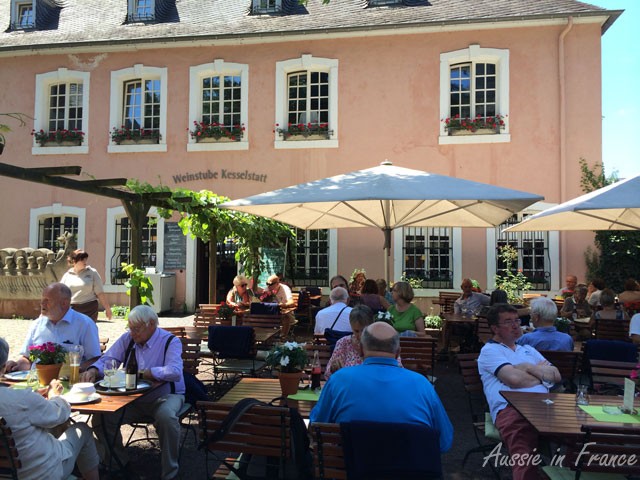
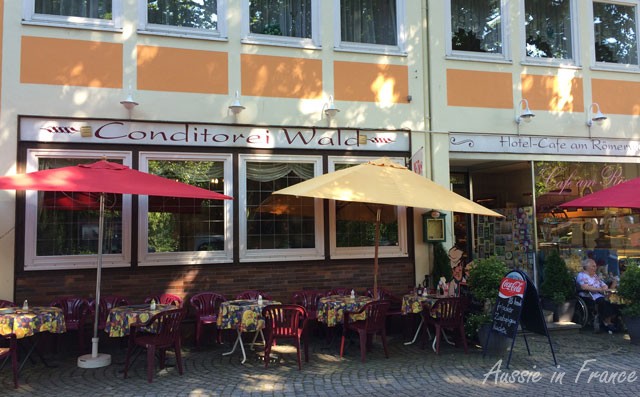
By then we are hot – it’s 33°C – and hungry so go back to a shady outdoor restaurant I noticed on the way. There is a card on the table explaining in English and German that you go inside and buy your drinks and order your food. You are given a flag with a number that you put in the flowerpot on your table and the waitress brings your order. Just like an Australian pub, says Jean Michel.
He comes back with two different glasses of Riesling and I go and order the pork steaks and summersalat. The restaurant also has a great view of the two churches – provided you know about the second terrace, which we only discover after we finish.
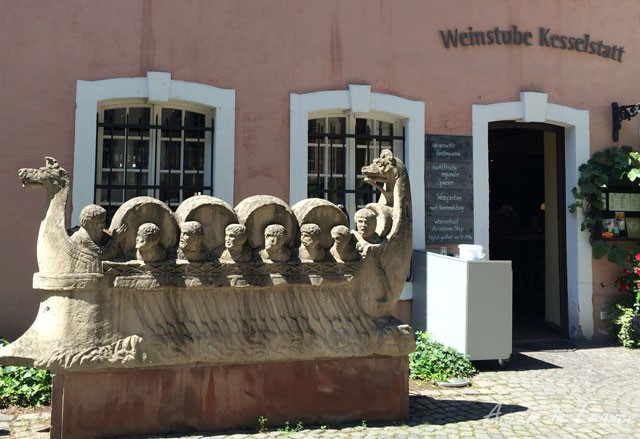
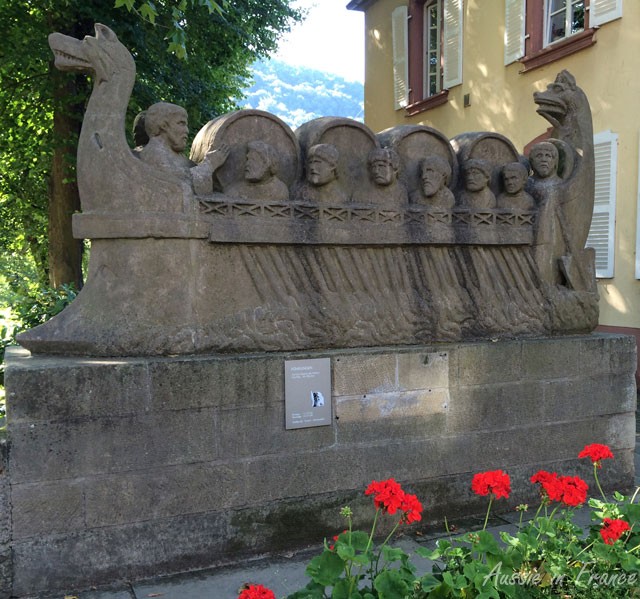
Just next to the Kesselstadt Weinstube is an unusual stone monument of a Neumanger weinschiff, or wine boat.
After lunch, we decide we’ve seen enough of Trier so return to the parking lot where we have a 10 euro parking ticket. I obviously misinterpreted the information!
We drive to Thörnich wondering why on earth we’re going to cycle in the heat. “Where are my binoculars?”, I suddenly cry. I look everywhere but have no recollection of when I last saw them. I phone the weinstube, having checked how to say binoculars in German (fernglas) but no one has found them. Ah, you were luckier with your sunglasses, I say, just in case Jean Michel is tempted to mention how often I lose things.
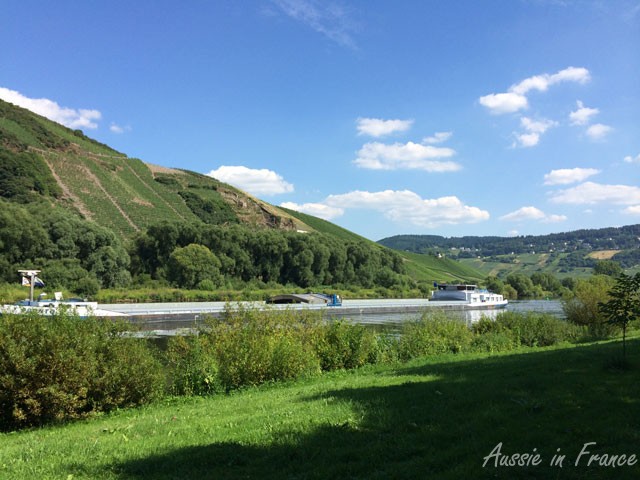
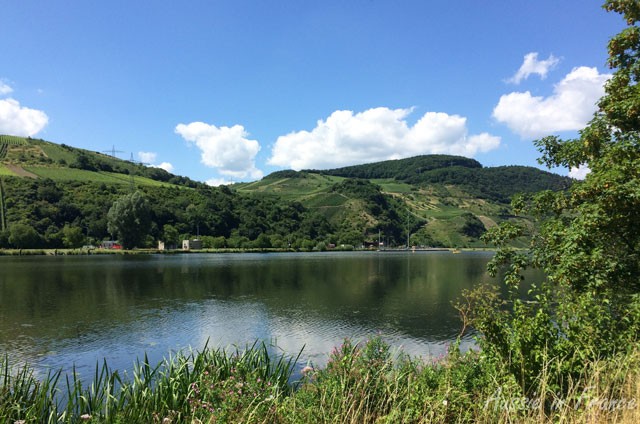
It’s very hot going, mainly through vineyards, with some occasional shade along the edge of the Moselle. Also, I’m feelilng very depressed about the binoculars.They were a present from my children and Jean Michel and are very good Leica binoculars. I try to put them out of my mind.
We arrive at Neumagen-Dhron which we didn’t even enter yesterday because it looked most unpromising and discover it’s actually a pretty little village with lots of places to eat, in particular an eis café.
Just in front, what do we see, but another weinschiff monument with an explanation in approximate English. It’s a winegrower’s tombstone, with 4 wooden wine kegs. I have to wait until a French cyclist finishes his mobile phone conversation before I can take the photo.
On the way back, I stop to take a photo of what looks like a children’s paddling pool. I later learn it’s a kneippbad after Dr Sebastian Kneipp, who may be one of my ancestors. It’s a therapeutic pool that you are supposed to wade through like a stork. What a pity I don’t know!
We’re hotter than ever when we get back to the car. I check the car for my binoculars again but still no sign of them.
After shopping in a little supermarket we found earlier that has the most surprising coffee shop at the entrance we go back to our flat.
We’re sitting out on the balcony experiencing end-of-holiday blues while drinking the wine we bought in Bernkastel the day before. It hasn’t been a real holiday, says Jean Michel. We haven’t had any time for relaxation. I can’t agree more. We talk about why. I think that we were expecting the same magic as our Danube trip last year but Jean Michel doesn’t agree.
However, we both agree that when everything is planned ahead of time, it’s less stressful. But we wanted to follow the good weather, which we accomplished pretty well.
Let’s not stay in for dinner, says Jean Michel. Let’s go and find something in Bernkastel. On the way we find a hotel with a garden restaurant. We have rumpsteak (not schwein!) and the waitress speaks real English which is somewhat of a relief.
After dinner we walk over the bridge to the old city and discover that there is another long street with lots of beautiful houses (and restaurants) we missed the day before. By now our end-of-holiday blues have disappeared.
It’s next morning and we set out early on our 6 ½ hour drive to Blois. As we’re packing up the car, I have another look for my binoculars. And there they are! They’ve half fallen into the top zippered part of my bike bag that I only use when we have a picnic. When we got back to the car after Trier I must have put them on the back seat on top of the bike bag and because both the binoculars and the bag are black, I didn’t see them.
We arrive in Bernkastel at about 1.30 pm after a 4-hour drive from Hann Münden with only a couple of rough patches on the motorway. I wouldn’t have liked to be going in the other direction around Hanover though. The line-up seemed to go on forever. One thing I will not regret are the German motorways.
The sun is out although the temperature is not that high. We have a light lunch at the Weinkulturel centre which is next to the 15th century Saint Nicolas hospital where they only ever have 33 patients because it was the age at which Christ died. In any case, it’s a very lovely spot.
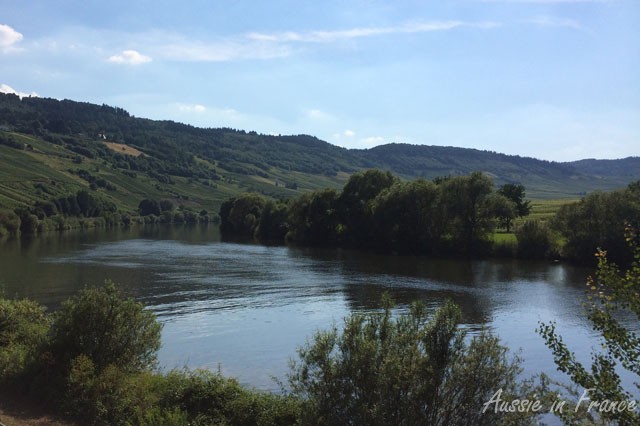
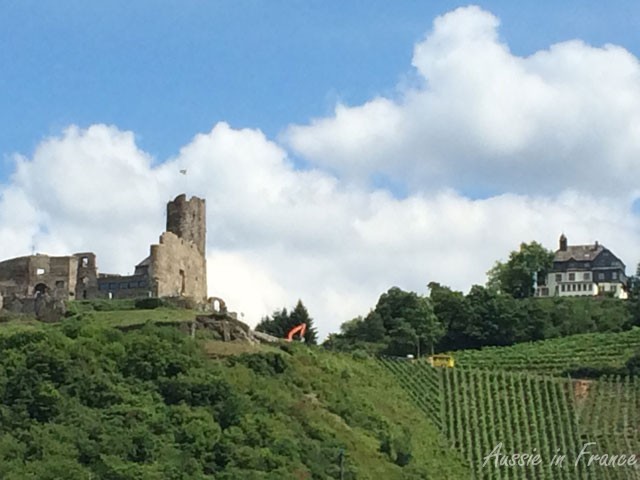
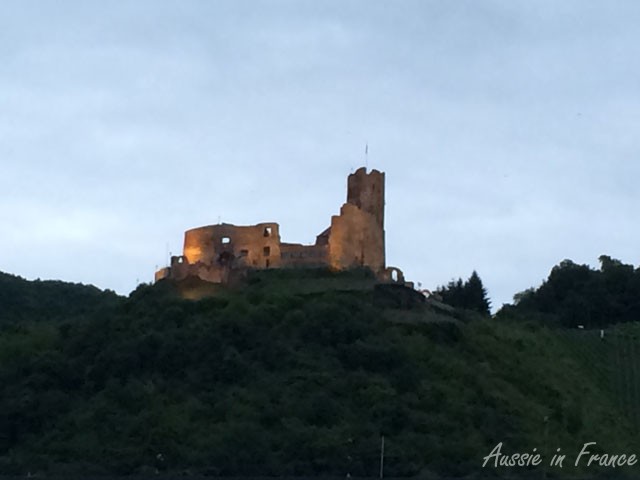
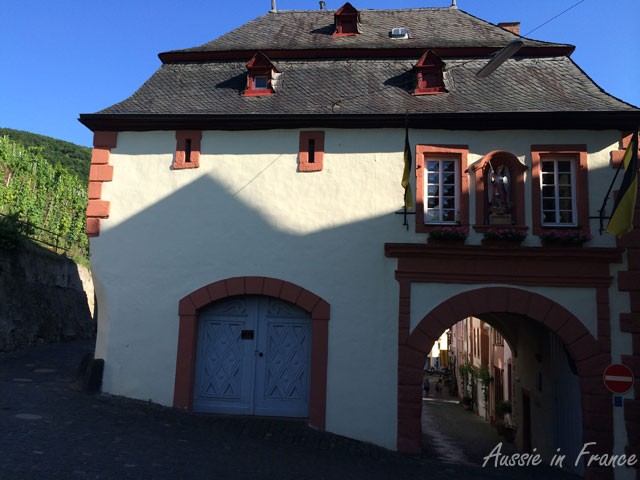
We have to check in at our ferienwohnung (holiday flat) between 2 and 3 pm. The owner is very friendly and speaks good English. The flat is fairly rudimentary but has a little balcony with an excellent view of the vine-covered hillside and the ruins of the Burg Landshut castle on the other side of the Moselle if you ignore the school in the foreground. The big problem is the internet connection which only works if I sit on the step between the entrance and the living room. I try moving the small sofa but one of the legs falls off … not our best accommodation.
After a short shopping excursion, we set out on our bikes directly from the flat 15-K downstream to Lösnich. On the way , we discover a small platz in Bernkastel which we find attractive and get some brochures from the tourist office next door.
We’re a little disappointed with the countryside which corresponds to what we initially saw around Kondorf. Jean Michel is a little worried that it’s not going to bet any better. Also, we are often parallel to the road.
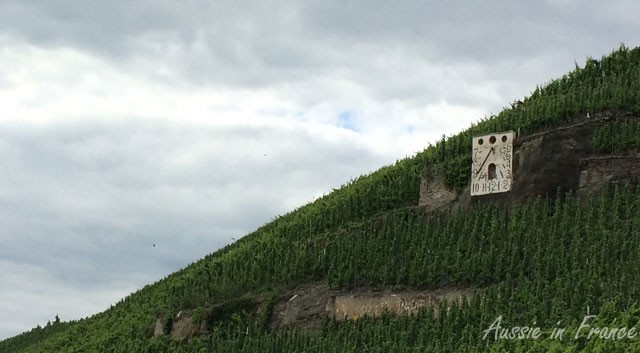
We see some interesting sundials, though, in the middle of the vineyards. They were built in the 19th century so that the workers knew when to knock off for lunch or go home for the day!
On our return to Bernkastel, we can’t find a restaurant to our liking so end up going home, which is actually much more relaxing and we’re really not that hungry. We watch the sun set over Burg Landshut on our little balcony.
The bed turns out to be a disaster – hard and creaky. The pillow gives me a sore neck so I don’t have a very good night despite the good shutters. I’m really starting to long for my own bed.
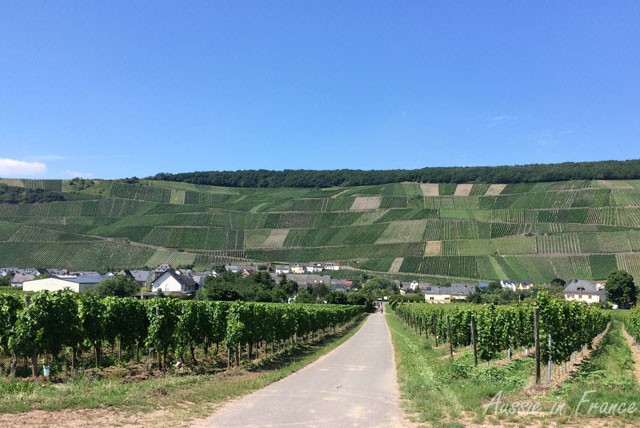
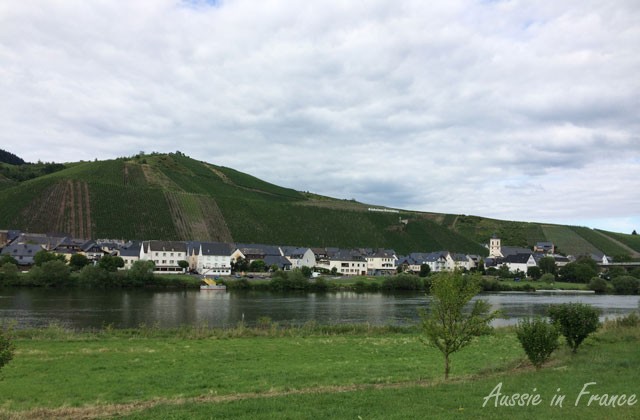
Today, we’re heading 25 km upstream to Neumagen-Dhron. The scenery is much prettier and the bike path is closer to the river and we go through a lot of little villages.
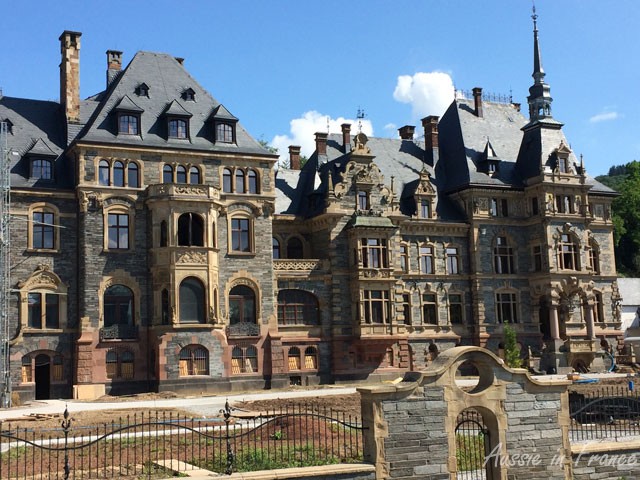
In Lieser, we see a very unusual 19th century Neo-gothic building that is obviously being refurbished. It has some amazing details on the façade including mosaics and fish-shaped gutters.
We come across any number of weinguts or wineries but no cafés, not even for radlers (cyclists). We finally get some coffee at Peter’s bäckerei in where I have to bring out the coffee myself.
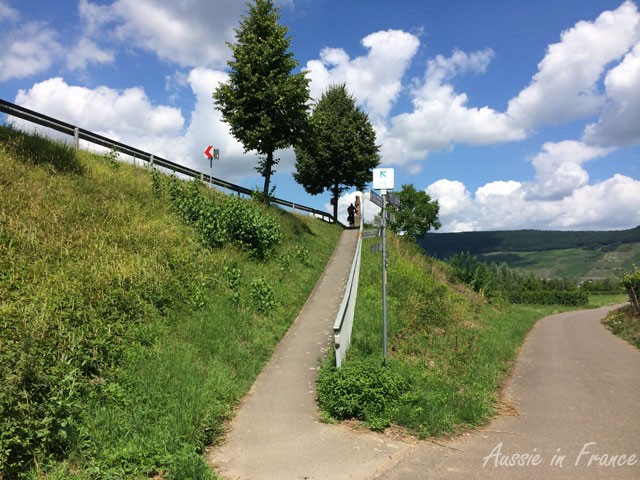
Our bike path includes some nearly vertical sections which I’m flat out wheeling my bike up but Jean Michel, who’s been riding a bike since primary school, cycles up with great aplomb.
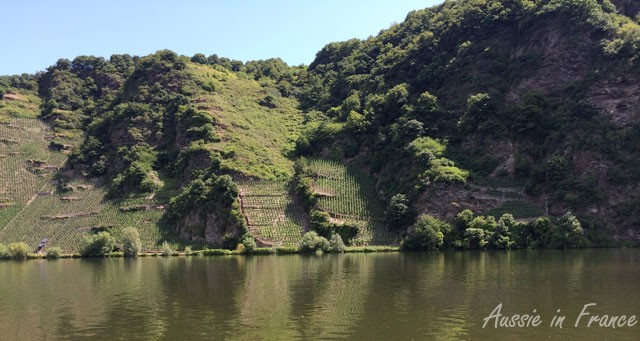
Most of the vineyards which encircle us on every side are also nearly vertical! In one place, there is obviously no other way to get to one lot of vines except by boat.
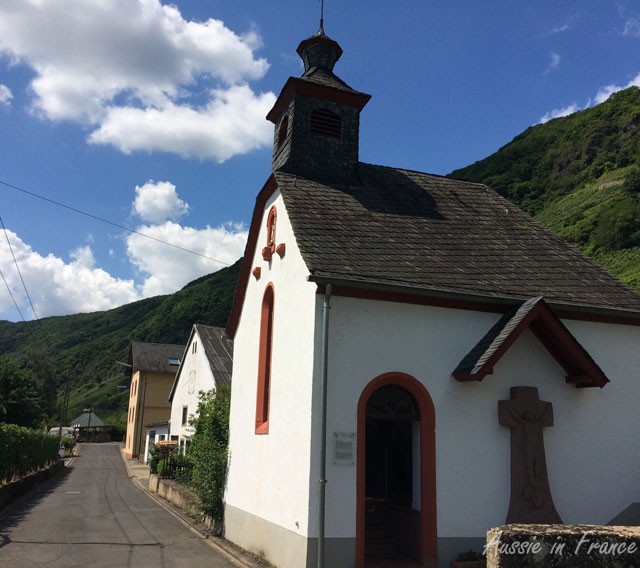
I spy a little roadside chapel whose legend is explained in English for once. Probably in the 17th century, a wooden cross swirled around in the same place when the river was in spate, pointing in the direction of the village of Ferres. This was taken as a sign to build a chapel. Today, the locals call it Ferres Cathedral because of its great importance to them.
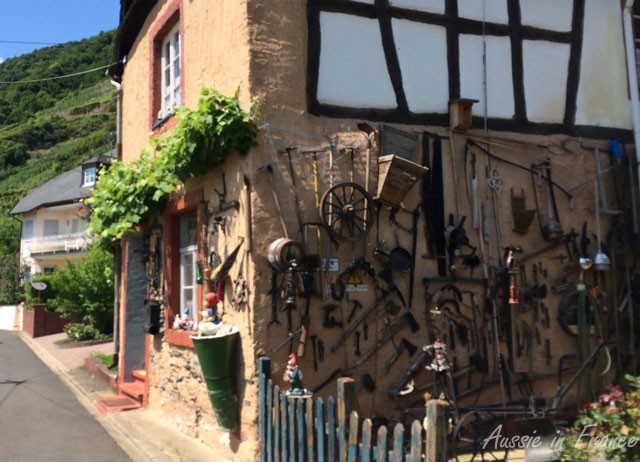
Further down the road, there is a house that looks like it has a second-hand shop on its wall!
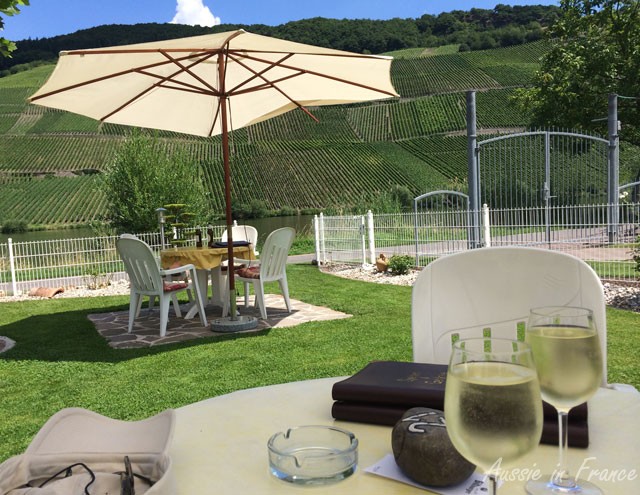
As we cycle past Piesport, I see a couple of likely lunch spots just in case Neumagen-Dhron doesn’t have anything better to offer. I’m right and by the time we get back to Piesport along the other side of the river, we are well and truly ready for our trocken weiss wein! It must be about 28°C.
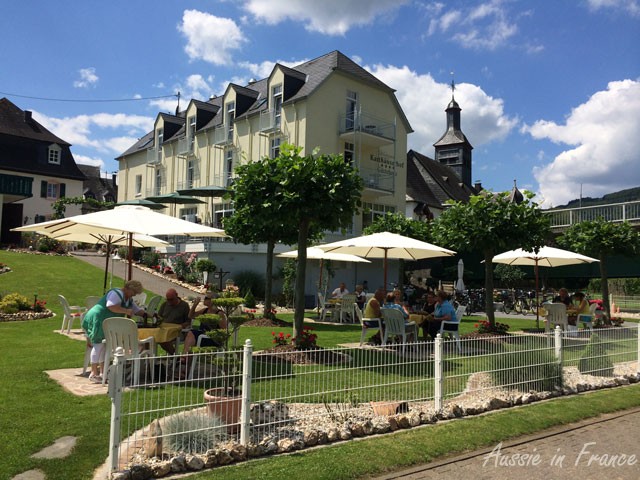
We choose the Karthäuserhof with its inviting parasols, and only the bike path between us and the river. We manage to communicate with the very jovial waitress and enjoy our wiener art schnitzels and pommes frites.
It’s a bit difficult to get back on our bikes after such high calorie food (not to mention the wine) and we seem to go up and down a lot among the vineyards but we finally reach Bernkastel ready for an ice-cream.
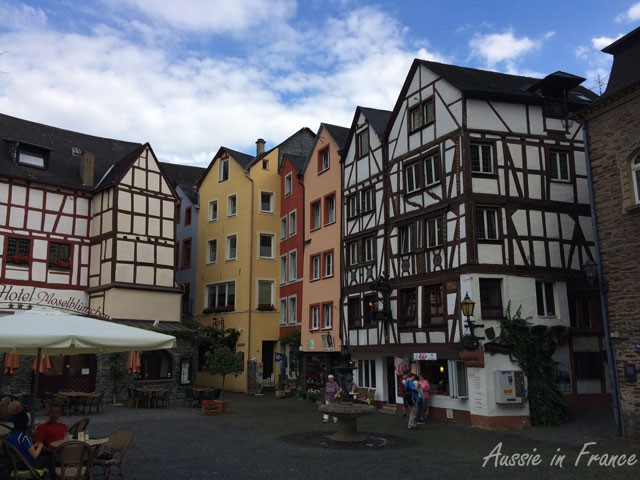
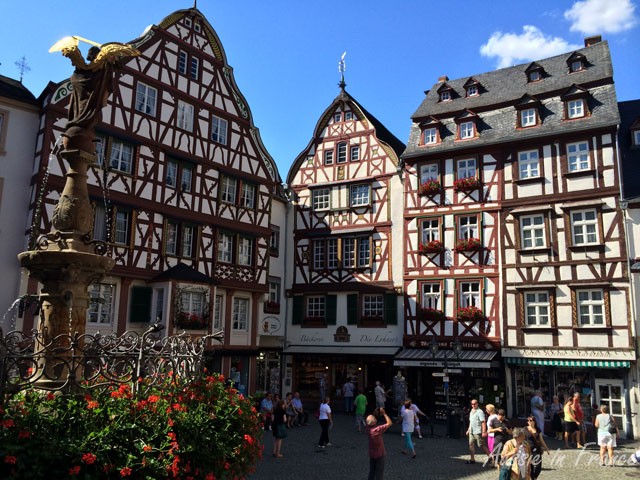
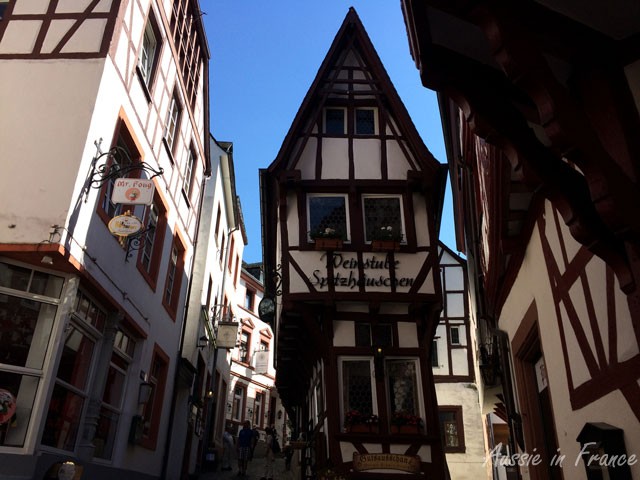
I suggest we go further than the platz we’ve already visited and to our immense surprise, the little streets are very pretty (and full of tourists). Then we come out into Marktplatz and look at each other in bemusement. Why isn’t this mentioned in our guidebooks and the local brochures? The 16th and 17th century façades are really beautiful.
After wandering around we finally end up at a shady table at the Ratskeller with a glass of wine and our binoculars studying all the wonderful architectural features. I see that the façades are not just painted but carved as well. They also have some lovely wind vanes.
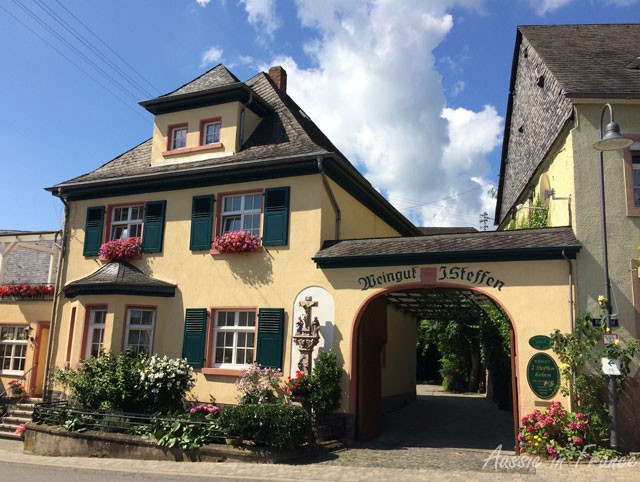
Before we go and visit the only remaining town gate, we enter the nearby weingut, Robert Schmitz-Herges, which looks as though it might keel over any moment, and buy an excellent 2010 Spitzhäusen riesling classic at 4.90 euro a bottle! All the vineyards are around Bernkastel.
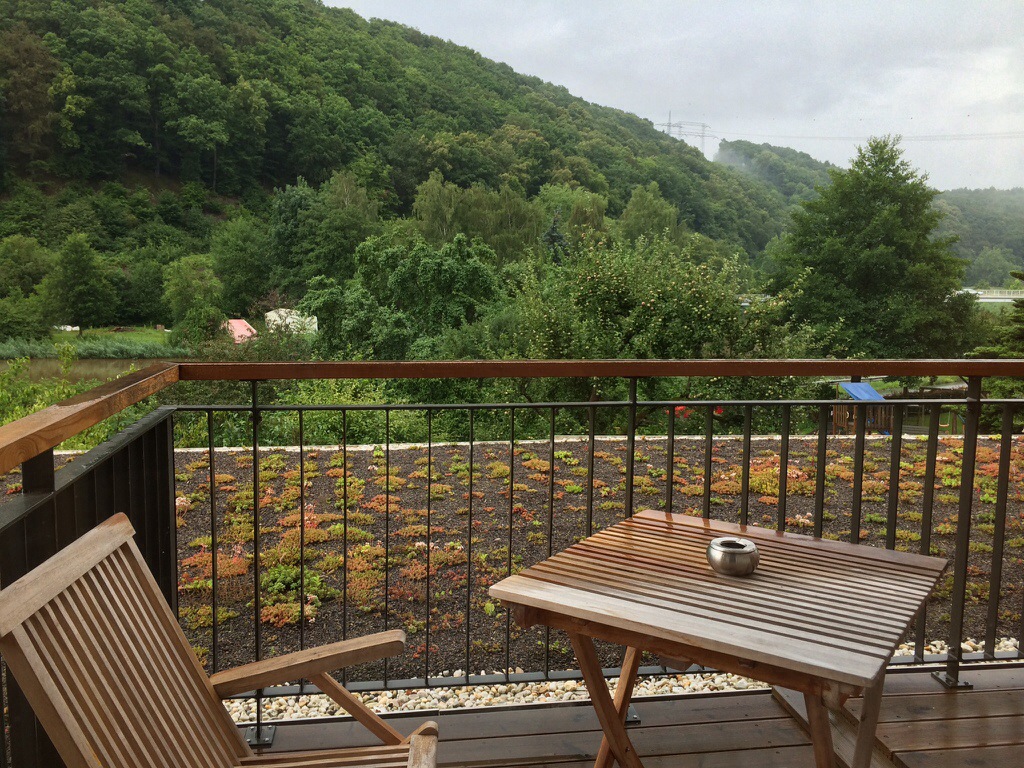
After our three days of wonderful weather in Friesland, we are homeward bound. We have 5 nights left in Germany and are spending the last three on the Moselle, near Trier, which is an 8-hour drive, so we are looking for somewhere in the middle where it’s not going to pour with rain. I would like to go to Hamelin (of Pied Piper fame) but it’s a bit out of the way and drizzly. We opt for Hann Münden for which light showers are forecast.
As there is nothing interesting on the way and it’s an intermittent fast day, we have a picnic lunch and arrive at the Werratal Hotel in the rain at 3 pm. We flake out and finally emerge at 6.30 pm. It’s no longer raining so we ask the girl at the desk if she has a map of the bike path to Hann Münden as it’s 6 K from the hotel. She looks so sceptical – after the rain, it will be very muddy – that we change our minds and drive there.
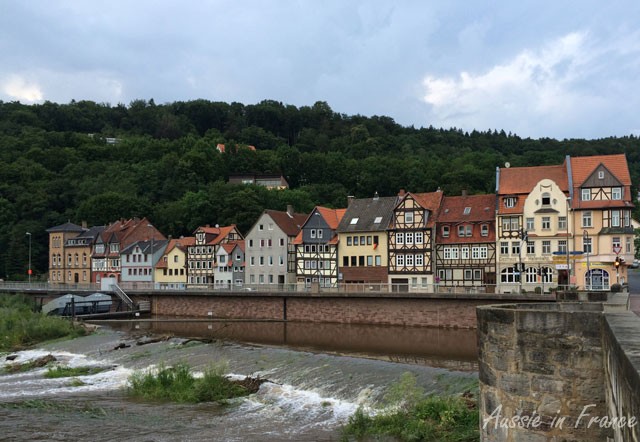
We find a stone picnic table and bench overlooking the town which is at the confluence of the Fulda and Weser Rivers on which Bremen is located.
It has another claim to fame. Blois’ most important historical figure, Denis Papin, inventor of the steam engine and pressure cooker, built a steam-pump powered paddlewheel boat, probably pedal-driven, in 1704, and as a demonstration, used his steam paddlewheeler to navigate down the Fulda River from Kassel to Hann. Münden in 1707.
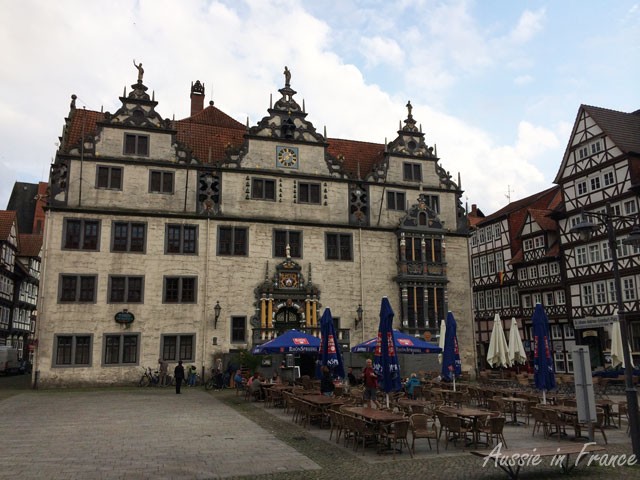
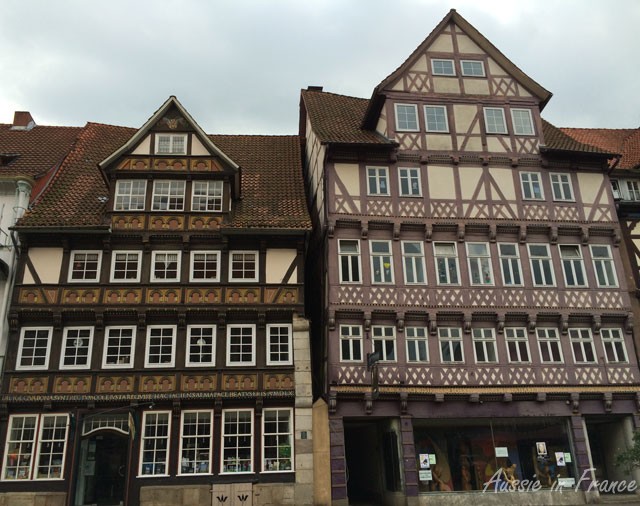
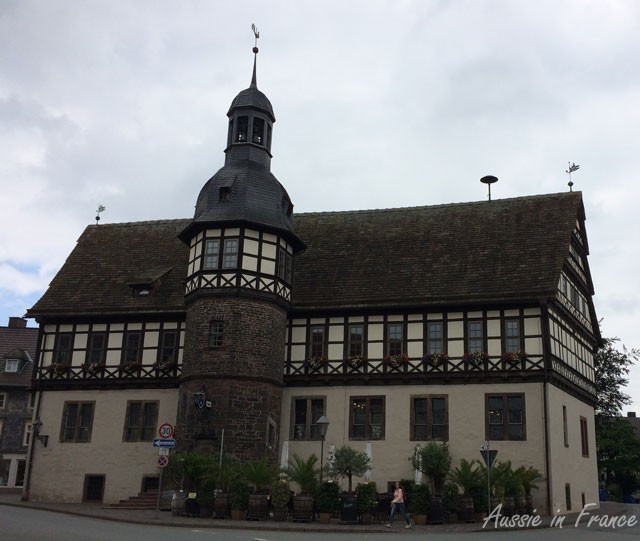
We wander over the covered wooden bridge, typical of those we saw on the Danube last year, and into the town, which has more than 700 historical houses, some of them more than 600 years old, in the Weser Renaissance style.
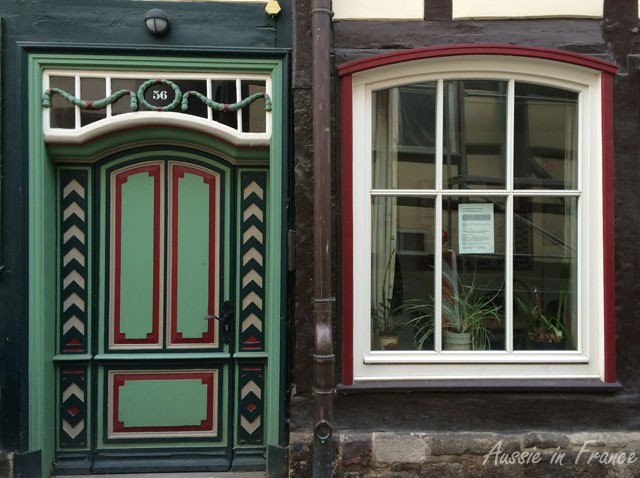
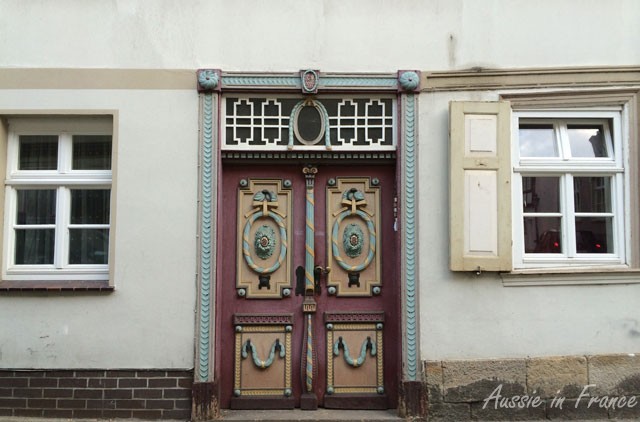
It is not as stunning as Celle, but it is still very charming and there are some beautiful painted doors.
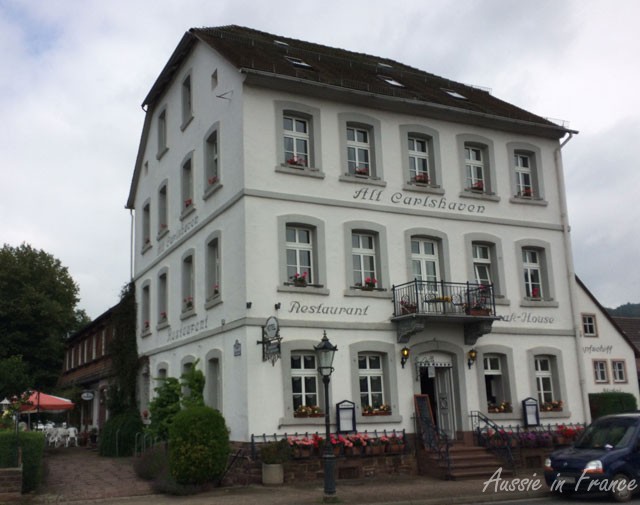
It’s next morning and we’ve had an excellent breakfast (good bread for once!). The forecast is scattered showers so we’re taking a chance. We’ve studied the cycling map on the web and decided to start at Bad Karlshafe, which has an interesting history.
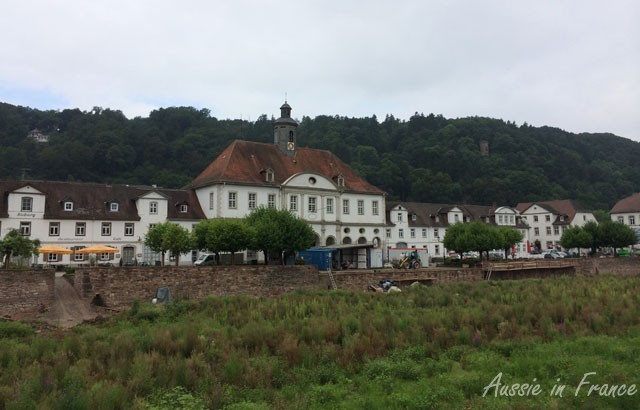
It was founded in 1699 by French Huguenots fleeing persecution in France. Though initially named Sieburg, the town was later named after Charles I, Landgrave of Hesse-Kassel, who granted them refuge. We find this particularly interesting as the original owners of our house in Blois, Closerie Falaiseau, were Huguenots.
The town was built to an ideal plan in the classical Baroque style with a harbour in the centre that is currently undergoing restoration, which unfortunately somewhat detracts from the overall aesthetics.
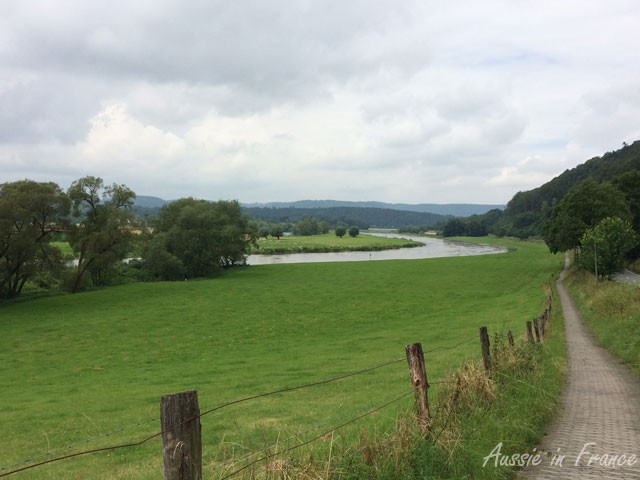
After a false start we find ourselves on a very pleasant bike path along the Weser River. We lament the lack of sun because the scenery is very calm and peaceful, with rolling hills on both sides.
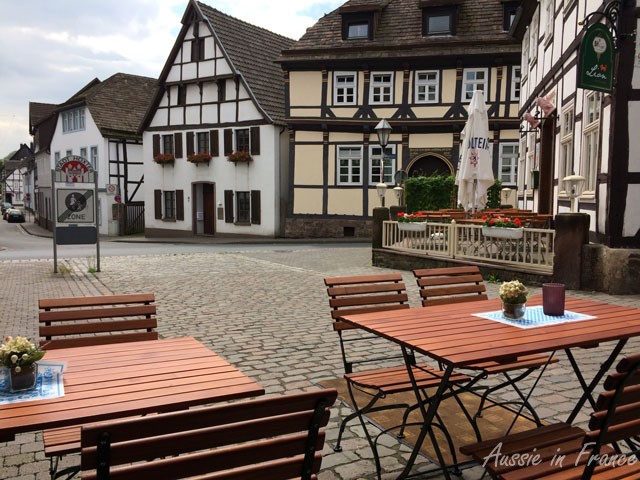
It’s nearly midday. I’m feeling sluggish and needing a coffee fix so when we arrive at Lauenförde which has some lovely old houses with more painted doorways, we stop at the first outdoor café we see, the Dolce Vita Theatre Café. The cappuccino is almost real and the excellent Schwarzwälder Kirschtorte (Black Forest) will keep us going until lunch in Höxter which is still another 20 K.
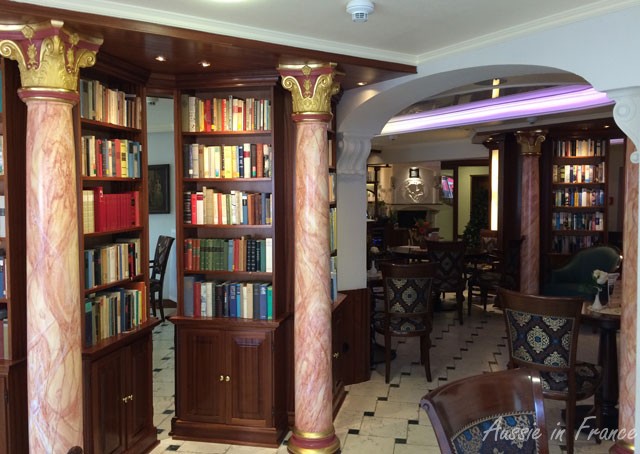
I go in to use the ladies and discover that the inside is like an antique library. It’s beautiful. Downstairs in the basement, there is a small theatre, hence the name. I follow the Ausgang sign and find myself in a small courtyard with a well – we could have sat there instead of facing the street!
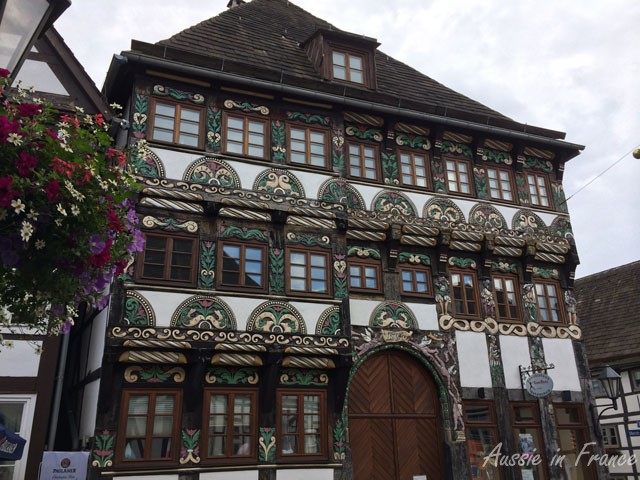
The path to Höxter is very pleasant and the sun finally comes out. Höxter proves to have more beautiful painted façades, with a different sort of motif. We cycle through the pedestrian centre until we find a restaurant to our liking. By then it’s 2 pm and we are the only people there.
Using my German dictionary app, we order roast suckling pig with saukerkraut and dumplings – klein for me and gross for Jean Michel (of course). We are brought a little cup of cucumber and cream soup while we’re waiting. The food is delicious. The bill, including a glass of trocken weiss wein each is 34 euros! I can definitely recommend the Paulaner Wirtshaus on Stummreger Strasse.
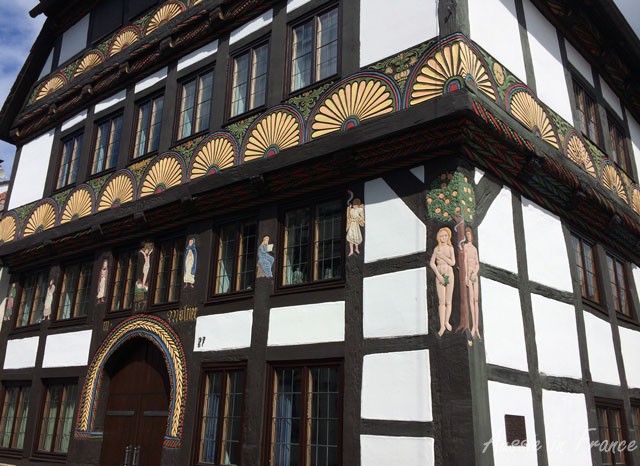
We call in at the tourist office to get a town map and check we’ve seen all the sights. Ah, we’ve missed Adam & Eve’s house. It turns out to be just down the road from our restaurant and is worth the detour.
We take the path back on the other side the river and it is just as pretty – and just as hilly!
At Wehrden, we visit the grounds of a schloss, a bit worried when we see a privat sign, then have a very cold (and rare) Coke sitting in comfortable chairs with a view of the Weser.
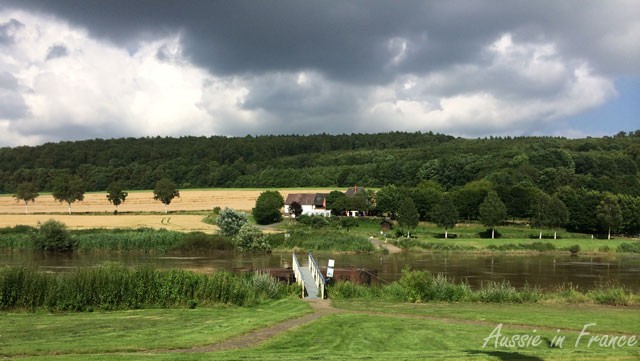
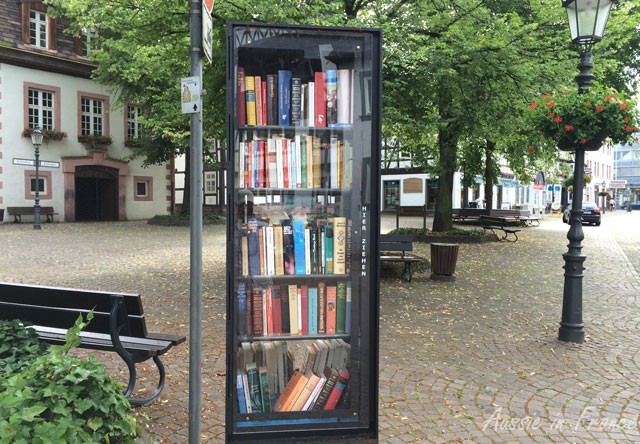
At Beverunge, there are more painted façades and an old winch which was no doubt used for a cable ferry. There is also another book tower but not nearly as cute as the red one in Friesland.
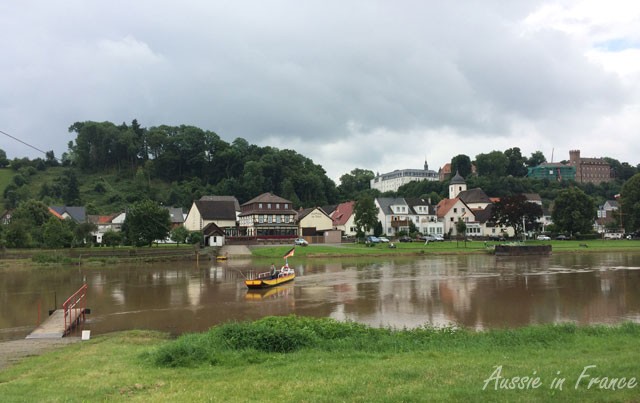
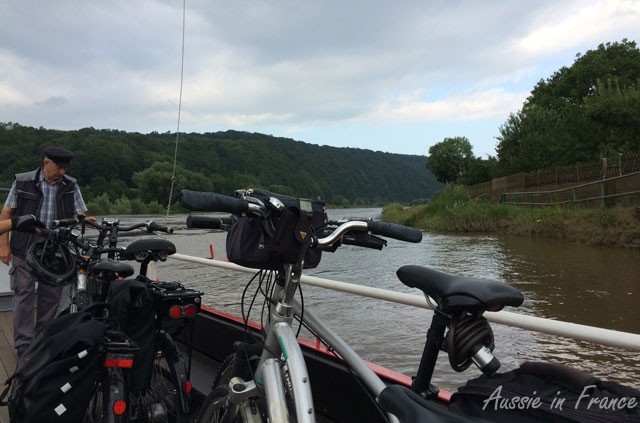
By the time we get to Herstelle, it’s 6.05 pm and we can see the ferry across the river. The sign says the ferry stops at 6 pm but the ferryman waves to us and comes over. Another couple of cyclists are waiting. We’ve never seen a ferry like this one. I’m even wondering how I’ll get my bike on.
But the ferryman shows us how to turn the bike and back it into the main part of the ferry. With four bikes and 5 people, we’re almost full. When he sees us taking photos of him, he spontaneously offers to take photos of us. He’s obviously done this before. The ferry costs 1 euro for two people and two bikes.
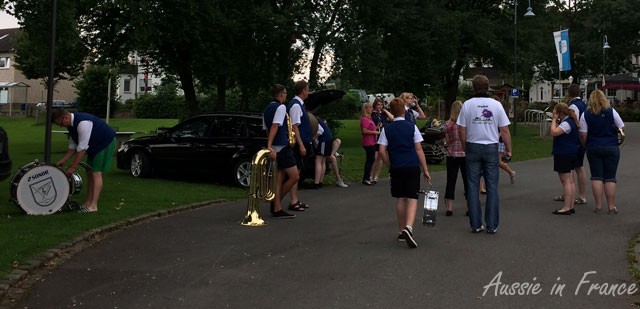
On the other side, a brass band is obviously about to start practising but after waiting around for a while we move on. It’s getting late and we haven’t bought our tomatoes, lettuce and fruit yet for dinner.
At 7.30 we’re on our balcony with a glass of Riesling and a packet of pistachios, having cycled 54 K and had the sort of day we love – soaking up the scenery, discovering new types of architecture, visiting unusual places – and it didn’t rain! Tomorrow, we’re off to the Moselle and the weather forecast is hot and sunny.