Weekly Blogger Round-Up – All About France with Lou Messugo

You are all familiar with Phoebe from Lou Messugo who lives in Nice and has often been featured in this weekly blogger round-up.

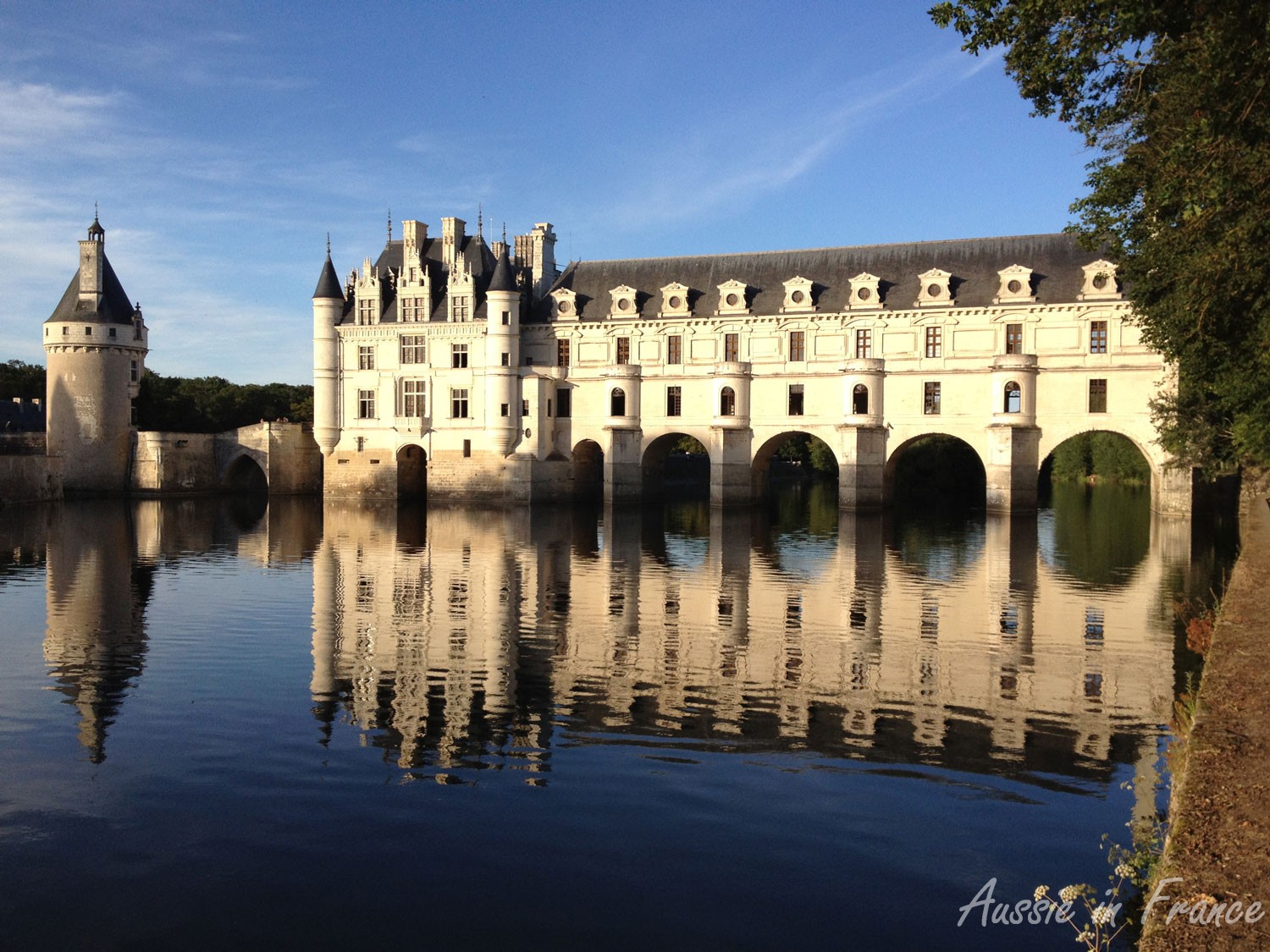
Today, she is beginning a new monthly link-up focussing on posts about France from bloggers across the glob. I’ve contributed my post on the Ten Top Châteaux in the Loire Valley. As I’m writing she already has 16 other participants, including such diverse subjects as the 2CV, the tooth fairy, how to talk to your Muslim kids about Charlie Hebdo and the beautiful Alsatian village of Colmar. Enjoy!

All About France #1

by Phoebe from Lou Messugo, a traveller, francophile, expat, mum and foodie now living in Roquefort les Pins where she runs a gîte after many years of travelling and living in Asia, Eastern Europe and Australia.

AllAboutFranceBadge_bisWelcome to the first All About France blog linky (and my first time hosting a link-up).   I’ve been thinking about starting this for a few months now and keep getting side tracked, but there’s no time like the present….So if you write or have written about France in any shape or form then please join in.  You don’t have to write regularly about France, an old post about a holiday is perfectly appropriate, for example. Feel free to link old or new posts, as long as they’re about France or French they’re welcome. Read more.

A Mock-Up of the Little House

You may remember our poultry yard dilemma that got in the way of our project to renovate our “little house” to make a gîte (self-catering holiday rental accommodation). We thought we might have to drop the idea altogether. The next idea was to convert our second barn instead. Then the neighbours sold their house to a lovely couple who has no intention of pursuing the barnyard theme.

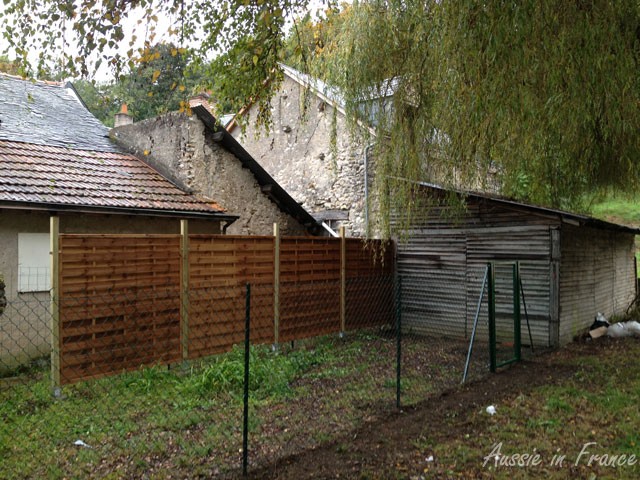
The enclosure, with the lean-to on the right which is up against our barn and the house that is going to be pulled down to form a garden for the gîte

Jean Michel has been pondering the question for some time and has now decided that we should go back to the original idea of refurbishing the little house. He explains it to me but I am one of those people who finds it difficult to change something that I like and I can’t imagine in my mind what he wants to do. I love the side view of the little house which Jean Michel simply cannot undertand.

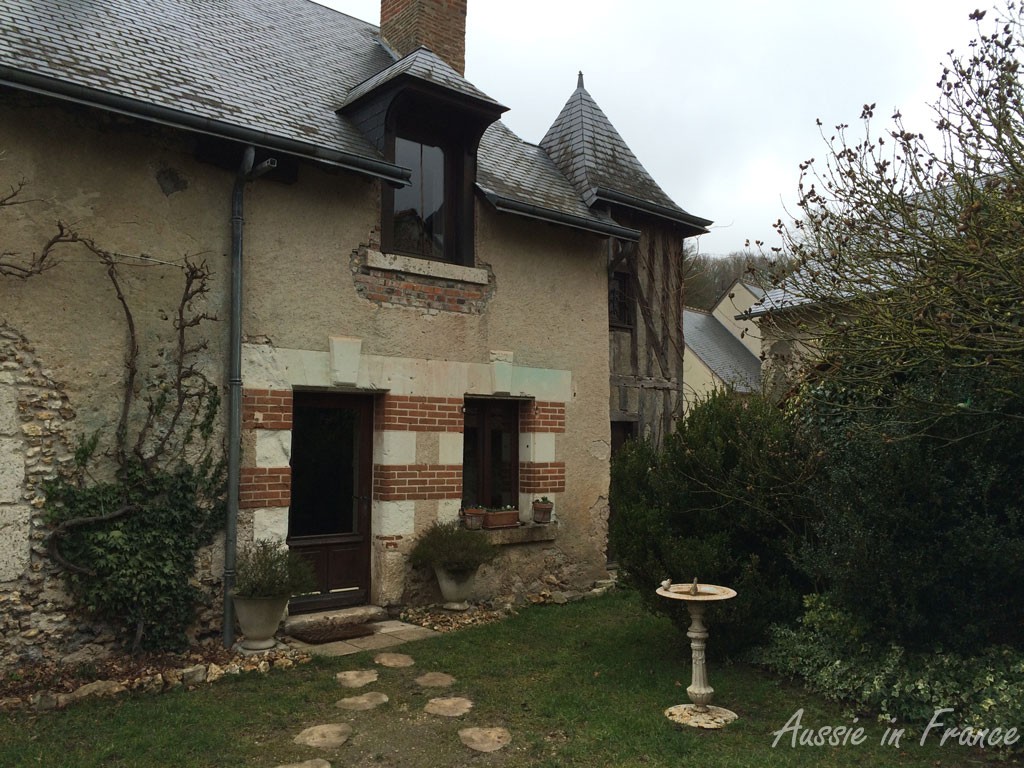
The corner view of the little house seen from our garden
The corner view of the little house seen from our garden 

He starts getting annoyed with me and I can see we’re heading for an argument so I say I’ll make a scale model. Whatever you want, he replies. I just need all the dimensions. I have the dimensions. I’ve drawn the floor plans of little house to scale, he says. Well, can I have them? It’s after dinner and he thinks it’s a bit late to be embarking on model-making but he gets them anyway.

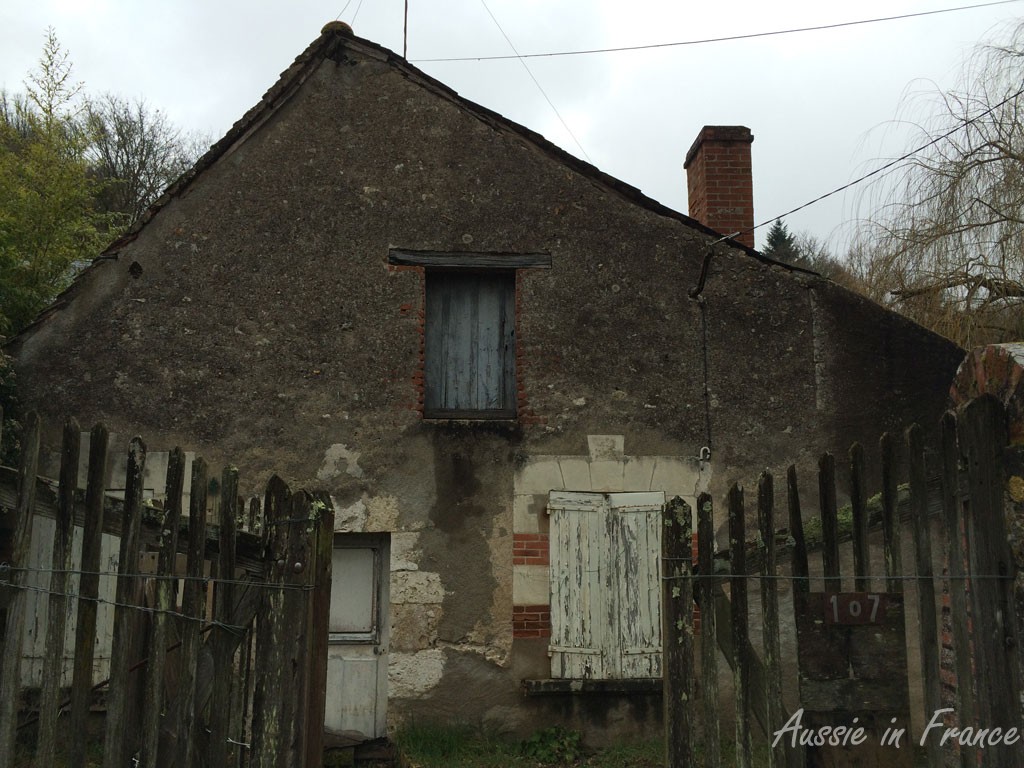
The façade of the little house at the moment, which is rather ugly, you will agree!

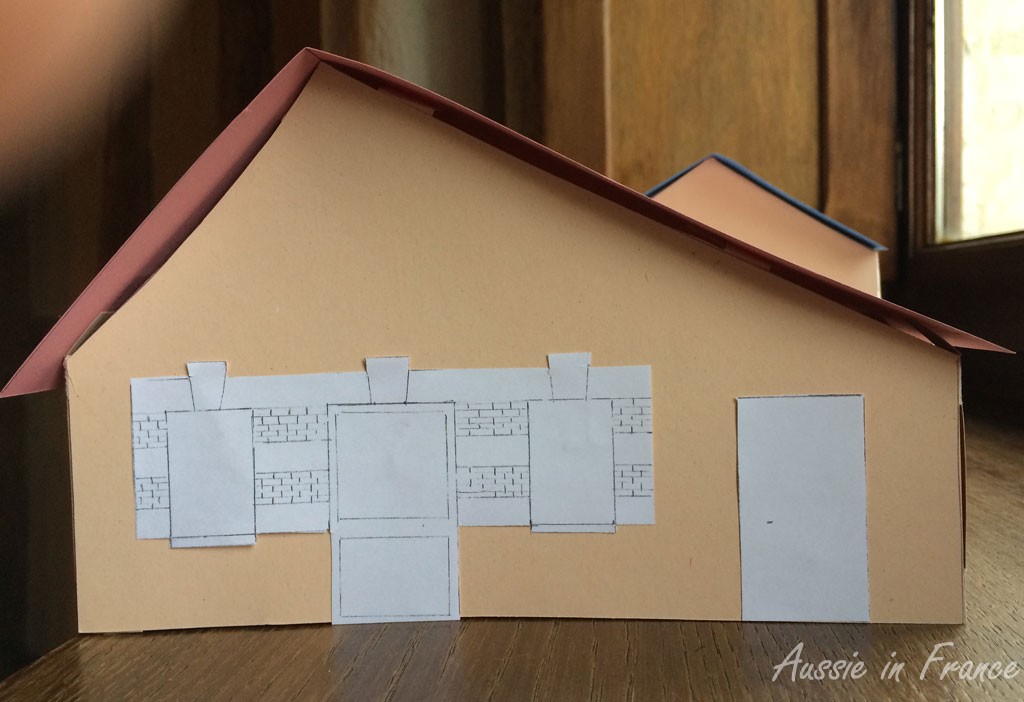
I go and find some coloured cardboard, sticky tape, scissors, pen and a ruler. He looks on amazed as I proceed to rule lines and cut out pieces of cardboard. Well, I can see this isn’t your first scale model, he says. It is actually the first one that I’ve made myself but I loved making models when I was a child. Dad once bought Buckingham Palace for me and my sister and we spent hours putting it together on Magnetic Island.

The façade of the little house on our mock-up, a replica of our own façade

I make the little house, except for the new roof at the back, as this is the part I can’t understand. Jean Michel, who is now itching to get his hands on the cardboard and scissors too, takes over.  I am amazed when I see the result. Never in a thousand years could I have imagined it without a physical model to help me.

The brick and stone façade of our house at the kitchen end

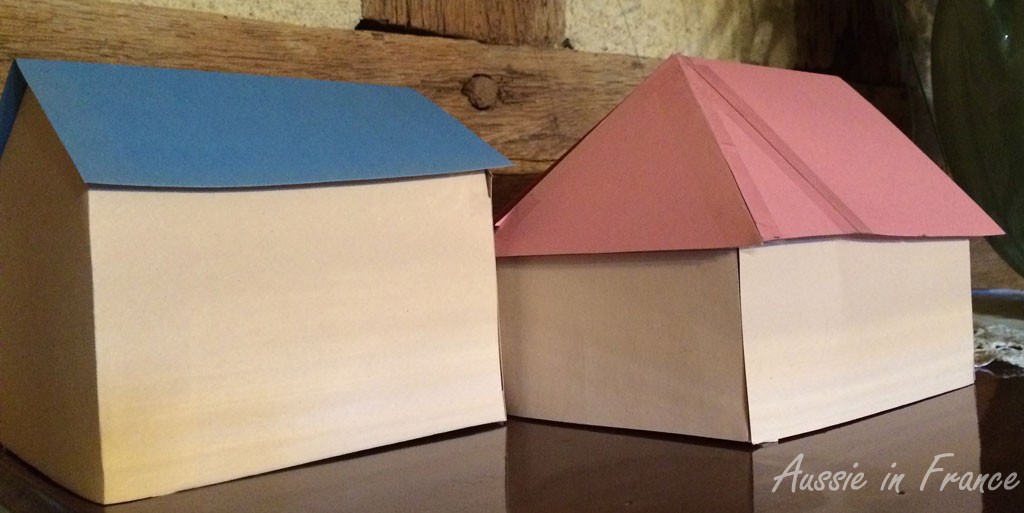
So where does the barn fit in, I ask. We need to make the barn as well. So I go and find some more buff-coloured cardboard. We decide on a blue roof to represent the slate because we used pink for the tiles. We fit the two together and I am at last able to imagine the result. We start discussing the floor plan of the inside of the little house and come up with several interesting ideas. But by then it’s nearly midnight so we go to bed.

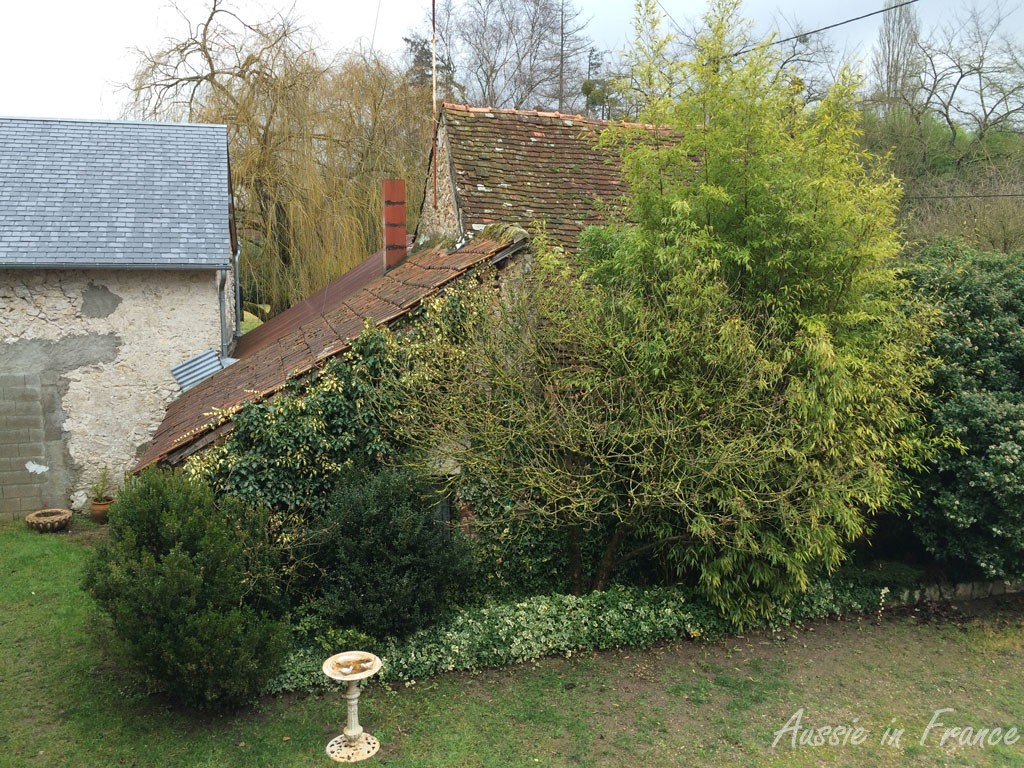
The barn on the left and the back of the little house on the right, with its new roof

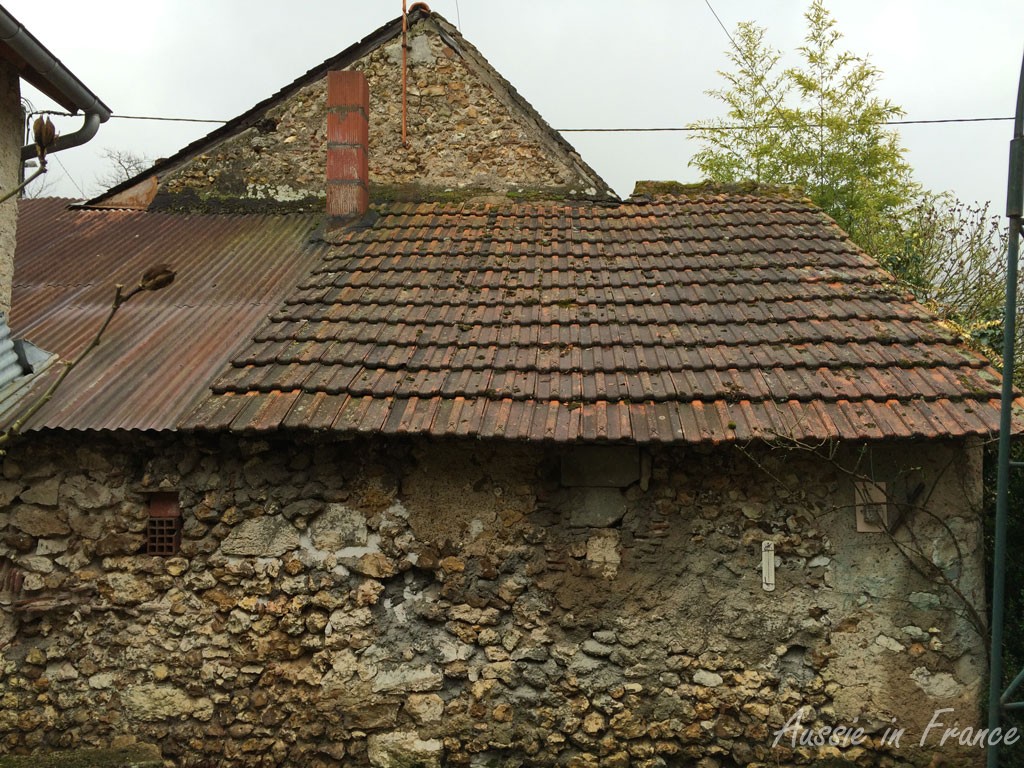
Next day, I have another look at the existing roof and see that Jean Michel’s idea isn’t so bad after all. We’ll lose a boxwood bush and a small althea but the new roof is actually quite attractive.

The back of the little house whose roof will disappear

One of the things we can add is an outside toilet which I’m very happy about. There is nothing worse than working in the garden and having to stop and change your muddy shoes to go to the other end of the house to the toilet, wash your hands or even get a glass of water.

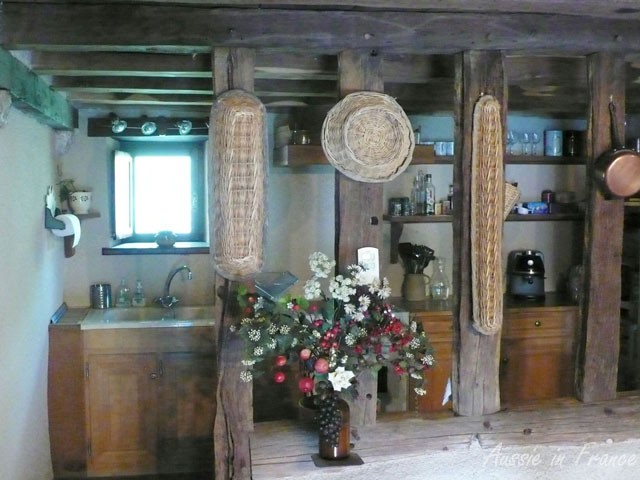
The division between the kitchen and dining area in the big house
The division between the kitchen and dining area in the big house that I would like to reproduce in the little house

Making the scale model has inspired me. I’m now thinking about how to organise the inside so that it will be as attractive and practical for holiday makers as possible. All this won’t be happening for a few years yet, but we need to ask for planning permission and incorporate the future plans into any other work we do on the house in the meantime (such as installing a heat pump, renovating the barn to take the current content of the little house and providing a garage for our second car which has mainly been parked across the street for the last three years !)

Wish us luck and if you have any criteria you think are essential for rental accommodation, please share!

Back Home in Blois to a Broken Weather Vane

We pick up our car at the long-term parking lot near Orly Airport at 10.30 pm after our flight back from Malaga and drive the two hours back to Blois with no mishaps. Closerie Falaiseau is safe and sound with no break-ins (you never know in this day and age what might happen) so we unload the car and turn on the electric blankets. The temperature in the bedroom is 15°C. Jean Michel brings up the portable oil heater.

You can see the round window on the right just opposite the street light!

I sleep like a log, most unusual for me, but there are no cars going over the cobblestone outside our house on the Double Hill and no light streaming into the enormous round unshuttered bedroom window from the street light as there was in Granada. Everything is perfectly still and quiet.

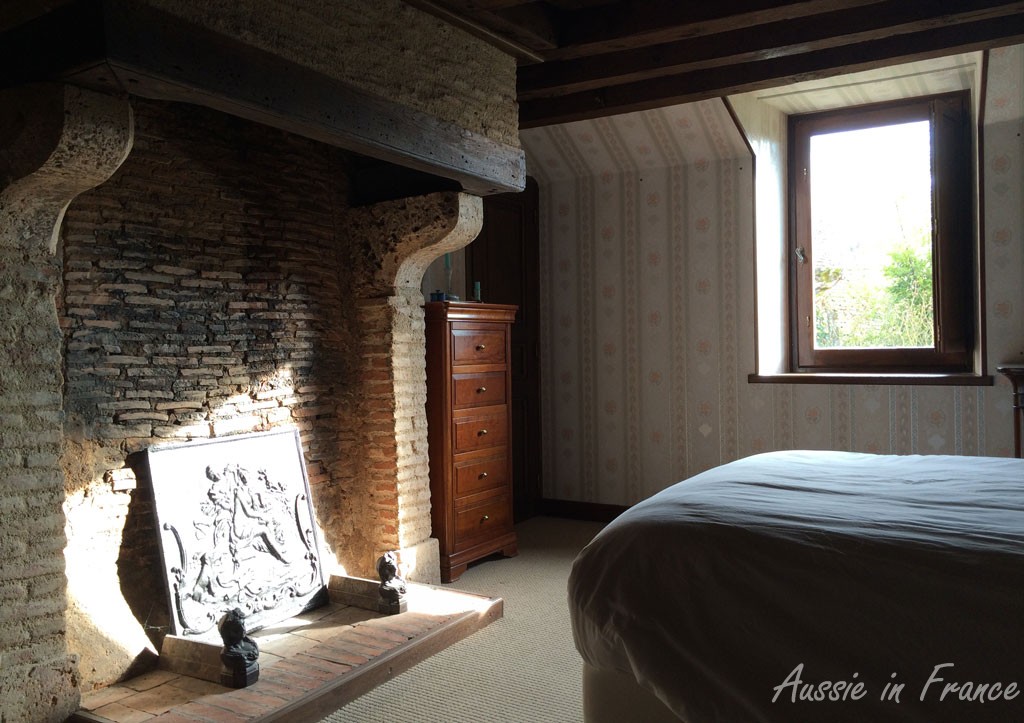
Bright sunshine in our bedroom - after we open the shutters!
Bright sunshine in our bedroom – after we open the shutters!

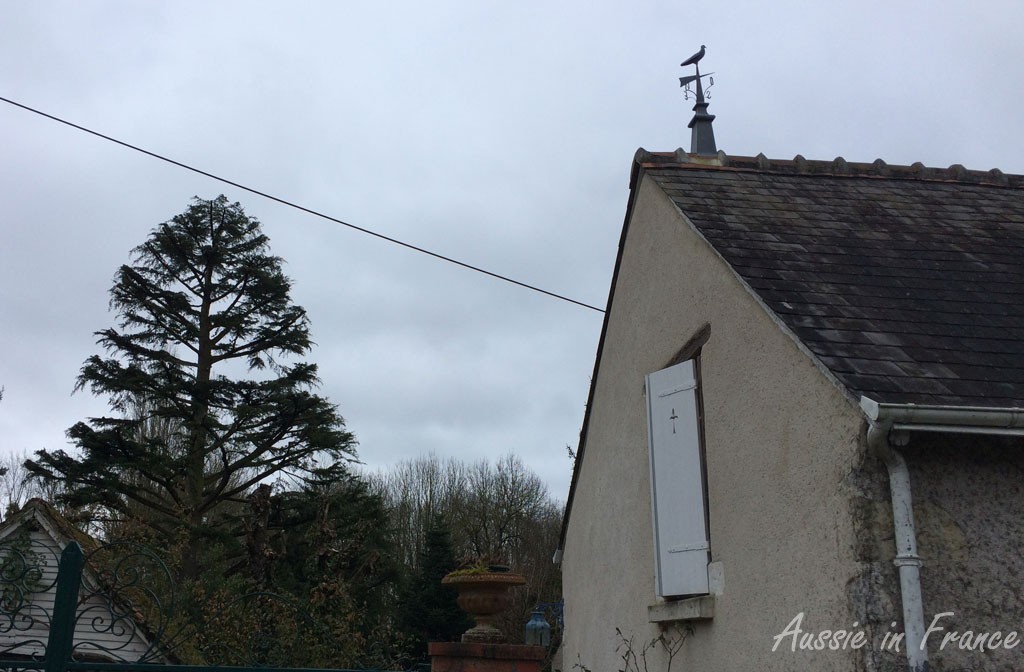
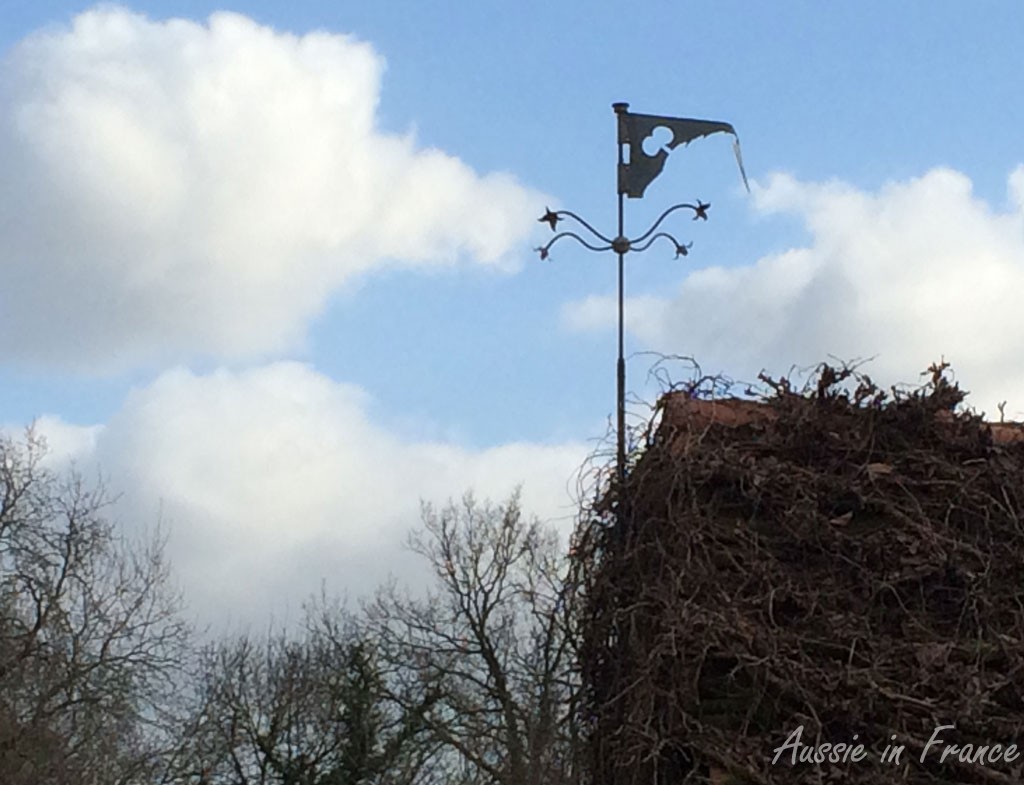
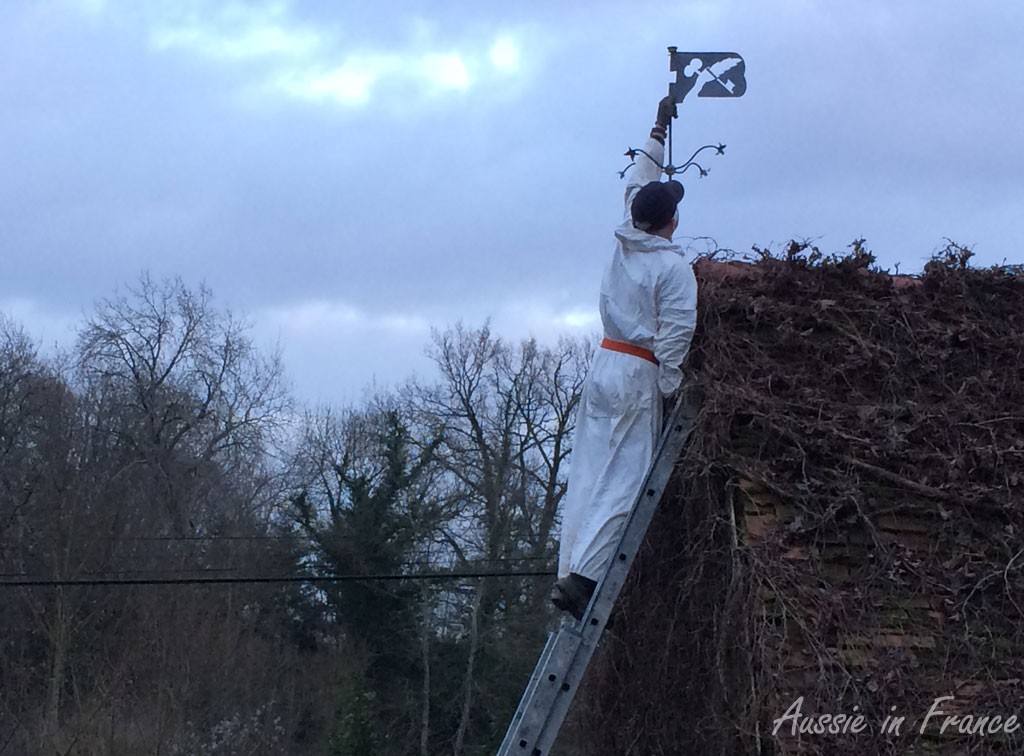
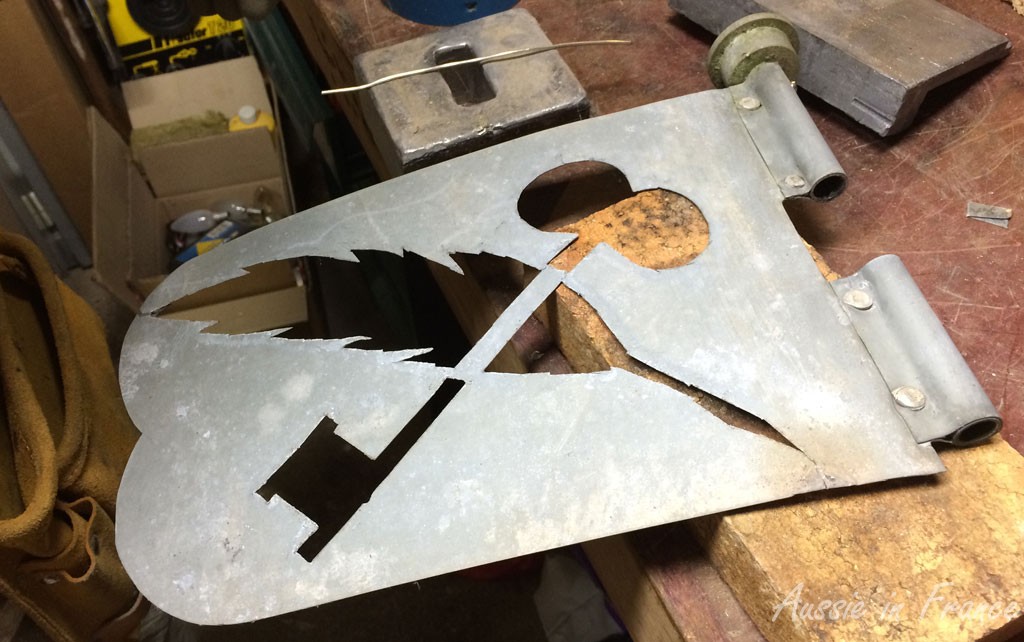
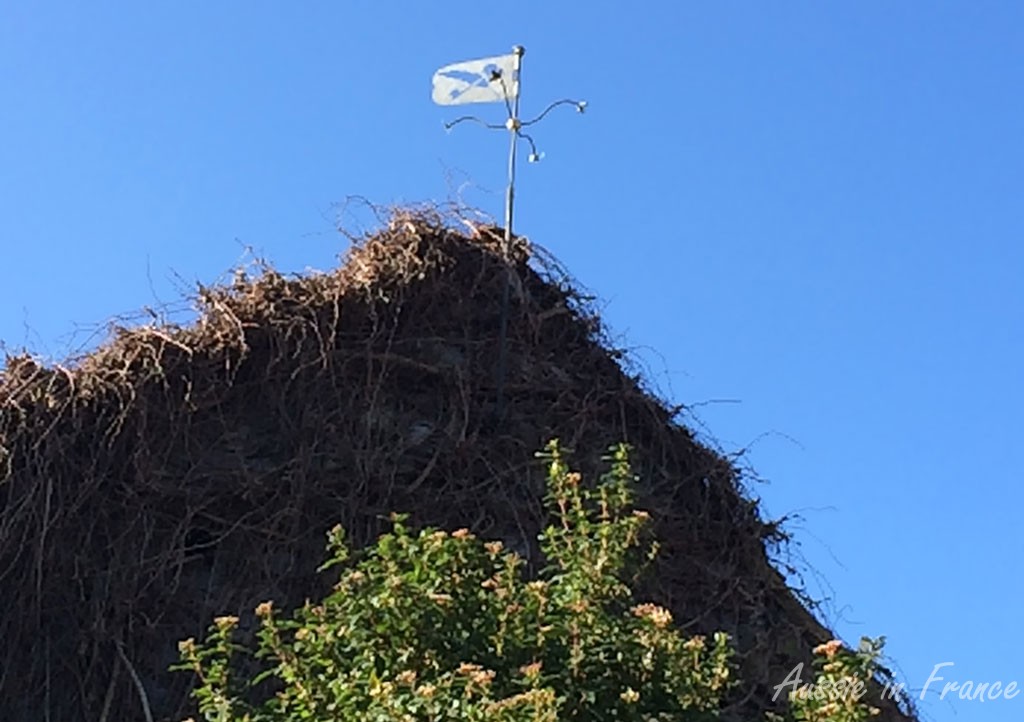
The first thing Jean Michel notices when he opens the window in the morning to bright sunshine is that our weather vane is broken.  We have a beautiful, unique weather vane on one of our barns, made by our previous owner who was a locksmith. It has a key to represent his trade and a feather to symbolise that of his wife, who was a secretary.

The broken weather vane

Both are perfect symbols for us as well. We can also see the weather vane from the upstairs living room so can check which way the wind’s blowing when we’re having breakfast. In France, north winds are chilly and south winds are warm.

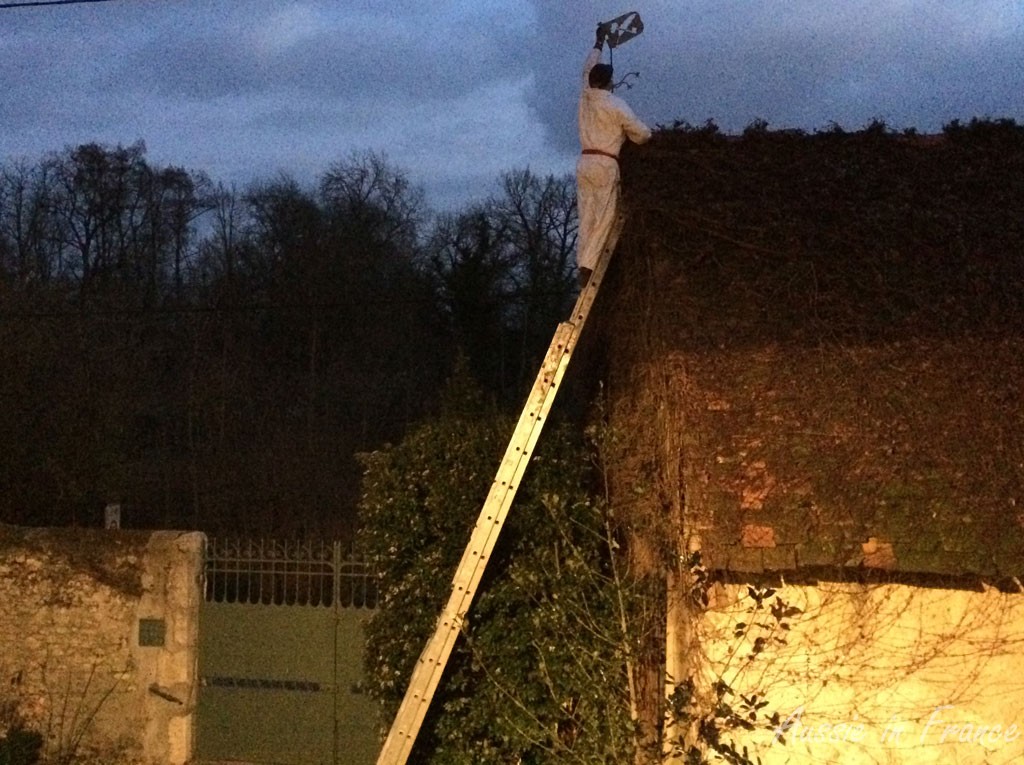
Jean Michel removing the broken weather vane

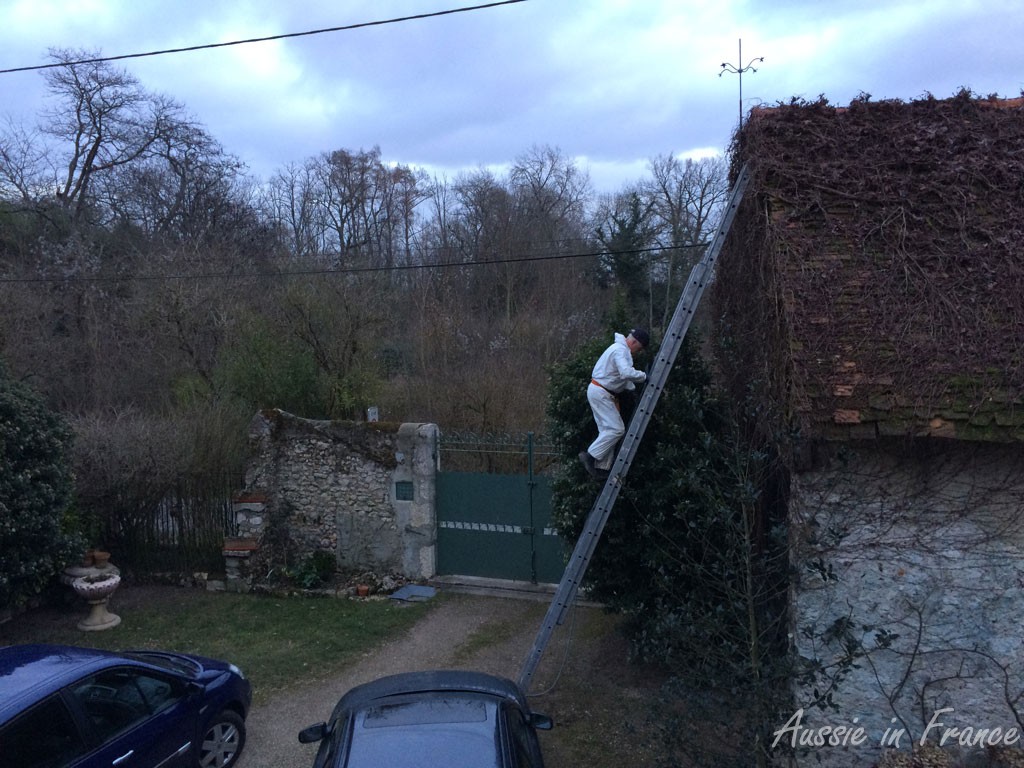
But one side of the weather vane is now looking as though it might fall off altogether. Jean Michel waits until late afternoon when the wind dies down and it’s a bit warmer so he can climb up his big ladder and bring the weather vane down for repairs.

Coming down the ladder

I don’t like heights but he has even done a special course in climbing up on roofs so I’m not too worried. He unscrews the weather vane from its little pole and climbs carefully down the ladder.

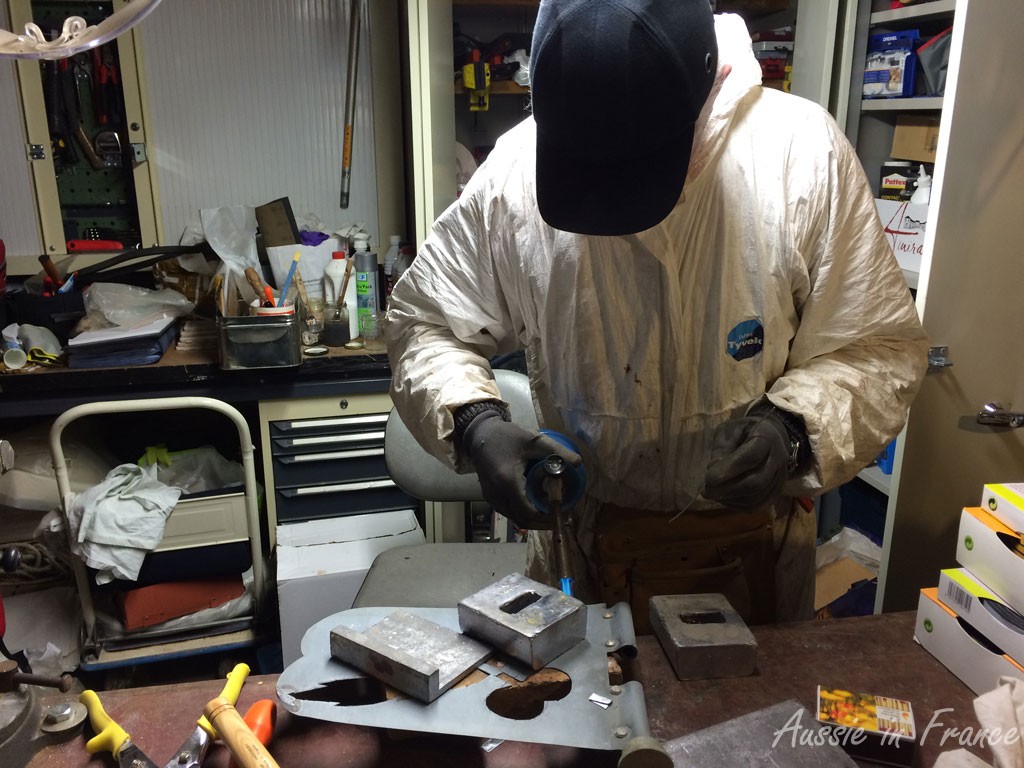
Soldering the weather vane

The repairs prove to be a bit more difficult than expected because the weather vane is zinc and he is using galvanised iron to fix it so the solder isn’t behaving very well. However, he eventually finds the solution and it is soon repaired.

You can see the broken bit at the bottom of the feather stem

However, it is nearly dark by the time he climbs up the ladder again and I’m just a little worried this time. But all goes well and it’s soon in place again.

Putting the repaired weather vane back on its pole

I have to say that I am extremely lucky to have such a talented husband. He really does seem to be able to fix anything!

Good as new next morning

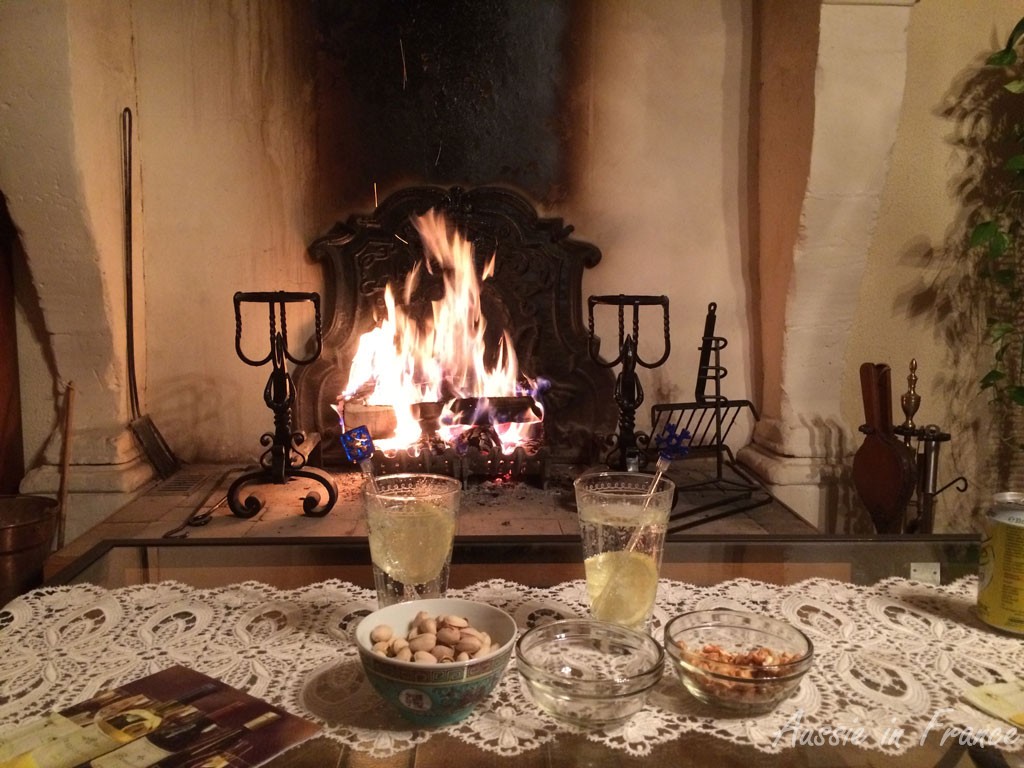
He certainly deserves a gin and tonic in front of the fireplace after his hard work.

Gin & tonic to make up for the one that Transavia airlines doesn't serve in-flight!
Gin & tonic to make up for the one that Transavia airlines doesn’t serve in-flight!

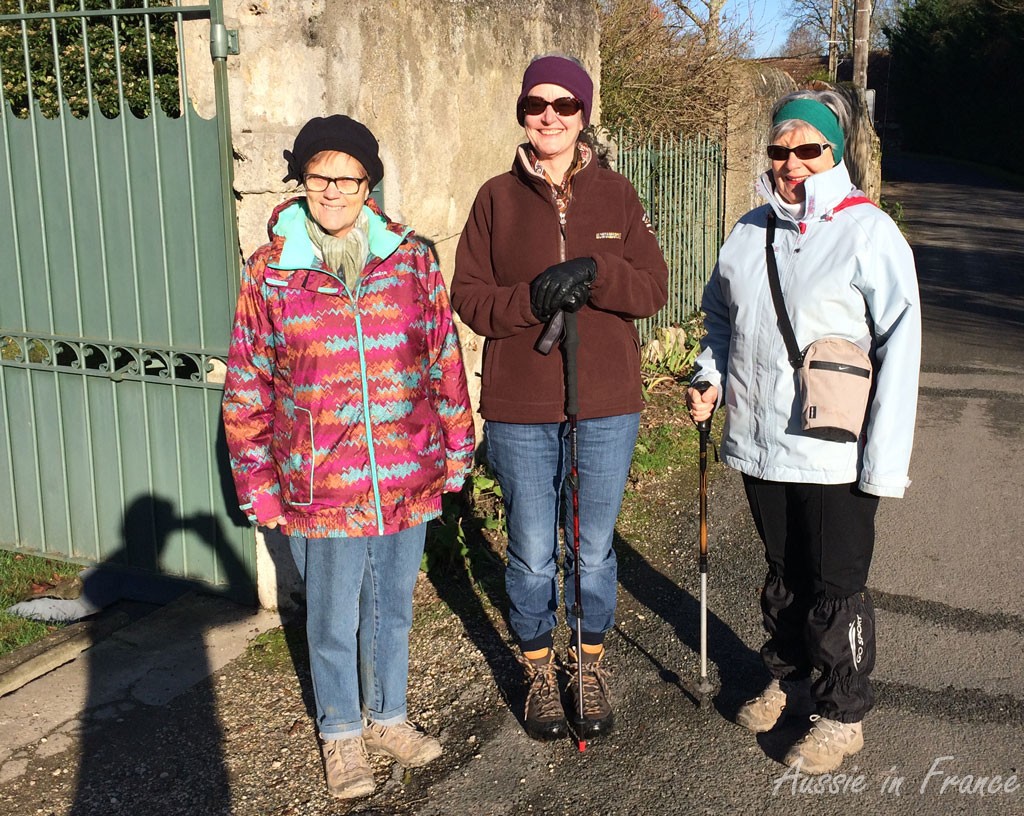
And just in case you’re wondering how I am health-wise, this awful flu is still not completely finished even after nearly three weeks. I’m still very tired and have a cough but am able to translate and rake the moss off the lawn when I need a break. However, I’ve fared better than my neighbour who still isn’t out and about. I hope that next week we’ll both be back to Nordic walking together.

Granada – Final Impressions and Suggestions – and maybe Cordoba

I somehow feel that Granada escaped me. I think there are two reasons: the fact that I was still recovering from a bad bout of flu and the unexpectedly cold weather. It seems to me that Spain is an outdoor country and that is the only real way to enjoy it. With temperatures around freezing, it was difficult to find enough to do outside and the indoor venues were practically never heated.

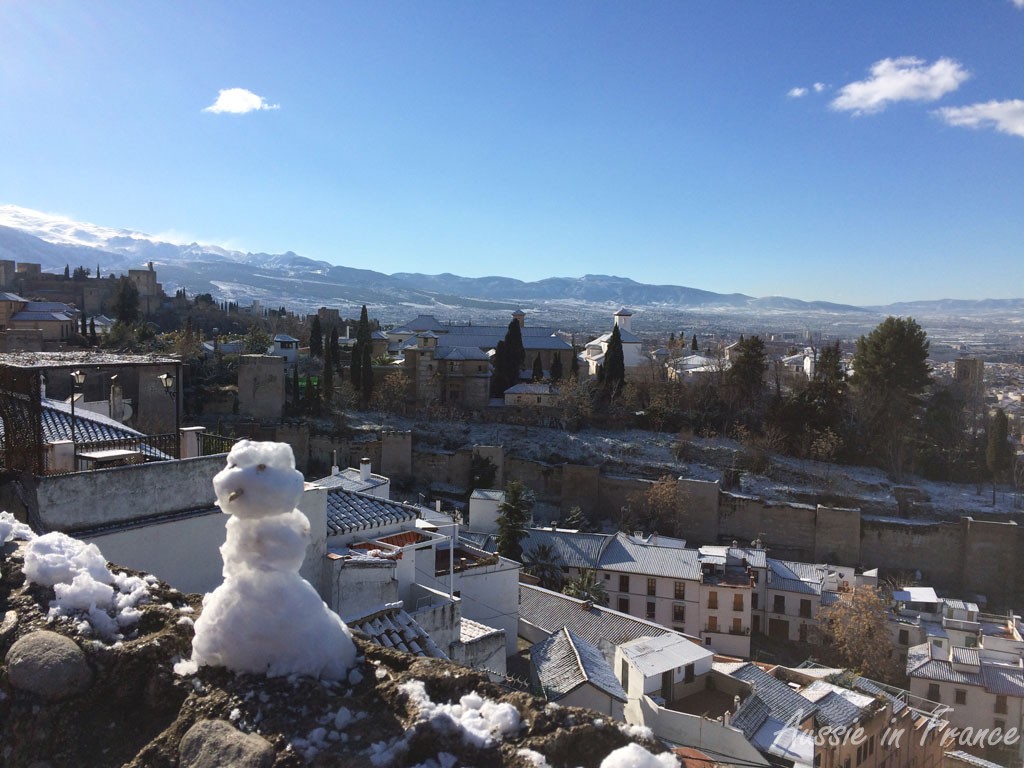
We did not expect to see a snowman in Granada!

When to go – not winter!

So my first suggestion would be to avoid January and February, despite the oranges on the trees and the possibility of snow.

How to get there

I also think we were there too long, but surprisingly, the cheapest flights were Saturday to Saturday! There are no direct flights to Granada (you need to change in Madrid), so the cheapest way to go is via Malaga which has flights arriving from all over the world.

You can then either stay overnight in Malaga or take a bus directly to Granada. Because we were arriving at night, we pre-booked our transport from the airport to our hotel in the centre via airportshuttles.com. It wasn’t that much more expensive than public transport and much cheaper than a taxi. Our friendly driver was waiting for us and we arrived at our hotel in next to no time.

Bus from Malaga to Granada

We didn’t stay long in Malaga as there is nothing to see but new buildings. I seriously don’t see the attraction but Black Cat was there during fiesta time one year with local friends and loved it.

Modern buildings in Malaga

The bus station is within easy walking distance of the centre of Malaga. There are machines to buy your ticket (in English) and you get to choose your seat.  The buses are modern and efficient and leave on time. We even had a bag of goodies on the ride back from Granada to the airport!

However, the bus station in Granada is very far from the centre so it’s better to take a taxi (less than 10 euro) to your accommodation. We literally walked outside and jumped in a cab. On another occasion, however, we walked there and bused back and it was long and complicated.

A café at the bottom of our hill
A café at the bottom of our hill with great tostadas

How long to stay – and make a side trip to Cordoba

I think that 3 or 4 nights is a maximum to spend in Granada. I regret that we did not get our act together in time to rent a car (50 euro for 24 hours), drive the 2 ½ hours to Cordoba, visit the famous mosque, stay the night, visit the rest of the town the next morning  then drive the 2 ¾ hours directly to Malaga airport.

Eating in Granada

When we visit another country, we prefer to eat in fairly basic local restaurants rather than go for an often disappointing gourmet experience. Spain is known for its tapas. Sometimes, they are served free with drinks in the evening and other times you pay a small amount (1.60 to 2 euros a time) per serve. Some are very filling. Larger serves that you can share are called raciones.

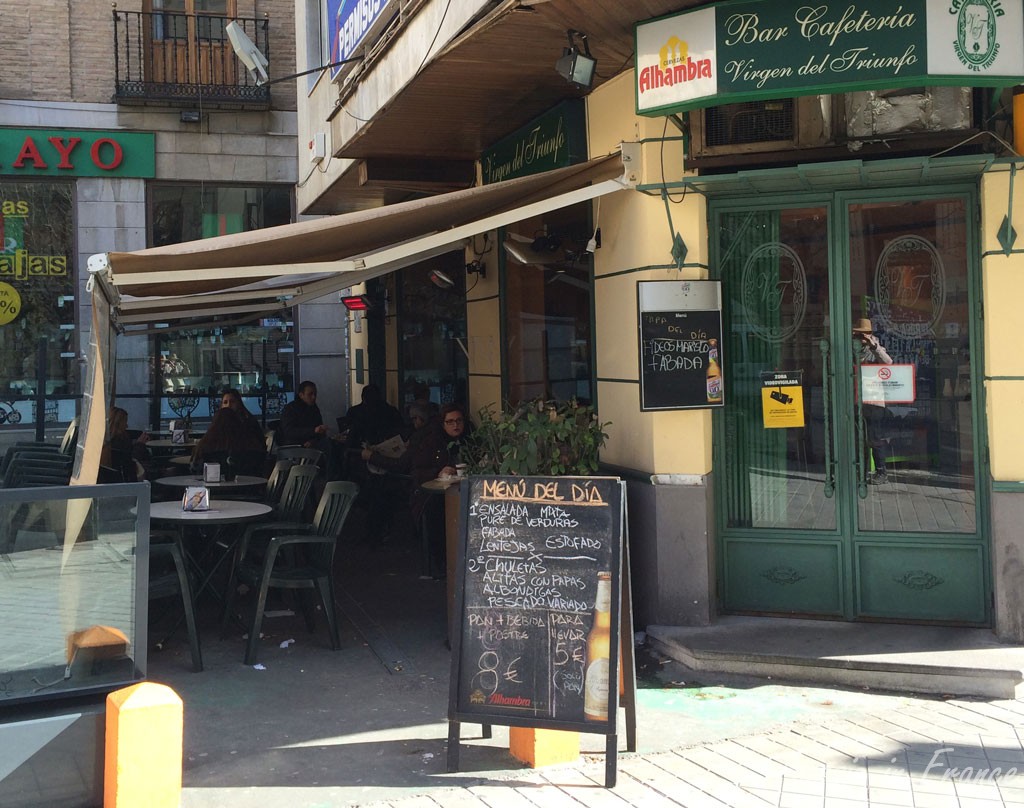
Menu del dia for 8 euro!

We found the menu del dia (menu of the day) at 8 to 9.50 euros excellent value for money. It includes a starter, main course, dessert, bread and a glass of wine. There is sometimes a tapa as well. There isn’t a very wide choice but the food is often prepared on the premises and copious.

Breakfast with tostadas and fresh orange juice

Eating hours are very different from France. Breakfast seems to take place at about 10 am, with people having a break from the office. Tea or coffee, freshly-squeezed orange juice and a tostada (toasted bread) spread with tomato pulp and olive oil, butter or just olive oil are always offered. On the last day, we went to a very small café and watched the lady put some tomatoes into a blender to make the pulp. Delicioius! It seems you can grate the tomatoes as well. The total price for this type of breakfast is about 3.50 to 4 euros per person.

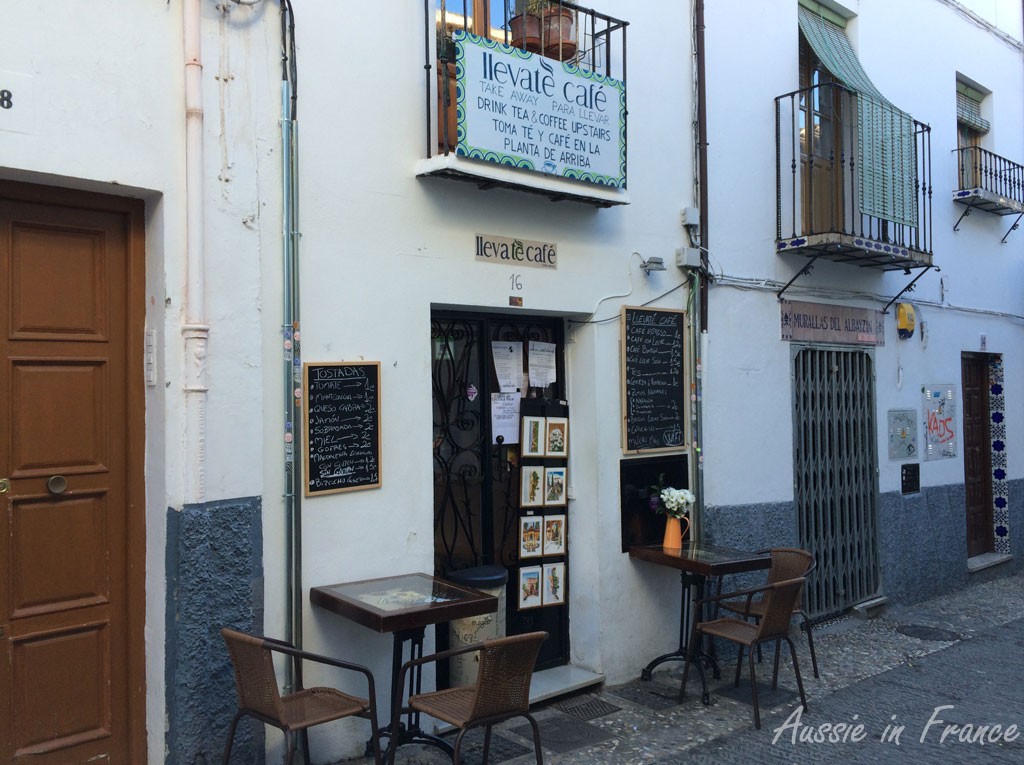
The wonderful breakfast café at Plaza Larga in the Albaicin we found on the last day!

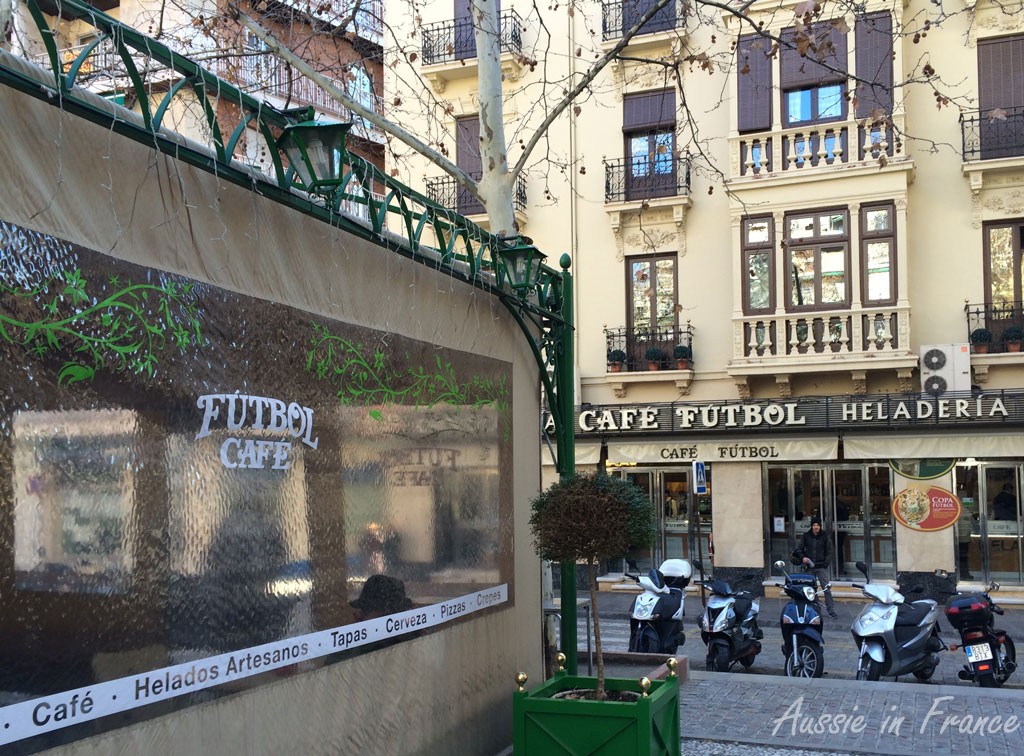
Churros are another speciality of Spain. We loved them in Madrid but found that even in the most popular churro place in Granada (Futbol Café), they were salty and too chewy. You dip them in hot chocolate that is made with some kind of thickening. I don’t really think they are worth the calories to be honest!

The Futbol Café famous for its churros and where every game of futbol is celebrated with great gusto

Where to stay

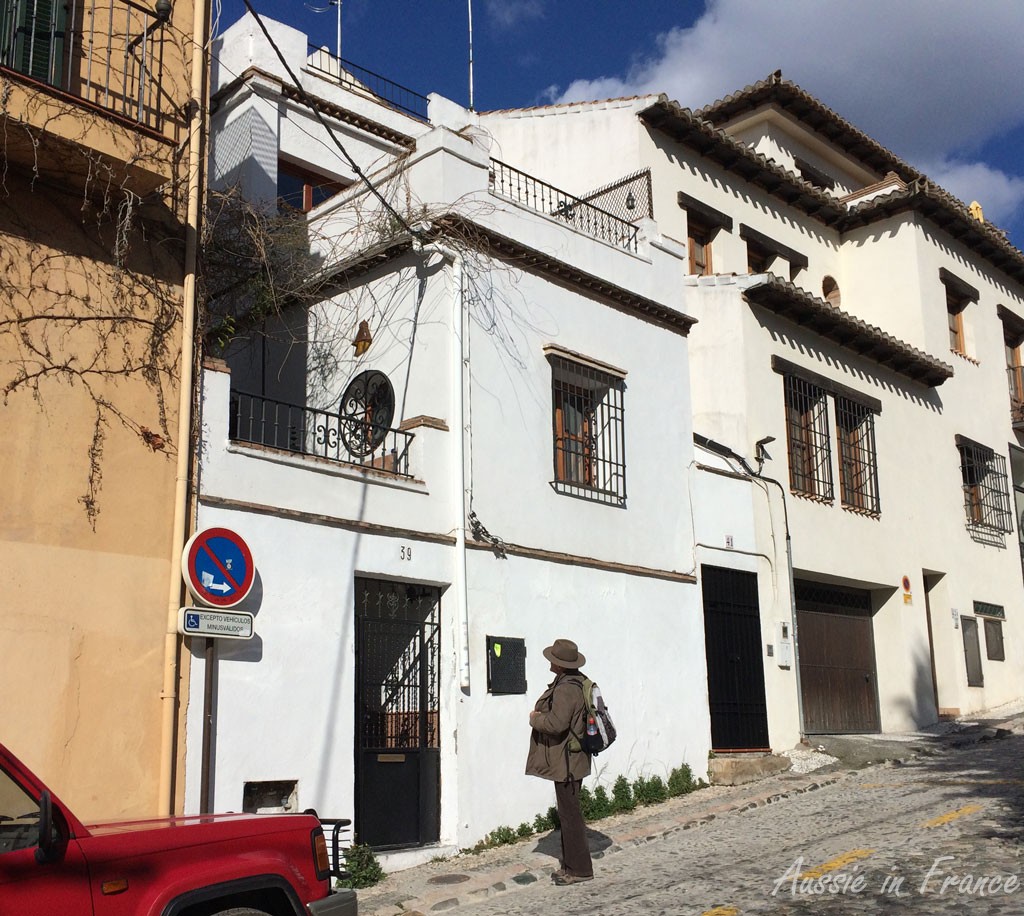
With regard to accommodation, we chose a self-catering flat as that is what we prefer if we go somewhere for more than a few days. I’m still not sure about the location. We were halfway up Cuesta Alhacaba in the Albaicin, which is the oldest neighbourhood of Granada and definitely the most interesting. If we went down the (very steep) hill, we were in the main modern part of the town and if we went up the (slightly less steep) hill and wandered around the other side, we were in the older part.  The two best vantage points, Mirador Nicolas and Mirador San Cristobal, are at the top of the Albaicin. However, at least in winter, there isn’t much open there at night.

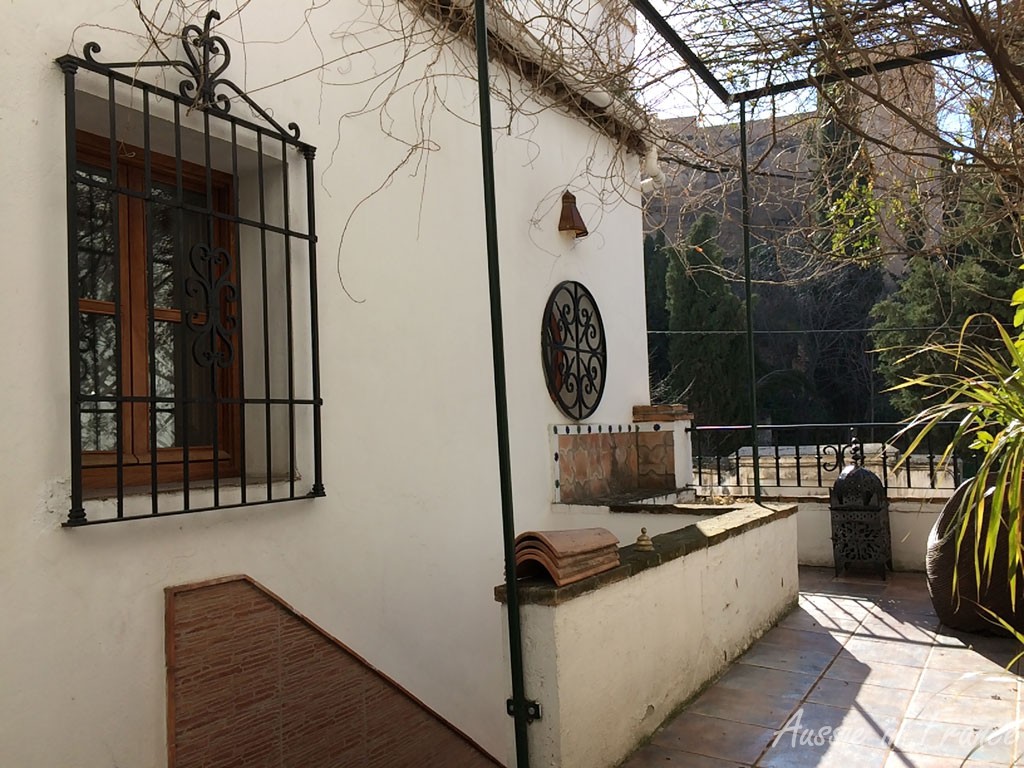
Our self-catering flat from the outside, halfway up Cuesta Alcahaba
Our self-catering flat from the outside, halfway up Cuesta Alhacaba

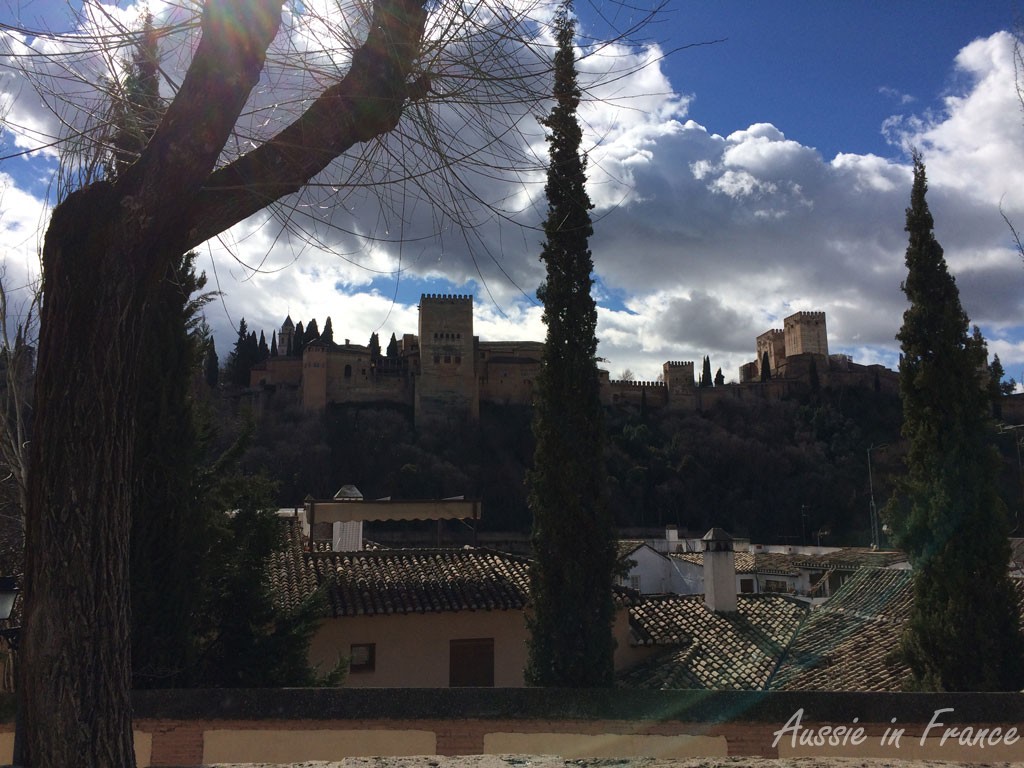
The Alhambra, of course, is the star attraction, but it’s up on a hill and isn’t really close to anything else. A view of the Alhambra is much sought after apparently, but you can drink in the view from a lot of places in the city. To book ahead, you can use the official website and pick up your tickets in a ServiCaixa machine with your credit card.

One of the many views of the Alhambra from the Albaicin quarter

My perference still goes to Seville which we visited at about the same time several years ago and loved and Barcelona which we really enjoyed as well, especially anything to do with Gaudi. We also enjoyed San Sebastian, despite the weather!

My Spanish Past

The first time I went to Granada was in the spring of 1976 when I was young and naive. I was living and working in Pau in the French Pyrenees and had befriended a woman called Anne Marie who ran a hikers’ refuge in the mountains in the summer months. She suggested we go on a hitchhiking holiday to Spain. After the repressive era of the dictator Franco, young women – and foreigners in particular – were easy prey so Anne Marie insisted we wear obstentious signs of religion so that the men would leave us alone. I had a large coloured ceramic cross! It worked. We were never bothered.

Seville during orange season

It was a whirlwind trip. Anne Marie had omitted to inform me of two major details: she had no money and she had a rendezvous with her Spanish lover in Sarragossa at the end of the trip, which was a surprise to me because first, she was married and I knew her husband, and second, she was not my idea of a femme fatale.

When she came to collect me, she proceeded to empty half my backpack, which meant that I had only the barest of creature comforts. It was not until a year or so later that someone pointed out to me that my superduper backpack contained a small rubber mattress.

Anne Marie was used to sleeping on the ground when mountain-hiking but it was a rude  shock when I had to sleep on hard concrete in a sleeping bag for the first time in my life. I know that we went to Seville, Granada and Cordoba but since I left my camera behind in the train to Madrid, I have nothing to jog my memory and my subsequent visits to Seville and Granada have contained no familiar places.

I don't remember our tapas being this sophisticated in 1976
I don’t remember our tapas being this sophisticated in 1976

We mainly ate bread and tapas which, at that time, were free. You just had to buy a drink to eat any of the little « lids » of olives, ham and cheese set out on the counter. I can remember being hungry. I would have been happy to buy food for both of us but Anne-Marie wouldn’t be any part of it and I had to eat what she ate.

From Cordoba, we were supposed to hitch-hike up the Sierra Nevada to Madrid but rides were scarce so we ended up taking the train on the last stretch, then another train in the direction of Saragossa. By the time we arrived in some little town I can’t remember it was close to midnight and Anne-Marie managed to find a double bed in someone’s home that sank badly in the middle. Only mildly better than hard concrete.

The next morning we hitch-hiked the rest of the way to Saragossa and arrived late for the rendezvous with the Spanish lover on the steps of the Cathedral. We waited about an hour before we finally left with Anne-Marie in tears. About ten minutes later, she decided to go back to the cathedral steps and there he was, waiting for her!

We drove out of town to a forest in his Mini and I waited in the car and dosed while they went off into the forest. How I/we got back to Pau I don’t remember. It’s a long time ago, but I didn’t ever go on holiday with her again!

My next trip to Spain was a couple of years later when I did a two-week language course in Salamanca while studying translation at ESIT. This time, I hitch-hiked by myself down to San Sebastian just over the French border then took the train the rest of the way. I boarded with a family in their small apartment. I was still not used to people with children actually living in anything other than a house and my day-to-day Spanish was virtually non-existent.  It was a strange experience. I also only  knew the third person of verbs so would have to say things like “she’s going out now – me”.

One day the landlady asked if I had any ropa. When I couldn’t work out what she meant, she called in the other boarder, a German girl to explain that she wanted to wash my clothes. After that, everyone assumed that I didn’t speak a word of Spanish and they wouldn’t actually believe that I had understood a whole conversation about the stock exchange (la bolsa). I knew a lot of financial and technical vocabulary from ESIT but we had never done any texts on washing clothes.

It was the same occasion on which I went to visit Avila, home of Saint Teresa of Avila and saw her little finger. It put me off relics for a lifetime! Don’t worry – I don’t have a photo of that either!

Sunset over the Alhambra in Granada

I have retained a surprising amount of vocabulary but have never actually learnt to speak or understand the language with any ease. But when we travel, I get by especially if I practise what I want to say beforehand but I’m often discouraged. I have less formal learning in Italian and can understand (and speak) a lot better.

I’m not sure I’ll ever need Spanish again though, because I think we have exhausted our possibilities here. Next time, we’ll go back to Italy for the sun!

Sun and Snow in the Albaicin in Granada

Snow has been predicted but when we wake up, there is no sign of it. We walk up Cuesta Alhacaba, our double hill road, to Casa Pasteles on Plaza Larga for breakfast. There’s a market today – one clothes stand and a fruit and vegetable stand!  We go for the tostado medio and have trouble understanding how much we have to pay : 7.70 euro, which somehow seems a very strange amount.

Dramatic skies in Albaicin

We walk down the other side of the Albaicin quarter through tiny winding streets, the sky dramatic with its bright sun, deep blue and menacing clouds. I’m starting to get the feel of Granada which has escaped me up until now. A word we keep seeing is Carmen, derived from the Arabic for a garden planted with vines. In Granada, it means a villa. I’d love to see behind the high iron gates.

A typical "carmen"
A typical “carmen”

Our first destination is the 11th century Bañuelo, one of the oldest surviving and best-conserved baths in Andalucia and the oldest public building in Granada. It was not destroyed during the Christian era because it is underneath a private dwelling. We have the place to ourselves and are impressed by the sheer size of the baths although their tiles have long disappeared.

Banuelo, Granada's oldest public building
Banuelo, Granada’s oldest public building

As we walk past Plaza Nueva, I connect it up with the touristy place at the bottom of the Alhambra from the day before. Granada seems to have no centre.

Having coffee in the sun - at last!
Having coffee in the sun – at last!

After having our only outdoor coffee since the beginning of our stay in Granada, we visit the Royal Chapel and I’m astonished to see how terrible some of the wall paintings are although the faces of the sculptures on the ornate altar are finely carved.

We walk quickly through the modern souk in Alcaiceria, that replaced the original medina after it burnt down in 1843, and is now a craft market with lots of souvenir shops. We cross over Gran Via de Colon and start walking up the little streets to the Albaicin.

Tapas at
Tapas at Bañeao

By the time we get to Plaza Aliatar, I’m more than ready for lunch – well, a rest in any case. We choose Bañeao with its 3-course menu at 9.50 euro and hope for the best. We are served a tapa consisting of a small fried egg surrounded by some sort of dried peas or beans, followed by what look like eggplant French fries, then grilled squid with salad. I have the somewhat liquid rice custard. People keep running outside to see the whispy little bits of snow that are falling.

Snow falling on our terrace

It’s late afternoon and the snow has finally started, light at first, then gradually heavier. By the time we venture out to buy food for dinner, it’s snowing quite heavily and wetly. The paving stones are a little slippery as well.

Snow on our terrace next morning

When we look out the window next morning, we see there is still snow on the ground, especially on our terrace, but the sky is bright blue so we head over to our favourite Mirador San Nicolas.

The Alhambra after snow

It hasn’t snowed enough to turn the Alhambra white but the glinting rooftops and snow-covered orange trees are lovely. It’s biting cold though.

Snow-covered rooftops of Granada

We make our way down the hill towards the university quarter where we’re going to visit the Carthusian Monastery and are delighted by the views of the city spread out before us.

Carthusian Monastery

From the outside, the Cartuja reminds me of the Cartosa near Milan, one of the most beautiful churches I’ve ever seen. The inside is very ornate with multi-coloured marble and polychrome wood drapery. Unfortunately photos are not allowed.

Former royal hospital, now Granada university

On the way back, we discover a new area we haven’t been to before and visit the former royal hospital, now the University of Granada. It consists of a series of beautiful white patios but no students. Maybe it’s holiday time.

Snow on the orange trees

We debate whether or not to eat downtown or up in the Albaicin and decide on the latter. As before, the views from the tiny winding streets are stunning but exhausting and it’s still very cold with little pockets of snow on the ground in some places.

Horno de Paquito
Horno de Paquito

We end up again on Plaza Aliatar and try the other restaurant, Horno de Paquito (horno = oven) which ostensibly has the same menu but turns out to have a lot more deep-fried dishes. We order a vino tinto followed by a vino roja, although we’re not sure what the difference is!

Sunset over our wall

After our well-earned siesta, we suddenly look outside and see there’s a magnificent sunset. We quickly get dressed, but by the time we are rugged up and ready to leave, the sunset’s nearly over. I nearly burst my chest getting up another of those hills but we are five minutes late. Maybe we’ll do better tomorrow.

Sunny Spain and the Alhambra

We’ve booked our tickets for the Alhambra ahead of time on ticketmaster.es and collected them in a Servi Caixa terminal to avoid the queues. We know this from Barcelona. This is a great idea when there are lots of tourists but unfortunately it means you can’t choose the weather. Today it’s overcast and sometimes drizzly although we have a fleeting patch of blue sky mid-morning. The next sun is predicted for Thursday.

Fleeting blue sky on Gran Via

At about ten, after eating a boiled egg and a yoghurt at home, we walk down our double hill and left onto Gran Via de Colon, the main street of Granada. The first place we choose for coffee doesn’t have any tables left. This is a common occurrence during peak breakfast hour in Granada. Fortunately there is another place across the road with lots of tables.

Tostada tomate
Tostada tomate

We order our espresso and freshly squeezed orange juice, then tostados and tomate which are even bigger than yesterday. We pour over olive oil as we’ve seen the other other patrons do. Jean Michel finishes off my second one. It’s costs us a whopping 3.50 euro each.

The gate at the bottom of the Alhambra

Then we set off for the Alhambra which is on top of another hill. This world heritage site consists of a palace and fortress mainly rebuilt in the 11th century by a Moorish emir called Mohammed ben Al-Ahmar and converted into a royal palace in 1333 by Yusuf I, Sultan of Granada. After falling into disrepair it was rediscovered in the 19th century by European scholars and travellers.

Lunch at Jardines Alberto

By the time we get to the top of the steep hill at 11.30 and discover we’re at the wrong entrance for our tickets I need a very long rest as I am still tired from my flu. We find a restaurant where we can just have coffee because even by French standards it’s way too early for lunch and we can’t get into the Nasrid Palace until 2 pm.  There is a welcome fire blazing in a brick fireplace. So much for sunny Spain!

I slowly recuperate while Jean Michel reads the guide book and we eventually ask for the menu. I order an eggplant salad and Jean Michel a Caesar salad and we both have our customary dry white wine (though I did have a red with my baby lamb cutlets yesterday which also went will with Jean Michel’s ox tail).

Eggplant in filo pastry salad

I’ll just make a slight digression here about the ox-tail which is a typical Andalusian dish during bull-fight season which obviously results in large amounts of bull’s meat.

The eggplant salad turns out to be slices of eggplant cooked in filo pastry – it’s very hard to get away from deep fried food here – on a bed of lettuce, hard tomatoes and capers with a sprinkling of parmesanand a large amount of mayonnaise.

Mirador San Nicolas from the Alhambra

We walk back down to the correct entrance and wander around the gardens waiting for 2 pm. We can see the Mirador San Nicolas opposite where we took our photos of the Alhambra the day before.  It’s at the top of our double hill road. We can also see the troglodyte houses in the side of the hill.

One of the many beautifully carved archways

We begin our visit of the Alhambra. It’s full of people taking photos of each other in front of every single visible arch which somehow detracts from the atmosphere. There is no furniture, but mainly intricately carved Arabic inscriptions in the form of geometrical patterns, with painted tiles on the walls. I have to confess it’s all a bit repetitive for me and it is absolutely freezing cold as well.

Opposite windows looking over an inside garden

I do like the different patios with their fountains and greenery which are no doubt a welcome break from the steamy hot weather that most people experience in Grenada.

One of the many keyhole views overlooking the surrounding countryside

The path out of the palace takes us through more gardens and past stunning views of Grenada to the Palace of the Generalife and the Upper Gardens which we also try to imagine in the warmer weather.

The Generalife palace and fountains

We finally emerge an hour and a half later (the visit is supposed to take 3 hours). It’s spitting and we’re cold. Let’s find somewhere to have hot chocolate and churros we both decided of a common accord.

In the gardens walking towards the Generalife

We ignore the touristy places at the bottom of the hill and head for Gran Via de Colon. On the left we see a promising-looking place appropriately called Via Colon. We order our chocolate and churros and sit back in eager expectation. We have very fond memoires of eating the same thing in a very famous place in Madrid called Chocolateria San Giné.

Our sorry looking churros

The hot chocolat, which arrives first, is OK but the churros are very disappointing. They are large and a bit tough and SALTY. We coat them with sugar and dip them in our hot chocolate but it doesn’t improve them much. Jean Michel orders a chocolate cake with a strange spice in it to get rid of the salty taste. I reckon we might have done better in one of those touristy places after all!

Getting to Granada and First Impressions

We leave Blois at 10 am on Saturday to drive to Orly Airport where we’re leaving the car in a somewhat suspicious-looking long-term parking lot near for the airport for 70 euros. If the car’s still there on our return, it’s a hassle-free way of get to the airport. Otherwise, we would have had to catch a train to Gare d’Austerlitz in Paris and taken a train out to the airport.

Pale skies on leaving Blois

After my week of flu I seem to be having a relapse and the first thing I do on the Transavia flight to Malaga leaving at 4.35 pm is to nearly faint on the way back from the ladies. The hostess lies me down on a double seat and I sleep until our arrival at 7 pm. We collect our baggage and are relieved to see that the shuttle we booked at airportshuttles.com for 21 euro is waiting for us.

Our room at the Hotel Soho in Malaga

It’s quite balmy at 13°C. Malaga looks very clean and modern. The driver takes us to our boutique hotel . The rooms are small but very trendy. The sign behind the door says 200 euro but we are paying 72 euro per night, I guess because it’s winter. We leave our things and go to find a restaurant. Jean Michel says we’re near the sea so have to have fish.

Bodeguita de Carlos
Bodeguita de Carlos

At Bodeguita de Carlos that we find by accident, I order a grilled John Dory to share and Jean Michel eats about ¾ of it. I certainly can’t manage any more. All I really want to do is go to bed.

Next morning I am not feeling brilliant at all. We get dressed and go down for breakfast but the breakfast café is very busy and there are no tables. I start feeling really ill and we go back upstairs. Jean Michel goes down to secure a table and order coffee because I seem to be having orthostatic hypotension again and need to get the adrenaline pumping. We finally get served and Jean Michel has a buffet breakfast. I pull off a few bits of bread.

Olives and the Sierra Nevada from the bus on the way to Grenada

We decide to go straight to the coach station to take the 1 pm bus to Granada and I manage to eat a tortilla frances while Jean Michel has some sort of fish. The bus is new and takes 1 ¾ hour to get to Granada. It costs about 23 euro for both of us. From there we take a taxi to our rental accommodation. The sky is bright blue.

View from the flat
View from the flat

A very unwelcoming Spanish woman with minimal English shows us the flat which is arranged on two stories. The two bedrooms (one about the size of a monk’s room) are on the first floor with a patio outside and a bathroom up three and down two steps. Great in the middle of the night! A narrow tiled staircase leads up to a living room and rudimentary kitchen with a large patio outside with a lovely view of the city walls.

None of it feels very warm with a current outside temperature of 10°C predicted to fall below zero during the week.

Front patio
Front patio

We unpack our belongings and see that apart from oil and vinegar, the kitchen has nothing else, not even a teapot. The bed doesn’t look wonderful and there is a large round window without a shutter that turns out to be lit by a street light. Sigh.

Typical Albaicin street

Our street is called Cuesta Alhacaba which means  double hill. All is said. We walk up to the top of the old Albaicin quarter by which time I am completely exhausted of course but I love the houses and Moorish decoration along the way.

Our first sighting of the Alhambra

We get our first sighting of the famous Alhambra and wander through the gardens of the Palacio de los Cordova. At the bottom of the hill on the other side, we walk along the Darro River until we reach the main thoroughfare.

In the Cordova palace gardens

I’m suddenly hungry so we go into a bar called Minotoro where we order freshly squeezed orange drinks, some slices of goats cheese and what turns out to be French fries with mayonnaise and tomato ketchup on them! Not exactly what I feel like …

Mayonnaise and tomato ketchup French fries

We decide to make our way home so we can have a siesta despite the fact that it’s near 6 pm but I’m feeling pretty exhausted at this point and we still have to climb our double hill to get back.

Church in Albaicin
Colegiata de San Salvador  in Albaicin

The house is gradually warming up but I’m still quite cold. It probably hasn’t been heated for a while even though we’ve turned the electric heaters up to maximum. We sleep for an hour or so.

The courtyard of Le Ladrillo where we have dinner
The courtyard of El Ladrillo (the brick?) where we have dinner

Since there are no shops open on Sunday afternoon we still have no food so at about 8 pm (early by Spanish standards) we go looking for dinner. All those great tapas bars that we open during the afternoon are now closed but we eventually find a place called El Ladrillo selling grilled fish. Jean Michel misreads the menu and the waiter’s English is very basic so we end up with a large platter of fried seafood and a mixed salad. I eat the battered octopus pieces and half the salad but am not tempted by the rest.

Before we’re even finished, they’ve closed the kitchen, we’ve already paid and the waiter is whisking away our plates as soon as he can!  We walk all the way down the hill for a decaff coffee (I must be crazy) and halfway back again to our cold house. I’m too tired by then to do anything else except go to bed!

Fighting the Flu

Very short and sweet, just to say that I am been in the grips of the flu (grippe = flu!) since Saturday afternoon and am desperately hoping I’m going to be better by Saturday when we are leaving for Granada! Fortunately, Jean Michel has only caught a very mild version so has been holding the fort. I finally saw the doctor yesterday (no home visit on offer) but he only told me what I knew – a bad case of flu.

My only view since Saturday afternoon

Friday’s French – service civil, service civique, civil service, fonction publique

Le balayeur de rue est un fonctionnaire

France Info is by far my favourite radio station. I like it because it keeps repeating the news all day so that if you tune off at any time, the same information will soon come round again. I usually listen when I’m cooking or eating by myself. They don’t just do news. They also have regular features such as the meaning of words.

Yesterday, they were talking about the difference between service civil and service civique.

Until it was absolished by Jacques Chirac in 1996, 10 months’ service militaire was compulsory in France for all men over the age of 18 if considered fit. Call-up could be delayed if the conscript was a full-time student in higher education. Conscientious objectors were required to do two years of service civil as opposed to militaire. Nothing to do with our civil service.

Service civil was then replaced by service civique which is voluntary community work open to all young people from 16 to 25. They are paid 573 euros per month for a minimum of 24 hours a week for 6 to 12 months. So service civil no longer exists.

What we call the civil service in Great Britain or the public service in Australia is known as la fonction publique in French. Civil servants are fonctionnaires. Un haut fonctionnaire is a top-ranking civil servant or senior official while un petit fonctionnaire is a minor official.

La fonction publique covers a much broader range of activities than our civil service. There are about three million fonctionnaires (also known as agents de l’Etat). They include teachers, social services staff, post office workers, police officers and employees of the French rail services.

They are recruited by competitive examination and successful candidates are known as titulaires. Because of their almost total job security, they are often stereotyped as having unfair advantages compared to employees in the private sector. It’s certainly easier to get a mortgage or rent an apartment if you’re a fonctionnaire.

Whence expressions such as il a une mentalité de fonctionnaire – he has the mentality of a petty bureaucrat. C’est un vrai fonctionnaire means he’s a petty bureaucrat. Petty of course is a deterioration of the French word “petit”.

Bureaucrate also exists, and is both masculine and feminine. Paperasserie (administrative) is red tape and dates back to the 1500s. Paperasse is paperwork. Which reminds me. I have more forms to fill out. I’m still trying to get my address changed everywhere.

from the Tropics to the City of Light