Category Archives: Cycling

Cycling along the Danube – Wachau in Austria, a World Heritage Site

We nearly missed out on one of the highlights of our trip. If our home exchange in Budapest hadn’t fallen through, we would have passed over Washau altogether. It was Jean Michel’s fault, of course (he organised the itinerary and read the guide books!) but he he hadn’t realised it’s a Unesco World Heritage Site.
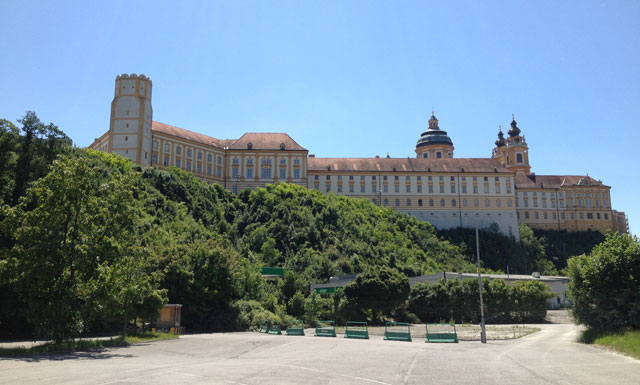
Melk Abbey
Melk Abbey

Melk and its famous abbey were on our list when we were in Aschach but in fact they were further than we thought – 125 K by bike – so after leaving Aschach early due to bad weather, I suggested we stop off at Melk on the way back from Budapest.
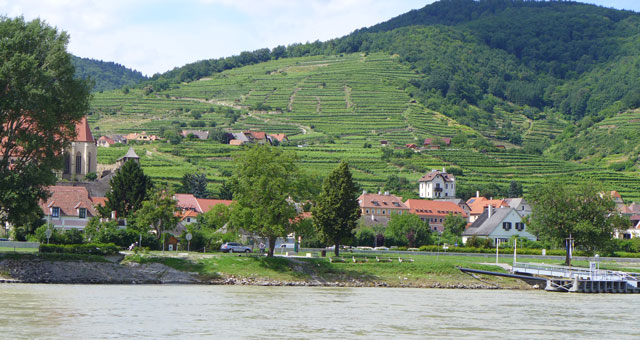
Vineyards on the hills in the Wachau

After consulting the Routard and checking the website, I phoned Weingasthof Donnauwirt at Weissenkirchen to see if they had a room for 2 nights. Bingo! As we neared our destination, we became more and more delighted. Quaint little villages, lovely scenery dotted with vineyards, panoramic views of the Danube. Exactly like the photos in our book and such a relief after the river banks around Budapest.
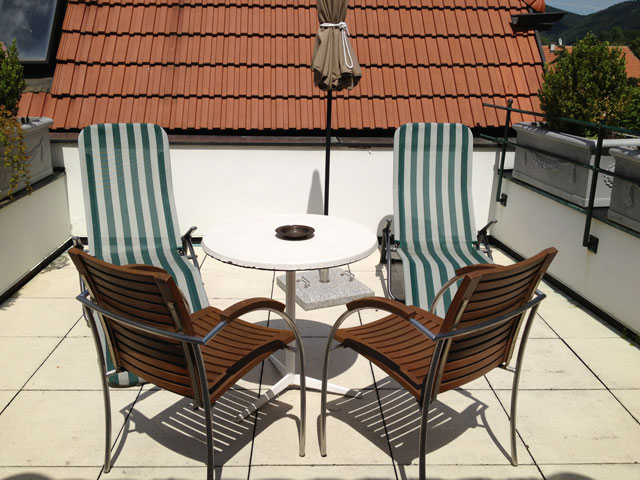
Our sunny terrace with a corner view of the Danube

Our room in the gastfhof is beautifullly decorated and has a table and chairs in one corner which is much better than the last one where I had to use the laptop sitting up in bed and we had to have dinner perched on one side making sure we didn’t get the sheets dirty, but best of all, it has its own terrace.
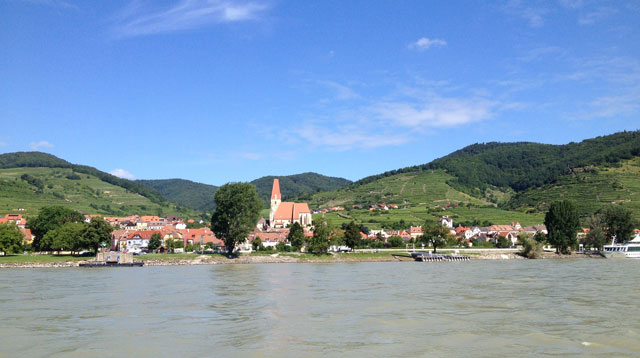
The village of Weissenkirchen from the ferry

Weissenkirchen is perfectly located. Just opposite the hotel is the ferry that takes you across the Danube. There are bike paths on either side which meant we could cycle along one bank and back along the other.
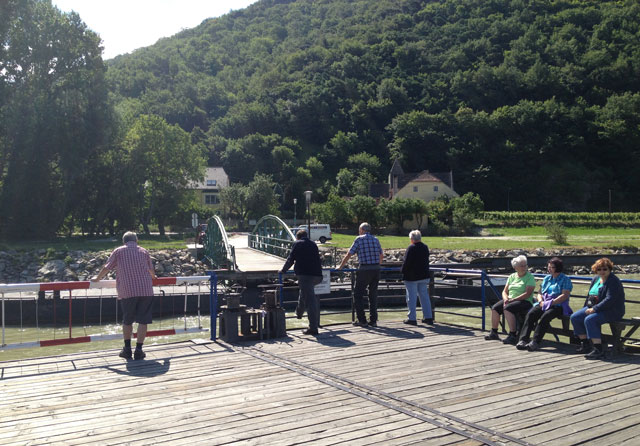
Crossing the Danube on the ferry

Since we arrived at the gasthof around 2 pm, we had time to book in, get changed, go across on the ferry and ride to Krems which is on the eastern tip of the Wachau.
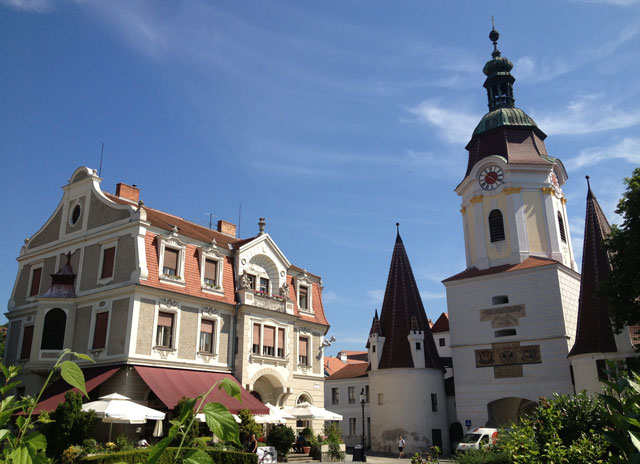
The main entrance to Krems
Steiner Tor, the main entrance to Krems

The entrance to Krems is via the Steiner Tor, built in the late 15th century, the only one of the four town gates still standing. There are various other buildings of interest including two churches and a mediaeval quarter worth visiting.
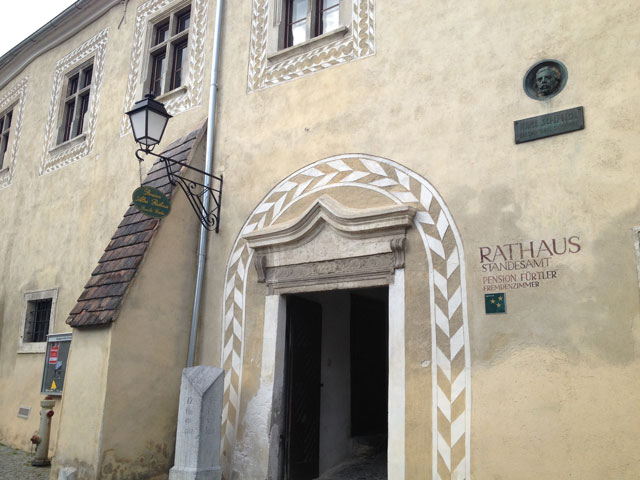
The rathaus (town hall) in Durstein

On the way back, we visited Durnstein, one of the most popular villages in the area. By then we had completely fallen in love with the area.
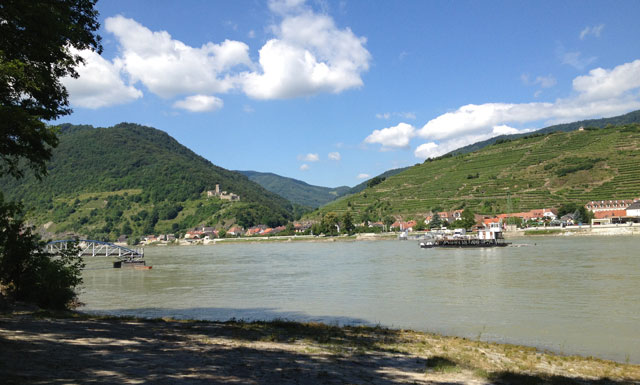
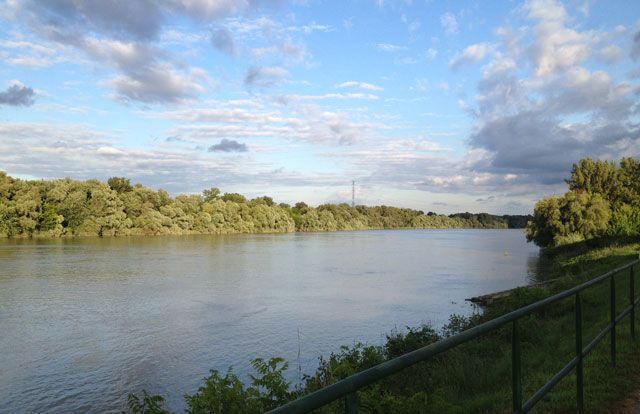
On the banks of the Danube in the Wachau

Next day, we crossed on the ferry again and rode 26 kilometers west this time, to Melk. We were definitely on the right side of the river because the prettiest villages are across the other side.
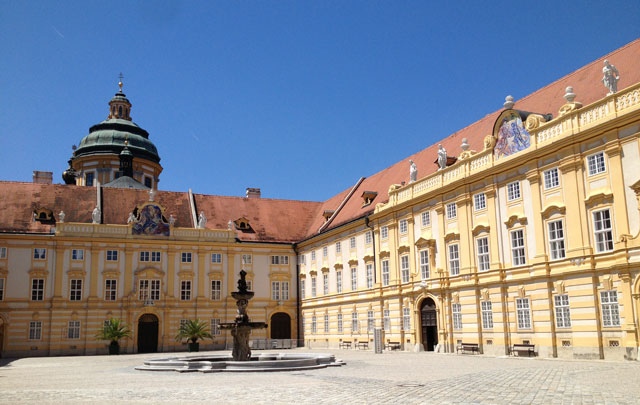
Inner courtyard of Melk Abbey

At Melk, we rode up to the Baroque Benedictine abbey built in the early 18th century which overlooks the entire valley and left our bikes in a bike shelter that even had lockers to leave our paniers.  The Austrians are very organised.

The entrance was expensive at 9.50 euro each and we weren’t that taken with all the religious exhibitions.
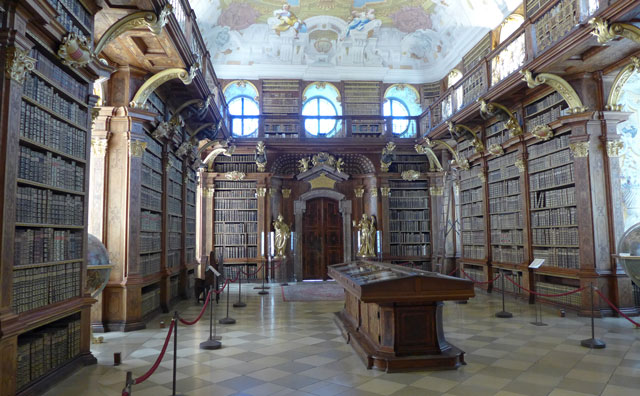
melk_library

However, the library  with its numerous mediaeval manuscripts, including 750 incunables (books printed before 1501) was very impressive, though not nearly as extravagant as the one in Wiblingen Abbey in Germany.
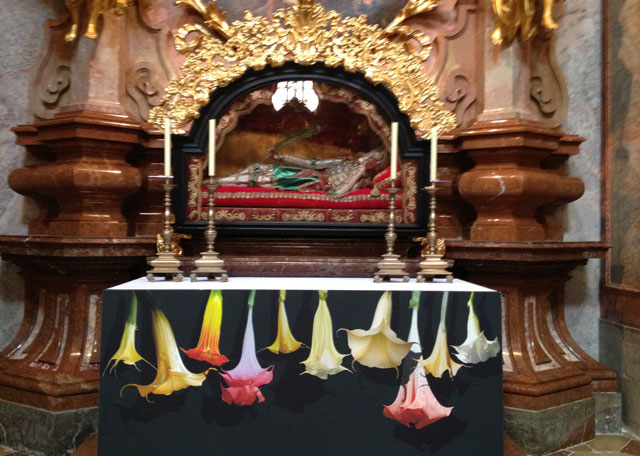
Modern painting on a side altar in Melk abbey church

The baroque church, whose renovation was completed about thirty years ago, is absolutely dripping with gold. There was even a lady polishing up the main altar to make it even brighter. There are also some unfortunate modern paintings on the side altars.
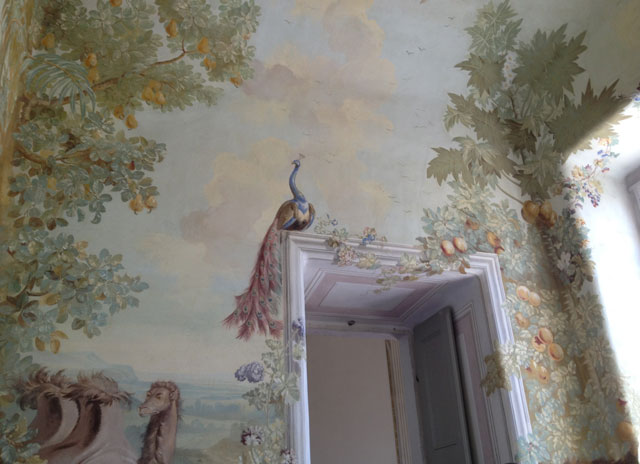
Wall paintings in the pavillion of Melk Abbey

We had a cold drink in the summer house with its beautiful frescoes and admired the view from the garden behind. The Benedictines certainly picked a wonderful spot.
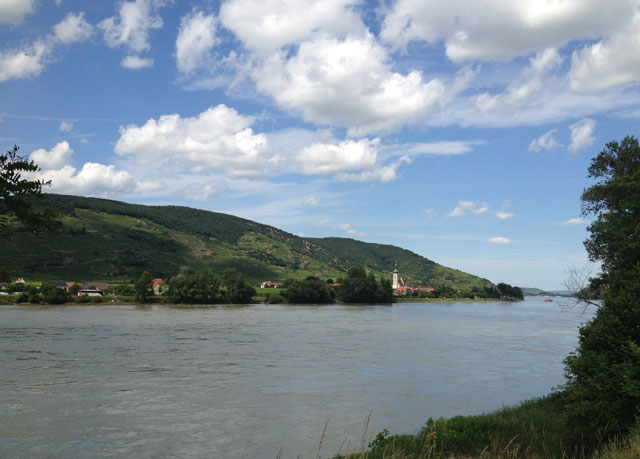
Another typical view of the Danube

The trip back along the other side of the Danube was not nearly as exciting. Most of it wound through vineyards and apricot and cherry orchards. We even bought some fruit from a sulky wayside vendor. While we were there, a man pulled up in his truck and got out, wearing ledenhosen! They were even better from the front but I couldn’t take a discreet photo.
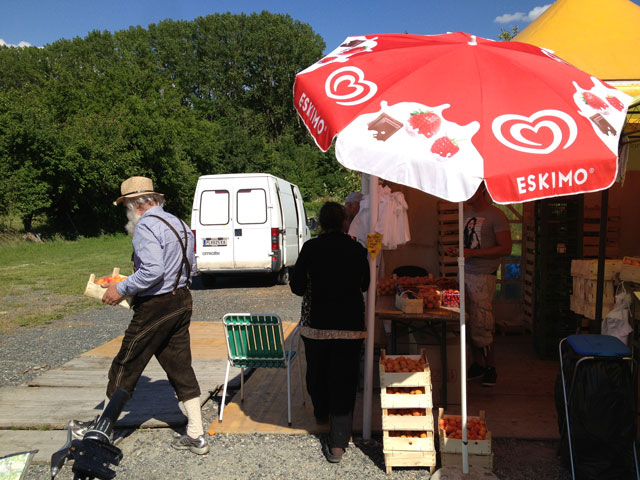
Man in lederhosen buying fruit

In the evening we dined al fresco in the hotel restaurant. The meal was expensive and disappointing, except for the wine which was excellent, reinforcing our usual practice of eating in middle-of-the-range family-run restaurants that cater to the locals.
Budapest – more accommodation problems

We’re driving along the motorway to Budapest pleased to have our Aschach and Bratislava accommodation experiences behind us.

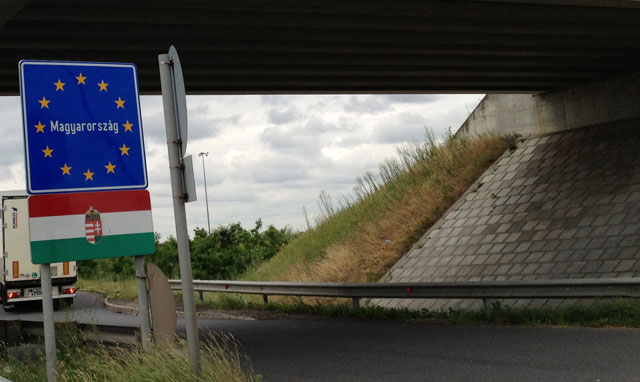
The Hungarian border

This time, there should be no problems. We have organised a home exchange with an American couple who have a well-located apartment in the centre of Budapest which they let and exchange. They have kindly agreed to our arriving ahead of schedule because of the bad weather in Aschach. We can arrive on Wednesday around noon and L. will be there to give us the key.

We leave Aschach on Tuesday and stay overnight in Bratislava which is a two-hour drive from Budapest. We arrive about fifteen minutes ahead of time, park right in front of the appartment, get some florints out the bankomat, buy a couple of things for lunch and feed the surprisingly expensive parking meter.

The appartment we almost stayed in!

L. arrives on cue, very apologetic. There is no electricity. His father has been looking after the apartment for A. but is now in hospital after major brain surgery and the last electricity bill has not been paid. He takes us up to the apartment, which is spacious and has everything we need, in particular a washing machine which is starting to become a major preoccupation.

Jean Michel goes into panic mode, much worse than in Bratislava and is looking furious. Neither L. nor I has A’s phone number unfortunately but L has sent her an email. Apologising profusely, L.  goes off to look after the electricity problem saying he’ll be back in an hour or so.

Our first view of Budapest

We decide to have lunch in the meantime. Jean Michel is very pessimistic but I try to stay calm and be as nice to L as I can be. It isn’t his fault, after all! He soon returns with bad news. Even if he pays the electricity bill in cash, the electricity company will not put the power back on unless the owner of the apartment is present. L’s father has an official proxy but he doesn’t and A. is in the US. We’re in Hungary, he says.

Jean Michel wants to get out of Budapest as soon as he can. He looks up the Routard and finds an appartment to rent in Esztergon, a small town on the Danube an hour’s drive away, where we will be able to do our washing*. I have a look but am not convinced. I suggest Szentendre which is closer to Budapest and seems more promising but no apartments are listed. Jean Michel is adament, particularly after he discovers he has left his photo-grey sunglasses behind in the appartment.

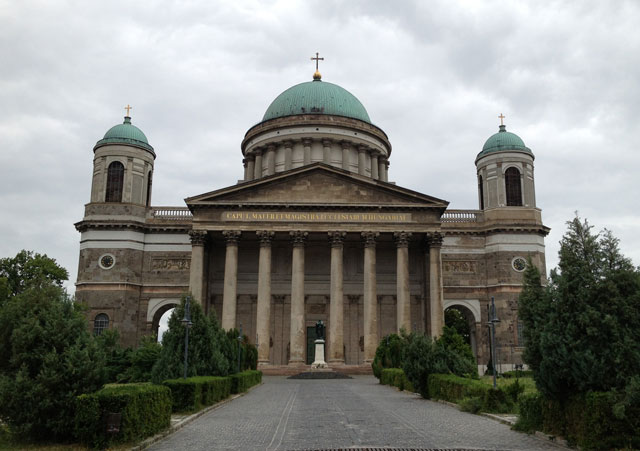
Basilica in Eztergon
Primatial Basilica of the Blessed Virgin Mary in Esztergon

About a half an hour out of town, we enter a forest and the road starts winding up a small mountain. We finally come down the other side and into the very dismal little town of Esztergon. We pull up at the address in the Routard and I have another look at the description. I quote, “We don’t know why anyone would possibly want to stay in Esztergon, but if you do, here are a few addresses.” Jean Michel had not read that bit.

I start laughing and Jean Michel at last joins me. We park the car near Hungary’s biggest building, the Primatial Basilica of the Blessed Virgin Mary, so we can visit it before going to Szentendre. It is certainly huge but not particularly attractive.

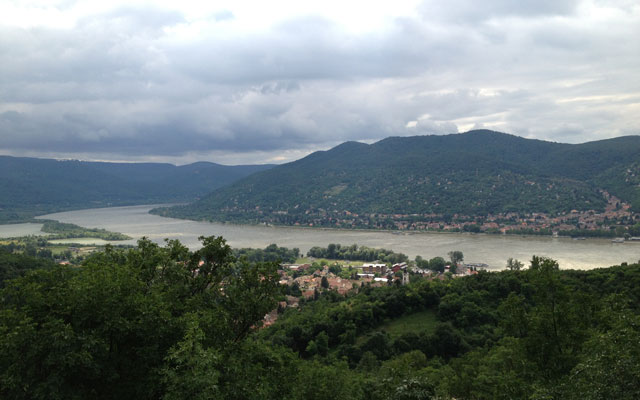
The Danube from Visigrad

We drive along the Danube to Szentendre, stopping off on the way at Visigrad and driving up a hill behind it from which there is a breathtaking view of the Danube.

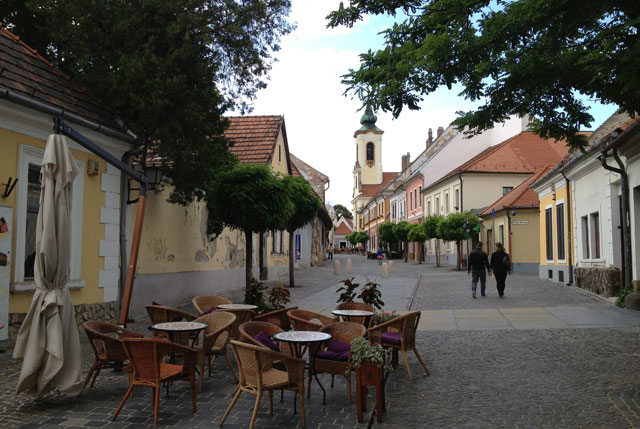
The main pedestrian street in Szentender

Szentendre turns out to be a pretty little town with a pedestrian area in the middle and no fewer than five churches. After calling in at the tourist office for local bike maps just before it closes, we go to Roz Panzio the first of two hotels listed in the Routard under the prix moyens et plus chics category. We are shown two rooms and choose the largest. Then I ask about washing. The lady takes us to the hotel laundry, then phones someone on her cell. “No, I’m sorry”, she says, “not possible”.

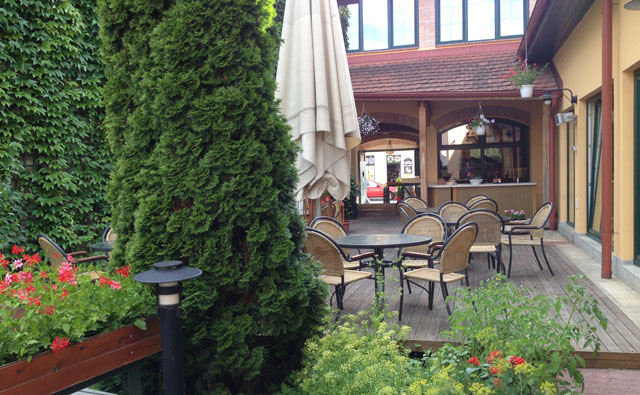
The terrace at Mathias Rex Panzio

We try the second address, Mathias Rex Panzio, which I actually prefer. Yes, there’s a double room for 50 euros including breakfast. Wifi? Yes. Parking? Yes. Washing? No. So I explain about the apartment falling through and our 10 days’ washing. “OK”, she says. “You can use our private washing machine.” I thank her profusely. The room isn’t very big, but it’s clean, it has a comfortable bed and a very interesting bathroom, that appears to be all moulded in one piece. We take it. Dinner? At Movies (actually Muvesz) down the road.

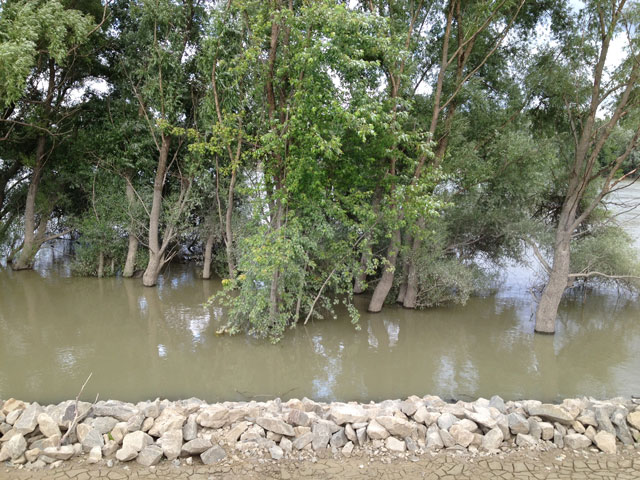
Aftermath of flooding of the Danube

We change, take the bikes off the back of the car and off we go. It’s amazing how quickly the annoyances of the day disappear. From the height of the water in the Danube, we are lucky to be cycling at all. The whole area was obviously badly flooded.

The Danube at sunset

Muvesz turns out to be an excellent address and for the equivalent of 30 euros for the two of us, we have two courses and a glass of red and white wine each. Tomorrow, we’ll visit Budapest.

*We have been unable to find a laundromat in either Germany or Austria despite a lot of time spent following up non-existent addresses.
 
Mathias Rex Panzio, Kossuth Lajos utca 16, Szentendre 2000, Hungary. www.mathiasrexhotel.hu info@mathiasrexhotel.hu
 

Rain on the Danube in Austria

When we leave Andelfingen after six wonderful days of cycling along the Danube, the weather forecast for our next stop – Aschach in Austria – is not promising. As we’ve never been to Munich, we decide to stop for a couple of hours on the way.

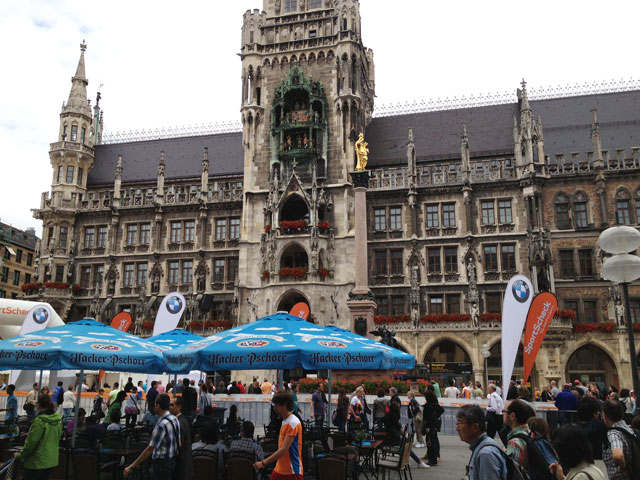
Marienplatz in Munich during the Stadtlaufmüncher marathon

Unfortunately, there is a big annual sports event on – 10,000 people running a marathon or semi-marathon – and the main square, Marienplatz, is chock-a-block which somewhat detracts from the historical ambiance. We see the main sights beneath an overcast sky, have a picnic lunch on a bench (it’s a fast day) and continue on our way.

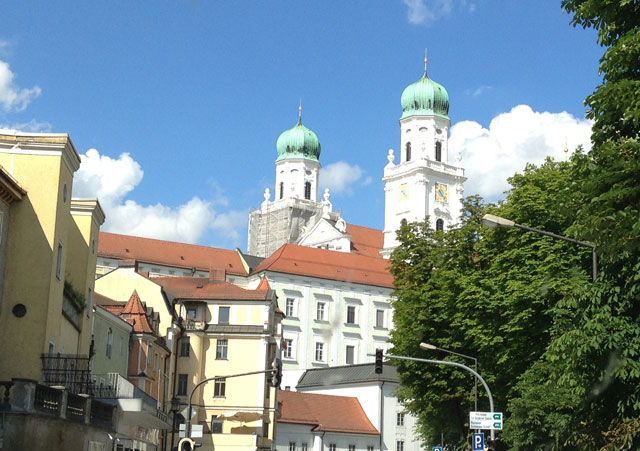
Passau
Passau

After leaving the motorway at Passau at the juncture between Austria and Germany, which we visited on another occasion, we drive along the Danube, much wider and navigable here, seeing the aftermath of the recent floods. The river looks muddy and there is silt on the edge of the pavements and piles of debris everywhere. Nothing like the bucolic scenery we have left behind in Germany.

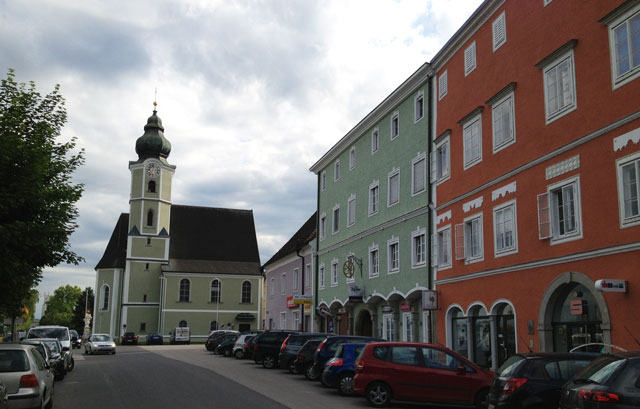
The church in Aschach

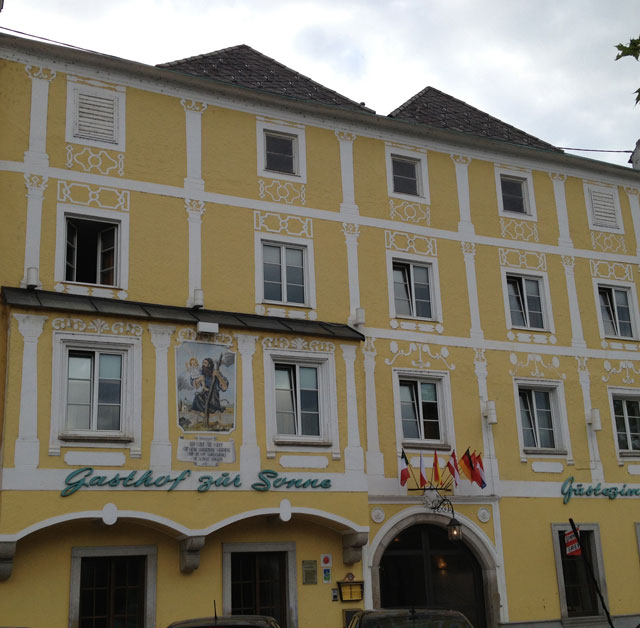
At the turnoff to Aschach, large production installations loom on the right and I begin to worry about what we’ll find. From the internet photos, our hotel, Gastof zür Sonne, seemed to be right on the water but, in fact, it is across the road. A not-very-friendly young man gives us a key card and sends us up to room 4 on the second floor.

Gasthaus Sonne in Aschach
Gasthof zür Sonne in Aschach

As we walk into the room, I see the wash basin is in an open area on the left ; the shower and toilet are behind a frosted glass door on the right. The room is small with dark furniture including an open wardrobe and a view of the Danube.  I go into complaint mode and Jean Michel says I have to make up my mind whether we are staying or going. By then it is 6 pm and looking for another place to stay seems a bit daunting. I go down to the desk and ask if there is another room that doesn’t have a wash basin in the entrance. It seems they are all the same.

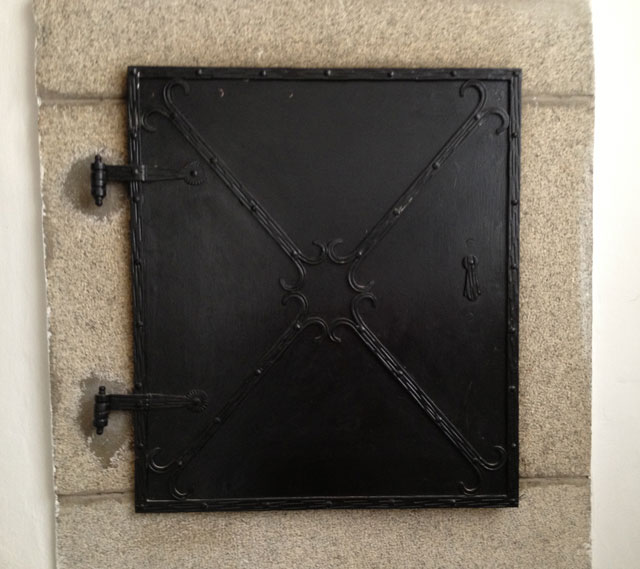
An iron door inside the Gasthaus Sonne
An iron door inside the Gasthof zür Sonne

We bring up our luggage and bits and pieces and I empty our small case into the wardrobe so we can change into our cycling clothes, pointing out all the negative aspects of the room as I go. Jean Michel understandably starts to get annoyed so I stop complaining. It is then that I realise that an automatic light comes on over the wash basin/entrance each time you go past which means that when I get up in the night, the whole room will be flooded with light.

The Danube at Aschach in the evening

Even Jean Michel sees the impossibility of that! We go back down and I put on my best smile to ask how to stop the light coming on automatically. The young man comes up reluctantly to have a look. However, he immediately understands the problem and says that unfortunately all the new rooms are like that but we can have the “old” room next door. Not only is the washbasin inside the bathroom this time; the open wardrobe is hidden behind the door, the room is much bigger and we have a sofa from which we can comfortably see the Danube.

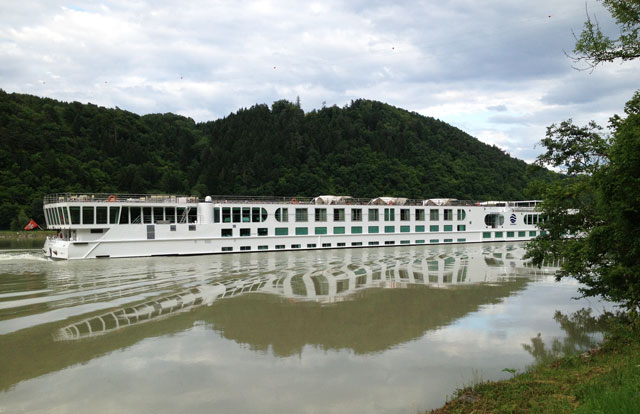
An enormous cruise ship on the Danube
An enormous cruise ship on the Danube at Aschach

This time my smile is not forced. “Perfect”, I say. “And look, the washbasin is not in the entrance”. The young man then explains that he thought I was objecting to the bathroom being on the left, not about the washbasin being in the entrance (he didn’t know the word in English). We rapidly change into our cycling clothes and get in an hour’s cycling before dinner.

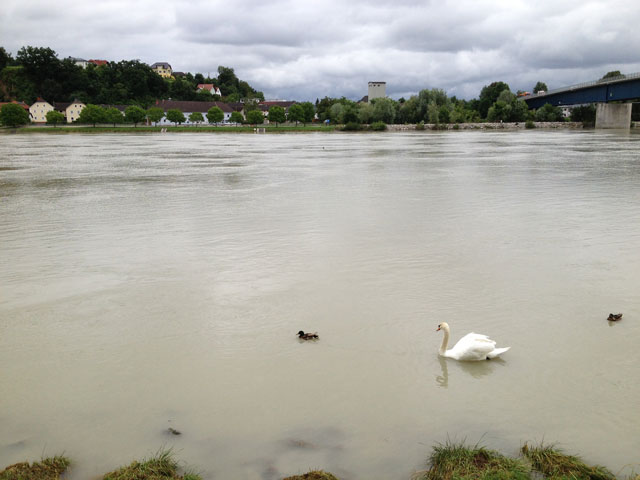
Swans on the Danube at Aschach am der Donau

That, however, proves to be the last time we cycle for several days. It rains all night and next morning, it’s 12°.  Change of programme.

Cycling along the Danube – Ehingen to Ulm

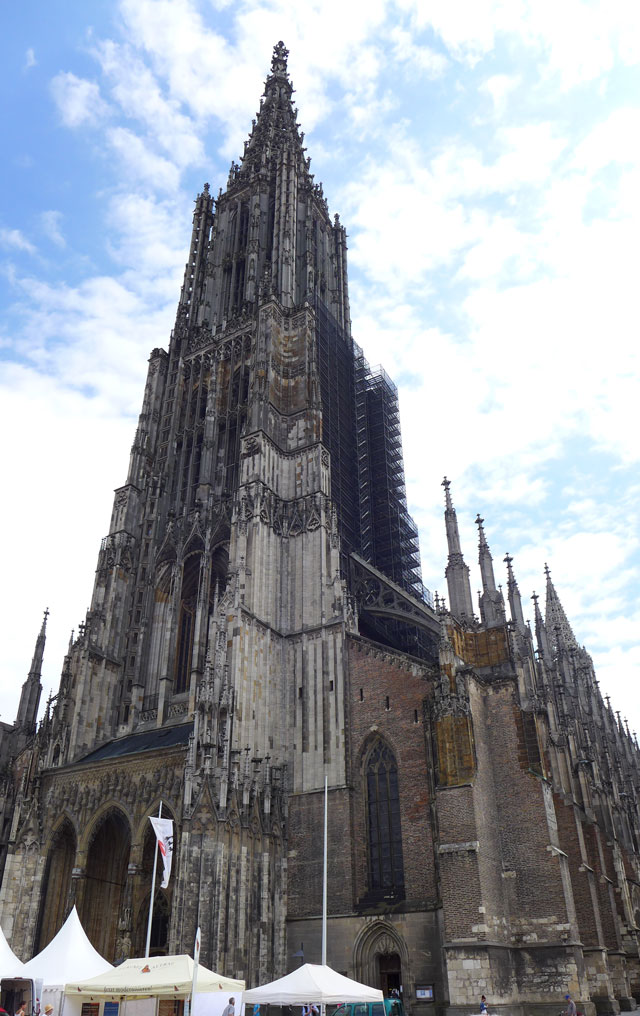
It’s funny how you can go to the same place twice and have a totally different experience each time. When we saw Ulm the first time, it didn’t seem at all attractive.  Its famous Minster might be the tallest church in the world but it was dark and ugly in my books, particularly after all the beautiful rococco churches we’ve been seeing.

The minster in Ulm
The minster in Ulm, the tallest church in the world

We couldn’t visit the inside because there was a concert on. Jean Michel was ready to leave without seeing anything else but I encouraged him to at least take a walk through the pedestrian streets nearby. There were a few old houses but nothing outstanding so we drove to Erlingen to start cycling.

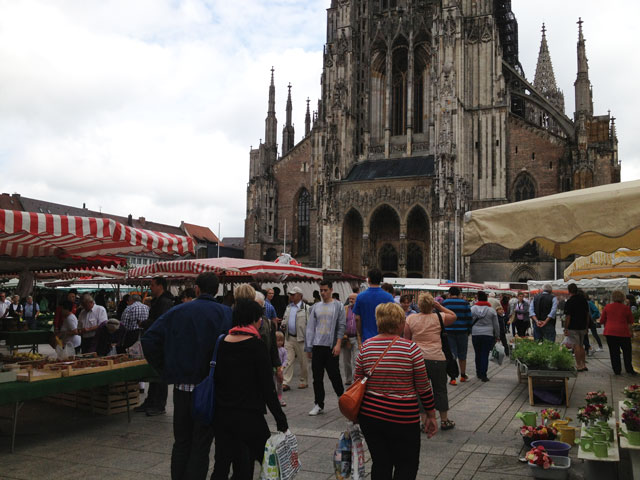
Saturday market in Ulm

Next day, which was Saturday, we drove to Ehingen and took the train to Ulm. It was as though we were in a completely different town! There was a fresh produce market in front of the cathedral, which was open this time. Then we went to the Fishermen’s Quarter along the Danube and discovered the real soul of Ulm.

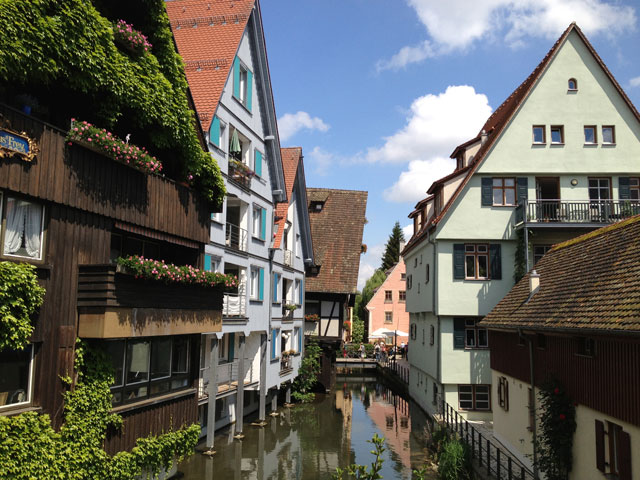
Fishermens' quarter in Ulm
Fishermens’ quarter in Ulm

We had lunch at an old mill with a water wheel and cycled through quaint little streets with pretty little houses.

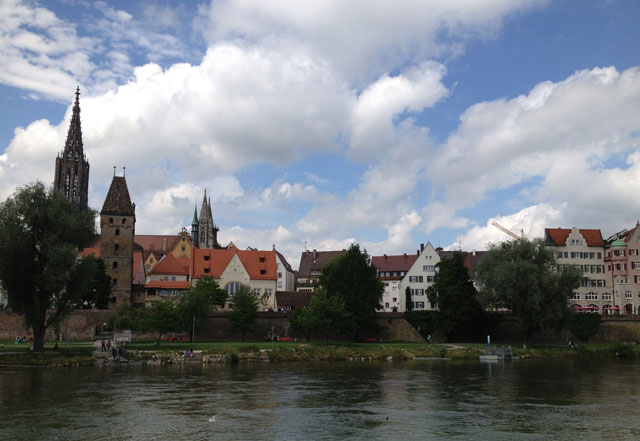
Ulm minster from the other side of the Danube

We then rode along the old ramparts overlooking the Danube and went across the bridge to the other side where the Minister looked much more attractive! What a pity it would have been had we not gone back.

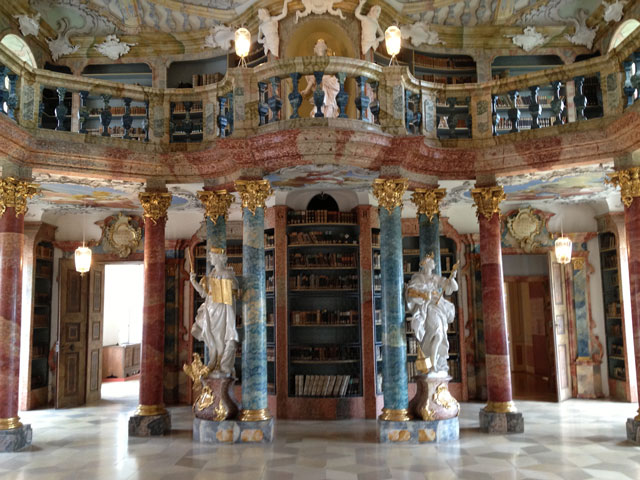
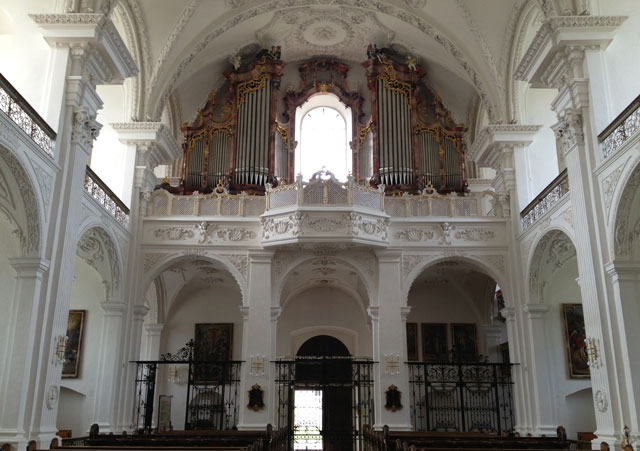
Baroque library in Wiblinger Abbey
Baroque library in Wiblingen Abbey

Not far from Ulm, we visited Wiblingen Abbey, another astonishing piece of baroque architecture including the abbey church, where a wedding was taking place, and a very beautiful library completed in 1744.

The balcony of the baroque church in Erbach

Another baroque church awaited us at Erbach, built on the top of a hill and commanding an extensive view of the surrounding area. Since Jean Michel has the map, I had no idea how steep the climb was and started too fast, spurred on by a car waiting at the top. To my dismay, we turned a corner and the road kept going. My legs were like jelly by the time I finally reached the church.

French cyclists carrying 40 kilos on their bikes, including a tent

We stopped at a roadside Gasthaus in the little village of Ersingen for a cold drink and were surprised to hear the couple at the next table speaking French. It turned out they were camping at the Gasthaus that night and had just ridden 90 kilometers lugging 40 kilos on their bikes. Not really my scene, I must say!

The spring in Erbach
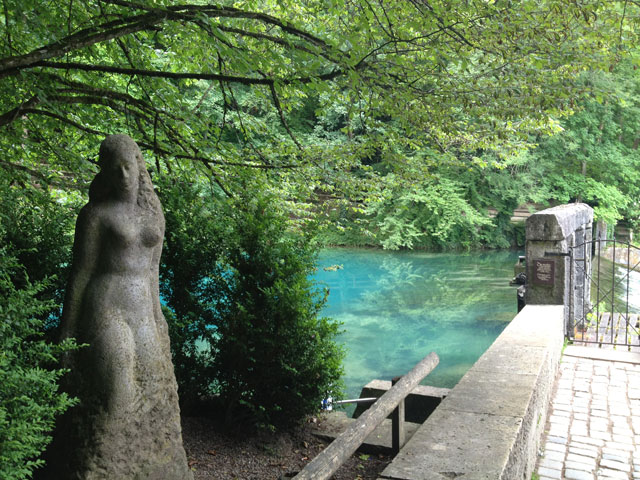
The asure spring in Blaubeuren

On another circuit along the Blau River north of the Danube, we visited the delightful little of town of Blaubeuren where the river comes out from under the ground in an azure blue pool.

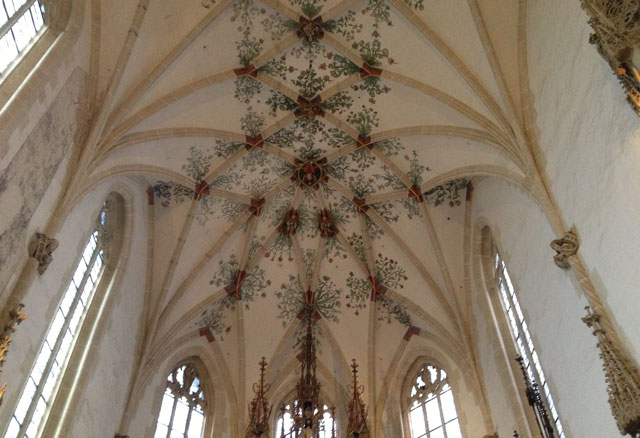
Ceiling of the abbey church in Blaubeuren

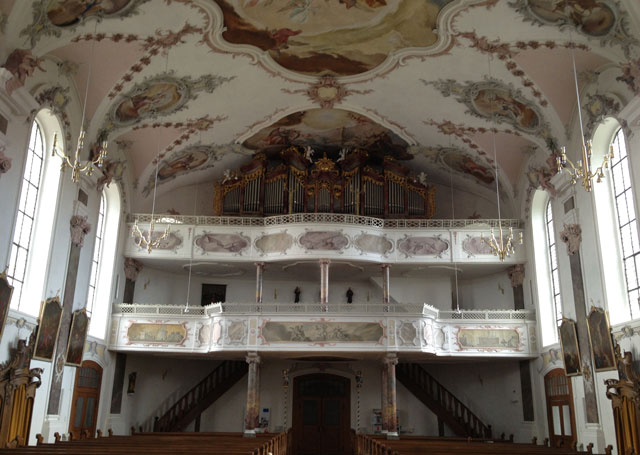
It was no surprise that the Cistercian monks built a very large abbey there including a baroque church with a beautiful painted ceiling and a cloister.

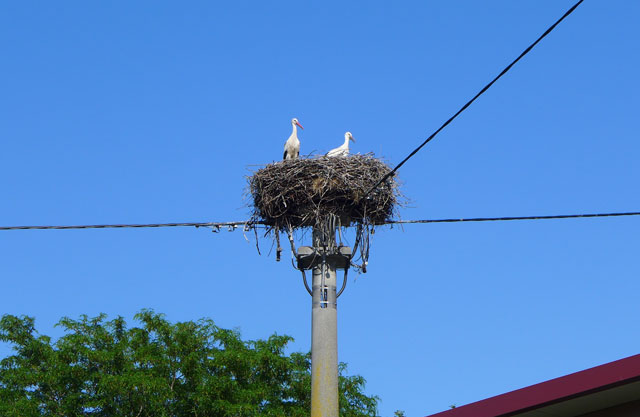
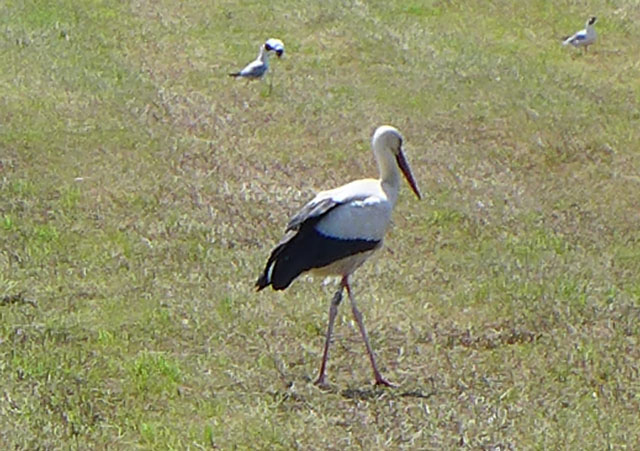
Storks' nest
Storks’ nest

On the way back, Jean Michel spied another storks nest.

One of our last views of the Danube near Andelfingen in Germany

The weather on both days was not as hot as the first three days, often cloudy and overcast, but we didn’t get any rain. The weather forecast for the next stage of our trip near Linz in Austria does not look promising though.

OTHER POSTS ABOUT CYCLING IN GERMANY

Cycling in Germany – Tips & Tricks
Cycling in Germany #1 – Kobern-Gondorf on the Moselle
Cycling in Germany #2 – Rhine from Saint Goar to Lorch
Cycling in Germany #3 – Cochem to Zell on the Moselle
Cycling in Germany #4 – Koblenz where the Moselle meets the Rhine
Cycling in Germany #5 – Bad Schaugen to Pirna along the Elbe
Cycling in Germany #6 – Bastei Rocks, Honigen and over the border to Czech Republic 
Cycling in Germany #7 – Dresden: accommodation & car trouble and Baroque Treasure  
Cycling in Germany #8 – Dresden Neustadt: Kunsthof Passage, Pfund’s Molkerei, a broom shop & trompe l’oeil
Cycling in Germany #9 – Country roads around Niderlommatzsch on the Elbe
Cycling in Germany #10 – Meissen on the Elbe
Cycling in Germany #11 – Martin Luther Country: Torgau on the Elbe
Cycling in Germany #12 – Martin Luther Country: Wittenberg on the Elbe
Cycling in Germany #13 – Wörlitz Gardens and the beginning of neo-classicism in Germany
Cycling in Germany #14 – Shades of Gaudi on the Elbe: Hundertwasser
Cycling in Germany – Turgermünde, the prettiest village on the Elbe
Cycling in Germany #16 – Celle & Bremen
Cycling in Germany #17 – Windmills & Dykes
Cycling in Germany #18 – Painted façades from Hann. Münden to Höxter
Cycling in Germany #19 – Bernkastel on the Moselle: a hidden treasure
Cycling in Germany #20 – Trier & the Binoculars Scare
 
Cycling along the Danube – A Renaissance festival in Neuburg, Bavaria
Cycling along the Danube – Watch out for trains!
Cycling along the Danube – Regensburg & Altmuhle
Cycling along the Danube –  The Weltenburg Narrows
Cycling along the Danube – from its source to Ehingen
Cycling along the Danube – Ehingen to Ulm
Cycling along the Danube – Singmarigen to Beuron
Cycling along the Danube – Binzwangen to Mengen including  Zwiefalten
Eurovelo 6 – Cycling around Lake Constance
Eurovelo 6 – Moos to Stein am Rhein and Steckborn on Lake Constance
Heading home to France after a month’s cycling holiday

Cycling along the Danube – from its source to Ehingen

A total of 110 km, but it actually took two days. We’ve definitively adopted the train-in-one-direction system which means we can see more and not have to cycle up all those hills again on the way back. Jean Michel thought we should start with the source in Donau-Eshingen so we began day 2 by driving an hour to Tuttlingen and getting the train to Donau-Eshingen.

Donau-Eschingen, where the Danube begins

Although it was as sunny and hot as the day before (over 30°C in the afternoon), it was not nearly as pretty. Our first disappointment was that the source is undergoing renovation so is not open to the public. So after having lunch in Donau-Eshingen, we set out for Tuttlingen.

One of the canals along the Danube

The cycle route doesn’t always run along the Danube and we often rode through hay fields interspersed with flowers, which did, of course, have the advantage of mostly being flat. There were lots of irrigation canals, water irises, storks and covered bridges, but I missed the wonderful surprises of the day before. We didn’t see a single rococco church.

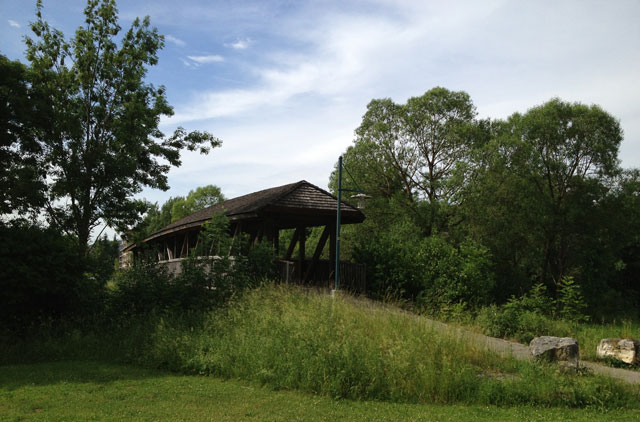
One of the many wooden bridges over the Danube
One of the many covewooden bridges over the Danube

On the way home from Tuttlingen, whose main attraction is its modern covered bridges, Jean Michel suggested we go to the lookout at Knopfmacherfelsen which is about 750 metres above the Danube.

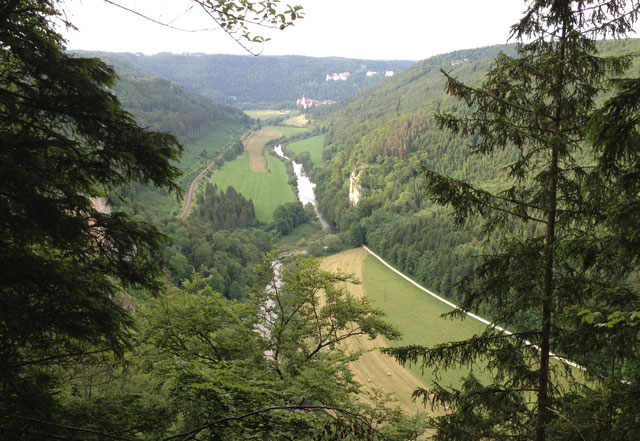
View of Beuron Monastery from Knopfmacherfelsen

The view is absolutely breathtaking with the monastery in Beuron in the distance.  We then drove down to Beuron to see the monastery up close. Access was through a covered bridge. It was a truly wonderful way to finish off the day.

Riedlingen
Riedlingen

Fortunately, day 3 was not as hot (only 23° at 9 am), because was lucky because it was VERY hilly (and also an intermittent fast day). We drove to nearby Riedlingen and parked at the train station since we intended taking the train back from Ehingen. It’s a pretty little town, with lots of colourful half-timbered houses and painted façades.

Balcony in the church in Alstein

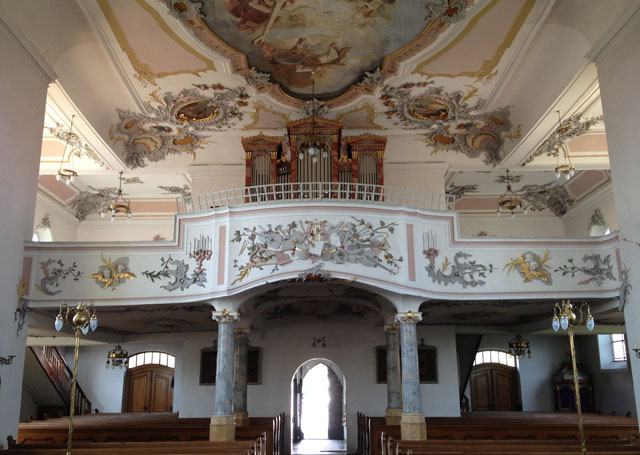
Before cycling along the Danube, we looped back to Altheim which our Gasthof owner had told us about.  We found another beautiful rococco church with a painted balcony featuring bas-relief musical instruments.  There was also a stunning vase of peonies which are very prevalent here and grow taller than they do in the Loire Valley.

A stork in a field
A stork in a field

Back on the Danube we crossed a couple more wooden bridges and stopped for coffee in Riedlingen. We then passed several fields full of storks which obviously explains why there are so many shop signs and sculptures of storks in the villages.

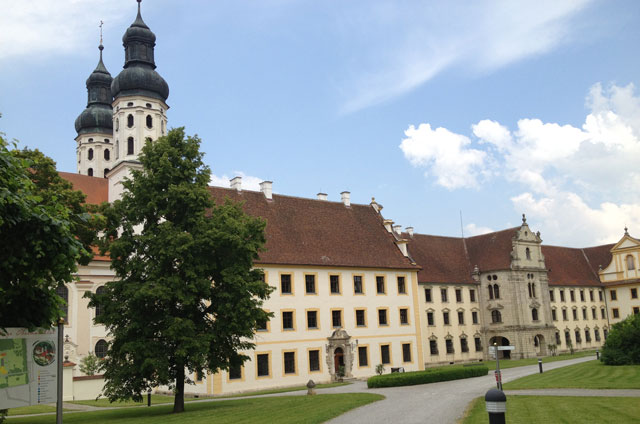
Obermarchtal Abbey Church from the Danube

Our next stop was the Monastery Cathedral of Obermarchtel with more wonderful rococco and a balcony, but not as rich as Zwiefalter. As we came out, it was starting to spit which was a bit annoying as I had taken the rain capes out of the paniers. Fortunately, there were a few rumbles of thunder and nothing more.

The balcony at Obermarchtal Abbey Church

More hills and dales before we stopped at Munderkingen for a surprisingly good coffee. The sky was not looking very encouraging and we feared the worse. By the time we got to Rottenacker, about 7 or 8 K from our destination of Ehingen, fat drops were started to fall. We got a bit wet, but  not soaked, and just made the train station in time.

Obermarchtal Abbey Church from the outside

When we got back to Andelfingen, where we’re not staying at Gasthof Sonne (that’s the next one!) but at Gasthof Swanen, Frau Smidt told us they had had golf-ball size hailstones! That was a lucky miss. Tomorrow I’m putting the rain capes back in the paniers.

And just for the record, despite our fast day (500 calories for me, 600 for Jean Michel), we cycled 61 kilometers  including lots of hills. Tomorrow, we can have ice-cream and riesling again.
OTHER POSTS ABOUT CYCLING IN GERMANY

Cycling in Germany – Tips & Tricks
Cycling in Germany #1 – Kobern-Gondorf on the Moselle
Cycling in Germany #2 – Rhine from Saint Goar to Lorch
Cycling in Germany #3 – Cochem to Zell on the Moselle
Cycling in Germany #4 – Koblenz where the Moselle meets the Rhine
Cycling in Germany #5 – Bad Schaugen to Pirna along the Elbe
Cycling in Germany #6 – Bastei Rocks, Honigen and over the border to Czech Republic 
Cycling in Germany #7 – Dresden: accommodation & car trouble and Baroque Treasure  
Cycling in Germany #8 – Dresden Neustadt: Kunsthof Passage, Pfund’s Molkerei, a broom shop & trompe l’oeil
Cycling in Germany #9 – Country roads around Niderlommatzsch on the Elbe
Cycling in Germany #10 – Meissen on the Elbe
Cycling in Germany #11 – Martin Luther Country: Torgau on the Elbe
Cycling in Germany #12 – Martin Luther Country: Wittenberg on the Elbe
Cycling in Germany #13 – Wörlitz Gardens and the beginning of neo-classicism in Germany
Cycling in Germany #14 – Shades of Gaudi on the Elbe: Hundertwasser
Cycling in Germany – Turgermünde, the prettiest village on the Elbe
Cycling in Germany #16 – Celle & Bremen
Cycling in Germany #17 – Windmills & Dykes
Cycling in Germany #18 – Painted façades from Hann. Münden to Höxter
Cycling in Germany #19 – Bernkastel on the Moselle: a hidden treasure
Cycling in Germany #20 – Trier & the Binoculars Scare
 
Cycling along the Danube – A Renaissance festival in Neuburg, Bavaria
Cycling along the Danube – Watch out for trains!
Cycling along the Danube – Regensburg & Altmuhle
Cycling along the Danube –  The Weltenburg Narrows
Cycling along the Danube – from its source to Ehingen
Cycling along the Danube – Ehingen to Ulm
Cycling along the Danube – Singmarigen to Beuron
Cycling along the Danube – Binzwangen to Mengen including  Zwiefalten
Eurovelo 6 – Cycling around Lake Constance
Eurovelo 6 – Moos to Stein am Rhein and Steckborn on Lake Constance
Heading home to France after a month’s cycling holiday

Cycling on the Danube – Sigmaringen to Beuron

We wake up to another brilliant blue sky and by the time we’ve finished breakfast, it’s already 25°C. We decide to drive to Sigmaringen, about 20 K away and get ourselves a proper cycling map since ours isn’t detailed enough.

Animated main street in Sigmaringen

After paying 20 centimes for one hour’s parking (you wonder why they bother!) we wander through the quaint animated streets looking for the tourist bureau. The only thing they have is a not-very-detailed map of all the cycling routes in this part of Germany (Baden Württemberg). We regret not having ordered the Eurovelo 6 on the internet but we didn’t get our act together in time.

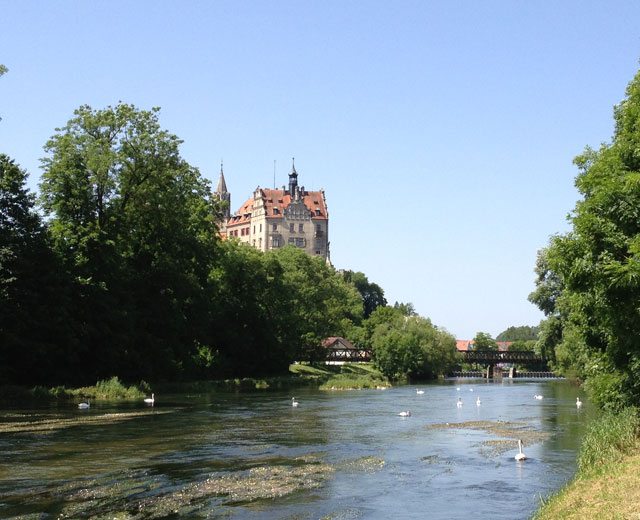
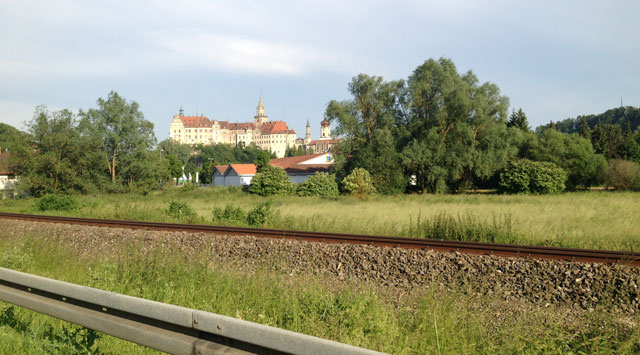
Sigmaringen Schloss with swans

We find ourselves a place to park near the cycle path and set out for Beuron, only to discover, after taking a multitude of photos of the schloss (castle), with and without swans, that a flower festival is temporarily occupying the banks of the Danube in Sigmaringen. So we ride along the main road for a while.

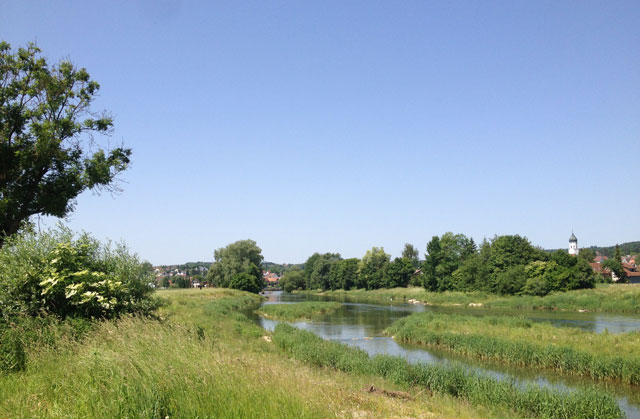
Typical scenery along the Danube with a church bulb in the distance

We finally catch up with the bike path on the outskirts and start to enjoy the beautiful scenery along the river. The temperature keeps rising but we don’t notice it while the path is flat because you always stir up your own little breeze when cycling.

Enzigkofun

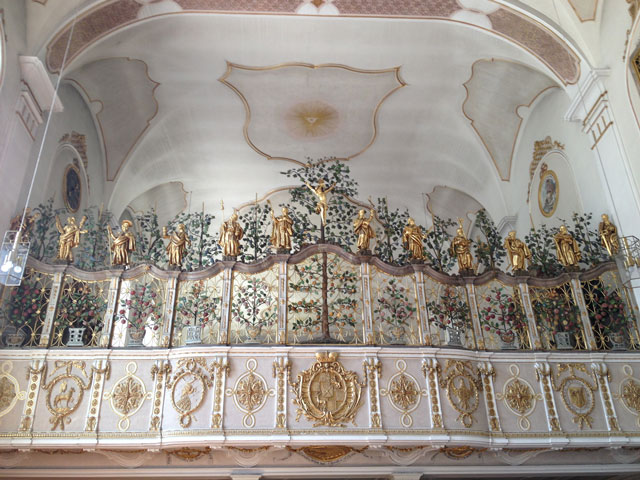
When the road begins to climb however, we start noticing it! As cliffs start to form on either side, the path gets steeper and steeper. By the end, we are walking our bikes up and dripping with sweat. At the top, in the little village of Enzigkofun, we see a church with a white bulb and go inside to get cool off. We are rewarded with an amazing baroque gallery with the twelve apostles on either side of a crucifixion.

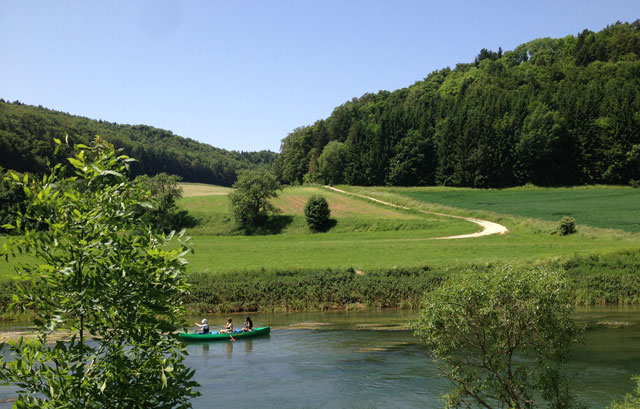
Kids canoeing on the Danube

Fortunately, the path then leads into a forest otherwise we might melt altogether. Suddenly it starts descending  and I can’t even enjoy it because I keep thinking about having to ride back up again on the way back. At the bottom, when I catch up with Jean Michel (I’m always reluctant to go down too fast in case I skid or something), I tell him that I really don’t think I’m up to the return journey.

Lunch in the shade at Gasthaus Mühle in Dietfurt

“I have a proposal”, he says. “We can take the train back from Beuron.” I shout with glee. After lunch at Gasthaus Mühle in Dietfurt, where we cool off under the shade for an hour and eat enormous salads, we’ve only done 15 kilometers out of 38 but Jean Michel reassures me that there are no more hills.
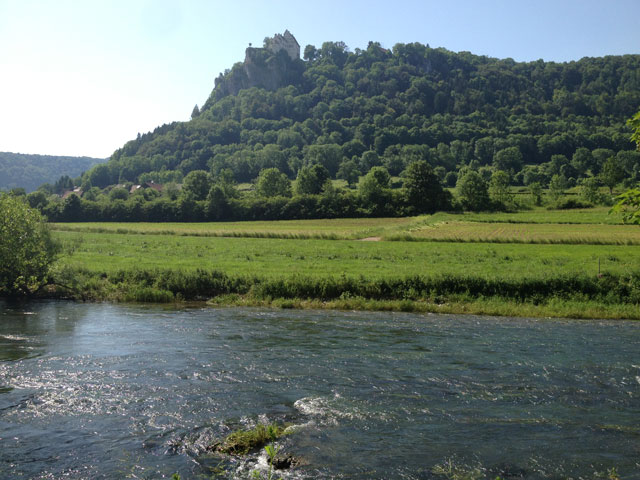
Werenwag Schloss that I don't want to cycle to
Werenwag Schloss that I don’t want to cycle to

Well, he’s wrong. Most of the path from Dietfurt to Beuron is up hill and down dale in the boiling sun, with a few shady stretches to save the day. We round a corner at one stage and Jean Michel points out a shloss on a high hill towering above us. “That is one schloss I do not want to see”, I say. “Then I’ll take it off the list.” “Don’t let me stop you see it; I’m happy to stay down here and rest while you go up.” He very kindly says he’ll relinquish it for my sake.

Warenweg schloss up closer

Eventually we find somewhere to have coffee – Gasthof Neumühle in Tiergarten – and I suddenly remember the word eis so we have an ice-cream Sunday each. After all those hills – and the ones to come – I reckon  we deserve it. The enterprising chef, Walter, looks up the train timetable for us and behind him, I see a plasticised Radweg brochure with all the Danube cycling maps we need. Bingo !

Gasthof Neumühle in Tiergarten
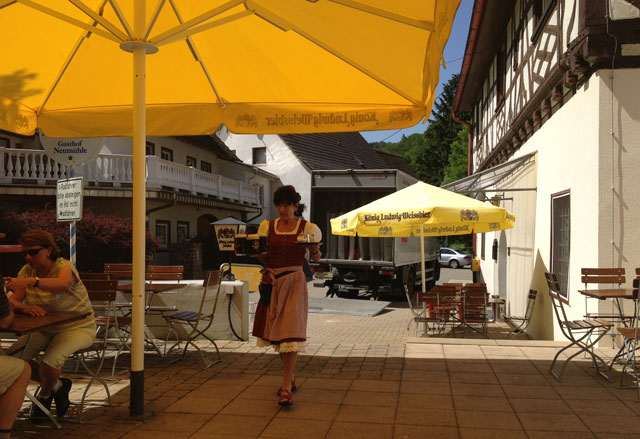
The waitress in her dirndle Gasthof Neumühle in Tiergarten

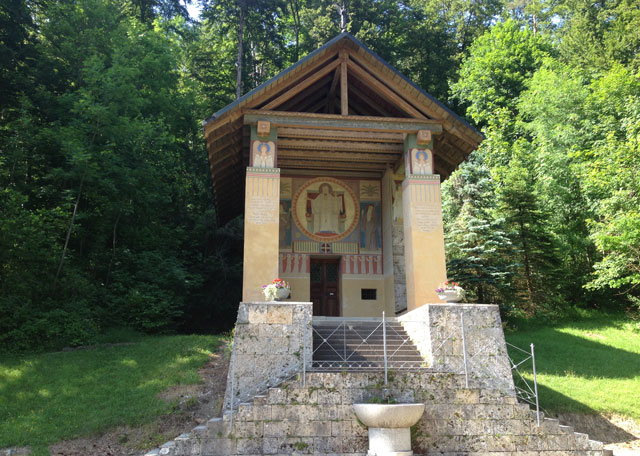
The ice-cream seems to give me new strength and I somehow get ahead during the next stretch. Jean Michel’s probably taking photos. I round a corner after another climb and see a large building on the right. It turns out to be Sant Maurus Kapelle and has painted scenes both inside and out. We buy a booklet but it’s all in German. I think it was built in 1861.

Sant Maurus Kapelle
Sant Maurus Kapelle

At that point we see a signpost saying 6 K to Beuron. I thought it was only 3 which is a bit disappointing. I’m getting tired by this stage. We see the 5 o’clock train speed past so know we’ve got plenty of time to catch the 6.09.

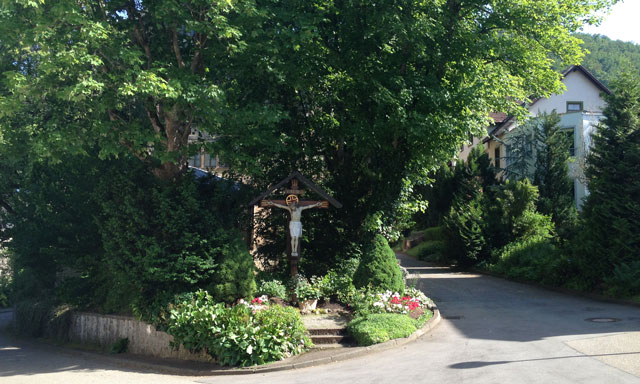
Wayside crucifixion in Beuron

After a glass of riesling  to cool off (a little early maybe but they don’t have any diet coke) at a local café opposite a crucifixion, we cycle down to the station which shows no sign of selling tickets. However, a lady indicates a little haus further along the platform which turns out to be a ticket machine – all in German, of course. However, after four tries we manage to buy one ticket and then another second.

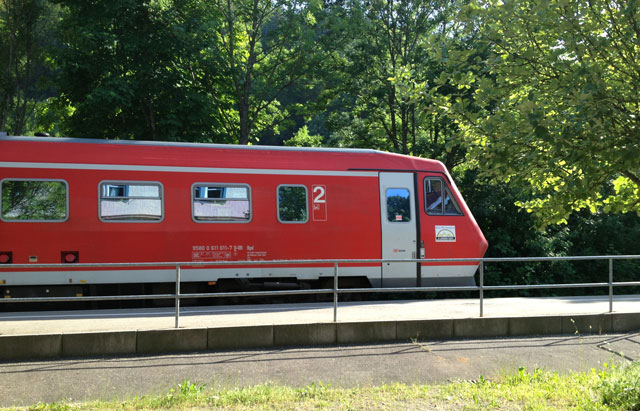
Our little red train

The train arrives and we see there is a bike compartment. Yes, inside there is a large area to put our bikes and even seat belts to attach them. But there is no special system for hoisting the bikes up the steep steeps into the train. Fortunately, another passenger helps me.

Sigmaringen schloss from the train

It’s rather fun going past the places we cycled along, taking 20 minutes instead of 3 hours! Jean Michel amazingly knows how to get from the bahnhof to the car. He always surprises me with his sense of direction. Looks as thought it’s going to be hot and fine tomorrow again. But it’s going to be hard to beat today!

OTHER POSTS ABOUT CYCLING IN GERMANY

Cycling in Germany – Tips & Tricks
Cycling in Germany #1 – Kobern-Gondorf on the Moselle
Cycling in Germany #2 – Rhine from Saint Goar to Lorch
Cycling in Germany #3 – Cochem to Zell on the Moselle
Cycling in Germany #4 – Koblenz where the Moselle meets the Rhine
Cycling in Germany #5 – Bad Schaugen to Pirna along the Elbe
Cycling in Germany #6 – Bastei Rocks, Honigen and over the border to Czech Republic 
Cycling in Germany #7 – Dresden: accommodation & car trouble and Baroque Treasure  
Cycling in Germany #8 – Dresden Neustadt: Kunsthof Passage, Pfund’s Molkerei, a broom shop & trompe l’oeil
Cycling in Germany #9 – Country roads around Niderlommatzsch on the Elbe
Cycling in Germany #10 – Meissen on the Elbe
Cycling in Germany #11 – Martin Luther Country: Torgau on the Elbe
Cycling in Germany #12 – Martin Luther Country: Wittenberg on the Elbe
Cycling in Germany #13 – Wörlitz Gardens and the beginning of neo-classicism in Germany
Cycling in Germany #14 – Shades of Gaudi on the Elbe: Hundertwasser
Cycling in Germany – Turgermünde, the prettiest village on the Elbe
Cycling in Germany #16 – Celle & Bremen
Cycling in Germany #17 – Windmills & Dykes
Cycling in Germany #18 – Painted façades from Hann. Münden to Höxter
Cycling in Germany #19 – Bernkastel on the Moselle: a hidden treasure
Cycling in Germany #20 – Trier & the Binoculars Scare
 
Cycling along the Danube – A Renaissance festival in Neuburg, Bavaria
Cycling along the Danube – Watch out for trains!
Cycling along the Danube – Regensburg & Altmuhle
Cycling along the Danube –  The Weltenburg Narrows
Cycling along the Danube – from its source to Ehingen
Cycling along the Danube – Ehingen to Ulm
Cycling along the Danube – Singmarigen to Beuron
Cycling along the Danube – Binzwangen to Mengen including  Zwiefalten
Eurovelo 6 – Cycling around Lake Constance
Eurovelo 6 – Moos to Stein am Rhein and Steckborn on Lake Constance
Heading home to France after a month’s cycling holiday

Cycling on the Danube in Germany – Binzwangen to Mengen including Zwiefalten

There’s thunder and lightning and pouring rain when we leave Paris at 9 am but after 3 hours driving east, the weather improves immensely and  by the time we reach Germany, it’s an incredible 31°C and the sky is an intense blue. Now, that’s what I call holiday weather!

Zwiefalden Cathedral

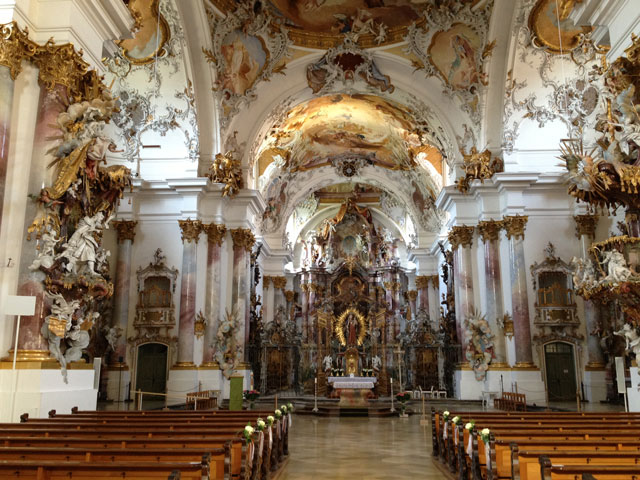
We come round a bend and see a shining white bulb that turns out to be the cathdral of Zwiefalten completed in 1750. We have a cold drink at the bar opposite and visit the beautiful baroque interior just before it closes at 6 pm. It reminds us of the first time we saw a rococco interior in Germany. It was the Pilgrimage Church of Wies at the foothill of the Alps and we walked for hours up a hill. It was very plain from the outside, but the inside was extraordinary.

 Baroque interior of Zwiefalden cathedral
Baroque interior of Zwiefalden cathedral

The village itself is very pretty and peaceful, especially with its little stream.

Little stream running through Zwiefalden

After checking into Gasthof Sonne (sonne means sun) in Andelfingen, we change into cycling clothes and head for the Danube by car. We picnic before setting off on our bikes. We’re delighted to be in holiday mode so soon.

A typical view along the Danube

We pass several villages with their clean white houses and church spires along the path.

Wayside cross along the Danube

We’re amazed at the number of crosses along the way as well, often next to picnic tables.

Mengen church and house built in 1596

Fifteen kilometers later, we arrive at Mengen, a quaint little town with a tall spire, many colourful half-timbered houses, one of which was built in 1596.

Half-timbered houses in Mengen

They have a number of very large storks on the buildings which intrigues us. Many of the shop windows also have dummies dressed as soldiers in traditional garb, including a a surprising Beefeater but I stupidly forget to take a photo.

A very old house in Mengen

By the time we start on our way back, the light is waning and we reach the car just before it gets dark. As soon as we open the door to Gastof Sonne, we are greeted by welcome coolness. One thing I did not worry about when booking our accommodation was air conditioning and I was afraid we were in for a sleepless night! We need to be fit for tomorrow’s 40 K!

OTHER POSTS ABOUT CYCLING IN GERMANY

Cycling in Germany – Tips & Tricks
Cycling in Germany #1 – Kobern-Gondorf on the Moselle
Cycling in Germany #2 – Rhine from Saint Goar to Lorch
Cycling in Germany #3 – Cochem to Zell on the Moselle
Cycling in Germany #4 – Koblenz where the Moselle meets the Rhine
Cycling in Germany #5 – Bad Schaugen to Pirna along the Elbe
Cycling in Germany #6 – Bastei Rocks, Honigen and over the border to Czech Republic 
Cycling in Germany #7 – Dresden: accommodation & car trouble and Baroque Treasure  
Cycling in Germany #8 – Dresden Neustadt: Kunsthof Passage, Pfund’s Molkerei, a broom shop & trompe l’oeil
Cycling in Germany #9 – Country roads around Niderlommatzsch on the Elbe
Cycling in Germany #10 – Meissen on the Elbe
Cycling in Germany #11 – Martin Luther Country: Torgau on the Elbe
Cycling in Germany #12 – Martin Luther Country: Wittenberg on the Elbe
Cycling in Germany #13 – Wörlitz Gardens and the beginning of neo-classicism in Germany
Cycling in Germany #14 – Shades of Gaudi on the Elbe: Hundertwasser
Cycling in Germany #15 – Turgermünde, the prettiest village on the Elbe
Cycling in Germany #16 – Celle & Bremen
Cycling in Germany #17 – Windmills & Dykes
Cycling in Germany #18 – Painted façades from Hann. Münden to Höxter
Cycling in Germany #19 – Bernkastel on the Moselle: a hidden treasure
Cycling in Germany #20 – Trier & the Binoculars Scare
 
Cycling along the Danube – A Renaissance festival in Neuburg, Bavaria
Cycling along the Danube – Watch out for trains!
Cycling along the Danube – Regensburg & Altmuhle
Cycling along the Danube –  The Weltenburg Narrows
Cycling along the Danube – from its source to Ehingen
Cycling along the Danube – Ehingen to Ulm
Cycling along the Danube – Singmarigen to Beuron
Cycling along the Danube – Binzwangen to Mengen including  Zwiefalten
Eurovelo 6 – Cycling around Lake Constance
Eurovelo 6 – Moos to Stein am Rhein and Steckborn on Lake Constance
Heading home to France after a month’s cycling holiday

The 5:2 fast diet – fast and feast and still lose weight!

Success at last ! I can now wear most of my summer clothes again! I just love the 5:2 eat fast diet that I told you about last week. I’ve had two more fast days and lost a kilo in weight and 3 cm at the waist in 10 days. Also I am no longer getting headaches.

Celebrating our annivesary at Domaine des Hauts de Loire

After celebrating our wedding anniversary in style at Domaine des Hauts de Loire on Thursday night, we thought Friday would be a good day to fast. Not only did we have no problem skipping breakfast which we ate at 2 pm, but we also cycled 40 K in the afternoon.

Ok, it was flat ground but we still cycled for 2 ½ hours, drinking lots of water of course. We stopped  at a little café in Muides for a cold drink but they didn’t have any zero Coke or zero anything, for that matter, so Jean Michel had a normal one and discovered how much sugar it contains while I drank an unsweetened expresse for the first time in my life – not great but no way was I going to use up 139 of my 500 calorie allowance on coke.

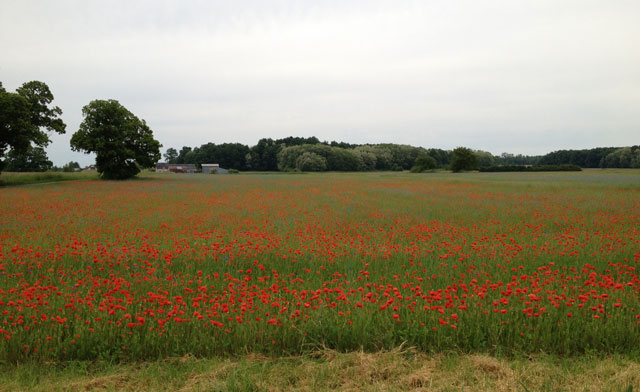
Poppies along the bike path

For dinner, we shared a small tin of tuna with a raw fennel and mushroom salad which, as Jean Michel pointed out, had the advantage of giving an impression of quantity. We finished off with an orange and, surprisingly, did not feel hungry.

I had no hunger pangs, even though I went to sleep quite late and, better still, NO HEADACHE like the first time. And the great thing is that next day, I didn’t feel particularly hungry and ate a normal breakfast and light lunch.

We cycled another 30 kilometers in the afternoon, with lots of hills this time and didn’t even have our usual (healthy) biscuit snack halfway through although Jean Michel claimed it when we got back in the car.

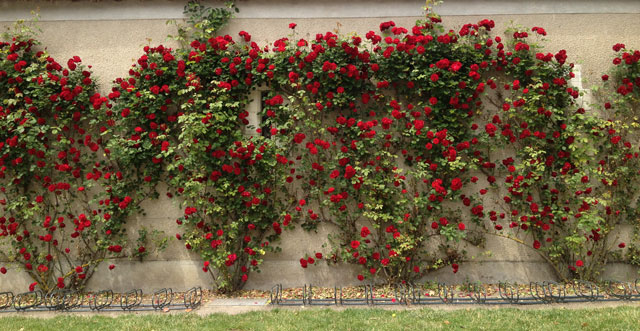
A wall of roses at Château de Cheverny on our bike route

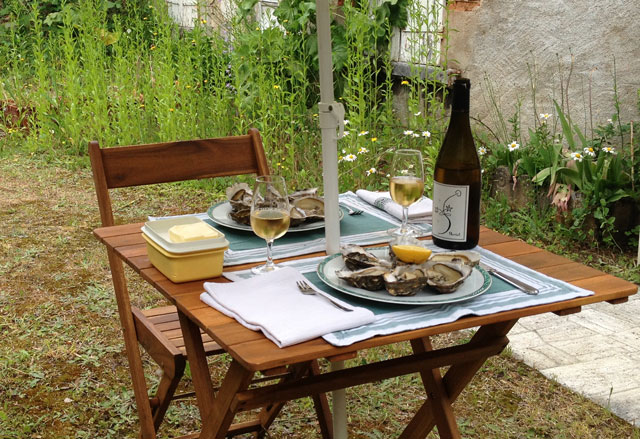
For dinner, we ate côte de bœuf, baked potatoes and our favourite eggplant, zucchini and bell pepper bake  plus a couple of glasses of wine each. On Sunday, we had oysters as usual and it was wonderful to be able to eat bread and butter and drink wine without having to worry about the calories.

I scheduled the next fast for Monday but Jean Michel is doing his roster this week, which entails a certain amount of stress and more physical activity than usual so he declined.  I decided to try the no-breakfast system again as it seems to suit me better. The only thing I can’t do is drink tea because it always makes me feel nauseous on an empty stomach.

My overall impression was not of hunger but of a certain lightheadedness which first peaked around 11.45 am. I had my usual high-protein breakfast at  12.30 (280 calories) and began to feel seriously lightheaded again about 5 pm. I had a black coffee with sweetener and felt instantly better.

Oysters on Sunday in our little house

By 7.30 pm I was feeling hungry, but not inordinately so. We had dinner about 8 pm (220 calories – cucumber, white fish, spinach and cherries, which are still horrendously expensive but I reckon you should treat yourself on fast days!).

I started feeling slightly hungry around 11.30 pm, but not enough to bother me and went to sleep around 1 am.

I woke at 7 and couldn’t go back to sleep so got up and weighed and measured myself – down 400 grams and 2 cm at the waist since the day before. I had my usual breakfast, then fish, vegetables and some quinoa and more cherries at lunch. I had no desire to eat any more.

I joined a friend for an aperitif in the evening (a glass of white wine) then an Asian meal including dim sums, kebabs and rice. Once again, I didn’t have a very big appetite.

Next morning, I had lost another 300 grams! I’ve had several exchanges on Facebook concerning the 5:2 diet and have learnt that it is becoming increasingly popular and most people seem satisfied. So, who’s game?

Other posts on dieting

The Natural Skinnies and Us
How I lost 20 kilos after 50 – for good: Part 1
How I lost 20 kilos after 50 – for good: Part 2
How I lost 20 kilos after 50 – for good: Part 3
How I lost 20 kilos after 50 – for good: Part 4
How I lost 20 kilos after 50 – for good: Part 5
How I lost 20 kilos after 50 – for good: Part 6
How I lost 20 kilos after 50 – for good – well, almost: Part 7
Where do all those extra kilos come from?
Appetite suppressants anyone? Some natural solutions
Intermittent fasting – for better health and less fat

How to Experience France on a Budget – Cycle Path from D-Day Beaches to Mont-Saint-Michel Open – Two books that take you off the beaten track in Paris

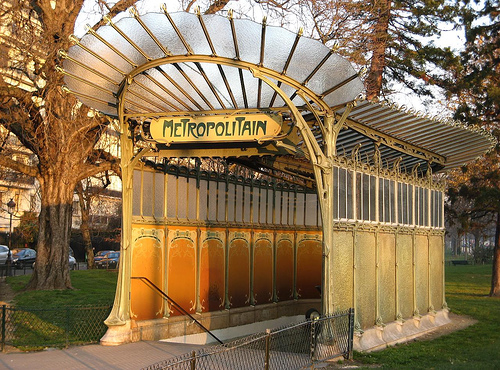
Welcome to Wednesday’s Blogger Round-up.  To start, Petite Paris gives tips on how to experience Paris on a budget, with a list of free things to do. Maggie LaCoste from Experience France by Bike then takes us from the D-Day beaches to Mont Saint Michel by bike while Mary Kay from Out and About in Paris takes us off the beaten track in Paris, first by bike and then by metro. Enjoy!

How to experience Paris on a Budget. Without compromising quality or quantity. And free!!!

by Petite Paris, an Australian-based service for Australian travellers and fellow Francophiles 
portedauphine1Here are our local tips and secrets on how to cut corners (and lines), avoid expensive tourist traps and overall save your precious Paris pennies with some smart, practical city advice.

TIP: sometimes a glass of red is more worthwhile than a coffee. 3-4euro per cup/glass.

a. Museum Madness

·       Free entrance to museums: On the first Sunday of each month for all major museums run by the City of Paris Includes: The Louvre; Musee moyen Age; Musee d’Orsay; Musee National Picasso; Musee Rodin; Musee Quai Branly and Centre Pompidou. Read more

Cycle Path From D-Day Beaches to Mont-Saint-Michel Open

by Maggie LaCoste from Experience France by Bike, an American who loves biking anywhere in Europe, but especially France, which has the perfect combination of safe bike routes, great food, great weather and history.

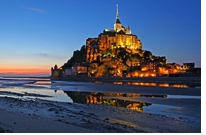
mont_saint_michelJust in time for the summer season, a new bicycling path has opened from the D-Day beaches to Mont Saint Michel.  On this route through Normandy, cyclists will have the opportunity to pass through the Regional Park of the Cotentin and the Bessin wetlands and test their athletic skills on the itinerary that runs through the Gorges of the Vire Valley.  The reward at the end of the route, the magnificent Mont-Saint-Michel. The complete itinerary is about 120 miles, passing through the beautiful medieval town of Bayeux and the Abbey of Juaye-Mondaye. Read more

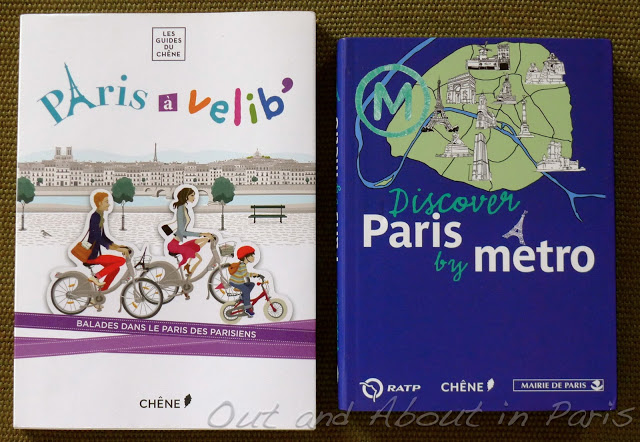
Two books that will take you off the beaten track: “Paris by Bike” and “Discover Paris by Metro”

by Mary Kay from Out and About in Paris, an American by birth, Swiss by marriage, resident of Paris with a Navigo Pass for the metro that she feels compelled to use

discover_paris_bike_metroI haven’t done a lot of cycling in Paris, mainly because I’m afraid of all the crazy drivers, but one of my best memories is of a magical afternoon when Joseph the Butler, Stéphane and I biked to the Bois de Boulogne for a picnic. Circling around the Lac Inférieur with a backpack full of cheese, foie gras, champagne and a baguette, we paused for a moment to watch a small boy diligently rowing his father across the placid lake and a family playing croquet on the shore. It felt as if we were a million miles away from the hustle and bustle of the city streets.

A Visit to Château de Chenonceau

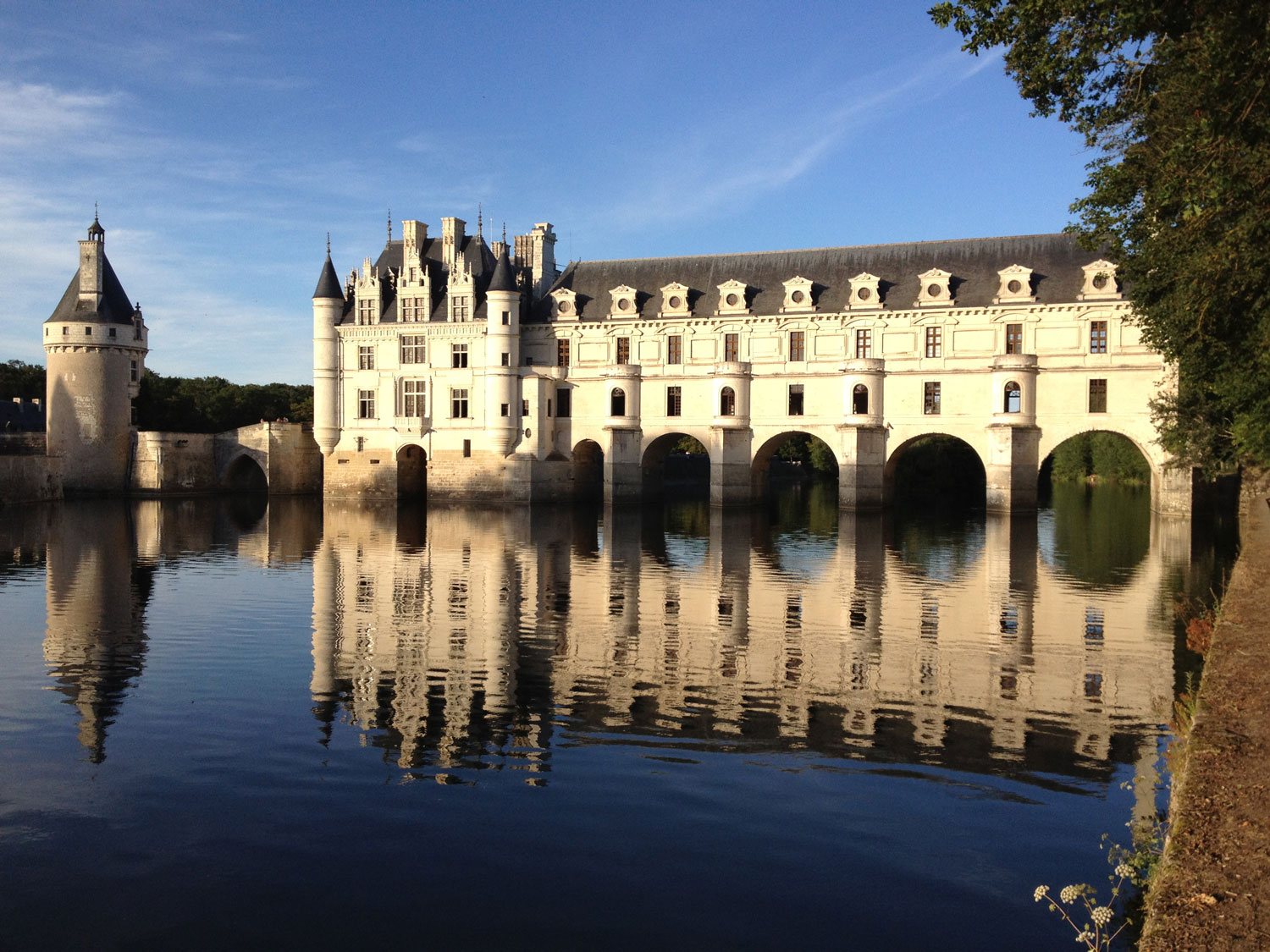
Château de Chenonceau has always been one of my favourites and is definitely among the top ten châteaux in the Loire. In recent years, we’ve cycled along the path on the opposite side several times and taken some wonderful photos of outside but we haven’t visited the interior for some years.

Chenonceau from the bike path opposite

The weather was supposed to be better but it turned out to be too cold to cycle (14°C) with occasional light showers, despite the fact that we’re already in the second half of May. So we decided to visit Chenonceau which is 40 minutes from Closerie Falaiseau.

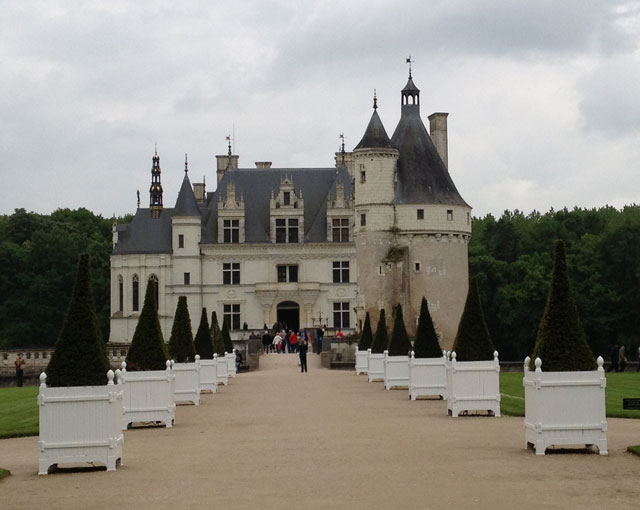
Front view of Chenonceau on a rainy day in May 2013

We were surprised to see the parking lot was quite full. There seemed to be a lot of older people milling around, no doubt with guided tours. There are automatic ticket machines though which meant we didn’t have to queue.

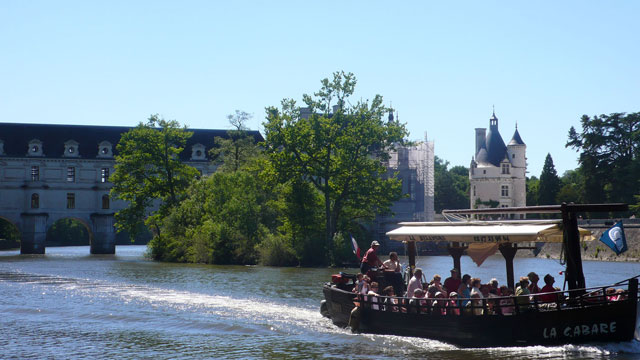
Tourist boat at Chenonceau in May 2012

Chenonceau is a ladies castle, as I’ve already mentioned in another post with photos of the outside of Chenonceau from the bike path. It was built in 1513 by Katherine Briçonnet, decorated by Diane de Poitiers some 30 years later, extended by Catherine de Médicis, used as a place of reclusion by Louise of Lorraine after the death of her husband Henri III, saved by Louise Dupin during the French Revolution, restored by Marguerite Pelouze in the mid-19th century and turned into a temporary hospital during WWI by Simone Menier. Whew!

60-metre gallery spanning the Cher River

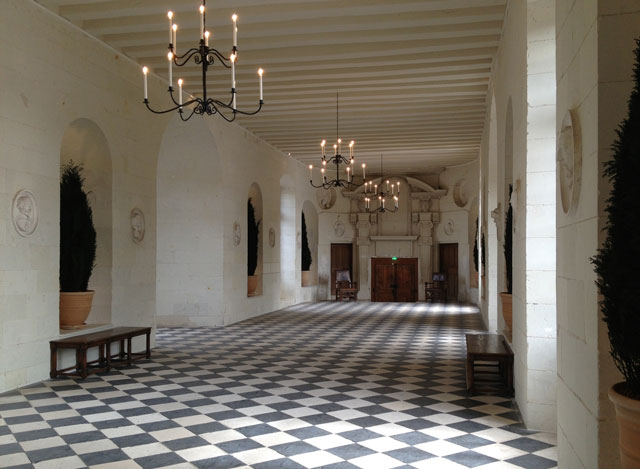
Its location on the Cher River is unique. The main gallery, 60 metres long, built by Catherine de Medicis, with its chequerboard slate-tiled floor and magnificent Renaissance fireplace at each end, spans the river, offering incredible vistas on both sides.

The keep and Catherine de Medicis' garden
The keep and Catherine de Medicis’ garden

The original keep is still standing, on the other side of the bridge from the château, and is covered with thick vines of trumpet creeper.

Diane de Poitier's garden
Diane de Poitier’s garden

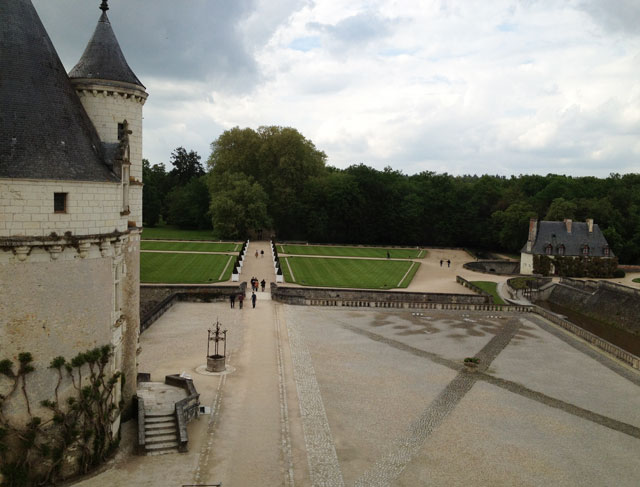
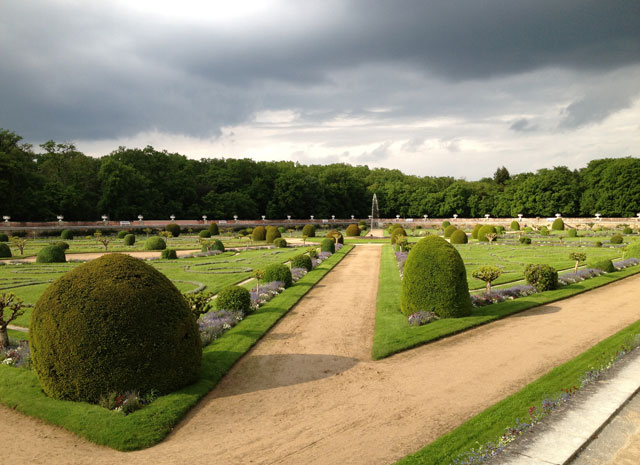
Diane de Poitier’s garden with its eight triangular lawns and climbing iceberg roses can be seen to the left of the château while Catherine de Medici’s more intimate garden, with only five lawns, is on the right. Both offer wonderful views of the château but the best, in my view, are still across the other side.

Carved and painted door with the arms of Thomas Bohier and Katherine Briçonnet

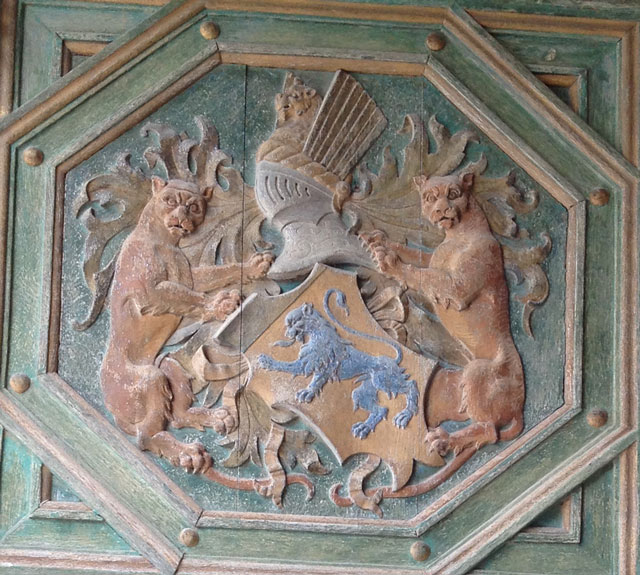
Each room is more sumptuous than the last, although little of the original furniture and furnishings remain, one notable exception being the beautiful painted,  sculpted wood door bearing the arms of the first owners, Thomas Bohier and Catherine Briçonnet.

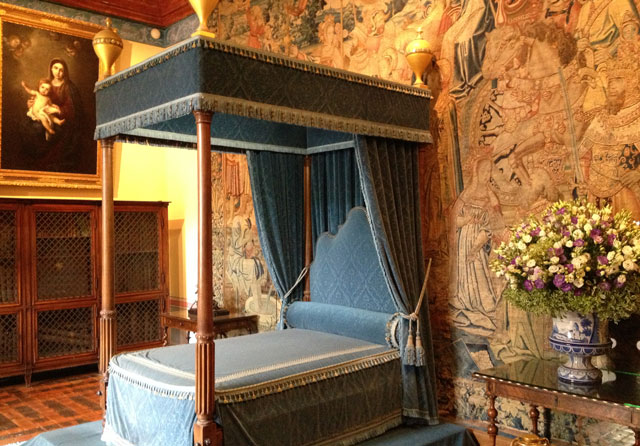
Diane de Poitier's Bedroom
Diane de Poitier’s Bedroom

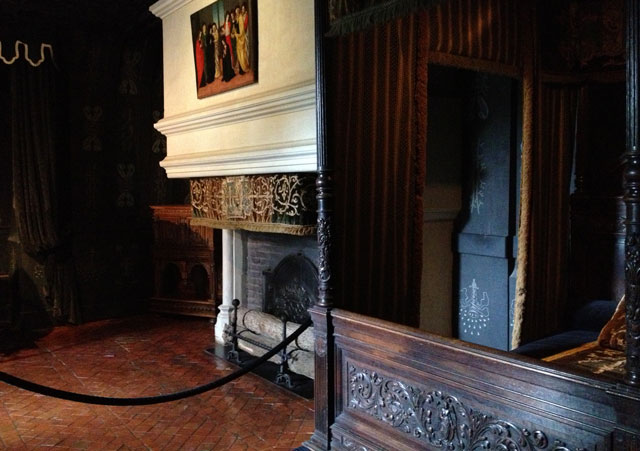
Diane de Poitier’s bedroom with its magnificent 4-poster bed was restored by Madame Pelouze. The fireplace is engraved with the initials of Henri II and Catherine de Medicis, H and C, which, when intertwined can form the D of Diane de Poitiers, Henri II’s favourite – and incidentally the mistress of his father, François I – to whom he gave the château which originally belonged to Catherine de Medicis.

Catherine de Medicis' Bedroom
Catherine de Medicis’ Bedroom

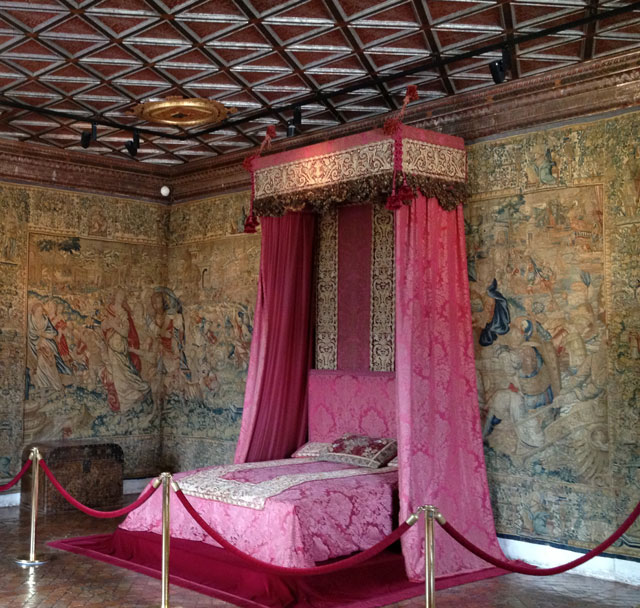
After his death, however, Catherine claimed it back, in exchange for Chaumont. Her bedroom has magnificently carved furniture and a rare set of Flanders Tapestries remarkable for their borders of animals symbolizing proverbs and fables. A painting by Correggio depicting The Education of Love, is one of the château’s many masterpieces, and my favourite.

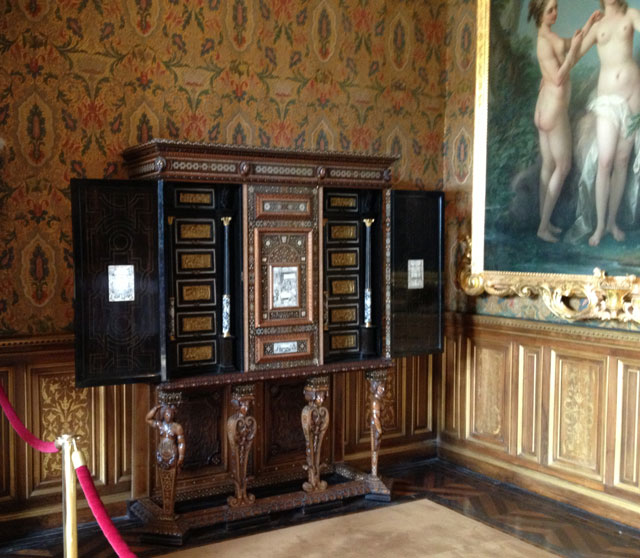
François I's drawing room
François I’s drawing room

In addition to an exceptional Renaissance fireplace and a remarkable 16th century Italian mother-of-pearl and ivory incrusted cabinet, François I’s drawing room has paintings by Van Dyck, Mancini, Ribera and Van Loo and a portrait of Diane the Huntress by Primaticcio.

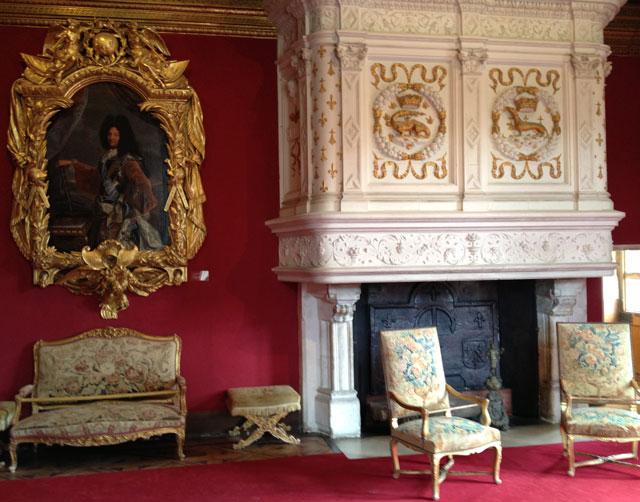
Louis XIV's drawing room
Louis XIV’s drawing room

The salamander and ermine, the emblems of François I and Queen Claude of France on the gold-embossed Renaissance fireplace in Louis XIV’s drawing room, almost pale in contrast with Rigaud’s portrait of the king its extraordinary gold frame. There is another collection of 17th and 18th century French paintings.

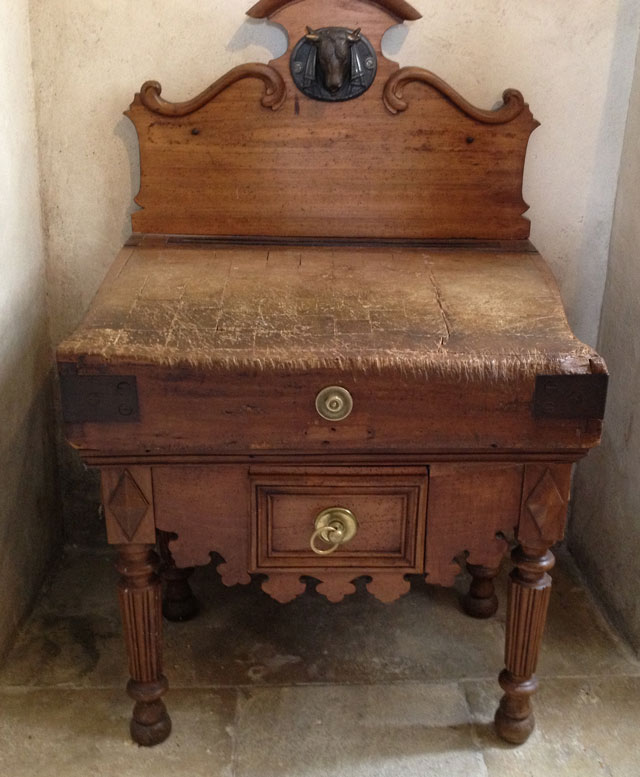
Beautifully carved butcher's block in the kitchens
Beautifully carved (and well-used) butcher’s block in the kitchens

The kitchens at Chenonceau, built in the bases of the piers under the gallery spanning the Cher, are quite remarkable and include a very elaborate butchery. The kitchens were modernised when the château was used as a hospital during WWI. Deliveries were made directly from boats on the river.

The White Queen's bedroom in which she mourned Henri III
The White Queen’s bedroom in which she mourned Henri III

The second floor contains the “gothic” bedroom of the “White Queen”, Louise of Lorraine, where, dressed in the royal mourning colour of white, she prayed and meditated after the assassination of her husband, Henri III.

The Five Queens' Bedroom with its beautiful ceiling
The Five Queens’ Bedroom with its beautiful ceiling

I haven’t described the equally sumptuous bedrooms of César of Vendrôme, Gabrielle d’Estrées and the Five Queens, or  the Green Study, the Library, Katherine Briçonnet’s Hall, the Exhibition Room and the Second Floor Hall, but all contain the same high quality furnishings, furniture and masterpieces.

View of château from the cafeteria at Chenonceau

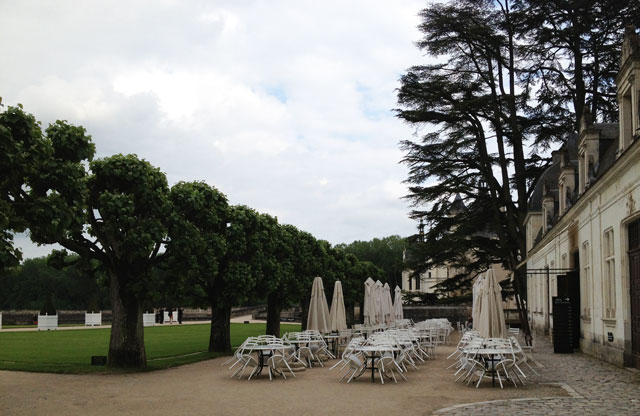
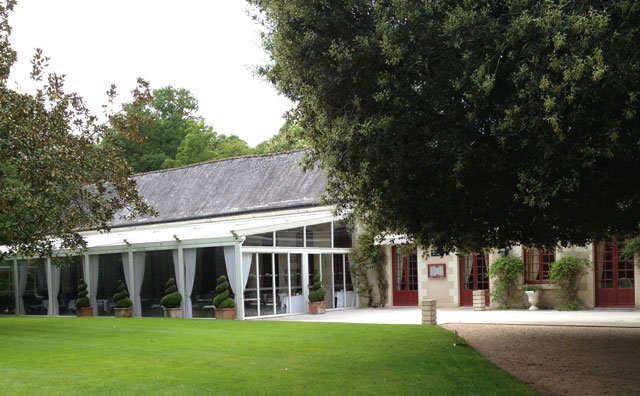
At about 5.30, when we finished visiting the interior, we had a coffee and a disappointing patisserie sitting outside the cafeteria looking toward the château. There were very few people by then, but given the very reasonable prices, I imagine it’s packed at lunchtime. There is also a gourmet restaurant in a beautiful setting (the former Orangery) on the other side of the building with a set menu of 29 euro. Unfortunately, we were too late for teatime (3 to 5 pm).

Orangery gourmet restaurant

We passed through the wine cellar, where tastings are 2 euro per person. We have a wonderful memory of drinking vintage chenonceau in the Orangery restaurant which we then bought from the cellar, but this time, they were only selling wines from 2010 and 2011 (8 and 10 euro a bottle).

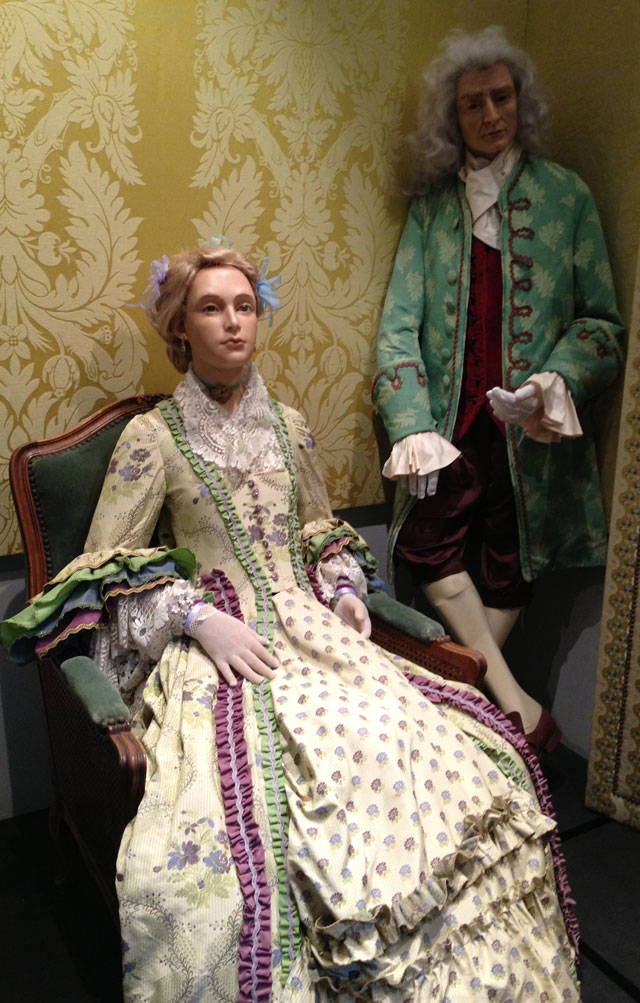
Diderot's salon at the Wax Museum
Diderot’s salon at the Wax Museum

Our visit to the wax museum was very disappointing, except for the costumes which are quite beautiful; the wax models are not of very good quality and don’t resemble the people portrayed. Given the number of foreign visitors, I thought the video at the beginning could have been offered in English as well.

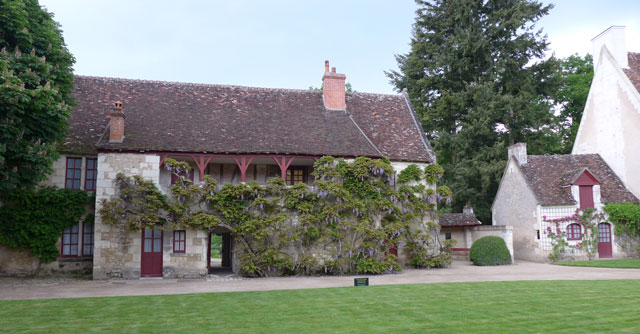
16th century farm at Chenonceau with wisteria and climbing roses in bloom

But the biggest surprise was the 16th century farm, including Catherine de Medici’s stables, which I had never seen before. At 7 pm, we were the only visitors. Wisteria, climbing roses and trumpet creepers grace several very charming little houses organised around a circular lawn.

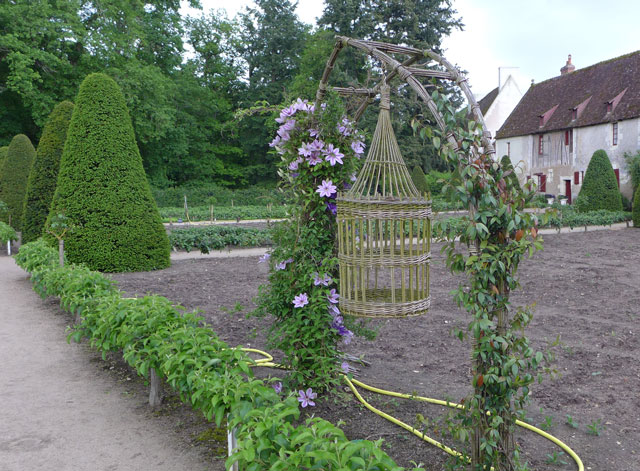
Flower & vegetable garden at Chenonceau with clematis in bloom

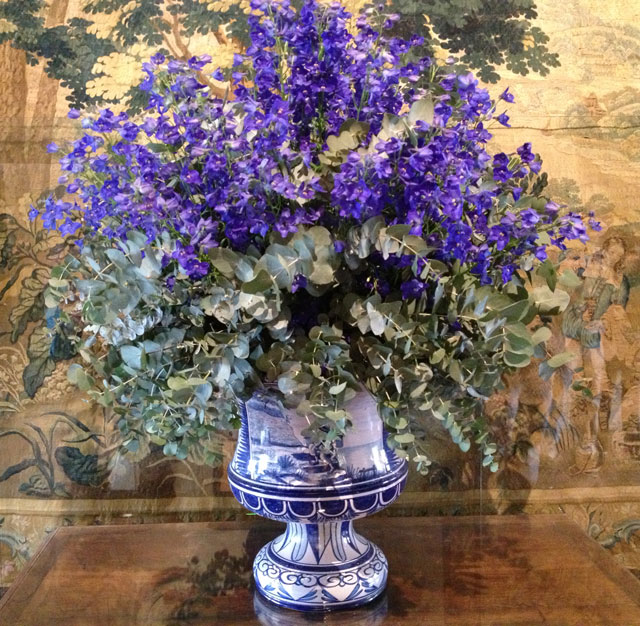
Behind the farm is the vegetable and flower garden which supplies the château’s superb floral arrangements, one in each room, which are worth a post of their own.

One of the many bouquets at Chenonceau

We didn’t see Catherine de Medici’s Italian maze as we ran out of time, but we’ll make sure we see it next time!

Open all year round, 9 or 9.30 am to 5 to 8 pm, depending on the season. 11 euros for the château and grounds, 13 euros including the wax museum, plus 2 euros for an audioguide.